Tepotzotlán, Mexico
30 memories from Tepotzotlán, Mexico
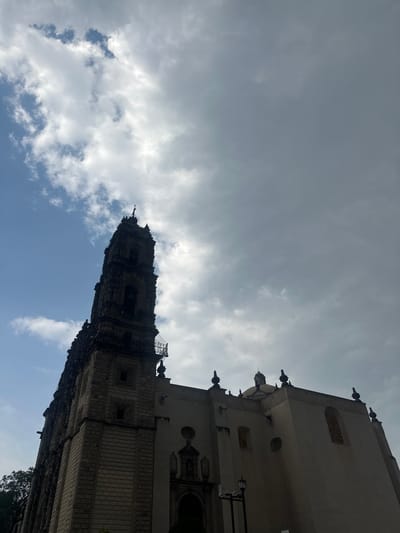
This media file captures a low-angle perspective of a magnificent historical building, likely a church or monastery, set against a dramatic sky. The building, consistent with the architectural style found in colonial Mexico, is ornate and heavily detailed, suggesting Baroque or Churrigueresque influences. A prominent bell tower, intricately carved and dark with age, dominates the central part of the building's visible structure. Decorative finials, round and arched windows, and elaborate stone patterns adorn the facade, which appears to be a light, weathered stone. Portions of a dome are also visible behind the main structure. The sky occupies a significant portion of the frame. It is a mix of overcast grey clouds, suggesting variable weather, and patches of bright blue sky, particularly towards the bottom and center, indicating breaks in the cloud cover. The lighting is natural, suggesting daytime, possibly late morning or afternoon, with diffused light due to the clouds. The scene depicts a static view of architecture, with no people or specific events taking place. The grandeur of the building implies a location of historical and cultural significance, aligning with the context of Tepotzotlán, Mexico, renowned for its colonial-era religious structures like the former Colegio de San Francisco Javier (now Museo Nacional del Virreinato). A minimal amount of dark tree foliage is visible at the very bottom right corner. There is no visible text in the image.
Tepotzotlán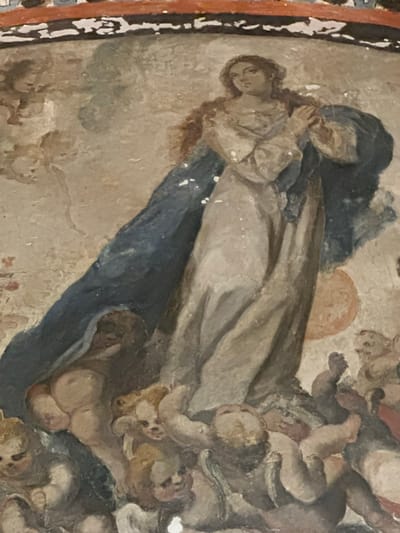
This media file captures a detail from an aged religious fresco or mural, likely dating from the Colonial era, in Tepotzotlán, Mexico. The artwork features a muted color palette dominated by earthy tones, ochres, browns, and deep blues, exhibiting visible signs of wear and cracking consistent with its age. The central focus is a light-skinned woman with dark hair, dressed in a light-colored garment, depicted in a devotional pose. Her hands are clasped in prayer, and her upward gaze conveys an expression of serenity or spiritual contemplation, suggesting a moment of grace, ascent, or heavenly vision. Behind and partially above her is another figure, heavily draped in a deep blue mantle, a color often associated with the Virgin Mary in Christian iconography. This figure's hands are also joined in a prayerful or supplicatory gesture, though their face is largely obscured. Surrounding these central figures, particularly on the right and lower right, are numerous cherubic figures (putti). These plump, childlike forms, characteristic of religious art, appear to be floating amidst clouds, reinforcing the ethereal and celestial setting. A faint, warm orange-yellow glow or halo is visible behind the upper portion of the composition, indicating a divine light source. The diagonal arrangement of the figures creates a sense of upward movement or elevation. The scene's iconography strongly suggests a religious narrative such as the Assumption of the Virgin Mary or the glorification of a female saint. No text is visible in the image.
Tepotzotlán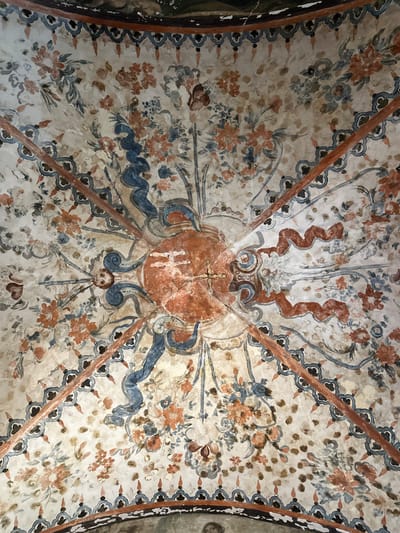
This image displays a richly decorated vaulted ceiling, likely a fresco, found within a historic building such as a church or chapel in Tepotzotlán, Mexico. The entire arched surface is covered in intricate painted motifs. At the very center of the ceiling, a prominent reddish-orange oval or shield-like emblem draws the eye. Within this emblem, the stylized Christogram "IHS" (Iesus Hominum Salvator – Jesus, Savior of Men) is clearly visible, surmounted by a small cross. This central religious symbol is surrounded by swirling blue and reddish-brown decorative ribbons and abstract patterns. Thin, dark reddish-brown diagonal bands radiate outwards from the center, delineating sections of the vault and creating a structural framing effect. The bulk of the ceiling is adorned with abundant stylized floral patterns and foliage. These flowers are rendered in muted tones of orange, blue, and gray, intertwined with green-gray leaves, forming a dense and organic tapestry across the light, aged cream background. Small, repeated decorative patterns, resembling scallops or stylized leaves, border some of the structural lines and sections. Directly below the central IHS motif, a small, pale face, characteristic of a cherub or putto, is subtly depicted, appearing to gaze downwards from the celestial composition. The frescoes exhibit a decorative style reminiscent of colonial Mexican art, likely influenced by Baroque or Rococo aesthetics, yet with a distinct folk-art quality in its execution. The paint appears somewhat faded and aged, showing the texture of the underlying plaster, which contributes to its historical authenticity. No activity is taking place; the image is a static portrayal of architectural and religious artwork.
Tepotzotlán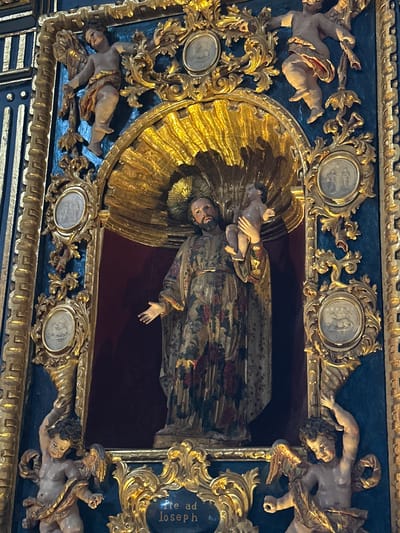
This media file showcases a highly ornate religious artwork, likely a section of an altarpiece or a large niche decoration, from Tepotzotlán, Mexico. The central subject is a statue of Saint Joseph, depicted with a beard and wearing a richly patterned robe adorned with floral motifs in red, green, and gold. He cradles the Christ Child in his arms. Behind Saint Joseph's head is a prominent, golden, rayed halo or mandorla, and the figures are set within a deep red recess. The central scene is surrounded by an elaborate, multi-layered frame. The immediate border is gold, featuring intricate rococo-style scrollwork and foliage. Beyond this, on a dark blue background, are numerous sculpted putti (cherubic figures) in various dynamic poses, some with wings, integrated into the golden decorative elements. Several oval and circular medallions are also embedded within the golden scrollwork, each containing faint bas-relief imagery, possibly depicting saints or biblical scenes. On the right side of the frame, within a golden cartouche, the Latin text "te ad Joseph" is visible, likely part of the phrase "Ite ad Joseph" (Go to Joseph). The artwork is characterized by its opulent use of gold, detailed carving, and vibrant colors, typical of Baroque or Churrigueresque style. The lighting suggests an indoor setting, and no specific activity beyond the static portrayal of the religious figures is occurring. The photograph is taken from a low angle, looking upwards at the artwork.
Tepotzotlán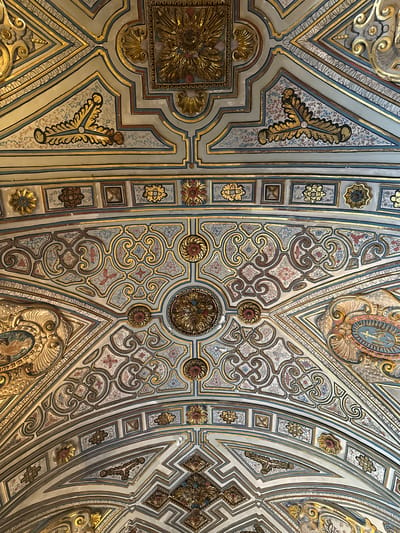
An upward-facing perspective reveals a segment of an exceptionally ornate, gilded, and painted ceiling, characteristic of Baroque or Churrigueresque style. The ceiling is a complex tapestry of geometric patterns, curvilinear shapes, and detailed motifs, dominated by an extensive use of gold leaf that outlines various panels and highlights raised architectural features. The central part of the image showcases intricate painted patterns, including floral designs and delicate scrollwork in muted shades of blue, red, and brown against a light cream or off-white background. These painted sections are interspersed with gilded borders and elaborate three-dimensional elements, such as decorative medallions with central floral or starburst designs, some appearing carved or molded in relief. Larger, more complex gilded reliefs with abstract or symbolic designs are also visible in different sections, contributing to the rich texture and depth of the ceiling. The overall design features a repeating sequence of square and rectangular panels, often containing smaller, stylized floral emblems. The setting is clearly an indoor space, likely a grand hall or, given the context of Tepotzotlán, Mexico, the ceiling of a colonial-era church or religious building, such as the Museo Nacional del Virreinato. No activity or event is taking place in the image, as it captures a static architectural detail. There is no visible text. The intricate craftsmanship, vibrant use of gold, and detailed artistry suggest a significant historical and cultural landmark.
Tepotzotlán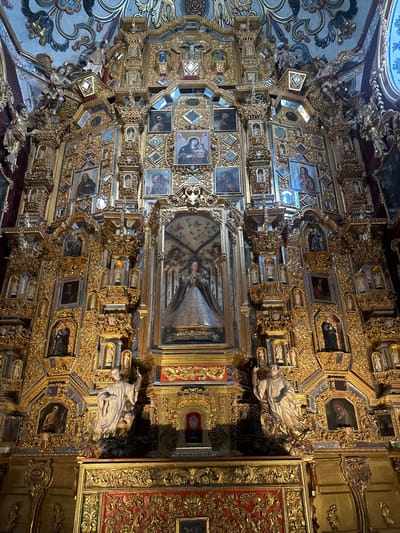
This image captures the highly ornate and gilded interior of a Baroque or Churrigueresque religious building in Tepotzotlán, Mexico. The scene is dominated by an overwhelming display of gold leaf, intricate carvings, and numerous religious artworks. The walls and possibly part of the ceiling are densely covered with a lavish framework of gold, featuring elaborate scrolling motifs, foliage, and architectural elements. Embedded within this golden matrix are a multitude of small, framed paintings. These paintings depict various religious subjects, including portraits of saints, figures of Christ, and the Madonna and Child. Many of these artworks are set within rectangular, octagonal, or diamond-shaped frames. Several small, sculpted figures, likely saints or angels, are also integrated into the golden decoration, often appearing within niches or as part of larger ornamental structures. The inclusion of multiple small mirrors within the gilded elements adds to the dazzling effect, reflecting light and enhancing the opulence. A large, central painting is a focal point, featuring multiple figures, possibly depicting the Virgin Mary with Jesus and surrounding angels, all framed by an exceptionally detailed golden border. On the far right, a section of a dark red panel adorned with intricate gold patterns suggests further rich decoration. In the upper left corner, a portion of a ceiling or upper wall with a fresco in shades of blue and white provides a contrast to the prevailing gold. The image presents a static view of this intensely decorated space, highlighting the architectural and artistic grandeur rather than any ongoing activity. The sheer volume of gold, the intricate craftsmanship, and the religious iconography evoke an atmosphere of profound reverence and splendor. No discernible text is visible in the image.
Tepotzotlán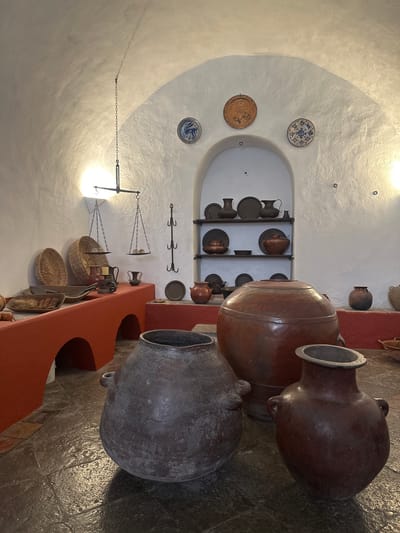
This image captures the interior of a traditional space, likely a historical kitchen or storage area, in Tepotzotlán, Mexico. The scene features a rich collection of antique pottery and household artifacts, displayed against textured white, arched walls and a vaulted ceiling. In the foreground and to the right, several large, traditional clay pots are prominently featured. Two are reddish-brown, appearing well-maintained, one with a distinctive lid. A third, darker gray pot exhibits a more weathered, matte texture. These substantial vessels rest on a dark, uneven floor and alongside a reddish-orange, low-set counter or shelf. The white wall in the background incorporates an arched niche, housing wooden shelves that display an array of smaller, dark-colored clay pots, pitchers, and plates. Decorative ceramic plates, adorned with blue and brown patterns, are mounted on the flat wall surfaces, adding splashes of color. To the left, a traditional hanging balance scale, with chains suspending two woven baskets, evokes a sense of historical daily life. Nearby, a wrought iron rack with multiple hooks is also visible. The space is illuminated by artificial light, casting soft shadows that emphasize the texture of the white stucco walls and the graceful arch of the ceiling. The overall impression is one of cultural preservation, showcasing traditional Mexican craftsmanship and rustic aesthetics. No people are present, and no text is visible in the frame.
Tepotzotlán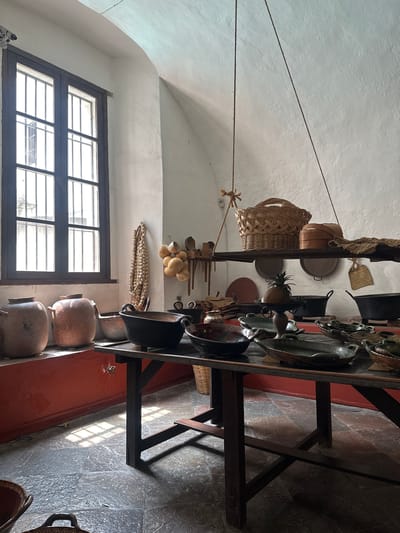
A wide-angle, low-angle shot captures the interior of what appears to be a traditional kitchen or a historical exhibit of culinary implements, likely located in Tepotzotlán, Mexico. The scene is dominated by a long, dark wooden table or shelving unit that runs horizontally across the image, laden with an array of earthenware and metal cooking vessels. On the table, numerous pots and pans of varying sizes, some dark metallic and others reddish-brown clay, are meticulously arranged. Decorative, elongated ceramic or metal plates with intricate patterns are prominently displayed, leaning against the back of the shelf. A small, spiky pineapple-like plant sits amidst the cookware. Above and to the left of the table, several woven wicker baskets are suspended or placed on a higher shelf, along with smaller flat pans. Hanging from the white vaulted ceiling, two thin ropes stretch across the frame. Further along the ceiling, near a corner, strings of dried garlic bulbs and possibly dried gourds are hung, suggesting a traditional kitchen environment. To the left, a large, dark-framed window with multiple rectangular panes allows ample natural light to flood the room, casting strong shadows from the table structure onto the light-colored, patterned stone or tiled floor. A section of the far wall is painted a distinct reddish-orange. No people or overt activities are depicted, giving the scene a still-life quality, showcasing the rich cultural heritage of traditional Mexican culinary arts. No text is visible. The time of day appears to be bright daylight.
Tepotzotlán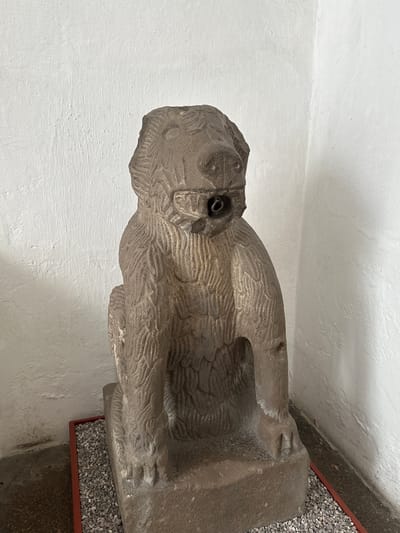
A stone sculpture, possibly depicting a stylized creature or animal, stands vertically in an indoor setting. The sculpture is made of a grayish, textured stone with intricate carvings, particularly visible on its body, which suggest scales, feathers, or fur. The head features a distinct, deep-set eye socket containing a dark, circular object, possibly metal. The creature appears to be seated or standing on a simple, robust base. Beneath part of the sculpture, a rectangular tray filled with small grey pebbles is visible, forming part of its display arrangement. The background consists of a plain, light-colored (white or off-white) wall, likely plastered, showing some texture. The lighting is even, typical of an indoor environment with artificial or diffused natural light. The overall scene suggests an exhibition or museum display, consistent with its context in Tepotzotlán, Mexico. No activity is occurring, and no text is visible in the image.
Tepotzotlán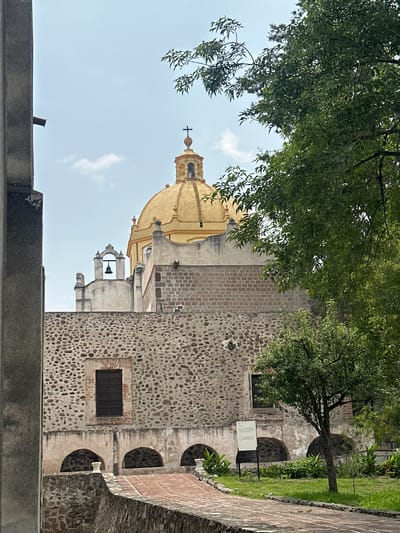
The image captures a historical architectural complex, likely a church or monastery, set amidst lush natural surroundings under a clear daytime sky. The central feature is a building with a prominent, golden-yellow dome topped with a cross, visible against a light blue sky with a few faint clouds. Below the main dome, a smaller bell tower is visible, housing a dark bell. The building's walls display varied construction materials. The lower right section is composed of rough-hewn, light-colored stones, giving it a rustic, textured appearance. This section includes several arched alcoves or openings and a small, gridded window. Adjacent to this, a wall section made of neatly laid reddish-brown bricks suggests either a different construction phase or architectural style. Dense green foliage from large trees frames the upper and left parts of the image, indicating a well-treed environment. In the foreground and to the right, a paved path or low stone wall borders a patch of green grass with further shrubs and a small tree. A dark, rectangular sign with white, mostly illegible text, likely an informational plaque, stands near the base of the stone wall on the right. No people are present, lending a serene and tranquil atmosphere to the scene. The bright, even lighting suggests it is daytime, likely morning or early afternoon. The architectural style, with its dome and bell tower, is characteristic of colonial-era religious buildings found in Mexico, fitting the context of Tepotzotlán.
Tepotzotlán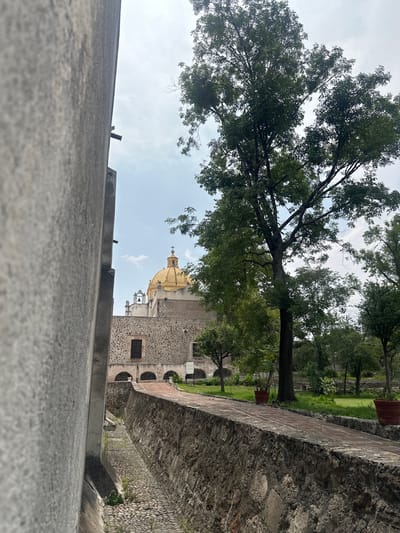
The image captures an outdoor scene in Tepotzotlán, Mexico, featuring historical architecture and natural elements under a bright, partly cloudy sky. The perspective is low, looking over a textured, grey concrete or stone ledge that occupies the bottom portion of the frame. In the midground, a substantial stone wall with a brick top runs horizontally, separating the foreground from a lush green area. Beyond this wall, a paved pathway is visible, leading to a garden or courtyard with several trees and grassy patches. The dominant feature in the left half of the image is a large, leafy tree with dark green foliage, its branches extending towards the sky. Through the trees and above the midground wall, a prominent stone building with a striking golden dome and a bell tower is visible. The building's walls appear to be constructed from dark, rough-hewn stone, suggesting historical significance. The golden dome, with a cross at its apex, gleams brightly, indicating the building is likely a church or a cathedral, possibly part of the Museo Nacional del Virreinato. Arched openings are discernible on the side of the building. The scene appears peaceful and devoid of any human activity. The time of day is daytime, with soft, ambient lighting suggesting either late morning or early afternoon. No visible text is present in the image.
Tepotzotlán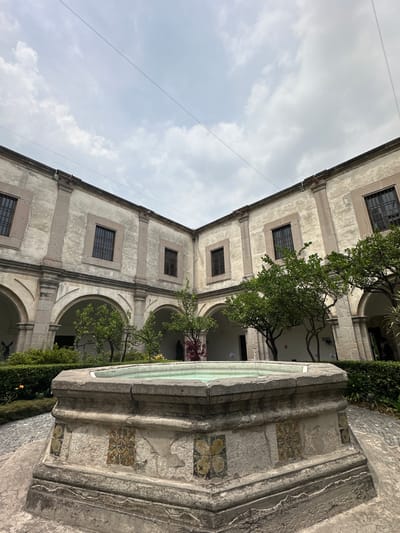
The image depicts a tranquil outdoor courtyard of a historical building, likely in Tepotzotlán, Mexico, under an overcast or partly cloudy sky during daytime. The primary subject is a multi-story structure with a weathered, light-colored stone facade accented by darker stone around rectangular windows and arched porticos. Each floor features multiple barred windows, and below them, open arches lead to covered pathways. Within the courtyard, vibrant green trees with visible branches grow, their foliage providing a natural contrast against the aged stone architecture. In the foreground, positioned to the right, stands a substantial stone structure, possibly a fountain or a large planter. This structure is adorned with colorful ceramic tiles featuring intricate geometric and floral patterns, adding a decorative element to the robust stone. The tiled patterns are visible on the side and near the basin of the structure. The scene conveys a sense of historical grandeur and peacefulness. No human activity or visible text is present. Thin lines or wires are subtly discernible against the light grey sky in the upper portion of the image. The overall impression is one of architectural beauty and natural integration within a historic setting.
Tepotzotlán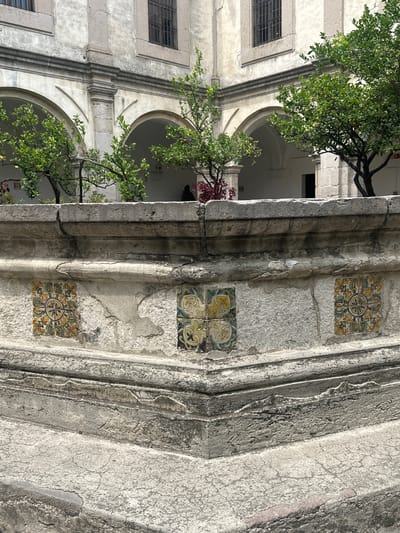
The image presents a sunlit view of an aged stone structure adorned with decorative tiles, overlooking a verdant courtyard and colonial-era architecture. In the foreground, a substantial stone wall or pillar occupies the right side, exhibiting a weathered, textured surface with visible cracks and imperfections. Embedded into this stone are several square azulejo tiles, featuring intricate, symmetrical patterns in shades of blue, yellow, green, and brown, depicting floral or geometric designs. To the left and in the mid-ground, vibrant green trees with small, dense leaves and possibly small fruits (resembling citrus) grow abundantly, their branches extending across the frame and partially obscuring the background. In the background, a light-colored architectural complex unfolds, characterized by a series of graceful arches that suggest a cloister, corridor, or an enclosed courtyard. Above these arches, windows fitted with dark grates are visible. A small amount of reddish-purple foliage is also present further in the background. The scene is illuminated by natural daylight, creating clear shadows and highlights that emphasize the textures of the stone and foliage, indicating a bright, clear day. The architectural style, notably the arches and azulejos, is characteristic of colonial buildings, aligning with the context of Tepotzotlán, Mexico. There are no people or specific events depicted, and no visible text. The image evokes a sense of historical serenity and architectural grandeur integrated with natural elements.
Tepotzotlán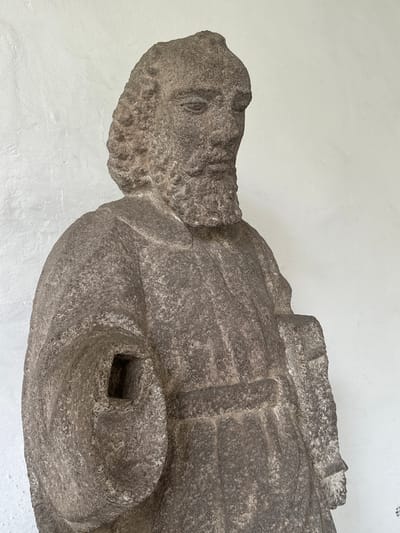
The media file presents a close-up, rotated view of a weathered stone sculpture, likely an effigy, set against a plain, light-colored textured wall. The sculpture is crafted from a coarse, dark grey stone, exhibiting significant erosion and granular texture from age. The visible portion primarily focuses on the upper body and head of what appears to be a male figure. The head, positioned on the left side of the frame, features a discernible, albeit eroded, face with a carved eye, nose, mouth, and a prominent, textured beard. The body, extending to the right, shows indications of draped clothing or possibly armor, with distinct folds and geometric carvings, including some rectangular shapes. A notable detail on the sculpture's torso is a prominent square-shaped hole or indentation, surrounded by a swirling or circular depression. This feature suggests it might have once held an inlay, a missing element, or perhaps represents a symbolic carving. The lighting is soft and even, suggesting an indoor display or shaded outdoor environment. No activity is taking place, and no text is visible in the image. The location is Tepotzotlán, Mexico.
Tepotzotlán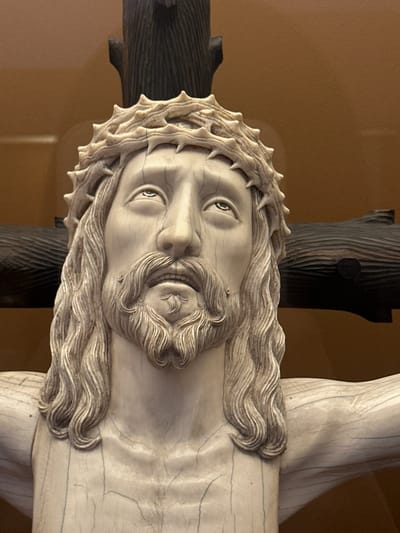
A close-up, horizontally oriented photograph captures a meticulously carved sculpture of Jesus Christ on the cross, originating from Tepotzotlán, Mexico. The sculpture is crafted from a pale, smooth material, likely ivory or aged bone, displaying fine lines and subtle cracks consistent with its age. Jesus's face is depicted with profound solemnity, featuring open eyes gazing slightly upwards, a finely sculpted beard, and long, flowing wavy hair intricately rendered. A prominent crown of sharp thorns encircles his head, with each thorn distinctly carved. The cross to which the figure is affixed is made of a dark, textured wood, exhibiting distinct vertical grain patterns. The sculpture is presented against a plain, warm brown background, suggesting an indoor setting such as a museum, church, or gallery. The lighting subtly illuminates the sculpture, emphasizing its intricate details and contours while casting soft shadows that add depth to the figure. No activity is taking place, as the image presents a static, reverent representation of the crucifixion. There is no visible text in the image.
Tepotzotlán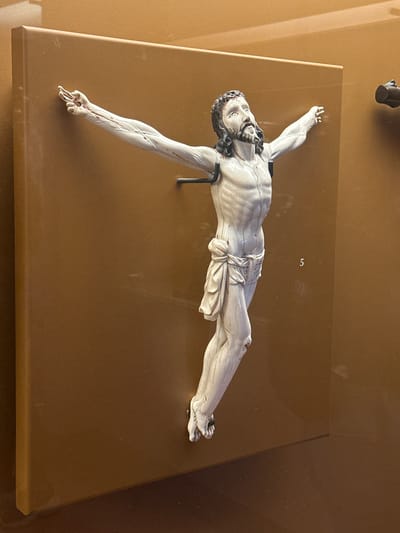
An ivory or similar material sculpture of the crucified Christ (corpus) is displayed within a glass case, resting on a flat, light-brown pedestal. The figure is depicted with outstretched arms and crossed legs, embodying a serene yet pained expression, looking slightly upwards. The sculpture is highly detailed, showing prominent muscle definition, veins, and subtle hints of reddish coloration around the hands, feet, and possibly the forehead, suggesting wounds. The hair and beard are darker, providing contrast to the light body. A dark, metal support structure is visible beneath the torso, holding the figure in position. The setting appears to be a museum or gallery, with a warm, solid brown background behind the display. Reflections on the glass case are noticeable, including a faint, dark, cylindrical object in the upper left corner of the original image, likely part of the surrounding environment or lighting. A light-colored number "5" is visible on the brown background wall of the display case, possibly an exhibit or inventory number. The overall ambiance is solemn and reverential, fitting for a religious artifact. The location context indicates this piece is in Tepotzotlán, Mexico, suggesting it could be a significant historical or religious artwork from the region or an imported piece housed there.
Tepotzotlán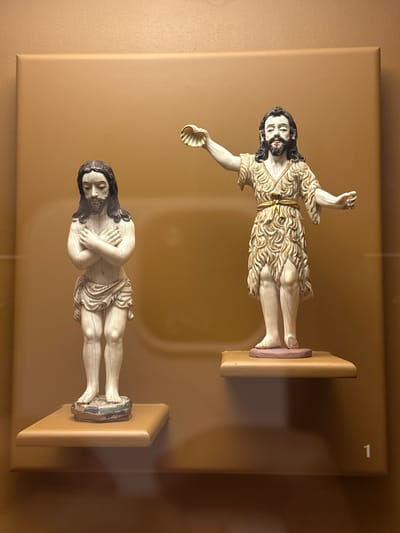
The image displays two intricately carved religious statues, likely from a museum or exhibition in Tepotzotlán, Mexico. Both figures are male with long, dark hair and beards, and are presented against a plain, light brown background, possibly behind a glass barrier given the faint reflections. The upper statue depicts a figure standing upright, with his right arm raised and his left hand holding a shell. He wears an off-white, textured garment, possibly resembling animal skin or fur, with golden accents around the waist and collar. This figure's iconography, particularly the shell, suggests a depiction of Saint John the Baptist. His feet are placed on a reddish-purple element set on a small, light-brown rectangular base. The lower statue portrays a figure lying in repose or deceased, with his eyes closed and hands crossed over his chest. He is partially draped in an off-white garment with some gold detailing. Visible on his bare chest and legs are delicate carved lines, possibly anatomical or representing wounds. This figure could represent the Dead Christ or a recumbent saint. His feet rest on a blue-grey element atop a similar small, light-brown rectangular base. The statues exhibit fine detail in their carving, particularly in the hair, beards, and garments. A white numeral "1" is visible in the top right corner of the background, possibly an exhibit number. The overall display is simple, focusing attention on the figures themselves.
Tepotzotlán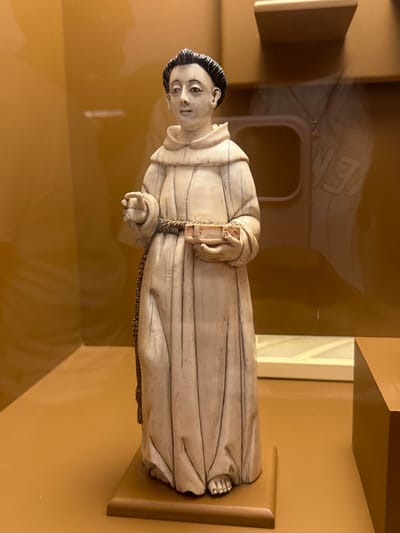
A finely carved statue of a male religious figure, likely a friar or monk, is presented in the image. The figure, possibly made of ivory, alabaster, or light-colored wood, is dressed in a flowing, cream-colored habit with detailed folds, secured at the waist by a dark, textured rope. His hair is dark and neatly styled, providing a strong contrast to his pale skin. The figure’s face conveys a serene and contemplative expression. He holds a small, rectangular book in his left hand, while his right hand is open with the palm facing upwards, possibly in a gesture of teaching or receiving. The statue is displayed in an indoor setting, likely a museum or gallery, against a warm, ochre-colored background. Prominent reflections on a clear, protective surface (such as glass or acrylic) cover the foreground, showing abstract shapes and faint, indistinct letters like "EN" or "MEN" from the surrounding environment. The lighting is soft, creating subtle shadows that enhance the depth and detail of the sculpture. The overall scene suggests a historical or religious artifact, consistent with a display at a museum in Tepotzotlán, Mexico. There are no overt activities taking place, as it is a static display of an artwork.
Tepotzotlán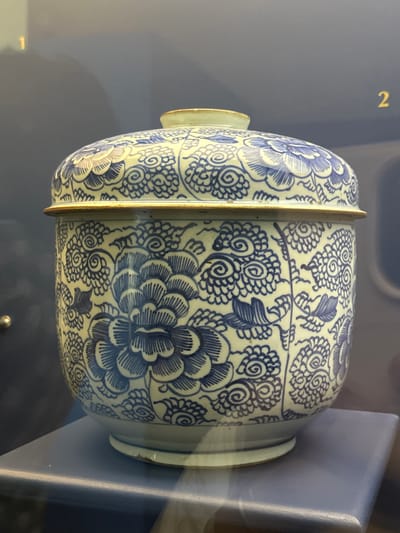
A blue and white ceramic jar, likely made of porcelain, is displayed in a museum or exhibition setting. The jar is horizontally oriented and features intricate underglaze cobalt blue floral decorations against a light, possibly white or cream-colored, background. The patterns include large, detailed peony-like blossoms, smaller swirling chrysanthemum-like motifs, and delicate foliate designs. A distinct, narrow band with a metallic or golden sheen runs horizontally around the middle of the jar, suggesting it might be a lidded vessel or constructed in sections. The object is seen against a muted blue-grey background, which appears to be a display case or wall. In the upper left background, a golden number "2" is visible, likely serving as an exhibition label. The lighting suggests an indoor environment. This artifact is located in Tepotzotlán, Mexico.
Tepotzotlán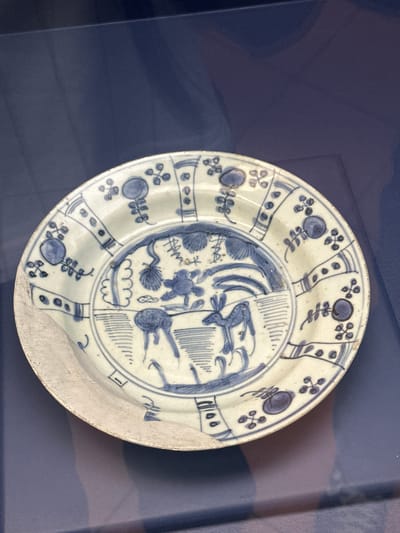
The image features an antique, circular ceramic plate, predominantly white with intricate blue hand-painted designs, displayed against a uniform dark blue background. The plate is slightly angled and shows clear signs of age, including a significant chip on its bottom right edge, exposing the unglazed material beneath the glaze. The decoration is divided into a central medallion and a wide border. The central area contains abstract and stylized motifs, including what appears to be aquatic elements like fish or sea creatures, as well as plant-like forms and wave patterns. This central design is segmented, with one section featuring more linear patterns and the other depicting organic shapes. The broad rim of the plate is adorned with a series of alternating decorative panels and circular motifs. These panels contain various patterns such as vertical lines, dots, and stylized floral or leaf designs resembling four-leaf clovers. The blue pigment varies in intensity, characteristic of hand-painted ceramics. The setting, with its dark, plain background and focused lighting, suggests the plate is an exhibit, likely in a museum or private collection, possibly within a display case. There is no visible text on the plate or in the background. The artifact's context is in Tepotzotlán, Mexico, indicating its location.
Tepotzotlán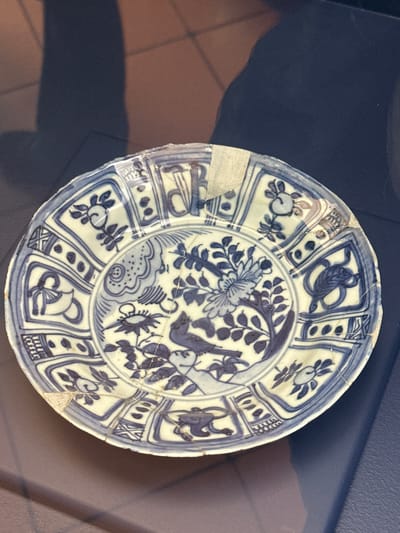
An antique, round ceramic plate, predominantly white with intricate cobalt blue designs, is depicted against a dark, reflective background. The plate shows significant signs of age and wear, including numerous fine cracks radiating across its surface and several larger chips and missing fragments along its rim, some of which appear to have been repaired with lighter material. The central motif of the plate features two birds perched among detailed flowering branches and foliage. One bird is depicted looking upwards, while the other faces downwards. Surrounding this central design, the plate's border is divided into multiple rectangular or semicircular panels. Each panel contains a distinct, stylized blue motif, often alternating between floral or leaf patterns and more abstract or geometric elements, such as dots in a row or cross-hatching. The blue pigment varies in intensity, creating depth in the artwork. The plate appears to be displayed in an indoor setting, possibly a museum exhibit or a private collection, given the dark background and subtle reflections that suggest a display case or a polished dark surface. The lighting highlights the plate's textures and crack lines. The item's condition and artistic style suggest it is a historical artifact. No human activity is visible, nor is any text present on the plate or in the background. The location context indicates it is found in Tepotzotlán, Mexico.
Tepotzotlán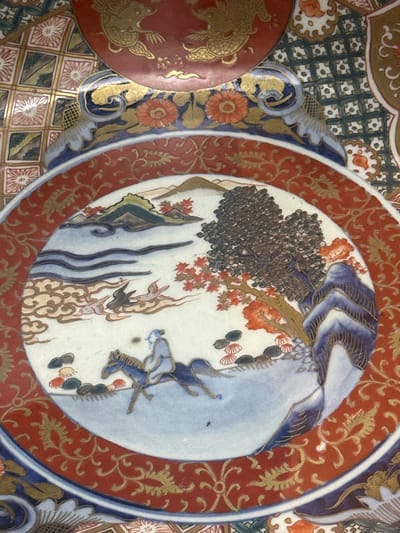
This image provides a detailed close-up of an ornate ceramic dish, indicative of Japanese Imari or Arita porcelain. The central circular medallion features a vibrant, dynamic scene. Two human figures, dressed in blue and white robes, are visible; one appears to be flying or descending, while the other is partially obscured. A prominent cluster of dark, stippled shapes, resembling grapes or berries, hangs from a branch adorned with small red leaves. Stylized waves or smoke patterns and delicate butterfly-like motifs complete the natural elements in the central scene. Surrounding the medallion is a wide, dark red band intricately decorated with gold floral and foliate scrollwork. This band is bordered by a deep blue ring, followed by another band featuring gold, red, and blue floral patterns. The outermost visible section of the dish displays a checkered grid of squares, alternating between green and a lighter tone, each containing a stylized, radiating flower. To the far left, a portion of another, smaller red dish with gold patterns, possibly depicting dragons or mythical creatures, is visible. The activity within the central medallion suggests a narrative or symbolic event, with figures interacting harmoniously with nature. Notable details include the rich color palette, dominated by deep reds, blues, and gold, accented with greens and white. The intricate patterns, meticulous brushwork, and the glossy finish highlight the sophisticated craftsmanship. There is no visible text on the artifact. The image focuses exclusively on the decorative elements, without revealing the broader setting.
Tepotzotlán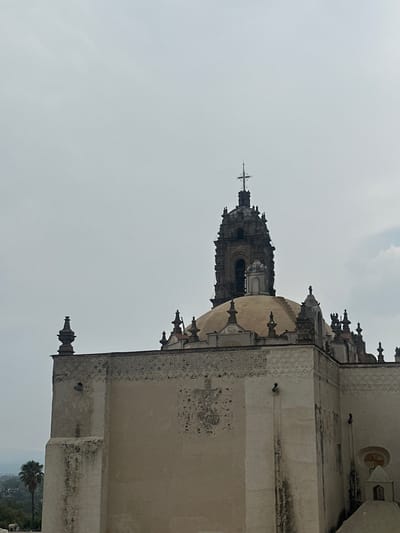
A photograph captures a grand, light-colored historical building, likely a church or monastery, set against an overcast sky in Tepotzotlán, Mexico. The main structure, constructed of aged stone or stucco, features intricate architectural details, including decorative friezes and finials along its cornices. A prominent domed section is visible, with ornate carvings at its base. Behind this, a tall, elaborately decorated bell tower rises, topped with a cross. The tower displays multiple tiers and arched openings, characteristic of colonial Spanish architecture. The sky is a uniform, soft grey, indicating an overcast day. Details on the building's facade include what appear to be drainpipes or similar fixtures and a small, circular window. In the lower right corner, a palm tree and distant foliage suggest a broader landscape setting beyond the immediate structure. No people are visible, and no specific activity is taking place; the image is a static architectural study. There is no visible text.
Tepotzotlán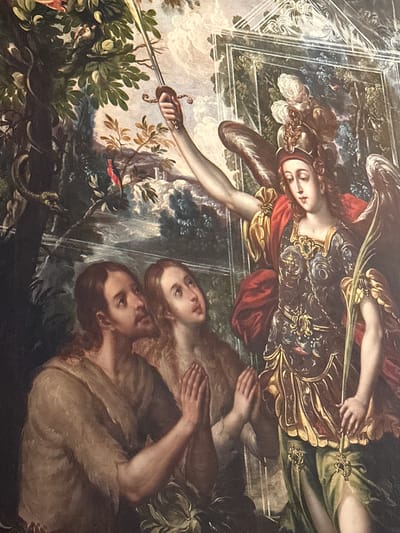
This painting depicts the biblical scene of the Expulsion from the Garden of Eden. On the left, a majestic angel, likely Archangel Michael, is shown in flight or descending. The angel wears ornate golden armor over a red tunic and green drapery, with large, feathery wings extending behind. A sword with a decorative hilt is held in the angel's right hand, pointed downwards towards the figures below, indicating their expulsion. The angel's face shows a solemn, determined, yet possibly sorrowful expression. To the right, huddling together in distress, are two nude figures, a man and a woman, representing Adam and Eve. They embrace tightly, with the man's arm around the woman and his hand covering her breast, conveying shame and sorrow. Both look upwards at the angel with expressions of fear and despair. The man has a beard and long dark hair, while the woman also has long, flowing hair. The setting is a dense, lush garden filled with rich green foliage, trees, and scattered colorful birds. In the lower right, coiled on the ground near Adam and Eve, is a dark snake with its mouth slightly ajar, symbolizing its role in the temptation. The background includes glimpses of a brighter, cloud-filled sky and distant natural elements. The painting features a dramatic, detailed style, characteristic of Baroque artistry. There is no visible text in the image. This artwork is located in Tepotzotlán, Mexico.
Tepotzotlán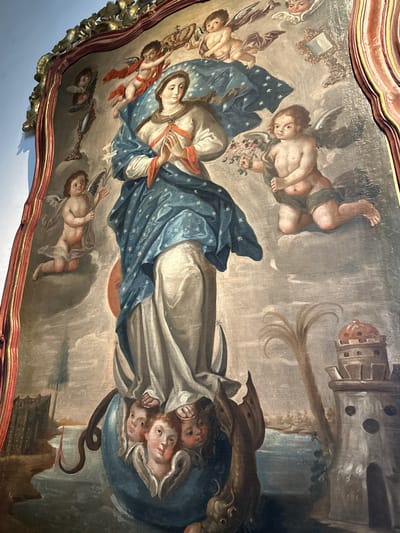
This media file captures a detailed religious painting, likely a ceiling fresco or large canvas, within an ornate, gilded frame. The central subject is a female figure, presumably the Virgin Mary, depicted in a celestial setting. She wears a white gown and a flowing blue mantle adorned with white stars, and has a serene expression. Her hands are clasped or holding a small object near her chest. She appears to be standing on a crescent moon or a stylized globe. Numerous winged putti (cherubs or small angels) surround her. One cherub, positioned above her head, holds a crown. Others are depicted in various poses of adoration or activity, some holding floral bouquets, and one near the bottom left holds a mirror. Below the central figure, a cluster of heads emerges from a cloud-like mass, some looking upwards. Beneath this, a dark serpent is visible, being subdued or crushed, a common symbol associated with the Immaculate Conception. The painting features a rich, yet aged, color palette dominated by blues, whites, and earthy tones, indicative of Baroque or Colonial art styles. The brushwork suggests a detailed and dramatic composition. In the upper right corner, a structure resembling a fortified building or castle with a dome-like top can be faintly seen in the background. The overall activity portrays the glorification of the Virgin Mary, surrounded by heavenly beings. The painting shows signs of age, including some cracking and darkening of the surface. No discernible text is visible within the artwork itself. The ornate frame suggests this piece is part of a significant architectural or devotional setting, consistent with its location in Tepotzotlán, Mexico.
Tepotzotlán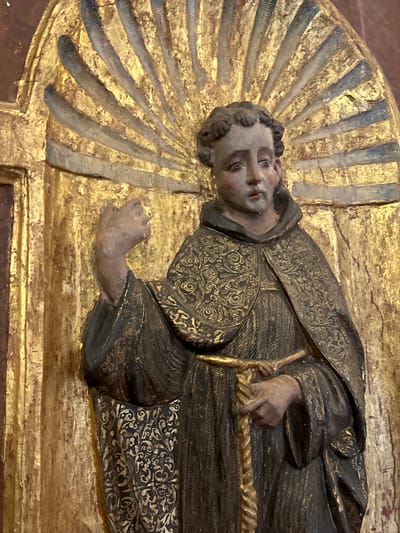
This media file captures a close-up of an ornate, polychrome wooden sculpture, likely depicting a male saint or religious figure. The figure is shown from the torso up, in a recumbent or semi-reclined pose, his head tilted back and looking slightly upwards. The subject is a man with short, dark, curly hair and a pale complexion. His face has a serene, contemplative, or perhaps pained expression, with his mouth slightly ajar. He is dressed in a dark brown or black monastic habit or robe, which is elaborately decorated with intricate gold patterns, resembling filigree or brocade, featuring scrolling vines and floral motifs. A simple rope or cord belt is visible around his waist. His left hand is raised towards his chest, loosely holding the cord, while his right hand rests near his hip, seemingly clenched or gesturing. The figure is set against a gilded background element that resembles a radiating fan or a scallop shell, with multiple parallel lines emanating from behind his head. Some of these lines show remnants of faded blue paint, suggesting a once more vibrant color scheme. This background element functions as a halo or a decorative niche, emphasizing the sacred nature of the figure. The sculpture exhibits characteristics of Baroque or Rococo religious art, common in colonial Mexico. The materials appear to be carved wood with gesso, gilding (gold leaf), and paint. The surface shows signs of age and wear, with some flaking of the gold and paint, revealing the underlying material in places. The overall impression is one of intricate craftsmanship and spiritual devotion. The scene takes place within a larger architectural or sculptural context, likely part of an altarpiece or a devotional shrine in a church, consistent with the art and architecture found in Tepotzotlán, Mexico. There is no visible text in the image.
Tepotzotlán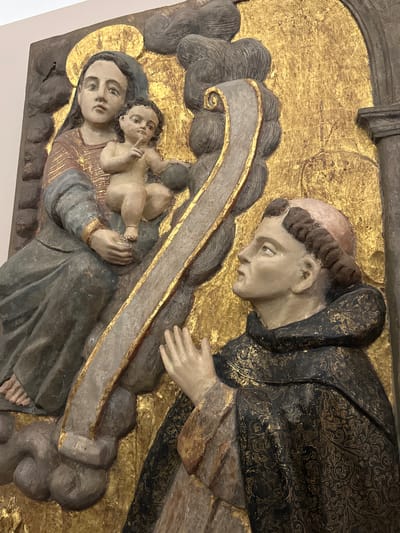
This media file displays a religious relief carving, likely part of an altarpiece or devotional artwork, from Tepotzotlán, Mexico. The carving features three central figures against a richly gilded background. On the left, a woman, presumably the Virgin Mary, is depicted holding an infant, likely Jesus Christ. She wears a dark blue head covering and a reddish-brown tunic. A faint halo is visible behind her head. The infant, with a somewhat curious expression, raises one hand and looks upwards. To the right, a male figure is shown, presumably a saint, perhaps a Franciscan friar given his tonsured haircut and habit. He wears a dark, almost black, habit richly adorned with intricate gold brocade patterns. He gazes reverently towards the Virgin and Child, with his hands gently reaching out or clasped in adoration. The figures are surrounded by dark, swirling cloud-like motifs, and a light grey ribbon or scroll with gold trim winds diagonally between the main figures. The background is covered in golden leaf, which appears textured and somewhat aged, suggesting a celestial or sacred setting. The overall style points to a Baroque or Colonial era artwork, characterized by detailed carving, rich ornamentation, and religious subject matter. No visible text is present in the image.
Tepotzotlán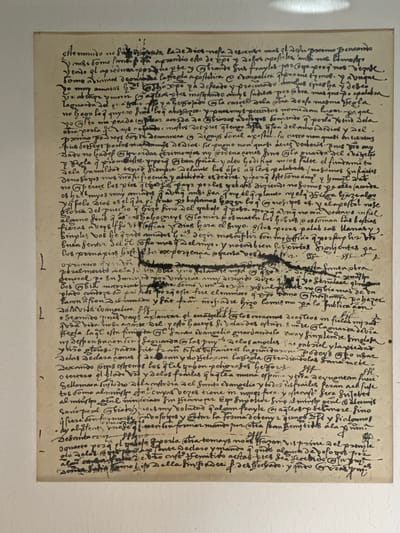
The image displays a single, aged sheet of paper, densely covered with handwritten text in dark brown or black ink. The paper has an off-white or cream color, indicating its historical nature, and shows signs of age such as slight discoloration, minor creasing, and several darker smudges or stains, particularly in the central and lower-right portions. The text is written in a consistent, elaborate cursive script, characteristic of historical manuscripts, with varied line thickness and flourishes. It occupies the entire surface of the paper, from margin to margin. There are no depicted subjects, people, or objects other than the document itself; the image focuses entirely on the written content. The activity implied is the act of historical record-keeping or writing. Notable details include the uniform style of the handwriting, suggesting a single scribe, and the evident age of the document. Throughout the text, small circles are drawn around certain letters or words, possibly serving as markers or references. At the bottom center of the page, the numeral '1' is visible in a modern font, likely a later addition for pagination or cataloging, distinct from the original historical script. The visible words suggest the language is Spanish, consistent with the historical context of Tepotzotlán, Mexico. The document appears to be a significant historical manuscript.
Tepotzotlán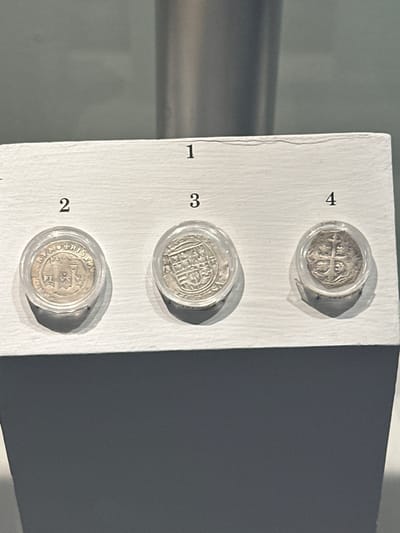
Three historical silver-colored coins are displayed vertically on a textured white surface, each encased in a clear circular plastic holder. The coins are numbered '4', '3', and '2' from top to bottom respectively, with '1' partially visible at the bottom left, suggesting a larger collection. The top coin (#4) features a prominent cross design, likely a religious or heraldic symbol. The middle coin (#3) displays a detailed, possibly architectural or coat-of-arms design, with faint, illegible text along its rim. The bottom coin (#2) clearly shows a central star or shield motif surrounded by partially visible Latin text, including fragments like 'HISPAN' and 'REX SA'. The display is set indoors, likely within a museum or historical exhibit in Tepotzotlán, Mexico, consistent with the probable Spanish colonial origin of the coins suggested by the visible text and location context. The lighting creates soft shadows from the coin cases, enhancing their three-dimensional appearance. The scene is static, showcasing the preserved artifacts.
Tepotzotlán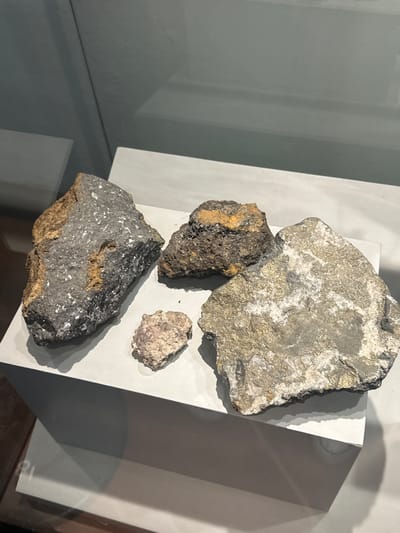
The image displays an indoor geological exhibit featuring four distinct rock or mineral specimens arranged on a white rectangular stand. This display is likely housed within a museum or educational institution, possibly in Tepotzotlán, Mexico, as indicated by the context. The specimens vary in size, color, and texture. At the top-right, a large, light grey rock is prominent, characterized by numerous sparkling golden or yellowish metallic flecks embedded within its matrix. To its lower left, a medium-sized, dark brown to black rock shows some lighter, rust-colored patches. A smaller, light pinkish-purple, somewhat granular specimen is positioned to the right of the dark rock. The largest specimen is located at the bottom-left, a dark grey to black rock liberally coated with silvery or white metallic flakes, and it features a notable section of rough, earthy brown material. The rocks are illuminated by directional lighting from the upper left, casting distinct shadows on the white stand and the background. The background itself is a plain, light grey surface, likely the interior of a display case. Reflections on what appears to be a glass enclosure are visible, particularly in the lower right, where a faint, distorted shape resembling the number "21" can be seen, though it is not clearly legible as text. No people or active events are present in the image, focusing solely on the mineral samples and their display.
Tepotzotlán