Teupinbayu, Indonesia
20 memories from Teupinbayu, Indonesia

A young boy wearing a red baseball cap and a gray t-shirt stands on a wooden bench in an outdoor setting. He is looking at the camera and holding his right hand up near his face, with his index finger extended. The background consists of lush green vegetation, including banana trees, and a building with a concrete pillar and a light-colored wall. The ground appears to be concrete or dirt. The image has a slightly overexposed quality due to bright sunlight. The context of Teupinbayu, Indonesia, is not visually evident from the image itself, but can be inferred from metadata or external information.
Teupinbayu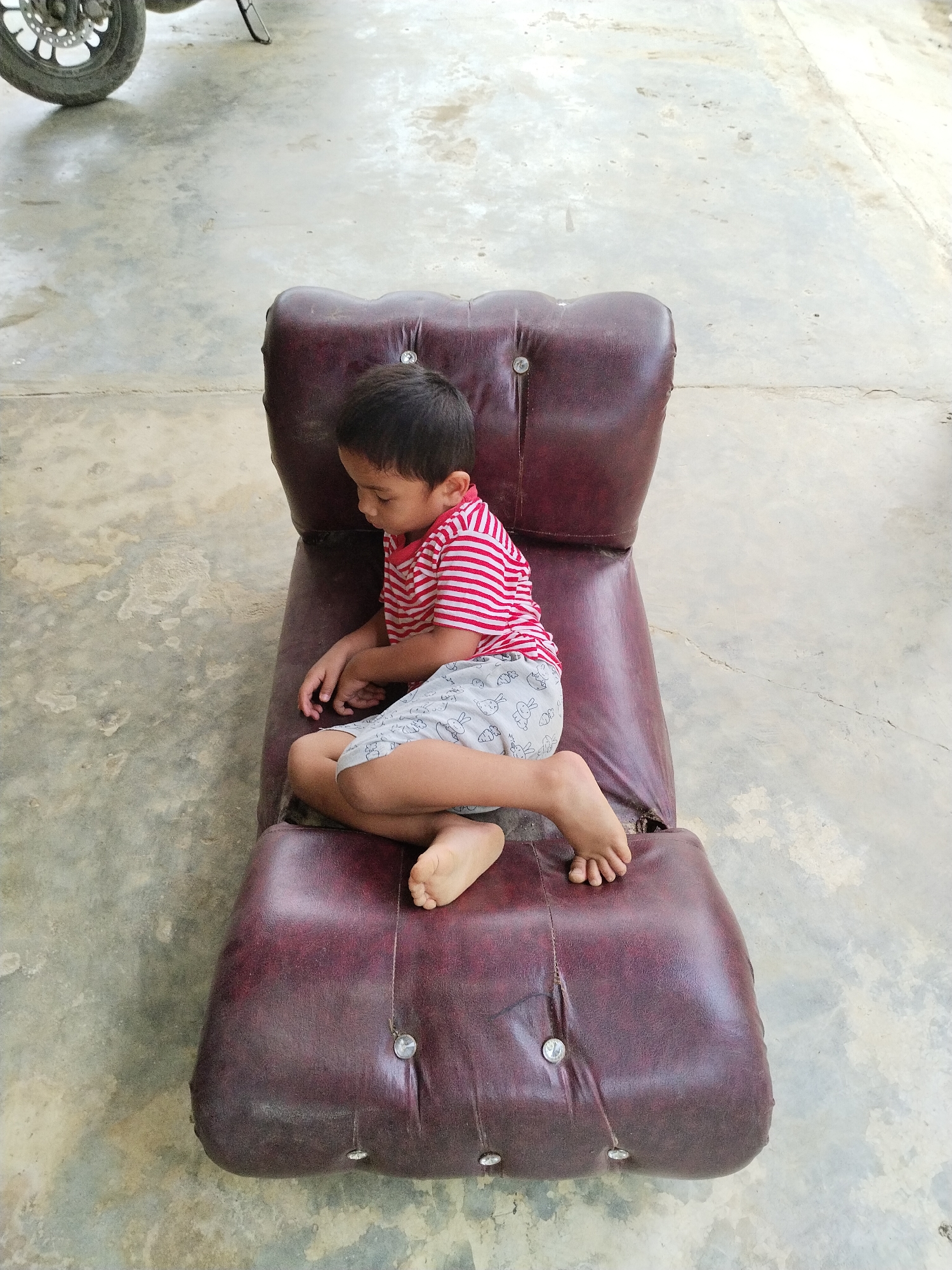
A high-angle outdoor shot in Teupinbayu, Indonesia, depicts a young boy seated on a worn, dark red tufted lounge chair positioned on a light grey concrete surface. The boy, of indeterminate age but appearing to be a toddler or young child, wears a red and white horizontally striped short-sleeve shirt and light grey shorts adorned with repeating rabbit or bunny patterns. He is barefoot, with both feet visible. His head is turned downwards, and his hands are resting in his lap, suggesting he is looking at something below him or lost in thought. The lounge chair, made of a synthetic leather-like material, shows significant signs of wear, including cracks, discoloration, and peeling. It features circular metallic buttons, some of which are loose, missing, or attached to frayed threads, creating a tufted effect. The concrete ground exhibits variations in tone, with darker patches indicating moisture or staining. In the upper left quadrant of the image, the front wheel of a vehicle, likely a motorcycle, with a visible disc brake and part of a kickstand or frame, is partially visible. The scene is illuminated by bright, diffuse overhead light.
Teupinbayu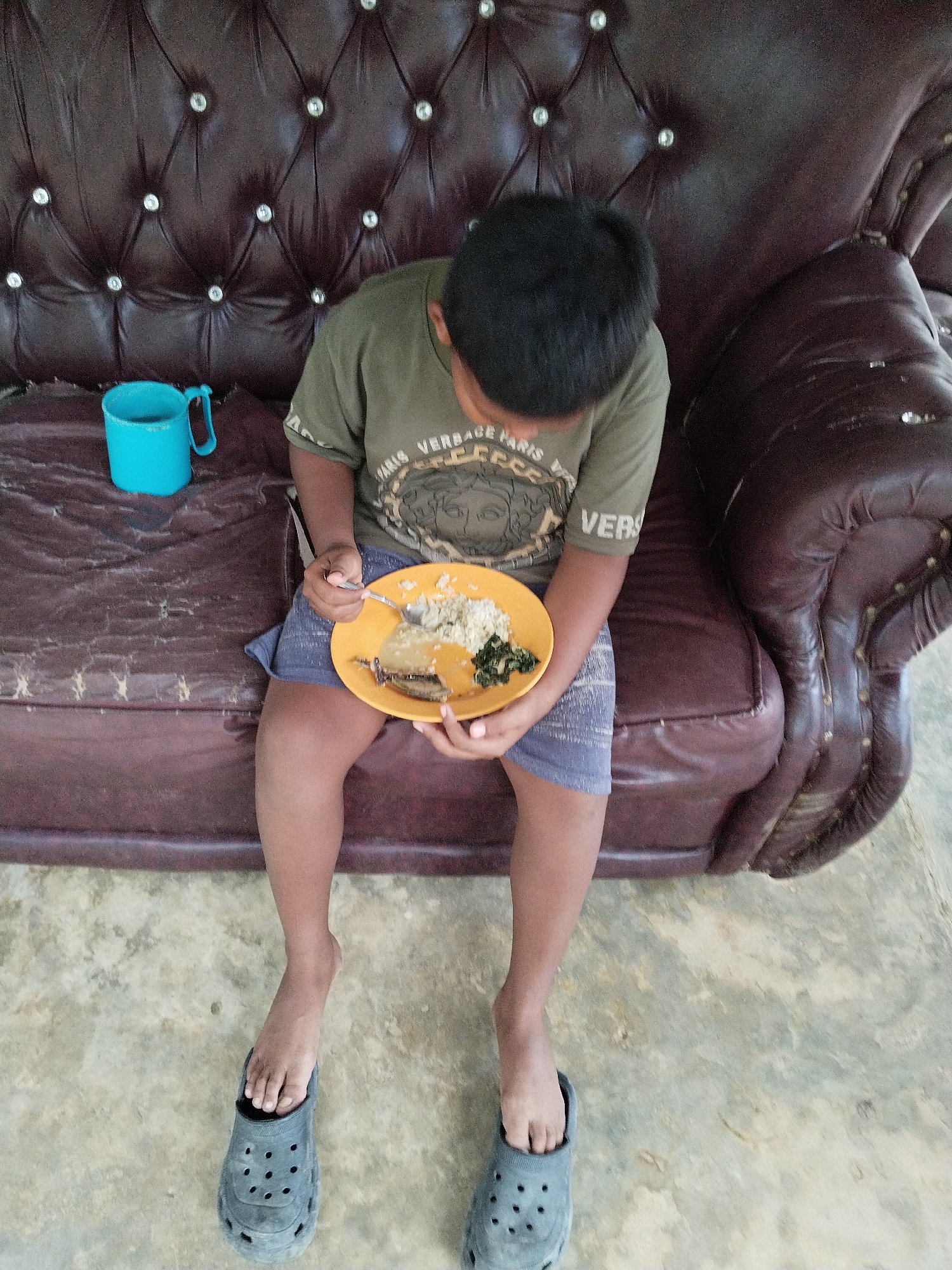
A child sits on a worn, dark brown tufted sofa adorned with silver-colored buttons, holding an orange circular plate containing white rice, dark green leafy vegetables, and a piece of protein covered in a brown sauce. A silver-colored spoon is positioned in the child's right hand over the plate. To the child's left, on the sofa cushion, rests a turquoise-blue plastic mug with a handle. The child is wearing an olive-green t-shirt with faded text and design, and blue shorts. The child's bare feet are partially inserted into dark grey, perforated clog-style shoes. The floor beneath is a light-colored concrete surface, exhibiting mottled grey and tan patterns. This scene is located in Teupinbayu, Indonesia.
Teupinbayu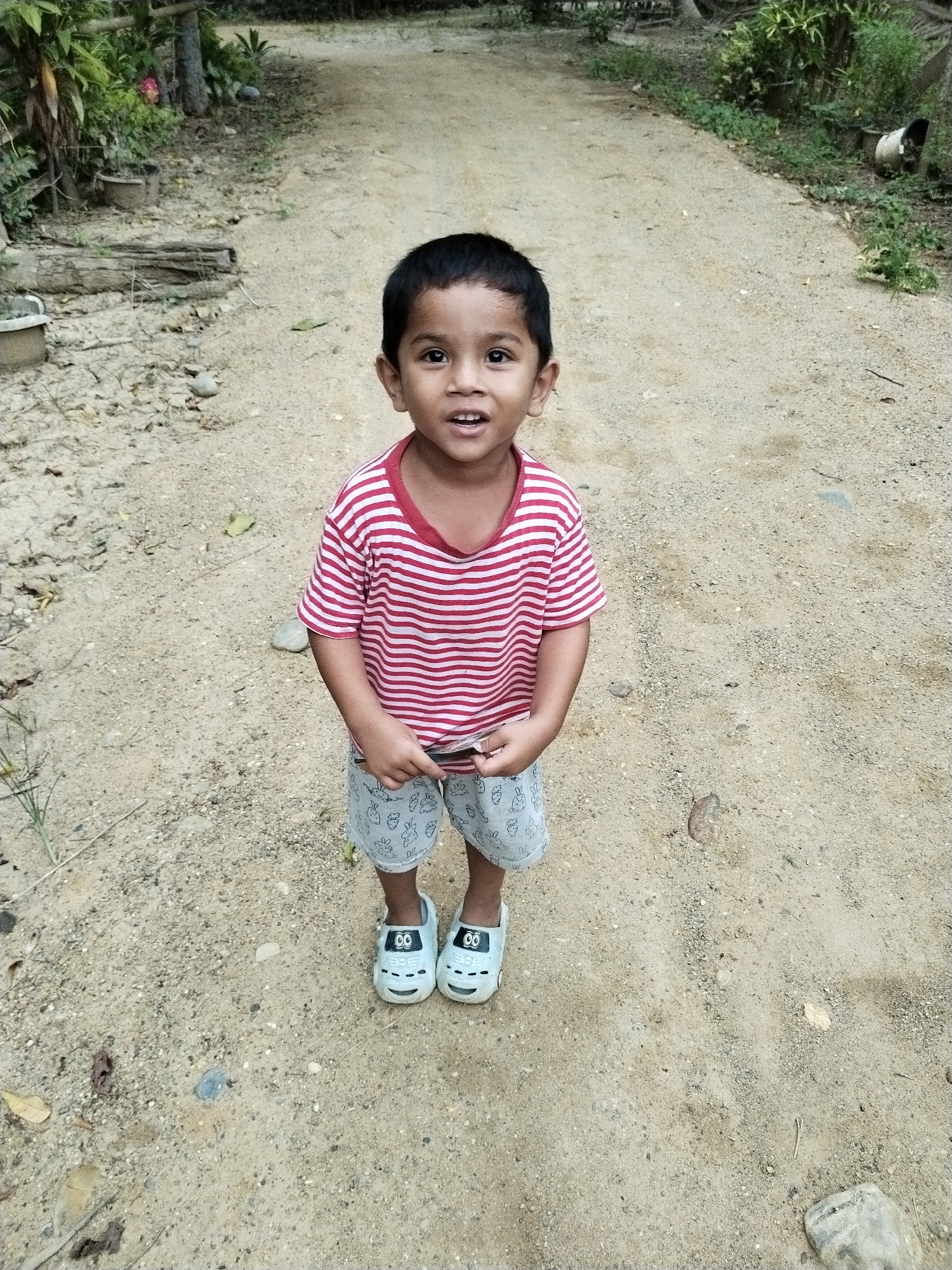
The image depicts a young child standing on a dirt path in Teupinbayu, Indonesia. The child, appearing to be male, has dark hair and a dark complexion, estimated to be between 2 and 5 years old. He is wearing a red and white horizontally striped short-sleeved t-shirt, light grey shorts patterned with repeating cartoon rabbits, and light blue or grey closed-toe sandals featuring a black and white cartoon face design with eyes and a smile on the front. The child is positioned centrally, facing directly towards the camera with his mouth slightly open, suggesting a smile or verbalization. Both hands are clasped in front of his waist, holding a small, flat, dark-colored object, possibly a mobile phone or toy. The immediate environment is an unpaved, light brown dirt path, characterized by loose soil, small pebbles, scattered dry leaves, and sparse green vegetation. The path extends into the background. To the left of the path, dense tropical foliage, including large green leaves, tree trunks, and several unglazed terracotta-colored pots, is visible. A weathered wooden log or branch lies horizontally on the ground near the left edge of the path. To the right of the path, there is additional greenery, with some plants and another container or object partially visible in the mid-distance. The scene is illuminated by natural daylight, indicating an outdoor setting.
Teupinbayu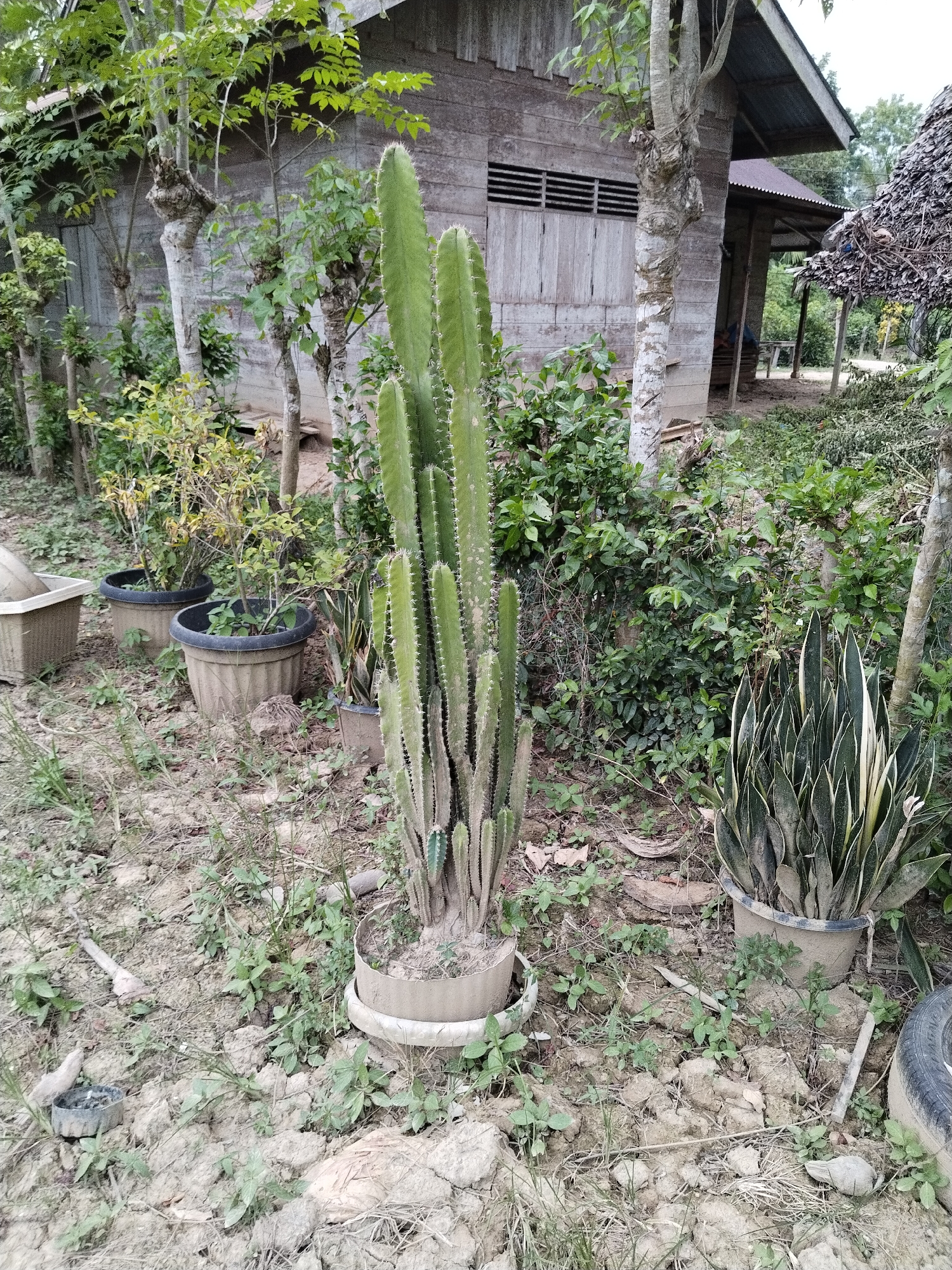
The image depicts an outdoor scene in Teupinbayu, Indonesia, characterized by a dry, unpaved yard adjacent to a wooden structure. In the foreground and central to the image, a tall, multi-stemmed green columnar cactus is planted in a light-colored pot, which is situated within a wider, low-rimmed container on the ground. To the immediate right of the cactus, a potted snake plant (Sansevieria) with variegated leaves is visible. Further right, a dark rubber tire segment rests on the ground. The ground surface is predominantly dry, cracked soil with sparse patches of green weeds and grass. Towards the lower-left, a light-colored, square-shaped planter is present, and a small, dark, circular object, possibly containing ash, rests on the ground. In the midground, several other potted plants are arranged behind the central cactus, some appearing smaller or less robust. A dense assortment of green foliage, including trees and shrubs of varying sizes, forms a natural backdrop. The background features a rustic wooden house constructed with horizontal planks. A window with horizontal slats is visible on the left section of the house. To the right, an extension of the structure or a separate building features a corrugated metal roof. A smaller, crude lean-to structure with a thatched roof is partially visible on the far right side of the image. The scene is devoid of any visible people or animals.
Teupinbayu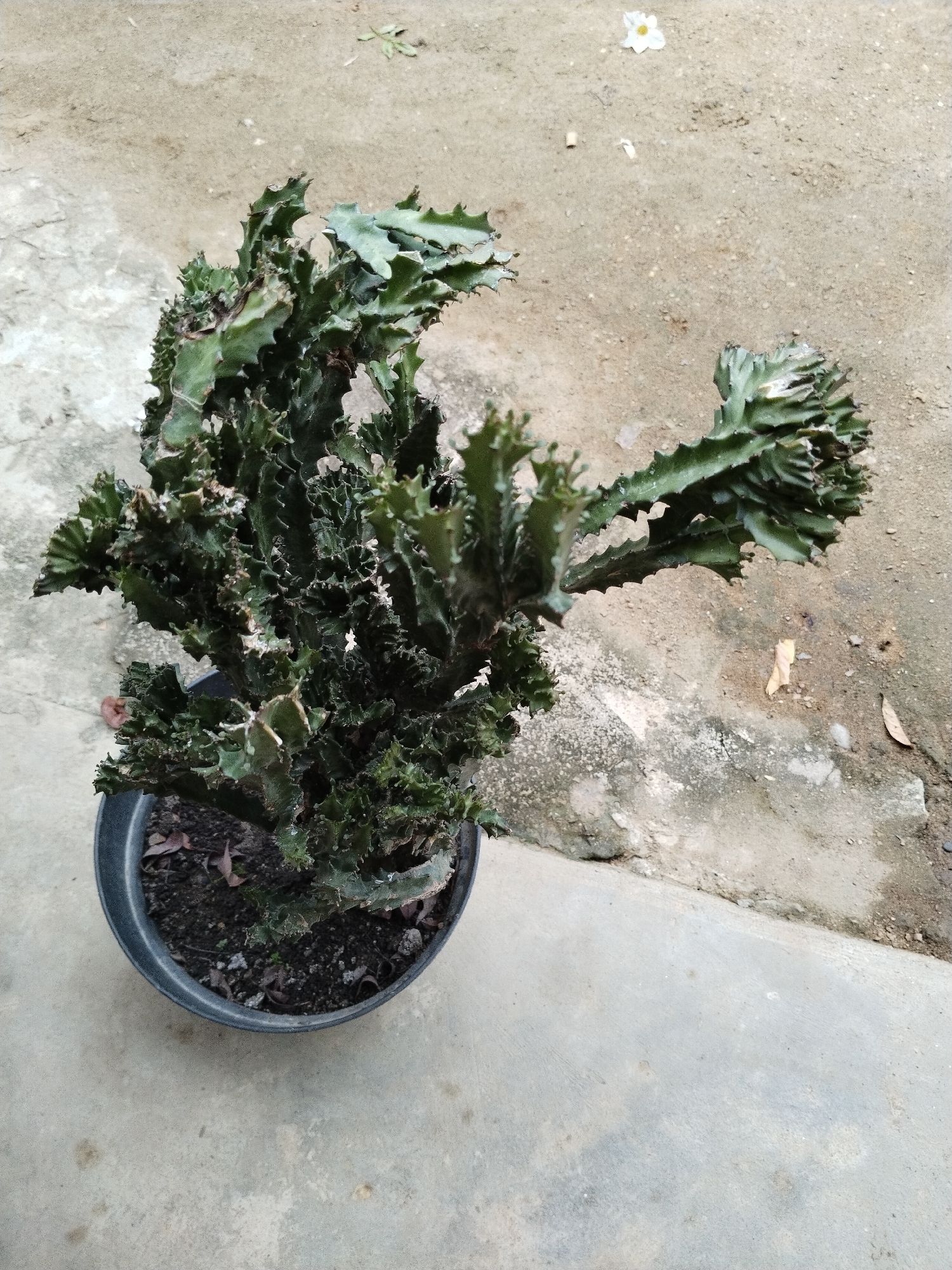
The image depicts an outdoor scene in the city of Teupinbayu, Indonesia. A dark green, multi-stemmed, crested cactus-like plant, possibly a crested Euphorbia, exhibits a complex, irregular growth pattern with numerous undulating, serrated stems and branches. The plant is housed in a black, tapered plastic pot, approximately one-third visible from the bottom-left of the frame. The soil within the pot is dark brown, with scattered dry, light brown fallen leaves. The pot rests on a light grey concrete surface. The concrete displays variations in texture and shade; the foreground is smoother and lighter, while the mid-ground transitions to a rougher, darker, and more mottled section. A distinct seam or crack separates these two concrete areas horizontally across the frame. Beyond the rougher concrete in the upper right, a patch of bare, light brown soil or dirt is visible. Scattered on the concrete are several small items: a single white, five-petaled flower appears in the upper right, a small green leaf (possibly a weed) is visible towards the top center, and a few dried, light brown leaves are distributed near the pot and on the rougher concrete. The scene is illuminated by natural daylight, suggesting an outdoor setting during the daytime. No people or animals are present, and no specific actions or interactions are depicted.
Teupinbayu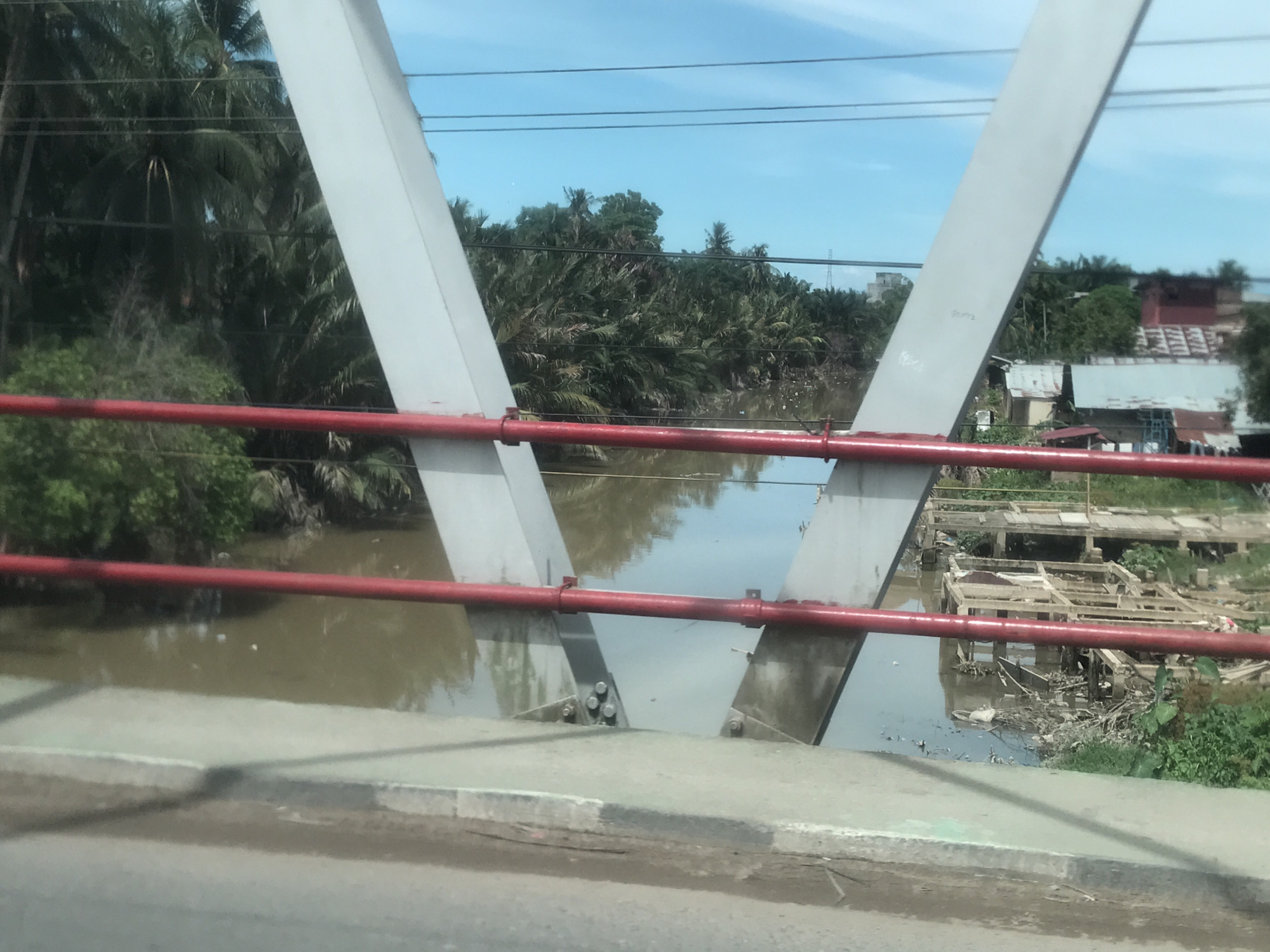
The image captures a daytime scene from a bridge crossing a muddy river or canal in Teupinbayu, Indonesia. In the immediate foreground, the grey concrete surface of the bridge is visible, with a distinct black and white striped curb. Two parallel red metal handrails stretch across the frame, leading the eye towards the middle ground. Dominating the center of the image are two large, light grey, diagonal structural beams of the bridge, forming a prominent V-shape. These beams anchor to the bridge deck with visible bolts. Through this V-shaped opening, the brownish-green water of the river is seen, reflecting some of the surrounding foliage. The left bank of the river is densely covered with lush tropical vegetation, primarily tall palm trees, likely coconut palms, and other green foliage. Above these trees, a clear blue sky with some faint clouds and several thin power lines are visible. On the right bank, the landscape suggests human settlement. Simple structures, possibly houses or shacks, with corrugated metal roofs are nestled among trees. Near the water's edge on this side, there are several dilapidated wooden structures, appearing as frames or foundations, along with visible debris and trash in the water and on the bank. No people are present in the image. The time of day is clearly daytime, characterized by bright sunlight and a clear sky. Faint graffiti or markings are visible on the grey diagonal beams; on the right-hand beam, some scribbled lines and what appears to be the word "DUMMY" are faintly discernible. The scene depicts a tropical environment with a mix of natural lushness and signs of human presence and waste.
Teupinbayu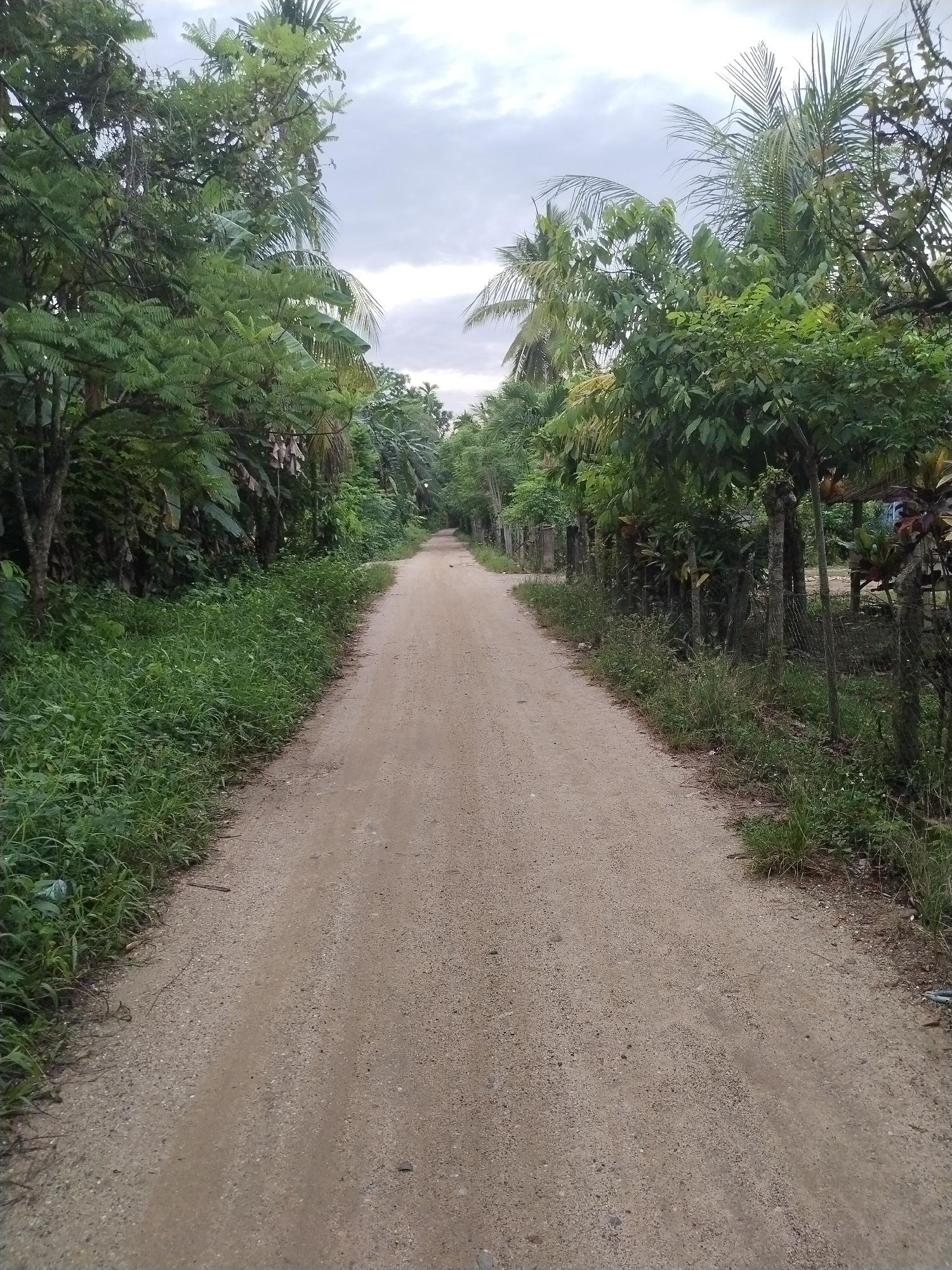
The image displays a straight, unpaved dirt road receding into the distance under an overcast sky. The road, composed of light brown earth and small gravel, occupies the central and lower portions of the frame, narrowing as it extends. On both sides of the road, abundant, lush green vegetation forms a dense corridor. To the left, a thick growth of trees and underbrush creates a vibrant wall of foliage. On the right, similar greenery lines the path, and a simple fence constructed from wooden posts and wire mesh is partially visible, interspersed with plants. Beyond the fence, hints of structures or dwellings can be discerned through the trees, suggesting a residential area integrated with nature. Numerous palm trees, identifiable by their distinctive fronds, are scattered among the other trees, especially in the background and on the right, indicating a tropical climate. Large-leafed plants also contribute to the dense green canopy. The sky is largely covered by grey and white clouds, casting a soft, diffused light over the scene. There are no people or animals present, and no specific activity is occurring. The atmosphere is one of tranquility and stillness. No text is visible within the image. The setting appears to be a rural or semi-rural environment, consistent with the given location context of Teupinbayu, Indonesia.
Teupinbayu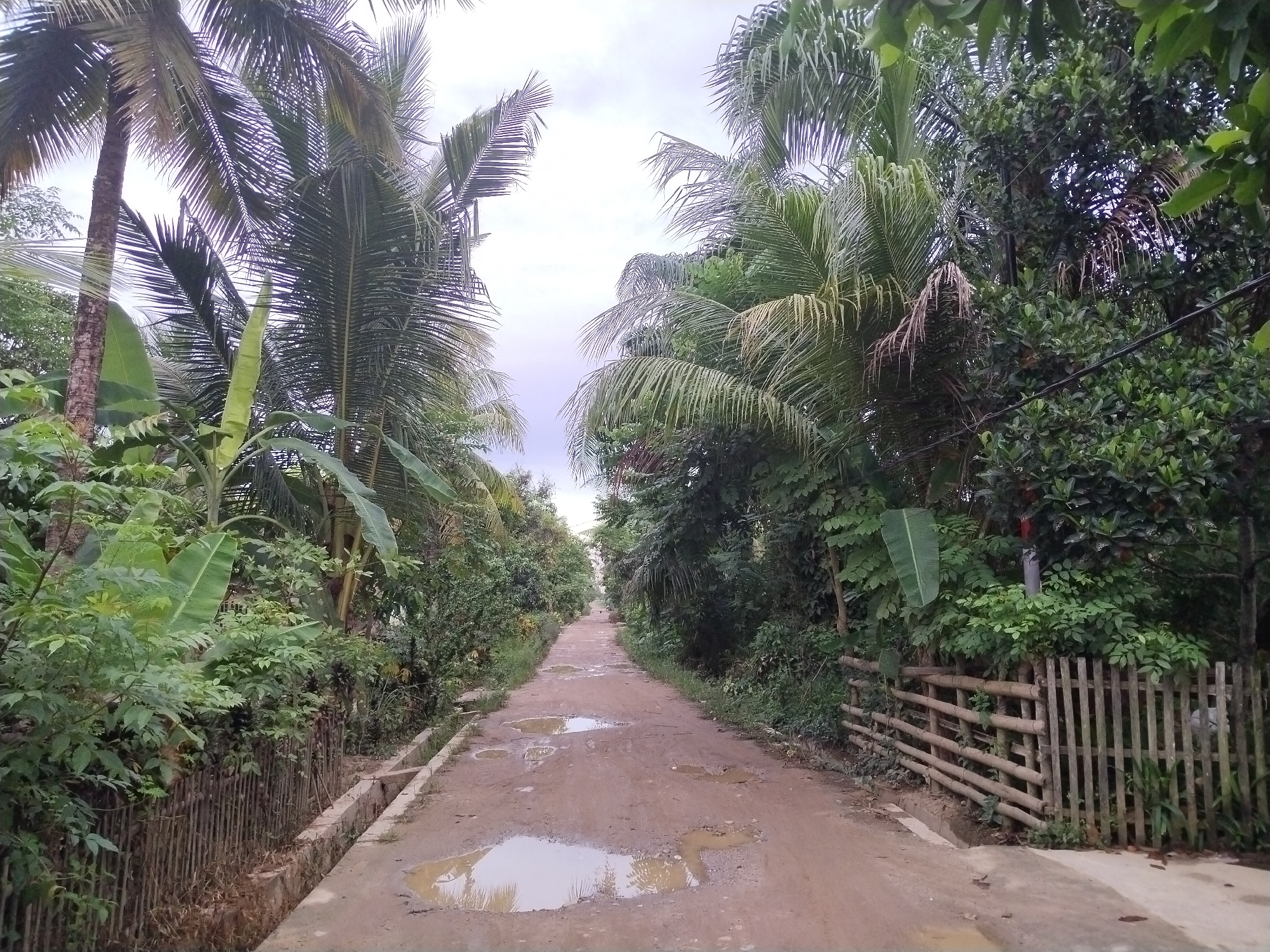
An eye-level shot captures a straight, unpaved dirt path cutting through dense tropical foliage under an overcast sky. The path, wet from recent rain, is dotted with several reflective puddles, with the largest one in the foreground clearly mirroring the sky and surrounding greenery. On both sides, the path is flanked by abundant and lush vegetation. Tall palm trees, likely coconut palms, dominate the scene, their fronds extending overhead and forming a natural canopy. Banana plants with their characteristic large, broad leaves are also prominent, especially on the left side. Various other green trees and shrubs create a thick, verdant wall, giving the impression of a jungle-like or heavily vegetated rural setting. A narrow concrete drainage ditch runs alongside the left edge of the path. On the right, a rustic fence made of vertical and horizontal bamboo or wooden slats serves as a boundary to the dense foliage. Faint utility lines are visible entangled within the greenery on the right. The sky overhead is bright but cloudy, suggesting either an overcast day or the immediate aftermath of rain, which is consistent with the puddles on the ground. No people or visible text are present in the image. The scene evokes a tranquil, rural atmosphere typical of tropical regions like Teupinbayu, Indonesia.
Teupinbayu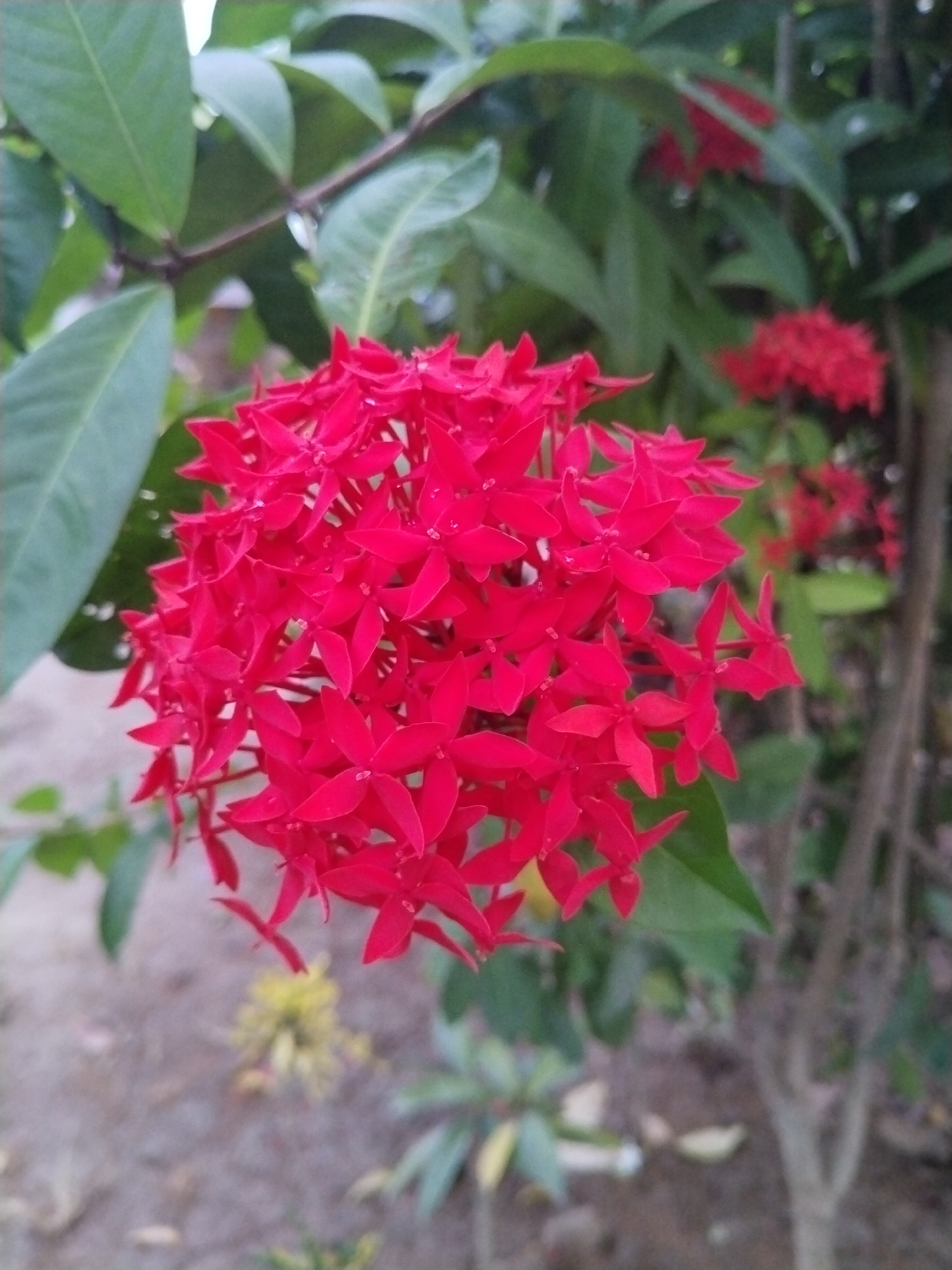
The image displays a close-up, eye-level view of a vibrant red flowering plant, likely Ixora, situated outdoors in Teupinbayu, Indonesia. The primary subject is a large, dense cluster of small, star-shaped, four-petaled red flowers, dominating the center of the frame. Their intense crimson hue stands out vividly against the surrounding greenery. Individual florets show a slightly glossy texture, with subtle glints that might suggest dew or recent rain. Lush, dark green leaves frame the flower cluster; some are in sharp focus in the upper left, while others are partially visible and softly blurred. In the background, additional, out-of-focus clusters of similar red flowers and green foliage suggest a larger plant or garden. The overall setting is a natural, vegetated area. The ground beneath the plant is blurred, appearing as light-colored earth or sand with hints of small, indistinct yellowish-green plants. The lighting is soft and diffused, characteristic of daylight, possibly during an overcast day or the softer hours of morning or late afternoon, as there are no harsh shadows. No people or visible text are present in the image. The scene evokes a feeling of natural beauty and the richness of tropical flora.
Teupinbayu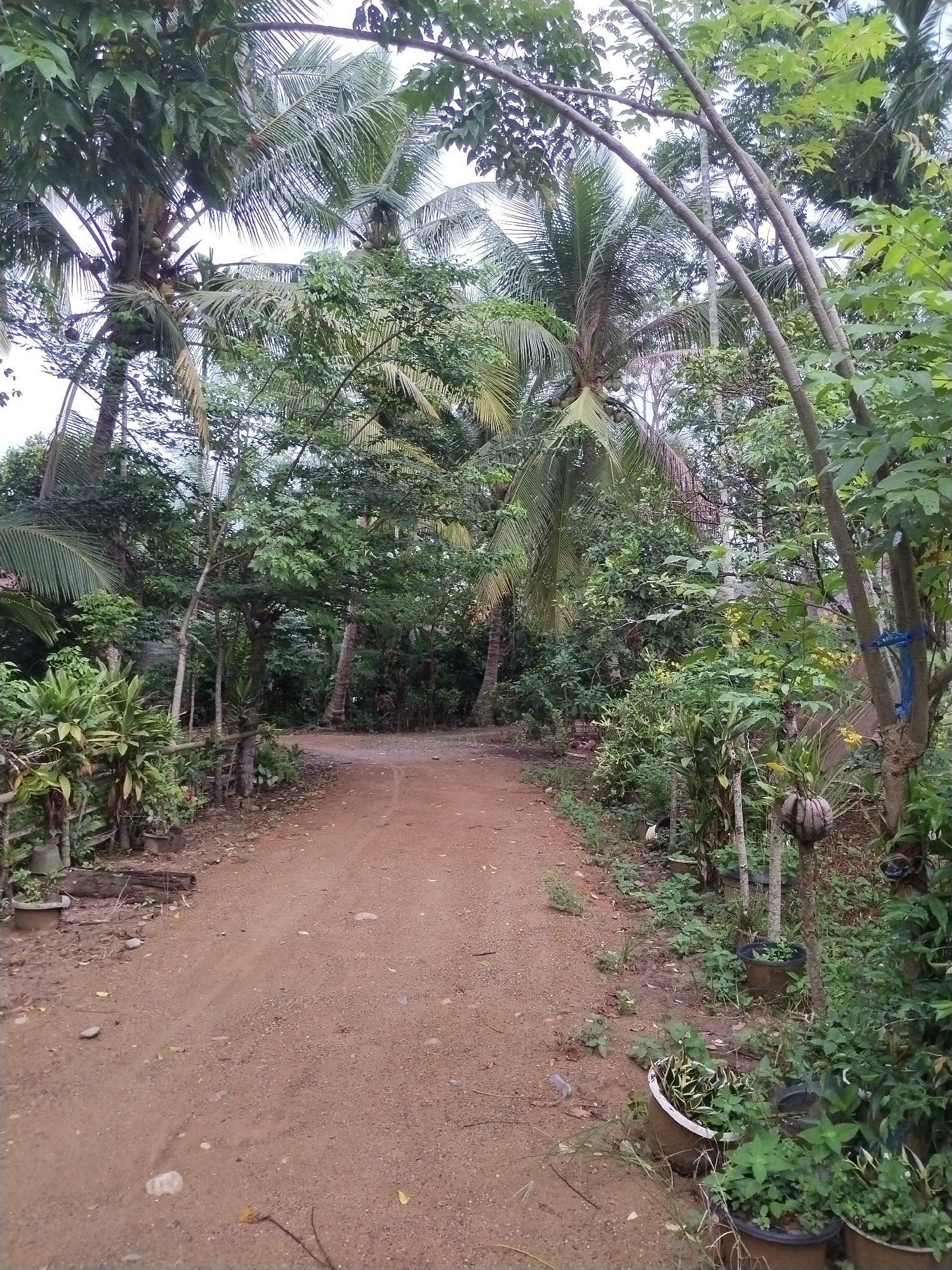
The image depicts a serene, unpaved dirt path meandering through a dense, tropical landscape in Teupinbayu, Indonesia. The reddish-brown path, speckled with small stones and fallen leaves, is wide in the foreground and narrows as it extends into the distance, curving slightly. Lush, green vegetation borders both sides of the pathway. Tall coconut palms with visible clusters of coconuts dominate the canopy, particularly on the left and towards the center. Various other broadleaf trees and abundant undergrowth create a rich, verdant environment. Some slender tree branches arc over the path, forming a natural archway. Along the edges of the path, especially on the right, several potted plants are visible in terracotta and dark-colored containers. A dried coconut husk is innovatively used as a hanging planter on a tree trunk. A blue rope or tie is wrapped around a tree on the right, hinting at human interaction or cultivation. Simple wooden supports are also visible amidst the plants on the left. The scene is illuminated by soft, diffused light, suggesting an overcast day or a period of indirect sunlight. The sky, visible in patches through the dense foliage, appears bright but not intensely sunny. There are no people or discernible activities taking place, contributing to the tranquil atmosphere of the rural setting. No text is visible in the image.
Teupinbayu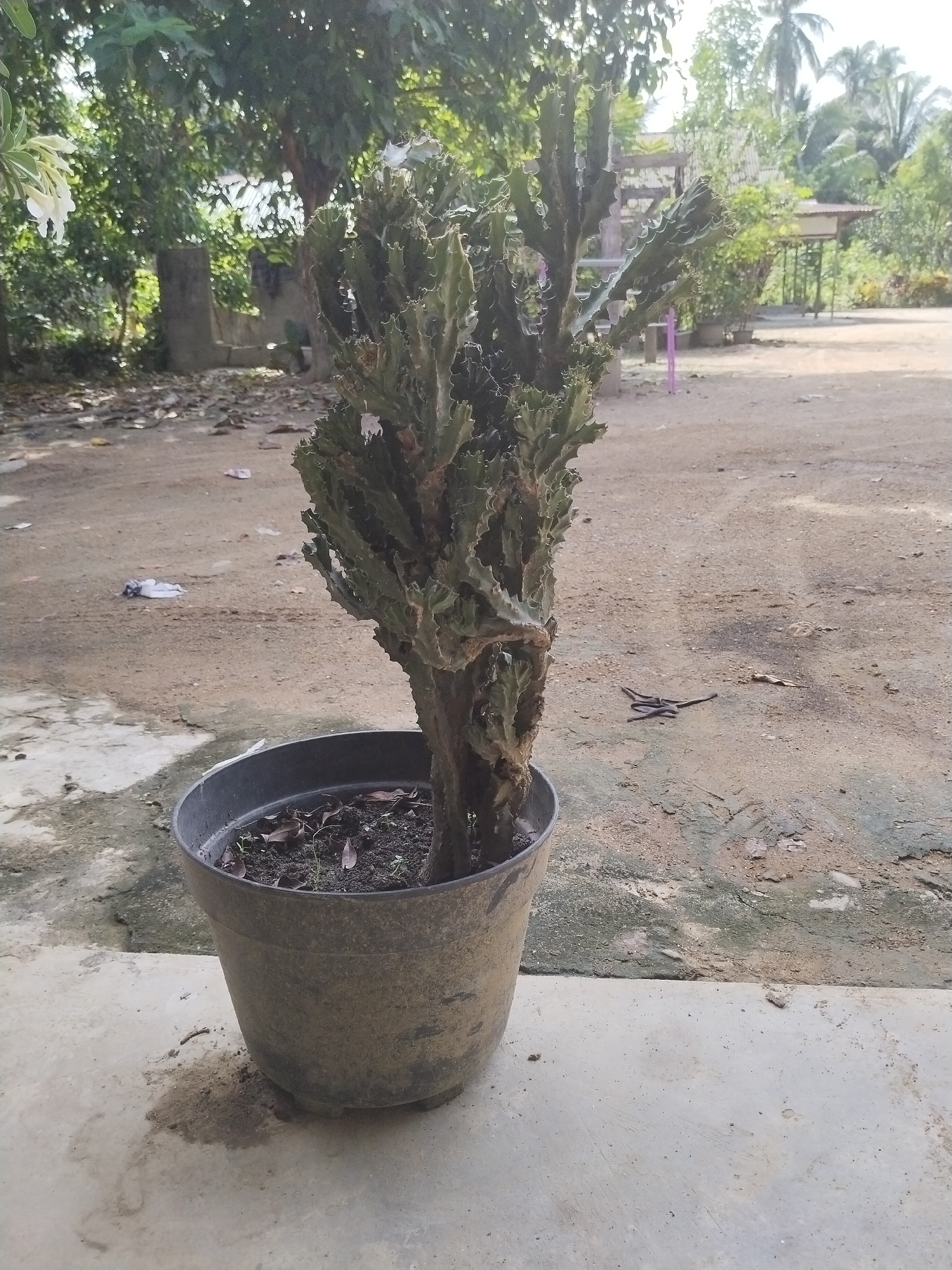
A potted plant, likely a candelabra-like succulent such as a Euphorbia trigona, stands prominently in the foreground. The plant features multiple green, upright, ribbed stems with small thorns, growing from a thicker, weathered base. It is housed in a dark grey or black plastic pot, filled with dark soil and some dried leaves. The pot itself appears dirty and well-used. The plant rests on a light-colored concrete or paved surface, which transitions into an unpaved, earthy area behind it. This dirt ground is textured, showing signs of wear and scattered with small pieces of white debris and what appears to be a dried-up centipede or worm. In the mid-ground and background, a lush, verdant environment unfolds with numerous trees and dense foliage, indicating an outdoor, possibly tropical or semi-tropical setting. Tall palm trees are visible towards the right side of the frame, and a building with a light-colored, possibly corrugated roof can be glimpsed through the trees. On the far left, out-of-focus white flowers are visible. The scene is brightly lit by natural daylight, suggesting it is daytime on a clear, sunny day. No human activity or visible text is present. The overall setting is consistent with a rural or semi-rural area in Teupinbayu, Indonesia.
Teupinbayu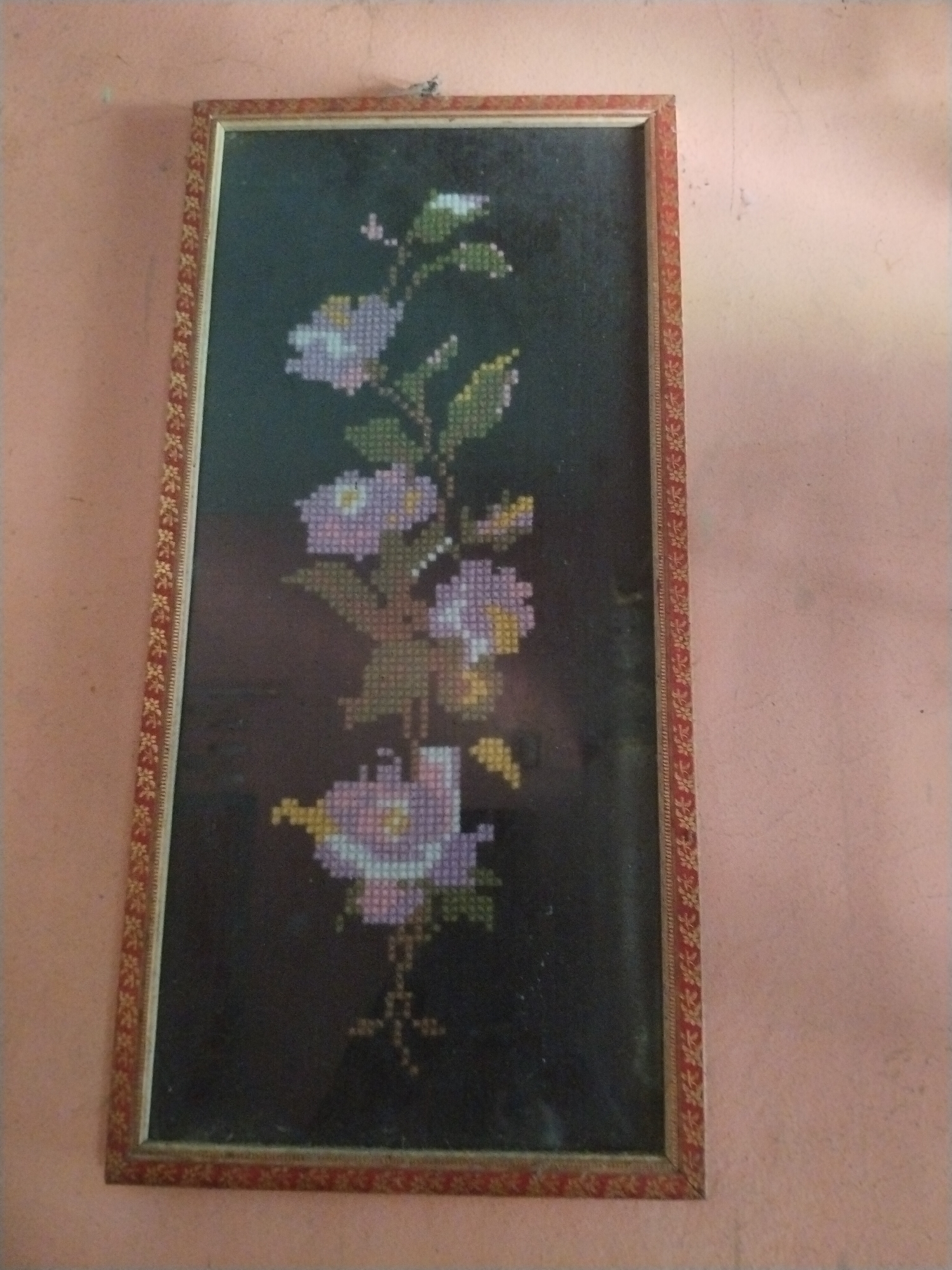
A vertically oriented, framed piece of cross-stitch artwork hangs on a light peach-colored wall. The artwork features a floral design, depicting a vine or stem with several stylized flowers and leaves against a dark, possibly black, background. The flowers are rendered in shades of light purple, lavender, and white, with small yellow centers. The leaves are predominantly green with some yellowish-green accents. The cross-stitch technique is evident, showing the individual stitched "pixels" that form the image. The frame is rectangular, with a reddish-brown base color and a golden, intricate patterned border that appears to repeat a small floral or geometric motif. A small string or wire used for hanging is visible at the top center of the frame, attached to a hook or nail on the wall. The wall itself shows some faint discolorations and marks, suggesting an aged or lived-in environment. There is no discernible activity taking place, as it is a static display of an indoor decoration. No text is visible in the image. The scene is likely indoors in Teupinbayu, Indonesia.
Teupinbayu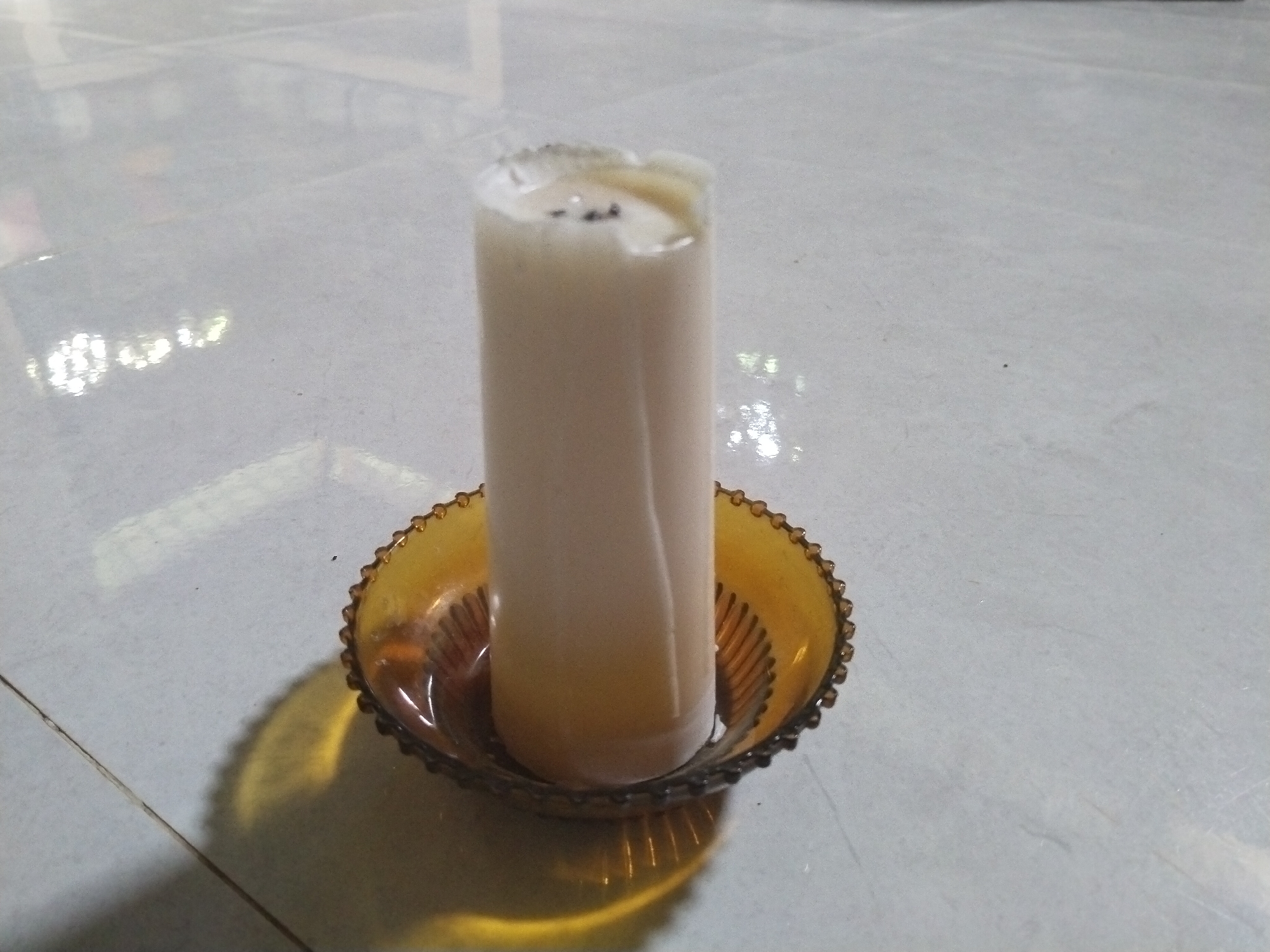
The image features a white, cylindrical candle resting in an amber-colored glass holder. The candle shows clear signs of previous use, with its top portion melted and uneven, revealing dark specks where the wick once burned. Some solidified, yellowish wax has accumulated in the bottom of the holder around the candle's base. The holder is a decorative, shallow bowl made of amber glass, characterized by a distinct scalloped or beaded rim and a ribbed texture on its interior base. This holder casts a subtle yellow reflection and shadow on the surface it rests upon. The candle and holder are placed on a light-colored, possibly tiled or concrete, floor or flat surface. This surface exhibits a slight sheen, reflecting blurred bright spots that suggest artificial overhead lighting or reflections from nearby windows. A faint, thin dark line, resembling a grout line or seam, crosses the surface in the lower left quadrant. The scene is a static still life, implying an indoor setting. There are no people visible, and no specific activity is taking place beyond the evidence of the candle having been burned. The image is captured with an overhead, slightly oblique perspective. No discernible text is present in the photograph. The overall impression is one of a simple, everyday object in a functional setting, likely indoors in Teupinbayu, Indonesia.
Teupinbayu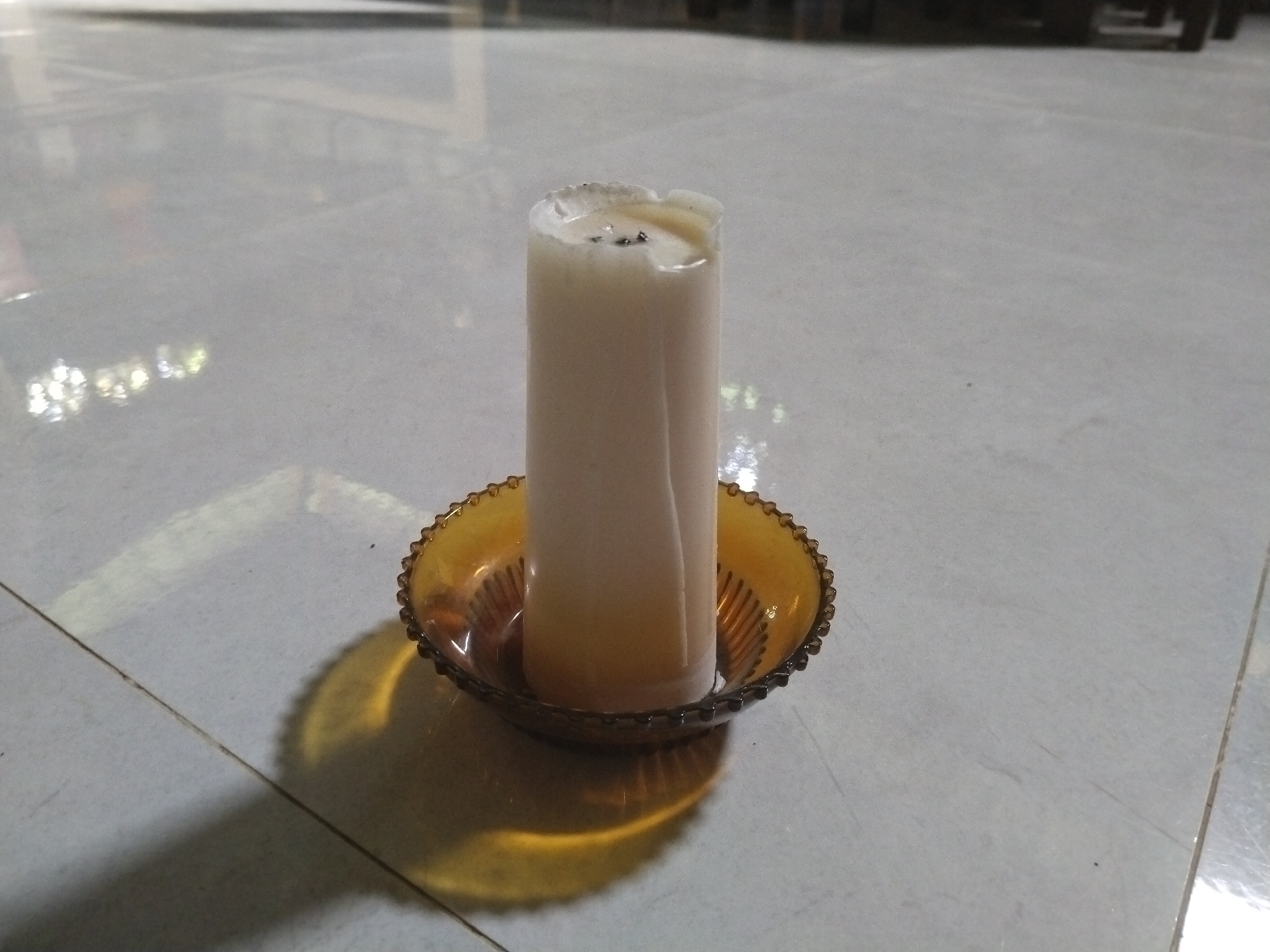
A white cylindrical candle stands upright in an amber-colored glass candle holder, positioned on a light-colored tiled floor. The candle shows clear signs of prior use, with its top edge irregularly melted and a dark wick visible amidst solidified wax. Melted wax has also run down the sides of the candle and collected in the base of the holder. The candle holder features a decorative design, including a ridged or beaded rim and vertical fluting on its interior base. A prominent shadow of the candle and its holder is cast on the tiled floor to the left, suggesting an artificial light source originating from the right side of the frame. The floor is composed of light grey or off-white tiles, separated by thin, dark grout lines. The background is softly out of focus, indicating an indoor setting, likely a room, with some faint, shimmering reflections visible on the floor further back. The scene is static, depicting an unlit candle, conveying a quiet, domestic atmosphere. There are no people or visible text present in the image. The location context is Teupinbayu, Indonesia.
Teupinbayu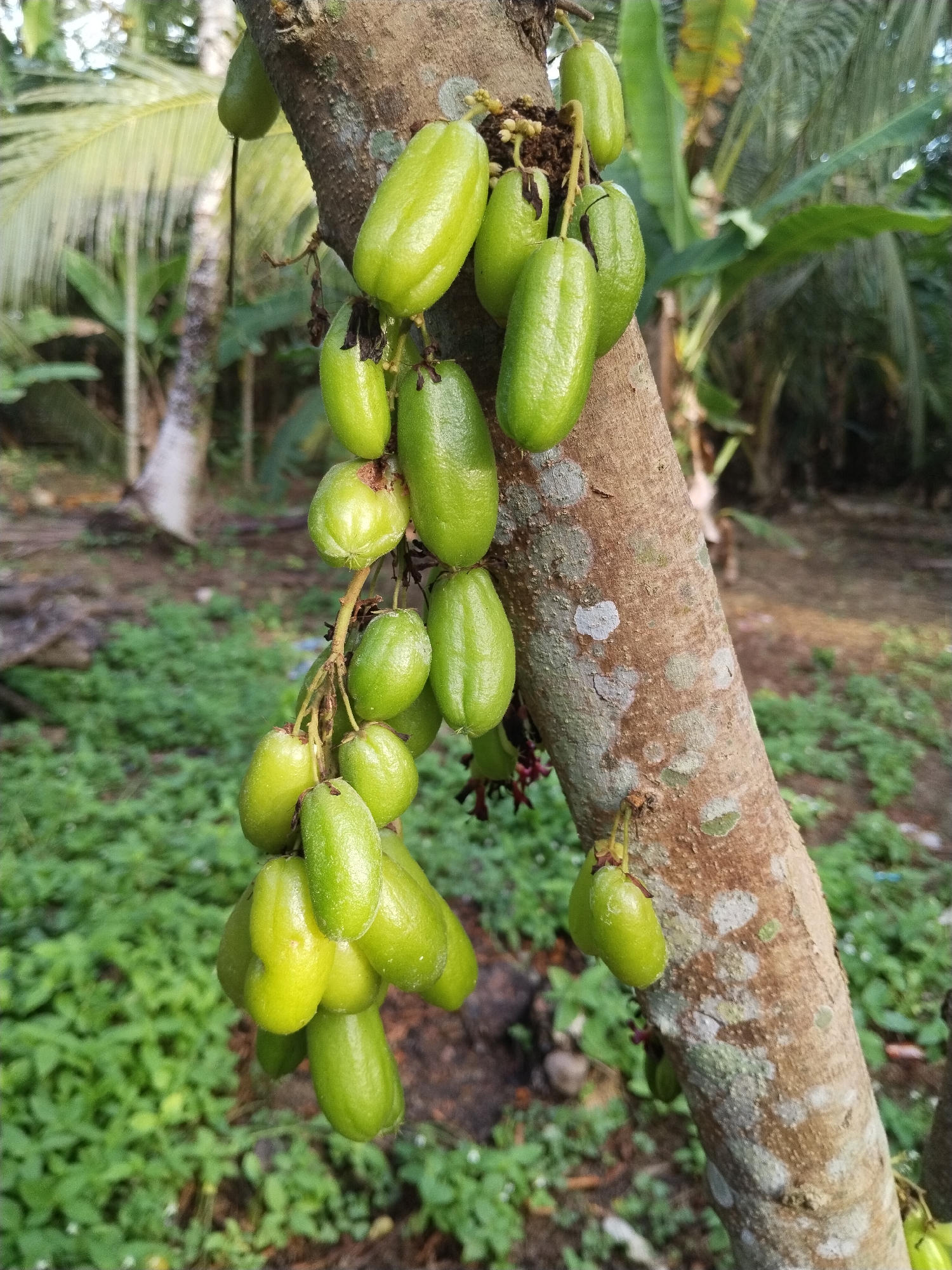
The image presents a close-up view of a tree trunk covered in numerous small, green, oval-shaped fruits, likely *Averrhoa bilimbi* (bilimbi), which are growing directly from the bark in clusters. The fruits are unripe, with smooth, bright green skin, and appear to be in various stages of development. They are attached to the trunk by short, dark stems. The tree trunk itself is textured, displaying a mix of brownish and grayish tones, with lighter, irregular patches that could be lichen or areas where the bark has shed. The lighting suggests it is daytime, with soft, natural light illuminating the scene, indicating pleasant weather conditions. The background is softly blurred, revealing a vibrant tropical environment. Lush green foliage dominates, including the distinctive fronds of palm trees and broad-leaved plants, possibly banana trees. The ground beneath the tree is covered with dense green undergrowth. The scene depicts a natural outdoor setting, likely a garden or a tropical plantation, consistent with its location in Teupinbayu, Indonesia. There are no people or human activities visible, and no text is present in the image. The photograph captures the unique characteristic of cauliflory, where fruits grow directly from the woody trunk or branches of a plant.
Teupinbayu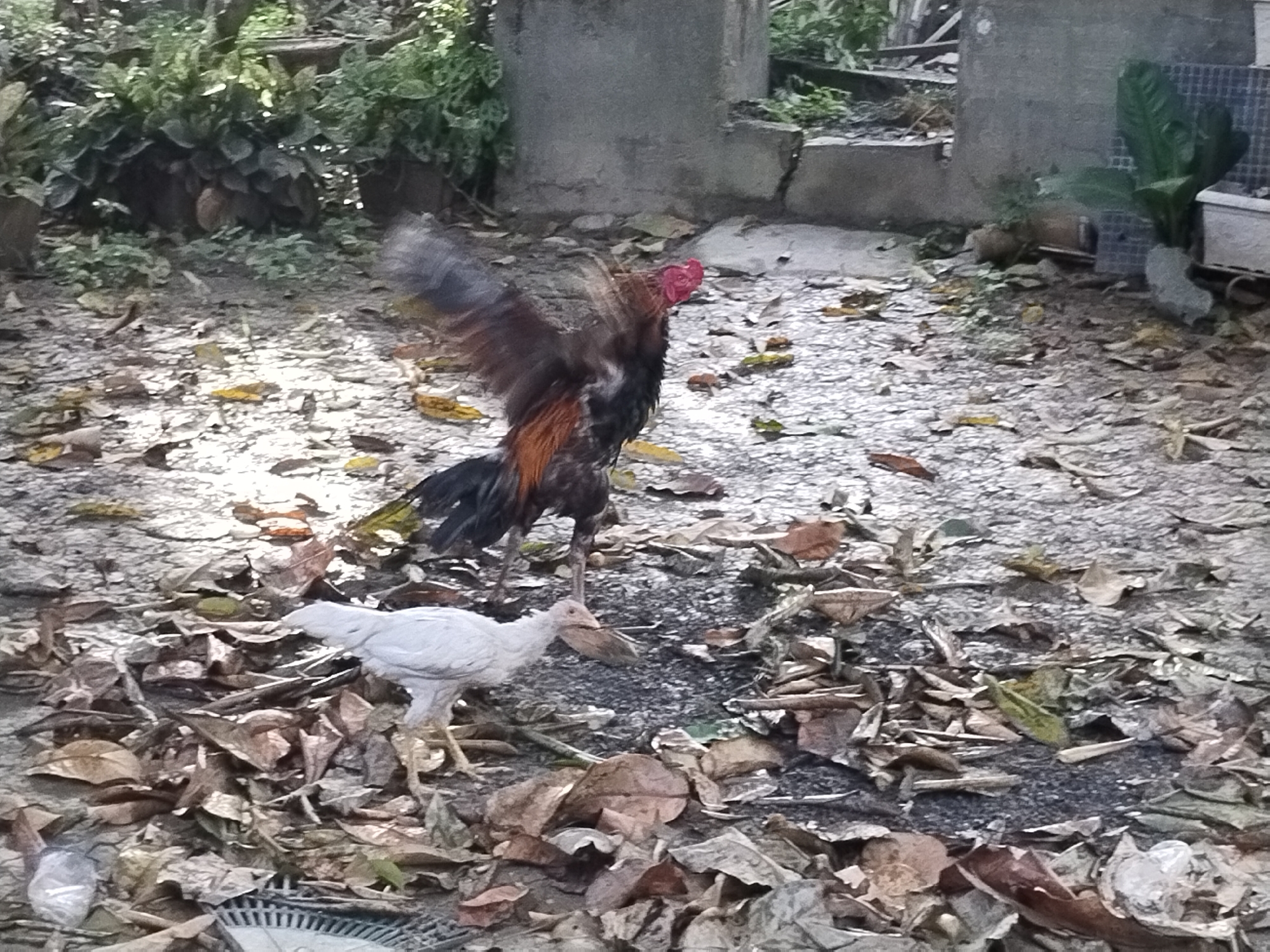
This media file captures an outdoor scene in Teupinbayu, Indonesia, featuring two domestic fowl. The main subject is a large rooster, positioned centrally, with striking black, brown, and reddish-orange feathers, and a prominent red comb and wattles. It is captured in motion, with its wings widely spread and blurred, suggesting it is flapping them or stretching. Its head is turned towards the right side of the frame. To the left and slightly in front of the rooster, a smaller, entirely white chicken or young fowl is visible. It stands on the leaf-covered ground, with its head bent down, appearing to forage or peck among the debris. The ground is predominantly covered with a thick layer of dried, brown leaves of various sizes, with patches of darker, bare soil visible underneath. In the background, to the left, there is dense green foliage, while to the right, concrete structures, possibly a wall or steps, are visible. More potted plants or green vegetation can be seen near these structures. Scattered among the leaves are pieces of litter, including a crumpled clear plastic bag in the lower left corner and what appears to be part of a plastic grate or basket in the lower center. The lighting is soft and natural, indicating daytime, possibly with indirect sunlight or an overcast sky. There is no visible text in the image. The scene suggests a rural or backyard setting.
Teupinbayu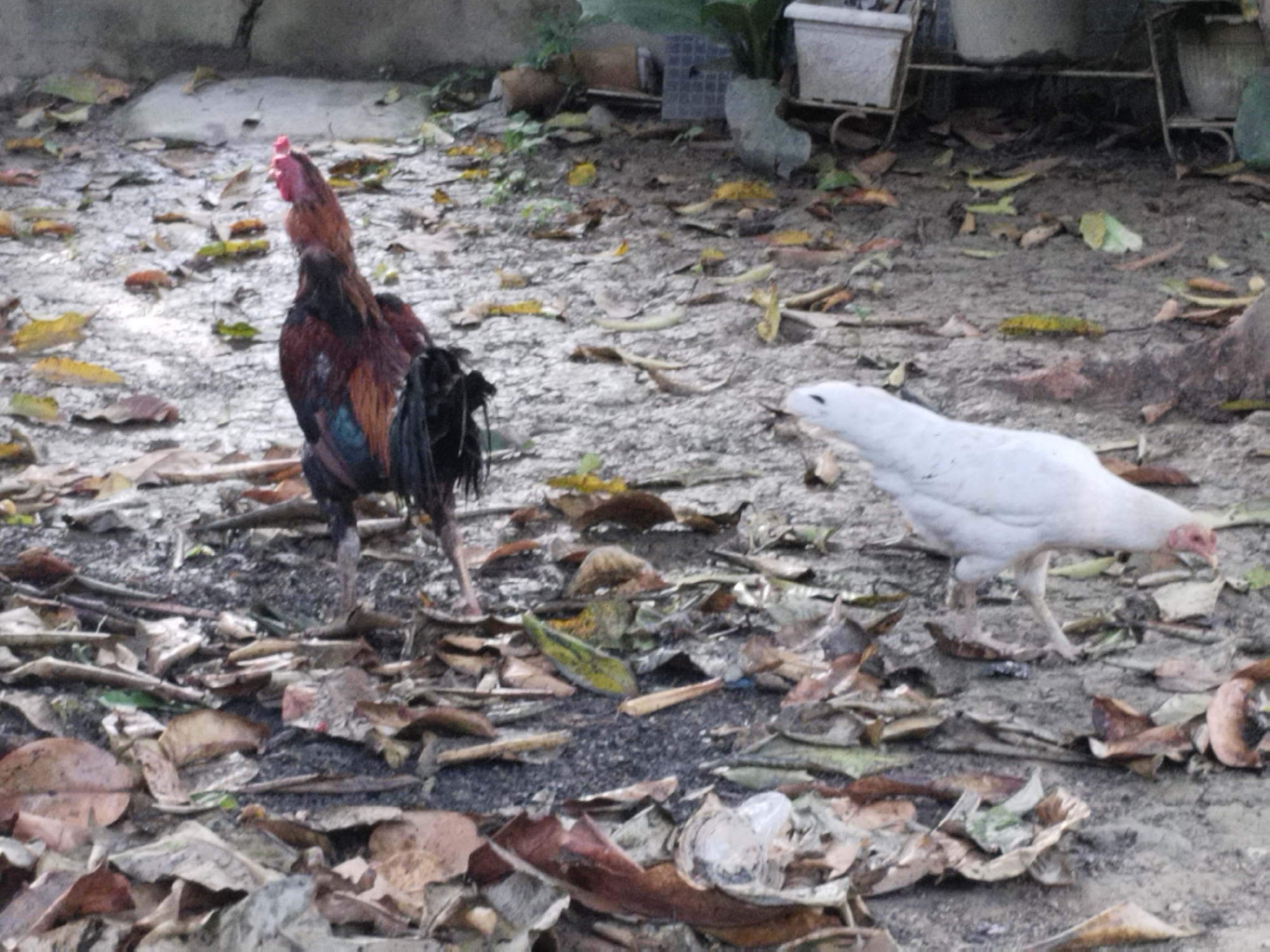
The image depicts an outdoor scene in Teupinbayu, Indonesia, featuring two chickens on a ground covered with dry, fallen leaves and dirt. On the left, a multi-colored rooster stands tall and alert, looking towards the left side of the frame with its head raised. It has reddish-brown, black, and iridescent blue-green feathers, a prominent red comb, and long black tail feathers. To the right, a white hen or pullet walks across the frame, moving from left to right, with its head lowered as if foraging or pecking at the ground. The setting appears to be a backyard or undeveloped area. The ground is a mix of light-colored soil and small gravel, heavily littered with brown, yellow, and some greenish dry leaves of varying sizes. In the background, there's a low concrete wall or structure, along with several potted plants resting on metal stands or directly on the ground. Some green foliage is visible around the pots and against the wall. The overall lighting suggests daytime, possibly overcast or with diffused sunlight, as there are no harsh shadows. No human subjects or visible text are present in the image. The chickens seem to be calmly moving about their environment.
Teupinbayu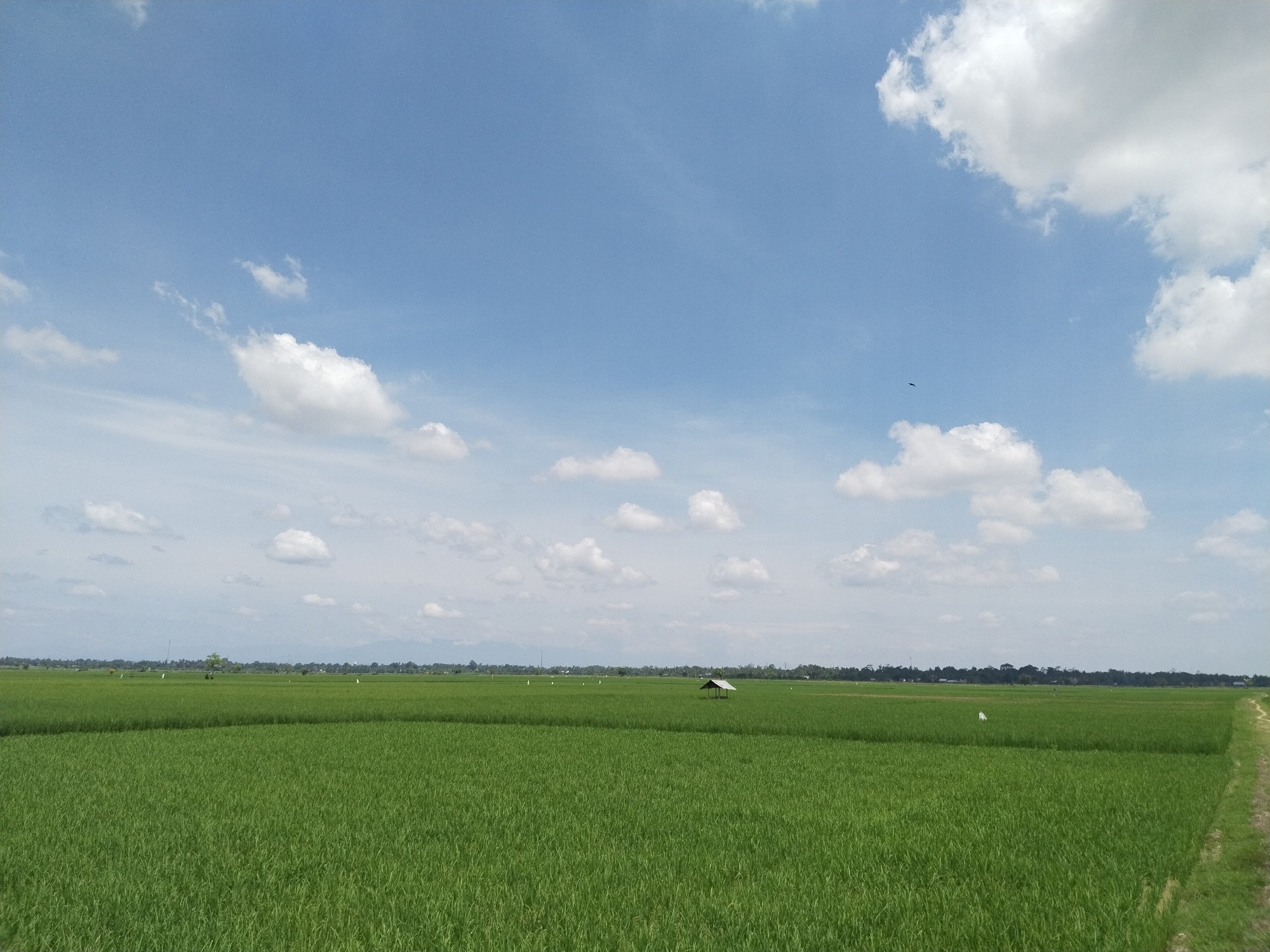
The image shows a vast expanse of green rice fields under a blue sky with scattered white clouds. A small, open-sided shelter is visible in the middle distance. The fields stretch to a distant tree line. A narrow path runs along the right edge of the frame. The location is Teupinbayu, Indonesia.
Teupinbayu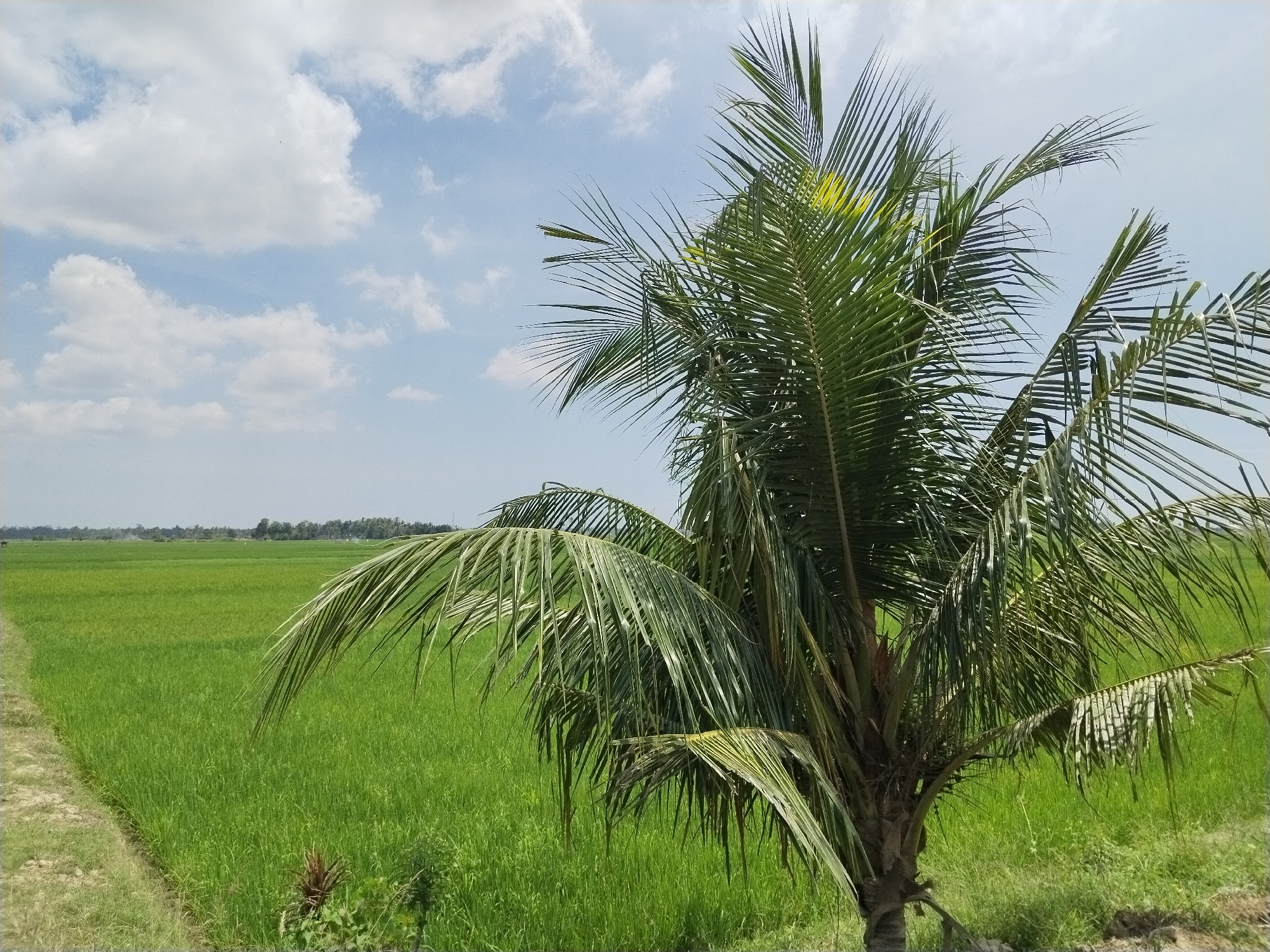
The image depicts a rural landscape in Teupinbayu, Indonesia. The foreground is dominated by a young coconut palm tree with vibrant green fronds. Behind the tree stretches a vast, lush green rice paddy field, suggesting an agricultural setting. The sky is light blue with scattered white clouds. There are no visible people or animals. The image conveys a sense of tranquility and tropical nature.
Teupinbayu