The Rocks, Australia
25 memories from The Rocks, Australia
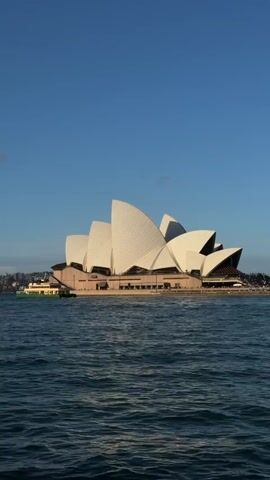
The video shows a slow pan across the Sydney Opera House from the water. The opera house is a multi-venue performing arts center. Its distinctive sail-like shell is white and white. The structure is on the harbor, and the water is a deep blue. The sky is clear and blue. The sun is shining. A ferry is visible in the distance on the left.
The Rocks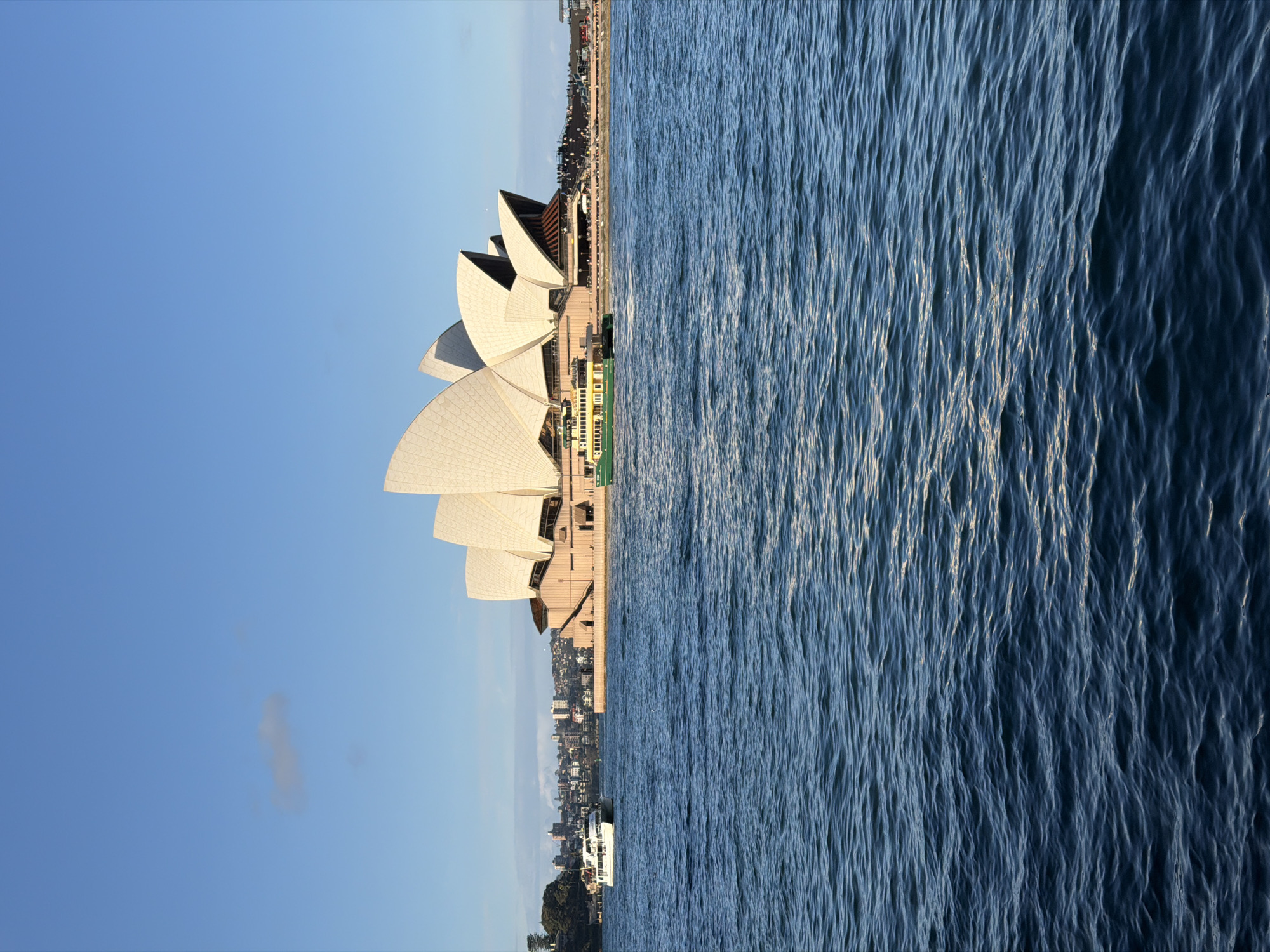
The image depicts a view of the Sydney Opera House, located in the Circular Quay area near The Rocks, Australia. The iconic building, characterized by its distinctive sail-like roofs, is prominently featured against a clear blue sky. In the foreground, a large expanse of blue water, likely Sydney Harbour, is visible, with gentle ripples on its surface. Two ferries are present in the water: a white catamaran-style ferry on the left, and a larger green and yellow ferry in the middle, closer to the Opera House. The shoreline behind the Opera House shows a cityscape with numerous buildings, indicating its urban setting. The scene is bathed in sunlight, suggesting it is daytime.
The Rocks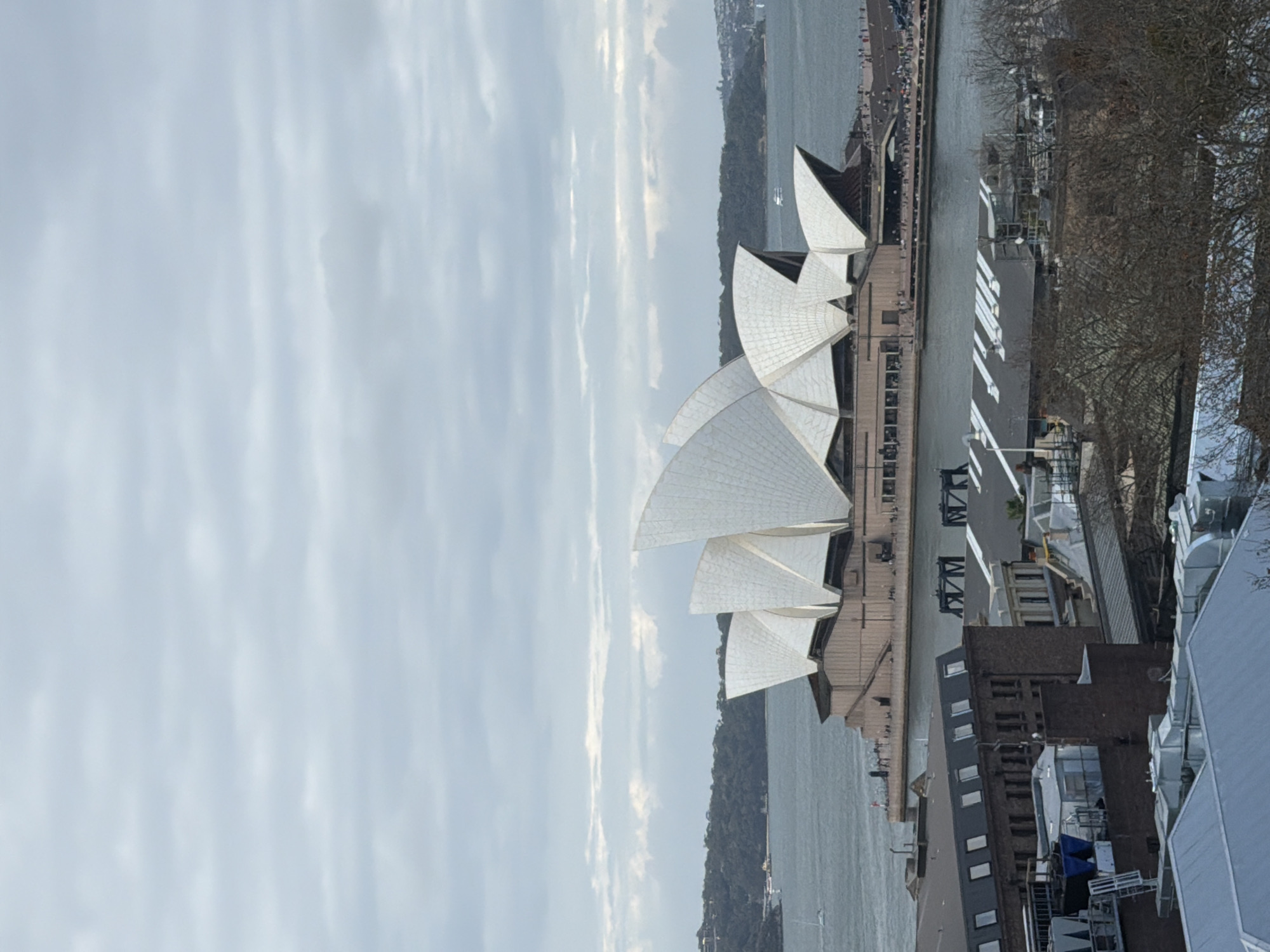
This image captures a view of the Sydney Opera House and the surrounding waterfront, with buildings in The Rocks district in the foreground. The Sydney Opera House, with its distinctive white sail-like shells, is prominently featured in the middle ground. It sits on the water's edge, with a promenade along its base where numerous people are visible. The water in front of the Opera House is a deep blue, and there are several boats on the harbor, including a white sailboat to the left. In the foreground, the buildings of The Rocks district are visible. These are a mix of brick and darker-colored structures with visible rooftop elements like ventilation units and skylights. The architecture suggests a mix of older and more modern industrial buildings. Some trees with bare branches are also visible in the lower part of the frame, indicating it might be a cooler season. The sky above is overcast with a layer of grey clouds, creating a muted lighting condition. In the distance, a tree-covered headland can be seen across the harbor, with some buildings dotting its slopes. The overall scene is a panoramic view of a significant urban waterfront landscape.
The Rocks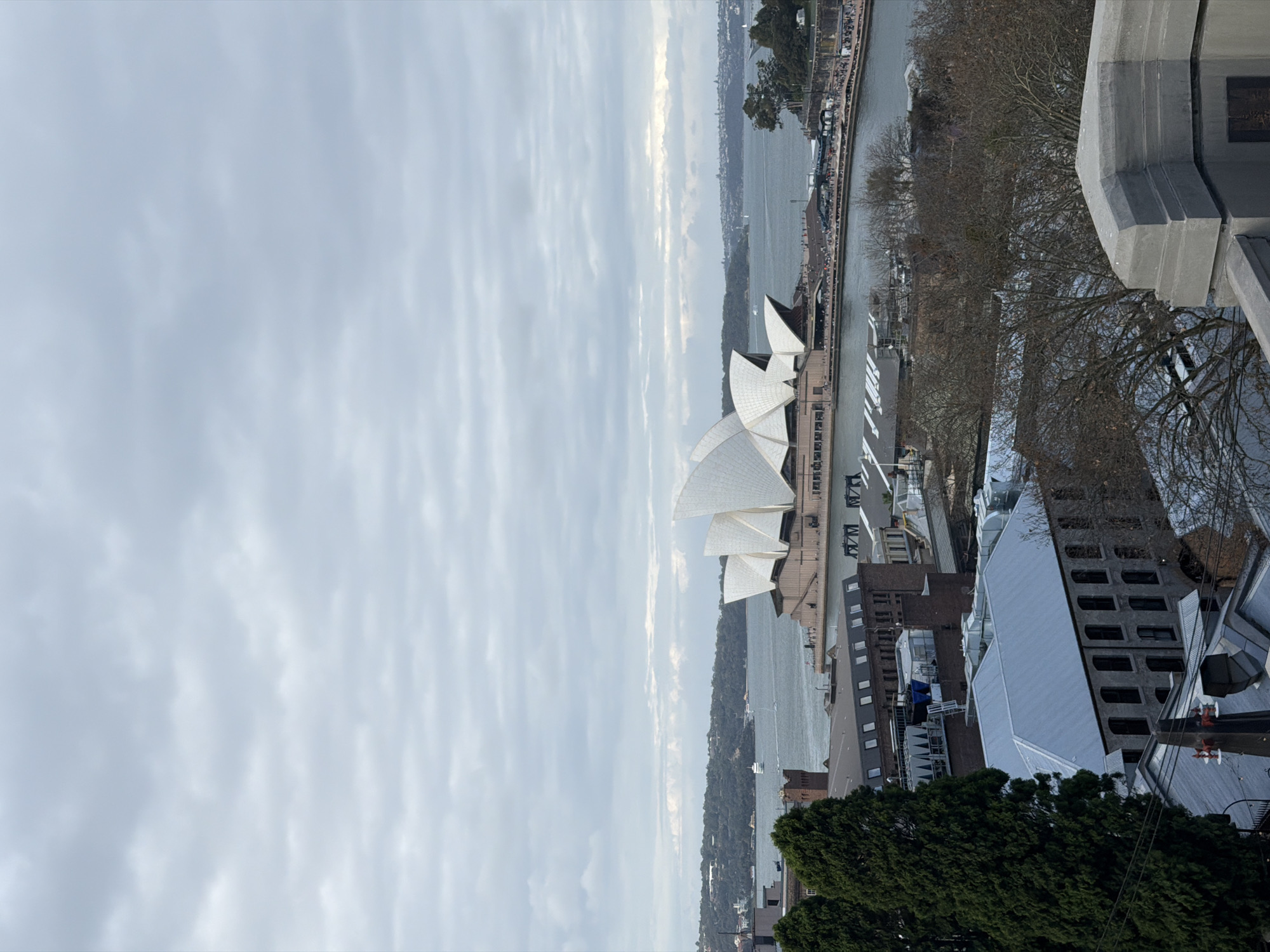
The image captures a view of the Sydney Opera House from The Rocks, Australia, on an overcast day. The iconic white sails of the opera house dominate the background, set against a grey, cloudy sky and a calm body of water. In the foreground, several buildings with grey, sloped roofs and visible windows are depicted, interspersed with dark green trees. Some of these buildings appear to be older, brick structures with a historical architectural style. A stone ledge is visible in the lower right corner, suggesting the viewpoint is from a building or elevated structure. The water in front of the opera house shows a few boats, and a walkway or promenade along the waterfront is populated with numerous people, indicating a public gathering or activity. The overall scene conveys a sense of urban landscape with a prominent architectural landmark.
The Rocks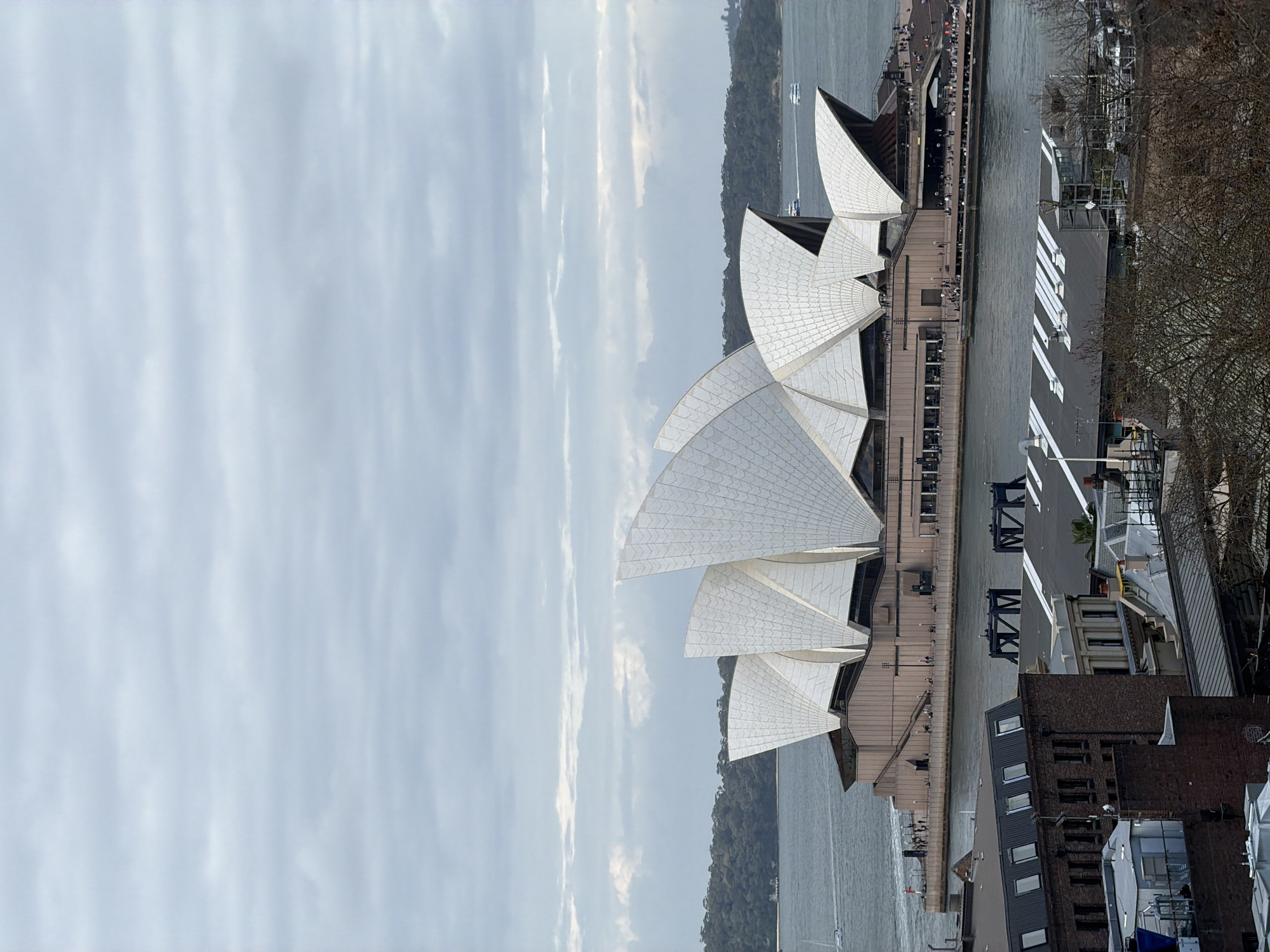
The image shows a distant view of the Sydney Opera House from The Rocks, Australia. The Opera House, with its distinctive white sail-like shells, is situated on the water, with a body of water in front of it. Behind the Opera House, a tree-covered landmass is visible. In the foreground, the rooftops and upper floors of buildings in The Rocks district are visible, including brick structures and modern industrial-style rooftops. Several boats are present in the water near the Opera House, and a few individuals are visible on the promenade in front of the building. The sky is overcast with layered clouds.
The Rocks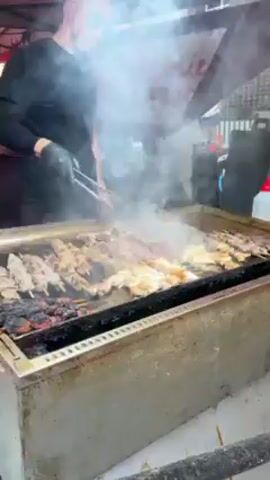
A man is seen grilling meat skewers on a large, flat grill. He's wearing a black shirt, black gloves, and sunglasses. Smoke rises from the grill as he uses tongs to turn the skewers. He then squeezes a bottle of liquid, likely oil or marinade, onto the grilling meat. A sign reading "Daniel's BBQ" is partially visible in the background. The scene appears to be outdoors under a red canopy.
The Rocks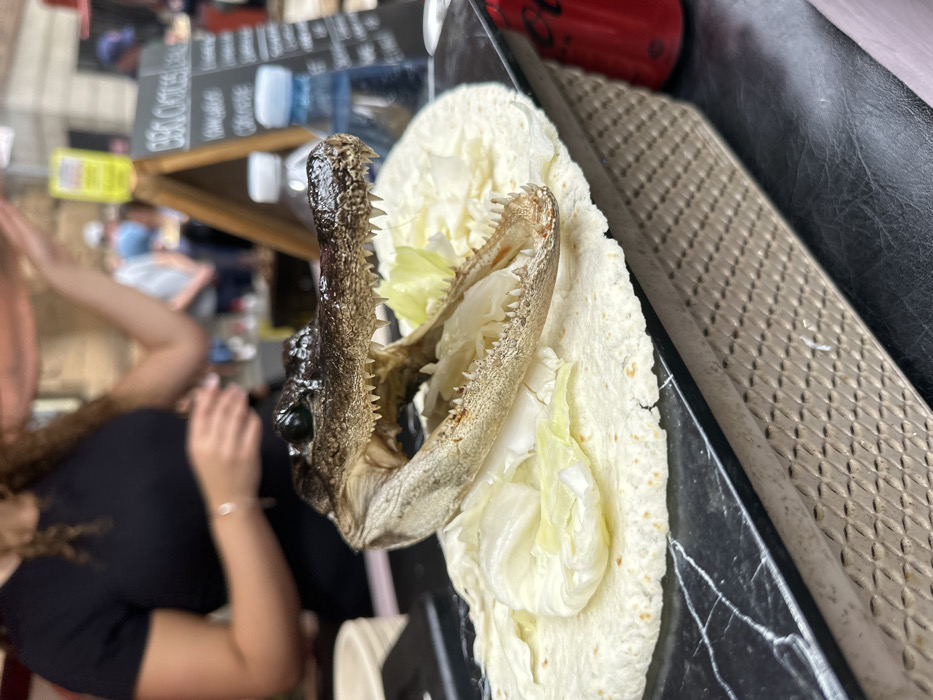
A tortilla wrap filled with lettuce is topped with a cooked alligator head, featuring an open mouth displaying sharp teeth. The alligator's head is dark brown with visible eyes. The tortilla appears to be on a black marble surface next to an interior with a patterned surface and a red can. A blurred human figure is visible in the background, adding context to the setting, possibly indicating a food vendor or restaurant.
The Rocks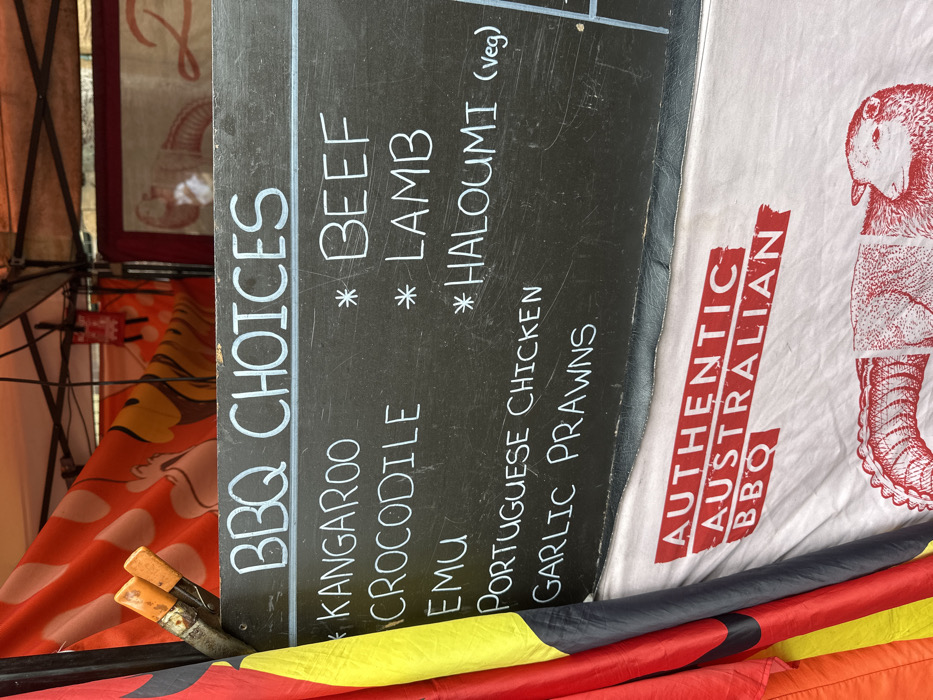
A chalkboard menu advertising "BBQ CHOICES" lists various meats and vegetarian options. Among the choices are kangaroo, crocodile, emu, beef, lamb, and haloumi (vegetarian). Additionally, Portuguese chicken and garlic prawns are available. Next to the chalkboard is a white t-shirt with a red print that reads "AUTHENTIC AUSTRALIAN BBQ" and features a red illustration of a wombat in a pair of boots. The corner of the t-shirt and menu is covered by a flag with red, yellow, and black stripes.
The Rocks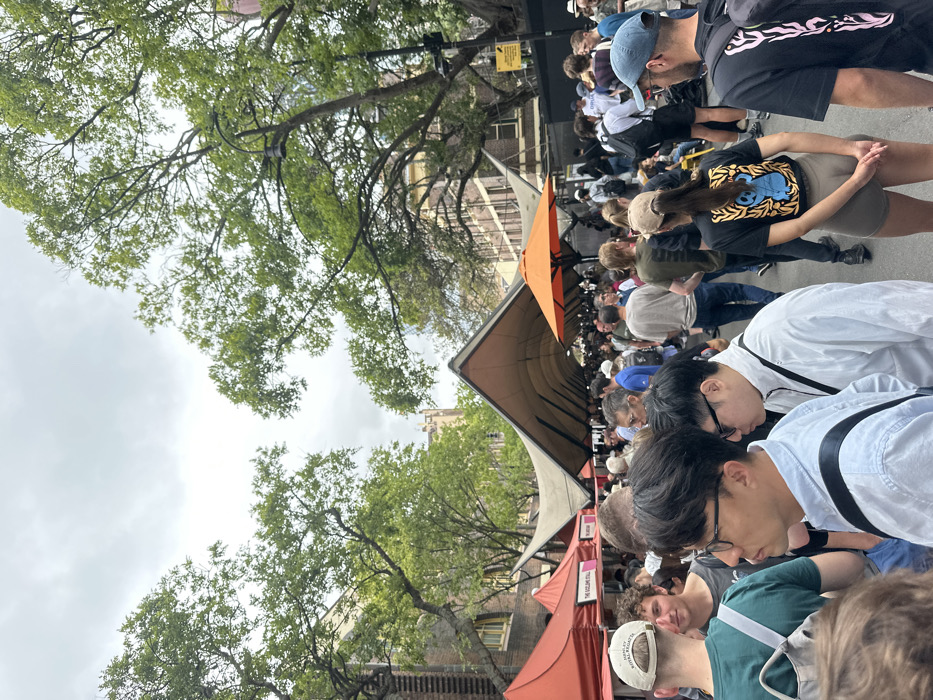
A bustling outdoor scene with a dense crowd under orange-roofed stalls and tents. People are closely packed, many looking downward, possibly at vendors or displays. Trees with lush green leaves frame the top and left sides, contrasting with a cloudy sky. Buildings are visible in the background, suggesting an urban setting. The photo is oriented sideways, giving a tilted perspective of the event.
The Rocks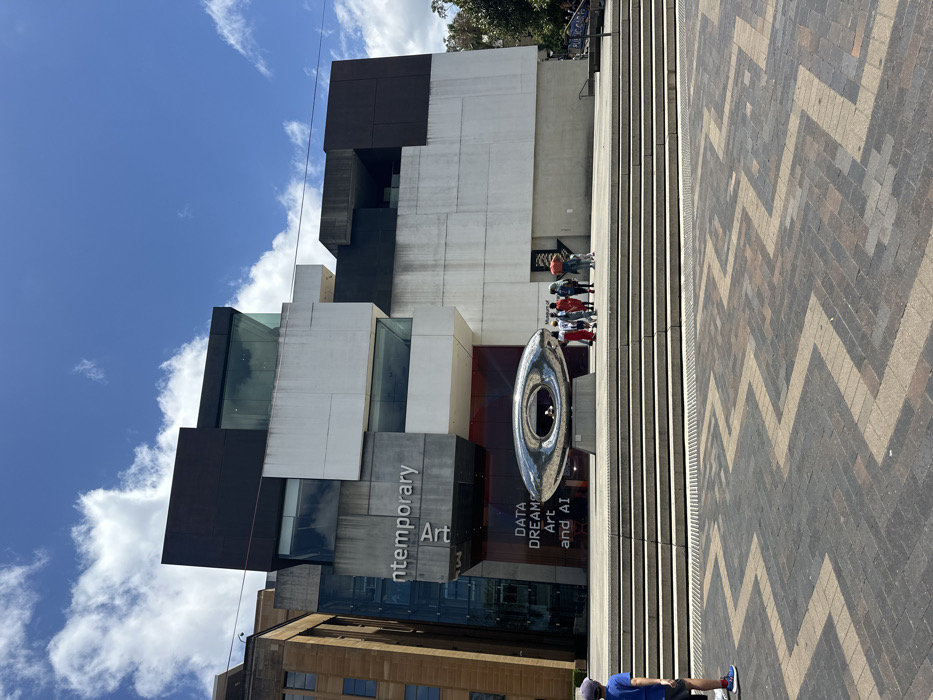
A modern architectural building stands under a blue sky with scattered clouds. The building is constructed with stacked, angular blocks in shades of brown, white, and gray. A large silver sculpture is positioned near the entrance. The building has the words "contemporary Art" and "DATA DREAMS Art and AI" written on it. A group of people can be seen on the stairs leading up to the building. The walkway in front of the building is paved with a herringbone pattern. A man is visible walking on the side.
The Rocks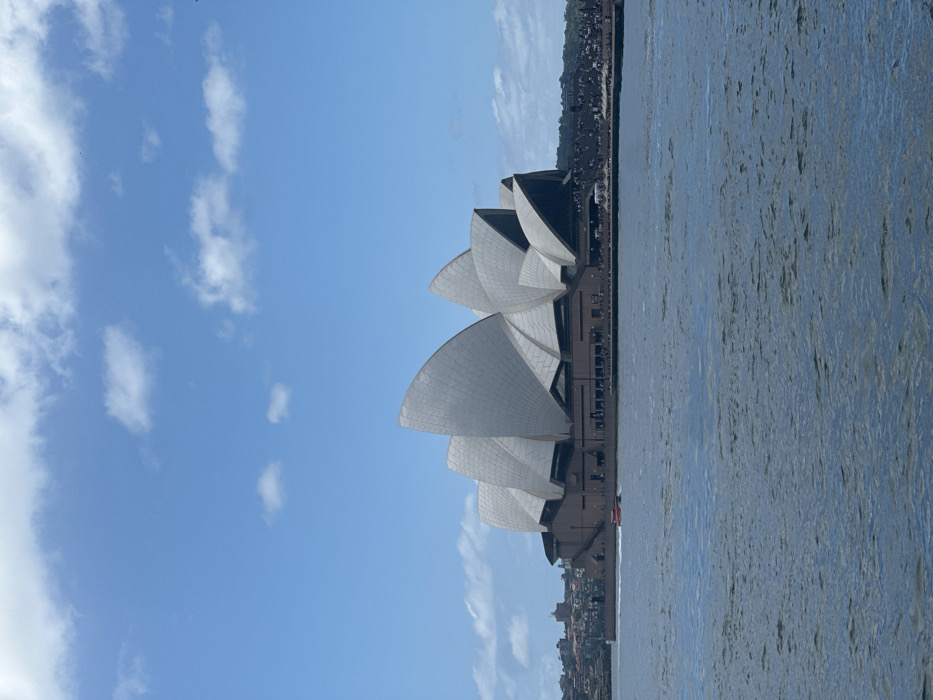
Sydney Opera House stands prominently against a blue sky with scattered clouds. The iconic white sails face the viewer, juxtaposed with the calm water reflecting the surroundings. The structure is partly shadowed, revealing details of its architecture. A cityscape stretches along the waterline beyond the Opera House, contrasting with the vastness of the sky and water.
The Rocks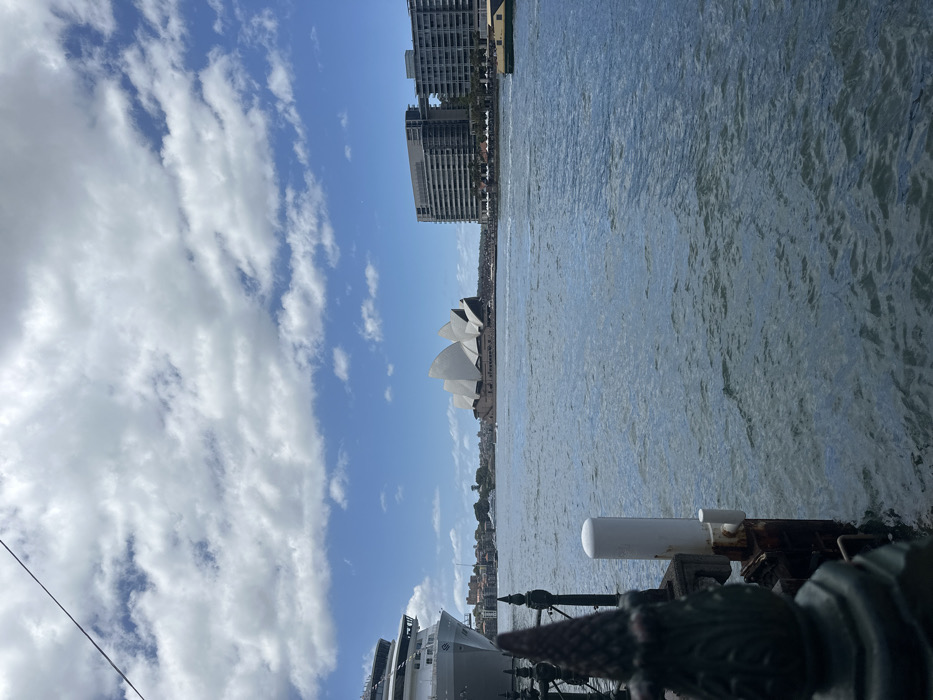
The Sydney Opera House is viewed from a boat, framed by ornate railings. The harbor is choppy with sunlight reflecting across the water. Buildings rise along the coastline. The sky is blue with scattered, fluffy white clouds. The overall scene is bright, capturing a quintessential Sydney vista.
The Rocks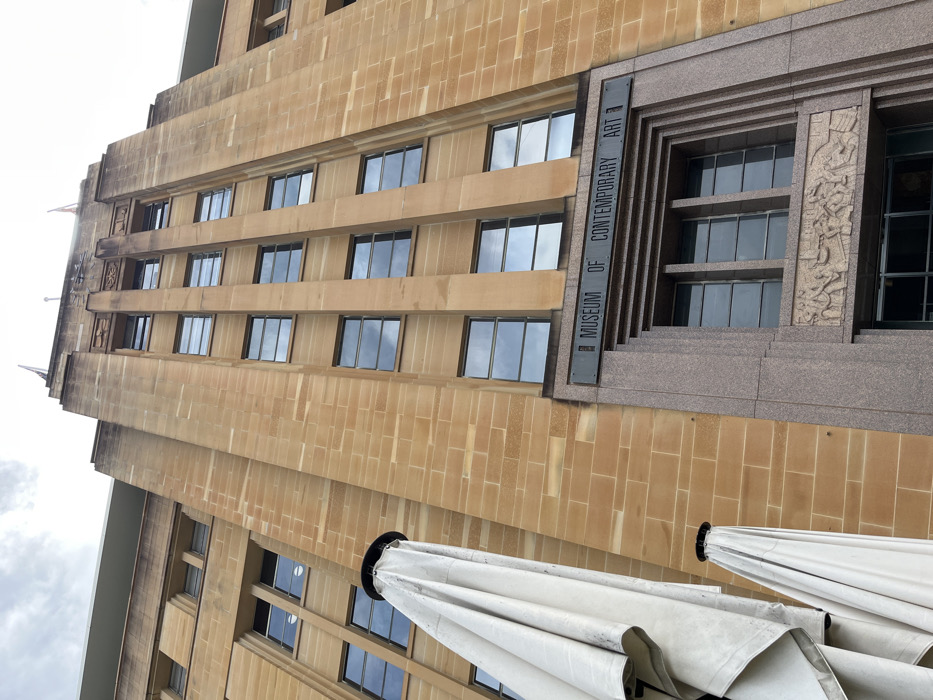
The image captures a striking low-angle view of a tall, multi-story building, composed of light brown, rectangular stone blocks. The photograph is rotated counter-clockwise, presenting the imposing structure diagonally across the frame against an overcast sky. The building exhibits a tiered or stepped design, featuring numerous rows of rectangular windows that reflect the cloudy daytime sky. A prominent vertical sign is visible on the right side of the building, clearly stating "MUSEUM OF CONTEMPORARY ART". This sign is part of a distinct architectural section detailed with darker, possibly granite, trim, deeply recessed window frames, and an ornate carved relief panel situated to the right of the sign. The relief depicts intricate figures or scenes, emphasizing the building's artistic purpose. The architectural style suggests an Art Deco influence with its solid, monumental aesthetic. In the foreground, two large, folded white patio umbrellas are partially visible at the bottom, suggesting an outdoor seating area or cafe adjacent to the structure. The weather is overcast, and the scene is set during the daytime. No individuals or specific activities are visible, lending a quiet, grand quality to the composition. Based on the visible text and architectural style, and the provided context, the building is the Museum of Contemporary Art Australia (MCA) located in The Rocks, Australia.
The Rocks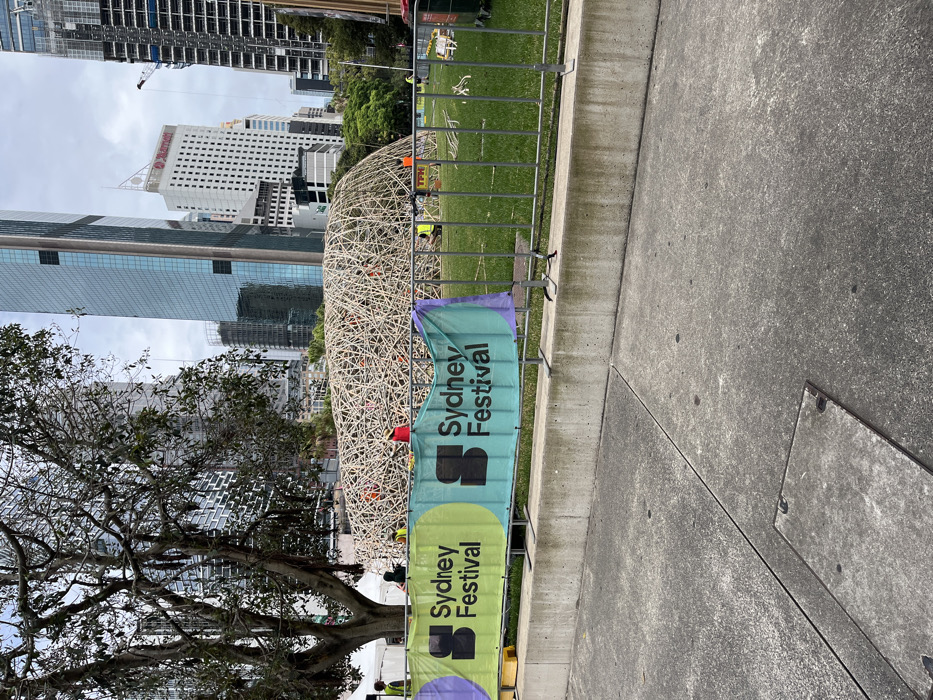
This outdoor photograph, taken in The Rocks, Sydney, Australia, depicts an urban scene likely associated with the Sydney Festival under an overcast sky. The central feature is a large, intricate art installation resembling an organic, beehive-like structure, intricately woven from light-colored branches or wicker. This sculpture is positioned on a grassy lawn, separated from a public concrete walkway by temporary metal barriers. Attached to these barriers are multiple vibrant banners, clearly displaying the text "Sydney Festival" and its logo, confirming the event. Several individuals, some wearing high-visibility vests, are visible near and within the sculpture, suggesting ongoing setup, maintenance, or attendance. In the background, a cluster of modern high-rise buildings dominates the skyline, with one white structure prominently featuring "Marriott" signage near its top. A large, mature tree with a significant canopy and visible branches stands to the left, partially obscuring some of the distant architecture. The foreground consists of a wide, grey concrete path, hinting at a bustling city environment. The overall lighting is soft and diffused due to the cloudy conditions, indicating daytime.
The Rocks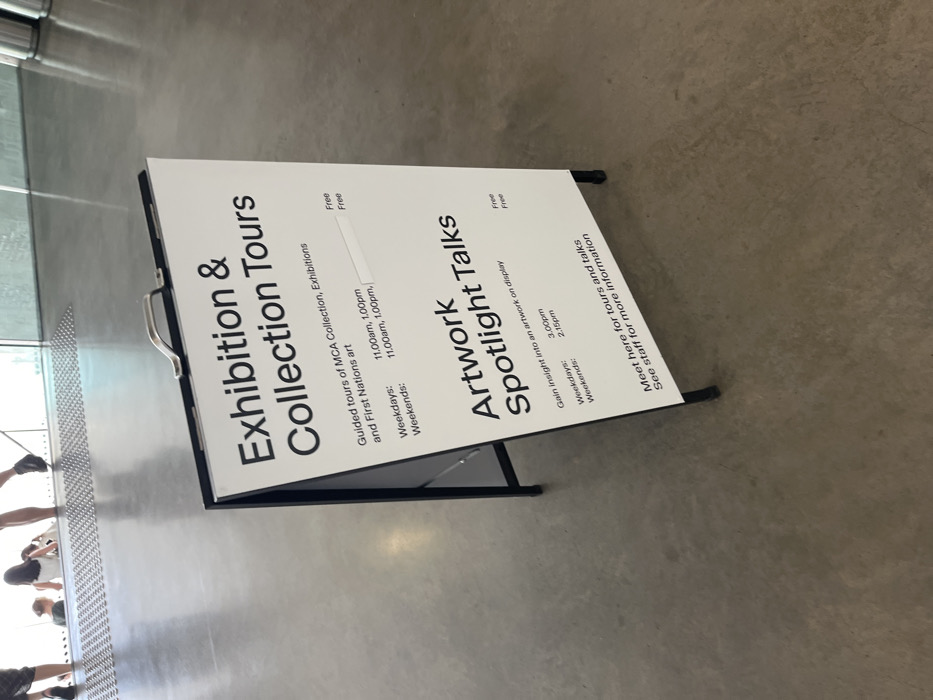
An A-frame sign, predominantly white with black text, stands on a light gray concrete floor in what appears to be a modern indoor public space, likely a museum or gallery. The sign is angled, allowing both sides to be visible. The left panel of the sign advertises "Exhibition & Collection Tours," described as "Guided tours of MCA Collection, Exhibitions and First Nations art." These tours are "Free" and scheduled for Weekdays at "11.00am, 1.00pm" and Weekends at "11.00am, 1.00pm." The right panel of the sign promotes "Artwork Spotlight Talks," which aim to "Gain insight into an artwork on display." These talks are also "Free" and take place on Weekdays at "3.00pm" and Weekends at "2.15pm." Below both sections, the sign instructs visitors to "Meet here for tours and talks" and "See staff for more information." In the background to the left, a bright area suggests a glass wall or window, reflecting ambient light indicative of daytime. The lower halves of several people are partially visible near this bright area, some standing, some seated, suggesting visitors or staff. A section of metallic gridded flooring is also present near the glass. The setting, including the mention of "MCA Collection" on the sign, points to the Museum of Contemporary Art in The Rocks, Australia.
The Rocks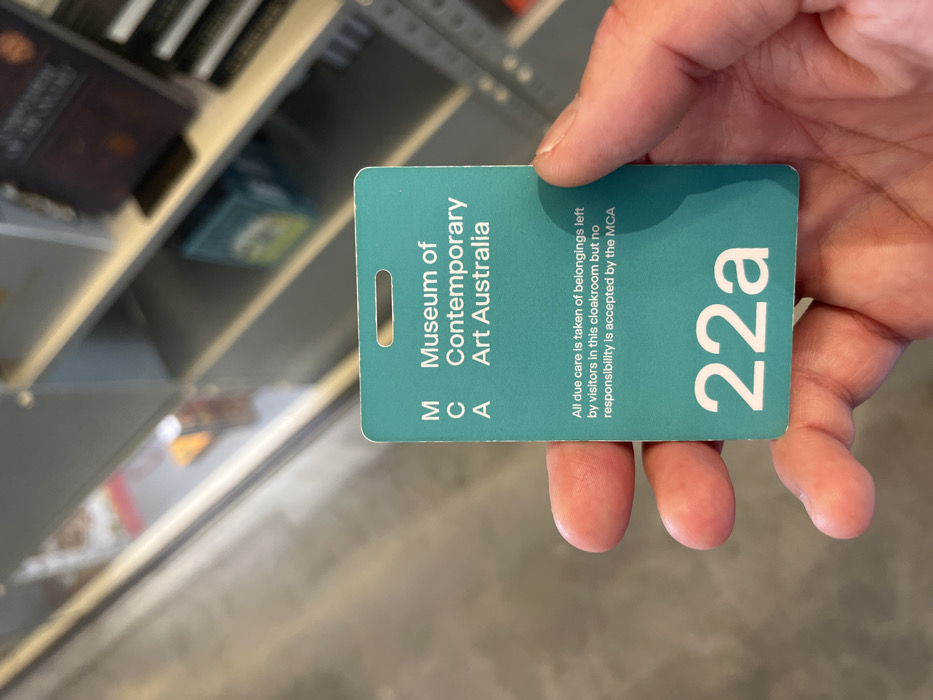
A person's right hand is prominently featured in the foreground, holding a rectangular, teal-colored cloakroom tag. The tag is held horizontally, spanning most of the width of the hand, with the thumb grasping the top left corner and fingers supporting the bottom edge. The tag is a vibrant teal or turquoise color with white text. On the left side, oriented vertically, are the letters "M C A" stacked, followed by "Museum of Contemporary Art Australia" also oriented vertically. A small, oblong punched-out slot is visible near the top left edge of the tag, suggesting it can be attached to a hook or lanyard. To the right of the museum name, in smaller, horizontal text, is a disclaimer: "All due care is taken of belongings left by visitors in this cloakroom but no responsibility is accepted by the MCA." Further to the right, in large, bold, horizontal white text, is the alphanumeric code "22a". The tag appears to be made of a durable material, possibly plastic, and shows minor signs of use. The background is softly blurred, indicating an indoor setting, likely within the Museum of Contemporary Art Australia. Distant shelves or storage units are visible, containing indistinct items that could be books or other stored objects. The soft focus on the background emphasizes the cloakroom tag and the hand holding it. The lighting appears to be even, suggesting an indoor environment. The image captures a moment, likely at a museum cloakroom, either before depositing an item or upon retrieving one, using the tag as identification.
The Rocks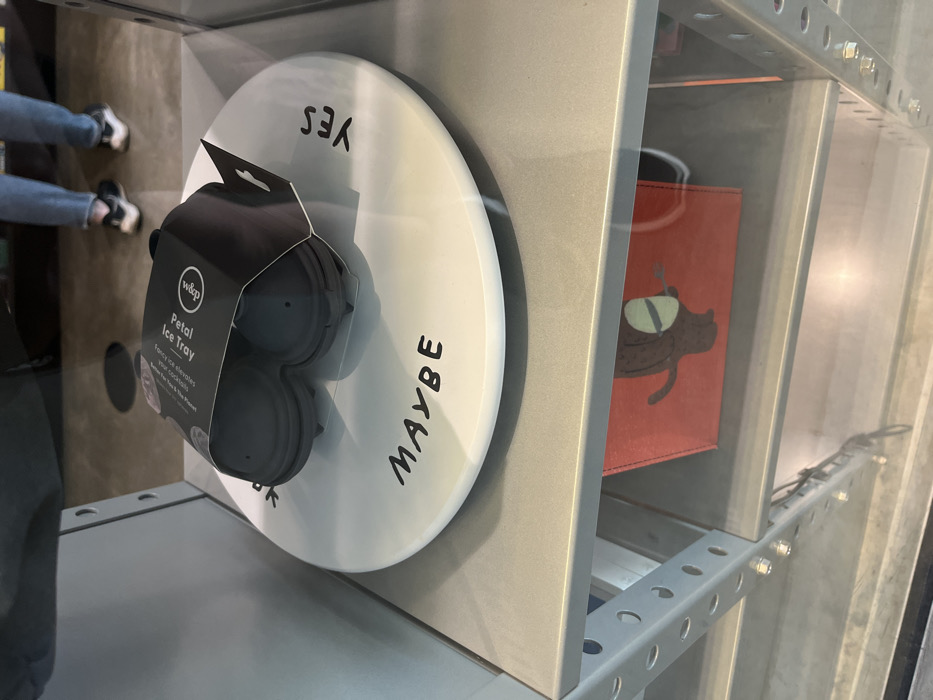
This image depicts an indoor retail or exhibition display, possibly located in The Rocks, Australia, viewed through a clear barrier or glass. The primary focus is a product showcase featuring a circular element and several items. In the left-center, a white, circular disc or surface is prominent, displaying the words "YES" (upside down) and "MAYBE" in a handwritten style. Resting on this disc is a black product package from the brand "w&p," containing a "Petal Ice Tray." The packaging highlights "Fancy ice elevates your cocktails" and states "Better for you & the Planet." The ice tray itself appears to be made of dark silicone, featuring several spherical molds. To the right, within a metallic shelving unit, a reddish-orange object with a distinct black cartoon cat face is visible. The cat has large green eyes and a simple, stylized design, possibly indicating a bag, wallet, or book cover. The shelving unit itself is made of light grey metal with visible bolts and perforated sections, suggesting a sturdy, modular display system. In the upper left corner, the lower body of a person is partially visible, wearing blue jeans and white sneakers, suggesting a visitor observing the display. Their legs are partially obscured and reflected in the foreground glass. The lighting is consistent with an indoor environment. The scene presents a curated display of consumer goods within a modern retail setting.
The Rocks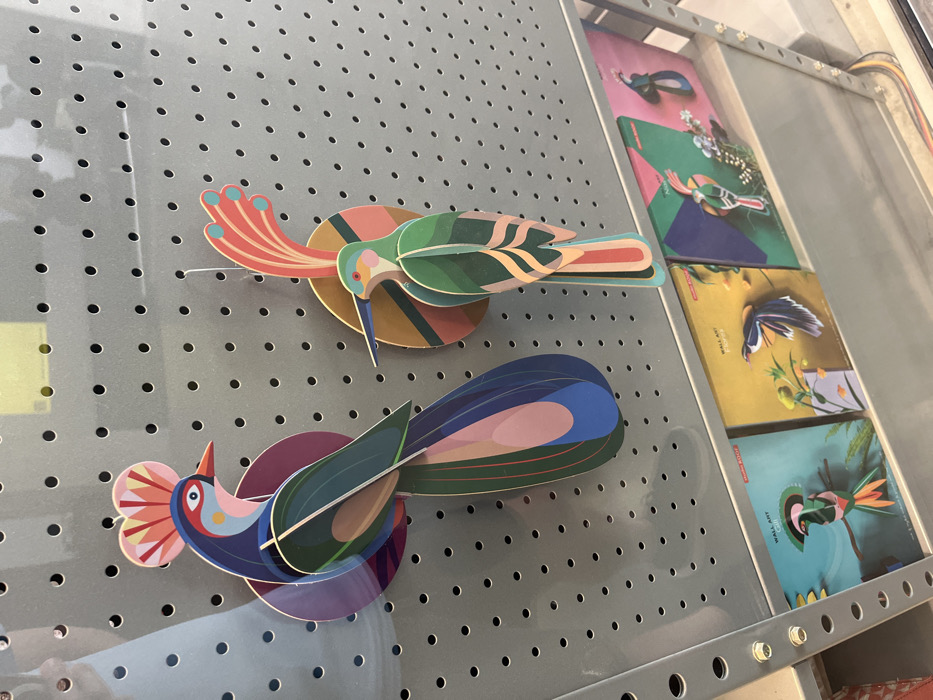
The image displays a vibrant exhibit of decorative bird art, likely paper-based or thin material cutouts, mounted on a light grey pegboard. This display is set in an indoor environment, possibly a retail space or gallery, in The Rocks, Australia. Two prominent, three-dimensional bird figures are the focal point. The upper bird features a long, pointed beak, a reddish eye, and a body primarily in shades of green with yellow and orange geometric patterns. Its fanned tail is a striking reddish-orange with subtle blue tips. It is attached to a circular, multi-colored backing. Below it, a second bird has a rounder head with a prominent red and orange crest, a blue body with flowing purple, pink, and green accents, and a fanned, pink and orange tail. This bird also rests on a circular, multi-colored base, largely purple. Both birds exhibit a layered, artistic style, suggesting they are crafted from multiple pieces. To the right, a display case contains several rectangular items, likely wall art prints, cards, or small books. These items showcase bird designs in a similar artistic style to the cutouts. Visible text on some items includes "WALL ART" in white lettering on a golden-yellow background, and partially legible text such as "Jack&." These items feature different bird illustrations on varying backgrounds, including pink, golden-yellow, and turquoise. The pegboard surface is light grey with a regular grid of dark circular holes. The entire scene is viewed through a reflective surface, possibly glass or clear plastic, which causes visible reflections, including a partial reflection of a person's hand and arm near the bottom left of the image. The lighting indicates an indoor setting.
The Rocks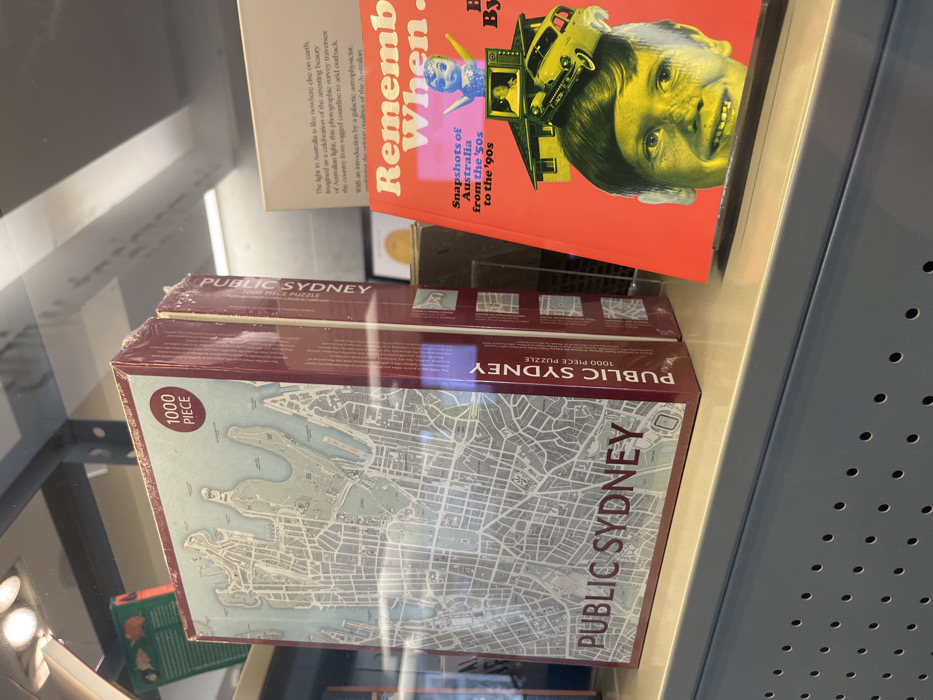
The image displays a collection of Australian-themed merchandise, likely within a retail or museum setting in The Rocks, Australia. The items are viewed through a reflective glass surface, indicated by visible glare and light reflections. In the foreground, two identical "PUBLIC SYDNEY 1000 PIECE PUZZLE" boxes are stacked. The front of the uppermost puzzle box features a detailed, light-colored map of the Sydney metropolitan area, including its distinctive harbor, waterways, and street grid. The text "1000 PIECE" is clearly visible in a circular emblem on the left, and "PUBLIC SYDNEY" is prominently displayed vertically on the right. The side of the box also reiterates "PUBLIC SYDNEY 1000 PIECE PUZZLE". Above the puzzles, two books are displayed. The top book has a striking red cover titled "Remember When..." with the subtitle "Snapshots of Australia from the '50s to the '90s". Its cover art is a retro-style collage depicting a person's head from which various elements like a car, a house, and a doll emerge, set against a vibrant yellow and blue background. The author's name "By" is partially visible. Behind this book, another book with a lighter-colored cover is visible. Text on its cover begins: "The light in Australia is like nowhere else on earth. Imagined as a celebration of the arresting beauty of Australian light, this photographic survey traverses the country from rugged coastline to arid outback. with an introduction by a galactic astrophysicist, the qualities of the Australian". The scene depicts a static retail or exhibition display, with no active event or individuals present. The indoor lighting provides no cues about the time of day or external weather conditions.
The Rocks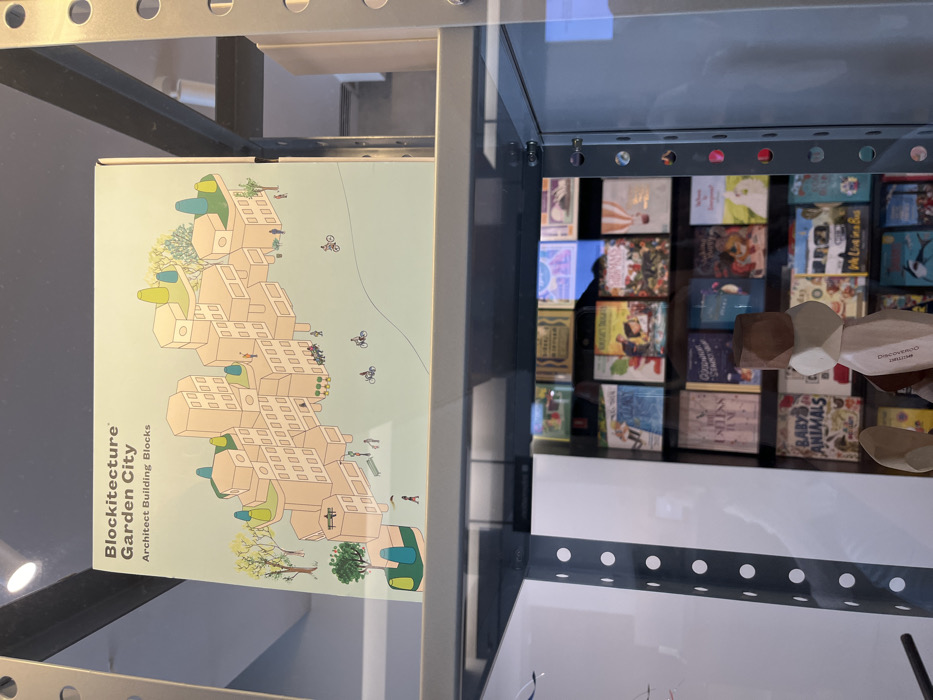
An image, rotated 90 degrees counter-clockwise, captures a product box displayed within what appears to be a metal and glass shelving unit, likely in a retail store or exhibition space in The Rocks, Australia. The primary subject is a light blue-green box titled "Blockitecture Garden City Architect Building Blocks." The box features an illustrative design of a modular, block-like city with integrated green spaces, small stylized trees, and tiny human figures, including cyclists on pathways. The box is positioned on a shelf to the left of the frame. To its right, a vertical metal support separates it from a glass panel, which reflects a dense grid of other product boxes or books. These reflections show numerous colorful covers, some partially legible. Visible text from these reflected items includes "BABY ANIMALS," "We Live in a Bus," and "DISCOVERDO." The overall setting suggests an indoor environment with artificial lighting, emphasizing the items on display. A faint, dark silhouette of a person is visible in the reflections among the books, hinting at a passerby or another display element.
The Rocks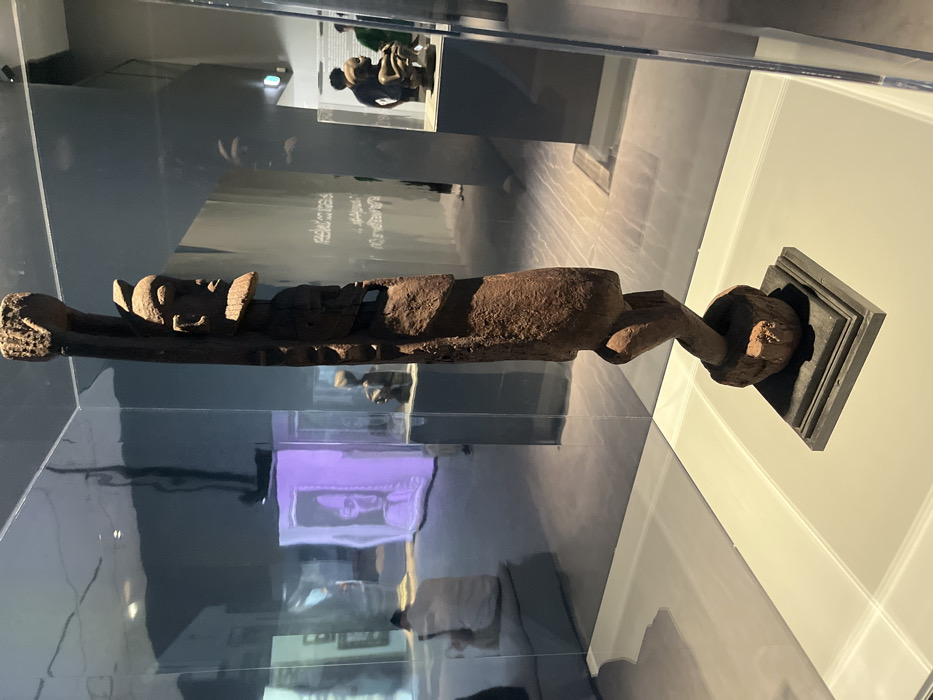
This image displays a dark brown, carved wooden sculpture of a standing human figure, presented within a clear, reflective display case in what appears to be a museum or exhibition space. The figure is tall and slender, with distinct facial features and arms bent, one appearing to be raised towards its head. It rests on a square black base. The wood exhibits a textured, aged appearance. The polished surfaces of the display case create numerous prominent reflections. Most notably, a vivid purple-hued light box or screen is reflected in the lower half of the case. In the background, another display case holds a lighter-colored wooden sculpture depicting two smaller, huddled figures. Faint, indistinct white text on a dark background, likely an informational panel, is also visible in the reflections. The lighting appears to be artificial, casting bright highlights and contributing to the reflective quality of the scene. The image is captured in a portrait orientation but is rotated 90 degrees counter-clockwise, causing the upright sculpture to appear horizontal in the photograph. No explicit activity is taking place beyond the static display of the artifact for viewing. The setting is sterile and controlled, characteristic of a museum environment. No specific location cues are visible within the image to indicate "The Rocks, Australia," beyond the general museum context.
The Rocks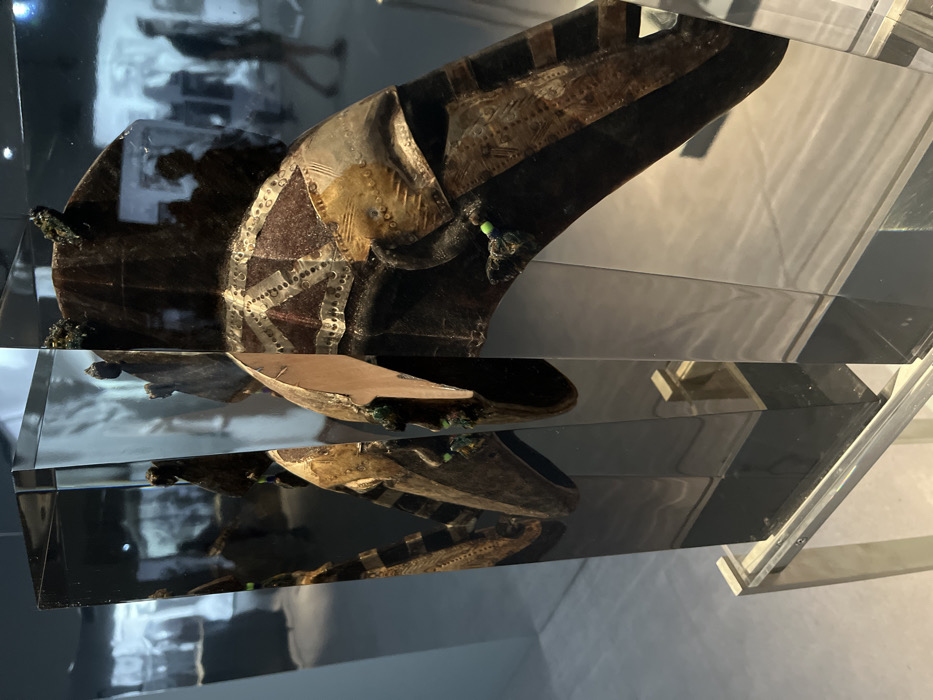
This media file presents a close-up view of an intricate artifact encased within a clear, multi-layered reflective display case, likely situated in a museum or gallery in The Rocks, Australia. The primary subject is a dark, elongated artifact, possibly crafted from aged leather or fur, adorned with elaborate metallic embellishments. Its surface exhibits a dark brown or black hue, suggesting an organic material with a subtle texture. The object is decorated with hammered metal plates, possibly bronze or brass, featuring intricate patterns of embossed dots and lines. Lighter-colored strips, which appear to be perforated, form a distinct triangular design on one section. Small, bright green bead-like elements or woven details are visible near the base and integrated into the metallic decorations. The craftsmanship points to an item of cultural or historical significance, potentially a ceremonial accessory, headpiece, or part of a garment. The artifact is presented on a dark surface inside the display case. The highly reflective, transparent walls of the case create multiple layered reflections above and below the object, producing a fragmented visual effect. These reflections faintly capture indistinct shapes of people and architectural elements in the background, reinforcing the setting as an indoor public exhibition space. No specific activity is depicted other than the object being showcased for observation. The lighting is even, typical of an indoor display environment. No readable text is visible within the image.
The Rocks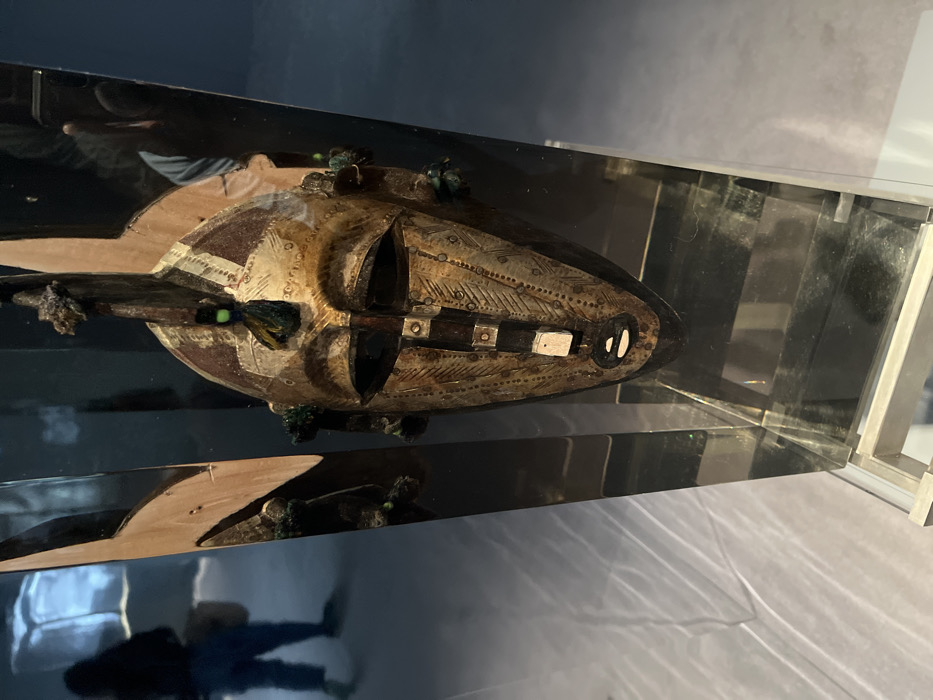
An intricately crafted artifact, possibly a mask or a ceremonial object, is displayed within a clear glass or acrylic case. The object, seen from a slightly elevated perspective, is horizontally elongated, with an oval, somewhat pointed shape at both ends. It measures approximately 30-40 cm in length. The artifact is made primarily of dark wood, with significant sections covered in a lighter, golden-hued material, possibly brass, gold leaf, or a light-colored wood inlay. This lighter material is adorned with detailed engravings of lines, dots, and geometric patterns. Distinct features include two prominent, deeply carved, eye-like depressions, and a mouth-like area with small, rectangular projections, some appearing to be made of bone or ivory. Small green and blue tassels or tufts of fibrous material are attached at several points along the object, including near the rear and along the sides. The rear of the object tapers into a flat, tail-like or fin-like extension. The object rests on a dark, reflective surface within the case, which reflects blurry outlines of people and ambient light, suggesting an indoor exhibition setting. The clear case itself also shows reflections. No text is visible on the object or its immediate surroundings. This artifact is likely on display in a museum or gallery in The Rocks, Australia.
The Rocks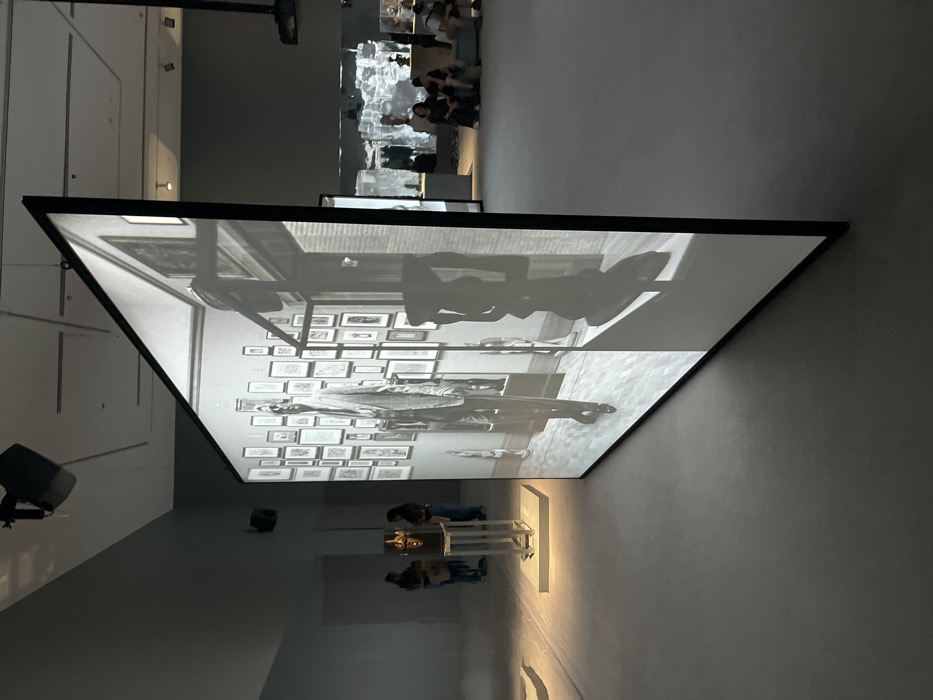
The image depicts an indoor art exhibition or gallery, characterized by a dim, atmospheric lighting design and highly reflective surfaces. The walls and floor are dark, possibly grey or black, with the polished floor creating clear reflections of the displays and visitors. The central element is a large, triangular display screen or projection, positioned prominently on the left side of the frame and angled towards the viewer. This screen showcases a monochromatic, black and white image that appears to be a historical exhibition space or studio. Within this projected image, a wall is densely covered with framed pictures or sketches, and a full-length sculpture or mannequin of a person stands in the foreground of the projected scene. In the immediate foreground, a small, rectangular display stand with an internal light source illuminates a section of the reflective floor. Two people are partially visible in this area; one person stands near the illuminated display, their reflection clearly mirroring their form on the glossy floor. A second individual is seen further right. In the background, a separate, slightly elevated area of the exhibition space is dimly lit, where a group of people are gathered. Some appear to be seated, while others stand, observing additional displays that include smaller, illuminated cases or screens. Their activity suggests they are art patrons engaging with the exhibits. The overall scene conveys a quiet and immersive art viewing experience. The interplay of light and shadow, combined with the extensive use of reflections, adds depth and visual interest to the space. The setting is indoors, so external weather conditions are not a factor, and the time of day is indeterminate due to the artificial lighting. There is no discernible text visible within the image. While contextually located in "The Rocks, Australia," the image itself contains no specific geographical identifiers.
The Rocks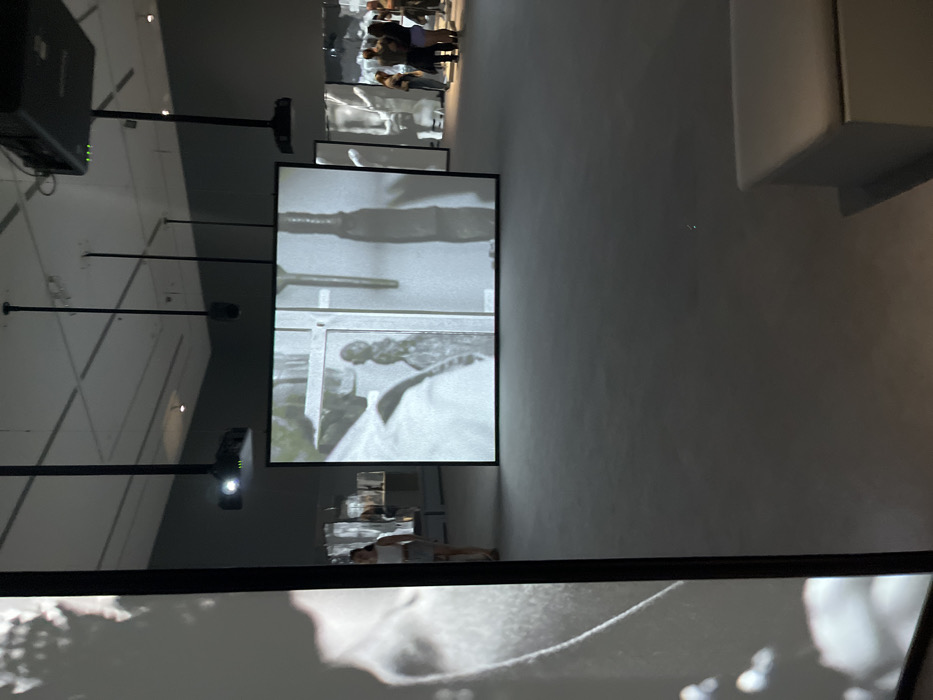
The image displays an indoor exhibition or art gallery setting, characterized by multiple vertically oriented screens projecting black and white visuals. The central focus is a large rectangular screen showcasing two distinct black and white images: the upper half features a long, narrow object resembling a tool or weapon, possibly a dagger or spear, and the lower half presents a more complex scene including what appears to be a prone human figure or sculpture within a structured environment. Several other screens are visible, some displaying similar black and white content, while others show blurred reflections of people moving through the space, suggesting visitors engaging with the exhibition. One reflection in the lower right shows a figure lying down. Overhead, at least two black projectors are mounted on long poles extending from a white, paneled ceiling, casting light onto the screens. The overall lighting is subdued, highlighting the illuminated projections. In the upper right corner, a white architectural element, possibly a bench or platform, is partially visible. The scene evokes a quiet, contemplative atmosphere typical of a museum or art installation. No visible text is present in the image.
The Rocks