Thessaloniki, Greece
30 memories from Thessaloniki, Greece
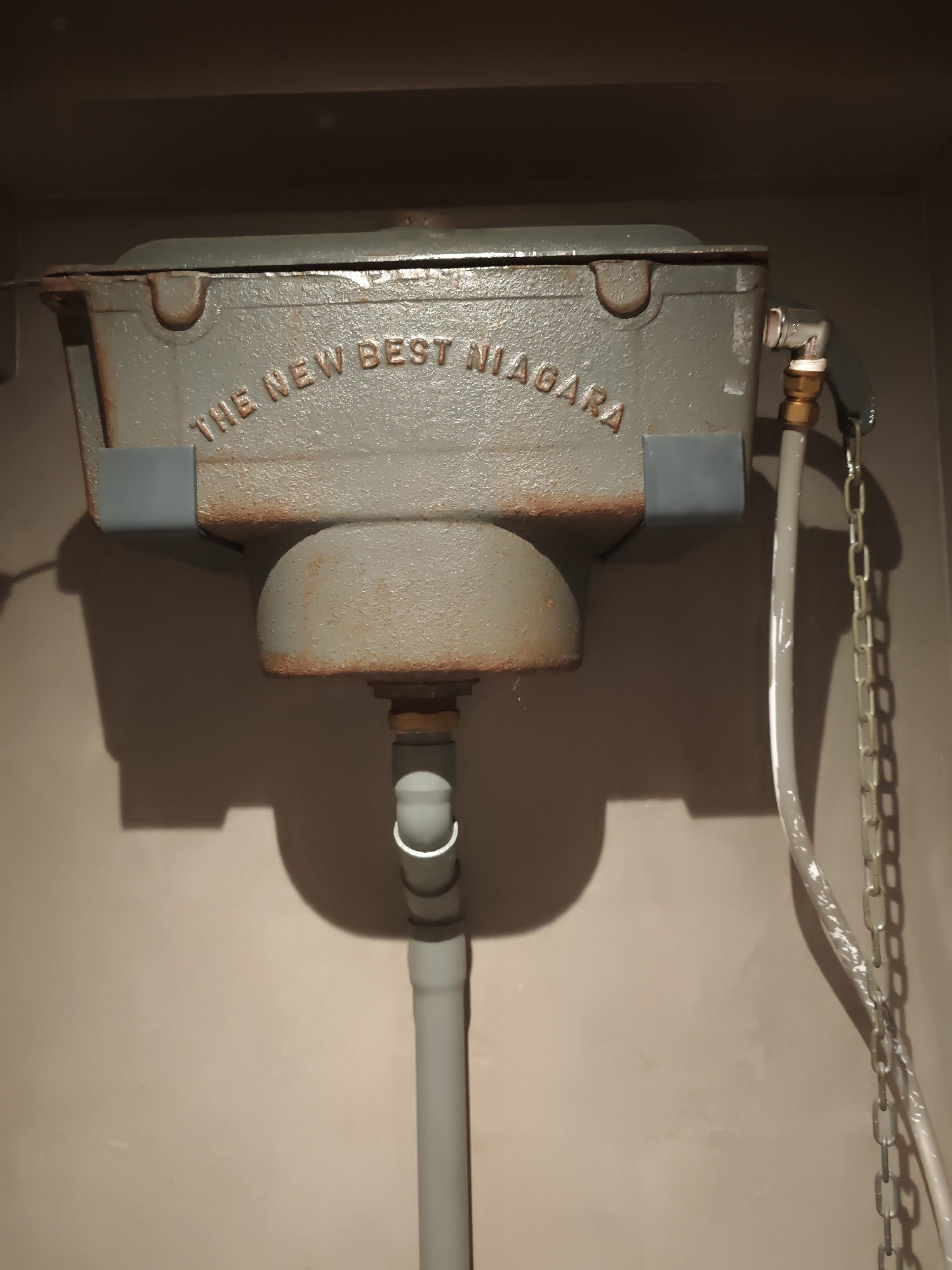
The image shows a close-up, eye-level, interior view of an antique toilet cistern. The cistern is made of cast iron and is painted a muted green color with visible signs of rust and wear, particularly around the edges and on the front where the words "THE NEW BEST NIAGARA" are embossed in raised lettering. Two grey, L-shaped brackets are attached to the sides of the cistern, supporting it. A flexible grey hose, likely for water supply, enters the cistern from the right side via a brass elbow fitting. A metal chain, also showing signs of age, hangs from the right side of the cistern and extends downwards out of the frame. Below the cistern, a curved piece of white ceramic or plastic is visible, connected to a grey pipe that descends vertically out of frame. The background is a plain, light-colored wall with a shadow cast by the cistern and its attachments. The scene does not provide any specific landmarks or context that would allow for identification of its location within Thessaloniki, Greece.
Thessaloniki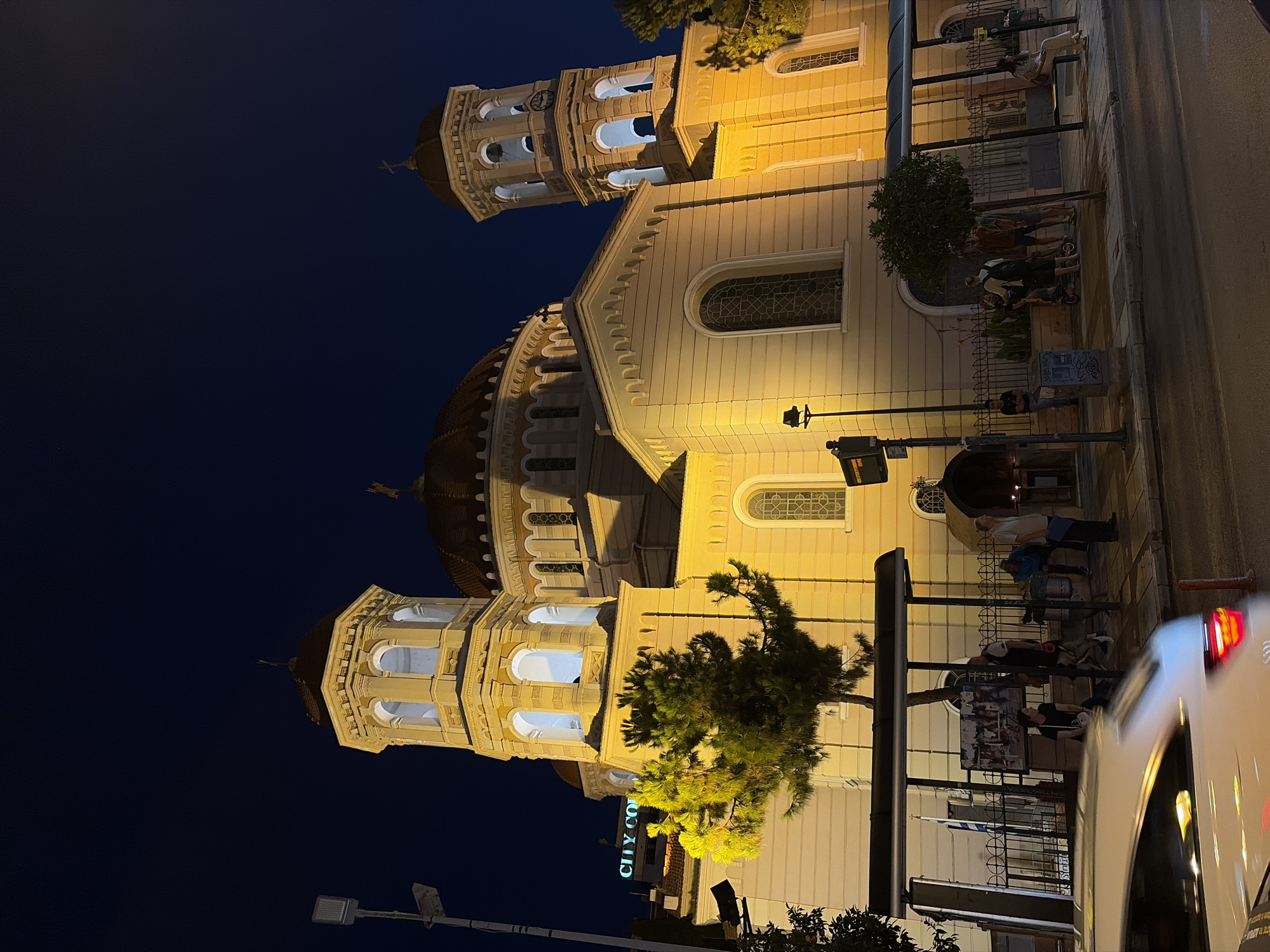
The image captures the Church of Saints Constantine and Helena in Thessaloniki, Greece, at night. The church, illuminated by warm artificial light, features a prominent dome and two bell towers. In the foreground, a street and sidewalk are visible. Several people are present, some standing under a bus shelter, others walking on the sidewalk, and one person is sitting on a bench. A white car is partially visible in the lower left corner, its taillights illuminated. The sky is dark, indicating it is nighttime.
Thessaloniki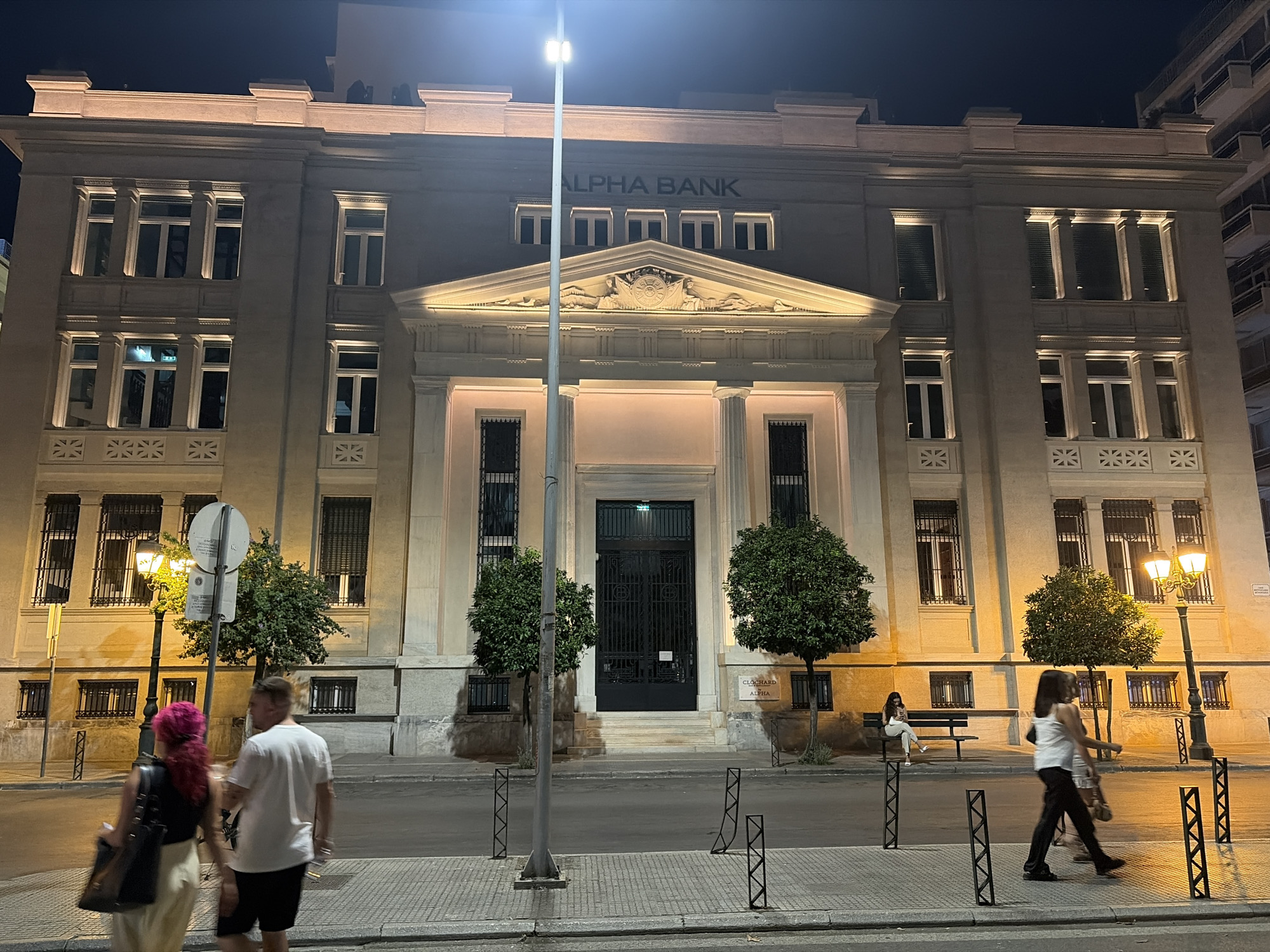
The image captures the Alpha Bank building in Thessaloniki, Greece, at night. The neoclassical facade of the bank is illuminated, highlighting its architectural details, including rows of windows, columns, and a pediment. The building's name, "ALPHA BANK," is visible in large letters across the upper facade. In the foreground, a sidewalk and street are visible. Two individuals are walking away from the camera on the sidewalk, one with bright pink hair wearing a black top and a light-colored skirt, carrying a dark bag. The other person, a man, is wearing a white t-shirt and dark shorts. Further down the street, a woman is seated on a bench. Another group of people are walking on the sidewalk towards the right side of the frame. Streetlights and trees are strategically placed along the sidewalk, contributing to the ambiance of the night scene. The street appears to be an urban environment, with other buildings visible in the background. The overall lighting suggests it is nighttime, with artificial lights illuminating the bank and street.
Thessaloniki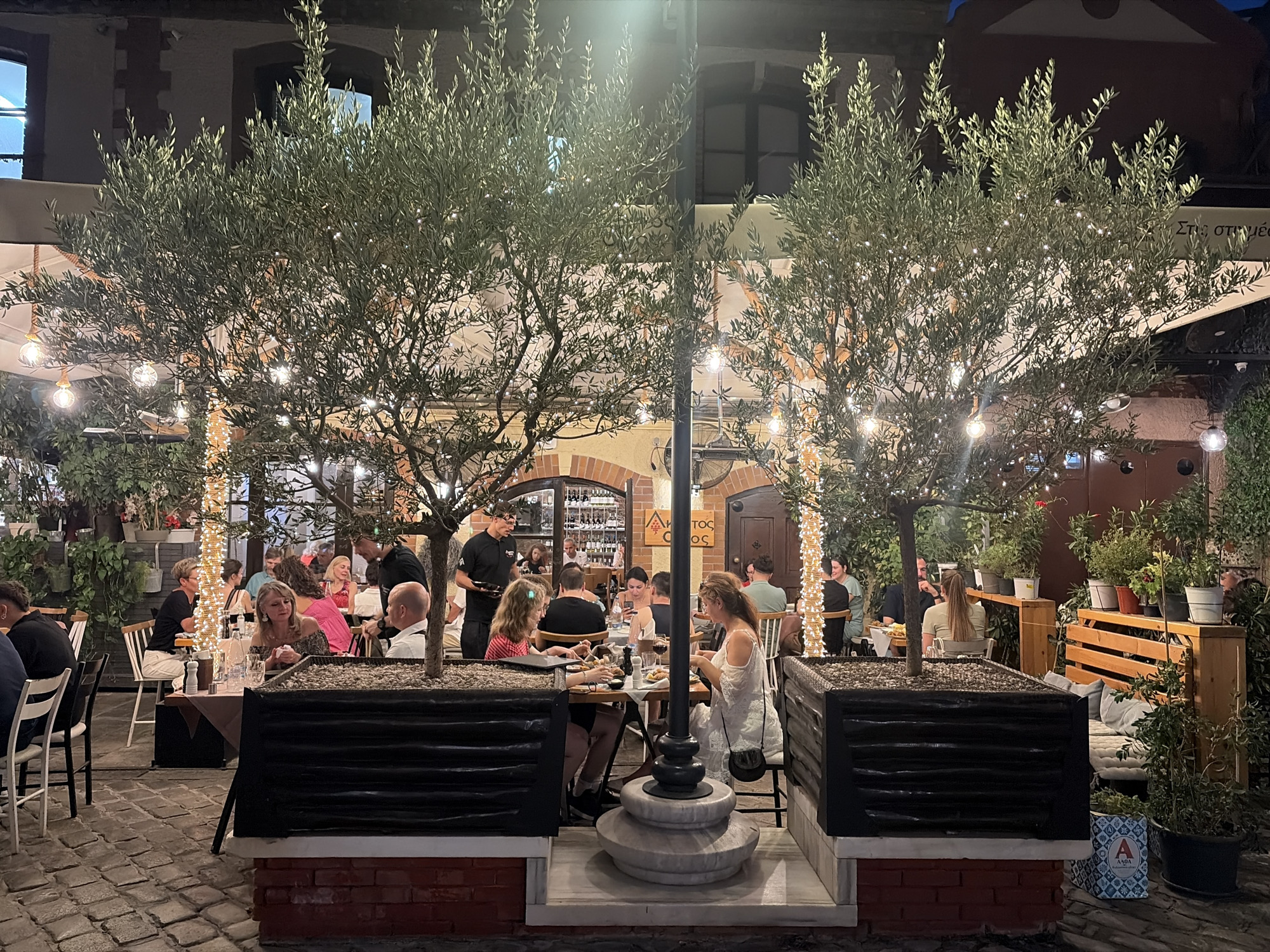
The image captures an evening scene at a restaurant in Thessaloniki, Greece. The restaurant appears to be an outdoor seating area with cobblestone flooring. Two olive trees, adorned with string lights, are prominent in the foreground, framing the view of diners. The trees are planted in large, dark rectangular planters resting on brick bases. Several tables are occupied by people eating and conversing. The diners are dressed casually. In the background, the restaurant building features arched windows and entrances, with some shelves of bottles visible through one window. Other decorative elements include more string lights and potted plants. The lighting is atmospheric, with the string lights and overhead lamps casting a warm glow. The overall impression is that of a pleasant evening dining experience in a lively, albeit relaxed, urban setting.
Thessaloniki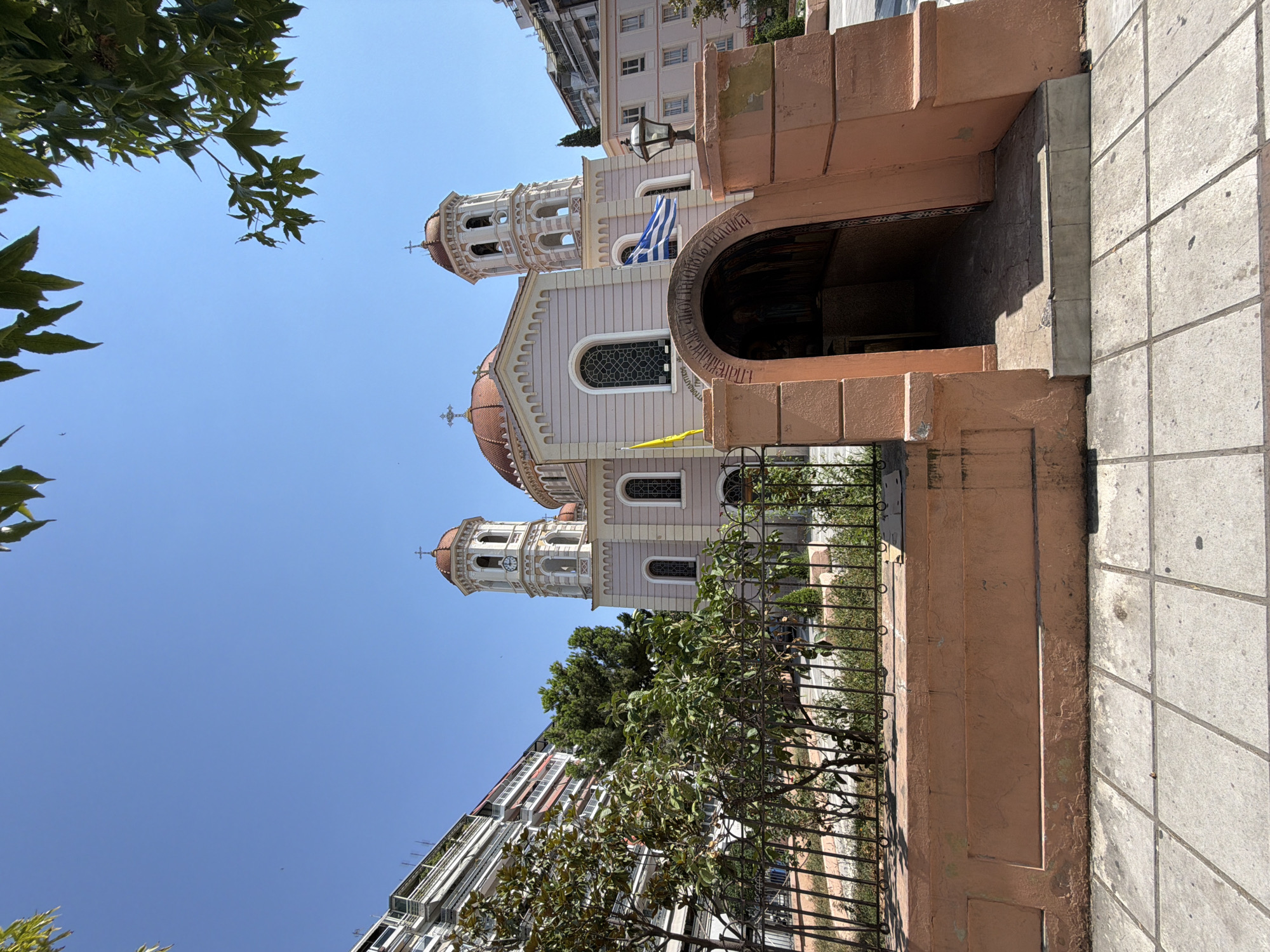
The image depicts a view of the Church of Saint Demetrius in Thessaloniki, Greece, on a clear, sunny day. The facade of the church is visible, characterized by its pale pink exterior, red-domed roofs, and twin bell towers. A prominent bell tower on the right features arches and a clock face. In front of the church entrance, there is an arched passageway adorned with religious imagery. A Greek flag flies from a pole to the right of the entrance. To the left of the church, a modern, multi-story building with balconies is visible. A black metal fence encloses a green area in front of the church, where trees and bushes are present. The foreground consists of a paved sidewalk made of grey square tiles, with some debris on the ground. The overall scene is one of an urban religious site under a bright blue sky, with elements of traditional architecture and modern city structures. There are no people or discernible actions taking place in the image.
Thessaloniki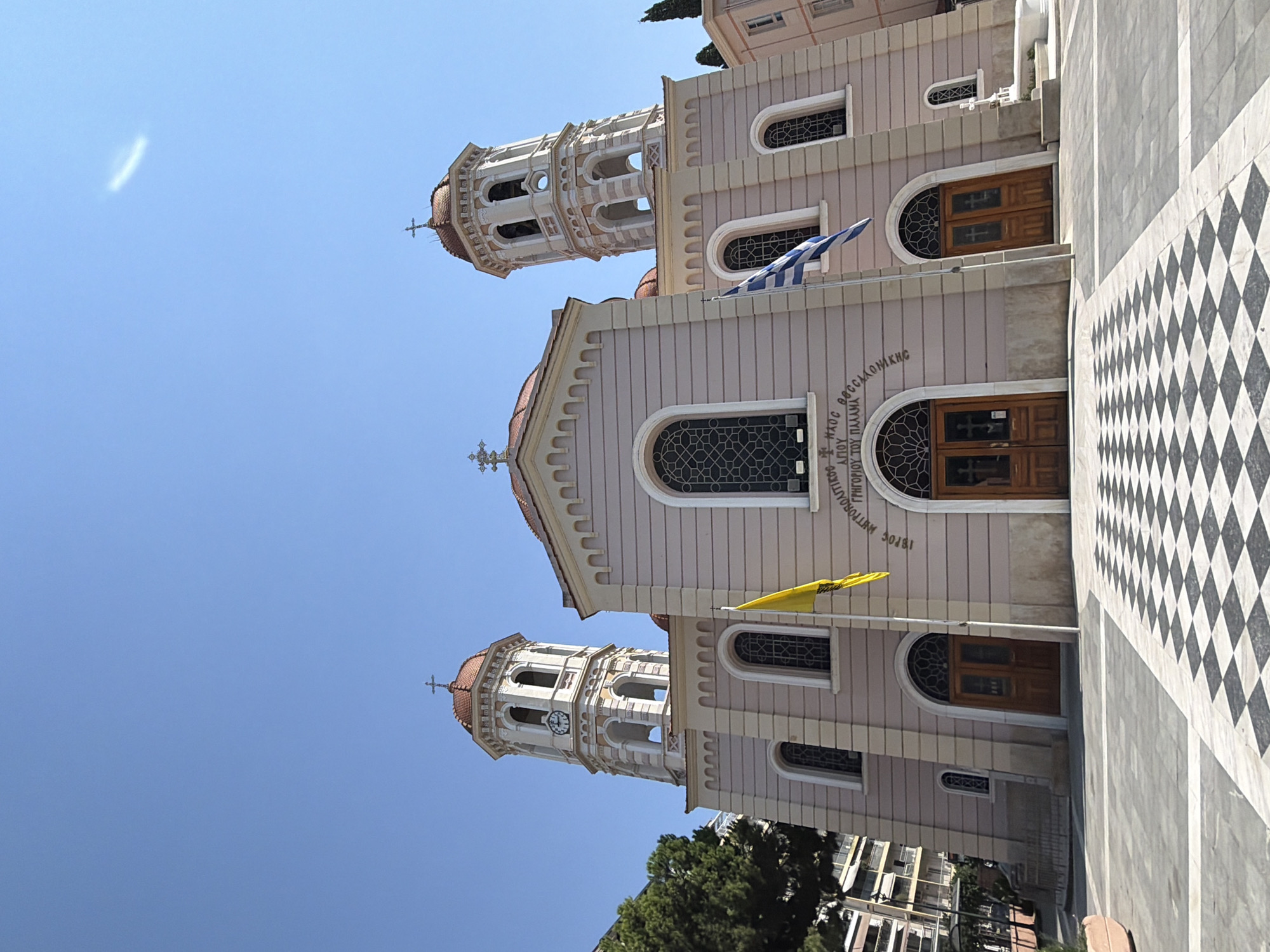
A wide-angle, low-angle exterior shot captures the Metropolitan Church of Agios Gregorios Palamas in Thessaloniki, Greece, under a clear blue sky. The church's facade is light pink with white accents, featuring two prominent bell towers flanking a central dome. The left bell tower displays a clock face. Both towers are topped with red domes and crosses. Arched windows adorn the facade, and a large rose window is centered above the main entrance, which has double wooden doors. Two flags, a yellow one and a Greek flag, are positioned in front of the church. The foreground is a paved plaza with a checkered pattern of black and white squares interspersed with marble. To the left of the church, a large green tree is visible, and behind it, apartment buildings and other structures suggest an urban setting. The lighting indicates it is daytime, with sunlight casting minimal shadows. There are no people visible in the image.
Thessaloniki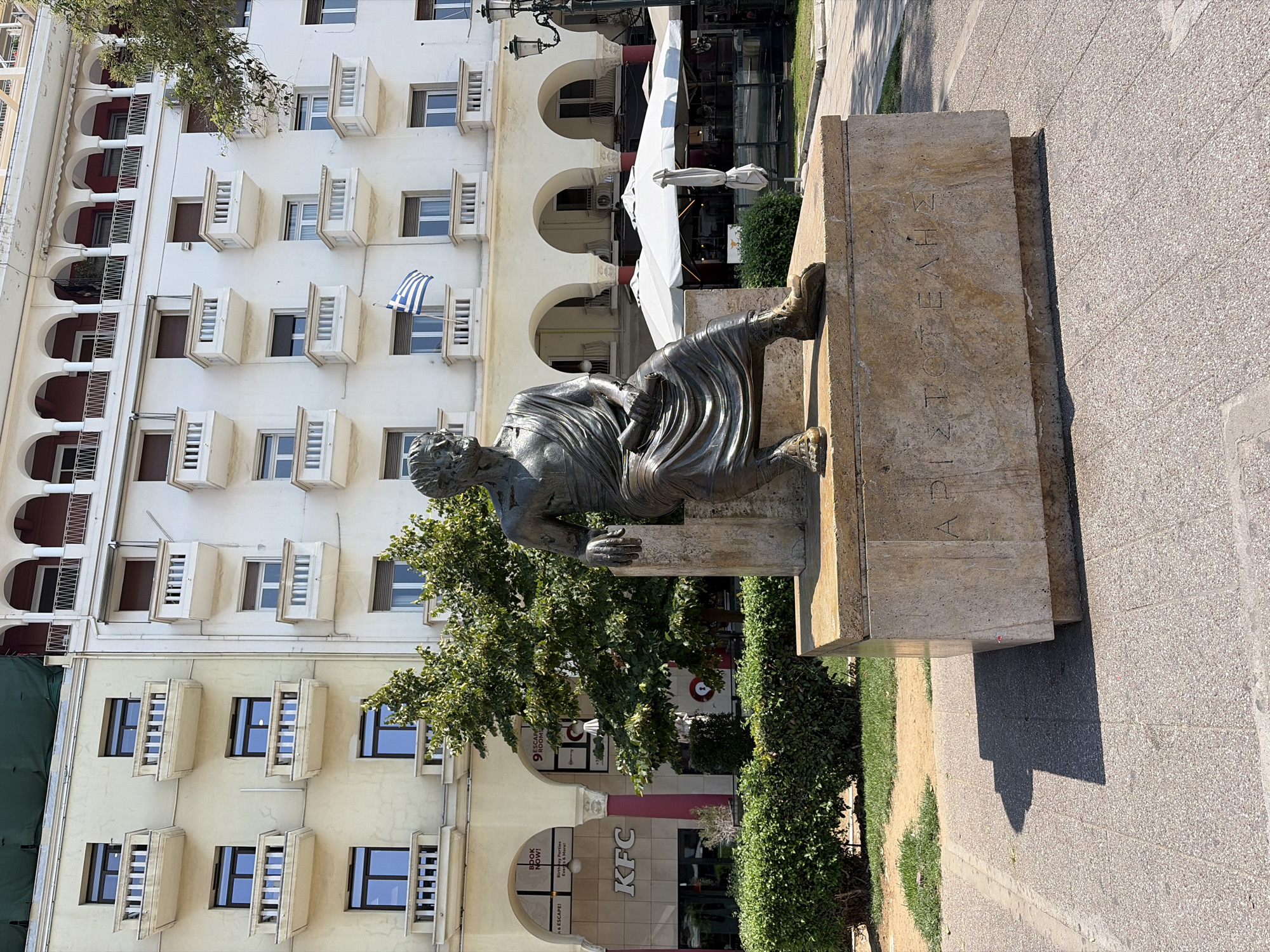
The image depicts a bronze statue of Aristotle seated on a stone pedestal in Aristotelous Square in Thessaloniki, Greece. The statue is positioned in the foreground, with its gaze directed slightly to the left. The pedestal features engraved Greek text which reads "ΑΡΙΣΤΟΤΕΛΗΣ" (Aristotle). Behind the statue, a multi-story building with arched colonnades on the ground floor is visible. Several balconies with white railings are present on the upper floors of the building. A Greek flag is flying from one of the balconies. Green trees and bushes are planted in front of the building, and outdoor seating with umbrellas suggests a cafe or restaurant area. The ground is paved with textured tiles. The overall scene suggests a sunny day in a public urban space.
Thessaloniki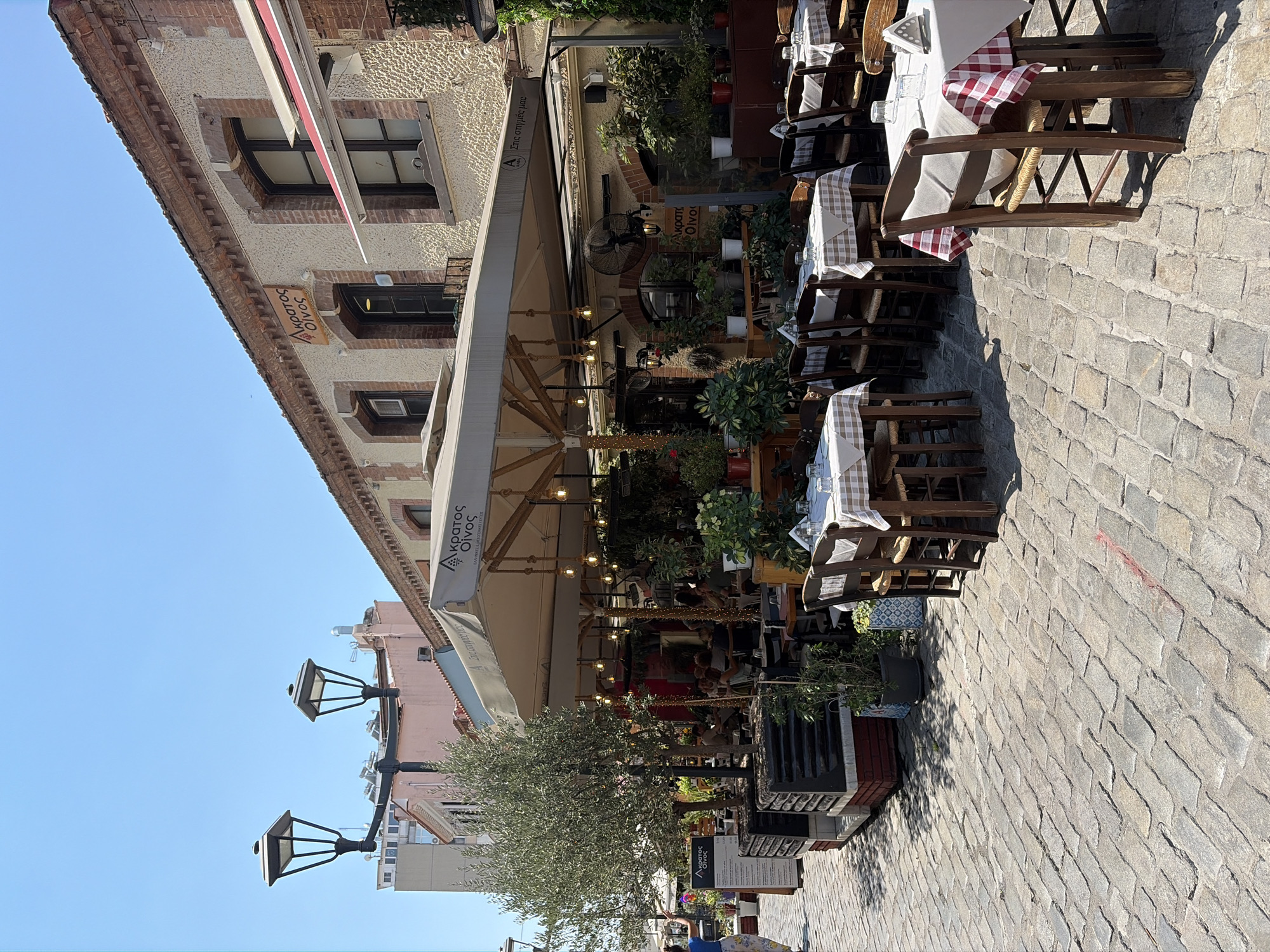
The image depicts an outdoor seating area of a restaurant on a cobblestone street in Thessaloniki, Greece. The restaurant, named "Akratos Oinos" (Ακρατος Οίνος), has tables set with checkered tablecloths and chairs. The building behind the restaurant has a light-colored facade with exposed brick accents and arched windows. Two street lamps are visible on poles against a clear blue sky. There are olive trees in large planters and numerous potted plants decorating the space. Several people are seated at tables inside the covered area of the restaurant, appearing to be dining. A person is walking away from the camera on the left side of the street. The overall impression is of a lively, sunny day in a Mediterranean city.
Thessaloniki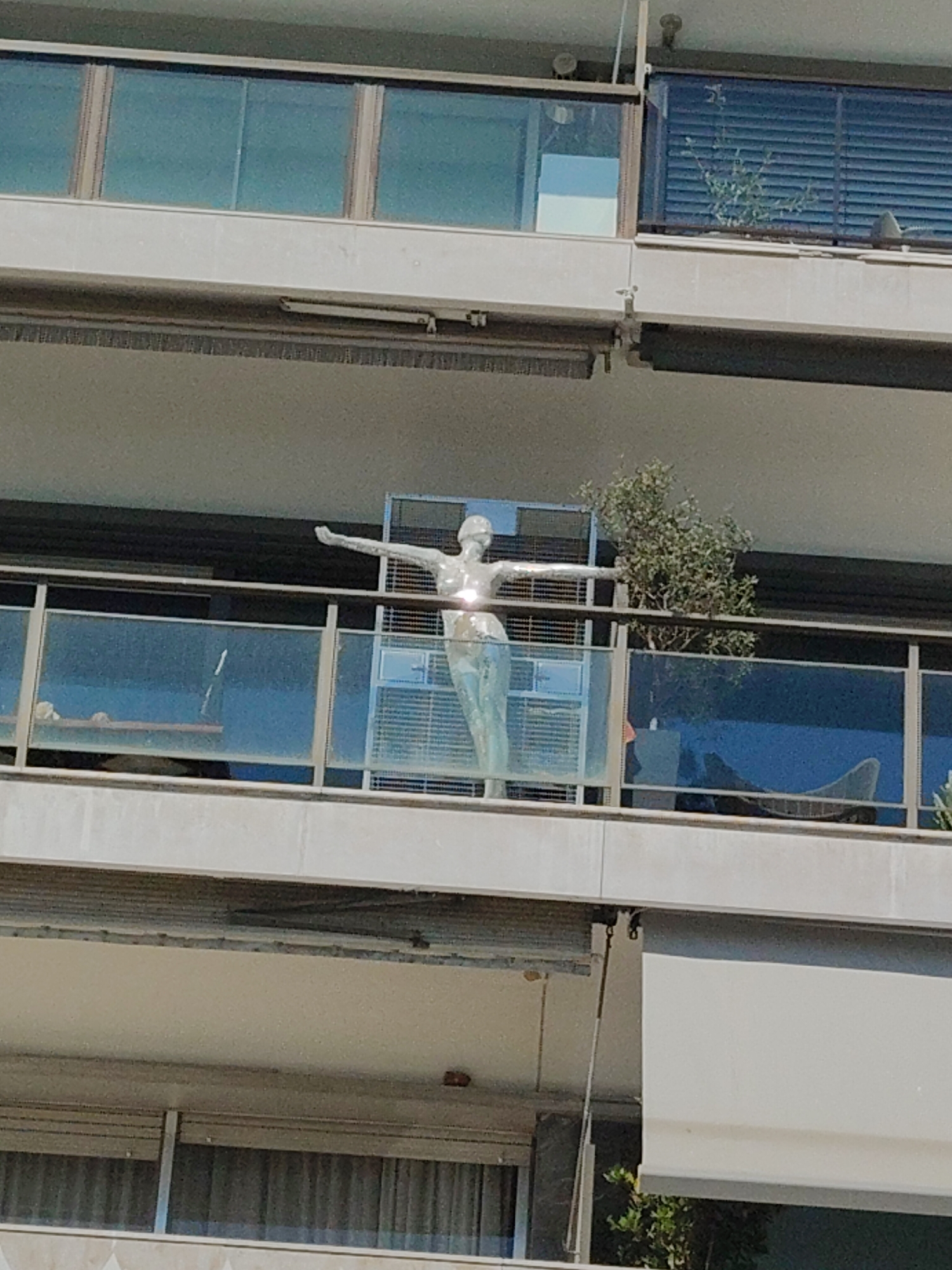
An outdoor shot captures a modern apartment building in Thessaloniki, Greece, on a bright day. The building features multiple floors with balconies. On one of the balconies, a large, translucent statue of a human figure with arms outstretched is prominently displayed. The statue appears to be made of a reflective material, catching the sunlight. To the right of the statue, a potted tree with green foliage is visible. The balcony is enclosed by a glass railing. In the background, windows and shutters of the building are visible, along with a section of sky. The overall impression is one of contemporary architecture and urban living.
Thessaloniki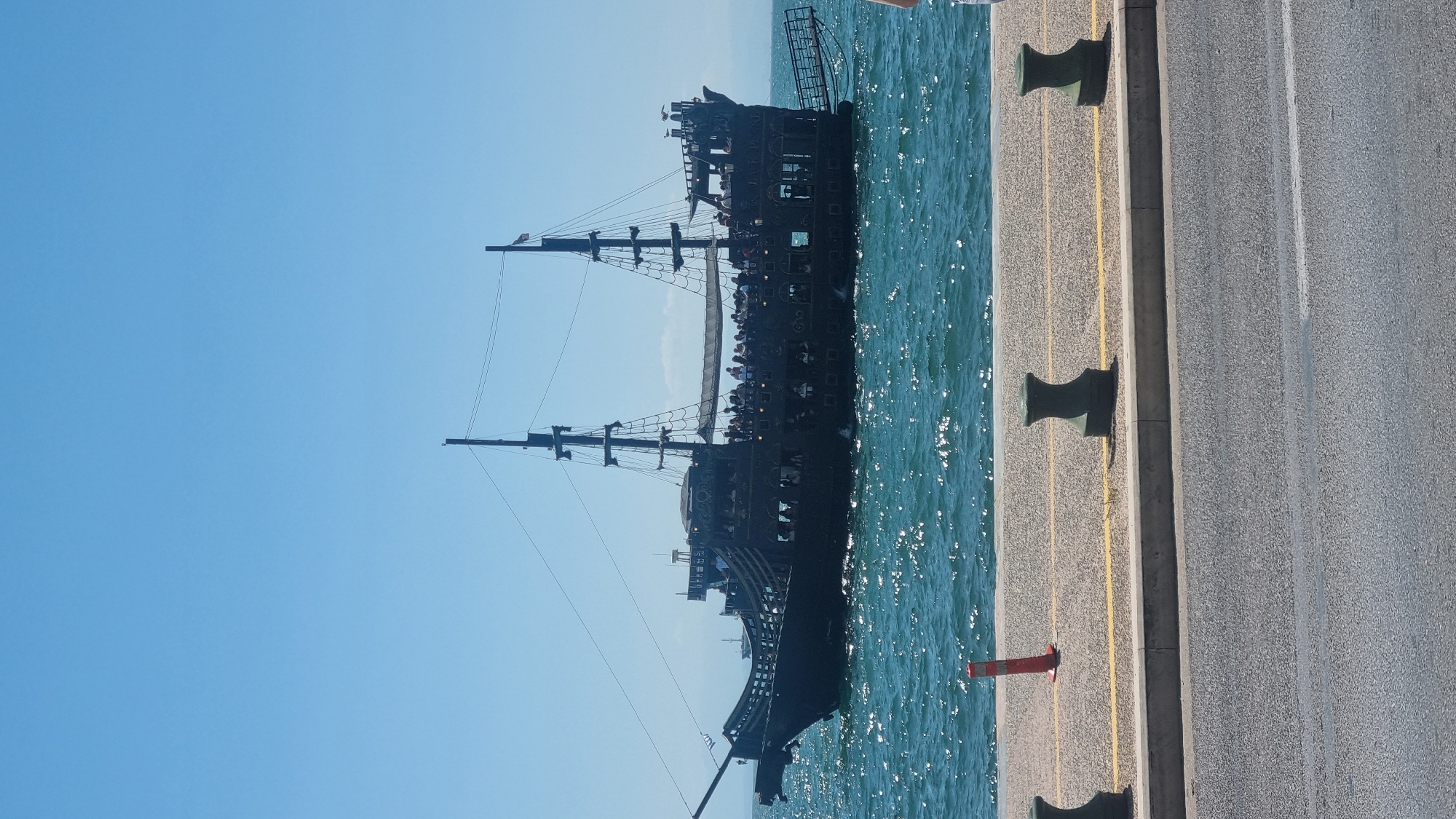
An elaborately designed, dark-colored pirate-themed ship, filled with numerous passengers, sails on the shimmering turquoise waters of the Aegean Sea. The ship features two prominent masts with rigging and a decorative bow. In the foreground, a paved walkway lines the waterfront, with a concrete curb separating it from a road. Several dark green bollards are positioned along the walkway, and a bright orange traffic cone stands near the water's edge. The sky above is a clear, bright blue. The scene is likely captured from a waterfront promenade in Thessaloniki, Greece, given the architectural style of the ship and the characteristic bright sunlight.
Thessaloniki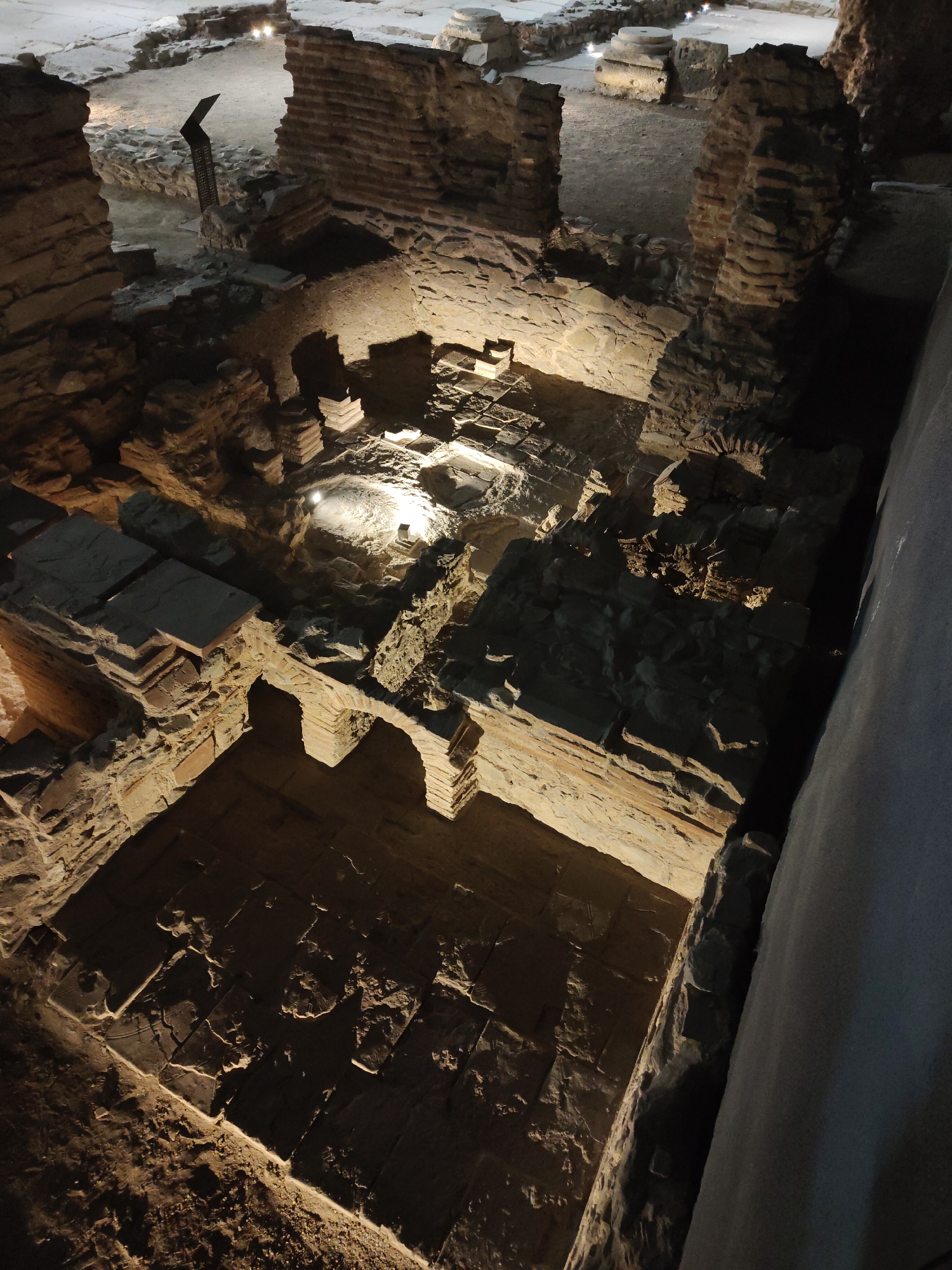
This is an overhead, high-angle, full shot of the excavated ruins of a Roman building, likely a bathhouse or a similar public structure, in Thessaloniki, Greece. The ruins are illuminated by artificial lighting, highlighting the intricate brickwork and stone construction. The scene is composed of multiple levels and interconnected rooms, with walls of varying heights and degrees of preservation. Some areas show remnants of paved floors made of stone slabs, while others are covered in dirt and debris. In the background, more ruins are visible, also lit, suggesting a larger complex. There are no people present in the image. The overall impression is one of ancient history and archaeological discovery.
Thessaloniki
The video shows an archaeological site within a museum setting. The ground is covered in dirt and stone, with various remnants of ancient structures. In the foreground, a line of rough stones separates two distinct areas. To the left, the ground is more uniform and appears to be compacted earth. To the right, larger, flat stones are laid out, some appearing to be broken or incomplete. As the camera pans and moves, the remains of walls built with layered stones and what appears to be plaster are visible. There are also stone columns and sections of flooring. The lighting suggests an indoor exhibition space, with track lighting illuminating the artifacts. No people are visible in the video.
Thessaloniki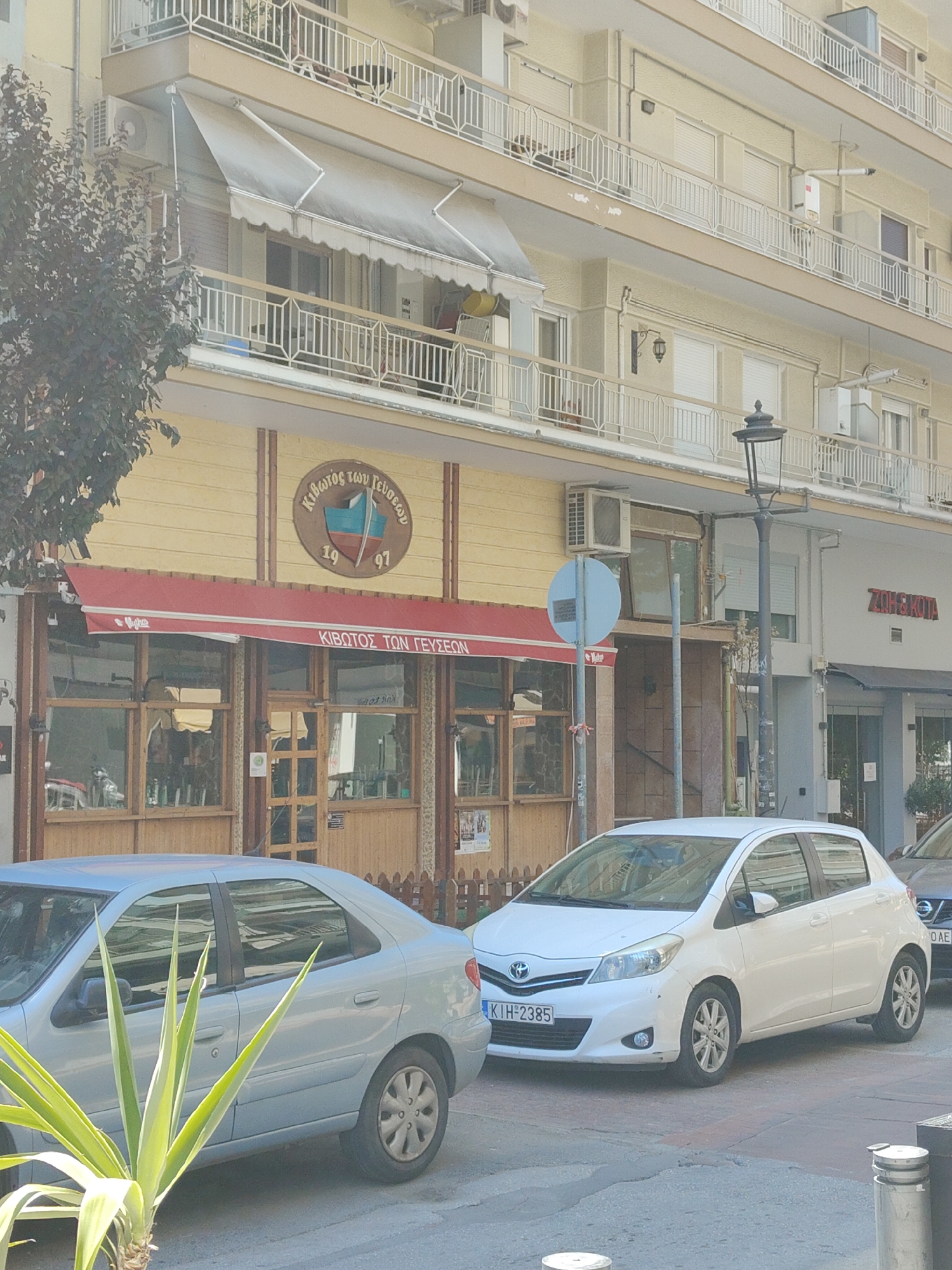
The image shows a street scene in Thessaloniki, Greece, specifically in front of a establishment with a sign reading "ΚΙΒΩΤΟΣ ΤΩΝ ΓΕΥΣΕΩΝ". The building facade is yellow with wooden accents and a red awning. A circular logo above the awning depicts a boat with the numbers "19" and "97". Two cars are parked on the street, a silver sedan on the left and a white hatchback on the right with license plate "KIH-2385". A street lamp stands near the right side of the frame. Balconies with white railings are visible on the upper floors of the building. A tree with dark foliage is partially visible on the left. The overall impression is a typical urban street with shops and residential buildings.
Thessaloniki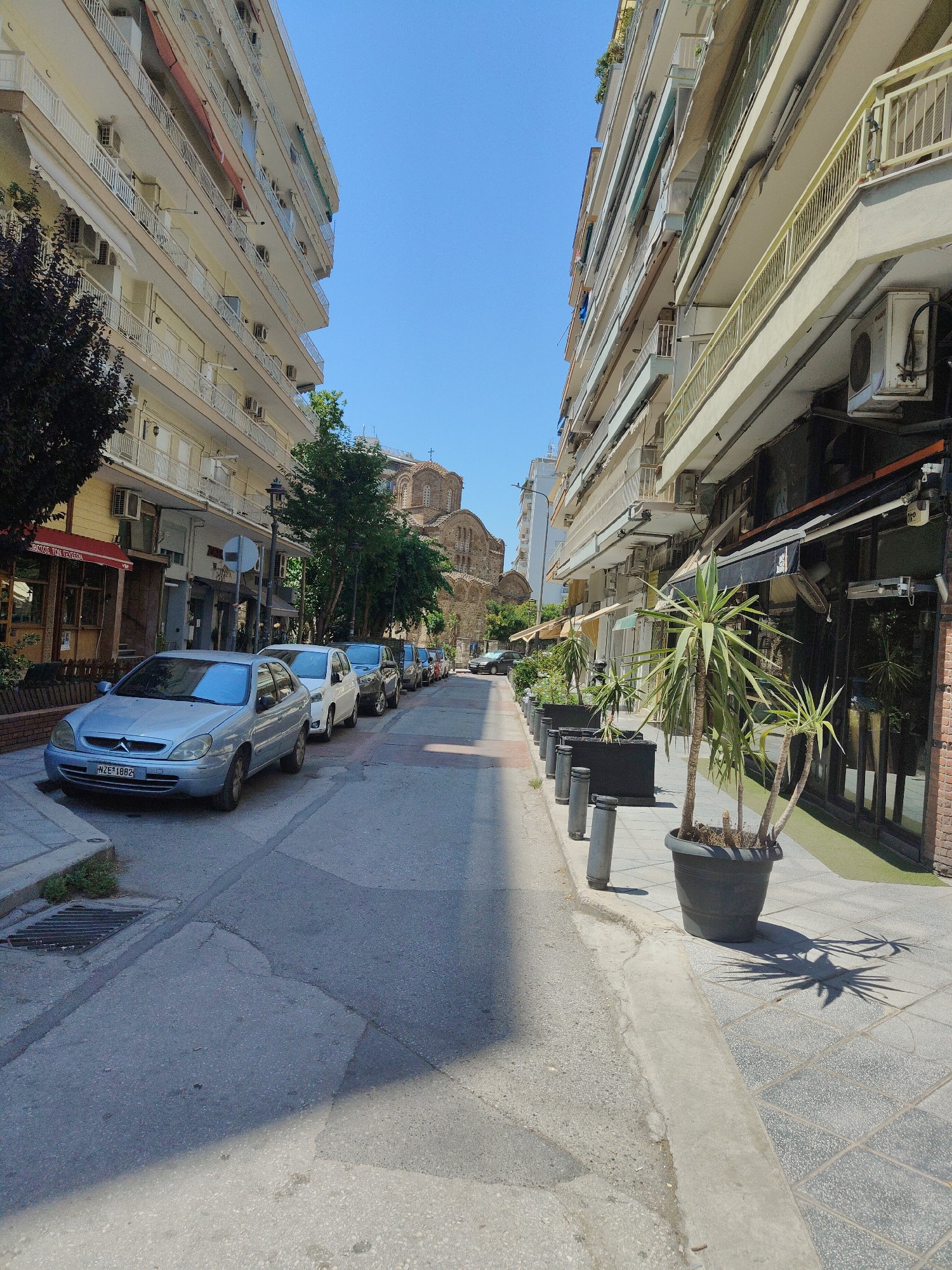
This is a ground-level, eye-level, full-shot photograph taken on a sunny day on a city street in Thessaloniki, Greece, specifically on the pedestrian sidewalk adjacent to Egnatia Street, as indicated by the presence of the Church of Hagia Sophia, a significant Byzantine monument located on this street. The scene depicts a narrow street flanked by multi-story apartment buildings on both sides. The building on the left is a pale yellow with balconies and air conditioning units. The building on the right is cream-colored with similar features. A dark purple tree with sparse foliage is visible on the far left. The street is paved with asphalt, and parked cars line the left side. The car closest to the camera is a silver Citroën with the license plate "NZE 1882". Other cars, including a white one and a dark grey one, are parked behind it. On the right side of the street, the sidewalk is paved with square tiles and features several large black planters with yucca-like plants. One planter with a plant casting a distinct shadow is prominent in the foreground. Shops with awnings and dark glass storefronts are visible along the right sidewalk. In the background, a large Byzantine-style church with a dome and arched windows can be seen between the buildings, identifying the location as Thessaloniki and specifically near the Church of Hagia Sophia. The sky is a clear, bright blue. The overall impression is a typical urban street scene in Greece on a warm, clear day.
Thessaloniki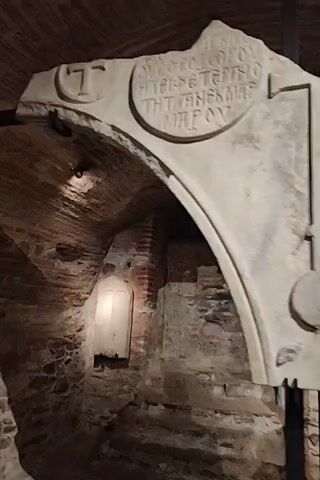
The video pans across an interior archaeological site with exposed brickwork and stone walls. A large, light-colored carved stone fragment, possibly part of an archway or lintel, is prominently displayed and supported by metal stands. The stone has inscriptions and a carved symbol resembling a pendulum. The lighting is dim, with spotlights highlighting the stone artifact and some areas of the wall.
Thessaloniki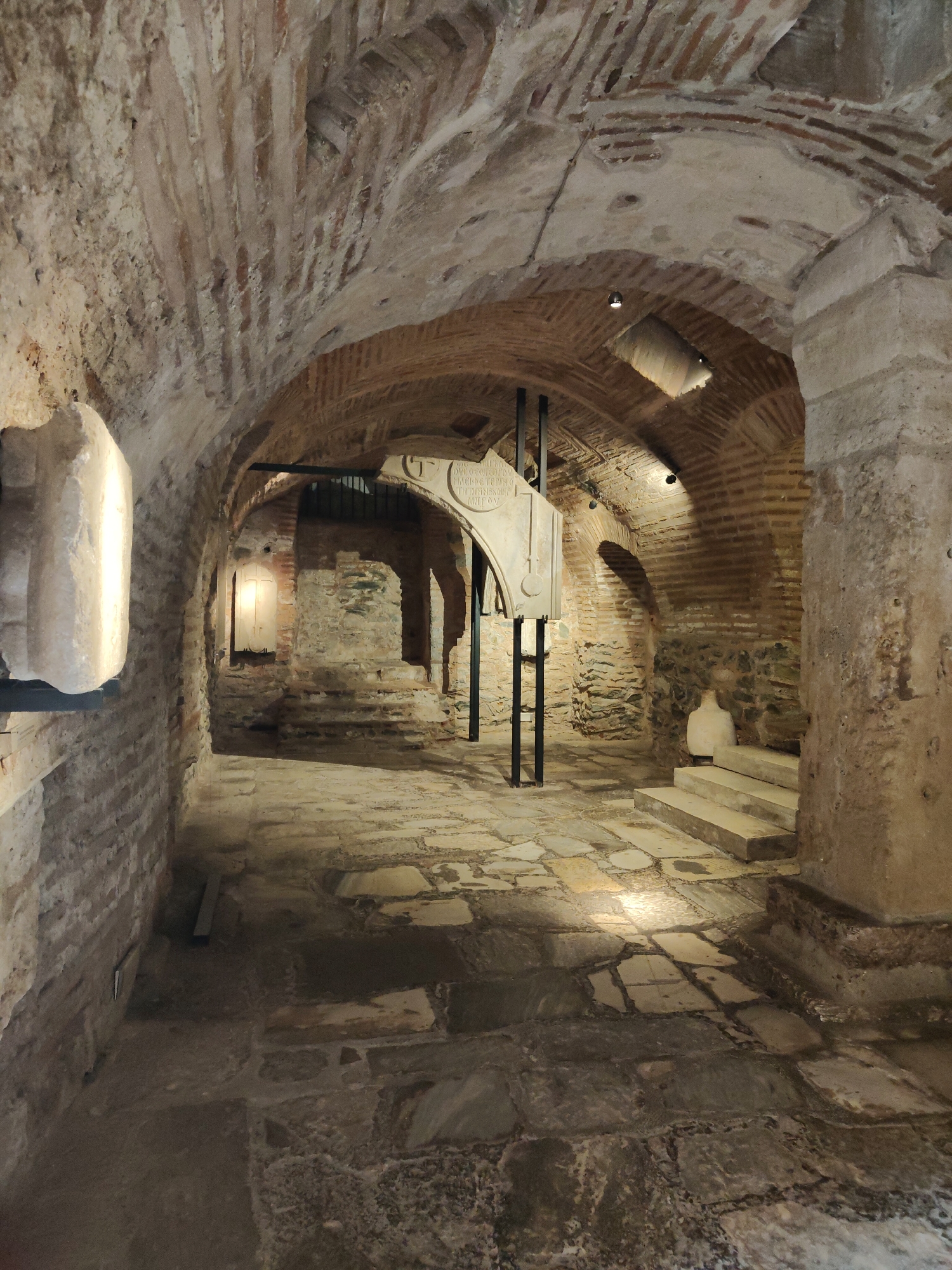
The image depicts the interior of the Rotunda of Galerius in Thessaloniki, Greece. It is a dimly lit, ancient stone passageway with a vaulted brick ceiling. Large, irregular flagstones pave the floor, some appearing wet and reflecting the light from strategically placed spotlights. On the left, a large, carved stone fragment, possibly a column capital or a piece of architectural decoration, is mounted on a dark metal stand. Further down the corridor, a similar, but smaller, stone artifact hangs from black metal supports. This artifact appears to have some inscriptions on it. The walls are constructed of rough-hewn stone and brickwork, showing signs of age and wear. In the background, there are more arched openings and steps leading up to an elevated area. A white ceramic amphora sits on these steps, illuminated by a spotlight. Several spotlights are visible throughout the passageway, casting pools of light and shadows, highlighting the textures of the stone and brick. The overall atmosphere is one of historical preservation and archaeological interest.
Thessaloniki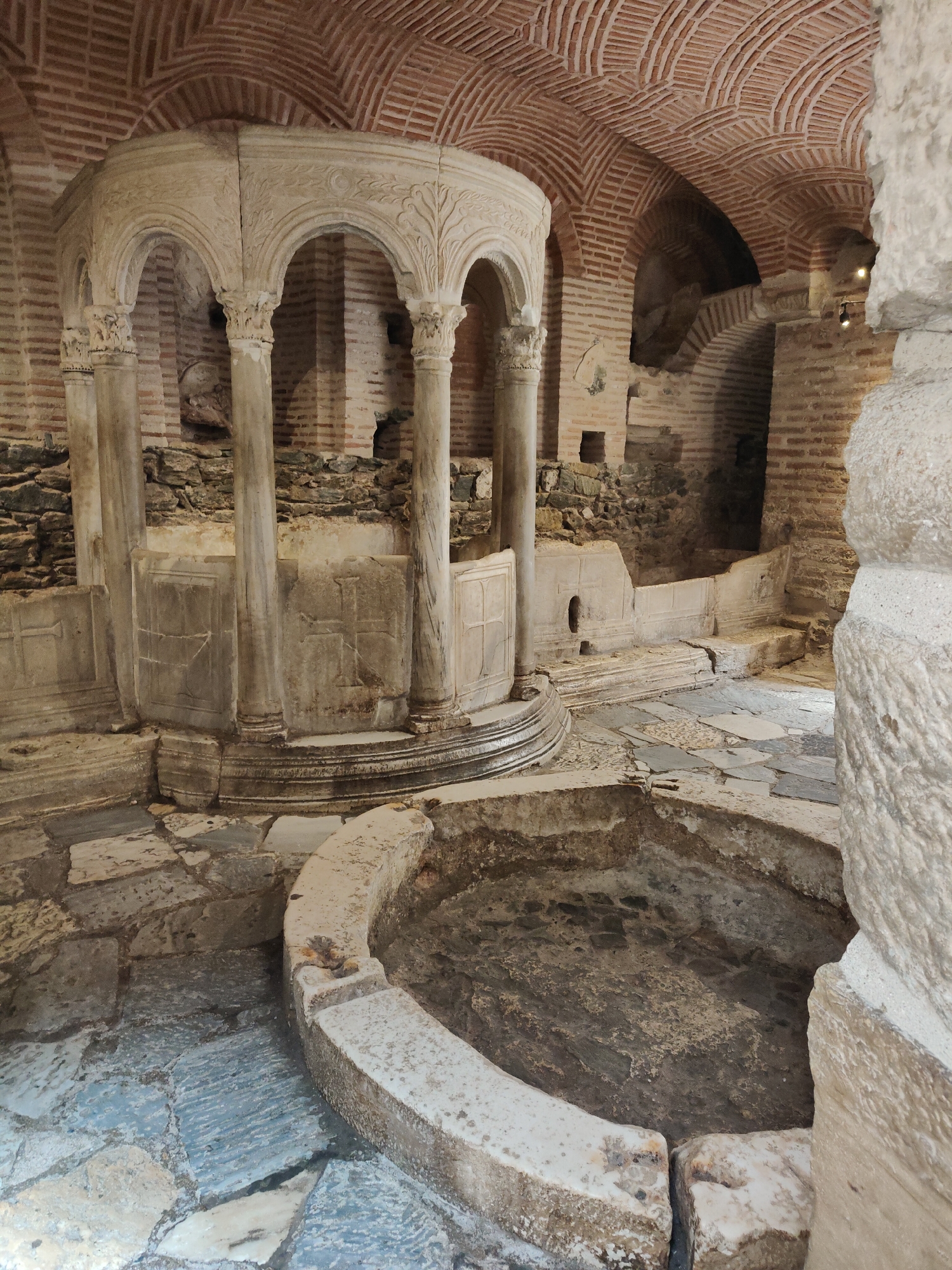
The image depicts the interior of the Rotunda of Galerius in Thessaloniki, Greece, a historic monument with a circular structure and domed ceiling constructed from brick. In the foreground, a stone basin with rough, textured walls is partially visible, its interior filled with dark, possibly water-damaged material. The floor is paved with irregular flagstones of varying colors, including grey and blue hues. A prominent architectural element in the mid-ground is a semi-circular structure supported by ornate stone columns. These columns feature carved capitals and are topped with arches adorned with intricate floral reliefs. Behind this, the curved walls of the Rotunda are visible, built with alternating bands of brick and stone, creating a distinctive pattern. Several arched alcoves are present in the wall, some appearing dark and recessed. Scattered debris, including stones and what appears to be rubble, is present in various areas, suggesting an archaeological context. The lighting is dim, with some illumination highlighting the stone basin and parts of the floor, creating shadows that emphasize the texture and depth of the scene. No people are visible in the image.
Thessaloniki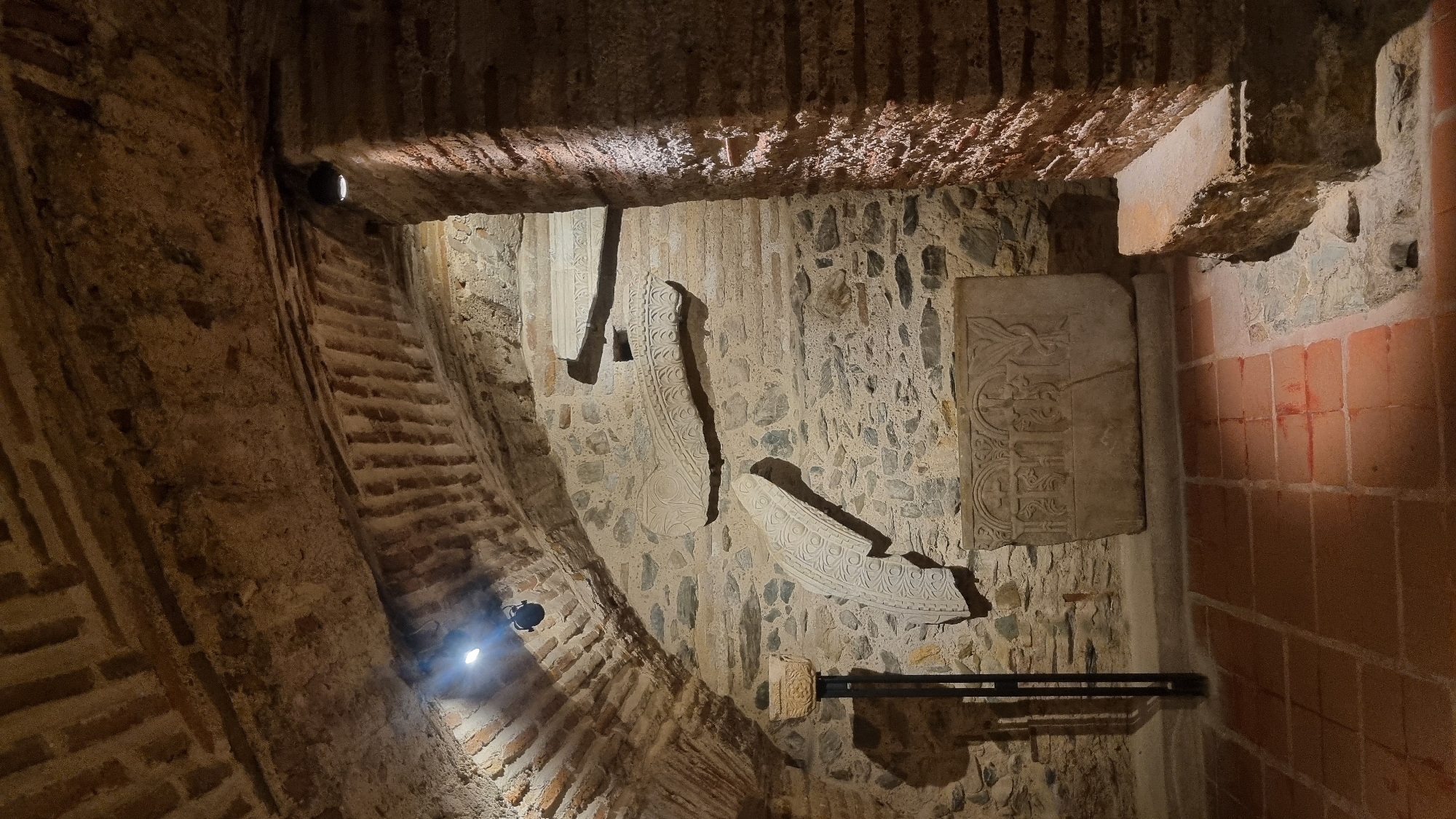
The image shows an interior view of a dimly lit, ancient stone room, likely in Thessaloniki, Greece, given the context of a historical excavation or museum display. The room features a vaulted ceiling constructed of bricks and stone, with exposed rough stone walls. Several ancient stone artifacts are displayed: a large, rectangular stone slab with intricate carvings of religious iconography, likely a sarcophagus lid or altar piece, is positioned prominently in the foreground. Above and to the left of this slab, two large, curved stone fragments with decorative carvings are mounted on the wall. To the left of the wall carvings, a stone pedestal with a small, bowl-like top stands on a dark metal pole. A rough-hewn stone bench is visible to the right, against a brick pillar. The floor is paved with reddish-brown square tiles. Artificial lighting from spotlights illuminates the artifacts and the textured surfaces of the room. There are no people visible in the scene.
Thessaloniki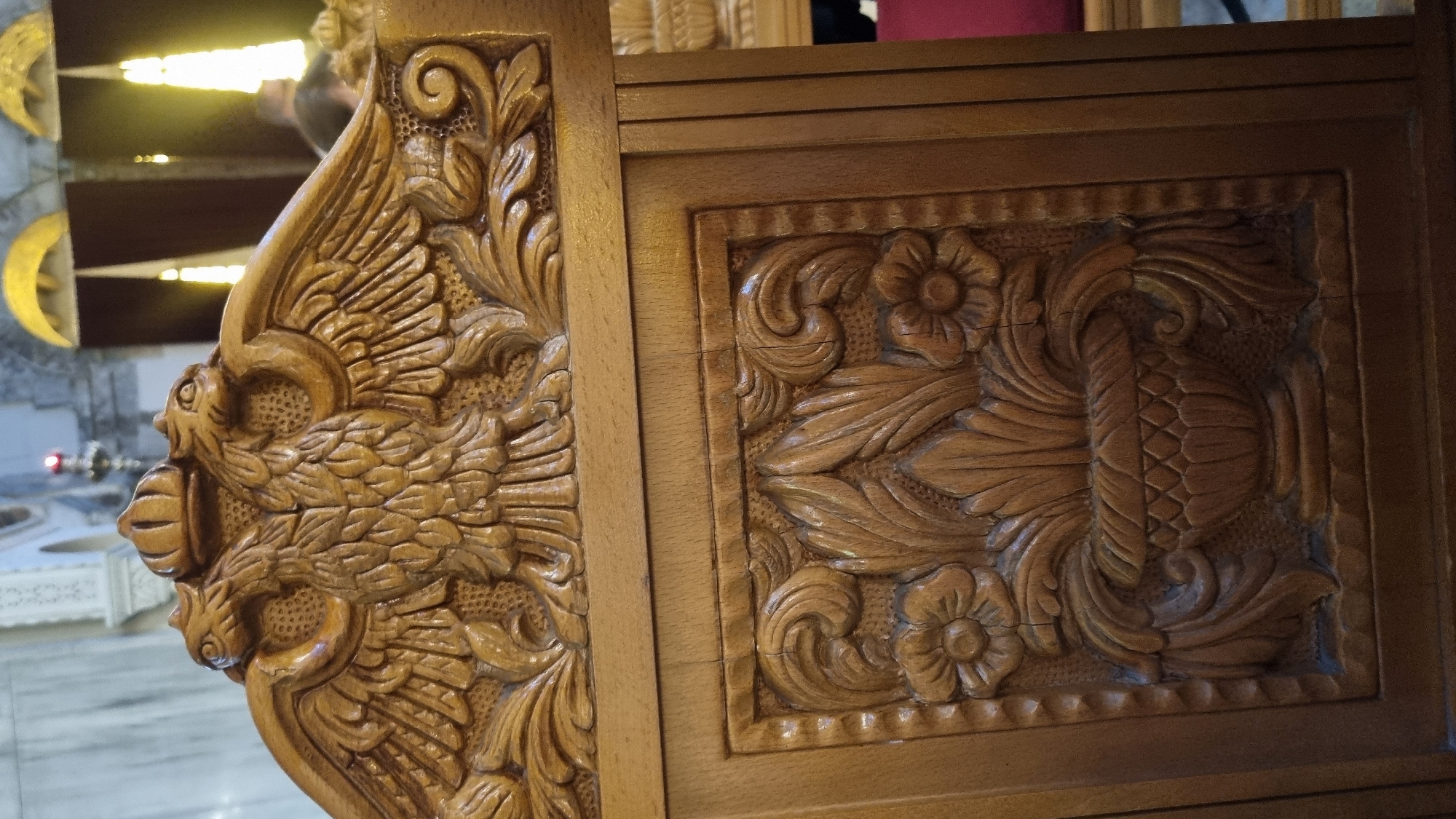
A close-up, eye-level, medium shot captures the intricate wooden carvings of what appears to be a throne or a significant piece of furniture within a religious building. Dominating the upper portion of the frame is a detailed relief of a double-headed eagle, an emblem often associated with Byzantine history and the Greek Orthodox Church. The eagle is crowned, with its wings spread and feathers meticulously carved. Below this, a rectangular panel features a carved floral motif, centered around an ornate vase overflowing with leaves and flanked by two stylized flowers. The wood is a warm, medium brown, with visible grain and subtle signs of wear. The background is blurred, showing architectural elements of what could be a church in Thessaloniki, Greece, with marble columns and arched openings, as well as glimpses of yellow light filtering through, suggesting stained glass or illuminated windows. A sliver of red fabric is visible on the right, possibly part of another seat or altar cloth. The overall impression is one of rich, historical craftsmanship within a sacred space.
Thessaloniki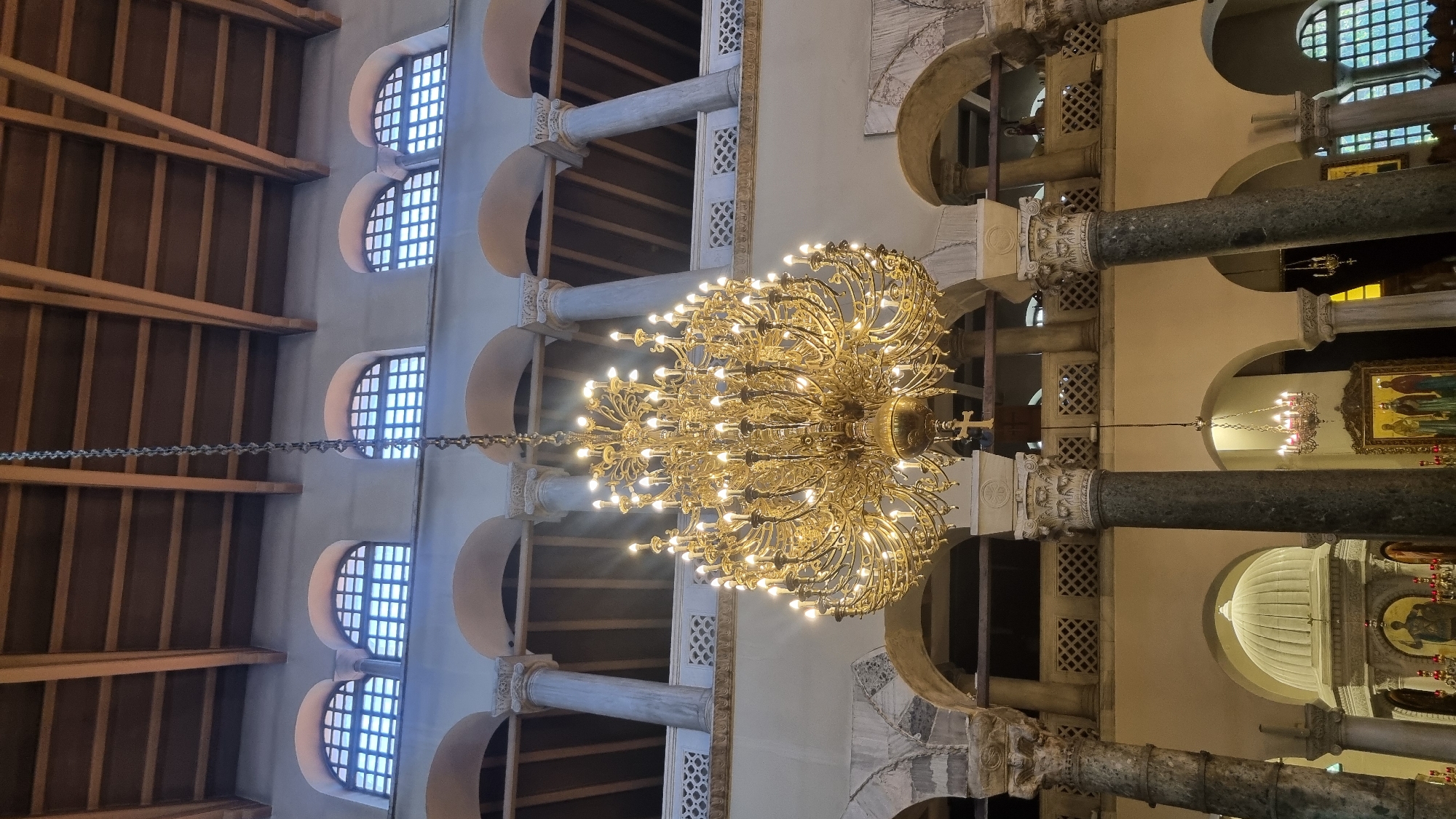
The image shows the interior of the Hagia Sophia Church in Thessaloniki, Greece. A large, ornate golden chandelier hangs from the ceiling. The chandelier has many branches with multiple light bulbs, illuminating the space. The ceiling is constructed with wooden beams. Above the chandelier, there are arched windows with latticed panes, letting in natural light. The church features a colonnade with marble columns and arched openings. In the background, there are glimpses of the church's dome and religious iconography, including a large framed icon with figures. The overall impression is of a grand and historic religious building, with a focus on the dramatic lighting provided by the central chandelier.
Thessaloniki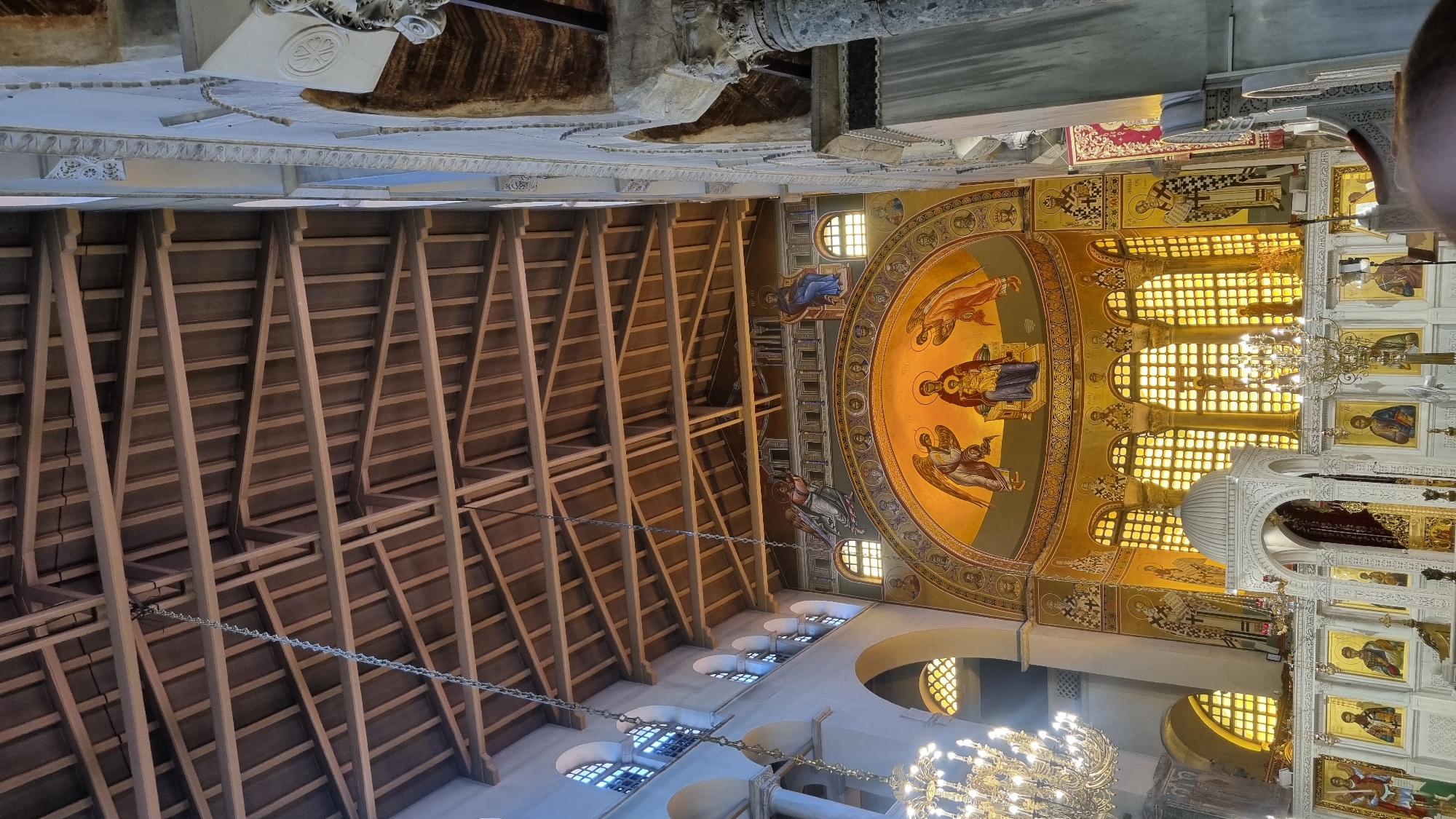
The image captures the interior of the Hagia Sophia in Thessaloniki, Greece, looking towards the altar and apse. The wooden, beamed ceiling is visible at the top, with chains hanging down. The apse features a large mosaic of the Virgin Mary holding the infant Jesus, flanked by angels. Below the mosaic are rows of arched windows illuminated from behind, casting a warm glow. The walls are adorned with further mosaics and religious icons. An iconostasis, a wall of icons, stands in front of the altar area, with a white, dome-like structure at its center. Ornate chandeliers hang from the ceiling. The overall impression is one of solemnity and grandeur, characteristic of a Byzantine basilica. No people are clearly visible in the image.
Thessaloniki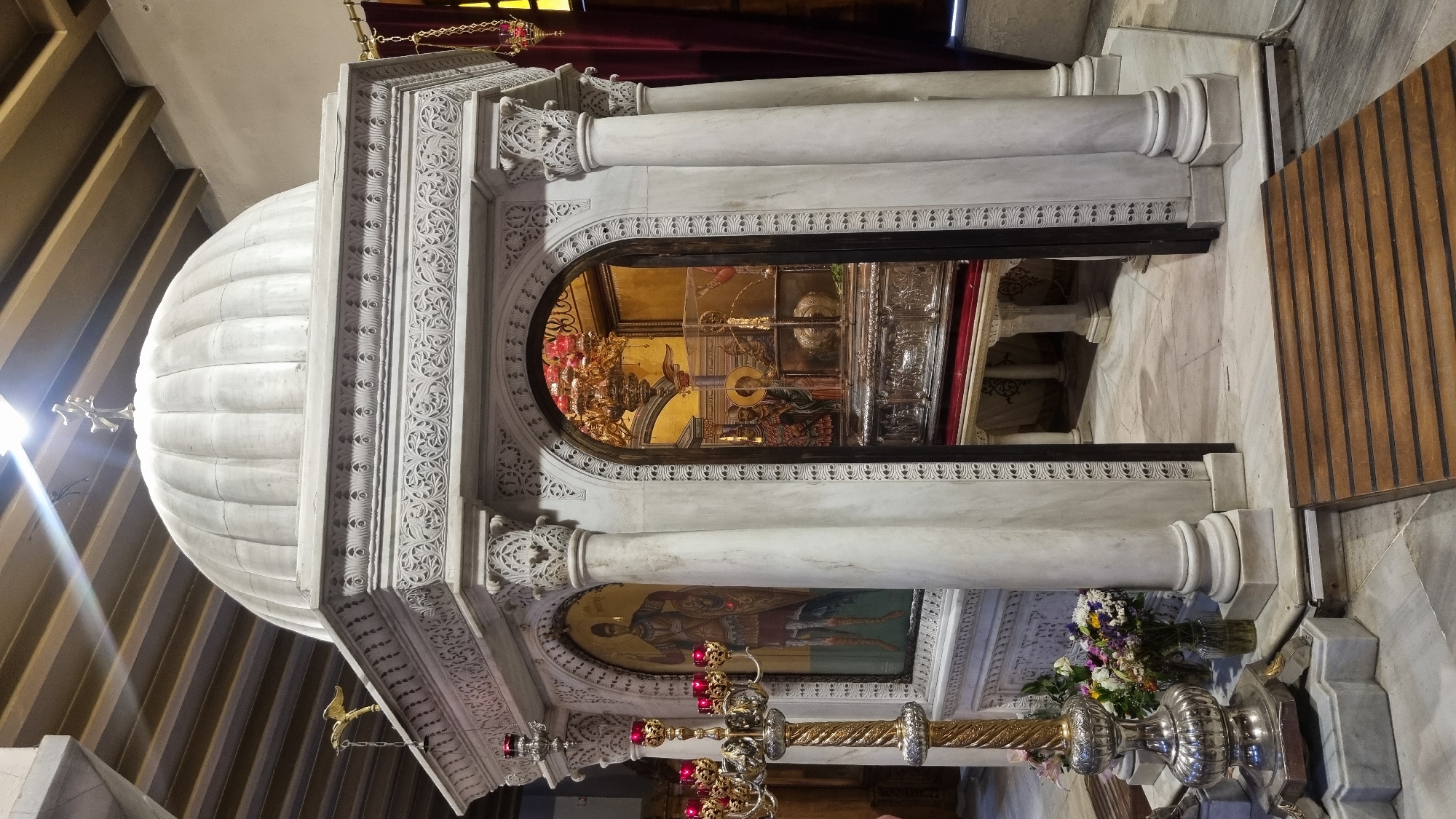
This is a full shot of a marble structure in Thessaloniki, Greece, containing religious artifacts. The structure is ornate, with a dome on top topped with a cross. Carvings adorn the sides of the structure, and pillars support the roof. Inside the structure, visible through an arched opening, is a silver reliquary adorned with intricate carvings, resting on a red velvet cloth atop a wooden table. Several religious icons are also visible inside, including one depicting a warrior saint. A large, ornate candelabra with red candles stands to the left of the structure, with a vase of flowers on the floor nearby. A wooden ramp leads to the entrance of the structure. The ceiling, made of wooden beams, is visible at the top of the frame. The floor is tiled marble. The scene appears to be indoors, likely in a church or a religious shrine.
Thessaloniki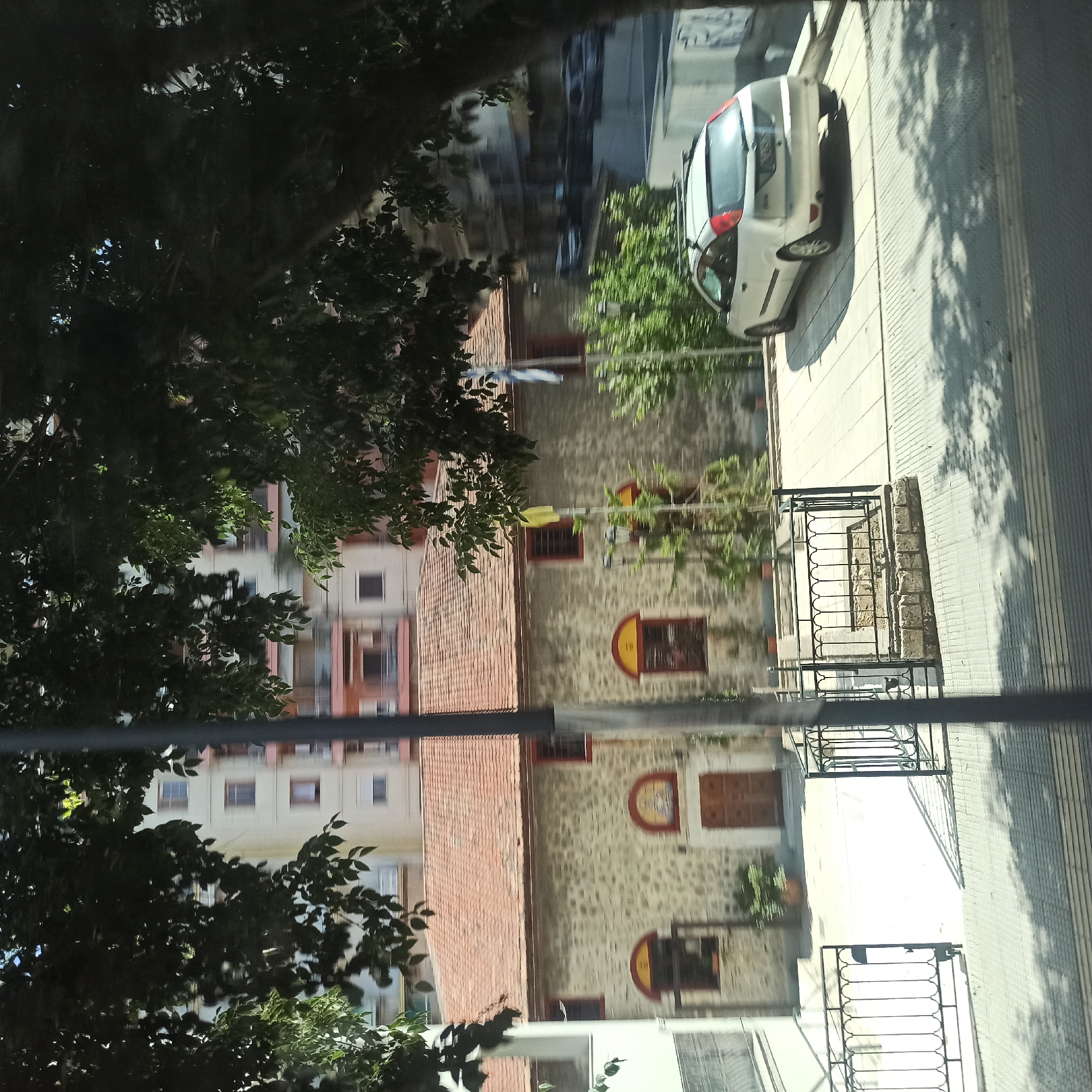
This is a photo taken from a moving vehicle, likely a bus, in Thessaloniki, Greece. The image captures a glimpse of a stone building with a red-tiled roof, possibly a church, with arched windows and wooden doors. In front of the building, a white car is parked. The scene is partially obscured by the leaves and branches of a large tree in the foreground. The background shows a multi-story residential building. The overall impression is of a sunny day in a Mediterranean city.
Thessaloniki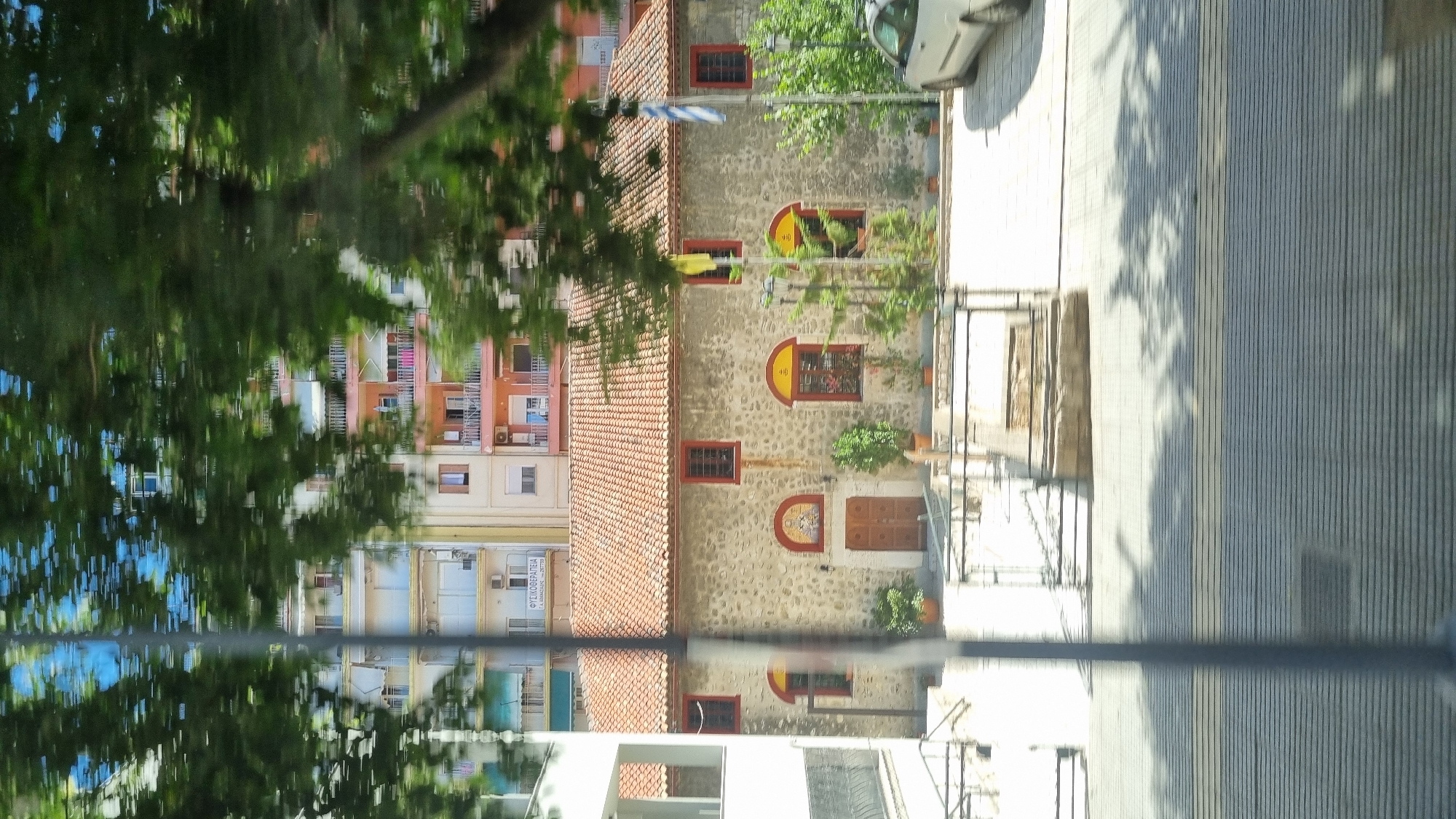
This is a photograph taken from a moving vehicle, likely a bus, looking out at a street scene in Thessaloniki, Greece. The foreground is dominated by blurred green foliage from trees and a vertical dark pole. In the midground, a stone church with a red tile roof is visible. The church has arched windows with red frames and a decorated arched entrance. To the left of the church is a white modern building. Behind the church and modern building, a taller, multi-story apartment building with balconies in various colors (pink, white, and yellow) is visible. A white car is parked on the right side of the image. The ground in front of the church is paved, and there are shadows from trees cast on the ground. The overall impression is a sunny day with movement blur due to the vehicle's motion.
Thessaloniki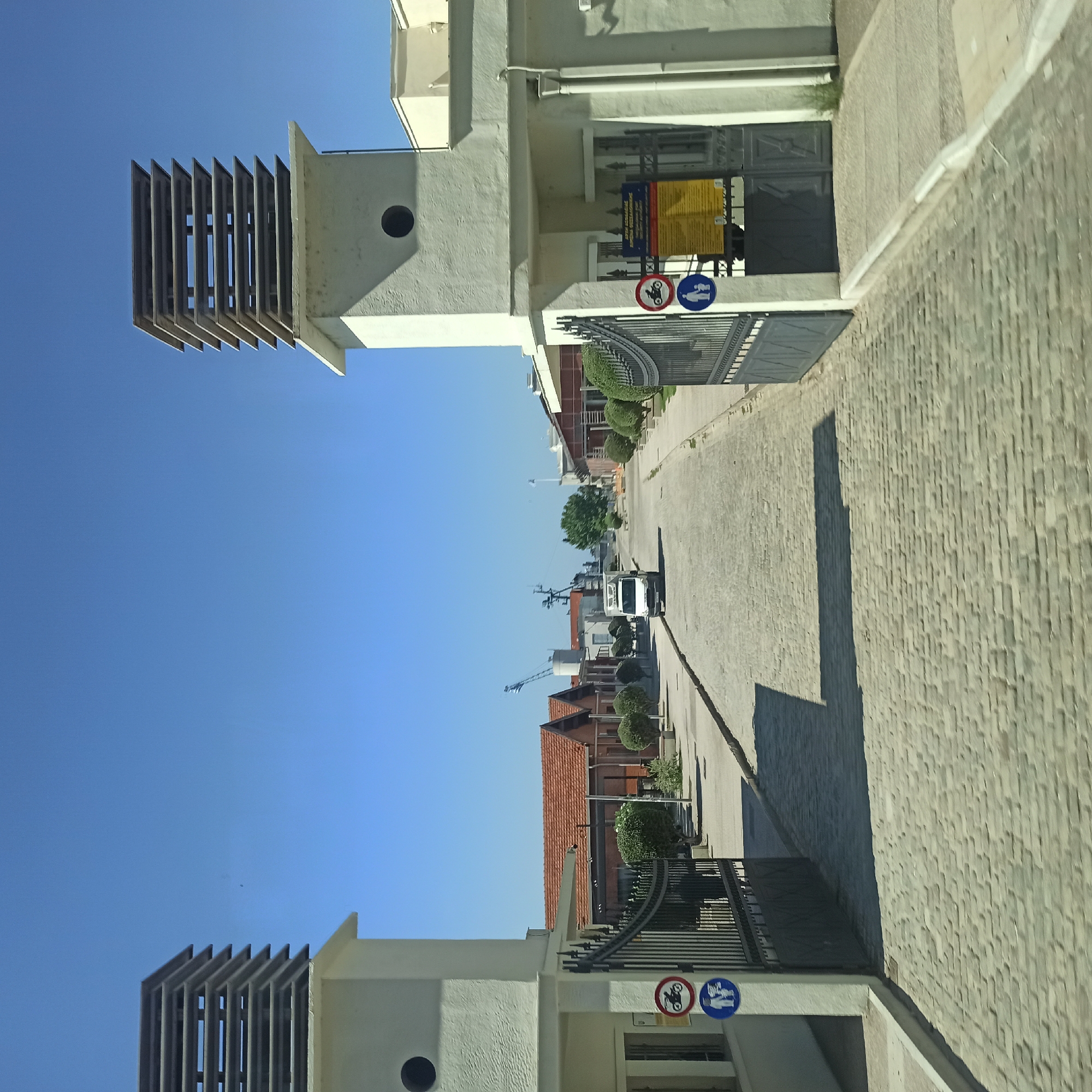
The image depicts a sunlit day in an industrial or port area, likely within the city of Thessaloniki, Greece, given the presence of Greek text on a sign and the architectural style. A paved cobblestone road leads straight ahead into a complex lined with buildings that have terracotta-tiled roofs. On either side of the road, at the entrance to the complex, stand two identical white gatehouses topped with distinctive, stacked horizontal louvres. These gatehouses flank open wrought-iron gates. Attached to the left gatehouse is a circular blue sign with a white motorcycle silhouette, indicating "no motorcycles." Below that is a blue circular sign with a white silhouette of two people, signifying "pedestrian crossing" or "pedestrian area." A similar set of signs is attached to the right gatehouse, though the specific details are less clear. A yellow sign with Greek text is also visible on the right gatehouse, likely containing information or regulations. A white refrigerated truck is driving down the cobblestone road. In the background, construction cranes and parts of ships are visible, suggesting proximity to a harbor or shipyard. Green trees and bushes are strategically placed along the sides of the road, softening the industrial landscape. The sky is a clear, vibrant blue. The overall scene conveys a sense of order and activity within a functional, working environment.
Thessaloniki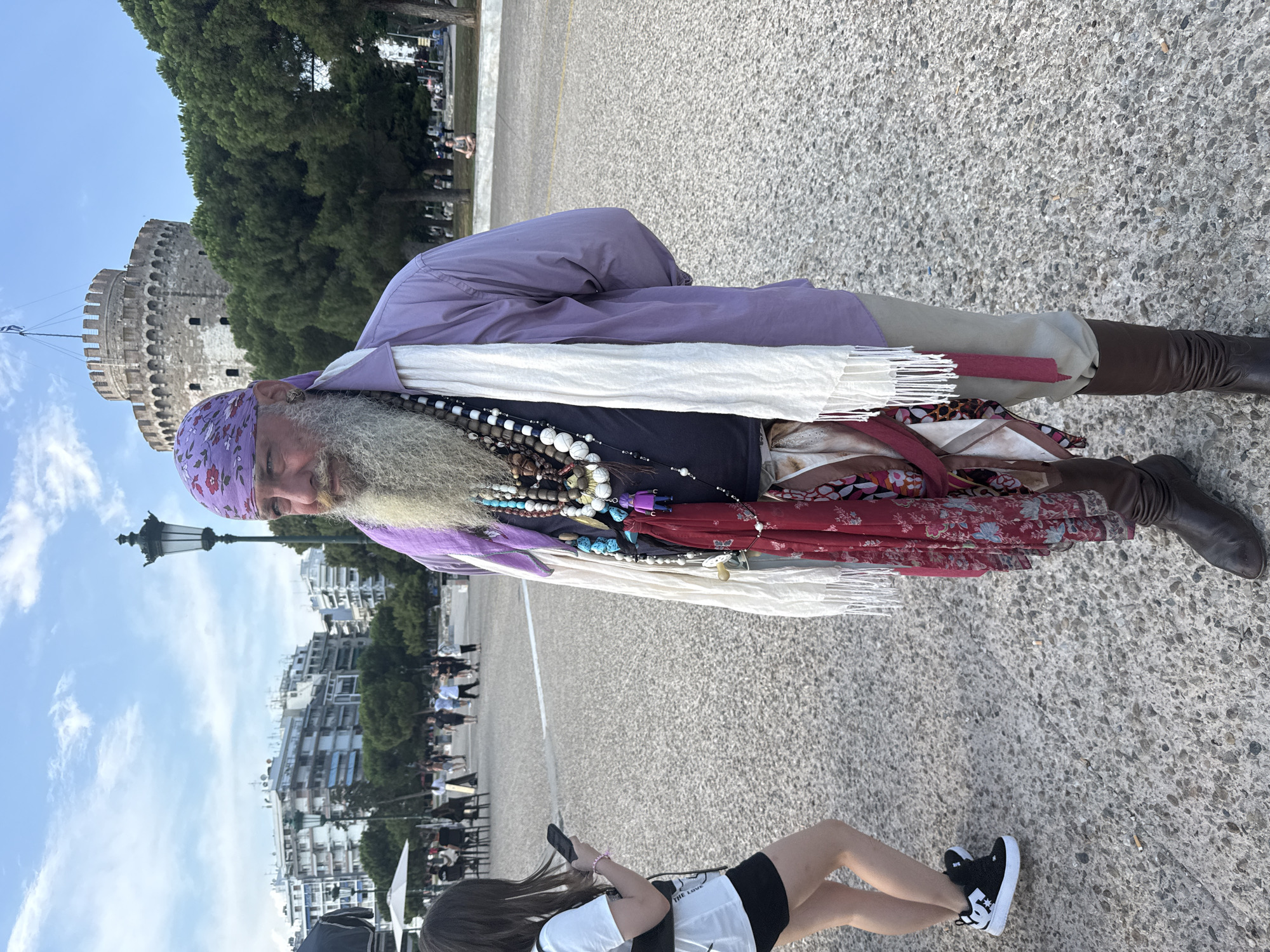
The photograph captures a street scene in Thessaloniki, Greece, with the White Tower visible in the background. In the foreground, a man with a long, grey beard and a purple bandana is standing. He is wearing a light purple shirt, multiple layered necklaces, a white scarf, and a patterned red scarf. He also has on light-colored pants and dark brown boots. To the left, a young girl with dark hair is walking away from the camera, looking at her phone. She is wearing a white t-shirt and black shorts, with black and white sneakers. The ground is paved with small grey stones. In the middle ground, people are walking and sitting at outdoor tables. Trees and buildings line the background, under a partly cloudy sky.
Thessaloniki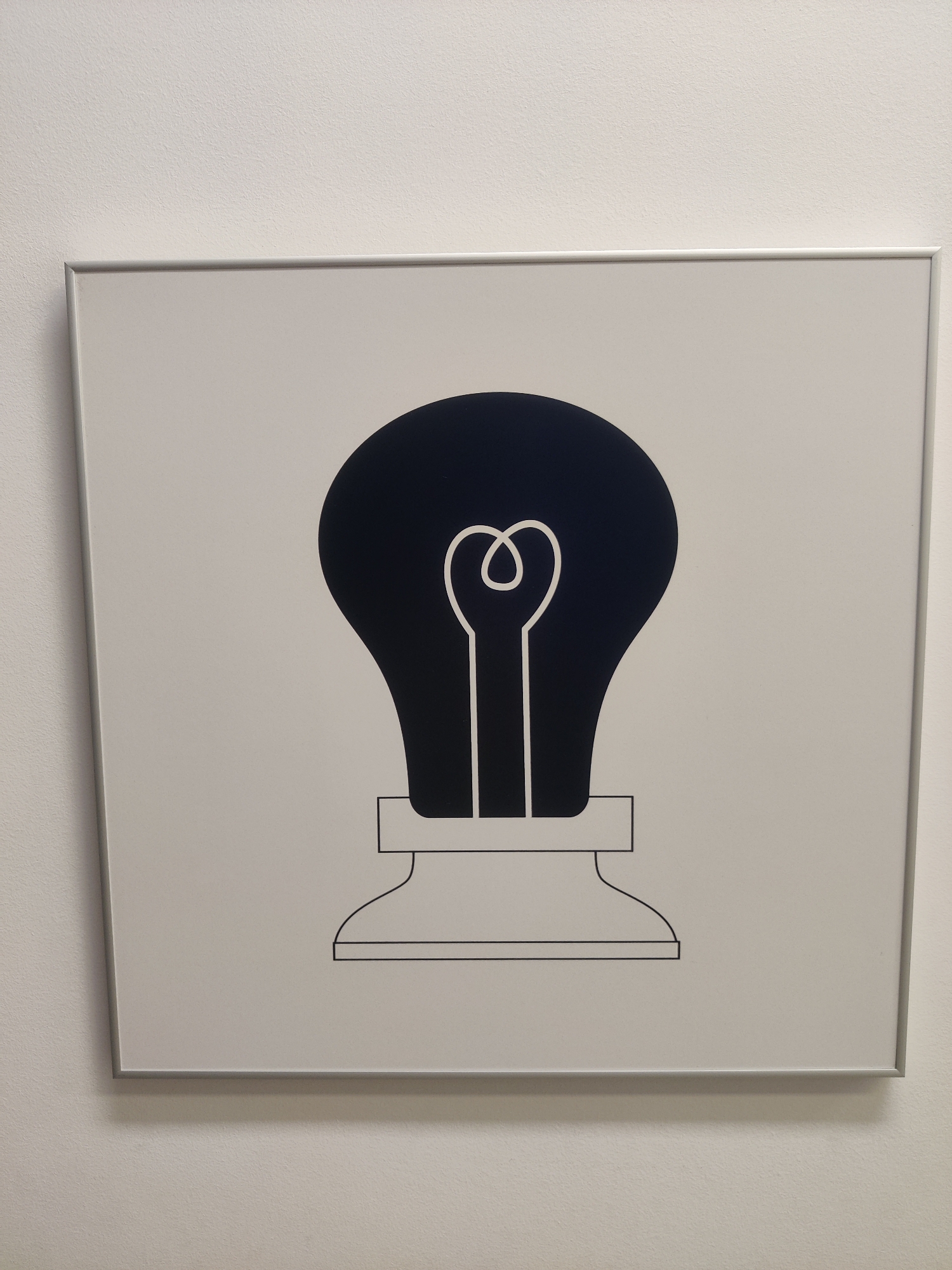
This is a photograph of a framed, minimalist illustration of a lightbulb. The illustration is in black and white, with a dark blue or black lightbulb silhouette and a white filament inside. The lightbulb is depicted in its base, with a simple, stylized stand. The artwork is framed by a thin, metallic silver frame and is mounted on a textured white wall. The lighting suggests an indoor setting, likely a well-lit room or hallway. No people are visible in the image. The overall impression is one of simplicity and modern design. The location context of Thessaloniki, Greece, does not offer any specific visual cues within the image itself. There is no visible text in the image.
Thessaloniki
The video captures a person walking through a neon-lit, blue-toned tunnel that appears to be an attraction or a funhouse. The tunnel is decorated with numerous small, glowing dots of light, primarily teal and pink, creating a psychedelic and immersive atmosphere. Some areas show a person's silhouette, blurred by motion, suggesting movement through the space. The lighting is dramatic and enhances the sense of depth and disorientation. The person is wearing light-colored clothing, which stands out against the dark and vibrant surroundings. There are also glimpses of architectural elements like staircases and railings, reinforcing the idea of a constructed environment designed for entertainment. The overall impression is one of playful exploration in a visually stimulating, almost otherworldly setting.
Thessaloniki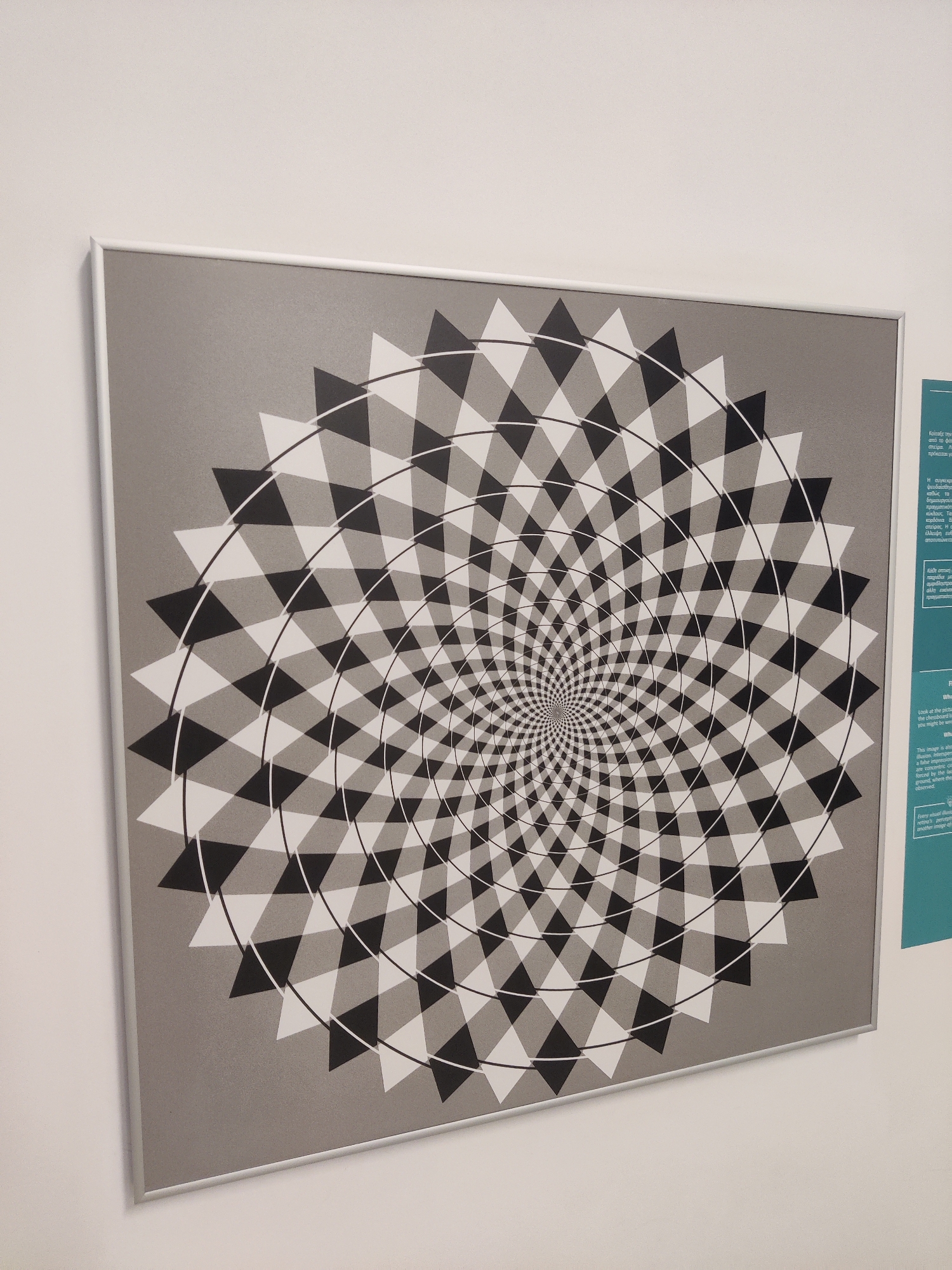
The image shows a framed optical illusion artwork on a white wall. The artwork itself is a circular pattern of black and white triangles that create a sense of spiraling motion. The background of the artwork is a textured gray. To the right of the artwork, a portion of a teal informational panel is visible, containing text in both Greek and English. The Greek text at the top discusses a spiral and "real circles," while the English text below, under the heading "When the chessboard illusion appears," explains that the image is about a "false impression" and "smoothness" created by the "light and dark ground." The setting appears to be a museum or exhibition space in Thessaloniki, Greece, given the bilingual text and the display of an optical illusion. There are no people, specific time of day, or weather conditions evident.
Thessaloniki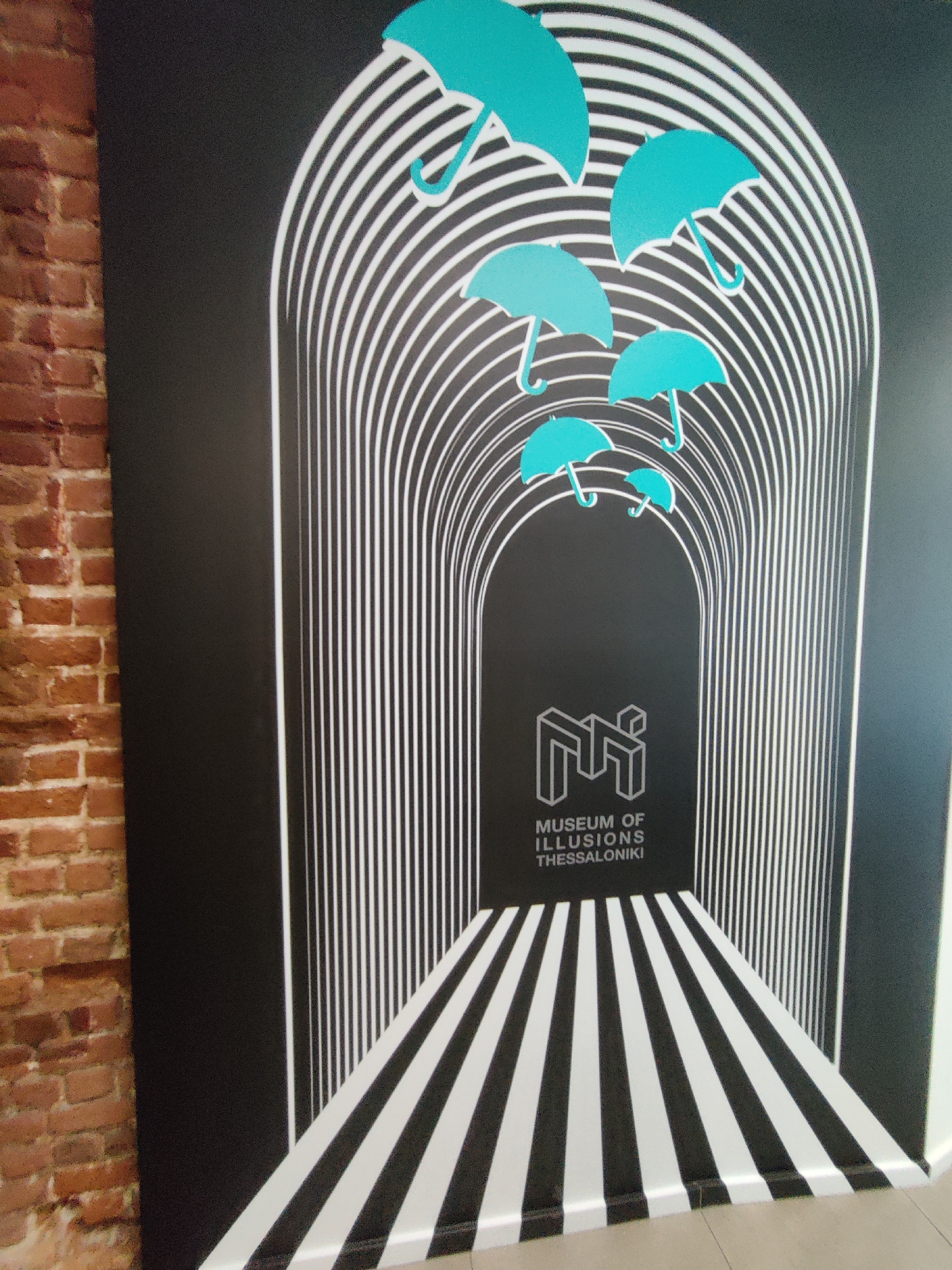
The image shows a large, black wall with a graphic design that appears to be an advertisement for the "Museum of Illusions Thessaloniki". The graphic features a tunnel-like archway made of alternating white and black curved lines, with several stylized teal-colored umbrellas floating above. At the center of the archway is the museum's logo, a geometric "MI" in white outline, followed by the text "MUSEUM OF ILLUSIONS THESSALONIKI" in white capital letters. The foreground of the graphic depicts a floor made of black and white stripes that create an optical illusion of depth, suggesting a pathway leading into the archway. To the left of the wall, a portion of a red brick wall is visible. The photograph is taken from a slightly downward angle, with the lighting appearing to be artificial and casting a slight glare on the surface of the graphic.
Thessaloniki