Tomar, Portugal
15 memories from Tomar, Portugal
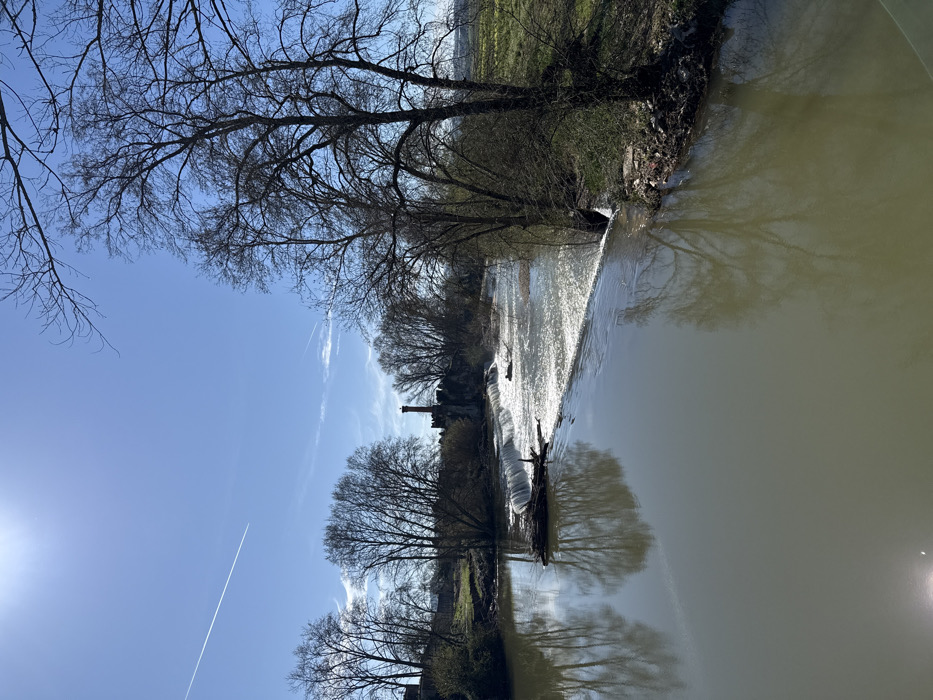
This image presents a wide view of the Nabão River in Tomar, Portugal, specifically at the Prado Dam. The scene is illuminated by bright sunlight under a clear blue sky, with a strong lens flare visible in the upper left and a white aircraft contrail arcing across the upper left quadrant. The river dominates the lower two-thirds of the frame, flowing from the background towards the viewer. In the midground, a concrete weir spans the river, creating a cascading waterfall with sun-dappled, turbulent water. Upstream of the weir, positioned slightly left of center, a large collection of dark, intertwined logs and branches floats partially submerged. The river water in the foreground is calm and reflects the sky and bare tree branches, appearing as a brownish-green hue. Both river banks are densely lined with numerous deciduous trees, currently bare of leaves. Their distinct reflections are visible in the calmer water. On the distant left bank, a tall, dark brick chimney structure, identifiable as part of the former Fábrica de Papel do Prado (Tomar Paper Mill), rises prominently above the tree line. The far right bank reveals a grassy field with visible patches of yellow vegetation. The immediate right bank in the foreground displays sparse undergrowth and dark soil or debris along the water's edge. No individuals, animals, or vehicles are present within the frame.
Tomar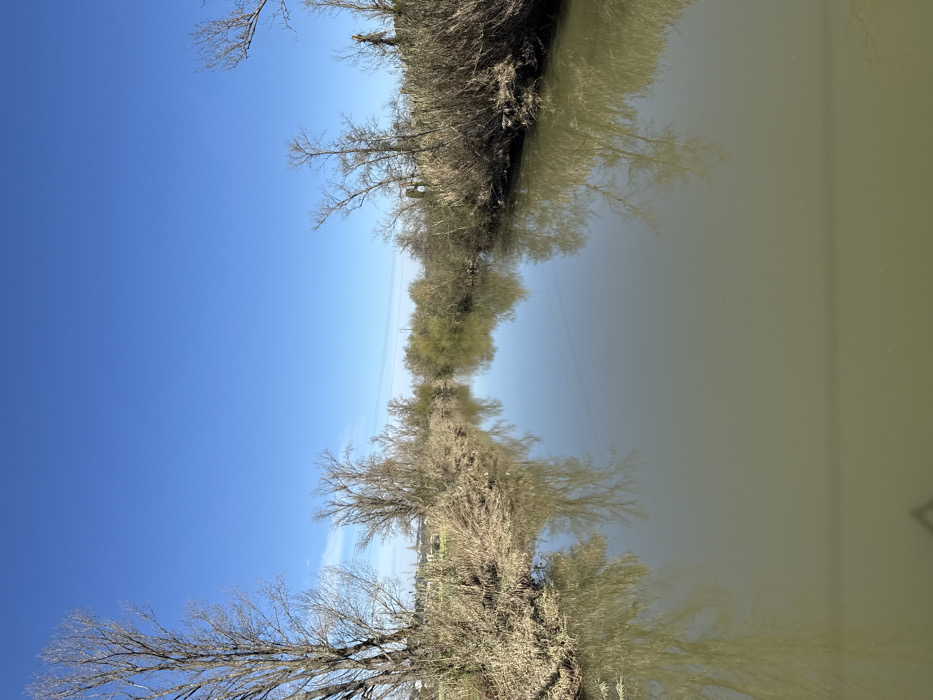
The image presents a longitudinal view of a calm, brownish-green river or canal, likely the Nabão River, situated within the city of Tomar, Portugal. The water surface reflects the clear, bright blue sky that dominates the upper two-thirds of the frame, and also mirrors the dense riparian vegetation lining both banks. The left bank is heavily vegetated with bare deciduous trees and dry, reedy brush. In the middle distance, partially obscured by the foreground vegetation, a light-colored building featuring a distinct spire or tower is visible against the sky; this architectural element is consistent with structures found in central Tomar, such as the Convent of Christ. The right bank exhibits similar vegetation, comprising bare deciduous trees and dense, dry, light-brown brush. A series of utility wires are visible horizontally across the mid-ground sky, passing above the right bank's vegetation. A thin, dark horizontal line, possibly part of a railing or infrastructure, traverses the lower portion of the image, just above or at the water's surface. No human or animal subjects are present in the scene. The environment appears natural and largely undisturbed by immediate human activity, illuminated under a clear sky.
Tomar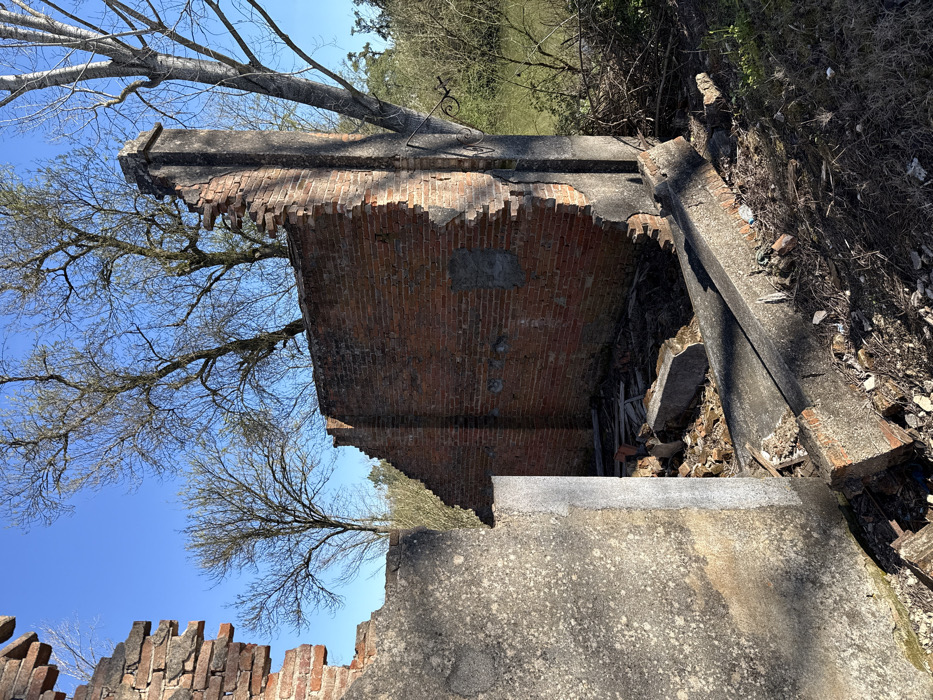
The image depicts the substantial ruins of a former industrial building, specifically the Old Paper Mill of Tomar (Antiga Fábrica de Papel) located along the Nabão River in Tomar, Portugal. The scene is dominated by a fragmented, reddish-brown brick wall standing prominently in the mid-ground. This wall exhibits significant decay, with an irregular top edge, missing bricks, and exposed mortar. A thick, grey concrete or stucco-covered support pillar or chimney-like structure is integrated into the right side of this brick wall, extending upwards. To the left, a thick, textured grey concrete wall section occupies the immediate foreground, its top also uneven. The ground within the ruined structure is covered with a substantial amount of debris, including broken bricks, concrete fragments, and remnants of wooden planks. In the background, a body of water, identifiable as the Nabão River, is visible on the right, bordered by dense green foliage. Several deciduous trees with bare branches stand against a clear, bright blue sky, some appearing to grow close to or within the ruins. One large tree trunk is situated directly behind the right side of the brick wall and pillar. Harsh sunlight casts strong shadows across the ground and parts of the structural remnants. No people or animals are present. The overall environment suggests an abandoned industrial site reclaimed by nature.
Tomar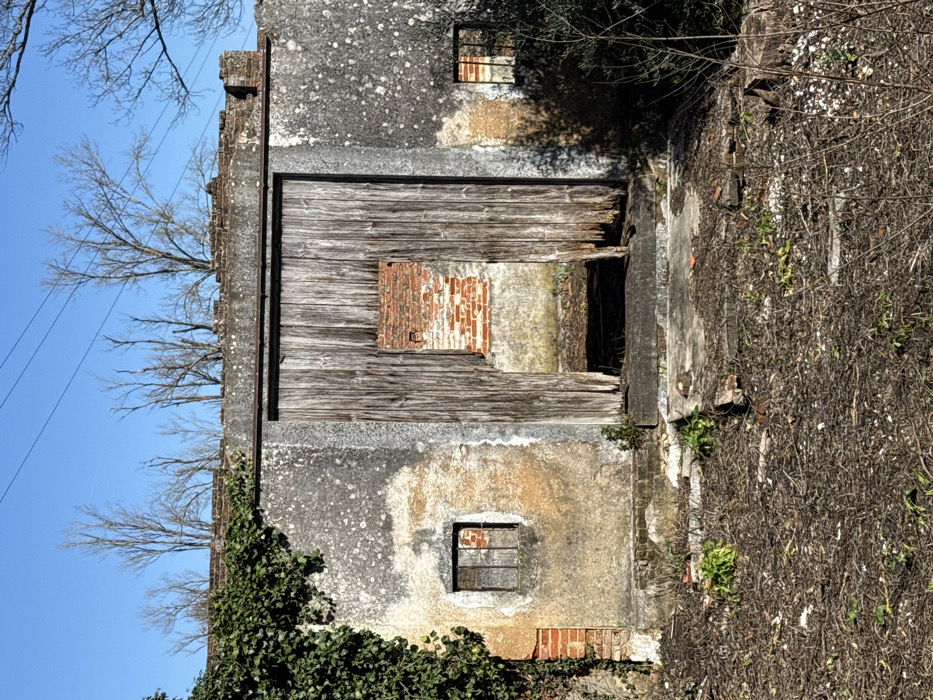
This image depicts the exterior of a dilapidated, single-story building in Tomar, Portugal, under a clear blue sky. The structure features heavily weathered, light-colored stucco or concrete walls exhibiting grey, yellowish, and brownish discoloration, indicative of age and exposure. The left side of the building is extensively covered in dense green ivy. Two small, rectangular window openings are visible: one on the left wall with a rusted, gridded metal frame, and a similar one on the right, partially obscured by shadows and vegetation. Both windows show exposed red brickwork within their frames. The central feature is a large, presumably double-panel wooden door or gate, constructed from vertically oriented planks. This entrance is severely degraded; a large, irregular section is missing from the lower center, revealing a dark interior and an exposed brick infill or wall section directly above the opening within the wooden structure. The bottom edges of the wooden doors are frayed and splintered. Above the structure, a damaged roofline reveals exposed red brickwork. The ground immediately in front of the building is unpaved, covered with dark brown organic debris, including what appears to be dried leaves and twigs, interspersed with sparse green herbaceous growth. In the background, above the building, several bare deciduous trees with visible branches rise against a vivid, clear blue sky. Overhead, thin dark lines consistent with power lines are visible in the upper right quadrant. No individuals or active elements are present in the scene, which conveys a sense of abandonment and natural decay.
Tomar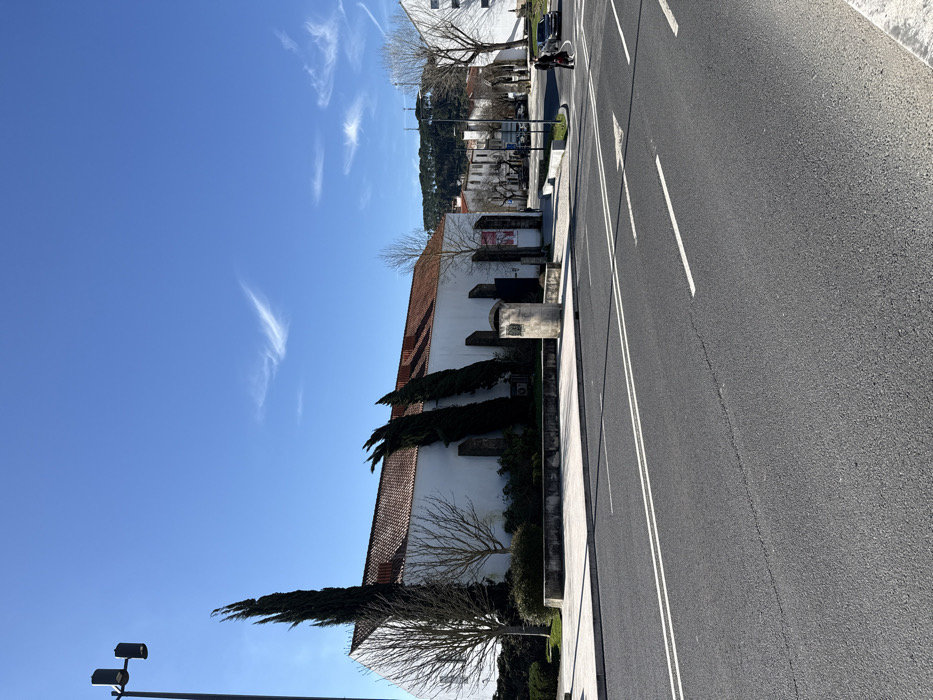
The image displays an urban street scene in Tomar, Portugal, specifically facing the former Convento de São Francisco (now cultural facilities like Cine-Teatro Paraíso) on Avenida Cândido Madureira. The foreground features a wide asphalt road with two visible lanes separated by double solid white lines. A single solid white line delineates the road edge on the right. Painted white arrows and dashed lines are visible further down the road, indicating traffic guidance. The asphalt exhibits minor surface cracks. The midground is dominated by a long, single-story building with white walls and a reddish-brown terracotta tiled roof. Several tall, dark green cypress trees are planted directly against the building's facade, alternating with dark, narrow architectural elements. Bare deciduous trees with thin branches are also present on the property. A raised, light-colored concrete planter or low wall runs along the building's perimeter. In front of this, a light-colored stone monument, possibly a plinth or pillar with an attached plaque, stands on a paved pedestrian area. To the far left, a black streetlamp with two cylindrical luminaires extends upwards. In the mid-to-background, to the right, a solitary individual dressed in dark clothing is observed walking across a pedestrian crossing. A dark-colored sedan is partially visible behind the person, either parked or in motion. Further down the street, additional white and light-colored buildings with terracotta roofs are visible, characteristic of a Portuguese townscape. A large hill, densely covered with green vegetation, rises in the distant background. The sky is clear and blue with minimal, wispy white clouds. The scene is illuminated by bright daylight, casting visible shadows.
Tomar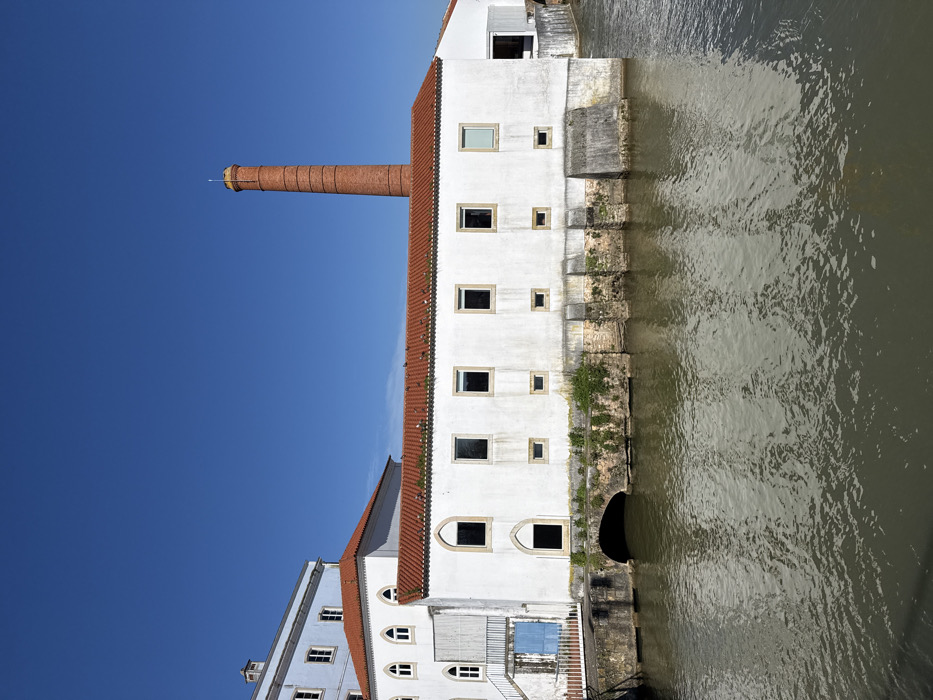
The scene depicts a multi-sectional building complex situated on the Nabão River in Tomar, Portugal, under a clear blue sky. The primary structure is a white-walled building with a terracotta-tiled roof, featuring a tall, slender, red brick industrial chimney rising prominently from its right side. The building's façade, directly above the water, displays a row of five rectangular windows on an upper level and four smaller square windows below them. To the left, an arched window opening is visible at water level. Further left, another white-walled section with a terracotta roof features multiple arched windows and an external white staircase leading to a landing with a blue double door. The building's foundation is composed of stone and concrete, directly entering the olive-green water. An arched culvert is present at water level on the left. Patches of green vegetation adhere to the lower walls of the structure. The water surface shows ripples and reflects the building and sky. No individuals or discernible activities are present.
Tomar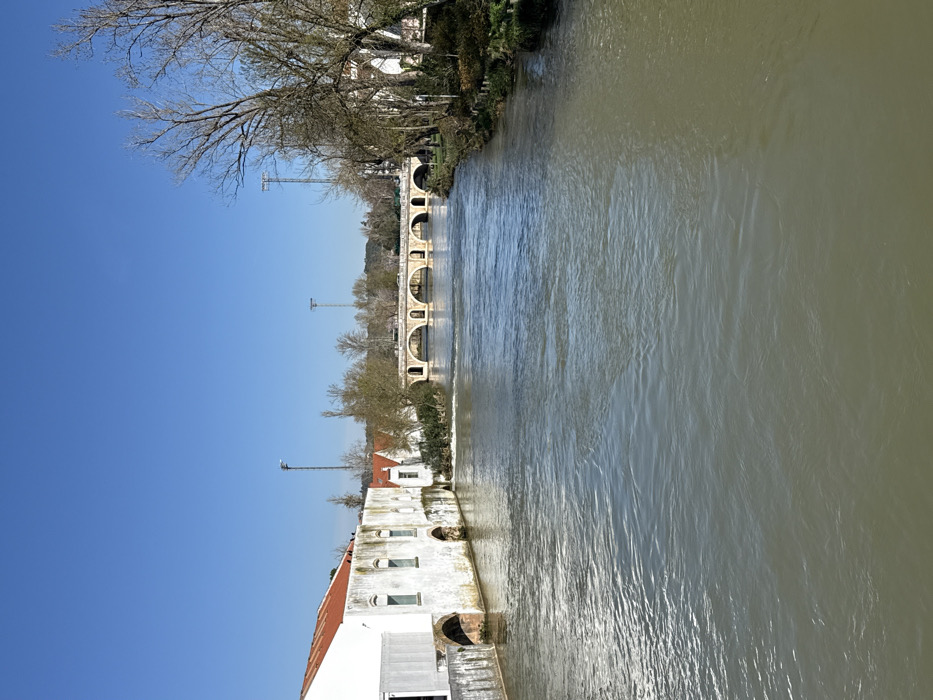
The image presents a wide river flowing through the city of Tomar, Portugal, under a clear, cloudless blue sky. The perspective is upstream, with the water occupying the majority of the foreground and midground. The river water is a murky greenish-brown, displaying ripples and reflections on its surface. On the left bank, a row of white, multi-story buildings with rust-orange tiled roofs runs parallel to the river. The closest structure, prominent in the foreground, features multiple rectangular windows with white frames and at least two distinct arched openings at its base, directly above the water line, from which turbulent water flows. The lower sections of the building's facade exhibit staining and discoloration. Beyond this, smaller, similar white buildings are partially visible. The right bank is characterized by a strip of natural vegetation, including numerous tall, bare deciduous trees, suggesting late autumn or winter, interspersed with evergreen shrubs and ground cover closer to the water. In the mid-distance, a multi-arched stone bridge, consistent with the Ponte Velha (Old Bridge) in Tomar, spans the river. It is constructed of light-colored stone and features at least five visible arches supporting a flat deck. Behind the bridge and further along the riverbanks, distant trees and structures are visible. Notably, two tall, metallic floodlight poles stand prominently in the background, suggesting a nearby open field or sports facility. No individuals, specific actions, or interactions are discernible in the scene.
Tomar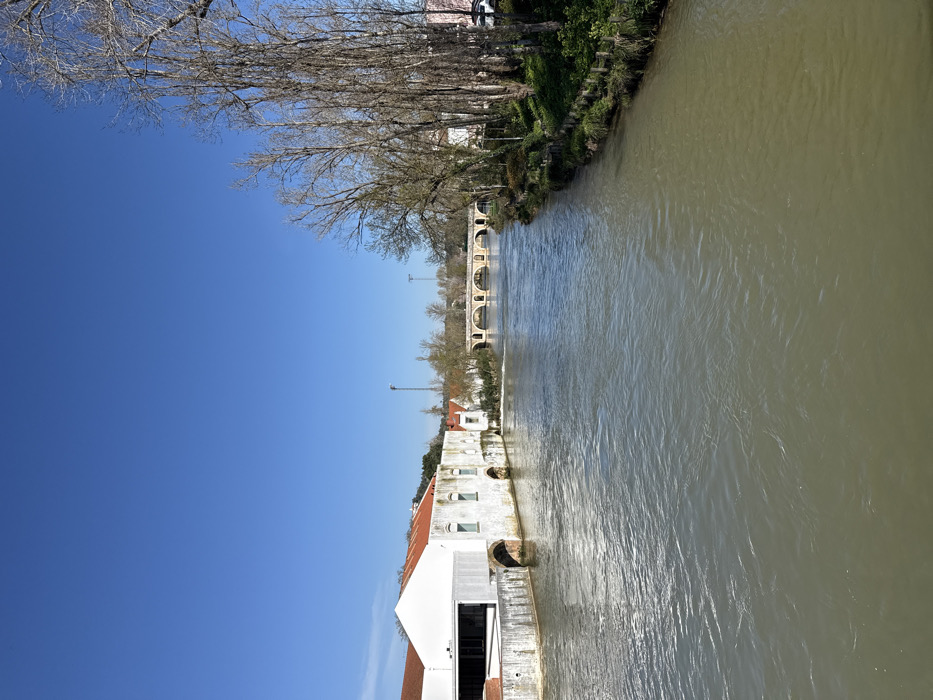
An image depicts a daytime view of the Nabão River in Tomar, Portugal, flowing under a clear blue sky. The river occupies the central and lower portions of the frame, exhibiting murky, greenish-brown water with visible surface ripples indicating a current. On the left bank, a multi-component structure is present. In the foreground, a modern white building with dark rectangular windows and a flat roof is adjoined to an older, traditional white building featuring a terracotta-tiled roof and several arched openings at its base near the water. A concrete embankment borders the river along this side. Further upstream on the left, additional buildings with terracotta roofs are visible. The right bank is densely lined with tall, slender, bare deciduous trees, their branches and trunks prominent. Green undergrowth covers the ground along this bank, and sections of a wooden retaining barrier are visible at the water's edge. In the mid-ground, a historic, light-colored stone bridge with multiple arches spans the river. Beyond the bridge, more distant trees and urban structures are discernible. Two tall, slender utility poles stand on the left, situated between the buildings and the bridge. The sky above is uniformly clear and deep blue, devoid of clouds. No individuals or active human elements are present in the scene.
Tomar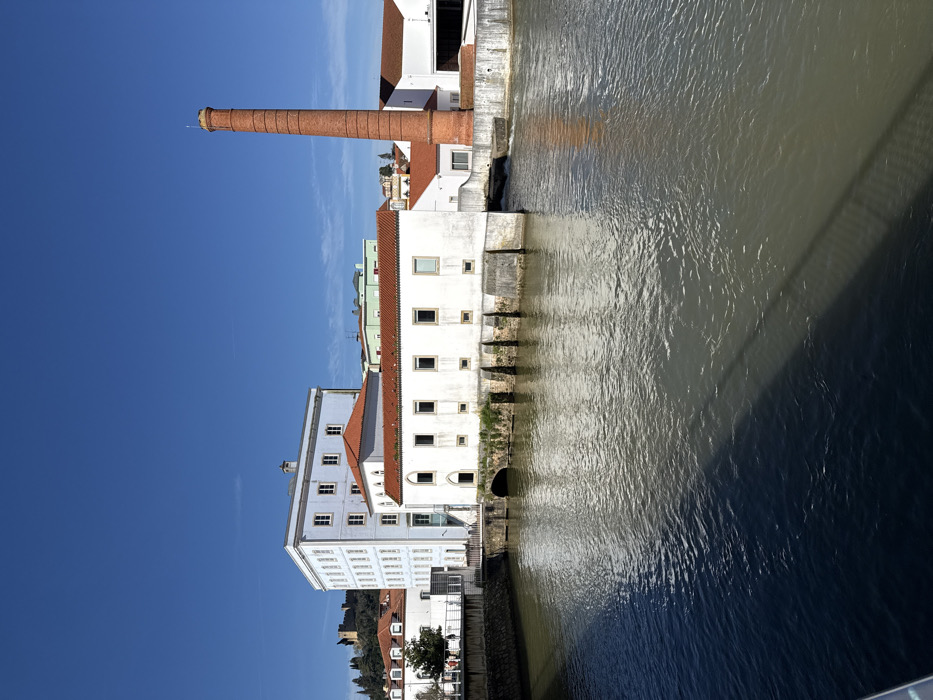
This image captures a riverside scene in Tomar, Portugal, under a clear blue sky. The River Nabão occupies the lower portion, bisected diagonally by a dark shadow, likely from a bridge, leaving the left side of the water dark and the right side lighter and reflective. On the left bank, a multi-story building with a light blue-white facade and numerous uniformly spaced rectangular windows stands prominently. Behind it, on a tree-covered hill, the ruins of a historic castle are visible in the distant background. Adjacent to the river on this bank is a lower white structure with a red tile roof, featuring several arched openings at its base that appear to be former water channels, with some vegetation growing on the stone foundations. Faint, indistinct figures of people are visible on a walkway further left, behind a railing. On the right bank, a long, white building with a red tile roof extends along the river, also displaying multiple rectangular windows. To its right, a tall, cylindrical industrial chimney, constructed from reddish-brown brick, rises against the sky. A small weir or waterfall is visible between structures on the right, where water flows into the main river channel. Another white building with a dark, open bay and a red tile roof is present further to the right. The scene is brightly illuminated by direct sunlight. No specific actions or interactions between individuals are clearly depicted.
Tomar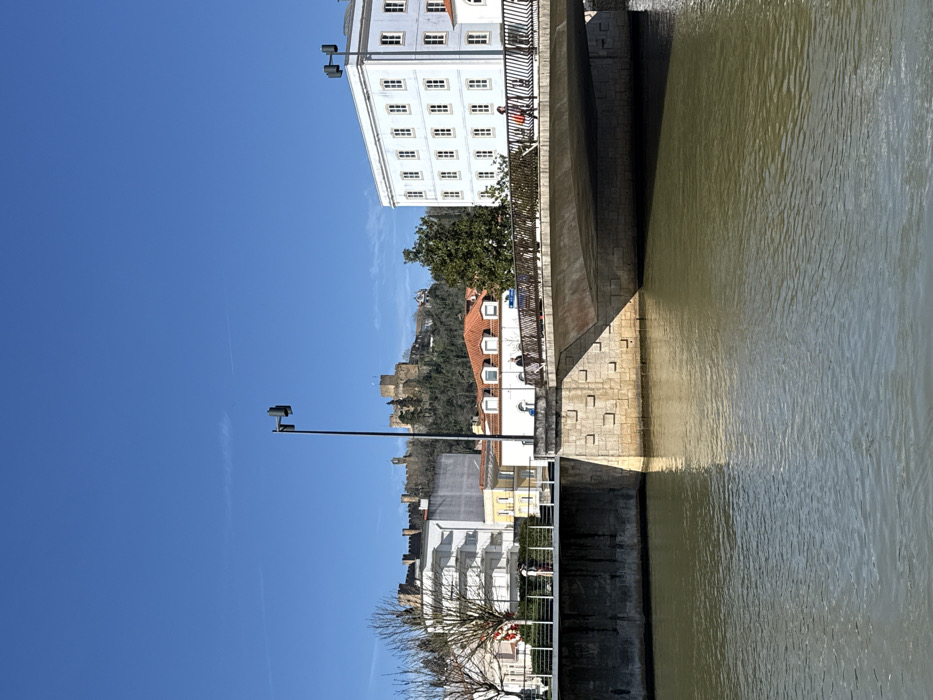
This image captures a daytime scene in Tomar, Portugal, viewed across the Nabão River. The foreground is dominated by the river, displaying a rippled, olive-green hue. A concrete and stone bridge spans the river, featuring a metal railing. On the bridge, two individuals are visible on the right side walking left; one wears a bright orange top and dark trousers. Another individual is on the left side of the bridge, walking right. On the left riverbank, a paved promenade secured by a grey metal railing shows one pedestrian walking right. Buildings line both banks. On the immediate right, a large, multi-story white building with numerous rectangular windows is prominent. On the left bank, a variety of structures include a white multi-story building with balconies, a yellow building, and several buildings topped with terracotta tile roofs. Dominating the distant background, atop a heavily wooded hill, is the ancient Convento de Cristo and Castle of Tomar, characterized by its stone walls and towers. The sky above is clear and brilliant blue, with a faint, thin contrail visible. Two black streetlights, each equipped with multiple luminaire heads, are positioned in the mid-ground. Shadows are cast under the bridge, indicating a high sun position.
Tomar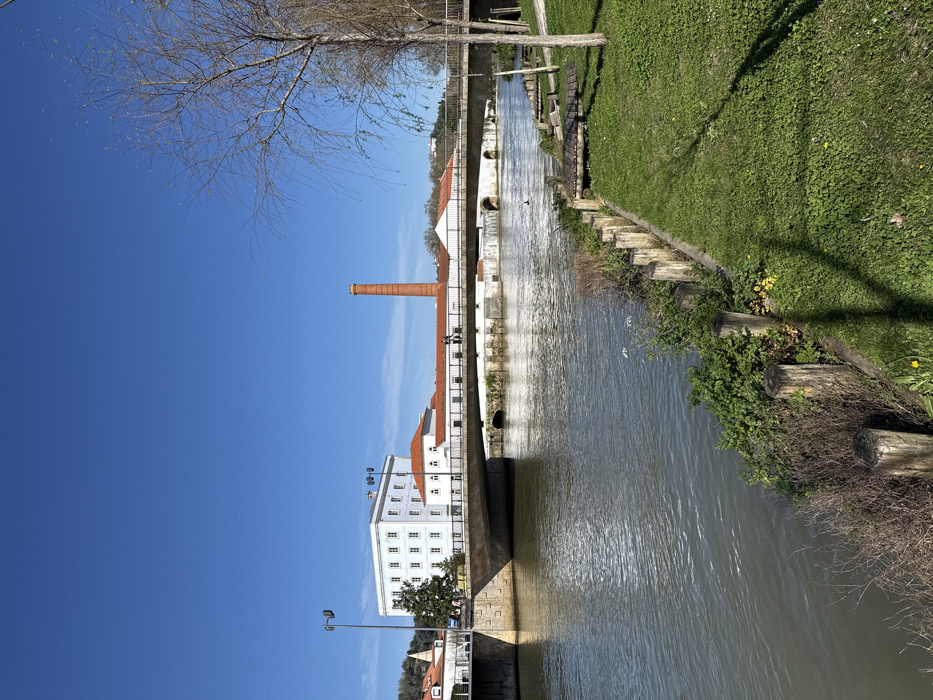
This image captures a daytime scene along the Nabão River in Tomar, Portugal, specifically depicting the area near the Complexo Cultural da Levada and the former Fábrica de Papel do Prado. The environment is characterized by a clear, bright blue sky dominating the upper portion of the frame. The foreground on the right features a grassy bank covered in lush green, clover-like vegetation. A line of weathered, dark wooden posts marks the edge of the bank along the river. Behind these posts are scattered green bushes and sparse dry vegetation. Two wooden, slat-style reclining benches or chairs are present on the grass, facing the river. A bare-branched deciduous tree is partially visible on the far right, casting a distinct shadow across the grassy area. The Nabão River occupies the midground, flowing from left to right. Its surface is rippled and reflects the blue sky, with the water appearing murky green-brown. A multi-arched concrete and stone bridge crosses the river, featuring a gray metal railing along its top. Below the bridge, on the far bank, water flows through additional arches, indicating a weir or dam structure. On the left bank, beyond the bridge, stands a large, multi-story white building with numerous white-framed windows and an orange-tiled hip roof. To its immediate right, connected by a lower, elongated building with a red-tiled roof, is a tall, slender, red brick industrial chimney. Two streetlights with dual lamps are visible near the white building. Two indistinct human figures are walking eastward on the pedestrian walkway of the bridge. In the far background, on the upper left, green hills with some smaller white structures are visible. Sunlight is strong, casting clear shadows, indicating a sunny day.
Tomar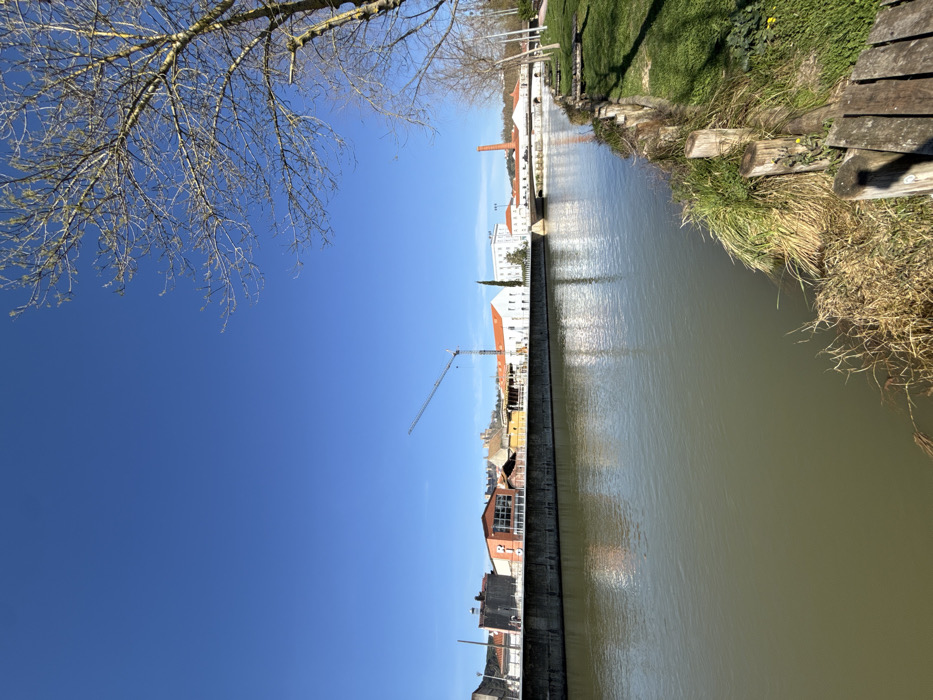
The image depicts a panoramic view of the Nabão River in Tomar, Portugal, under a clear, bright blue sky. The river occupies the lower half of the frame, flowing from the foreground towards the background, exhibiting calm, murky greenish-brown water with subtle reflections. On the right side of the foreground, a grassy bank slopes gently towards the river, bordered by a rustic retaining wall constructed from vertical wooden posts and horizontal planks. Patches of green and dry, yellowish grass are visible on this bank. A large, deciduous tree with bare branches and nascent buds partially extends into the upper right corner of the frame. Further along the right bank, smaller, leafless trees are visible, and a grassy path extends into the distance. The opposite bank of the river features a prominent, dark-colored concrete retaining wall. Above this wall, a row of buildings lines the river. Notable structures include a reddish-orange building with a partially visible "RIO" sign on its facade, and several other multi-story buildings of varying colors including white, grey, and light yellow. Some structures appear to be undergoing construction or renovation, with exposed framing visible. A tall, red and white construction crane is positioned above these buildings in the mid-ground. In the further distance, an industrial-style building with a reddish-brown brick chimney stands out, and a white, arched bridge spans the river connecting both banks. On the elevated horizon behind the buildings, a distinct historic stone structure, likely a castle or convent, is visible. No individuals or animals are present within the scene. The overall lighting suggests mid-day conditions.
Tomar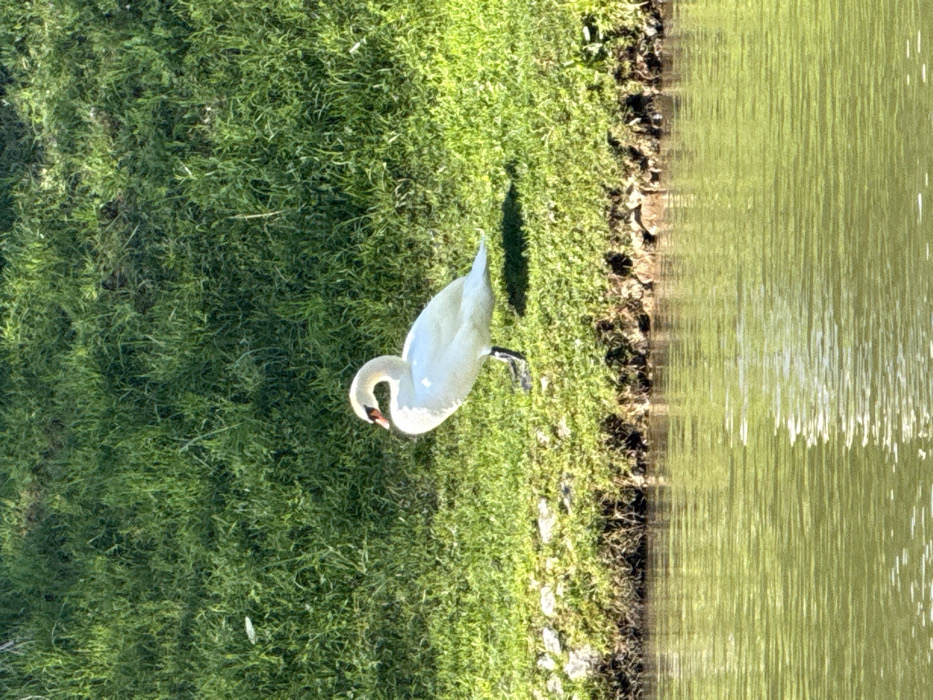
A white swan stands on a green grassy bank along a waterway in Tomar, Portugal. The swan, predominantly white, features an orange bill with a prominent black knob at its base. It is oriented towards the left of the frame, with its neck curved backward and its head turned over its left shoulder. A single black webbed foot is visible on the grass. The bank slopes down to a body of green water, which exhibits ripples and reflections of sunlight. A distinct shadow is cast beneath the swan onto the grass, indicating direct illumination. The immediate shoreline where the grass meets the water shows exposed soil and small irregularities. No other subjects or interactions are visible.
Tomar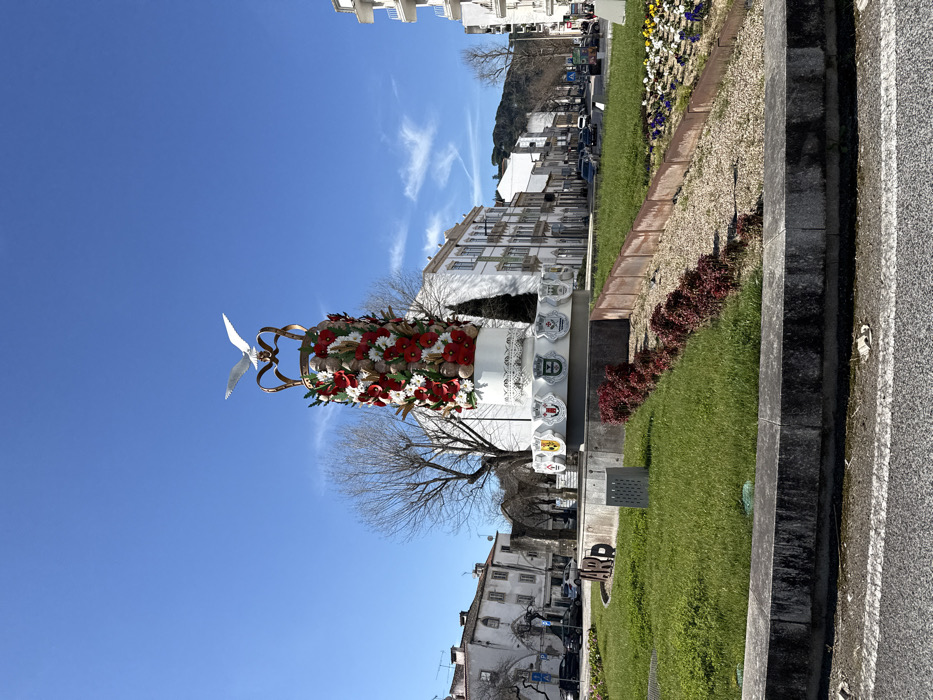
A tall, ornate monument stands at the center of a landscaped traffic roundabout in Tomar, Portugal, under a clear blue sky. The monument features a white cylindrical base, encircled by a band of relief work and a series of heraldic shields. Above this, the main column is densely decorated with red and white sculpted floral elements, appearing to be poppies, interspersed with numerous sculpted human faces. The monument is crowned by a golden, open-style crown, from which a white dove with outstretched wings appears to ascend. The roundabout itself is covered in green grass, with sections of gravel and parallel rows of small, reddish-leafed plants. A low concrete curb defines the perimeter of the central island. In the background to the left, several multi-story buildings with white facades and traditional architecture line a street, where multiple vehicles are parked. Bare deciduous trees are visible, along with what appears to be a large, weathered stone archway structure. To the right, additional multi-story white buildings extend along a street with active vehicular traffic. A distant hill, densely covered with trees, forms the horizon line. The sky is bright blue with scattered thin, white cirrus clouds, indicating clear weather. No individuals are visible in the immediate scene.
Tomar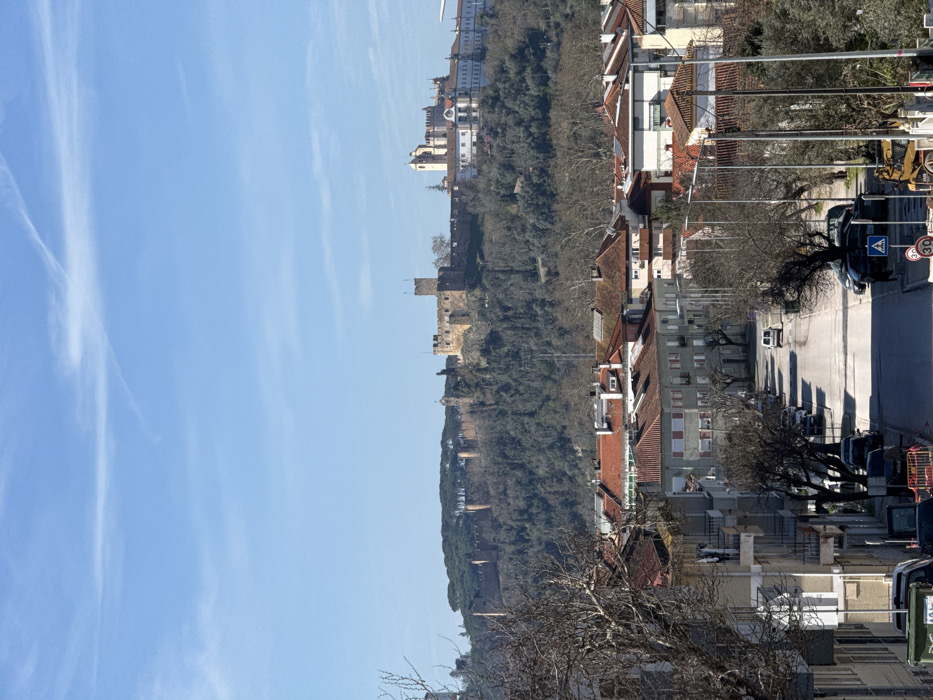
An outdoor, daytime image depicts a view in Tomar, Portugal, looking uphill from a residential street towards the Castle of Tomar and the Convent of Christ on a prominent forested hill. In the foreground, a paved asphalt street ascends the incline, flanked on both sides by parked passenger vehicles. A white panel van is observed moving uphill in the center of the street. Multi-story residential buildings with terracotta-tiled roofs and balconies line both sides of the street. Bare deciduous trees and streetlights are spaced along the curbs. A green waste bin is visible in the lower-left corner. Traffic signage includes a blue pedestrian crossing sign and a circular "30" speed limit sign. The mid-ground features a densely wooded hillside, primarily composed of bare deciduous trees with some interspersed evergreens, acting as a natural buffer between the residential area and the summit structures. In the background, atop the hill, the historical complex of the Castle of Tomar and the Convent of Christ is prominently displayed. The Castle of Tomar exhibits light brown stone walls, battlements, and multiple towers, with flags flying from at least one tower. Adjacent to the castle, the Convent of Christ presents a series of lighter-colored, multi-story buildings with distinct architectural features. A dense line of dark green evergreen trees crowns the summit behind the castle and convent structures. The sky above is clear blue with sparse, high-altitude white wispy clouds, including one distinct linear contrail-like cloud formation. No discernible individuals are engaged in specific actions within the visible frame.
Tomar