Torre di Santa Maria, Italy
10 memories from Torre di Santa Maria, Italy
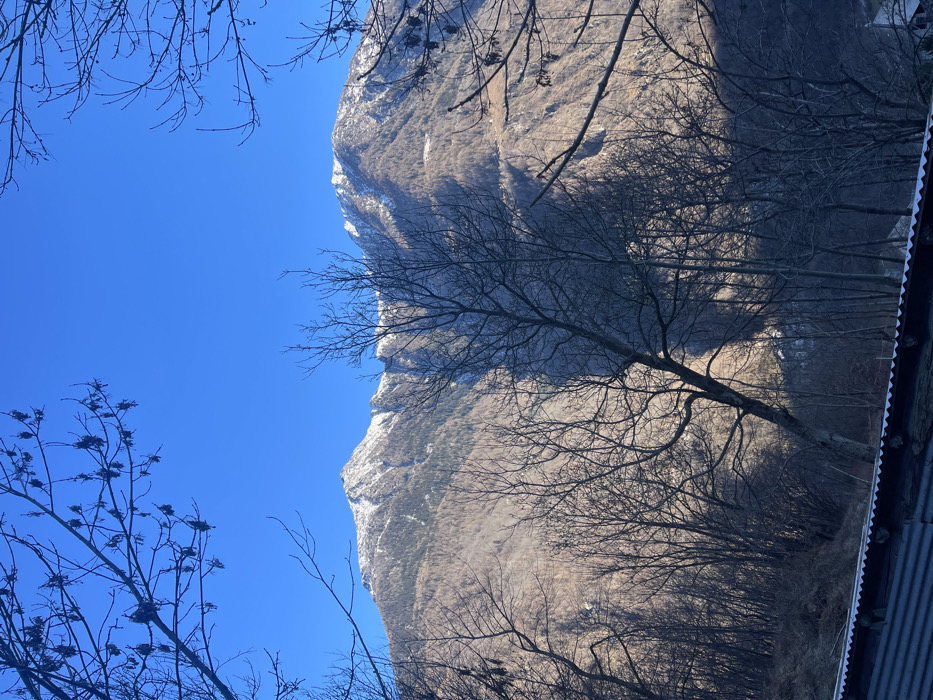
This vertical image presents a majestic mountain landscape under a clear, vibrant blue sky. A massive, rugged mountain face dominates the right side of the frame, displaying rocky textures and patches of white snow or ice near its summit and in crevices. The left and bottom portions of the scene are framed by the dark, intricate silhouettes of numerous bare, deciduous tree branches, characteristic of winter or early spring. Some branches in the lower-left corner exhibit small, dark clusters, possibly dried berries or seed pods. In the midground, a dense stand of leafless trees casts deep shadows across the lower mountain slopes and a valley floor that stretches into the distance. A segment of a corrugated metal roof is visible along the bottom-right edge, suggesting a nearby structure. The bright sunlight and lack of clouds indicate a clear, sunny day. The bare trees and snow-dusted mountain suggest the scene takes place during winter or early spring. There are no people or discernible activities, and no visible text in the image. The setting conveys the stark beauty and scale of a mountainous region, consistent with Torre di Santa Maria, Italy.
Torre di Santa Maria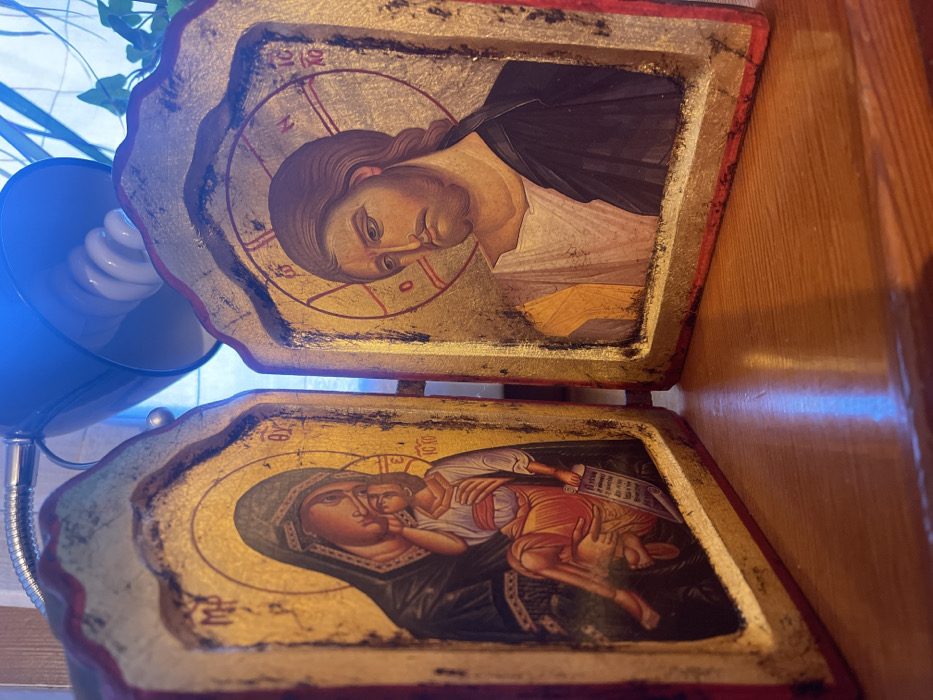
The image displays two open religious icons, possibly forming a diptych or part of a triptych, presented vertically. Both icons are framed in wood with red-painted edges and gold leaf backgrounds, showing notable signs of age and wear, including cracks, chips, and darkened areas. The upper icon depicts Jesus Christ in a half-body portrait, his gaze directed slightly to his right. He has long brown hair, a beard, and wears dark outerwear over a lighter tunic. Behind his head is a halo with a cruciform design, containing Greek letters. Visible text includes "IC" on the left arm of the cross within the halo and "O ω N" (O ON, "The Being") on the right arm and circle, identifying him as Christ Pantocrator. The lower icon portrays the Virgin Mary, known as the Madonna, cradling the infant Jesus. Mary is depicted with a dark blue or black maphorion covering her head and shoulders. The infant Jesus is partially clothed in an orange/red garment, holding a scroll with faint, unreadable Greek text in one hand and reaching towards his mother with the other. Both figures have halos; Mary's contains faintly visible Greek letters, likely "ΜΡ ΘΥ" (Meter Theou, Mother of God). In the background to the left, a modern blue desk lamp with a coiled fluorescent bulb (CFL) emits a cool light. A hint of green foliage is visible above the lamp. To the right, a warm-toned wooden surface or furniture piece with vertical grain serves as the backdrop. The overall setting is indoors, with artificial light contributing to the illumination. The icons' solemn expressions and traditional style are characteristic of Byzantine or Orthodox iconography. This scene is located in Torre di Santa Maria, Italy.
Torre di Santa Maria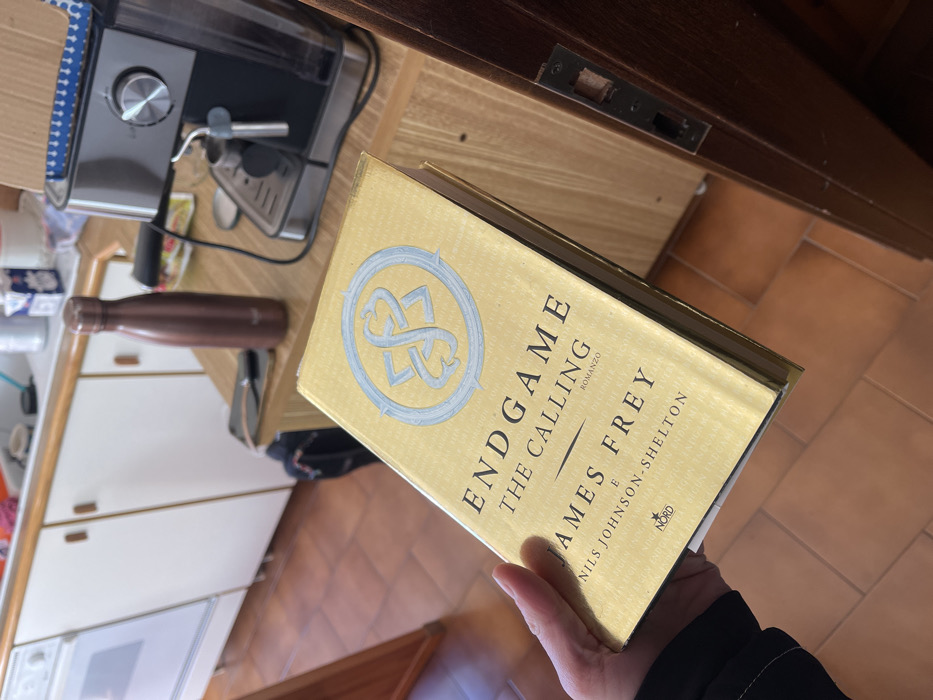
The image, taken in Torre di Santa Maria, Italy, depicts an indoor scene, likely a kitchen or a room adjacent to it. A person's hand, partially visible in the lower right, holds a book with a prominent yellow cover. The book is titled "ENDGAME THE CALLING" by authors James Frey and Nils Johnson-Shelton, with "ROMANZO" also visible, and "NORD" as the publisher. The cover features a circular emblem with intertwined blue-grey symbols. The background shows a domestic setting. On a wooden countertop to the left, an espresso machine with a silver knob and steam wand is present, along with a brown insulated water bottle. Below the countertop are white kitchen cabinets with brown handles. To the right, part of a wooden door frame with a metal strike plate is visible. The floor, visible in the lower right, consists of reddish-brown tiles. The scene is illuminated by ambient light, suggesting daytime. The image is captured at an angle, making the elements appear tilted.
Torre di Santa Maria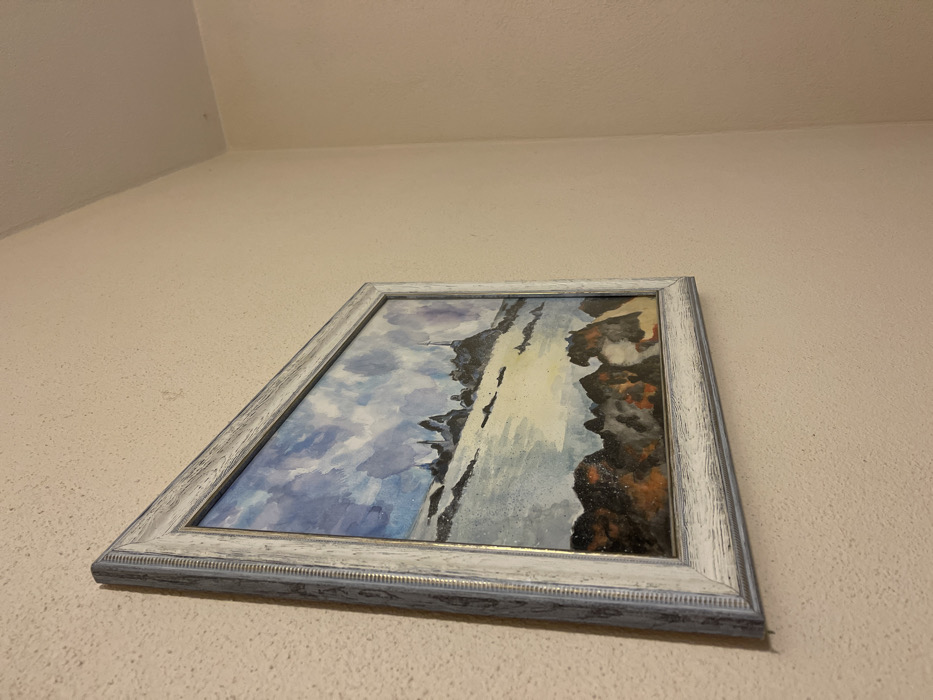
The image displays a framed watercolor painting hanging on a textured, light-colored wall, captured from a low, upward-angled perspective. The painting depicts a dynamic landscape, likely a dramatic waterfall or a steep coastal scene. The left side of the artwork features a cloudy sky rendered in blues and grays, transitioning into a body of water. The right side showcases dark, rugged land formations or cliffs in earthy tones of brown, orange, and black, possibly with sparkling or speckled accents. A prominent vertical streak of light colors, potentially a waterfall or reflections, bisects the composition. The artwork is encased in an ornate, distressed wooden frame with a weathered white and light grey finish, accented with subtle blue-grey details and a thin gold-colored inner rim. The wall behind the painting has a granular or stucco-like texture and is a uniform light beige or off-white color. The corner where the wall meets the ceiling is visible in the upper portion of the photograph. There are no people or specific activities visible in the image. The setting appears to be indoors, under ambient lighting, which does not indicate a specific time of day. No text is discernible anywhere in the frame or on the wall. While the location context is provided as Torre di Santa Maria, Italy, there are no specific visual elements within the photograph itself that confirm this location.
Torre di Santa Maria
An indoor, brightly lit close-up shot captures a doll with blonde, curly hair and striking blue eyes. The doll's head is positioned towards the left of the frame, lying on its back, with its mouth slightly open, revealing a glimpse of its tongue. A light yellow bow is tied in its hair on the left side. The doll wears a light pink and white patterned dress, possibly featuring floral or geometric designs, accented with a white lace trim across the bodice. An orange garment appears to be worn underneath the dress, visible around the doll's neck. The doll is resting on a reddish-pink, ribbed surface, which could be a mat or a box lid. In the upper right background, a blurred, light-colored object, possibly a box, displays faint, illegible text. A brown wooden surface frames the far right edge of the image. Part of another doll's or the same doll's leg and foot, wearing a white sock, is visible on the right side of the frame. The setting is ambiguous but appears to be indoors.
Torre di Santa Maria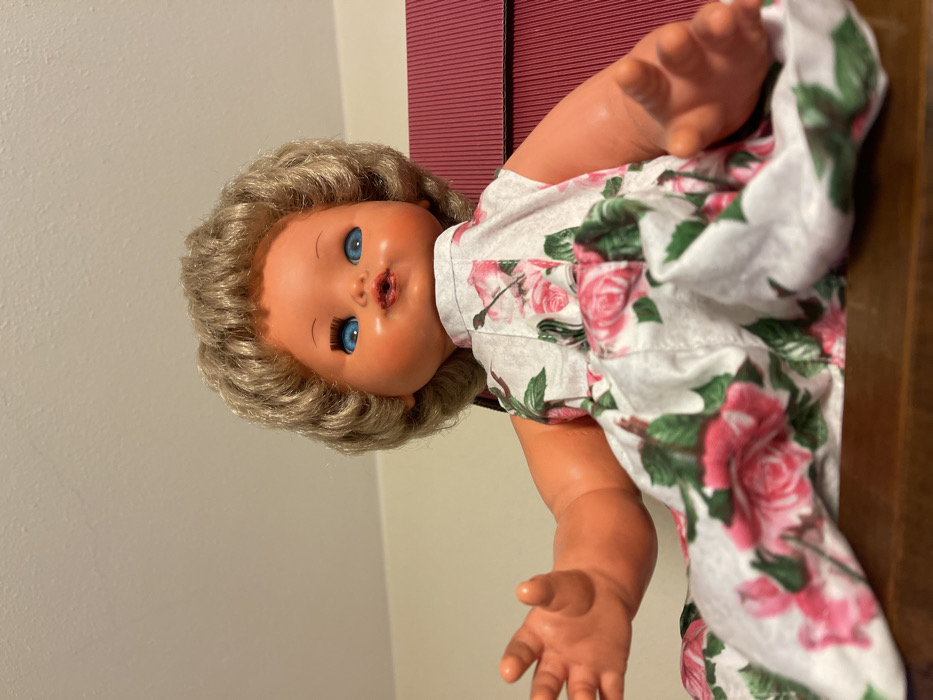
A doll is depicted in a close-up, angled shot, lying on its back with its head positioned towards the left of the frame. The doll has fair skin, bright blue eyes, and light brown, curly hair. Its mouth is slightly open, giving the impression of speaking or cooing. It is dressed in a white fabric garment, possibly a dress or romper, patterned with vibrant pink roses and green leaves. The background to the left of the doll is a plain, light-colored wall, likely off-white or beige. To the right, behind the doll's body, is a darker, textured surface, appearing to be a piece of furniture or a blind with horizontal slats, in shades of reddish-brown or dark wood. The doll's arms and legs are visible, resting casually. The setting is indoors, with no specific activity occurring as the doll is static. There is no visible text in the image. The provided location context for the image is Torre di Santa Maria, Italy.
Torre di Santa Maria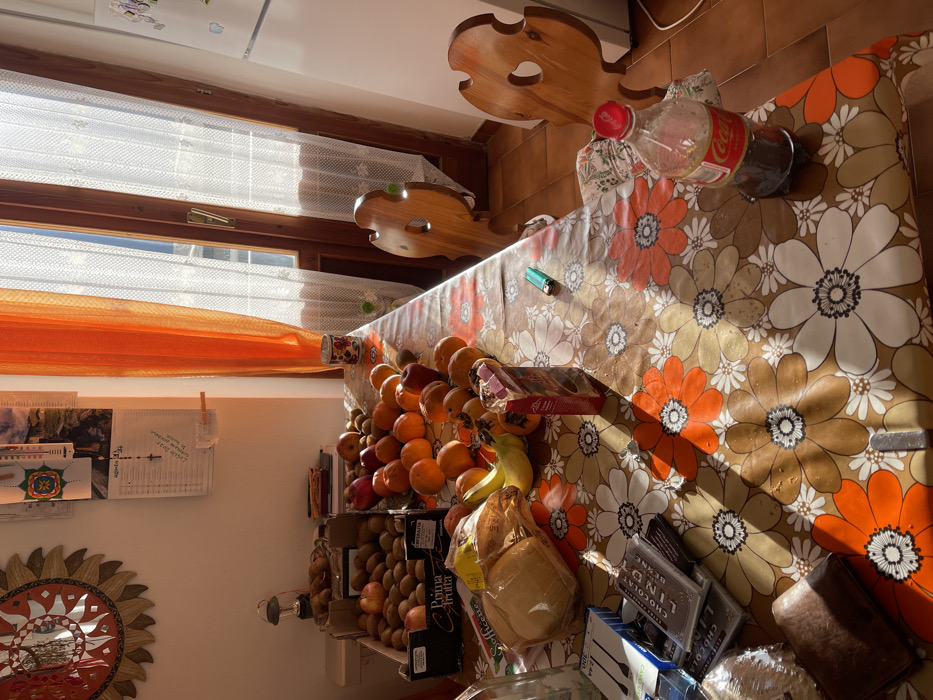
The image, captured in a rotated landscape orientation, depicts a sunlit domestic interior, likely a kitchen or dining area, in Torre di Santa Maria, Italy. A large wooden table, adorned with a vibrant floral tablecloth featuring orange, white, and brown blossoms, dominates the scene. On the table, a substantial display of fresh fruit includes a large pile of oranges, several red apples, and a bunch of yellow bananas. Below the table, boxes containing kiwis, some labeled "Prima Frutta," are visible. Other food items present are two plastic bags of bread (one labeled "Coffeette"), multiple boxes of "Lindt" chocolate, and a smaller box of confectionery. A partially consumed Coca-Cola bottle with a red cap and a green disposable lighter also rest on the tablecloth. A white ceramic mug is placed near the window. Bright, direct sunlight streams through a large, wooden-framed window, illuminating the scene and casting sharp shadows across the table. The window is dressed with white sheer curtains and an orange sheer fabric drape, adding a warm glow. Above the table, decorative carved wooden elements are affixed to the wall. On a lighter-colored wall to the left, a prominent, circular sun-shaped mirror is mounted. Papers, including one with partially visible Italian text like "LUNEDÌ 2023," are pinned to the wall. No people are present, suggesting a quiet moment in a well-stocked home. The bright lighting indicates it is daytime, possibly morning or afternoon. The overall impression is one of warmth and abundance in a traditional setting.
Torre di Santa Maria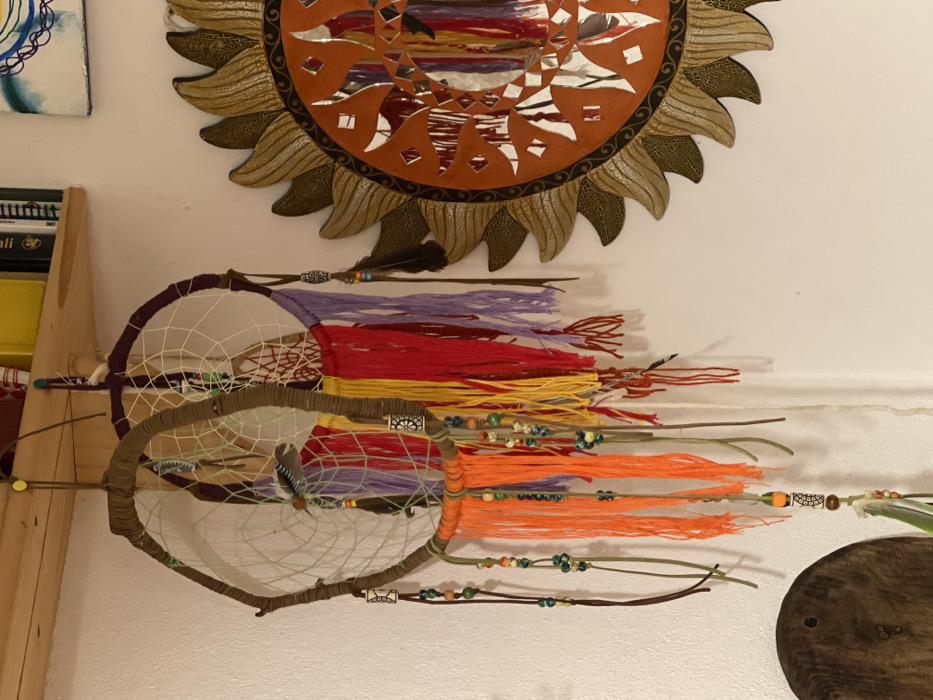
The image captures a collection of decorative objects mounted on a light-colored wall, likely in an interior space within Torre di Santa Maria, Italy. At the top, a large, intricate sun-shaped wall hanging is prominently displayed. It features an orange central disc embedded with small mirror pieces, surrounded by textured, golden-brown rays. Below the sun decor, several dreamcatchers are visible. They vary in size and design; one has a dark purple-wrapped hoop, and another a light brown-wrapped hoop, both containing delicate white web-like netting. Hanging from these dreamcatchers are numerous colorful tassels made from yarn in shades of purple, red, yellow, and orange, interspersed with green and brown strings. These hanging elements are adorned with a variety of beads in green, orange, brown, white, and multicolored patterns, along with small silver-colored metal accents. Brown and spotted feathers are also integrated into the dreamcatcher designs. To the far left, a section of a light-colored wooden shelf or furniture piece is visible, supporting what appear to be book or box spines with partially readable text, including "ali" and "manu." A small corner of a white canvas artwork with blue circular patterns is visible in the top left. In the bottom right, a portion of a dark, round wooden object is present against the wall. No human activity is depicted; the scene portrays static decorative items, creating a warm, bohemian, and artfully arranged atmosphere.
Torre di Santa Maria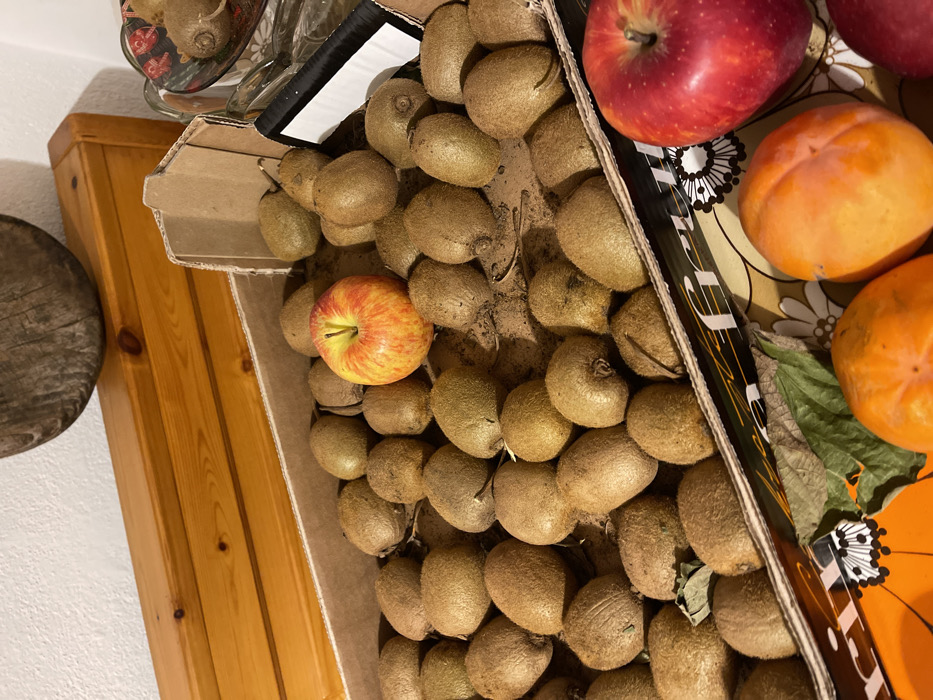
This media file captures an indoor setting in Torre di Santa Maria, Italy, focusing on a collection of fruits. The primary subjects are a large quantity of kiwis, two apples, and two persimmons. A substantial cardboard box, partially open and with some visible dirt/fibers inside, holds numerous kiwis, appearing to be freshly harvested or recently acquired. Nestled among these kiwis is one small, round apple with red and yellow stripes. To the right of the box, another larger, deep red apple is visible. Alongside this apple are two ripe, orange persimmons, resting on a patterned surface that features floral or geometric designs in shades of cream and brown. A dark green leaf is also present near one of the persimmons. The box and surrounding fruits are placed on a warm-toned wooden surface, likely a table or countertop. To the left, a portion of a round, rustic wooden object, possibly a cutting board, is visible, alongside a white wall in the background. The lighting suggests an ambient indoor environment. The side of the cardboard box displays an unreadable black and white logo or text. No people are visible, and no specific activity is taking place beyond the arrangement or storage of the fruits. The scene evokes a sense of home or a local market display.
Torre di Santa Maria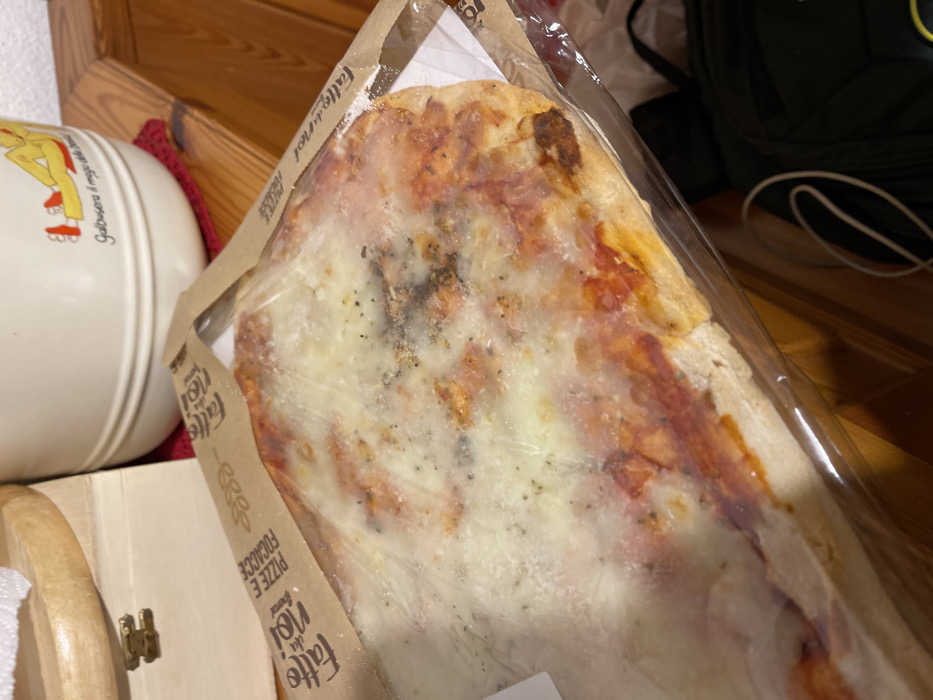
The image captures a close-up view of a rectangular or oval-shaped pizza, centrally positioned and still in its packaging, resting on a wooden surface. The pizza is topped with melted white cheese, streaks of red tomato sauce, and sprinkled with what appears to be black pepper or herbs. It is encased in clear plastic film, with a brown cardboard sleeve partially wrapping around it. Visible text on the cardboard sleeve is in Italian, reading "Fatto da noi" (Made by us), repeated several times, and "PIZZE E FOCACCE" (Pizzas and Focaccias), confirming the product type and aligning with the location context of Torre di Santa Maria, Italy. To the left of the pizza, a large, white ceramic container with a lid is present. It features a yellow cartoon illustration of a character, possibly a chef or baker, dressed in red and seemingly on roller skates. Some additional, mostly illegible text is visible beneath the illustration on the container. Below this, a portion of a light-colored wooden box or tray with a metallic clasp is seen. The background on the right reveals a dark black bag or backpack and some white electrical wires, indicating an indoor, casual, and somewhat cluttered setting, likely a home. The wooden surface supporting the objects exhibits a noticeable grain. The scene depicts static objects; no active event or human presence is shown. Time of day or specific emotions are not discernible.
Torre di Santa Maria