Trakai, Lithuania
30 memories from Trakai, Lithuania
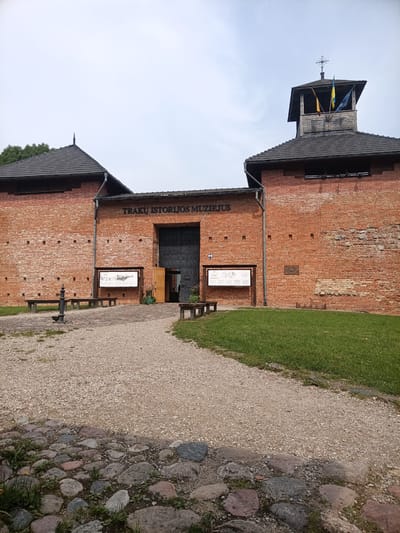
The image shows the exterior of the Trakai History Museum, located in Trakai, Lithuania. The museum is housed in a large, red brick building with a prominent tower topped with flags and a cross. The entrance to the museum is a large, dark metal gate, with an open wooden door to its right. In front of the building, there is a gravel path leading to the entrance, with a cobblestone path in the foreground. There are several benches made of wood and metal scattered around the area, as well as a vintage-style water pump. A large information board is displayed outside the entrance. The grounds are partially covered with grass and some vegetation. The sky is overcast. There are no people visible in the image.
Trakai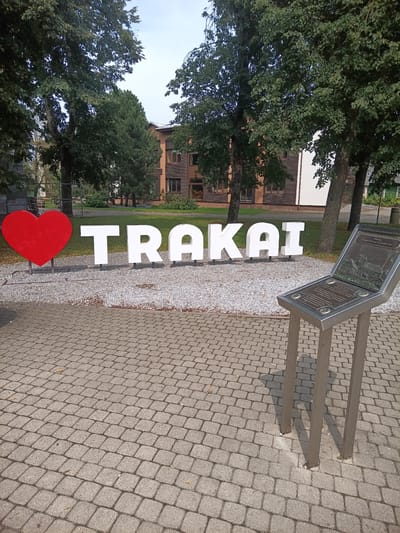
In the city of Trakai, Lithuania, a large red heart is placed next to three-dimensional white letters spelling "TRAKAI." The letters and heart are situated on a bed of white gravel, with a paved walkway in the foreground. To the right of the letters, a metal information stand with a plaque is visible. In the background, trees and buildings can be seen. The lighting suggests it is daytime.
Trakai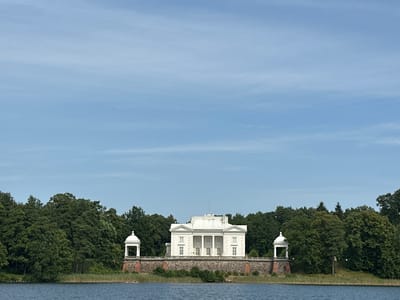
This is a landscape photograph featuring a large, white, neoclassical manor house with a portico of columns, situated on the shore of a lake. The manor is flanked by two white, domed gazebos, one on each side, atop a stone foundation. A dense forest of green trees forms the background behind the manor and gazebos. The foreground consists of a body of dark blue water, likely a lake, with reeds growing along the shoreline. The sky above is a clear, pale blue with some wispy white clouds. Two small figures in a boat are visible on the water in the lower left portion of the image. The manor house appears to be the Užutrakis Manor, located in Trakai, Lithuania, overlooking Lake Skaisčio.
Trakai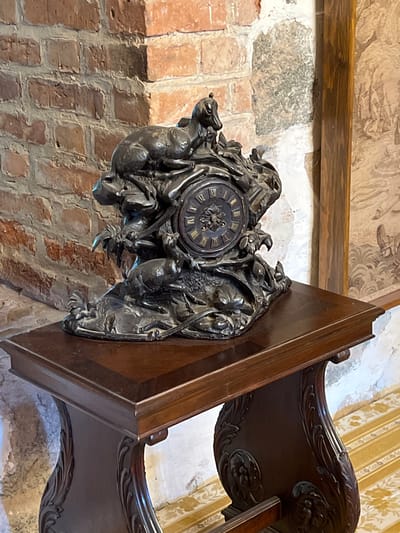
A dark, ornate antique clock featuring sculpted animals sits on a polished wooden table in Trakai, Lithuania. The clock's base depicts several animals, possibly dogs or wolves, in dynamic poses. The clock face itself is circular with Roman numerals. The table has carved, ornate legs and is placed against a brick wall. To the right of the clock, a portion of a framed tapestry or painting is visible. The floor has a yellow and white striped pattern with a floral motif.
Trakai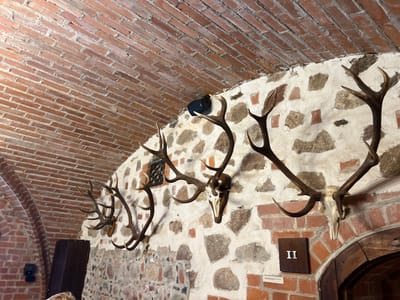
The image shows the interior of a building, possibly a museum or historical site, in Trakai, Lithuania. The scene is dominated by a brick arch ceiling and a stone wall adorned with mounted deer antlers. Several sets of antlers, some with skulls attached, are displayed on the wall. A dark-colored speaker is mounted high on the wall near the ceiling. There is a wooden cabinet or structure on the left side of the image. In the lower right corner, a dark wooden arched doorway is visible, with a dark brown plaque bearing Roman numerals "II" mounted on the wall to the left of the doorway. A person's head and shoulders are partially visible at the bottom left of the frame. The lighting suggests an indoor environment, possibly with artificial light sources.
Trakai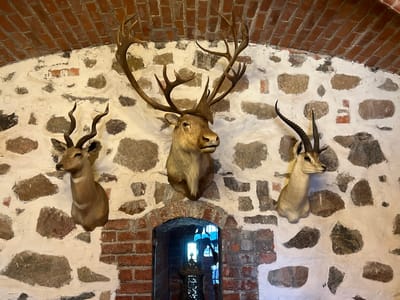
The image shows a wall decorated with three taxidermied animal heads. The wall is constructed of rough-hewn stones embedded in white plaster, with a red brick archway at the bottom center. Above the stone wall, a red brick arch curves upwards. The animal heads are mounted on the wall. From left to right, the first is a deer with spiraling horns. The middle is a larger deer with extensive, branched antlers. The third is another deer or antelope with long, curved horns. The overall impression is that of a rustic or historic interior, possibly a hunting lodge or a museum. The image is taken inside the Trakai Island Castle in Trakai, Lithuania. This specific location is likely within one of the castle's chambers or exhibition halls, given the architectural style and the display of hunting trophies. The lighting suggests an indoor environment, possibly with natural light filtering in from windows or from an artificial source outside the frame.
Trakai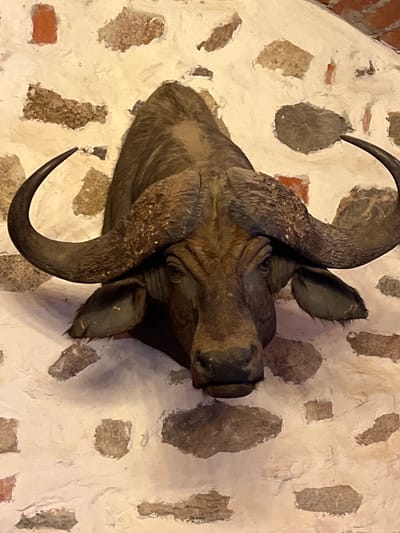
A taxidermied buffalo head mounted on a rustic stone wall is the subject of this close-up, eye-level, vertical, full-shot photograph. The buffalo head is dark brown with large, curved horns and a solemn expression. The wall behind it is made of rough, irregularly shaped stones embedded in a lighter-colored mortar. Some of the stones are reddish-brown, while others are grayer. The lighting appears to be warm, casting subtle shadows and highlighting the texture of the wall and the buffalo's fur. The overall impression is one of a hunting trophy displayed indoors, possibly in a lodge or restaurant. The location in Trakai, Lithuania is not visually discernible from the image itself.
Trakai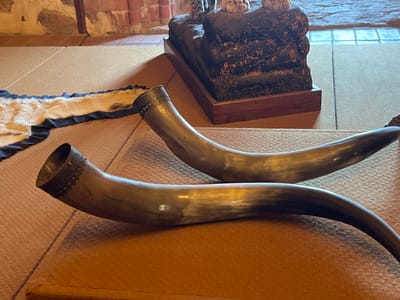
The image shows two ornate drinking horns, possibly made from animal horns, placed on a textured brown mat. One horn is positioned in the foreground, curving to the right, while the other is further back and to the left, also curving to the right. Both horns have decorative metal bands around their openings, featuring intricate patterns. Behind the horns, a piece of fur with dark edging is laid out on a similar mat. In the background, a stone wall with visible brickwork can be seen, and a dark, rough-textured object on a wooden stand, possibly a decorative sculpture, is present. The scene appears to be indoors, with the lighting suggesting it might be a dimly lit room or a location with natural light filtering in. The overall impression is one of historical or cultural artifacts displayed in a setting that might be a museum, a historic building, or a themed environment. Considering the mention of Trakai, Lithuania, this could be a display within Trakai Castle or a related historical site, showcasing artifacts reminiscent of medieval or ancient traditions.
Trakai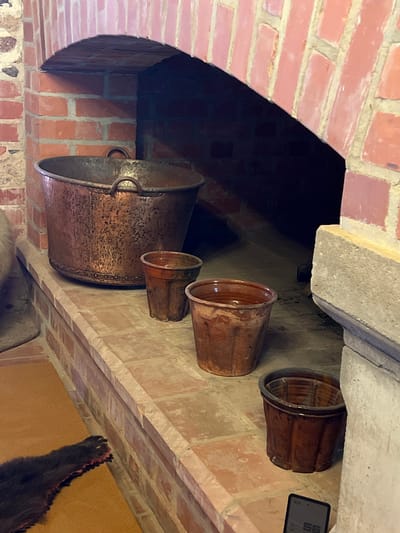
An interior shot shows a brick fireplace with an arched opening. On the hearth in front of the fireplace are four terracotta pots of varying sizes and one large copper basin. The largest pot, a copper basin, is in the center-left foreground. Three smaller terracotta pots are arranged to the right of the copper basin. A furry, dark-colored object with claws, possibly an animal pelt, is partially visible in the lower-left corner of the frame. A digital device displaying the number "56" is on the hearth in the lower-right corner. The scene is likely located in Trakai, Lithuania, given the historical and architectural context often found in the region.
Trakai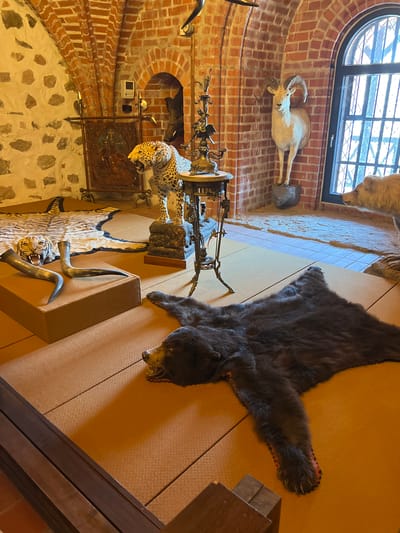
The image depicts a room, likely a museum exhibit, containing several taxidermied animals and historical artifacts. In the foreground, a dark brown bear rug is spread on the floor, with its head facing left. To the left of the bear rug, a taxidermied tiger rug is partially visible, with the tiger's head and a portion of its body on display. Two animal horns rest on a raised brown platform in front of the tiger rug. Behind the tiger, a taxidermied leopard stands on a rocky base. To the right of the leopard, a ram with large curved horns is mounted on the brick wall. An antique ornate stand with a light fixture sits between the leopard and the ram. In the background, a wild boar's head is visible through an arched opening in the brick wall. The room has stone and brick walls, and the floor is covered with mats and rugs. The overall impression is of a historical display, possibly related to hunting or natural history, located within a building with medieval architecture, such as the Trakai Island Castle or a related museum in Trakai, Lithuania.
Trakai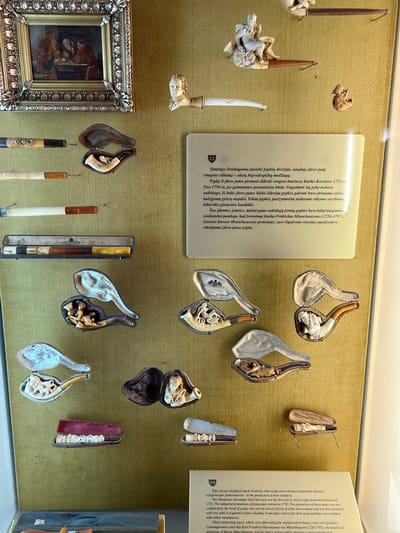
The image shows a museum display of elaborately carved meerschaum pipes, likely in the Trakai Island Castle Museum in Trakai, Lithuania. The display features numerous pipes and pipe cases arranged on a textured, olive-green wall. In the upper left corner, a small framed painting depicts a group of men gathered around a table, possibly in a tavern setting. To the right of the painting, a small, carved bust of a man's head serves as the bowl of a pipe, which extends to the right. Another small carved figure of a cherub is positioned to the right of the bust. The majority of the display consists of various meerschaum pipes and their associated cases. Many of the pipes are intricately carved with figures, including reclining nudes, mythological scenes, and human busts. Some of the pipes are presented open within their velvet-lined cases, showcasing the detailed craftsmanship. One case in the lower center holds a pipe with multiple carved figures along its length. To the right of that, another case contains a pipe with a carved human figure at the bowl. In the upper right quadrant, a pipe with a seated figure is visible in its case. A rectangular case at the top center contains two pipes. A descriptive plaque is mounted on the wall below the pipe carvings. The plaque has a heading with "LT" and "EN" indicating multilingual information. The English text describes the creativity in pipe carving using meerschaum, highlighting that the industrial production of foam pipes began in 1750. It mentions Karl Korvach of Hungary as one of the first to carve meerschaum pipes and notes that the pipes were polished with wax to achieve a yellow hue. The text also refers to Karl Friedrich Hieronymus von Münchhausen and his supposed stories told while smoking these pipes. The overall environment appears to be a well-lit museum interior, with the display cases and artifacts well-preserved and presented for public viewing.
Trakai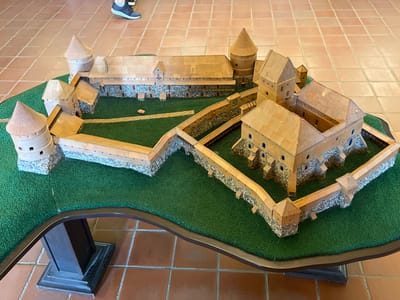
A detailed scale model of Trakai Island Castle, located in Trakai, Lithuania, is displayed on a dark-brown, curved table. The model features a sprawling complex of wooden and stone structures, including several towers with conical roofs, a large central courtyard, and extensive defensive walls. The model is situated on a green, grassy base, designed to represent the surrounding landscape. The table is placed on a floor tiled with reddish-brown squares. In the upper left portion of the image, the lower legs and feet of a person wearing athletic shoes are visible, indicating their presence near the display. The lighting appears to be natural, coming from above.
Trakai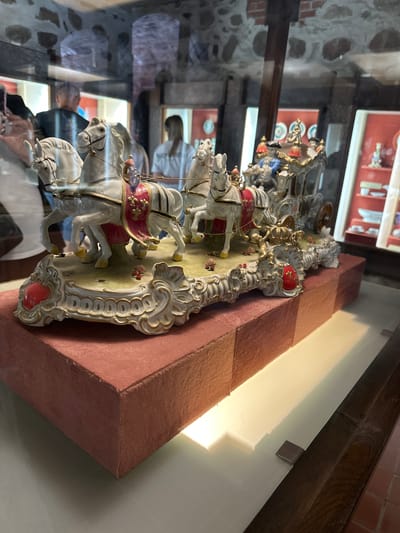
The image shows a close-up, eye-level shot of a highly ornate porcelain figurine of a horse-drawn carriage on display. The figurine features four white horses, each adorned with red and gold harnesses, pulling a detailed carriage carrying several figures dressed in historical attire. The carriage itself is elaborate, with gold trim and decorative elements. The figurine rests on a decorative, white and gold base, with red heart-shaped accents and miniature roses. This display is situated on a textured, reddish-pink velvet-covered platform, which is itself placed on a glossy, light-colored surface. In the background, reflected in a glass enclosure, are blurred figures of people and display cases containing other porcelain items, suggesting the setting is a museum or exhibition. The architectural elements of the enclosure, including arched stone walls, are also visible in the reflection. This figurine is on display at the Trakai Island Castle Museum in Trakai, Lithuania, which houses a collection of historical artifacts and decorative arts.
Trakai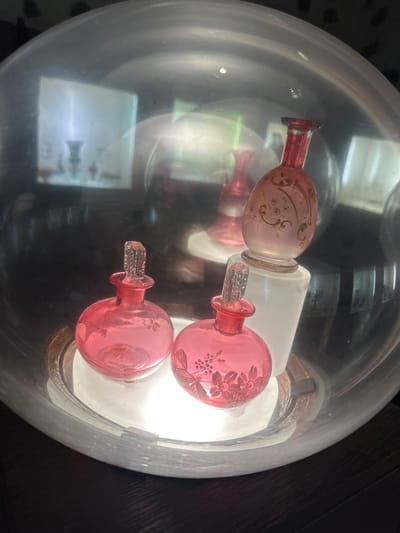
The image shows three pink glass perfume bottles with stoppers, arranged inside a large glass dome. Two of the bottles are in the foreground, and a third, taller bottle is visible behind them. The bottles appear to be antique, with decorative etching on the glass. The dome is placed on a reflective surface, which amplifies the light and reflections. In the background, there are blurred reflections of a room with furniture and possibly other decorative objects. The scene is lit from within the dome, creating a soft, ethereal glow. The image does not provide any information about a specific location in Trakai, Lithuania.
Trakai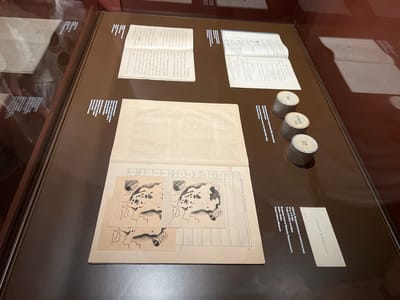
The image shows an exhibit in the Trakai History Museum in Trakai, Lithuania. The exhibit displays historical documents and artifacts. In the foreground, a large open ledger book is visible with handwritten notes and a series of hand-drawn illustrations depicting maps or diagrams. To the right of the ledger, three cylindrical objects, possibly film canisters, are arranged in a row, each with a label indicating a year, such as "1937" and "1938." Behind these objects, an open book with handwritten text and diagrams is displayed. Further to the left, another open book with handwritten text is visible, partially obscured. The exhibit is presented on a dark brown surface under display lighting, suggesting an indoor museum setting. A label with text in Polish and English, including "Walery Romańczuka's Business Card," is placed to the lower right of the ledger.
Trakai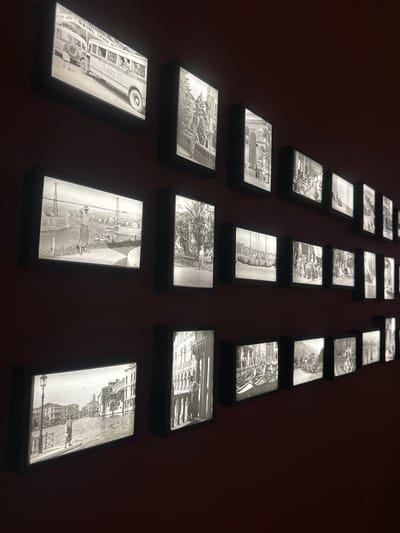
The image displays a gallery of backlit black and white photographs mounted on a dark red wall. The photographs are arranged in a staggered pattern, creating multiple rows. In the top row, the leftmost photograph shows a vintage bus with passengers. The subsequent photographs in this row depict architectural scenes and street views. The second row from the top features images of people and street scenes, including a man standing on a walkway with a suspension bridge in the background. Further to the right, a photograph shows palm trees and two individuals. The third row from the top contains images of boats docked at a harbor, a group of people in an outdoor setting, and architectural elements. The bottom row starts with a photograph of a man standing on a street next to a canal with buildings lining the waterway, reminiscent of Venice. This image is followed by photographs of architectural facades and street scenes. The overall impression is of a curated collection of historical images, likely documenting urban life and historical sites. The reference to Trakai, Lithuania is not visually supported by the provided image.
Trakai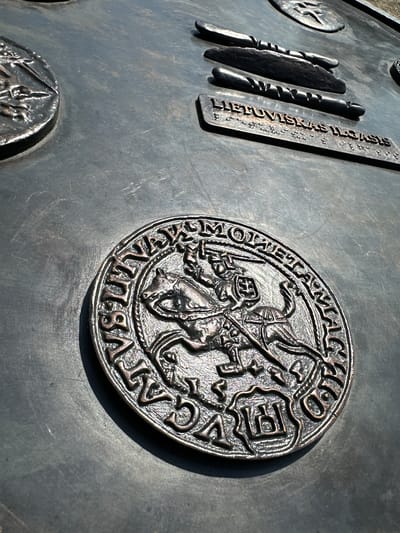
The image shows a close-up of a bronze relief on a dark, textured surface, likely part of an outdoor monument or information board. In the foreground, a circular bronze medallion features a detailed relief of a knight on horseback, a symbol commonly associated with Lithuania, specifically the "Vytis" or "Pahonia" motif. The knight is depicted with a sword raised, and a shield bearing an emblem. The medallion is surrounded by text in an archaic script, partially obscured. In the middle ground, a rectangular bronze plaque is visible with raised text that reads "LIETUVISKAS ILGASIS" followed by what appears to be Braille. Above this plaque are three horizontal, elongated bronze elements, resembling stylized representations of traditional Lithuanian tools or weapons. In the background, another circular bronze element with relief details is partially visible, suggesting this is part of a larger artistic installation. The lighting indicates an outdoor setting with strong sunlight casting shadows. This monument is located in the city of Trakai, Lithuania, specifically at the Trakai Island Castle complex. The reliefs likely serve to inform visitors about Lithuanian history, culture, and symbols.
Trakai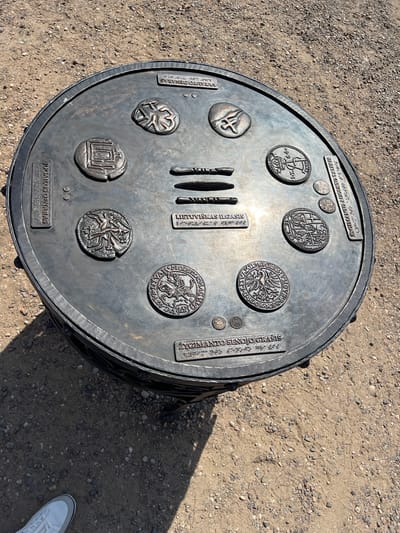
The image shows a circular, bronze monument in the city of Trakai, Lithuania, placed on a gravelly ground. The monument depicts various historical coins and symbols, possibly representing the monetary history of Lithuania. Inscriptions in Lithuanian and braille are visible on the monument's surface. The monument appears to be a public art installation or a historical marker. The background consists of dry, sandy soil with scattered pebbles and some shadows cast by the monument. No people are clearly visible in the image.
Trakai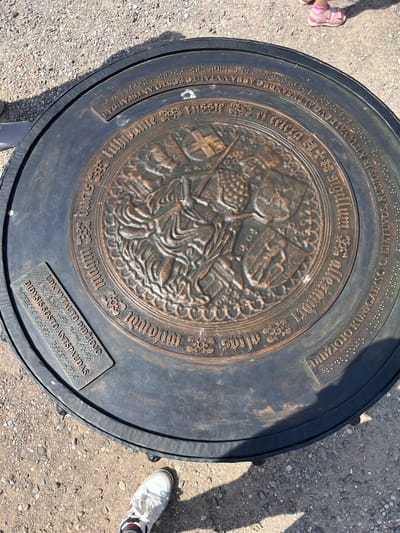
This is a medium, high-angle, outdoor, close-up, full shot of a large, circular, bronze plaque embedded in the ground, likely made of gravel. The plaque features an embossed central design of a knight on horseback, possibly Saint George slaying a dragon, surrounded by a decorative border with what appears to be Lithuanian text and Braille. Some of the text is partially obscured by shadow. On the left side of the plaque, a separate rectangular plaque with more text and Braille is affixed. The surrounding ground is covered in small, light-colored gravel and pebbles. In the upper right corner, the feet of a child wearing pink sandals are visible. In the lower portion of the image, a white sneaker with red and blue accents is positioned near the plaque. The overall lighting suggests a sunny day, with distinct shadows cast by the plaque and the surrounding objects. This plaque is located at the site of the Trakai Castle in Trakai, Lithuania, marking the "Footprint of Vytautas the Great."
Trakai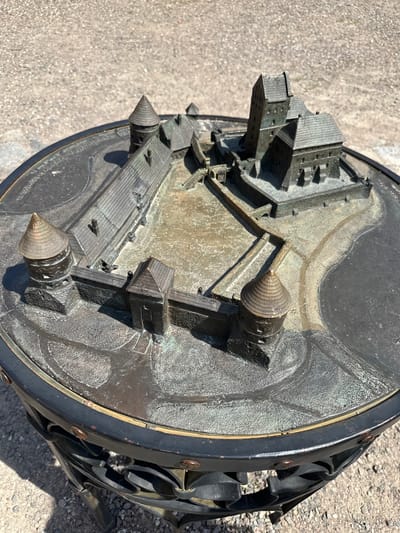
The image shows a detailed bronze model of Trakai Island Castle, situated on a circular platform. The model depicts the castle's walls, towers, courtyards, and prominent keep with its steep roof. The platform is supported by an ornate black metal stand with decorative scrollwork. The model is placed outdoors on a gravelly surface, likely in the vicinity of the actual castle in Trakai, Lithuania. The lighting suggests it is a sunny day, casting shadows across the model. There are no people visible in the image.
Trakai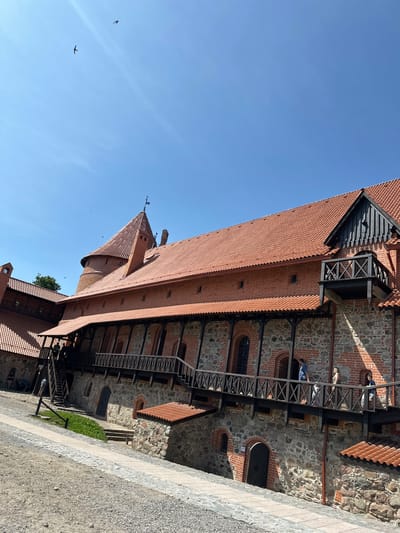
The image depicts the Trakai Island Castle in Trakai, Lithuania. The castle is constructed primarily of red brick and stone, with distinctive terracotta tiled roofs. A wooden walkway with intricate railing details runs along the upper levels of the castle, connecting various sections. Several people are visible on the walkway, some walking and others conversing. In the background, a conical tower with a flag at its peak rises above the main structures. The sky above is a clear, bright blue with two birds in flight. The ground in the foreground is a mix of gravel and paved pathways. The overall scene suggests a sunny day, likely during tourist season, with visitors exploring the historical landmark.
Trakai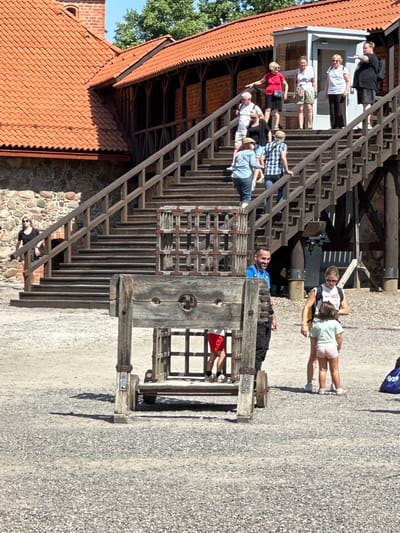
The image depicts an outdoor scene at Trakai Island Castle in Trakai, Lithuania. In the foreground, a wooden pillory, an archaic punishment device, stands on a gravel-covered ground. Behind it, a wooden scaffold structure with metal bars is visible. A man in a blue shirt and black pants stands to the right of the pillory, looking to his left. A woman in a white shirt and shorts with a backpack stands next to a young girl in a light green shirt and pink shorts. Both are looking towards the man. In the background, a wooden staircase with railings leads up to a building with a red tiled roof. Several tourists are visible on the stairs, some ascending and some descending. The environment appears to be a sunny day, with shadows cast on the ground.
Trakai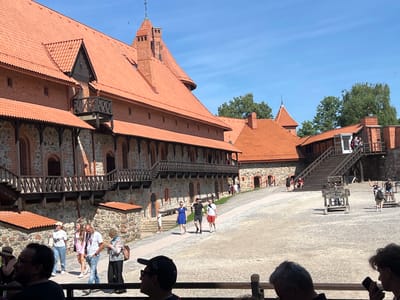
The image depicts the Trakai Island Castle in Trakai, Lithuania, on a sunny day. The castle, constructed of red brick with distinctive red-tiled roofs and wooden balconies, dominates the left side of the frame. Multiple tourists are visible walking around the castle grounds. In the foreground, several people are seated or standing, appearing to observe the scene. In the middle ground, a group of tourists walks along a path leading towards the castle. Further back, a set of wooden stairs ascends to a higher level of the castle. A historical pillory-like structure is present in the courtyard. The ground is covered in gravel and sand, and trees are visible in the background. The sky is clear and blue.
Trakai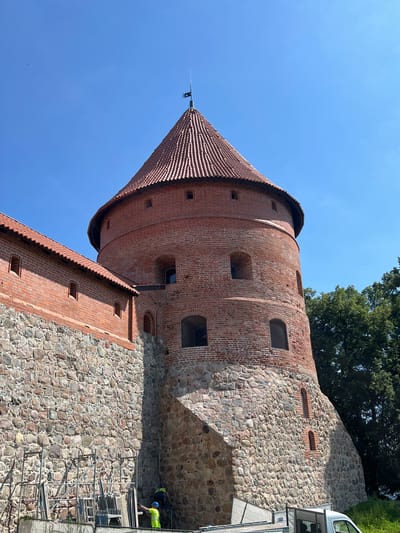
The image shows a close-up, low-angle view of the Trakai Island Castle in Trakai, Lithuania. The focus is on a circular brick tower with a conical red-tiled roof, topped with a metal spire flying a dark flag. The tower is constructed from red brick and features several arched windows, some of which appear dark. The lower portion of the tower and the adjacent wall are made of rough-hewn stones. To the left of the tower, a section of a brick wall with a red-tiled roof runs horizontally, also constructed with stone at its base and featuring small rectangular windows. The wall is undergoing some form of construction or renovation, with scaffolding and construction materials visible at its base. Two individuals, dressed in high-visibility safety vests and hard hats, are working near the scaffolding. One person, wearing a yellow vest and blue helmet, is standing and appears to be working on the scaffolding. Another person, wearing a bright yellow vest, is bent over near the ground. In the background, to the right of the tower, is a dense canopy of green trees. The sky is clear and bright blue.
Trakai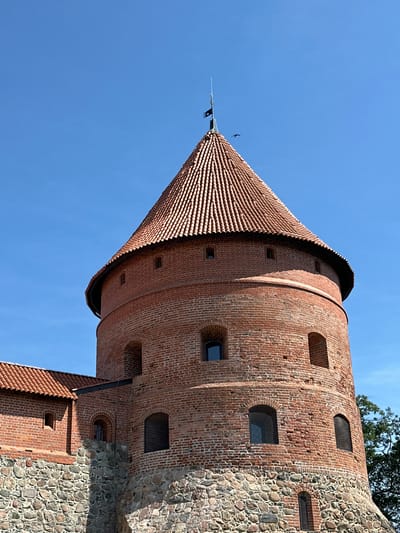
The image shows a close-up view of a circular red brick tower with a conical red tile roof, a prominent feature of Trakai Island Castle in Trakai, Lithuania. The tower has several arched windows with dark panes and is built on a base of large, rough stones. A smaller, attached brick building with a red tile roof and similar stone base is visible to the left. The sky is clear and blue, with a small black flag at the pinnacle of the tower and two birds flying in the distance. The overall scene depicts a historic defensive structure against a bright, sunny sky.
Trakai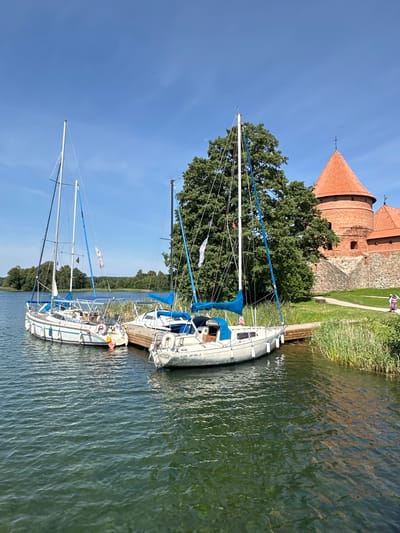
The image captures a scenic view of Trakai Island Castle in Trakai, Lithuania, on a clear, sunny day. Three sailboats are moored at a wooden dock on the left side of the frame. The closest sailboat on the right has "GURU" and "TU 1252" visible on its hull. The water is a greenish-blue, with ripples reflecting the sunlight. Tall green reeds line the edge of the water in front of the castle. Behind the boats, a large, leafy green tree dominates the landscape. To the right of the tree, the iconic red-roofed Trakai Island Castle, constructed of brick and stone, stands prominently. A pathway is visible in front of the castle walls, and two people are walking along it in the distance. The sky above is a vibrant blue with a few small birds in flight.
Trakai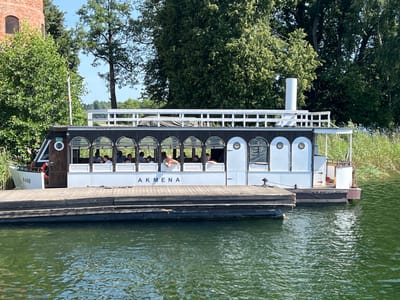
The image shows a white boat named "AKMENA" docked at a wooden pier on a body of water, likely a lake in Trakai, Lithuania. The boat has a dark-colored upper deck with arched windows and a white lower hull. Several passengers are visible inside the boat, seated and looking out. The background features lush green trees, a tall brick tower to the left, and a blue sky. The water is green and slightly rippled. The pier is made of dark wooden planks.
Trakai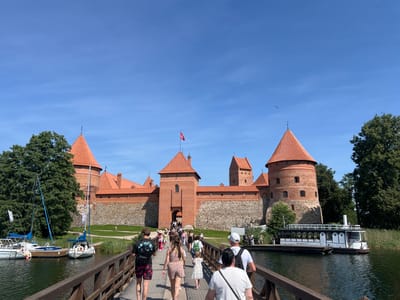
The image captures a view of Trakai Island Castle in Trakai, Lithuania, on a clear, sunny day. A wooden bridge, teeming with people walking towards the castle, spans a body of water. The castle itself, constructed of red brick and stone, features multiple towers with conical, orange-tiled roofs. A red flag with a white emblem flies from one of the towers. On the water to the left, several sailboats are docked, and to the right, a white tour boat named "AKMENA" is moored. Lush green trees surround the castle and line the water's edge.
Trakai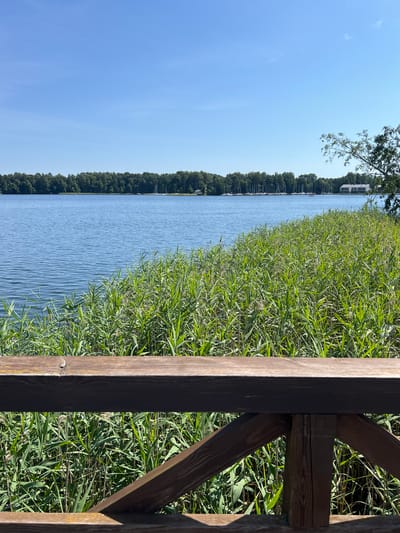
The image depicts a serene lake scene in Trakai, Lithuania, likely during daylight hours. In the foreground, a weathered wooden railing with visible grain and a dark stain creates a barrier. Beyond the railing, lush green reeds and tall grass dominate the immediate shoreline, their stalks swaying gently. The lake itself is a calm expanse of blue water, reflecting the clear, pale blue sky. On the far side of the lake, a dense line of green trees forms a natural border. Visible among the trees and on the water are numerous white sailboats moored along the shore, suggesting a harbor or marina. A white building with a dark roof is also partially visible amongst the trees on the right side of the frame. The overall impression is one of peaceful natural beauty.
Trakai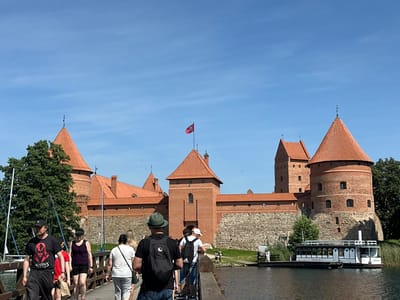
The image shows a bright, sunny day at Trakai Island Castle in Trakai, Lithuania. A group of people are walking across a wooden bridge towards the castle. The castle is a large, red brick structure with multiple towers and red-tiled roofs. In the foreground, a man in a black t-shirt with a graphic on it is walking away from the camera. To his right, a woman wearing a black tank top and shorts is walking. Behind them, several other people are also walking on the bridge. A white boat with a black roof is docked on the right side of the image, near the castle. The water is calm, and trees are visible behind the castle and on the left side of the bridge. The sky is clear and blue.
Trakai