Tudun Nupawa, Nigeria
30 memories from Tudun Nupawa, Nigeria
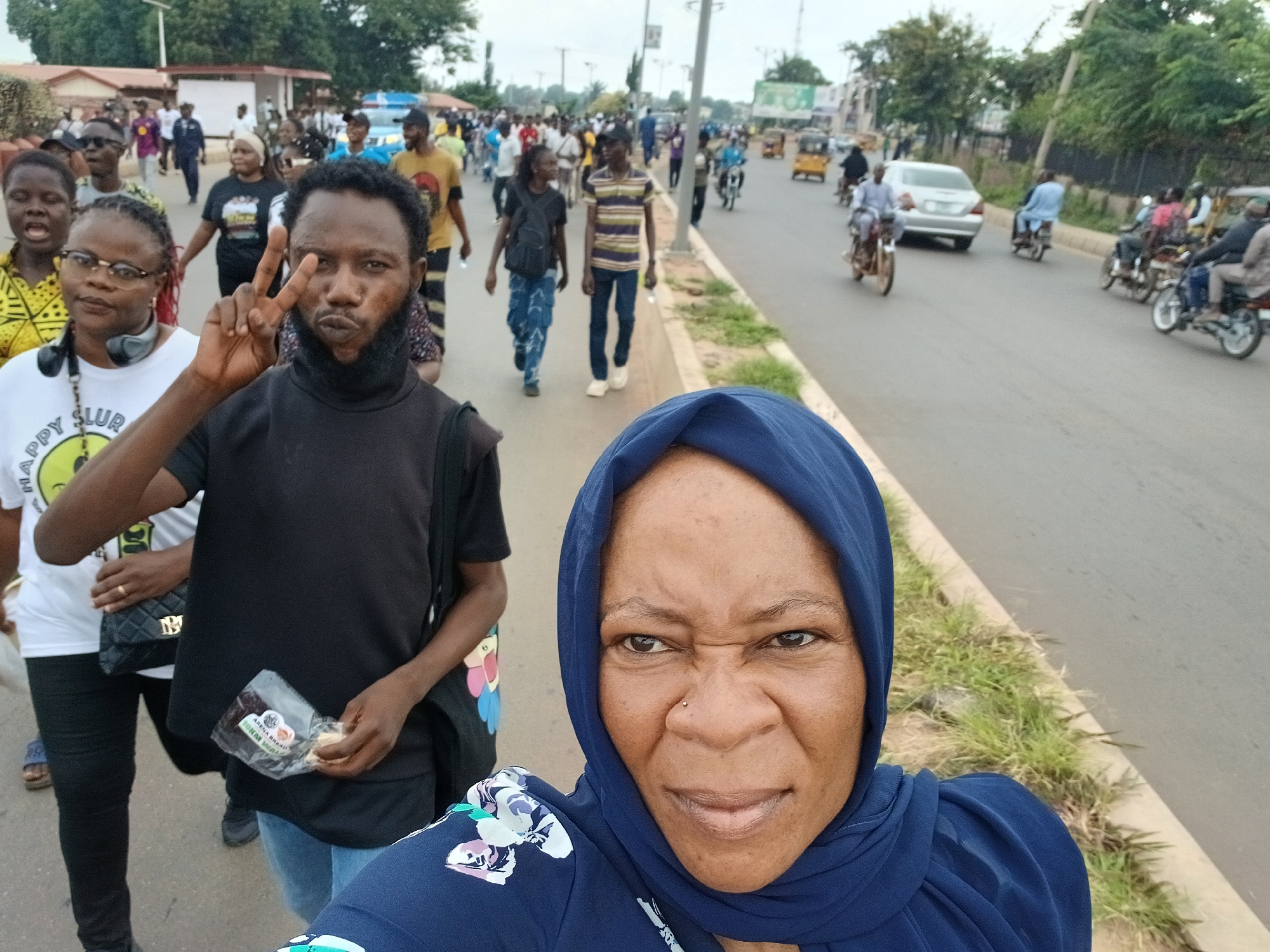
The image captures a street scene in Tudun Nupawa, Nigeria, with a group of people walking along a paved road. In the foreground, a woman wearing a blue hijab and patterned blue top is taking a selfie, her face angled towards the camera. To her left and slightly behind her, a man with a beard and a black top is holding up two fingers in a peace sign, and holding a small plastic bag with food items. Behind them, a woman with glasses and headphones around her neck, wearing a white t-shirt, walks alongside other pedestrians. Several individuals are visible in the background, including men and women walking, some carrying bags, and others on motorcycles. The road is lined with grassy verges and trees, and buildings can be seen in the distance. Traffic, including cars and motorcycles, is present on the road, indicating a moderately busy urban environment. The sky is overcast.
Tudun Nupawa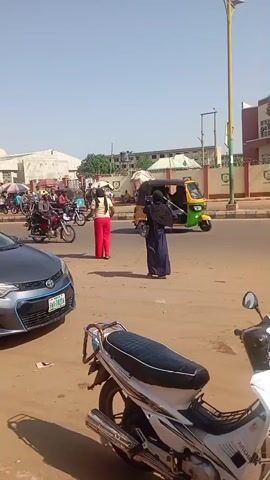
The video shows a street scene with several people and vehicles. In the foreground, a motorcycle is parked. Further back, a dark gray sedan is parked on the left side of the road, with its front bumper visible. To the right of the sedan, two individuals are standing on the street. One person is wearing a dark headscarf and a long blue garment, while the other is wearing a white top and red trousers. Behind them, several other people are visible, along with motorcycles and a tricycle. In the background, there are buildings and streetlights. The road appears to be paved, and the ground on the side of the road is dirt or gravel. The sky is clear and blue. There are utility poles and wires visible along the street. In one segment, a young boy is shown walking on the side of the road carrying a black plastic bag. Another segment shows a red sedan driving on the road.
Tudun Nupawa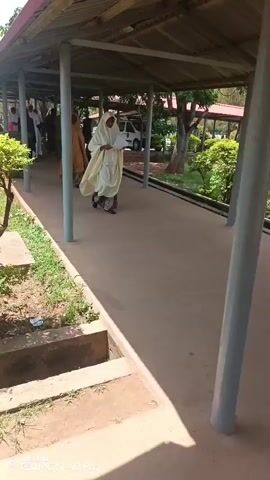
This video shows a group of people walking along an covered walkway. The subjects are primarily women dressed in traditional Islamic attire, with several wearing hijabs and flowing robes in various colors like yellow, white, and brown. One woman in the foreground is wearing a light yellow robe and holding a piece of paper. Another woman in a mustard-yellow robe walks further back. Several individuals in white uniforms, possibly nurses or medical students, are visible in the background. The setting appears to be an outdoor walkway connecting buildings, likely a hospital or educational institution, given the presence of uniformed individuals. Greenery and trees are visible on the left side of the walkway, suggesting a daytime scene, possibly late morning or early afternoon given the lighting and shadows. The walkway itself is paved with concrete and supported by pillars. The overall atmosphere seems calm and orderly as the group proceeds along the path. The visible text at the bottom of the screen reads "TECNO CAMON 40 Pro," indicating the device used to record the video. There are no overt signs of distress or urgency, suggesting a routine movement or procession. The environment seems well-maintained. The location context of Tudun Nupawa, Nigeria, combined with the attire of the individuals, suggests a cultural and regional setting.
Tudun Nupawa
The media file is a close-up, low-angle, headshot of a young Black female with braided hair. She is looking directly at the camera with a wide, toothy smile, her mouth open, revealing her teeth and tongue. Her eyes are open, and her gaze is directed forward. She is wearing a dark top and a delicate gold chain necklace. The background appears to be a wall with some faint, handwritten text in what looks like English script. One legible portion of text in a circular outline reads, "NDUISE", followed by "Nudged". There are other faint scribbles that are difficult to decipher. The lighting suggests it might be indoors or an overcast day, as there are no strong shadows. The setting does not provide many specific cues about the location beyond the text on the wall, which, when combined with the provided location context of Tudun Nupawa, Nigeria, suggests the image was taken there. The subject's expression conveys happiness and a sense of joy. The overall impression is a candid, self-taken photograph capturing a moment of cheerfulness.
Tudun Nupawa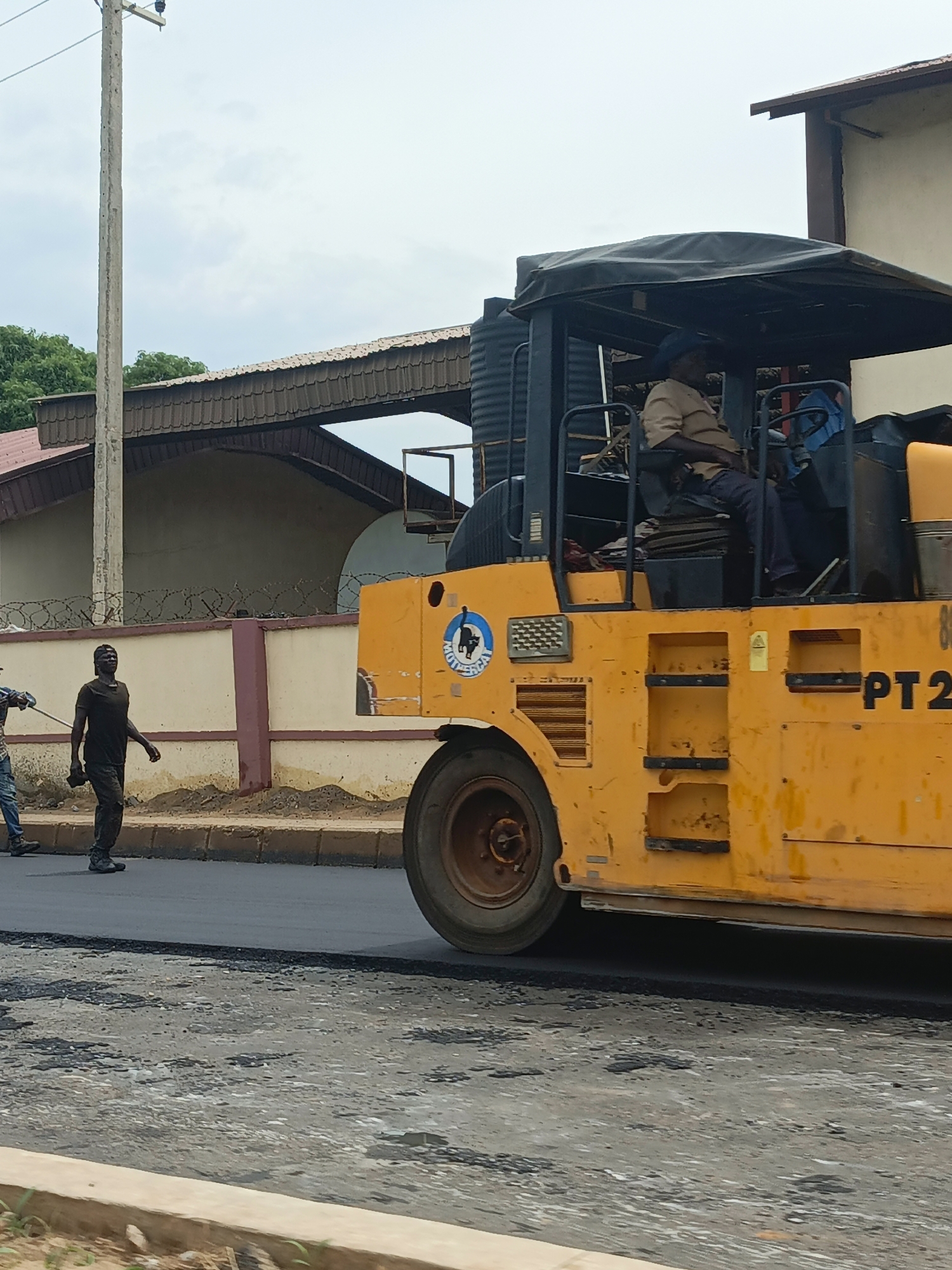
In Tudun Nupawa, Nigeria, a bright yellow road roller is compacting fresh asphalt on a street. A man wearing a tan shirt and dark pants operates the roller from its cabin. In the foreground, another man in a dark shirt and pants walks away from the roller, holding what appears to be a tool in his right hand. The street is lined with a low wall topped with barbed wire, behind which are buildings with reddish-brown tiled roofs and a beige facade. A utility pole stands to the left of the frame, supporting power lines. The sky is overcast.
Tudun Nupawa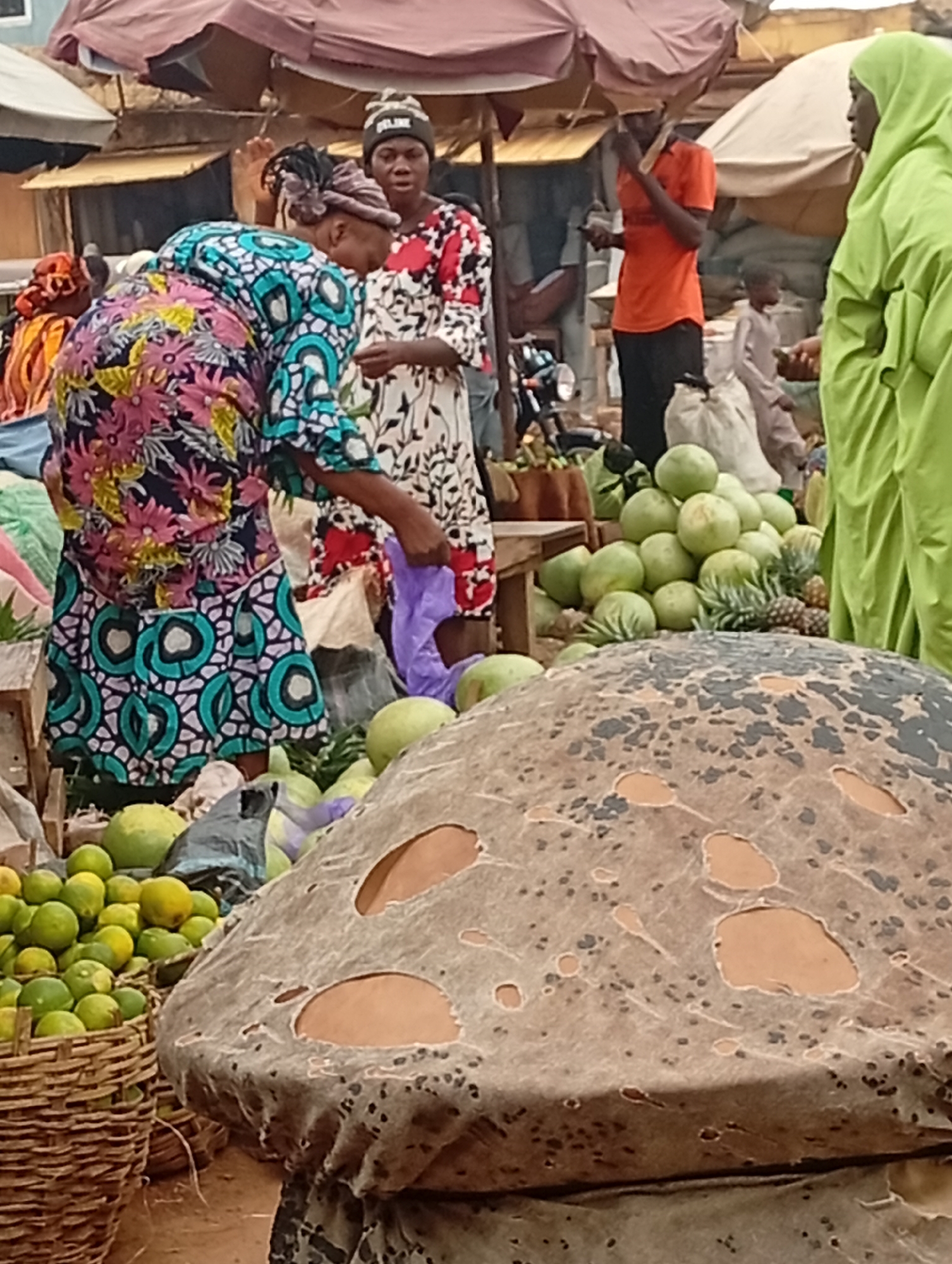
An eye-level shot captures a lively outdoor market scene in Tudun Nupawa, Nigeria. In the foreground, a large, dark brown, irregularly shaped object with worn, lighter brown patches and holes partially covers the bottom right of the frame, resembling a dried animal hide or similar material. Several people are visible, engaged in market activities. To the left, a woman wearing a vibrant, multi-patterned dress, featuring floral and geometric designs in pink, purple, blue, and green, bends forward, seemingly examining goods. Next to her, another woman stands, wearing a white dress with a black and red patterned design, and a black beanie with the word "CELINE" visible on it. She holds a purple plastic bag. Behind them, a large pile of green, melon-like fruits and some pineapples are stacked on the ground or a low surface. To the left of these fruits, baskets overflow with small, green citrus fruits, likely limes or unripe oranges. Further in the background, a man in an orange t-shirt and dark pants stands. To his right, partially obscured, a person in a bright green hijab or garment stands facing away from the camera. Market stalls with various umbrella canopies are visible, indicating an outdoor setting. A motorcycle is faintly visible in the mid-ground. The natural bright lighting suggests it is daytime. The scene conveys a bustling and functional local market.
Tudun Nupawa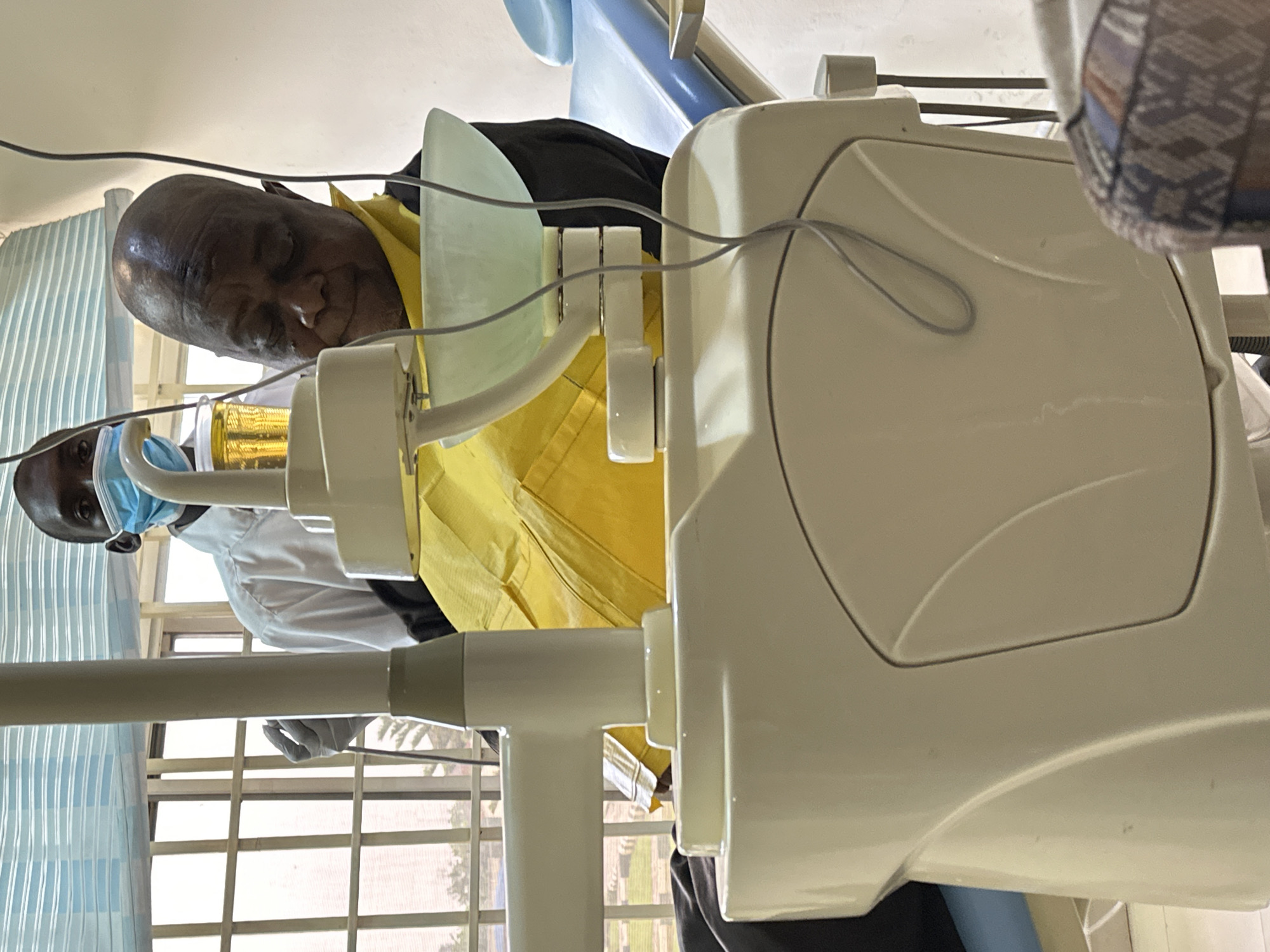
The image depicts a dental examination in progress, possibly in Tudun Nupawa, Nigeria. An older Black male patient lies in a light blue dental chair, wearing a yellow protective covering. A dental professional, wearing a white coat and a blue surgical mask, stands nearby. Dental equipment, including a white examination light and the dental unit, is prominently featured. A window with bars is visible in the background.
Tudun Nupawa
The image shows a magenta background with white text that reads "The more harder the stories, the more brighter the glory. WAIT AGAIN I SAY ON THE LORD." The location in the city of Tudun Nupawa, Nigeria is not discernible.
Tudun Nupawa
The video depicts an indoor public speaking event or conference held in Tudun Nupawa, Nigeria. A large screen at the front of the venue displays two men. One man, dressed in a white agbada and a black cap, is speaking at a podium with a microphone and a tablet device. The second man, wearing a dark suit and a pink tie, stands behind him. The screen also shows partially visible text like "te;", "tions,", and "alè," along with "Nigeria Public Relations Week" and "NRRW City 2026," indicating the nature and likely future host city of the event. In the foreground and middle ground, a diverse audience is seated in rows of red chairs, facing the screen. Most attendees are seen from behind, and many are wearing traditional Nigerian attire or head coverings. One woman in a patterned black and white dress walks across the frame from right to left, between the camera and the seated audience. The atmosphere appears attentive, with the audience focused on the presentation displayed on the large screen.
Tudun Nupawa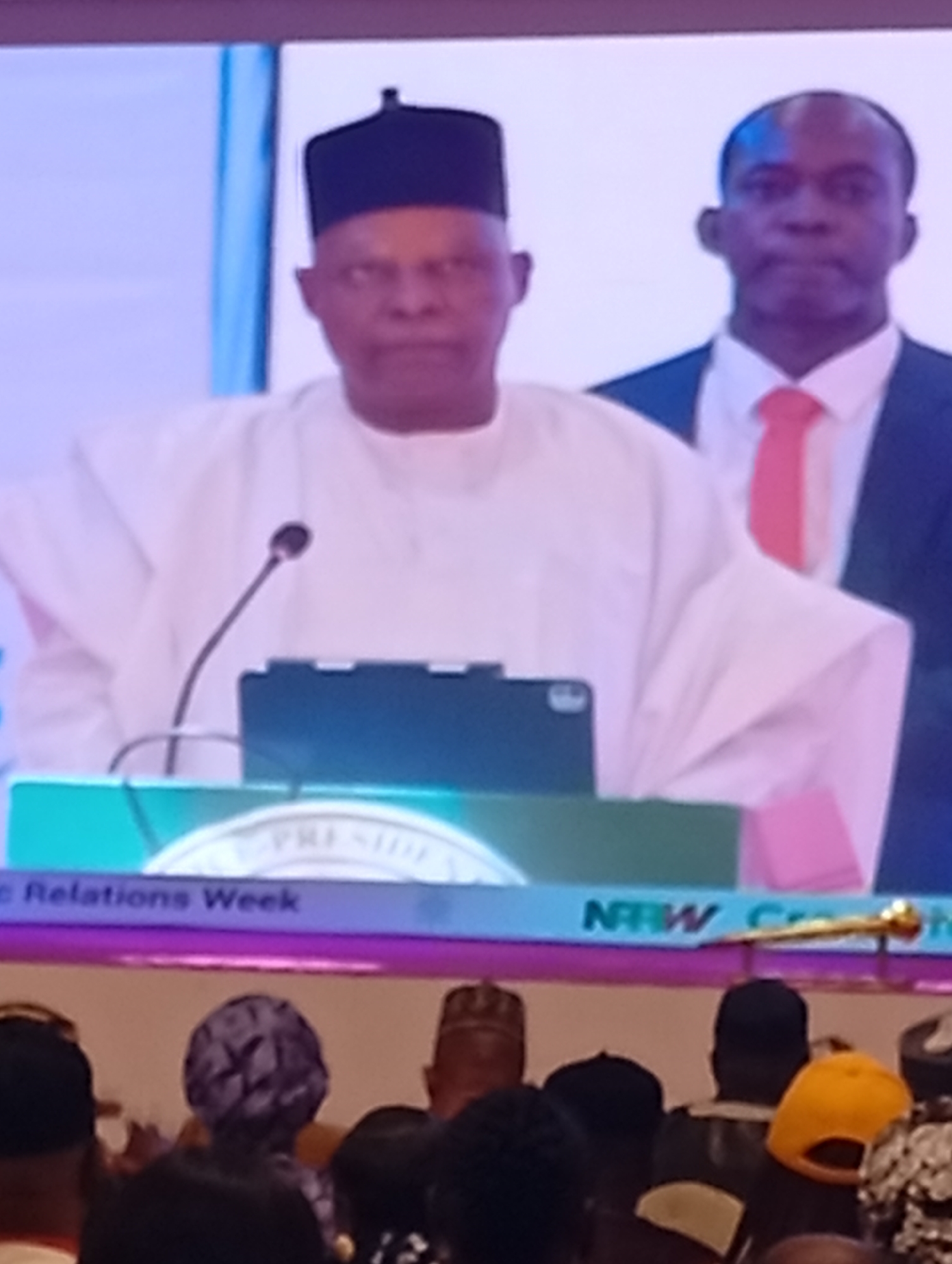
A blurry photograph captures an indoor public speaking event, likely a conference or public address in Tudun Nupawa, Nigeria. The central figure is a man of medium complexion, wearing traditional white attire, including a flowing white robe and a dark, possibly black, cap. He stands behind a podium equipped with a microphone and a tablet device. His expression is serious or focused as he addresses an unseen audience. Behind and slightly to the right of the main speaker, another man stands, dressed in a dark suit with a white shirt and a red tie. He has a neutral expression. The foreground shows the backs of several audience members' heads, indicating they are seated and facing the speaker. Some audience members wear caps, including one bright yellow cap. Visible text on the green banner or screen at the podium includes "...PRESIDE..." (likely "PRESIDENT" or "PRESIDENCY") and "...Relations Week." Below this, on a purple-blue strip, the acronym "NRW" is clearly visible, followed by what appears to be part of another word starting with "C" (e.g., "Conference"). A golden, possibly ceremonial, staff or emblem is also partially visible on this lower strip. The overall scene suggests a formal event, possibly governmental or an important organizational meeting, given the prominence of the speaker and the "PRESIDE" text.
Tudun Nupawa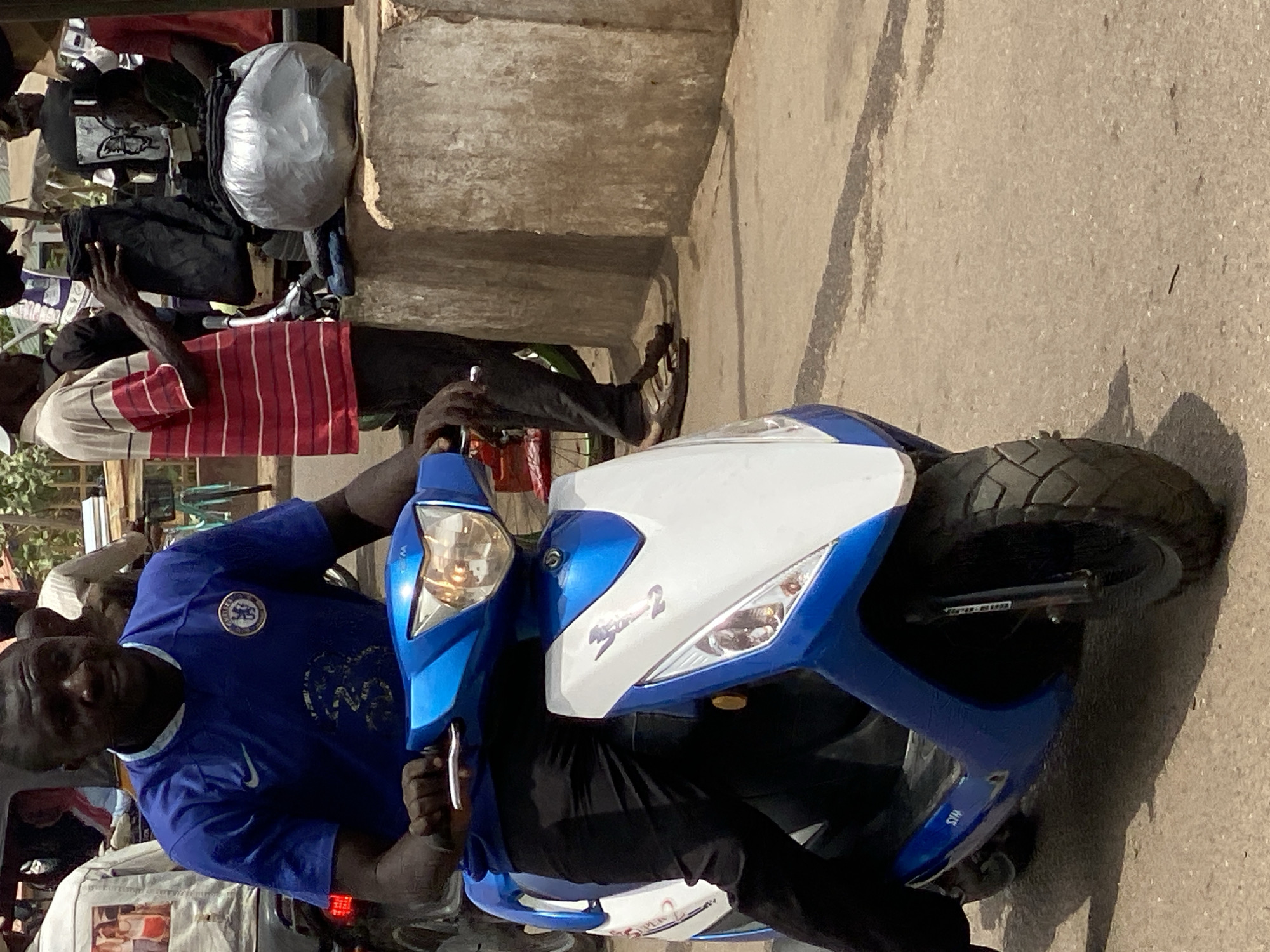
In Tudun Nupawa, Nigeria, a man wearing a blue Chelsea football club t-shirt sits on a blue and white scooter on a paved street. The man is looking at the camera. Several people stand behind the scooter, and objects like bags and clothes are visible. A concrete structure is to the side. The environment suggests a busy street scene.
Tudun Nupawa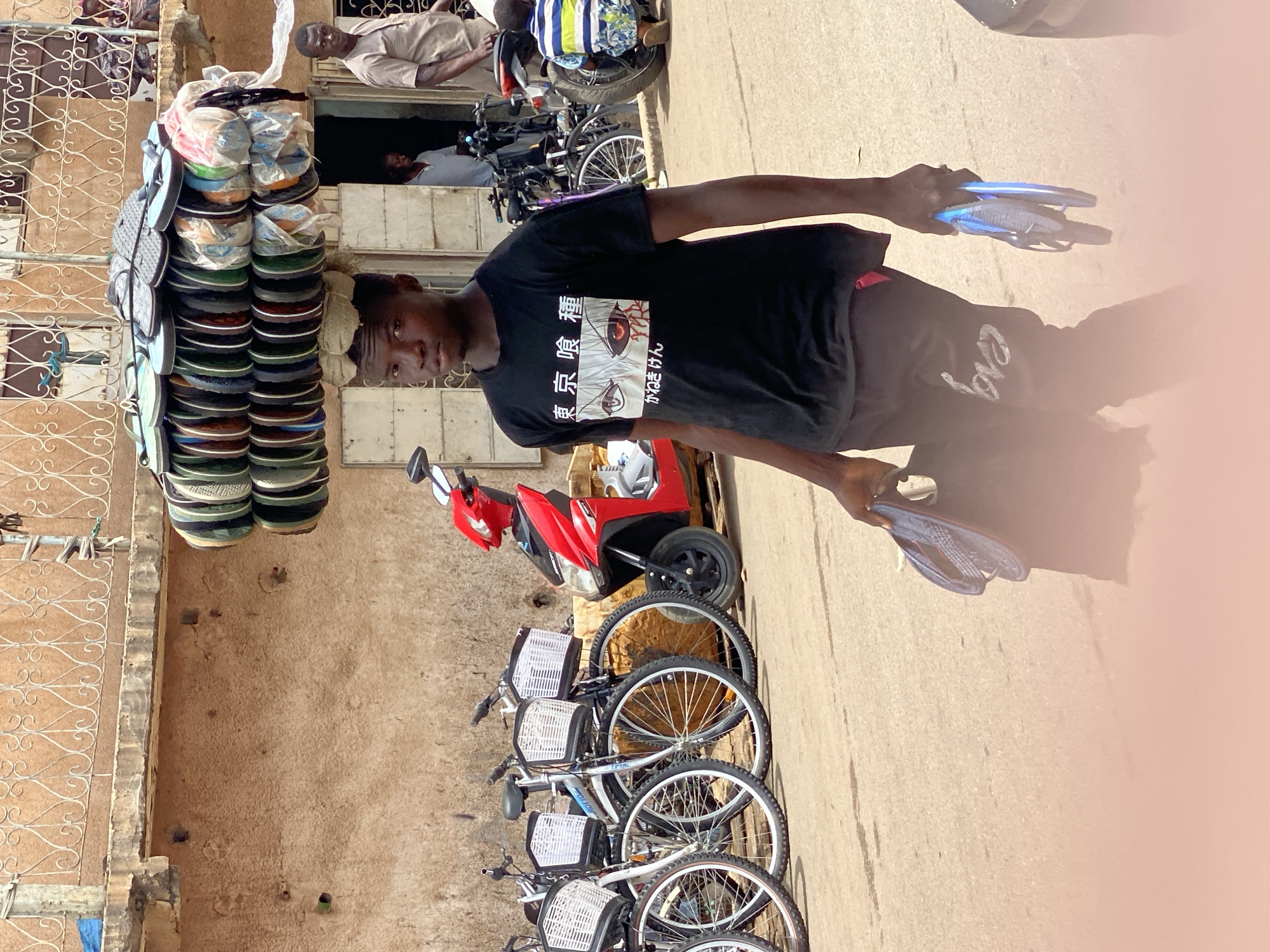
In Tudun Nupawa, Nigeria, a young man stands on a street alongside bicycles and a red scooter. He holds two pairs of flip-flops. A stack of flip-flops sits outside a building. People are visible through windows in the background.
Tudun Nupawa
The video shows a busy street scene, likely in an urban area of Africa. From a partially obscured vantage point under some kind of shelter, one can see a variety of activity taking place. In the foreground, there's a parked motorcycle, a pile of discarded tires, and some litter. A man wearing a blue shirt and dark pants walks away from the camera, crossing the street. Further down the street, there are several auto rickshaws, motorcycles, and pedestrians. A billboard advertising A.A. Rano Rice Mill is visible in the background. The scene is slightly dusty, with a mix of paved and unpaved surfaces.
Tudun Nupawa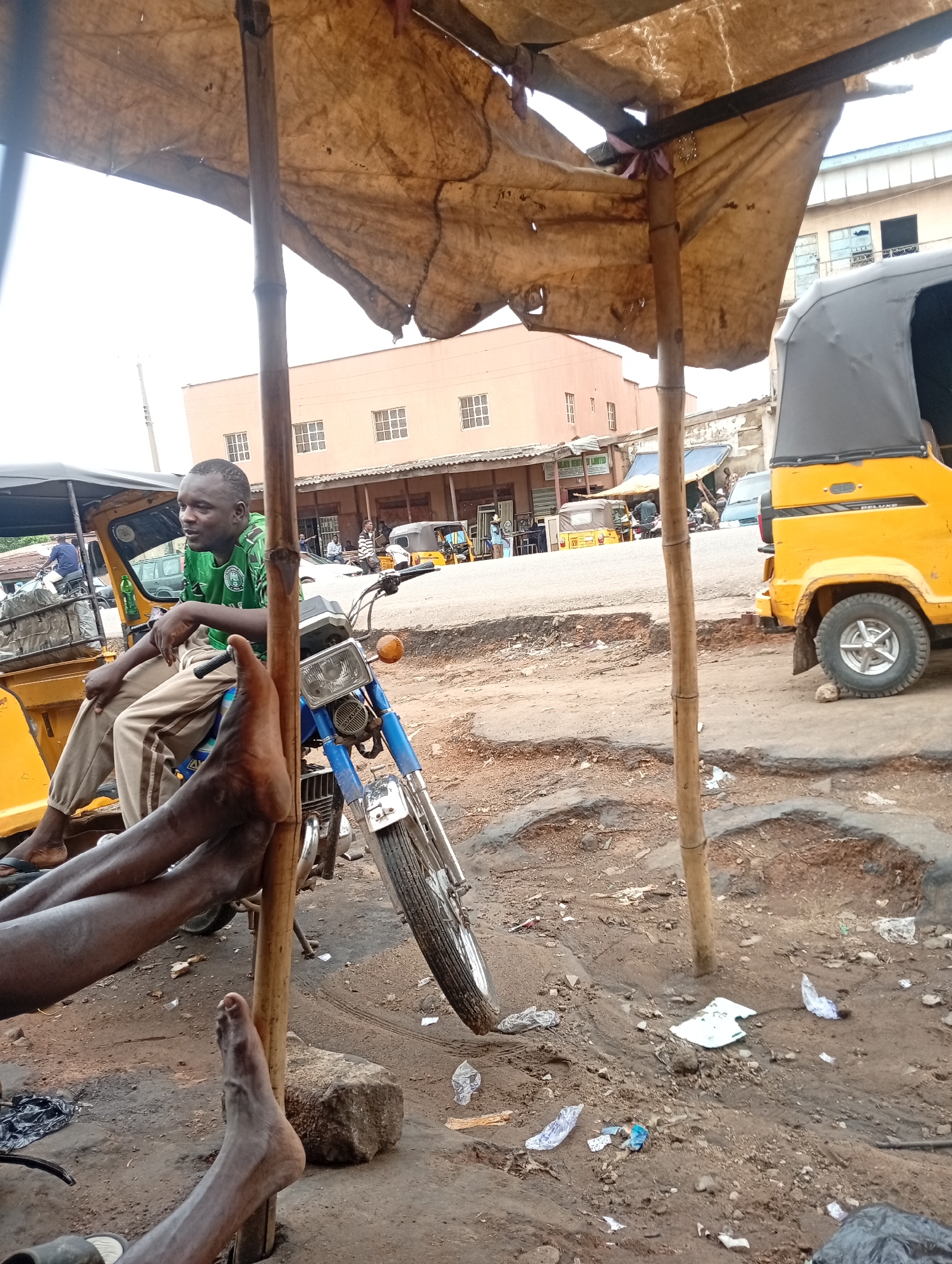
In Tudun Nupawa, Nigeria, a man wearing a green soccer jersey and khaki pants sits on a blue motorcycle parked next to a yellow auto rickshaw (tricycle taxi). The motorcycle faces toward a building with multiple windows across the street. The ground is dirt and has scattered debris. Another person's bare feet are prominently visible in the foreground. The scene is under a makeshift canopy supported by wooden poles. More rickshaws and people are visible further down the street.
Tudun Nupawa
The photograph depicts an interior scene, likely a room, in Tudun Nupawa, Nigeria. The visible components include two sections of draped curtain, with a floral pattern, against walls of a light color. The lighting is dim, obscuring details. A curtain rod is visible near the top of the frame. At the bottom of the frame, a dark mass of what looks like a plastic bag can be found. The perspective is tilted, giving the impression of viewing the corner of a room at an upward angle. The overall setting appears to be a residential space.
Tudun Nupawa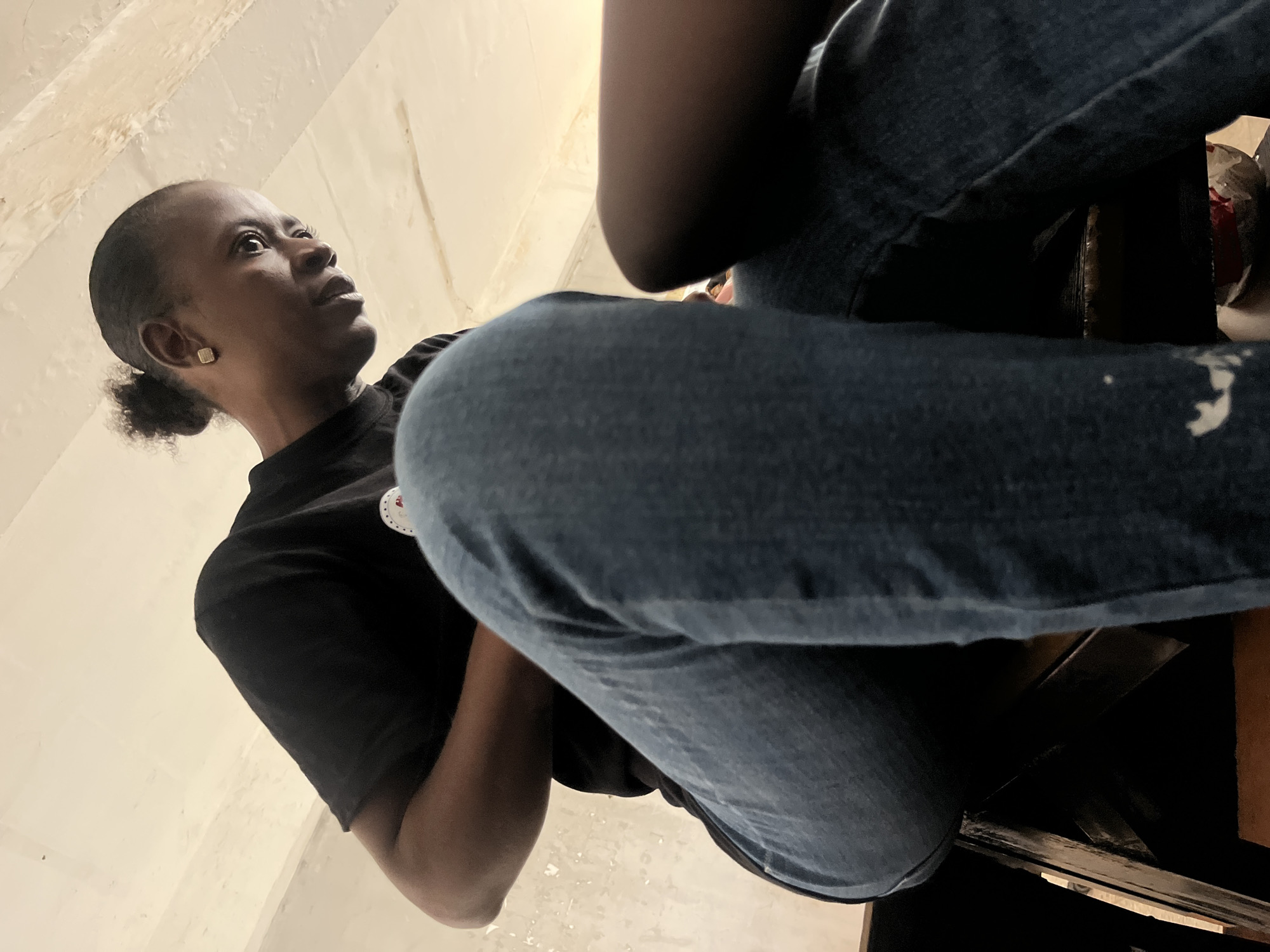
The image is an upward-angled shot of two people, with a focus on the first individual. The first person is a dark-skinned woman with short, dark hair pulled back into a small ponytail. She is wearing a black t-shirt and looking up and to the left. A small stud earring is visible in her left ear. The second person is only partially visible, with their lap and legs prominently featured in the foreground. They are wearing blue jeans. The setting appears to be indoors with off-white walls visible in the background. It is not possible to confirm that the photo was taken in Tudun Nupawa, Nigeria, from the image alone.
Tudun Nupawa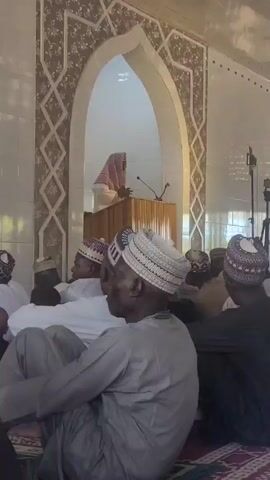
A low-angle shot depicts a group of men in a mosque, sitting on the floor and facing a speaker behind a wooden podium. The speaker, draped in a light-colored garment, appears to be addressing the gathering. The mosque's interior features white walls with decorative arches and geometric patterns around the podium area. The men are wearing a variety of traditional caps and clothing, with some in white and others in darker shades. A camera on a tripod stands to the side, possibly recording the event. The ceiling has a series of circular light fixtures. The room is well-lit, possibly with natural light streaming in from windows that are visible in the background.
Tudun Nupawa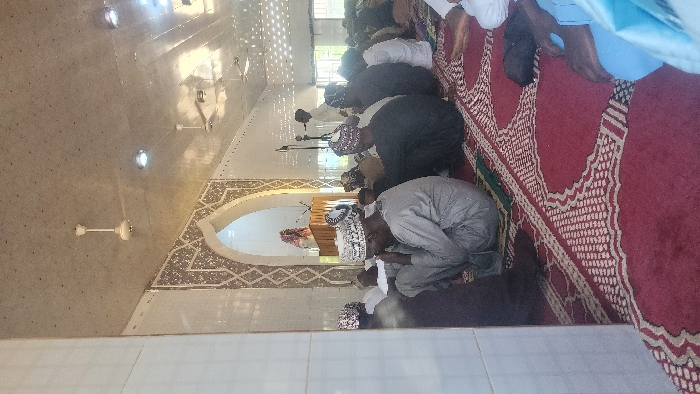
The image depicts an indoor religious gathering within a mosque in Tudun Nupawa, Nigeria. Approximately two dozen men are seated on a red patterned prayer rug covering the floor, arranged in rows facing forward. Most men wear traditional attire, including long robes and patterned skullcaps or kufi hats. In the immediate foreground, one man in a light grey robe and a patterned white cap has his head bowed, with his hands near his face. At the front of the room, positioned within an ornate arched alcove featuring geometric patterns in white and brown, a figure is standing behind a wooden lectern. This individual, partially obscured, wears a patterned head covering and a light-colored garment, appearing to address the congregation. To the right of the archway, another man stands with a microphone on a stand. The room features white tiled walls along the left side and a light-colored ceiling equipped with multiple white ceiling fans and recessed light fixtures. Bright ambient light illuminates the scene, with windows visible on the far right allowing natural light. The overall environment suggests a structured religious service or lecture.
Tudun Nupawa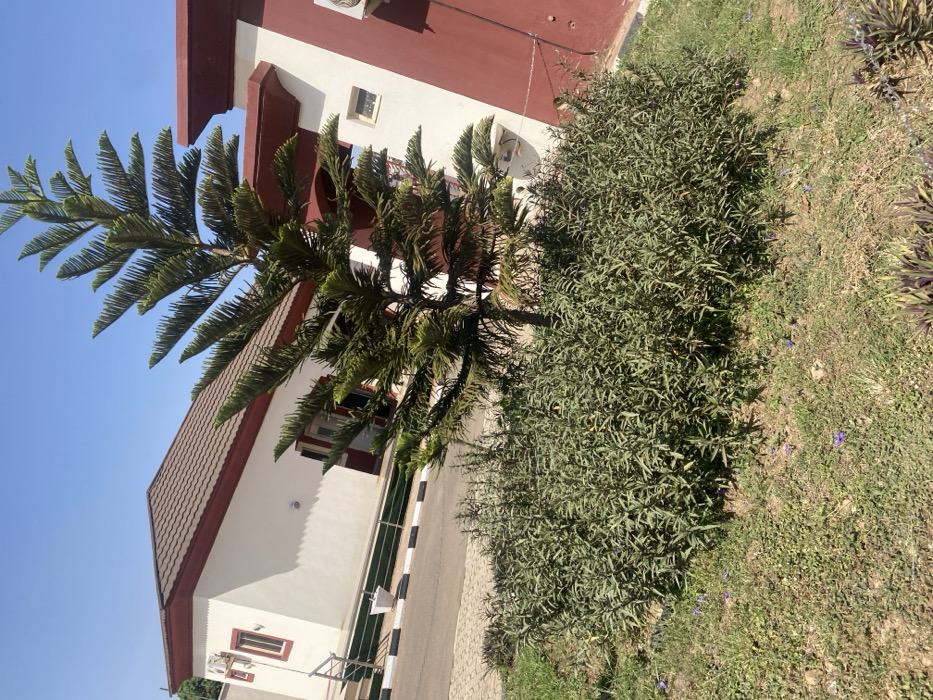
The image depicts an outdoor daytime scene in Tudun Nupawa, Nigeria, featuring a landscaped area adjacent to buildings. A prominent, multi-tiered coniferous tree with dark green foliage stands centrally, surrounded at its base by a dense bed of smaller, leafy green shrubs. The foreground consists of sparse green grass with patches of exposed earth and scattered small purple flowers. In the background, two buildings with white walls and dark red trim are visible under a clear blue sky. The building on the left features a brown tiled roof, dark-framed windows, and an external air conditioning unit. A paved driveway or road with black and white striped curbing runs in front of this building, separated by a low, silver-colored metal railing. A small, white geometric planter is positioned near the railing. The building on the right also exhibits white walls with dark red sections and an external air conditioning unit. No individuals or active interactions are present in the scene.
Tudun Nupawa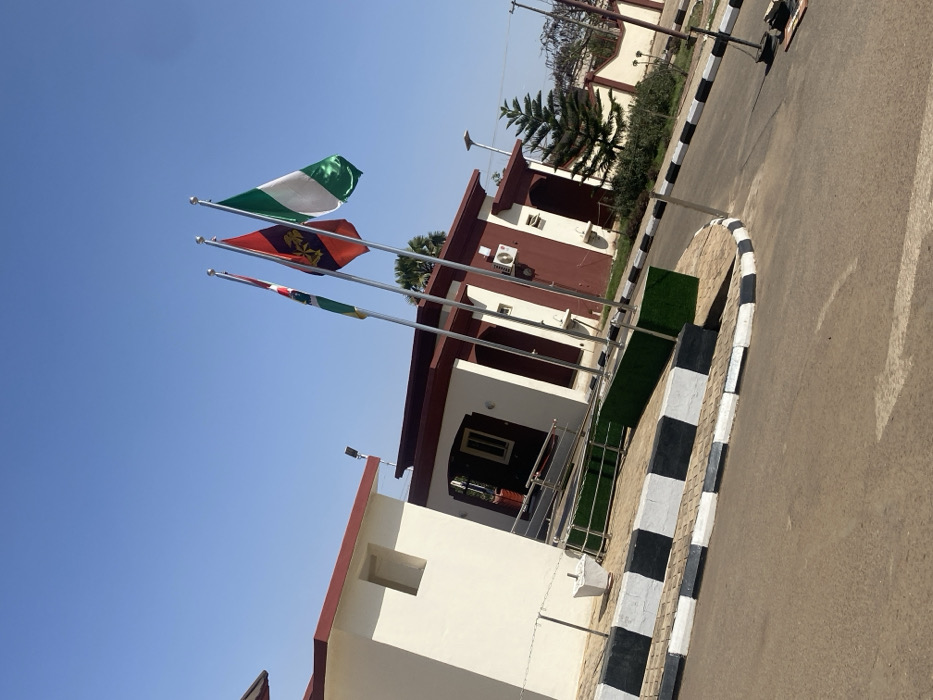
The scene depicts the exterior of a facility in Tudun Nupawa, Nigeria, under a clear blue sky on a sunny day. In the midground, three flags on silver poles are unfurled: from left to right, a green, white, and red flag with an emblem (likely Kaduna State), a predominantly red flag with a golden emblem (likely Nigerian Army), and the Nigerian national flag (green, white, green). Behind the flags, multiple one-story buildings with white walls and dark red trim/roofs are visible, featuring dark windows and an exterior air conditioning unit on one structure. A paved area with light-colored pavers and an artificial green turf section sits in front of the buildings. A black and white checkered curb separates this area from an asphalt road in the foreground, which bears a white arrow pointing left. Several palm trees are visible in the background, along with a conical evergreen tree to the right of the flags. No individuals are present.
Tudun Nupawa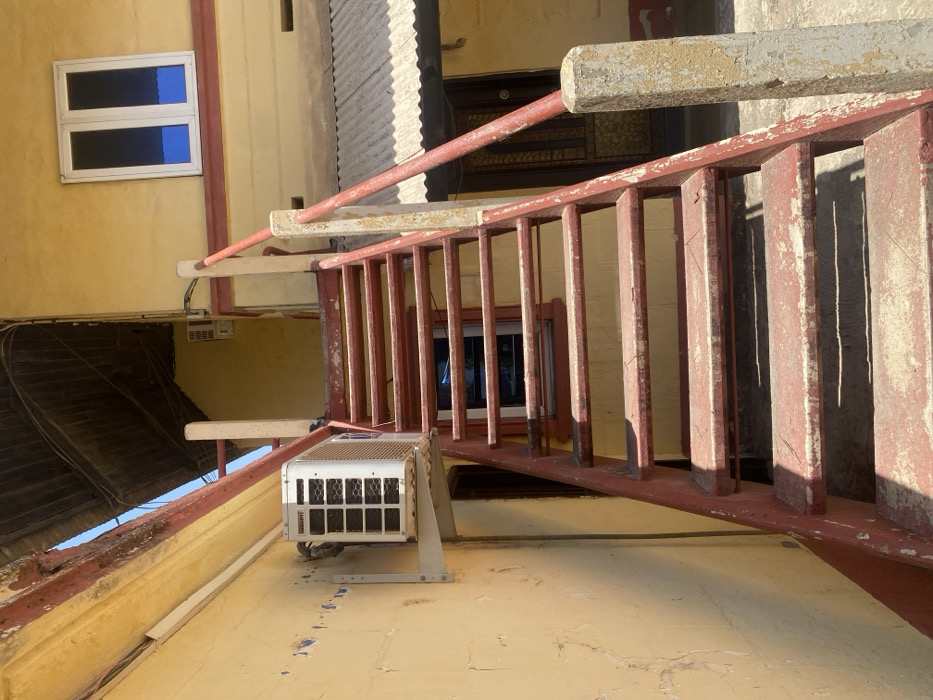
The scene, located in Tudun Nupawa, Nigeria, depicts an outdoor residential or commercial building facade under bright daylight. A prominent, weathered, rust-red painted metal staircase with concrete newel posts and metal handrails ascends centrally towards the upper right. The staircase exhibits significant paint peeling and surface degradation. To the left of the staircase, a light yellow-painted wall, showing cracking and peeling paint, features a white outdoor air conditioning condenser unit mounted on a metal bracket at mid-height. Below the unit, a dark rectangular opening, possibly a doorway or recessed area, is visible. Above the staircase, the upper section of the building also presents a faded yellow facade, adorned with a white-framed, two-pane window containing dark blue tinted glass. To the right of the staircase, partially visible beneath an overhang, is a section of a lower building with a grey corrugated metal roof. A dark entryway with a discernible patterned metal grate is situated beneath this roof structure. Above the upper left portion of the staircase, exposed wooden joists or the underside of a roof structure are visible. The ground surface at the base of the staircase is a light-colored, possibly concrete, patio area. No individuals or active events are present in the image. Shadows cast by the staircase elements indicate strong direct sunlight.
Tudun Nupawa
The video shows a person in a red robe walking with the assistance of two crutches, crossing a paved street with black and white-painted curbs. The person is walking away from the camera, moving from right to left. The setting appears to be an outdoor area on a sunny day. A large, light-colored building with multiple windows is visible in the background. There is a metal structure with a water tank attached to it. In the foreground, there is a gravel area and a drainage grate. Small trees are sporadically placed on a grassy area adjacent to the road. A satellite dish is visible near one of the trees.
Tudun Nupawa
In a medium shot, three construction workers are working on a street in a residential area. Two of the workers are standing by a pile of gray gravel, with one leaning on a shovel and the other holding a wheelbarrow loaded with the gravel. The third worker is sitting on the ground, next to a red metal box. The street in front of them is cracked and broken, and in the background, there are light-colored houses with brown tile roofs. Trees provide shade over the area. The workers are wearing casual clothes and hats, and their faces are visible. Another figure is walking in the background on the left side of the frame. The camera is steady.
Tudun Nupawa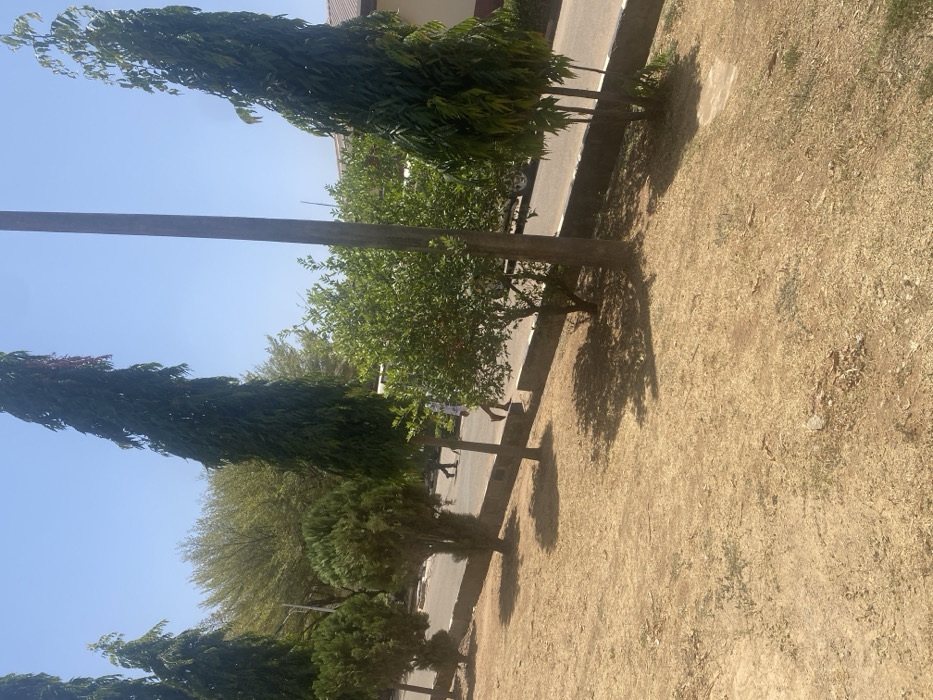
The scene is an outdoor daytime view in Tudun Nupawa, Nigeria, under a clear blue sky. The foreground comprises dry, light brown earth with sparse yellowish-brown vegetation, marked by distinct shadows from trees and a utility pole. A dark grey paved road, edged by a light grey concrete curb, extends across the midground. Several tall, slender, dark green coniferous-like trees, alongside smaller bushy green trees and shrubs, line the road. A solitary dark grey utility pole stands near the road on the right. Two individuals are present on the road: one person in a light-colored top and dark trousers walks from left to right, and another, partially visible, walks further left. A light-colored vehicle is partially obscured behind foliage on the road. In the background, a density of green trees precedes the partial view of light-colored buildings topped with reddish-brown roofs.
Tudun Nupawa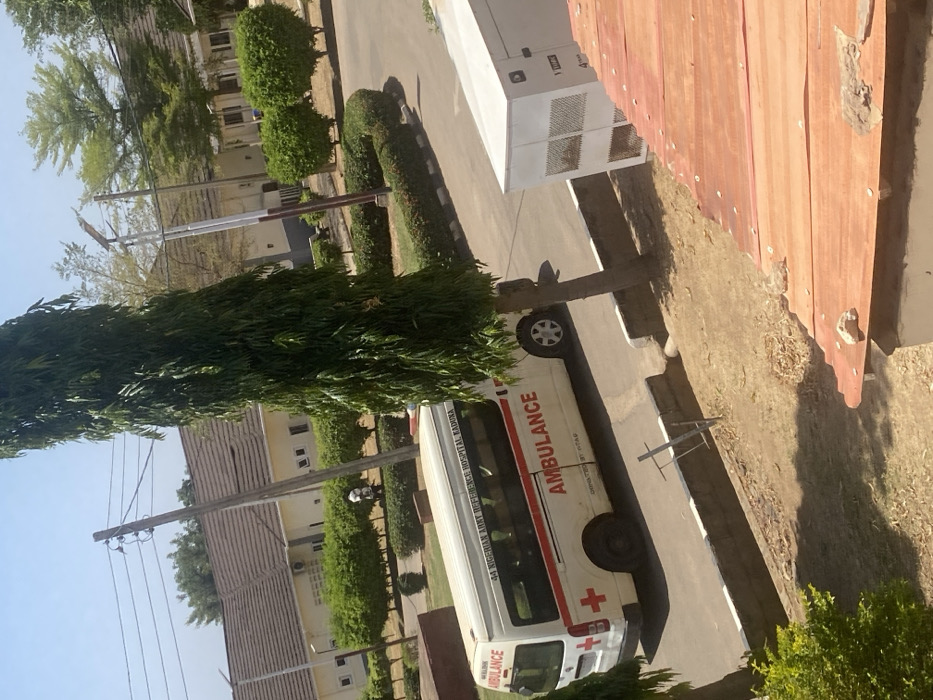
An overhead, slightly angled photograph captures an outdoor scene at the 44 Nigerian Army Reference Hospital in Kaduna, located within Tudun Nupawa, Nigeria, under a clear sky. A white van-style ambulance, featuring a red horizontal stripe, a red cross symbol, and the text "44 NIGERIAN ARMY REFERENCE HOSPITAL KADUNA" in green and "AMBULANCE" in red, is situated on an asphalt road. The road is bordered by a white curb, beyond which lies a dry, light brown grassy area interspersed with manicured green bushes. Multiple low-rise, light-colored buildings with brown tiled roofs are visible in the background, set amidst a landscape of scattered trees. A tall, slender green tree stands prominently in the midground. To the right, a white rectangular generator or utility box with vents is partially obscured by a reddish-brown corrugated metal roof, suggesting the image was captured from an elevated position. Utility poles and overhead power lines are visible against the sky in the upper background. No individuals are distinctly visible performing actions within the frame.
Tudun Nupawa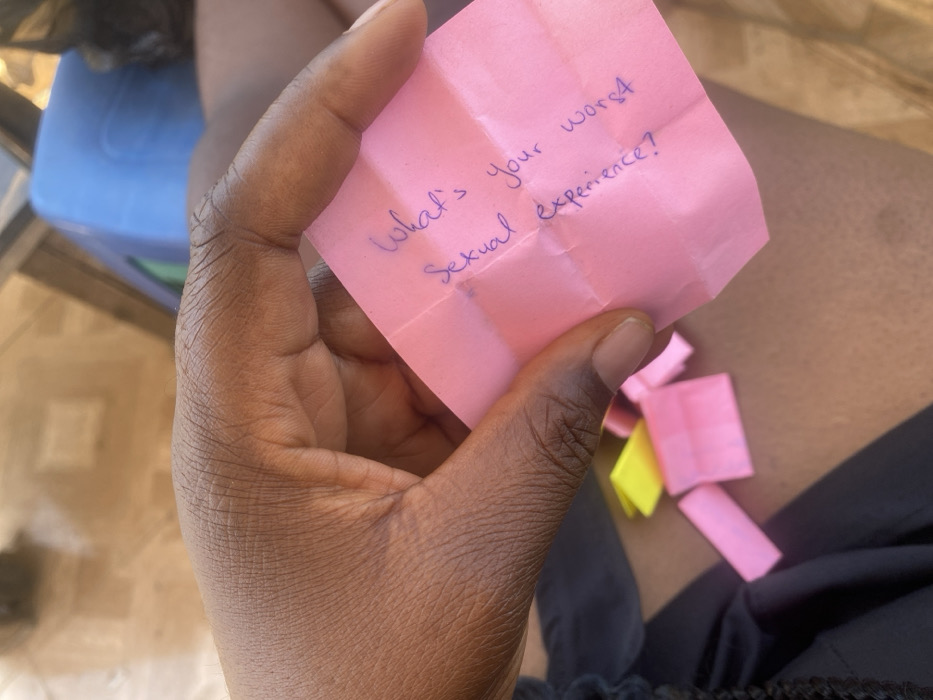
A close-up image taken in Tudun Nupawa, Nigeria, shows a dark-skinned hand holding a creased, pink square piece of paper. Blue handwritten text on the paper reads: "What's your worst sexual experience?". The hand's thumb and index finger are visible on the left side of the paper. Below the hand, on a dark fabric, are several small, folded pieces of paper; most are pink, and one is yellow. The dark fabric appears to be clothing, with a visible braid suggesting it is a person's upper leg. The background shows a light-colored, possibly tiled floor and a partially visible blue plastic object, likely a chair or stool. The scene is brightly lit.
Tudun Nupawa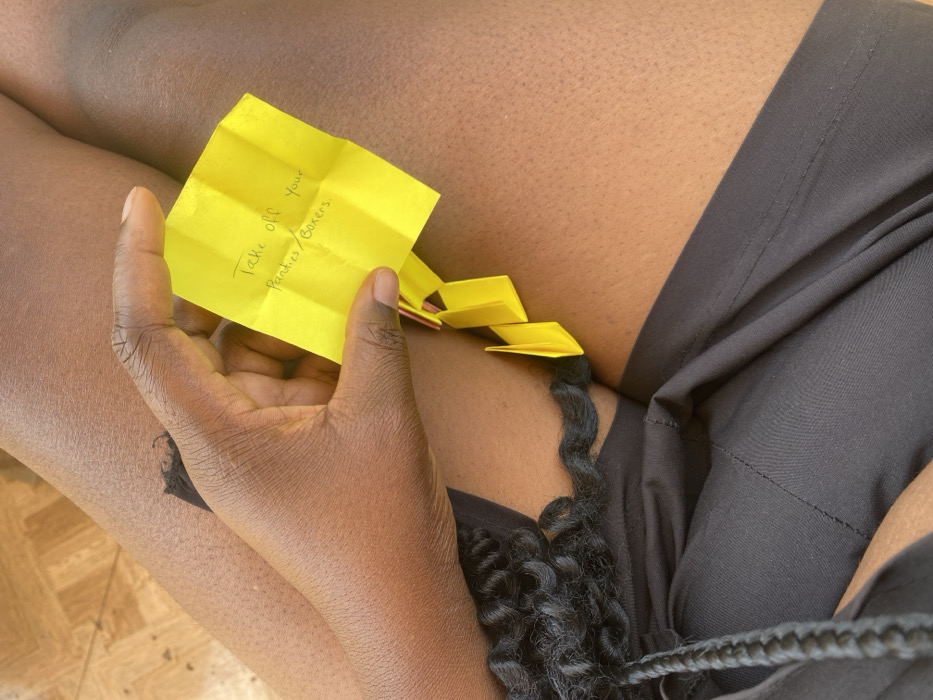
A high-angle, close-up photograph captures the upper thighs and one hand of an individual with dark skin, located in Tudun Nupawa, Nigeria. The hand is holding a crumpled, yellow rectangular piece of paper with handwritten text: "Take off your Panties/Boxers." Partially visible beneath this note is a smaller, folded yellow paper object. A strand of dark, curly braided hair rests upon the left thigh. The individual is wearing dark, possibly black, fabric covering the upper leg and lower torso area. The background depicts light-colored flooring, consistent with an indoor environment.
Tudun Nupawa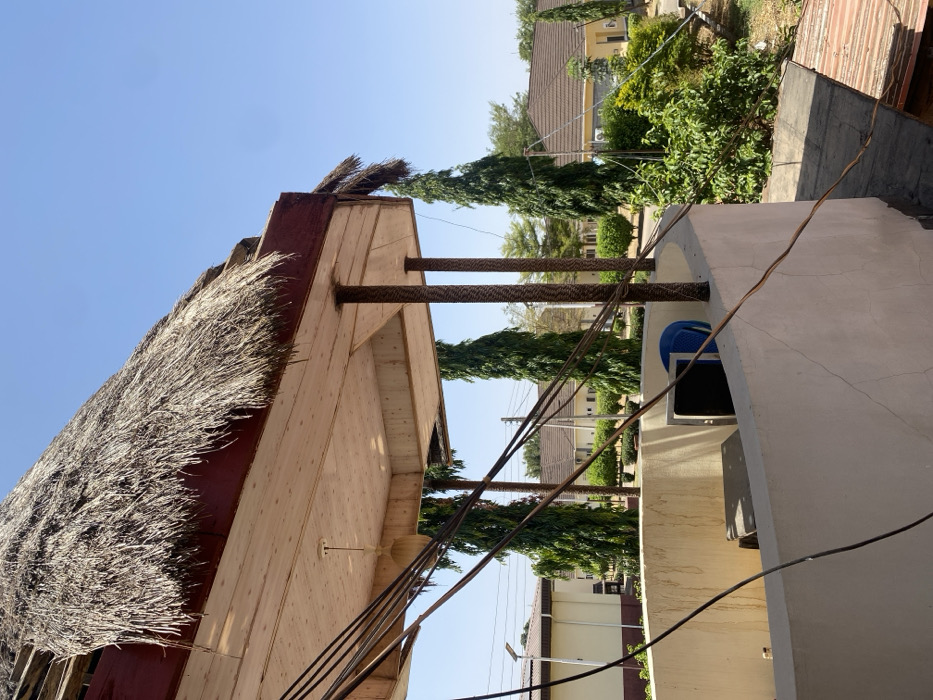
The image captures an exterior scene under a clear blue sky in Tudun Nupawa, Nigeria, viewed from an elevated vantage point. In the immediate foreground, a curved, light-colored concrete parapet wall with visible surface cracks partially encloses an area. Within this enclosure, a dark-colored rectangular object and a blue plastic chair are discernible. Multiple black cables descend from the upper left, crossing the frame diagonally and resting on the parapet wall. Above the parapet, a structure features a prominent thatched roof composed of dry straw, supported by a dark red fascia board and a light-colored, paneled underside. Two textured brown columns support this roof structure. A single, light-colored pendant fixture hangs from the paneled underside. Beyond the immediate structure, the environment includes multiple tall, slender green trees and various green foliage. In the middle distance, several single-story buildings with light-colored walls and brown-tiled roofs are visible, interspersed among the greenery. A solar-powered street light and utility poles with overhead wires are present on the left side of the background. No individuals are visible within the frame.
Tudun Nupawa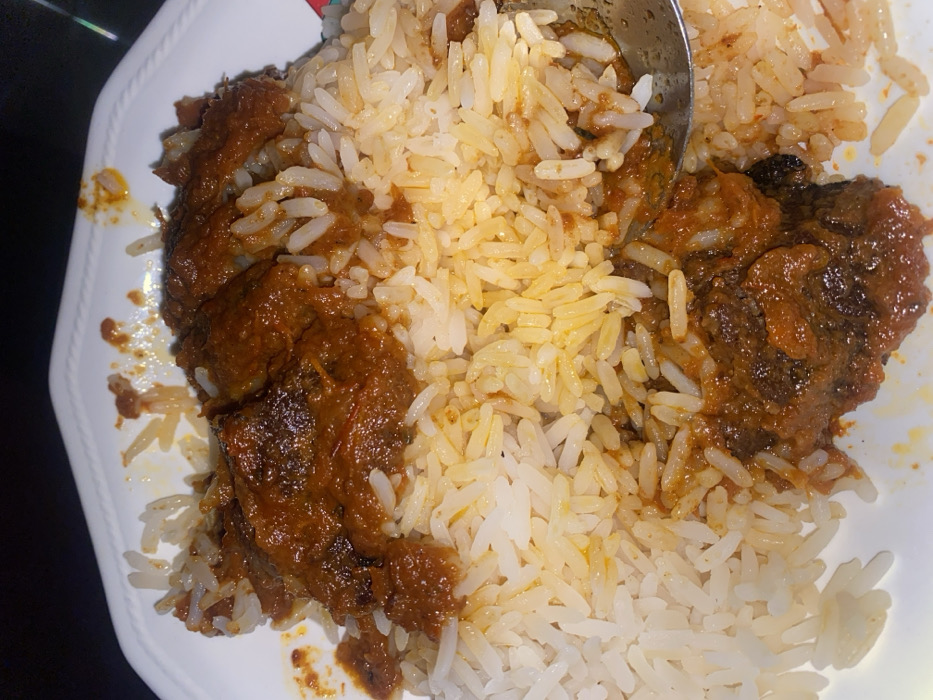
A close-up, top-down view captures a white plate with scalloped edges containing a meal, observed in Tudun Nupawa, Nigeria. The dish consists primarily of white, parboiled long-grain rice, largely covered by a reddish-brown, thick stew. Several dark, irregular pieces of meat or protein are visible within the stew, particularly concentrated towards the center and lower right. A silver-colored spoon is partially submerged into the food on the lower right side of the plate, indicating partial consumption or readiness for eating. The background is uniformly dark and out of focus, suggesting an indoor setting under low or artificial lighting conditions. No individuals are visible.
Tudun Nupawa
An overhead view in Tudun Nupawa, Nigeria, displays a collection of food items arranged on a dark, reflective surface. A white octagonal bowl, featuring a logo inscribed with "ALL LIVES ARE PRECIOUS" and "44 NARHK KADUNA," contains three brown-shelled eggs. To the upper left, a red and gold rectangular can of "OGBONGE" brand sardines in olive oil is visible. Adjacent to the right, a blue-lidded tub of "Blue Band" margarine or spread, depicting a child's face on its lid, is topped with two red peppers, one large and one smaller, possibly scotch bonnets. A clear plastic bag containing a sliced loaf of white bread with a red and green label partially visible occupies the lower right portion of the frame. No individuals are present, nor are any actions or interactions depicted.
Tudun Nupawa