Tukur Tukur, Nigeria
30 memories from Tukur Tukur, Nigeria
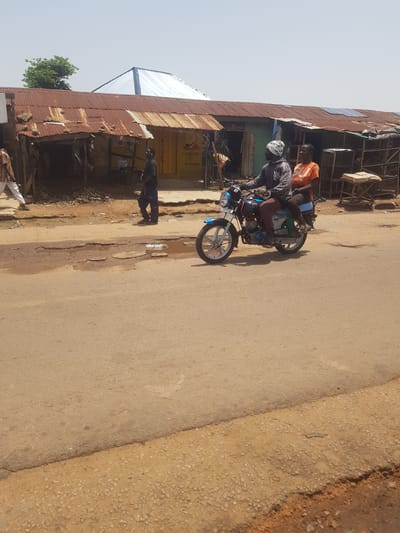
In Tukur Tukur, Nigeria, a motorcycle with two occupants travels on a paved road. The driver, a man wearing a dark patterned shirt and a white headscarf, operates the motorcycle. Behind him, a passenger, a woman wearing an orange t-shirt, sits on the back. The road is in poor condition, with several large potholes filled with murky water. In the background, a row of buildings with corrugated iron roofs and weathered walls lines the street. Some of the buildings appear to be shops, with open fronts displaying various goods or services. A man in a striped shirt and white pants walks on the far left of the image, and another man in dark clothing walks on the right. The sky is clear and the sun is bright.
Tukur Tukur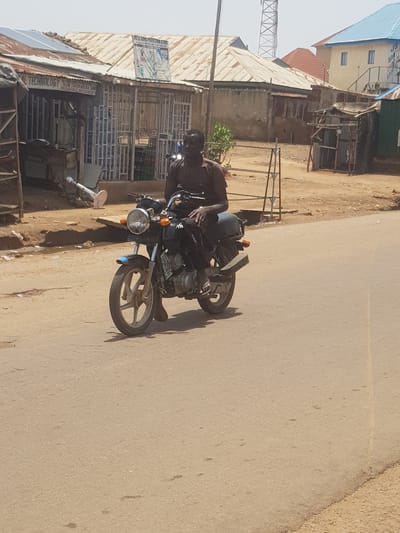
In Tukur Tukur, Nigeria, a Black man is riding a blue and silver motorcycle on a paved road. He is wearing a dark-colored shirt and dark pants. The motorcycle has a license plate that is partially visible. In the background, there are several buildings with corrugated metal roofs, some of which appear to be shops or small businesses. One building has solar panels on its roof. A tall telecommunications tower is visible in the distance. The environment appears to be an urban or semi-urban area with a dry, dusty atmosphere.
Tukur Tukur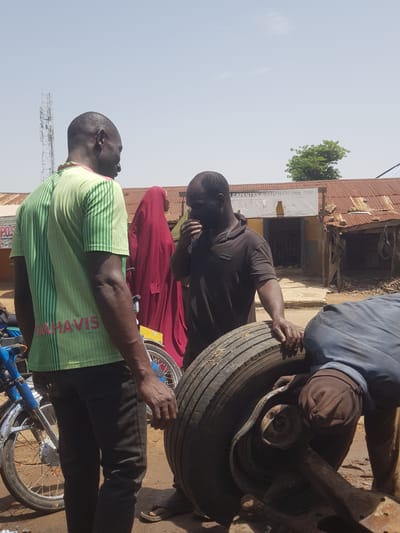
In Tukur Tukur, Nigeria, three men are engaged in activity outdoors. One man, wearing a green and white striped polo shirt with the inscription "MAHAVIS" on the back, stands facing away from the camera, looking towards the other two men. He is wearing dark pants and sandals. To his right, another man in a dark brown polo shirt is bent over, appearing to speak or gesture towards a large tire. He is also wearing dark pants. The third man, whose face is not visible, is wearing a blue shirt and is crouched down, working on the tire which is resting on metal machinery. The background shows a single-story building with a corrugated metal roof and a sign that reads "CAPENTRY & SERVICES NIG. LTD." A cell tower is visible in the distance against a clear sky. A blue motorcycle with a chrome fender is parked to the left of the frame. The ground is dusty and appears to be unpaved.
Tukur Tukur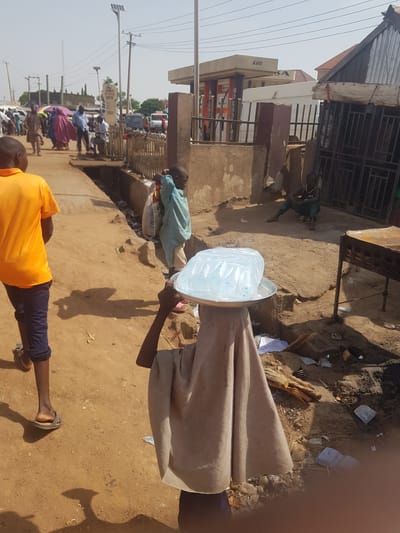
This vertical image depicts a bustling street scene in Tukur Tukur, Nigeria, under bright daylight. In the immediate foreground, a person, mostly covered by a long, light brown garment, carries a large metal tray filled with numerous clear plastic bags of water on their head. Their right arm is visible, holding a stick. To the left of this central figure, another person in a bright orange t-shirt and dark trousers walks away from the camera. A young boy in a light blue shirt stands nearby, facing the water carrier. The ground is unpaved, consisting of dry, light brown earth, uneven in texture, with some scattered debris and waste visible. In the background, a busy street stretches into the distance, lined with various buildings and structures, some with corrugated iron roofs. Several people are visible walking or standing along the street. Text visible on a building includes "AGO" and part of "KA". Power lines traverse the scene, and a solar-powered streetlight can be seen. Vehicles, including a truck, are present further down the road. The strong, direct sunlight creates sharp shadows, indicating a sunny midday or early afternoon.
Tukur Tukur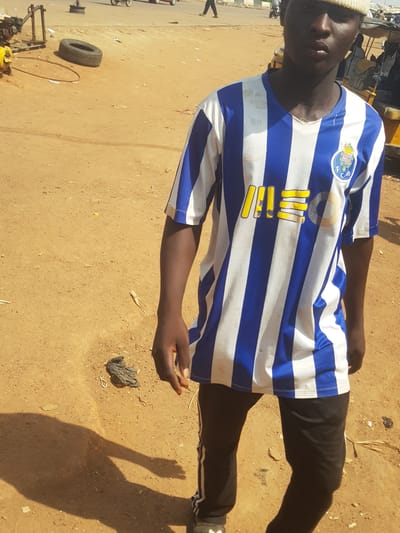
An outdoor, portrait-oriented image captures a dark-skinned individual standing on a dry, sandy, light-brown ground under direct sunlight in Tukur Tukur, Nigeria. The strong, elongated shadows suggest it is either morning or late afternoon. The subject, likely male, wears a white beanie and a blue and white striped long-sleeved football jersey. On the left chest, a circular crest is visible, identifiable as the emblem of FC Porto, with "FC P" clearly legible within it. Below the collar, several vertical yellow elements, possibly part of a sponsor logo or numbering, are partially obscured and appear worn. The person is also wearing black trousers with white stripes along the side seams. They stand facing slightly towards the camera, with a neutral expression, and their left arm is bent, hand open with the palm facing upwards. The ground is unpaved and uneven. Scattered objects include a black tire, a metal hoop, pieces of dark plastic or fabric, and a dried plant stem. In the background, an unpaved road stretches into the distance, with vague shapes of vehicles or structures and the legs of another person visible on the far left.
Tukur Tukur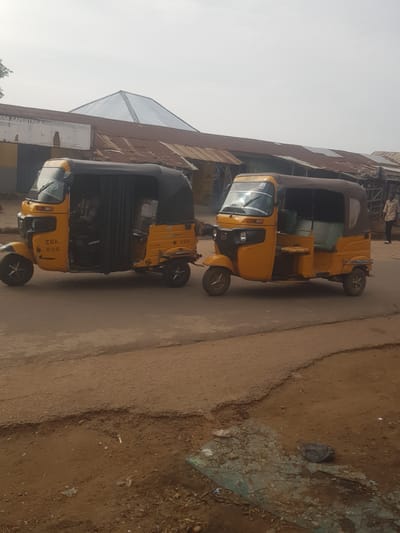
The image depicts two yellow and black "Keke Napep" auto-rickshaws parked on a paved road. The rickshaws are adorned with "ZRA" lettering. The background features a building with a metal roof and a sign for "ZYAB Carpentry & Services Nigl Ltd." The surrounding environment appears to be a dusty urban roadside in Tukur Tukur, Nigeria. There are no visible people in the immediate scene.
Tukur Tukur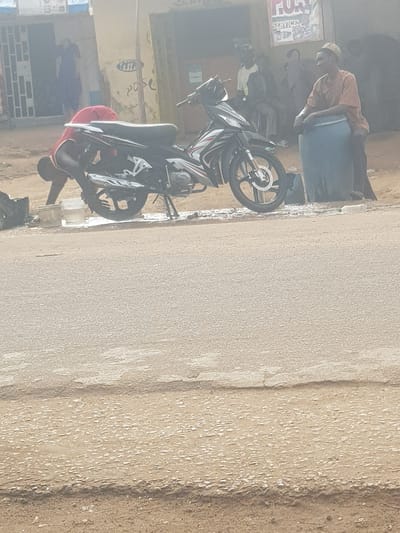
The scene is an exterior shot of a street in Tukur Tukur, Nigeria. A black and silver motorcycle is parked on the right side of the street. A man in a red shirt is crouched down near the motorcycle. Nearby is another man in a tan shirt and blue clothing is visible near a building. There is a group of people in the background near a building with a sign that says "SERVICE". The street is paved.
Tukur Tukur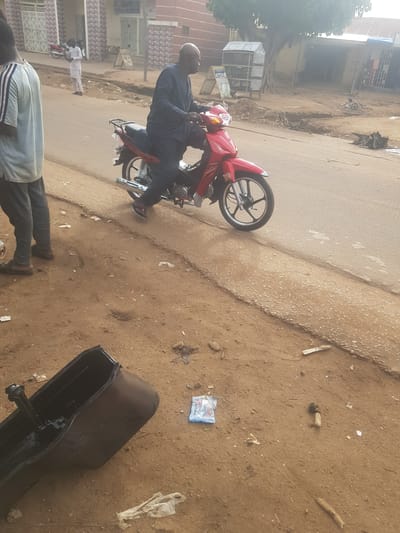
The image captures an outdoor street scene in Tukur Tukur, Nigeria, under bright daylight. The main subjects are three men, a red motorcycle, and a large black pan. In the midground, a bald man wearing a dark blue long-sleeved shirt and trousers is seated on a red Honda motorcycle, which is stationary on a paved road. His feet are on the ground, suggesting he is either paused or about to move. The motorcycle faces towards the left side of the frame (if upright). In the foreground, partially visible on the bottom right (if upright), is another man wearing a light-colored shirt with striped sleeves and dark trousers, standing on the dirt shoulder. Further in the background, a third man in white attire is seen standing near the road. The immediate foreground, to the right of the paved road (if upright), consists of reddish-brown dirt scattered with small stones, pieces of wood, and various items of litter, including plastic bags. A prominent object in this area is a large, black, rectangular pan, possibly a vehicle oil pan, lying on the dirt. The background features several modest buildings with corrugated iron roofs, indicative of local architecture. A small, simple kiosk or stall is visible near the buildings, with faint text that appears to read "POST" on a blue sign. Trees and sparse vegetation are also visible further back, beyond the buildings. The overall environment suggests a casual, perhaps busy, street in a residential or commercial area.
Tukur Tukur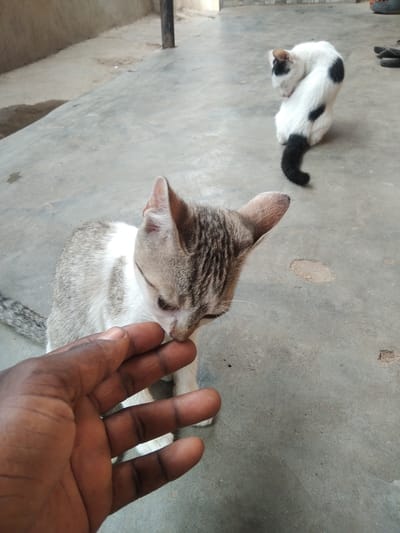
On a gray concrete surface, a light gray and white tabby cat is being touched on the face by a dark-skinned hand. In the background, a second cat, white with black spots and a black tail, is grooming itself. The scene is outdoors, possibly a yard or patio. The location is presumed to be Tukur Tukur, Nigeria.
Tukur Tukur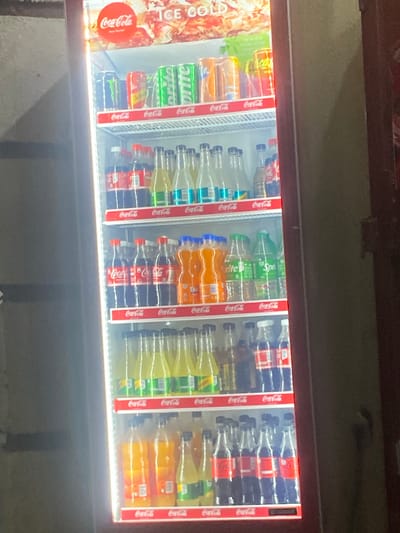
A refrigerated display case stocked with various Coca-Cola products and other soft drinks is visible. The Coca-Cola logo is prominently featured on the cooler and product labels. The bottles and cans are arranged in rows, indicating a commercial setting. There is no evidence or indication to determine the location or suggest it is in Tukur Tukur, Nigeria. The image shows beverages in a cooler.
Tukur Tukur
A selfie photograph shows a man wearing a blue soccer jersey with "Apex Soccer Academy" written on it. The photo seems to be taken indoors, with a door labeled "Ladies" visible in the background. The room appears to be simple, with green walls. While the location is reported as Tukur Tukur, Nigeria, there are no specific elements in the image that would verify this geographic information.
Tukur Tukur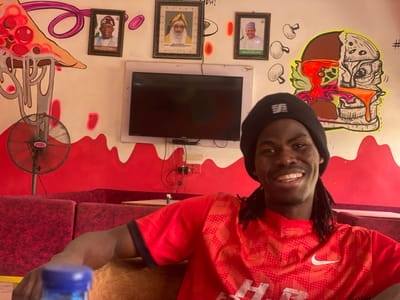
A smiling man wearing a black beanie and a red patterned Nike t-shirt sits in a restaurant or lounge. He has dark skin and dreadlocks. A bottle with a blue cap sits in the foreground. Behind him, the wall is painted with red drips and cartoonish drawings of a pizza slice and a hamburger. There are also three framed portraits of men in traditional dress. A flat-screen television hangs on the wall between the portraits and the cartoons. A standing fan is on the left, and a red sofa is visible. The restaurant or lounge is located in Tukur Tukur, Nigeria.
Tukur Tukur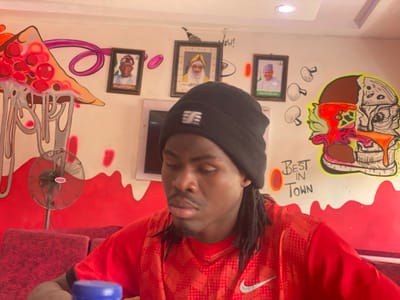
A man wearing a black beanie and a red shirt sits at a table in a restaurant in Tukur Tukur, Nigeria. Behind him is a wall decorated with food-themed graffiti, framed portraits of men, and a small television screen. An oscillating fan is also visible in the background. The restaurant wall is marked with the words "Best in Town".
Tukur Tukur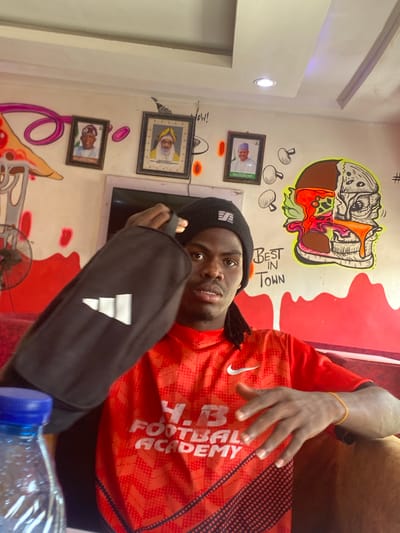
A man is indoors, potentially in a restaurant in Tukur Tukur, Nigeria. He wears a black beanie and an orange athletic jersey. He holds a black Adidas bag. Behind him, the wall is decorated with a cartoon burger, framed portraits, and graffiti. A water bottle sits on the table in the foreground.
Tukur Tukur
A medium shot captures two Black African men indoors against a brightly colored and patterned background. The man closer to the camera is seated, wearing a blue and white patterned shirt and black shorts with "Play" printed on them. He is leaning into a brown cushion attached to a yellow chair, his hand raised near his head as if in thought or discomfort. The second man stands to the left, wearing a black shirt with "24/7" printed on it and a red cap. He holds a phone. The backdrop includes a red wall with black lines, a white peace sign, and framed pictures. A mural featuring mushrooms and an orange-filled brown bowl, likely food-related, is also visible on the white wall. Artificial green turf is present near the top right of the frame. The image appears to be taken at eye level, with the men as the central subjects. There are no other discernible markers to conclude it is Tukur Tukur, Nigeria.
Tukur Tukur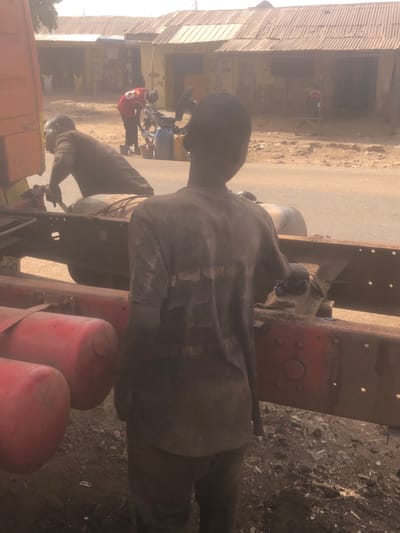
The image depicts an outdoor scene in a roadside mechanical repair area within the city of Tukur Tukur, Nigeria. The time is daytime, characterized by strong, hazy sunlight and a dusty atmosphere. In the immediate foreground, a young male, observed from the rear, stands to the right of a large vehicle chassis. He is dressed in a heavily dirt-stained, light-colored short-sleeved t-shirt and dark pants. His head is turned slightly to the left, obscuring his facial features. His hands are not clearly visible, but he appears to be observing or engaged with the vehicle. The vehicle itself is primarily a truck chassis, featuring a prominent red frame and two red cylindrical air tanks mounted horizontally underneath, all covered in dust and grime. The ground directly beneath this area is loose, dark soil mixed with debris, consistent with a repair site. To the left, another male individual, wearing a brown short-sleeved shirt and dark pants, is bent over the same vehicle's chassis. He is actively engaged in repair work, holding a tool in his right hand and interacting with the vehicle's undercarriage. In the mid-background, across a dusty, unpaved road, a third individual is visible. This person wears a red shirt and is tending to a motorcycle or scooter. Nearby on the ground are several blue plastic jerry cans, commonly used for liquid storage, possibly fuel. Behind these figures, a row of single-story commercial buildings with corrugated metal roofs and light-colored, worn walls line the street, indicative of local businesses. The entire scene is permeated by a visible haze of dust.
Tukur Tukur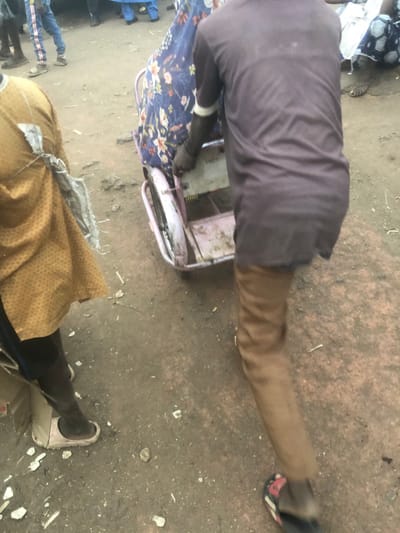
In Tukur Tukur, Nigeria, an outdoor scene on unpaved, light brown ground depicts human activity. In the central foreground, a person viewed from the rear wears a dark maroon tunic with white cuff trim, light brown trousers, and dark flip-flops with red detailing. This individual operates a worn, light pink two-wheeled cart, pushing it forward. A person in a blue floral garment is partially visible seated on or behind the cart. To the left, another person is partially visible, wearing a light brown patterned garment with a torn, light-colored fabric piece secured to their side, and dark footwear with a light sole. In the blurred background, other individuals are present on the unpaved surface, with one person visible wearing blue jeans with white side stripes. Debris and small stones are scattered across the ground.
Tukur Tukur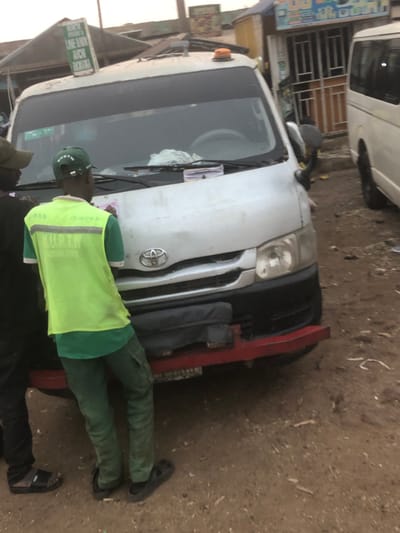
The image portrays an outdoor urban scene in the city of Tukur Tukur, Nigeria. The central subject is a white Toyota Hiace-style commercial van, viewed from the front, parked on reddish-brown dirt ground with scattered debris. The van features a black front bumper with a prominent red-painted aftermarket bull bar or protective frame affixed below it. An orange rotating beacon light is mounted on its roof. A rectangular sign attached to the roof rack displays partially legible text including "NORTH PHONES LINE BOOK ACHA NIGERIA." The vehicle's windshield wipers are in the upright position, and a white cloth along with a stack of papers or tickets rests on the dashboard. The van shows signs of use and dirt. Two men stand in the foreground, facing the front of the Toyota van. One man, viewed from the back, wears a bright lime-green reflective vest over a green t-shirt, green cargo pants, and black sandals. He wears a green baseball cap with the acronym "KURTW" and "KADUNA STATE" visible on the back. The second man, partially visible on the left, wears a dark shirt and black sandals. In the background, commercial structures with corrugated iron roofs and various storefronts are present. One storefront displays metal security bars and indistinct signage, including a partially visible "DJ" graphic. To the right of the main van, a portion of another white van is visible. The sky appears overcast or hazy.
Tukur Tukur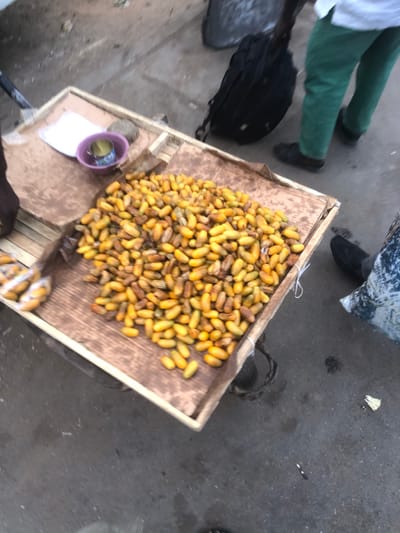
The scene depicts a street-level vendor's display in Tukur Tukur, Nigeria. A rectangular wooden frame, approximately 1 meter in width, serves as a display counter, covered with a brown, possibly cardboard, liner. Piled centrally on this surface is a large quantity of ripe, yellow to yellowish-brown, oval-shaped fruits, resembling dates. To the immediate left of the main fruit pile, a smaller quantity of the same fruit is visible, contained within clear plastic packaging. On the upper-left section of the display, a small purple plastic bowl holds a metallic can or cup, with a piece of white paper situated nearby. The ground is dark grey, appearing to be asphalt or concrete, with scattered dirt and small debris. Three individuals are partially visible: a person's left foot and lower leg in a dark sandal are present on the left side of the frame; another person, wearing green trousers and dark closed-toe shoes, stands near the right side of the display, with a black backpack resting on the ground behind their legs; and the lower legs and feet of a third person, dressed in a patterned garment and dark closed-toe shoes, are visible on the bottom right.
Tukur Tukur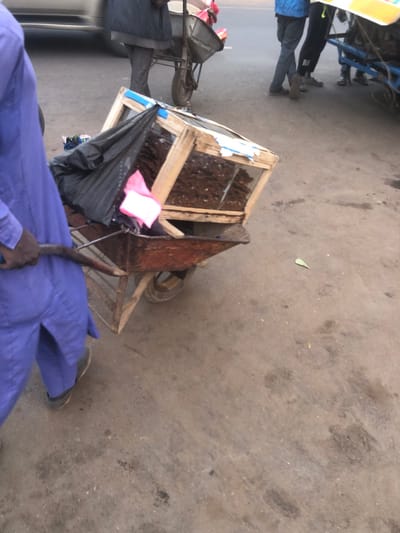
The image displays an outdoor urban scene in Tukur Tukur, Nigeria. In the foreground, a person clad in a light purple, long-sleeved garment is partially visible from the left rear, grasping the dark handle of a single-wheeled utility cart. The cart, exhibiting rust-colored metal and a wooden frame, carries a wooden display case with transparent panels. Inside the case, multiple dark, elongated items are arranged. A black plastic bag and a folded pink cloth object rest on the cart next to the display case. In the mid-ground, another individual, wearing a dark jacket and dark pants, stands near a wheelbarrow. Additional people and parts of other carts are visible in the background, along with a portion of a light-colored vehicle on the far left. The ground consists of a dusty, light grey-brown compacted surface. A single green leaf lies on the ground in the mid-right.
Tukur Tukur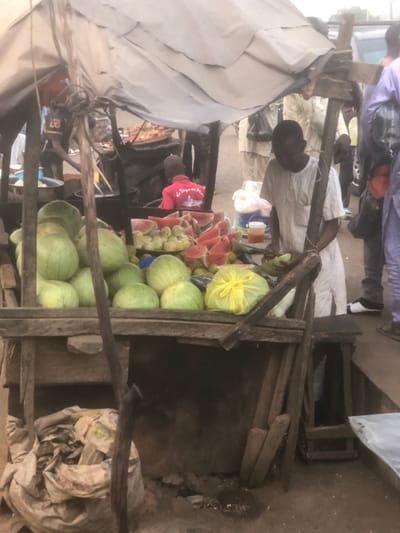
An outdoor market scene in Tukur Tukur, Nigeria, depicts a fruit stall with a makeshift tarp canopy. A dark-skinned male in a white tunic stands behind the wooden stall, actively preparing or cutting produce, possibly peeling a green item. The stall displays numerous whole, light-green watermelons, piles of cut red watermelon slices, and mounds of round yellow fruit. A yellow plastic bag is present on the stall surface. Underneath the stall, several sacks are visible on the unpaved, earthen ground. In the immediate background, another individual wearing a red shirt with white lettering is seated behind a separate food stall, where fried items are visible in a metal pan. Further back, several indistinct figures, some in light-colored traditional garments, are present, indicating general market activity. A vehicle is partially visible in the far background on the right.
Tukur Tukur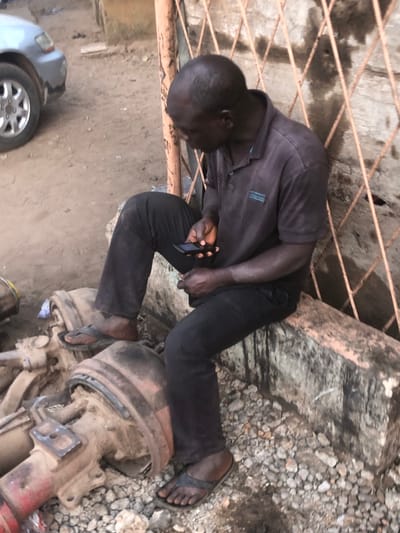
A man in dark clothing and sandals kneels among automotive parts and rubble, looking at a cell phone in his hand. He rests one foot on one of the parts. A car's wheel and the edge of the vehicle are visible on the left. A rusty metal grid is in the upper left corner of the frame. Pebbles and the edge of a concrete structure fill the upper right corner.
Tukur Tukur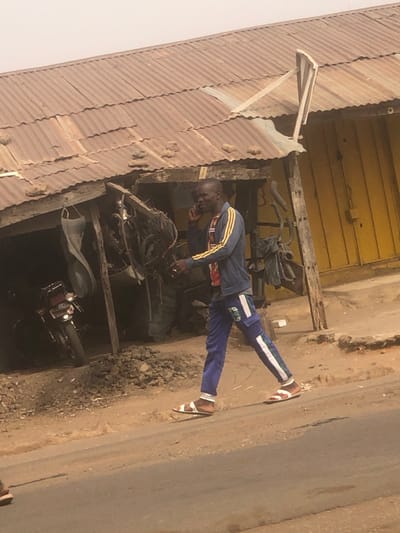
The scene is set in Tukur Tukur, Nigeria, depicting a street adjacent to a rudimentary workshop under a hazy sky. A dark-skinned, bald male, dressed in a blue jacket with yellow sleeve stripes, blue trousers with white side stripes, and two-toned sandals, walks left-to-right. He holds a black smartphone to his right ear, speaking, while his left hand is lowered, possibly holding a small white item. He traverses a dirt shoulder next to a paved road. The background features a single-story structure with a corrugated, weathered brown metal roof, partially supported by wood and weighted with rocks. A white, curved fragment resembling a satellite dish is affixed to the roof on the right. The open shop front reveals a cluttered interior: a dark motorcycle on the left, interwoven metal components or bicycle frames centrally, and a large tire or similar object in the rear. The ground immediately before the workshop is dirt and rubble. A yellow-painted wall is visible to the right of the shop opening. A single foot in a sandal is partially visible on the far left foreground.
Tukur Tukur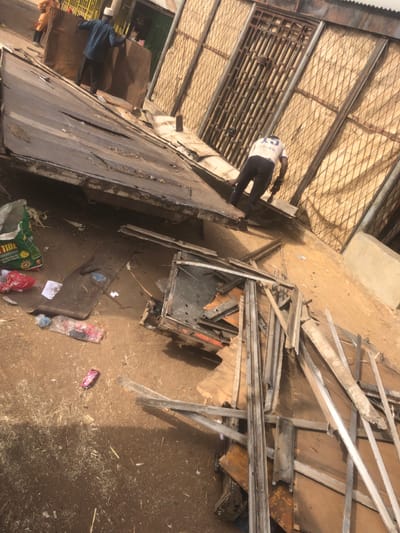
An outdoor scene in Tukur Tukur, Nigeria, depicts an area undergoing demolition or material salvage, characterized by scattered debris and active human presence. The ground is unpaved, consisting of light brown dirt or packed earth, with numerous wood shavings, discarded plastic items, and various scraps of metal and wood. In the mid-ground, a large, dark, rectangular metal or wood panel, approximately 3-4 meters long, rests at an angle on the ground, indicating it has been detached from a structure. Its surface is weathered and appears dented in areas. To the immediate right of this panel, another large assortment of dismantled wooden and metal frames and beams lies on the ground, suggesting a collection of salvaged materials. Three individuals are visible. In the mid-ground right, a person wearing a white shirt with the number "15" on the back and dark trousers stands with their back to the camera, bent over and seemingly interacting with the tilted panel. They appear to be holding a dark-colored tool, possibly a power tool or pry bar, against the panel. Further in the background to the left, a second individual, wearing a blue long-sleeved shirt and a light-colored cap, faces away from the camera while handling a large, flat, dark-colored sheet of material, possibly a piece of corrugated metal or wood. A third person, partially obscured, is visible further back, dressed in an orange-brown garment. The background features a building facade with a prominent metal grate or lattice pattern, possibly a security feature or decorative element. A large, dark, heavily barred metal gate is integrated into this wall. To the far left, another building with a corrugated metal roof and what appears to be a small storefront is visible. A green and white "Tide" brand plastic bag is visible among the litter in the lower left foreground. The lighting suggests a bright, sunny day, with visible shadows on the ground.
Tukur Tukur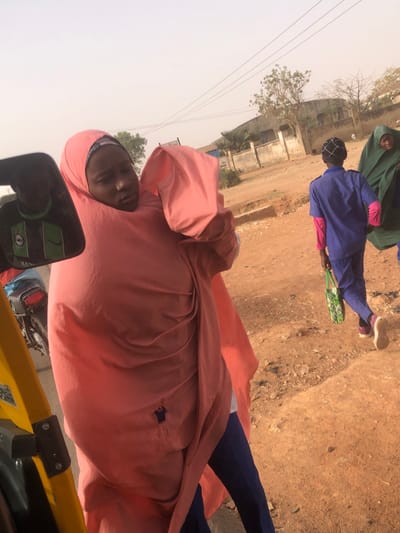
A person wearing a peach-colored hooded garment is visible, partially obscured by a vehicle mirror. Other people in blue and green garments walk on a dirt road alongside buildings and a tree. The sky appears hazy.
Tukur Tukur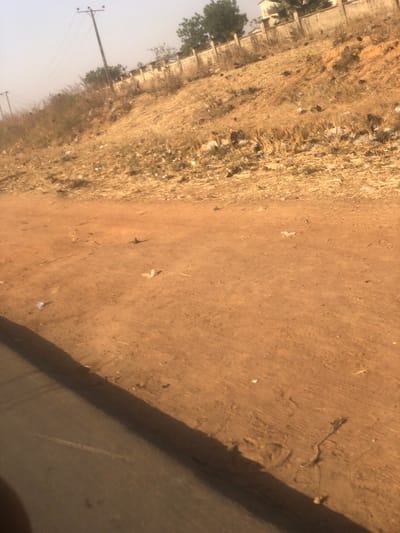
A sun-drenched landscape depicts a dirt path bordered by dry vegetation and sparse trees. Power lines traverse the scene, suggesting a rural or developing area. Structures with white walls are visible in the distance. A concrete edge and a glimpse of a paved road appear in the foreground. The image has a hazy, muted color palette dominated by browns and tans.
Tukur Tukur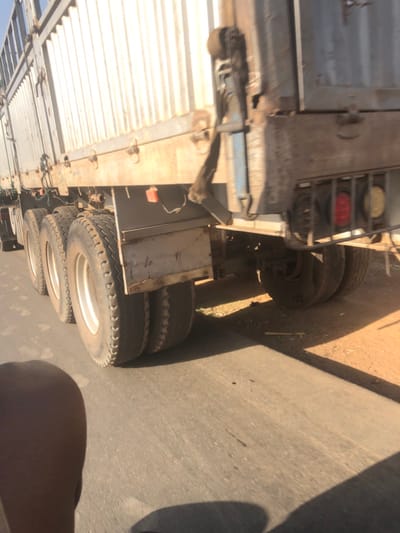
A partial view of a semi-trailer truck is shown from the side. Multiple tires are visible on the truck's axles, along with parts of the trailer's frame and body. The truck appears to be on a paved surface, possibly a road or parking lot. The trailer body is constructed from corrugated material, likely metal. The truck appears to be older, judging by the rust.
Tukur Tukur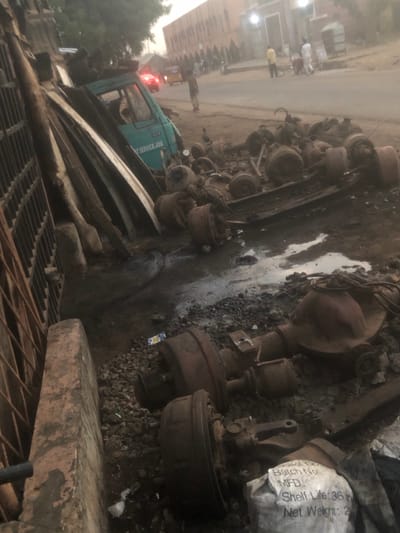
The image depicts an outdoor scene, likely a scrap yard or a large mechanic's workshop, filled with various discarded vehicle parts. The image is oriented vertically (portrait mode), but the scene itself is best interpreted in landscape mode, with the main subject matter spread across the ground. In the foreground, a large, rusty metal grate or drainage cover is partially visible on the right. To its left, a thick, rectangular concrete block or slab sits on the ground. The ground itself is uneven, composed of dirt, gravel, and several puddles or damp, muddy patches. The midground is dominated by a dense collection of heavy vehicle components, primarily what appear to be truck axles, differential assemblies, and large brake drums or wheel hubs. These parts are heavily soiled, rusted, and arranged in disarray, suggesting they are salvaged or awaiting disposal/repair. Some appear to be connected by wires or cables. On the far right side of this collection, a crumpled white sack or bag is visible, with some printed text. Part of the text that can be read includes "Batch No.", "MFD", "Shelf Life: 36", and "Net Weight:". A small, colorful wrapper is also on the ground near these parts. In the background, to the left of the main pile of parts, a light-colored, possibly teal or green, truck is partially visible. Its rear brake lights are illuminated red, suggesting it might be stopped or idling. On the side of the truck, some faded white text is discernible, including "SERVICE JOBS" and a number that looks like "208" or similar. Further into the background, above and behind the truck, there is a building or a sheltered area with several bright artificial lights visible, creating a soft glow in the otherwise dim environment. Several indistinct human figures are also visible in the distance near this structure, one appearing to wear a yellow top. The overall lighting suggests it is either late evening, dusk, or early morning, with artificial lights playing a significant role in illuminating the scene. There is no specific activity clearly taking place; the scene appears to capture a static view of a storage or work area.
Tukur Tukur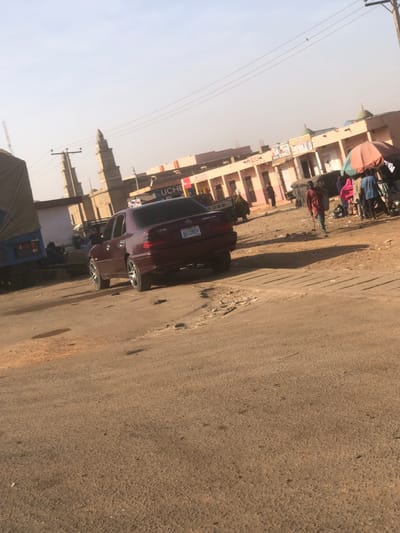
The scene depicts an active, sunlit street in Tukur Tukur, Nigeria. In the foreground, a dark red (maroon) Mercedes-Benz C230 sedan, license plate "ABC 195AV," is angled on a weathered, light brown road surface, showing visible potholes and a textured concrete/metal grate to its right. To the left, a blue truck with a tan canvas cover is parked. Two prominent, light-colored minaret-like structures rise in the mid-distance on the left, accompanied by utility poles and overhead lines. The background features a row of single-story commercial buildings with peach/pink facades and some blue trim, lining the street. A sign bearing "UCHE" is visible on one building. Further right, an open-air market area is present, indicated by an orange parasol sheltering vendors and goods. Several people are visible: one individual walks towards the right foreground with a walking stick, casting a distinct shadow. Others are gathered around the market stall under the parasol. A person in light-colored attire is visible near a partially obscured white pickup truck (possibly a Ford) in the background on the right. The sky is a pale blue, suggesting clear conditions, with shadows indicating either mid-morning or late afternoon.
Tukur Tukur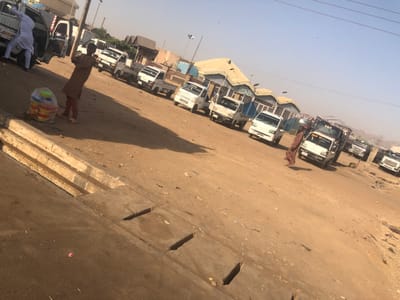
The image displays an outdoor, unpaved area in Tukur Tukur, Nigeria, under a clear sky. The ground consists of reddish-brown dirt and dust. In the immediate foreground, a concrete drainage channel with two slotted covers runs diagonally from the lower left towards the mid-right. On the far left, a person wearing a white long-sleeved garment is partially positioned inside the open cargo bed of a white pickup truck, appearing to engage with its contents. To their right, a second individual in a brown long-sleeved tunic and patterned trousers stands, observing the scene towards the right. Adjacent to this person is a stack of colorful plastic bowls or containers, wrapped in clear plastic. Stretching into the middle ground is a line of approximately ten parked white light commercial pickup trucks, all facing towards the right side of the frame. Beyond these vehicles, a third individual in a reddish-brown garment walks towards the left, potentially carrying an object on their head. Further into the background, several larger trucks are visible, one bearing "D&P MOTORS" on its side. Behind the vehicles, a series of single-story buildings with light-colored, possibly corrugated metal, roofs and patterned architectural features are present. Long shadows are cast towards the right, indicating an angle of sunlight from the left.
Tukur Tukur