Tuzdybastau, Kazakhstan
30 memories from Tuzdybastau, Kazakhstan

The image, taken in the city of Tuzdybastau, Kazakhstan, shows a view of mountains in the distance under a pale blue sky. A large, bright moon, illuminated by sunlight, is visible in the upper portion of the sky, partially obscuring the mountain peaks. In the foreground, several structures are visible. These include a portion of a building with a dark, tiled roof and a light-colored facade, as well as a grey cinder block wall. A security camera is mounted on the facade of the building, above the wall. The overall scene suggests an outdoor setting, possibly residential or commercial, with a natural landscape backdrop.
Tuzdybastau
The image depicts an outdoor scene in Tuzdybastau, Kazakhstan. In the foreground, a children's swing set with a yellow mat and a small wooden chair is visible. To the right of the swing set, a portable basketball hoop stands on a metal frame. Behind these playground items, a brick wall forms a boundary, with overgrown grass and some wooden pallets to the right. In the background, a building with a dark roof and a covered outdoor area with similar roofing can be seen. Beyond the structures, mountains with snow-capped peaks are visible under a clear blue sky. The scene appears to be a residential or recreational area.
Tuzdybastau
A bright yellow moon is visible in a pale blue sky, partially obscured by soft clouds. The moon is positioned above a range of mountains, their peaks softened by atmospheric haze. In the foreground, the dark, tiled roofs of two wooden structures are visible. A portion of a tall, brown wooden structure is also present on the left side of the frame. Green trees are scattered below the roofs. The image appears to be taken at dusk or dawn, given the lighting conditions and the color of the sky. The location is identified as Tuzdybastau, Kazakhstan.
Tuzdybastau
A full moon is visible in the night sky above Tuzdybastau, Kazakhstan. The moon, a bright white orb with a yellowish halo, is positioned in the upper left quadrant of the image. Below the moon, silhouetted against the dim light, are the dark shapes of mountains. The foreground shows the indistinct outline of a building or structure, possibly a rooftop, with some faint reflections of light. The overall scene is dimly lit, with a grainy texture throughout the image.
Tuzdybastau
A single coneflower, Echinacea, with pale pink petals and a brown, spiky center, is blooming amidst a patch of green leaves. The flower and foliage are set against a background of dry, greyish-brown soil, scattered with small pebbles and organic debris. The scene is outdoors, likely in a garden or natural setting. There are no people or animals present. The lighting suggests it is daytime. The image appears to be taken from directly above the flower. The location of Tuzdybastau, Kazakhstan is not visually discernible from the image itself, but if that is its stated location, the scene depicts a flora specimen in an arid or semi-arid environment.
Tuzdybastau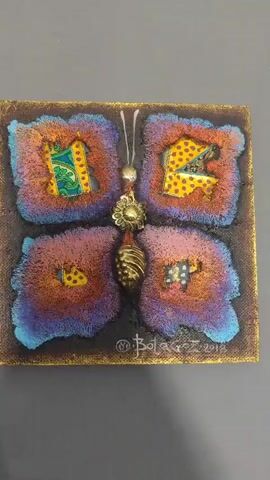
A close-up, slightly angled shot shows a decorative butterfly artwork mounted on a gray surface. The butterfly has large, four-part wings with ragged edges and a textured, fluffy appearance in shades of purple, pink, and blue, with touches of orange and yellow. Each wing section has an opening revealing fabric with patterns of yellow polka dots and green paisley. The butterfly's body is a central vertical element with a beaded antenna, a decorative metallic flower-like piece, and a ribbed, metallic lower body. The artwork is signed "@Botagoz 2017" in the lower center. The background is a plain, flat gray surface.
Tuzdybastau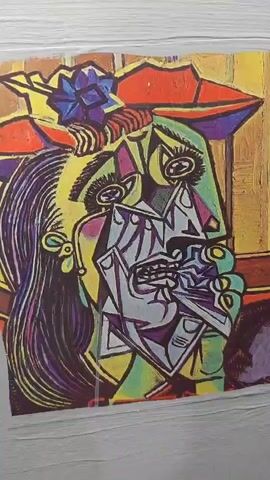
The video is a close-up, static shot of a framed picture of a painting. The painting is a cubist-style depiction of a crying woman. The woman has exaggerated features, including large, tearful eyes, a distorted mouth, and fragmented facial planes. She is wearing a colorful hat adorned with a blue flower. The background of the painting appears to be a striped pattern. The frame of the picture is visible, and it seems to be affixed to a wall. The lighting is somewhat dim, and the focus is sharp on the painting.
Tuzdybastau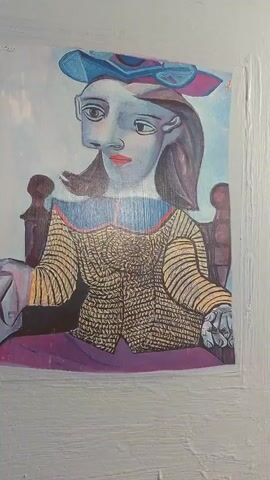
A close-up video shows a printed image of a cubist-style painting of a woman wearing a blue hat and a patterned shirt. The painting is taped to a textured, light-colored wall. The camera slowly zooms in on the painting, revealing details of the artwork. The woman in the painting has a fragmented face, with two distinct profile views of her face overlaid on each other. She is seated in a chair, with her hands resting in her lap. Her clothing is depicted in vibrant colors and intricate patterns. The background of the painting is a light blue, possibly representing the sky or a wall. The video ends with a final close-up view of the woman's face.
Tuzdybastau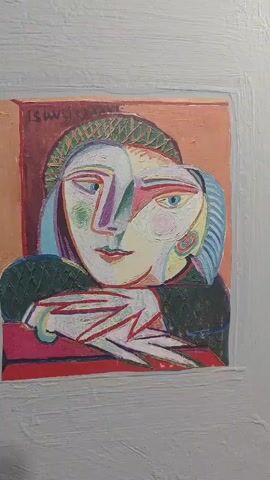
A video displays a painting of a woman's face in a cubist style. The woman has two faces, one looking forward and one in profile. She is wearing a green hat and a dark green top. Her hands are resting on a red surface. The painting is framed by a rough white border. The video pans slightly across the painting.
Tuzdybastau
This is a photograph of a star chart, likely a wall-mounted poster, displayed in an indoor setting. The chart is dark with white lines connecting dots, representing constellations and stars. Text in Cyrillic script labels various celestial bodies. The chart appears to be illuminated by ambient light, possibly from overhead or nearby sources, as there are no direct light sources visible. There are no people, animals, or other objects clearly discernible in the frame besides the star chart itself. The image is slightly out of focus, giving it a soft, somewhat abstract quality. There is no information in the image that can be used to determine its location in the city of Tuzdybastau, Kazakhstan. The image is a close-up of a star chart and does not contain any contextual elements like buildings, landmarks, or recognizable geographical features that would suggest a specific location.
Tuzdybastau
This is a close-up, eye-level shot of a textured butterfly artwork mounted on a wall. The artwork is square and features a butterfly with torn wings, revealing patterned fabric underneath. The wings are textured with purple and pink hues, and the fabric patches have gold polka dots. The butterfly's body is adorned with metallic embellishments, including a golden flower and a textured leaf-like shape. The background of the artwork is a dark brown with a gold border. In the lower right corner of the artwork, there is a signature that appears to read "©·BotaGoz 2019". The wall behind the artwork is a textured, pale blue-grey. There are no people visible in the image. The location of this artwork is not specified in the image itself or determinable from the visual information provided.
Tuzdybastau
This is a close-up, overhead photograph of a piece of textured art depicting a butterfly. The butterfly's wings are a textured gradient of blues, greens, pinks, and yellows, with darker brown accents around the edges. Each wing has a cutout revealing colorful patterned fabric underneath, resembling patchwork. The butterfly's body is made of metallic embellishments, including a spherical bead, a decorative circular piece, and a gold-toned, textured, leaf-shaped element. The art is on a dark canvas with a gold border. The artist's signature, "@Botagoz 2018", is visible in white script along the bottom edge of the canvas. The artwork is displayed against a textured, dark gray background. The image does not contain any information that would allow for its location in the city of Tuzdybastau, Kazakhstan to be determined.
Tuzdybastau
The image shows a close-up of a framed butterfly artwork. The artwork is textured with a mix of colors including teal, purple, pink, and gold. There are metallic embellishments and fabric pieces integrated into the butterfly's wings. The background is dark, possibly black canvas, with gold trim around the edges. A signature and the year "2018" are visible in white script at the bottom right of the artwork. The artwork is displayed against a plain gray surface, which appears to be a wall or table. There are no people or other elements in the image besides the artwork and its immediate background. There is no information about the city of Tuzdybastau, Kazakhstan, present in the image.
Tuzdybastau
An abstract butterfly artwork is displayed on a plain gray wall. The butterfly has four wing sections, each with a colorful patterned insert. The outer edges of the wings are textured with a gradient of purple, pink, orange, and blue. A metallic gold border frames the artwork. In the center of the butterfly's body, there are decorative metallic elements resembling beads and a flower shape, with a dangling, acorn-shaped metallic object below. The artist's signature, "@ Bola Göz", and the year "2018" are visible in white lettering on the bottom right of the artwork. The artwork is not located in Tuzdybastau, Kazakhstan.
Tuzdybastau
A framed painting of a stylized bird with colorful, circular patterns on its body and a patterned head is displayed on a white, textured wall in Tuzdybastau, Kazakhstan. The bird is depicted in profile, facing right, with thin black legs. The painting incorporates various textures, including what appear to be small metal coins and shimmering pieces embedded in the bird's head and body. The background of the painting is a solid green. The frame is a weathered gray wood. Below the bird, a signature reads "BOTAGUZ 2025". The scene appears to be an indoor shot of artwork on display.
Tuzdybastau
The image is a painting of a woman wearing a hat, in a cubist style. The woman is depicted in profile, with her face turned to the right. She has a large, blue hat with green and yellow accents. Her facial features are exaggerated and angular, with bright red lips and a heart-shaped blush on her cheek. The background is a mix of yellow and red, with some lighter areas that appear to be text. The painting is framed by a light gray border. There is no information within the image or in the provided context that suggests a connection to the city of Tuzdybastau, Kazakhstan.
Tuzdybastau
The artwork depicts a figure, rendered in earthy tones, with its back facing the viewer. The surface of the artwork is textured, possibly with a mesh material applied to the paint. The figure is posed in a seated or kneeling position, with one arm raised. The background is abstract and appears to be painted with broad strokes of brown and muted green, with areas of light blue and yellow. In the lower left of the image, a section of a light green wooden structure with a small orange cap is visible, casting a shadow on the artwork. The artwork is located in Tuzdybastau, Kazakhstan.
Tuzdybastau
The image shows a circular painting mounted on a white wall. The painting features a pink flamingo standing on one leg amidst blue calla lilies and green foliage, set against a textured golden background. The circular frame of the painting is brown with a textured, crackled finish. Black abstract shapes, including a large bird-like figure and a decorative border with dots and triangles, are painted on the white wall around the circular artwork. The wall itself has a rough, textured surface. This artwork is located in Tuzdybastau, Kazakhstan.
Tuzdybastau
The image depicts a mosaic artwork on a wall, featuring a stylized bird with its body composed of various broken ceramic shards, plates, and cups. The bird's body is a collage of colorful patterns and textures, including floral designs, geometric shapes, and solid colors. Some of the ceramic pieces used in the mosaic appear to be from tableware, with recognizable patterns from plates and teacups. The bird's head is a solid black shape, and its legs are rendered in black and white mosaic tiles. The background wall is also covered in a mosaic of irregularly shaped stone or tile pieces in neutral tones of beige, cream, and gray. To the lower left, there are several yellow ceramic objects, possibly decorative figures or boots. To the right, a narrow, arch-shaped mosaic column is visible, made of small, multi-colored mirrored tiles. The overall impression is a whimsical and artistic display created from repurposed materials. This artwork is located in Tuzdybastau, Kazakhstan, likely in a public space or an artist's studio, given its scale and detail.
Tuzdybastau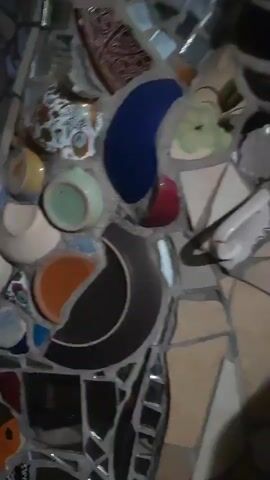
The video shows a mosaic made of broken ceramic pieces, including cups, plates, and bowls, as well as mirrored tiles. The mosaic appears to be on a vertical surface, possibly a wall or a sculpture. The colors are varied, with blues, greens, yellows, oranges, whites, and browns being prominent. Some of the ceramic pieces have floral patterns or other decorative designs. The lighting is dim, and the camera is moving, creating a slightly blurred effect.
Tuzdybastau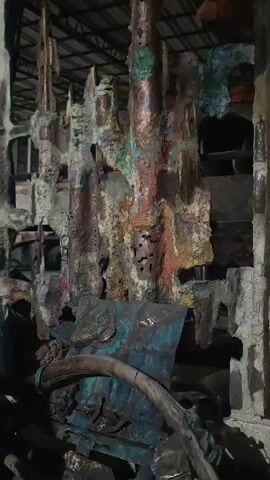
The video displays a close-up view of an abstract sculpture constructed from various materials, including what appears to be aged metal. The sculpture has a rough, textured surface with patches of rust and verdigris, suggesting significant weathering or an intentional patina. Several elements are visible within the sculpture, including a watch on the left side and what looks like a relief of an animal, possibly a snake or lizard, on a metallic surface in the foreground. The background is dark and indistinct, implying an indoor setting, possibly a workshop or exhibition space. The lighting is low, highlighting the details and textures of the sculpture.
Tuzdybastau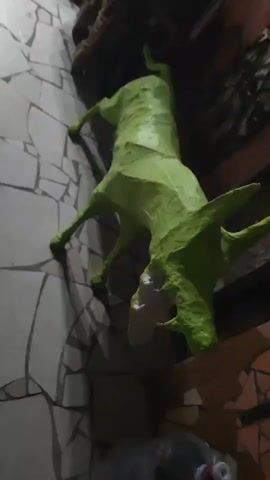
A green paper mache animal sculpture resembling a dog or wolf is attached to a wall covered in a mosaic of light and dark triangular tiles. The sculpture is positioned vertically, with its head facing downwards and its body angled away from the wall. Its mouth is open, revealing white teeth and a pink interior. Two front legs are bent and appear to be gripping the wall, while the hind legs are also bent and angled downwards. The sculpture's body is elongated and textured, with visible seams from the paper mache. To the lower right of the sculpture, a large clear plastic water jug with a red and white cap is partially visible, resting on the floor. The background includes elements of what appears to be a rough, textured wall or a decorative element with dark, spiky textures.
Tuzdybastau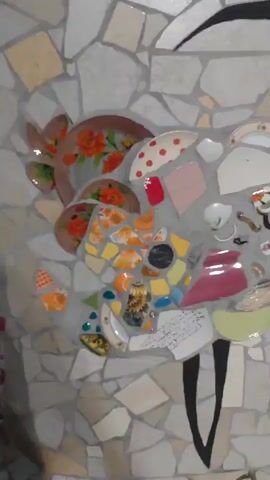
This is a vertical video of a mosaic artwork depicting a bird. The mosaic is made of various broken ceramic pieces, including plates, cups, and tiles, arranged to form the shape of a crane or stork with its wings outstretched. The bird's body is filled with a collage of these ceramic fragments in different colors and patterns. Some visible fragments include pieces with floral designs, red polka dots, and solid colors like yellow, blue, and red. There are also some smaller objects embedded in the mosaic, such as what appear to be small figurines or charms. The background of the mosaic is composed of larger, irregular-shaped light-colored tiles. The bird's legs are depicted as two black, narrow shapes extending downwards. To the right of the bird's head, there is a small rectangular mosaic detail with green and black tiles, resembling a windowpane. The lighting appears to be overhead, casting a slight shadow on the artwork.
Tuzdybastau
The image is a photograph of graffiti on a wall. The graffiti depicts a cartoon character with blue hair and large blue eyes, wearing a gray shirt and blue shorts. To the left of the character is a large pink donut with sprinkles. A basketball hoop is mounted above the donut. The graffiti is colorful and appears to be on an exterior wall, likely in an urban or semi-urban setting. The specific location is identified as Tuzdybastau, Kazakhstan. The wall surface is textured and appears weathered. The graffiti art style is characteristic of street art.
Tuzdybastau
This is a photograph of a colorful, abstract relief sculpture mounted on a blue background, which is part of a larger mural or wall painting in Tuzdybastau, Kazakhstan. The sculpture itself is multi-dimensional, with various shapes and textures painted in vibrant blues, greens, golds, oranges, and reds. It incorporates found objects, including what appear to be two small ceramic dishes or saucers with floral patterns and metallic elements, possibly spoons or other metallic fragments, embedded within the painted forms. The overall style is dynamic and organic, with swirling lines and raised elements that create a sense of movement and depth. The sculpture is framed by a textured blue border that is peeling away at the bottom, revealing lighter material beneath. The background wall above the sculpture is painted with horizontal bands of white and orange. Below the sculpture, the wall is painted with horizontal bands of yellow and orange brick patterns, with a shadow of an unseen person cast across the bottom section. The environment appears to be outdoors, given the natural lighting and the visible shadow. The context of Tuzdybastau, Kazakhstan, suggests this artwork is likely a public piece, possibly part of a street art initiative or a permanent installation in the town.
Tuzdybastau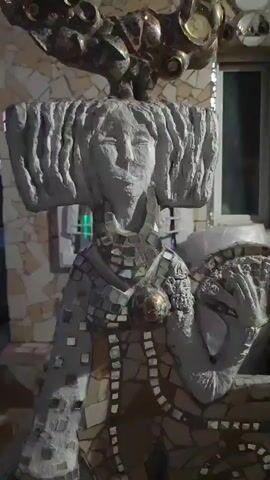
A statue of a woman is shown from the chest up. The statue is covered in mosaic tiles of various colors and textures. The woman has a stern expression and her hair is styled in a blocky fashion. She is wearing a mosaic necklace and has a mosaic dress. Her right arm is raised and she appears to be holding something in her hand, possibly a fan or a flower. The background is blurred but appears to be an outdoor setting with some architectural elements visible. The lighting is dim and the overall mood is somewhat mysterious.
Tuzdybastau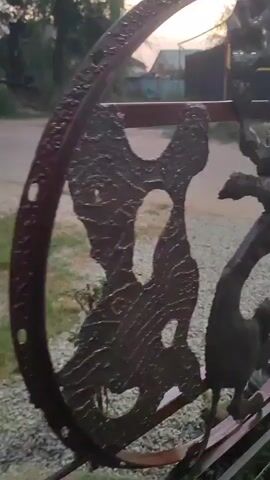
The video pans across a decorative metal fence at dusk. The fence features abstract, organic shapes and what appear to be stylized animal figures. In the background, a gravel driveway leads away from the fence, and a house with a dark roof is visible. Trees and sky are also part of the backdrop. The lighting suggests either sunrise or sunset.
Tuzdybastau
The video shows a close-up view of tall, green grass blades. The camera is focused on the grass, with some of the blades appearing sharp and in focus, while others are blurred. The lighting suggests it might be an overcast day or dusk. The background is out of focus, showing what appears to be a fence or railing and some darker ground or soil. There are no people or visible objects other than the grass in the foreground. The camera appears to be slightly shaking or moving subtly.
Tuzdybastau
The video shows a close-up, shaky view of rocks and dirt. The rocks are of various sizes and colors, including gray, brown, and pink. Some of the rocks are covered in moss or dirt. There are also some reddish-brown pieces of brick scattered among the rocks. The ground appears to be dry and dusty. The camera moves slowly, panning across the scene. In the background, a dark fence or railing can be seen. The lighting is dim, suggesting it may be dusk or a shaded area. There are no people or animals visible in the video.
Tuzdybastau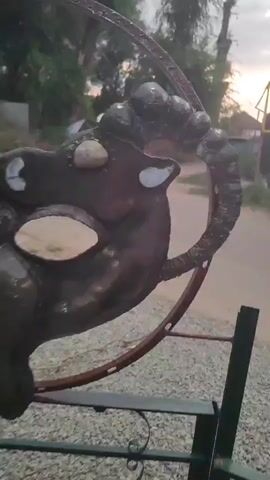
A close up panning shot of a dark metal sculpture of a mask on a rusty frame outside. The mask appears to be a stylized face with large eye openings and bumps on its forehead. The sculpture is set against a background of gravel, trees, and a fence with a house beyond it. The sky is visible and shows signs of dusk.
Tuzdybastau