Unguwar Gaya, Nigeria
30 memories from Unguwar Gaya, Nigeria
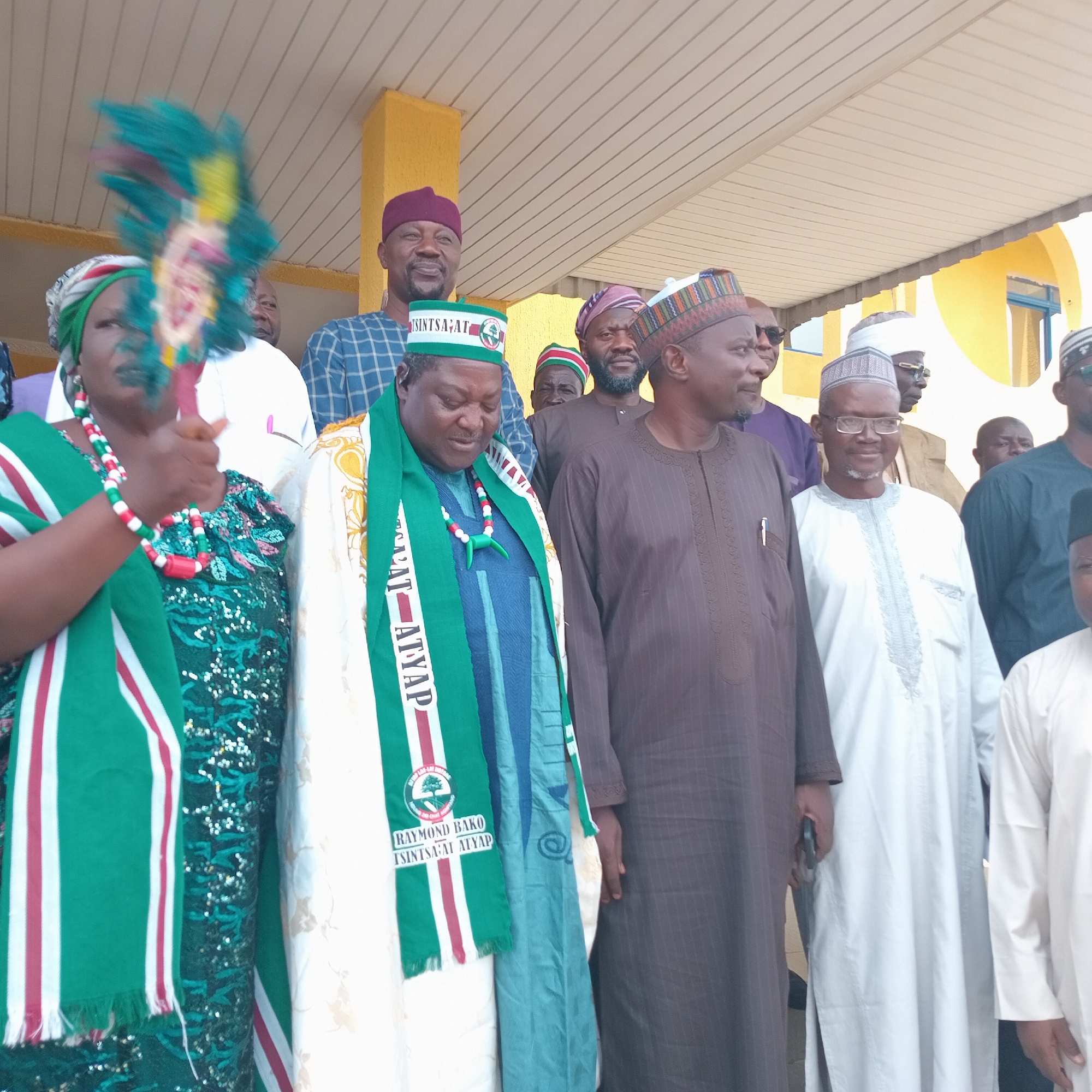
In Unguwar Gaya, Nigeria, a group of men and one woman are gathered outdoors, standing in front of a yellow building with a beige, slatted awning. The woman on the far left is holding a colorful fan, decorated with turquoise, yellow, and red feathers. She is wearing a green and red beaded necklace and a green outfit with intricate patterns. To her right, a man in a blue and white checkered shirt and a maroon cap is looking towards the camera. Next to him, a man wearing a green scarf with white and red stripes is visible. He is also wearing a cap. Further to the right, a man in a brown tunic and cap is looking to the side. Another man in a white cap and glasses is looking forward. The man to his right is wearing a dark blue outfit. The man furthest to the right is wearing a dark outfit and a black cap. The environment appears to be a public space, possibly for an event or gathering.
Unguwar Gaya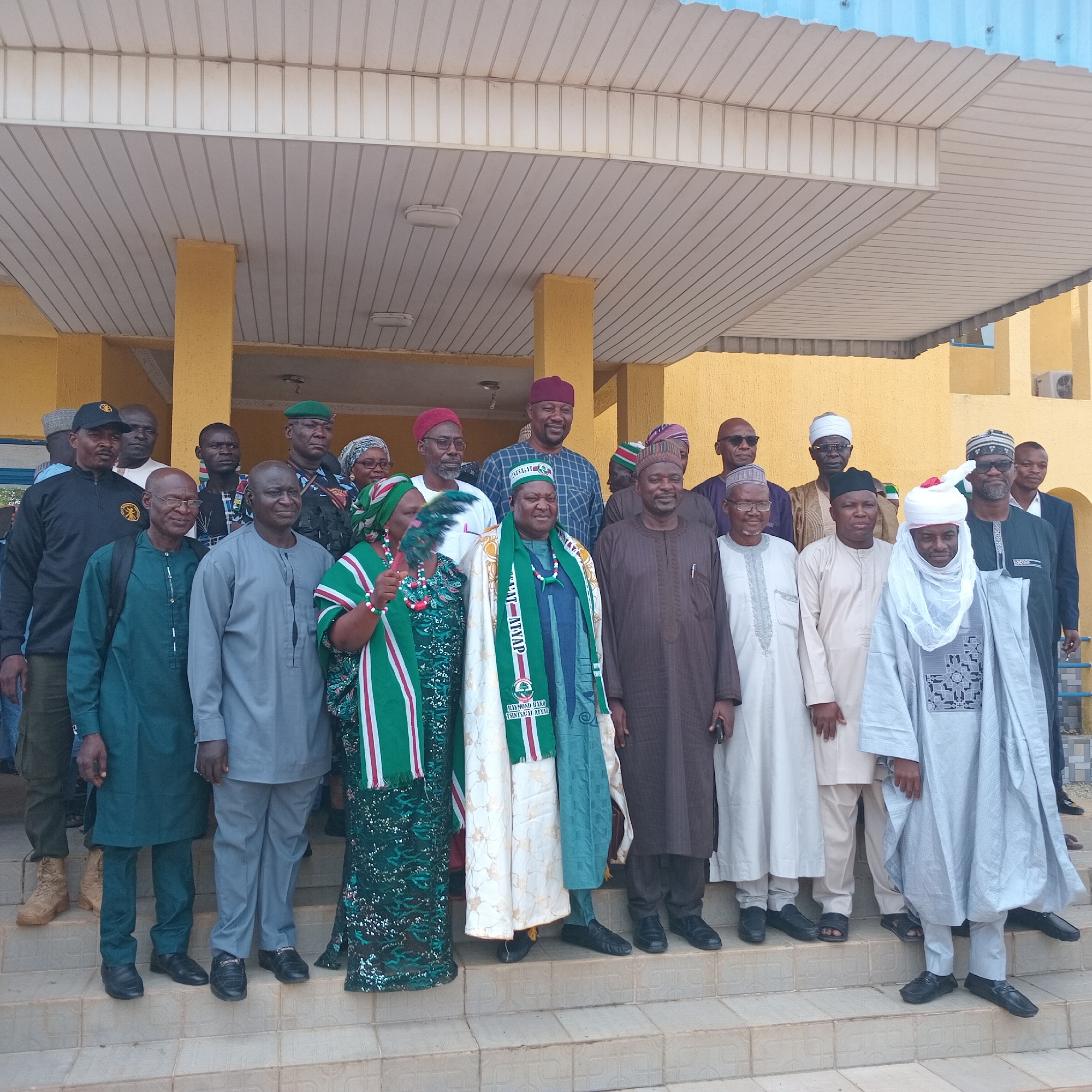
In Unguwar Gaya, Nigeria, a group of approximately twenty individuals, predominantly men with a few women, are gathered outdoors on a set of concrete stairs. They are posing for a photograph in front of a yellow building with a light blue corrugated metal roof overhead, supported by yellow pillars. The individuals are dressed in a variety of traditional and modern attire, including dashikis, caps, turbans, and some appear to be in military or security uniforms. Some individuals are wearing sashes or scarves, and one woman is holding a fan. The overall atmosphere appears formal, possibly a political or community gathering. The lighting suggests it is daytime, and the scene is viewed from a slightly low angle, looking up at the group.
Unguwar Gaya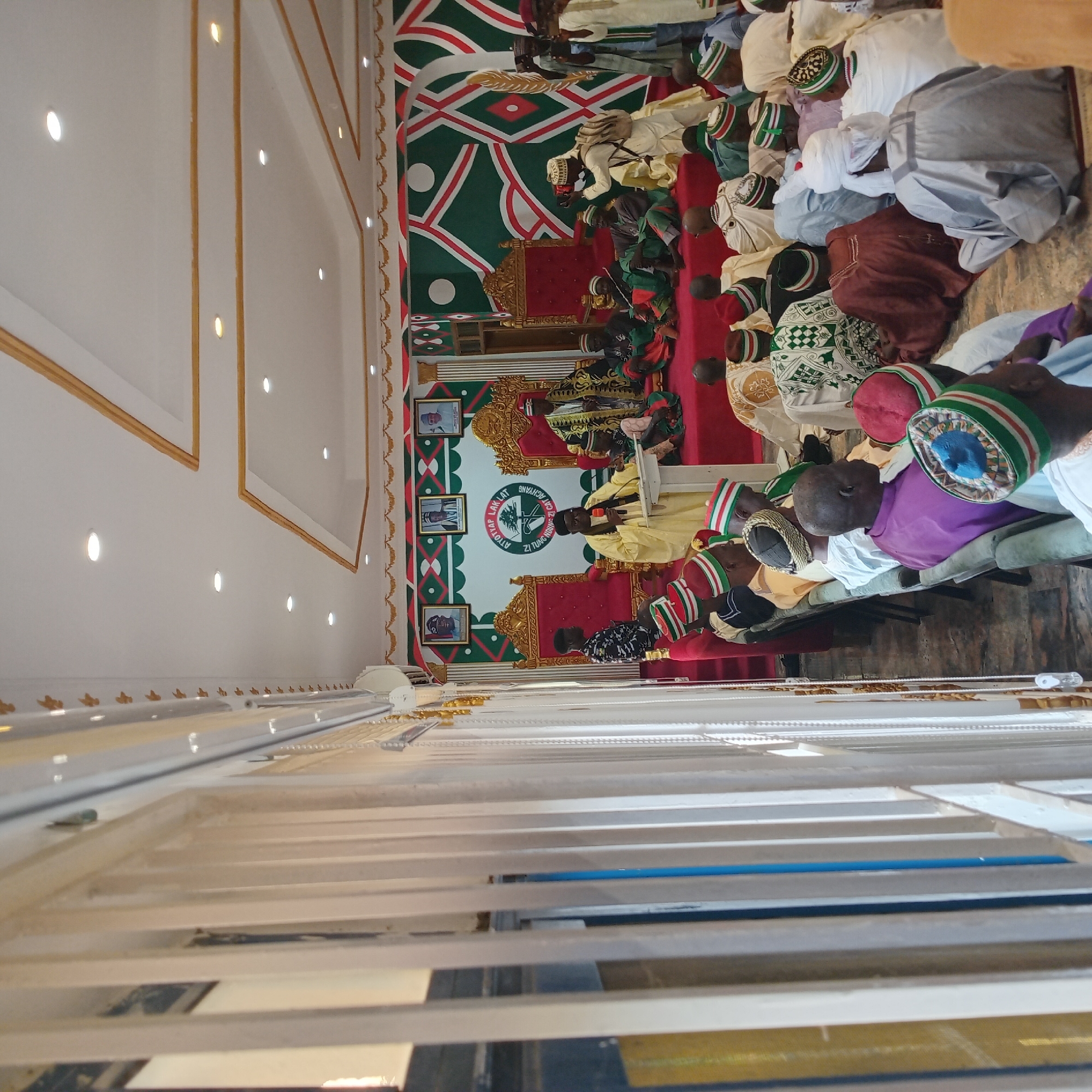
The image depicts an indoor gathering, likely a ceremony or formal event, taking place in Unguwar Gaya, Nigeria. A man in a light yellow robe stands at a podium, speaking into a microphone. He is positioned on a raised platform draped in red carpet, with two ornate, gold-trimmed thrones behind him. The wall behind the platform features a repeating geometric pattern of green and white, with three framed portraits of men above. A seated audience fills the space, many wearing traditional Nigerian attire, including caps with red, white, and green bands, and flowing robes. Some individuals are seated on the floor, while others are on rows of chairs. The overall ambiance suggests a community event or a significant cultural occasion. The room has a high ceiling with recessed lighting and decorative gold trim. The foreground is partially obscured by vertical blinds, suggesting the event might be viewed from an adjacent area.
Unguwar Gaya
The image shows the dashboard of a vehicle. The dashboard is textured and has an air vent with adjustable louvers and a dial. Next to the dashboard is a backpack with a tan strap and some black material. A blue object is visible above the backpack, possibly clothing. The location is unknown and there is no information about Unguwar Gaya, Nigeria, or any people or interactions.
Unguwar Gaya
From the perspective of a vehicle's dashboard, the view is through a cracked windshield onto a paved road. A motorcyclist is visible in the distance on the road. Trees line the sides of the road under a cloudy sky. The vehicle's wipers are visible and stationary. The dashboard includes a sticker with an image of a person on it.
Unguwar Gaya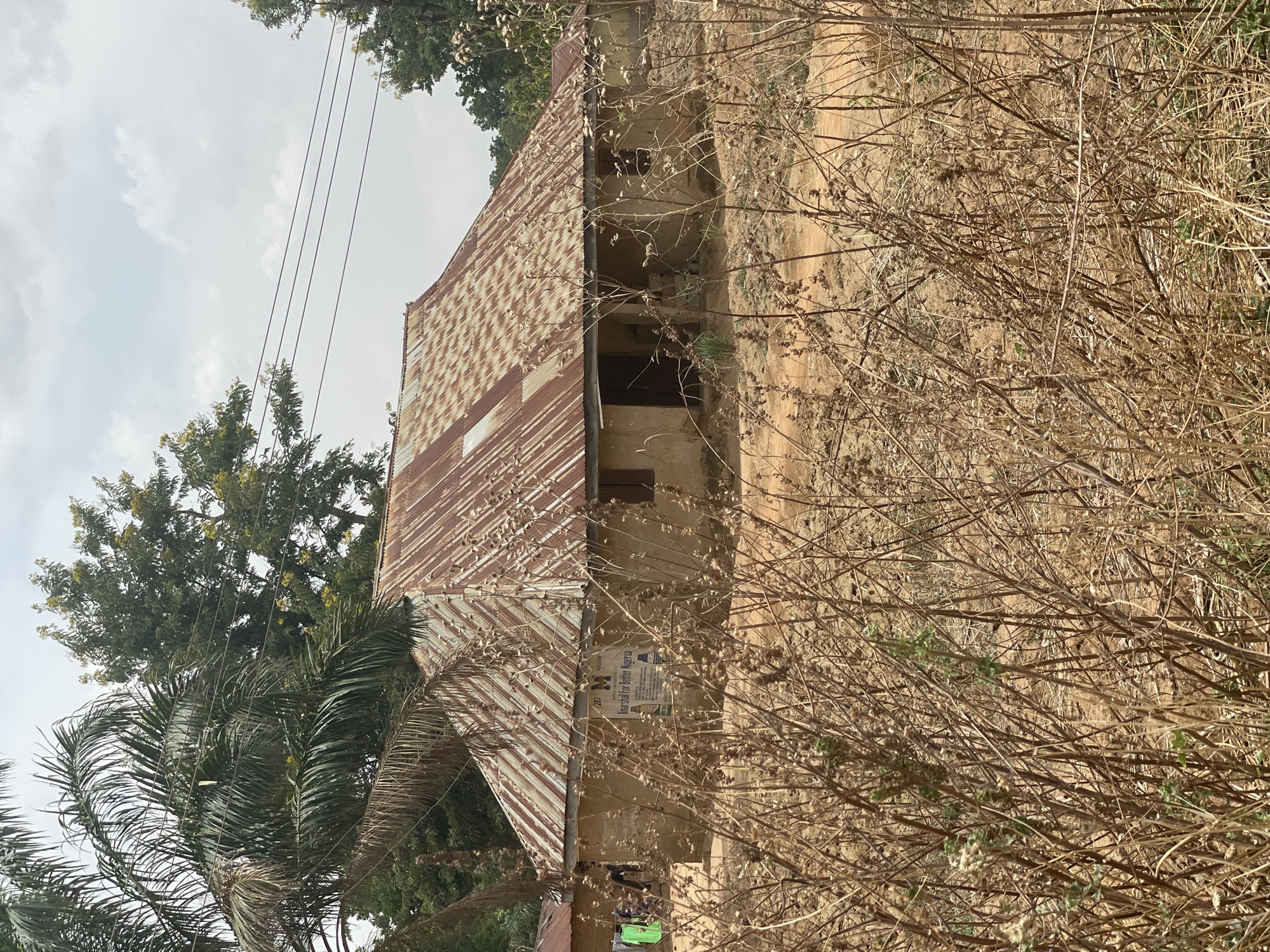
This full-shot image, taken in Unguwar Gaya, Nigeria, depicts a rustic outdoor scene centered around a modest building. The structure features a corrugated metal roof, heavily rusted with a distinctive brown and orange pattern, suggesting age and exposure to the elements. The walls appear to be constructed from earth or concrete, displaying a weathered texture, and include small, dark window openings and a recessed entrance. The foreground and surrounding areas are characterized by dense, dry, brown vegetation, including withered bushes, weeds, and grasses, indicative of a dry climate or unkempt land. A dirt path or road runs alongside the building. In the background and to the left, several trees are visible, including a large tree with green foliage and yellow blossoms, and a palm tree with long fronds. Overhead, the sky is overcast with light grey clouds, and multiple power lines stretch across the upper part of the frame. A white and blue sign or poster is affixed to the wall of the building. Although partly obscured and blurry, the text "MARCHING FOR BETTER Nigeria" and a number "207" are discernible. No people are visible in the image, and no specific activity or event is occurring. The scene appears to be set during daylight hours under a cloudy sky, conveying a sense of quietude in a rural or semi-rural setting.
Unguwar Gaya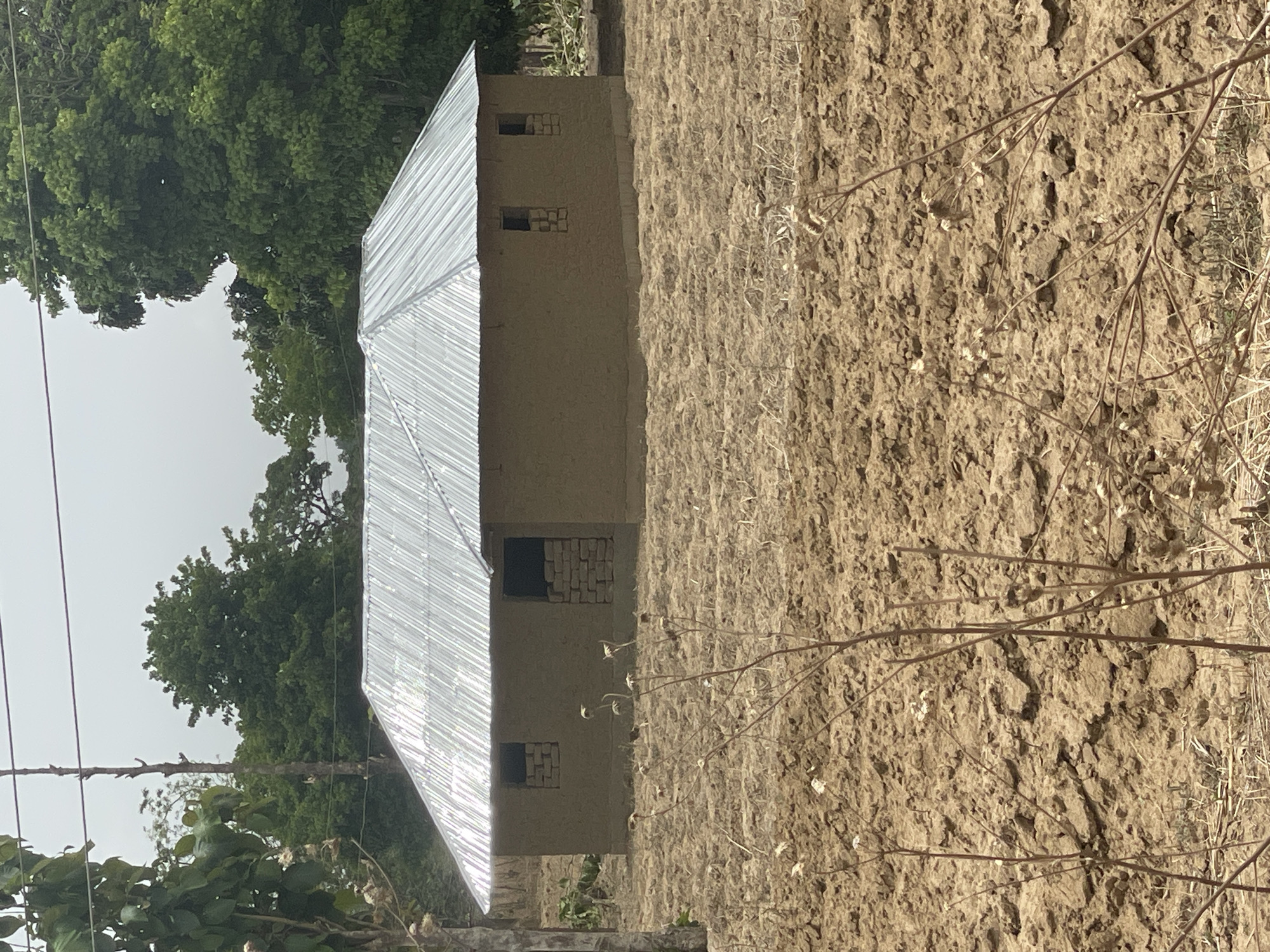
The image, oriented incorrectly on its side, depicts a rural landscape under bright daylight. A simple, single-story building with a reflective, corrugated metal roof is prominent on the left side of the frame. Its walls appear to be constructed from earthen materials, possibly mud bricks, and are a light brown or tan color. Several small, rectangular openings, likely windows, are visible in the building's walls; some of these openings are partially blocked with stacked bricks or stones. To the right of the building, a large expanse of dry, cracked, and uneven earth dominates the midground and foreground. This barren ground suggests a dry season or an uncultivated field. Scattered across this dry earth are thin, dry branches and plant stalks, indicating sparse vegetation. In the background, beyond the building and the dry field, a dense canopy of lush, green trees extends towards a bright, hazy sky, which occupies the upper left portion of the image. The overall impression is one of a rustic dwelling situated in a dry, possibly arid, environment with more verdant areas in the distance. No people or animals are visible, and no specific activity is taking place. The scene conveys a sense of stillness and the natural conditions of the area. The clear sky and strong lighting suggest it is daytime, likely mid-morning or early afternoon. There is no visible text in the image. The architectural style and arid landscape cues align with the provided location of Unguwar Gaya, Nigeria.
Unguwar Gaya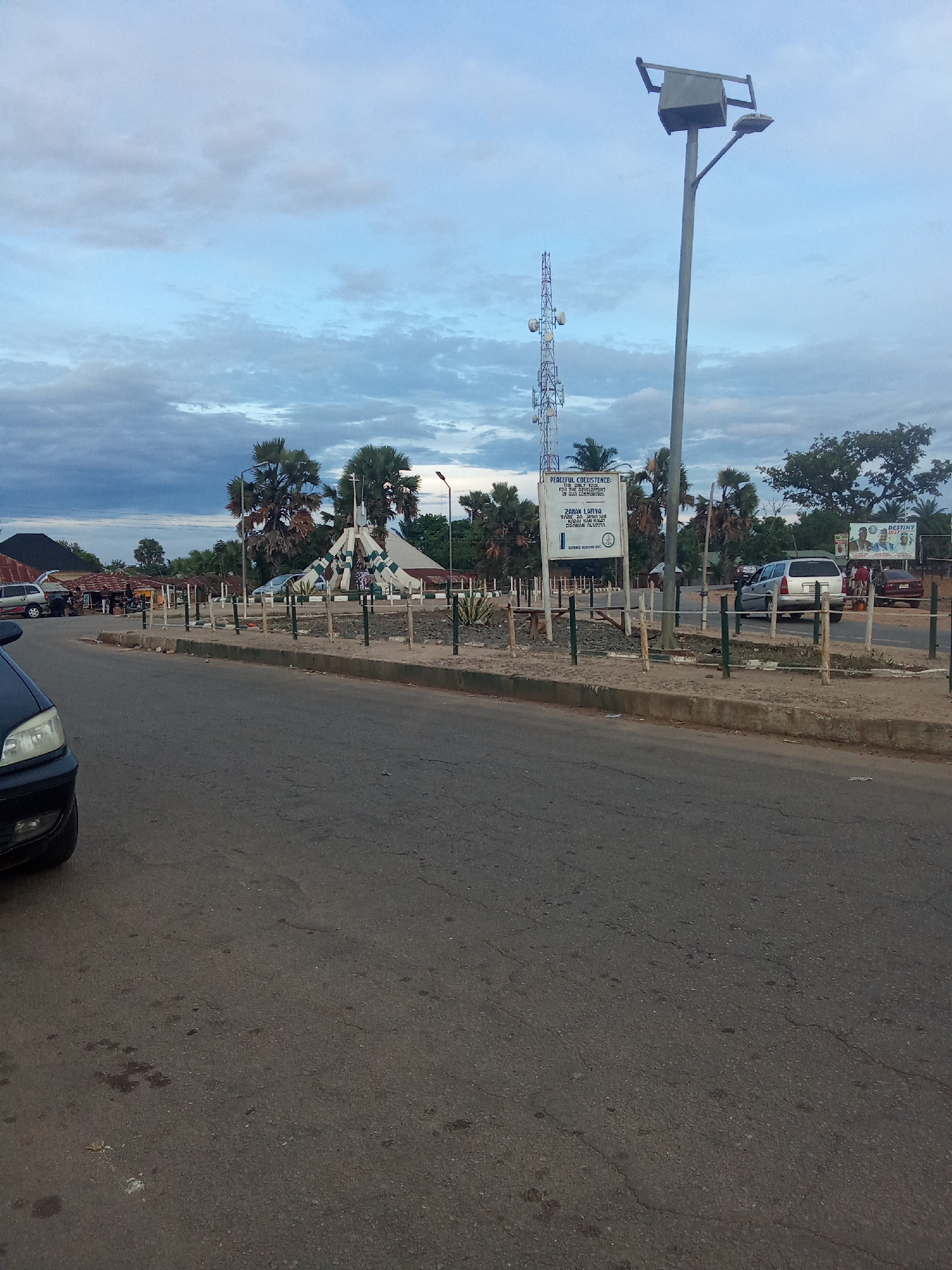
The image depicts a street scene in Unguwar Gaya, Nigeria. The street is asphalt, showing signs of wear and tear. On the left side, the front of a dark-colored car is partially visible. Across the street, a traffic island is adorned with a white and green geometric monument, flanked by palm trees. Signboards are posted on the island, with an announcement that reads "PEACEFUL COEXISTENCE." A telecommunications tower rises in the background. A tall light pole stands on the right side of the island. Several cars and people are visible further down the street, adjacent to market stalls or shops with corrugated roofs. The sky is partly cloudy, with a mix of blue and gray tones.
Unguwar Gaya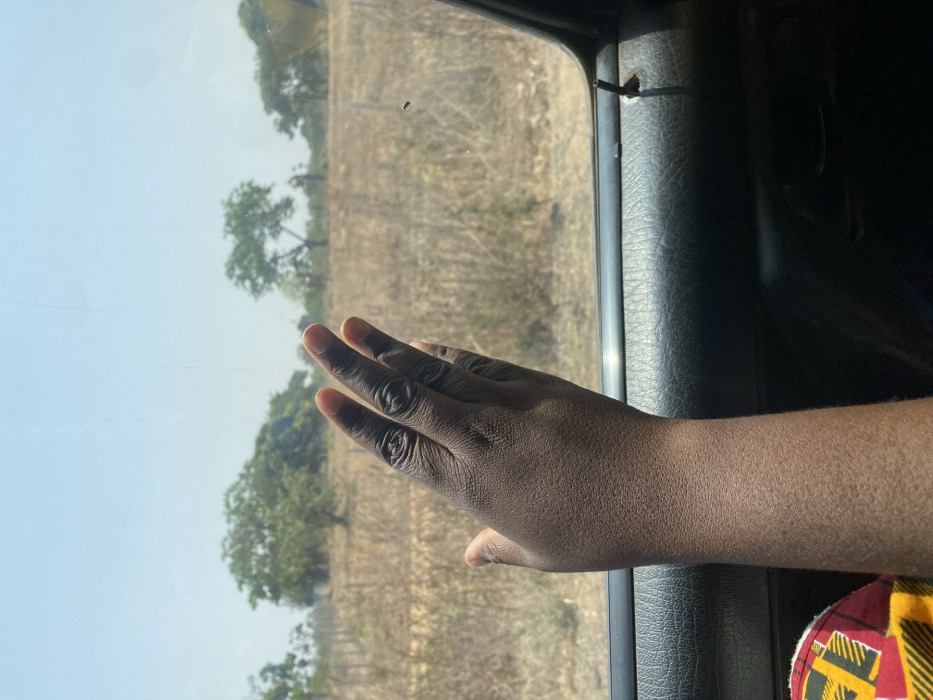
The image depicts a forensic view from inside a vehicle looking out a window onto an arid landscape in Unguwar Gaya, Nigeria, under a clear sky. In the foreground, the dark-skinned forearm and hand of a person are prominently displayed on the left, with fingers slightly splayed and extended towards the window. A fragment of patterned fabric, featuring red, yellow, and black geometric designs, is visible in the bottom left corner. The bottom and right portions of the frame are occupied by a dark, textured vehicle door panel, showing what appears to be a recess or attachment point near the right edge. Outside the window, a dry, brownish field with sparse vegetation and bare ground extends into the midground. A rudimentary fence line, comprising vertical posts and horizontal elements, traverses the field horizontally. Several trees with green foliage are scattered throughout the landscape. A small insect, resembling a fly, is present on the windowpane in the mid-right. The background features a light blue, cloudless sky. The scene is illuminated by bright sunlight.
Unguwar Gaya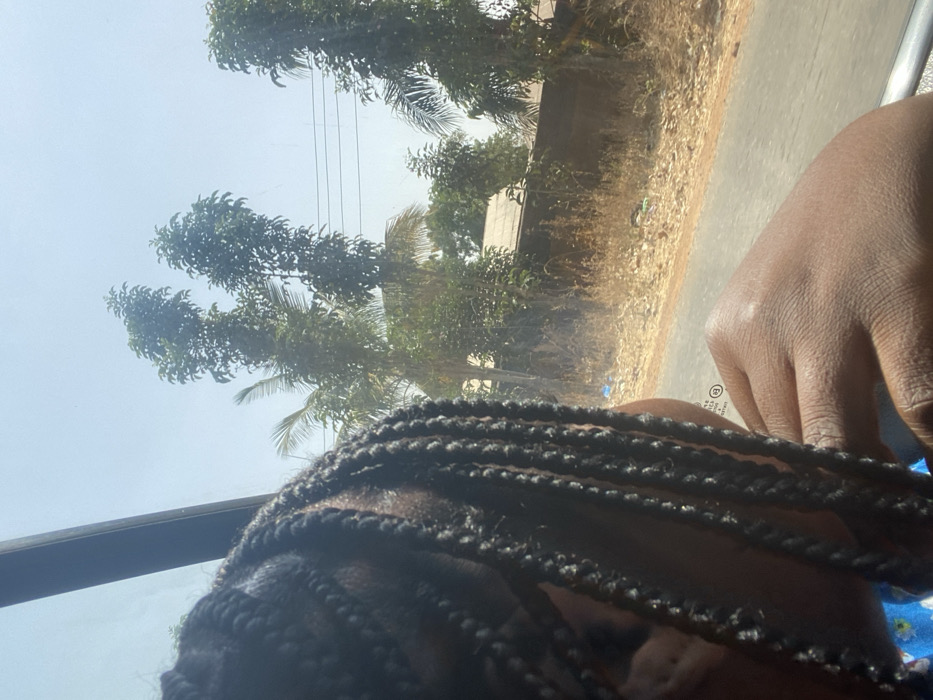
The image depicts a side profile of a person inside a vehicle, looking out a window onto an external scene in Unguwar Gaya, Nigeria. The individual has dark skin and black hair styled in numerous braids that fall forward. A portion of their right hand, with visible knuckles, rests near the window frame. Outside the vehicle, a light blue sky dominates the upper frame, traversed by thin horizontal wires, likely utility lines. Directly below the sky are several tall trees with dense green foliage, including at least two identifiable palm trees. Further down, a dirt or gravel roadside with dry, light brown vegetation is visible. Scattered small pieces of colorful refuse, possibly plastic bags, are present on the dry ground. A dark grey paved surface, likely a road, occupies the lower portion of the external scene. In the mid-ground, a low, light brown wall is partially visible, with a building structure featuring a corrugated metal roof behind it, partially obscured by trees. The overall environment suggests a sunny, possibly dry climate.
Unguwar Gaya
The scene is captured inside a vehicle in Unguwar Gaya, Nigeria. In the foreground, a dark-skinned left hand is raised, forming a "V" gesture with its extended index and middle fingers, while the thumb, ring, and pinky fingers are bent. The hand shows skin texture and highlights from ambient light. To the right, a dark gray, ribbed fabric car seat headrest occupies the midground. Behind and to the left of the headrest, a person is seated in the front passenger or driver's seat, wearing a bright yellow short-sleeved garment and red shorts or an undergarment with a red waistband. Their left arm is visible, bent at the elbow, with the forearm resting on their leg. Through the vehicle's window, the background reveals an outdoor environment consisting of a dirt road and sparse green vegetation under bright, natural daylight.
Unguwar Gaya
The image captures an interior view from a vehicle in Unguwar Gaya, Nigeria, under bright daylight conditions. In the foreground, a dark-skinned left hand is visible, positioned with its palm facing upward and slightly towards the viewer, with the middle finger extended in a pronounced gesture. A small, bright point of light, consistent with a sun reflection, is evident on the palm. To the right, a black fabric car seat headrest occupies a significant portion of the frame. Beyond the hand and headrest, the upper body of an individual wearing a bright yellow short-sleeved shirt with red trim is partially visible, seated in a forward position. Through the vehicle's open window and side mirror, a hazy outdoor environment is discernible, featuring distant green vegetation and a light-colored, possibly dirt or sand, landscape under a bright sky. A small section of blue fabric patterned with white and red flowers is visible at the bottom left edge of the frame.
Unguwar Gaya
The scene depicts a close-up of a human hand, dark in complexion, making a "shaka" or "hang loose" gesture with the thumb and pinky finger extended and the middle three fingers curled inward. The fingernails are short and appear natural, without polish. The hand is illuminated by strong, directional light, casting shadows. In the upper background, a section of yellow fabric is visible, possibly part of an article of clothing or a bag. To the right, a dark, ribbed fabric, consistent with vehicle upholstery, is present. In the lower right, a blue fabric with a white floral pattern is visible, upon which rests a transparent plastic bottle with a white cap. The environment suggests an interior setting, likely within a vehicle, located in Unguwar Gaya, Nigeria.
Unguwar Gaya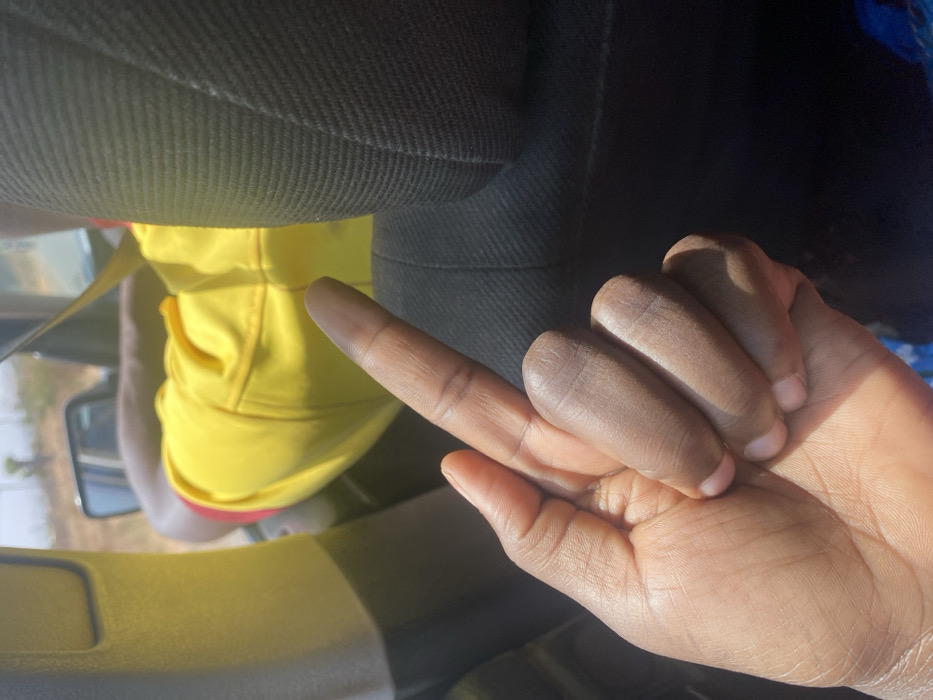
The image captures the interior of a vehicle in Unguwar Gaya, Nigeria, during daylight. In the foreground, a dark-skinned human left hand is prominent, with the index finger extended vertically upwards while the other fingers are curled into a fist. Direct sunlight illuminates the palm side of the hand and the extended finger. To the right, a dark, textured fabric surface, consistent with a vehicle seat or headrest, is partially visible. In the background, a person wearing a bright yellow garment with a red band on the upper arm is seated, their arm bent at the elbow. Through a vehicle window, a bright sky, distant sparse vegetation, and a portion of a side-view mirror are discernible.
Unguwar Gaya
A human hand with dark skin tone holds a mostly empty, clear glass Coca-Cola bottle diagonally across the frame. The bottle features its standard red label, displaying "Coca-Cola ORIGINAL TASTE" and text indicating "CARBONATED SOFT DRINK" and "LESS SUGAR". The background consists of dark grey, ribbed fabric, characteristic of vehicle upholstery, occupying the upper right quadrant. A vibrant yellow fabric is partially visible in the upper left, while a blue fabric with a white floral pattern is visible in the lower left and bottom. The scene is situated in Unguwar Gaya, Nigeria.
Unguwar Gaya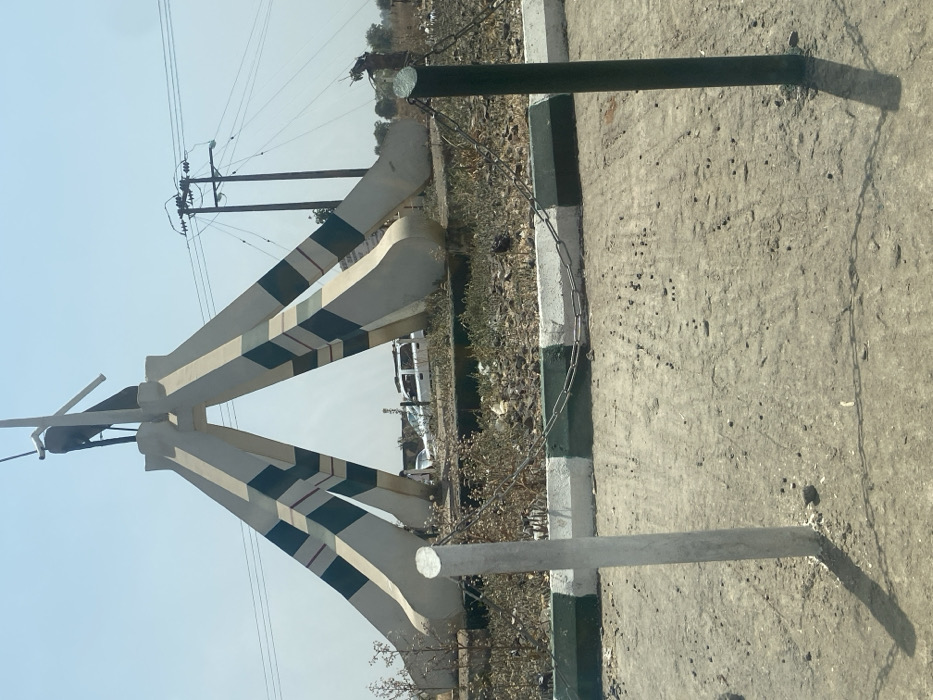
This image displays a street scene in Unguwar Gaya, Nigeria, under bright, clear daylight conditions. The central subject is a monument featuring four robust, upward-tapering concrete pillars painted white with horizontal green and thin red stripes, converging at an apex. A dark, abstract figure, possibly avian or mechanical, is mounted at the monument's peak. In the immediate foreground, a light-colored, uneven dirt surface extends across the lower frame. A white vertical post is situated on the left, and a dark green/black vertical post is on the right. These posts are linked by a single strand of silver-colored metal chain, forming a low barrier. Behind this barrier, a concrete curb, painted with alternating white and dark green sections, defines the edge of a circular central island. This island's surface consists of dry, sparse vegetation, exposed dirt, and scattered debris. In the background, behind the monument, a white SUV or van is partially visible, alongside another darker vehicle, suggesting a road or parking area. A solitary, indistinct figure is faintly discernible near the white SUV. To the right, multiple wooden utility poles with an array of overhead power lines are visible against a pale blue, cloudless sky. Distant, dry vegetation and minimal structures line the horizon.
Unguwar Gaya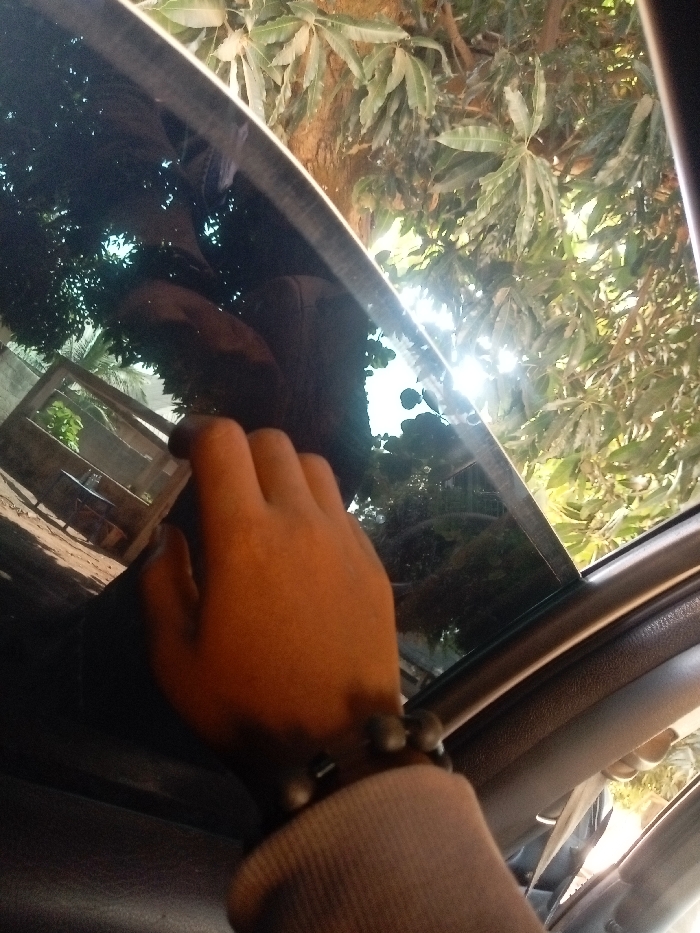
The image depicts an interior view from a vehicle located in Unguwar Gaya, Nigeria, looking outwards through a partially lowered window. In the foreground, a light brown hand, adorned with a multi-beaded bracelet containing dark spherical and rectangular beads, is visible. The individual is wearing a light grey long-sleeved garment with a ribbed cuff. Sections of the vehicle's dark interior, including the window frame and door panel, are observable. Outside the window, dense green foliage from trees is prominent, with bright sunlight penetrating the leaves on the right side of the frame, generating a distinct sun flare. In the lower-left background, a light-colored structural element, potentially a wall, and a wooden frame structure are discernible above light-colored ground. The scene is illuminated by natural daylight.
Unguwar Gaya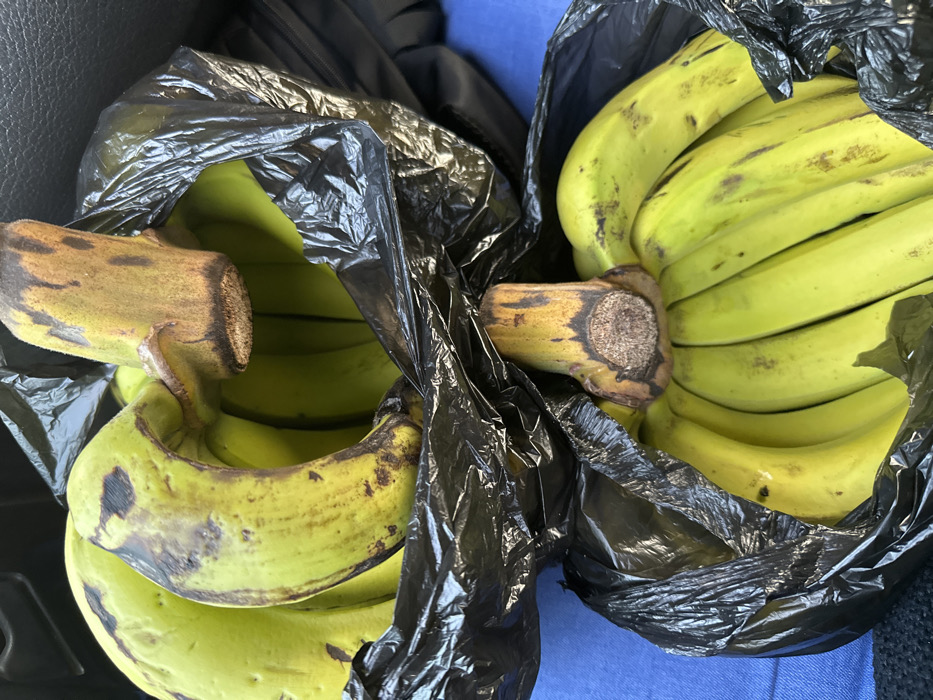
The scene, located in Unguwar Gaya, Nigeria, displays two distinct bunches of plantains or bananas, primarily green with yellow hues and scattered brown blemishes. Each bunch is contained within a crinkled black plastic bag. The upper bag partially covers the top bunch, exposing a prominent brown stem. The lower bag similarly holds another bunch, also featuring a prominent brown stem, and rests below the first. Both bagged items are situated on a surface covered by a blue fabric material. No individuals are visible.
Unguwar Gaya
A view from inside a car shows a rural landscape. Dry, brown vegetation and scattered trees line the roadside. A utility pole with power lines is visible. The sky is pale blue. The car's interior, including the seatbelt mechanism, a bit of the dashboard, and seat upholstery, are in focus. A building is seen in the distance.
Unguwar Gaya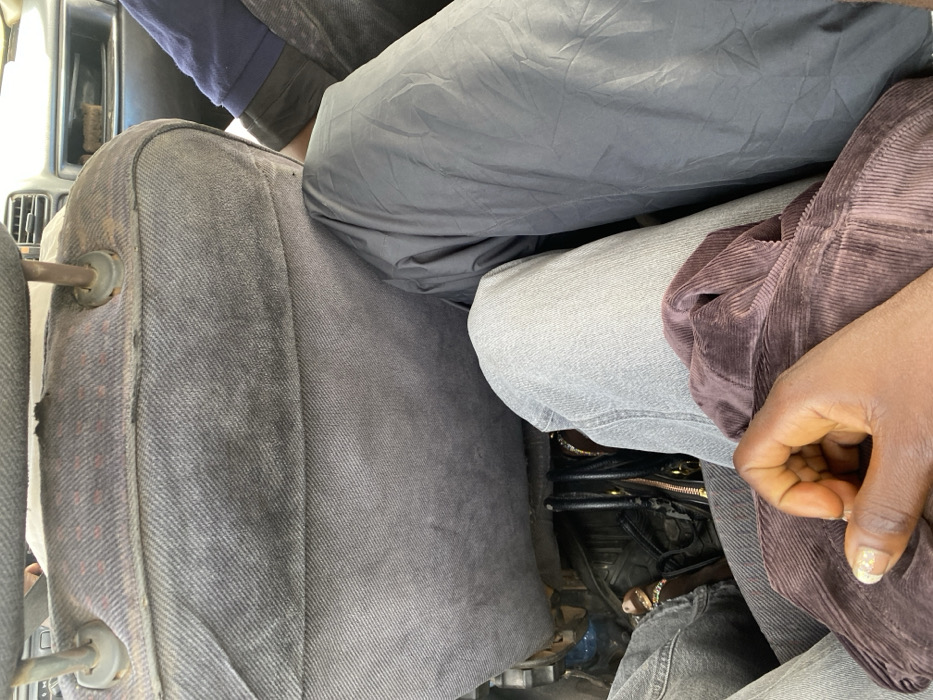
The image depicts the interior of a vehicle, viewed from a passenger's perspective in Unguwar Gaya, Nigeria. The upper half of the frame is dominated by the worn, grey fabric back of a car seat, including its metal headrest support rods. Below the seat, in the footwell, a black bag with a visible gold zipper and other indistinct objects are present. In the lower foreground, the left leg of the individual holding the camera, clad in light grey denim, is visible. Their right hand, with glitter nail polish, rests on a folded brown corduroy garment. Adjacent to the photographer's leg, to the right, is the right leg of another passenger, covered in dark grey, possibly nylon, material. A partial view of a third individual's navy blue long-sleeved arm is visible to the right of the front seatback.
Unguwar Gaya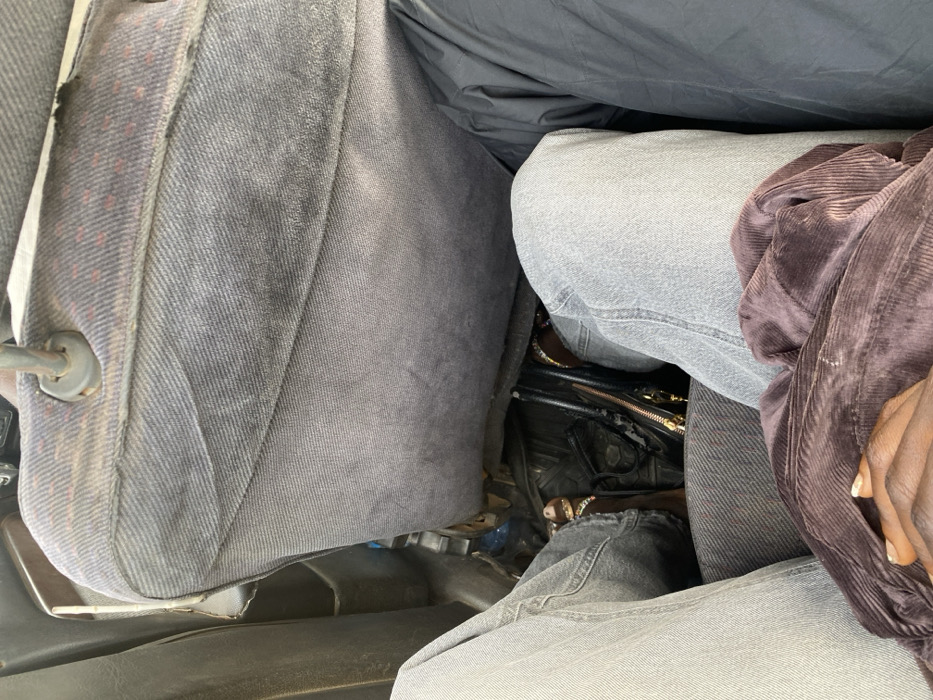
The image depicts the interior of a vehicle in Unguwar Gaya, Nigeria, viewed from a high-angle perspective. In the immediate foreground, a person's dark-skinned hands, with manicured fingernails, are clasped and resting on a dark brown, ribbed fabric garment (possibly corduroy). Light gray denim jeans are visible on this person's lap. To the right, a portion of a leg clad in a dark gray or black fabric garment is visible. In the midground, the worn backrest of a gray fabric vehicle seat occupies the upper half of the frame. The fabric is discolored and shows signs of wear, with a lighter, slightly patterned border at the top edge. A metal headrest support post extends upwards from the seat. Below the seat and between the legs of the foreground person, a black handbag with a visible gold-colored zipper and decorative elements is placed on the floor. Adjacent to the handbag, a person's feet, wearing open-toed sandals adorned with small, reflective embellishments, are visible. One foot displays painted toenails. These feet are connected to legs clothed in light gray denim jeans, consistent with the person occupying the seat in front of the viewer. The vehicle's interior trim, possibly a dark gray door panel, is visible on the far left. The overall environment suggests a compact and well-used vehicle cabin.
Unguwar Gaya
The scene depicts the interior of a vehicle, viewed from a rear passenger seat looking forward and slightly to the right, in Unguwar Gaya, Nigeria. The front passenger, a person with dark skin and short dark hair, is seated with their back to the viewer, wearing a light-colored shirt. Their right arm is visible. The seatbelt is extended from its B-pillar anchor point, but its use by the passenger is not discernible. The vehicle's interior shows signs of wear: the dark blue/grey fabric of the front passenger headrest and the visible portion of the rear seat are soiled. The dark grey plastic door panel on the passenger side has a brown trim insert, and a metal rod protrudes from a hole where the door lock pin would typically be. The sun visor is folded up against the light-colored, worn headliner. A dashboard air vent is visible on the passenger side. Outside the vehicle, a reddish-brown unpaved road is visible. Beyond the road, the environment consists of dry, sparse vegetation and several green trees with full foliage. In the mid-distance, indistinct brick-colored structures are partially visible. Overhead utility lines span across a clear, light blue sky. The overall impression is that of a vehicle traveling or parked on a rural or semi-urban road during daytime.
Unguwar Gaya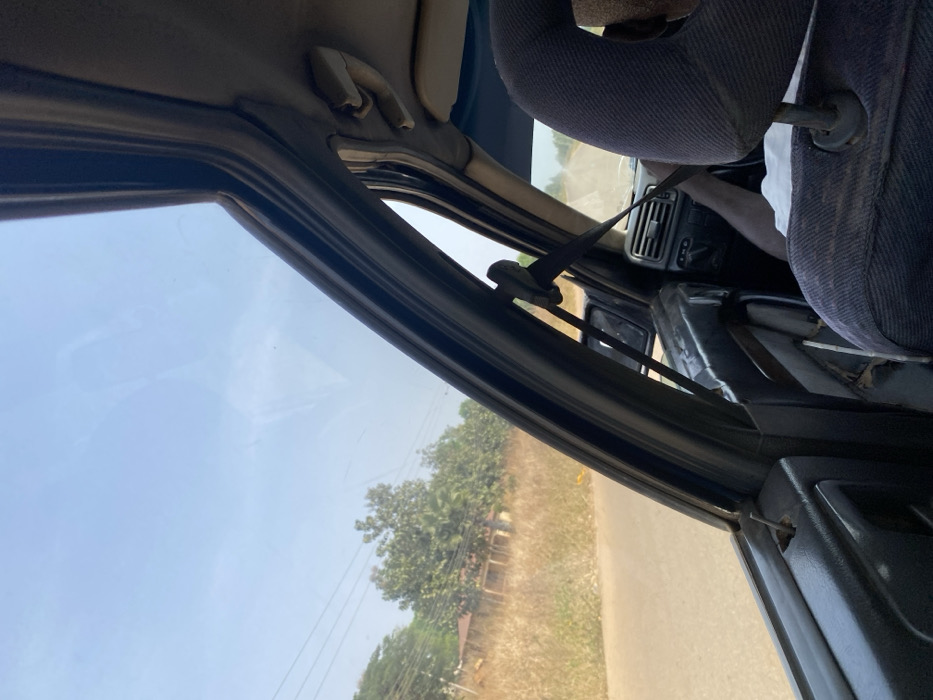
The view from inside a car, angled towards the passenger window. The headrest of the front seat is visible on the right. A seatbelt stretches diagonally across the frame. Outside the window, a bright, clear sky overlooks a landscape of trees and dry grass bordering a road. The car's interior includes the dashboard and door frame. The light is bright and appears to be outdoors.
Unguwar Gaya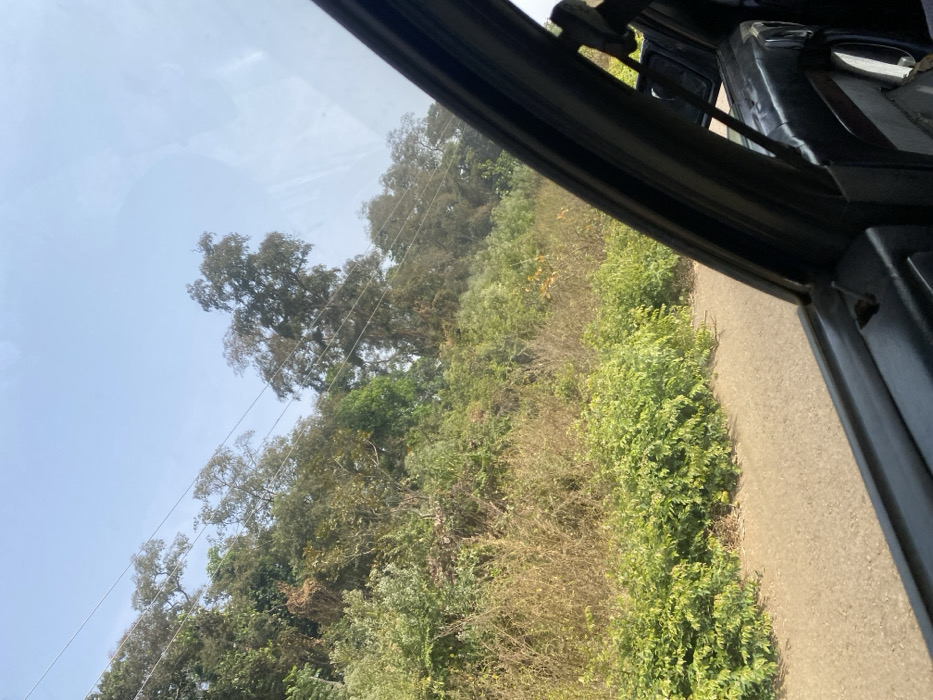
The image presents a daytime view from inside a vehicle, looking out a side window at an oblique angle, likely in Unguwar Gaya, Nigeria. The top left portion of the frame is dominated by a clear, bright blue sky with faint, wispy cloud patterns. Several thin power lines or utility wires traverse the sky, extending through the tree canopy below. The landscape features a diverse range of vegetation. A dense forest of trees with varying shades of green foliage occupies the middle ground, with some trees appearing taller and more established, while others are lower-lying bushes and shrubs. Sections of the vegetation show drier, brownish tones, suggesting mixed health or seasonal changes. In the foreground, on the right side, the dark, angular frame of the vehicle's interior, possibly a door or window frame, is prominently visible. Beyond this frame, a light brown, unpaved or dirt road runs alongside the vehicle's perspective. Immediately bordering the road is a strip of vibrant, healthy green bushes, contrasting with some of the drier vegetation further back from the road. Parts of the vehicle's dark interior, such as upholstery or panels, are also faintly visible. The scene is brightly lit by natural sunlight, indicating a clear, fair weather day. The combination of rural road, varied vegetation, and power lines suggests a countryside or semi-urban setting. No human activity or visible text is present in the image.
Unguwar Gaya
The scene depicts a view from the interior of a vehicle traveling on an unpaved road in Unguwar Gaya, Nigeria, under bright, hazy daylight conditions. The perspective is from a rear passenger seat, looking forward and towards the left. Inside the vehicle, a dark-colored door panel with a visible door lock pin is present on the left. The vehicle's left A-pillar displays a seatbelt mechanism. On the right side of the frame, a dark fabric headrest, possibly denim, from a front seat is visible, partially obscuring the view. The back of a person's closely shaven or bald head is discernible above this headrest, indicating a front passenger or driver. A damaged, light-colored overhead grab handle is mounted on the vehicle's interior roofline to the right. Parts of the dashboard, steering column, and control panel are visible through the front passenger window. The exterior environment consists of an unpaved or dirt road immediately adjacent to the vehicle on the left, flanked by dry, light-green and yellowish grasses and foliage. Beyond this vegetation, a dense line of green trees extends into the background. Multiple power lines run horizontally across the upper portion of the tree canopy. The foreground also shows more unpaved road and distant vegetation under a hazy, light-blue sky.
Unguwar Gaya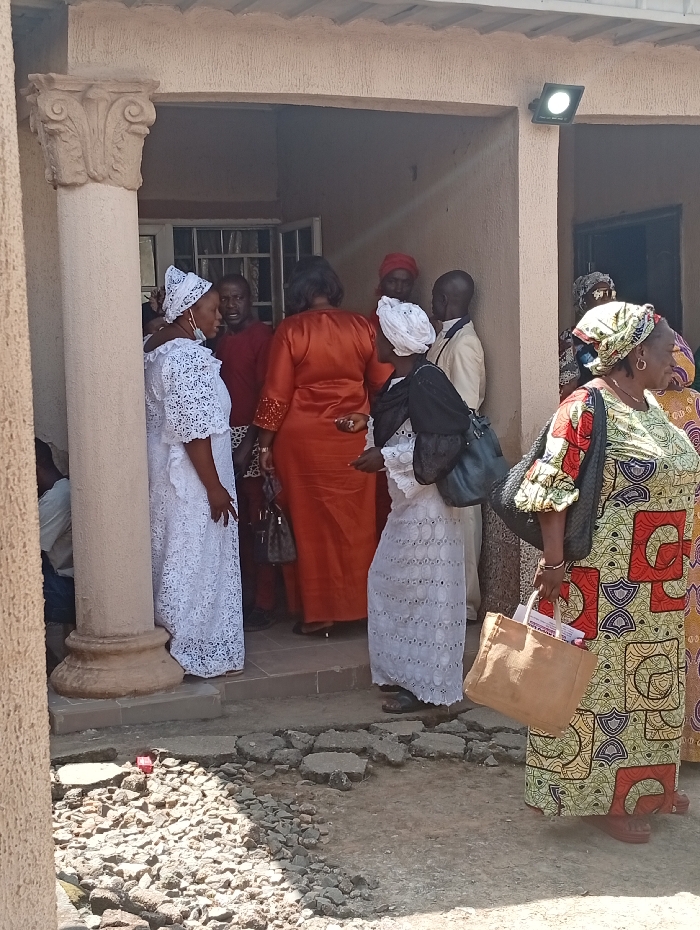
The image depicts a group of approximately ten individuals gathered at the entrance of a building in Unguwar Gaya, Nigeria, under bright natural light. The building exhibits light-colored, textured walls and a prominent decorative column with a Corinthian-style capital on the left side of the frame. A modern black floodlight is affixed to the exterior wall above the right side of the recessed entrance, emitting light. The ground directly in front of the entrance is an uneven, cracked concrete or paved surface interspersed with loose gravel and debris; a small red object is visible on the ground near the column's base. In the foreground on the right, a woman wearing a multi-colored patterned dress, primarily green, red, and yellow, with a matching headwrap, stands facing right. She carries a dark shoulder bag and a light brown canvas tote bag in her right hand. To her left and slightly behind, another woman in a white lace dress and matching headwrap wears a dark face mask. Near the column on the left, a third woman in a white lace dress with bell sleeves and a patterned white headwrap, wearing a light blue surgical mask, stands facing right, engaged in conversation. Deeper within the building's entrance, a woman in a rust-orange dress is visible from the back, facing inwards. Several other individuals, including men in a red shirt and a light-colored jacket, and additional women in traditional attire, are partially obscured in the shadows of the doorway, appearing to congregate or move through the entrance. One man within the doorway is observed wearing a red cap.
Unguwar Gaya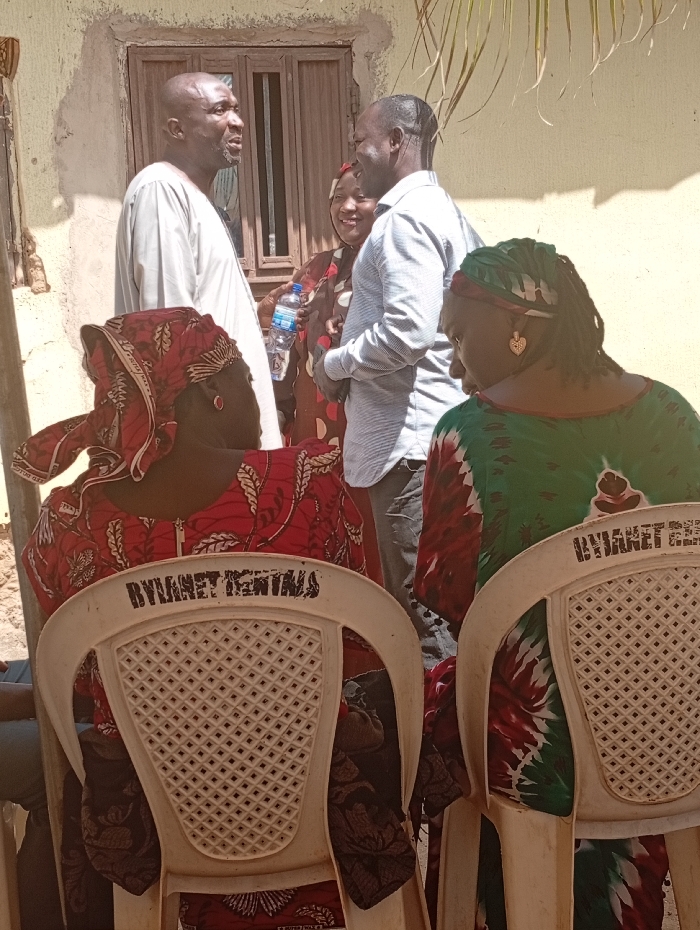
The image captures an outdoor scene in Unguwar Gaya, Nigeria, under direct sunlight. In the foreground, two individuals are seated facing away from the viewer on white plastic chairs, each bearing the visible black text "BYYANET RENTALS" on its backrest. The person on the left wears a red and black patterned dress and headwrap, while the person on the right wears a green, red, and white patterned dress and a green headwrap, with a gold-colored heart-shaped earring visible on their right ear. In the midground, three individuals are standing and interacting. On the left, a man with a shaved head and short beard wears a light-colored, long-sleeved traditional garment; his mouth is slightly open, suggesting speech. To his right, a woman in a dark patterned dress and head covering smiles while holding a clear plastic water bottle in her right hand. To her right, a second man with short dark hair, wearing a light blue long-sleeved collared shirt, smiles and faces towards the first man. The three appear to be engaged in a positive conversation. The background consists of a plain, light-colored wall with a rectangular window featuring multiple panes and a dark frame. Partial green foliage, possibly palm fronds, is visible in the upper right quadrant of the image. The ground appears to be unpaved dirt.
Unguwar Gaya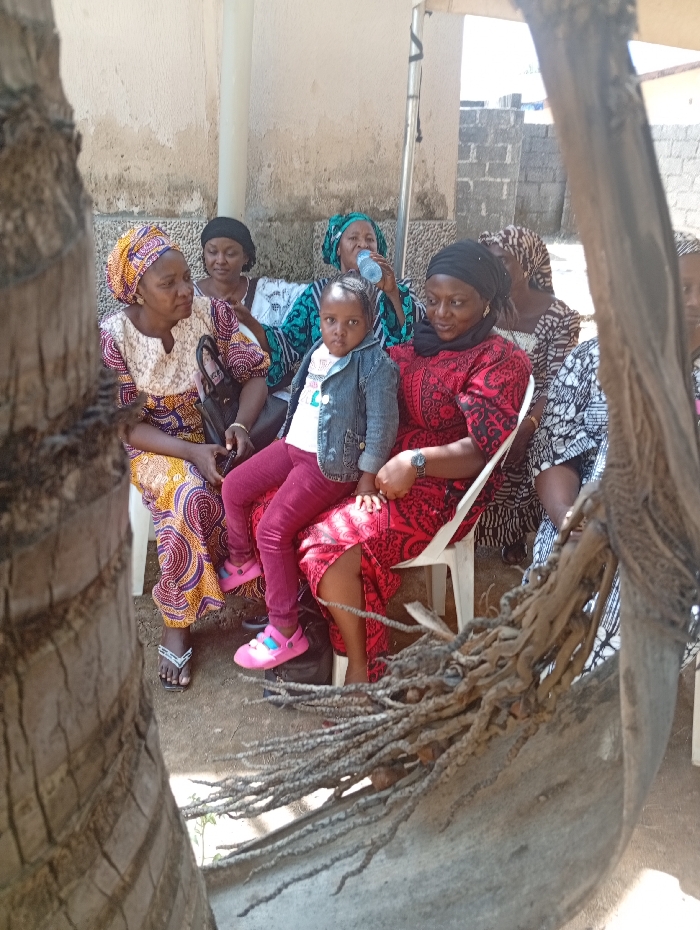
An outdoor scene in Unguwar Gaya, Nigeria, depicts eight individuals seated, comprising seven adult females and one young female child. All are seated on white plastic chairs, positioned under a partial white canopy structure visible via a support pole. In the center, a young female child, approximately 3-5 years old, is seated on the lap of an adult female. The child wears a white t-shirt, a blue denim jacket, red trousers, and pink clogs, and looks directly towards the viewer. The adult female holding the child wears a red and black patterned dress, a black headwrap, and a wristwatch on her left wrist; she is looking downward and slightly to her right. To this adult's immediate left, another adult female wears a yellow, purple, and white patterned dress with a matching headwrap, and looks to her own left. A black handbag rests on her lap. Directly behind the child, a third adult female, dressed in a green and white patterned outfit and a green headwrap, is drinking from a clear plastic water bottle. Four additional adult females, similarly clad in various traditional patterned garments and headwraps, are seated around the periphery of the group. The background consists of a weathered, light-colored concrete or plastered wall, transitioning to a grey cinder block wall further to the right. The ground beneath the individuals is exposed earth. The left foreground is partially obscured by a large, vertically textured tree trunk, possibly a palm tree. In the lower right foreground, a cluster of dried, fibrous palm frond bases is visible. Strong sunlight indicates a daytime setting.
Unguwar Gaya
This image depicts an outdoor scene in Unguwar Gaya, Nigeria, illuminated by direct sunlight. A mature coconut palm dominates the foreground, featuring a thick, textured brown trunk and prominent green fronds in the upper frame. Seven green coconuts are visible on the tree: a cluster of six hangs from a secondary branch or stem extending from the left side of the main trunk, and one is situated higher on the main trunk itself. In the mid-ground, a red motorcycle with a black seat and chrome exhaust pipe is parked on its kickstand, partially obscured by a thinner tree trunk. The background features a light-colored, single-story building with two visible windows; one is open, revealing a dark interior. To the left, an empty, light-colored wooden table stands. Approximately three to four individuals are partially visible behind the table and near the building, some wearing patterned garments and head coverings. A fifth individual is partially observable behind the main coconut palm trunk on the right, also in patterned clothing. The ground consists of dry, exposed earth.
Unguwar Gaya
The image depicts an outdoor gathering of approximately 25-30 individuals in Unguwar Gaya, Nigeria, within what appears to be a residential compound. The ground is unpaved, consisting of dry, reddish-brown dirt, with shadows of palm fronds cast upon it in the foreground. In the background, a light-colored building with a grey corrugated metal roof, white-framed windows, and decorative pillars on a porch or veranda is visible. A blue satellite dish is mounted on the building's exterior. To the left, a portion of another structure with a darker roof is present. On the right, a small green bush grows near the building, and a wooden table or bench is partially visible. A white plastic monobloc chair is positioned in the mid-ground, near the main building. The central figure in the foreground is an adult male, of apparent African ethnicity, walking towards the viewer. He wears a white kaftan-style outfit, a patterned cap, and eyeglasses. He holds a dark walking stick in his right hand and a piece of white paper in his left. To his right, another male wears a light-colored, patterned tunic and trousers. Most other individuals are congregated in the mid-ground and background, forming a casual group near the building's entrance. They consist of adults and some children, dressed in various traditional Nigerian attire, including colorful patterned dresses for women (e.g., green, pink, blue patterns) and tunics for men. One man stands out in a distinct red garment. A woman on the far right carries an infant secured to her back with a patterned cloth. Individuals appear to be standing, conversing, or observing. The scene is illuminated by bright daylight, casting distinct shadows.
Unguwar Gaya