Unknown, Brazil
30 memories from Unknown, Brazil

The image shows a kaleidoscope effect with reflections of a sunset over mountains. The central sphere displays segments of the sunset image, creating a repeating, symmetrical pattern. Surrounding the sphere are numerous mirror panels reflecting the environment, including people holding cameras and the structure of the installation itself. The setting appears to be an indoor exhibition or art installation. The specific location in Unknown, Brazil, is not evident from the image.
Unknown
The image shows a spherical object with a textured, possibly digital, display, surrounded by a kaleidoscope of mirrors. The mirrors reflect the sphere and create numerous fragmented images of people and the surrounding environment, which appears to be an indoor space with white walls and some lighting fixtures. Several individuals are visible in the reflections, mostly their hands holding phones or cameras, suggesting they are observing or documenting the spherical object. The display on the sphere exhibits a pattern of diamond shapes with intricate textures, resembling rock formations or natural patterns, rendered in warm tones of brown, orange, and yellow. The overall impression is that of an interactive art installation or exhibition.
Unknown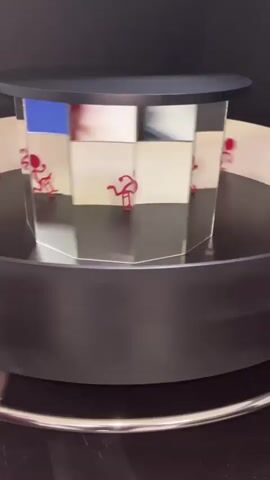
A video displays a rotating cylindrical object with multiple mirrored surfaces. Each surface features a red stick figure in a running pose. The figures are positioned facing outwards and appear to be in mid-stride. The cylinder is rotating on a black base, and reflections of the figures are visible on the mirrored surfaces. Above the cylinder is a black circular top. The background is dark.
Unknown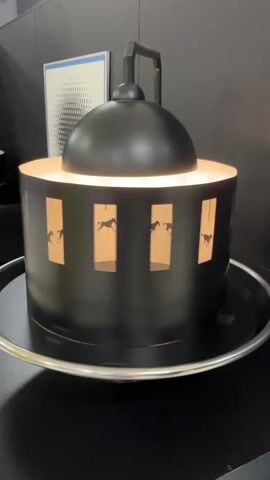
A black, cylindrical zoetrope with a black dome on top, mounted on a silver tray, is displayed on a black surface. Inside the cylinder, illuminated from above, are cutouts of horses in various stages of motion, creating an animation of running horses when viewed through the vertical slits in the cylinder. The zoetrope is in operation, showing the illusion of movement.
Unknown
In the city of Unknown, Brazil, a large, dark blue wall serves as a backdrop for a cutout of a chimpanzee's face with a psychedelic spiral pattern on its eyes. Above the chimpanzee cutout, on the blue wall, are several white security cameras. A small informational plaque with the text "Chimpanzé" is attached to the wall to the left of the cutout. In the background, a woman wearing a green dress and carrying a white backpack walks away from the camera. The floor is tiled with large, light-colored square tiles. The scene appears to be indoors, possibly in a public space like a museum or mall.
Unknown
An art installation features a white, translucent cube with internal illumination. Inside the cube, a black, three-dimensional shape is displayed. The shape appears to be a flat square on the left side and a triangle on the right side, creating an optical illusion. The cube is positioned on a black pedestal against a dark background. A small sign with text in Portuguese is attached to the pedestal. The ceiling above the installation has recessed lighting and air conditioning vents. The scene is indoors, likely in a museum or exhibition space.
Unknown
The image depicts an optical illusion of a brick tunnel receding into infinity, created by mirrors. Along the curved walls of the tunnel, there are multiple white, rectangular light fixtures, some illuminated with a cool white light and others with a warm yellow light. Several white, rectangular frames are positioned on the right side of the tunnel, also appearing to recede into the distance. The perspective suggests the viewer is looking down into the tunnel. The location is given as Unknown, Brazil, though the image itself does not contain any specific geographic markers.
Unknown
The image shows a holographic display of a skull, created using a clear acrylic pyramid. The pyramid is placed on top of a screen that displays images, and the pyramid reflects these images to create the illusion of a 3D hologram. A sign next to the display reads "Holograma TV" and explains that the hologram is created by a "pyramid of acrylic, reflecting in the center the union of separate parts of an image." The display is set against a dark background, suggesting an indoor environment, possibly a museum or exhibition. There are no people visible in the image.
Unknown
The image shows an infinity mirror installation. It is a circular mirror with a series of circular openings. Behind these openings, the mirror reflects an image of the same setup, creating an illusion of infinite depth. The reflections show a green and white striped pattern that recedes into the distance, with small, repeating circular lights. In some of the openings, a person's fingers can be seen. The outer edges of the image are blurred and dark, suggesting a tunnel or tube structure surrounding the mirror. The location is listed as Unknown, Brazil.
Unknown
An exhibit labeled "MUSEU DAS ILUSÕES" (Museum of Illusions) features a large, spherical display within a square frame. The sphere appears to be a kaleidoscope, reflecting a colorful, abstract pattern of oranges, yellows, purples, and reds, with a bright light source at its center. The exhibit is placed on a black platform, which is itself on top of a larger black base. A sign attached to the front of the base reads "Associação de Espelhos" (Association of Mirrors) and poses the question "Como pode um tronco de pirâmide produzir uma esfera gigante?" (How can a pyramid trunk produce a giant sphere?). Below this, it warns "Atenção: Espelhos de vidro frágeis. Use com cuidado." (Attention: Fragile glass mirrors. Use with care.). The background is a dark gray wall.
Unknown
The image shows an optical illusion display of a screw and two nuts, presented in a dark, enclosed exhibition space. The screw appears to pass through both nuts simultaneously, a visual paradox. The screw is depicted as a wavy, metallic rod with spiraling indentations, and the nuts are large, hexagonal, and light gray. The display is housed within a black, recessed shelf or niche, which is part of a larger, dark exhibit. In the lower right corner of the image, a small white label is affixed to a dark surface. The label has a blue header that reads "Parafuso Impossível" (Impossible Screw). Below the header, white text explains the illusion: "Ele vai dar um nó na sua mente. Tente entender como pode ele passar pela porca, veja do que a sua mente é capaz." (It will tie a knot in your mind. Try to understand how it can pass through the nut, see what your mind is capable of.) The overall impression is that of an exhibit designed to challenge perception and engage the viewer's intellect. The location is described as Unknown, Brazil.
Unknown
The video shows a dark, cylindrical object with two vertical, illuminated rectangular slits. Shadows of small figures are visible within the slits, appearing to move. The figures are silhouettes, with indistinct features, but some appear to have limbs. The lighting is bright yellow, and the background is dark.
Unknown
A black framed artwork featuring a lenticular print is displayed on a vibrant blue wall. The artwork is horizontally oriented, with its left half depicting a black and white striped pattern that, when viewed from different angles, creates the illusion of a silhouetted animal. The right half of the artwork shows a series of vertical black and white lines, behind which a reflective surface creates a distorted image. The blue wall appears to be made of a smooth material, possibly painted drywall or a similar surface, with a visible vertical seam running up the center of the image. The artwork is mounted with visible screws or fasteners.
Unknown
The image displays a framed optical illusion exhibit mounted on a vibrant blue wall. The exhibit features a black frame enclosing two distinct panels. The left panel shows a black silhouette of a hummingbird against a background of vertical black lines, creating a lenticular effect that makes the hummingbird appear to be in motion. Two small blue buttons are visible on the white background of this panel. The right panel displays a black and white optical illusion of two interlocking circles, also created with vertical lines. The blue wall exhibits a vertical seam running down the center of the image, with some visible tape or adhesive marks. A small white sign with text in Portuguese is partially visible in the bottom right corner of the frame. The overall environment appears to be a public space, possibly a museum or science center. The city and country are listed as Unknown, Brazil.
Unknown
The image shows a wooden sculpture of a face with carved eyes and a mouth, mounted on a wooden base. The sculpture is displayed against a dark, textured wall. A small informational plaque in Portuguese is attached to the front of the base, and a clear acrylic barrier is positioned in front of the lower part of the sculpture, revealing some mechanical elements. The plaque, which reads "Emoções" (Emotions), describes the sculpture as representing constant emotional transformation and states it was carved by artisan Orlando Dias for the Museum of Illusions. The overall scene suggests an indoor exhibition setting.
Unknown
The image shows a framed illustration of a fork with a blue border, mounted on a black surface. Below the illustration, there is a small card with text in Portuguese. The text on the card reads "Garfo" (Fork) and then "Para dietas, talvez seja melhor um garfo de três ou quatro pontas?" (For diets, perhaps a fork with three or four prongs is better?). In the bottom right corner of the illustration is a small logo that appears to be for "MUSEU DAS ILUSÕES" (Museum of Illusions). The overall scene suggests an exhibition display, possibly at a museum. There are no people or specific geographical landmarks visible to determine the city or country.
Unknown
The image shows an exhibit of optical illusions. In the foreground, a sign with the title "Dormentes" (Sleepers) in Portuguese is displayed. Below the title, a question in Portuguese asks "Let's count the railway sleepers. How many do you see here, three or four?". The main part of the exhibit features a framed picture containing an optical illusion of what appear to be three or four parallel, rectangular prisms, rendered in simple black outlines on a white background. The prisms are arranged at an angle, creating a sense of depth and potentially suggesting railway sleepers. The exhibit is mounted on a black wall. To the left of the main exhibit, a blue vertical frame is visible, and beyond that, a portion of a wall with a beige and white patterned texture and a bright orange surface can be seen. A white refrigerator-like appliance is also partially visible in the background on the left. A small white paper bag with handles is placed on the floor in the lower left corner of the image. The overall setting appears to be an indoor public space, possibly a museum or an exhibition hall. The location is identified as Unknown, Brazil, based on the provided context.
Unknown
In an indoor environment with a bright white tiled floor, a large, dark-colored cutout of a chameleon's head is attached to a vibrant blue wall. The chameleon artwork features a detailed pattern of white dots and scales, and a spiral design on its eye. To the right of the chameleon, three black chairs are neatly arranged against the blue wall. Beyond the chairs, a dark curtain hangs, suggesting a partition or entrance. The wall itself is constructed from large panels.
Unknown
An optical illusion artwork is displayed on a vibrant blue wall. The artwork is framed with white and has a light blue matting. The illusion depicts a three-dimensional hexagonal shape that appears to twist and turn impossibly. In the bottom right corner of the artwork, a logo for "MUSEU DAS ILUSOES" is visible, suggesting the location is the Museum of Illusions in Brazil. The image is taken at a slightly upward angle, with the blue wall occupying the majority of the frame.
Unknown
The image shows a framed optical illusion art piece featuring a Penrose triangle or impossible tribar. The art is displayed on a vibrant blue wall. The framed artwork has a white border and a light blue inner border. The illusion itself is rendered in white and grey tones, with shadows suggesting depth and three-dimensionality. In the bottom right corner of the artwork, there is a small logo with the text "MUSEU DAS ILUSOES". There is another similar framed artwork to the left of the main subject, partially visible. The location is identified as the "Museu das Ilusões" in an unspecified city in Brazil.
Unknown
A sign with rows of colored words is displayed against a blue wall. The words are in Portuguese and refer to colors. The top row reads "AMARELO" (yellow) in green and "AZUL" (blue) in red, and "LARANJA" (orange) in blue. The second row has "ROXO" (purple) in orange, "VERMELHO" (red) in purple, and "PRETO" (black) in red. The third row displays "PRETO" in red, "VERDE" (green) in orange, and "ROXO" in purple. The fourth row features "LARANJA" in black, "PRETO" in green, and "VERMELHO" in red. The fifth row shows "VERDE" in blue, "LARANJA" in red, and "AZUL" in green. The sixth row has "AZUL" in purple and "ROXO" in red. The bottom row reads "VERMELHO" in orange and "AMARELO" in blue. A small sign below the main display with the title "Teste das Cores" (Color Test) is also visible. The sign is positioned in a museum or exhibition space, indicated by the museum logo at the bottom of the main display and on the smaller sign.
Unknown
The image shows a framed optical illusion artwork titled "Mandala" mounted on a blue wall. The artwork is divided into four quadrants, each featuring a mandala-like pattern. The top-left and bottom-right quadrants have green backgrounds, while the top-right and bottom-left quadrants have coral-colored backgrounds. The mandalas themselves are composed of concentric diamond shapes in shades of purple and white, creating a perceived sense of movement or depth. Below the artwork, a small white sign with a blue border displays the title "Mandala" and a Portuguese caption that translates to "This mandala is incredible, it seems to move forever." The sign also includes social media icons and a website address. The background is a plain, deep blue wall. The lighting suggests an indoor environment, possibly a museum or gallery.
Unknown
The image shows a display of optical illusion art pieces on a blue wall. The main subject is a large, framed artwork depicting a stylized sun with a circular, spiraling pattern of orange and purple ellipses against a white background. The sun's rays are purple and jagged, emanating from a yellow ring around the central spiral. To the left of this artwork, another framed piece with a green and purple zigzag pattern is partially visible. To the right, a third framed artwork with a coral and teal background and a geometric pattern is also partially visible. Below the central "sun" artwork, a small informational placard is attached to the wall. It has a white background with a blue border and reads: "Sol A beleza desse sol é hipnotizante. Ao focar no centro, um funil em movimento aparecerá como se estivesse convidando para um passeio quente e infinito." This translates to: "Sun The beauty of this sun is hypnotizing. Focusing on the center, a moving funnel will appear as if inviting you for a warm and infinite walk." Below this text, there is a small icon and a web address. To the left of the "sun" artwork, another placard is visible, seemingly related to the zigzag artwork. Part of the text reads "o Universo" which translates to "the Universe". The overall environment appears to be an indoor exhibition space or museum, with a consistent dark blue painted wall. There are no people visible in the image. The lighting is even, suggesting professional exhibition lighting. The framed artworks are hung at eye level.
Unknown
A framed optical illusion artwork depicting a spiral tunnel with two spheres is displayed on a royal blue wall. The artwork, titled "Buraco no Universo" (Black Hole in the Universe), features a repeating pattern of green and purple star shapes that create a sense of depth and motion. Below the artwork is a small informational plaque with text in Portuguese. To the right of the main artwork, another framed artwork with a circular, sun-like pattern is partially visible. The scene appears to be in a museum or exhibition space, given the display method and the informational plaque. The lighting is bright and even, illuminating the artworks. There are no people visible in the frame.
Unknown
An optical illusion artwork, titled "Estrela do Mar," is displayed on a dark gray wall in a room. The artwork features a pattern of wavy yellow and black lines radiating outwards from a central star shape, creating a sense of movement and depth. Below the artwork, a small white plaque with black text is attached to the wall. To the left of the artwork, a portion of a large green poster is visible, featuring the blurred image of an animal's head and shoulder, possibly a bird of prey. The floor in the foreground is tiled with white and black squares, with some small red specks scattered on the white tiles. The lighting in the room is dim, casting shadows on the wall. The overall scene suggests an exhibition or museum setting.
Unknown
An optical illusion rug with a black and white checkered vortex pattern is placed on a tiled floor. The rug is circular and appears to create a hole in the floor. The surrounding walls are black. A small informational plaque is visible on the left wall, partially obscured by the rug. The scene appears to be indoors, possibly in an art installation or exhibition. The location is listed as Unknown, Brazil.
Unknown
An abstract still life is depicted, focusing on a black, camera-shaped object with a circular lens aperture. Through this aperture, a red triangular sign on a stand is visible against a backdrop of red vertical stripes. A small yellow circle, possibly a light or a ball, hovers above and to the left of the triangle. The scene appears to be indoors, likely in a playful or exhibit-like setting, given the stylized elements. The location is not discernible from the image.
Unknown
A white, Escher-like cube sculpture is displayed on a black stand in front of a black brick wall and a red curtain. The cube appears impossible, with its lines and planes suggesting multiple dimensions simultaneously. The sculpture is located in an indoor exhibition space, evidenced by the tiled floor and the informative signs. One sign, at the base of the sculpture, reads "Cubo Mágico" in blue text, suggesting it is a "Magic Cube" and is likely in Brazil given the Portuguese name. The lighting appears to be artificial, casting shadows that further enhance the optical illusion of the sculpture. There are no people visible in the frame.
Unknown
A framed print of an impossible cube optical illusion hangs on a dark brick wall. The print features a light-colored background with a thin blue border. In the center of the print is a three-dimensional rendering of a wooden cube that defies geometric rules, appearing to have multiple impossible connections. At the bottom right corner of the print, there is a logo that reads "MUSEU DAS ILUSÕES". The wall is textured and painted black, and the lighting suggests an indoor environment. The location of the print is identified as Unknown, Brazil, and it is not possible to ascertain if there are any people present in the image or if any actions are taking place.
Unknown
A framed print featuring a blue gradient Mobius strip-like circle is displayed on a dark, textured brick wall. The print has a white background and a thin blue border. Below the print, a small rectangular card with a blue header describes the image. The header reads "Círculo Infinito" (Infinite Circle). The body of the card contains text in Portuguese: "Siga o contorno do círculo e tente descobrir se a trajetória é possível." (Follow the outline of the circle and try to discover if the trajectory is possible.) A small logo, appearing to be a stylized building with the text "MUSEU DAS ILUSÕES" below it, is present on both the print and the card. The environment suggests an indoor exhibition or gallery space.
Unknown