Ust'-Kabyrza, Russia
26 memories from Ust'-Kabyrza, Russia
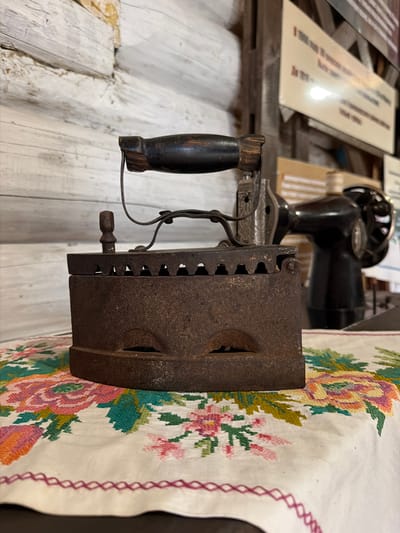
An antique, cast-iron flat iron, heavily oxidized, rests on a white cloth embroidered with colorful floral patterns. The iron has a dark wooden handle and a metal support mechanism. Behind the iron, a vintage black sewing machine is visible, also out of focus. The background consists of weathered wooden walls and a light-colored sign with text. The scene appears to be set in a room, possibly a museum or historical display, in Ust'-Kabyrza, Russia.
Ust'-Kabyrza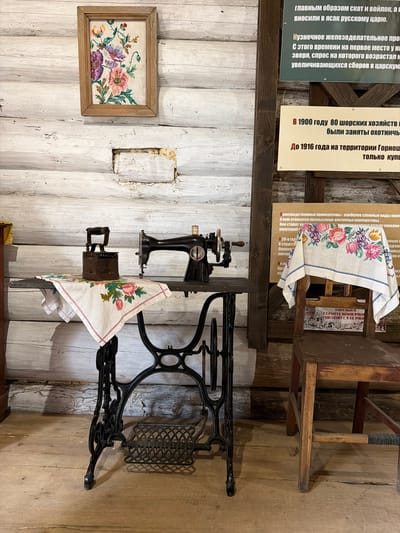
The image depicts an indoor scene, possibly a museum exhibit, set against a backdrop of a log wall. In the foreground, a vintage black sewing machine with an ornate cast-iron base and pedal mechanism stands on a dark wooden surface. To the left of the sewing machine, an antique cast-iron flatiron rests on a white embroidered cloth featuring floral motifs of pink, purple, and green flowers. Above the sewing machine, a framed embroidered artwork of similar floral patterns hangs on the wall. To the right, a wooden chair is positioned with another embroidered cloth draped over its back, also displaying a floral design. Several informational signs with text in Russian are mounted on the log wall behind the exhibit. The floor is made of light-colored wooden planks. The overall impression is one of a historical display showcasing domestic life and crafts. The location is identified as Ust'-Kabyrza, Russia, suggesting this scene is part of a local museum or historical site within that city. There are no people present in the image.
Ust'-Kabyrza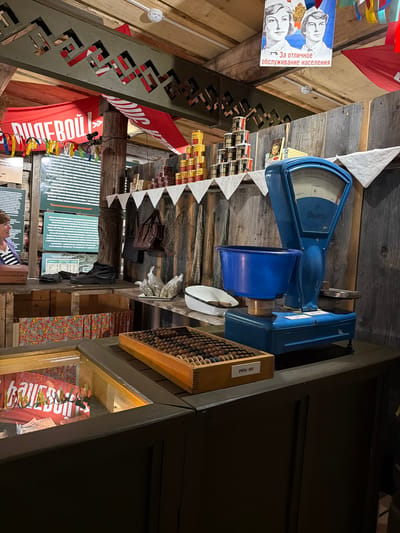
The image depicts a section of a museum exhibit, likely simulating a Soviet-era shop or market stall. The scene is set indoors, with a rustic wooden-planked wall serving as a backdrop. Dominating the right side of the frame is a vintage blue mechanical scale, with a weighing pan and a dial indicator. In front of it, a blue basin is placed on the scale. To the left of the scale, on a wooden shelf, are stacks of canned goods and a small framed picture. Further to the left, hanging on the wall, are various bags and dried items. In the foreground, a glass display case contains what appears to be red fabric with white lettering, possibly an advertisement or product display. Above this, on a wooden counter, is a wooden abacus with numerous beads. The ceiling area reveals decorative wooden elements and banners, one red banner with Cyrillic lettering is prominent. A poster featuring two young individuals is also visible near the ceiling. A woman is partially visible on the far left, looking towards the exhibit. The overall atmosphere suggests a historical reenactment or display of everyday life from a past era. The location is identified as Ust'-Kabyrza, Russia.
Ust'-Kabyrza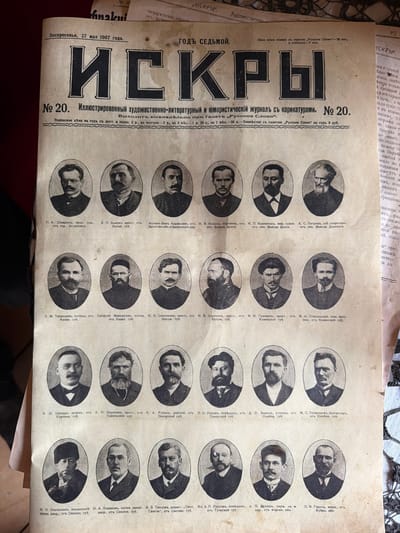
The image is a scan of the front page of a Russian newspaper titled "ИСКРЫ" (Iskry), dated "Воскресенье, 27 мая 1907 года" (Sunday, May 27, 1907). The newspaper is a weekly illustrated literary and humorous journal with caricatures, published as issue number 20. The page is dominated by a large title "ИСКРЫ" in bold, stylized font. Below the title, there is a description of the publication, including its price and subscription details. The majority of the page is filled with a grid of oval portraits of men, arranged in rows and columns. Each portrait is accompanied by a caption identifying the person, their profession, and their place of origin, typically a guberniya (province) in Russia. The men depicted are presented in formal attire, suggesting they are notable figures. The captions indicate a variety of professions, including landowner, merchant, peasant, doctor, military official, and various other professions. The locations mentioned in the captions are spread across different regions of the Russian Empire, such as Astrakhan, Samara, Kazan, Kaluga, Tula, Simbirsk, and others. There is no depiction of the city of Ust'-Kabyrza, Russia, within this image. The image is solely of a printed newspaper page.
Ust'-Kabyrza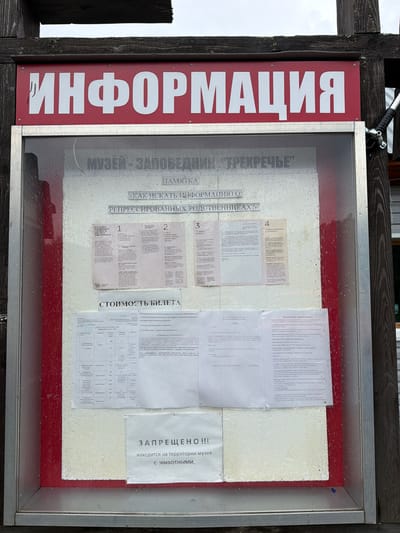
The image shows an information board at the "TREKRECHYE" Museum-Reserve in Ust'-Kabyrza, Russia. The board is mounted on a wooden post and has a red frame. The top of the board displays the word "ИНФОРМАЦИЯ" (INFORMATION) in large white letters. Below this, there is text in Russian indicating that it is a memorial and instructions on how to find information about repressed relatives. There are four sections numbered 1 to 4, each detailing a step in the process. Further down, a section titled "СТОИМОСТЬ БИЛЕТА" (TICKET PRICE) lists different ticket categories and their prices. At the bottom of the board, a prominent "ЗАПРЕЩЕНО!!!" (FORBIDDEN!!!) message in large capital letters is followed by text stating that animals are not allowed on the museum territory. The board is behind a glass panel which shows streaks of water or condensation. There are no people visible in the image. The environment appears to be outdoors, with wooden structures and a cloudy sky in the background.
Ust'-Kabyrza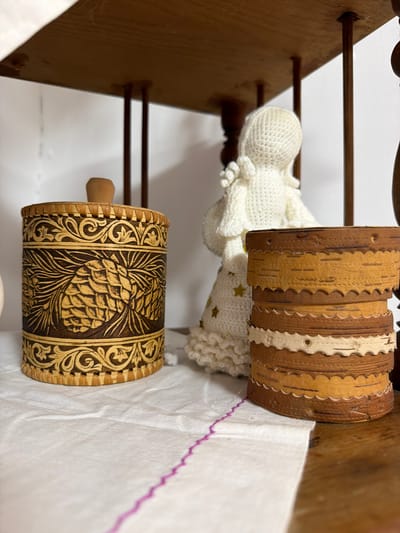
The image shows a close-up view of a wooden shelf in a room. On the shelf are two birch bark containers and a crocheted doll. The container on the left is larger and cylindrical, with intricate carvings of pinecones and swirling patterns. It has a wooden knob on top. To the right of it, there are two smaller stacked birch bark containers with decorative scalloped edges and ribbon accents. Behind these objects, a white crocheted doll with a conical head and ruffled clothing is partially visible. The shelf itself appears to be made of dark wood, and the background is mostly a plain white wall with some indistinct wooden elements on the right. The items are placed on a white cloth with a visible pink embroidered edge. The image does not provide any information about the city of Ust'-Kabyrza, Russia, or any specific context related to it.
Ust'-Kabyrza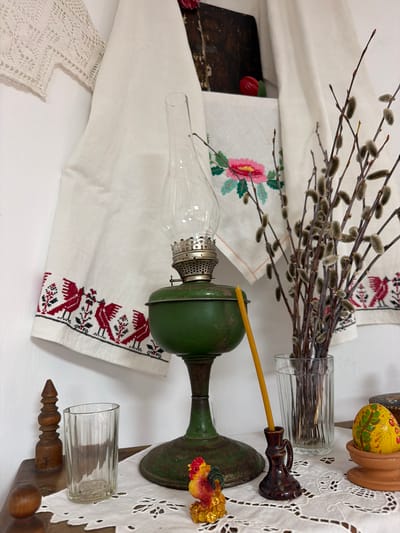
An indoor still life depicts traditional folk art and objects. In the background, a white textile with red embroidered birds and floral motifs hangs on a white wall, partially obscured by a dark, book-like object with a red item on top. To the right, a bouquet of pussy willow branches in a clear glass vase stands beside a white embroidered cloth. In the foreground, a green oil lamp with a glass chimney sits on a wooden surface covered with a white embroidered tablecloth. A yellow candle is placed in a small, dark brown ceramic holder next to the lamp. A small, decorative rooster figurine is positioned to the left of the candle. A clear glass with ribbed sides is to the left of the rooster, and a carved wooden finial stands behind it. A colorful, decorated egg sits in a terracotta holder on the right side of the frame. The scene is set indoors, likely in a domestic environment in Ust'-Kabyrza, Russia, evoking a sense of rural tradition and possibly related to Easter celebrations.
Ust'-Kabyrza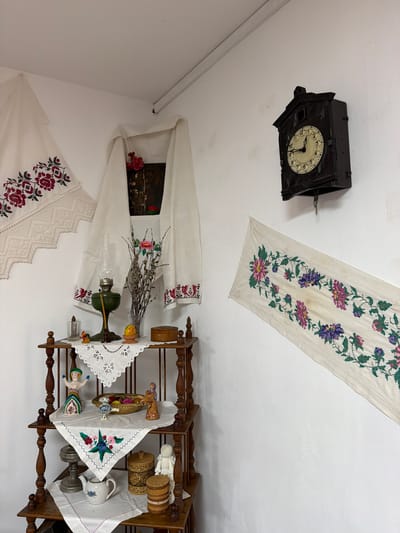
This is an indoor scene in Ust'-Kabyrza, Russia, likely a room within a traditional dwelling or museum. The environment is sparsely decorated with white walls and a wooden shelf unit. On the walls are two pieces of embroidered fabric: one with red floral patterns hangs to the left, and another with colorful floral patterns runs diagonally across the right. A dark wooden cuckoo clock hangs on the wall above the embroidered fabric on the right. The wooden shelf unit displays various decorative objects. The top shelf holds an oil lamp with a green base and glass chimney, a candle, a small egg in a stand, a small wooden box, and a glass container with a rooster figurine. The second shelf features a doll in a colorful dress, a basket filled with colorful objects, a small bird figurine, and another figurine resembling an angel. The third shelf displays a metal object, a teapot with a floral design, a round wooden container with a patterned surface, and a standing figure made of what appears to be white yarn or fabric. A piece of embroidered fabric with a floral design is draped over the third shelf.
Ust'-Kabyrza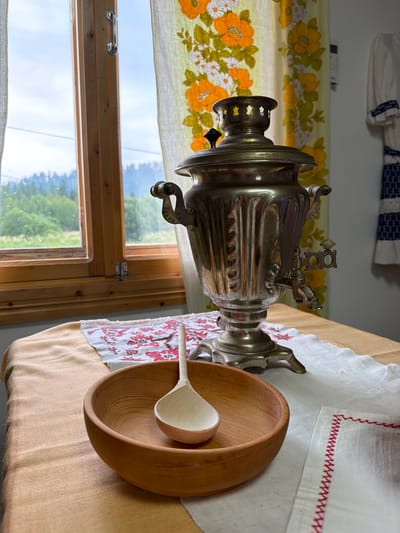
A close-up, eye-level shot captures a still life arrangement on a table with a window and floral curtains in the background. The table is covered with an orange cloth, a white cloth with red embroidery, and a piece of patterned fabric. In the foreground, a wooden bowl contains a wooden ladle. Behind the bowl, a silver samovar stands on a decorative base, featuring a spigot and handles. The window behind the samovar reveals a verdant, hilly landscape with trees. The curtains, patterned with orange and yellow flowers, hang to the right of the window. On the wall to the far right, a piece of embroidered clothing is visible. The scene suggests an indoor setting in Ust'-Kabyrza, Russia, possibly a home or a traditional craft shop, with elements of domesticity and regional culture.
Ust'-Kabyrza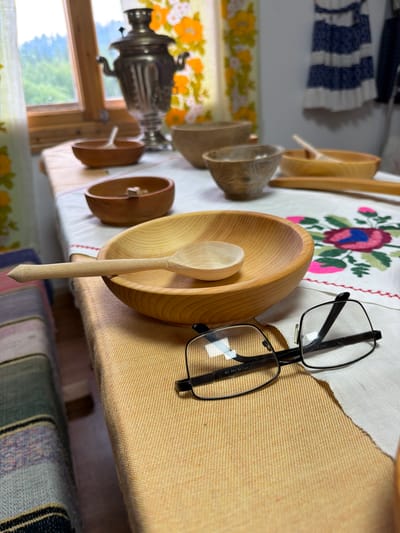
An indoor scene depicts a wooden table set with several handcrafted wooden bowls and spoons, a traditional Russian samovar, and a pair of eyeglasses. The table is covered with a tablecloth featuring embroidered flowers. The background reveals a window with a view of a green, mountainous landscape. The overall impression is one of a rustic, home setting, likely in a rural area, possibly a guesthouse or a domestic space in Ust'-Kabyrza, Russia. The lighting is natural, coming from the window.
Ust'-Kabyrza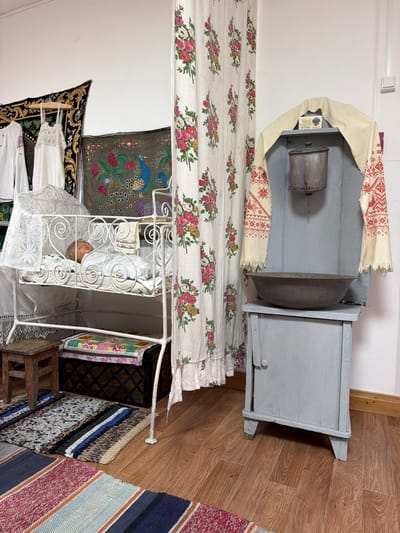
This image depicts an interior scene, possibly a museum exhibit or a preserved historical room, in Ust'-Kabyrza, Russia. The focal point is a white, ornate metal crib containing a doll dressed in white pajamas. The crib has a lace canopy. To the left of the crib, a small wooden stool sits on a woven rug. Behind the crib, a dark wooden chest is visible, topped with a colorful quilted cushion. To the right of the crib, a tall, pale blue wooden cabinet stands against the wall. It has a small door at the bottom and a large metal basin on a shelf at the top. Above the basin, a metal pot hangs, and a small box labeled in Cyrillic, likely soap, is placed on a piece of fabric. Draped over the top of the cabinet is a cream-colored textile with red embroidered patterns, possibly a shawl or towel. A floral-patterned curtain, featuring pink and red roses, hangs between the crib and the cabinet, creating a division in the space. On the wall behind the crib and cabinet, several decorative textiles are displayed. One is a dark tapestry with gold and black patterns, and another is a green fabric with embroidered peacocks and floral motifs. Two white garments, one with red embroidery on the sleeve and the other a white lace dress, hang on the left side of the scene. The floor is made of wooden planks, and several woven rugs are laid out. The overall impression is of a domestic or storage setting, with elements suggesting traditional Russian or Slavic culture. The lighting appears to be artificial, illuminating the objects evenly.
Ust'-Kabyrza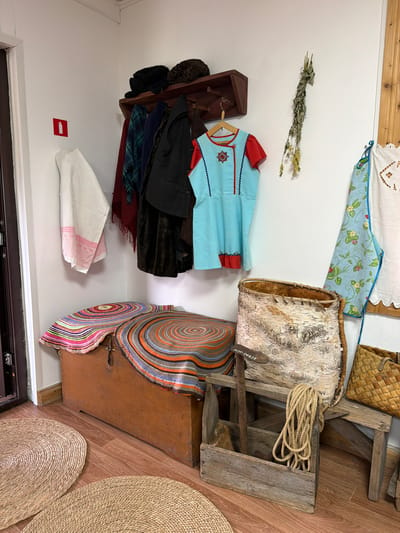
This is a medium shot, eye-level, interior photograph taken in a room in Ust'-Kabyrza, Russia, likely part of a museum or historical exhibit. The scene depicts a collection of rustic, traditional items displayed against a white wall and wooden floor. On the wall, a dark wooden shelf holds two dark, fur hats. Below the shelf, a wooden peg rack has several items of clothing hanging: a red and black patterned scarf, a dark blue scarf, a black vest over a dark brown garment, and a light blue dress with red trim and embroidered details. To the left of the rack, a white linen cloth with pink trim is draped. To the right, a dried bunch of herbs hangs on the wall. Further to the right, a light blue apron with a strawberry pattern is hung. In the foreground, a large, wooden chest sits on the floor, partially covered by two round, woven mats with concentric circular patterns in various colors, including orange, pink, and gray. To the right of the chest, a rustic wooden bench supports a large, upright birch bark basket. A weathered wooden toolbox sits on the floor in front of the bench, containing a rusty metal tool with a wooden handle and a coiled rope. A woven straw basket is visible on the right side of the bench. Two round, woven straw mats are on the floor in the lower left corner of the image. A red square sign with a white fire extinguisher symbol is mounted on the wall to the left of the clothing rack. The overall impression is one of a preserved domestic or workshop setting.
Ust'-Kabyrza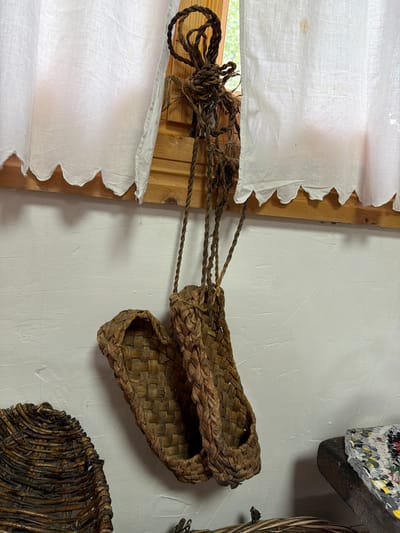
A pair of woven, natural fiber sandals hangs by their braided rope straps from a wooden support beam in front of a white, textured wall and a white linen curtain with a scalloped hem. The sandals are made of what appears to be straw or reeds, woven in a basket-like pattern, with a braided edge and a toe strap. They are positioned in the center of the frame, slightly angled. To the left, the edge of another woven basket is visible. To the right, a dark, rough-hewn wooden object supports a colorful woven mat or textile. The lighting suggests an indoor setting, possibly a rustic dwelling or museum exhibit, with natural light filtering in from a window behind the curtain. The overall impression is of handcrafted, traditional footwear displayed in a simple, unadorned environment.
Ust'-Kabyrza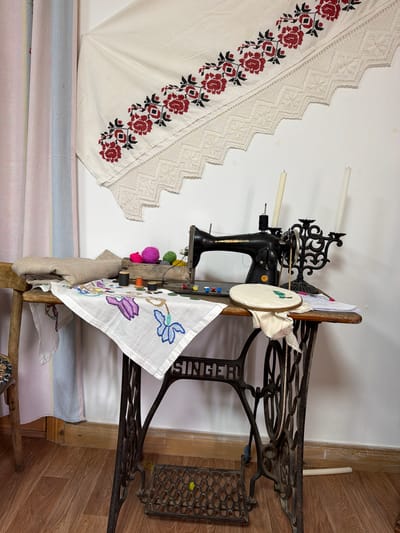
The image shows a close-up view of a sewing machine and surrounding crafting materials on a wooden table. The sewing machine is black and appears to be an antique Singer model. Various spools of thread, skeins of colorful yarn, and buttons are scattered on the table. A piece of white fabric with embroidered blue flowers is draped over the edge of the table, and another piece of fabric, folded, is on a wooden chair to the left. Above the sewing machine, a white textile with red floral embroidery and lace trim is hung on the wall. Two white candles in a decorative black candelabra stand behind the sewing machine. The scene is set against a plain white wall and a wooden floor. The overall impression is of a crafting or sewing area, possibly a workspace or a display in a home or small shop. The specific location in Ust'-Kabyrza, Russia is not determinable from the image itself.
Ust'-Kabyrza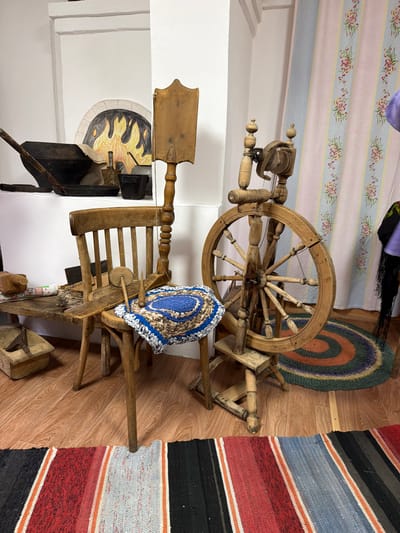
This image depicts a room with traditional elements, possibly a historical exhibit or a well-preserved living space. In the background, a white wall features a decorative rendering of a fireplace with flames, suggesting a symbolic representation of warmth or hearth. To the right, pastel-colored curtains with floral stripes hang, adding a touch of decorative softness. The foreground is dominated by antique wooden objects. A rustic wooden spinning wheel stands prominently, its intricate structure suggesting a bygone era of textile production. Beside it, a simple wooden chair is placed. On the chair rests a small, round rug with a blue and white patterned center and a brown and white outer edge, possibly handmade. A wooden board with what appear to be spinning tools lies across the chair. To the left of the chair, a wooden bench holds various items, including a dark pot or pan with a handle, a folded cloth, and some smaller tools. A wooden box with a handle is visible on the floor beneath the bench. Two colorful woven rugs are spread on the wooden floor, one in the foreground with bold stripes of black, red, orange, and white, and another circular rug with concentric rings of green, orange, and purple further back. A hint of a person wearing a purple garment and a black head covering with fringe is visible in the far right background, partially obscured by the curtains. The lighting is even and diffuse, illuminating the scene without harsh shadows, suggesting an indoor setting under soft light. The overall impression is one of a curated display of traditional domestic tools and decor, evoking a sense of history and cultural heritage. The specific location in the city of Ust'-Kabyrza, Russia, is not visually apparent from the image itself, but the objects suggest a connection to rural or folk traditions.
Ust'-Kabyrza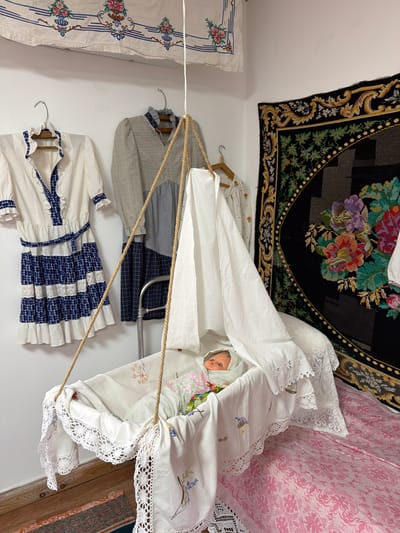
The image depicts a room, possibly in Ust'-Kabyrza, Russia, designed to resemble a historical nursery. In the center, a white, fabric-lined bassinet is suspended by ropes, containing a doll dressed in a light-colored outfit with floral patterns. The bassinet is adorned with white lace trim and embroidered details. Surrounding the bassinet, several pieces of clothing are displayed on hangers against a white wall. These include a white dress with blue trim and a plaid pattern, a grey and blue checkered dress, and another white dress with small floral embroidery. A large, dark tapestry with vibrant floral motifs hangs on the right wall. A pink patterned fabric covers a surface to the right of the bassinet, suggesting a bed or a similar piece of furniture. The overall impression is of a staged exhibit, showcasing traditional clothing and a nursery setup.
Ust'-Kabyrza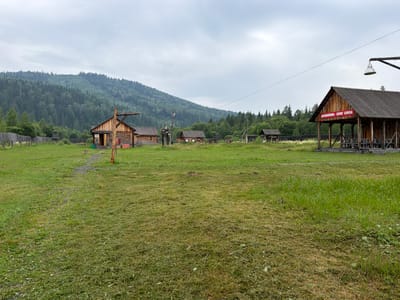
The image depicts an outdoor scene in a rural setting, likely a village or an agricultural compound, under an overcast sky. In the foreground, a large expanse of mown grass covers the ground, with patches of longer grass and some scattered wildflowers on the right. A narrow gravel path winds through the grass towards a cluster of wooden buildings. To the left, a rustic wooden fence encloses an area, and a small wooden guard tower or observation post stands within it. Several log cabins and smaller wooden structures are visible, appearing to be part of a settlement. One of these buildings has a sign with Russian text in red. In the midground, more wooden structures are scattered across the grassy field. A prominent wooden building with a large open-fronted section, possibly a covered market or workshop, is situated on the right side of the image. A large, cone-shaped lamp is suspended from a metal pole above this structure. The background is dominated by a dense, green, tree-covered mountain range, indicative of a forested, mountainous region. The overall impression is of a remote, possibly historical or traditional settlement, nestled within a natural landscape. The location is identified as Ust'-Kabyrza, Russia.
Ust'-Kabyrza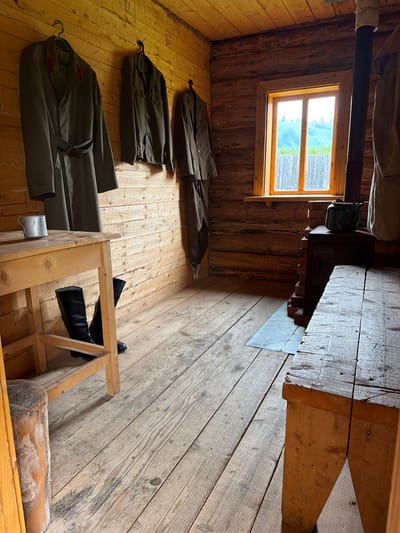
This is an interior shot of a rustic wooden room, likely a cabin or barrack, located in Ust'-Kabyrza, Russia. The room is sparsely furnished, emphasizing practicality and functionality. On the left wall, three military-style jackets are hung on hangers. The leftmost jacket is a long overcoat, cinched with a belt, and has red accents on the collar. To its right, a shorter jacket is also hanging, followed by a third, similar garment. Below these, a simple wooden table stands, supporting a metal mug. Beneath the table, a pair of tall black boots are placed on the wooden floor. The right side of the room features a wood-burning stove with a dark metal chimney pipe extending upwards. A green metal kettle sits atop the stove. In front of the stove, a stone or metal mat is laid on the floor. A rough-hewn wooden bench occupies the foreground on the right. A single wooden-framed window is visible on the back wall, offering a view of a green, hilly landscape with a wooden fence. The walls and floor are constructed from rough-hewn wooden planks, giving the space a primitive and utilitarian appearance. The lighting is natural, coming from the window and an unseen source, creating shadows that highlight the textures of the wood. The overall impression is one of a functional, living space, possibly from a historical military or frontier context.
Ust'-Kabyrza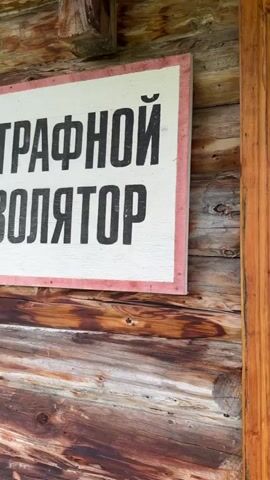
The video begins with a close-up of a weathered wooden wall with a partial sign that has Cyrillic text. The camera then pans to the right, revealing a narrow wooden hallway with several doors and an open wooden door on the right. The hallway is dimly lit, with wooden paneling on the walls and ceiling, and wooden floorboards. There are some metal doors visible down the hallway, and a taxidermied animal head mounted on the ceiling. As the camera continues to pan, it focuses on a room with wooden walls and a wooden floor. Several military-style jackets and pants are hanging on the wall. A small wooden table with a metal cup and a pair of black boots are in the foreground. The lighting in the room is warm and natural.
Ust'-Kabyrza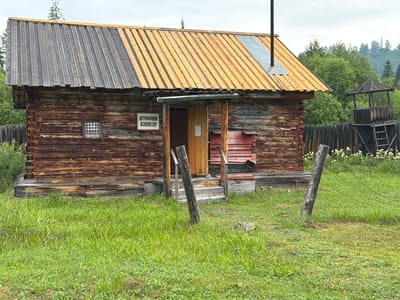
In the city of Ust'-Kabyrza, Russia, a rustic wooden building stands on a grassy field. The building, constructed of horizontal logs, has a weathered appearance. Its roof is a patchwork of grey and yellow metal sheeting, with a section of silver metal near the chimney. A sign above the open doorway reads "ШТРАФНОЙ ИЗОЛЯТОР" (Disciplinary Isolation). A small, barred window is visible on the left side of the building. The entrance is a wooden door, and a small wooden porch leads up to it. Two rough wooden posts stand in front of the building, and a barbed wire fence stretches across the foreground. In the background, a wooden guard tower and a dense green forest are visible. The sky is overcast.
Ust'-Kabyrza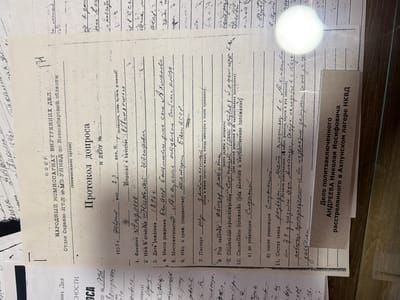
This is a close-up, eye-level, indoor shot of a document with handwritten Russian text. The document appears to be an official record, possibly an interrogation protocol or personal file, based on the headings and numbered questions. The document is cream-colored and shows signs of age, with some creasing and discoloration. A bright white circular light source is reflected in the upper right quadrant of the image, obscuring some of the text. A portion of another document, also with Russian text, is visible at the bottom right, featuring a stamp that reads "Дело политзаключенного АНДРЕЕВА НИКОЛАЯ ИОСИФОВИЧА расстрелянного в Акхунском лагере НКВД". The main document has a title "ПРОТОКОЛ ДОПРОСА" (Interrogation Protocol) at the top. Below this, it is identified as originating from "НАРОДНЫЙ КОМИССАРИАТ ВНУТРЕННИХ ДЕЛ" (People's Commissariat of Internal Affairs) and a specific department "Отдел Охраны ИТЛ МЗ УНБД по Новосибирской области" (Department of Protection of ITL MZ UNBD for Novosibirsk Oblast). The date "1938 г. февраль" (February 1938) is present. Several questions are numbered, and some have handwritten answers. For example, question 1 asks for "Фамилия" (Surname), and the answer is written as "Андреев". Question 2 asks for "Имя и отчество" (First name and patronymic), with the answer "Николая". Question 3 is "Дата рождения" (Date of birth) with "1896 г." (1896). Question 4 asks for "Место рождения" (Place of birth) and has the answer "Баш. АССР." (Bashkir ASSR). Question 5 is "Местожительство" (Residence) with the answer "г. Аханькское." (Ahan'kskoe). Question 6 asks for "Нац. и граж. (подданство)" (Nationality and citizenship (allegiance)) with the answer "на агари" (on agar - this part is unclear). Question 7 is "Паспорт" (Passport) with a handwritten "пр" (likely an abbreviation). Question 8 asks for "Род занятий" (Occupation) with the answer "общир род. (ком)" (general occupation - unclear). Question 9 is "Социальное происхождение" (Social origin) with the answer "Сибиряк" (Siberian). Question 10 asks for "Социальное положение (род занятий и имущественное положение)" (Social status (occupation and property status)), and question 11 asks for "Состав семьи" (Family composition) with the answer "у родителей, на родителей и их имущественное положение" (for parents, for parents and their property status). Some additional handwritten notes are present in the margin and between lines, including "гр. 34 г. гражданин" (citizen of 34 years) and "родственники, из им" (relatives, from them). The location of Ust'-Kabyrza, Russia is not explicitly mentioned in the visible text of this document. However, the document relates to
Ust'-Kabyrza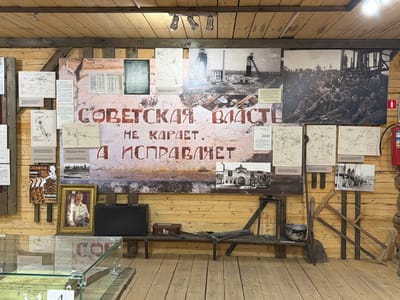
This is a medium shot, eye-level indoor photograph of a museum exhibit. The exhibit is displayed on a wooden wall with a wooden floor. The wall features a large mural with Russian text, a framed portrait of a man in a white suit, a black briefcase, and several historical photographs and maps. To the left of the mural, there is a glass display case containing historical items. To the right of the mural, a wooden bench displays a smaller brown briefcase, tools, and a pot. A fire extinguisher is visible on the far right side of the wall. The overall impression is one of a historical exhibit related to the Soviet era, possibly in a mining or industrial context given the presence of mining structures in the photographs and the tools on display. The location in Ust'-Kabyrza, Russia, is not explicitly stated in the image itself, but this context is provided.
Ust'-Kabyrza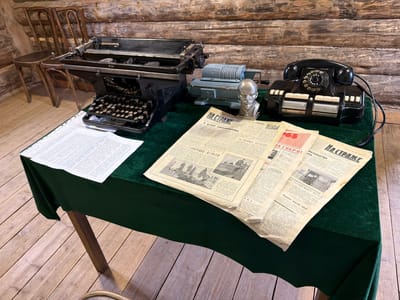
In a room with log walls and a wooden floor, a dark green tablecloth covers a table. On the table are several objects: a black manual typewriter, a light blue mechanical calculator, a silver bust of Lenin, and a black rotary telephone. Scattered across the table are newspapers. Two wooden chairs are visible in the background. The scene appears to be a static display, possibly in a museum or historical exhibit, depicting a historical office setting. The city of Ust'-Kabyrza, Russia is a rural settlement, and this scene may represent a historical office from that region or a similar setting.
Ust'-Kabyrza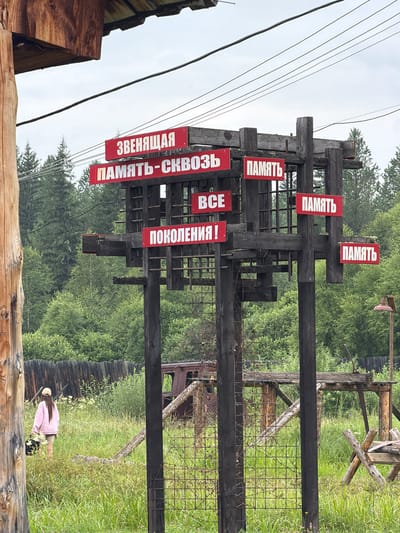
The image depicts an outdoor scene in Ust'-Kabyrza, Russia, featuring a weathered wooden structure with multiple red signs bearing white Cyrillic lettering. The signs appear to be historical or memorial in nature, with phrases like "ЗВЕНЯЩАЯ ПАМЯТЬ-СКВОЗЬ ПОКОЛЕНИЯ!" (Ringing Memory Through Generations!) and "ПАМЯТЬ" (Memory) visible. The structure is set against a backdrop of lush green trees and vegetation. In the foreground, a young person wearing a pink hoodie and shorts walks away from the camera, carrying a dark bag. The ground is covered in tall grass and wildflowers. In the background, there are remnants of what looks like an old vehicle and a rustic wooden fence. The overall atmosphere is one of historical reflection amidst a natural, rural setting.
Ust'-Kabyrza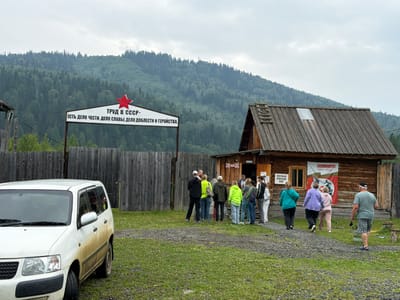
The image depicts an outdoor scene in Ust'-Kabyrza, Russia, featuring a wooden building with a rustic aesthetic and a group of people gathered outside. In the foreground, a white van, partially covered in mud, is parked on a gravel and grass area. A wooden fence runs along the left side of the scene, separating the area from a backdrop of a dense, forested mountain under an overcast sky. A prominent sign with a red star is visible above the fence, displaying Cyrillic text that translates to "Labor in the USSR - is a matter of honor, a matter of glory, a matter of courage." To the right of the fence, the wooden building has a weathered appearance with a shingled roof. A banner hangs on the side of the building, featuring an image and Cyrillic text reading "We Remember! 1941-1945." Another sign with Cyrillic text is affixed to the wall near the entrance. A group of approximately ten individuals, dressed in casual clothing, are positioned in front of and near the entrance of the building. Some are facing the building, while others are engaged in conversation. The overall atmosphere appears to be one of a gathering or a visit to a historical site. The environment is rural, characterized by the natural landscape and simple structures.
Ust'-Kabyrza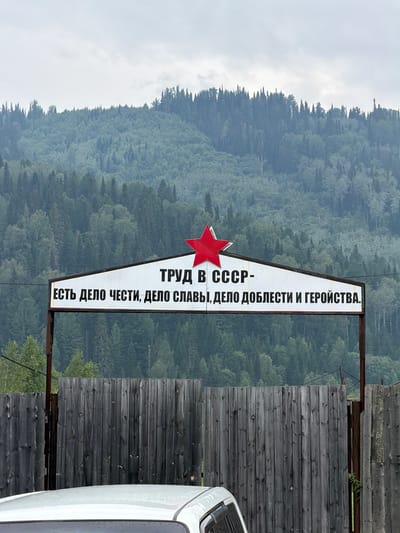
An outdoor, eye-level, medium shot captures a sign with a red star above a white background with black Russian text. The text reads "ТРУД В СССР - ЕСТЬ ДЕЛО ЧЕСТИ, ДЕЛО СЛАВЫ, ДЕЛО ДОБЛЕСТИ И ГЕРОЙСТВА." translated to "LABOR IN THE USSR IS A MATTER OF HONOR, A MATTER OF GLORY, A MATTER OF VALOR AND HEROISM." The sign is mounted on poles and appears to be a historical monument or propaganda sign. Behind the sign, a dense, misty forest covers a mountain slope under a cloudy sky. In the foreground, a weathered wooden fence runs horizontally across the image, partially obscuring the lower portion of the sign. The roof of a white car is visible in the bottom left corner. The image was taken in Ust'-Kabyrza, Russia.
Ust'-Kabyrza