Vỹ Dạ Ward, Vietnam
30 memories from Vỹ Dạ Ward, Vietnam
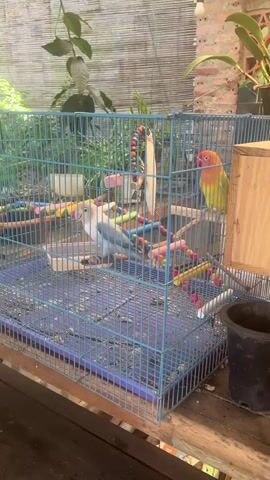
A blue metal bird cage is shown in an outdoor setting. Inside the cage, there are two lovebirds. One bird, predominantly white with hints of blue, is perched on a wooden dowel near the left side of the cage. The other bird, a vibrant yellow and orange, is positioned on a perch towards the back right of the cage. The cage floor is covered in scattered birdseed and debris. Various toys, including colorful beaded strings and wooden perches, are suspended within the cage. A wooden nesting box is attached to the exterior right side of the cage. In the background, a bamboo-like matting and some greenery are visible. The cage rests on a wooden surface.
Vỹ Dạ Ward
The image depicts a picturesque scene along a waterfront promenade in Vỹ Dạ Ward, Vietnam. A paved walkway, constructed with light-colored square tiles, stretches into the distance, bordered on the left by lush green trees and foliage. On the right, a decorative silver metal railing runs along the edge of a calm body of water. Across the water, a town is visible, with buildings of varying heights and architectural styles lining the shore under a bright blue sky dotted with white clouds. Sunlight casts dappled shadows from the trees onto the walkway, indicating a sunny day. The overall atmosphere is serene and tranquil, suggesting a public space enjoyed for leisure and scenic views.
Vỹ Dạ Ward
The image captures a static scene on a body of water within Vỹ Dạ Ward, Vietnam, under an overcast sky. In the midground, a small, light-colored, man-made island platform supports three miniature architectural structures. The leftmost structure is a small, red, single-story building with a sloping roof. To its right, a more elaborate, multi-tiered miniature pagoda or temple stands, displaying reddish-brown, orange, and cream coloration with architectural detailing. A smaller, white, single-story structure with a peaked roof is partially visible to the immediate right of the pagoda. The foreground consists of dark blue-green water with subtle surface ripples. The background reveals a distant landmass densely covered with trees, ranging from those with sparse, bare branches on the left to lush green foliage across the majority, bordering an exposed, somewhat eroded bank. No individuals or visible activity are present in the scene.
Vỹ Dạ Ward
The image displays a waterside vista in Vỹ Dạ Ward, Vietnam, under a partly cloudy sky. In the foreground, a grey metal railing, consisting of two horizontal bars supported by vertical posts, extends across the lower portion of the frame. Beyond the railing, a calm body of greenish-grey water stretches towards a vegetated landmass. This landmass, appearing as an island or peninsula, is densely covered with green foliage and numerous trees. Centered on this landmass are three modern, multi-story buildings characterized by their white, angular facades and extensive dark-framed glass windows. Small trees are planted both around and on the rooftops of these structures. To the far right, a section of a larger, multi-story white building with a more traditional architectural style and a red banner or flag on its roof is partially visible. To the far left, dense green vegetation marks a distant shoreline. No individuals, overt actions, or interactions are visible within the scene.
Vỹ Dạ Ward
The image depicts a street scene in Vỹ Dạ Ward, Vietnam, under a partly cloudy sky. The asphalt road in the lower foreground features two broken yellow lane lines. On the left side of the road, several motorbikes are parked, with one individual visible near them. A partial view of a white vehicle's rear bumper and taillight is present in the bottom right foreground. The right side of the street is lined with diverse buildings. On the left, a tall, multi-story white building with prominent arched windows and a dark roof section is visible. Adjacent to it, a structure displays an ornate upper balcony, with a lower balcony area covered by a large green tarp. This transitions into a row of one-to-two-story commercial buildings featuring awnings, weathered facades (yellow, grey), and red-tiled roofs. Vietnamese signage is visible on storefronts, including 'ANH COFFEE' and 'TÓC HÚT 21'. On the far right, a building with a cream-colored facade is partially obscured by dense green foliage, from which a red Vietnamese flag with a yellow star is displayed. A yellow A-frame sign stands on the sidewalk in front of this foliage.
Vỹ Dạ Ward
The image depicts a street-level view of a modern commercial building and an adjacent older structure under an overcast sky in Vỹ Dạ Ward, Vietnam. The prominent structure on the left is a multi-story building featuring a dark, perhaps marble-clad, ground-level facade and large, dark glass windows on its upper floors. The upper exterior is adorned with an array of varying-sized, hollow, light grey concrete-like cubes suspended at different depths from a dark metal framework, creating a textured architectural feature. Below these cubes, a large, dark, organic-shaped sculptural element is affixed to the facade, above a section with a dark grid containing irregular translucent panels. To the right of the main entrance, a tall vertical garden composed of dense green, orange, and yellow artificial foliage, interspersed with small lantern-like objects, covers a significant portion of the building's facade. The building's entrance includes dark steps leading up to dark-framed glass doors, flanked by planters containing neatly trimmed spherical green bushes and spiky succulents. Outdoor seating, consisting of dark tables and chairs, is visible behind the planters. To the right of this modern building, an older, two-story structure with a faded light-colored facade and a visible balcony with a dark balustrade is partially visible. In the foreground, a paved street runs horizontally. A light grey car with a "HUE XANH" logo on its side is partially visible on the far left. A light brown Peugeot 3008 SUV, license plate 75A-159.65, is parked or moving on the right side of the street, facing left. The sky is largely covered with scattered white and grey clouds. No individuals are visibly present.
Vỹ Dạ Ward
An urban street scene unfolds in Vỹ Dạ Ward, Vietnam, under an overcast sky. The image captures a paved, two-lane road with yellow dashed markings, flowing from the foreground towards the background. A concrete sidewalk lines the left side of the street, partially shaded by overhanging tree branches, some with green foliage and others bare. Multiple vehicles are in motion on the road. In the foreground, a person wearing an orange long-sleeved shirt and a white helmet rides a light-colored scooter, positioned centrally in the lane. Behind them, several other motorcycles and scooters are visible, with riders generally wearing helmets. Cars are interspersed with the motorcycles; prominent vehicles include a white sedan towards the middle-left, and a beige Peugeot 3008 SUV on the right, both facing away from the camera. At least five cars and six motorcycles are identifiable. Along the right side of the street, a continuous row of multi-story buildings forms the urban backdrop. These structures exhibit varied architectural styles and colors, ranging from older, light-colored buildings with red-tiled roofs to more modern designs. Many buildings feature commercial signage in Vietnamese and several small red Vietnamese flags are displayed. One distinctive building towards the right of the frame has a teal facade with a window, and another adjacent building features a large, dark-green vertical garden wall adorned with orange and yellow artificial foliage. A piece of white paper or debris rests on the sidewalk in the immediate foreground.
Vỹ Dạ Ward
This image captures a multi-tiered glass display case, likely within a bakery or café in Vỹ Dạ Ward, Vietnam. The primary subject is a small, round white cake positioned on a white square cake board on a middle shelf. The cake is frosted white and decorated with a ruffled white lace-like border around the top and base. The top features several pink frosting tulips, green leaf-like accents, and white frosting peaks. A pink butterfly decoration rests on the left side of the top border. A red heart-shaped topper, prominently displaying "HAPPY WOMEN'S DAY" in white text, is centrally placed on top of the tulips. Around the side of the cake, a brown ribbon is tied into a bow. A black rectangular tag on the left side of the cake board reads "Talia cake." A yellow sticker with the number "130" is affixed to the bottom right of the cake board. Above this cake, a blurred green object is visible on an upper shelf. Below, on a lower shelf, a portion of another round white cake is visible, decorated with Doraemon characters and colorful sprinkles. The display case features gold-colored metal framing.
Vỹ Dạ Ward
This image depicts a long, covered outdoor commercial space, likely a plant nursery or garden supply store, situated in Vỹ Dạ Ward, Vietnam. The scene is viewed down a central aisle. Overhead, a metal framework supports a roof structure, from which multiple grey plastic pots containing orchids with prominent aerial roots are suspended. An upper level or balcony is visible in the background, also containing potted plants. To the left, a large white planter holds a Peace Lily (Spathiphyllum) with multiple white blooms. Adjacent to it, stacks of red, white, and brown plastic planters are piled. Further along the left side, various other potted plants, garden supplies, and storage containers are arranged. In the immediate foreground on the left, a cluster of pink-flowering azaleas or similar shrubs is displayed. The central aisle is a light-colored, possibly concrete or tiled, surface that appears somewhat stained. A single blue plastic stool rests on the floor in the mid-right. To the right, a multi-tiered metal shelving unit displays numerous ceramic figurines, many depicting animals, alongside various gardening tools, smaller potted plants, and packaged goods in cardboard boxes. A potted plant, possibly a rose bush with red flowers, stands in the foreground on the right. The background shows the aisle receding into the distance, lined with more plants and merchandise, suggesting a larger establishment. No individuals are present in the image.
Vỹ Dạ Ward
The image displays a collection of seven potted cacti and succulents arranged on a weathered, light-colored tiled surface against a grey wall. The scene is located in Vỹ Dạ Ward, Vietnam. In the mid-ground, a large white ceramic pedestal pot contains a cluster of green cacti with yellow spines, topped with a small red and white spotted decorative mushroom. White pebbles cover the soil. To its right, a smaller white pot holds a dense cluster of dark green cacti. In the foreground, from left to right: 1. A white, round ceramic pot, decorated with red hand-painted characters (including "Tài") and red dots, holds several green and reddish-brown cacti, one with an elongated stem. 2. A second white, round ceramic pot with red dots contains a Haworthia succulent, characterized by dark green, ribbed leaves, with white pebbles covering the soil and a thin wooden stick inserted. 3. A third round pot features a black and white crackle glaze pattern and holds a globular green cactus with prominent white areoles, also with white pebbles on the soil. The background consists of a textured, light grey wall. To the far left, a vertical metallic support post is visible, alongside a darker, indistinct area with suggestions of stacked materials and foliage. No people are present. The arrangement constitutes a still life.
Vỹ Dạ Ward
The image depicts an outdoor retail display of plants and pottery in Vỹ Dạ Ward, Vietnam. In the foreground and midground, a distressed white metal two-tier shelf with peeling paint holds an assortment of potted plants. The top shelf's surface features light green patterned tiles. On both tiers, plants with red and green foliage, as well as several bundles of lucky bamboo, are housed in various white and light-colored ceramic pots. Below this shelf, numerous potted plants are arranged on wooden pallets and directly on the ground. These include anthuriums with prominent red spathes, flowering plants with vibrant pink and purple blossoms (e.g., Christmas cacti, azaleas, heather-like plants), and other green foliage plants, many in white ceramic or dark plastic pots. Some plants are wrapped in clear plastic. In the background, on the right side, a dark metal multi-tiered shelf unit holds a diverse collection of ceramic items. The top shelf displays several ceramic dog figurines, including what appear to be German Shepherds and other breeds. Lower shelves contain numerous white, colored, and patterned ceramic mugs, cups, and vases, some stacked. Bundles of colorful strings or thin fabrics hang in front of the lower shelves. Above these shelves, two potted yellow orchids in dark plastic hanging baskets are suspended from the ceiling. The background wall is a textured, light-colored surface, possibly concrete or stucco, exhibiting signs of wear and minor discoloration. The ceiling structure consists of visible dark metal beams and corrugated material. To the far left, a rusted, vertical metal structure, likely part of a gate or building support, is partially visible. No individuals are present in the scene.
Vỹ Dạ Ward
The image depicts a multi-compartment ceramic planter situated outdoors in Vỹ Dạ Ward, Vietnam. The planter, glazed in light brown and tan, features a relief sculpture of a smiling, corpulent Buddha (Hotei) on its front. To the left of the Buddha, the planter is embossed with white Chinese characters: "招財" (Attract Wealth), "納福" (Receive Blessing), and "四方財" (Wealth from all directions). The left compartment contains a globular cactus with dense, yellowish-brown spines, while the right compartment holds several variegated snake plant leaves. Both plants are potted in white decorative gravel. The planter rests on a tiled surface exhibiting a mosaic pattern of irregular, rounded shapes in off-white, light blue, and muted red. Behind the planter is a light-colored, textured wall. To the right, a weathered vertical structure, possibly a door frame or pillar with peeling paint, partially obscures a blurred outdoor background.
Vỹ Dạ Ward
The image displays an outdoor fruit stall in Vỹ Dạ Ward, Vietnam. In the central foreground, a substantial quantity of whole, spiky, light green durians are stacked high on a black metal multi-tiered display rack. Beneath these, numerous brown coconuts are arranged on the lower shelves of the same rack. To the left, a woven basket holds several light green guavas, partially covered by dark green leaves. The ground is paved with grey patterned tiles; a dark, rectangular object rests on the tiles near the guava basket, and a small, brown dried object is located beneath the plastic tables on the right. To the right of the durian display, two light red plastic tables are utilized to display an array of pre-packaged durian segments. These segments are contained within black-bottomed clear plastic trays with transparent lids, exhibiting yellow durian flesh. Approximately 15 to 20 such packages are neatly arranged across the two tables, some bearing small yellow tags. A female individual, dressed in a light-colored top and dark pants with her dark hair tied back, is observed crouching behind these tables, actively handling or arranging the packaged fruit. The lower leg and a foot wearing a white Crocs-style shoe belonging to another individual are partially visible in the bottom right corner. The background on the left side features a green vertical sign adorned with images of durian fruit. Adjacent to it stands a white display cabinet with glass shelves, holding various items including small glasses and a red decorative statue. Above this area, a round wall clock with a brown frame and a grey wall-mounted oscillating fan are visible. The background wall on the right is a light grey with subtle dark veining, against which a grey office-style chair with a dark garment draped over it is positioned. The scene is illuminated by ambient daylight.
Vỹ Dạ Ward
This is a vibrant, vertically oriented folk art painting, likely executed in acrylic on canvas, depicting a stylized figure of Buddha in a meditative posture. The painting, located in Vỹ Dạ Ward, Vietnam, features the Buddha seated centrally in the full lotus position (Padmasana) on a prominent golden-yellow, textured mound resembling hay or grass. The figure is draped in a flowing, single-shouldered orange-yellow robe that covers the body, with a lighter pinkish-orange garment visible underneath where the legs cross. The hands are positioned in the lap, palms upward, with the thumbs touching, forming the Dhyana Mudra (meditation gesture). The Buddha's face has a light peach complexion, with eyes closed, subtle red lips forming a faint smile, and characteristically long earlobes extending to the shoulders. The head is topped with a dark, tightly curled hairstyle gathered into an ushnisha (cranial bump). A bright, circular halo or aura, transitioning from light green at the center to pale yellow at its edges, emanates from behind the head against a textured, mottled blue background. The background displays varying shades of blue, with some lighter patches suggesting clouds or brushstrokes.
Vỹ Dạ Ward
The image displays the exterior of a two-story restaurant named "Quán Nón Huế" located at 27 Nguyễn Sinh Cung, Vỹ Dạ Ward, Huế City, Vietnam. The establishment features a rustic, dark reddish-brown wooden facade on the ground floor, contrasting with taller, dark-framed windows on the upper story. A large white rectangular sign above the ground floor entrance displays "QUÁN NON HUE" in yellow lettering and "BANH BEP - NEM LUI - NAM - LOC..." in red, alongside a phone number (0788.675.875). Below this, a string of approximately eight conical Vietnamese hats (nón lá), each fitted with a light bulb, hangs as decorative illumination. A tall, white vertical sign on the left side of the building lists "NÓN HUẾ AUTHENTIC LOCAL FOOD" and specialties such as "ĐẶC SẢN BÁNH HUẾ," "NEM LỤI," "BÚN BÒ HUẾ," and "CHÈ HUẾ," explicitly stating the address. Below it, a smaller green sign reads "QUÁN BÚN BÒ CAFÉ." The main entrance consists of open, ornate wooden double doors revealing a dimly lit interior. A transparent plastic curtain hangs inside the doorway. To the left of the entrance, a dark, small menu stand with a wooden top is positioned on the sidewalk. The sidewalk is paved with grey interlocking pavers, transitioning to black and white patterned tiles at the restaurant's entrance, which includes a low step. Numerous potted plants, including flowering and leafy varieties, are arranged along the sidewalk in front of the building. Green vines are observed growing around the upper facade and signage. Inside the restaurant, a few indistinct figures are visible, appearing to be seated at tables in the dark interior. To the far left, a white cardboard box rests on the sidewalk adjacent to a green corrugated metal structure. The sky above is partially visible, indicating a daytime scene.
Vỹ Dạ Ward
An outdoor scene in Vỹ Dạ Ward, Vietnam, depicts two white ornamental planters filled with numerous light pink artificial roses and green foliage, positioned in the foreground. The planter on the left is largely centered, displaying intricate carved details on its pedestal. Behind the planters, several motorbikes and scooters are parked; one black scooter on the left has a visible license plate "75-FM 507.72". In the background, a multi-story white building with a partial brownish-red roofline is visible. The building features windows with dark coverings on the left and a tall window or doorway with light green drapes on the right. The white walls of the building exhibit some cracks and wear. The scene is illuminated by natural daylight. No individuals are present or engaged in any discernible actions.
Vỹ Dạ Ward
This outdoor image presents the facade and immediate surroundings of the "Jade Palace Wedding & Event" venue located in Vỹ Dạ Ward, Vietnam, under a partly cloudy sky. The main building is a white, two-story structure featuring prominent gold lettering for "JADE PALACE" and silver lettering for "WEDDING & EVENT" on its upper facade. A central entrance is extensively decorated with white and light pink floral arrangements, forming an archway. A patterned paved pathway, composed of reddish-brown and grey interlocking tiles, leads directly to this entrance. The pathway is bordered by eight white square-column pedestals, four on each side, each topped with a spherical arrangement of cream-colored artificial flowers. Numerous motorcycles are parked in rows on the grey paved areas flanking the pathway, primarily black, grey, and red. A blue and white vertical banner, partially visible in the lower-left foreground, displays "WELCOME," "en Huy," and "03 | 2026," indicative of an event. A dark-paneled building with reflective windows is partially visible to the right of the main venue. An overhead circular light fixture with a yellow center is visible at the top center of the frame. No individuals are present in the scene.
Vỹ Dạ Ward
A multi-tiered traditional Vietnamese architectural structure, likely a gate or ceremonial entrance, is depicted in Vỹ Dạ Ward, Vietnam. The structure features a dark tiled roof with ornate white decorative elements resembling dragons and intricate eaves on each tier. Its facade displays weathered red, blue, and yellow panels, with large Chinese characters "府公建洋" (Phủ Công Kiến Dương) prominently displayed on the upper section. Below this, there are floral motifs and circular medallions with characters. The structure is fronted by a red metal fence and a double gate. The gate features vertical bars and a central golden circular emblem with the Chinese character "福" (Fú, meaning fortune). The lower part of the gate has horizontal golden panels. Two yellow concrete pillars flank the gate, with a black lantern-style light fixture mounted on the left pillar. A black plaque with white text, "P. KIÊN TƯƠNG CÔNG," is affixed to this pillar. In the foreground to the left of the gate, numerous empty and partially filled pots and planters of various sizes and colors (white, black, terracotta) are stacked on a paved surface, some on a small dolly. A white sign with green lettering, "HẠT GIỐNG - CỦ - HOA" (Seeds - Bulbs - Flowers) and "Chất lượng" (Quality), is partially visible. Two burlap-like bags rest on the pavement near the right pillar. The scene is heavily surrounded by green foliage from trees and bushes, which partially obscure the upper sections of the structure and frame the composition. Utility wires traverse horizontally across the upper middle of the image. The sky is partially visible through the leaves at the top. No individuals are present in the image.
Vỹ Dạ Ward
A large, anthropomorphic cartoon horse character is prominently affixed to a transparent glass surface. The character, rendered in light pink with a reddish-brown mane, tail, and hooves, wears a red traditional tunic featuring gold frog closures. It has rosy cheeks, an open-mouthed smile, and winks its right eye. Gold, tassel-like ornaments are attached to its head on both sides. The character holds a red lantern, adorned with gold Vietnamese script, in its left hand. Surrounding this central figure are various smaller red and gold decorative stickers on the glass, including red envelopes, gold ingots, and stylized red floral patterns. Partially visible at the top are fragments of a larger red and gold banner-like decoration. The glass surface exhibits reflections of the external environment. A reflected business sign, appearing in reverse, clearly displays Vietnamese text: "Shop Tân Thu" and the street name "NGUYỄN SINH CUNG". Below this, additional Vietnamese text refers to services like "DÀO VẢI - DÀO ĐẦU VAI - DÀO ĐỒ LÀM". A faint image of a traditionally dressed figure is discernible within the reflection of the shop across the street. A vertical, cylindrical polished metallic door handle is visible on the right side of the glass. Reflections at the bottom right suggest a dark-colored vehicle. The presence of Nguyễn Sinh Cung street unequivocally places the scene in Vỹ Dạ Ward, Huế, Vietnam. Further festive decorations, including green and red circular shapes, are partially visible at the bottom of the glass.
Vỹ Dạ Ward
The image displays a daytime street scene in Vỹ Dạ Ward, Vietnam. A large, mature tree, likely a banyan, dominates the left-center, characterized by its thick, gnarled trunks, extensive green foliage, and numerous aerial roots descending towards the ground. These roots form a natural, arch-like structure over the sidewalk. To the right of the tree, a modern storefront with dark glass panels features festive decorations. These include red and gold cloud patterns, a large "2020" numeral, and a cartoon horse character holding a red lantern, indicative of Lunar New Year celebrations. Above this storefront, a partial yellow sign displays the letters "T D N", and a bright pink rectangular banner hangs from the building's awning. A silver-colored ladder or utility rack is affixed to the building's exterior near the tree. Two scooters are parked on the sidewalk in front of the storefront; one is partially covered by a white tarp, and the other, a dark-colored scooter, has a visible license plate "25-F1 885.28". The sidewalk, paved with interlocking pavers, extends to the left, where a white car is partially parked. The street beyond the sidewalk shows light vehicular traffic, including several motorbikes and a red car in the distance. Further down the street, on the opposing side, multiple smaller vendor stalls or shops are visible, adorned with colorful banners and signs. Visible Vietnamese text on one sign reads "HÀNG LIÊN" and "CHÁO CÁ TRẦN" (Porridge Fish Trần). Overhead, numerous utility lines are strung across the street. In the background, distant high-rise buildings are visible against a clear to partly cloudy sky. At least two individuals are observed on motorbikes on the street, one of whom appears to be wearing a monastic robe.
Vỹ Dạ Ward
This image captures a daytime street scene at 102 Tỷ Dương Street, Vỹ Dạ Ward, Huế City, Vietnam, featuring the ornate pink gate of Tịnh Xá Ngọc Chơn (Ngoc Chon Monastery). The sky is partly cloudy. Numerous tall areca palm trees and dense green foliage are visible above and behind the monastery, with utility lines spanning across the upper frame. In the foreground, a black Honda Air Blade scooter, identifiable by its "AIR BLADE" text, carries two males from left to right on the asphalt road. The driver wears a light blue long-sleeved shirt, dark pants, a gold helmet, and a black face mask. The passenger wears a dark jacket, light-colored pants, a dark helmet, and a black face mask. To the right, two women are present on separate scooters. One woman, on a light-colored scooter, wears a purple top, dark pants, a red helmet, and a face mask. The other woman, on a red scooter, wears a light blue full-body sun-protective garment, a light blue helmet, and a light blue face mask. Both appear stationary or moving slowly. The prominent Tịnh Xá Ngọc Chơn gate is pink with white decorative scrollwork and a dark metal gate. The address number "102" is affixed to the right pillar. Vietnamese characters, translatable to "Tịnh Xá Ngọc Chơn," are visible above the archway. To the left of the gate, a low concrete wall and lush green vegetation are present, along with a white sign containing Vietnamese text. To the right of the gate, a multi-story building with a silver corrugated metal section and a yellow commercial sign displaying Vietnamese text is visible, suggesting a business. The road surface is asphalt, with a concrete sidewalk running adjacent to the monastery wall.
Vỹ Dạ Ward
A large, densely foliated bonsai tree occupies the center of the image, set within an ornate, weathered rectangular planter. The planter, displaying peeling decorative elements and a rust-like patina, rests on a matching base with curved legs, supported by rough stone blocks on a cracked concrete or asphalt surface. Green weeds grow through the pavement. Behind the tree, a light pink building facade is visible, featuring a dark brown window with vertical wooden slats and a curved alcove above it, containing a light-colored, possibly decorative relief or fixture. A yellow trim borders the building's architectural elements, and white vertical railings are partially visible to the right. Additional green foliage from other trees is present on the left side and in the background. No individuals, discernible actions, or interactions are visible. The scene is located outdoors in Vỹ Dạ Ward, Vietnam.
Vỹ Dạ Ward
The image depicts the interior of a hair or beauty salon located in Vỹ Dạ Ward, Vietnam. The environment features grey marble-patterned wall panels with visible seams. Five circular mirrors, each with integrated LED backlighting and a gold frame, are mounted on the wall, appearing to decrease in size with distance. In front of these mirrors are five light gold or beige hydraulic salon chairs with polished gold bases. The first three chairs in the foreground are covered with clear plastic. A light-colored wood-look tiled floor with a herringbone pattern extends throughout the room. The white ceiling has multiple long, rectangular LED light fixtures and a single caged ceiling fan. A white air conditioning unit is mounted high on the wall between the second and third mirrors. Between the second and third mirrors, a dark counter holds a vase with artificial red flowers. Another dark counter between the third and fourth mirrors displays a vase with artificial yellow flowers and a white device with antennas, likely a router. A large green potted plant stands on the floor to the left of the first mirror, and a smaller green potted plant in a white pot is positioned between the first and second mirrors. Reflected in the second mirror from the left, a male individual wearing a dark shirt is seated. In the reflection of the rightmost mirror, a white sign displaying "PRINCE NE" is partially visible. Further objects, including various salon products and a decorative item, are reflected in the leftmost mirror. A white electrical conduit box is visible on the wall near the first chair.
Vỹ Dạ Ward
The image depicts a traditional, weathered gateway or temple structure in Vỹ Dạ Ward, Vietnam, viewed from across a street. The structure exhibits a multi-tiered, tiled roof with ornate carved finials and dragons. Its facade features faded reddish-orange, yellow, and off-white paint with significant peeling, revealing intricate decorative patterns. Two prominent arched entryways with dark wooden doors or grates are visible behind a light-colored metal fence. A rectangular panel above the arches displays Vietnamese script, primarily "廣壽宮". In the immediate foreground, a dark asphalt street transitions to a concrete sidewalk. Three scooters are parked on the sidewalk: a beige scooter is partially visible on the far left, a white and black scooter is centrally positioned in front of the fence, and a dark-colored scooter is parked to the right of the white one. The dark scooter has a visible license plate: "47-AM 089.69". To the right of the structure's arches, a dark stone monument or plaque is situated on the sidewalk. A large tree with dense green foliage partially obscures the right side of the traditional building and its roof. Additional green foliage is visible around and behind the structure. In the upper left background, a modern, light-colored multi-story building with a flat roof is discernible. The sky above is light blue with scattered white clouds, traversed by two thin black power lines. No individuals are visible in the scene.
Vỹ Dạ Ward
The image depicts a static street scene in Vỹ Dạ Ward, Vietnam, centered on a weathered traditional building under a partially cloudy sky. The structure features an ornate tiled roof with decorative stone elements and a facade primarily in faded red, orange, and yellow hues with peeling paint. Two arched entrances with dark wooden doors are visible, flanked by decorative panels bearing faded inscriptions. Above the arches, a horizontal panel displays red characters. In front of the building is a white metal gate with vertical bars and central decorative circular motifs, appearing closed. To the immediate right of the gate, a white Honda SH scooter is parked on a paved surface, angled left, displaying the Vietnamese license plate "15-F1 952.86". To the left of the gate, a beige scooter is partially visible. A large tree with dense green foliage partially obscures the upper right portion of the traditional building and extends across the middle of the frame. In the background to the left, a modern, multi-story white building with visible air conditioning units and a partial red "HU" sign is situated behind the traditional structure. Other greenery is visible on the far left, along with what appear to be hanging commercial goods. No individuals are present in the scene.
Vỹ Dạ Ward
The image depicts an outdoor entrance area to a establishment named "Vỹ Dạ Xưa Nhà Hàng Cà Phê" (Old Vỹ Dạ Restaurant Cafe) in Vỹ Dạ Ward, Vietnam, adorned with festive decorations. A prominent dark-colored archway, possibly made of wood or metal, spans the entrance. Above the arch, a golden sign displays "Vỹ Dạ Xưa" in black Vietnamese script. Suspended by chains from the center of the arch is a rustic, irregular-shaped dark brown wooden sign with white Vietnamese script reading "Nhà Hàng Cà Phê." The left pillar of the archway is densely covered with a vertical cascade of large, artificial pink flowers with yellow centers, resembling cherry or peach blossoms. Several square, patterned lanterns in shades of orange and red are suspended around the arch and in the background. The ground in the immediate foreground is tiled with a light-colored, square pattern, transitioning to a smooth, light grey paved surface further in. On this paved area, two white easels are positioned. The left easel displays a vertical sign with text, possibly a welcome message, while the right easel holds a vertical photograph of a couple dressed in wedding attire. Behind the easels, a vibrant red backdrop is visible, decorated with numerous small red pouches or envelopes, commonly associated with Lunar New Year (Tet) celebrations. To the right of this backdrop stands a large, colorful cardboard cutout of a smiling cartoon animal character, wearing traditional attire, indicative of a festive event. To the left of the easels, a potted plant with small orange fruits, resembling kumquats, is present. A partially visible light-colored stone statue, possibly a foo dog, is situated behind the potted plant. The background consists of lush green foliage and trees, with multiple small, colorful lanterns (pink, yellow, blue, green) strung across the garden area. A bright blue sky with scattered clouds is visible overhead.
Vỹ Dạ Ward
An outdoor scene in Vỹ Dạ Ward, Vietnam, features a festive display. A large, rectangular red fabric panel stands vertically, serving as a central backdrop. Affixed to this panel are approximately two dozen small, red drawstring bags, many embellished with yellow calligraphic characters. Centered on the upper portion of the red panel is a black square frame enclosing the stylized, white-on-black text "VỸ DẠ." To the immediate right of the red panel, a life-sized cardboard cutout of a cartoon horse character, depicted in red traditional attire and holding two red rectangular objects resembling envelopes, stands upright. To the left of the red panel, a tree laden with numerous small, round, orange fruits is decorated with multiple red, accordion-style lanterns and additional small red pouches. Above this tree, an arched metal structure supports several diamond-shaped lanterns in various colors including yellow, green, purple, and blue. The ground surface in the foreground is paved with grey rectangular stone tiles. In the lower right corner, a dark, weathered stone statue resembling a stylized mythical quadruped with a textured mane is present. The background consists of dense green foliage, several trees, and the visible roofline of a building, all under a clear, light sky. No individuals are present in the image.
Vỹ Dạ Ward
The image displays an outdoor scene at the entrance of "Vỹ Dạ Xưa" (Old Vỹ Dạ), located in Vỹ Dạ Ward, Vietnam. A dark wooden archway, featuring a prominent gold sign with "Vỹ Dạ Xưa" in black Vietnamese calligraphy and a square seal-like logo to its left, frames the upper portion of the entry. A substantial arrangement of vibrant pink paper flowers with yellow centers arches along the left side of the wooden structure. From the archway, an irregular, dark wooden sign with "Nhà Hàng Cà Phê" (Restaurant & Coffee) in white script hangs suspended by chains. The foreground presents two white easels. The easel on the left holds a sign with partially legible Vietnamese text, appearing to be an event welcome or invitation. The right easel displays a photographic portrait of a bride in a white gown and a groom in a dark suit. Behind the easels, two ornate, light-colored stone statues resembling mythical creatures, possibly lions or guardians, are visible amidst potted plants. The ground is paved with large, light-colored square tiles. The background reveals a lush, verdant environment with numerous trees and foliage. Colorful, geometric paper lanterns are strung overhead, contributing to a festive atmosphere. To the far right, a large red fabric wall serves as a backdrop, adorned with multiple small red bags or envelopes, likely *lì xì* (red envelopes for auspicious money), and a large yellow and orange cutout that may represent a zodiac animal. Additional red lanterns and floral arrangements are positioned near this red decorative wall. The sky, partially visible above the trees and archway, is overcast or hazy. No individuals are present in the depicted scene, which appears to be set up for an event, possibly a wedding, at a restaurant or cultural venue.
Vỹ Dạ Ward
An outdoor scene in Vỹ Dạ Ward, Vietnam, is depicted under bright sunlight on a paved surface of light-colored slabs. In the mid-ground right, a large, light pink, stylized mythological creature statue, possibly a Qilin or Foo dog, stands on an ornate, carved stone pedestal. This statue features large black eyes, an open mouth, layered textured scales, and spike-like protrusions on its head, partially obscured by small pink flowers from an adjacent plant. In the left-center foreground, a smaller, dark brown, weathered stone statue of a guardian lion or Foo dog sits directly on the paving. Behind the smaller statue, to the left, is a large, octagonal ceramic planter adorned with blue and white patterns, holding a mature bonsai-style tree with green leaves. This planter rests on a stone base featuring heart-shaped cutouts. To the far left, a segment of a red vertical banner is visible alongside a large cutout of a cartoonish animal, resembling a mouse or rat, holding a red rectangular object. The background consists of dense green foliage and trees, with a partial view of a small, light-colored structure. No individuals are present.
Vỹ Dạ Ward
The image displays a sunlit outdoor courtyard located in Vỹ Dạ Ward, Vietnam. In the foreground, a paved path of square concrete slabs is bordered by potted plants, including large, ornate grey pots containing flowering bougainvillea with vibrant pink blossoms. To the left, a dense, manicured green bush rises. On the right, a long, weathered yellow structure with a tiled roof features a series of arched openings or pillars, adorned with red decorative elements above. A set of reddish-brown steps leads up to this structure. In the midground, a single-story light-colored building with a terracotta tiled roof is visible. It has two windows equipped with light blue shutters; the left window is open, revealing a dark interior. A white scooter is parked directly in front of this building, and several potted plants are arranged on its sills and steps. Dominating the background is a taller, multi-story building with a mottled grey and faded white facade. It is topped with a terracotta tiled roof featuring a distinct gable. This structure exhibits multiple arched windows and an upper-floor balcony with balustrades. The upper left portion of the scene is framed by the green foliage of trees, with utility wires faintly visible against a bright blue, clear sky. No individuals are present in the scene.
Vỹ Dạ Ward