Venice, Italy
30 memories from Venice, Italy
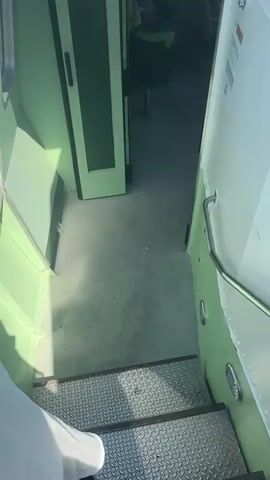
The video begins inside a passenger ferry, showing the entryway to the cabin. The cabin interior is painted a light green and has a few seats visible. The door to the cabin is open, and a few passengers are seated inside. The perspective then shifts to the exterior of the ferry, offering a view of the water and a distant coastline with buildings. The water is calm and blue, under a clear sky. The ferry appears to be moving, as indicated by the slight blurring of the distant scenery. There are other boats and buoys visible in the water. The video is shot from a low angle, giving a sense of being on the water.
Venice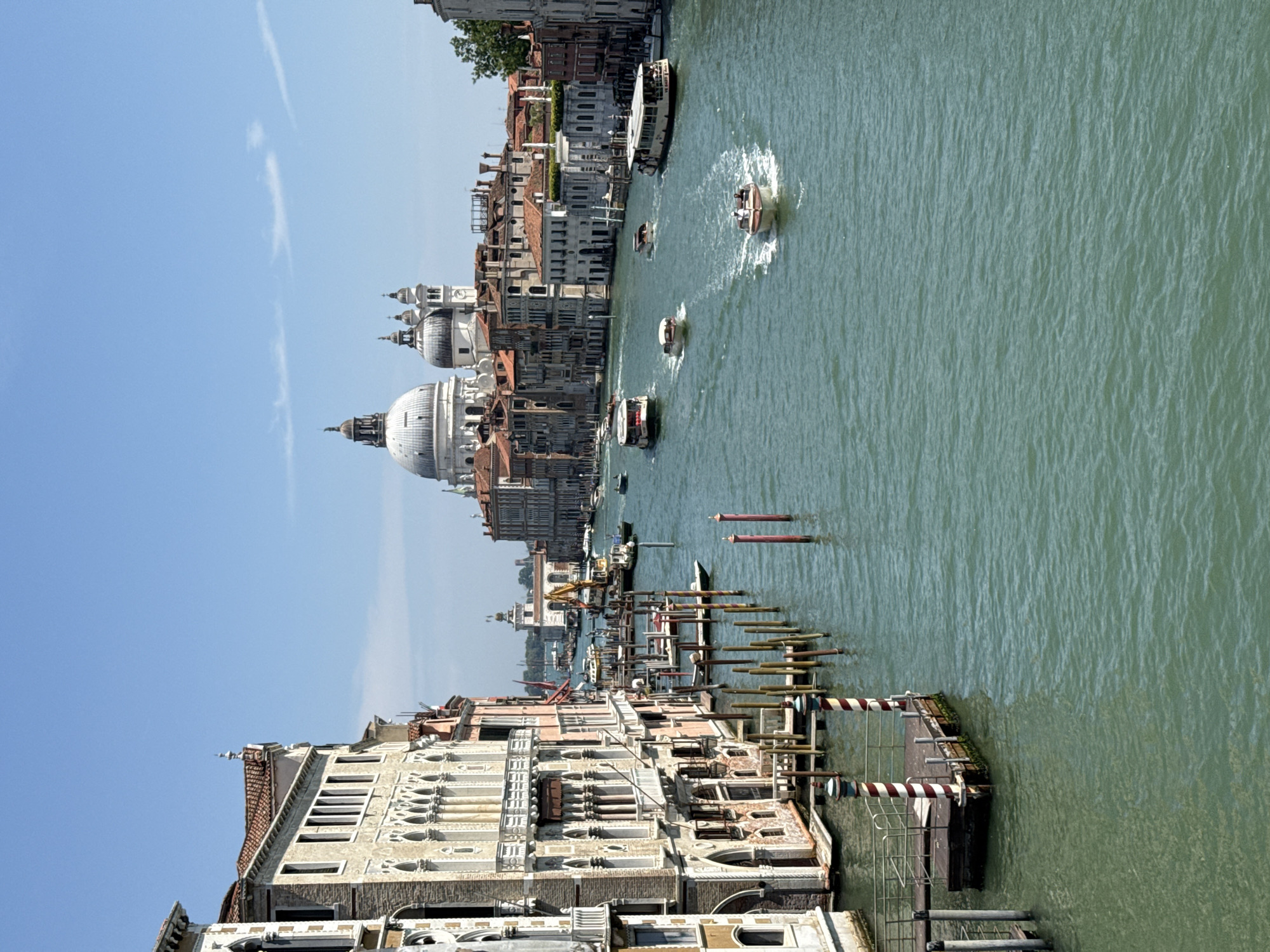
This media file depicts a sunny day in Venice, Italy, likely late morning or early afternoon given the bright light and clear blue sky. The scene is a panoramic view of a canal lined with historic buildings. The architecture is characteristic of Venice, with ornate facades, arched windows, and terracotta tiled roofs. Prominently featured is a large domed building, likely a church or basilica, with smaller domes and spires. Several boats are navigating the canal, including a larger passenger boat and smaller motorboats. One motorboat is creating a noticeable wake, indicating movement. The canal itself is a murky green, a common color for Venetian waterways, and is lined with wooden posts, some of which are striped with red and white. These posts likely serve as moorings or markers. The perspective suggests the photo was taken from a higher vantage point, possibly another building or bridge, looking down onto the canal and the surrounding architecture. The overall atmosphere is one of a bustling urban waterway in a historic European city. There is no visible text within the image.
Venice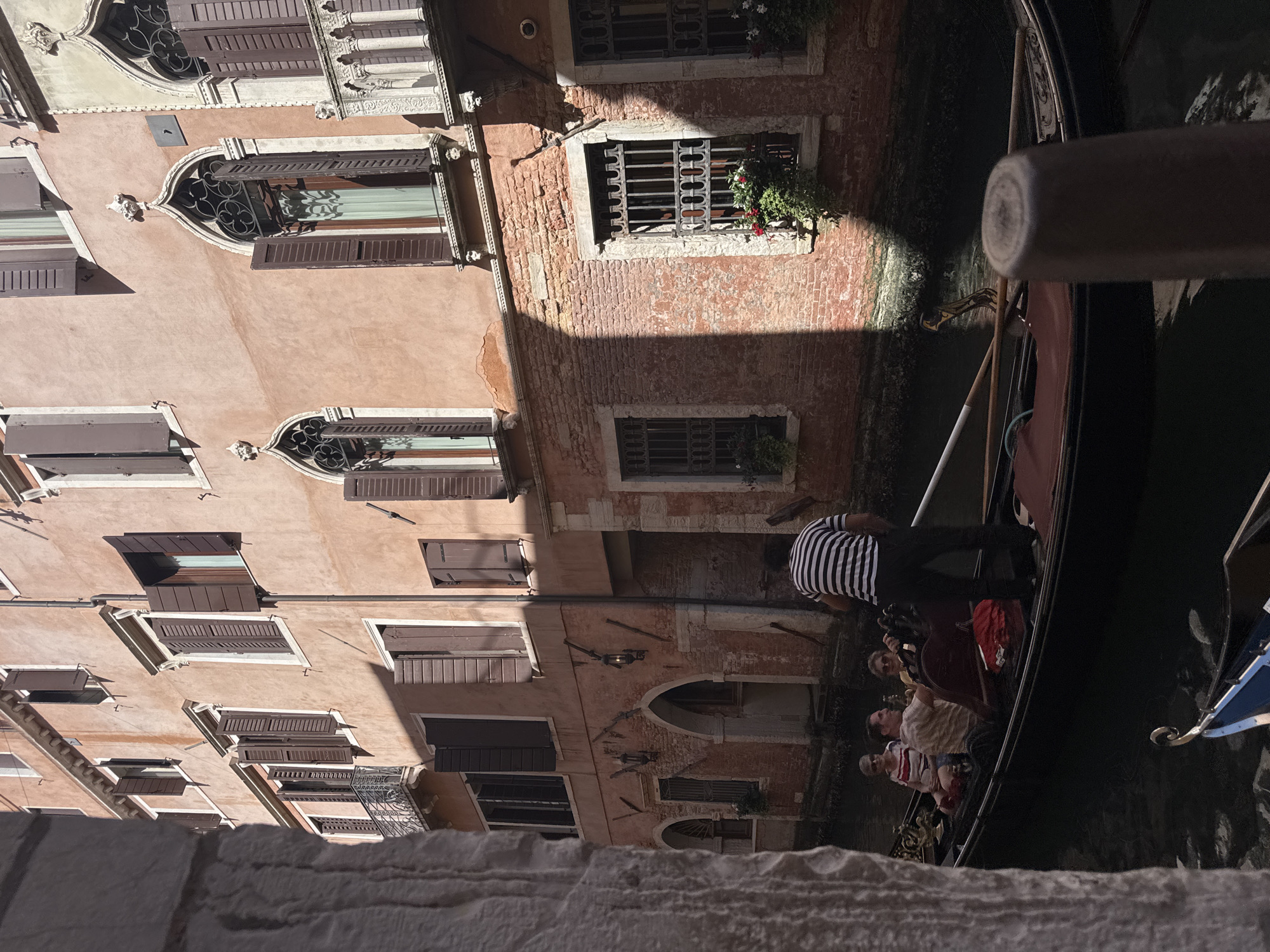
The image captures a scene in Venice, Italy, featuring a gondola carrying several people as it navigates a narrow canal. The gondola is dark green with ornate gold trim. A gondolier, wearing a black and white striped shirt and black pants, stands at the back, steering with a long oar. Inside the gondola, five passengers are seated, their faces visible. Sunlight casts strong shadows on the buildings lining the canal, suggesting it is either morning or late afternoon. The buildings are made of brick and plaster, with a warm, faded orange hue. They feature numerous windows, many with closed wooden shutters. Some windows have decorative iron grills, and a few have small potted plants with red and white flowers. Architectural details like arched doorways and intricate stonework are visible. The canal water is dark and reflects the shadows. The overall atmosphere is tranquil and evokes the classic Venetian experience. The image is shot from a slightly elevated perspective, possibly from a bridge or balcony, looking down onto the canal and gondola.
Venice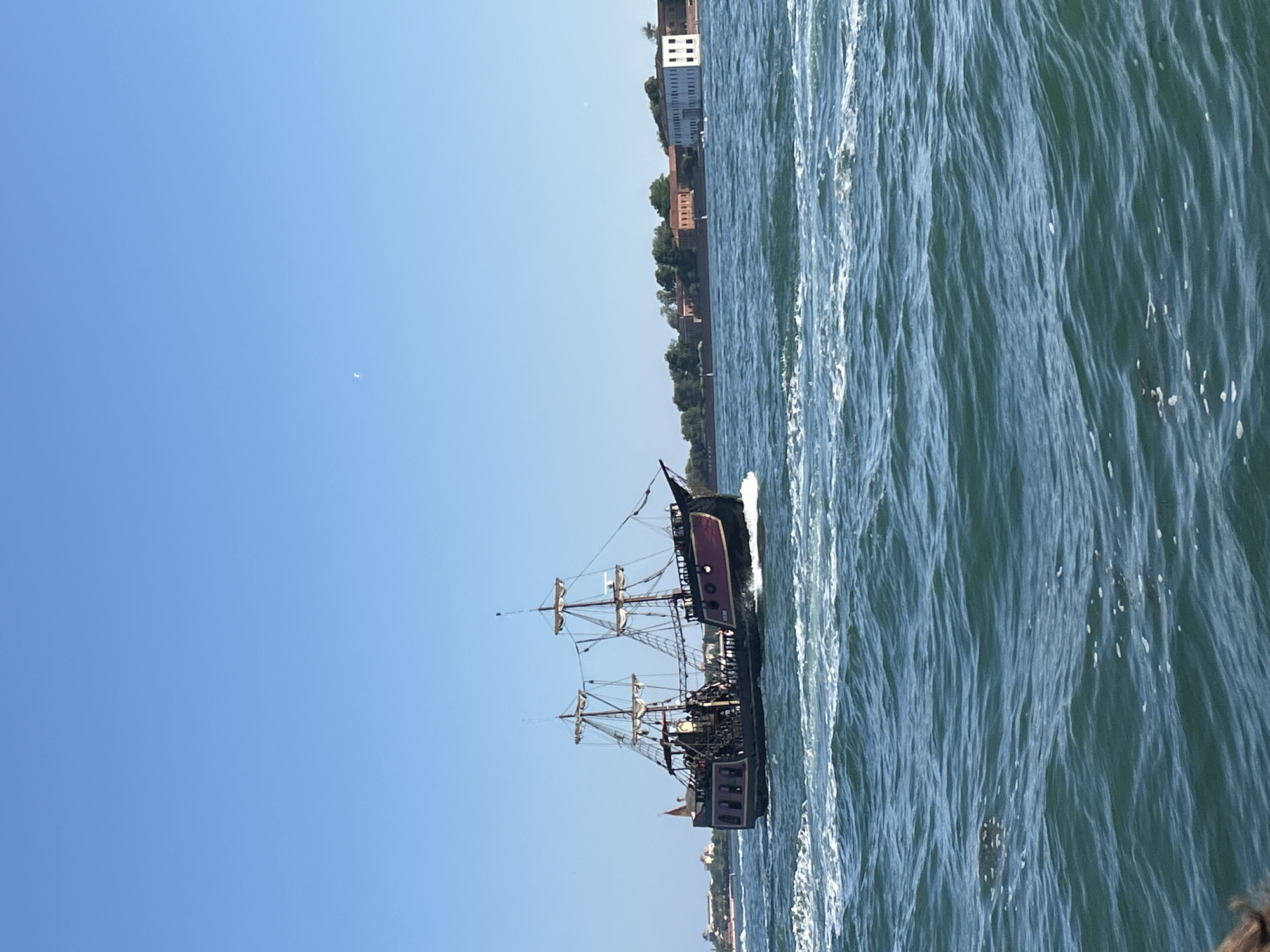
This image depicts a scenic view of a tall ship sailing on a body of water, likely a canal or bay, with a cityscape in the background. The sky is a clear, bright blue, suggesting a sunny day with good weather. The water is a deep blue-green, with noticeable ripples and whitecaps indicating movement. The tall ship is the primary subject, featuring multiple masts and sails, and appears to be an older, perhaps historical, vessel, potentially designed to resemble a pirate ship. It has dark colored hull with some ornate details and windows. The ship is in motion, creating a wake behind it. In the background, a line of buildings and trees can be seen along the shore. The architecture suggests an urban environment, and the mention of Venice as a location context strongly implies the setting is within the city's famous waterways. The buildings are varied in style, some appearing older with brickwork, while others are more modern, painted white. Green trees are interspersed among the structures. The time of day appears to be midday or afternoon, given the bright sunlight and clear sky. There are no visible people in the immediate foreground, nor is there any text present in the image. The overall impression is one of a picturesque day in a historic Italian city, with a striking nautical element dominating the scene. The image's orientation is portrait, with the ship and water filling the right side of the frame, and the sky and distant land on the left.
Venice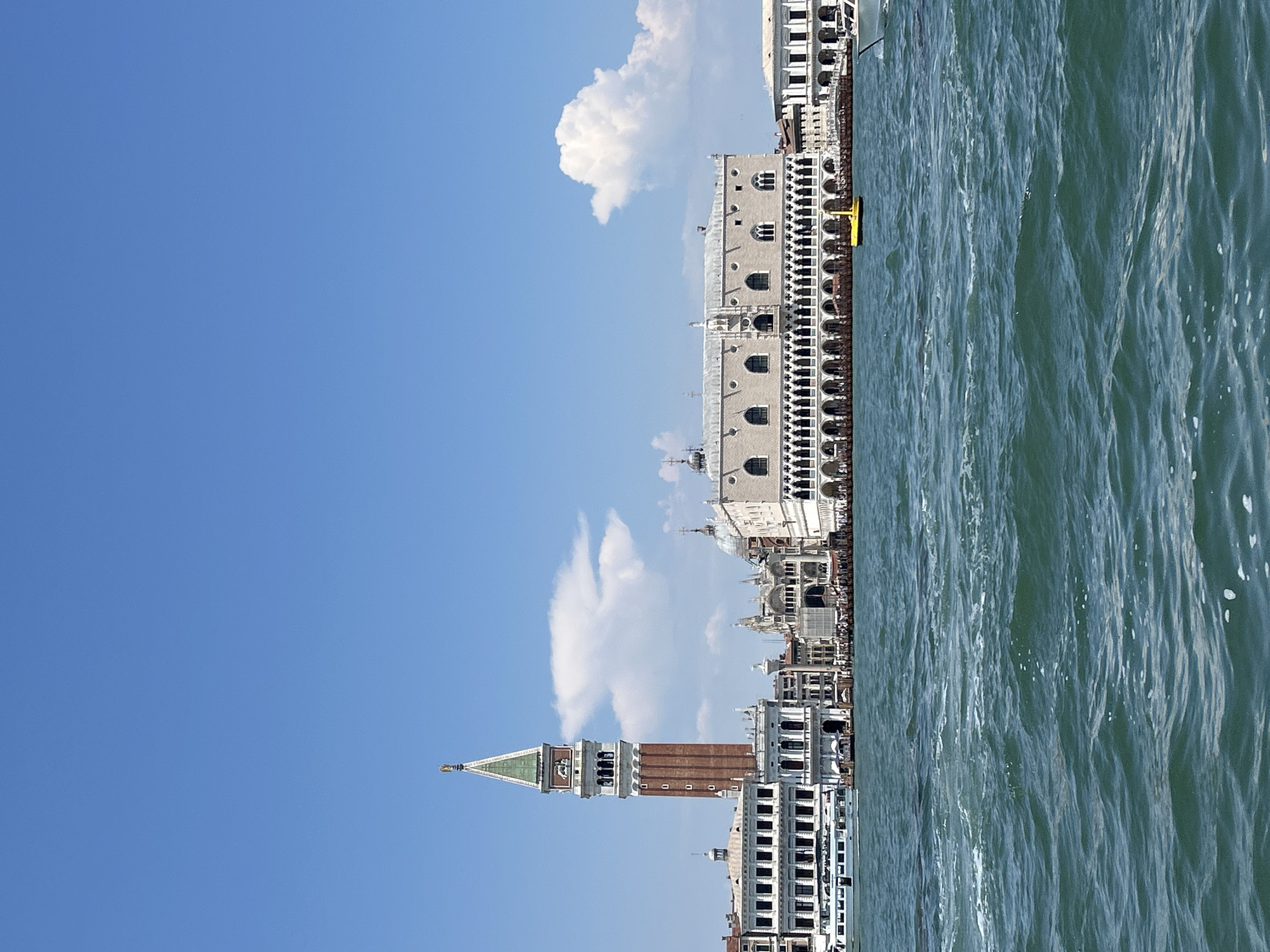
The image depicts a panoramic view of the Venetian lagoon with a historic cityscape lining the water's edge. The buildings are predominantly white and ornate, featuring arched windows and intricate architectural details, suggestive of Venetian Gothic style. Prominently featured is a tall, slender bell tower with a square base and a conical, green-tiled roof, topped with a spire. Adjacent to it, a grand, multi-story building with a long colonnade runs along the waterfront. Another imposing structure, likely the Doge's Palace, with its distinctive facade, is also visible. The water is a deep turquoise, rippling with small waves, and a bright yellow object, possibly a buoy or a small boat, is floating near the buildings. The sky is a clear, vibrant blue with a few scattered, fluffy white clouds. The sunlight suggests it is daytime, likely late morning or early afternoon, creating bright highlights on the buildings and the water. The scene conveys a sense of tranquility and historical grandeur, characteristic of Venice. There is no visible text in the image.
Venice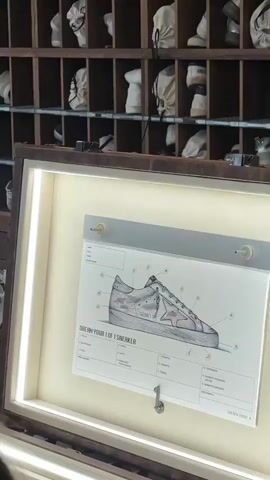
This media file captures an indoor scene, likely a retail or workshop environment, with a focus on footwear customization. A woman with long brown hair, wearing a plaid shirt and jeans, is actively engaged in presenting or explaining something to another person whose back is to the camera. Her posture and hand gestures suggest she is demonstrating a product or process. In the foreground, a display case illuminated by LED lighting showcases a detailed drawing of a sneaker. This drawing is accompanied by text, including "DREAM YOUR 1 OF 1 SNEAKER," indicating a personalized or bespoke service. Various labels and diagrams are visible on the poster, detailing the different parts of the sneaker. Behind the woman and the display, a wall is lined with numerous cubbies, each containing what appear to be shoe molds or sample shoe components. This suggests a place where shoes are designed, made, or showcased. The overall aesthetic is clean and organized, with wooden shelving and modern lighting. In the background, through glass partitions, a brightly lit workshop or studio space is visible, with equipment and workstations suggesting a manufacturing or design process is underway. Another person, a woman wearing a white top and denim shorts, is standing to the left, facing away from the camera, possibly a customer or fellow employee. While the specific time of day and weather are not discernible from the indoor setting, the bright lighting suggests it could be daytime. The presence of shoe-related displays and a workshop hints at a fashion or artisan business, potentially a shoe boutique or a custom sneaker studio. The woman's focused expression and the detailed presentation of the sneaker drawing convey a sense of expertise and engagement with the product. The context of Venice, Italy, adds a layer of potential cultural or stylistic influence to the scene.
Venice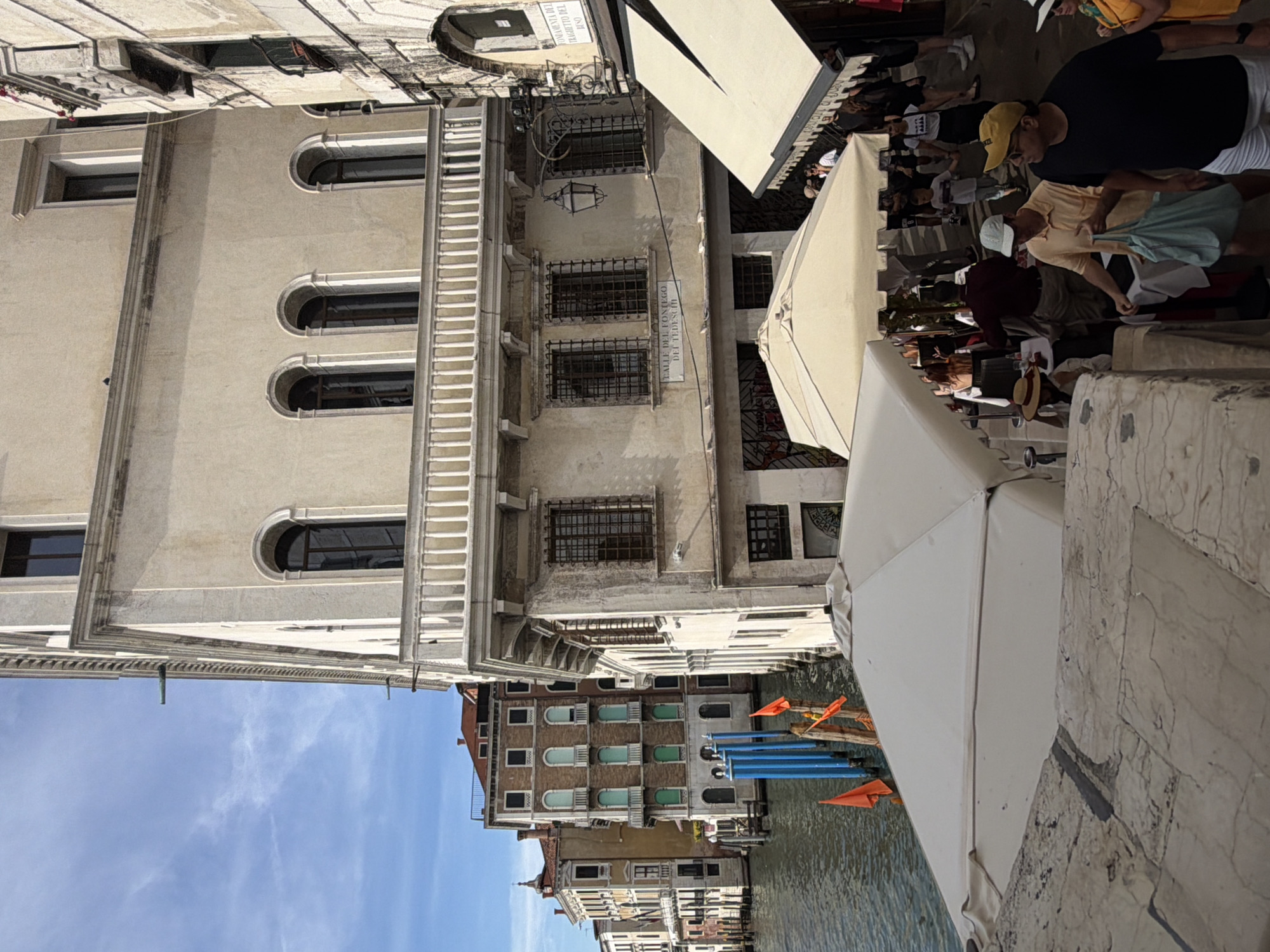
The image depicts a sunlit street scene in Venice, Italy, likely along a canal. The foreground features a stone railing and the white fabric of an awning. In the midground, several people are seen walking and interacting. A man in a yellow hat and black shirt, and another man in an orange shirt carrying a light blue bag are prominent. Behind them, a white umbrella shades a seating area, and a building with arched windows and decorative railings rises in the background. Orange flags are visible near blue poles in the water, suggesting a canal or waterfront area. The architecture is characteristic of Venetian buildings, with multiple stories, traditional windows, and weathered facades. The sky is blue with scattered clouds.
Venice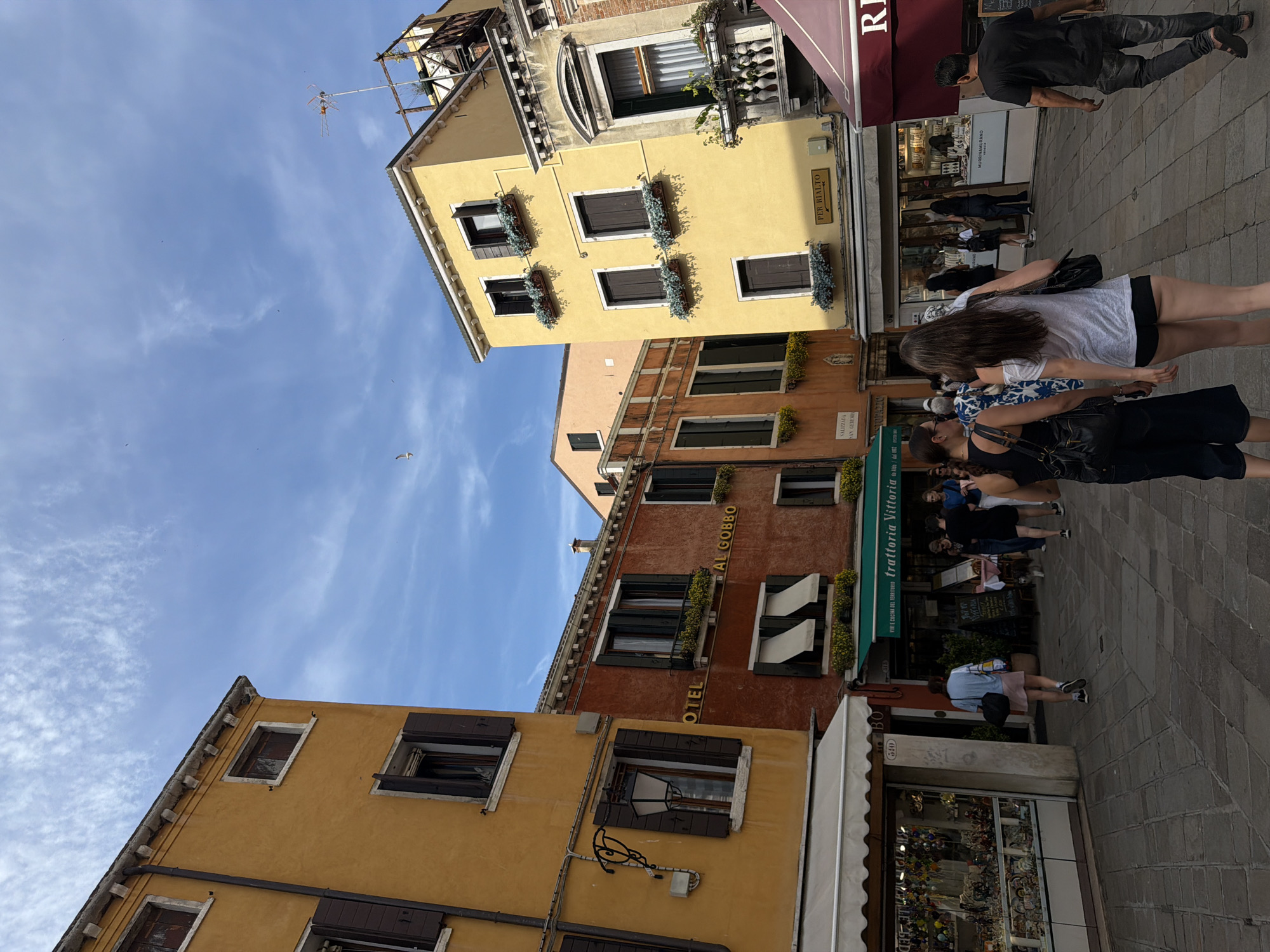
This is a photograph of a street scene in Venice, Italy. The image depicts several buildings with distinct Venetian architecture, characterized by their colorful facades (yellow and reddish-orange) and shuttered windows. In the foreground, a cobblestone pavement is visible, suggesting a pedestrian area. Several people are present in the scene, walking along the street or in front of shops. On the left, a person in a blue shirt and pink shorts walks away from the camera. In the center, two women are walking towards the camera, one with long dark hair wearing a white off-the-shoulder top and black shorts, and the other wearing a dark top and dark skirt. A man in a black t-shirt and jeans is walking away from the camera on the right. Other individuals are visible further in the background, in front of shops and restaurants. Various shops and businesses are identifiable. A shop with a white awning and displays of merchandise is on the left. A restaurant or trattoria with green awnings and outdoor seating is visible in the middle, with a sign reading "trattoria Vittoria". Another establishment with a dark red awning is on the right, with text partially visible. The overall atmosphere suggests a lively commercial area in Venice. The sky above is blue with scattered clouds.
Venice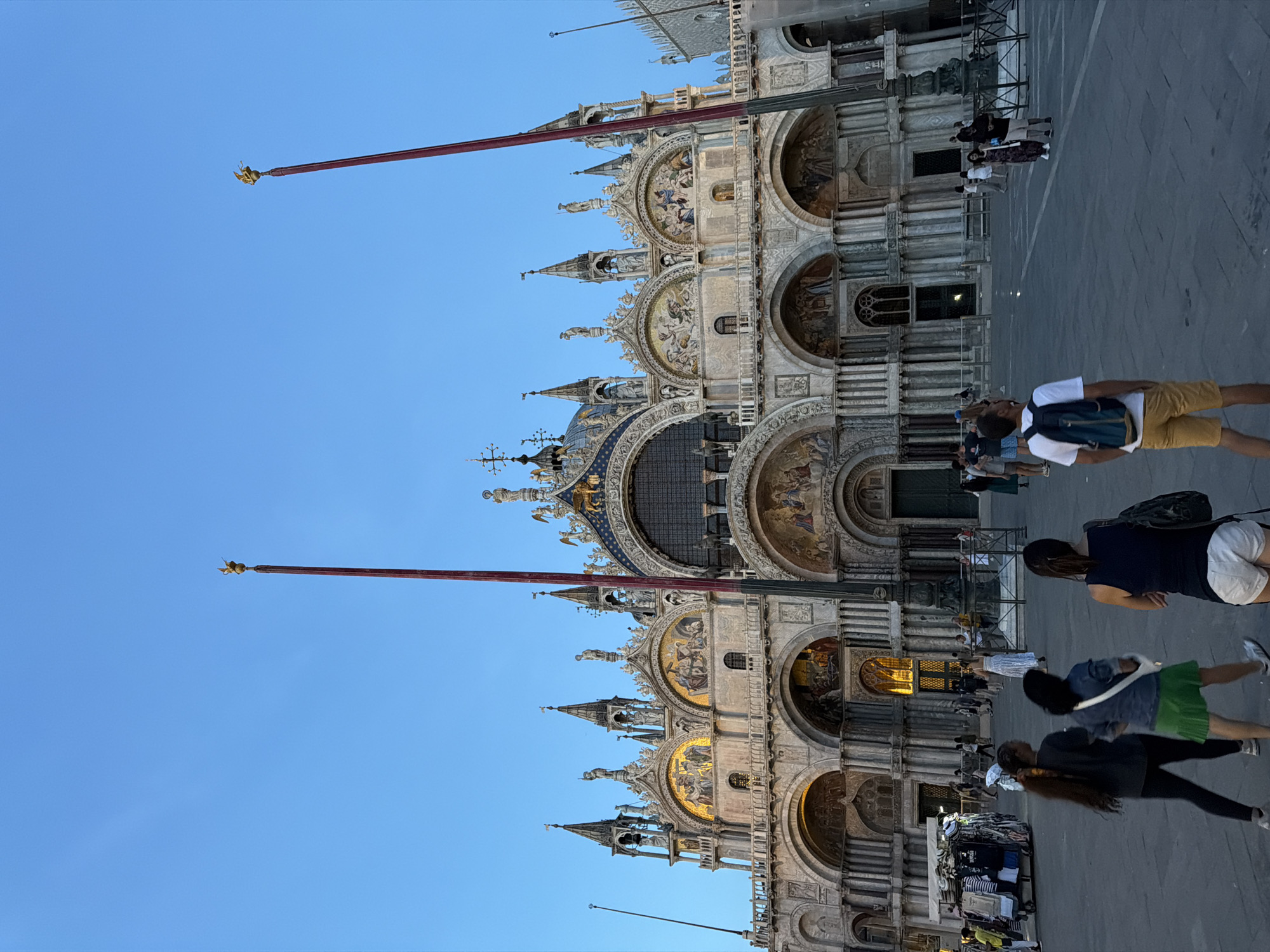
This image depicts St. Mark's Basilica and a portion of St. Mark's Square in Venice, Italy, at dusk or early evening. The prominent Byzantine facade of the basilica dominates the background, featuring multiple arches adorned with intricate carvings, statues, and glowing golden mosaics depicting religious scenes. Several spires and architectural details rise above the main structure, contributing to its ornate appearance. Framing the basilica in the mid-ground are two tall, slender flagstaffs, painted a deep red, each topped with a golden, winged lion finial, the symbol of Venice. The square itself is paved with dark gray flagstones and is populated by numerous people. In the foreground, with their backs to the camera, are several individuals: a person wearing a white t-shirt, yellow shorts, and a blue backpack, looking towards the basilica; to their left, three women are walking, one with long dark hair, a dark top, and black leggings, another in a denim jacket, green pleated skirt, and white cross-body bag, and the third in a dark top and white shorts. Further into the square and closer to the basilica, many other pedestrians are visible, moving about or standing. On the far left of the frame, a mobile vendor's cart, laden with apparel, is situated near the basilica's lower arches. The sky above is a clear, deep blue, contrasting with the illuminated architectural elements of the basilica.
Venice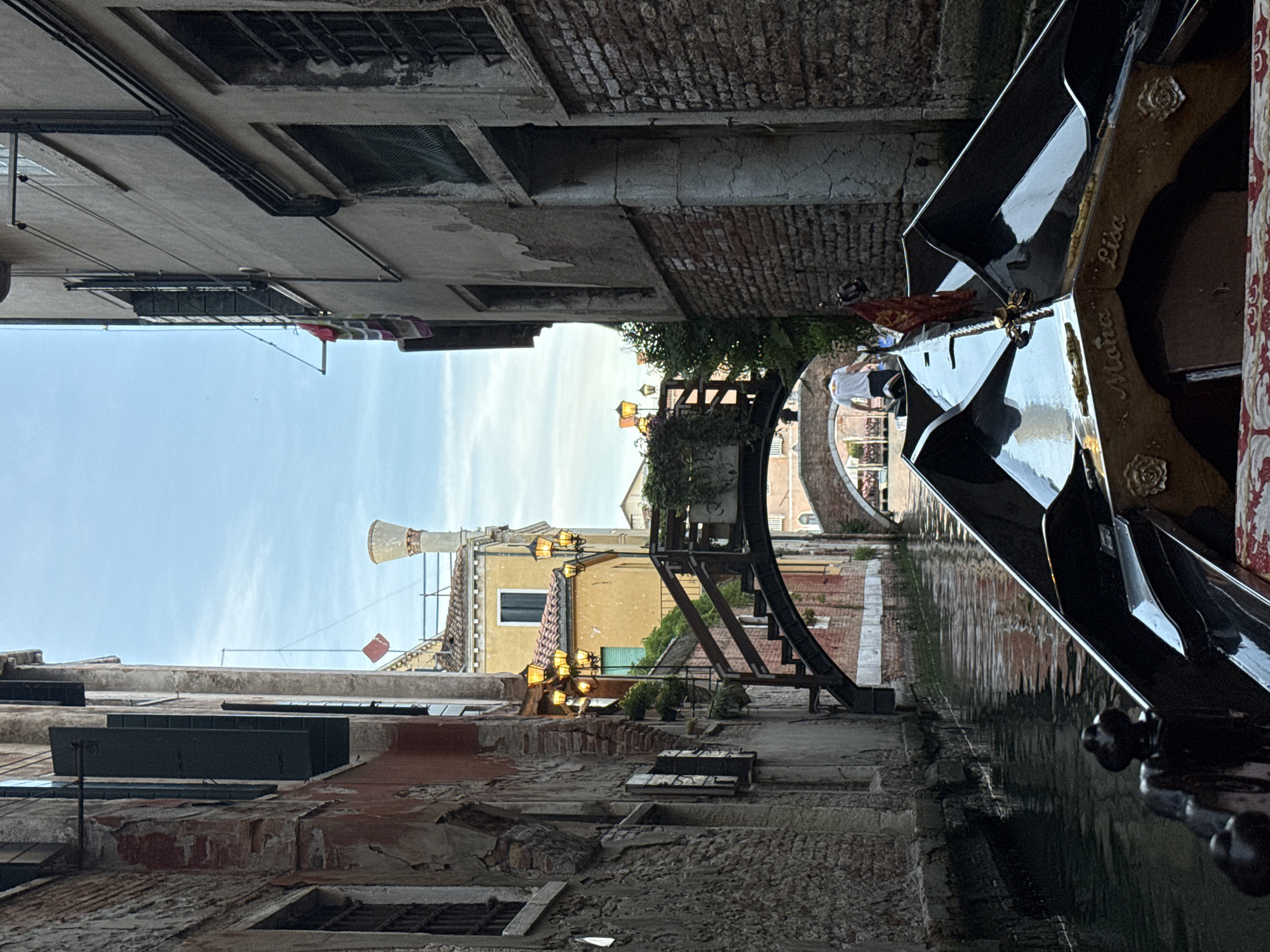
The image depicts a forward-facing view from inside a gondola navigating a narrow canal in Venice, Italy. The gondola's ornate bow, featuring a reflective black surface and gold accents, is prominent in the lower foreground, with the name "Mona Lisa" inscribed on its decorative wooden section. A small red flag with a golden emblem is affixed to the bow. The canal water is dark green, reflecting the surrounding architecture with visible ripples. Tall, aged buildings constructed of brick and plaster line both sides of the canal. The building on the left exhibits exposed red brickwork and weathered plaster, with dark closed shutters on windows. The building on the right is predominantly light-colored plaster, also showing signs of age, with grates on some windows and clothes hanging on a line high up. In the mid-ground, a pedestrian bridge with an arched metal structure and wooden steps spans the canal. Ornate, warm-toned streetlights are illuminated on this bridge and on a yellow building beyond it. Green foliage and planters adorn the bridge. A person wearing a white t-shirt and a light-colored hat is visible walking under this bridge, facing away from the viewer. Further down the canal, another stone arch bridge is visible. The sky above is a light blue with some scattered clouds. Typical Venetian chimneys and an antenna are visible on distant rooftops.
Venice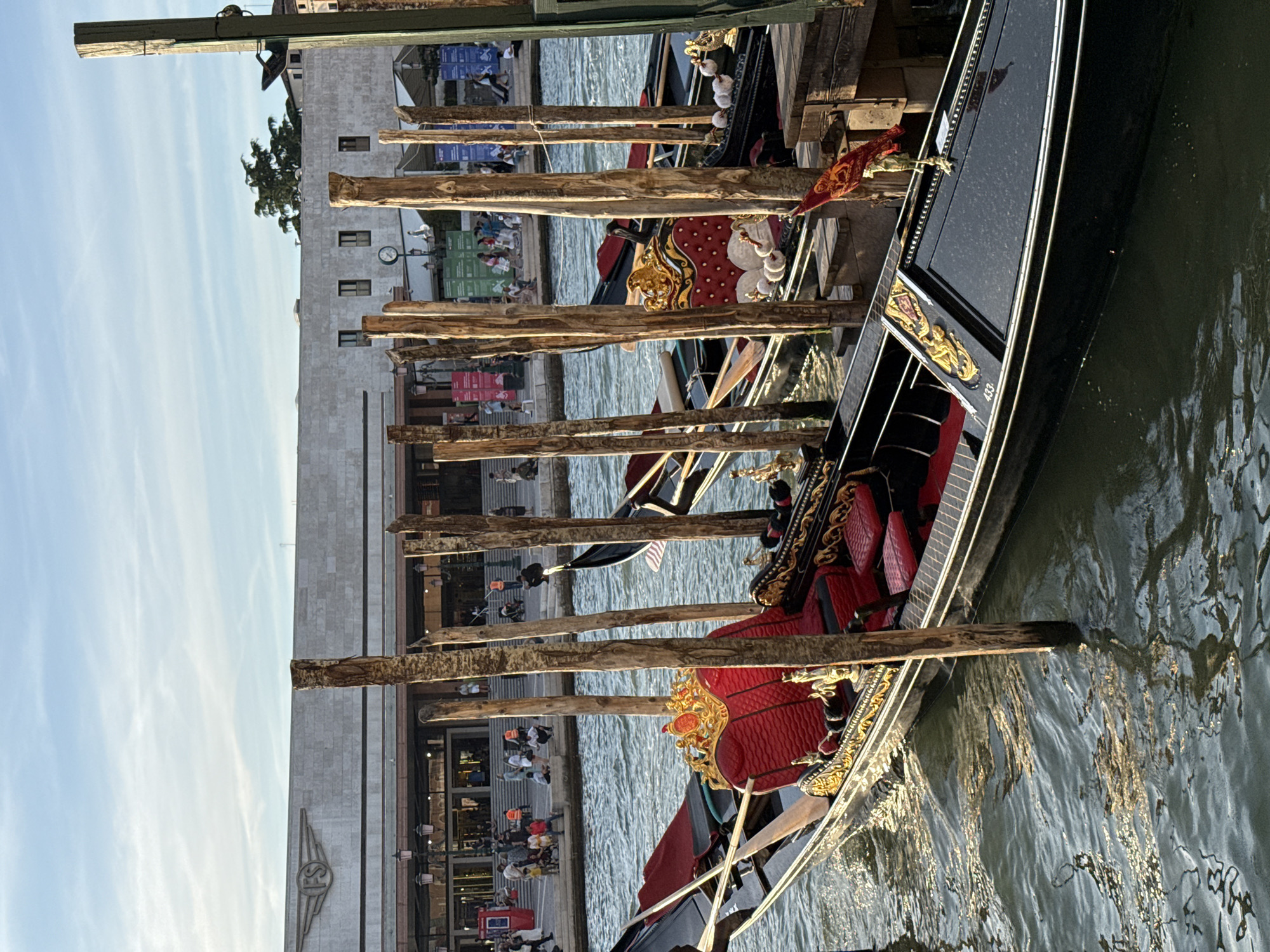
The image depicts a canal scene in Venice, Italy, with the Santa Lucia train station visible in the background. In the foreground and midground, multiple traditional black gondolas are moored to weathered wooden poles (paline) in the water. Each gondola features ornate red upholstered seating, often with prominent gold trim and decorative elements, including an "FS" logo, visible on the station's facade. The water exhibits ripples and reflections of sunlight. On the distant bank, a large, light-colored building, identified as the Santa Lucia train station by the "FS" (Ferrovie dello Stato) emblem on its upper left facade, serves as the backdrop. The station features numerous windows and multiple entrances at ground level. A clock is visible on the building's right side. A significant number of individuals are present on the wide pedestrian plaza in front of the station, engaged in various activities such as walking, standing, and sitting on steps. Lampposts and colorful promotional banners are also discernible on the plaza. The sky above is light blue with scattered wispy clouds, indicating a bright, clear day. A small red flag with a yellow emblem is attached to one of the gondolas on the right side of the frame.
Venice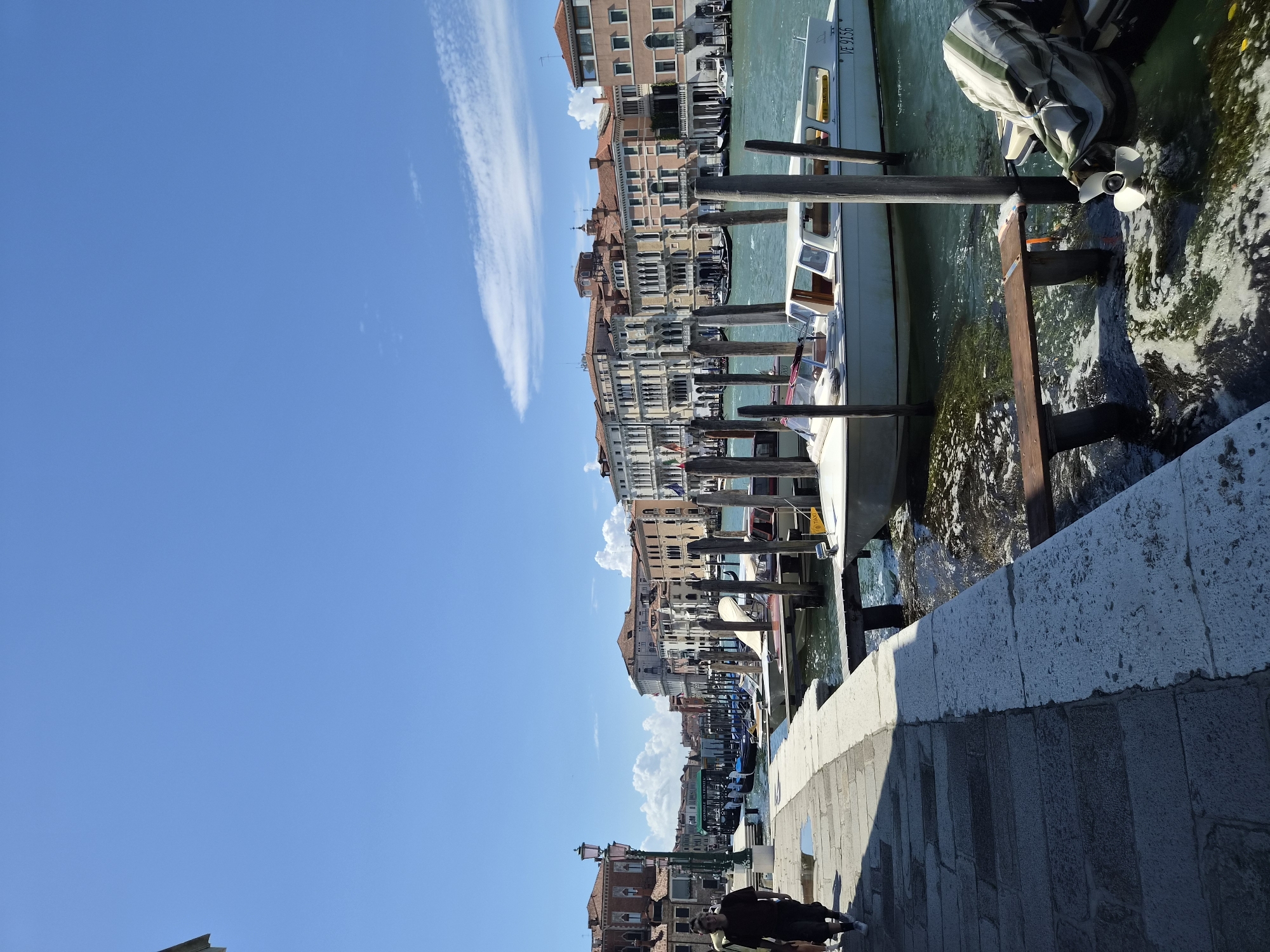
The image depicts a sunlit canal scene in Venice, Italy, likely the Grand Canal, viewed from a *fondamenta*. The sky is clear blue with scattered white cumulus clouds. In the foreground, a stone walkway runs diagonally from the lower left towards the mid-left. The left half of the walkway is in shadow, while the right edge, bordering the canal, is brightly lit. A male figure, dressed in a dark t-shirt and dark shorts with white shoes, walks away from the camera on the shadowed portion of the walkway. A small puddle is visible on the walkway near him. To the right of the walkway, the canal features several wooden mooring posts. A white motorboat, identified as a "TAXI" with the registration "VE 9156," is prominently docked. Further right, an outboard motor with a white propeller, partially covered by a green and white striped tarp, is visible in the water. The water itself is a murky greenish-blue, with extensive patches of dark green algae or seaweed floating near the bank and around the boats. A small, crude wooden bench or platform is partially submerged in the water amidst the algae. In the mid-ground and background, a continuous line of multi-story historic Venetian buildings with terracotta roofs, classical facades, numerous windows, and balconies extends along the far bank of the canal. The buildings exhibit warm tones of yellow, ochre, and red. Several gondolas are moored near a green bridge in the distance, and a sign partially visible above them reads "GONDOLE". A black lamppost with two green lanterns stands on the promenade to the left. The canal recedes into the distance, lined by more buildings and boats.
Venice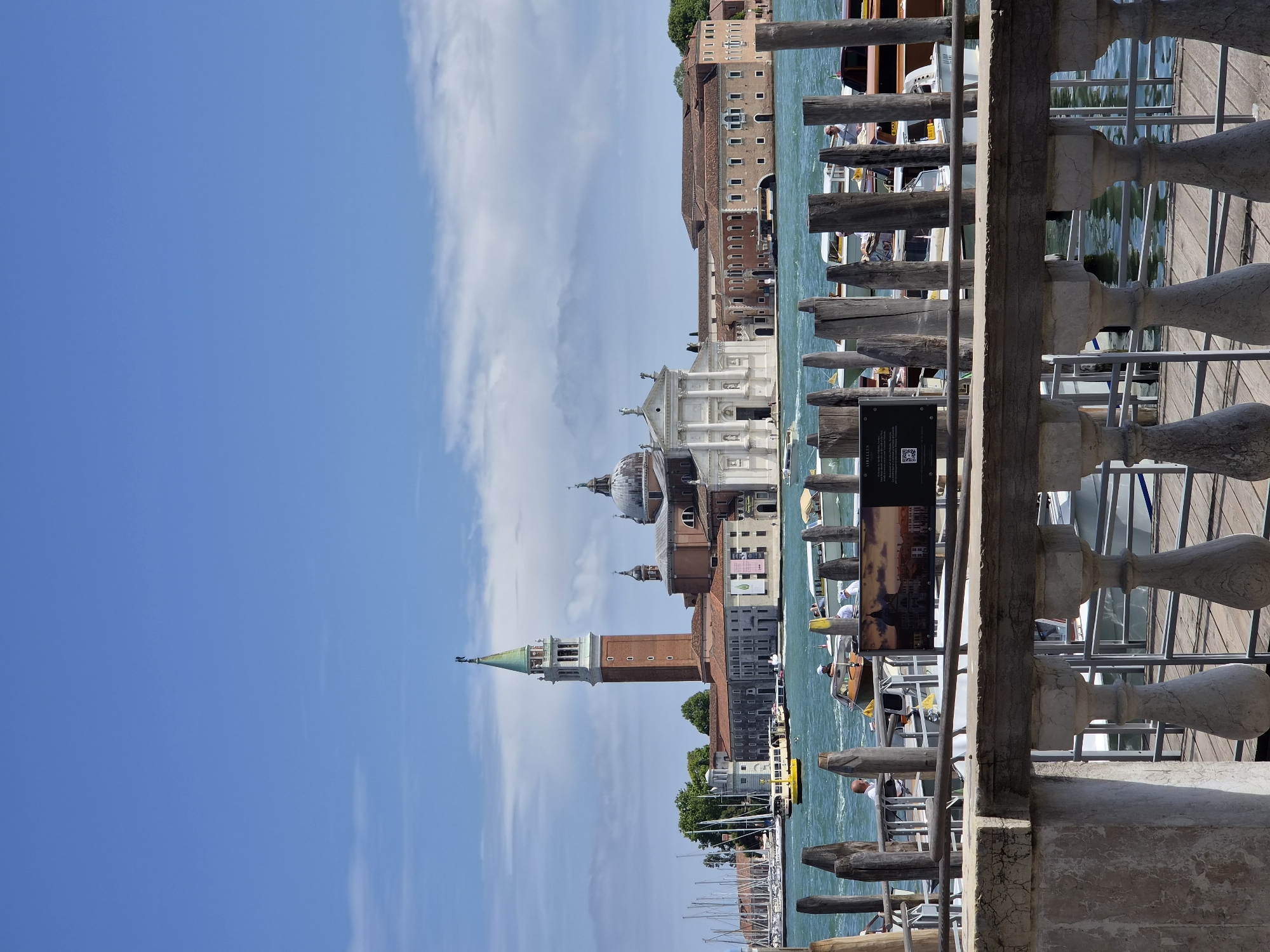
This daytime image captures a panoramic view of the Giudecca Canal in Venice, Italy, looking towards the island of San Giorgio Maggiore. The sky is clear blue with sparse, wispy white clouds scattered across the horizon. In the mid-ground, the prominent structures of San Giorgio Maggiore dominate the scene. On the left, a tall, reddish-brown brick campanile (bell tower) with multiple arched openings rises, topped by a green conical spire and a dark, slender statue. To the right of the campanile, the white, classical facade of the Basilica di San Giorgio Maggiore is visible, featuring columns, sculpted figures in niches, and a large dome situated behind the facade. Further to the right, a series of lower, reddish-brown buildings with numerous windows, part of the monastery complex, extend along the island's waterfront. To the far left, a marina with several sailboats docked is partially visible. The water in the canal is a choppy blue-green. A yellow vaporetto (public water bus) is visible in the mid-ground, moving from left to right and leaving a distinct wake. Various other motorboats and water taxis, some with white canopies, are scattered across the canal, several with visible passengers. In the immediate foreground, a light-colored stone balustrade with ornate balusters runs horizontally across the bottom section of the frame. Behind the balustrade, a wooden pier or dock structure is present, featuring numerous tall, weathered, dark brown wooden mooring posts ("bricole") that extend vertically into the water. Two rectangular dark signs are mounted on the pier; the left sign shows a landscape image, text, and a QR code, while the right sign also features a landscape image. Several people are visible on the pier and in the foreground boats, including a man in a white shirt situated in a boat or on the pier in the lower-left portion of the frame.
Venice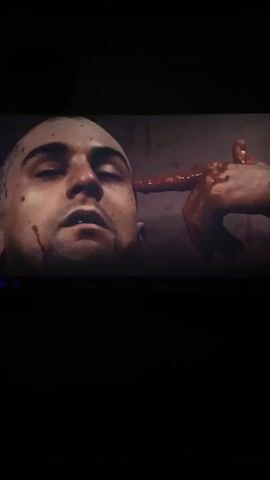
A close-up shot features a bloodied man, resembling Robert De Niro, with short dark hair, looking upward and slightly to the left. His right hand, also covered in blood, has its index finger pressed against his right temple, mimicking a gun. Blood streaks are visible on his face and neck. He takes a slow, deep breath. The background is dark and indistinct.
Venice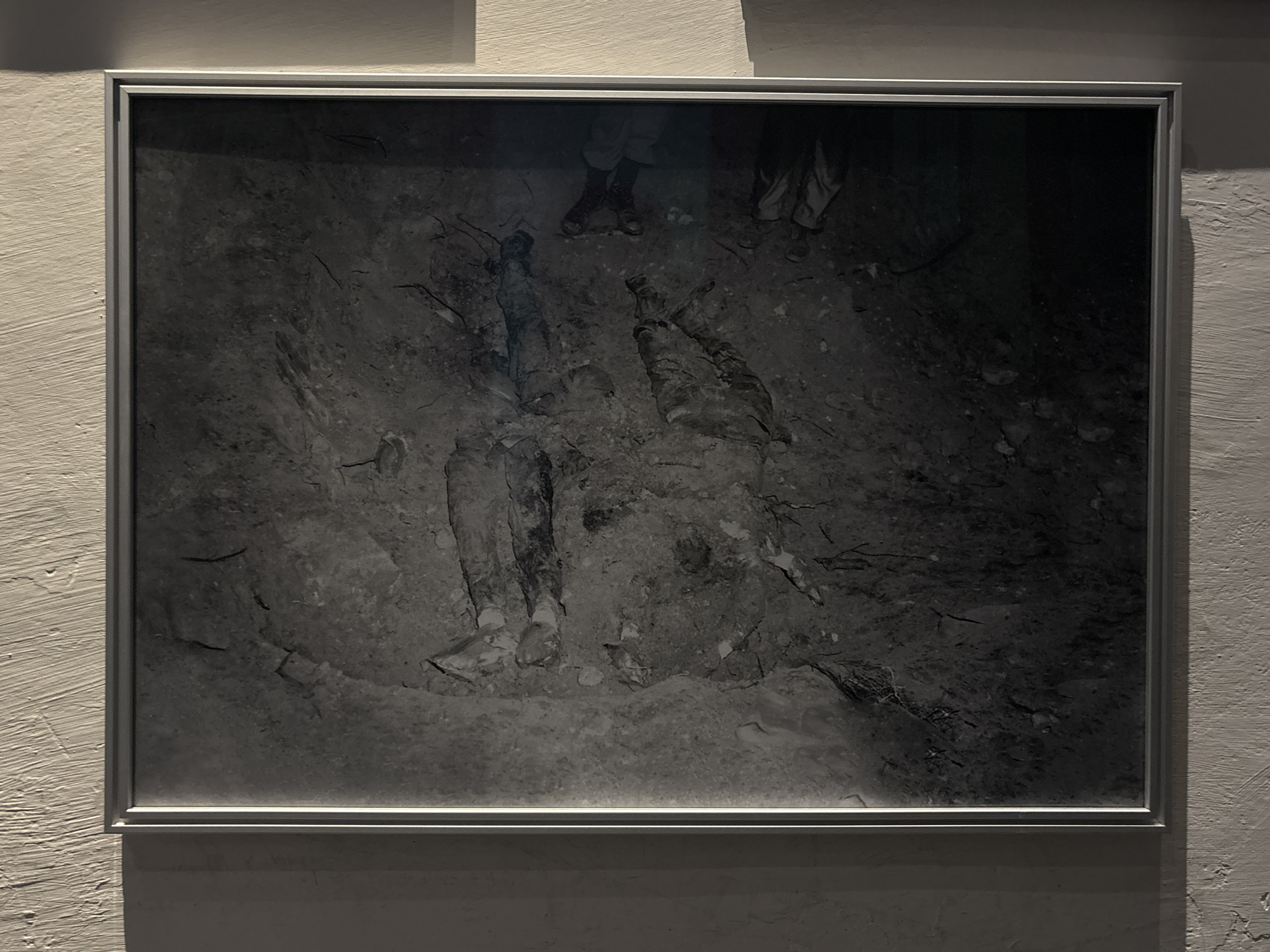
The image displays a framed, black and white photograph mounted on a textured, light-colored wall. The photograph depicts a somber scene within what appears to be an excavation site or a trench, characterized by disturbed earth, soil, and debris. Within the photograph, the partially exposed remains of at least three human bodies are visible. These figures are recumbent on the ground, with portions of their limbs and torsos discernable through the soil. Their clothing, although soiled and indistinct due to the monochromatic presentation, is visible on segments of their forms. In the upper section of the photograph, the lower extremities of two living individuals are present. One individual is clad in sturdy, dark boots and trousers, positioned to the left of center. Another individual, to the right, wears lighter footwear and trousers. These living figures appear to be standing over or observing the scene depicted on the ground. The photograph is encased in a simple, silver-toned metallic frame. The wall behind the frame exhibits a coarse, light-toned texture. A thin, linear light fixture is positioned below the bottom edge of the frame, illuminating the area. No visual information within the image content, including the photograph itself or its immediate display environment, provides specific details regarding its location in the city of Venice, Italy.
Venice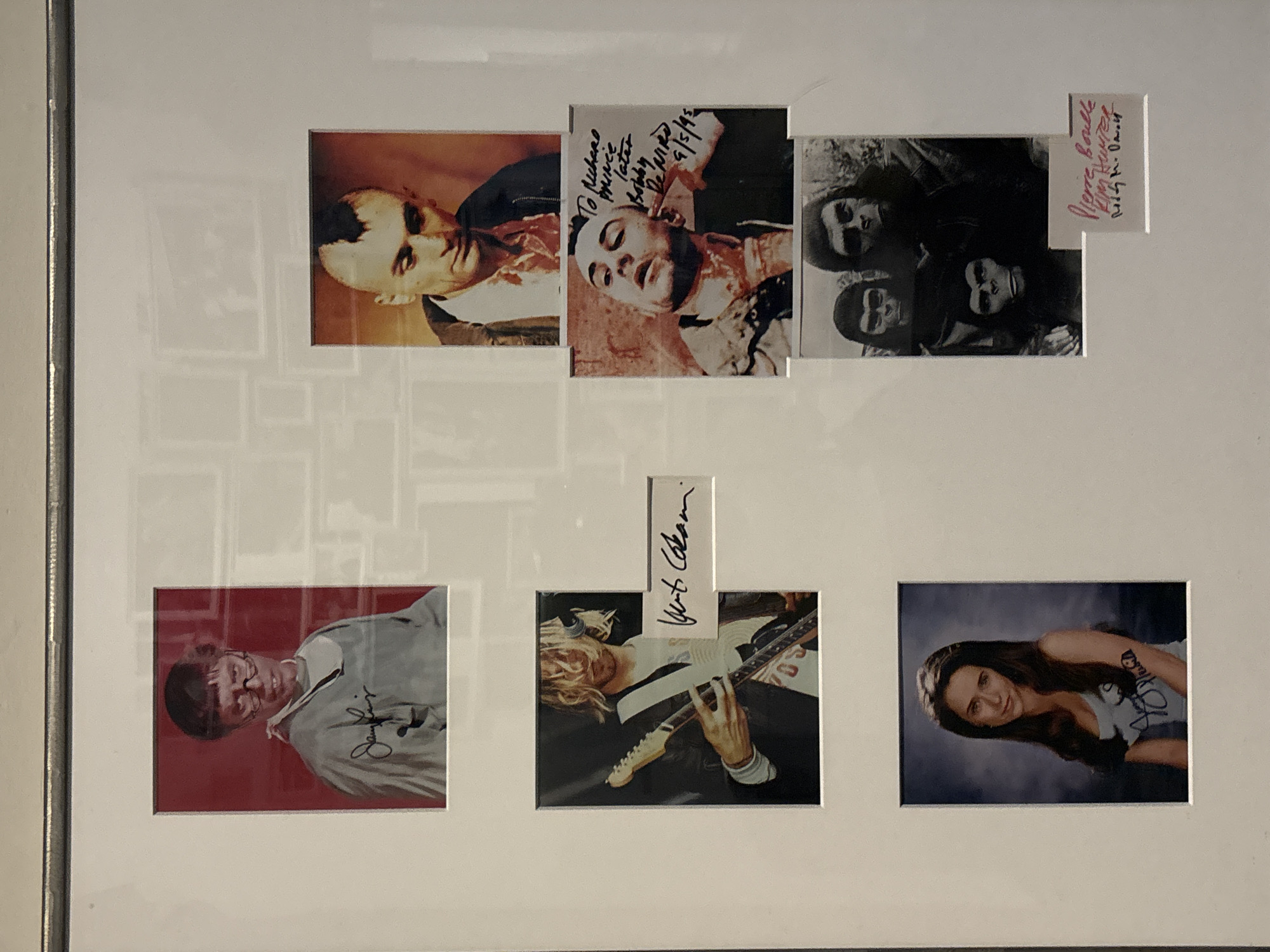
This image displays a collection of six autographed photographs, framed together under glass with a white mat. The frame itself is metallic. The setting is in the city of Venice, Italy. The photographs are arranged in three rows: **Top Row:** * **Left:** A color photograph of actor Jerry Lewis portraying Professor Julius Kelp from *The Nutty Professor*. He is shown from the chest up, wearing glasses and a light-colored smock, against a red background. His autograph, "Jerry Lewis," is visible in the lower left portion of the image. * **Right:** A color photograph of actor Robert De Niro as Travis Bickle from *Taxi Driver*, featuring his iconic mohawk haircut. He is depicted looking down, with visible bloodstains on his shirt. **Middle Row:** * **Left:** A color photograph of musician Kurt Cobain playing a guitar, with his long blonde hair partially obscuring his face. His autograph, "Kurt Cobain," is presented on a separate white slip of paper placed next to the photograph. * **Right:** A color photograph of Robert De Niro again as Travis Bickle, covered in stage blood and looking upwards. An inscription on the photo reads, "To Richard Prince later Bobby De Niro 9/15/95." **Bottom Row:** * **Left:** A color portrait photograph of actress Jennifer Love Hewitt as a young woman, with long dark hair and wearing a white tank top, against a blue background. Her autograph, "Jennifer Love Hewitt," is visible on her top. * **Right:** A black and white photograph depicting three individuals in ape costumes from *Planet of the Apes*. Two figures are prominent in the foreground, with a third slightly behind. An inscription on a separate white slip of paper below the photo lists names: "Pierre Boulle," "Kim Hunter," and "Roddy McDowall."
Venice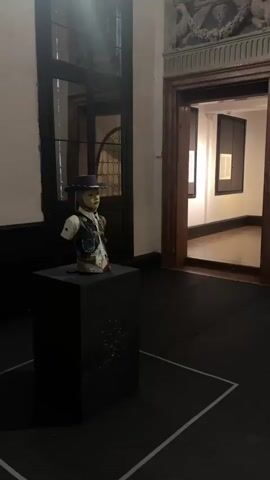
The video opens in an art gallery, displaying a stylized bust on a dark rectangular pedestal to the left. The bust depicts a figure with a light-colored face, a hat, a white shirt, and a dark vest. Behind it, a large window or glass door is visible. To the right of the bust, a dark wooden archway leads into another room with white walls and framed artwork. The floor is dark with white tape outlining a rectangular section in the foreground. The camera then slowly pans to the right, revealing a large contemporary painting on the wall. The painting features multiple figures, some appearing partially draped or nude, in various poses against a dark, reddish-brown background. A red fire extinguisher is mounted on the wall beneath the painting. As the camera continues to pan, it focuses on different sections of the painting, highlighting more of the figures and their distorted forms. The video concludes with the camera panning across the right side of the large painting.
Venice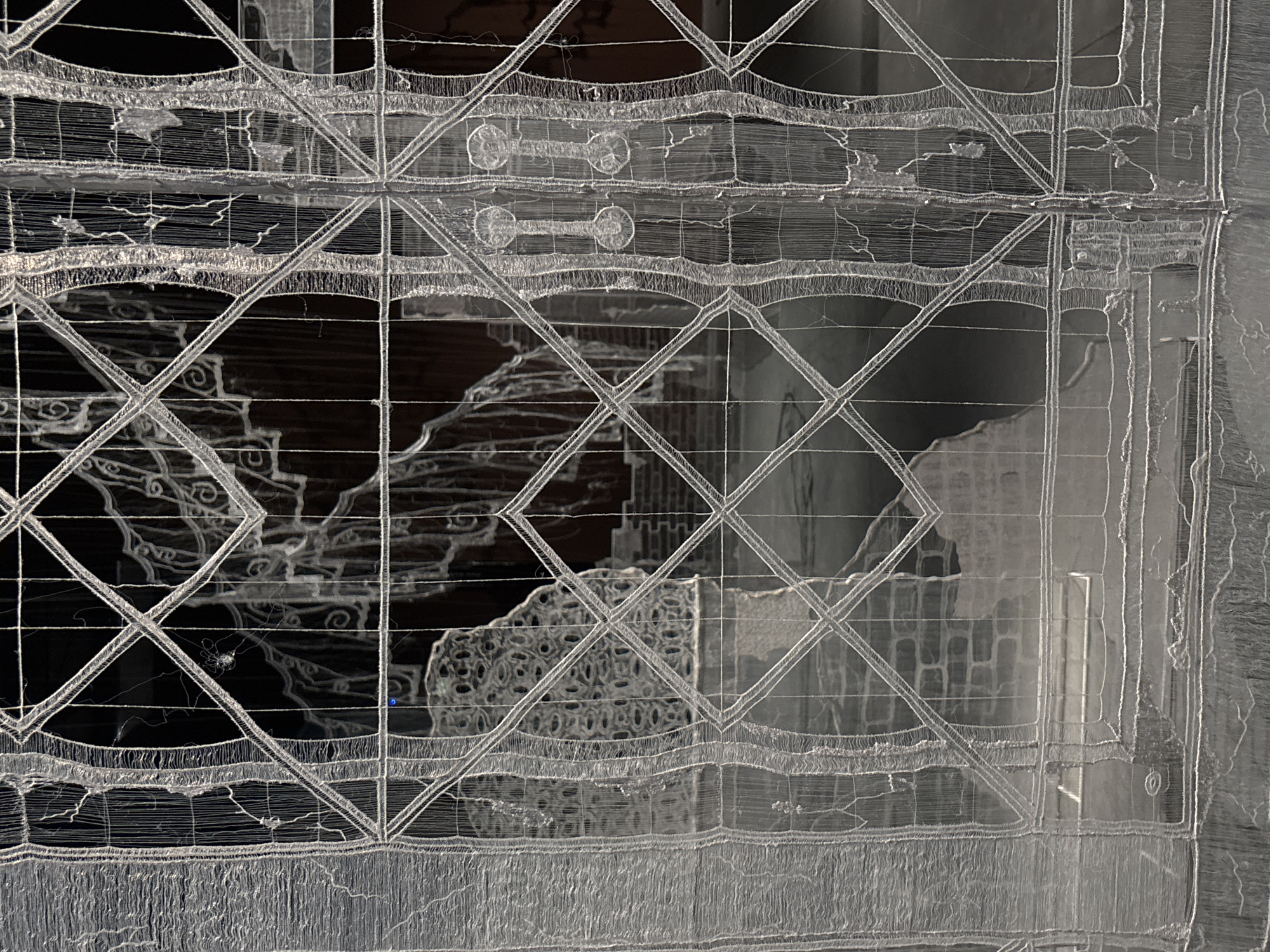
The image displays a translucent, white, 3D-printed architectural screen or facade, intricately designed to resemble a traditional window or ornate grille. The screen occupies the majority of the foreground, featuring a grid of intersecting diagonal lines forming diamond-shaped panes, interspersed with vertical, architecturally-inspired elements that mimic pilasters or mullions. These vertical sections exhibit a textured, almost corrugated appearance, and on the right, two distinct knob-like handle forms are present. The construction of the screen reveals its filament nature, with visible fine strands and layered patterns indicative of 3D printing technology. Through the translucent material, a dimly lit, out-of-focus background is discernible. On the left side, an abstract, textured, and porous sculptural form is visible. Towards the center-right and bottom, sections of a reddish-brown brick wall, characteristic of older European architecture, can be seen. The overall background suggests an interior space, possibly a historical building or courtyard. This specific type of delicate, 3D-printed architectural installation, often evoking Venetian lace and Gothic design elements, is associated with contemporary art and architecture exhibitions, such as those featured during the Venice Architecture Biennale in Venice, Italy. These installations are frequently placed within the city's historic palazzi or exhibition spaces, creating a dialogue between modern technology and traditional Venetian aesthetics. No people, discernible subjects, or explicit actions are present within the frame; the scene focuses entirely on the interplay between the foreground installation and its architectural backdrop.
Venice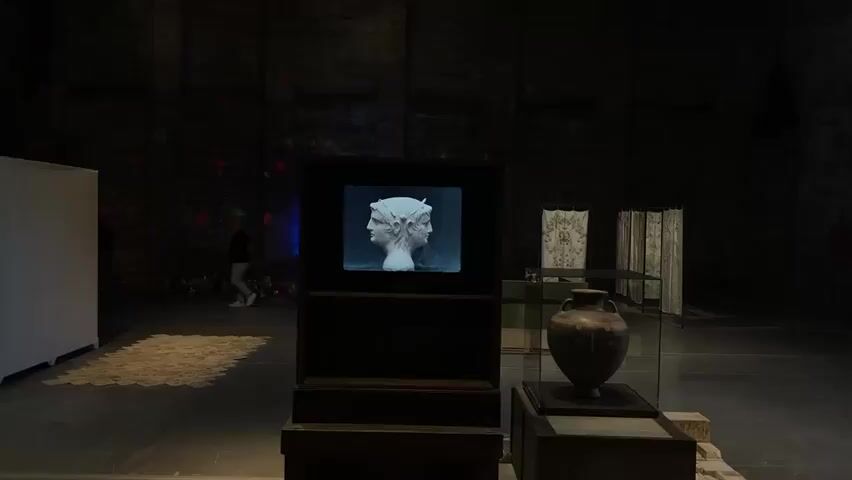
The video depicts a dimly lit exhibition space, likely an art gallery or museum in Venice, Italy. In the center, a monitor displays a static image of a classical-style, white, double-faced bust, resembling Janus, with two faces looking in opposite directions. The bust has a weathered texture and distinct classical features, including horned elements on its head. To the right of the central display, an antique-looking, dark brown ceramic urn or vase with handles is showcased within a glass display case, resting on a wooden base. Further back on the right, two panels of patterned fabric or tapestries hang, adding to the decorative elements of the exhibit. On the left side of the frame, a white panel or wall is visible. A person is seen walking in the background, partially obscured and moving from left to right, their presence indicated by subtle light reflecting off them. The floor is dark, and in the mid-ground on the left, a patch of lighter-colored, possibly textured material, is laid out. The overall lighting is low, with strategic illumination highlighting the exhibits. The background also features faint, shifting colored lights, including blue, green, and red, creating a dynamic, atmospheric effect against the dark walls.
Venice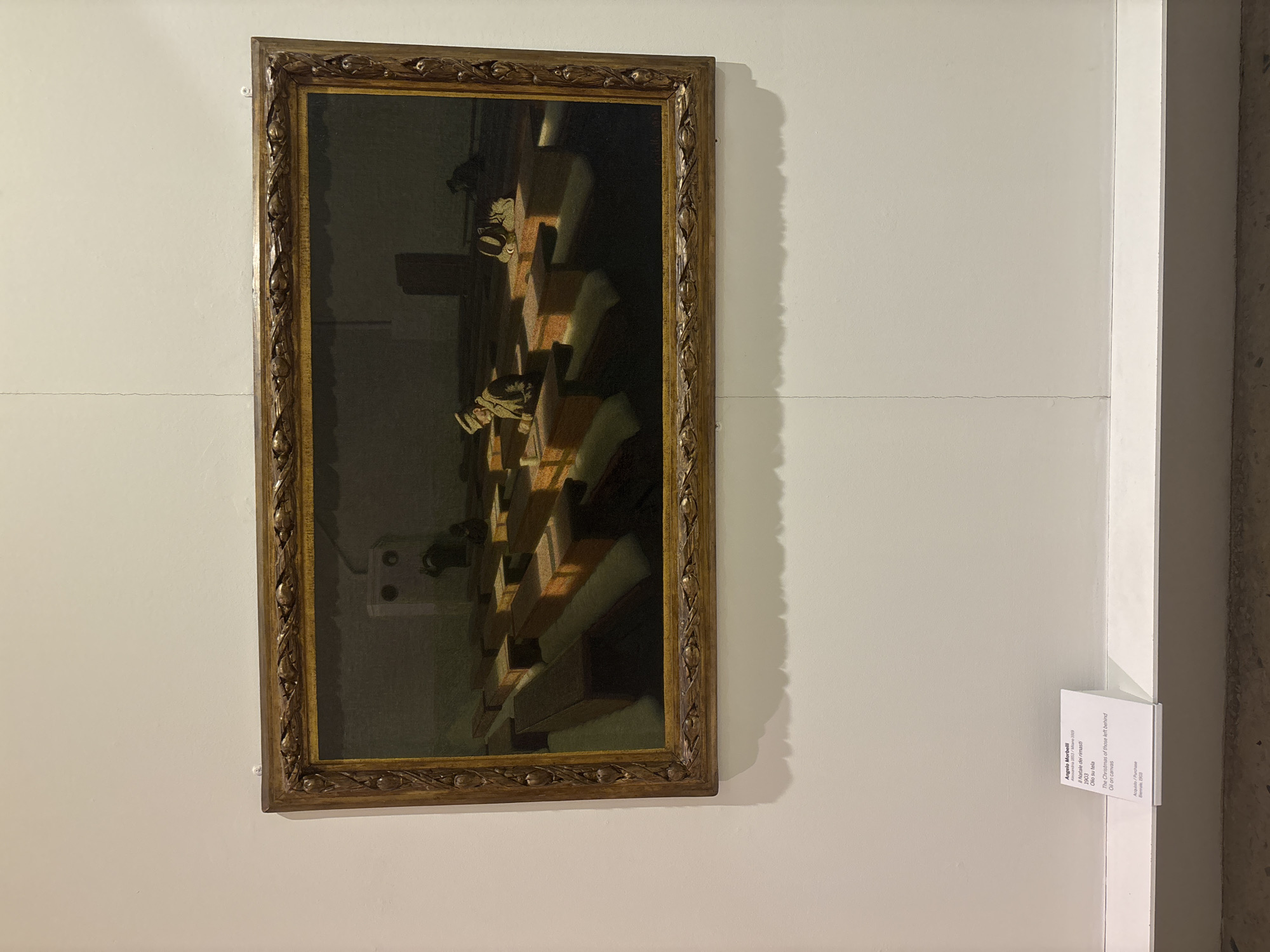
The media file presents a photograph of a framed painting displayed on a light-colored wall in what appears to be an art exhibition space, likely a museum or gallery. **Subjects:** The central subject is a painting titled "The Christmas of those left behind." It depicts a somber interior scene with several elderly men seated in rows on benches or pews. Their figures are mostly shown from the back or in profile, appearing contemplative or resigned. The men are dressed in dark clothing, blending with the overall dark palette of the painting. **Objects:** Within the painting, the main objects are the benches and the figures of the men. A dramatic light source, unseen but implied, casts strong light and shadow patterns across the interior, highlighting elements like the tops of the benches and the men's heads, creating a striking chiaroscuro effect. The painting itself is housed in an ornate, golden, carved wooden frame. On the wall beside the painting, a white informational plaque is visible. **Scene and Setting:** The painting's setting is a large, dimly lit indoor space, possibly a communal hall, dormitory, or refectory. The exhibition setting is a modern, brightly lit room with plain white walls. **Activity or Event:** Within the painting, the men appear to be gathered, sitting quietly, perhaps in reflection or during a meal. The title, "The Christmas of those left behind," suggests an event related to the Christmas holiday, implying themes of solitude, hardship, or introspection among those who might be isolated or forgotten during such a time. **Notable Details:** The painting's atmosphere is melancholic and introspective, created through its subdued colors and dramatic lighting. The strong contrast between light and deep shadow is a prominent artistic detail. The overall photograph is taken slightly off-angle, showing the painting and a portion of the surrounding wall. The location context of Venice, Italy, aligns with the "Biennale, 1903" text on the plaque, suggesting the painting was exhibited or acquired at the Venice Biennale. **Visible Text:** The white informational plaque provides details about the artwork: - **Artist:** Angelo Morbelli (Alessandria 1853 / Milano 1909) - **Italian Title:** Il Natale dei rimasti - **Year of Creation:** 1903 - **Medium (Italian):** Olio su tela - **English Title:** The Christmas of those left behind - **Medium (English):** Oil on canvas - **Acquisition Information:** Acquisto/Purchase, Biennale, 1903
Venice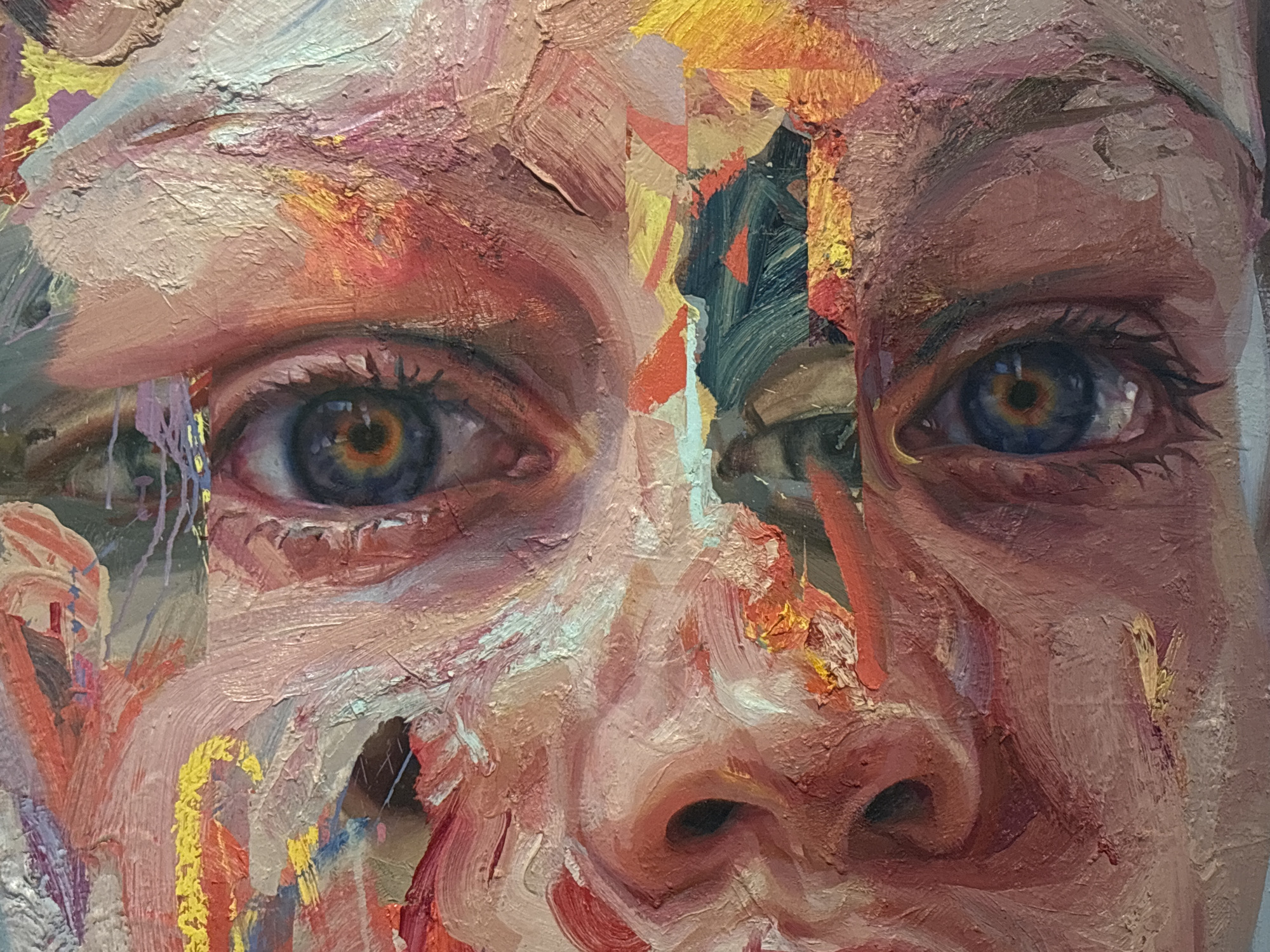
This is a close-up, highly textured portrait painting of a human face, rendered in an impasto style with thick, visible brushstrokes. The primary focus is on the eyes and the central region of the face, including the bridge and tip of the nose. The subject's eyes, wide and intense, feature prominent blue irises with warm, golden-orange rings around the dark pupils, creating a striking contrast. Eyelashes are visible, and the whites of the eyes are depicted with subtle color variations rather than pure white. The surrounding skin is painted in a range of flesh tones, from delicate pinks and light browns to deeper reds and ochres. The painting exhibits a fragmented, almost collage-like quality, with patches of vibrant and contrasting colors laid over and alongside the skin tones. Bright yellows, oranges, blues, greens, and purples break up the facial structure, particularly around the forehead, cheeks, and between the eyes. These abstract color blocks and textured layers give the impression of depth, complexity, or perhaps an emotional landscape. The nose is rendered with similar thick paint application, showing highlights and shadows through color shifts and varying textures. No specific time of day, weather, or location cues are visible within the artwork itself, nor is any text present. The overall impression is one of a deeply expressive and intricate portrayal.
Venice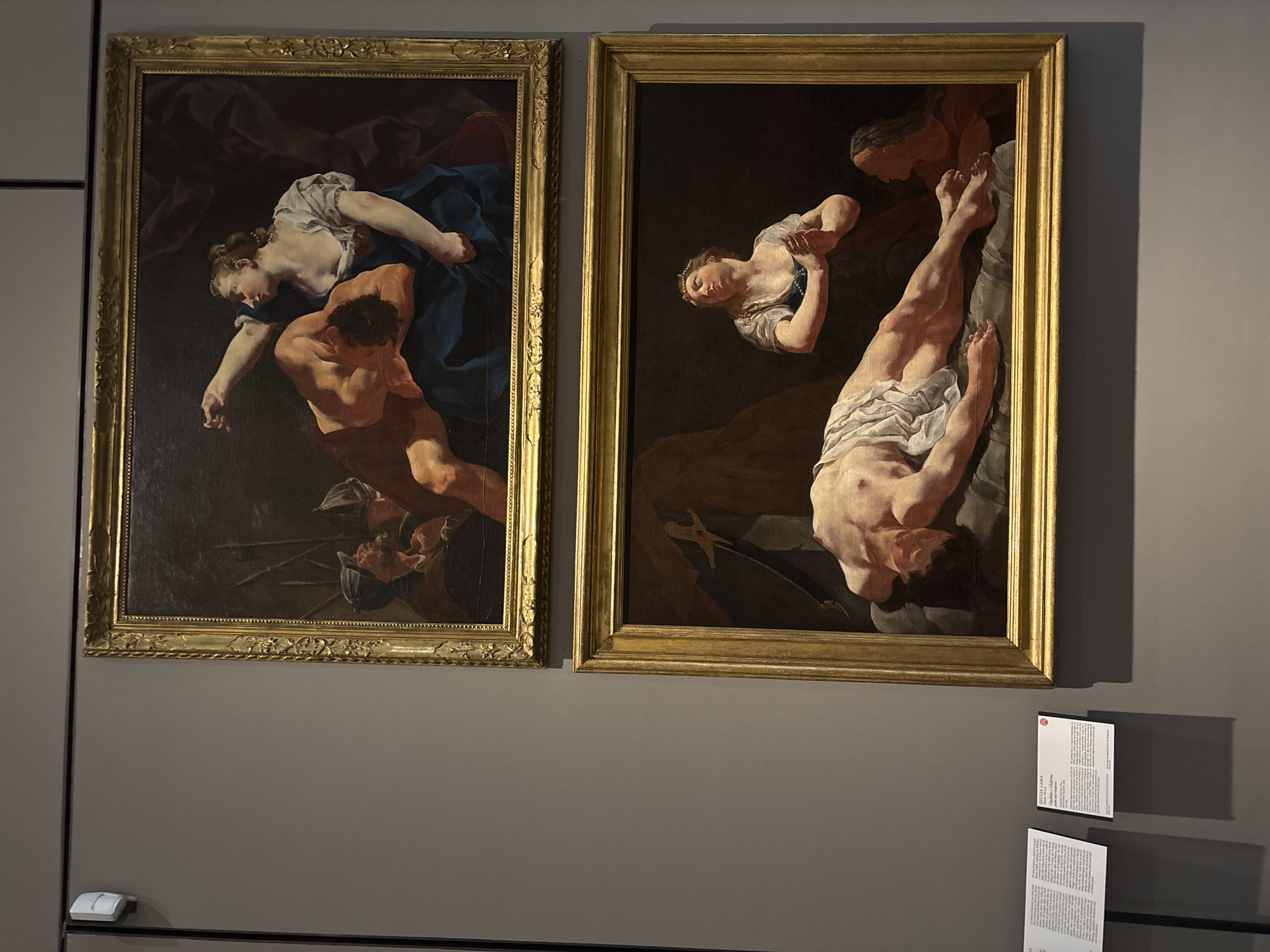
The image displays two large, rectangular oil paintings, framed in ornate gold, hanging side-by-side on a dark grey wall in what appears to be a museum or gallery setting. The ambient lighting is subdued, with spotlights illuminating the artworks and casting soft shadows on the wall. The painting on the left depicts a dramatic scene with several figures. In the foreground, a muscular man, his back mostly towards the viewer, struggles or interacts with a woman positioned above him. The woman wears a white blouse and dark blue drapery, her arm outstretched. Her expression suggests intense focus or effort. Below these two, faint details of weapons, possibly spears or swords, and armored elements are visible in the dark background, hinting at conflict or violence. The painting on the right also features multiple figures in a dynamic and dark composition. A man, largely nude except for a white cloth around his lower body, is depicted upside down, his legs extended towards the top of the frame. A woman in a light-colored dress and headscarf supports or holds the man's arm, her face conveying sorrow or concern. Another figure is partially visible in the darker background. Both paintings exhibit a Baroque style, characterized by intense chiaroscuro, dramatic poses, and rich, somber color palettes. The subjects appear to be entangled in moments of struggle, suffering, or intense emotion. Below the right painting, two white informational plaques are affixed to the wall. The top plaque clearly displays the artist's name: "GIULIA LAMA". Below the name, titles are visible, including "Giuditta e Oloferne" (Judith and Holofernes), followed by "Maddalena" (Mary Magdalene) and "e altre opere" (and other works). This indicates the paintings are likely by the Venetian Baroque artist Giulia Lama, with at least one possibly depicting the biblical story of Judith and Holofernes. A small white sensor or device is visible on the wall below the left painting.
Venice
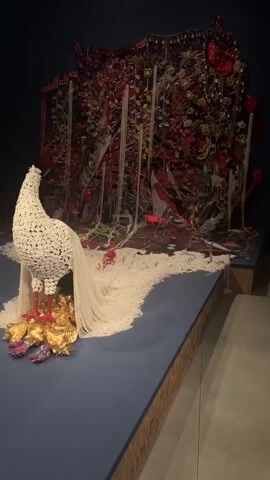
The video showcases an intricate art installation located in Venice, Italy. The central piece is a large, white, peacock-like sculpture positioned on a blue platform. Its body is composed of densely packed, small, white elements, while its expansive tail unfurls across the platform, made from countless white, bead-like strings that create a wavy, textured surface. The sculpture's feet are red and it stands on a cluster of gold, irregular, crumpled shapes. Behind the peacock, a large, dark background artwork is visible, adorned with rich textures, shiny red and green elements, and what appear to be various embellishments like beads or sequins. The camera pans and zooms, offering close-up views of the delicate details of the white tail and the vibrant textures of the background piece. No people or visible text are present in the video.
Venice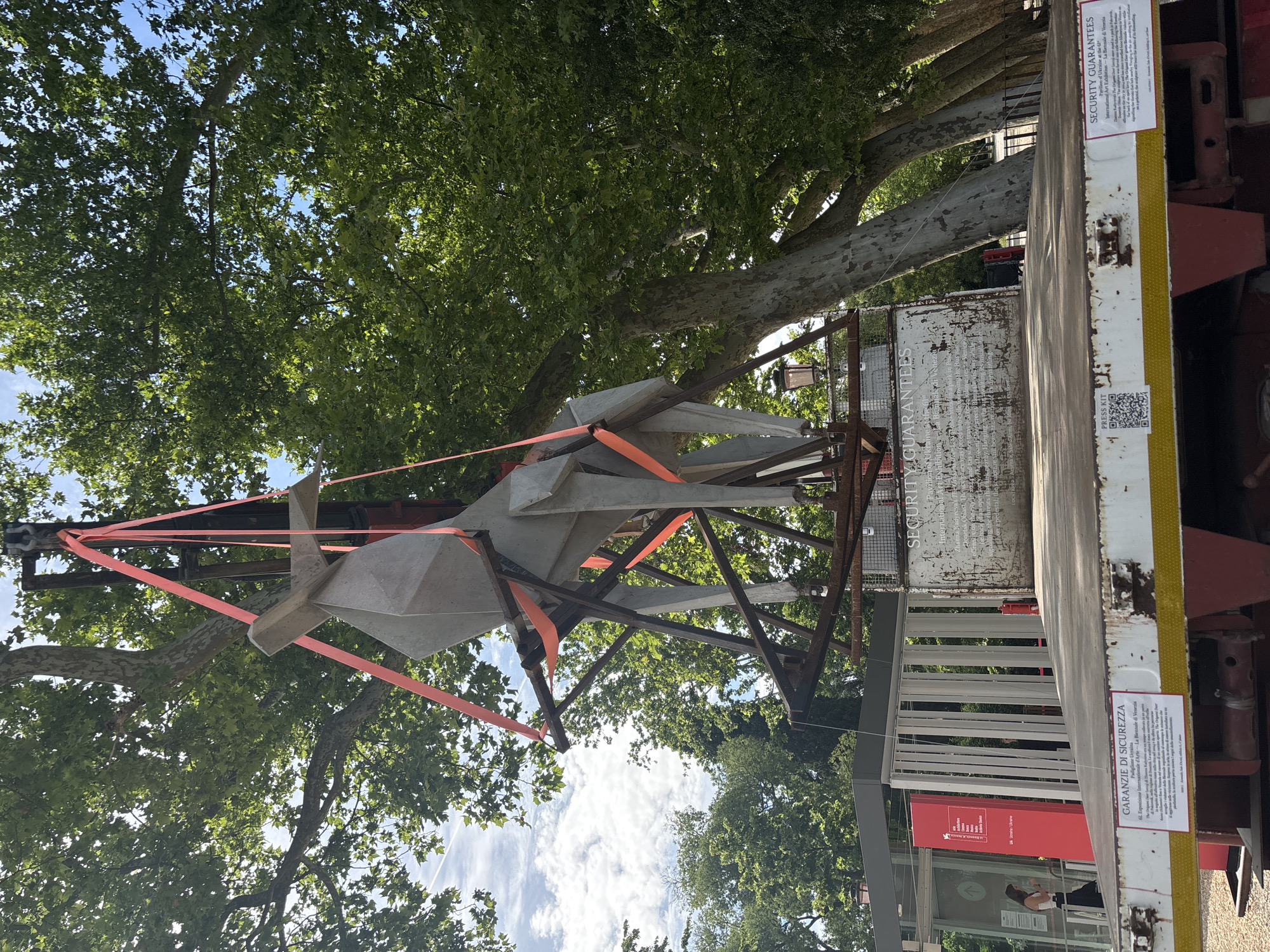
The image, originally captured in portrait orientation and currently rotated 90 degrees clockwise, presents an outdoor scene under bright, sunny daylight. The central subject is a large, abstract sculpture composed of angular, light grey concrete or stone forms. It is secured by multiple vivid orange cargo straps to a dark, open-framework metal structure, indicating that it is either in transit or being positioned for installation/deinstallation. Above the sculpture, a dense canopy of lush green leaves from mature trees dominates the upper part of the frame, with glimpses of a clear blue sky and scattered white clouds visible through the foliage. To the right, a portion of a flatbed truck or trailer is visible. Attached to its side are white signs with text and QR codes. Key inscriptions include "SECURITY GUARANTEES," "GARANZIE DI SICUREZZA," "Padiglione Ucraina," and "Pavilion of Ukraine at the 61° International Art Exhibition - La Biennale di Venezia." Another sign displays a "PRESS KIT" QR code. These details firmly place the setting at the Venice Biennale, specifically at the Ukraine Pavilion. In the background, behind the truck, parts of a building entrance or gate can be seen, characterized by red accents. A person is discernible near this entrance, adding a human element to the scene. The overall impression is one of active preparation or handling of a significant art installation within the context of a major international exhibition in Venice, Italy. The weather appears pleasant and clear.
Venice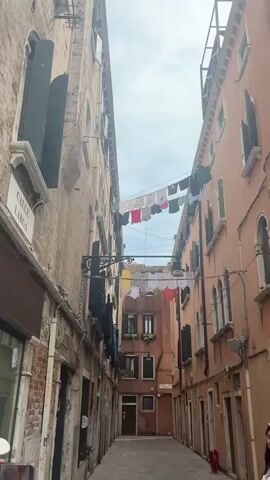
The video captures a narrow alleyway in Venice, Italy, flanked by tall, aged buildings. The building on the left is a lighter beige, while the one on the right has a reddish-brown facade. Both buildings feature multiple windows, some equipped with dark shutters. Several lines of laundry, consisting of various colorful shirts and t-shirts, are strung across the alley between the buildings, hanging to dry under an overcast sky. A white street sign with black lettering, reading "CALLE LARGA," is visible on the left building. In the opening seconds, a woman with dark hair, wearing a white top, is seen smiling in the bottom right corner of the frame. The camera performs a slight zoom, bringing the hanging laundry into sharper focus. The scene depicts a common sight of daily life in Venice.
Venice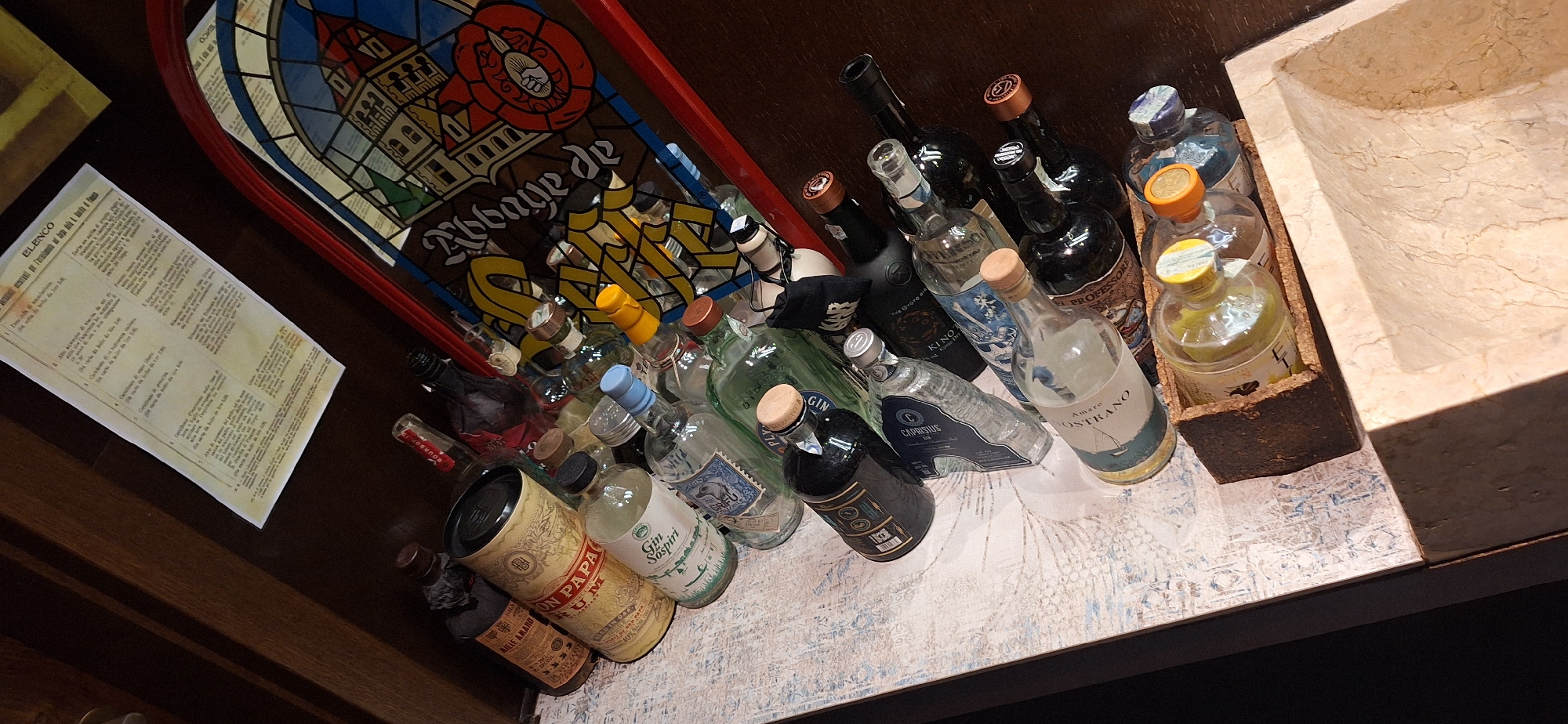
The image captures an eclectic bar setting, likely in Venice, Italy, considering the prevalence of Italian text on a document. The scene is dominated by a collection of liquor bottles arranged on a patterned surface, indicative of a countertop or bar top. Among the bottles, brands such as "Ron Papa Rum," "Gin Sospiri," "Kino," "Caprisius Gin," and "Amaro Ostrano" are visible, suggesting a selection of rum and various gins. The arrangement appears somewhat disorganized, implying either a recent service or an aesthetic choice. Above the bottles is a stained-glass style decoration featuring the words "Abbaye de," hinting at a possible thematic element in the bar's decor or a reference to a particular spirit or drink. To the left, a document titled "ELENCO" (Italian for "list") is present, containing what appears to be a menu or list of offerings in Italian. Adjacent to the bottles on the right is a stone-like structure, perhaps a sink or part of the bar's design, adding a textural contrast to the scene. The lighting is dim, creating a cozy atmosphere, with the focus primarily on the bottles and the decorative elements around them. Overall, the image portrays a unique, possibly themed, bar environment in Venice, Italy.
Venice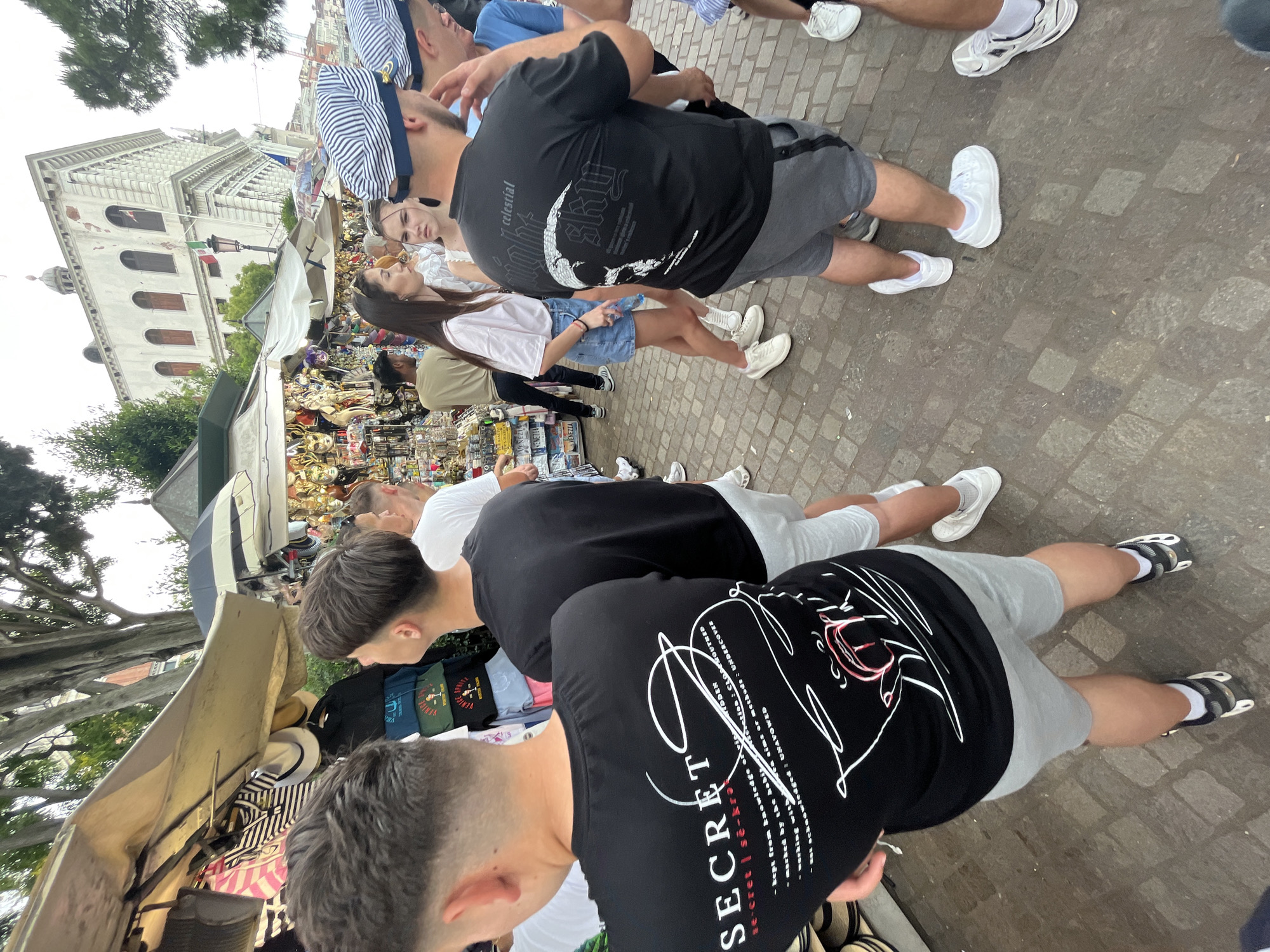
In Venice, Italy, pedestrians are walking along a cobblestone pathway. The scene is bustling with activity as people browse through market stalls. A tall, white, multi-story building with a rounded turret on top stands in the background, adding to the architectural charm of the city. A woman in a white t-shirt and jean skirt is visible, and the surrounding area is filled with the colors and textures of various market goods. The atmosphere is lively, reflecting the typical commerce in a tourist hub of Venice.
Venice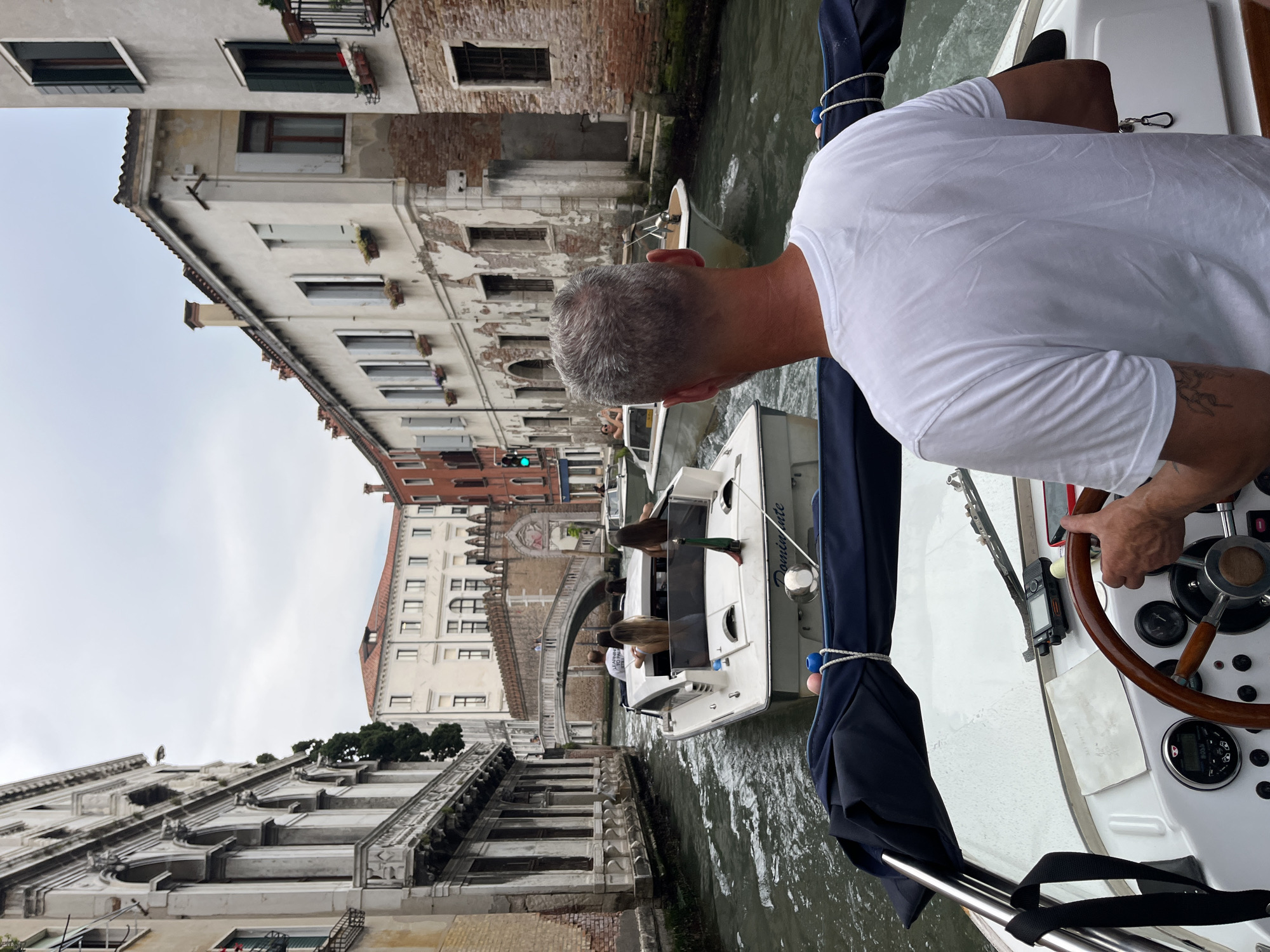
A medium-angle shot depicts a man piloting a boat through a Venetian canal, likely the Grand Canal, in Venice, Italy. The scene is viewed from behind the pilot, who is Caucasian, with short gray hair, and wearing a white T-shirt. He is holding the wooden steering wheel of the boat, which features various gauges and equipment on its dashboard. His right arm is visible, showing a tattoo on his upper arm. In the background, a canal is bordered by old Venetian buildings, constructed from light-colored stone or brick with a variety of window designs. On the opposite side of the canal, a similar boat is traveling in the same direction, carrying several passengers. Further back, the arched Rialto Bridge is visible, a prominent landmark in Venice. A green traffic light is seen near the bridge. The sky above appears overcast. The water in the canal shows movement from the boats.
Venice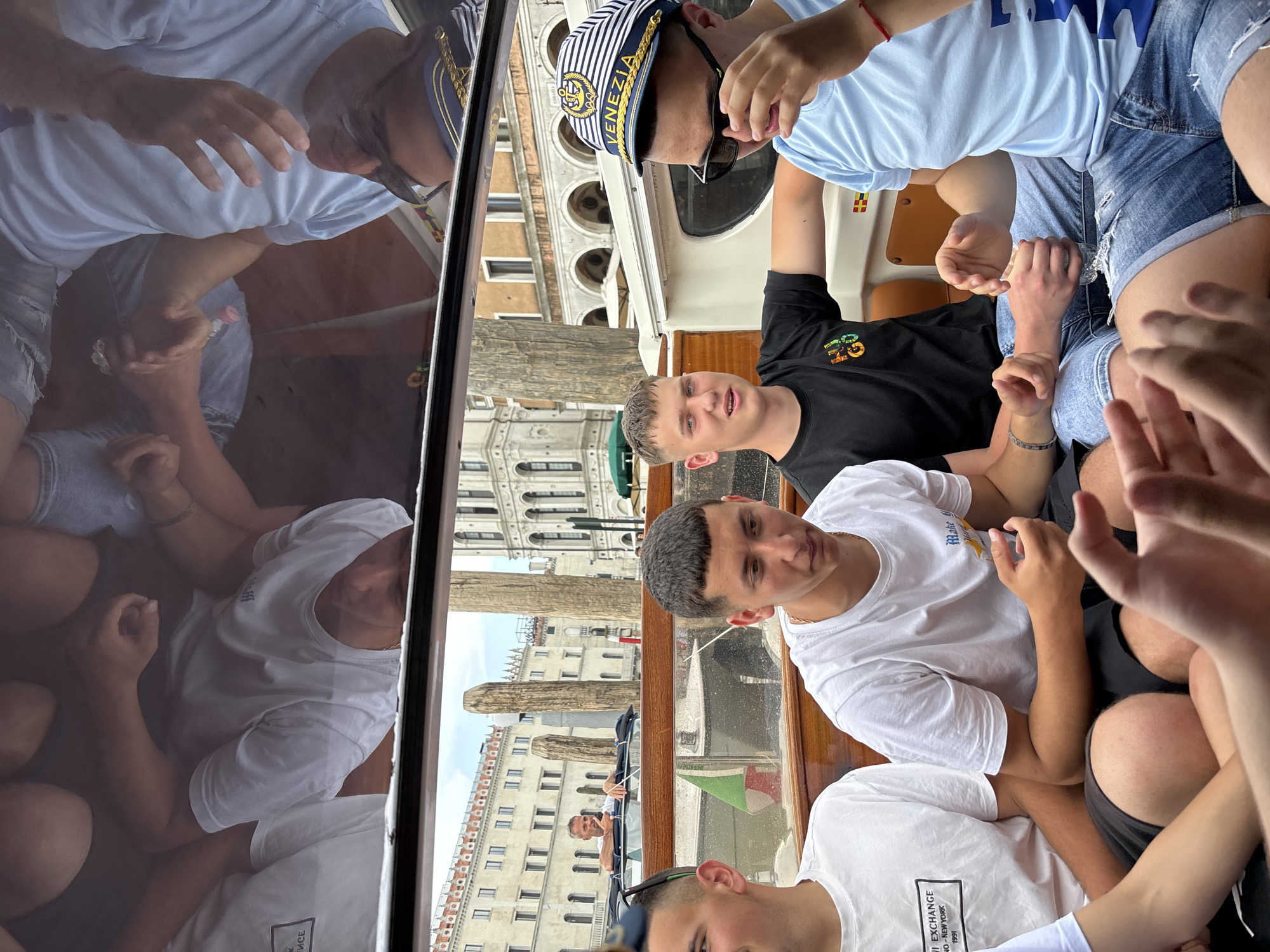
The image captures a group of young people on a boat in Venice, Italy. The boat appears to be passing along a canal, with the architecture of Venice visible in the background, including buildings with arched windows and ornate facades. The group consists of at least five individuals. One person is wearing a striped "VENEZIA" cap and sunglasses. Several others are wearing light-colored t-shirts; one appears to be wearing a black t-shirt. The boat is moving through the water, and the reflections of the people and surrounding buildings are visible on a glass surface, likely a boat window or partition. One person can be seen steering another boat. The group seems to be looking at something in front of them, gesturing with their hands.
Venice