Veraval, India
21 memories from Veraval, India
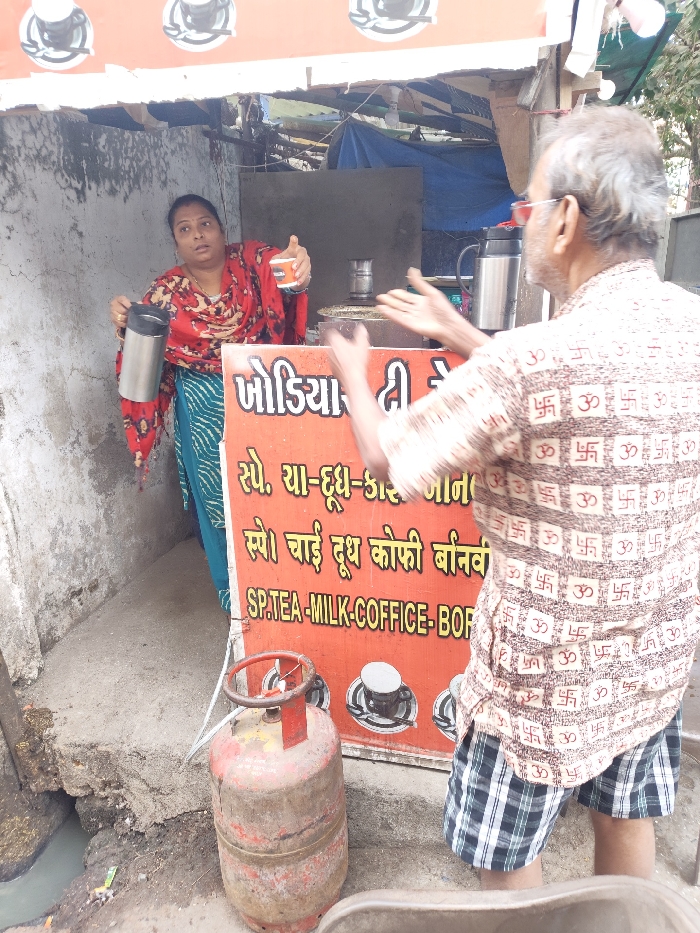
A woman hands a customer a cup of tea from a roadside stall. The woman wears a red floral shirt and teal skirt. The customer, with his back to the camera, is wearing a swastika/om symbol shirt and plaid shorts. The stall's sign, in Hindi and English, advertises tea, milk, coffee, and Bournvita. A red propane tank sits on the ground next to the sign. The setting is a simple, possibly rural, outdoor location.
Veraval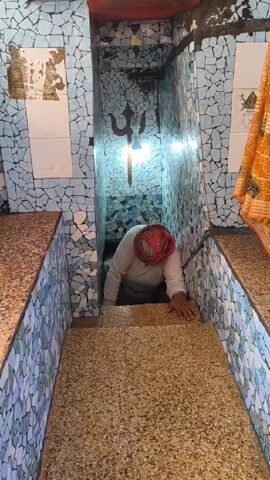
A woman with a red headscarf is seen descending a narrow staircase. She is wearing a white shirt and using her hands for support as she navigates the steps. The staircase is flanked by tiled walls with a mosaic pattern in shades of blue and white. On one wall, a trident symbol is visible above a light fixture. The lighting is moderate, and the space appears to be enclosed. There is a patterned cloth draped on the right side of the frame.
Veraval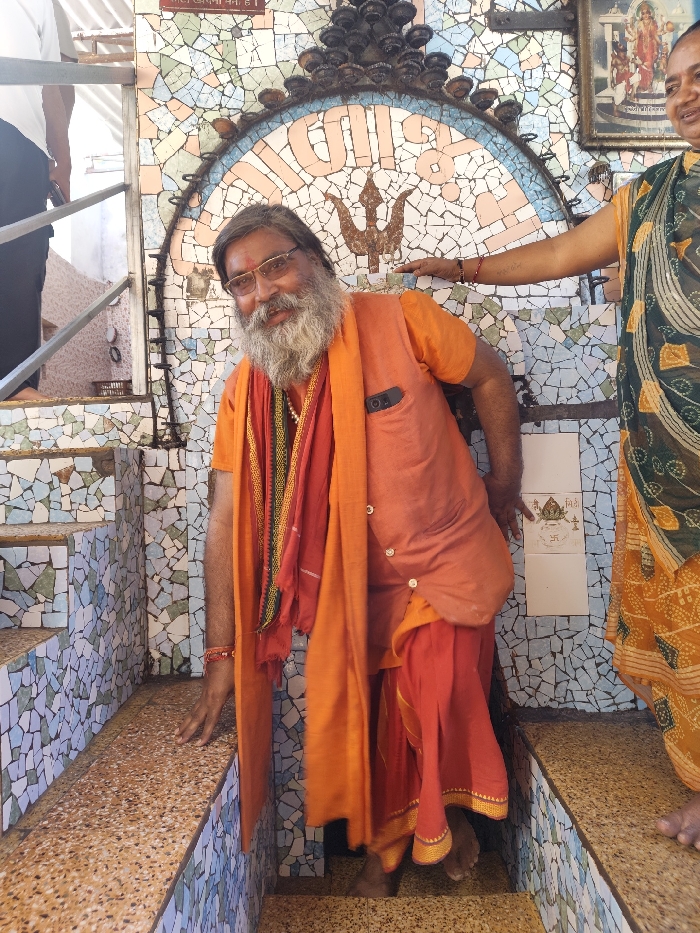
A bearded man wearing glasses, orange robes, and a colorful scarf stands in a stone-tiled alcove. A woman in a patterned yellow and green sari stands to his right. The alcove is decorated with a mosaic tile wall, a symbol resembling a trident, and a framed picture. Part of another person's arm is visible on the left side, near metal railings. The man is barefoot and smiling.
Veraval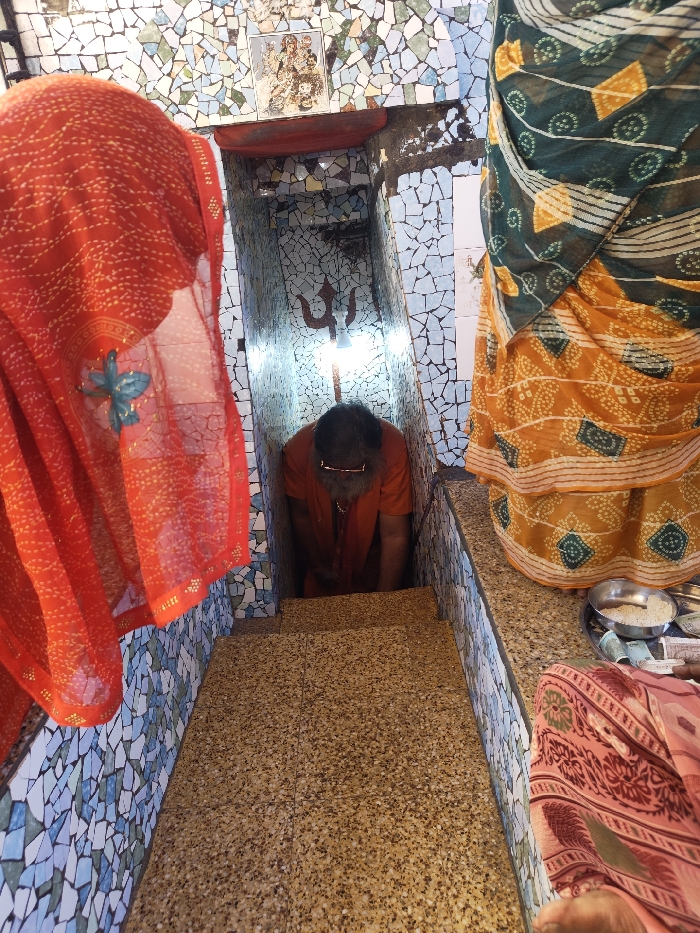
This image captures a scene within a Hindu religious structure in Veraval, India. A male individual, characterized by a dark beard, spectacles, and an orange robe, is depicted descending a narrow, light brown speckled staircase into a confined, recessed area. The walls flanking the staircase are covered in an irregular mosaic of blue, white, and light green tiles. Above the descending figure, a bright light fixture illuminates a red Trishul symbol painted on the mosaic wall. Higher up, a framed image depicting a Hindu deity is affixed to the wall. Two additional individuals are partially visible at the top of the staircase. On the left, a person wearing a red patterned garment is seen from behind. On the right, a person in a green, yellow, and orange patterned sari stands next to a tiled ledge. On this ledge, a metal tray contains a small bowl of white rice grains and several Indian Rupee banknotes, consistent with religious offerings.
Veraval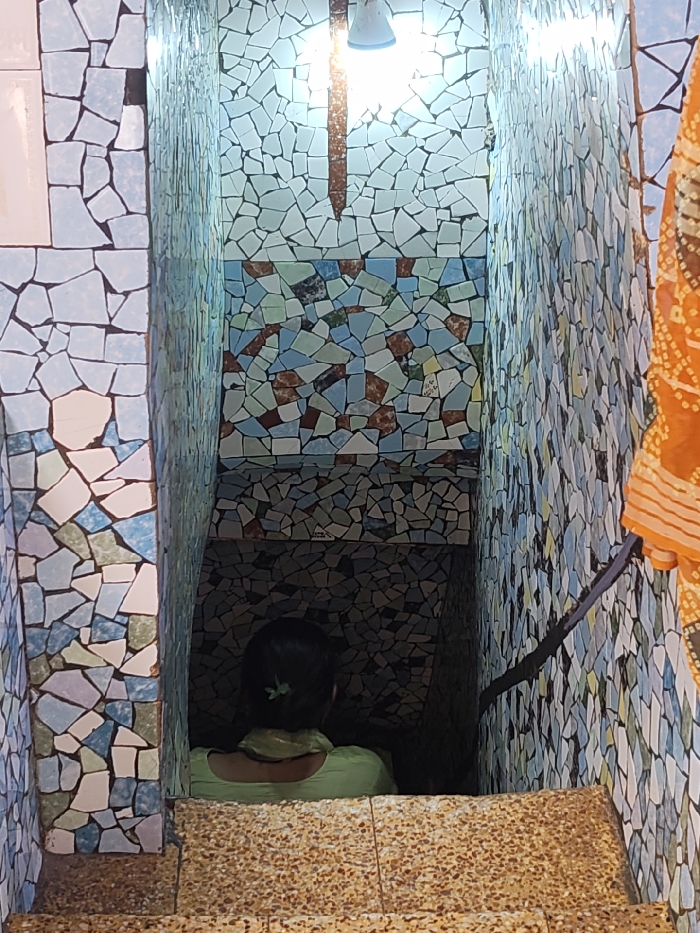
An overhead-view photograph depicts a single individual descending a tiled interior staircase in Veraval, India. The subject, viewed from behind, has dark hair secured with a light green accessory and wears a light green garment. The staircase consists of light brown speckled treads. The surrounding walls are entirely covered in mosaic tiling composed of irregular ceramic fragments; the upper sections feature primarily light blue and white tiles, transitioning to a mix of light blue, white, brown, and green tiles further down the stairwell. An exposed light bulb fixture at the top provides overhead illumination, causing the lower sections of the stairwell to appear progressively darker. A dark handrail is affixed to the right wall. A section of orange and white patterned fabric is visible on the far right edge of the frame.
Veraval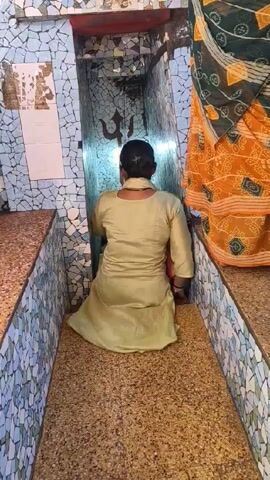
A woman in a light green salwar kameez kneels and prays facing a small alcove inside what appears to be a temple. The alcove is tiled in blue and white mosaic tiles and has a trishul (a trident symbol associated with the Hindu god Shiva) on the back wall. Light shines brightly from within the alcove. The woman is kneeling on a beige tiled floor. Another woman wearing a yellow and green sari stands nearby on the right side of the frame. The camera angle is at eye-level from behind the kneeling woman. The space is small and enclosed. The surrounding walls are also tiled with a similar mosaic pattern. Sounds of children's voices can be heard in the background.
Veraval
A woman in a light yellow salwar kameez walks down a set of stairs. The camera angle is from behind, focusing on her back and the outfit. A woman in a printed sari is standing at the top of the stairs. The stairs are decorated with blue and white tiles. The surroundings appear to be outdoors.
Veraval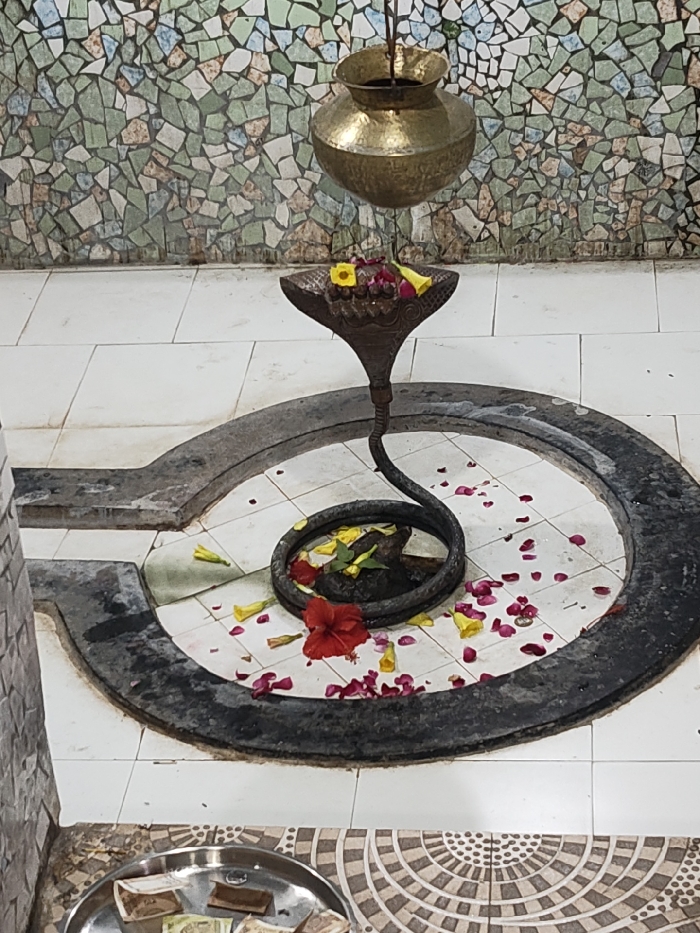
The image displays an interior scene from a structure in Veraval, India, centered on a religious shrine. A dark-colored Shiva Lingam stone rests within a circular, dark grey stone yoni base, which features an integral outflow channel extending left. A dark, coiled cobra figure, likely cast metal or carved stone, rises from the yoni, its head with a fanned hood positioned above the Lingam. Floral offerings, including a red hibiscus, yellow bell-shaped flowers, and various pink and yellow petals, are scattered around the Lingam and draped over the cobra's head. Suspended directly above the cobra is a brass-colored metallic pot, equipped with a narrow spigot at its bottom. The floor is covered with white, square ceramic tiles. In the lower foreground, a section of brown-toned floor tiles with a concentric semi-circular pattern is visible. A silver-colored metal plate rests on these patterned tiles, containing crumpled Indian rupee currency notes and several small, dark, rectangular objects. The background wall features a mosaic composed of irregular, multi-colored tesserae in shades of green, brown, and white. No individuals are present in the scene.
Veraval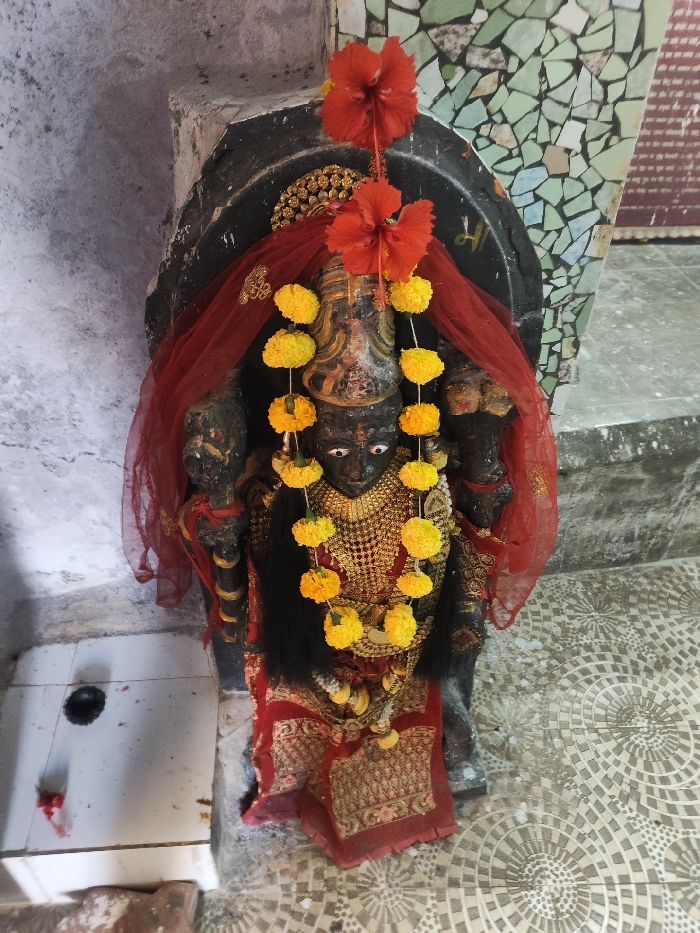
The image displays a dark-colored stone idol, identified as a Hindu deity, situated within a recessed shrine niche. The idol is adorned with multiple garlands of bright yellow marigold flowers and two prominent red hibiscus blossoms suspended from its head. A translucent red fabric is draped over its head and shoulders. The idol features a black face with distinct white painted eyes, a gold-colored, intricately patterned chest plate, and long black hair or a wig. Its lower body is covered by a red and gold patterned skirt-like garment. The immediate background behind the idol is a dark, carved stone structure forming an arch. To the idol's left, a textured, light-colored wall is visible. To its right, the wall features irregular mosaic tiling composed of light green and white pieces, below which another section of wall displays faint patterning. The floor in the foreground is tiled with a repeating circular, geometric pattern in beige and white tones. In the lower-left foreground, a white tiled surface contains a dark circular aperture and a reddish residue, consistent with ritual offerings. The scene is located in Veraval, India.
Veraval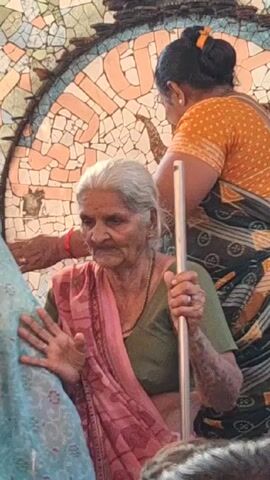
An elderly woman with gray hair, wearing a green blouse, a pink and red shawl, and a beaded necklace, is standing and holding a silver cane with both hands. She is surrounded by other people and looks slightly to the left. A woman in a yellow polka-dot top is behind her. Behind them is a wall covered in colorful tiles. The woman is standing outdoors.
Veraval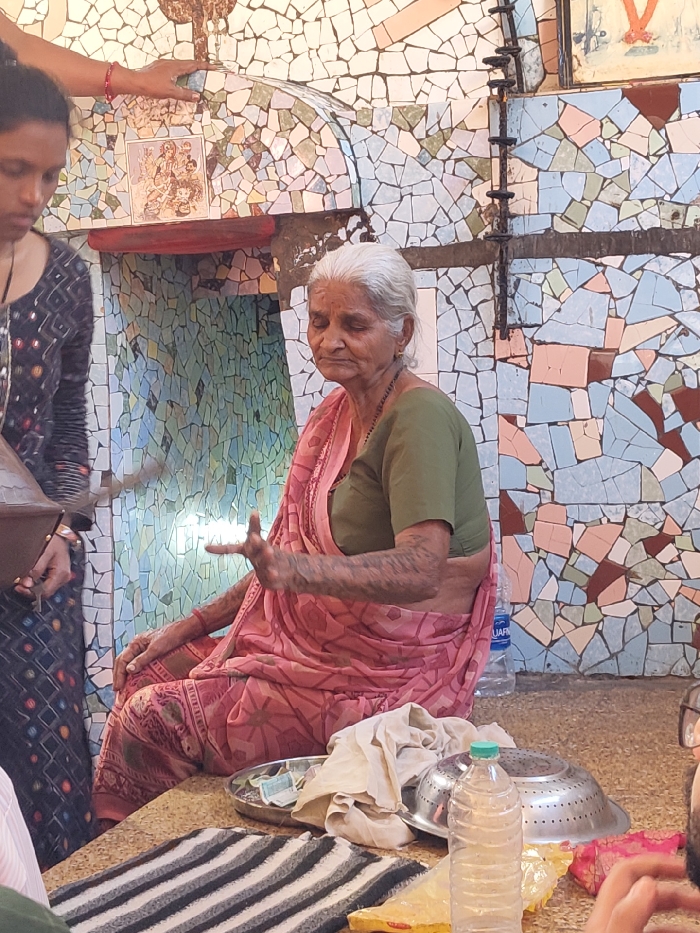
The image portrays an indoor or semi-outdoor religious or devotional setting in Veraval, India. An elderly woman, with grey hair pulled back, is seated on the floor or a low platform, facing slightly right with her eyes closed or downcast. She wears a green short-sleeved blouse and a pink patterned saree. Dark, extensive tattoos are visible on both her forearms. Her right hand is raised, forming a mudra-like gesture with the thumb touching the ring finger, while the index and middle fingers are extended. Her left hand rests in her lap. To the left of the elderly woman, a younger woman, wearing a dark patterned dress or kurti, is partially visible, appearing to stand or stoop. Her right hand is near a tiled feature on the wall. At the top left, a hand adorned with red bangles is seen touching the patterned wall. Part of a person's head, wearing glasses, is visible at the bottom right corner of the frame. The background features a wall extensively covered in a mosaic of irregularly shaped, multi-colored tiles, primarily in shades of light blue, beige, pink, white, and green. A small niche or alcove, also tiled, is visible in the lower center of the wall. Above this niche, a framed picture depicting a Hindu deity is mounted. To the right of the niche, a vertical series of dark metal components, resembling steps or hooks, are affixed to the wall. Further right, an Aquafina brand plastic water bottle leans against the mosaic wall. In the foreground, a black and white striped mat is spread on the ground. Various items are placed on the ground, including a silver-colored metal plate containing Indian currency notes and a light-colored crumpled cloth. Adjacent to this is an inverted silver-colored metal colander, a clear plastic water bottle with a turquoise cap, and a yellow plastic package. The scene is illuminated by bright, direct lighting.
Veraval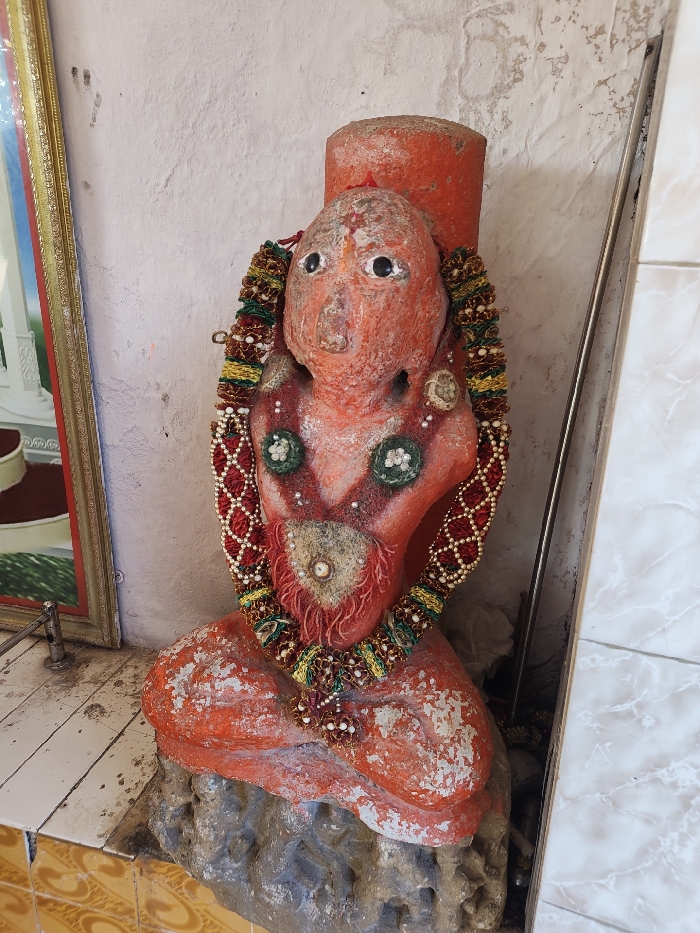
The image displays a weathered, reddish-orange statue, approximately half a meter tall, located within the city of Veraval, India. The statue, constructed from a concrete-like material, depicts a humanoid figure in a seated position, exhibiting paint chipping and surface deterioration. Its face features black-on-white painted eyes and indistinct nose and mouth areas. A reddish-orange cylindrical pillar is directly behind the statue's head and upper back. The statue is embellished with several adornments: a multi-layered garland around its neck consisting of red beads, white pearls, and interwoven green and gold threads; two circular green and white adornments on its chest; and a central, disc-shaped chest piece with a fibrous reddish texture beneath it. The figure rests on an irregular, grey-colored base. To the left of the statue, a portion of an ornate gold-framed picture is visible, depicting a white architectural structure with red and green elements. The background wall is off-white, textured, and shows discoloration. On the right, a slender metallic rod leans against a light-colored, possibly tiled, vertical surface. The foreground flooring transitions from patterned yellow-orange tiles on the left to light grey tiles on the right, with general dirt and debris present on the ground. No individuals are depicted in the scene.
Veraval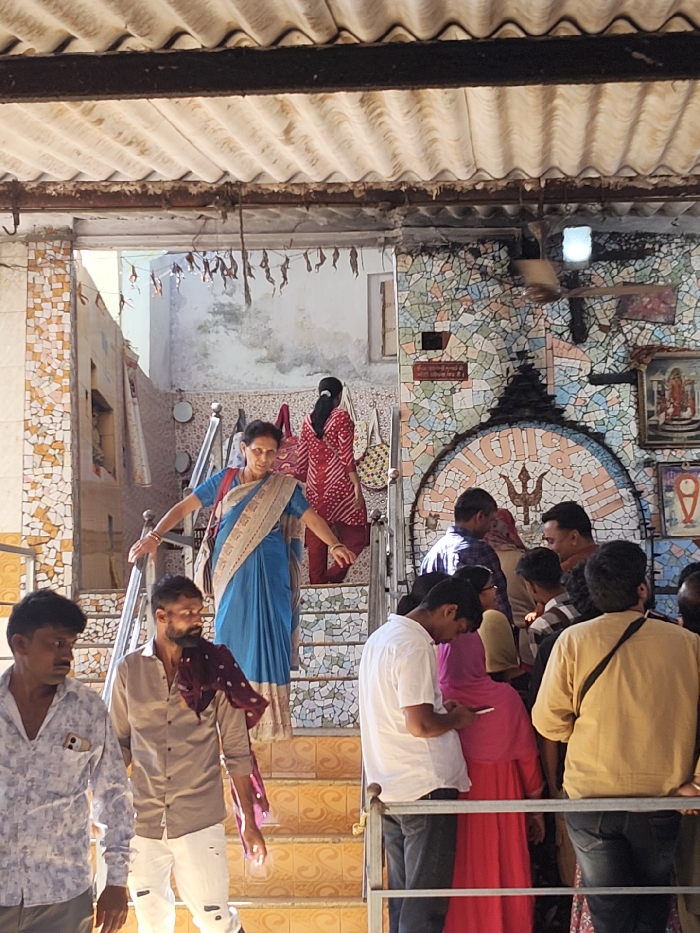
This image captures a bustling interior scene within a religious complex in Veraval, India, likely a temple. The view is partially obstructed by an overhead corrugated roof, supported by dark metal beams. **Environment:** The structure features walls extensively decorated with mosaic tiles in varied colors including white, blue, green, brown, and orange. A prominent wall on the right displays a large mosaic design incorporating a trident (trishul) symbol, with a framed image of a deity mounted above it. Below the trident, a ceiling fan with spinning blades is visible, along with a solitary light bulb. Another section of the wall to the left of the trident mosaic has a small, recessed shrine-like feature. Stairs, tiled with alternating patterns (some greenish-white, others orange-yellow), lead to different levels within the complex. Metal railings line these stairs. In the background, past an open archway, an older, worn wall with peeling paint is visible. A string of dried leaves or similar ritualistic items hangs horizontally from an overhead beam. Various bags are seen hanging in the background area. **People:** Approximately 15-20 individuals, predominantly adults of South Asian ethnicity, are present. * **Foreground Left**: A man in a patterned short-sleeved shirt stands, looking towards the left. Below him, a man with a beard and mustache, wearing a light brown collared shirt and white pants with a maroon scarf draped over his left shoulder, descends the stairs while looking downwards. * **Mid-ground Left**: A woman in a vibrant blue sari with a gold border descends the stairs, holding the metal railing with her right hand and extending her left arm for balance. She looks towards the viewer. Behind her, partially obscured, another woman in a red and white patterned dress or sari is ascending the stairs. * **Mid-ground Right/Background Right**: A cluster of people congregates. A man in a white t-shirt stands, looking down at a smartphone in his hands. Adjacent to him, a woman in a long pink garment stands. Several other individuals, mostly men in casual shirts (including light brown, yellow, and blue), are seen standing or moving. One man in a light brown shirt has a dark strap diagonally across his back. Another man with a mustache is visible further back in the group. The overall scene depicts a functional, active religious space with individuals moving between different levels and congregating, suggesting a typical day for visitors or devotees.
Veraval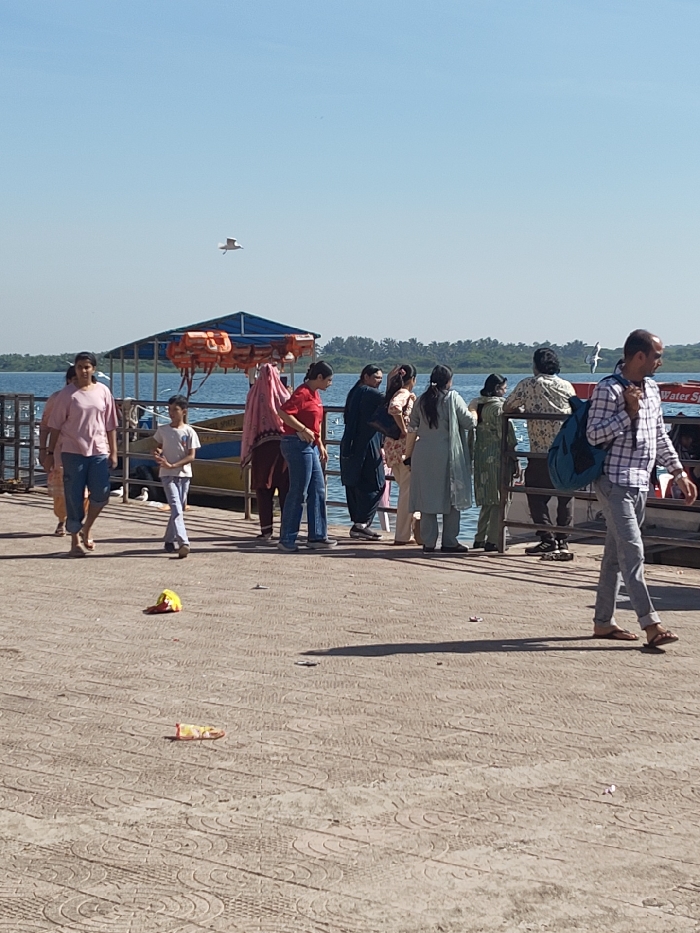
This image captures a daytime scene on a paved pier or promenade adjacent to a body of water in Veraval, India. The sky is clear and light blue, with a distant horizon line of green vegetation visible across the water. The water itself appears calm and blue. In the foreground, the light-colored concrete surface features a repeating circular embossed pattern. Two discarded items are present on this surface: a crumpled yellow and red object and a red, yellow, and white plastic wrapper. Bright sunlight casts distinct shadows, notably from individuals and structures. A man is walking from the mid-ground towards the right edge of the frame. He wears a light blue and white checkered shirt, light grey pants, and brown sandals, and carries a dark blue backpack on his left shoulder. To the left, a woman in a light pink top and blue jeans walks towards the left, followed by a child in a white t-shirt and light blue pants, also walking left. In the middle ground, a group of approximately seven to ten individuals stands near the water's edge, mostly facing towards the water. This group includes individuals dressed in various attire: a woman in a red top and blue jeans; another partially obscured woman wearing a pink/red head covering and dark clothing; a woman in dark blue traditional Indian clothing; a woman in light green/grey traditional clothing; a woman in patterned green traditional clothing; and a man in a patterned light-colored shirt. Partially docked at the water's edge are at least two boats. One boat features a blue canopy roof and several orange life jackets stacked on it. Partial text, "WATER SP..." and "SPORTS," is visible on signage associated with the boats. A white bird is in flight in the upper-middle sky, and other smaller white specks, possibly birds, are present further right in the sky and on the water near the boats.
Veraval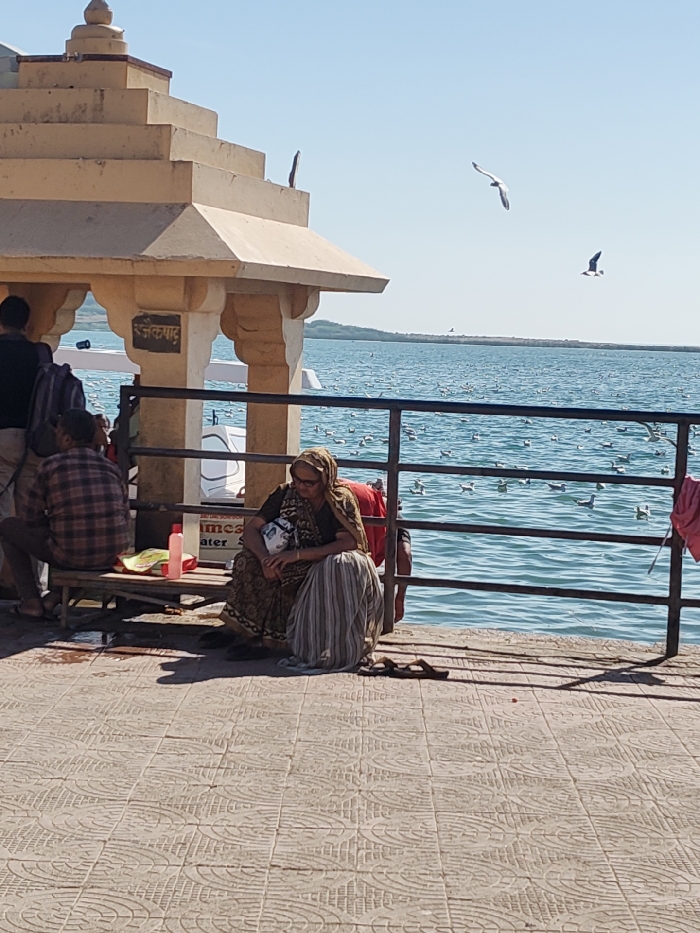
The scene depicts a sunny daytime view of a waterfront promenade in Veraval, India, likely at a pier or temple ghat. In the foreground, a light-colored paved area with geometric patterned tiles extends. To the left, a multi-tiered, beige stone pavilion with arched openings is visible; a sign on one pillar displays "जय द्वारकाधीश" (Jay Dwarkadhish) in Hindi/Gujarati script. Multiple individuals are present. On the left, partially obscured by the pavilion, a person with a dark backpack stands. Next to them, a man in a plaid shirt is seated on a simple wooden bench, facing away from the camera towards the water. A pink plastic bottle and a colorful bag rest on the bench beside him. In the center, an elderly woman with dark skin and sunglasses is seated on the tiled ground, facing slightly right. She wears a patterned brown and black sari or dress with a headscarf and holds a white object in her left hand. Her striped lower garment is visible. A pair of brown sandals lie on the ground near her feet. A glimpse of a red garment is seen behind her, possibly associated with another person or an object. A black metal railing separates the promenade from a large body of blue-green water, which is rippled. A pink cloth or garment is draped over this railing on the right. Numerous small white birds, consistent with seagulls, are scattered across the water's surface. In the clear, bright blue sky above the water, two seagulls are in flight. A low-lying landmass or distant shoreline is visible on the horizon across the water.
Veraval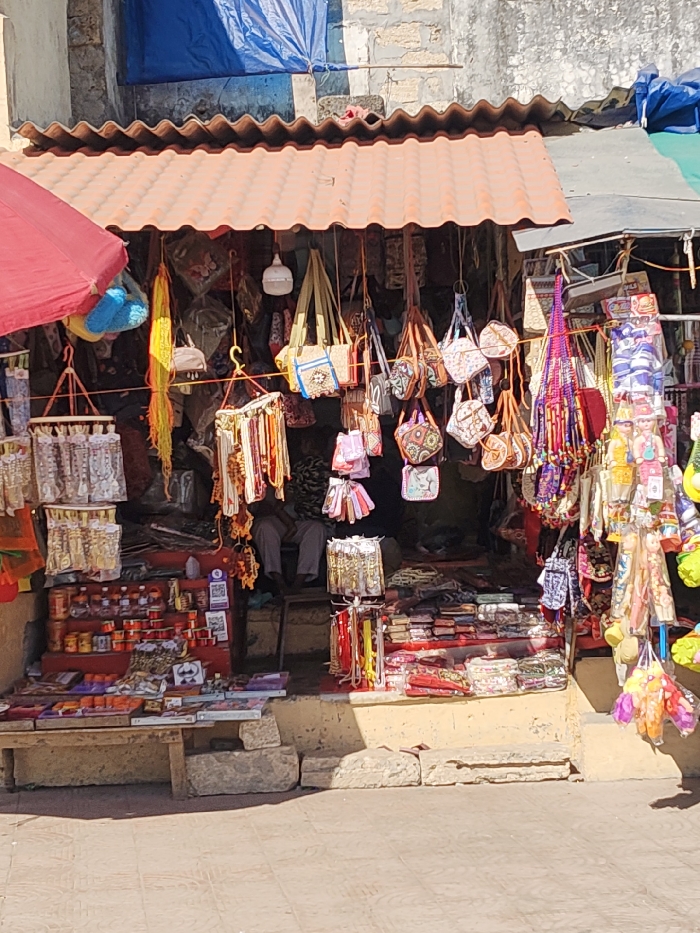
An outdoor street stall operates in Veraval, India, positioned against an older building with concrete or stone construction, partially obscured by a blue tarp above. The stall features a corrugated brown metal awning. Goods are densely displayed, primarily consisting of numerous handbags, small purses, and woven bags hanging from ropes and hooks beneath the awning. Strings of beads, garlands, and small decorative items also hang throughout the display. Inside, a person is seated, with only their lower legs and light-colored pants visible at the rear of the shop. On the left side of the stall, a tiered red stand holds various packaged items, possibly oils, spices, or religious offerings, alongside a visible QR code payment sticker. A low wooden bench in front of the stall offers additional items. The ground in front of the shop is paved with light-colored tiles, and the stall entrance is elevated by a stone step. A red umbrella partially visible on the far left suggests additional shading.
Veraval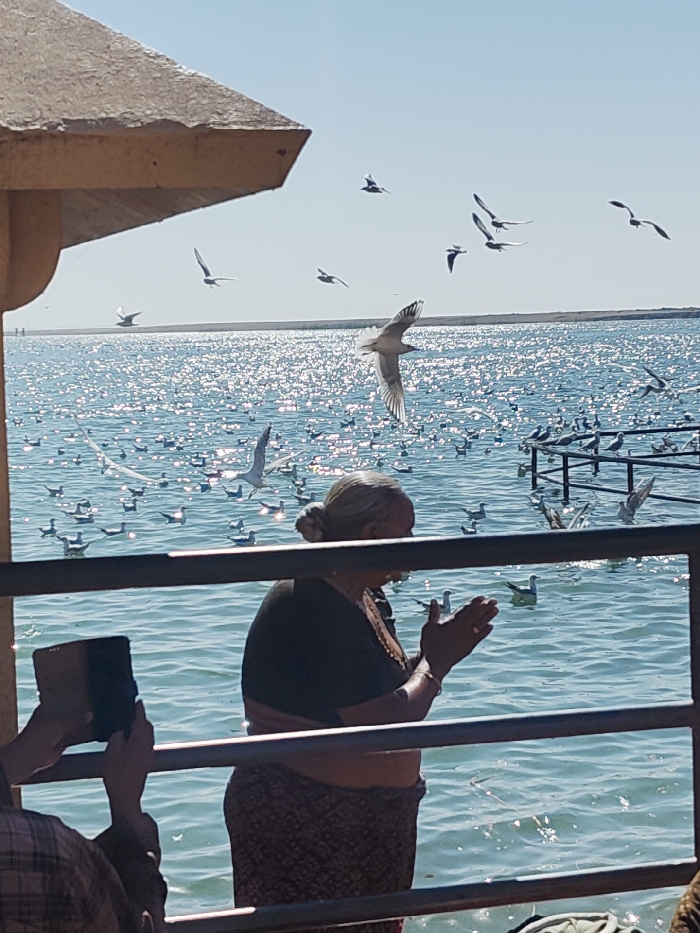
The image depicts a daytime scene in Veraval, India, at the edge of a large body of water, likely the Arabian Sea. A woman, seen in profile from the waist up, stands partially submerged in shallow water. She has light-colored hair styled in a bun, wears a dark top, and a patterned skirt or sarong. Her hands are held together near her chest, palms open, suggesting an act of offering or feeding. Numerous birds, primarily gulls or terns, are present throughout the scene. Dozens are visible swimming on the sparkling, sun-dappled water surface, while several more are in various stages of flight across the clear blue sky and over the water. One prominent bird is captured in mid-flight with outstretched wings in the upper-right area of the frame, and another descends in the middle-ground. In the foreground, a dark metal railing extends horizontally, partially obscuring the lower half of the scene. To the left of the woman and below the railing, hands are visible holding a dark electronic tablet or phone, pointed towards the water and the woman. A light-colored concrete architectural overhang is visible in the upper-left corner of the frame. The horizon line in the background shows a distant, low-lying landmass or breakwater under a bright, cloudless sky.
Veraval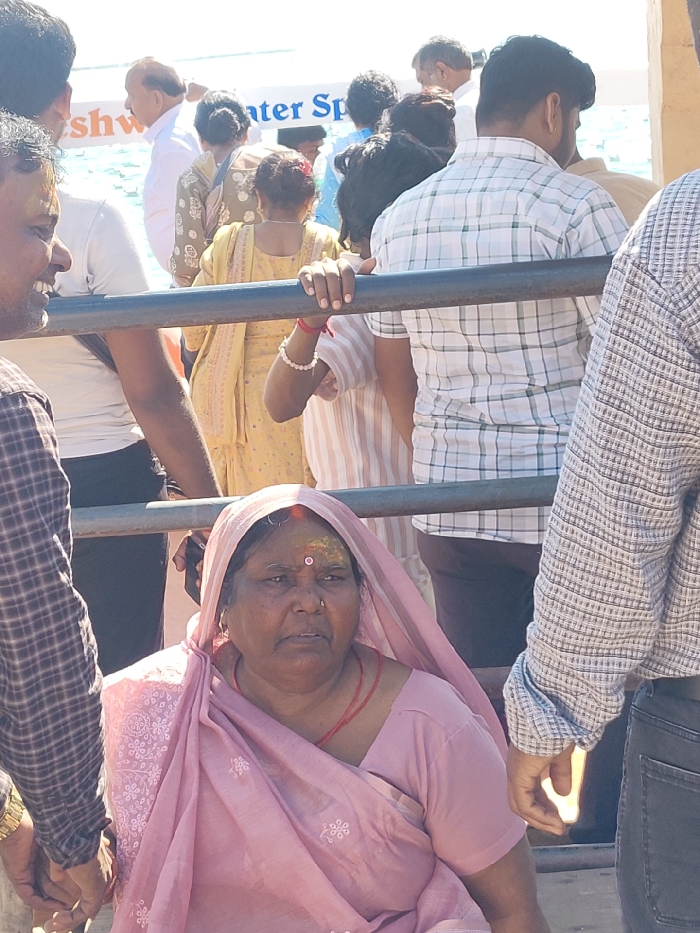
The image portrays an outdoor scene in Veraval, India, featuring a group of individuals near a body of water. In the foreground, an older Indian woman is centrally positioned, appearing to be seated or kneeling. She wears a light pink sari or shawl over a pink garment, a red bindi, yellow powder on her forehead, and a gold nose ring. A red beaded necklace is visible around her neck. To her immediate left, a man's plaid shirt and arm are partially visible. A black metal railing extends horizontally across the midground. Behind this railing, several individuals are standing. A woman, seen from the back, wears a light-colored, patterned garment and holds the railing with her right hand, adorned with a white beaded bracelet and a red string. Adjacent to her, a man in a white and green plaid shirt stands facing away from the camera, also holding the railing. Other individuals are partially visible in the background. Beyond the railing and people, a body of blue water is visible, and above it, a white banner with partial dark blue text reading "...shw Water Sp...", likely indicating "Freshwater Sports." The scene is brightly lit by natural sunlight.
Veraval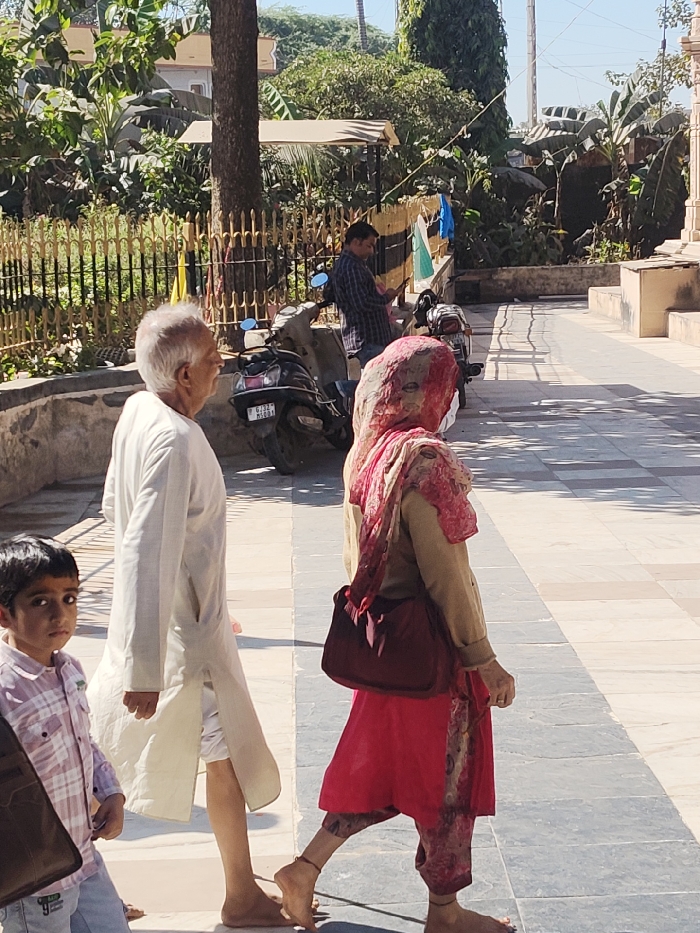
The image depicts an outdoor paved pathway in Veraval, India, illuminated by bright daylight casting distinct shadows. Three individuals are in motion across the foreground and mid-ground. On the far left foreground, a young boy with dark hair wears a light plaid shirt and blue jeans, looking directly towards the viewer. To his right and slightly ahead, an elderly man with white hair, clad in an off-white kurta and white lower garment, walks barefoot. Adjacent to the elderly man on the right, a woman wears a tan top, a red lower garment, and a patterned pink and cream headscarf, also walking barefoot with a dark anklet on her right ankle and carrying a dark red shoulder bag. All three are moving from left to right. In the mid-background, a man in a plaid shirt stands next to two parked scooters; one scooter displays the partial license plate "GJ 22 R 0501," and the man appears to be engaged with a mobile device. The pathway consists of alternating light and dark grey square tiles. A yellow metal fence borders the path on the left, behind which lush green vegetation, including trees and bushes, is prominent. In the background, a light-colored stone structure is visible on the far right, and additional green foliage with discernible banana plants extends across the scene. Blue and green cloth pieces are suspended from a line in the background.
Veraval
An upward-angled external view depicts the upper section of a temple dome (shikhara) in Veraval, India, set against a clear blue sky. The dome is constructed from light-toned carved stone, featuring multiple tiers adorned with intricate sculptural details and smaller golden finials. Several pigeons are perched on various ledges and decorative elements of the dome. At the dome's apex, a golden finial is visible. Above this, a flagpole supports a multi-colored flag displaying red, yellow, purple, and white segments. A white, horn-shaped loudspeaker is attached to the pole below the flag. A dark, rectangular object, possibly an electronic enclosure, is mounted at the very top of the pole structure. Thin white cables descend from the flagpole assembly. The lower visible portion of the structure includes a flat roof section exhibiting dark discoloration consistent with weathering. Below this roof, elaborately carved stone archways and columns form part of the temple's exterior. To the far right, a section of another, less ornate dome and a small plant growing from the rooftop are visible. No individuals, actions, or interactions are depicted.
Veraval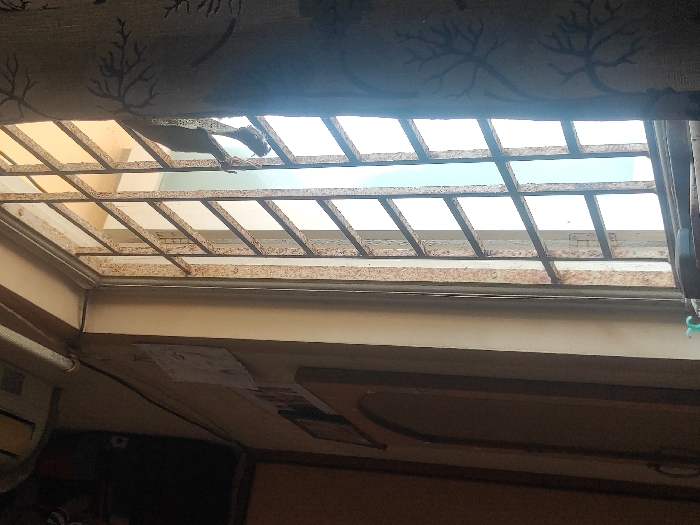
A window with a metal grate is situated in a room with a light brown wall. The window is open and a curtain with a tree pattern is partially drawn. The room is mostly dark and the outside is brightly lit, creating a silhouette effect. The scene is likely taken from a house or apartment located in Veraval, India, at the coordinates 20.906 latitude and 70.363 longitude. The only object visible in the room is a door with a handle to the left of the window. The room is empty. The focus is on the window.
Veraval