Veytaux, Switzerland
30 memories from Veytaux, Switzerland
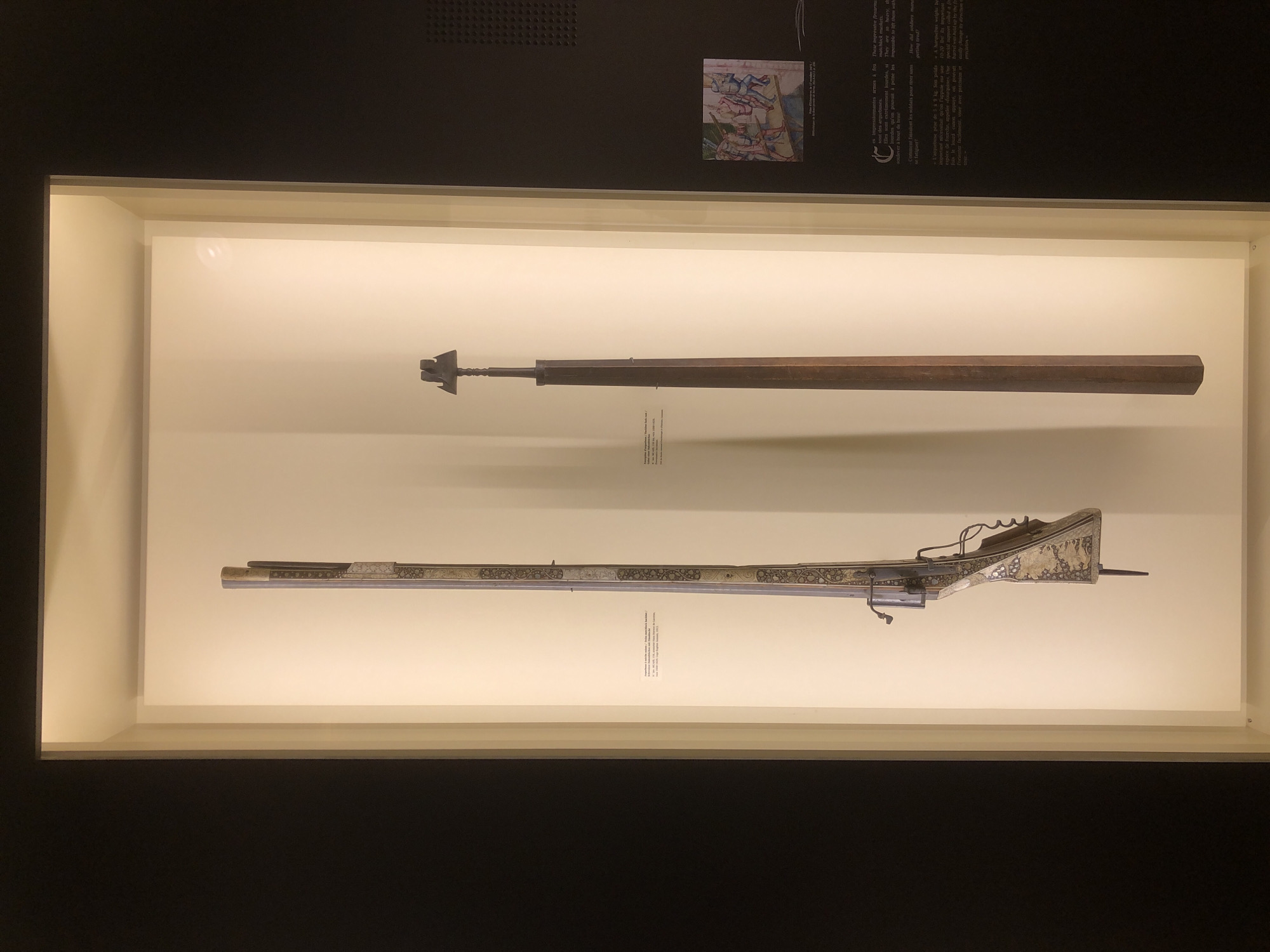
This image depicts two firearms displayed in a museum exhibit, likely located in Veytaux, Switzerland. The exhibit features a long, wooden-barreled weapon with an arrow-like head and a more ornate firearm with an intricate metal design along its barrel. The exhibit includes accompanying text, possibly providing information about the weapons' history and usage. The firearms are showcased inside a glass case with a bright, neutral background, contrasting with the dark surroundings of the museum. There's also a smaller illustration visible at the top of the display.
Veytaux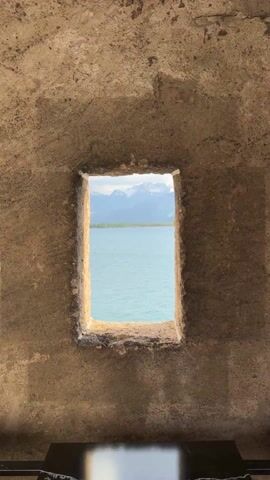
The video shows a view of a lake and mountains through a stone window. The window is rectangular and appears to be part of a stone wall. The lake is a light blue color, and the mountains are covered in snow. The sky is visible above the mountains. There is a dark colored table-like surface visible at the bottom of the window. The camera zooms in slightly to get a closer view.
Veytaux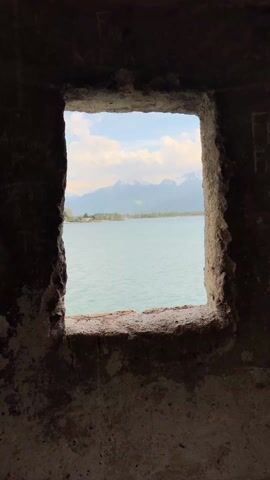
The video shows a view of Lake Geneva in Switzerland, seen from a stone window frame. The lake is calm and blue, with a few small boats visible. In the background, the Alps rise majestically, their peaks covered in snow. The sky is blue with scattered white clouds. As the camera pans slowly outward, it reveals the full vista of the lake and mountains.
Veytaux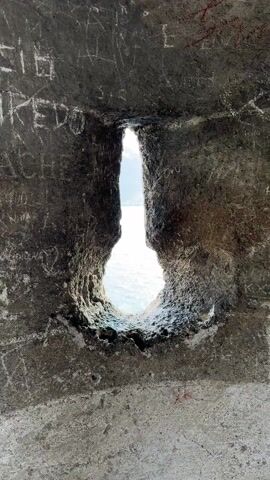
The video starts with a close-up view of a small, rough-hewn opening in a stone wall. As the camera slowly moves forward, the view through the hole is revealed: a body of water, possibly a lake or sea, stretches to the horizon where a line of mountains is visible under a blue sky with scattered clouds. The water is slightly choppy with small waves. The mountain range is a dark gray color, with some snow visible on the peaks. The video ends with a wider view of the scene, framed by the stone opening.
Veytaux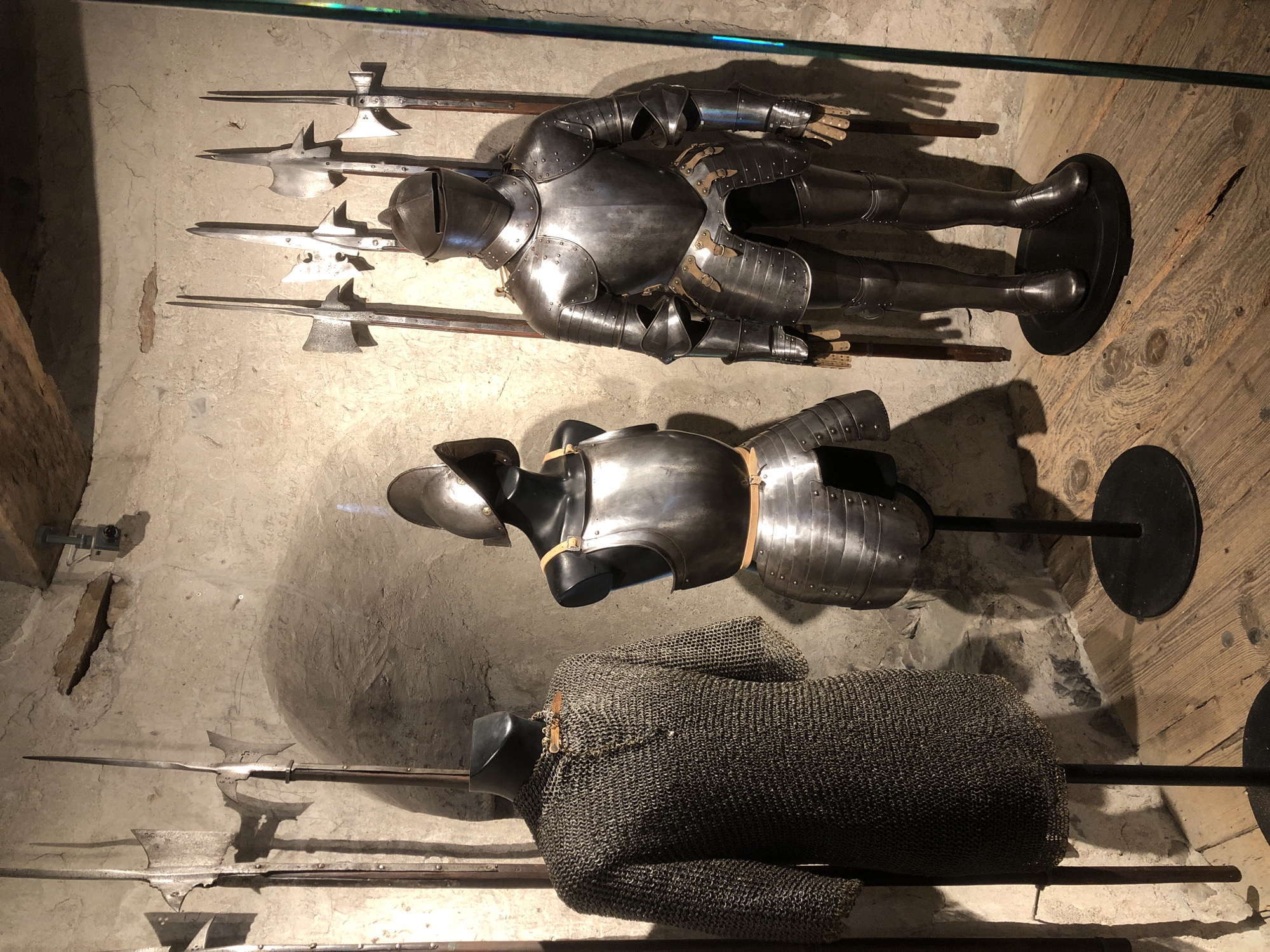
The image shows a display of medieval armor and weapons inside what appears to be a museum or historical site, possibly in the city of Veytaux, Switzerland. There are three sets of armor arranged from top to bottom. The top set is a complete suit of plate armor on a stand, consisting of a helmet, breastplate, gauntlets, and leg protection. Below it is a partial set of plate armor, including a helmet and breastplate on a stand. The bottom set is a chainmail shirt on a mannequin. Various polearms are displayed against the back wall behind the armor, including halberds with distinctive axe-like blades and spear tips. The backdrop is a rough, uneven stone wall. The display is positioned on a wooden floor. The lighting appears to be artificial and casts shadows.
Veytaux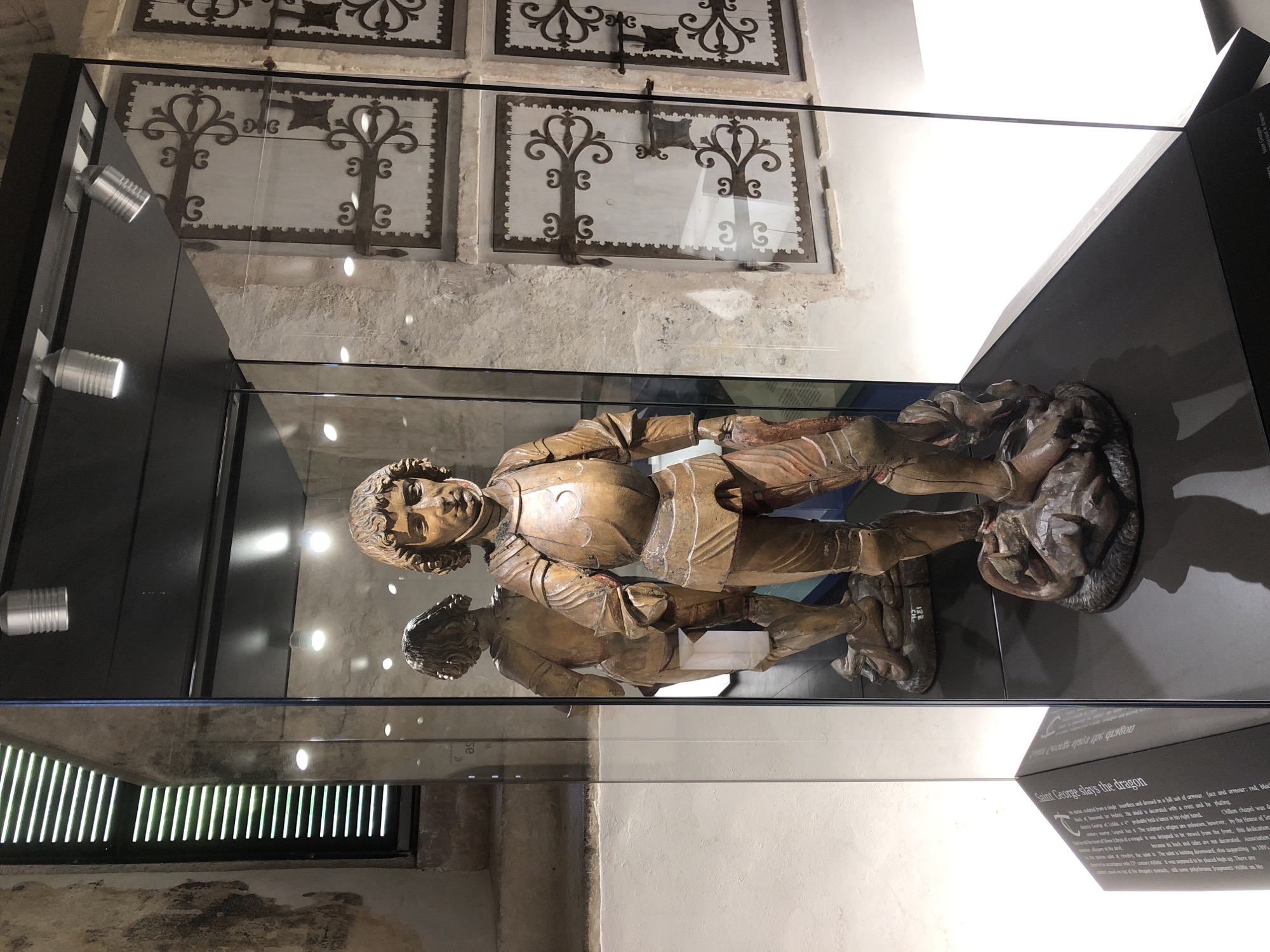
The image shows a wooden sculpture of Saint George slaying a dragon, displayed in a glass case. The sculpture depicts a knight in armor standing over a dragon. The case is in front of a stone wall with decorated panels on it. The sculpture is described by a plaque next to it, detailing the sculpture's origins and history. The location, according to the text, is the Chillion chapel of Veytaux, Switzerland.
Veytaux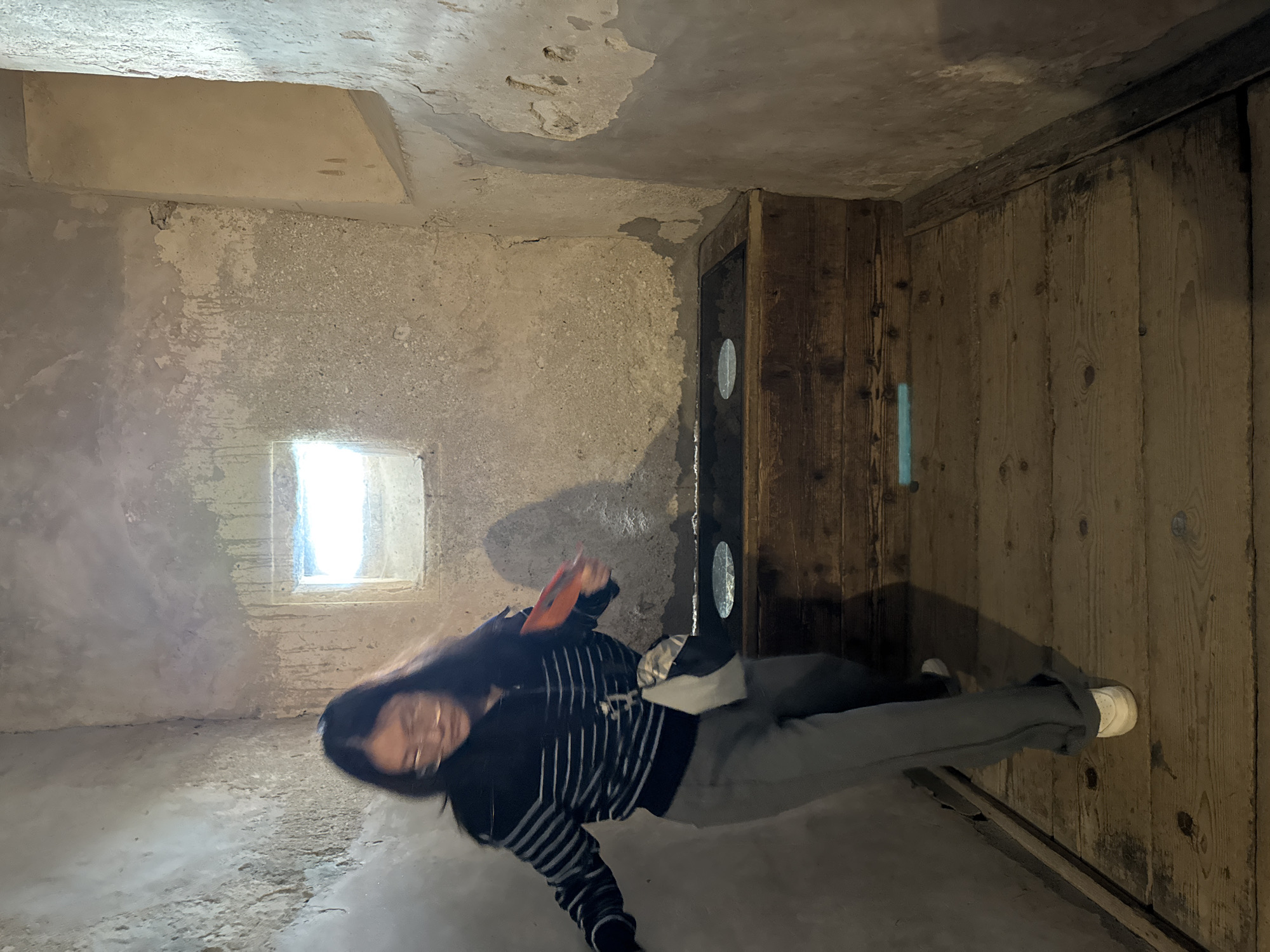
The image shows a person standing in a stone room with a small window. The room appears to be old, with textured walls and a wooden door on the right. The person is wearing a black and white striped shirt, gray pants, and white shoes. The picture was taken in the city of Veytaux, Switzerland.
Veytaux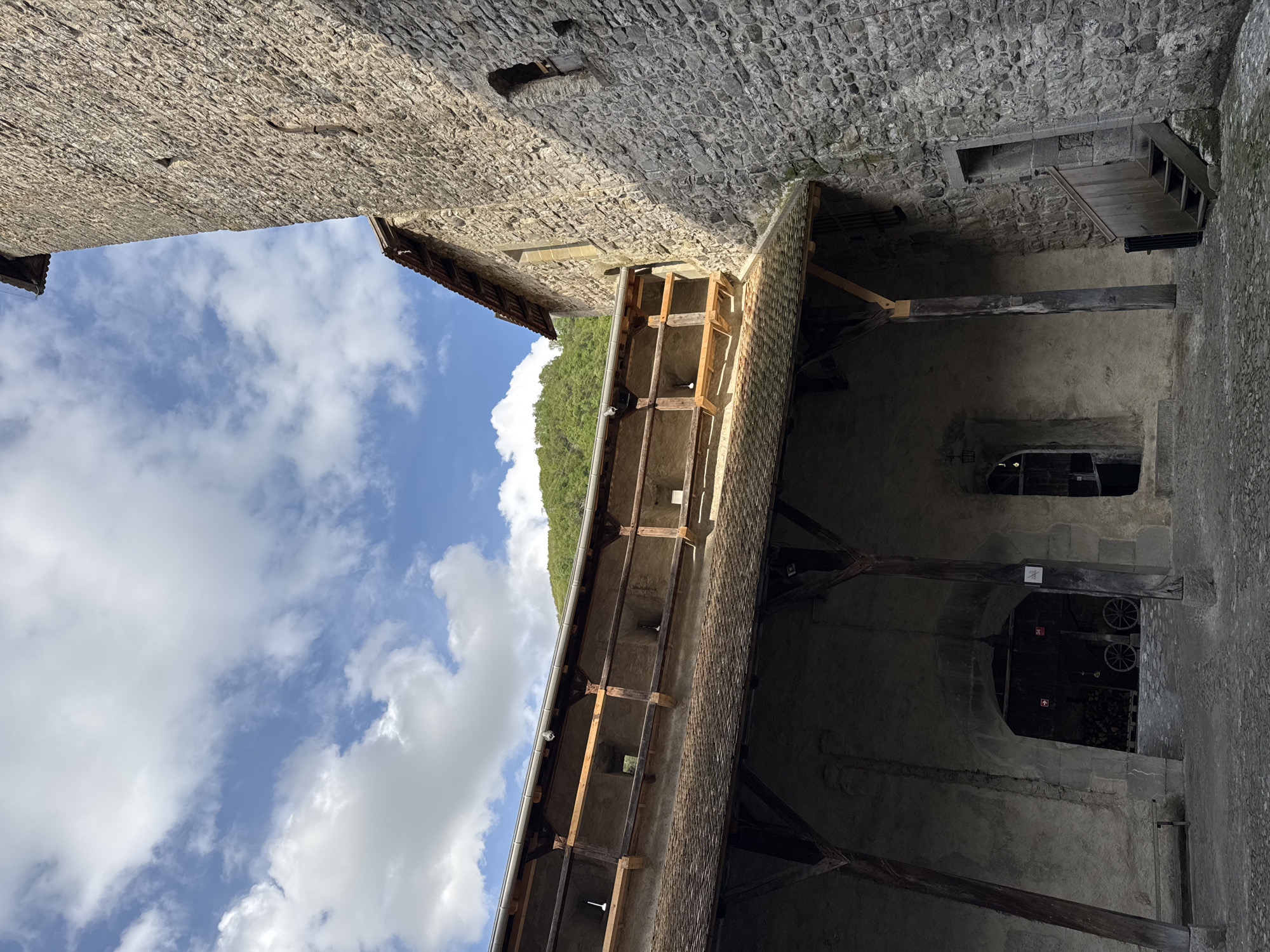
The image shows an upward view of a courtyard within Chillon Castle, located in Veytaux, Switzerland. The scene is framed by stone walls on both sides, built of rough-hewn blocks. On the right is the castle's interior, showing a structure built of stone with wooden beams supporting a shingled roof. A covered wooden walkway extends to the left, providing a covered exterior corridor. The sky is visible above with scattered white clouds and clear blue patches, and a green wooded hillside is visible in the background. The lighting is diffused, creating shadows within the castle structure and reflecting off the stone. The interior wall shows a window and a lower doorway with visible wagon wheels and a sign with an upward pointing arrow and "EXIT" in both english and french.
Veytaux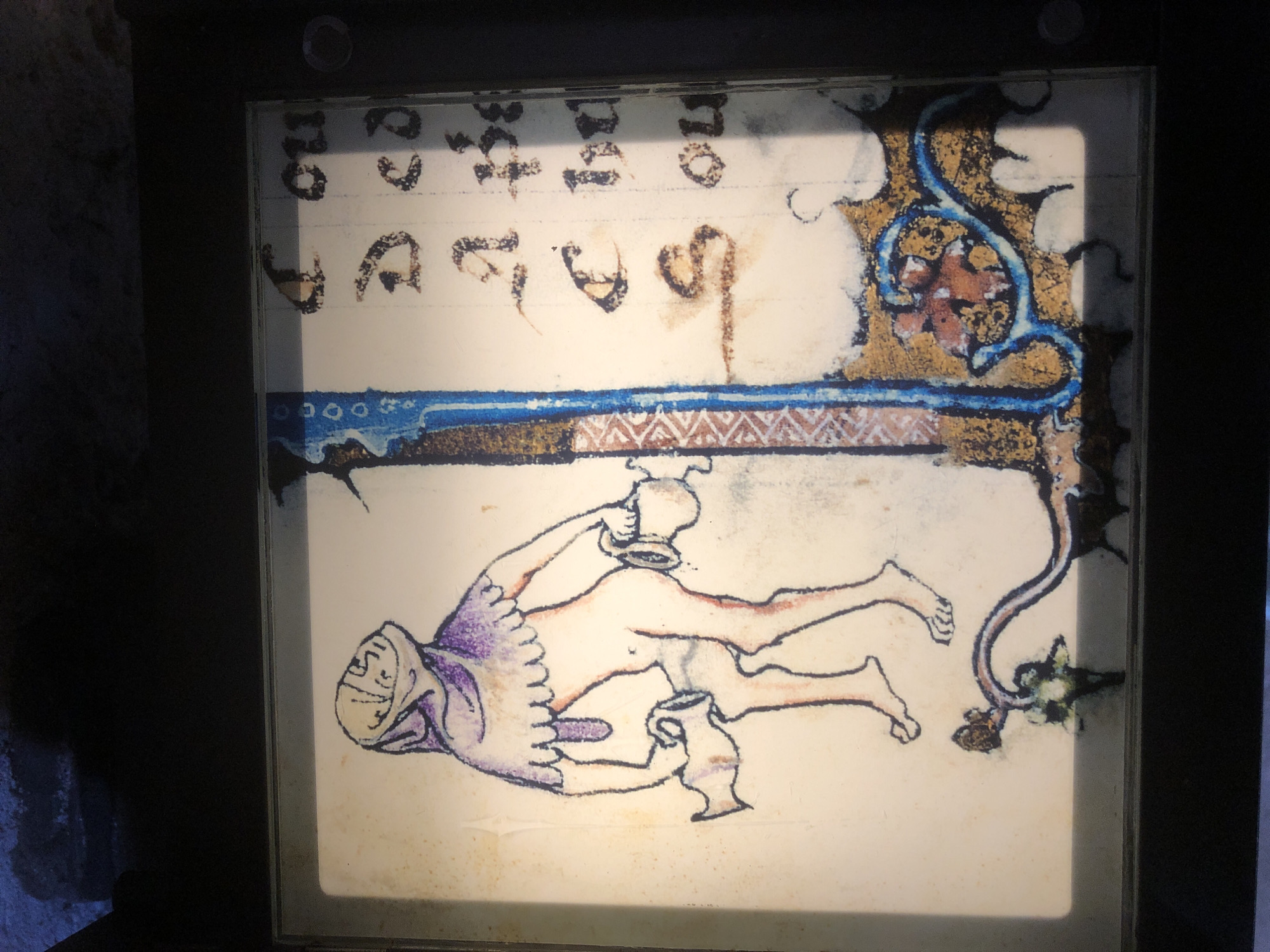
The image depicts a medieval-style illustration displayed under glass. The location is likely the Chillon Castle in Veytaux, Switzerland, based on similar artwork found there. The illustration features a naked figure in a prone position, possibly female, wearing a purple headdress and with what appears to be a feathery, frilled adornment around the head or neck. The figure is pouring liquid from a vessel held above into another vessel positioned below. Above the figures is a blue, horizontal bar with brown and white geometric patterned underlay. Above that is medieval-style writing. To the right is an elaborate decorative border with blue and golden elements including floral shapes. A tail comes from the same motif and ends in a foliage-like element. The artwork appears aged and slightly faded. It is contained within a black frame or is set into a dark environment.
Veytaux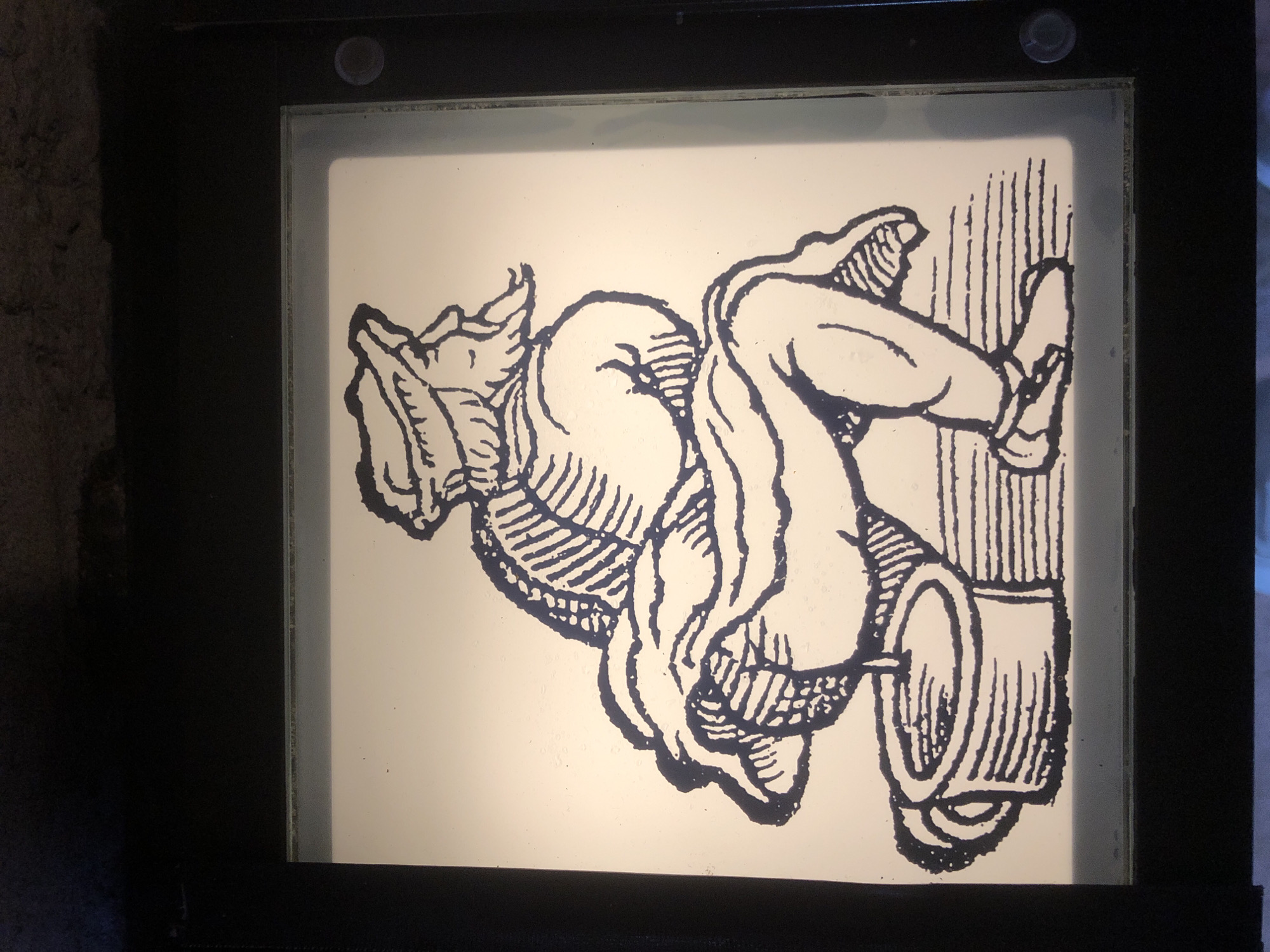
The image shows a black and white cartoon of a person lying on a toilet paper roll next to a pole, encased within a black frame on a white lightboard. This image can be found within the city of Veytaux, Switzerland.
Veytaux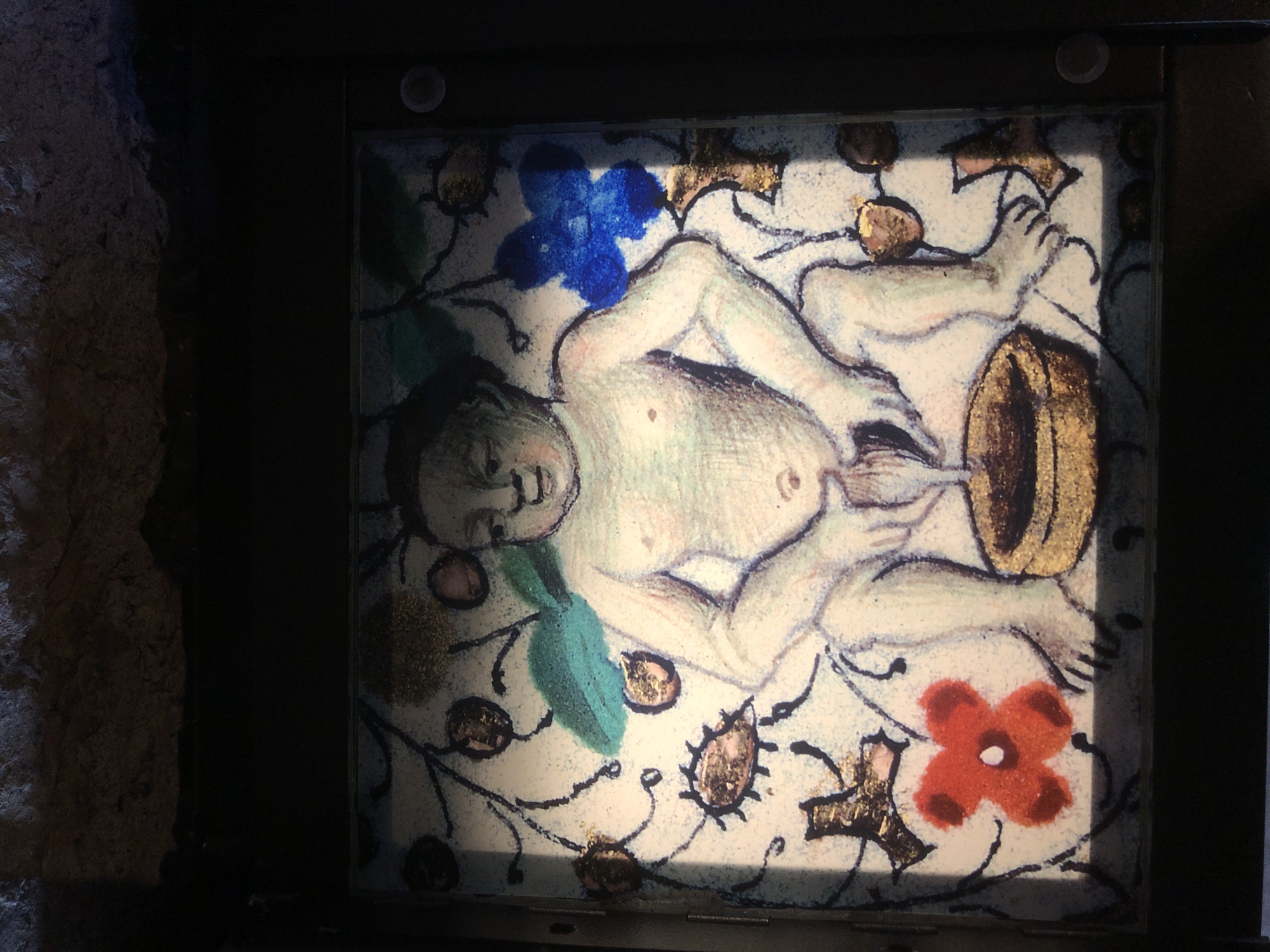
An image of a tile depicting a medieval illustration is visible. The tile is set in a dark frame, possibly a display case or mounted on a wall. The illustration depicts a nude figure with fair skin in a reclined pose, centered on a white or cream-colored background. The figure is surrounded by floral designs, including a blue flower, a red flower, and stylized leaves, all interconnected by black vines or stems. The tile is located in the Château de Chillon, a castle on the shores of Lake Geneva, in the commune of Veytaux, Switzerland.
Veytaux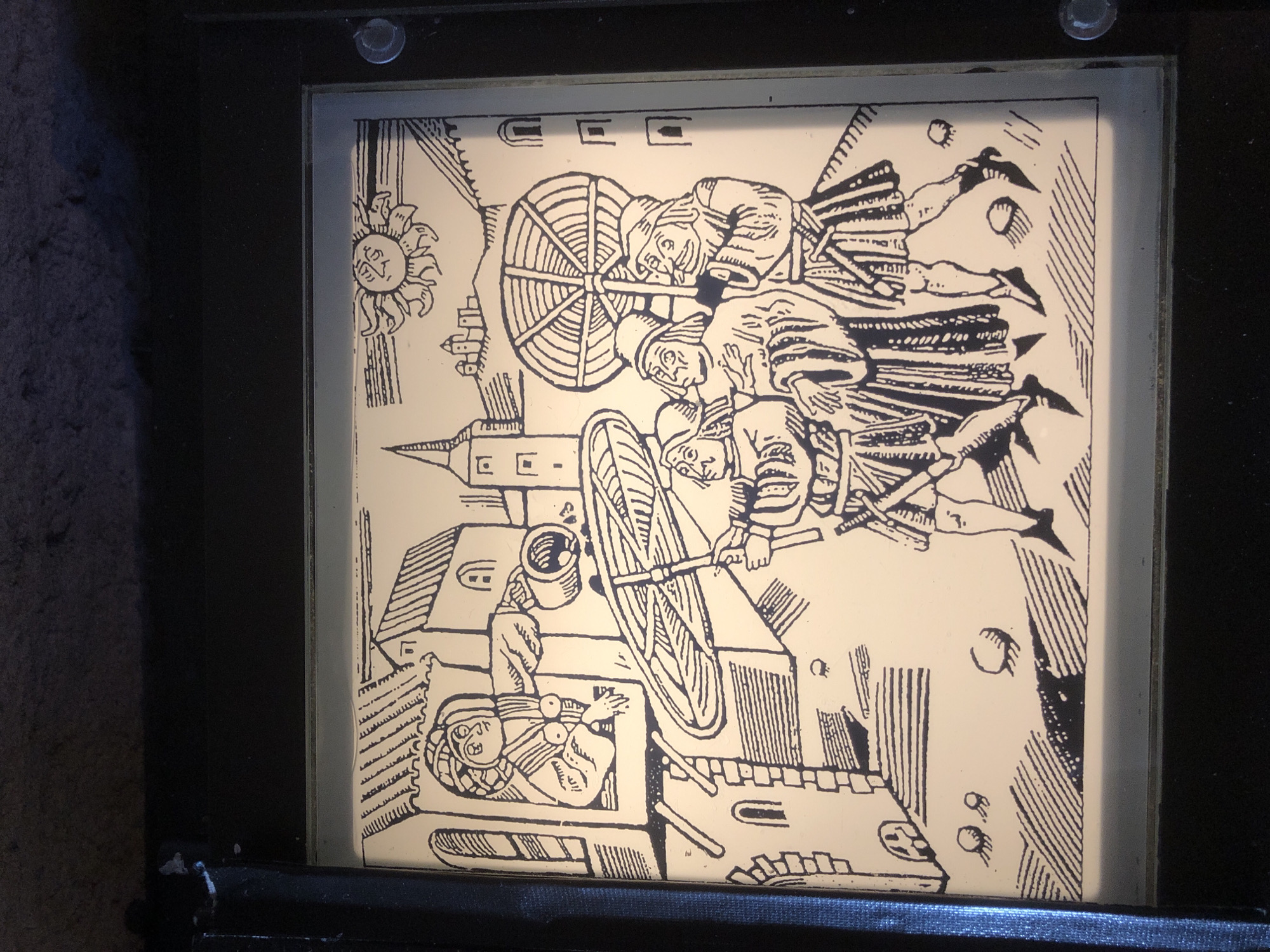
The image depicts an illustration, possibly a woodcut, with a scene reminiscent of medieval art. Three individuals are centrally located, appearing to manipulate large spoked wheels or similar devices. To the left of this central action, architectural elements suggest a town or city, with a person in what seems to be a window or opening in the structure. A stylized sun is positioned in the upper left corner of the image. Scattered throughout the illustration are various geometric shapes. The image does not contain enough evidence to place it in Veytaux, Switzerland.
Veytaux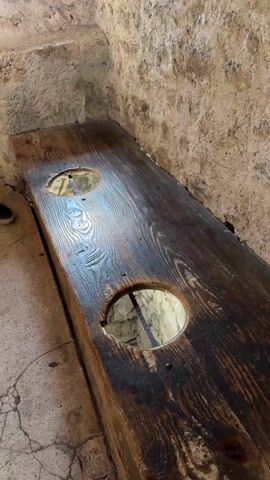
The video shows a close-up of an old wooden bench with two circular holes cut into it. The wood is dark and appears aged, with visible grain and imperfections. Light shines through the holes, revealing a stone structure beneath. The bench is positioned against a rough stone wall and the floor appears to be cracked and aged stone as well. The camera zooms in to focus on one of the holes.
Veytaux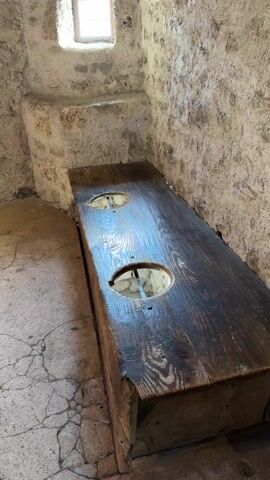
The camera pans slowly up and to the left, showing a dark, rectangular wooden structure with two holes cut in the top. The structure is located in a room with stone walls and a cracked concrete floor. There is a small window in the upper left corner of the frame. The room appears to be old and possibly part of a castle or historic building.
Veytaux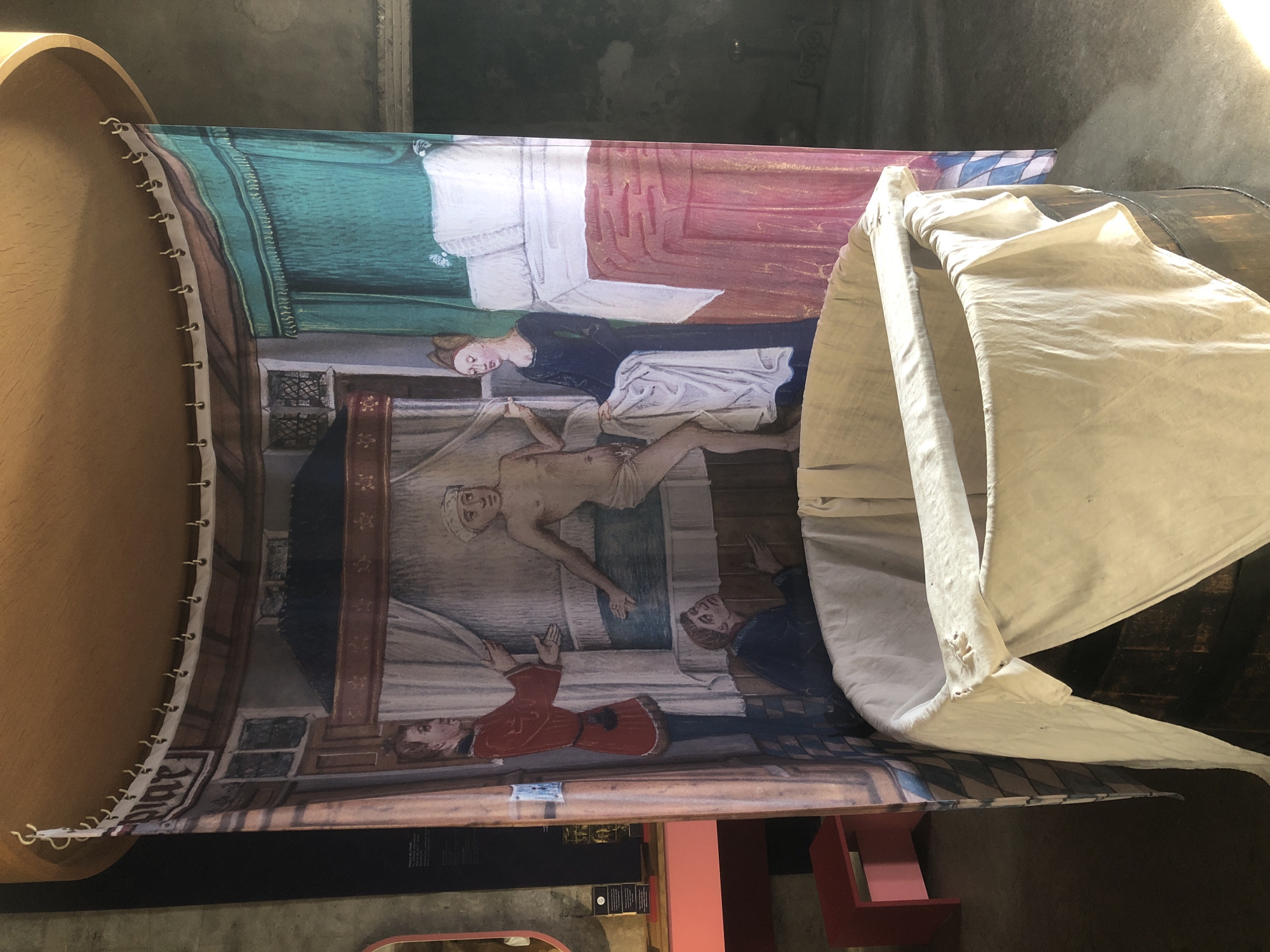
The image shows a tapestry depicting a historical scene, displayed in what appears to be a museum or historical site. The tapestry portrays a medieval setting, with figures in period clothing; a woman stands beside a reclining or deceased male figure, attended by other people. The scene includes a bed with green, white, and red coverings. The tapestry is suspended by a wooden frame with hooks. A section of folded white cloth or canvas partially obscures the right side of the tapestry. The display is in a dimly lit indoor environment, likely within a historical structure in Veytaux, Switzerland. The city name is not visible within the tapestry; the location name comes from the image caption. A small part of a pink colored object, likely a piece of furniture, is visible in the lower right.
Veytaux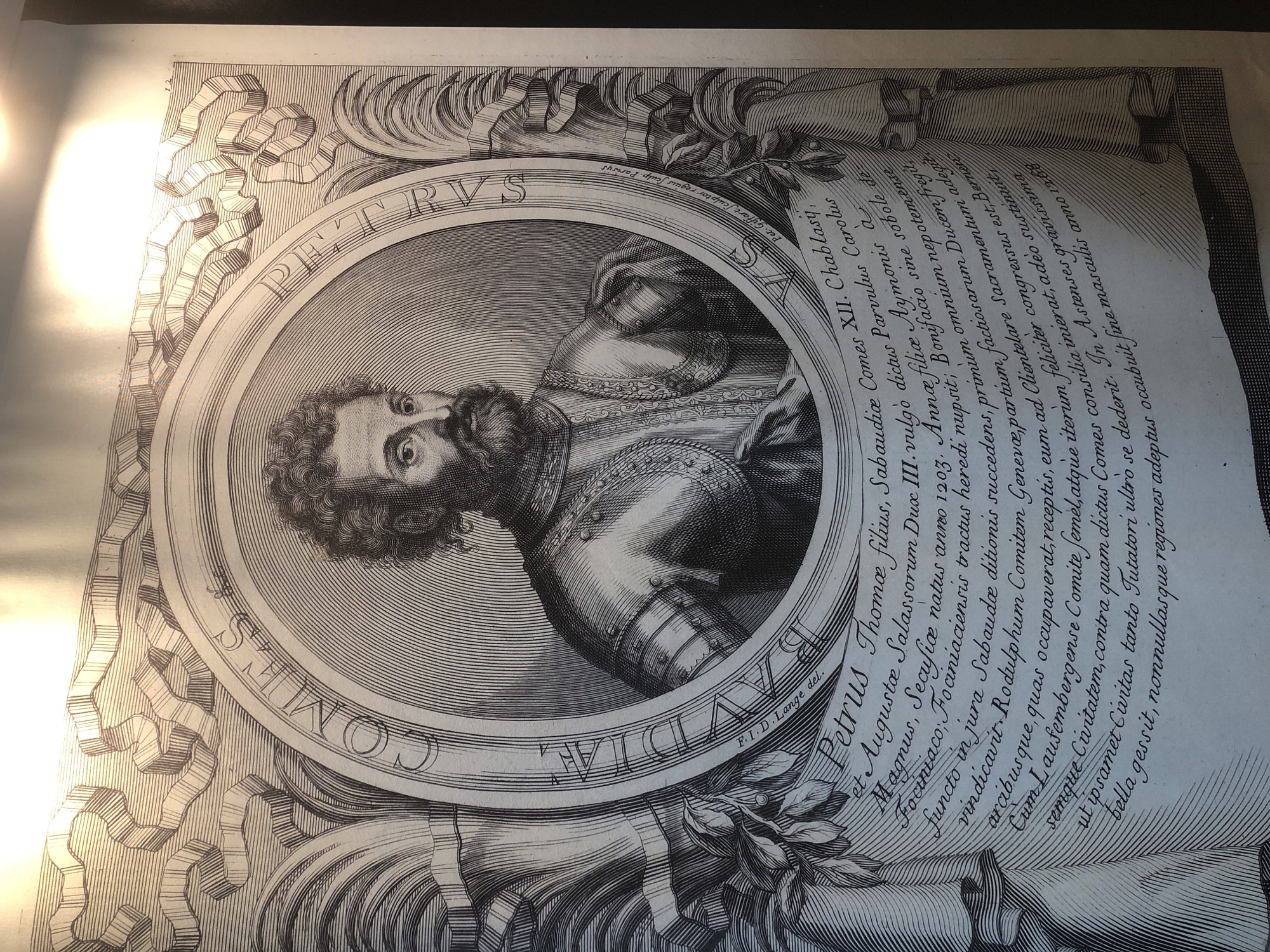
The image is a detailed engraving of Petrus, Count of Savoy. He is depicted in a circular frame, wearing armor and a beard. The text surrounding the portrait identifies him as Petrus Thomæ filius, Comes XII. Chablasy, and other titles. The engraving includes decorative elements such as ribbons, foliage, and elaborate border designs. The text is written in Latin. The artist and engraver are identified as F.I.D. Lange del. and Pet. Giffart Sculptor regius Sculp. Parisys. The image does not appear to be located in Veytaux, Switzerland.
Veytaux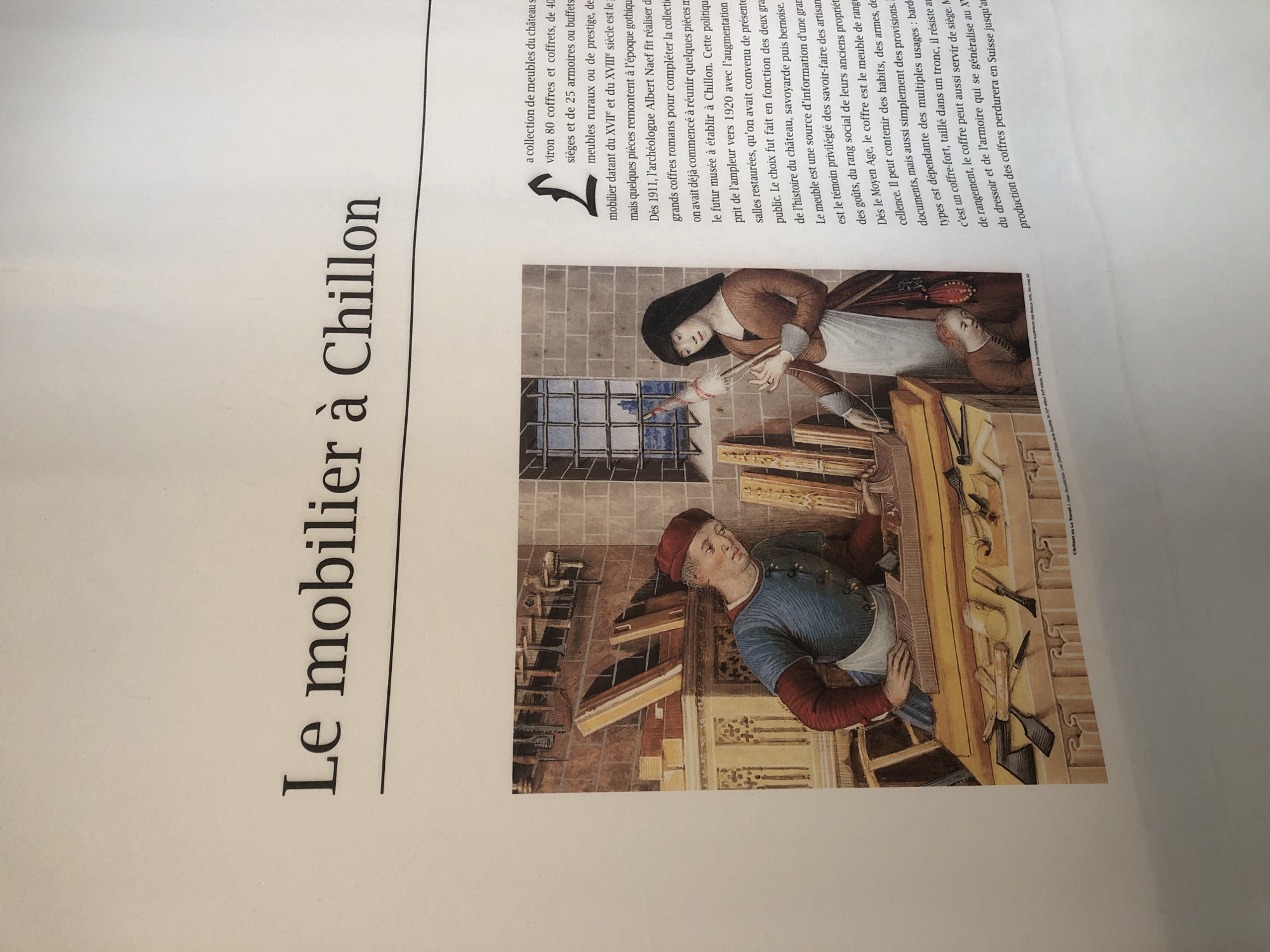
The image shows a printed page with the title "Le mobilier à Chillon" (The furniture at Chillon). The content refers to a collection of furniture at the Chillon Castle in Veytaux, Switzerland. It describes the collection's size, types of furniture (coffers, chests, seats, armoires), and historical periods represented. The text mentions the efforts of archaeologist Albert Naef starting in 1911 to complete the collection. The printed page includes an image of a man and woman working in a workshop. The text also discusses the significance of furniture as a source of information about history, savoir-faire, tastes, and social status.
Veytaux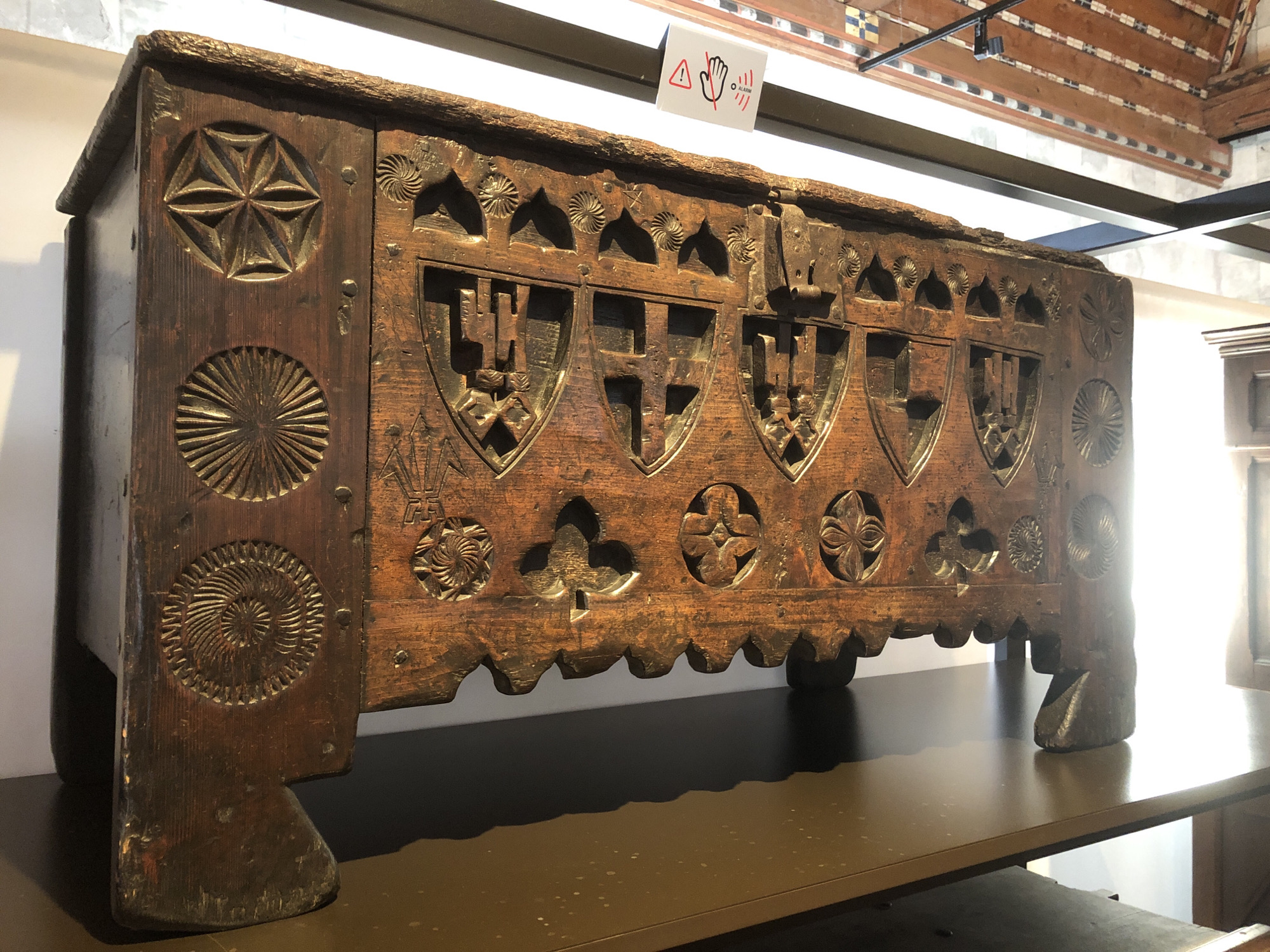
This image shows an ornate, antique wooden chest sitting on a shelf. The chest is dark brown, likely from age and polishing, and features numerous carved details. On the sides are circular patterns and the front has a series of shield-shaped carvings, with additional floral or geometric decorations between and beneath the shields. The chest appears to be in a museum or exhibit, as indicated by the "Do Not Touch" sign visible above it, and a modern black metal support structure can be seen in the background. The background appears to be an interior setting with bright, diffuse lighting. Considering the location in Veytaux, Switzerland, the chest is most likely on display at the Château de Chillon museum.
Veytaux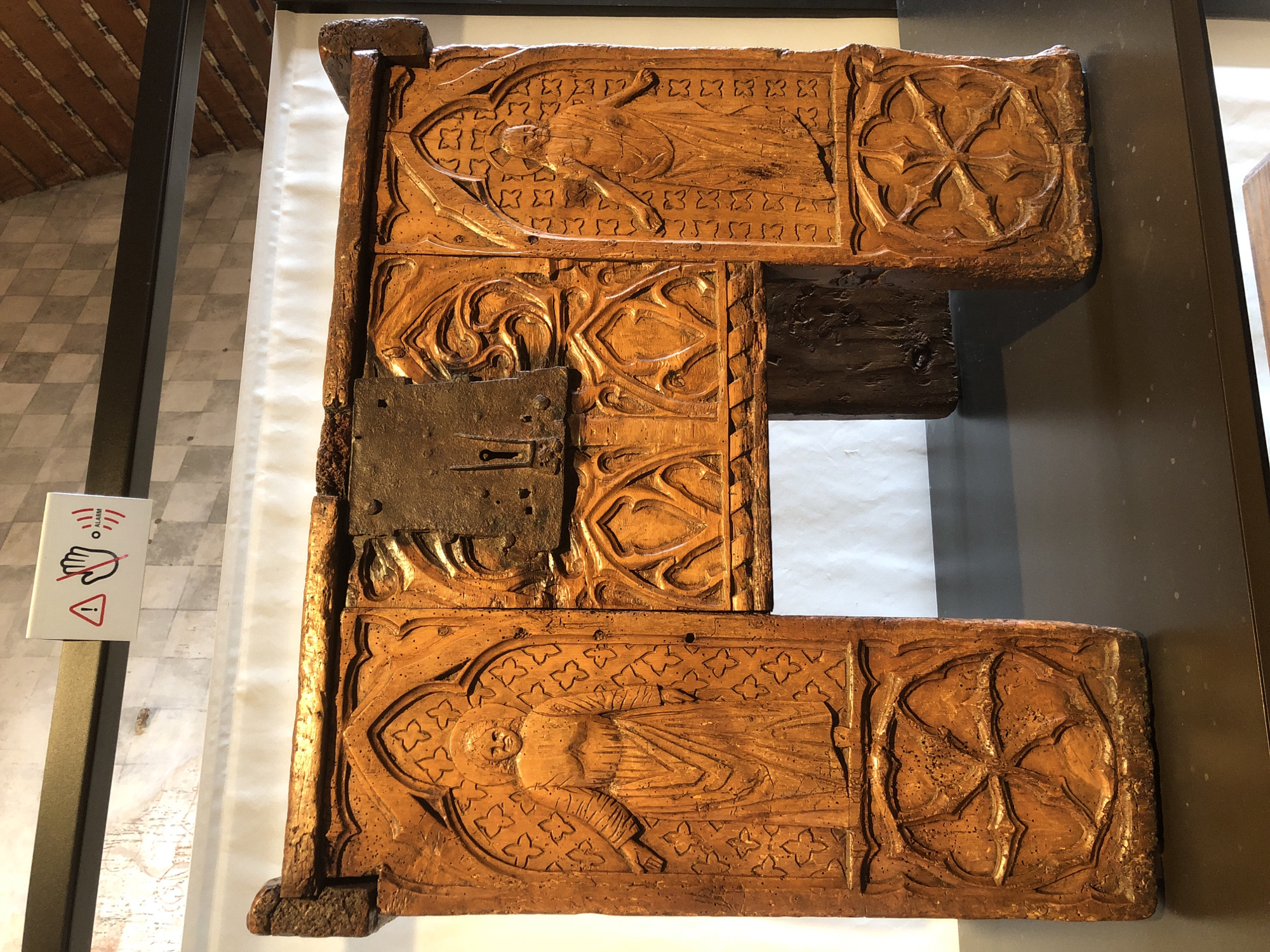
A detailed, ornate wooden carving is displayed in a museum setting. The carving is light brown and appears to be quite old. It features two similar rectangular sections positioned horizontally, with a connecting vertical section. Each horizontal section is decorated with a relief carving of a figure, possibly religious, surrounded by ornate patterns. The top and bottom horizontal sections feature a relief carving with a similar pattern. There is a metal latch or lock attached to the center vertical section, indicating the piece may have been part of a larger structure, such as a chest or door. The object is exhibited in a glass display case, with a white backdrop. To the left of the display, there is a warning sign with an image of a hand with a line through it, suggesting "Do Not Touch". The floor near the object has a checkered pattern. The location is Château de Chillon, Veytaux, Switzerland.
Veytaux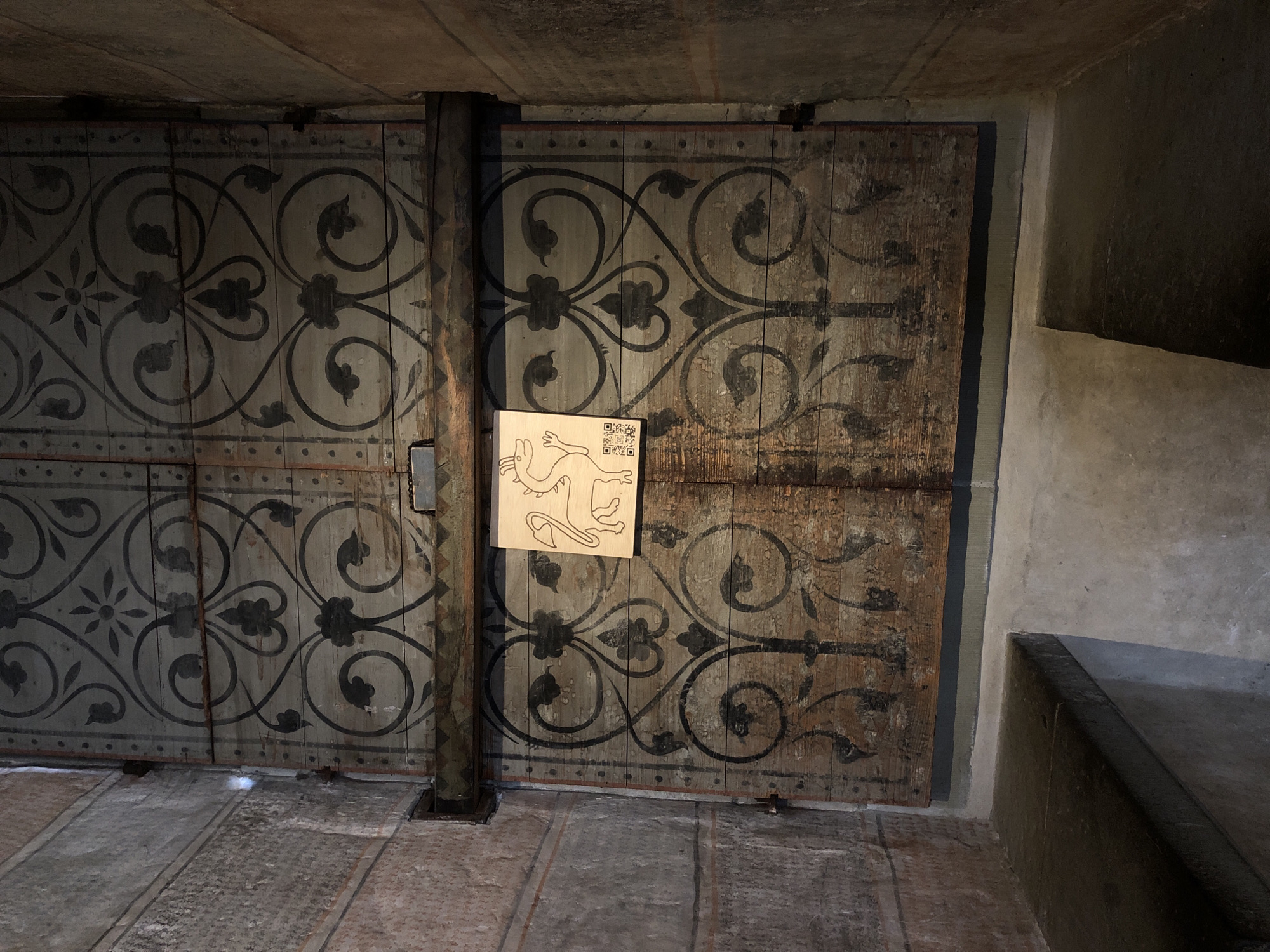
The image depicts a section of the Chillon Castle in Veytaux, Switzerland. Two large, aged wooden doors are visible, each decorated with a symmetrical, dark gray floral and vine pattern. A central vertical beam, also patterned in dark gray, separates the two doors. A light brown sign with a black cartoon drawing and a QR code is affixed to the right door. The floor is made of textured gray stone tiles with thin darker gray lines running across. The background includes parts of a concrete wall with a built-in ledge on the right side. The scene suggests an interior passage within the castle.
Veytaux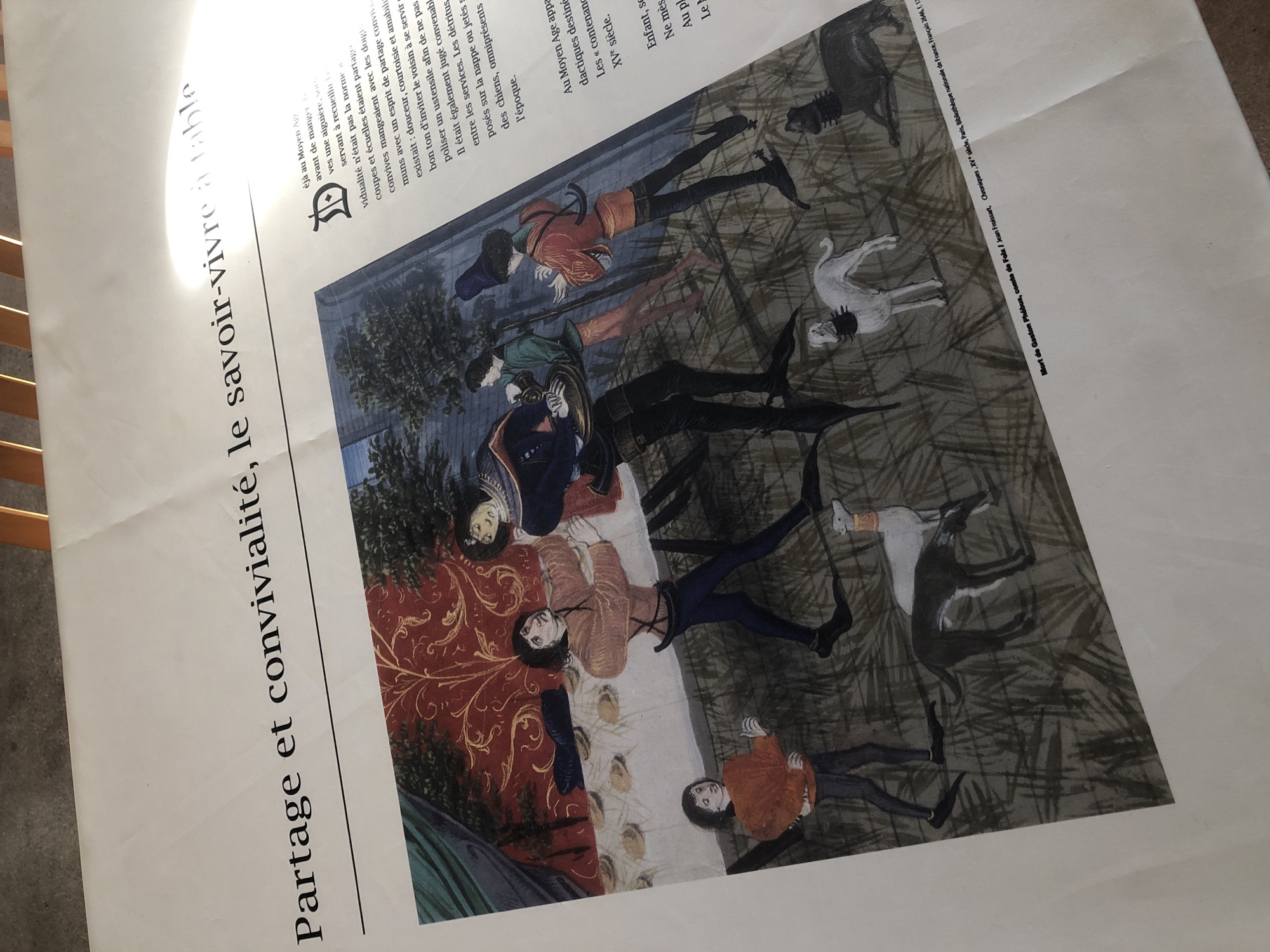
The image shows a poster, with the text "Partage et convivialité, le savoir-vivre à table" printed prominently on the left. The poster features a reproduction of a medieval painting showing a group of people sitting at a table and dining, with several dogs around them. The text to the right of the image appears to discuss table manners in the Middle Ages. The bottom of the poster includes the title of the artwork "Mort de Gaston Phébus, comte de Foix / Jean Froissart, Chroniques, XVe siècle, Paris, Bibliothèque nationale de France, Français 2646, f. 12." The location of the image isn't Veytaux, Switzerland, but rather references medieval table manners according to historic French documents, and the image shown on the poster is housed at the Bibliothèque nationale de France in Paris.
Veytaux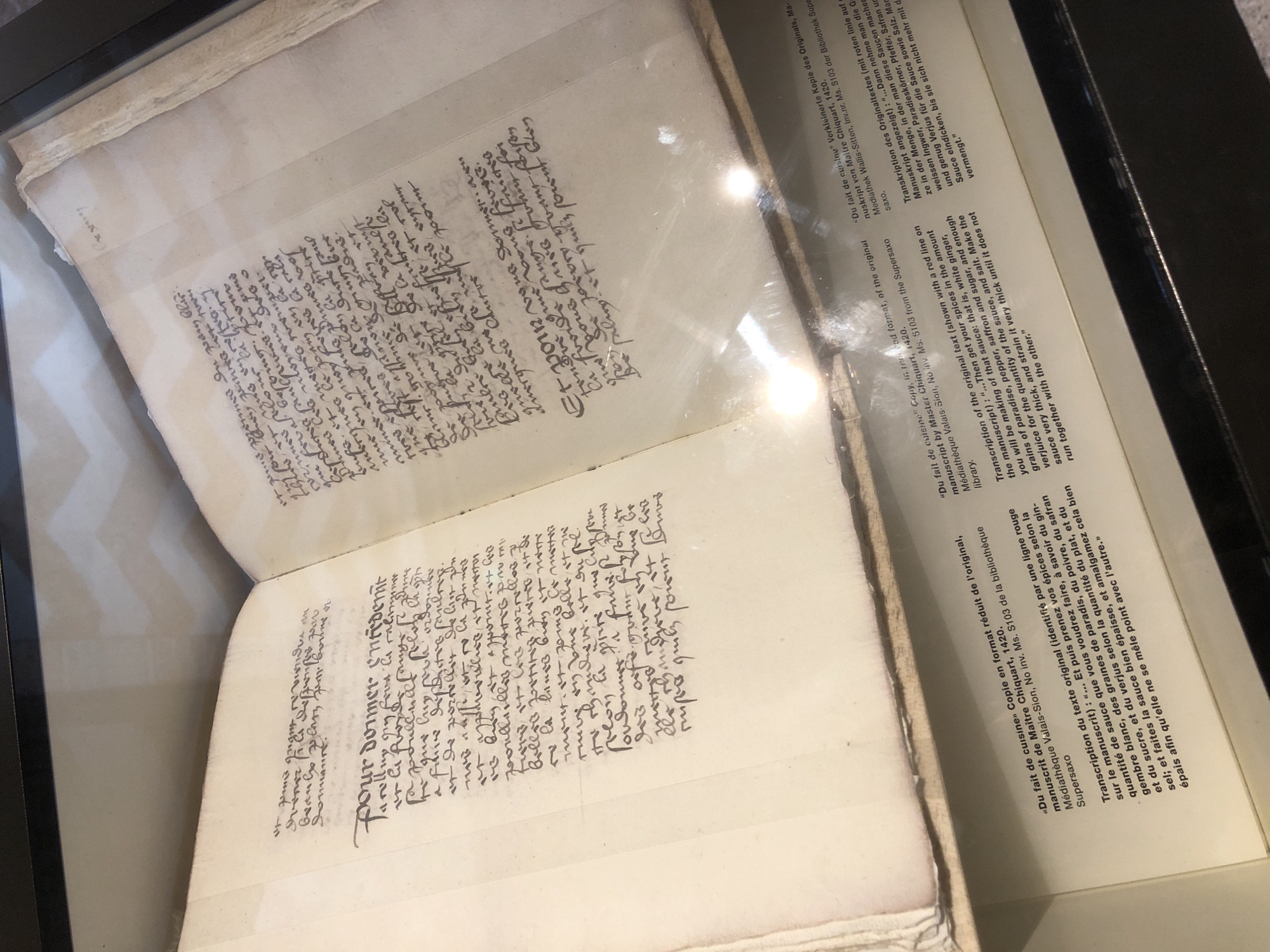
A photograph shows an open book displayed in a glass case in a museum or gallery setting. The book contains handwritten text in a dark ink, filling both pages with dense script that appears to be old French. The text is difficult to read in detail due to the handwriting style and possible degradation of the ink. To the right of the book, under the glass, is a typed transcript of the original text in French, German, and English. No identifying information relates to Veytaux, Switzerland.
Veytaux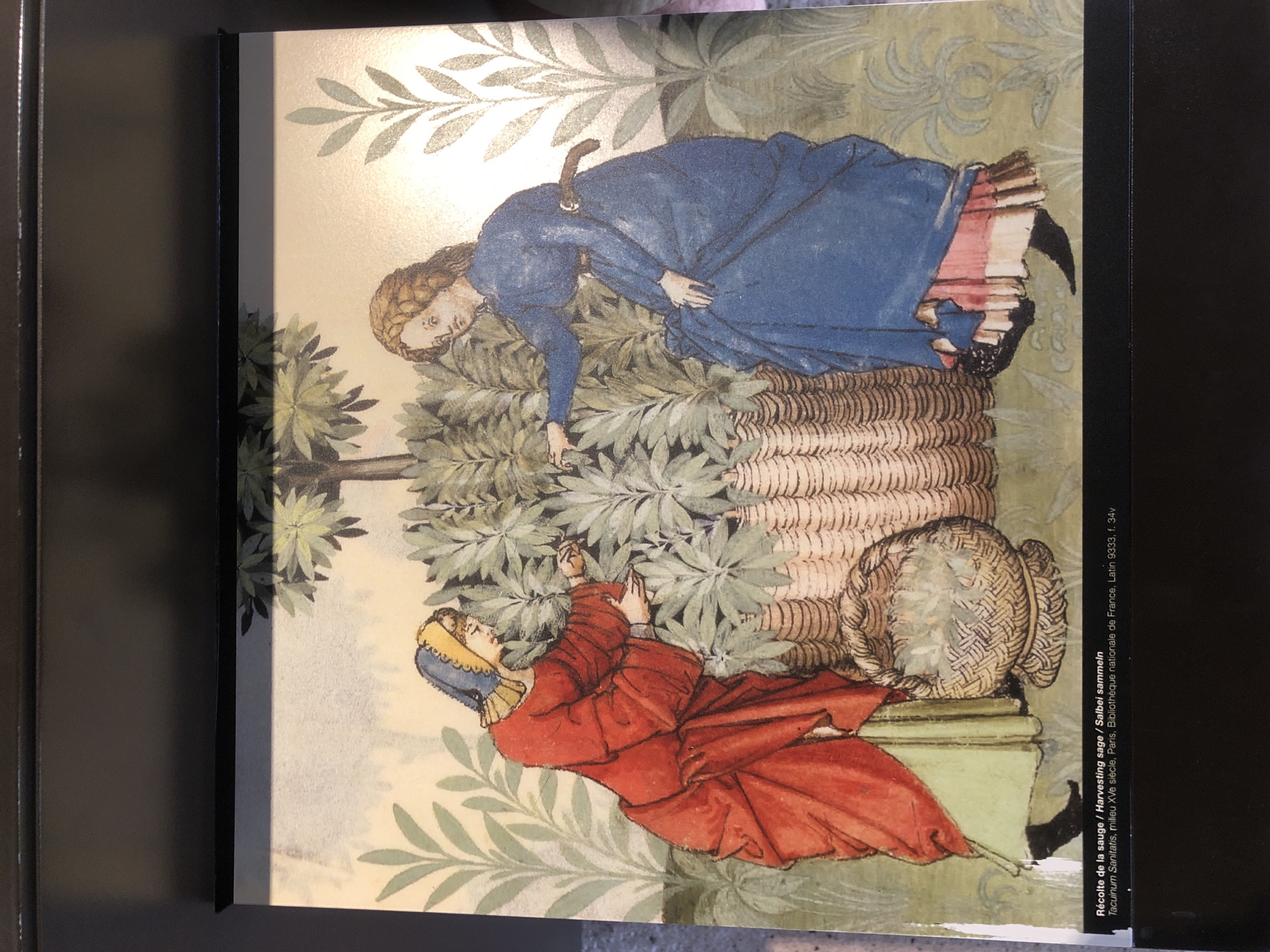
The image is a reproduction of an artwork titled "Récolte de la sauge / Harvesting sage / Salbei sammeln" from the "Tacuinum Sanitatis", dating from the mid-15th century, and held at the Bibliothèque nationale de France, Latin 9333, f. 34v, Paris. The artwork depicts two figures harvesting sage. One figure, wearing a blue dress, is reaching into a large basket-like structure filled with sage. The other figure, wearing a red dress and a head covering, is on the ground, also reaching for sage. The background features a decorative leaf pattern. There is no information indicating that it is in Veytaux, Switzerland.
Veytaux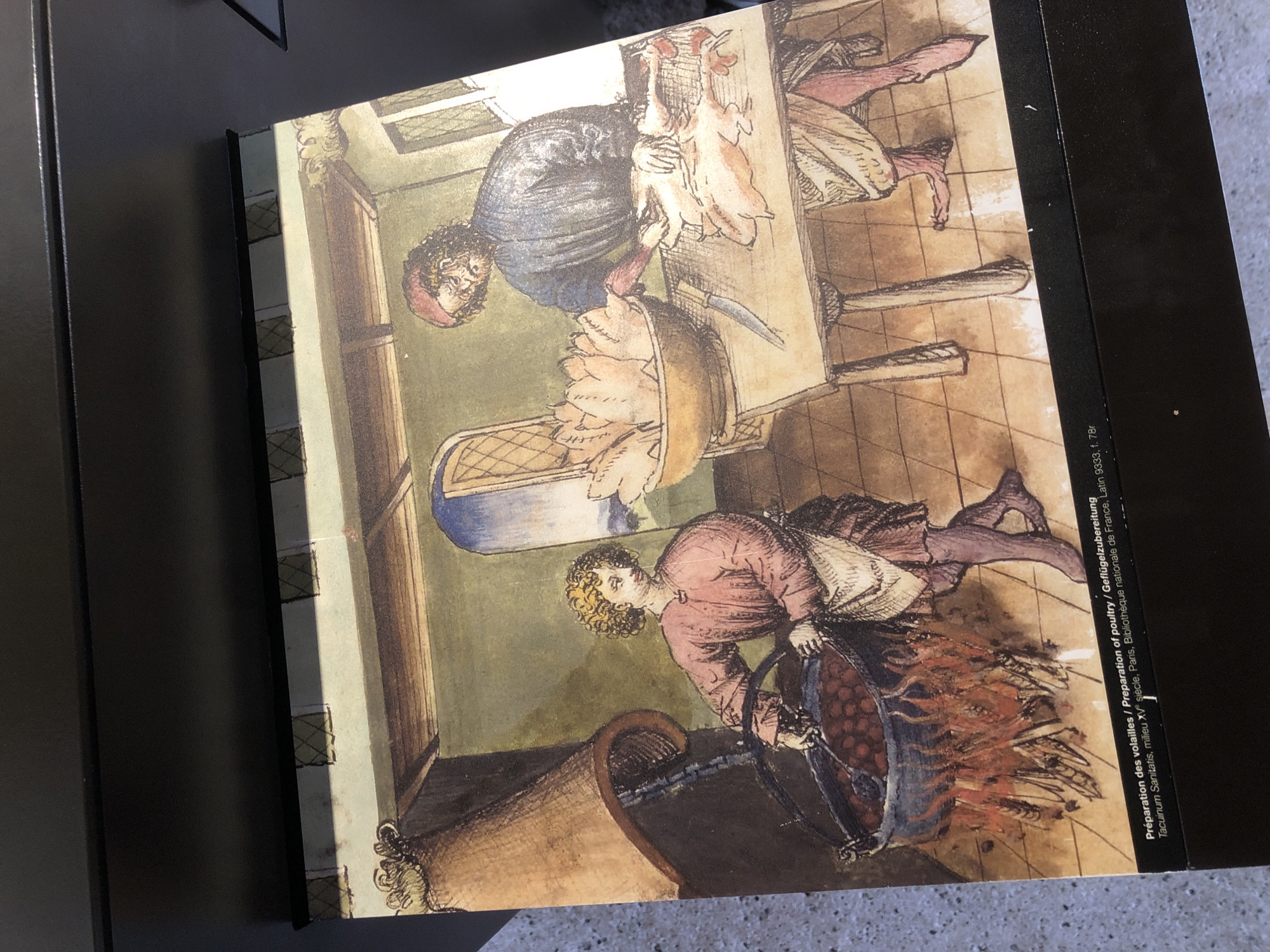
This image shows a medieval illustration of poultry preparation. Two men are depicted. One man, standing at a table, is holding a plucked chicken. Another man is standing beside a large pot, which appears to contain boiling water. The men are inside a room with a tiled floor and paneled walls. The text on the side of the image provides the title "Préparation des volailles / Preparation of poultry / Geflügelzubereitung" and indicates the source of the illustration as "Tacuinum Sanitatis, milieu XV siècle, Paris, Bibliothèque nationale de France, Latin 9333, f. 78r," suggesting it is a French manuscript from the 15th century in Paris. There is no information to suggest it has anything to do with Veytaux, Switzerland.
Veytaux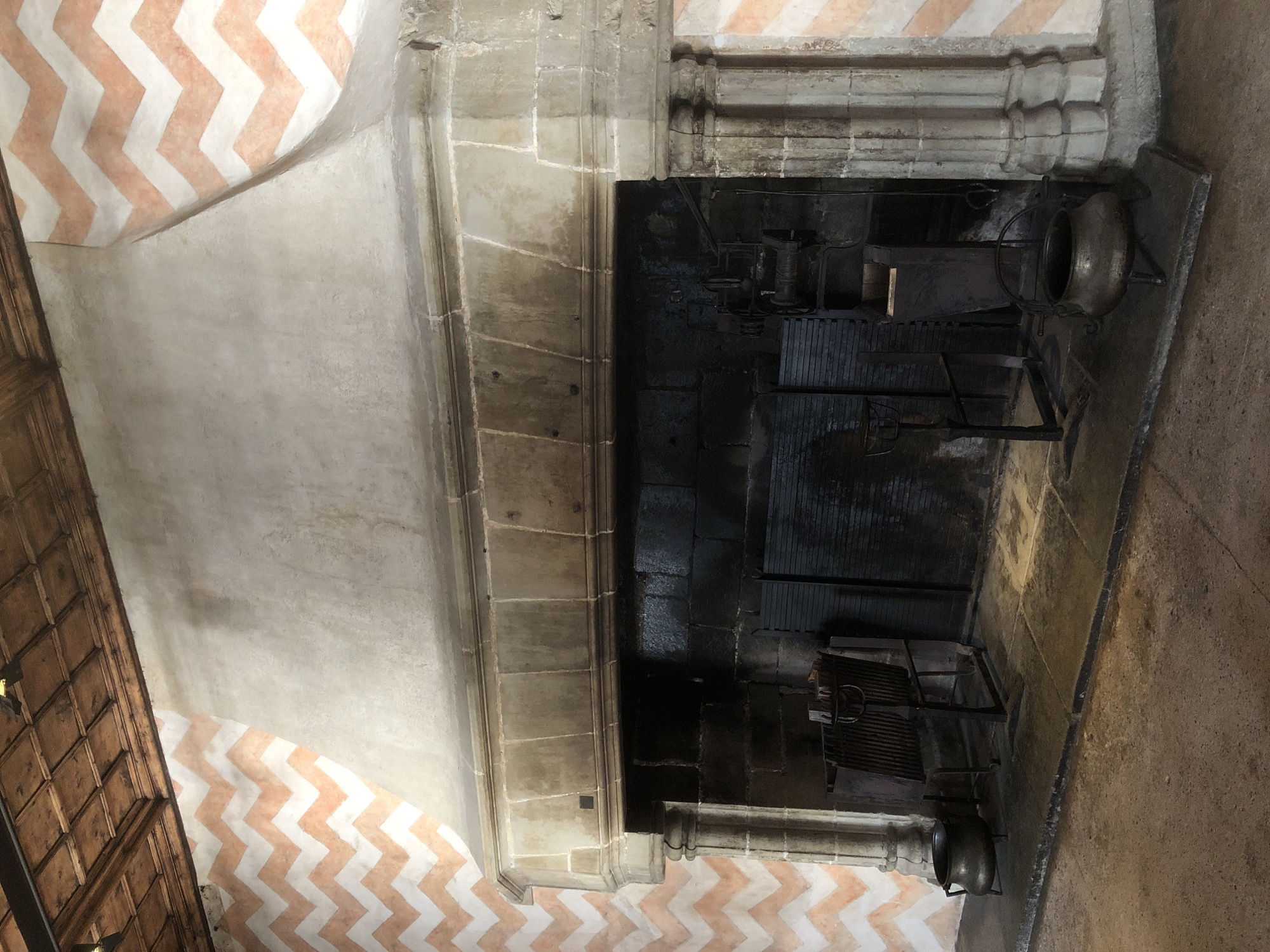
This image shows a large fireplace in the Chillon Castle, located in Veytaux, Switzerland. The fireplace is constructed of stone and blackened from soot, with visible stone detailing above the firebox. Inside the firebox are metal racks and what appear to be cooking pots on stands. The surrounding walls feature a salmon and white chevron pattern above and on the left side.
Veytaux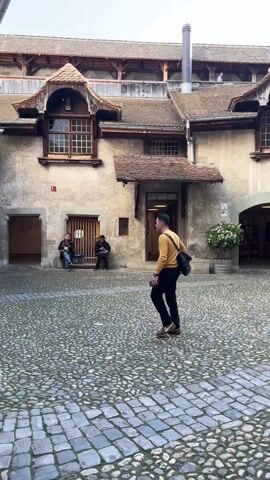
The video shows a courtyard with a cobblestone ground and old stone buildings around it. One building has dormer windows and a wooden door that is open. Two people are sitting on a bench in front of the building, and another person is walking across the courtyard. As the camera pans to the right, the viewer sees a small tree in a pot, another building with an open wooden door, and an archway. Two women are standing in the archway, and a young woman is sitting on the ground near the archway, looking at her phone. People are walking through the archway.
Veytaux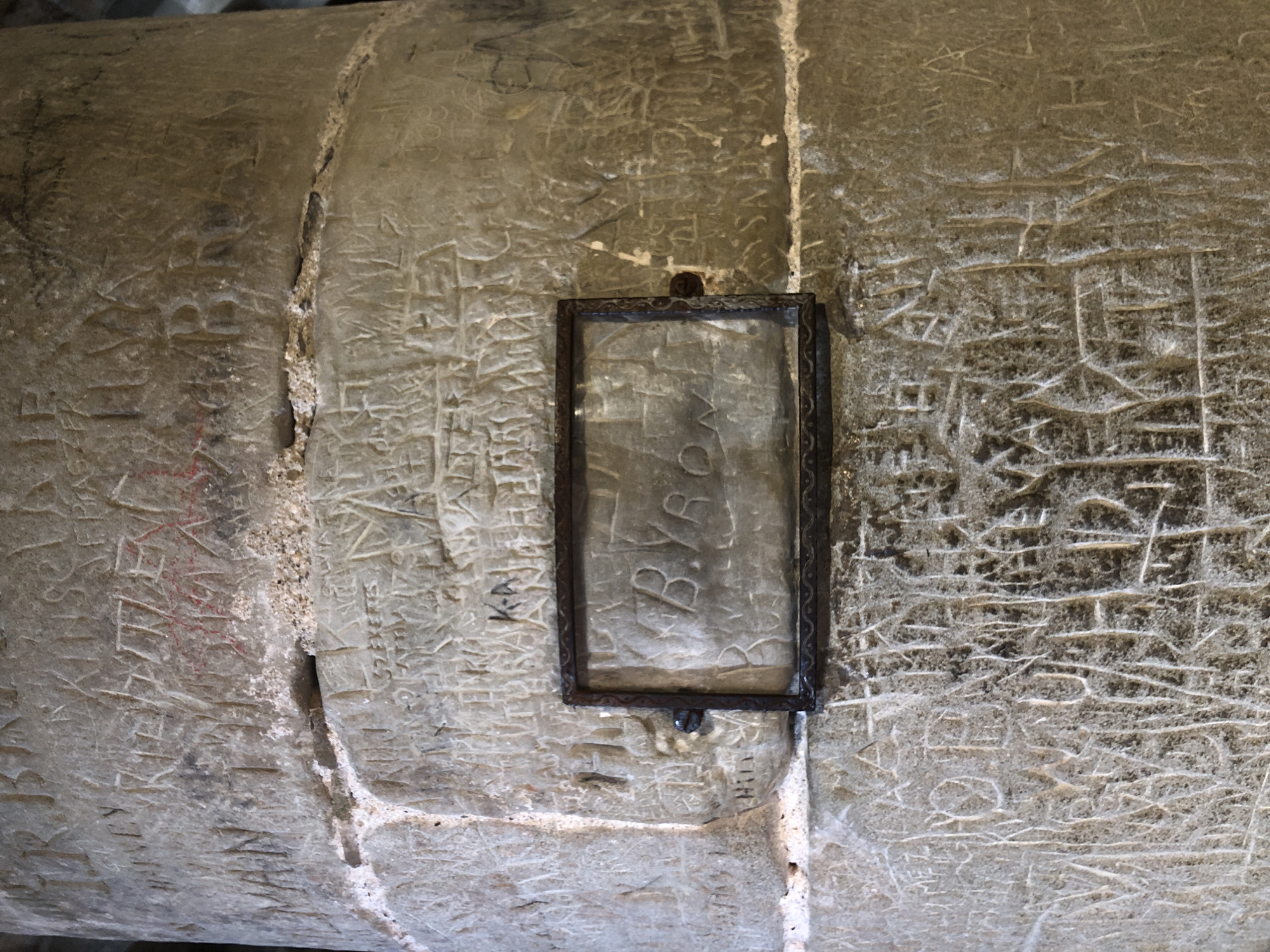
Close-up of a rough, light-colored stone column or wall, covered in carved graffiti. A dark-framed sign or display case is affixed to the stone, partially obscuring the carvings. The visible text inside the frame reads "BYRON". The photograph depicts graffiti attributed to Lord Byron in Château de Chillon, Veytaux, Switzerland. The stone surface shows signs of age and wear. Some carvings are shallow and faint, while others are more pronounced.
Veytaux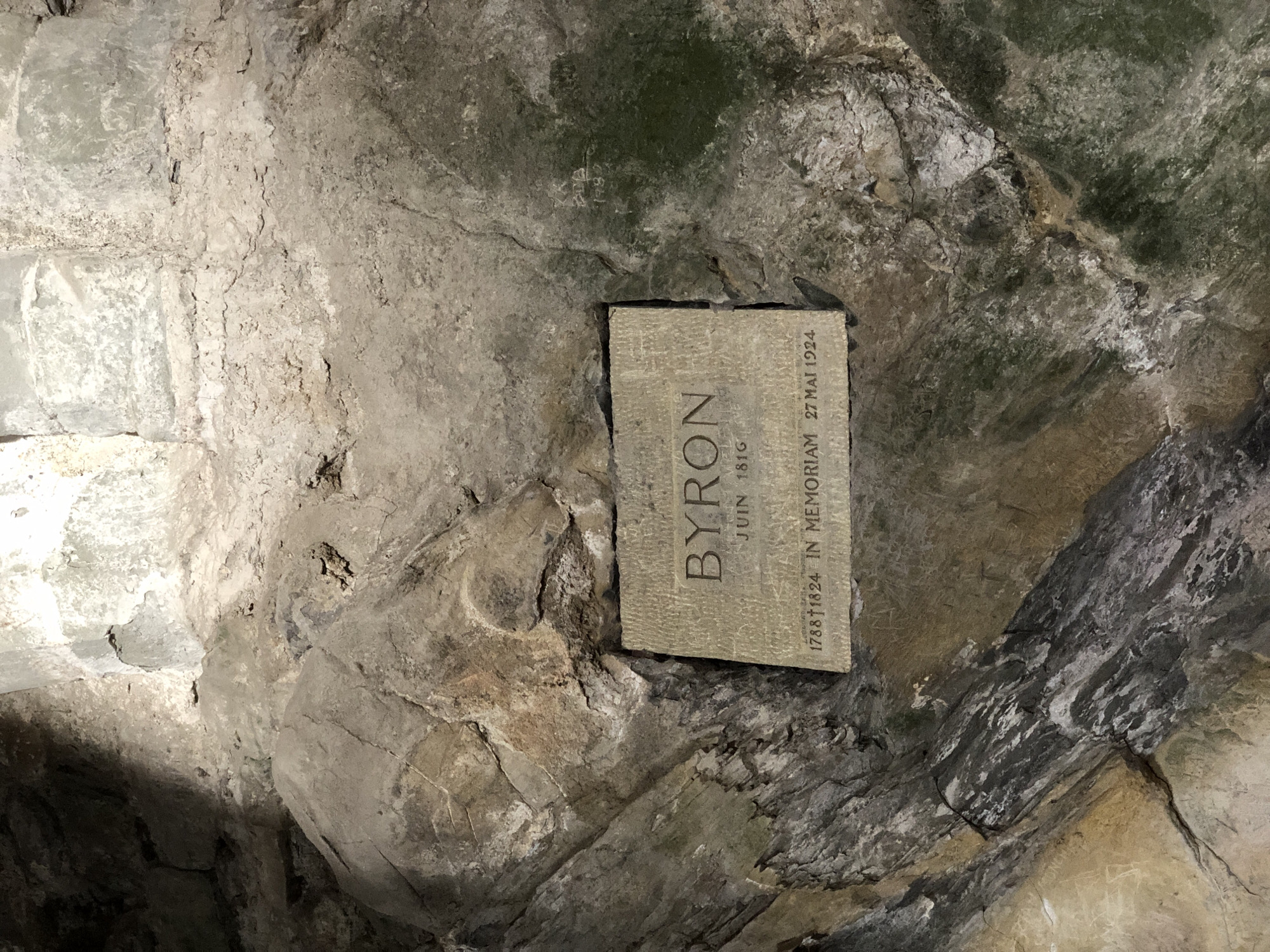
The image captures a close-up view of a stone plaque mounted on a rough, uneven rock wall. The plaque commemorates Lord Byron, inscribed with "BYRON JUIN 1816" and "1788 t 1824 IN MEMORIAM 27 MAI 1924." The stone has a light gray color with darkened edges and some signs of weathering. The surrounding rock wall exhibits a mix of light and dark gray hues, with visible cracks, crevices, and irregular textures. There are possible signs of moisture or moss in some areas of the rock wall. This location is likely a memorial at the Chateau de Chillon, in Veytaux, Switzerland.
Veytaux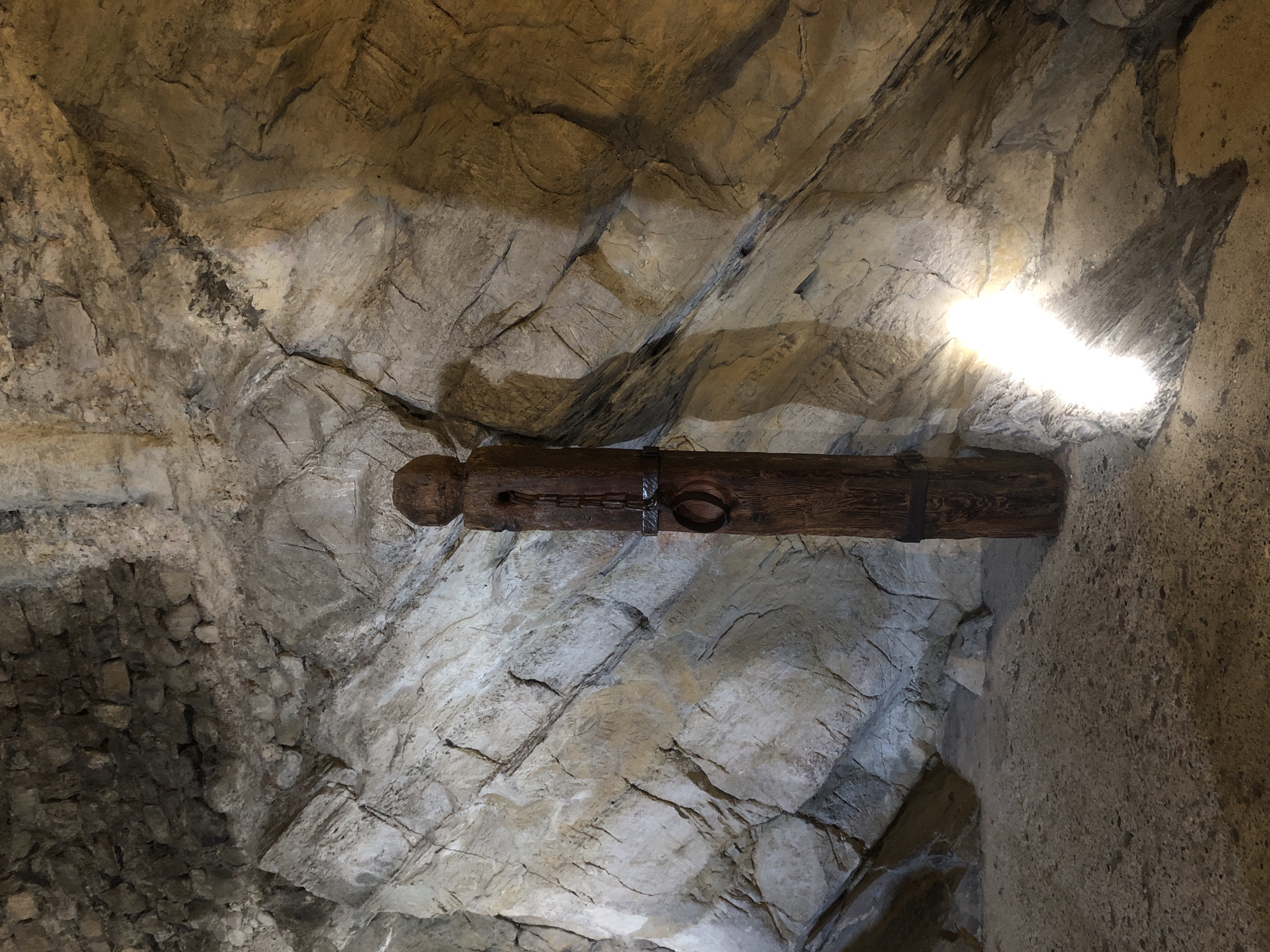
The image shows a dark, cavernous space constructed from rough-hewn stone. The walls are irregular and fractured, with variations in color and texture indicating different types of stone or layers of construction. A wooden beam spans across the space, secured with iron bands. A chain hangs from the beam. The upper right of the image is intensely illuminated, possibly from an artificial light source. The location is likely the Château de Chillon in Veytaux, Switzerland, specifically an interior area possibly used for torture, as indicated by the beam and chain. No people are visible.
Veytaux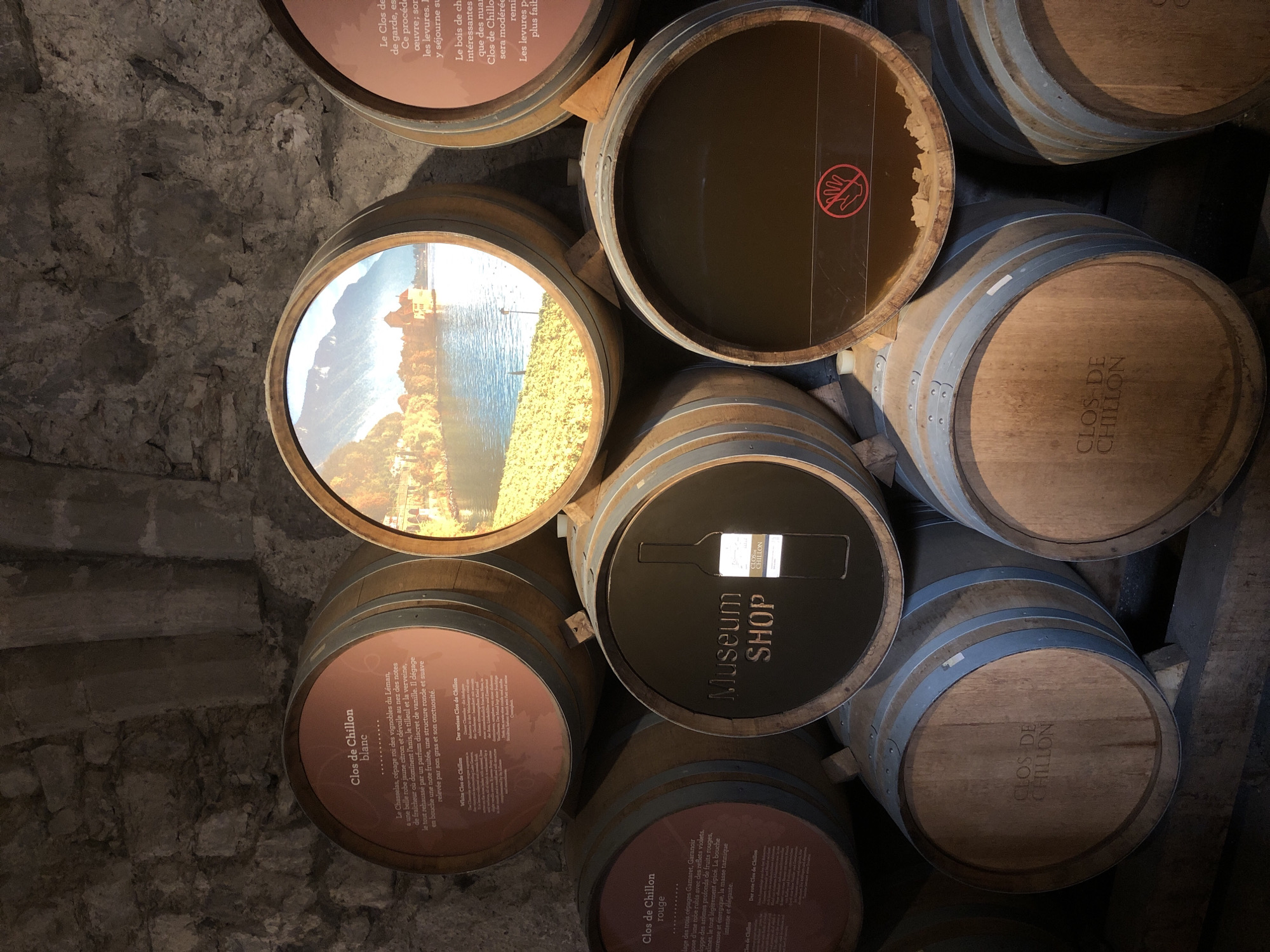
The image shows a stack of wine barrels in what appears to be a cellar or storage area. Each barrel has a round sign on top with information about wine, a landscape, and a museum shop. The image shows a collection of barrels, some labeled "Clos de Chillon" with descriptions in French and German, suggesting a location in Veytaux, Switzerland. The image is captured from a high-angle perspective, and the lighting is subdued, emphasizing the textures of the barrels and the stonework of the surrounding walls.
Veytaux