Wąwelnica, Poland
8 memories from Wąwelnica, Poland
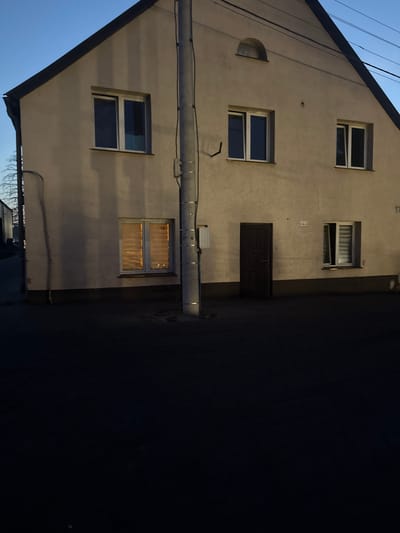
The image shows the exterior of a two-story building in Wąwelnica, Poland. The building has a light-colored facade and a dark sloped roof. There are several windows on the upper floor, and one window and a dark wooden door on the ground floor. The windows have white frames. The ground floor window on the left appears to have blinds, and the window on the right has blinds that are partially open. A utility pole with wires runs vertically along the right side of the building's facade. The area in front of the building is dark, suggesting it is nighttime or dusk, with a dark asphalt surface. A faint house number "17" is visible on the facade to the right of the door. The sky is a deep blue, indicating twilight.
Wąwelnica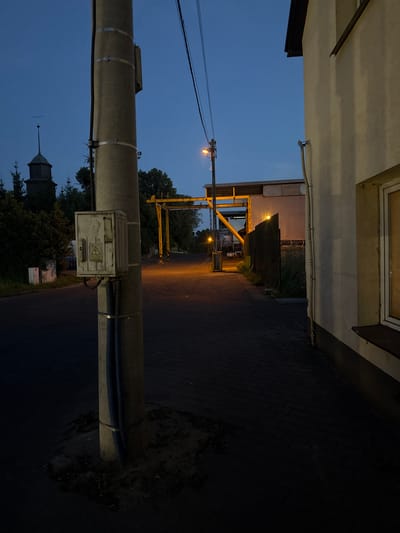
In Wąwelnica, Poland, at dusk, a concrete utility pole stands prominently in the foreground on the left side of a paved pathway. Attached to the pole is a light-colored electrical junction box with a warning sticker displaying a lightning bolt symbol. Dark blue conduits run vertically along the pole, secured with metal bands. Beyond the pole, the pathway extends into the distance, illuminated by a single streetlamp casting an orange glow. To the left of the pathway, a dark wooden church tower with a cross on its spire is visible amidst trees, and further back, a large industrial building with a yellow gantry structure is situated. On the right side of the image, a light-colored building with a window and a dark overhang is partially visible. The sky is a deep blue, indicating the late hour of the day. The environment appears to be a semi-urban or industrial area.
Wąwelnica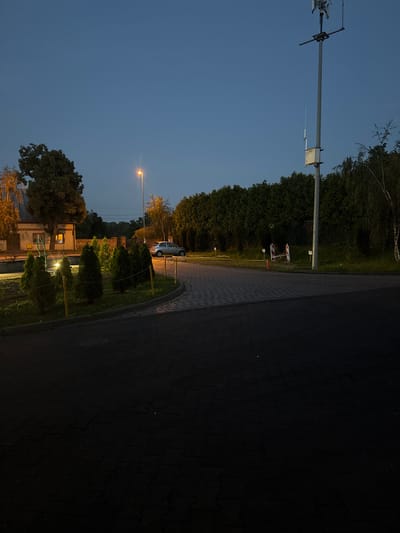
The image depicts an outdoor scene at dusk in Wąwelnica, Poland, likely a residential or public area, possibly a parking lot or roundabout. The sky is a deep twilight blue, with a single streetlamp casting a warm orange glow. In the background, a silver car is parked near a building with lit windows. A tall utility pole with antennas and a white box is prominent on the right side of the frame. Several small, cone-shaped evergreen trees are arranged in a line, bordered by a low fence. The ground is paved with interlocking bricks, and the foreground is dark asphalt. Vegetation, including trees and shrubs, surrounds the paved area. There are no people visible in the image. The overall impression is one of quietude and transition from day to night.
Wąwelnica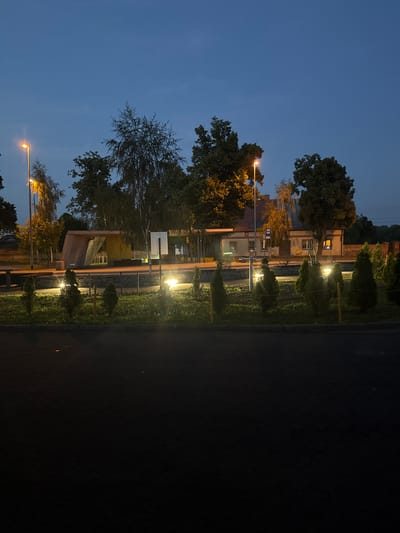
This image depicts an outdoor scene at dusk or early night in Wąwelnica, Poland. In the foreground, a dark asphalt or paved area with a visible brick-like pattern stretches across the bottom of the frame. Beyond this, a low-lying grassy area is illuminated by several ground lights, casting a warm glow. Several small, cone-shaped evergreen trees are interspersed within this grassy area, with thin wooden posts marking the boundary. A low wall made of stone blocks forms a border between the grassy area and a walkway or platform. Behind the wall, a modern-looking structure with a slanted concrete roof and yellow panels is visible, possibly a bus stop shelter or a small pavilion. Further back, a traditional building with a tiled roof, windows with illuminated interiors, and a bus stop sign is present. Trees, some bare and some with foliage, are scattered throughout the scene, with streetlights casting an orange light on them. The sky is a deep blue, indicating twilight. No people are visible in the image.
Wąwelnica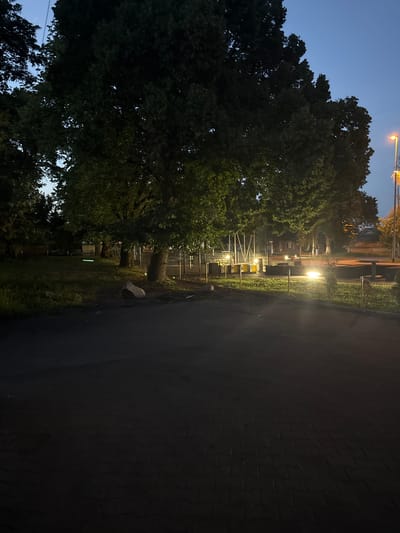
The image depicts an outdoor scene at dusk or night, showcasing a park-like area with mature trees and illuminated elements. The foreground is dominated by a dark, paved surface, likely a pathway or road, with visible interlocking brick patterns. Beyond this, a grassy area is sparsely lit by a few luminous green rectangular markers on the ground, interspersed with larger, rough-textured rocks. In the middle ground, several trees with lush green foliage are prominent. Some are illuminated by artificial lights, including several ground-level lamps casting a warm glow, and a taller streetlamp with an orange light visible on the right side of the frame. A low fence, constructed with metal posts and possibly mesh or wire, encloses part of the area. Some yellow cylindrical objects, possibly bins or decorative elements, are also present within the fenced section. In the distance, hints of buildings and more trees can be observed. The sky is a deep blue, indicative of twilight. There are no people or animals visible in the image. The scene appears to be in a public or recreational space, likely within the city of Wąwelnica, Poland, given the context.
Wąwelnica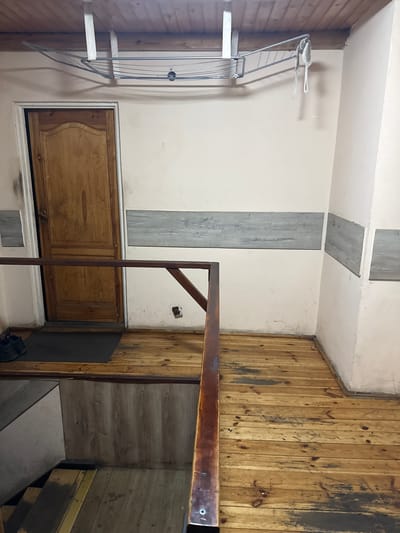
This is an indoor scene, likely a hallway or landing area, in Wąwelnica, Poland. The flooring is made of unfinished wooden planks with visible wear and some dark staining. A dark brown wooden railing runs diagonally across the foreground, obscuring a staircase descending into a lower level which has wood-paneled walls. To the left, a wooden door with a curved top is visible, set in a white frame. Black shoes are placed on a dark doormat to the left of the door. Above the door and extending across the scene is a metal clothes drying rack mounted to the wooden slatted ceiling. The walls are painted a light color and have horizontal decorative grey panels. There are some scuff marks and dark stains on the walls and floor.
Wąwelnica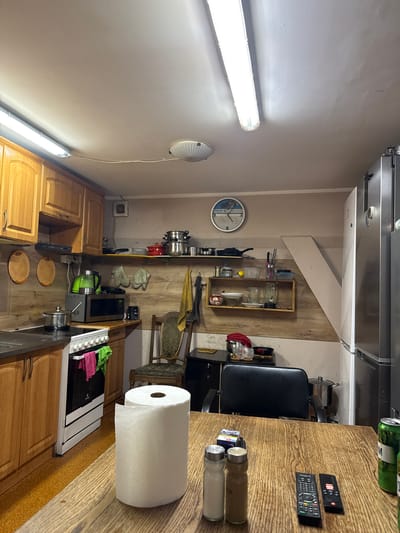
The image depicts a rustic kitchen in Wąwelnica, Poland. The kitchen is equipped with wooden cabinets, a white oven with colorful towels draped over it, and a microwave. Above the counter, shelves hold various kitchenware, including pots, pans, and a blender. A round clock hangs on the wall, and a tall refrigerator stands to the right. In the foreground, a wooden table is set with a roll of paper towels, two shakers, and two remote controls. A can of beer is also visible on the table. The lighting appears to be from fluorescent ceiling fixtures. The overall impression is one of a lived-in, functional kitchen.
Wąwelnica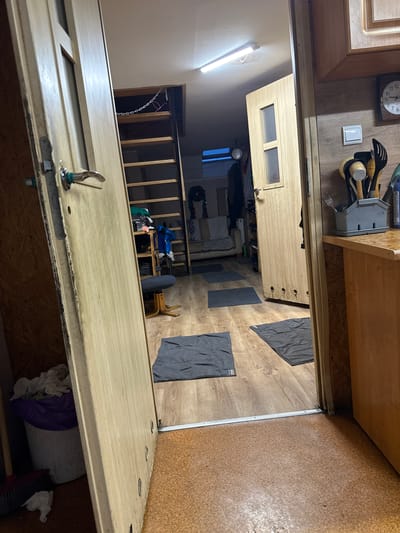
The image depicts an interior scene of what appears to be a residential dwelling. The foreground is dominated by a light-colored wooden door, partially open, revealing a hallway or living space beyond. The floor in the foreground is a textured, light brown material, possibly cork. The hallway visible through the open door features a wooden floor with a visible grain. Several dark grey rectangular mats are laid out on the floor, spaced evenly. To the left, a set of wooden stairs leads upwards, with a metal chain attached near the top. A dark blue chair with a black cushion and wooden legs is positioned near the stairs. Shelving units are visible against the wall to the left of the stairs, holding various items. In the background, through another doorway, a section of a kitchen area is visible on the right. This includes a wooden countertop, cabinetry, and various kitchen utensils in a holder. A clock with Roman numerals is mounted on the wall above the countertop. A light fixture is visible on the ceiling in the hallway. A white trash can with a purple liner, containing white refuse, is situated in the lower left corner of the image, near a broom. The overall impression is a lived-in, somewhat cluttered interior space. There are no people visible in the image. The context provided about Wąwelnica, Poland, suggests this is an indoor scene within a residence in that location.
Wąwelnica