Wassenaar, Netherlands
30 memories from Wassenaar, Netherlands
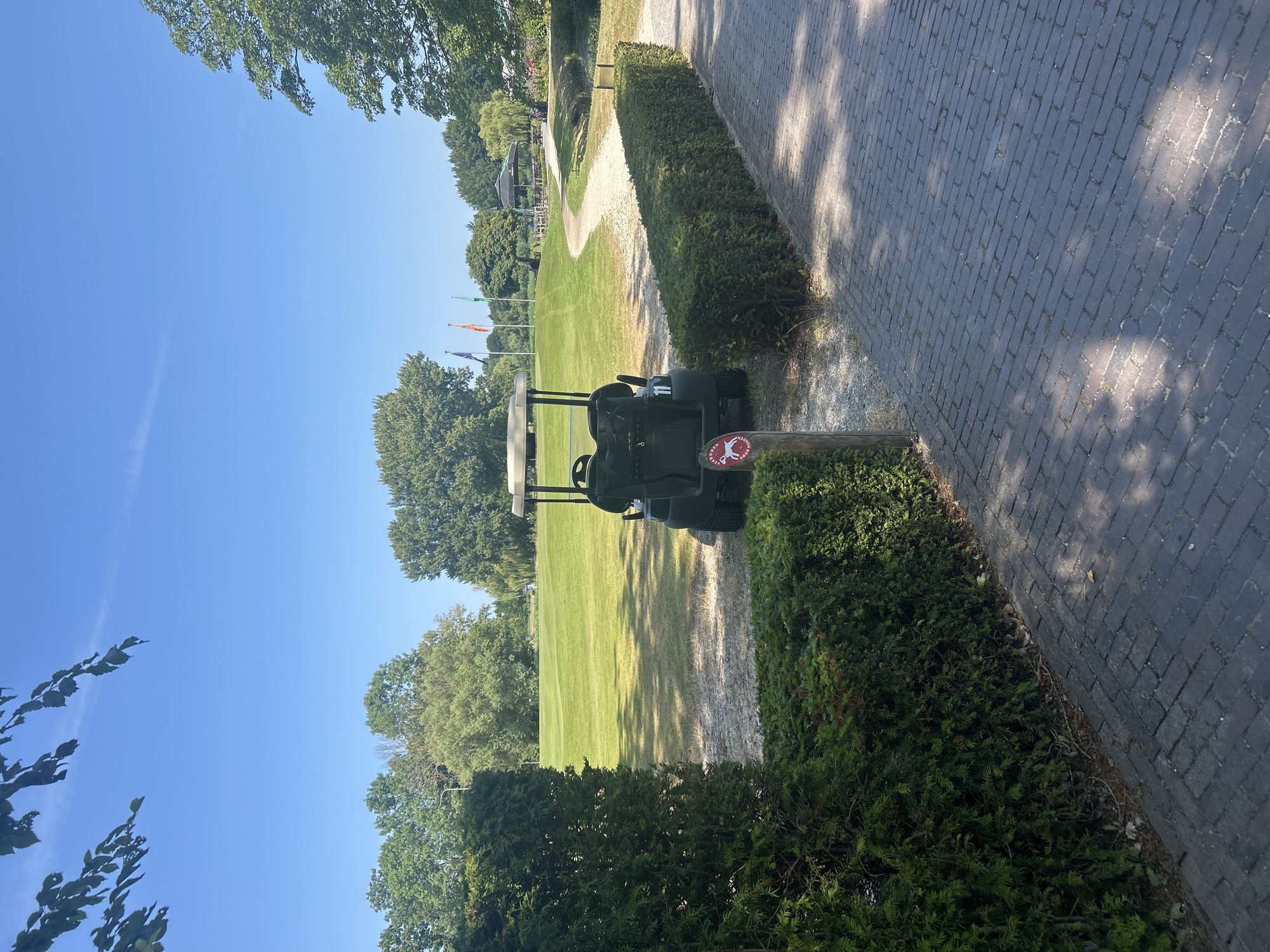
A golf cart is parked on a gravel path next to a manicured lawn of a golf course, under a clear blue sky. The cart is dark green and has the number 11 visible on its side. A wooden post with a circular red and white sign showing a horse is in front of the golf cart. A brick pathway is visible in the foreground, bordered by trimmed hedges. In the background, there are trees, flags, and a covered seating area with umbrellas. The location is a golf course in Wassenaar, Netherlands.
Wassenaar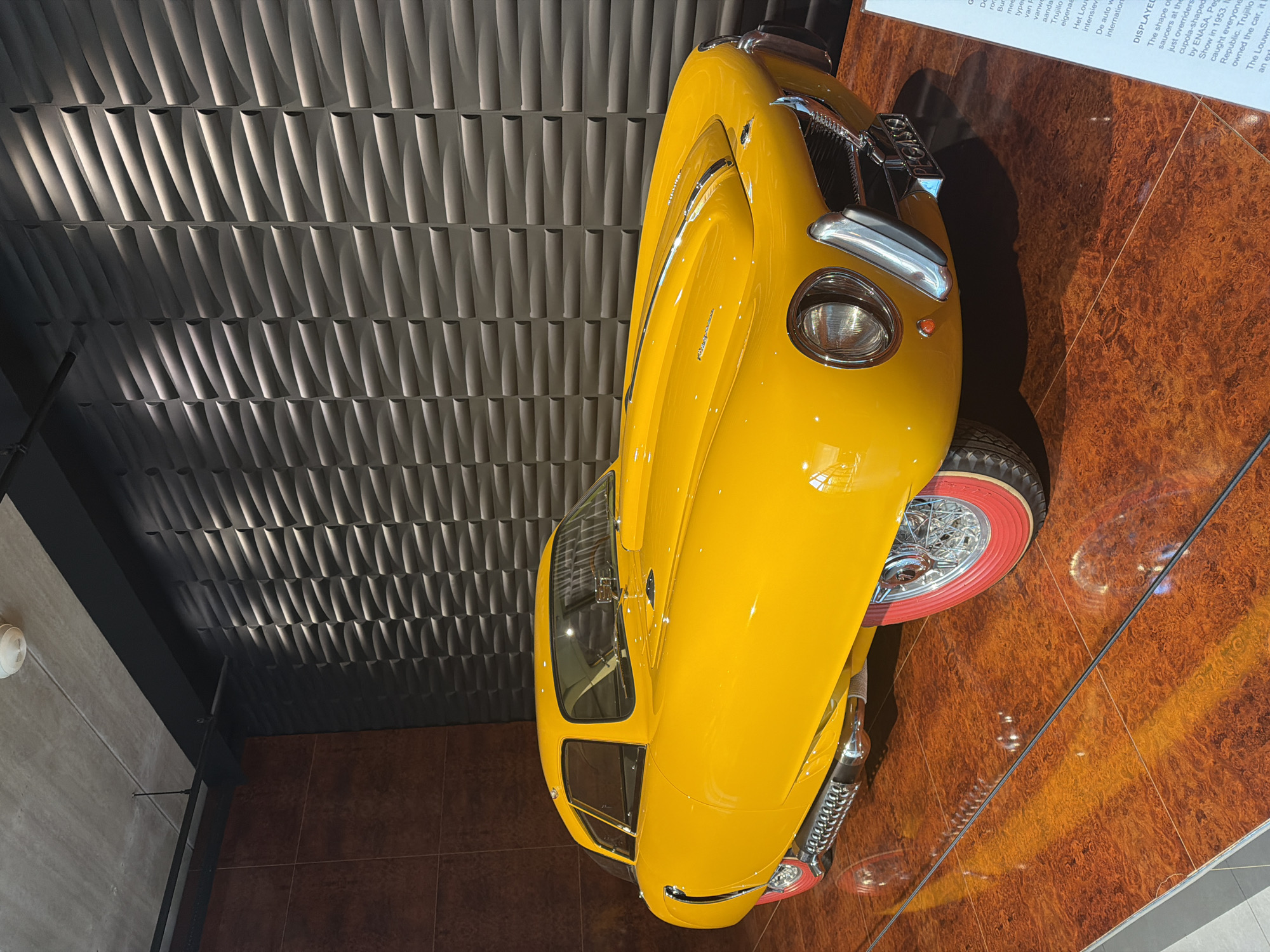
An extreme wide shot captures a bright yellow, vintage sports car on display in a museum. The car is positioned diagonally on a polished, wood-grained floor that reflects its vibrant color. The background features a textured, dark gray wall composed of undulating, horizontal elements that create a ripple effect. The car's design is sleek and aerodynamic, with prominent chrome accents, including a grille, bumper, and side exhaust pipes. It has a distinctive glass canopy and red-rimmed tires with spoked wheels. A placard with text is visible on the right side of the frame, partially obscuring the car's front passenger-side wheel. The lighting in the scene is dramatic, with spotlights highlighting the car and casting shadows. The overall impression is one of a meticulously presented exhibit in a modern museum setting. The car is likely on display at the Louwman Museum in Wassenaar, Netherlands, a renowned automobile museum.
Wassenaar
In this medium shot, a woman lies on her side, her body angled towards the viewer. She is wearing a black and red patterned garment adorned with intricate dragon designs. The fabric has a slight sheen, suggesting it might be silk or satin, and features a prominent zipper and buckle details at the neckline. A silver chain necklace rests on the garment. The woman's head is tilted back, and her eyes are wide open, looking slightly to her right. Her lips are parted, and her expression appears surprised or intrigued. She has on silver, flower-shaped stud earrings. Her blonde hair is pulled back. A pair of black-rimmed glasses are pushed up on her forehead, resting near her hairline. The background is blurred, but hints of a reflective surface, possibly glass, are visible at the top. Sunlight casts a sharp shadow across the woman's chest and arm, indicating a bright, sunny day. She is lying on a textured blue surface, which could be a cushion or upholstery. The overall impression is that of a candid moment captured, possibly during leisure or travel. There is no visible text in the image. The setting is the Wassenaar, Netherlands.
Wassenaar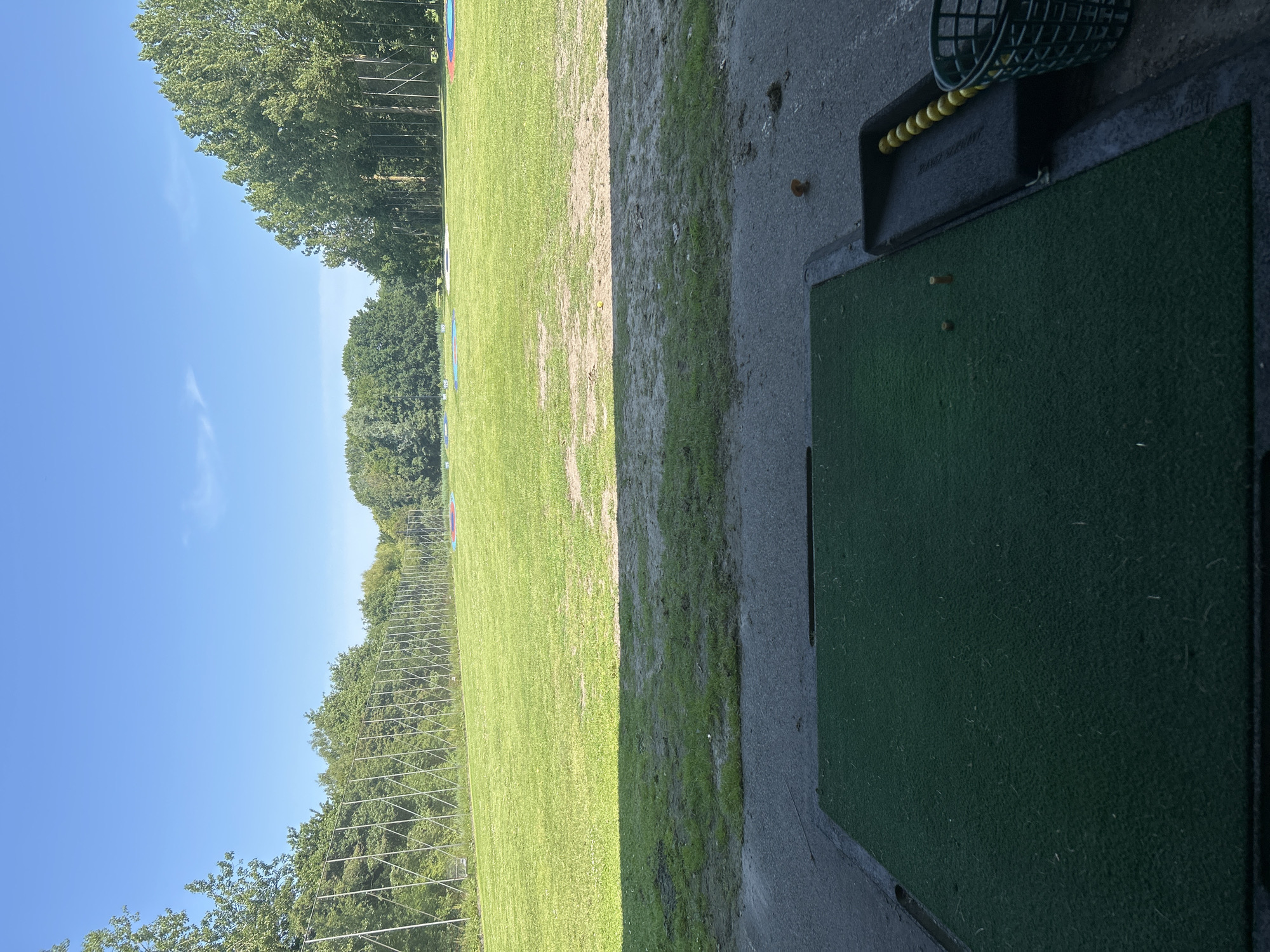
The image shows an outdoor golf driving range on a clear, sunny day. In the foreground, a green artificial turf mat is positioned on a concrete surface, with two small wooden tee holders visible. To the right of the mat, a black tray holds a row of yellow golf balls, and a green plastic basket is nearby. The driving range itself is a large, grassy field with various colored targets scattered across it at different distances. The field is bordered by trees and a tall fence. The scene appears to be located at the Golfclub Wassenaar, situated in the municipality of Wassenaar, Netherlands, given the presence of a golf course. No people are visible in the image.
Wassenaar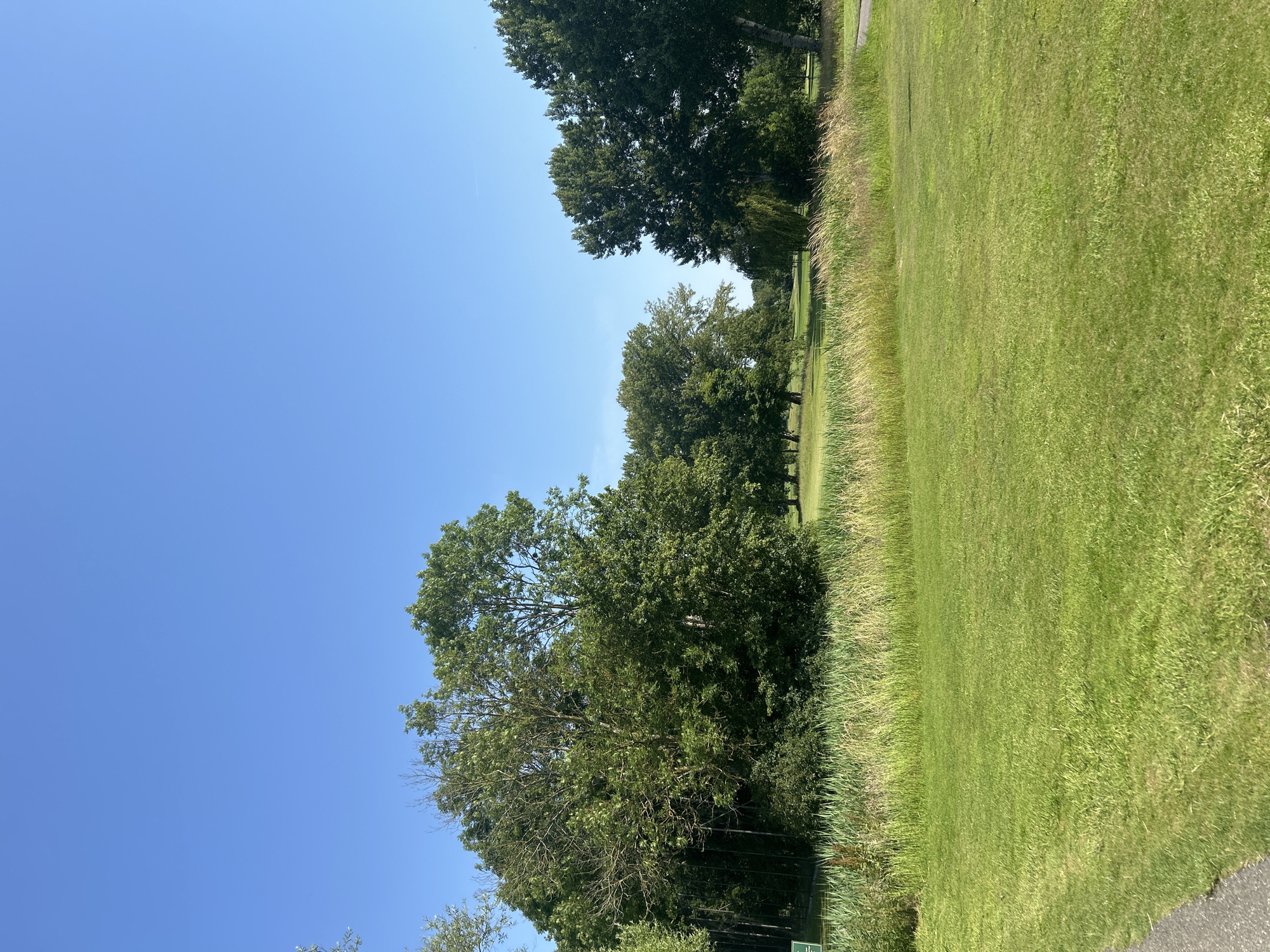
The image depicts a vast, manicured green lawn, characteristic of a golf course, bathed in bright sunlight under a clear blue sky. The foreground is dominated by the lush, short-cropped grass, bordered by a path made of asphalt on the left. Further back, a dense line of tall, reedy grass and shrubs separates the lawn from a cluster of mature deciduous trees. Beyond the trees, the gentle undulation of the golf course fairway is visible, with more trees and patches of grass extending towards the horizon. A single paved path or cart track curves into the distance on the right side of the image. The scene appears tranquil and serene, evoking a sense of an open, well-maintained outdoor recreational area within the city of Wassenaar, Netherlands. No people or specific structures, other than the golf course infrastructure and the path, are discernible in the frame. The overall impression is one of a peaceful, summery day in a park-like setting.
Wassenaar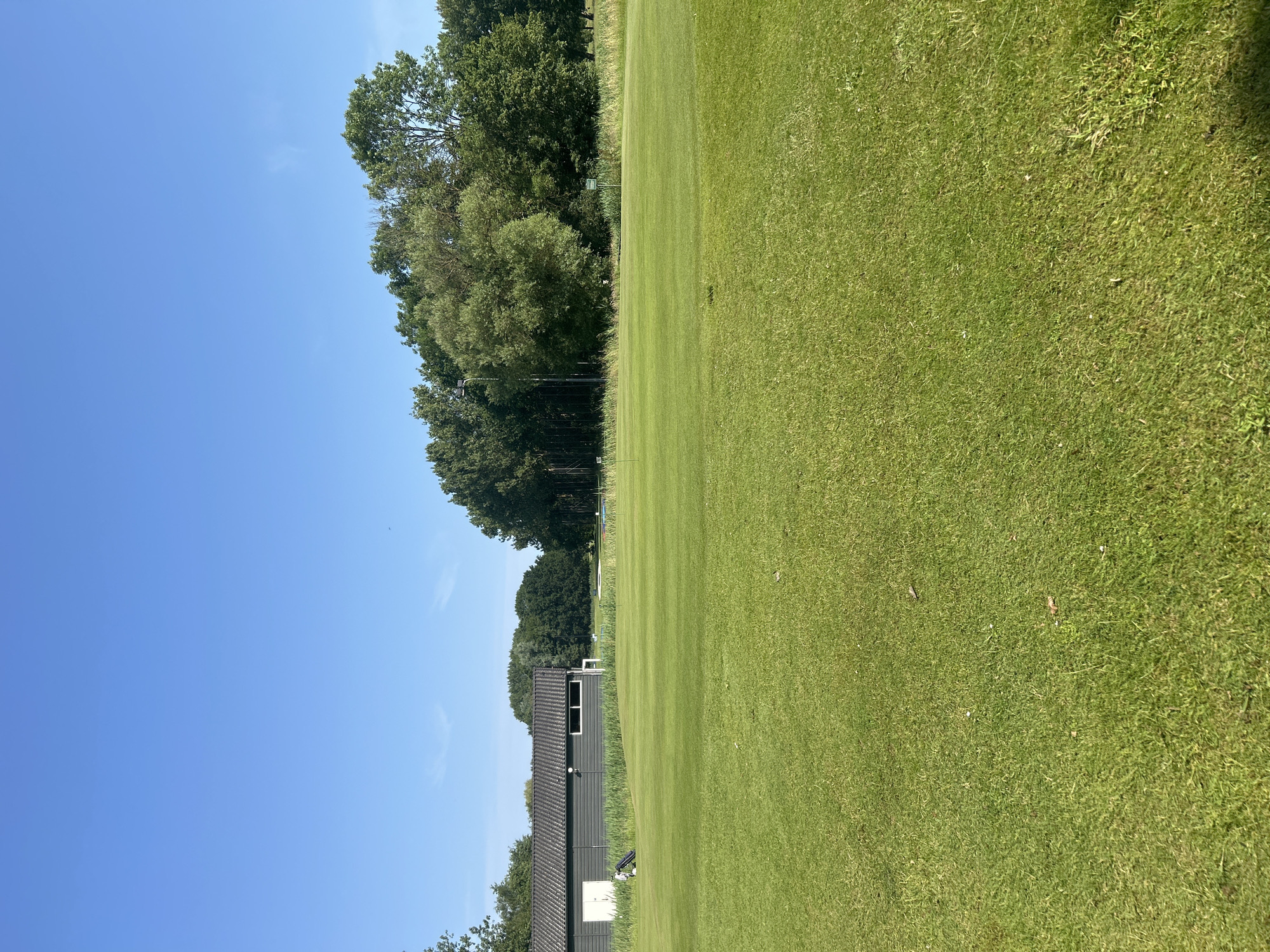
The image shows a well-maintained golf course under a clear blue sky. In the foreground, a vast expanse of neatly mown green grass stretches towards the horizon. To the left, a dark gray building with a sloping tiled roof and white doors is situated. Adjacent to the building, a black golf bag stands upright, with a white golf club leaning against it. Beyond the building and to the right, a line of lush green trees forms a backdrop, with some taller trees interspersed. In the middle ground, another stretch of manicured grass leads to a distant line of vegetation and trees. A green sign is visible on the right side of the image amidst the grass. The overall scene depicts a serene outdoor setting on a sunny day, likely at a golf club in Wassenaar, Netherlands, given the typical landscape of such facilities in the region.
Wassenaar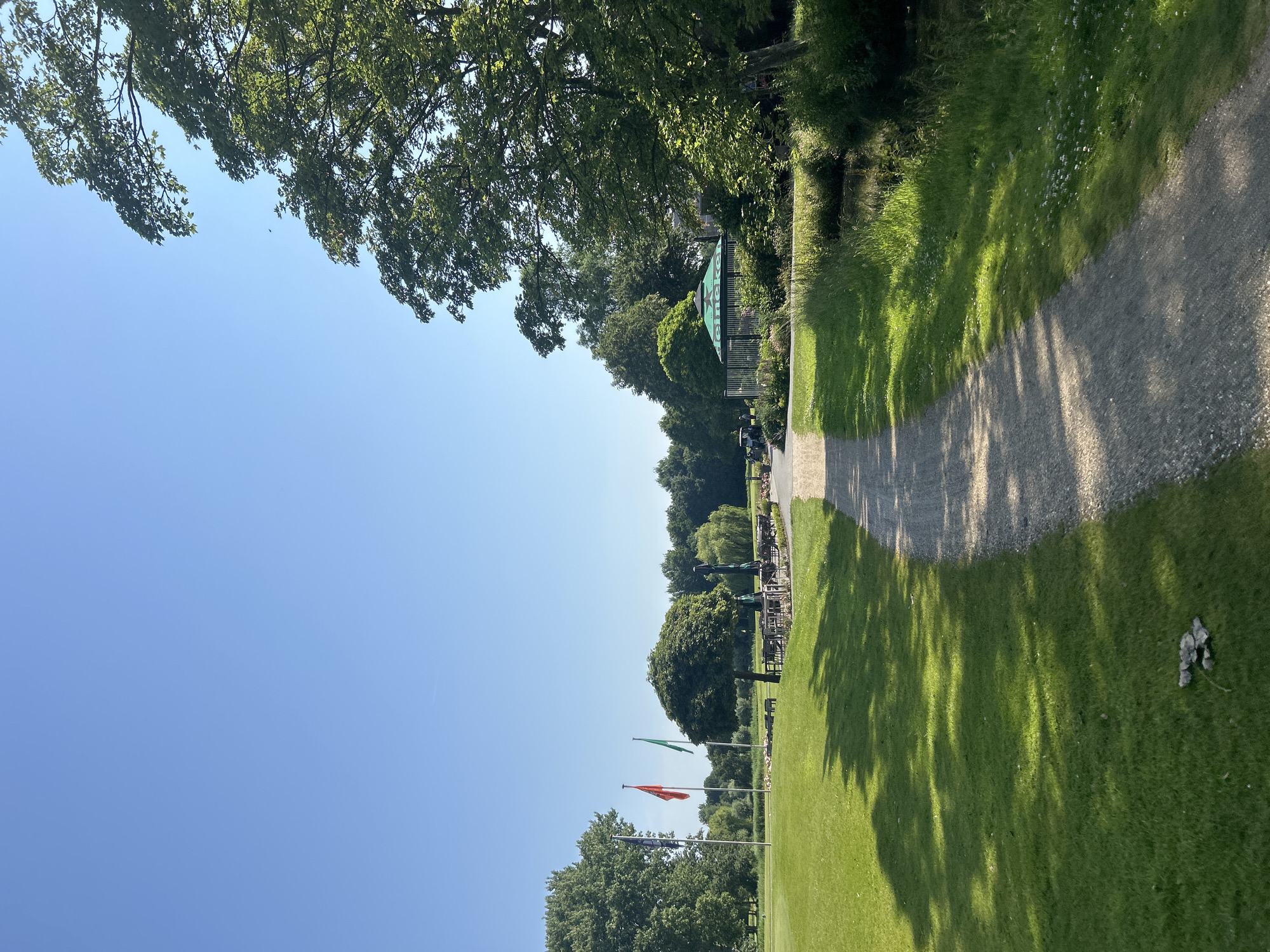
A gravel path leads through a lush green landscape, characteristic of a golf course in Wassenaar, Netherlands. The path curves gently to the right, bordered by manicured grass on the left and overgrown vegetation and a small body of water on the right. The sky above is a clear, bright blue, with the sun casting dappled shadows from nearby trees onto the path and grass. In the distance, on the left side of the image, there are three flags on poles, two of which are distinctly colored red and green, suggesting a national or club affiliation. Beyond the flags, a treeline forms the horizon, with some buildings or structures partially visible amongst the foliage. Closer to the path, on the left, several sets of outdoor tables and chairs are arranged under umbrellas, some of which are green, suggesting a seating area or patio associated with the golf course. On the right side of the image, further back from the path, a distinctive green umbrella with a logo resembling "Heineken" is visible, suggesting an outdoor bar or seating area. Several golf carts are parked near this area, indicating active use of the golf course. The overall impression is of a serene, sunny day at a well-maintained recreational facility.
Wassenaar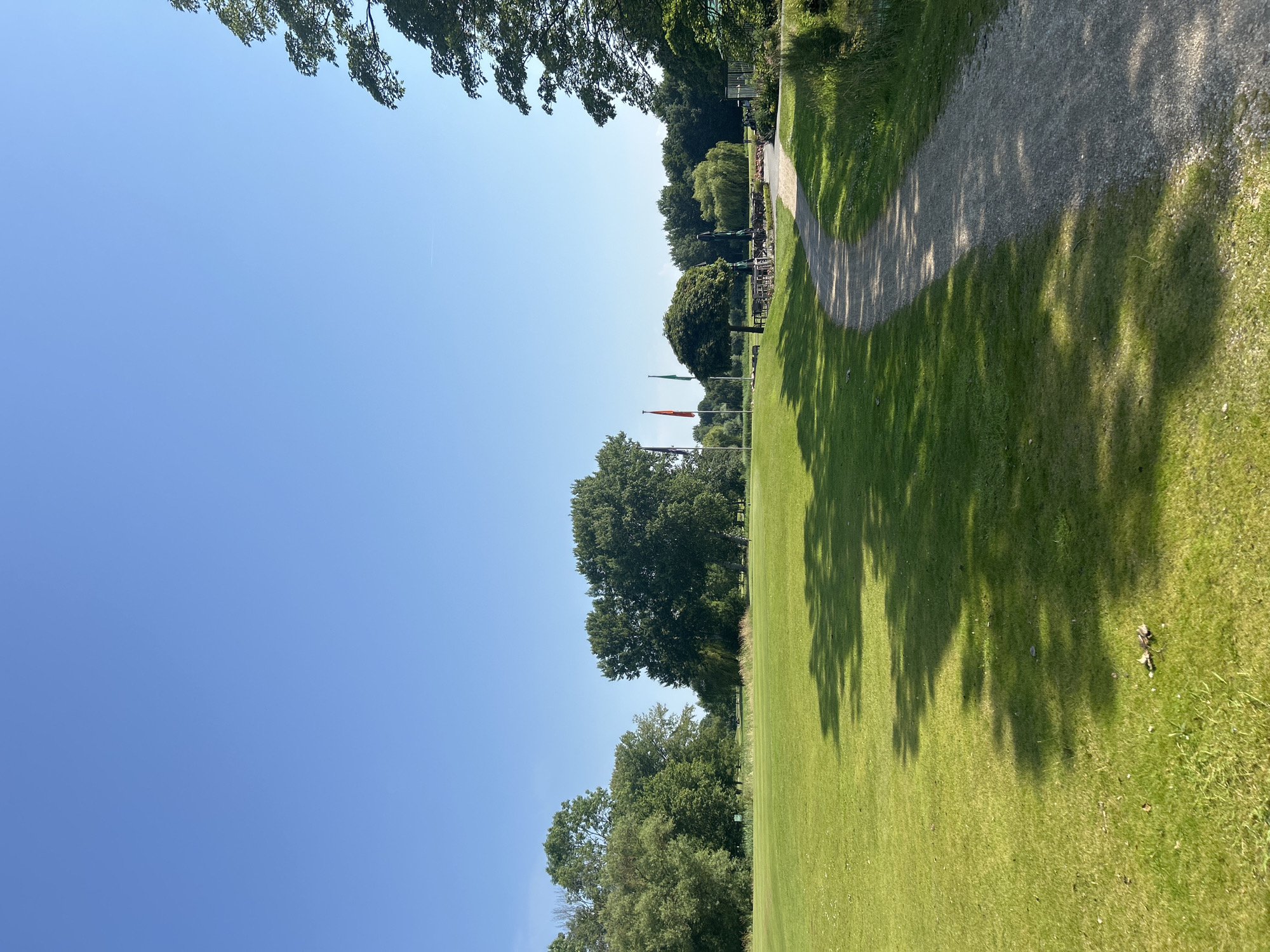
The image depicts a wide, well-maintained green lawn, likely a golf course, with a winding gravel path in the foreground. Tall, lush green trees line the background, with a clear blue sky above. Several flags, one red and two green, are visible in the mid-ground, suggesting a sports or recreational facility. In the distance, there appears to be an area with tables and umbrellas, possibly an outdoor seating area for a clubhouse. The overall scene is serene and idyllic, bathed in bright sunlight. The environment is natural and open, with no visible people or animals. This scene is consistent with the landscape of the Wassenaar Golf Club in Wassenaar, Netherlands, known for its expansive green grounds and tree-lined fairways.
Wassenaar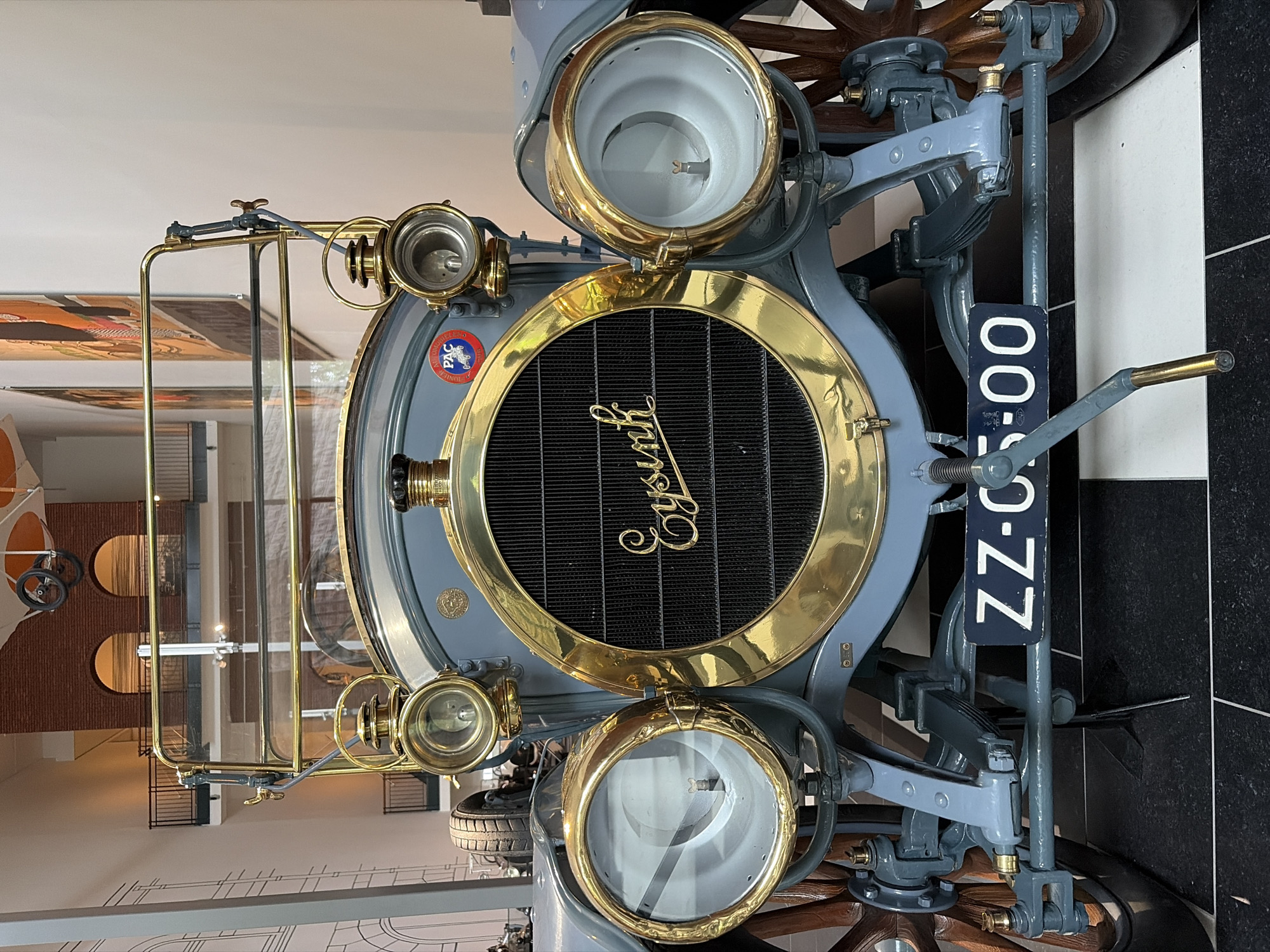
An antique automobile, oriented vertically, is prominently displayed indoors, likely in a museum setting in Wassenaar, Netherlands. The front of the vintage car, painted in a muted grey-blue, is the primary subject. Its most striking features are the polished brass components: a large, circular radiator surround, two prominent main headlights, and two smaller auxiliary lights positioned below. The central radiator grille, a black mesh, bears the car's name "Spyker" in elegant gold script. A round badge affixed to the left side of the radiator displays the text "PAC AUTOMOBILES" surrounding a red and blue emblem. The car's front suspension system, also in grey-blue, is visible, along with parts of a wooden spoked wheel on the right. A dark blue license plate with white characters, reading "ZZ-C5-00", is mounted vertically on the right side of the front assembly. A brass-tipped hand crank extends from the lower right. The background reveals a spacious, well-lit interior with a blend of modern and industrial architectural elements. Reflections suggest glass barriers or polished surfaces. Further back, textured walls, possibly exposed brick, feature large circular openings, while a patterned floor (black and white squares near the car) transitions to a lighter color. The car appears stationary and is the sole focus of the scene, with no people visible. The setting suggests an exhibition or permanent display of historical vehicles.
Wassenaar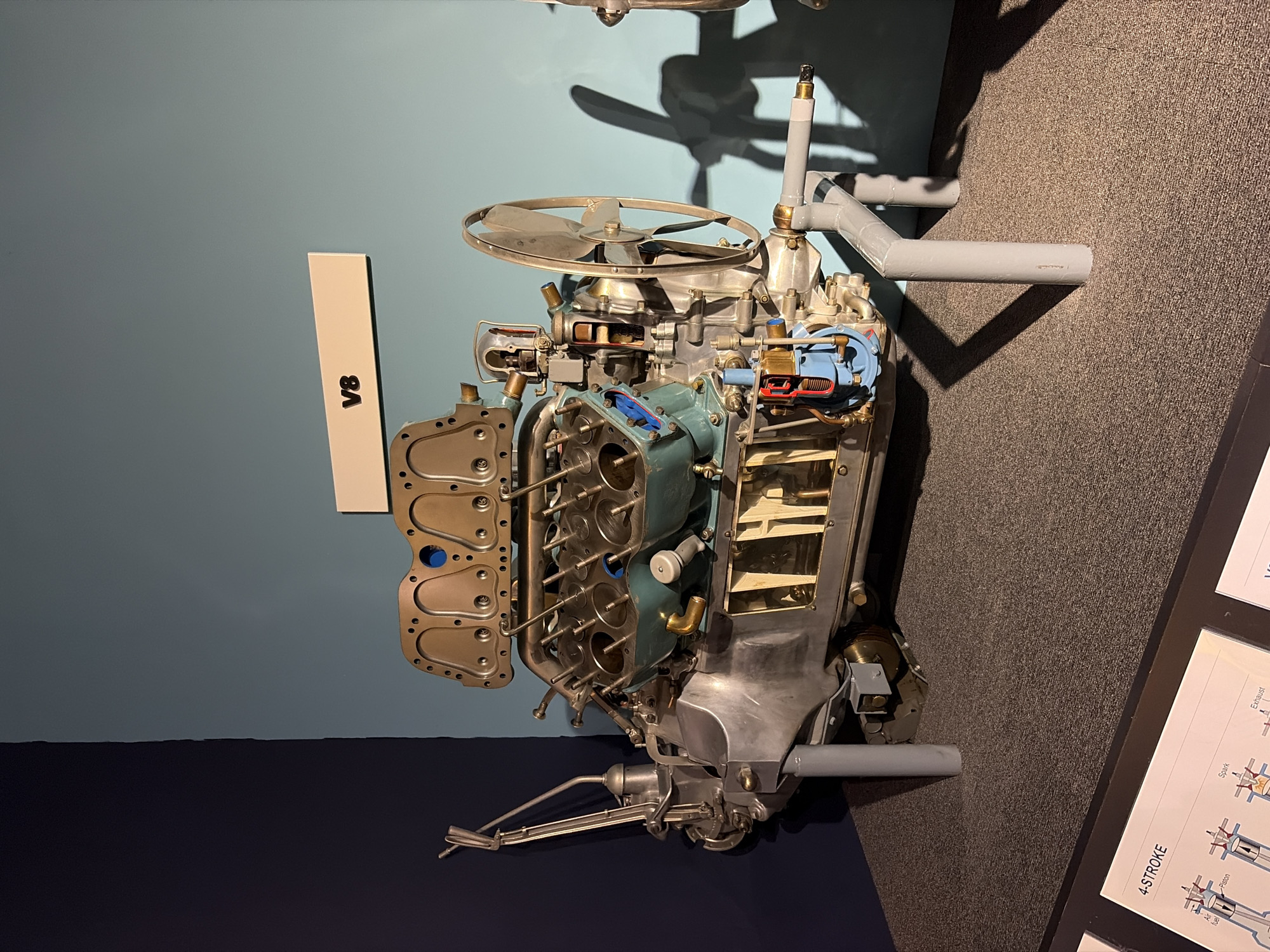
The image displays a detailed cutaway model of a V8 engine, presented as an exhibit in what appears to be a museum or educational setting in Wassenaar, Netherlands. The engine is positioned at an angle on a grey stand, showcasing its intricate internal mechanisms. A large cooling fan with multiple blades is visible at the top of the engine. The engine block is partially opened and sectioned, revealing several cylinders with pistons and valve trains. Some internal components are highlighted with colors such as blue, red, and gold, likely to distinguish different parts or systems like fluid passages. A separate, unattached component resembling a valve cover with multiple bolt holes lies beside the main engine structure, further exposing the engine's internals. Pipes, possibly for exhaust or cooling, extend from the engine toward the dark grey carpeted floor. The background consists of a plain light blue-grey wall, against which the engine and its stand cast shadows, suggesting indoor artificial lighting. To the left of the engine, a white rectangular sign with the black text "V8" is mounted on the wall. In the bottom right corner of the image, part of a black informational display panel is visible on the floor, featuring diagrams and the prominent text "4-STROKE," along with labels like "Exhaust," "Spark," "Piston," and "Air Fuel," indicating it explains the principles of a four-stroke engine cycle.
Wassenaar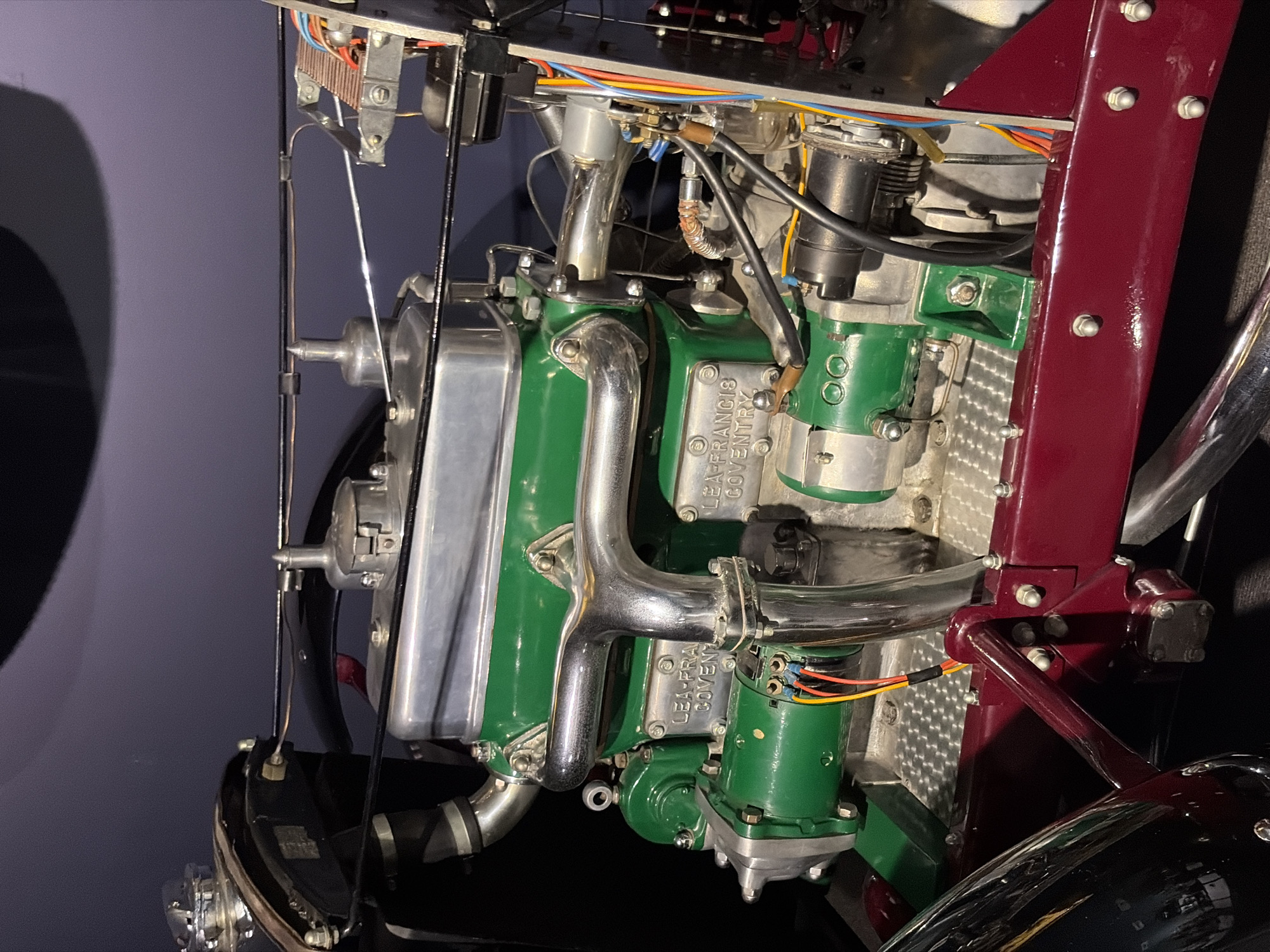
This image captures a meticulously preserved engine, likely from an antique vehicle, displayed indoors. The engine features prominent bright green painted components, including two main blocks or covers, which contrast with polished silver or chrome pipes and heat sinks. On two of the green engine covers, the embossed text "LEA-FRANCIS COVENTRY" is clearly visible, identifying the manufacturer and place of origin. Intricate wiring, including red, orange, yellow, blue, and black insulated cables, connects various electrical components on the engine. Numerous bolts, nuts, and metal fasteners are visible throughout the assembly, along with several intricate mechanical parts and tubes. To the right, a glossy, dark red painted metal frame or chassis component runs vertically, secured by silver bolts, suggesting part of the vehicle's structure. Portions of what appears to be a dark tire or wheel and reflective chrome bodywork are visible at the bottom. The setting appears to be a museum or exhibition space, with a plain, dark purple-grey background and artificial lighting that highlights the engine's details. No activity is taking place; the engine is stationary and presented for observation. The scene is located in Wassenaar, Netherlands.
Wassenaar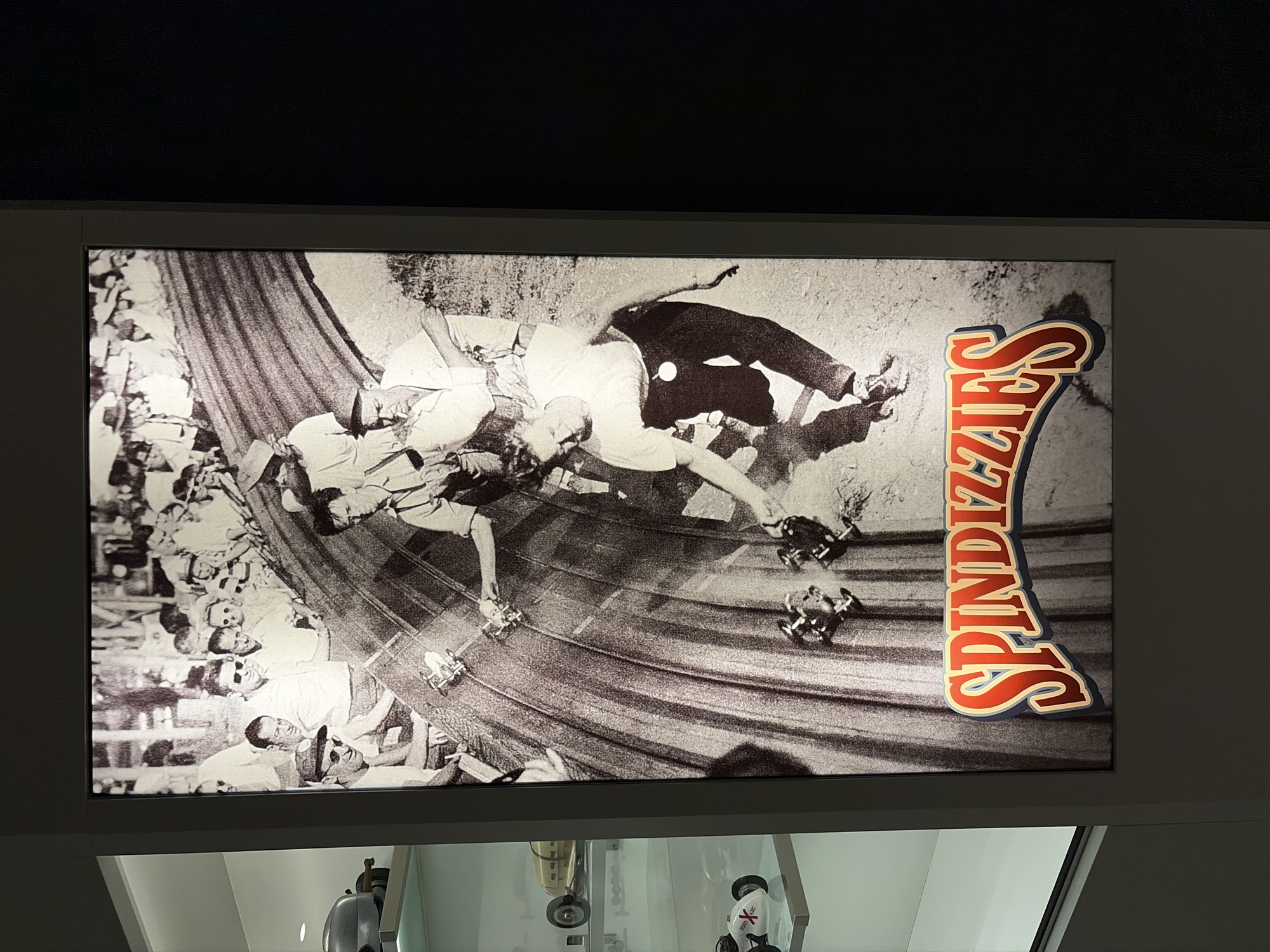
The media file displays an illuminated black and white photograph, likely part of a museum or exhibition exhibit, with additional details visible below. The main photograph depicts a vintage tether car race. Numerous people, primarily adult males, are gathered around a multi-lane, banked race track. Several individuals in the foreground are actively participating, leaning over the track and operating small, gas-powered model race cars, commonly known as "spindizzies." Multiple miniature cars are visible on the track, suggesting a race in progress. Spectators fill the background, watching the event intently. The black and white imagery and the clothing styles suggest the scene is from the mid-20th century. A prominent, stylized title "SPINDIZZIES" is overlaid vertically on the right side of the photograph. The text is rendered in a bold, retro-style font with red coloring, a light outline, and a drop shadow. Below the main display, partial views of physical miniature racing cars are visible in a reflective display case, reinforcing the exhibit's theme. One car is white with a red "X" on its side, and another has a metallic finish. The overall setting is indoors, within a museum or exhibition located in Wassenaar, Netherlands.
Wassenaar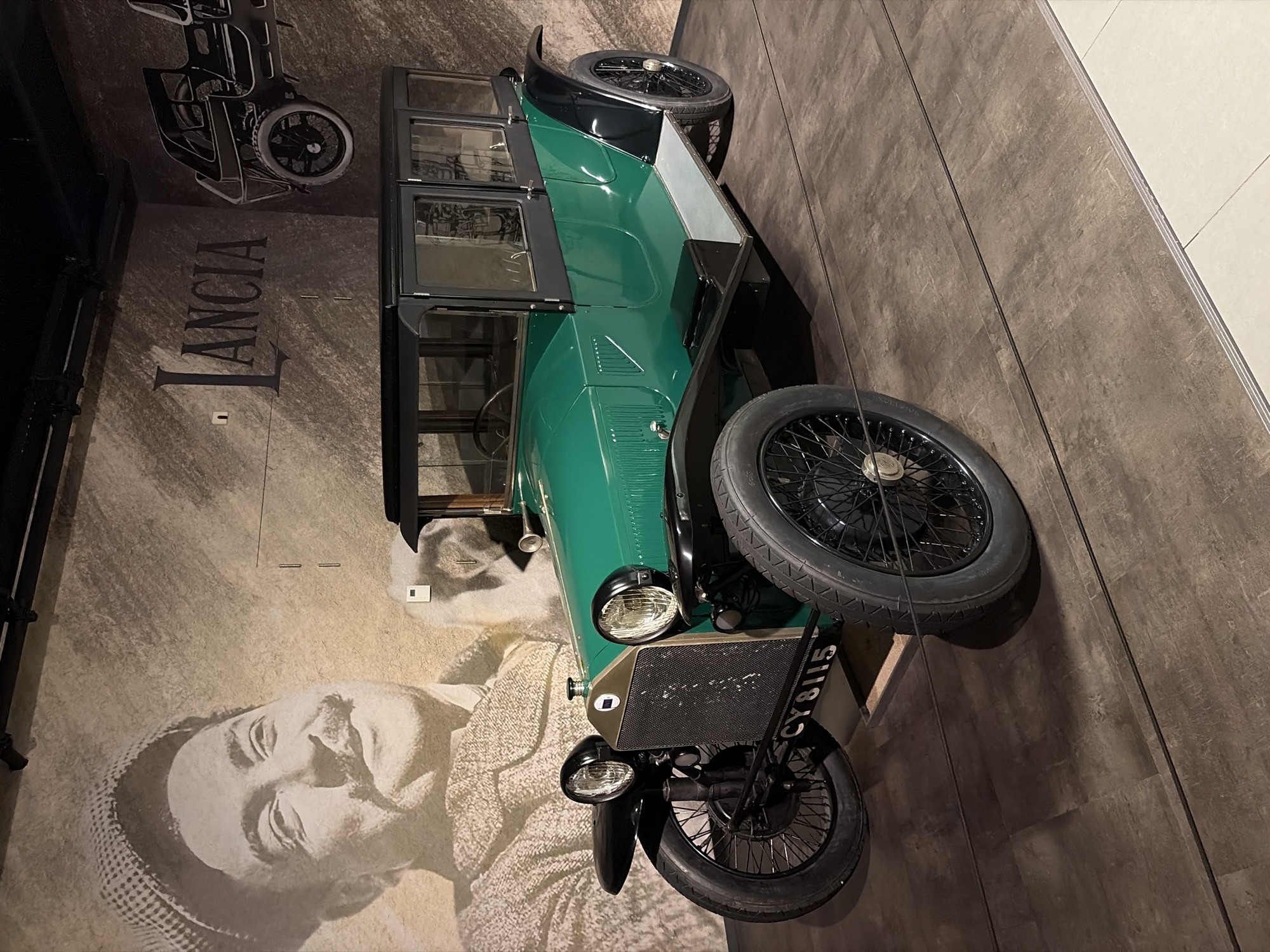
This media file depicts a vintage dark green Lancia automobile displayed in an indoor setting, likely a museum or exhibition in Wassenaar, Netherlands. The classic car, an early 20th-century model, features a dark green body, black fenders, and a black-framed cabin with windows. Its front is equipped with two prominent round headlights, a metallic mesh radiator grille, and a license plate clearly displaying "CY8115". The car rides on spoked wheels fitted with black tires, and a spare tire is mounted on its side. The background consists of a dark, textured floor and a large wall adorned with graphic prints. Dominating a section of the wall is the word "LANCIA" rendered in large, dark serif letters, identifying the vehicle's manufacturer. Adjacent to the car's front is a striking, sepia-toned portrait of a man, possibly Vincenzo Lancia, the company's founder. He is depicted with a thoughtful expression, looking upwards, and wearing a distinct cap and textured clothing. Above the Lancia text, a line-art illustration of an early automobile's chassis or open-wheel design is also visible. The scene suggests a static exhibit, showcasing automotive history.
Wassenaar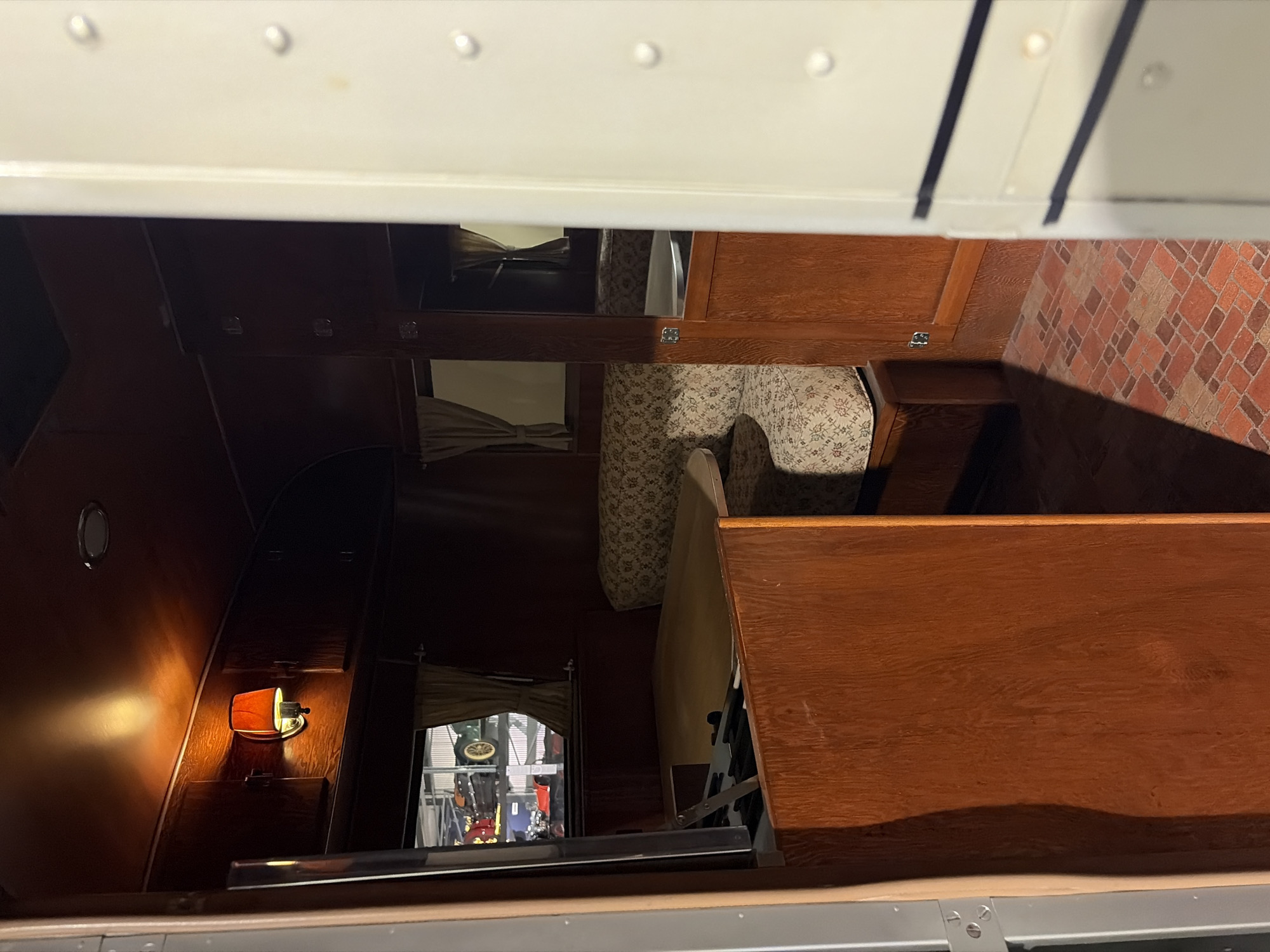
This image captures the interior of what appears to be a vintage cabin or compartment, possibly within a vehicle like a bus, train, or RV, likely displayed in a museum setting in Wassenaar, Netherlands. The perspective is tilted, but the scene primarily features warm, dark wooden paneling on the walls and furniture. A light-colored, possibly white, ceiling or upper structure is visible at the top, featuring several small, round rivets or bolts. Below this, a series of wooden shelves or compartments are built into the wall. On the right side, a seat or cushion upholstered in a patterned fabric with floral or botanical motifs is prominent, alongside another padded surface, possibly a bunk or storage area, above it. Further to the right, a wall or floor section displays a distinctive brick-like pattern in shades of brown and orange. On the left side, a vintage wall light fixture with an orange-tinted shade emits a warm, soft glow onto the wooden wall, creating an inviting atmosphere. Below the light, a rectangular window or opening offers a glimpse, possibly a reflection, of an external scene that includes mechanical parts and a yellow wheel, further suggesting an exhibition environment. No people are present, and there is no visible text. The interior design emphasizes historical craftsmanship and a cozy ambiance, likely enhanced by the warm artificial lighting.
Wassenaar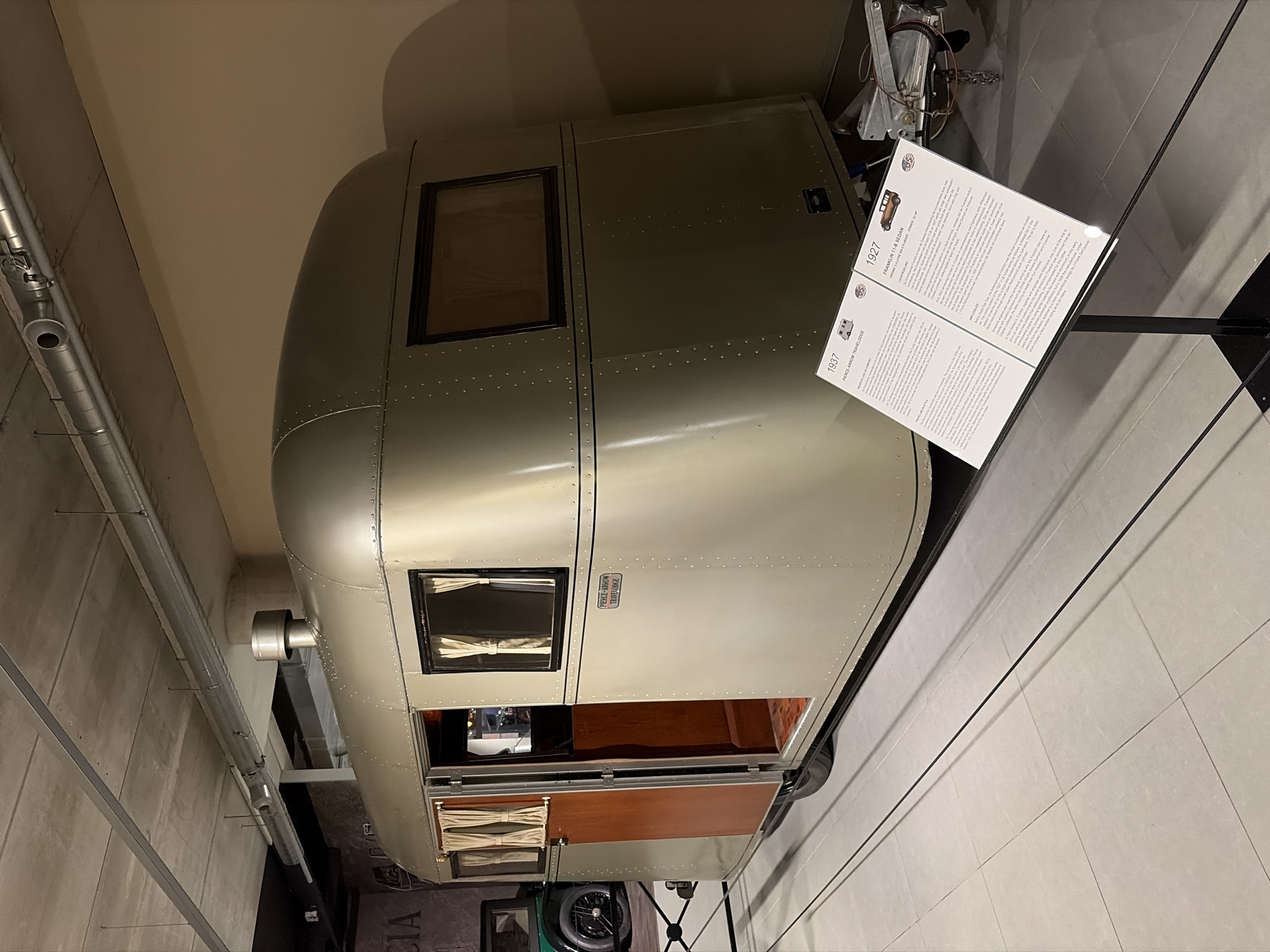
The image displays a vintage, streamlined travel trailer, identified by a nearby sign as a 1937 Pierce-Arrow Travelodge, within an indoor museum or exhibition setting. The trailer is a light grey or silver color, characterized by its riveted metal panels and rounded edges, which give it a distinct aeronautical appearance. It features multiple rectangular windows, one of which has curtains, and an open door that reveals a wooden interior. A metal exhaust or vent pipe protrudes from the side. Next to the trailer, a white informational display board provides details about the "1937 PIERCE-ARROW TRAVELODGE" and also a "1927 FRANKLIN 11-B SEDAN." Visible text includes "LUCHTKOELING" (Dutch for 'air cooling'), "ENGINE 3-LITRE SIX-CYLINDER AIR-COOLED," and mentions of Franklin cars being "one of the first to" and having a "conventional design by J Frank DeCa Case." The setting features concrete walls and ceilings with exposed metal piping, indicative of a modern exhibition space. The floor is covered with light-colored square tiles. Artificial lighting illuminates the scene. Partially visible beneath the trailer and through its open door are glimpses of other exhibits, including a wheel and the letters "CIA." There are no people visible. The Dutch text on the display board confirms a location within the Netherlands, aligning with the provided context of Wassenaar.
Wassenaar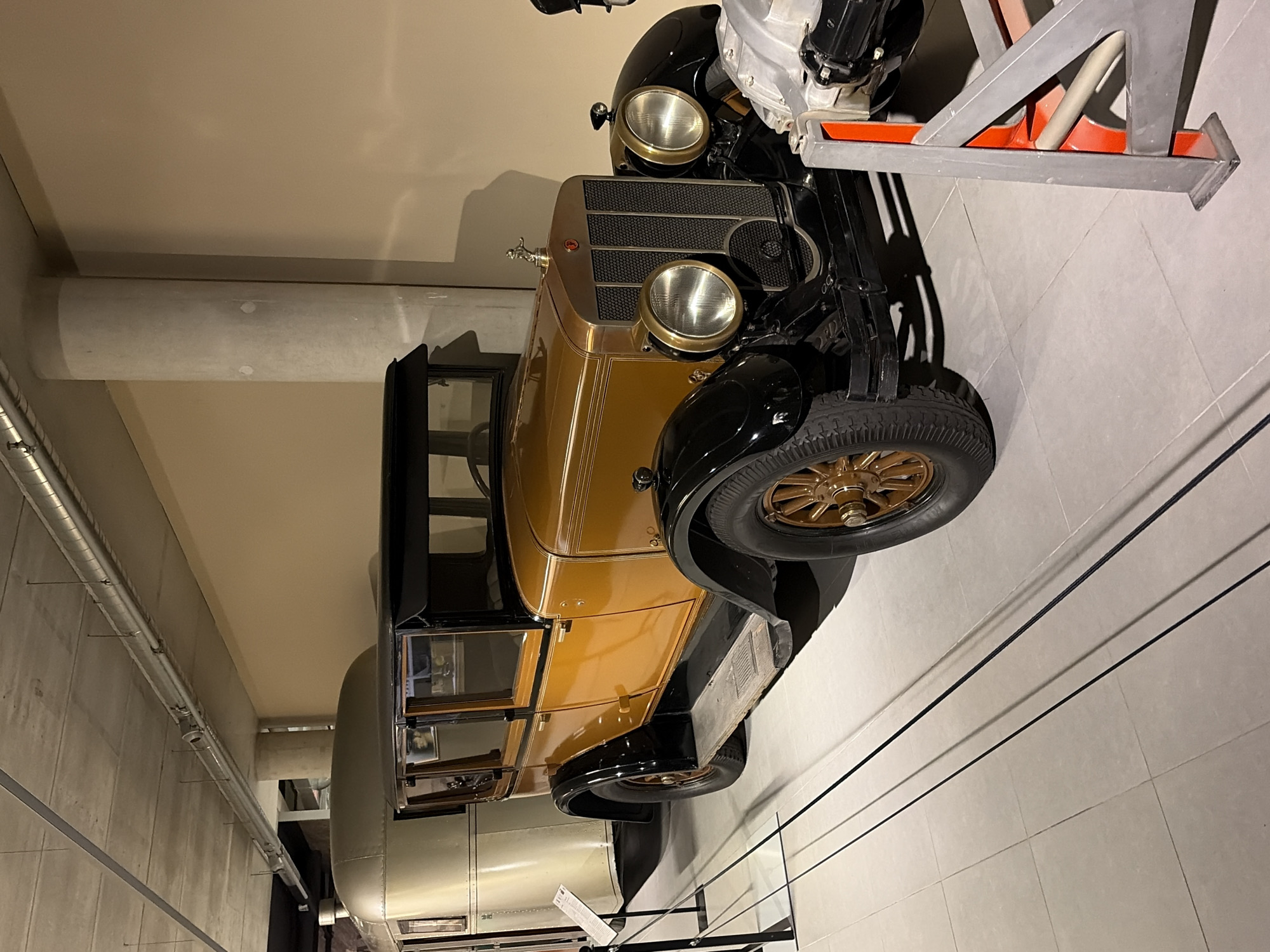
The image captures a vintage automobile displayed in an indoor exhibition space, likely a museum. The car, the primary subject, is a classic model from an earlier era, distinguished by its two-tone color scheme: a rich golden-bronze for the main body panels and contrasting black for the fenders, running boards, and roof. It features large, prominent circular headlights with metallic bezels, a vertical radiator grille, and multi-spoke wheels in a matching golden-bronze hue. A spare tire is mounted on the side of the car, and a small, intricate ornament (possibly a mascot) adorns the radiator cap. The car is stationary, presented on a light-colored tiled floor. The background consists of plain, light-colored walls (beige or cream) and exposed ventilation ducts running along the ceiling or upper wall. To the right of the car, a metallic structure with silver and orange elements is visible, possibly a part of another exhibit or a display support. To the left, further into the background, part of another light-colored vehicle is discernible behind a glass barrier, suggesting multiple exhibits in the same space. The scene is well-lit by artificial indoor lighting. No people are visible, emphasizing the static display of the exhibit. A small white sign or label can be seen near the glass barrier in the bottom left, but any text on it is illegible. The overall setting is clean and modern, providing a neutral backdrop that highlights the vintage vehicle.
Wassenaar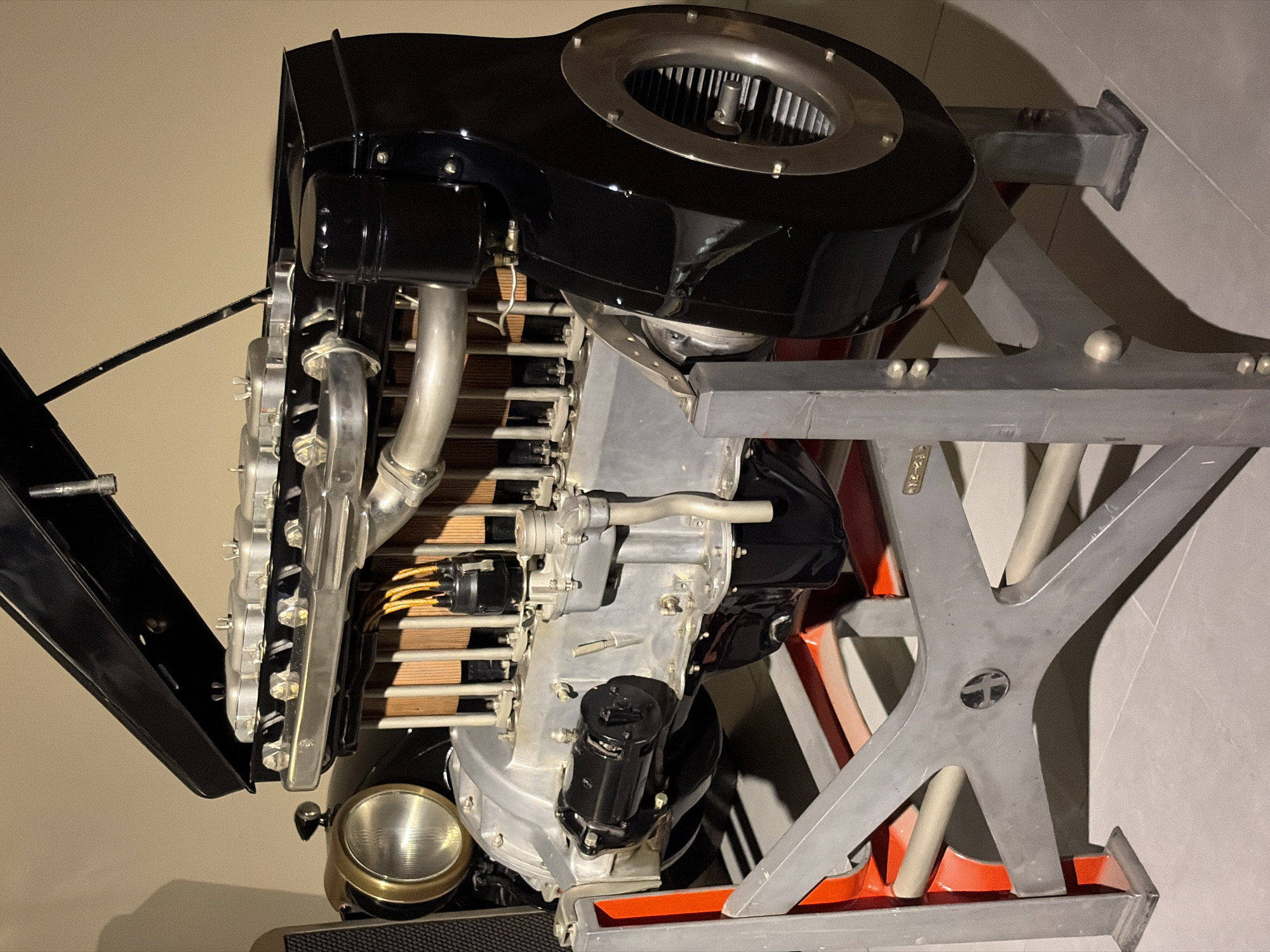
This media file captures a large, vintage internal combustion engine displayed on a stand. The engine is predominantly silver-grey metal, contrasted with black components and accents. The main subject is a multi-cylinder engine, likely an inline configuration, visible with numerous exhaust pipes curving upwards and away from the block. On the side, an ignition system is visible with yellow/orange spark plug wires connected to the engine cylinders. A black, cylindrical starter motor is mounted near the bottom of the engine block. A prominent feature is a large, glossy black housing on top of the engine, which appears to cover an overhead mechanism. This housing has a circular, metal-rimmed opening with internal vanes, possibly indicating a supercharger or a cooling fan assembly. Below this, chrome-like exhaust manifolds are visible, leading into larger pipes. Part of a black vehicle fender and a brass-rimmed headlight are visible in the lower left, indicating the engine is from an automobile. The engine is mounted on a sturdy display stand made of grey metal, featuring bold, angular supports that form an X-shape at its base. The base of the stand also incorporates sections painted in a vibrant orange. The setting appears to be indoors, likely a museum or exhibition space, with a plain, light-colored wall serving as the background. The overall impression is one of showcasing engineering and automotive history. There is no clearly legible text on the engine or stand, though some faint, unreadable markings appear on the grey engine block and a stylized symbol is present on the central hub of the X-shaped stand support. The lighting is artificial, suggesting an indoor environment.
Wassenaar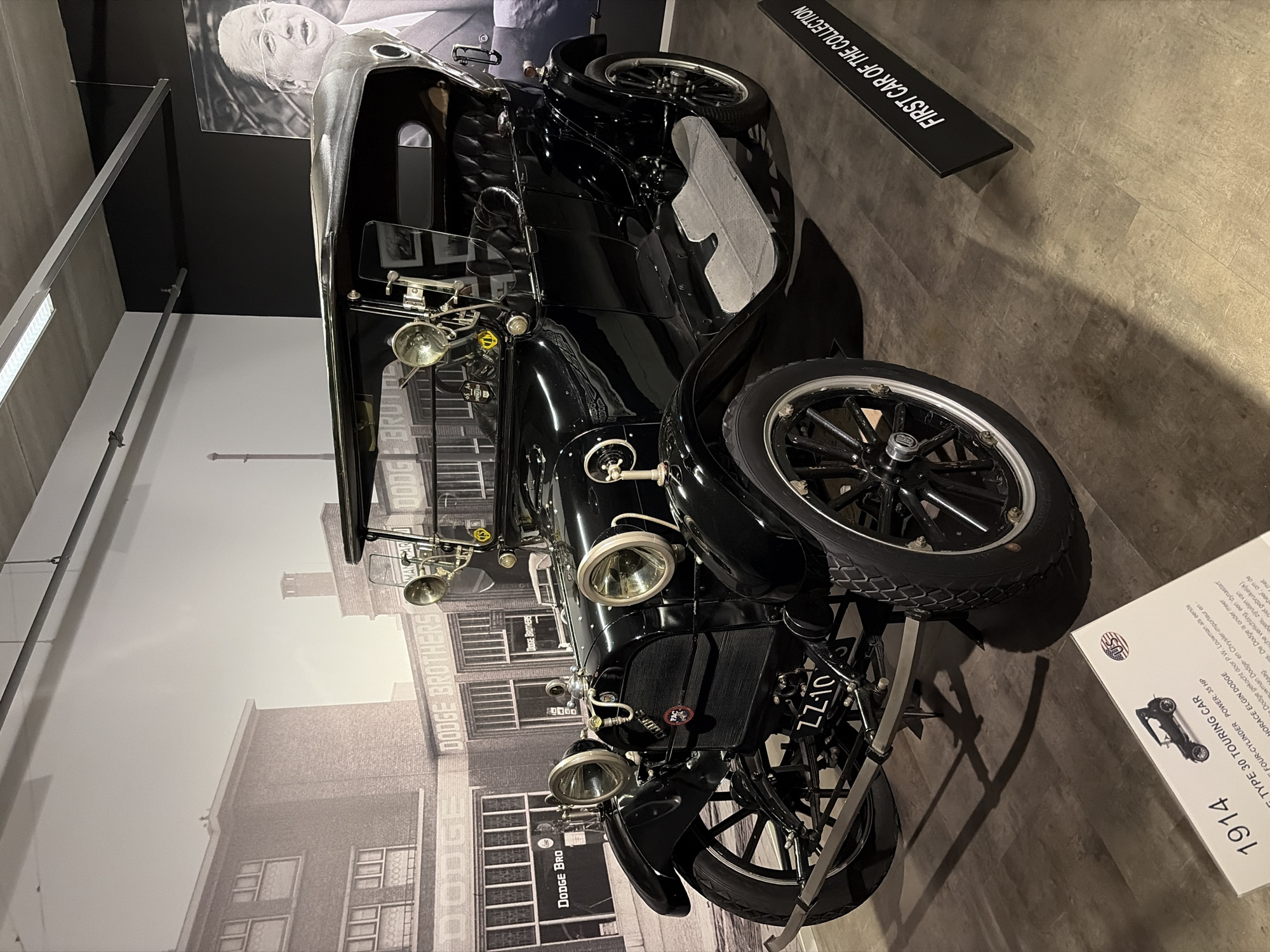
This media file presents an indoor museum display featuring a well-preserved black 1914 Dodge Type 30 Touring Car. The vintage vehicle is polished and equipped with prominent headlights, a front grille, and wooden spoked wheels, with a spare tire mounted on the side. A license plate displaying "ZZ-10" is visible at the front. The setting includes a dark, mottled floor and walls that transition between dark and light sections, along with overhead metal railings and lighting. In the background, a large black and white mural depicts an industrial building, identified by "DODGE BROTHERS" and "DODGE" signage, likely representing an early factory or dealership. Above this mural, a black and white portrait of a man, possibly Horace Dodge, is displayed. An overhead black sign highlights the car's significance, stating "FIRST CAR OF THE COLLECTION." A white informational plaque next to the car provides further details, including "1914," "TYPE 30 TOURING CAR," and "FOUR-CYLINDER POWER: 35 HP." The text also mentions "HORACE ELGIN DODGE" and "Dodge gekocht door P.W. Louwman als eerste Louwman Dodge- en Chrysler-importeur en..." which contextually places the exhibit at the Louwman Museum in Wassenaar, Netherlands, celebrating automotive history. The overall scene conveys a sense of historical preservation and appreciation for classic automobiles.
Wassenaar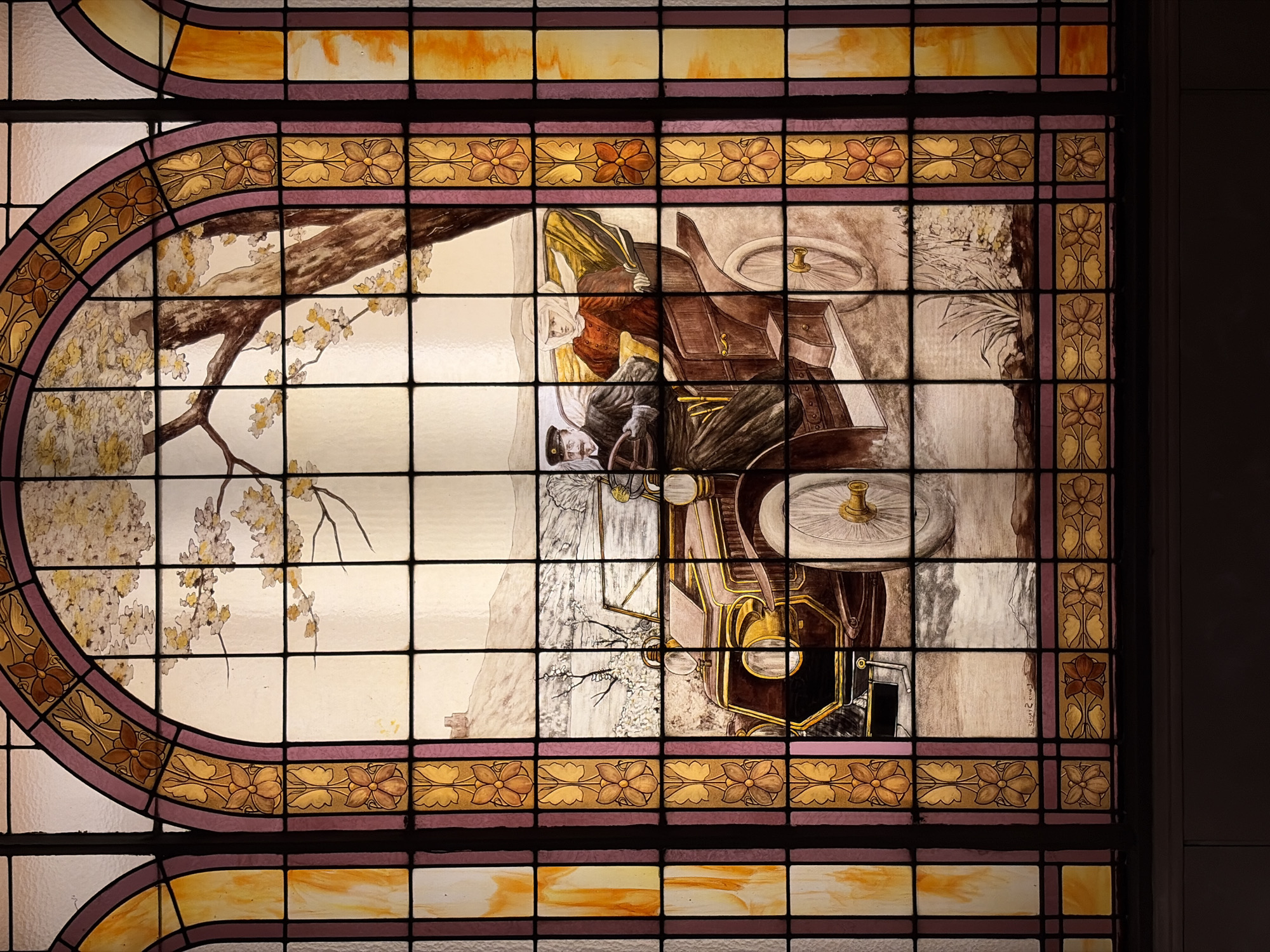
This is a vertically oriented image of a stained glass window, featuring a detailed pictorial scene framed by decorative glass panels. The central scene depicts a man and a woman riding in a vintage open-top car. The man, presumably the chauffeur or driver, wears a cap and a dark coat and is positioned on the right side of the vehicle, holding the steering wheel. To his left, a woman with a bonnet and a warm-looking jacket sits as a passenger. The car itself is an early 20th-century model, characterized by its open design and classic details. The setting appears to be outdoors, with a prominent tree branch extending into the left side of the frame, adorned with light-colored blossoms or foliage, suggesting a spring or early autumn scene. The background is light and somewhat abstract, implying a path or road through a natural landscape. The overall mood conveyed by the figures and setting is one of leisurely travel. The pictorial scene is encased within an elaborate stained glass border. This border features a wide band adorned with repeating floral and leaf motifs in shades of gold, orange, and brown, set against a muted purple or mauve background. Above and below this main decorative band are simpler horizontal strips of plain and textured glass in light yellow and amber tones. The style of the figures and vehicle within the stained glass is illustrative, resembling a painting integrated into the glass medium. There is a faint, unconfirmed signature "P. SCHATT" visible on a small glass panel in the lower right portion of the main scene.
Wassenaar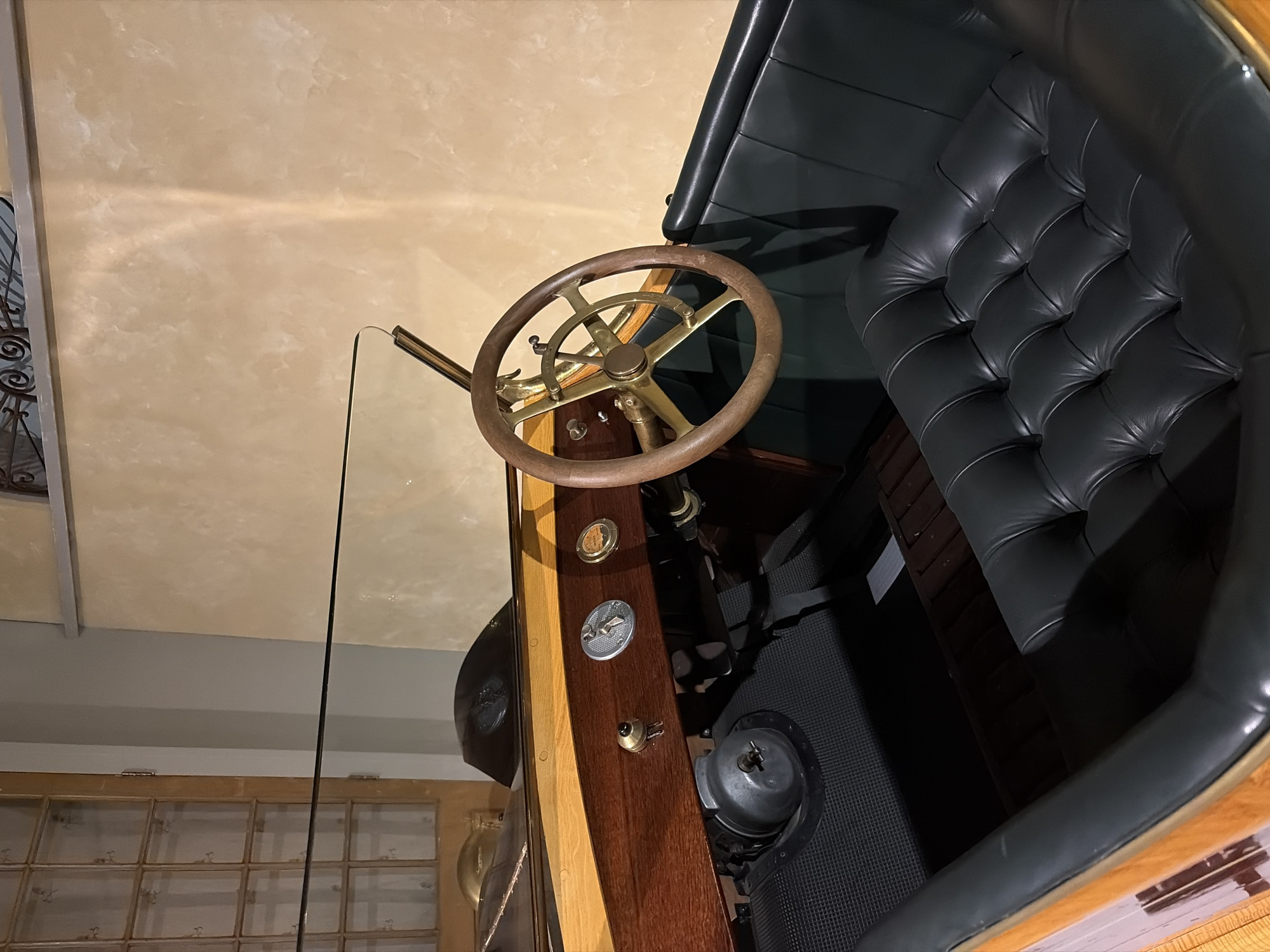
An interior view of a meticulously preserved vintage automobile is presented, featuring a classic design with rich materials. The image, originally rotated 90 degrees counter-clockwise, primarily focuses on the driver's area and a portion of the passenger seating. The prominent feature is a wooden steering wheel with intricate brass spokes and central controls, indicative of early automotive engineering. Below the steering wheel, a polished wooden dashboard or panel extends, crafted from a combination of lighter wood trim and a darker, possibly mahogany, section. Embedded in this panel are two circular metallic emblems or gauges; one appears to be a crest, while the other features a stylized winged figure, possibly an early brand logo. A small metallic knob or switch is also visible on the panel. Adjacent to the driver's area is a plush, dark grey or black tufted seat, likely upholstered in leather or high-quality faux leather, exhibiting deep buttoning and fine craftsmanship. A dark, textured floor mat covers the footwell area. The background suggests an indoor setting, possibly a museum, showroom, or private collection in Wassenaar, Netherlands, given the clean condition of the vehicle and the surrounding architecture. A light-colored, mottled wall or ceiling is visible above, along with a portion of a lighter grey wall and a wooden structure with multiple glass panes in the lower left, hinting at a display cabinet or architectural feature within the building. A thin, dark rod extends upwards from the car's interior into the background. There is no clearly legible text visible on any of the car's components or the surrounding environment.
Wassenaar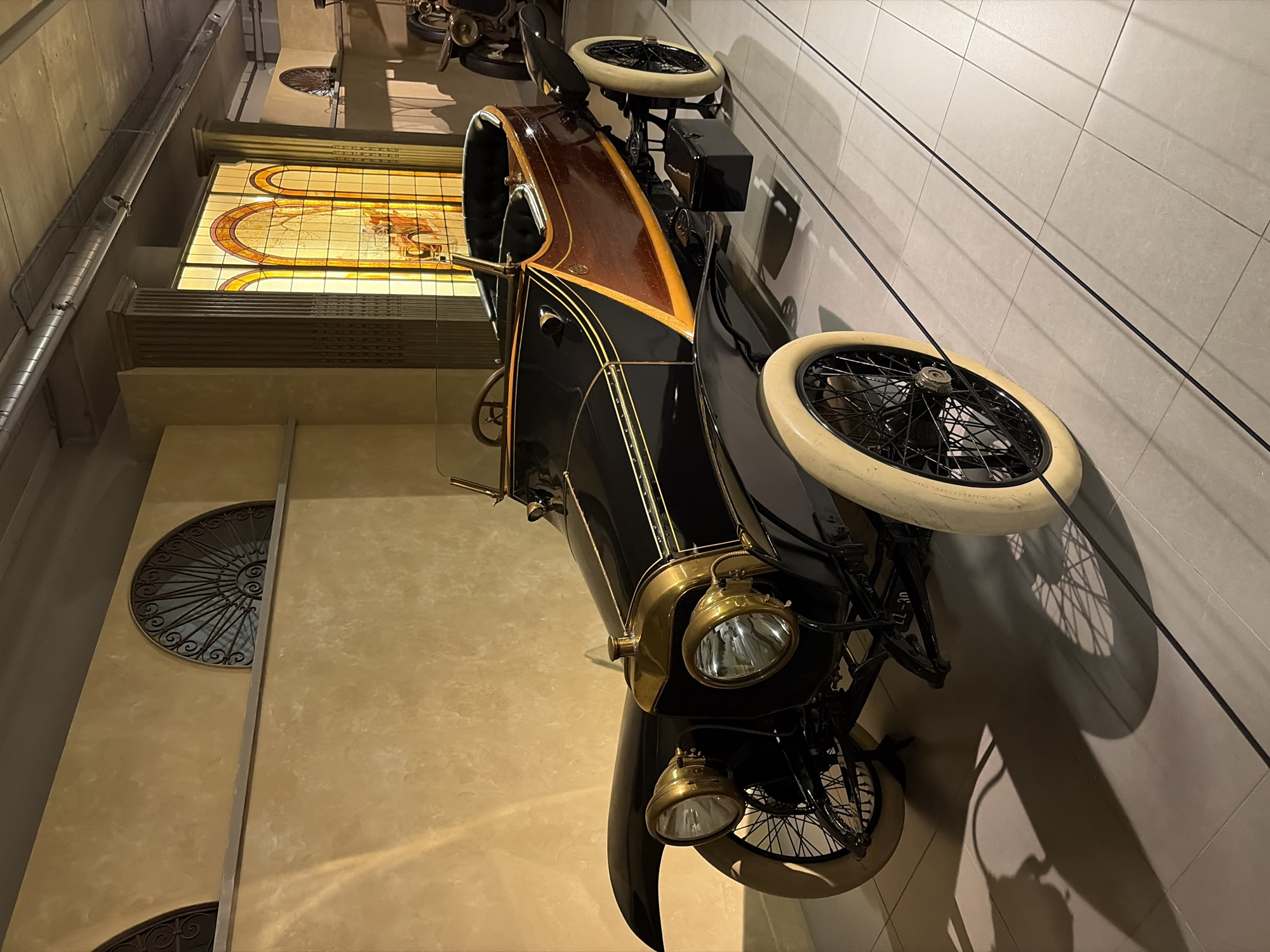
An antique or vintage car is displayed indoors, likely within a museum or exhibition space in Wassenaar, Netherlands. The vehicle is predominantly black with a polished wooden upper body or trim, accented with gold-colored pinstripes. It features distinctive brass components, including two sets of headlights and other fittings, and rests on white-walled tires with black wire-spoked wheels. The car is positioned on a light-colored tiled floor, casting a long, distinct shadow on the adjacent wall, which is also tiled. In the background, a large, ornate stained-glass window with intricate patterns in warm amber and orange hues suggests a historic or grand architectural setting. Above the window, industrial-style pipes run along the ceiling. Further into the background, yellowish walls feature decorative circular wrought-iron grilles. The lighting indicates an indoor, artificially lit environment, creating a focused and atmospheric presentation of the automobile. No people are visible in the image, and no clearly legible text is present on the car or in the surroundings.
Wassenaar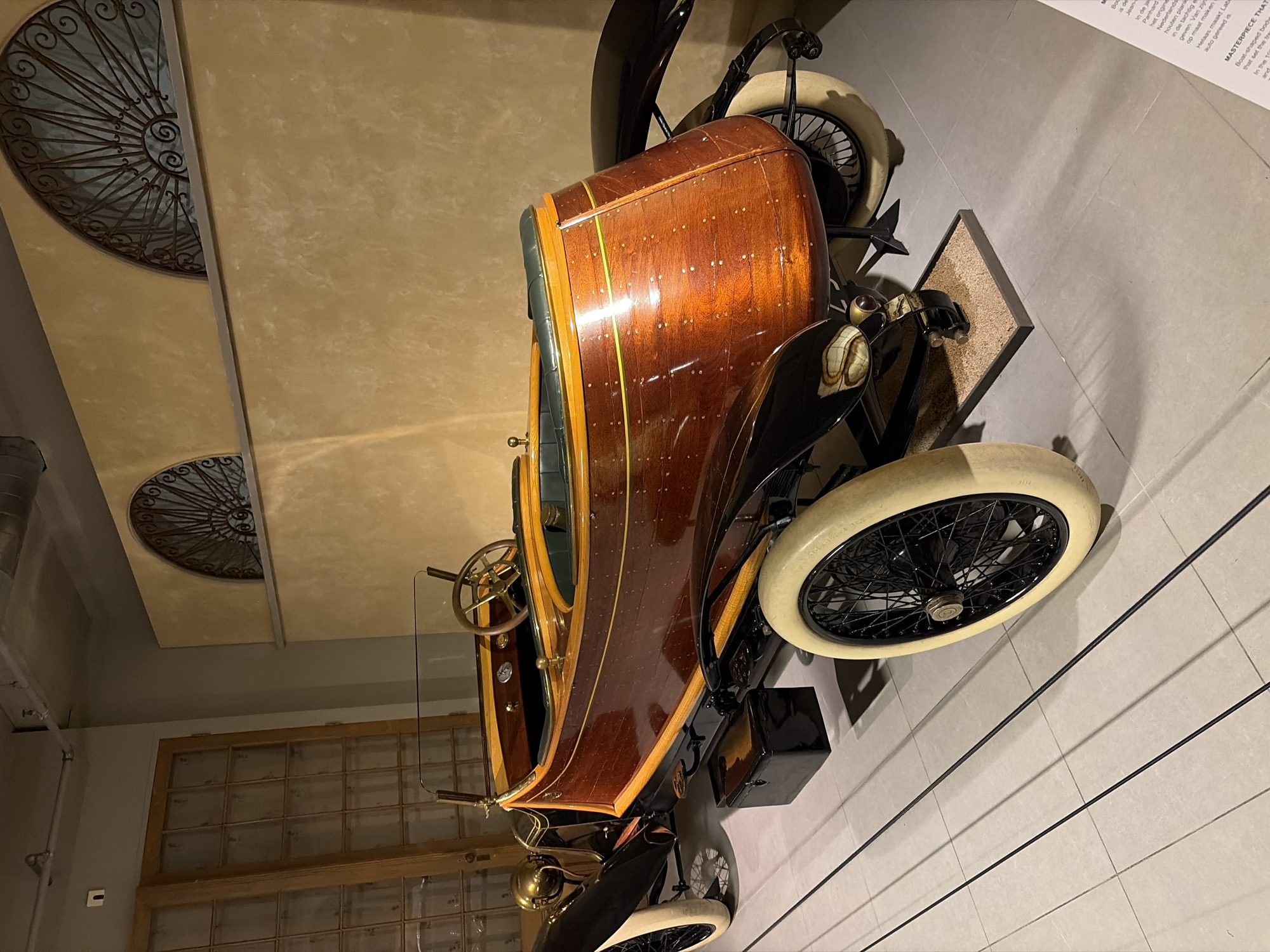
A vintage, boat-shaped car with a highly polished, reddish-brown wooden body is the central subject of the image, displayed indoors, likely in a museum in Wassenaar, Netherlands. The car features black fenders, a black chassis, and distinctive cream-colored, white-walled tires with black spoked wheels. Gold or brass accents are visible, including a steering wheel and a horn near the front wheel. The car's unique wooden construction, resembling a boat hull, is a prominent detail, with small fasteners or rivets visible across its surface and a yellow stripe running along its side. The setting consists of light beige/tan walls with a textured finish and a light grey tiled floor with dark grout lines. Architectural details include two decorative wrought iron grilles with spiral motifs, one partially visible at the top left and another smaller one below. A large wooden window frame with multiple small panes is visible in the background. The car is presented on a low platform, with an information signboard standing next to it. The visible text on the signboard, partially in Dutch and English, references "Panhard," "Nederlands" (Dutch), "houten plank" (wooden plank, referring to the body), and describes the vehicle as a "Boat-shaped body" and a "MASTERPIECE THAT set the trend." The text also mentions "In the 10" and "In de ja," indicating historical context. The environment suggests an exhibit, with artificial lighting illuminating the vehicle.
Wassenaar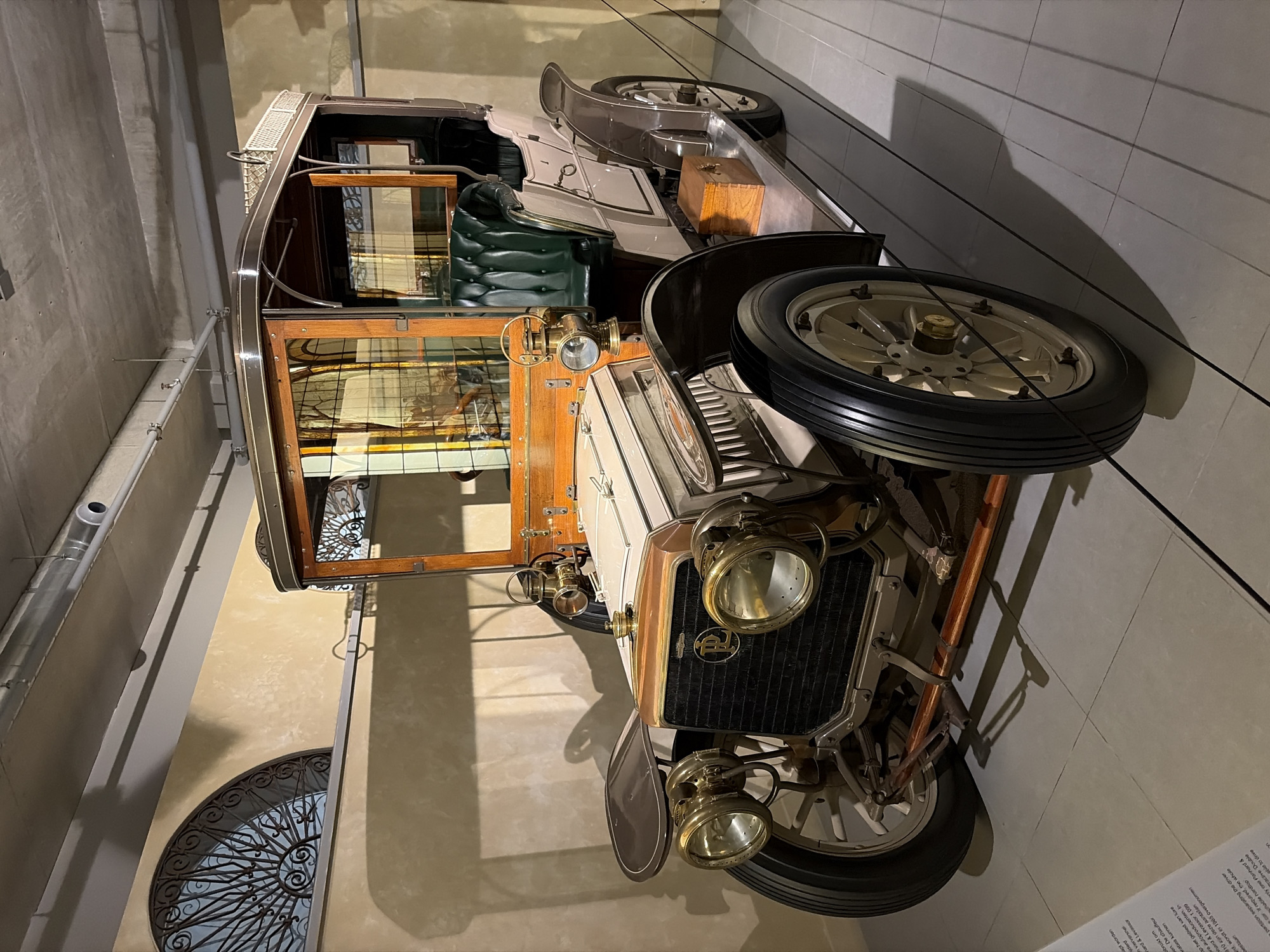
This image, rotated 90 degrees clockwise, displays an antique automobile, likely in a museum setting in Wassenaar, Netherlands. The car is largely cream or light beige with dark brown or black accents and features polished wooden elements. The front of the car is visible, showcasing large, round, brass or gold-colored headlights and a prominent dark radiator grille with a logo that appears to be a stylized "PL" or similar design. Below the headlights, the front wheels with cream-colored spokes and black tires are visible. A spare tire is mounted on the side, near the front passenger area. The interior of the car is partially visible, featuring a tufted, dark green leather seat (possibly driver's side), and ornate wooden paneling around the windows. The windows themselves have decorative, possibly stained glass or etched patterns. A rear view of the car shows a mesh luggage rack and another spare tire mounted on the side. The overall design suggests a luxury vehicle from the early 20th century. The setting appears to be an indoor exhibition space with plain walls. Strong shadows are cast on the walls by the car and its components, suggesting artificial lighting. In the background, an ornate, semicircular metal grate or window treatment is visible. Visible text from a display plaque, partially translated from Dutch and English, mentions "Panhard & Levassor," indicating the car's manufacturer. Phrases like "vierversnel" (four-speed), "autoproducenten" (car manufacturers), and "wordt in 1965 overgenomen" (was taken over in 1965) provide historical context about the company. Other fragments like "partition separating the driver" and "detachable hardtop" describe specific features of such vehicles.
Wassenaar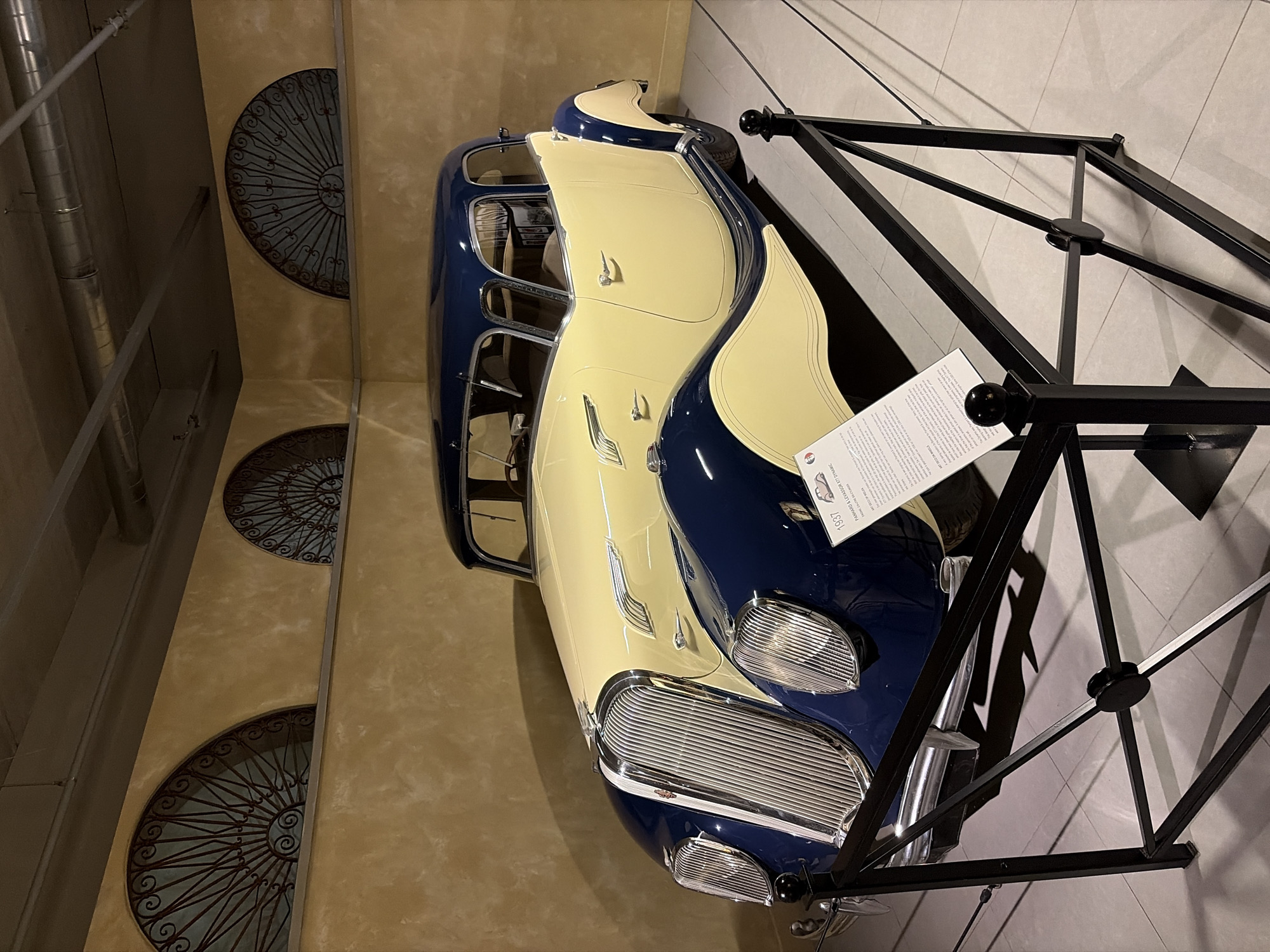
An antique two-toned car, primarily dark blue and cream/beige, is prominently displayed indoors, likely within a museum or exhibition space in Wassenaar, Netherlands. The car's front features a distinctive chrome grille and integrated headlights, with chrome accents visible along its bodywork and door handles. The lower half of the vehicle, including the fenders, is dark blue, contrasting with the cream-colored hood and upper body. To the right of the car, a black metal barrier or display stand frames the scene. A white rectangular plaque positioned near the car provides descriptive information, with the year "1937" clearly visible, along with the partial text "PANHARD ET LEVASSOR DYNAMIC" and a small logo. The background consists of light brown/beige walls adorned with multiple circular decorative iron grates, featuring intricate radial and spiral patterns. On the far left, industrial-style silver piping or ducts run vertically along a darker wall section, creating a contrast with the more ornate grates. The car is situated on a light-colored floor, possibly tiled. The overall scene depicts a well-preserved classic automobile showcased under controlled indoor lighting, highlighting its aesthetic and historical value.
Wassenaar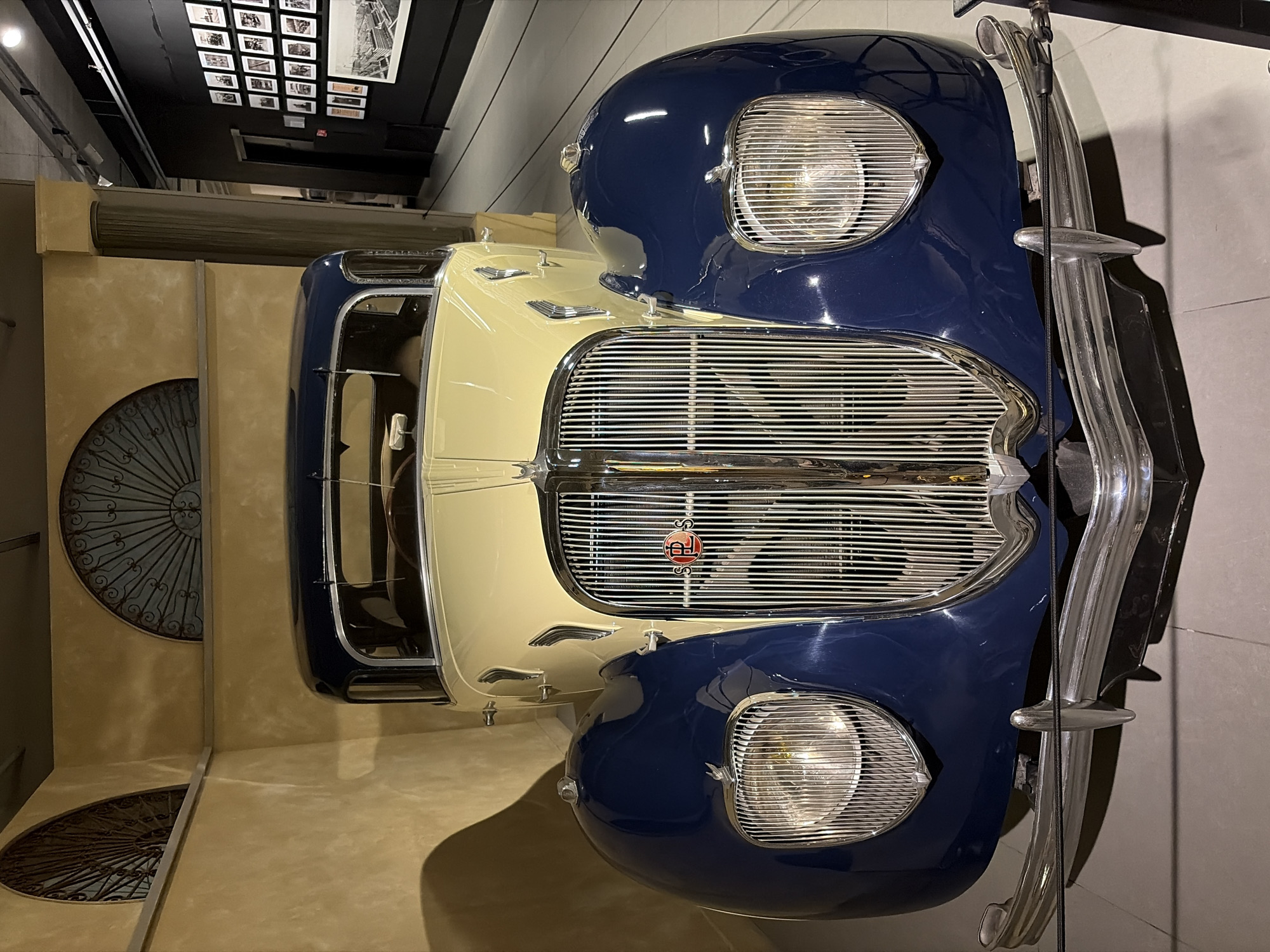
The image, oriented vertically, captures a vintage two-tone car on display, likely within a museum or exhibition hall in Wassenaar, Netherlands. The car's body features a distinct dark blue on its upper half and a creamy light beige on its lower half, including the fenders. The front of the vehicle is prominent, showcasing a large, chrome-plated grille composed of numerous horizontal bars. A circular red emblem, possibly a brand insignia with stylized letters, is centered on the grille. Flanking the grille are two large, circular headlamps, each with a chrome surround, embedded in the dark blue bodywork. A shiny, robust chrome bumper extends across the very front of the car. The car is situated indoors, with warm-toned, possibly plaster or concrete walls forming the immediate background. On the left side of the frame, two decorative, circular metal grilles are visible, seemingly integrated into the floor or wall. In the upper background, a dark wall or ceiling area features a precise grid display of multiple framed black-and-white photographs or historical documents, characteristic of a museum exhibit. The setting is illuminated by artificial indoor lighting. No people are visible, focusing attention solely on the meticulously presented classic automobile. The overall impression is one of historical preservation and artistic display.
Wassenaar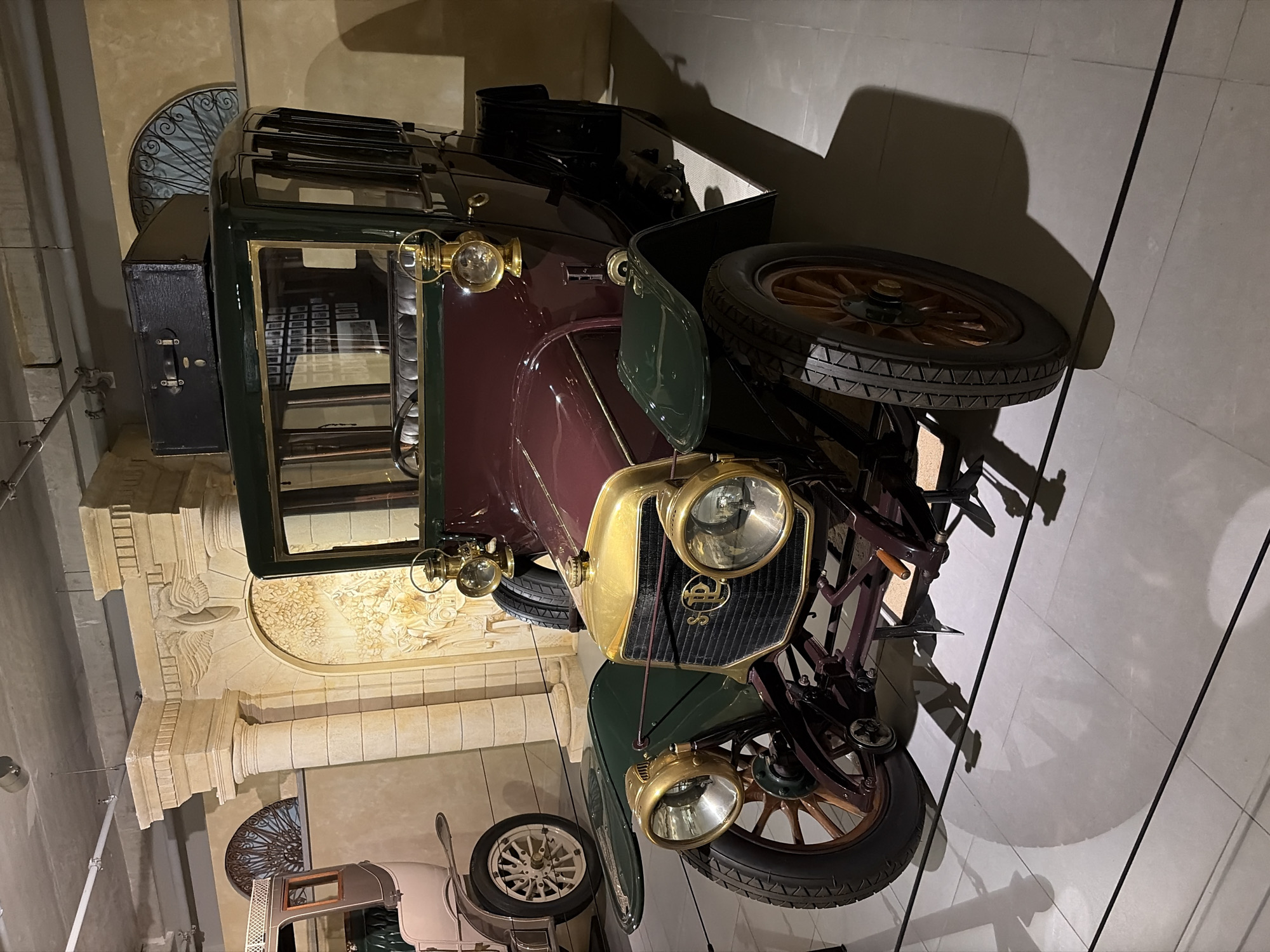
An antique automobile, likely from the early 20th century, is the central subject of this indoor scene, possibly within a museum or grand hall in Wassenaar, Netherlands. The car features a two-tone paint scheme with a deep maroon body and dark green fenders and trim. Its front is adorned with gold-colored brass accents, including two large, prominent circular headlights and two smaller side lamps. The radiator grille, also brass-colored, showcases a distinct dark oval emblem in its center, displaying what appears to be a stylized "SP" monogram. The car is equipped with wooden-spoked wheels fitted with black tires, and a spare tire is mounted prominently on its right side. A black, suitcase-like trunk is attached to the rear of the vehicle. In the background, ornate architectural elements are visible, including beige stone columns, arches, and decorative relief carvings depicting foliage and possibly figures. A decorative metal grille is also seen behind the car's rear. A partial view of a second, lighter-colored vintage car with white spoked wheels is visible in the lower-left background, suggesting a collection or exhibition of historical vehicles. Strong artificial lighting casts distinct shadows of the main car and its components onto the light-colored floor. The scene depicts a static display, highlighting the craftsmanship and design of vintage automobiles within an architecturally rich and historic environment.
Wassenaar![An indoor scene, likely a museum or exhibition in Wassenaar, Netherlands, showcases a meticulously restored vintage dark green automobile with bright yellow spoked wheels and brass accents. The car, identified by a display board as a "1909 GEORGES ROY 12-HP TOURING SPORT TORPEDO", features prominent external headlamps, an engine with horizontal fins, and a spare yellow wheel mounted on its side. Its interior, partly visible, includes dark seating and a wooden steering area.
Two large framed posters adorn the wall behind the car. The poster on the left depicts a man in a hat smoking a pipe, holding a magnifying glass over a small car. Partial Dutch text reads: "TOONSTELLING VAN... AUTOMOBIELEN... AMSTERDAM... 21 DECEMBER 191[X]... De Rijwielen en Automobiel:Indust," indicating an early 20th-century automobile exhibition. The poster above the car shows a figure in a dark coat looking into a beam of light that illuminates a distant structure, possibly a castle. A red object is partially visible in the foreground of this poster.
Adjacent to the car, a white display board provides further details, including the car's engine specifications ("17-LITRE FOUR CYLINDER POWER 12 HP") and notes in both Dutch and English about its configuration, such as "Georges Roy als tweezitter" and "Georges Roy as a two seater." The floor is made of light-colored tiles, and the overall lighting suggests an artificial, controlled environment typical of a museum. The scene captures a moment of historical automotive display.](https://firebasestorage.googleapis.com/v0/b/patr-3a75e.appspot.com/o/uploads%2Fimage_picker_7b03ef39-5556-40d6-a.jpg?alt=media)
An indoor scene, likely a museum or exhibition in Wassenaar, Netherlands, showcases a meticulously restored vintage dark green automobile with bright yellow spoked wheels and brass accents. The car, identified by a display board as a "1909 GEORGES ROY 12-HP TOURING SPORT TORPEDO", features prominent external headlamps, an engine with horizontal fins, and a spare yellow wheel mounted on its side. Its interior, partly visible, includes dark seating and a wooden steering area. Two large framed posters adorn the wall behind the car. The poster on the left depicts a man in a hat smoking a pipe, holding a magnifying glass over a small car. Partial Dutch text reads: "TOONSTELLING VAN... AUTOMOBIELEN... AMSTERDAM... 21 DECEMBER 191[X]... De Rijwielen en Automobiel:Indust," indicating an early 20th-century automobile exhibition. The poster above the car shows a figure in a dark coat looking into a beam of light that illuminates a distant structure, possibly a castle. A red object is partially visible in the foreground of this poster. Adjacent to the car, a white display board provides further details, including the car's engine specifications ("17-LITRE FOUR CYLINDER POWER 12 HP") and notes in both Dutch and English about its configuration, such as "Georges Roy als tweezitter" and "Georges Roy as a two seater." The floor is made of light-colored tiles, and the overall lighting suggests an artificial, controlled environment typical of a museum. The scene captures a moment of historical automotive display.
Wassenaar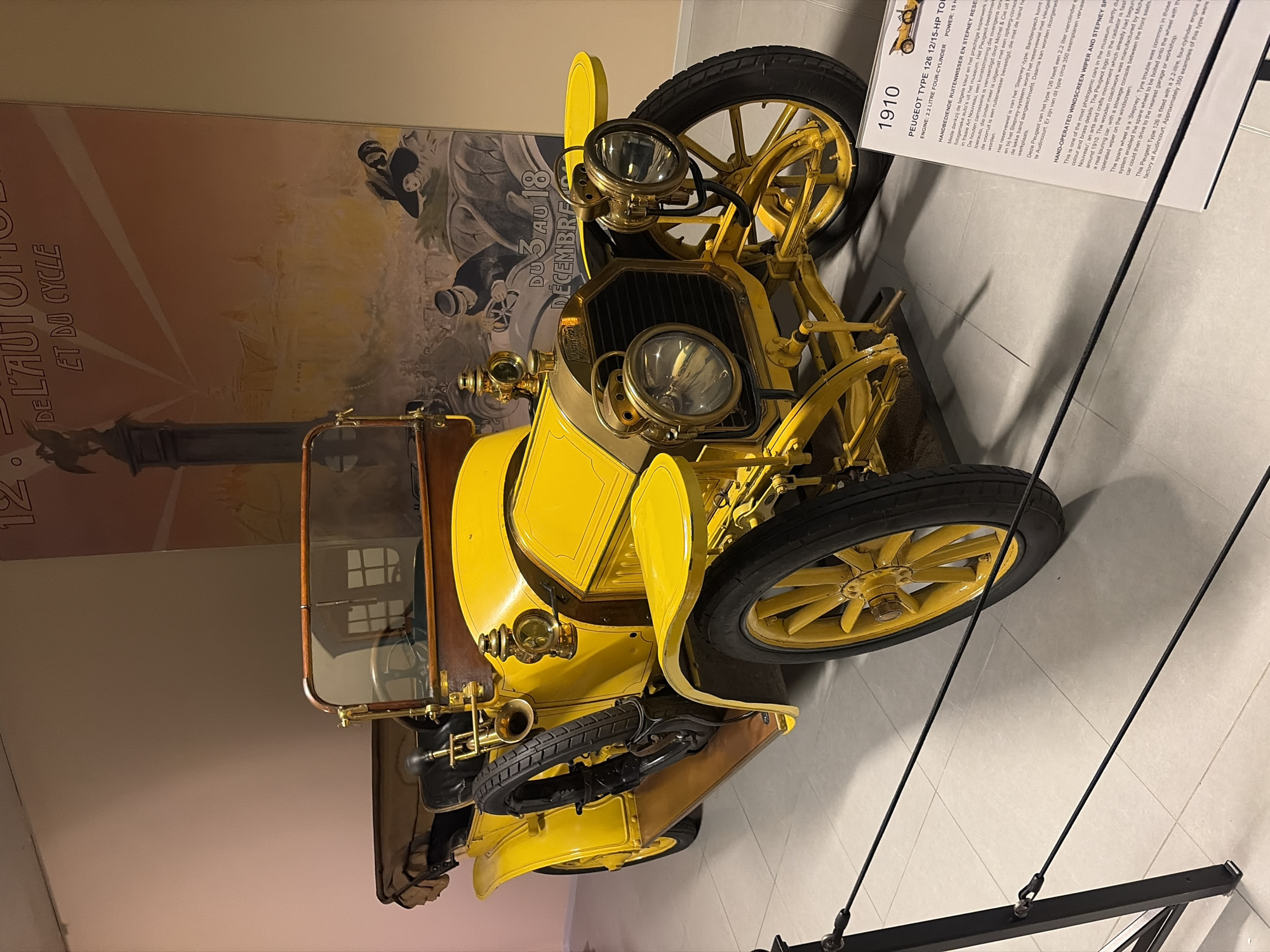
A bright yellow 1910 Peugeot Type 126 12/15-HP touring car is prominently displayed indoors, likely within a museum or exhibition hall in Wassenaar, Netherlands. The vintage vehicle features a vibrant yellow body, large brass headlamps, a brass horn, and wooden spoked wheels, with a spare tire mounted on its side. A wooden-rimmed steering wheel is visible through the windshield. Behind the car, a large, vintage-style poster is affixed to the wall, partially visible. It reads "12. DE L'AUTO ET DU CYCLE" and "DU 3 AU 18 DÉCEMBRE", depicting stylized figures in period attire, suggesting an early automobile and cycle exhibition. To the right of the car, a white display board provides detailed information about the Peugeot Type 126. The text, in both Dutch and English, identifies the car as a 1910 model with a 2.2-litre four-cylinder engine producing 15 horsepower. It highlights features like its hand-operated windscreen wiper and Stepney spare wheel system, and mentions that approximately 350 examples of this type were manufactured. The board also notes its aesthetic appeal: "This is one of the most photogenic cars in the museum, partly due to its bright yellow colour and brass details." The car is positioned on a light-colored tiled floor, with black metal barriers in the foreground indicating a viewing area. The setting is well-lit by artificial lighting, creating a clear and informative display of the historic automobile.
Wassenaar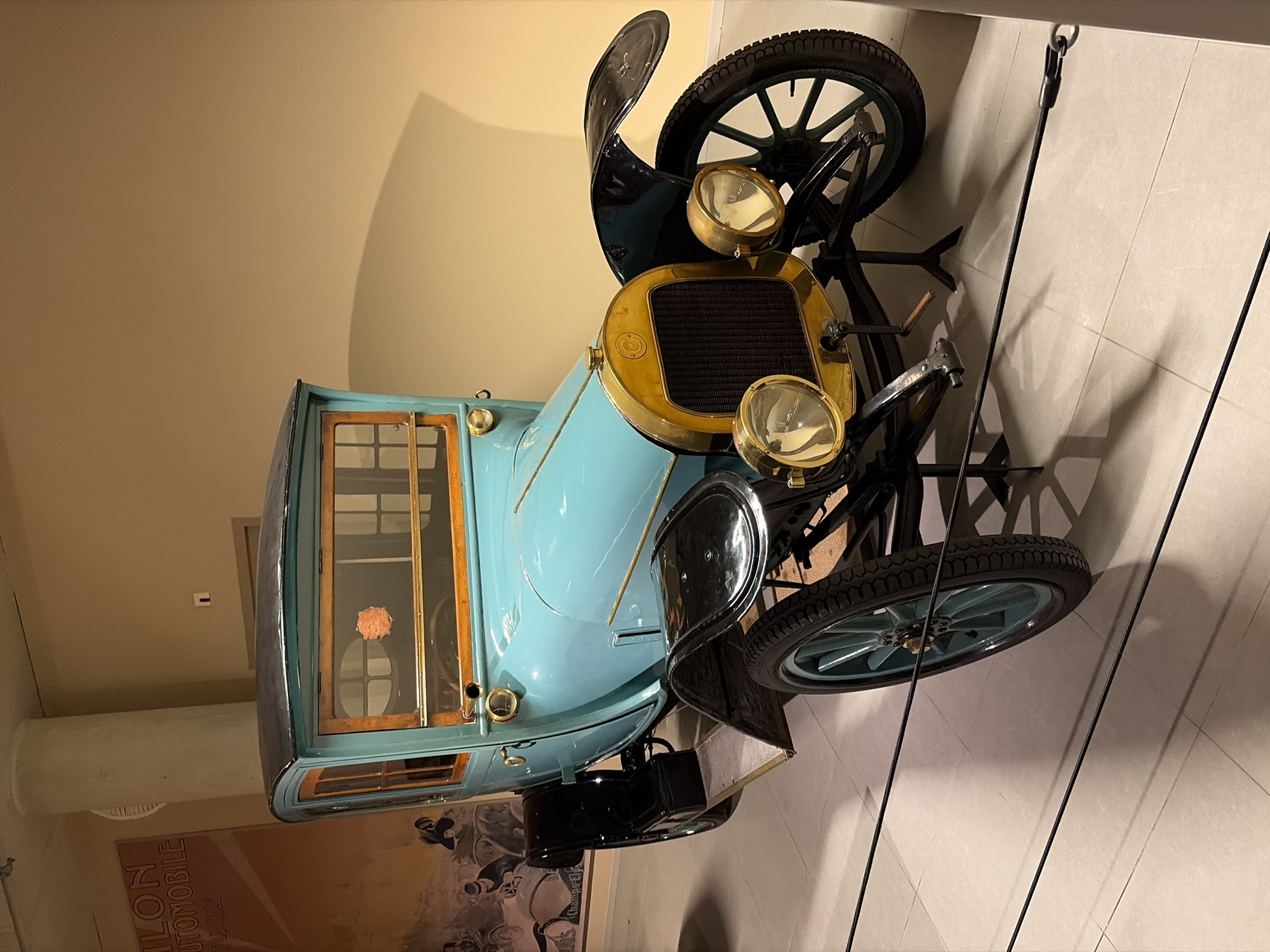
A vintage, light blue automobile, likely from the early 20th century, is displayed indoors in what appears to be a museum or exhibition space in Wassenaar, Netherlands. The car features a prominent brass radiator grille and two large, circular brass headlights. Its body is painted a distinctive light blue, complemented by black fenders and black-spoked wheels with light blue hubs and pneumatic tires. The cabin showcases intricate wooden window frames, and a small, circular orange or pink object is visible through a rear window. A black step or running board is attached to the side. The background consists of plain light beige walls, with a large, white cylindrical column visible on the left side. Black ropes act as barriers in the foreground and to the right, reinforcing the exhibition setting. Shadows are cast on the walls and the light-colored tiled floor, indicating artificial lighting. A partially visible framed poster on the lower left wall displays the text "LON AUTOMOBILE," strongly suggesting "SALON AUTOMOBILE," a term commonly used for motor shows. The car is stationary, presented as an exhibit.
Wassenaar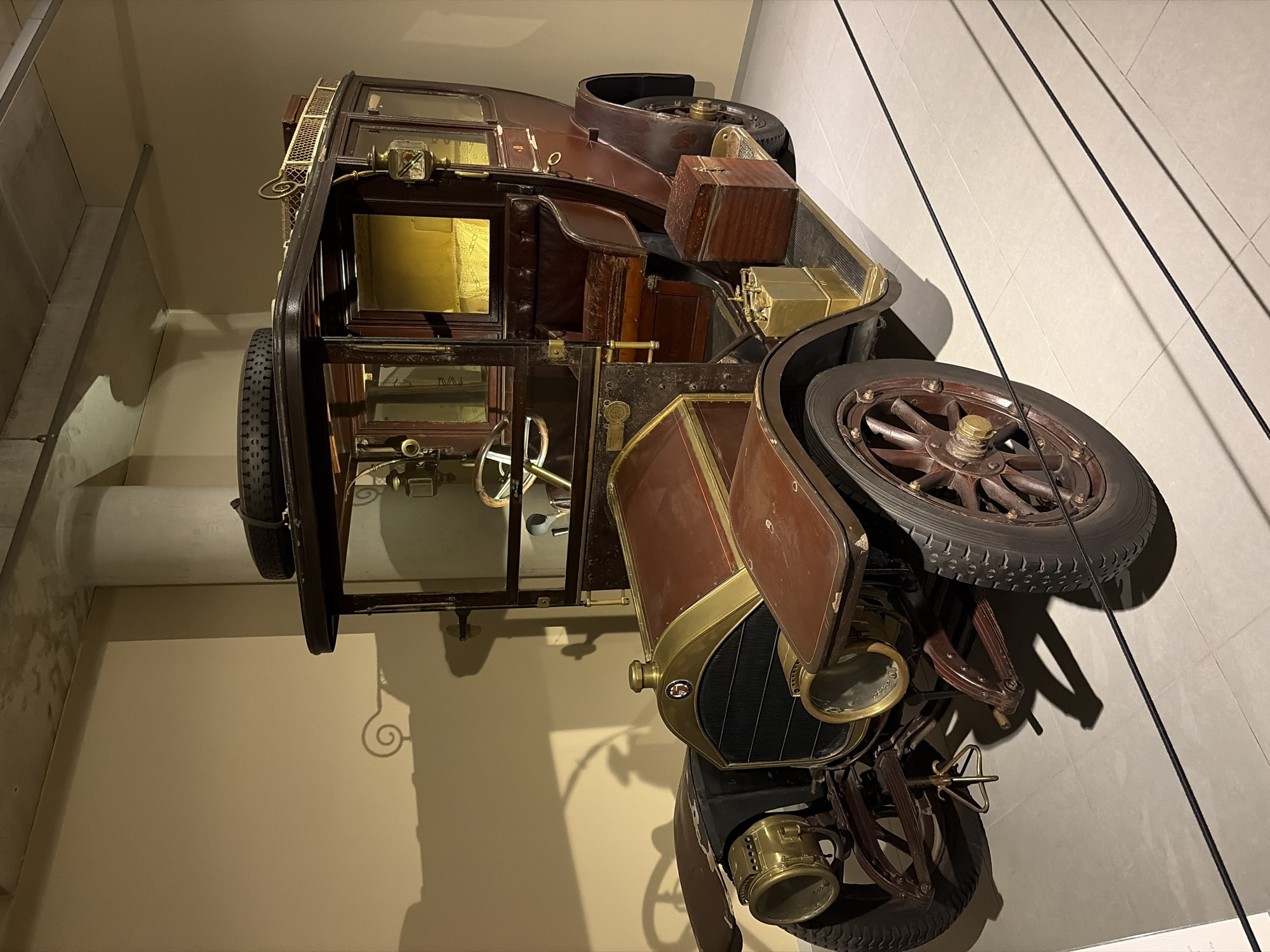
This image captures a vintage automobile, likely an early 20th-century model, displayed indoors, possibly within a museum or exhibition space in Wassenaar, Netherlands. The car is seen from a slightly elevated side angle, facing towards the right. The vehicle is characterized by its dark brown bodywork and prominent brass accents, including headlights, trim, and interior fixtures. It features large wooden spoke wheels with dark pneumatic tires, one of which appears to be a spare mounted on the side. The front of the car shows a distinctive grille with a small, circular manufacturer's emblem containing stylized letters, possibly "L-F". A brass-colored radiator cap is visible above the grille. The car's design suggests a coach-built body, possibly a landaulet or brougham, with a closed rear passenger compartment featuring glass windows and a more exposed front driver's area where a wooden steering wheel is visible. The interior of the passenger compartment shows hints of plush, possibly yellow, fabric or upholstery, and what might be a map or decorative lining through the windows. A small wooden box and a brass-colored container are secured on the running board or fender. A detailed, clear glass lantern or lamp is attached to the side of the cabin. The setting consists of plain, light-colored walls—a beige wall on the left and a white, tiled wall on the right. Dark, thin lines, possibly ropes or barriers, stretch diagonally across the white wall. Prominent shadows cast by the car and other structural elements suggest strong artificial lighting. A white pipe or cylindrical fixture is visible along the left wall. No people are present, and the vehicle is stationary, serving as a static exhibit. No discernible text beyond the car's emblem is clearly legible.
Wassenaar