Weimar, Germany
30 memories from Weimar, Germany

A POV shot from a vehicle traveling on a highway shows traffic ahead. The road is asphalt with white lane markings. On the left lane, a white van is visible. In the right lane ahead, several trucks and cars are driving. The surrounding environment consists of green trees and vegetation on both sides of the highway, and the sky is overcast with clouds. The video is a continuous shot with no apparent significant changes in the scene.
Weimar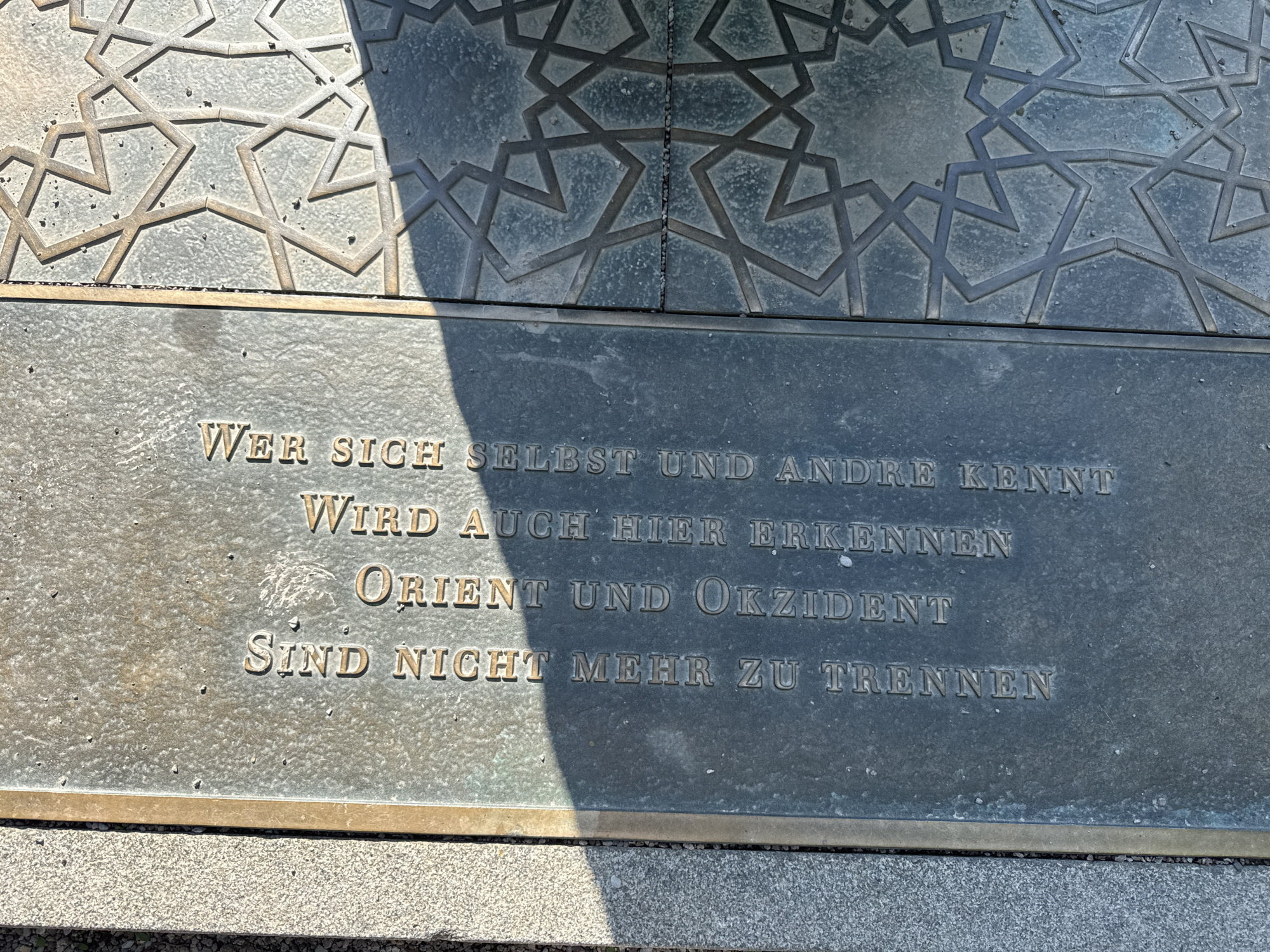
This is a close-up, vertical, eye-level shot of an engraved metal plaque with text on it, placed in the city of Weimar, Germany. The plaque is part of a ground installation, as evidenced by the patterned stone paving next to it, which displays a geometric design. The plaque itself is a weathered bronze or brass metal, with the text deeply etched into its surface. The text on the plaque reads in German: "WER SICH SELBST UND ANDRE KENNT WIRD AUCH HIER ERKENNEN ORIENT UND OKZIDENT SIND NICHT MEHR ZU TRENNEN". This translates to "WHOEVER KNOWS HIMSELF AND OTHERS WILL ALSO RECOGNIZE HERE THAT THE ORIENT AND THE OCCIDENT ARE NO LONGER SEPARABLE". The inscription is oriented vertically, with the words running from top to bottom. The lighting casts a distinct shadow from the right side of the image across the plaque, highlighting the texture of the metal and the engraved letters. The left edge of the plaque is bordered by a rough, grey stone material, likely part of the surrounding pathway or monument. The patterned paving to the right is made of lighter grey stone or concrete and features interlocking star-like geometric shapes. The scene is clean and appears to be an outdoor public space in Weimar, Germany, likely a memorial or a place of historical significance, possibly related to cultural exchange or understanding. There are no people or animals visible in the image. The focus is entirely on the plaque and its inscription, as well as the immediate surrounding ground.
Weimar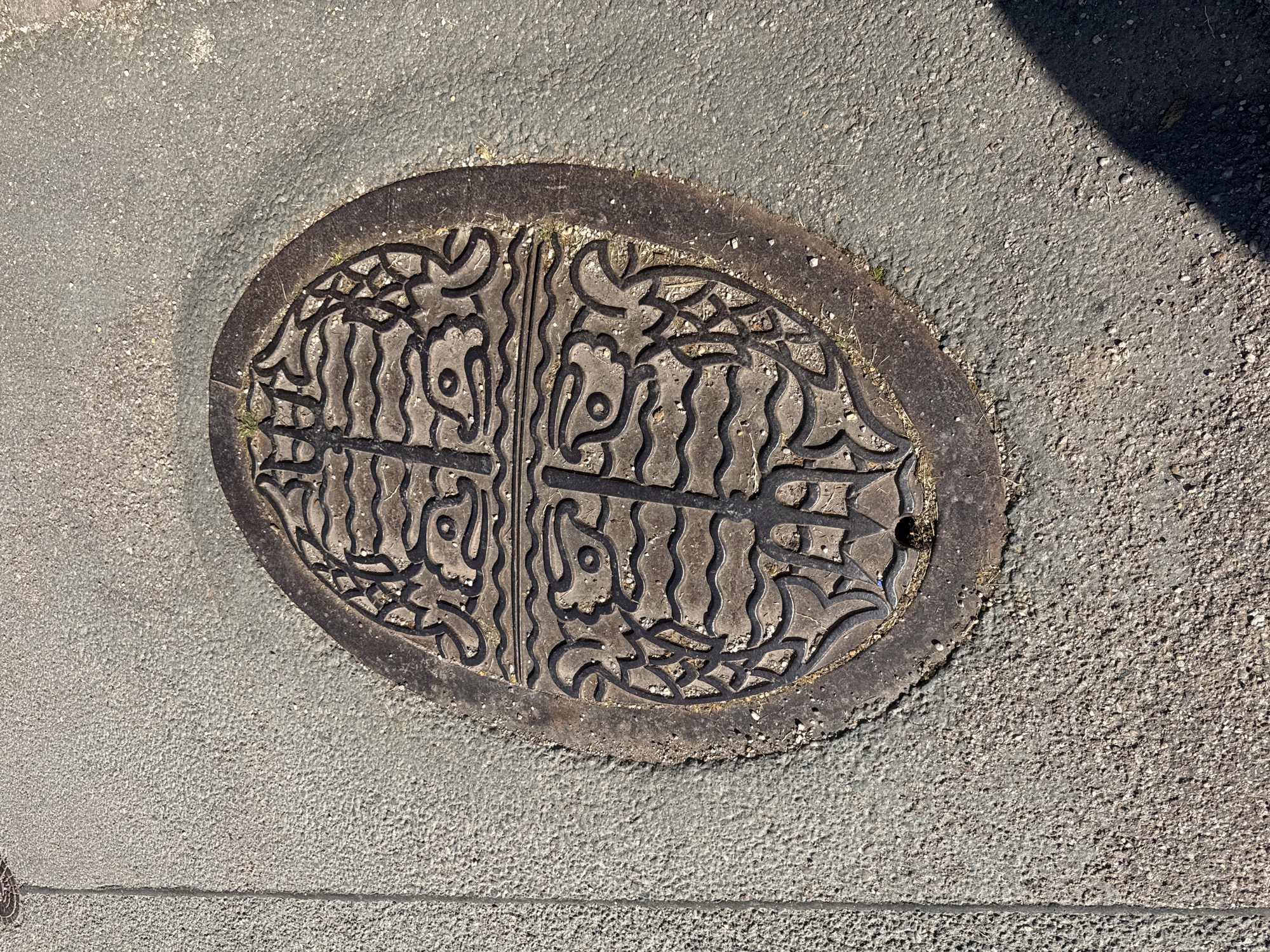
This is a high-angle, medium shot of an oval-shaped manhole cover embedded in asphalt. The manhole cover is ornately decorated with a relief pattern of stylized fish and wavy lines, divided into four quadrants by a central cross shape that resembles a trident. The surface of the asphalt is grey and textured, with some small pebbles visible. A shadow falls across the lower right portion of the image. There are no people visible in the image. The manhole cover is located on a sidewalk or street in Weimar, Germany.
Weimar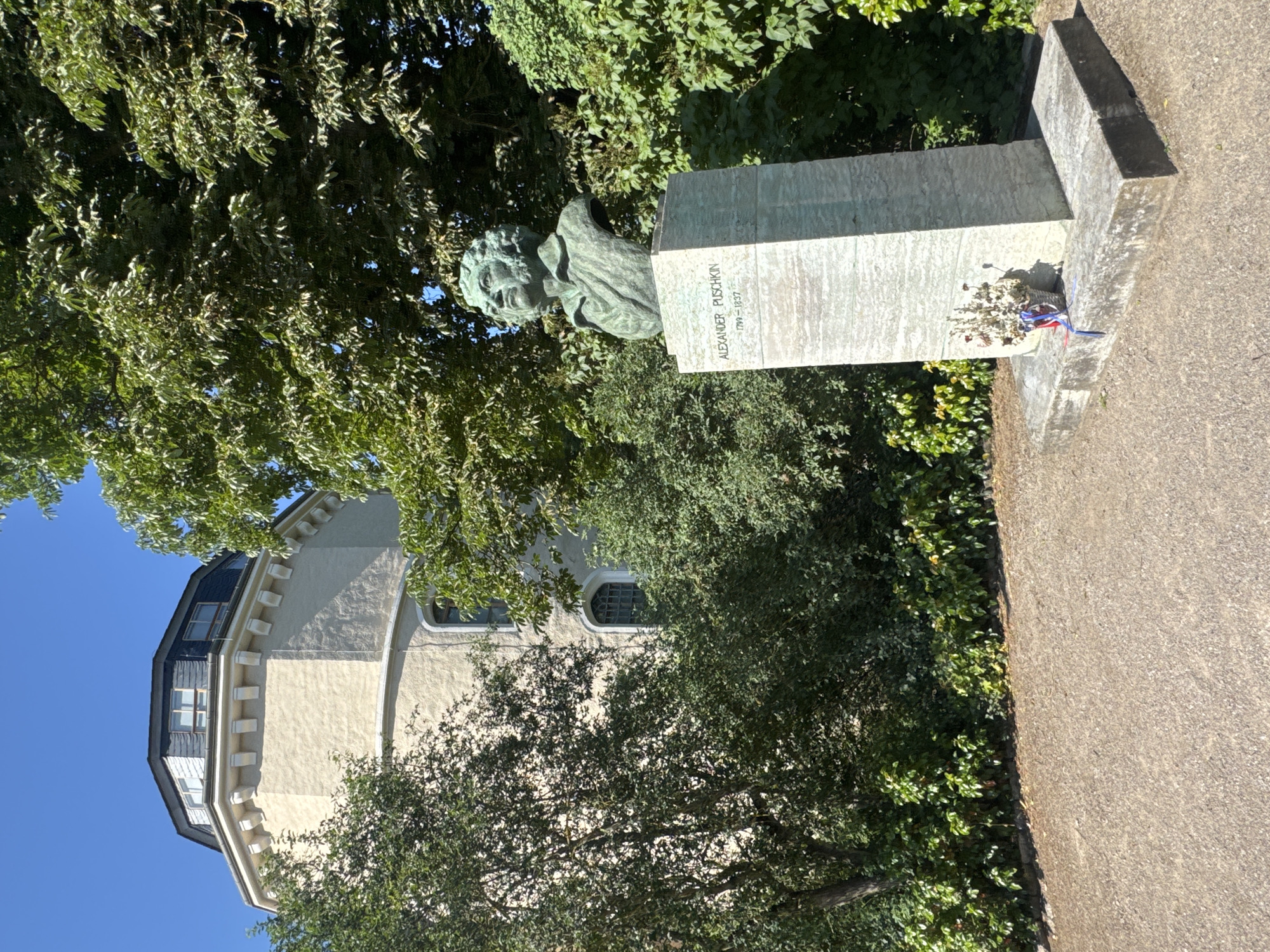
The image shows a bust of Alexander Pushkin in the city of Weimar, Germany, located in the Pushkin Memorial on the grounds of the Goethe National Museum. The bronze bust is mounted on a tall, light-colored stone pedestal with the inscription "ALEXANDER PUSCHKIN 1799–1837". A small bouquet of flowers with red, white, and blue ribbons rests at the base of the pedestal. Behind the sculpture, lush green trees and foliage obscure a portion of a cream-colored, octagonal building with a dark, mansard roof. The building has arched windows with intricate grates. The ground in front of the sculpture is a gravel path. The sky is clear and blue.
Weimar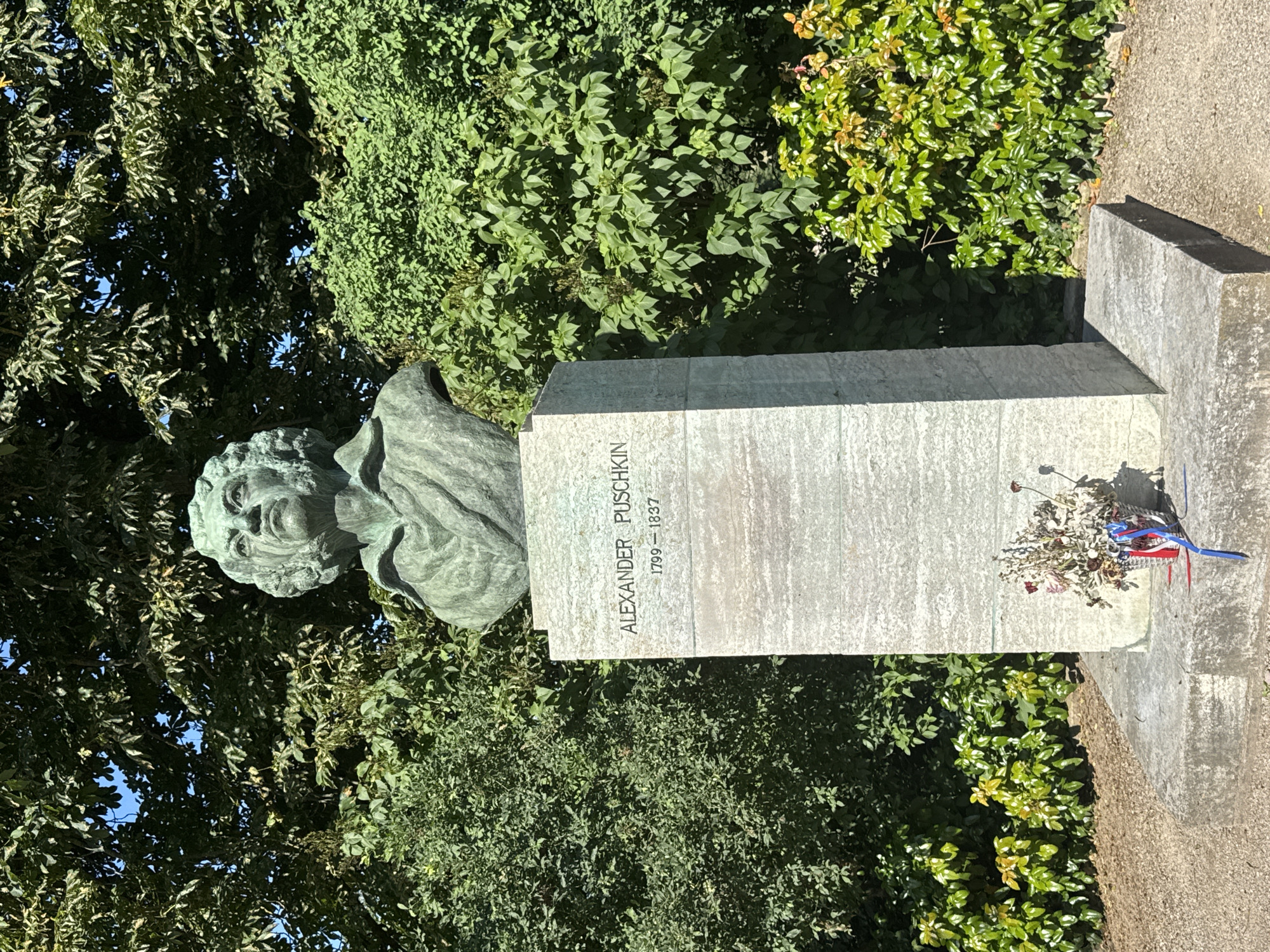
A bronze bust of a man with curly hair, looking upwards, is mounted on a tall, rectangular stone pedestal. The pedestal is inscribed with "ALEXANDER PUSCHKIN" and "1799-1837". At the base of the pedestal, resting on a stone slab, is a basket of dried flowers with red, white, and blue ribbons. The monument is set against a backdrop of lush green trees and foliage. The scene is illuminated by bright sunlight. This monument is located in the Goethe-Schiller-Denkmal complex in Weimar, Germany.
Weimar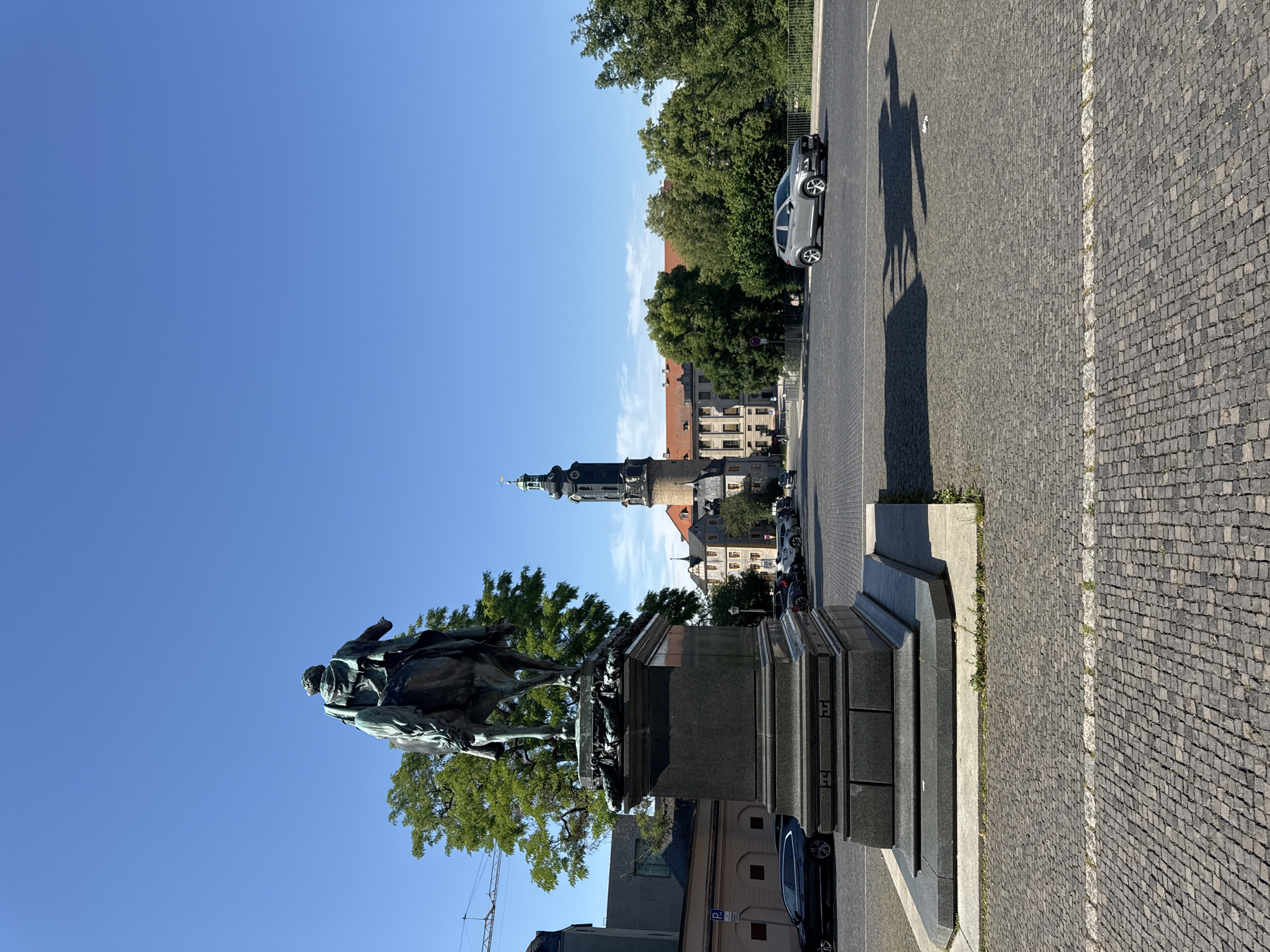
The image shows an equestrian statue in a city square in Weimar, Germany. The statue depicts a man in military attire on horseback, cast in bronze. It stands on a large, dark granite pedestal with intricate carvings. In the background, a prominent clock tower with a green spire rises above a building with a red-tiled roof. Trees line the square, and several cars are parked and driving on a cobblestone street. The sky is clear and blue. The location is likely the Marktplatz (Market Square) in Weimar, given the presence of the historical buildings and the statue, which appears to be that of Carl August, Grand Duke of Saxe-Weimar-Eisenach, a significant figure in Weimar's history.
Weimar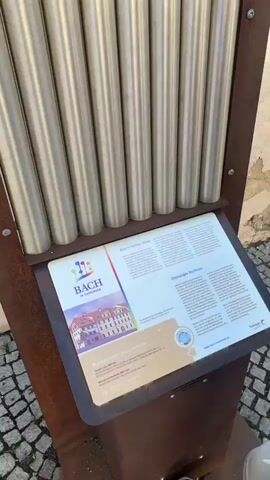
A person's lower leg and foot, wearing ripped jeans and a dark shoe, are visible as they step on a pedal. The pedal is attached to a metal structure with several vertical metal pipes of varying lengths, resembling an outdoor musical instrument. A sign with text and an image of a building is mounted below the pipes. The instrument is situated on a cobblestone pathway next to a textured wall. In the background, a street with buildings and parked cars is visible under a bright sky. The video captures the action of playing the instrument, with the sound of the pipes being struck.
Weimar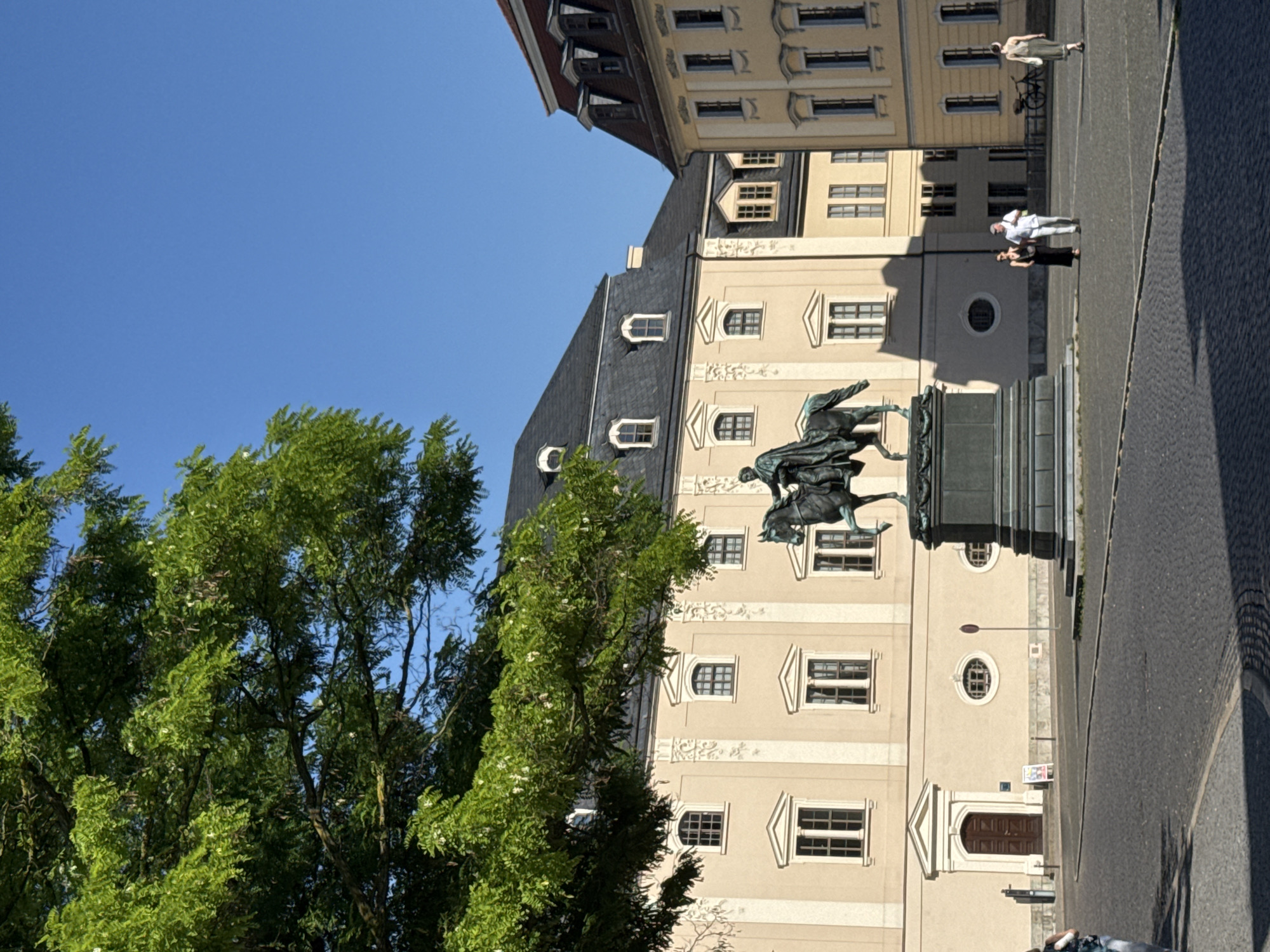
The image depicts the equestrian statue of Carl Friedrich on horseback in the market square of Weimar, Germany. The statue stands prominently on a dark stone pedestal in the foreground. Behind the statue, a light-colored building with a dark, mansard roof is visible. The building features numerous windows with dark frames and decorative architectural elements. To the right, another building with a red-tiled roof and dormer windows is partially visible. A large, leafy green tree is in the upper left corner of the image, partially obscuring the sky. The ground of the square is paved with dark cobblestones, reflecting the sunlight and casting shadows. In the middle ground, several people are walking across the square. Two individuals, a man and a woman, are walking together towards the right, and another person is walking away from the camera on the right side of the square. The sky is clear and blue, indicating a sunny day. The overall scene captures a public square in a European city, likely a historic district, under bright sunlight.
Weimar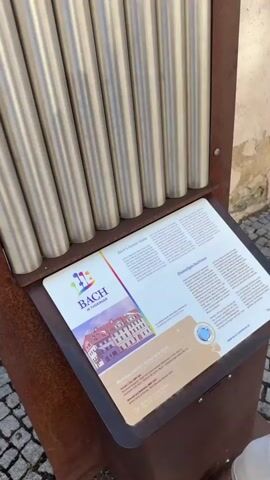
A close-up, eye-level shot shows a section of a pipe organ with a plaque in front of it. The organ pipes are made of metal and are arranged vertically. The plaque has text and an image of a building. A person's foot is visible in the bottom right corner of the frame, pressing down on a pedal at the base of the organ. The pedal is attached to a rusty metal mechanism. The ground beneath the organ is paved with cobblestones. The background is slightly out of focus, showing a textured wall and part of a street sign. The lighting suggests an outdoor setting during the day.
Weimar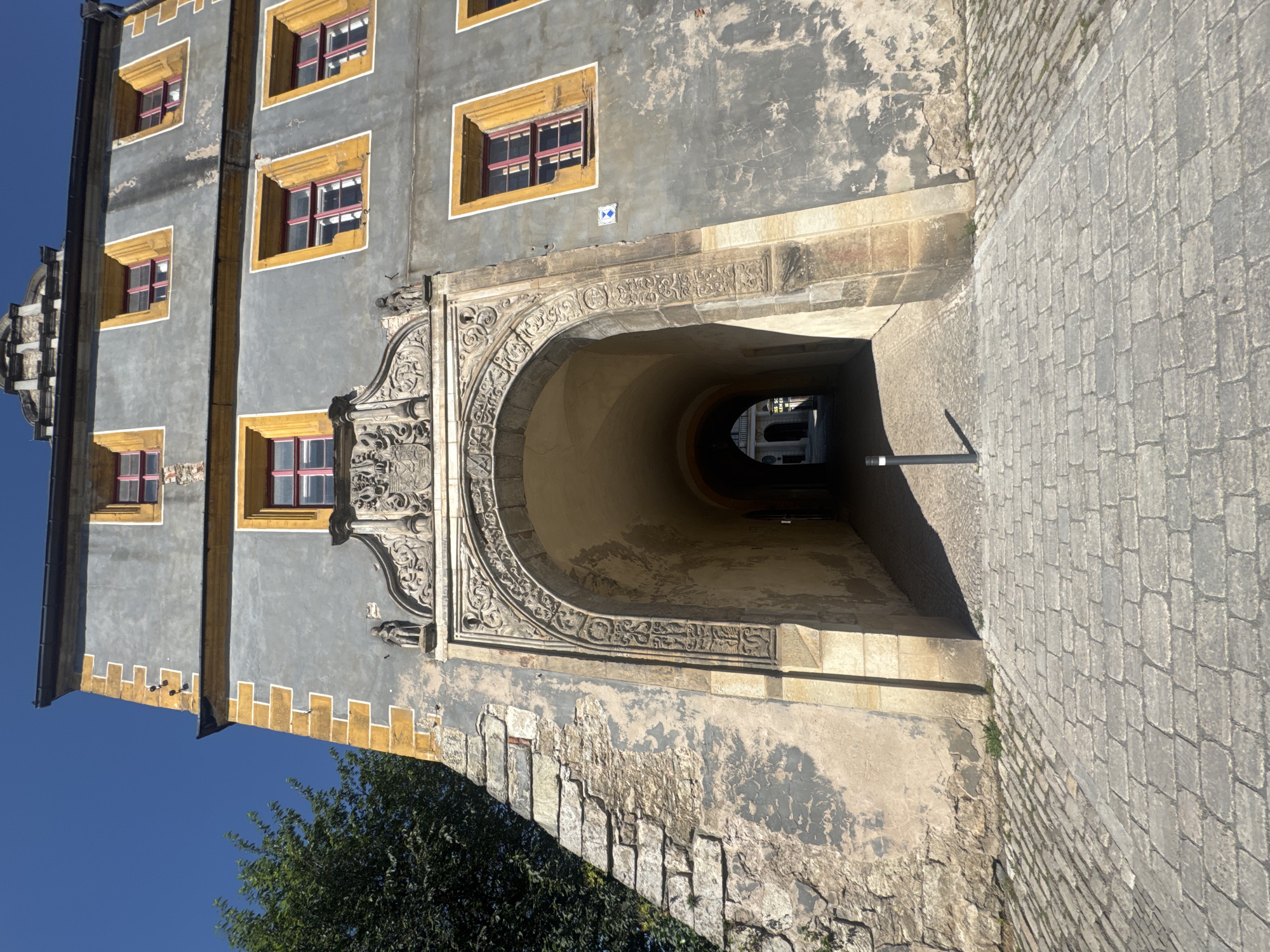
The image captures the historic Buchenwald Gate in Weimar, Germany. The gate features a grand stone archway with intricate carvings above, leading into a dimly lit tunnel. The building's facade is a weathered gray with striking yellow trim around the red-paned windows. A section of the stone wall on the left is in disrepair, contrasting with the well-maintained cobblestone path in the foreground. Lush green trees are visible to the left of the gate. The sky above is a clear, bright blue, indicating a sunny day. There are no people or animals visible in the scene, and no actions or interactions are taking place.
Weimar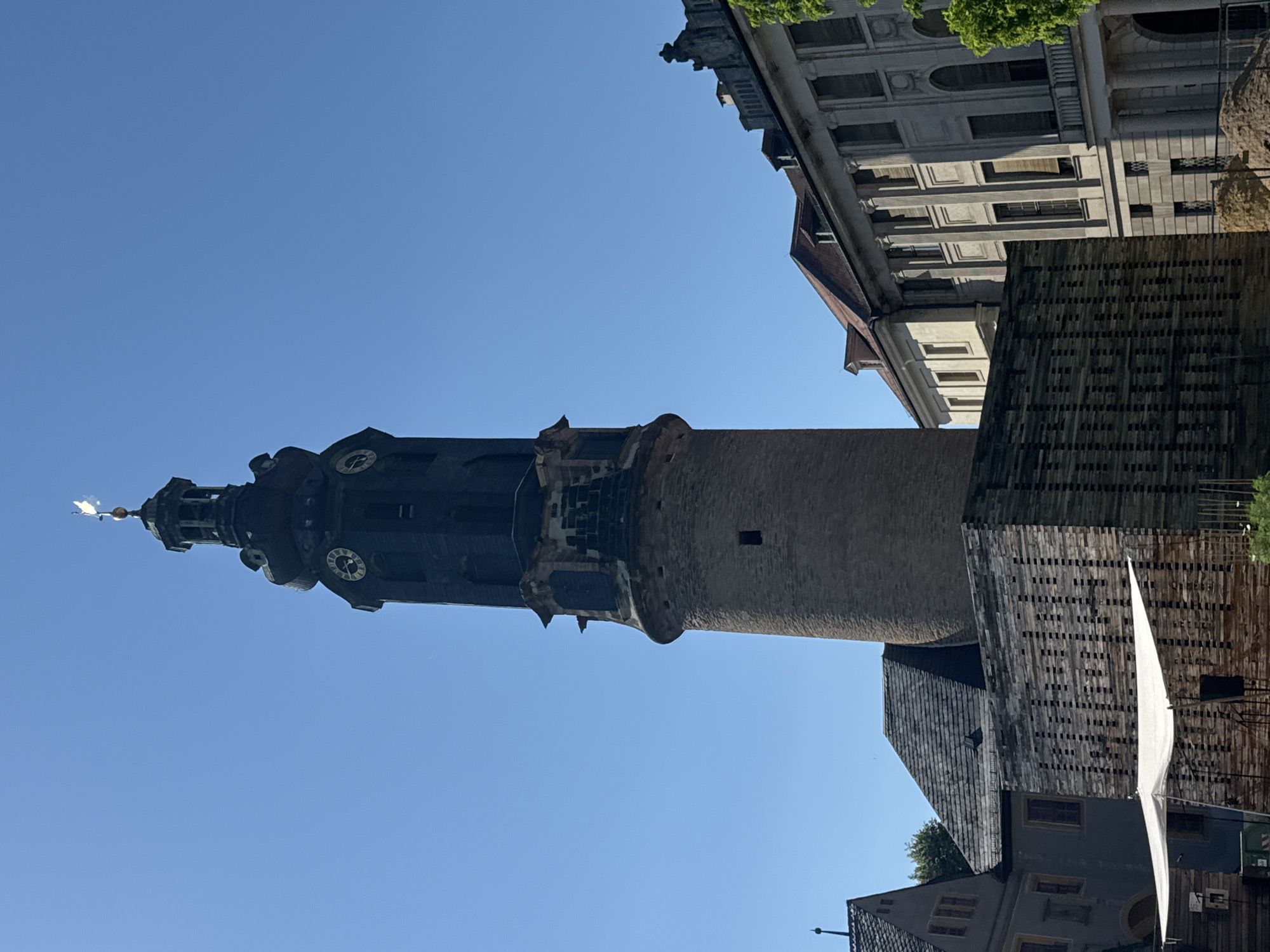
This media file depicts a tall, stone tower with a dark, ornate spire, likely a church tower or bell tower. The tower is partially obscured by buildings, including a large, modern-looking structure with a textured, dark wood facade featuring rows of small, rectangular openings. To the left of the tower, a classic European building with stone detailing and arched windows is visible. The sky is a clear, bright blue, suggesting a sunny day. The image is oriented vertically, with the tower's spire pointing towards the top left. The scene appears to be set in an urban environment, possibly a historic city center, given the architecture. No people are visible. The time of day appears to be daytime, with clear sunlight casting shadows. There are no overt signs of a specific event or activity, but the presence of a clock face on the tower suggests a public space with a functional purpose. The overall impression is one of a historical and architectural landmark bathed in sunlight.
Weimar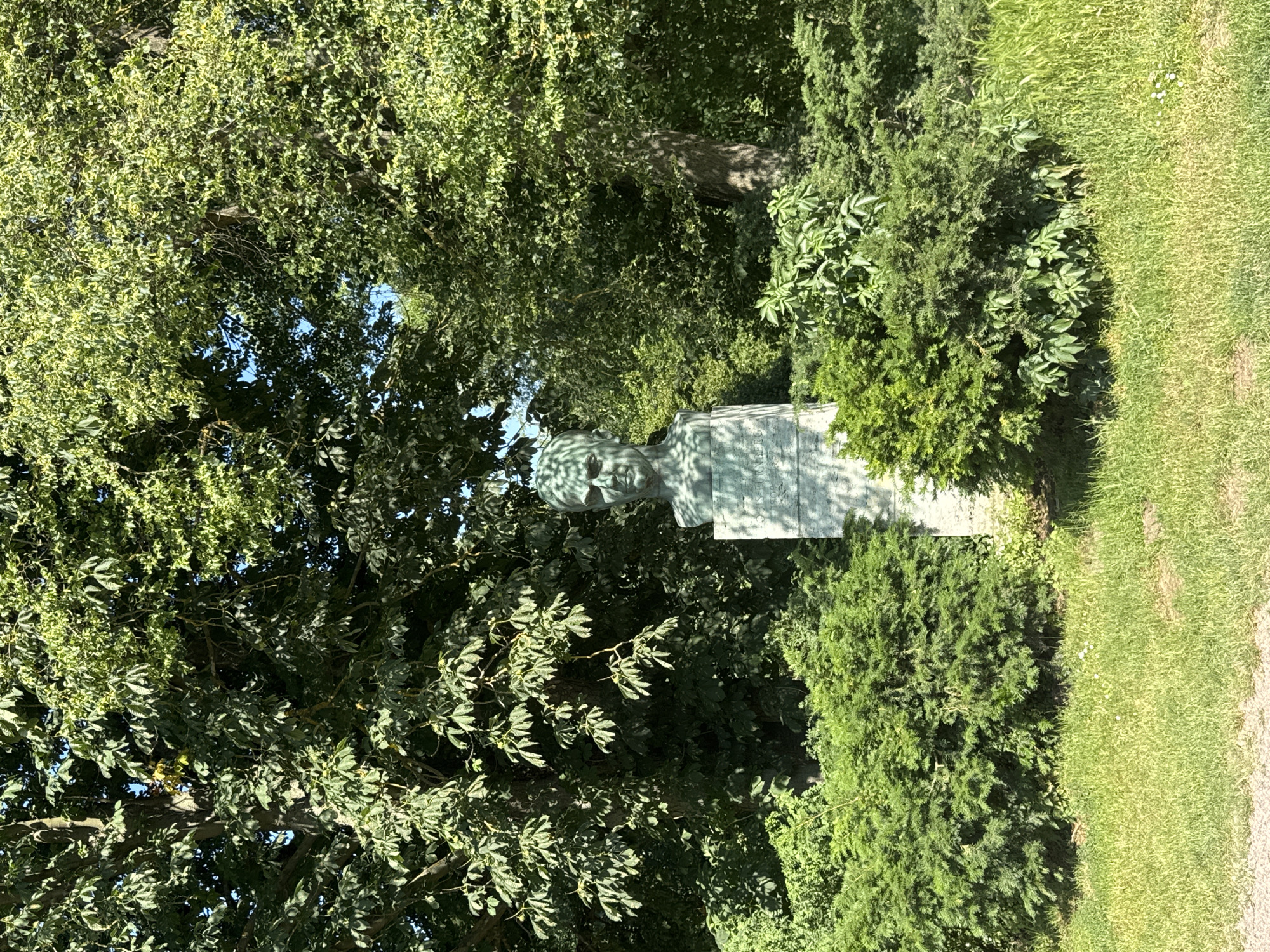
A bust of a man is displayed on a stone pedestal in a park setting. The bust is made of a dark material and depicts a man with short hair and a serious expression. The pedestal is made of light-colored stone and has an inscription on its front, which is partially obscured by shadows. The bust is surrounded by lush green bushes and trees, with sunlight filtering through the leaves. The ground in front of the pedestal is covered in green grass. The overall scene suggests a memorial or monument in a public garden. The inscription on the pedestal reads "HERBERT VON KARAJAN, KULTURHAUS NURNBERG", indicating the bust is of Herbert von Karajan, a renowned Austrian conductor, and is located in Nuremberg, Germany.
Weimar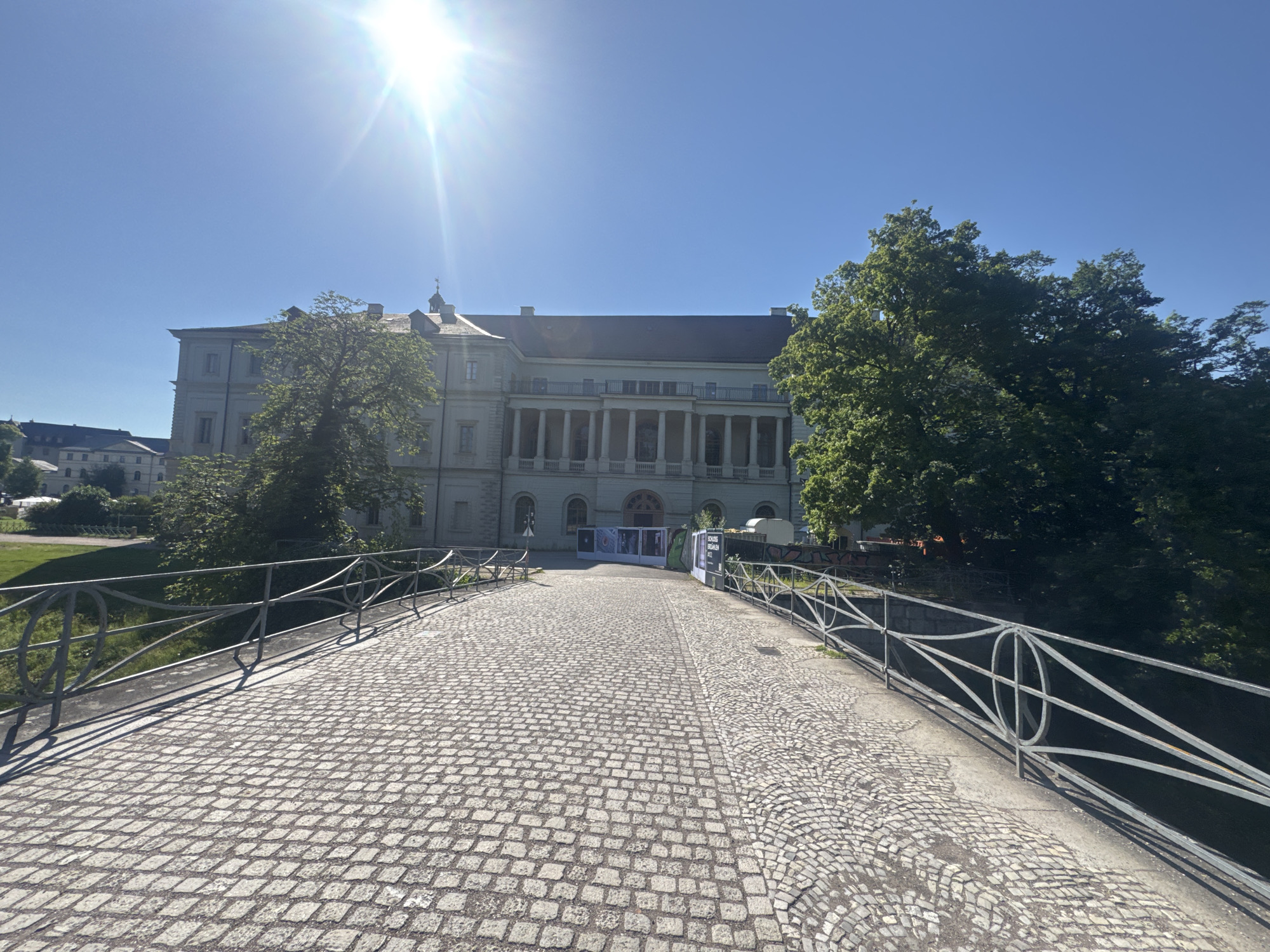
This image depicts a view from a cobblestone bridge in Weimar, Germany, leading towards a large neoclassical building with a colonnade. The sun is shining brightly in the upper left corner, creating lens flare and casting shadows. The bridge has metal railings with decorative circular and linear elements. Trees with green foliage are visible on either side of the building and on the left side of the bridge. In the background, on the left, are other buildings. In front of the main building, there are several large display panels and signage, one of which reads "SCHLOSS ORANGERIE". The scene is set on a clear day with a bright blue sky. There are no people visible in the frame.
Weimar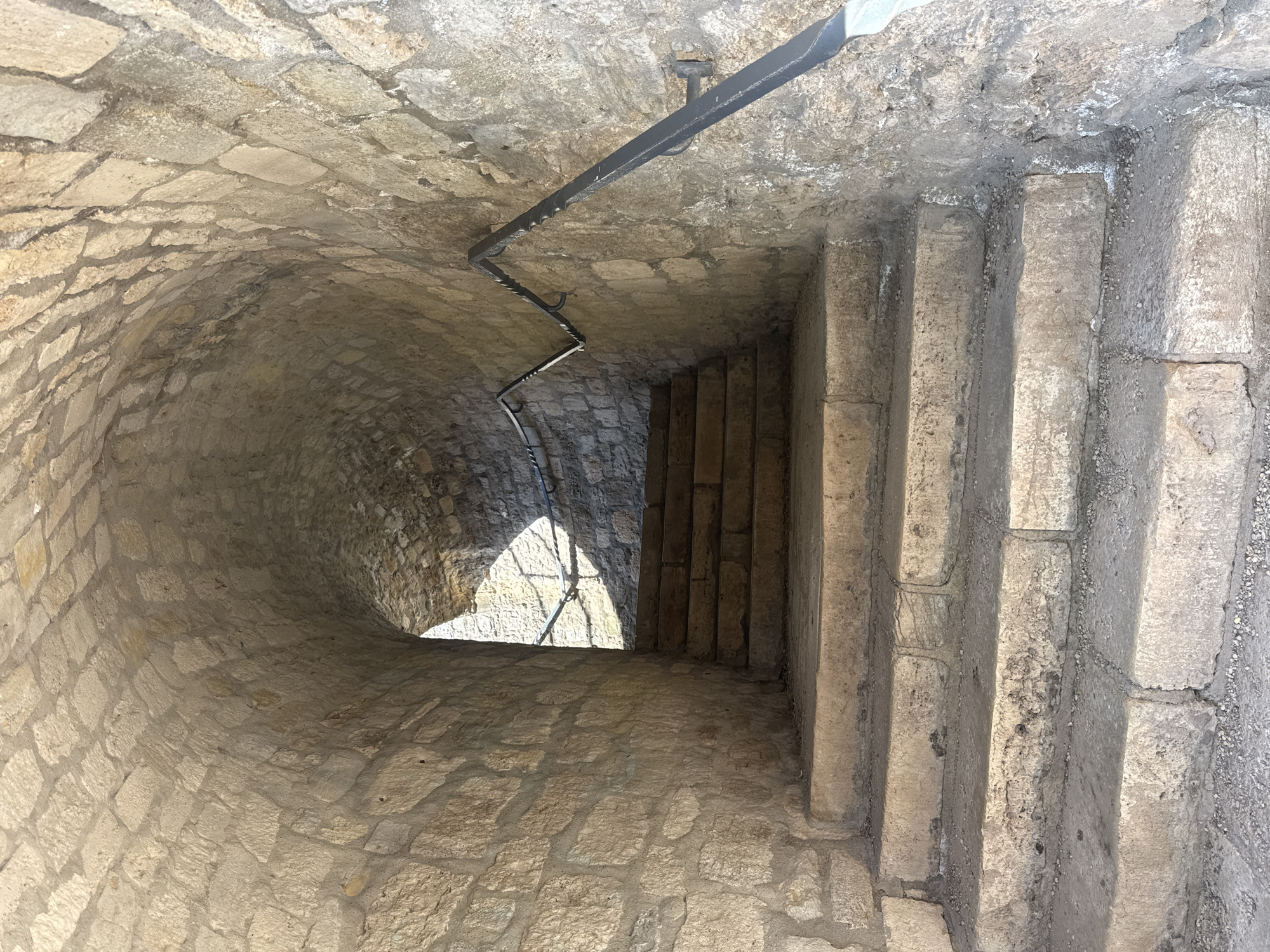
The image depicts a stone staircase inside a castle tunnel in Weimar, Germany. The tunnel is constructed from rough-hewn stones, with a curved ceiling and walls. A metal handrail runs along the right side of the stairs, which are also made of stone. Sunlight streams in from an opening at the end of the tunnel, casting shadows on the stairs and walls. The overall impression is one of age and durability, suggesting a historical structure.
Weimar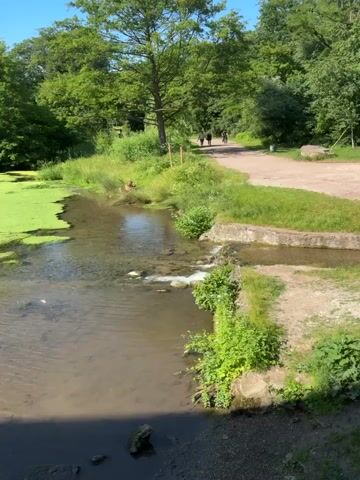
The video shows a natural scene with a body of water and lush green vegetation. In the foreground, there is a slow-moving stream with some algae on the surface. The water appears shallow, with rocks visible beneath the surface. On the right bank of the stream, there is a stone structure that seems to be a small dam or weir. Lush green plants and grass grow along the bank. In the middle ground, the stream widens slightly and a person, appearing to be a child, is seen sitting near the water's edge, possibly interacting with it. Beyond the stream, a path or road is visible, with a few people walking and one person riding a bicycle in the distance. The background is filled with mature trees, indicating a park or wooded area. The sky is clear and blue. The overall impression is a tranquil, natural environment on a sunny day.
Weimar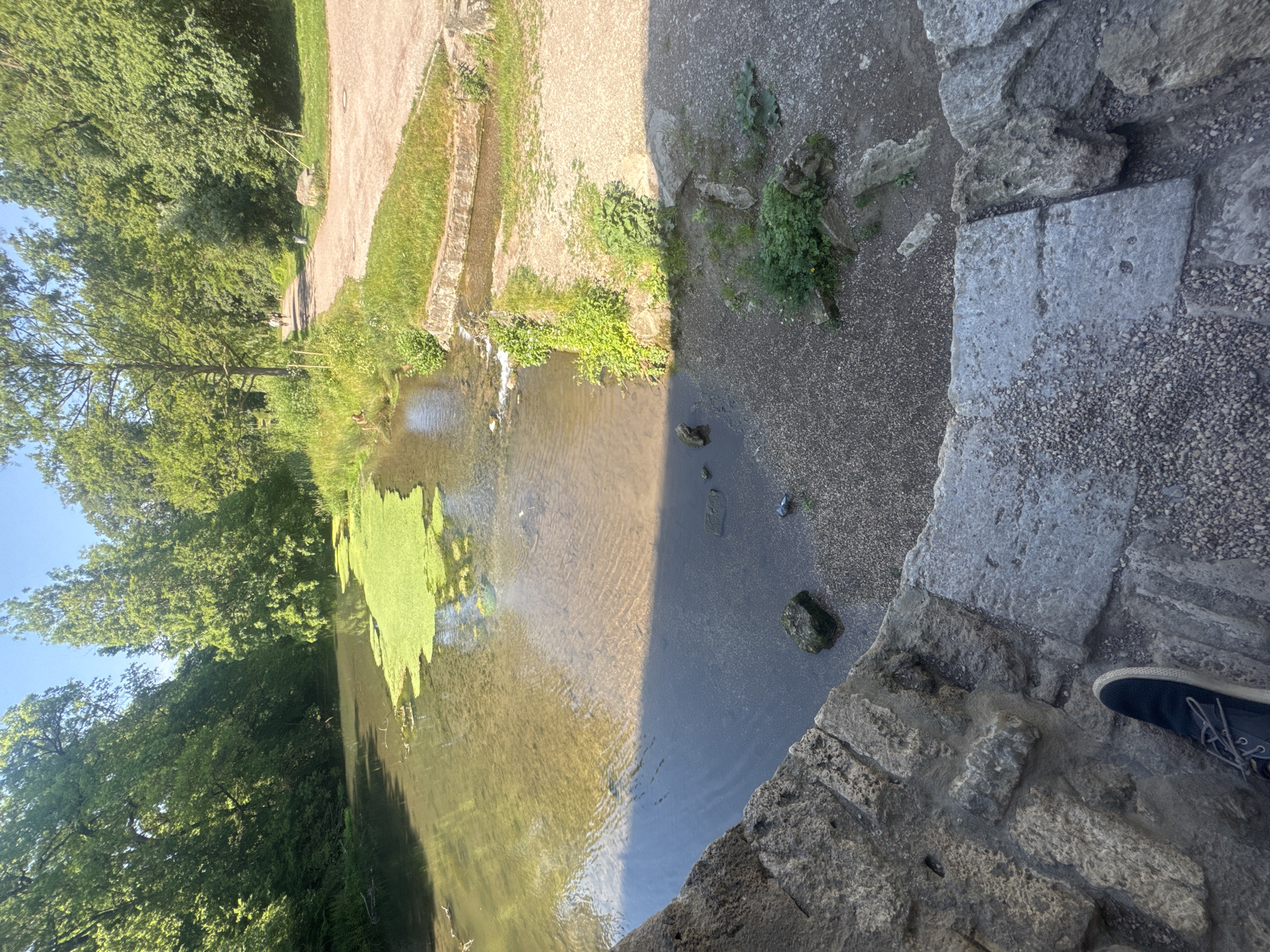
This image depicts a serene natural scene, likely in Weimar, Germany, featuring a clear stream flowing through lush greenery. The water is shallow and transparent, revealing the sandy bottom and scattered pebbles. On the left bank, dense trees with vibrant green foliage create a shaded canopy, while on the right, a gently sloping path meanders through grassy areas and more trees. In the foreground, a stone structure, possibly part of a bridge or retaining wall, is visible, with a person's foot wearing a dark sneaker resting on it. The overall impression is one of tranquility and natural beauty, suggesting a park or natural reserve within the city.
Weimar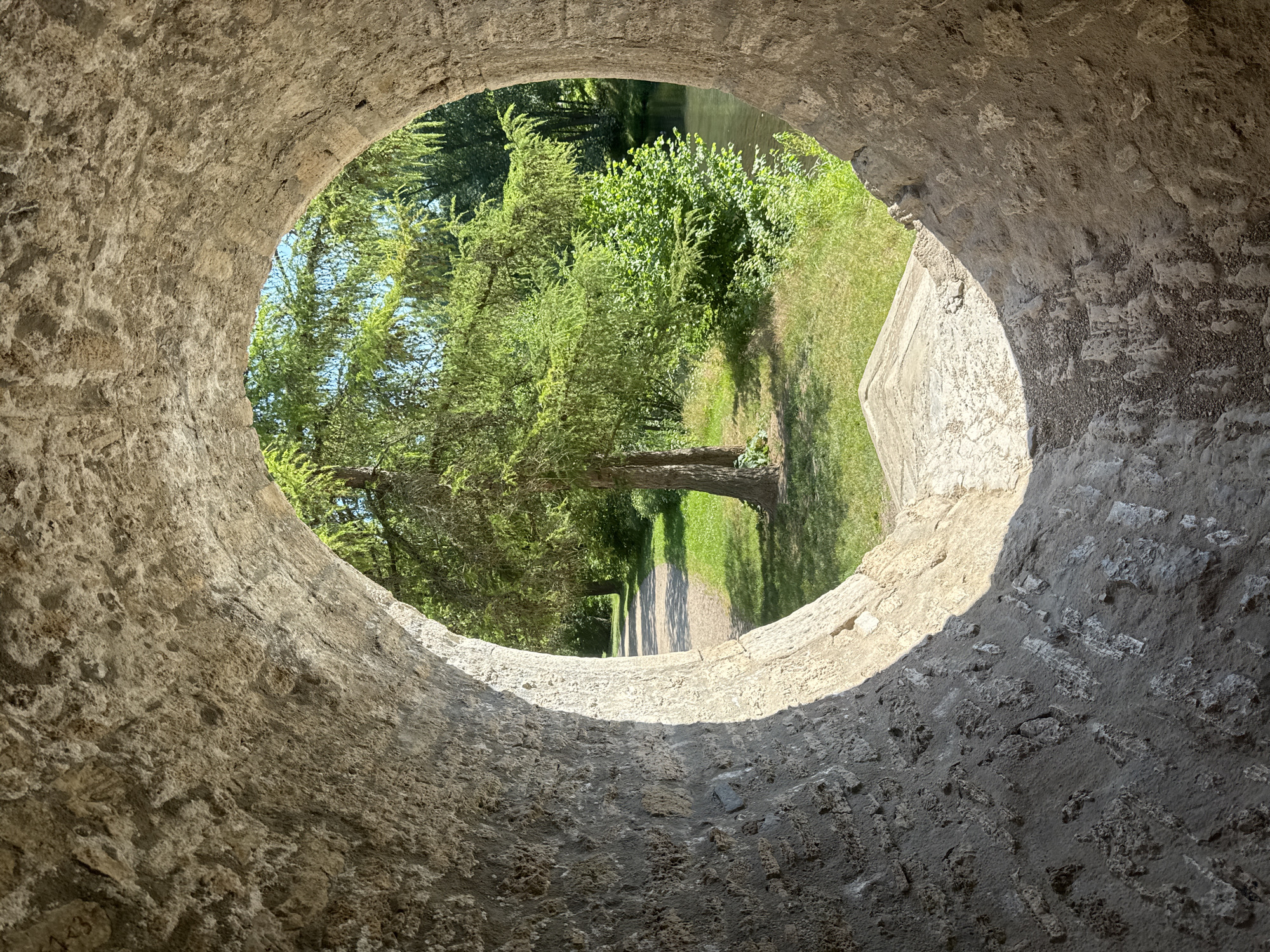
The image shows a view through a circular stone archway, possibly part of an old bridge or tunnel. The archway is constructed of rough-hewn, light-colored stones. Through the opening, a sunlit scene of lush greenery is visible. A paved pathway winds through a grassy area with trees, and a body of water, likely a river, is to the right. The sky is clear and blue. There are no people or animals in the image. The location is identified as the Ilm Park in Weimar, Germany, and the archway is part of the Pinetum structure.
Weimar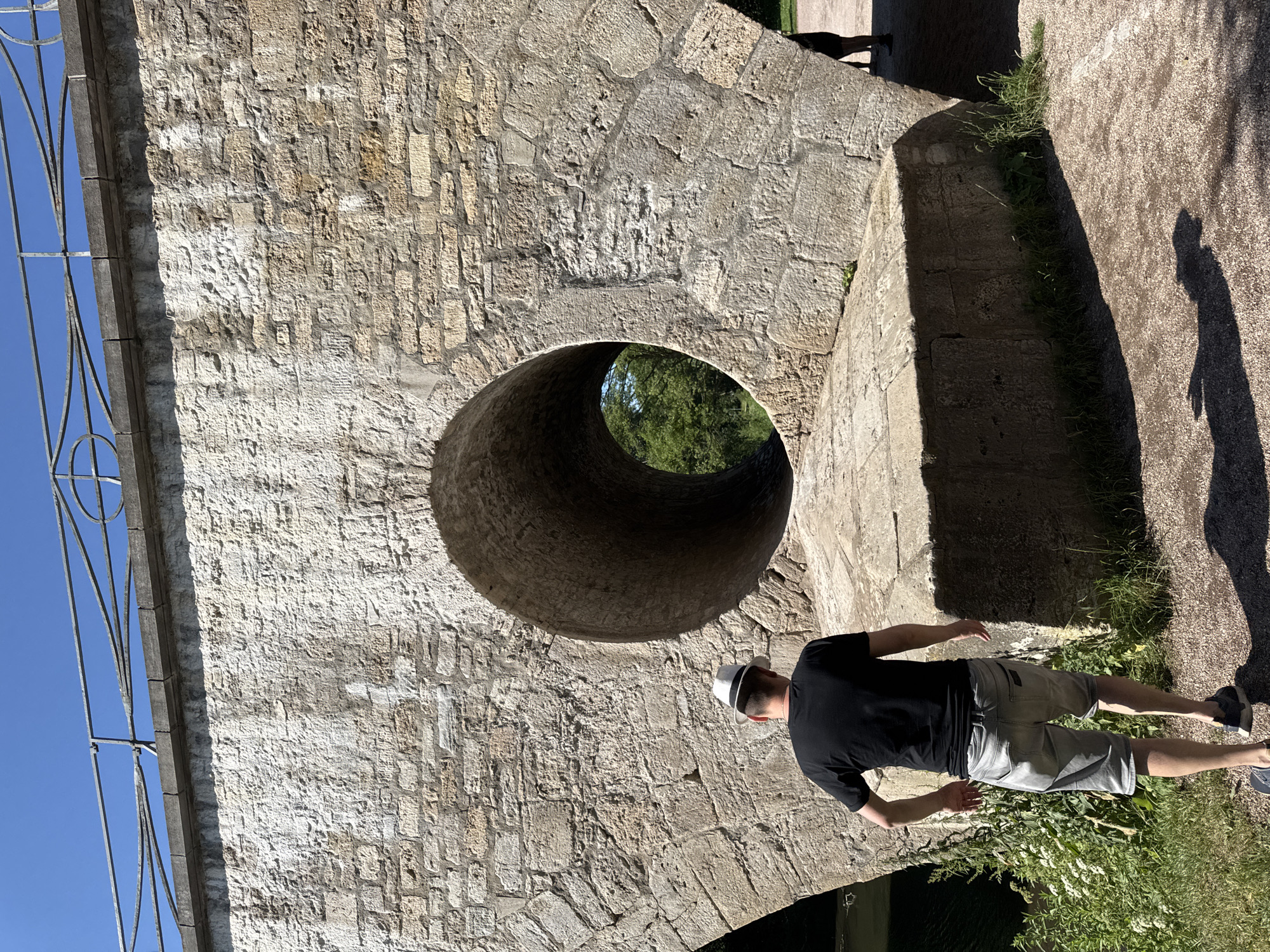
A man wearing a black t-shirt, grey shorts, and a white fedora walks away from the camera towards a large stone bridge with a circular opening. The bridge has a metal railing on top and is constructed from rough-hewn stone blocks. Through the circular opening, trees and greenery are visible. The ground in front of the bridge is a gravel path, and to the left, there is grass and some foliage. Sunlight casts a shadow of the man on the path. The scene is set under a clear blue sky. This is the Römische Haus bridge in Weimar, Germany.
Weimar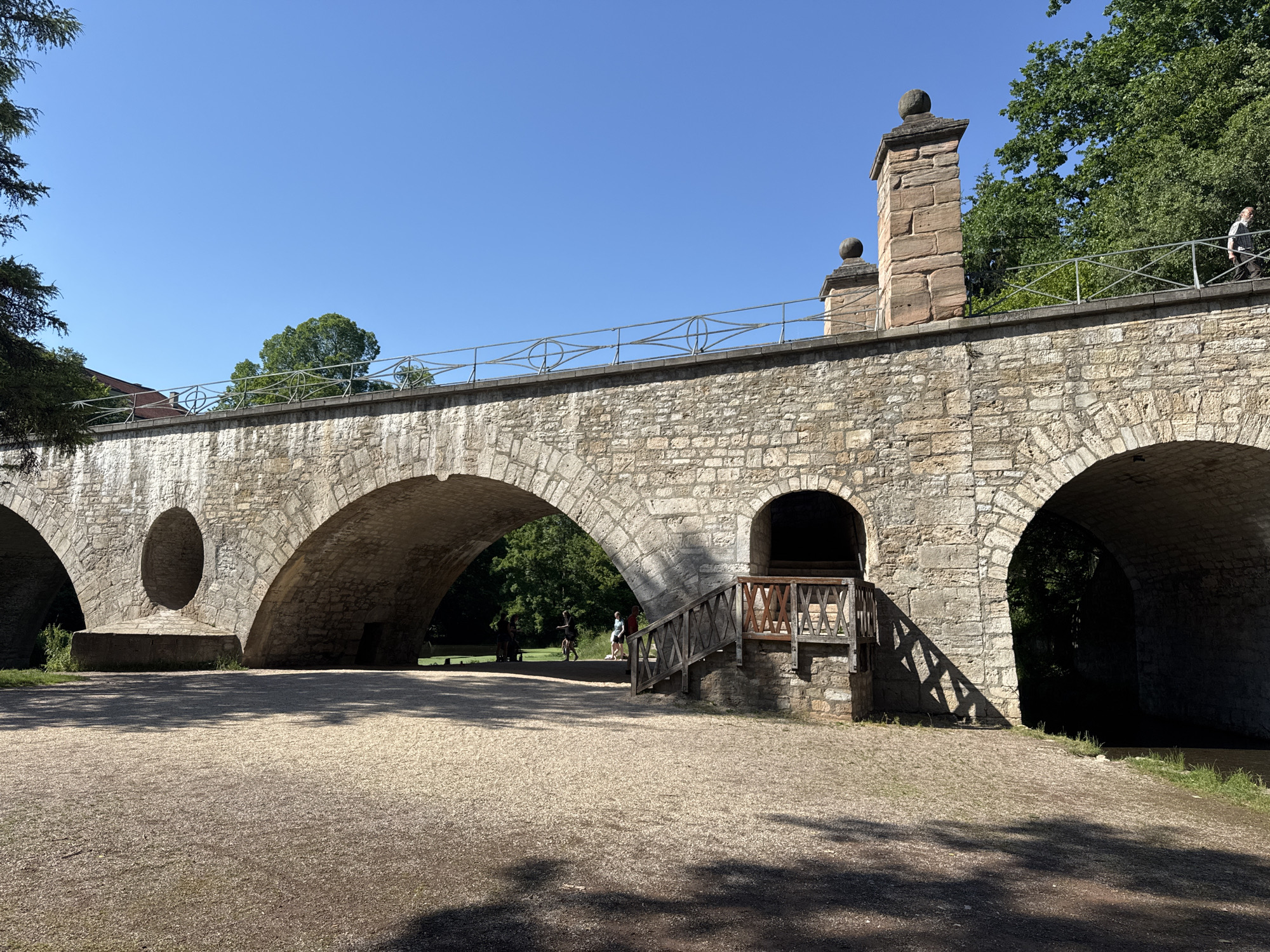
This image depicts a stone bridge with multiple arches in Weimar, Germany. The bridge's architecture features stone construction with decorative elements, including finials on the pillars at the right end. A metal railing runs along the top of the bridge. Underneath the arches, a gravel path is visible, leading towards a green area with trees. There are several people in the scene: one person is walking on the bridge on the far right, and two individuals are near one of the arches in the middle ground. The lighting suggests a sunny day, with shadows cast on the ground. The environment is a park-like setting with lush vegetation. The specific location is the bridge connecting the city of Weimar to the historical park, a prominent feature of the city's landscape.
Weimar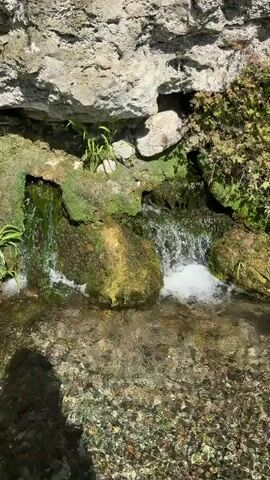
A close-up shot shows a small waterfall cascading over moss-covered rocks. The water is clear and reflects the sunlight, creating a shimmering effect. Green moss clings to the rocks and the surrounding earth, indicating a damp and shaded environment. In the background, a large rock formation with some vegetation is visible. The video focuses on the movement of the water as it flows into a shallow stream at the bottom of the frame.
Weimar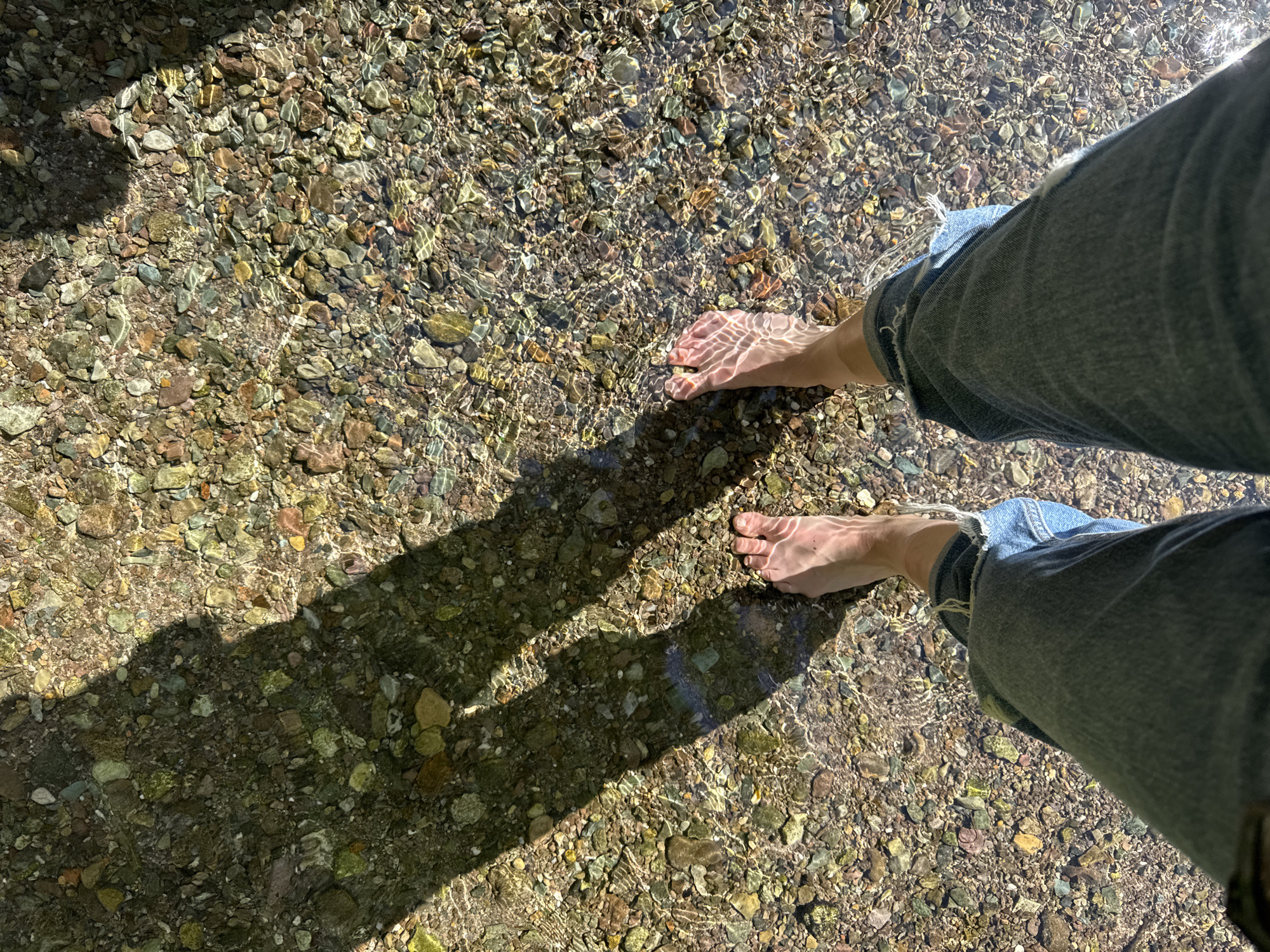
An overhead view shows a person's bare feet and lower legs submerged in shallow, clear water flowing over a rocky riverbed. The person is wearing blue denim jeans with frayed cuffs. The sunlight casts a long shadow of the person across the water and rocks. The riverbed is composed of various colored, smooth pebbles and stones, with sunlight reflecting off the water's surface, creating dappled patterns. The scene appears to be outdoors, in a natural setting with flowing water.
Weimar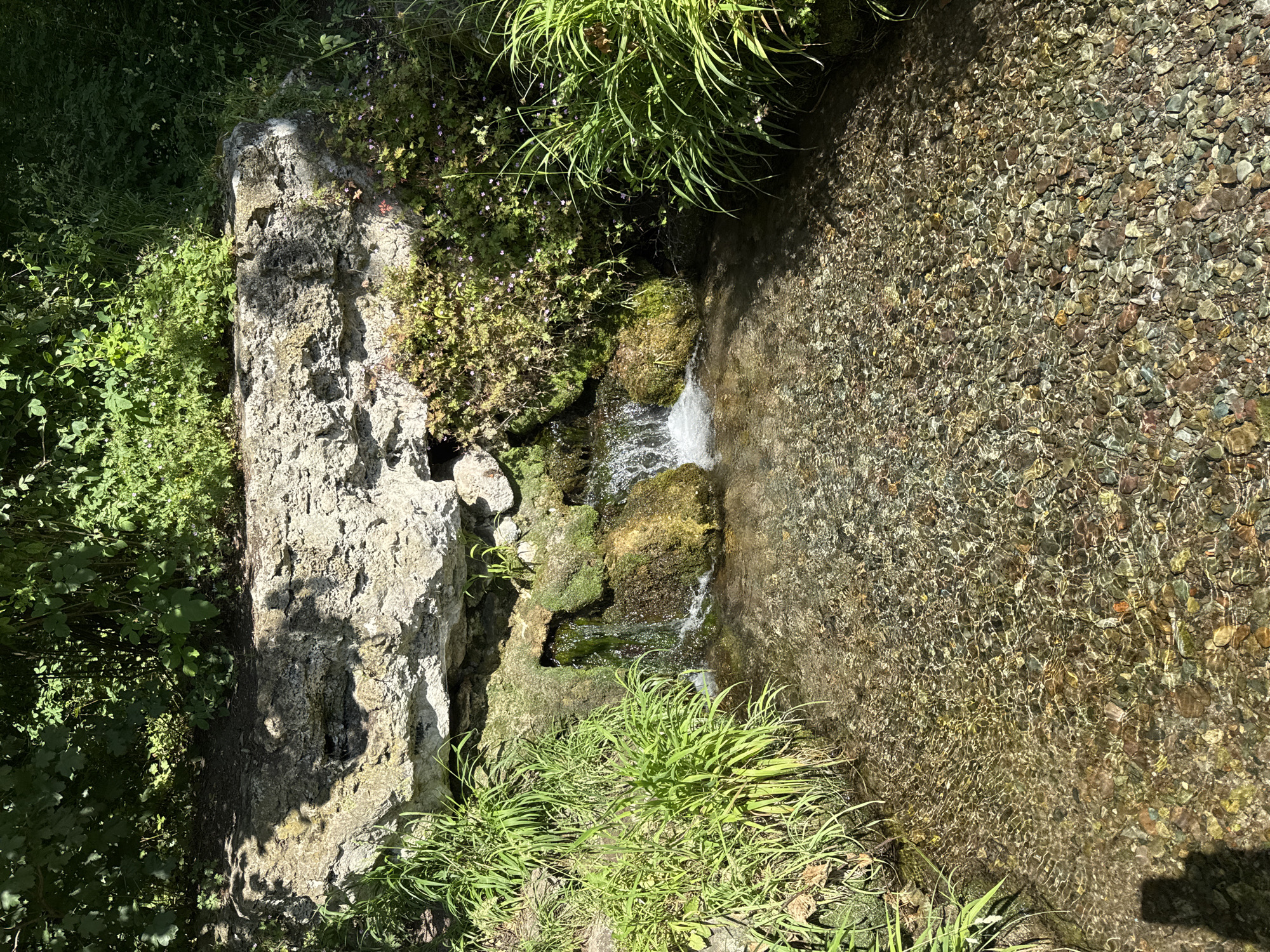
The image depicts a small, clear stream flowing over a rocky bed, originating from a cascade amongst moss-covered rocks. The stream is bordered by lush green vegetation and a large, rough stone formation. Sunlight filters through the leaves of trees, casting dappled shadows on the water and the surrounding rocks. The overall scene is natural and serene. This is the brooklet in the park of the Goethe-Nationalmuseum in Weimar, Germany.
Weimar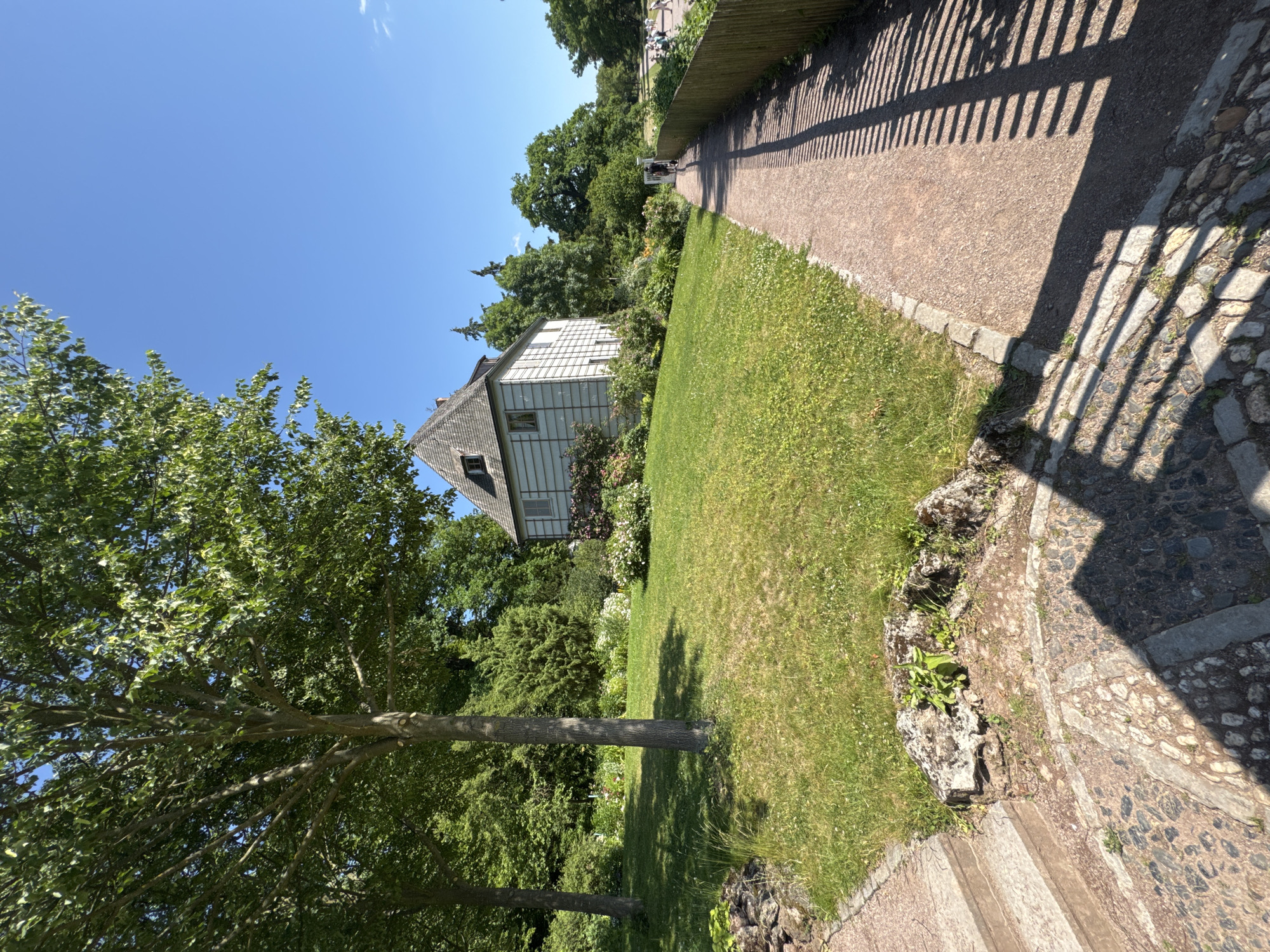
This is a ground-level outdoor photograph of the Goethe National Museum in Weimar, Germany, taken on a clear, sunny day. The museum building, a two-story structure with a mansard roof and light-colored siding, is situated on a grassy slope in the background, surrounded by lush green trees and flowering bushes. In the foreground, a gravel path curves to the right, bordered by a wooden fence. The path is partially shaded by the fence, casting long, parallel shadows. To the left of the path, a stone staircase leads down from an upper level, with a cobblestone path at its base. A large tree with green foliage stands prominently in the left midground. In the distance, along the path, several figures can be seen walking, including a person pushing a stroller. The sky is a vibrant, cloudless blue.
Weimar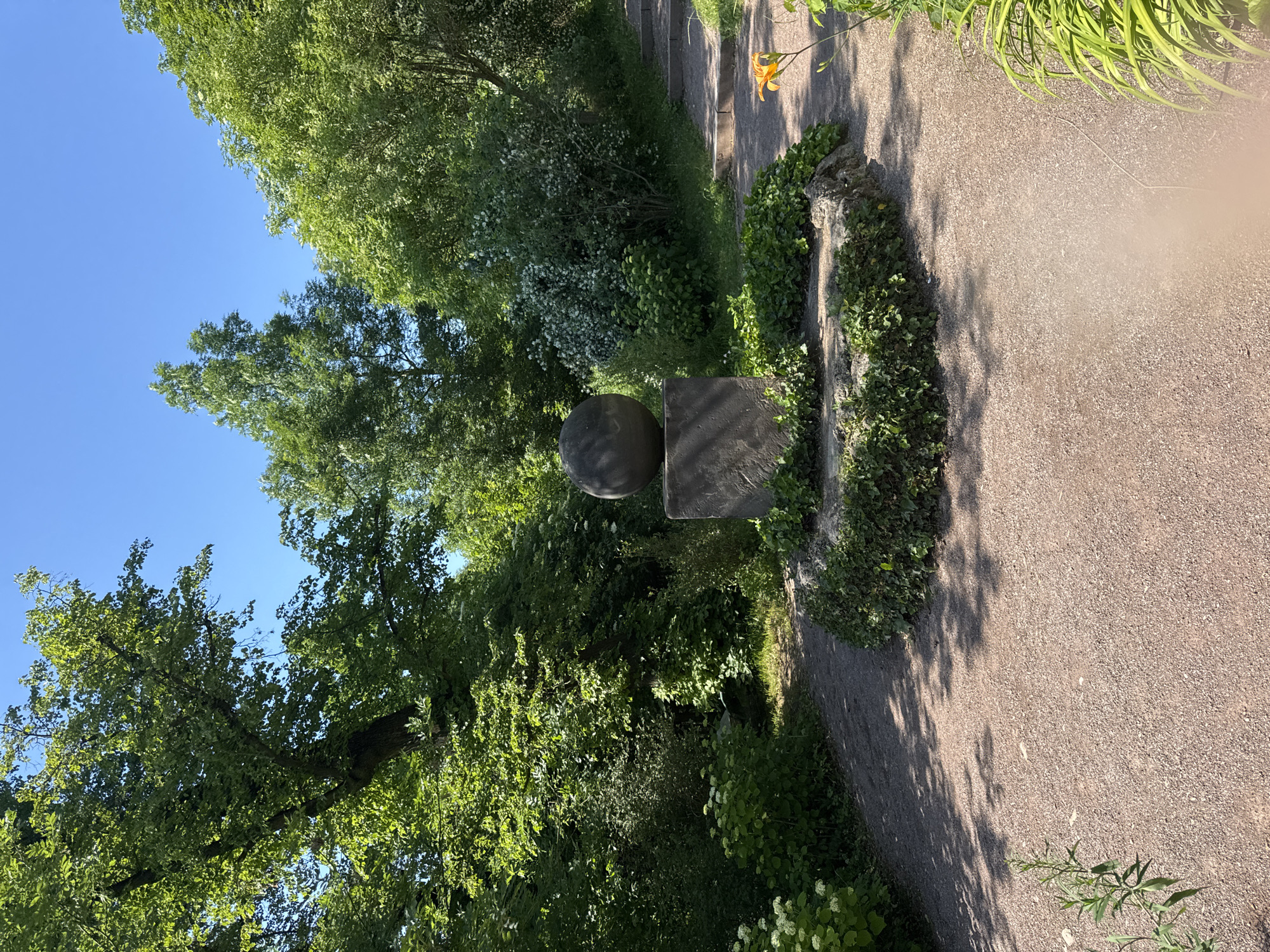
This is a medium shot of a garden scene in Weimar, Germany, featuring a spherical sculpture on a stone pedestal. The sculpture is dark gray and roughly textured, centrally placed on a square, rough-hewn stone base. The base is surrounded by a low, curved planter filled with dense green ivy and some scattered rocks. The garden path, made of reddish-brown gravel, winds around the sculpture and leads towards a set of stone steps in the background to the right. The environment is lush and verdant, with numerous trees and shrubs providing shade and framing the scene. Large trees with dense green foliage dominate the background and left side of the image. Some white flowers are visible among the greenery on the left. The sky is clear and bright blue. A single orange lily is in bloom to the right of the path, near the bottom of the steps. Shadows from the trees are cast across the gravel path. There are no people visible in the image.
Weimar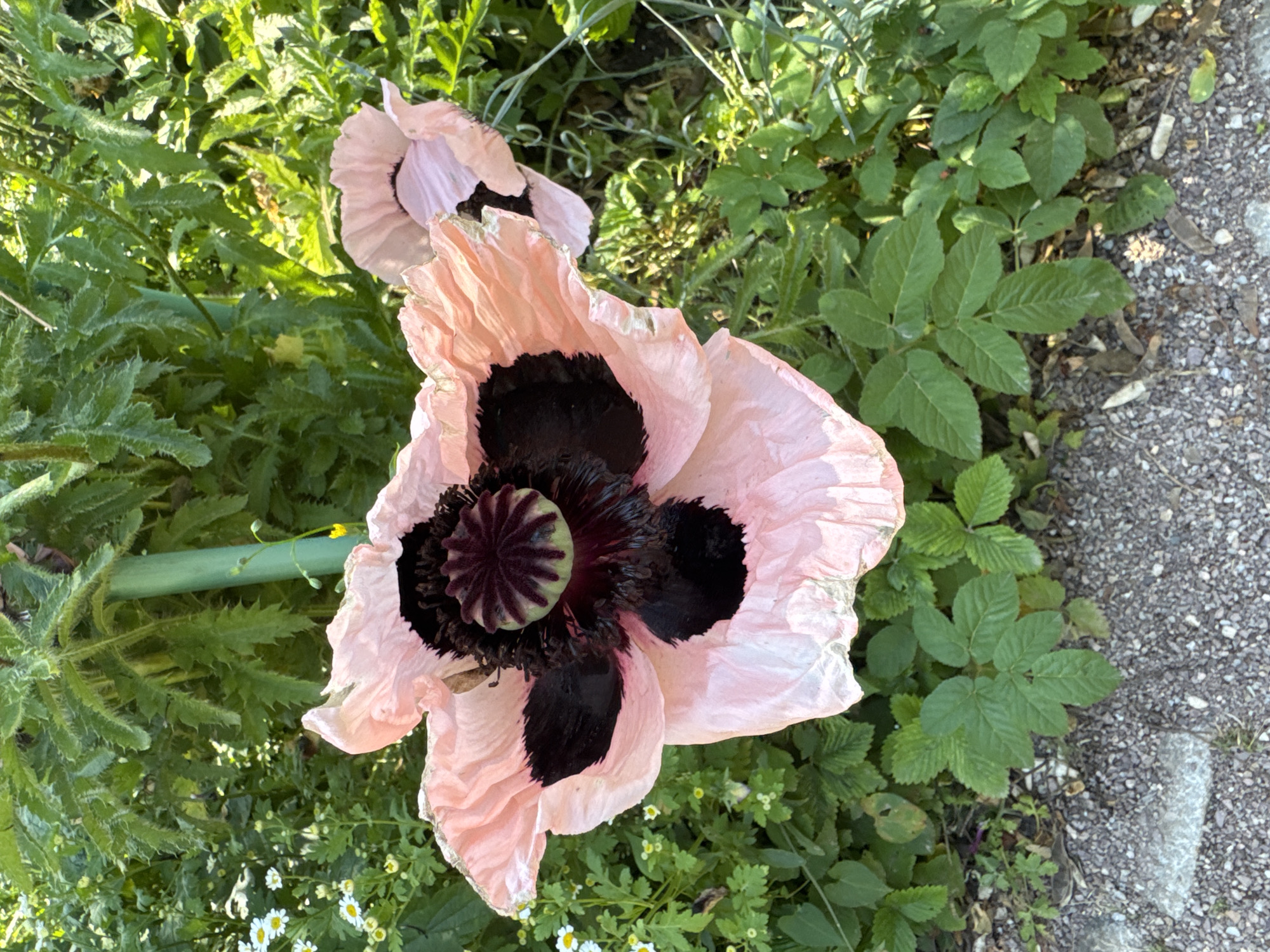
A close-up, eye-level shot captures a large, light pink poppy flower in bloom against a backdrop of lush green foliage. The poppy's delicate petals are slightly crinkled and translucent, revealing dark, almost black centers. The flower's stamen, a deep maroon color, is prominently displayed at its core, topped with a seed pod that has a ribbed, greenish-purple exterior. The surrounding greenery is varied, with some plants featuring feathery leaves and others having broader, serrated foliage. Small white wildflowers with yellow centers are visible in the upper left portion of the frame. A thick, green stem, likely supporting the poppy, stands vertically behind the flower. The ground in the foreground is covered with small, grey gravel, interspersed with larger, light-colored stones and fallen leaves. The scene suggests an outdoor setting, possibly a garden or park, bathed in natural sunlight. This photograph was taken in Weimar, Germany.
Weimar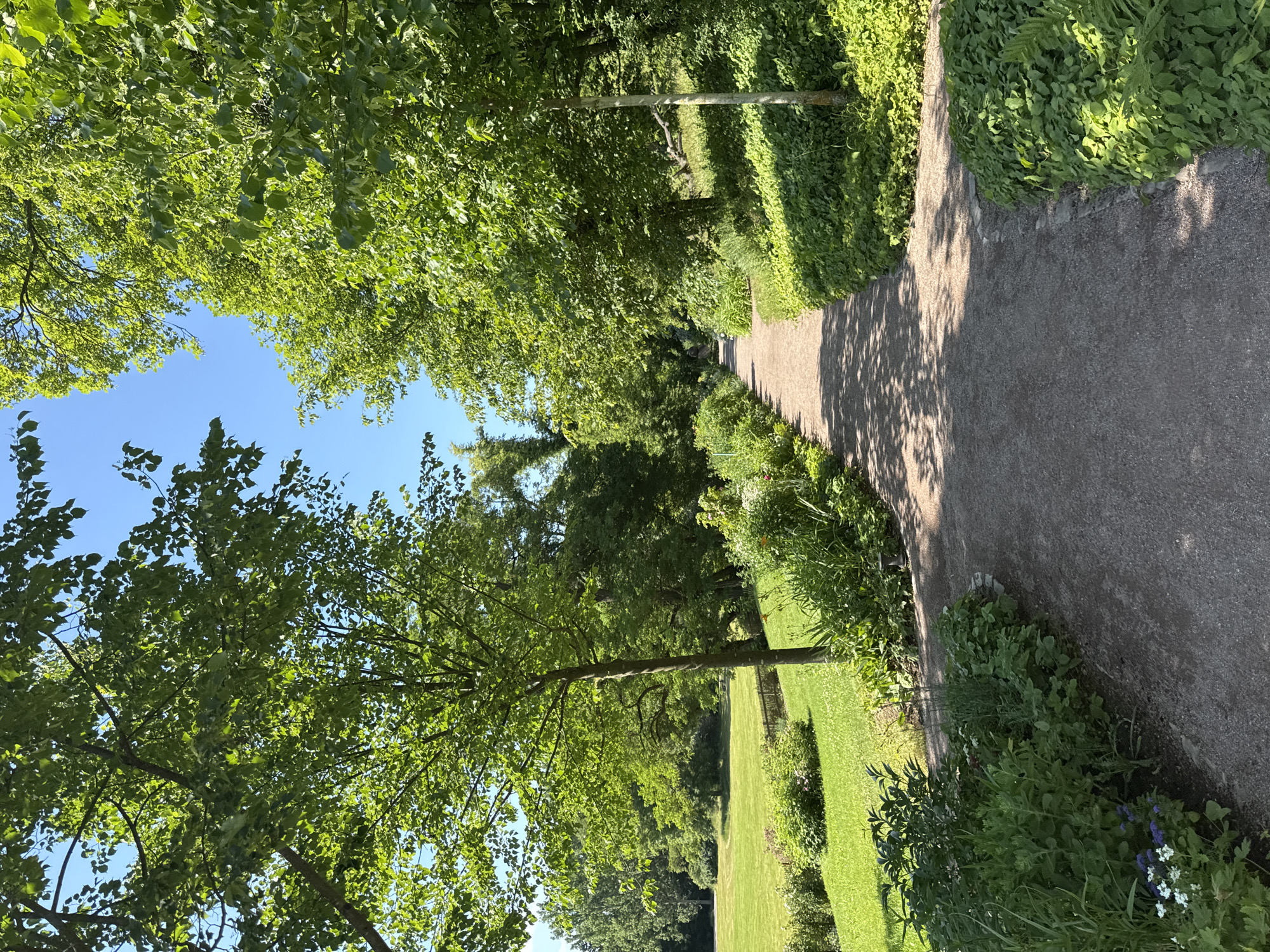
The image depicts a gravel pathway winding through a lush, green park on a bright, sunny day with a clear blue sky. Tall trees with dense foliage line both sides of the path, casting dappled shadows on the ground. To the left of the path, a manicured green lawn slopes gently downwards, bordered by a wooden fence and more dense greenery. The path itself appears to be a walking or cycling trail. On the right side of the path, dense, low-lying green plants and foliage create a thick border, with a single, slender tree trunk rising from this vegetation. The scene is peaceful and natural, suggesting a well-maintained public park. The location is the Belvedere Garden in Weimar, Germany, known for its Baroque architecture and extensive gardens. There are no people visible in the image.
Weimar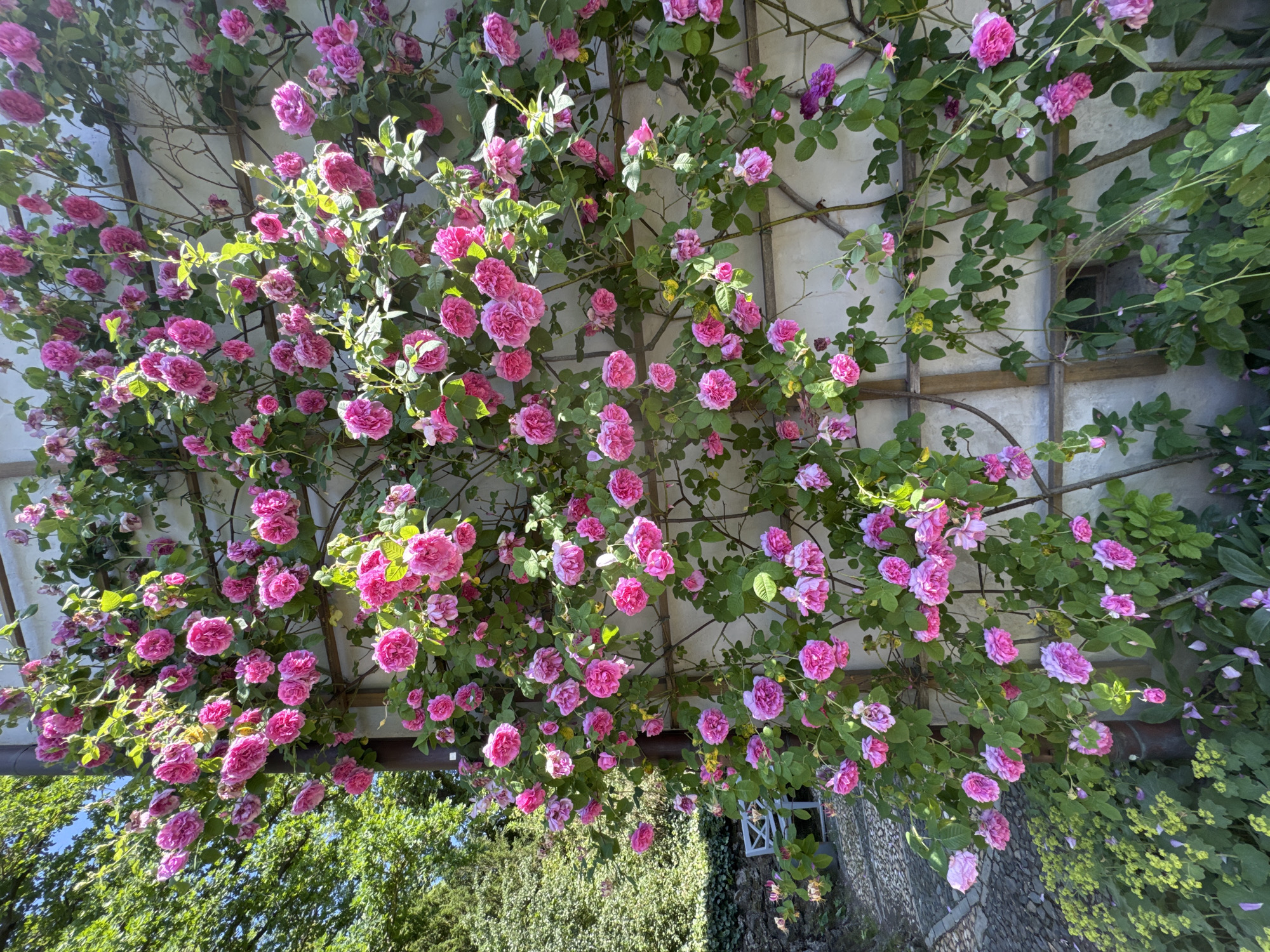
This image depicts a vibrant climbing rose bush with numerous pink blooms cascading down a white wall. The wall is adorned with a wooden lattice structure, which supports the extensive growth of the rose plant. The scene is set in a garden environment, with lush green foliage visible in the background, including trees and smaller plants. Sunlight filters through the leaves, casting dappled shadows and illuminating the roses. A cobblestone path and a white garden bench are partially visible in the lower left portion of the image, suggesting an outdoor seating area. This particular rose trellis is located at the Goethe National Museum in Weimar, Germany, a significant cultural and historical landmark. The image captures the essence of a serene and beautifully cultivated garden space.
Weimar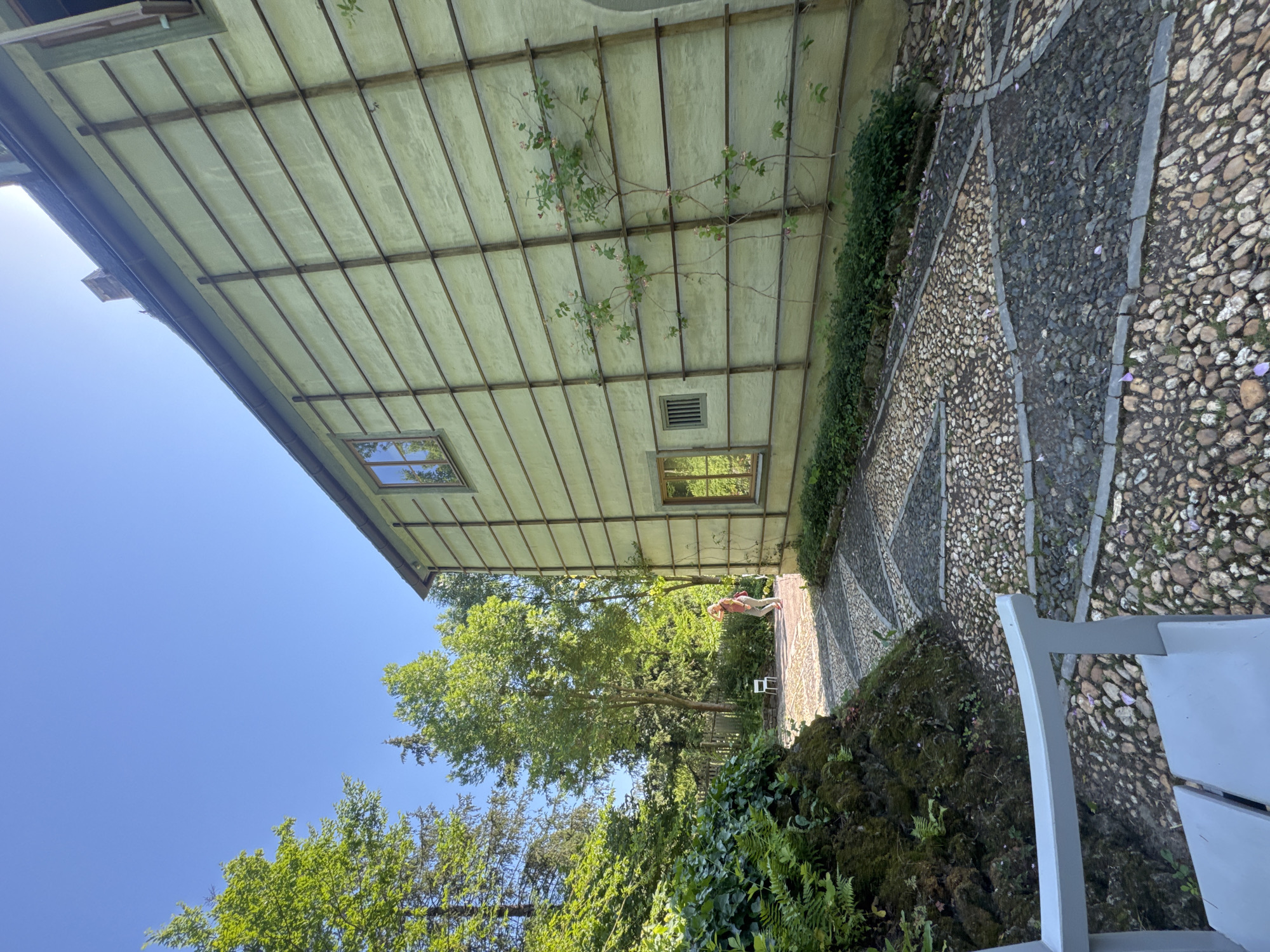
This is a photograph taken in the garden of the Goethe National Museum in Weimar, Germany, on a clear, sunny day. The perspective is low and angled upwards, focusing on the side of a pale green building with a dark roof. The building has two windows visible, one with a prominent wooden frame and reflection of trees, and another smaller, barred window. The wall is adorned with a trellis of horizontal wooden beams. Green foliage and trees are abundant in the background and to the left of the frame, creating a lush, garden setting. A paved pathway, constructed from a mosaic of light and dark pebbles arranged in geometric patterns, winds through the scene. In the middle ground, a person wearing a light-colored top and orange pants stands on the pathway, facing away from the camera, appearing to be walking or paused. A white chair is visible further down the pathway. In the foreground, the corner of a light gray wooden bench is visible, with part of its slatted seat. The overall impression is of a serene and well-maintained historical garden.
Weimar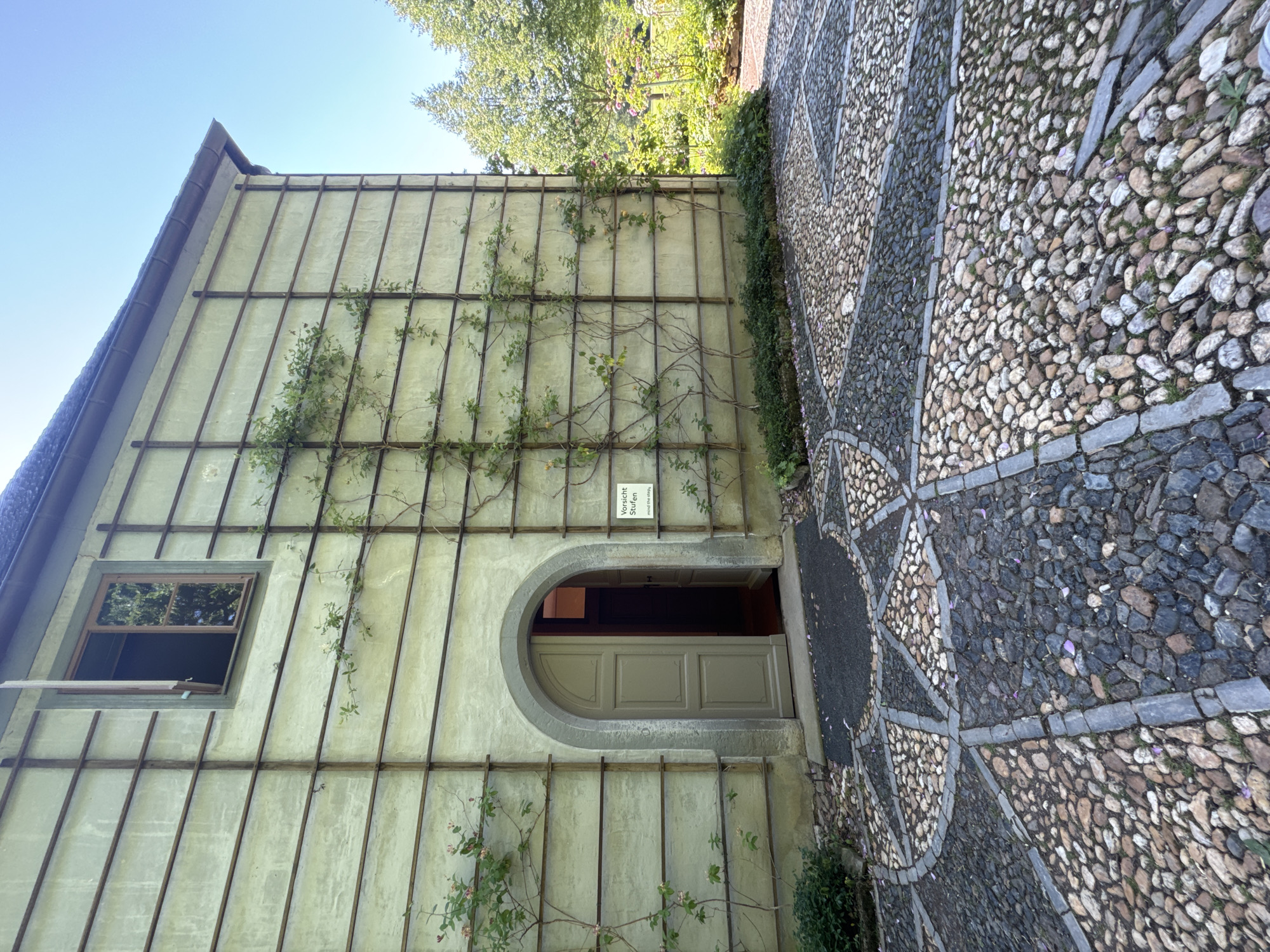
The image depicts the exterior of a pale green, weathered building with a dark grey roof and a single, open window. The building's facade is covered by a grid of thin, dark horizontal and vertical bars, against which several climbing plants are growing. An arched doorway, painted a muted green, is slightly ajar, revealing the dark interior of the building. A small sign with German text, "Vorsicht Stufen," and English text, "mind the steps," is affixed to the wall to the right of the doorway. The foreground features a patterned cobblestone pathway. The cobblestones are arranged in a starburst or radial pattern, with alternating sections of dark grey and lighter, mixed-color stones. Small patches of green grass and scattered purple flower petals are visible between the stones. To the right of the building, a lush, sunlit garden with trees and flowering bushes is visible. The sky above is a clear, bright blue. The scene is one of an outdoor courtyard or entrance area, likely in a historical or garden setting. This is the entrance to the Goethe National Museum (Goethe-Nationalmuseum) in Weimar, Germany, specifically the entrance to the Goethe House, the last residence of the poet Johann Wolfgang von Goethe.
Weimar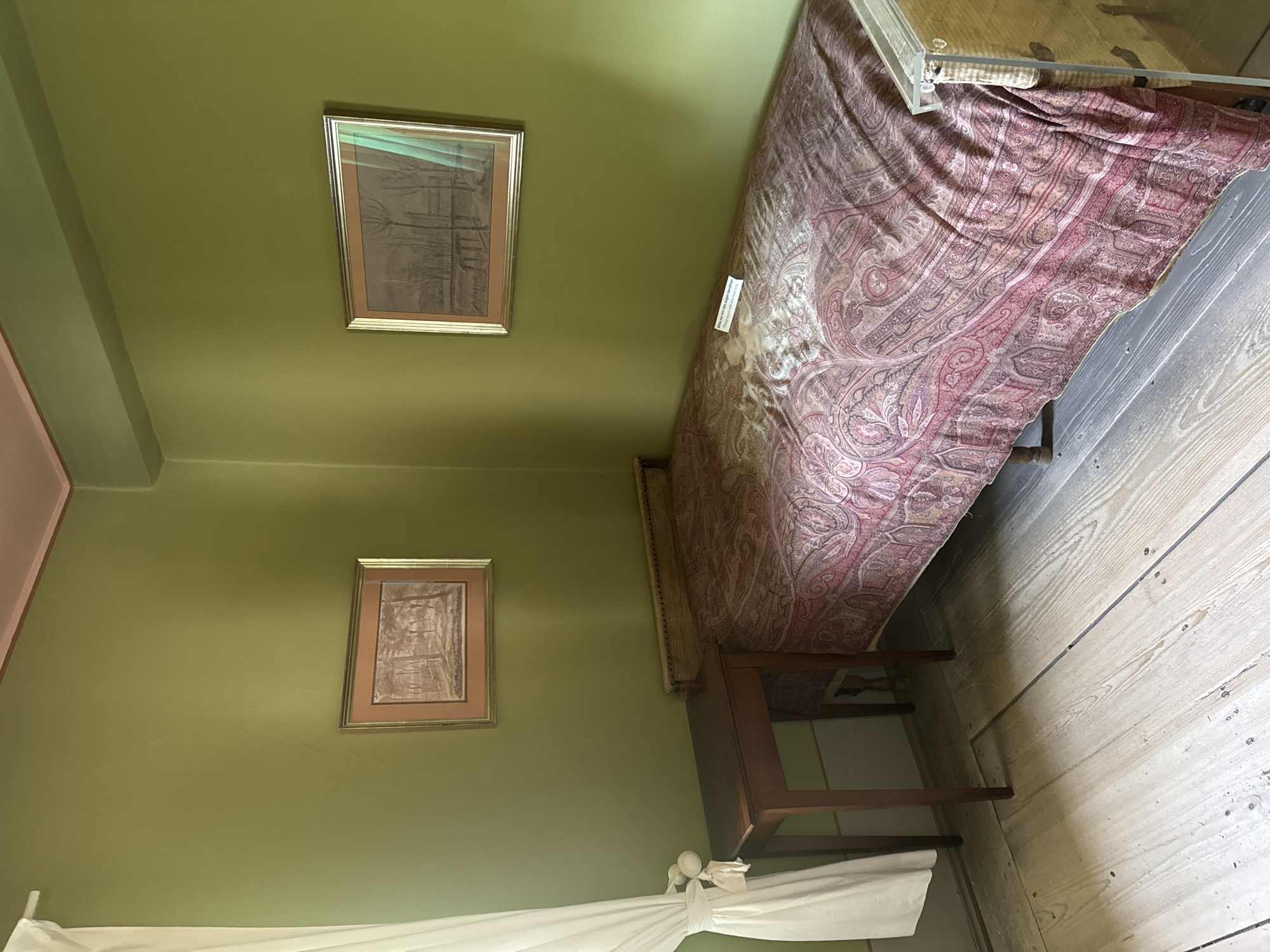
The image shows a sparsely furnished room with light wooden floorboards. The walls are painted a muted green. A single bed with a paisley patterned bedspread dominates the center of the room. To the left of the bed is a small, dark wooden side table. Two framed landscape pictures hang on the walls, one above the side table and one to the right of the bed. A white curtain is visible on the far left of the image. A small white sign is placed on the bedspread. The room appears to be part of a historical exhibition, possibly a re-created living space from the past. This scene depicts a bedroom in Goethe National Museum, Weimar, Germany.
Weimar