Wieliczka, Poland
30 memories from Wieliczka, Poland
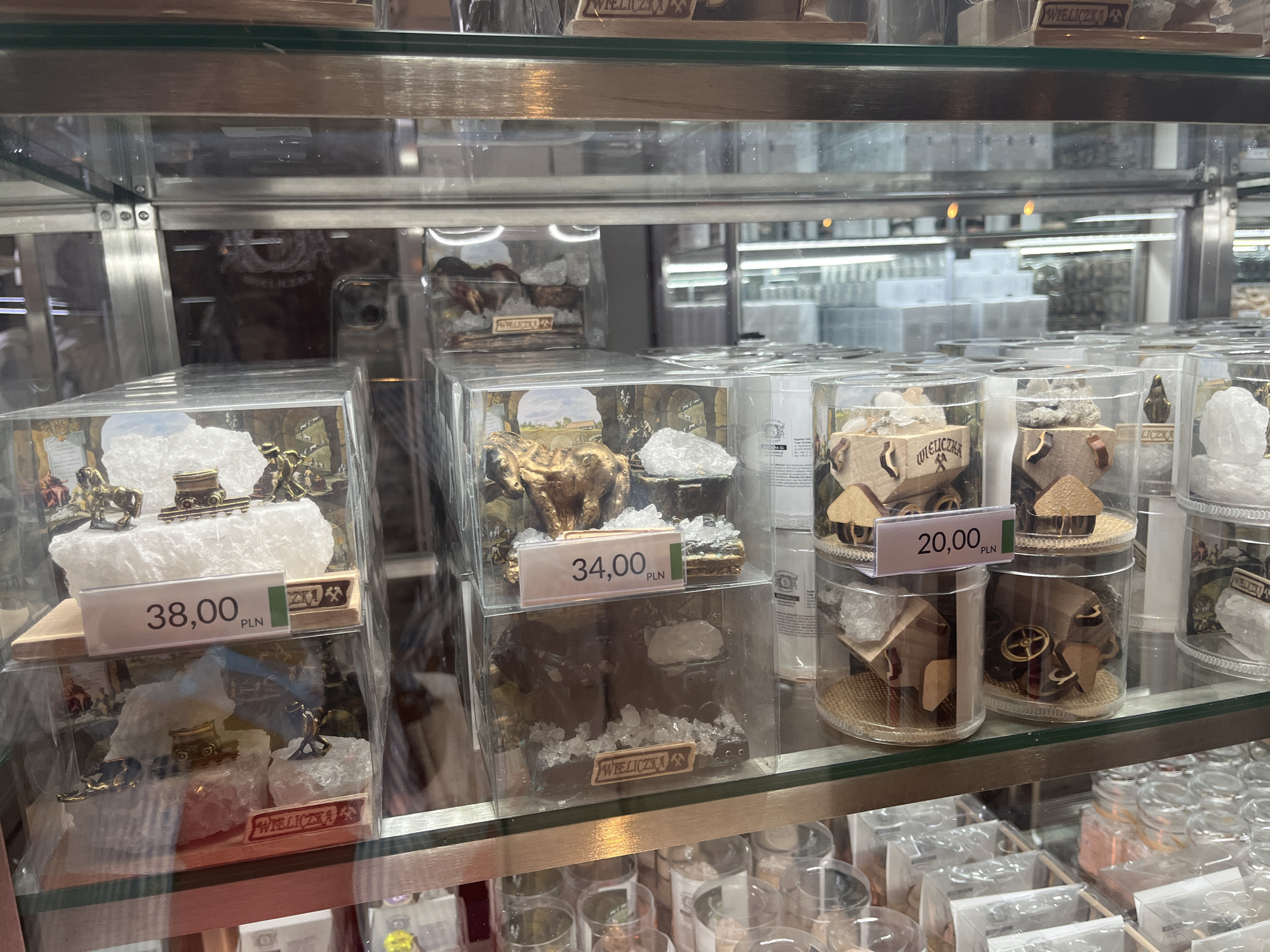
The image shows a display case in a shop in Wieliczka, Poland, featuring various souvenirs. The souvenirs are small, decorative items, many of which appear to be made of salt or depict scenes related to mining. Several items are enclosed in clear plastic boxes, some with price tags. One price tag shows "38,00 PLN", another "34,00 PLN", and a third "20,00 PLN". The background shows more shelves with merchandise, including what appear to be jars and other packaged goods. The lighting suggests an indoor setting, likely a gift shop or souvenir store. There are no people visible in the image.
Wieliczka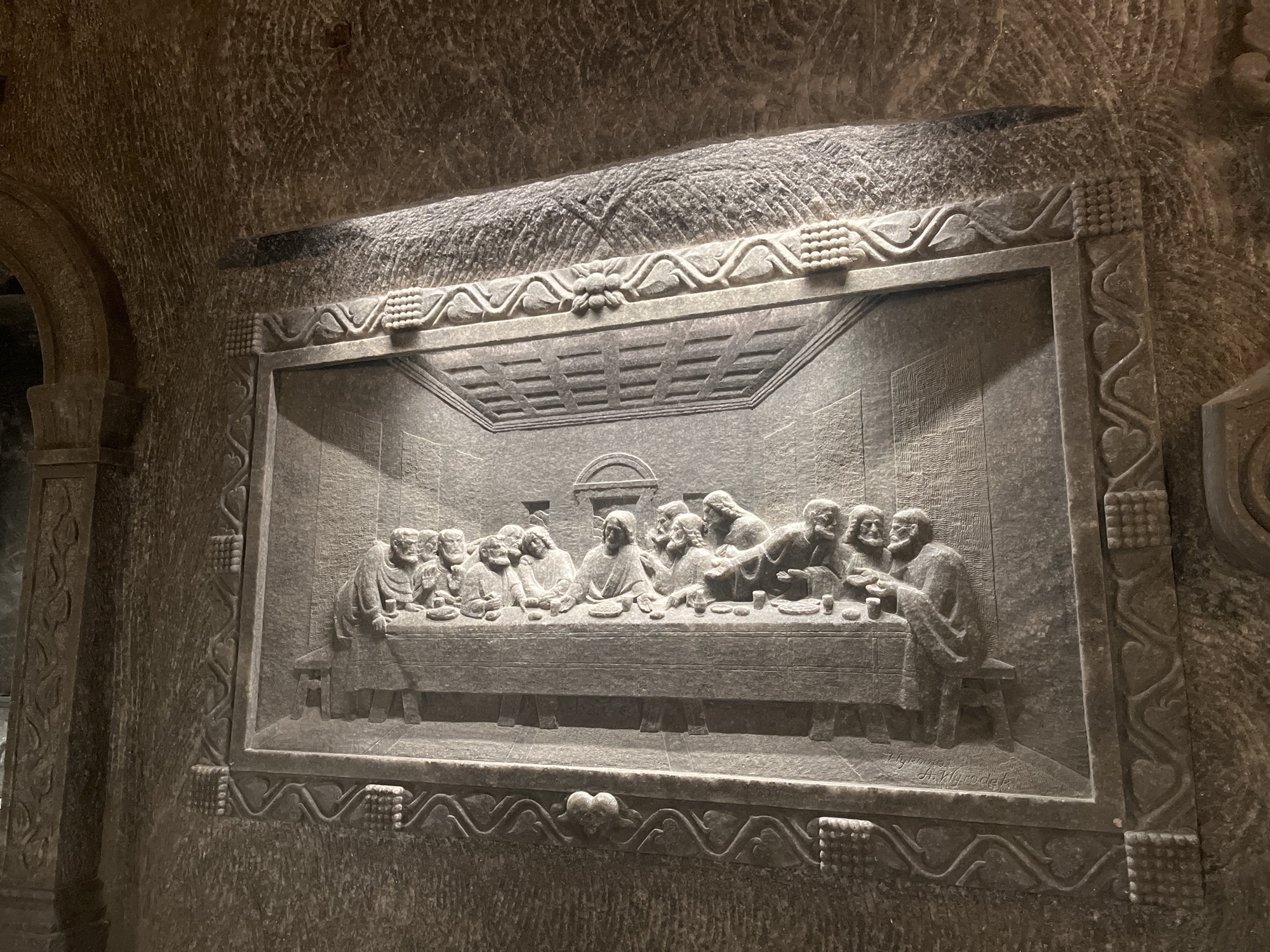
This is a photograph of a relief carving depicting the Last Supper, located in the Wieliczka Salt Mine in Wieliczka, Poland. The carving is made of salt and depicts Jesus and his apostles gathered around a long table. The figures are dressed in robes and are engaged in conversation and eating. The scene is set in a room with a vaulted ceiling. The carving is framed by ornate salt decorations, including geometric patterns and floral motifs. The environment appears to be a cavernous space within the salt mine, with rough-hewn salt walls surrounding the artwork. The lighting is dim, with focused spotlights highlighting the relief.
Wieliczka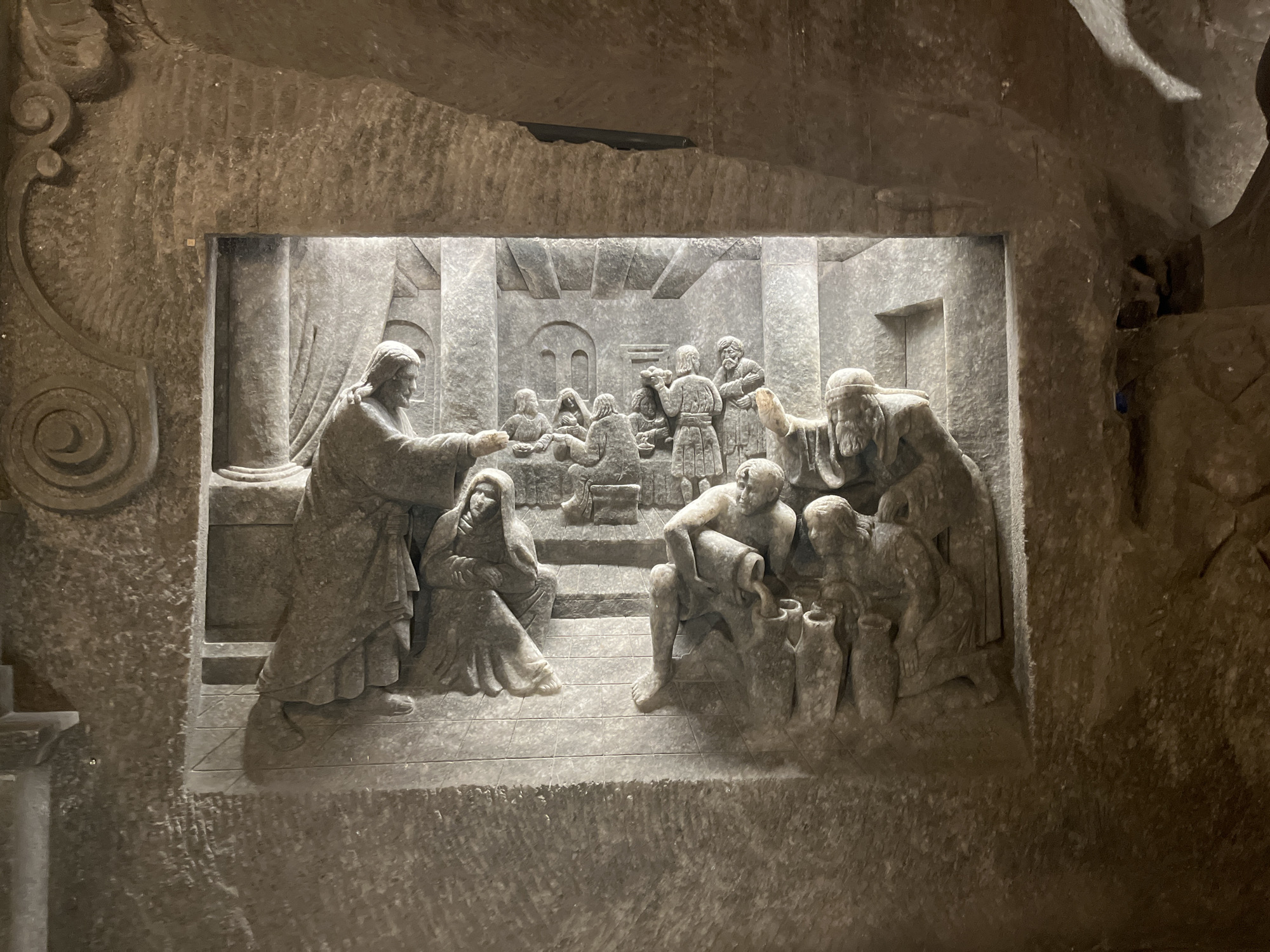
This is a photograph of a bas-relief carving made of salt. The carving depicts a scene with multiple figures in classical attire. In the foreground on the left, a man in a robe with a beard is gesturing with his left hand towards a seated woman who is looking down. Behind them, a group of figures are gathered around a table, with some seated and others standing. One figure is pouring liquid from a vessel into jars, while another figure holds a bowl or plate. In the background, architectural elements such as columns and arched doorways are visible. The carving is set within a rough, uneven salt rock environment. This salt carving is located in the Chapel of St. Kinga in the Wieliczka Salt Mine in Wieliczka, Poland.
Wieliczka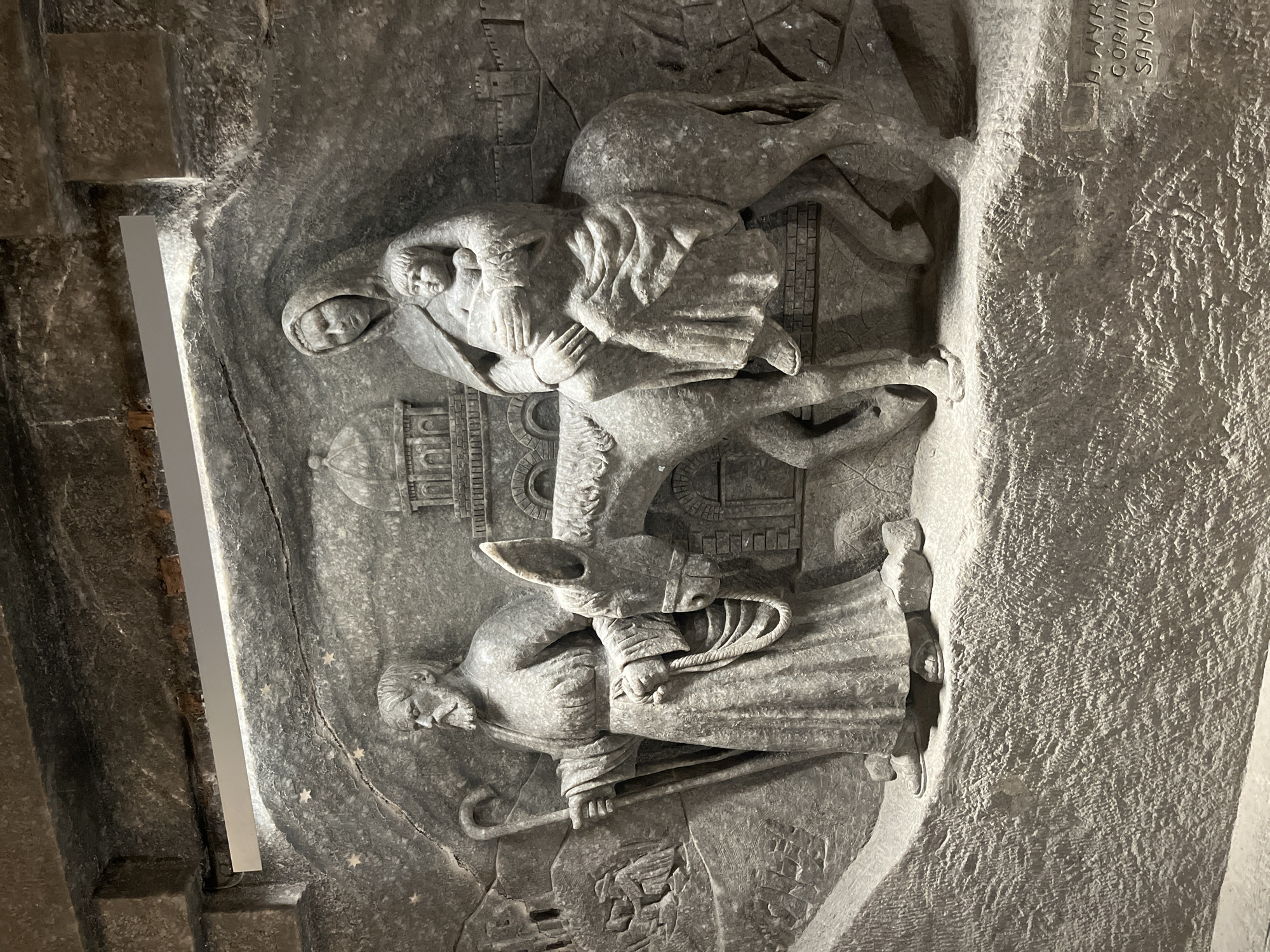
This is a full-shot, eye-level, medium-light, grey-toned, carved relief depicting a religious scene in the Wieliczka Salt Mine in Wieliczka, Poland. The relief is carved into the salt wall and portrays the Holy Family's flight into Egypt. On the left, a bearded man, likely Saint Joseph, stands facing right, wearing a long robe and sandals. He holds a shepherd's crook in his left hand and a rope in his right. He is walking beside a donkey. The donkey is depicted in profile, facing right, with its head lowered. It carries a woman on its back, presumably the Virgin Mary, who is wearing a hooded cloak and holding a child. The child, Jesus, is cradled in her arms. The woman's face is turned towards the viewer, while the child looks away. In the background, on the left, is a depiction of a village with buildings and a hill. In the center background, behind the donkey, is a building resembling a church with a dome. On the right side of the relief, more buildings and structures are visible, suggesting a journey through a landscape. The entire scene is carved in a realistic style, with attention to drapery and facial features. The texture of the salt mine wall is visible throughout the carving. A carved inscription is present in the lower right corner of the relief. The lighting highlights the carved details of the salt sculpture.
Wieliczka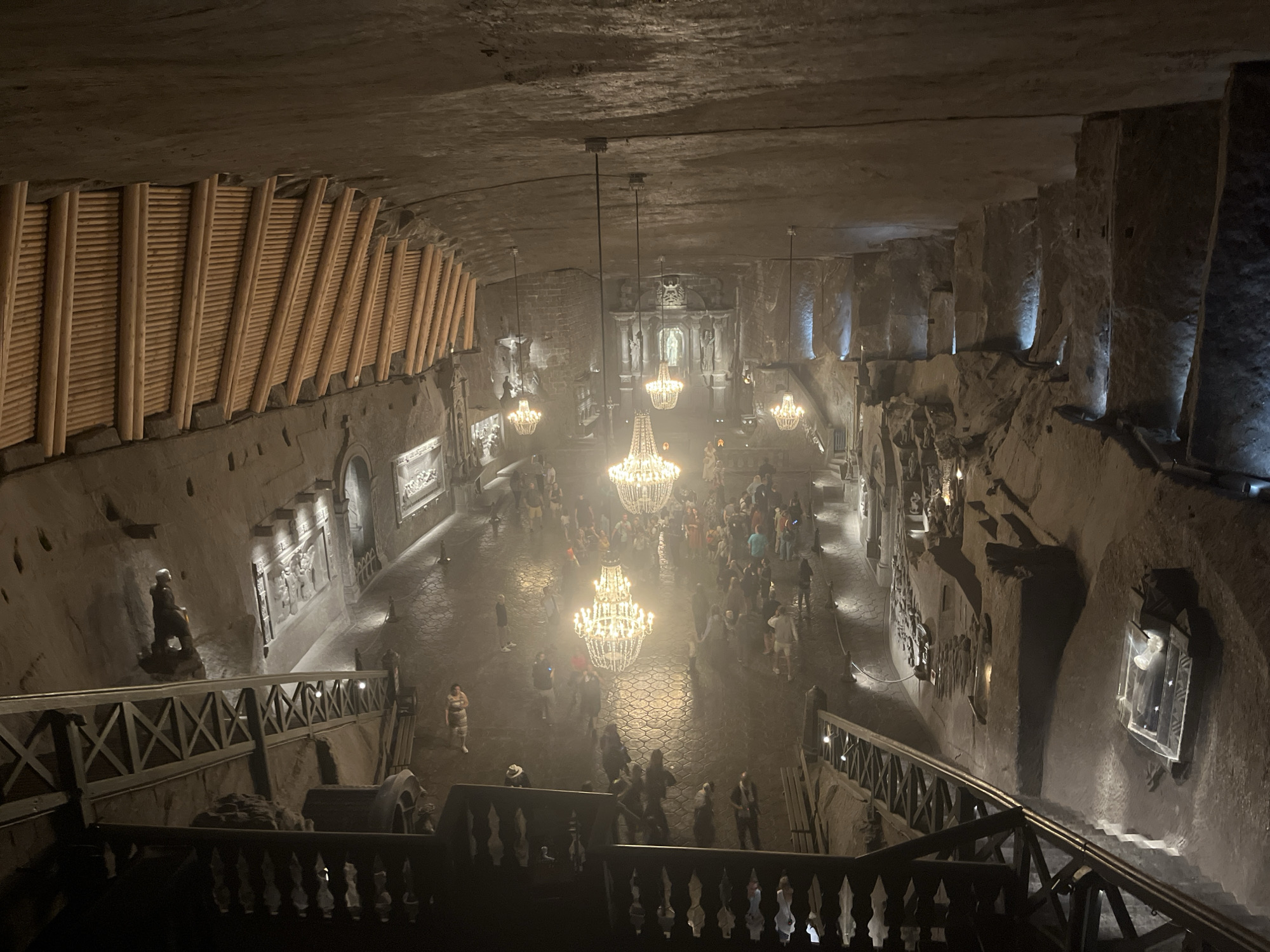
The image shows the interior of the St. Kinga's Chapel, located in the Wieliczka Salt Mine in Wieliczka, Poland. The chapel is carved entirely out of salt and is adorned with chandeliers made of salt crystals. Several groups of tourists are visible, exploring the vast underground space. The walls are decorated with intricate salt sculptures depicting religious scenes. The lighting in the chapel is dim, creating an ethereal atmosphere. The architecture of the chapel is unique, with vaulted ceilings and carved pillars. The floor is paved with salt blocks.
Wieliczka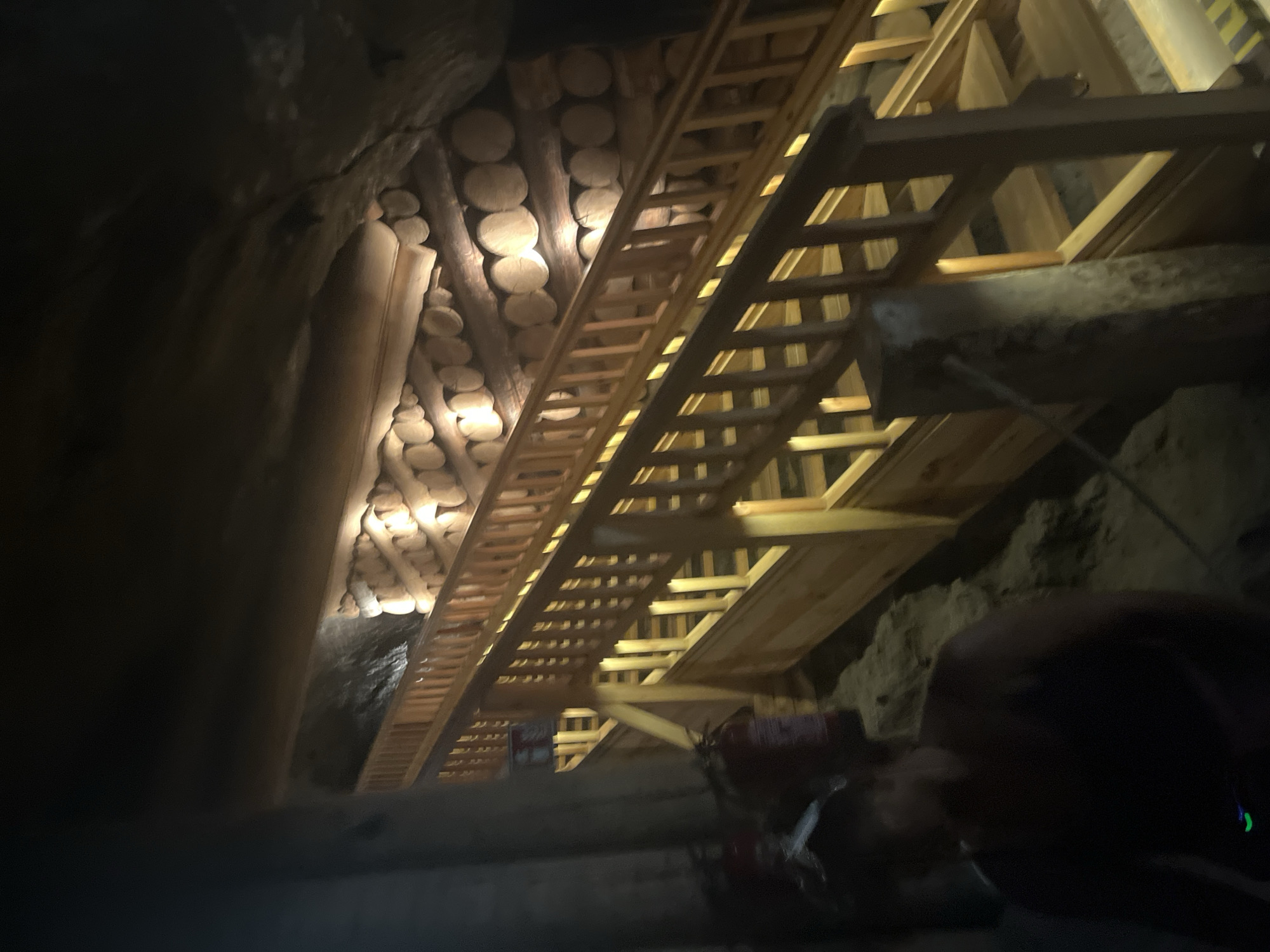
The image depicts a wooden staircase with illuminated railings, descending into a dimly lit area. The walls of the space are constructed from stacked logs. In the foreground, a person is visible in silhouette, partially obscured by shadow. To the left of the staircase, two fire extinguishers are mounted on the wall. The scene appears to be located within the Wieliczka Salt Mine in Wieliczka, Poland, a UNESCO World Heritage Site known for its underground chapels, sculptures, and lakes carved entirely from salt.
Wieliczka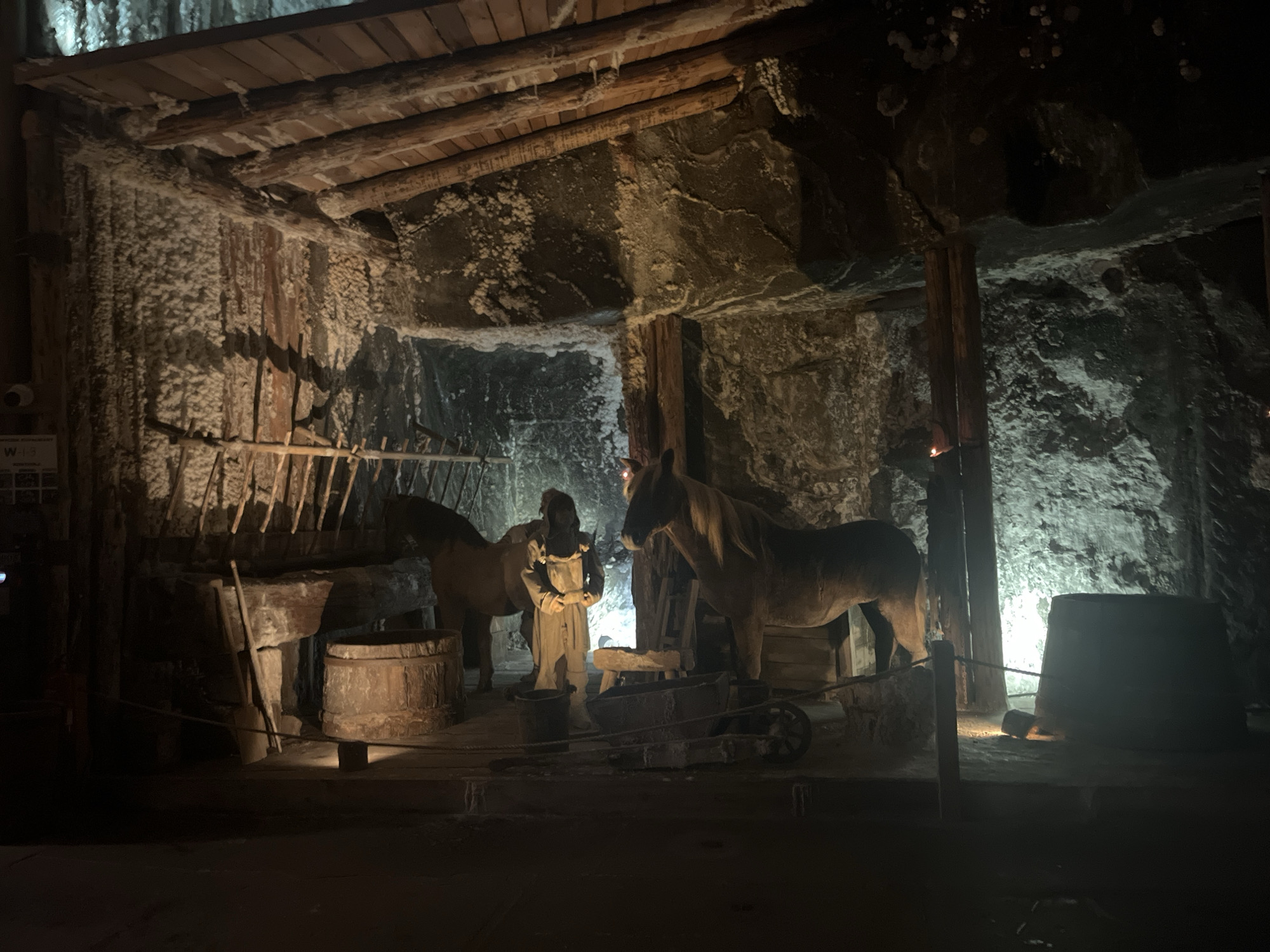
The image depicts a historical exhibit within the Wieliczka Salt Mine in Wieliczka, Poland, showcasing a scene of mining operations. In the dimly lit, cavernous environment, two horses stand tethered, appearing to be part of a horse-drawn transport system. Between the horses, a figure dressed in what appears to be miner's attire stands near a wooden barrel, a shovel, and a wheelbarrow, suggesting manual labor and the movement of materials. The walls and ceiling of the mine are rough and irregular, coated with crystalline salt deposits, indicative of the subterranean environment. Wooden beams support the ceiling and reinforce parts of the walls. The overall scene aims to recreate the working conditions of past salt extraction.
Wieliczka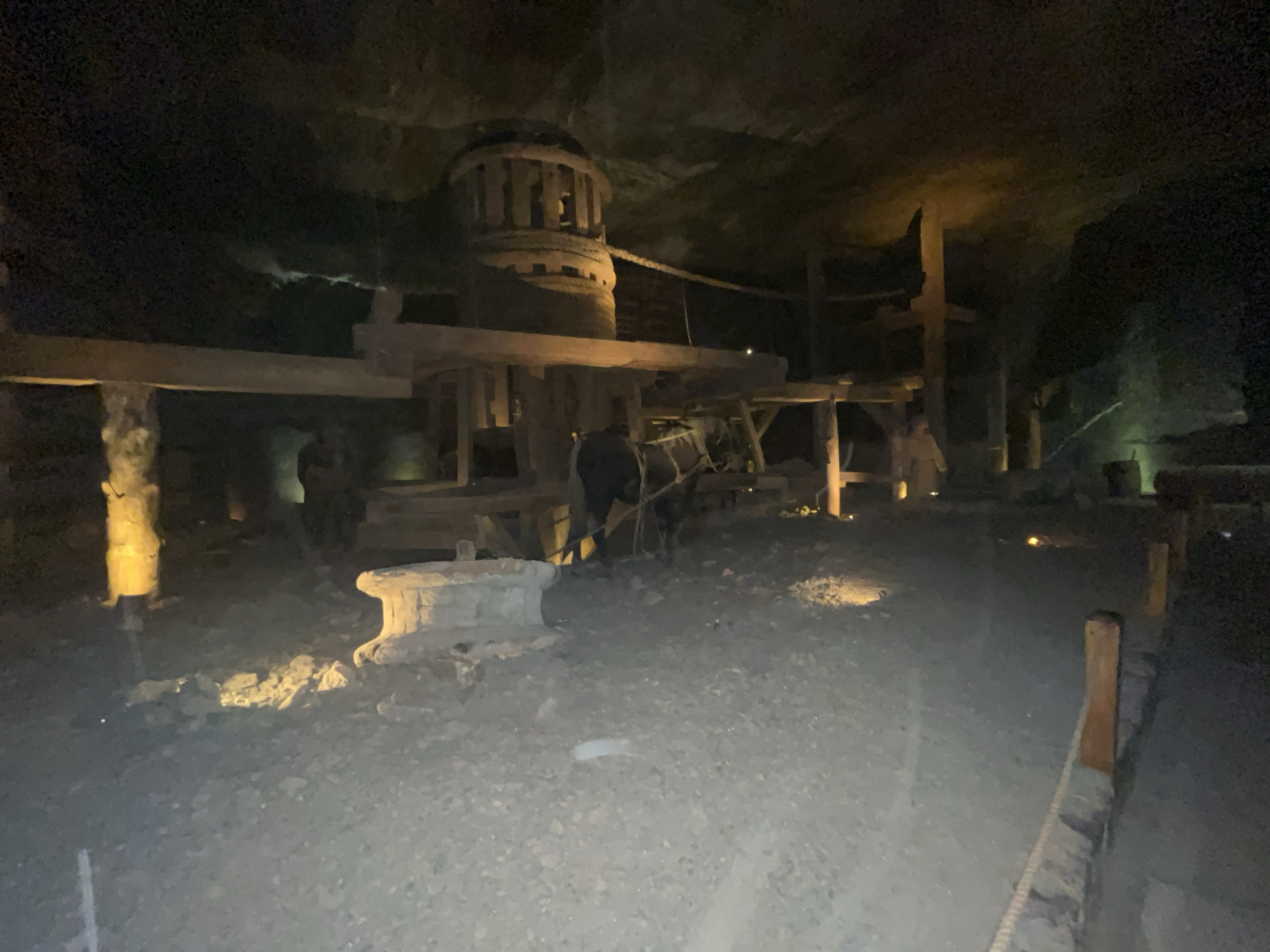
The image depicts the interior of a mine in the city of Wieliczka, Poland, likely the Wieliczka Salt Mine. The scene is dimly lit, with various wooden structures and machinery illuminated by artificial lights. In the center of the frame, a horse is harnessed to a large wooden winch, suggesting it is used for labor within the mine. Behind the winch, a cylindrical stone structure with wooden supports and platforms is visible, possibly part of a hoisting system. The ground is covered in gravel and dirt, typical of a mine environment. Several wooden posts and beams are present, forming the infrastructure of the mine. In the background, indistinct figures and more machinery can be observed, contributing to the overall impression of an operational or historical mining site. The cave-like ceiling and rough-hewn walls are characteristic of underground mining.
Wieliczka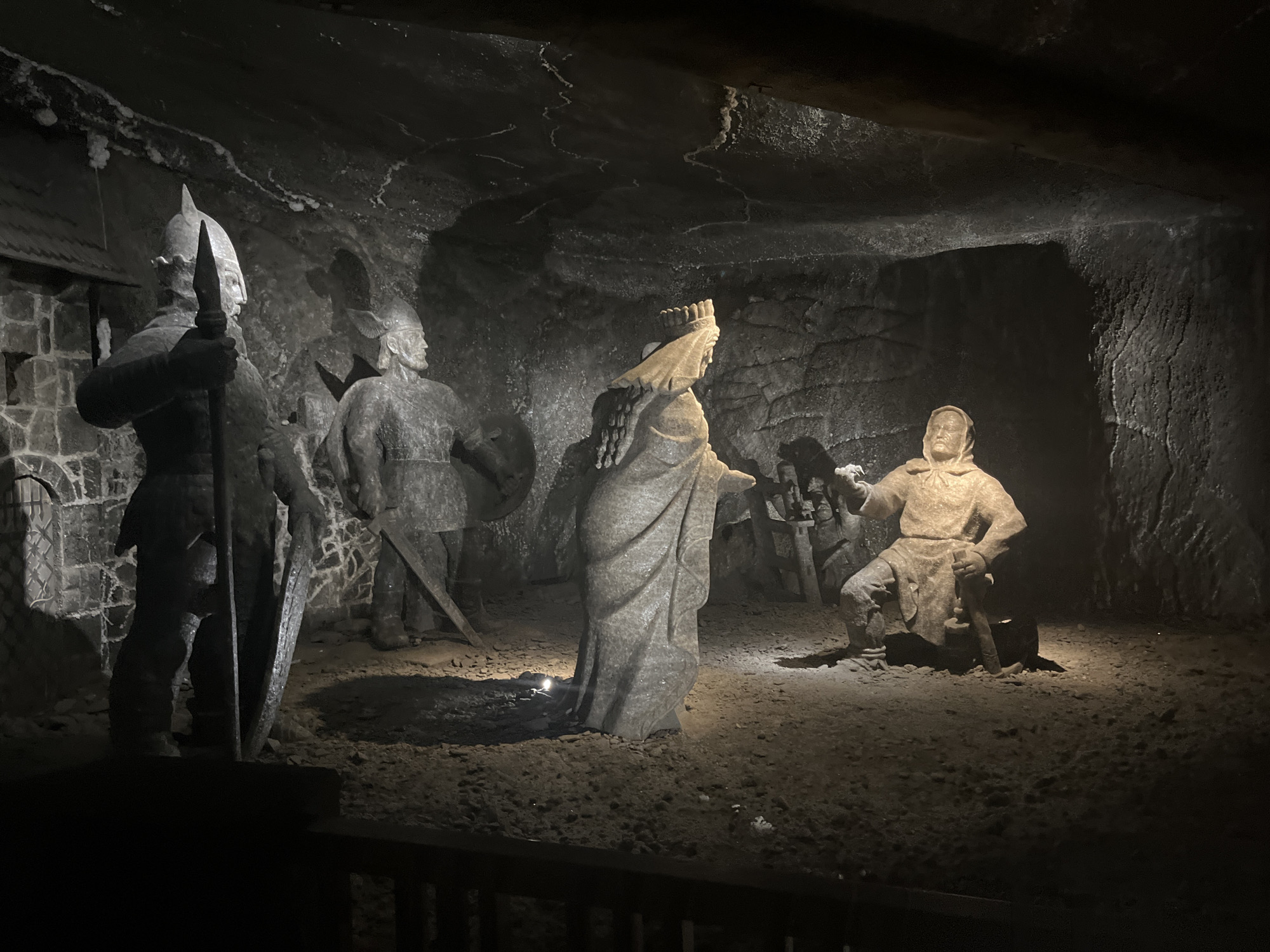
This is an image of the St. Kinga's Chapel in the Wieliczka Salt Mine, located in Wieliczka, Poland. The chapel is carved entirely from salt. The scene depicts several life-sized salt sculptures of figures in historical attire. On the left, two figures stand guard, one holding a spear and a shield, wearing helmets. To the right, a central figure, possibly a queen, wears a crown and a draped garment. Further to the right, a figure sits, holding a tool resembling a pickaxe. The sculptures are set within the rough-hewn walls and ceiling of the salt mine, with some lighting illuminating the figures and the cavernous space. The ground is covered in loose salt or earth.
Wieliczka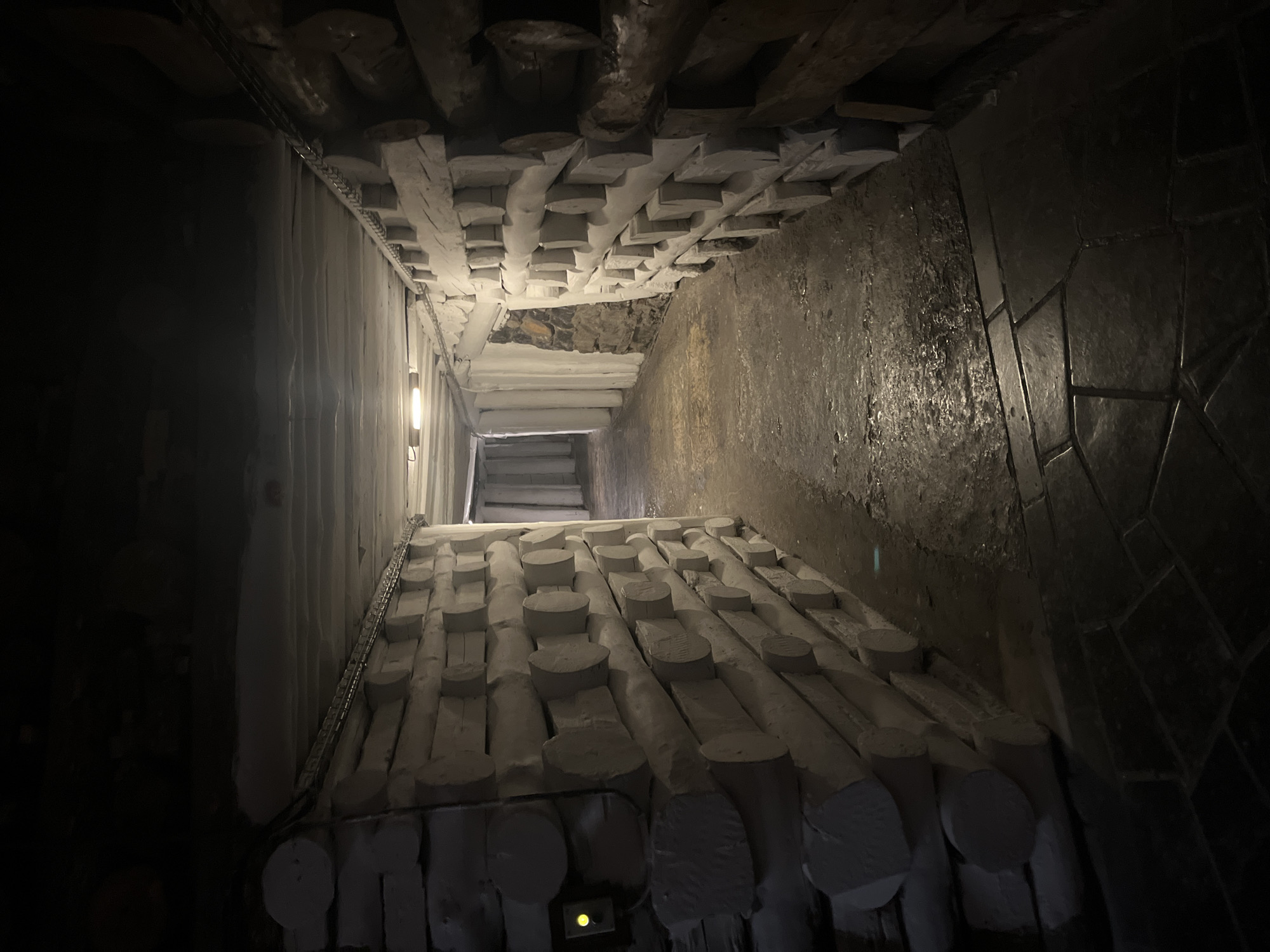
The image depicts a dimly lit underground corridor constructed with logs and stone. The walls on either side are lined with horizontally stacked logs, painted white on the left and natural wood on the right. The floor is a combination of rough, wet concrete and dark stone paving. The corridor recedes into the distance, where more dimly lit spaces are visible. A yellow light is visible on the left wall, and overhead lights illuminate the ceiling, which is also constructed of wood and concrete. This scene is located within the Wieliczka Salt Mine in Wieliczka, Poland, a UNESCO World Heritage site. There are no people or active interactions visible in the image. The environment is dark, damp, and appears to be ancient and industrial.
Wieliczka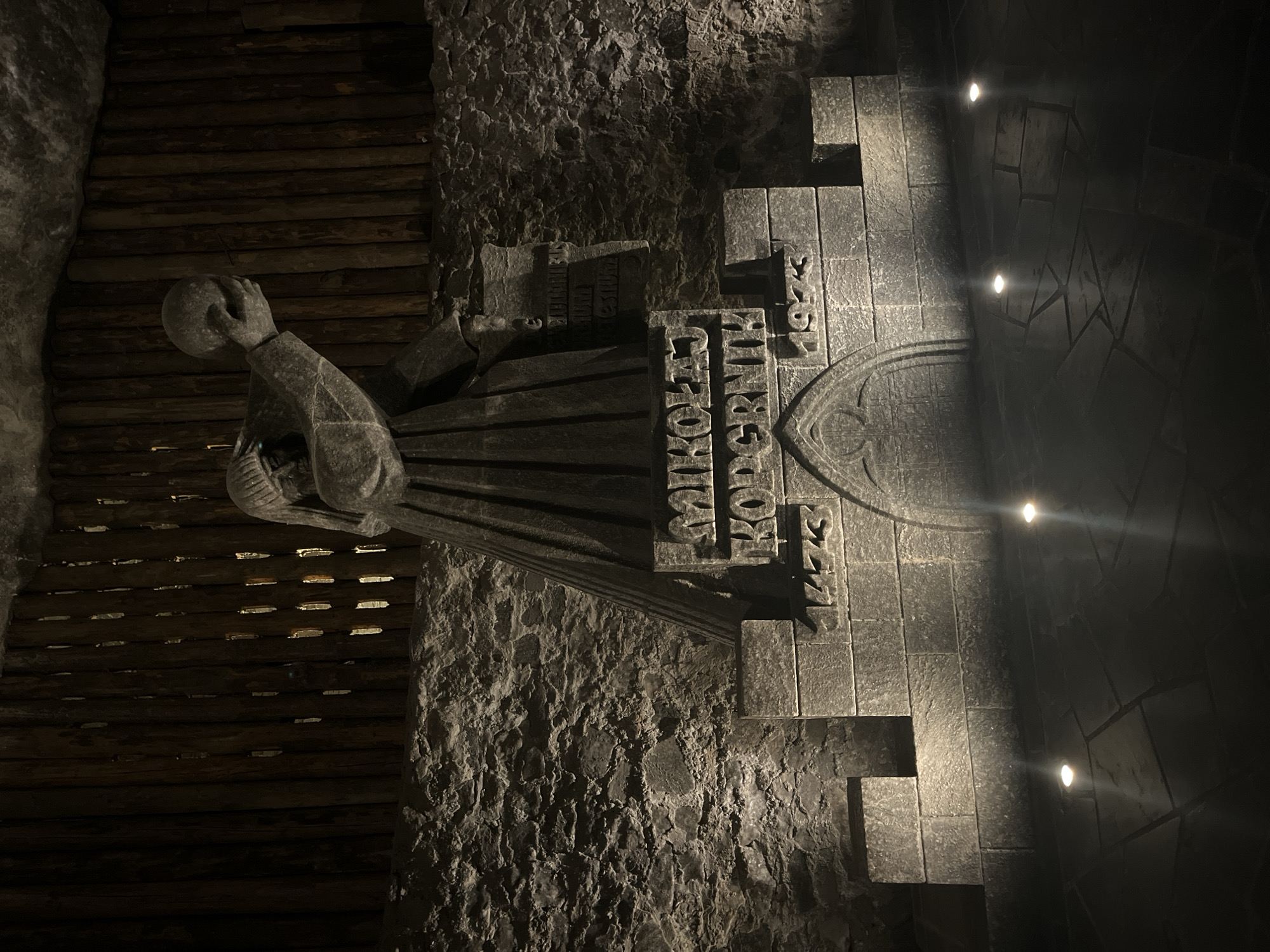
The image shows a stone monument within the Wieliczka Salt Mine in Wieliczka, Poland. The monument depicts Nicolaus Copernicus holding a sphere, likely representing the Earth. The sculpture is carved from salt and is mounted on a stone pedestal with inscriptions and dates. The background consists of rough-hewn salt walls and wooden supports, illuminated by artificial lighting. The floor is paved with stone tiles, and several spotlights are embedded in the floor, casting light upwards. The overall scene suggests a subterranean environment, characteristic of a salt mine. The inscription on the monument includes the name "MIKOLAJ KOPERNIK" and the dates "1473-1543".
Wieliczka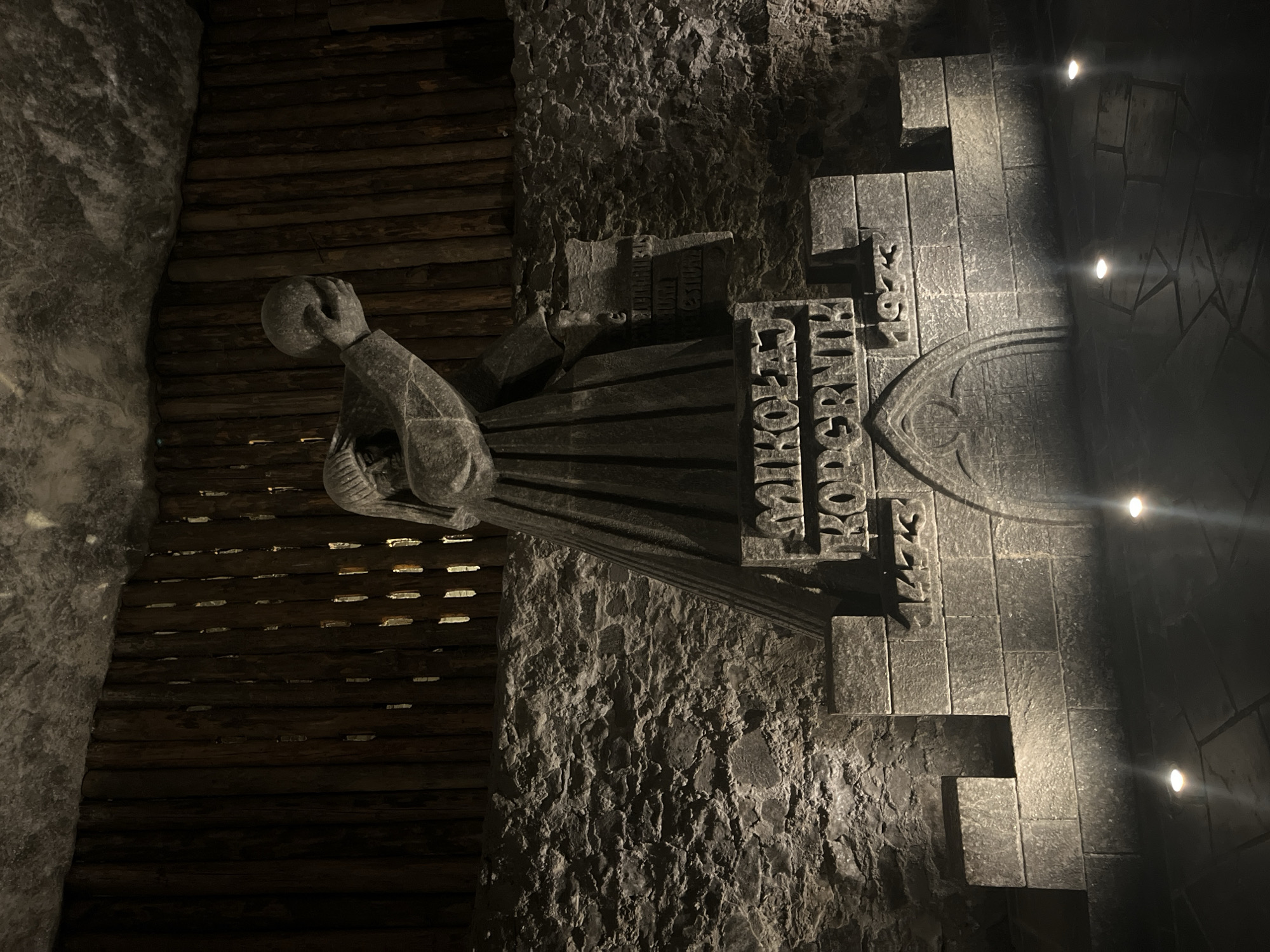
The image shows a sculpture of Nicolaus Copernicus in the Wieliczka Salt Mine in Wieliczka, Poland. The sculpture is made of stone and depicts Copernicus holding a sphere. He is standing on a pedestal that is decorated with carved stone blocks and has the years "1473" and "1543" inscribed on it, representing his birth and death years. Behind the sculpture, there is a wall of rough-hewn stone, and above that, a wooden structure made of vertical planks with gaps between them, allowing light to shine through. The floor in front of the sculpture is paved with irregularly shaped stones, and several small spotlights illuminate the scene from below. The overall environment is dark and appears to be underground, consistent with a salt mine.
Wieliczka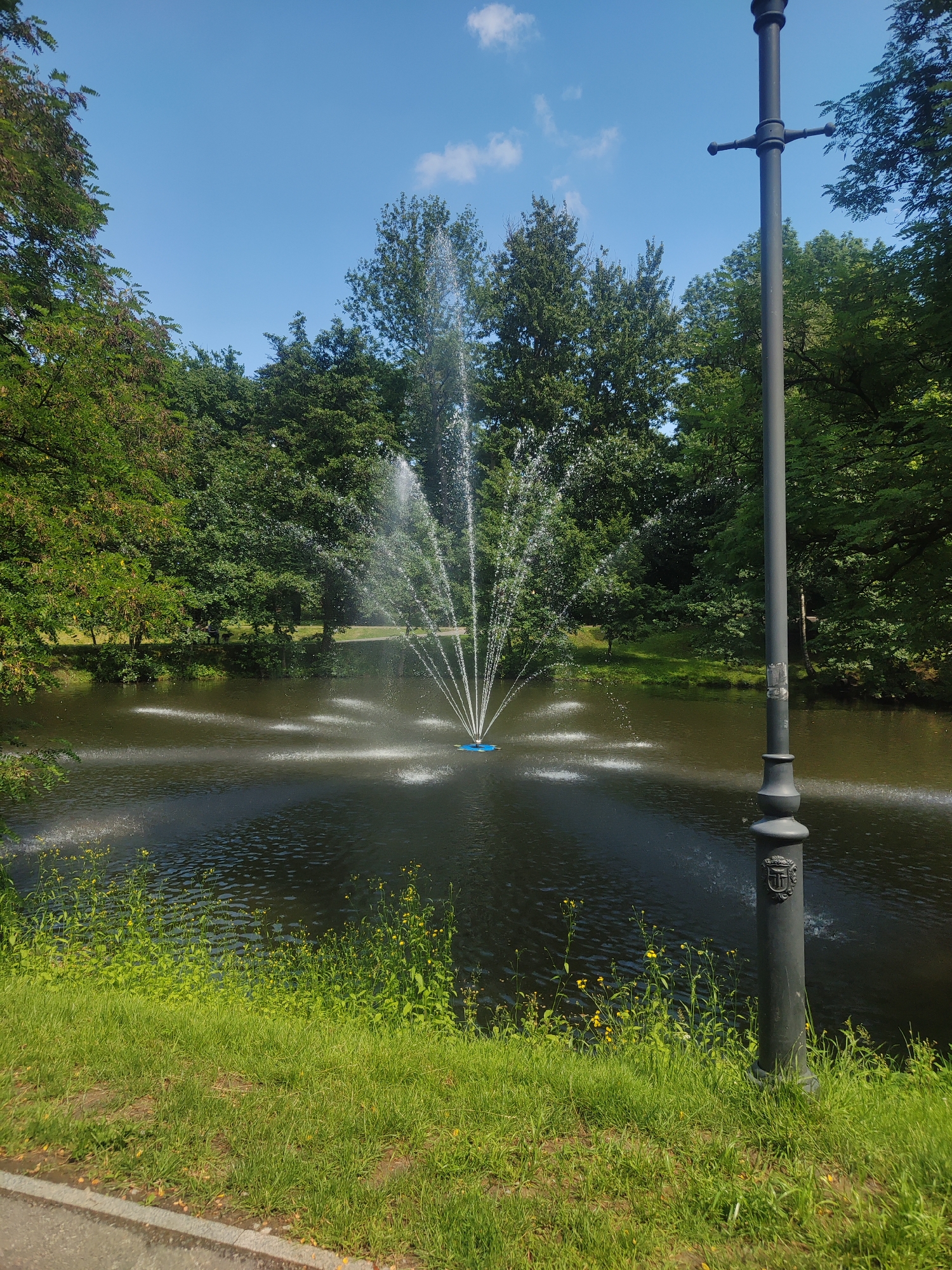
This media file depicts a serene outdoor scene in Wieliczka, Poland. The main subjects include a tranquil pond with an active fountain at its center, surrounded by lush green trees. The fountain is spraying water upwards and outwards, creating a dynamic visual element against the calm water. Several smaller sprays of water are also visible on the surface of the pond, emanating from different points. In the foreground, there is a well-maintained grassy area with some wildflowers, leading towards the edge of the pond. To the right of the frame, a dark-colored lamppost stands tall, adding a touch of urban or park infrastructure to the natural setting. The lamppost has a decorative base and a crest or emblem visible on its shaft. In the background, behind the pond and trees, the sky is a clear blue with a few scattered white clouds, suggesting fair weather. The overall impression is one of a peaceful park or garden on a bright, sunny day. The time of day appears to be daytime, likely midday or early afternoon, given the brightness and the clear blue sky. There is no discernible text visible in the image. The scene evokes a sense of calm and natural beauty, typical of a pleasant day spent outdoors.
Wieliczka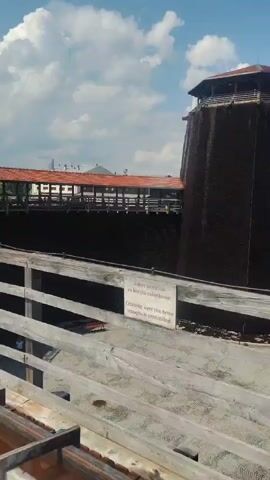
The video pans across a large, rustic structure made of dark wood, appearing to be a salt graduation tower. The tower is covered in a dense network of branches or twigs, through which brine is dripped to evaporate and concentrate salt. A wooden walkway with railings runs alongside the tower. In the foreground, there are more wooden planks and a sign with Polish and English text. The sky above is blue with scattered white clouds, and a distant town with red-tiled roofs is visible in the background.
Wieliczka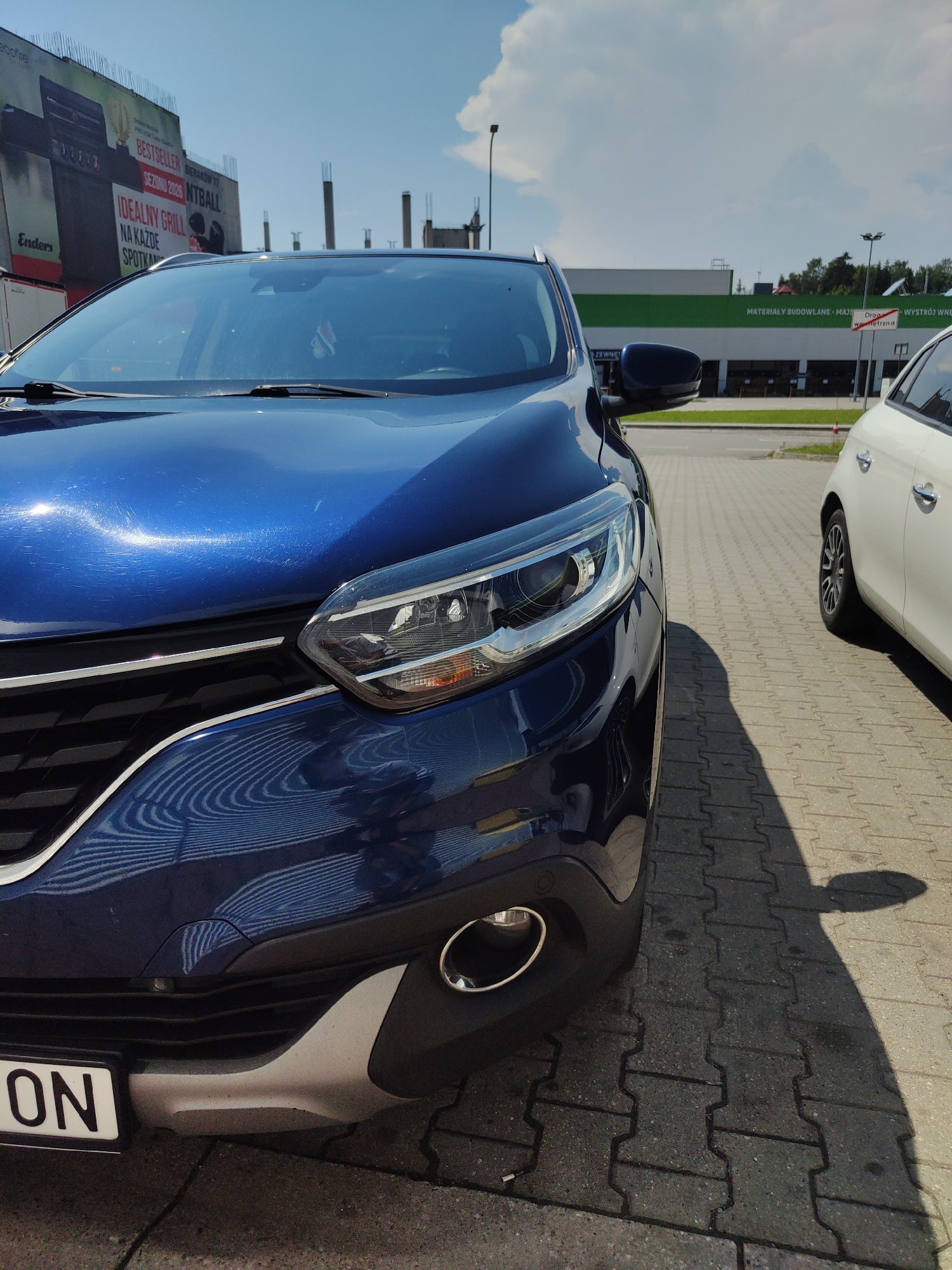
The image shows a dark blue car parked on a paved surface, possibly a parking lot, in Wieliczka, Poland. The car is positioned in the foreground, taking up the majority of the frame. Its front left side, including the headlight, grille, and part of the bumper, is clearly visible. The car's hood reflects the bright blue sky and scattered clouds, as well as some of the surrounding environment. A white car is parked to the right of the blue car. In the background, a large building with a green and white facade can be seen, which appears to be a commercial establishment, possibly a hardware or building supply store, indicated by signage that reads "MATERIAŁY BUDOWLANE" (building materials) and "WYSTRÓJ WNĘTRZ" (interior design). Construction scaffolding and unfinished structures are visible beyond this building, suggesting ongoing development in the area. To the left of the frame, a large billboard displays advertisements for grills and other products. The ground is paved with interlocking concrete blocks, typical of many outdoor public spaces in Poland. The lighting suggests it is daytime, with strong sunlight casting distinct shadows from the vehicles. There are no people visible in the image. The overall impression is a utilitarian, outdoor commercial setting on a sunny day.
Wieliczka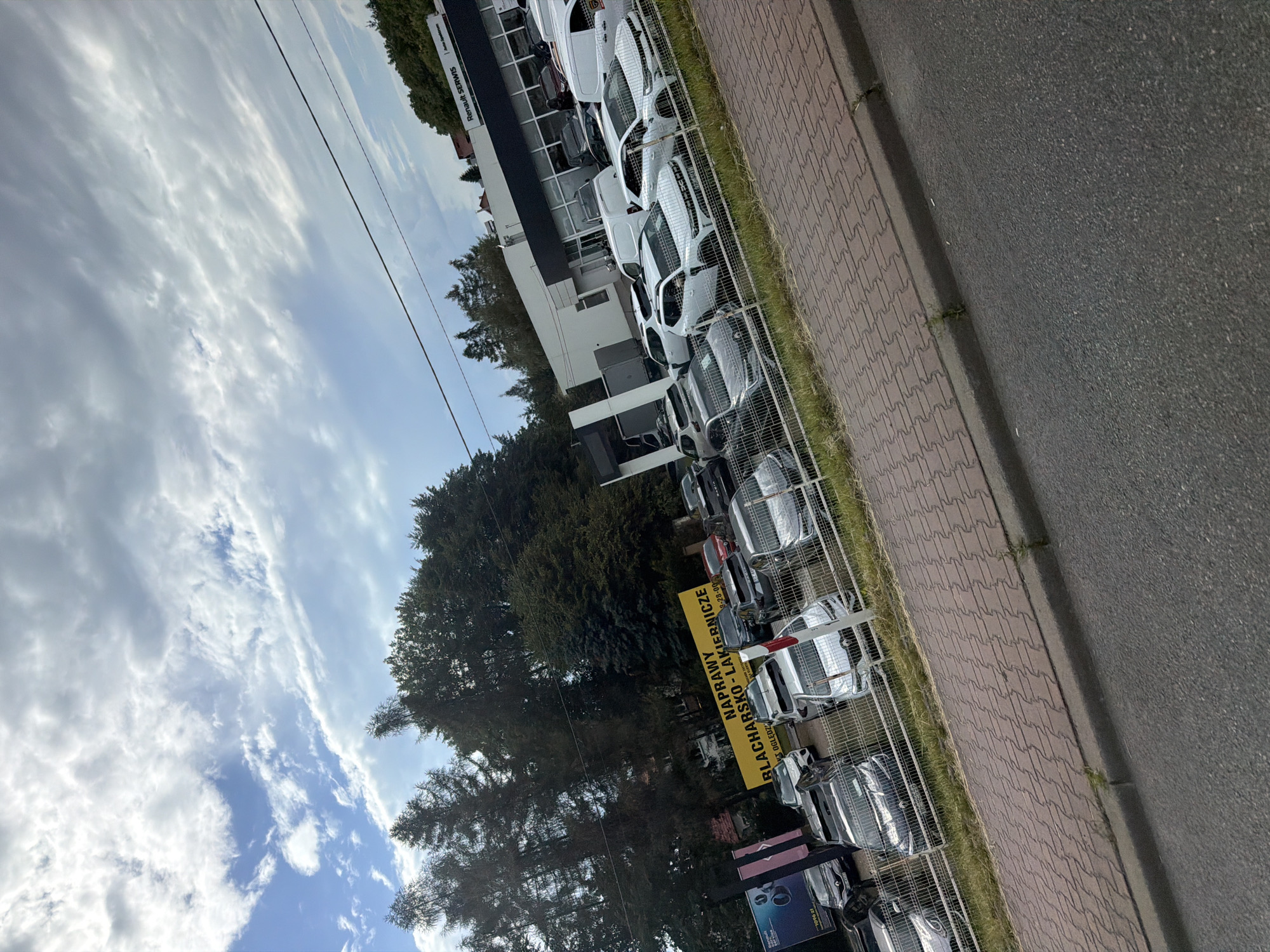
The image shows an outdoor car dealership in Wieliczka, Poland. A variety of cars, including sedans, SUVs, and vans, are parked in rows behind a fence. Some of the cars are white, while others are darker colors. A yellow sign with Polish text, "NAPRAWY BLACHARSKO-LAKIERNICZE" (Bodywork and paint repairs), is visible. To the right, a building with "Renault SERWIS" signage indicates a Renault service center. The sky is cloudy with patches of blue. Trees surround the dealership. A paved sidewalk and road are in the foreground.
Wieliczka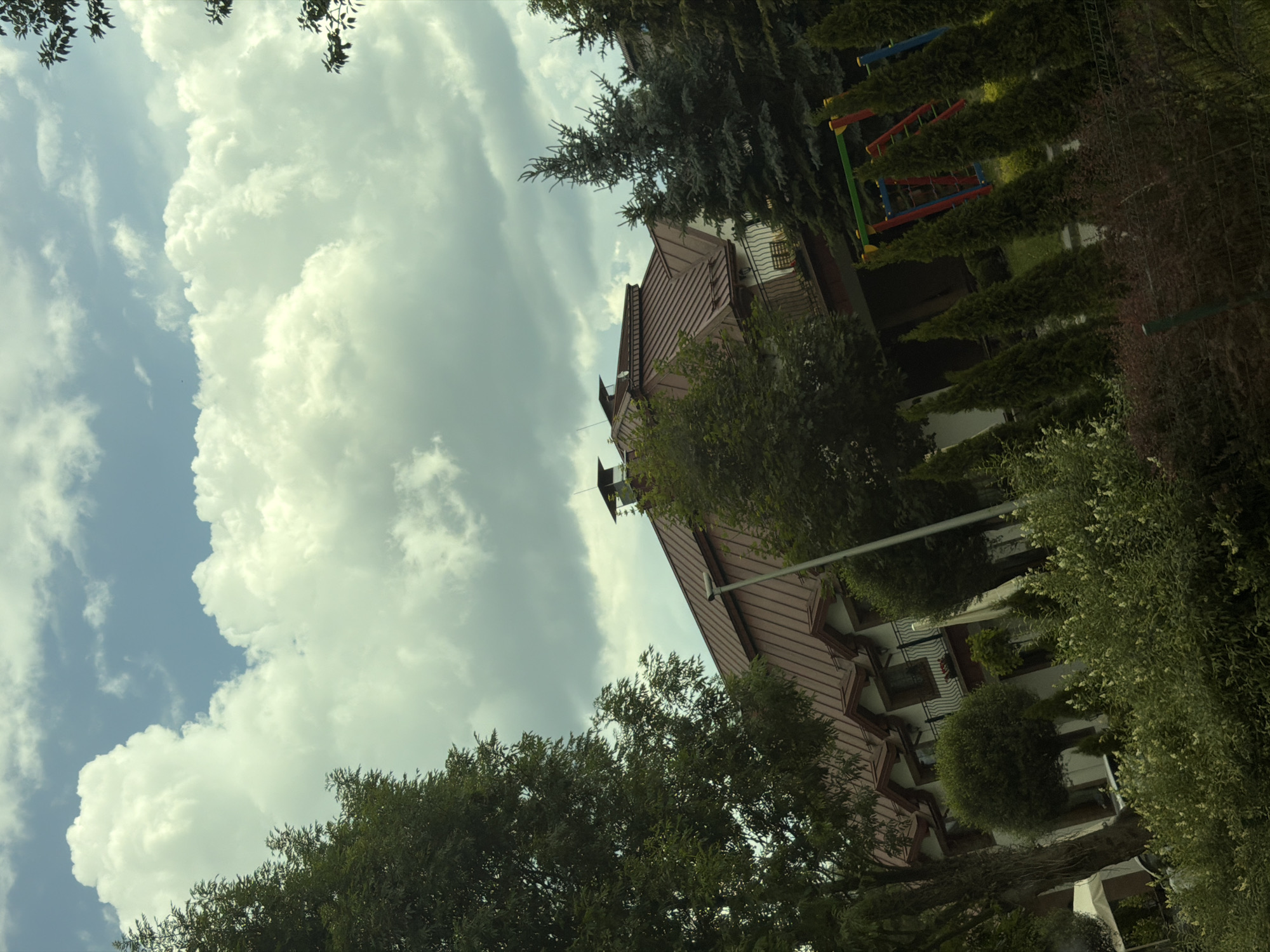
The image shows a view of a residential building in Wieliczka, Poland, with a focus on its exterior architecture and surrounding greenery. The building features a prominent brown, multi-pitched roof with dormer windows. The facade appears to be light-colored, with dark-framed windows and balconies. Several trees and bushes surround the building, creating a natural and somewhat overgrown setting. A large tree with dense foliage stands to the left of the frame, partially obscuring the building. In the foreground, there is a variety of shrubs and smaller trees, some with white flowers. To the right of the building, a children's playground structure with colorful bars and red, yellow, and blue elements is visible. The sky above is filled with large, white, fluffy clouds against a pale blue background, suggesting a partly cloudy day. The perspective is slightly tilted, giving a dynamic feel to the scene. No people are visible in the image.
Wieliczka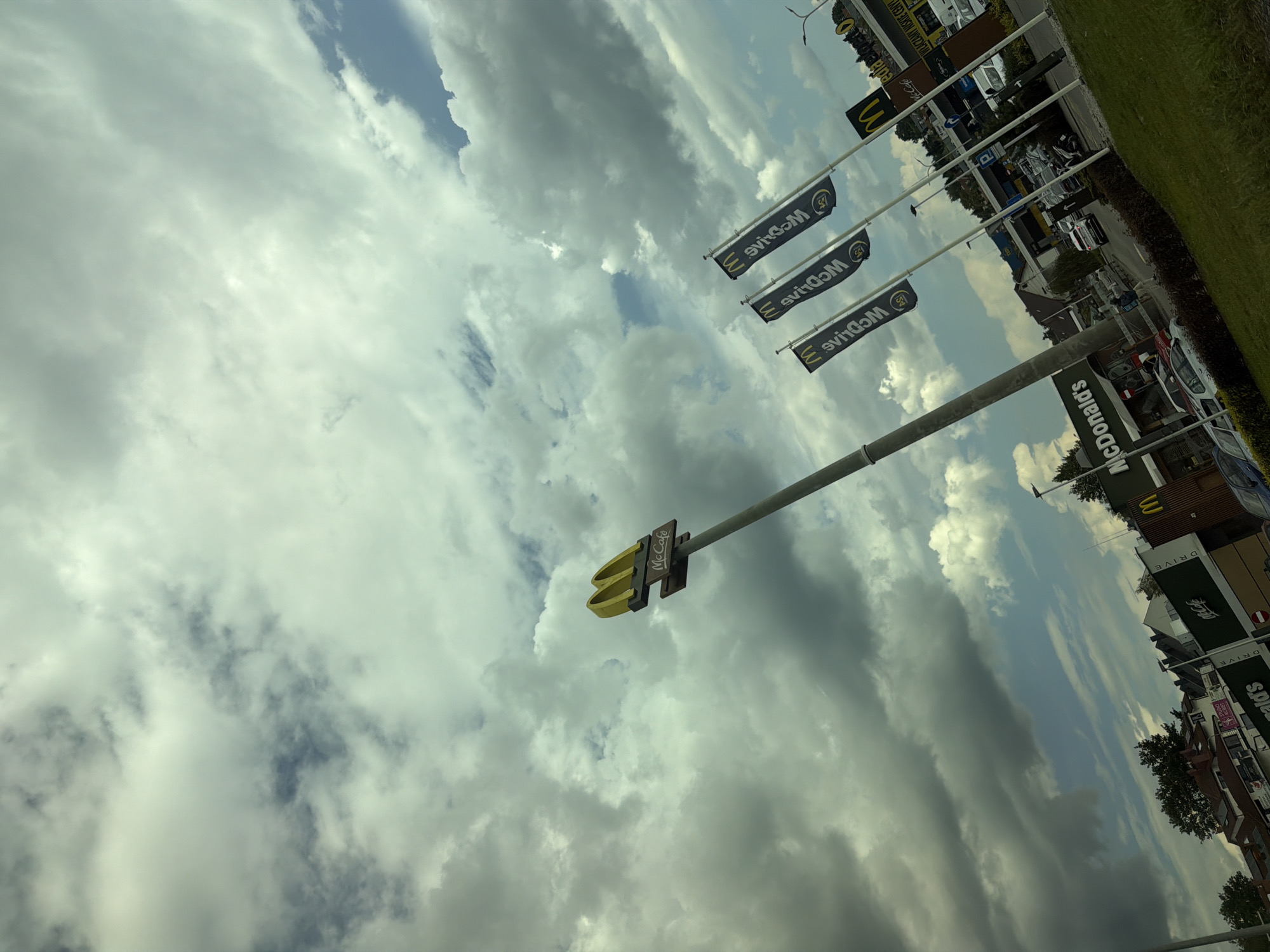
The image shows a McDonald's restaurant in Wieliczka, Poland. The sky is cloudy, with patches of blue visible. A tall sign with the McDonald's logo stands prominently, topped by the iconic golden arches and a McCafe sign. Several dark flags with the McDonald's logo are planted in a row, some of which are angled and appear to be blowing in the wind. In the background, the McDonald's building is visible, along with other structures and parked cars. A few people can be seen near the building and the drive-thru area. The scene appears to be set during daylight hours.
Wieliczka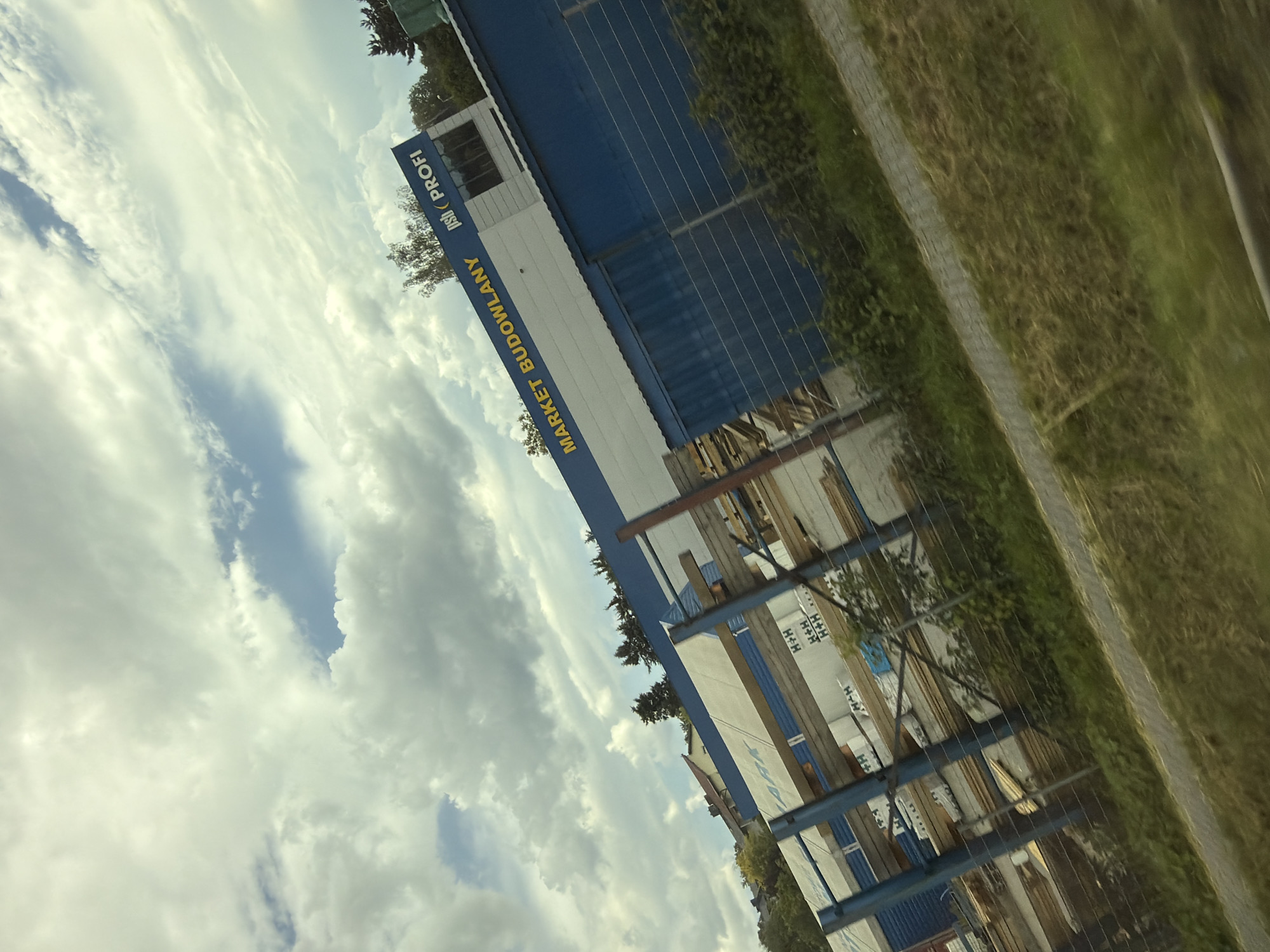
The image shows a low-angle, tilted outdoor shot of a "MARKET BUDOWLANY" (Construction Market) with "psb PROFI" branding. The building is a modern structure with a white and blue facade. The building appears to be a retail store for building materials. In front of the building, there are stacks of construction materials, possibly wood or insulation panels, displayed on metal racks. A metal fence runs along the foreground, separating the construction market from a grassy area and a pathway. The sky above is filled with dramatic clouds. The presence of the "MARKET BUDOWLANY" and "psb PROFI" branding, coupled with the architectural style of the building and surrounding vegetation, strongly suggests this location is in Poland. Based on external knowledge, a PSB PROFI market is located in the city of Wieliczka, Poland, making it highly probable that this image was taken there.
Wieliczka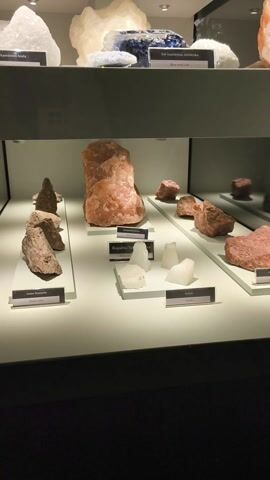
The video displays an indoor exhibit showcasing various large samples of rock salt and other minerals. The camera slowly pans from right to left, revealing different sections of the display cases and shelves. The exhibit features numerous pieces of rock salt, varying in color, size, and texture. Colors observed include white, off-white, light pink, dark pink/orange, brown, translucent white, and striking blue. One section features green and yellowish minerals, identified by a label as "Gips zabarwiony związkami metali ciężkich" (Gypsum colored with heavy metal compounds). Each sample or group of samples is accompanied by a white label with text, primarily in Polish, identifying the type of mineral or its origin. Visible labels include: - "Sól kamienna biała" (White rock salt) - "Sól kamienna niebieska" (Blue rock salt) - "Kopalnia Soli Kłodawa" (Kłodawa Salt Mine) - "Kopalnia Rudna" (Rudna Mine or Mining Pit, in this context likely a salt mine section) - "Sylwin" (Sylvite, a mineral) - "Złoże Solankowe" (Brine deposit) - "Zubek Kruszcowy" (Ore lump/cube) The exhibit is well-lit by spotlights, highlighting the textures and colors of the minerals against a dark background in the display cases and a light-colored wall. The setting appears to be a museum or an educational center, likely related to salt mining, given the location context of Wieliczka, Poland. There are no people visible in the video.
Wieliczka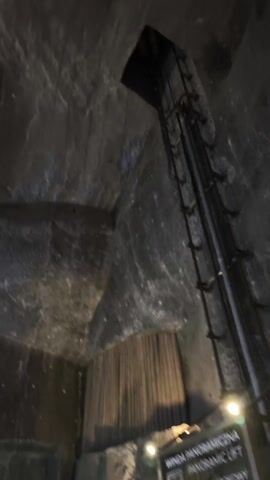
The video shows a view inside a cavernous space with rough, rocky walls. The lighting is dim, with a warm, orange glow illuminating certain areas. There are wooden structures built within the cavern, resembling platforms or walkways. The camera appears to be moving, panning upwards to show the full extent of the interior.
Wieliczka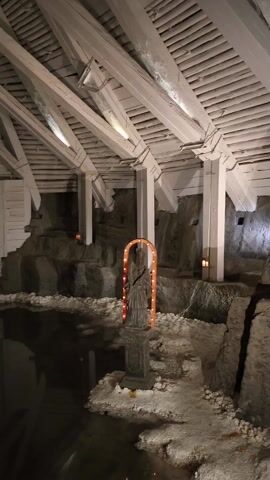
The video shows an underground structure with a body of water and white wooden architecture. The camera slowly pans from right to left. The architecture consists of a low-slung, peaked roof supported by white pillars. Below the roofline on the right side, there is a gray rock formation, upon which there are a few small candles. In front of the formation, a statue stands on a small pedestal, framed by an arched, orange light. The statue and its lighting are reflected in the dark body of water. On the left, there's a white brick wall with an opening leading to a tunnel illuminated by green light. Above the opening, there is a white plaque with text. The reflection of the tunnel and plaque are also visible in the water. The overall lighting is dim, emphasizing the glow of the candles and lights.
Wieliczka
The video shows a man walking on a wooden floor. The video is shot from a low angle, looking up. The man is wearing a green shirt, blue jeans, and sneakers. He is carrying a black bag on his shoulder. The floor is made of wooden planks and has yellow and black stripes on it. There is a white wall on the left side of the screen. The background is dark and blurry.
Wieliczka
The video is almost entirely black, briefly revealing a white, skull-like shape with dark eye sockets, before returning to darkness. A scream is heard as the image flashes.
Wieliczka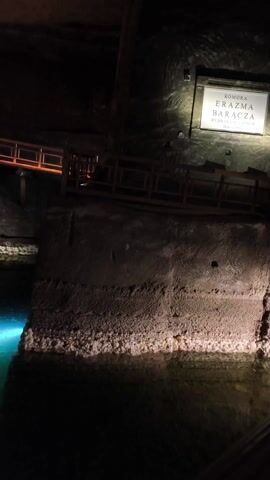
The video depicts an underground chamber, possibly a salt mine, with a pool of water illuminated by a green light. Above the water, a wooden walkway or bridge with orange lights runs along the edge of the chamber. The chamber walls appear to be constructed of dark, rough material, likely salt. The lighting is dim overall, focusing attention on the water and the walkway. No people are visible.
Wieliczka
The video shows a group of people walking through a dark, cavernous space. The space is lit by artificial lights that illuminate the walls and a wooden walkway. The walkway is elevated and has a railing. A sign on the wall reads "KOMORA ERASMA BARACZA. WIZEB WIEKU." The people are walking in the same direction. The camera follows behind them, focusing on the back of their heads and shoulders. The environment looks like a mine or a cave.
Wieliczka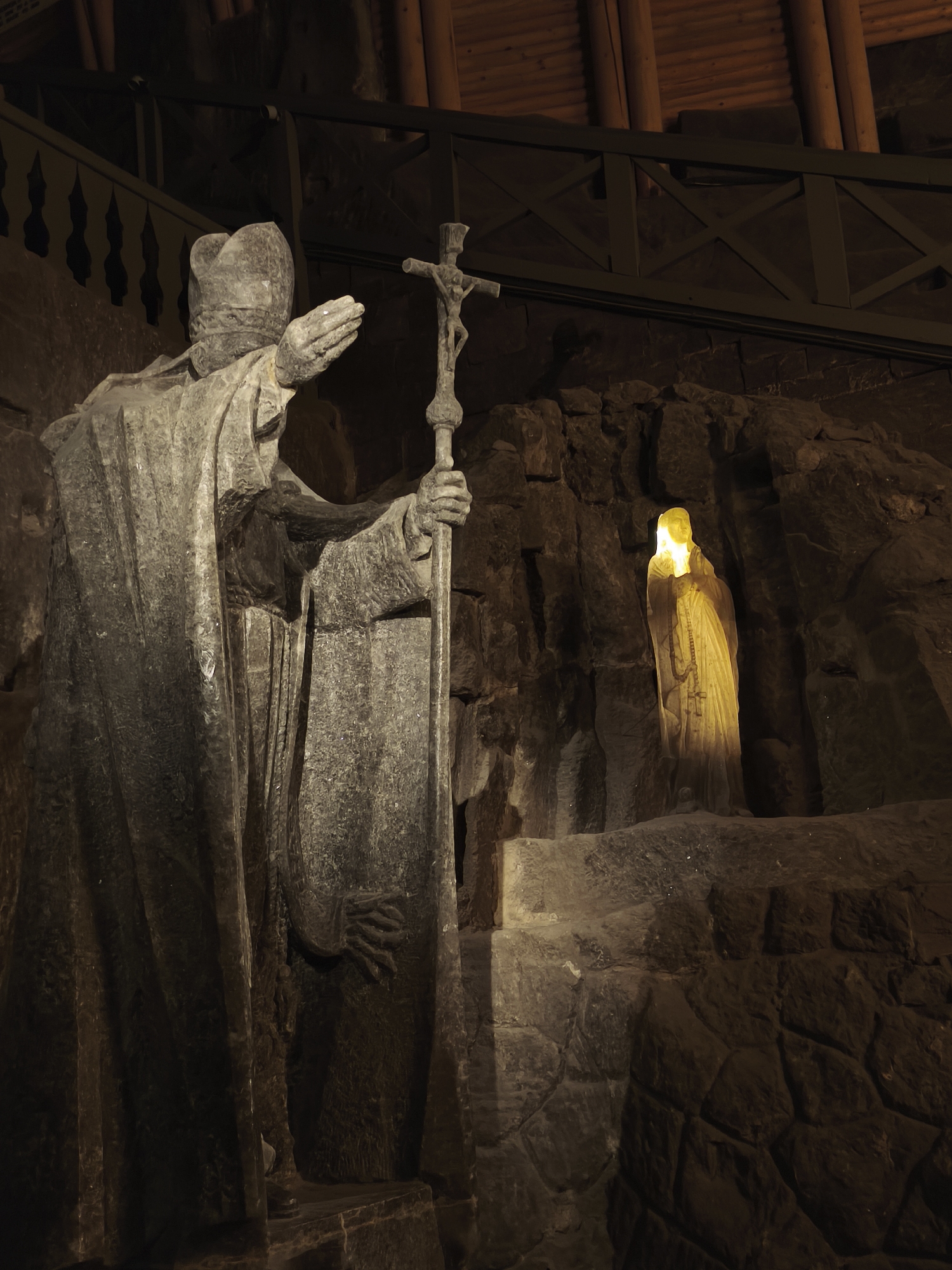
The image captures a dimly lit interior, likely a cavern or underground space, featuring religious sculptures. In the foreground, a large, gray stone statue of a robed figure resembling a bishop stands prominently, holding a cross in one hand and extending the other in a gesture of blessing or greeting. The statue is intricately carved, showing details in the robes and facial features. In the background, another stone statue of a similar robed figure is illuminated with a warm, yellow light, creating a stark contrast against the dark stone walls. The surroundings appear to be rough and uneven, suggesting a natural or partially natural environment, possibly a cave or mine. A wooden structure with decorative railings is visible in the upper portion of the frame, hinting at an elevated level or platform. The overall atmosphere is solemn and contemplative, possibly within a church or religious site, specifically located in Wieliczka, Poland.
Wieliczka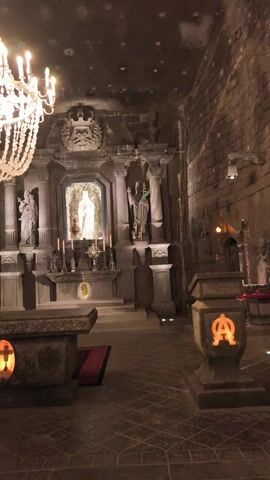
The video shows the interior of a church, possibly carved out of a salt mine, with a large chandelier dominating the left side of the frame. The walls are made of rough, dark brick or stone, speckled with what appears to be mineral deposits. The church features a detailed altar area, housing what looks like religious statues. Candles are visible around the statue. The floor is tiled. Two people enter the frame, and one is taking pictures with a phone. The lighting is dim, with several light fixtures, including the chandelier, illuminating the space.
Wieliczka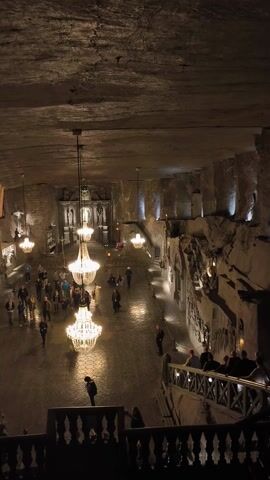
This image depicts a vast, dimly lit underground chamber, characteristic of the Wieliczka Salt Mine in Poland. The scene is dominated by several large, ornate chandeliers, which are the primary light source, casting a warm glow across the cavernous space. Numerous people are visible on the chamber floor, clustered in groups, appearing to be tourists or visitors exploring the site. Their reflections can be faintly seen on the polished or wet surface of the floor. Some individuals are also positioned on a raised balcony or platform along the right side, looking down into the main area. The walls of the chamber are rough and textured, likely carved from salt, with various architectural details and reliefs visible under spotlighting. On the left side of the frame, a long, sloped wooden ramp or staircase extends downwards, adding to the sense of depth. A sturdy wooden support structure or barrier is also visible on the right. The overall atmosphere is one of grandeur and historical significance, with the bright chandeliers providing a striking contrast to the dark, cavernous surroundings. No discernible text is visible in the image.
Wieliczka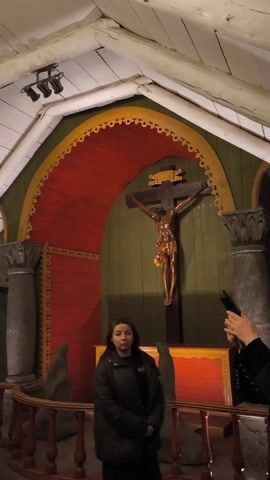
The video shows the interior of a church-like space that appears to be carved from rock. The architecture is unique, with a white, angled ceiling. In the first shot, a woman in a black coat stands in front of a colorful altar with a crucifix. The second shot pans across a group of people walking through the space. The third shot features a large, ornate chandelier hanging from the ceiling. Finally, the video focuses on a statue of a woman holding a child, positioned against a rough rock wall.
Wieliczka