Witzenberg Local Municipality, South Africa
30 memories from Witzenberg Local Municipality, South Africa
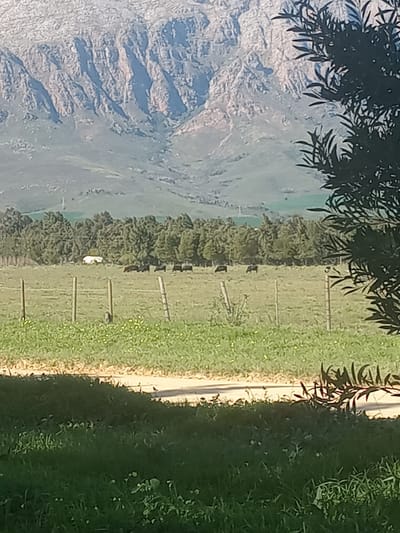
The image depicts a rural landscape in the Witzenberg Local Municipality, South Africa. In the foreground, a dirt path cuts through lush green grass, with some sparse yellow wildflowers visible. A dark green tree branch with thin leaves partially obscures the view on the right side of the image. The midground features a fenced pasture with several cows grazing. The cows are predominantly dark brown and black. A small white structure, possibly a shed or a shelter, is visible in the distance, behind the cows. A line of dense green trees forms a backdrop to the pasture. The background is dominated by a large, rugged mountain range with visible rock formations and slopes. The mountains appear to be a mix of earthy tones and green vegetation. The overall lighting suggests it is daytime, possibly late afternoon given the shadows. There are no people visible in the image.
Witzenberg Local Municipality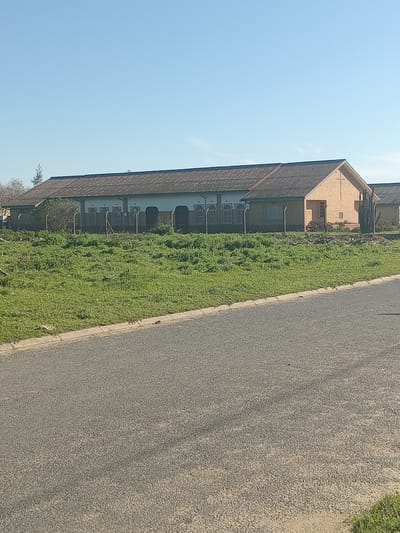
The image shows a building with a brick facade and a corrugated roof, set against a clear blue sky. The building appears to be a church or similar institution, with a cross visible on the right-hand side. A fence runs along the front of the building, separating it from a patch of overgrown grass. In the foreground, a paved road with a concrete curb is visible. The scene is set in a rural or semi-rural area, likely within the Witzenberg Local Municipality in South Africa, given the vegetation and architectural style. No people are visible in the image.
Witzenberg Local Municipality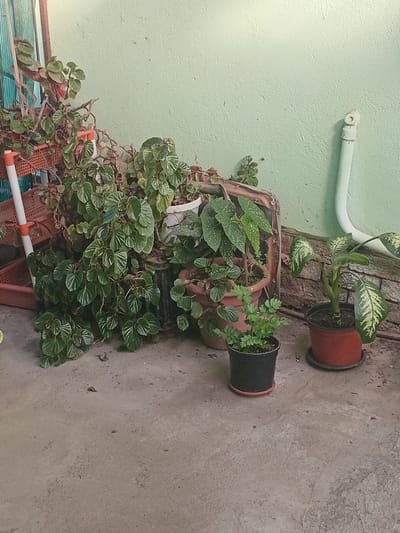
The image depicts an outdoor scene, likely a patio or courtyard, with several potted plants arranged against a light green wall. The plants are varied in size and type, with lush green foliage. Some are in terracotta pots, while others are in dark plastic containers. In the background, a white pipe runs vertically along the wall, and there's a hint of a window or screen on the left side of the frame. The ground is a concrete surface, appearing somewhat worn and dusty, with a few scattered dry leaves. The lighting suggests it is daytime, possibly overcast or late afternoon, with soft shadows. There are no people visible in the image. This scene is consistent with a domestic setting in a residential area. Given the context of Witzenberg Local Municipality, South Africa, this location could be a garden or outdoor living space in a town such as Ceres or Tulbagh.
Witzenberg Local Municipality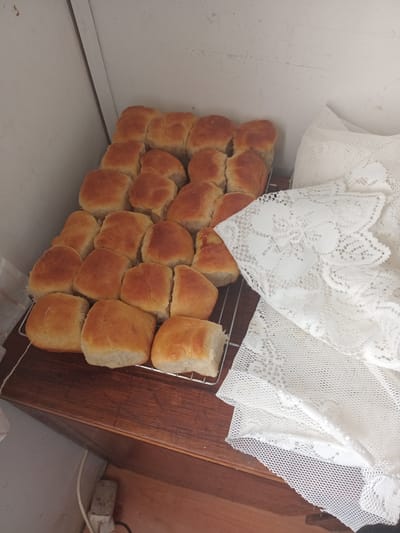
The image shows a metal cooling rack filled with freshly baked bread rolls. The rolls are golden brown and appear to be soft. They are arranged in rows on the rack. To the right of the cooling rack, a white lace tablecloth is draped, partially obscuring the background. The cooling rack rests on a wooden surface, possibly a table or countertop. In the background, a light-colored wall is visible, with a corner where two sections of the wall meet. A white electrical cord with a plug is visible on the floor in the lower left corner, near the wooden surface. The scene appears to be indoors. The image does not provide information about the specific location within Witzenberg Local Municipality, South Africa.
Witzenberg Local Municipality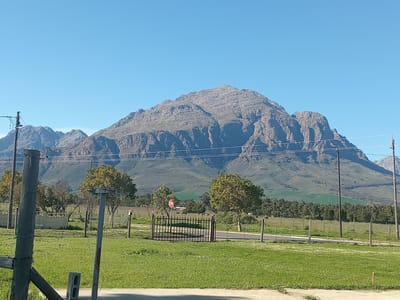
The image depicts a wide, scenic view of a mountainous landscape under a clear blue sky. In the foreground, a vibrantly green, well-maintained grassy field stretches across the frame. A dark metal gate, adorned with vertical bars, stands open in the middle ground, with a red octagonal "STOP" sign positioned above and to the left of it. Beyond the gate, a paved road curves through the landscape, bordered by wooden fence posts and more green fields. Scattered trees, some with sparse foliage and others with full canopies, dot the middle ground, adding depth to the scene. A low, decorative concrete wall runs horizontally behind the gate, further separating the foreground from the middle ground. The background is dominated by a majestic, imposing mountain range, its rugged slopes detailed with rocky outcrops and shadowed crevices. The mountains appear to be covered in a mix of scrub and sparse vegetation, with patches of lighter green indicating cultivated fields or different types of terrain. Power lines are visible crisscrossing the middle and background, supported by tall utility poles. The overall impression is one of a rural or semi-rural environment, likely in a region known for its natural beauty, possibly within the Witzenberg Local Municipality of South Africa, given the characteristic mountainous terrain and vegetation often found in the Western Cape. There are no people or animals clearly visible in the image. The scene appears tranquil and undisturbed, bathed in bright, natural daylight.
Witzenberg Local Municipality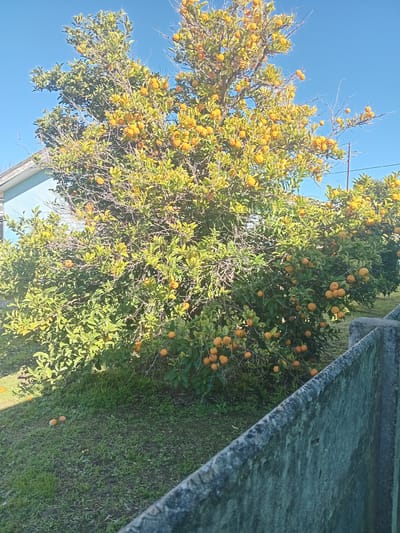
An outdoor scene shows a mature citrus tree laden with ripe orange fruits, positioned on a grassy area. The tree is dense with green foliage and branches, with numerous bright orange fruits visible throughout. Some fruits have fallen to the ground. To the left of the tree, a portion of a light blue building is visible. In the foreground, a textured, grey concrete wall runs diagonally across the frame, partially obscuring the lower part of the tree and the ground. The sky above is a clear, bright blue. The scene suggests a residential or agricultural setting within the Western Cape province of South Africa, possibly in the town of Ceres or one of the surrounding agricultural communities within the Witzenberg Local Municipality, known for its fruit production. There are no people or animals present in the image.
Witzenberg Local Municipality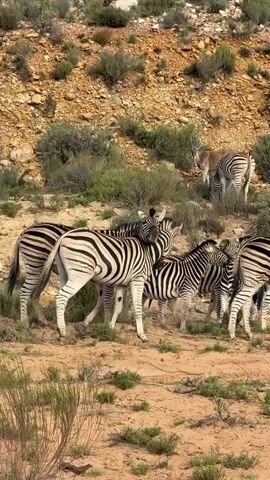
A herd of zebras, comprising adults and several younger individuals, is seen gathered in a dry, sandy landscape. Many of the zebras have their heads lowered, suggesting they are grazing or foraging. In the background, on a rocky and bush-covered hillside, a single oryx (gemsbok) is also visible, partially obscured by the terrain. The setting is an arid or semi-arid environment with sparse vegetation, under clear daylight, indicative of a sunny day. The animals appear calm and undisturbed. The scene takes place in what appears to be a natural habitat, consistent with the Witzenberg Local Municipality in South Africa. A human voice can be heard in the background.
Witzenberg Local Municipality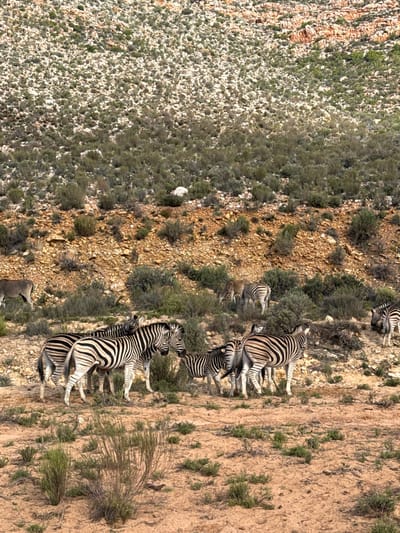
An outdoor, aerial-like view captures a herd of zebras and at least one Oryx in a semi-arid landscape within the Witzenberg Local Municipality, South Africa. The scene is dominated by dry, rocky terrain with sparse, green-grey scrub vegetation. The primary subjects are approximately nine zebras, identifiable by their distinctive black and white stripes, situated on a reddish-brown dirt path or slope that cuts across the mid-ground of the image. The zebras are mostly standing, with some appearing to graze or rest, while others are more upright. In the lower left section of the frame, a large Oryx (gemsbok) with its characteristic long, straight horns is partially visible, facing towards the left. The landscape features a rugged, stony hillside covered in light-colored rocks and low bushes on one side of the path, contrasting with a more sandy, less vegetated slope on the other. The lighting indicates it is daytime, likely mid-morning or afternoon, with clear conditions and visible shadows cast by the animals and topography. The weather appears dry and clear. There is no visible text in the image.
Witzenberg Local Municipality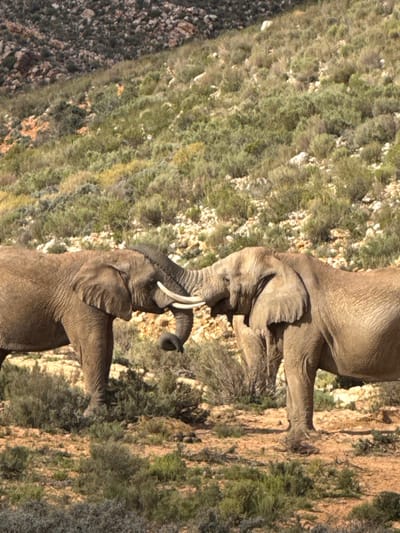
The image, when viewed in its correct upright orientation, captures two African elephants interacting in a rugged, natural environment, likely within the Witzenberg Local Municipality, South Africa. An adult elephant stands prominently in the upper part of the frame, facing left. Its trunk is raised and curled, revealing its long, curved tusks. Below it, a second, slightly smaller elephant stands, also facing left, with its trunk extended upwards. The two elephants appear to be touching trunks, indicating a social interaction, possibly a greeting or bonding moment. The setting is characterized by arid or semi-arid terrain, with sparse, low-lying green and brown scrub vegetation interspersed with rocky patches and exposed soil. A darker, rocky hillside or mountain slope is visible in the background on the left side of the image. The lighting suggests bright daylight under a clear sky, likely late morning or early afternoon. There are no people, man-made objects, or visible text present in the image. The scene portrays a serene moment of wildlife in their natural habitat.
Witzenberg Local Municipality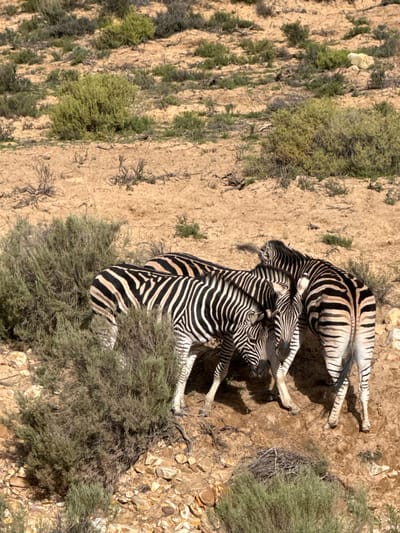
The image captures a group of zebras in a dry, arid, and rocky landscape. At least three distinct zebras are visible, with their iconic black and white striped coats. One zebra appears to be lying down or resting close to the ground, while at least two others stand upright nearby, their heads and upper bodies partially visible. The scene is set on light brown, sandy, and stony terrain, indicative of a semi-arid or desert-like environment. Sparse, low-lying green and brown shrubbery and bushes are scattered across the ground, providing some coverage and contrasting with the light earth. Strong shadows cast by the zebras and vegetation suggest bright, direct sunlight, indicating a daytime setting, likely mid-morning or early afternoon, under clear skies. The composition highlights the zebras against the natural backdrop, conveying a sense of wildlife in its natural habitat. The absence of human elements or structures emphasizes the wilderness. This type of environment and the presence of zebras are consistent with landscapes found in the Witzenberg Local Municipality, South Africa, as specified in the context. There is no visible text in the image.
Witzenberg Local Municipality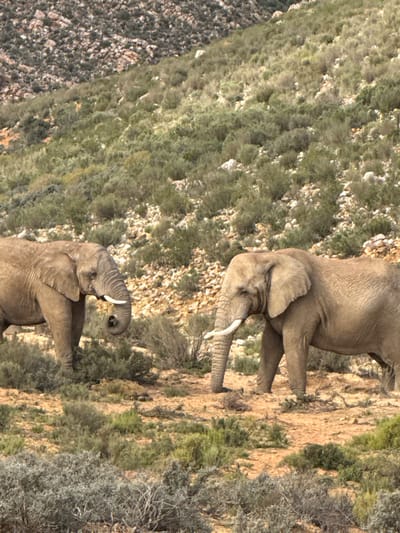
Two African elephants are seen on a rocky, vegetated slope in the Witzenberg Local Municipality, South Africa. The image is oriented vertically, depicting the elephants moving across or up an incline. The elephant in the upper portion of the frame is an adult, mostly visible from its head to its rear flank, with its trunk lowered towards the ground, and discernible tusks. The second elephant, positioned lower in the frame, is partially obscured; its head is raised with its trunk curled upwards. The setting is characterized by a rugged, dry landscape with light brown, rocky soil interspersed with green, scrubby bushes and sparse vegetation. To the left and in the background, the terrain appears more densely rocky and darker in tone. The lighting suggests it is daytime, possibly late morning or afternoon, with soft illumination and no harsh shadows. There is no visible text in the image.
Witzenberg Local Municipality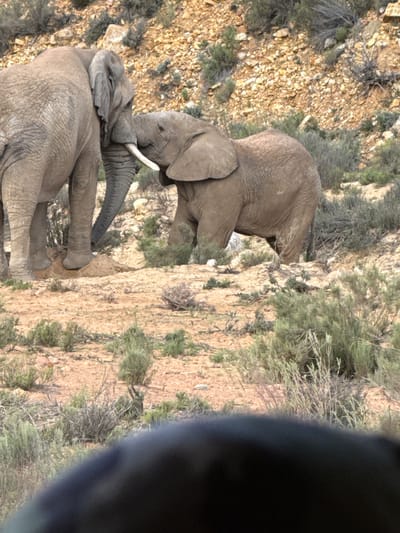
Two elephants are featured in a sunlit, arid landscape, with the image rotated 90 degrees clockwise. The scene depicts a larger, adult or subadult elephant standing over a smaller, younger elephant that appears to be resting or lying down on the rocky ground. Their trunks are interacting, possibly touching or intertwined, suggesting a moment of connection, affection, or play between them. The larger elephant is positioned above and slightly behind the smaller one, which has a visible tusk. The setting is characterized by dry, light-brown, rocky terrain with sparse, green-brown scrub and bushy vegetation scattered across the ground and hillside. The lighting is bright, indicating clear daylight, likely mid-day or early afternoon, with no harsh shadows. A large, dark, out-of-focus object partially obstructs the right side of the frame, possibly a camera component or an object in the immediate foreground of the lens. The environment is consistent with a natural wilderness or reserve area in a dry region, such as the Witzenberg Local Municipality in South Africa. No text is visible in the image.
Witzenberg Local Municipality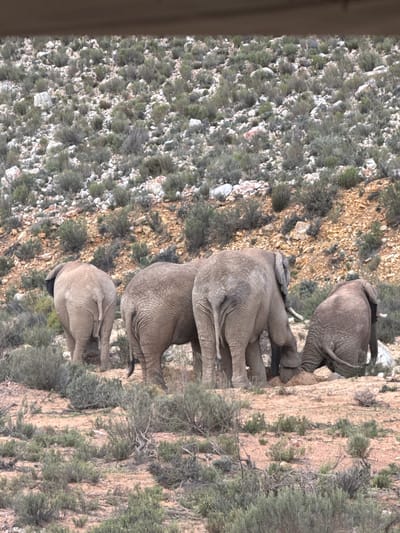
The image, oriented correctly, displays a scene of four African elephants navigating a dry, rocky hillside under natural daylight. The photograph is taken from a slightly elevated perspective, looking down onto the sloped terrain. In the upper right portion of the frame, the hindquarters and tail of a large adult elephant are visible, appearing to ascend the slope. Below and to its left, a second adult elephant is more completely in view, showcasing its wrinkled grey skin, sturdy back, and a visible trunk. Further down the slope, behind the second adult, the back and hind legs of a third, possibly sub-adult, elephant are discernable. Closest to the bottom of the visible group is a small elephant calf, its compact form suggesting it is part of the family unit. The elephants are traversing a rugged landscape characterized by a mix of light-colored rocks, patches of reddish-brown soil, and sparse, low-lying green and brown scrub vegetation. The terrain appears uneven and somewhat challenging, indicative of a semi-arid or rocky mountainous region. The overall environment suggests a natural habitat typical of African wilderness. The time of day appears to be daytime with clear weather conditions, as indicated by the natural light. There are no people or artificial objects apart from a dark, blurry band on the far left edge of the original image, which might be part of a vehicle or viewing platform. No text is visible in the media file. The elephants seem calm, moving deliberately across their habitat in Witzenberg Local Municipality, South Africa.
Witzenberg Local Municipality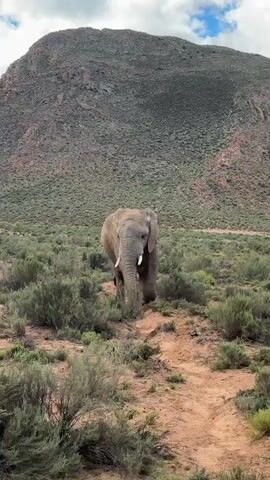
The video shows an elephant standing in a grassy area, with a large mountain in the background. The elephant is facing the camera and standing on a dirt path. The sky is cloudy with patches of blue. The elephant appears to be calm.
Witzenberg Local Municipality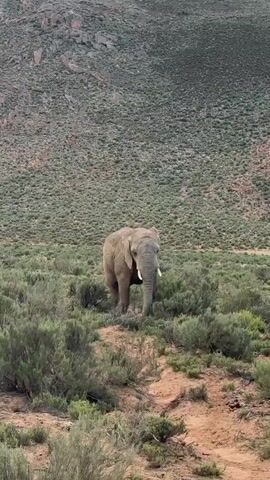
The video features a large adult African elephant, the primary subject, walking slowly and steadily towards the camera through an open, natural landscape. The elephant possesses prominent tusks and large, fanned ears. Its skin is textured and appears dusty, blending with the muted green and brown tones of the environment. The setting is characterized by low-lying, sparse scrub bushes and patches of reddish-brown earth. In the background, gently rolling hills or mountains, also covered in similar vegetation and exposed rocky outcrops, complete the scene. The overall impression is that of an arid or semi-arid region. The elephant continues its approach, pausing briefly to look towards the camera before continuing to walk. The activity is simply the elephant's movement through its habitat, observed from what appears to be a stationary vehicle or elevated position. Notable details include the natural light, indicating daytime conditions, possibly morning or late afternoon, or an overcast sky, as shadows are not harsh. The weather appears calm. The location cues, such as the elephant species and the sparse vegetation, are consistent with the provided context of Witzenberg Local Municipality, South Africa, a region known for its natural reserves and landscapes. The elephant appears calm and undisturbed throughout the recording. There is no visible text in the media file.
Witzenberg Local Municipality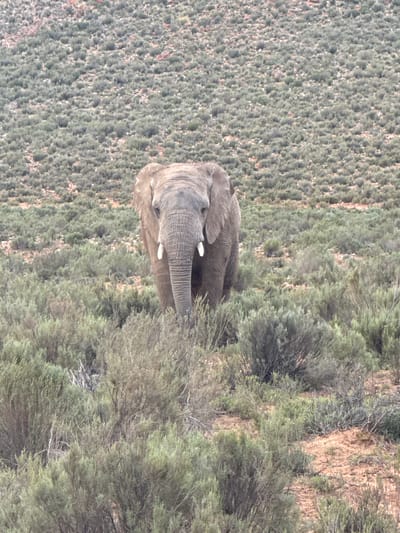
An African elephant stands prominently in a natural, bushy landscape, captured in a full-length, slightly elevated shot. The elephant, which appears to be greyish-brown with textured, wrinkled skin, is positioned slightly off-center to the right. Its trunk is lowered towards dense green vegetation, suggesting it might be grazing or browsing. Two visible tusks, one more prominent than the other, protrude from its face. Its eye is visible, and one large ear is partially obscured by its body and the surrounding foliage. The background consists of extensive, undulating terrain covered in dense, low-lying green and grey-green scrub or bushland, characteristic of a savanna or semi-arid region. Patches of reddish-brown earth or rock are visible between the vegetation, particularly towards the upper right and in the distant background, indicating dry conditions. The lighting is soft and natural, suggesting it is daytime, possibly late morning or afternoon, with no harsh shadows visible. The overall scene conveys a calm, natural environment, likely within a wildlife area. No human subjects or text are visible in the image. The setting aligns with the provided context of Witzenberg Local Municipality, South Africa.
Witzenberg Local Municipality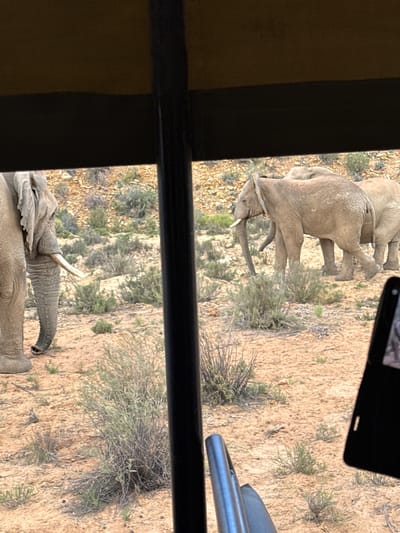
This high-angle image, rotated 90 degrees clockwise, captures a group of African elephants in a dry, semi-arid landscape, likely observed from an elevated safari vehicle. The foreground prominently features the head and trunk of a large elephant with visible tusks, with the upper part of another elephant behind it. In the upper section of the image, two more elephants are present; one appears to be an adult, and another, smaller individual walks behind it. The elephants are a light grayish-brown color and seem to be moving or foraging. The scene is set on sandy, light brown ground dotted with rocks and sparse vegetation, including green and dried scrub bushes. This arid environment is characteristic of the Witzenberg Local Municipality in South Africa, where the image was captured. The viewing perspective is from above, through what appears to be a vehicle's opening. Dark structural elements, possibly a window or door frame and a vertical support, are visible on the left side, with a silver metal rail on the right. In the upper right corner, a hand is visible holding a dark mobile phone, suggesting the photograph was taken by a person within the vehicle, potentially also recording the scene with their phone. The bright, even lighting indicates it is daytime, under clear weather conditions. The image conveys a close-up wildlife viewing experience. No text is visible in the image.
Witzenberg Local Municipality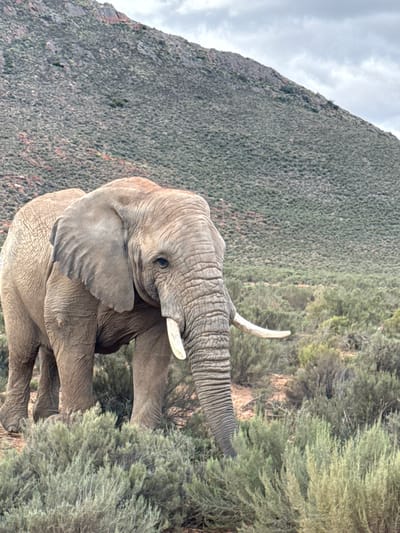
An African elephant is depicted standing in a natural, rugged landscape. The adult elephant, with its distinctive grey, wrinkled skin, prominent tusks, and large ears, is positioned facing towards the right side of the frame. Its trunk is raised and extended towards a dense thicket of light green bushes located to its right, suggesting it is foraging or investigating the vegetation. One tusk is clearly visible, curving upwards, while an eye is also discernible, conveying a calm and focused demeanor. In the background, a steep, rocky mountain or hill rises dramatically, covered in sparse, scrubby green vegetation that blends with the earthy tones of the rock. The sky above is overcast with soft, diffused clouds, indicating a cloudy daylight scene. The ground beneath the elephant and around the base of the mountain is also covered in similar low-lying green flora. No human figures or man-made objects are visible, emphasizing the wild nature of the setting. There is no visible text in the image. The scene is consistent with wildlife found in the Witzenberg Local Municipality, South Africa.
Witzenberg Local Municipality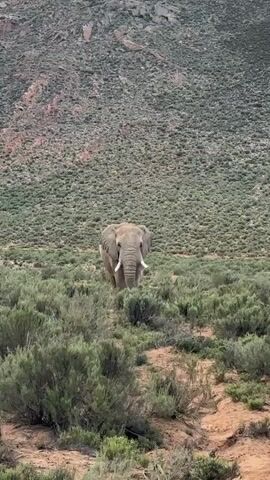
An African elephant stands prominently in the center of a semi-arid landscape, facing directly towards the viewer. The elephant has large tusks curving upwards and outwards, and its ears are slightly fanned. It is mostly still, with only minor head movements. The setting is characterized by sparse, greenish-brown scrubland and bushes covering rolling terrain. In the background, a large, rocky mountain or hill, covered in similar low-lying vegetation, rises steeply. The ground visible beneath the bushes is sandy or reddish-brown dirt. The lighting suggests it is daytime, possibly under clear skies. The overall scene conveys a sense of untouched wilderness. No people or visible text are present. The location context indicates this is in the Witzenberg Local Municipality, South Africa.
Witzenberg Local Municipality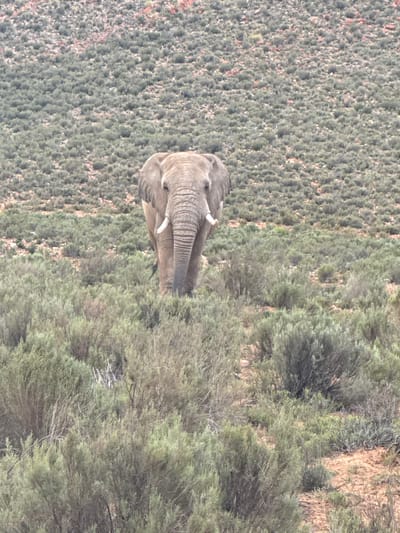
An African elephant is the central subject of this outdoor, natural scene. The large mammal, with its textured grey skin, is positioned towards the left of the frame, partially obscured by dense vegetation. Its head, trunk, and parts of its back and legs are clearly visible, with one prominent tusk extending forward. The elephant is situated in a landscape dominated by a vast expanse of low-lying, bushy vegetation, characterized by shades of green and brownish-green, indicative of shrubs and small trees. Scattered patches of reddish-brown earth are visible among the foliage, suggesting dry ground or specific soil types. A denser grouping of taller, perhaps older, trees and bushes occupies the right side of the image, offering a slight variation in the vegetation density. The overall setting appears to be a savanna or bushland environment. The activity depicted is the elephant standing or slowly moving through its natural habitat. The scene is brightly lit by natural daylight, suggesting clear weather conditions. There are no visible people or artificial structures. The image portrays a tranquil moment of wildlife in an undeveloped natural area, consistent with the location context of Witzenberg Local Municipality, South Africa. No text is visible within the image.
Witzenberg Local Municipality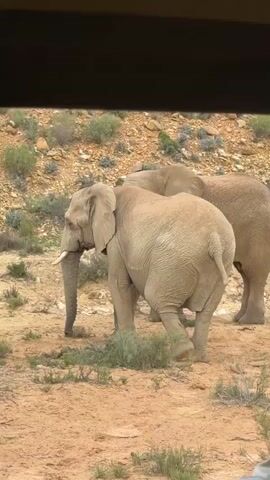
The video captures a close-up view of two elephants in a dry, open landscape, framed as if seen from inside a vehicle. The primary subject is an elephant on the left, shown from its side, with its trunk subtly curved downwards and small tusks visible. It appears to be walking slowly or standing still. Partially obscured by the first elephant, a second elephant is visible mostly from behind on the right, also seemingly standing or moving gently. Both elephants exhibit light grey-brown, dusty, and wrinkled skin. The surrounding environment consists of reddish-brown soil, scattered rocks, and sparse, low-lying green shrubs, indicative of an arid or semi-arid region. The bright, clear lighting suggests it is daytime. The scene evokes a wildlife observation, consistent with a safari or game drive in the Witzenberg Local Municipality, South Africa. No visible text is present in the frame.
Witzenberg Local Municipality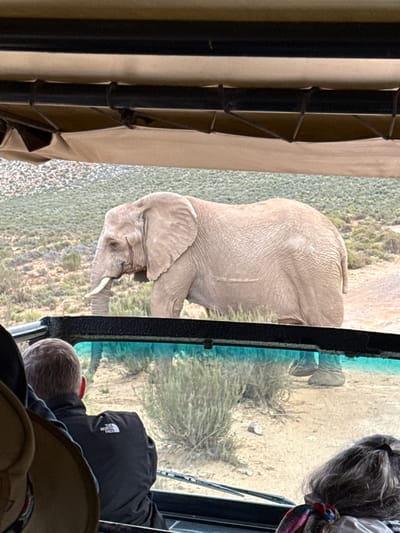
An African elephant stands very close to a safari vehicle, observed by several people. The scene unfolds in a natural, dry environment with sparse vegetation, indicative of a wildlife reserve or open grassland, specified as Witzenberg Local Municipality, South Africa. The large elephant, with its characteristic wrinkled, grey skin, is positioned beside the vehicle, with its head and one tusk clearly visible. It appears to be standing or subtly moving, possibly foraging. The perspective is from inside the safari vehicle, looking out through a large window or viewing panel. Multiple human observers are seen from behind, looking towards the elephant. One person in the foreground is leaning forward, engrossed in the sighting. The interior of the vehicle shows structural elements like dark vertical bars and a beige canvas or fabric roof/covering. The lighting suggests it is daytime with clear weather. A notable detail is the white "THE NORTH FACE" logo visible on the back of a black jacket worn by one of the people in the vehicle.
Witzenberg Local Municipality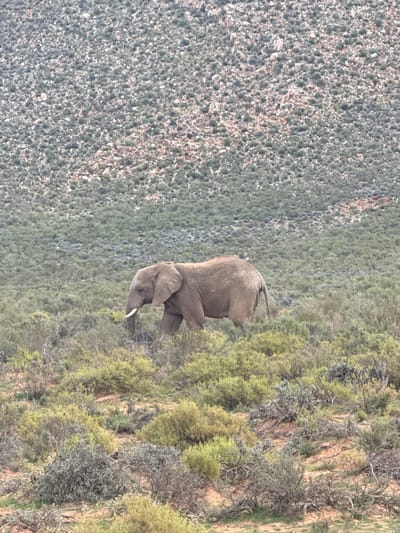
An African elephant is depicted in a natural, wild landscape, characteristic of the Witzenberg Local Municipality in South Africa. The image is oriented vertically (when viewed upright, the elephant is walking across the frame from left to right, situated on the right side). The elephant, with its distinctive large, greyish-brown hide and prominent ears, is seen with its head slightly lowered, and one tusk clearly visible. Its body is angled, suggesting it is either walking or pausing to browse. The surrounding environment is a rugged, arid-looking terrain covered extensively with diverse vegetation. There are dense patches of dark green bushes and lighter green scrub, interspersed with areas of reddish-brown soil and rocks, hinting at a dry, possibly rocky, hillside. In the distance, a similar landscape of sparse vegetation extends to the left. The lighting indicates it is daytime, with an even spread of natural light and no harsh shadows, suggesting clear weather. There are no visible people, man-made objects, or discernible text within the image, reinforcing the untouched wild setting.
Witzenberg Local Municipality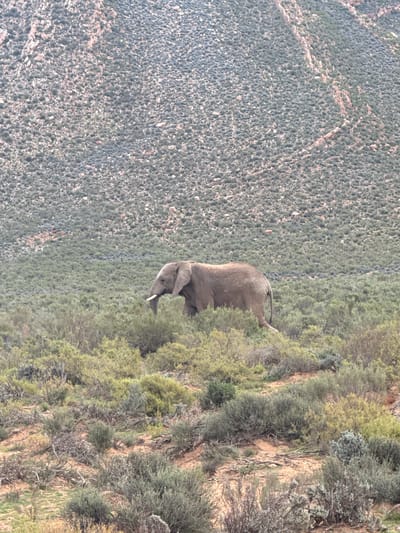
An African elephant stands partially obscured by dense, scrubby vegetation on a hillside. The elephant, oriented towards the right, has its head lowered, suggesting it is grazing or foraging. Its grey hide blends with the earthy tones of the surroundings. A tusk is visible, curving slightly downwards from its head. The scene depicts a rugged, mountainous landscape, likely within the Witzenberg Local Municipality of South Africa, as suggested by the context. The foreground and midground are covered in various shades of green and grey-green bushes and small trees, with exposed patches of reddish-brown earth and rocks. Beyond the immediate slope where the elephant stands, a vast expanse of similar, densely vegetated mountainous terrain stretches into the distance, appearing somewhat hazy. The image is captured during the daytime under natural light, with no extreme shadows, indicating a clear day. No human activity or visible text is present. The overall impression is one of wild, untamed nature, typical of a South African wilderness area.
Witzenberg Local Municipality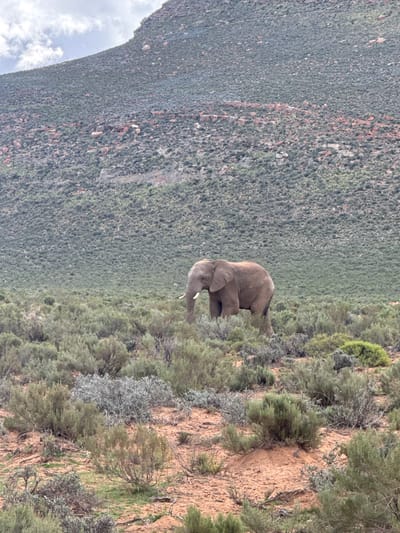
This image presents a natural landscape featuring a lone elephant in a mountainous, vegetated region. The adult elephant, with a light grey-brown hide and visible tusks, is positioned on a sloping hillside covered in dense, low-lying green and greyish-green scrub and bushes. The ground beneath the vegetation appears to be a reddish-brown soil. The elephant is captured in profile, facing towards the left of the frame, with its trunk slightly lowered, suggesting it is either moving through the brush or possibly grazing. The immediate foreground and midground consist of this bushy terrain. In the background, a large mountain range dominates the scene, stretching across the frame. These mountains are uniformly covered in dense, dark green vegetation, appearing rugged and expansive. A portion of the sky, with white clouds, is visible in the upper left corner, indicating daytime conditions with overcast or soft lighting. The scene depicts a wild environment typical of parts of South Africa, specifically within the Witzenberg Local Municipality, showcasing the region's unique blend of shrubland and mountainous topography inhabited by large wildlife. There is no visible text in the media file.
Witzenberg Local Municipality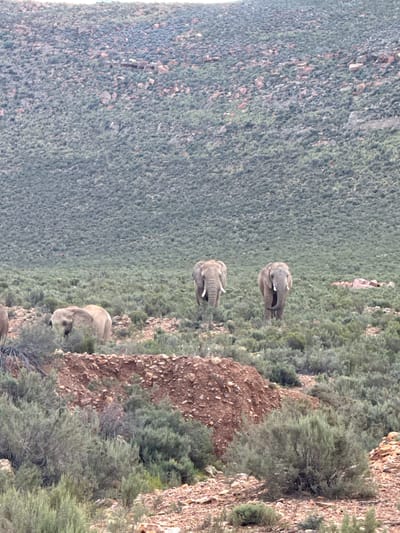
The image depicts a natural landscape featuring at least three elephants in a rugged, vegetated environment. The scene is dominated by a vast expanse of green, low-lying shrubbery and sparse trees covering rolling hills or mountains in the background and midground. Closer to the foreground and along the right side, there are prominent sections of reddish-brown rocky terrain and exposed earth. Three elephants are visible. One is positioned in the immediate foreground, partially cropped at the bottom. A second elephant is in the midground, facing towards the left side of the frame with its trunk lowered. A third elephant is further back, also facing generally left, appearing to be walking or standing among the dense vegetation. All elephants exhibit the characteristic large ears and grey hide of African elephants. The activity taking place appears to be the elephants moving or standing within their natural habitat, possibly foraging. The scene is calm and undisturbed, with no human presence evident. Notable details include the time of day, which appears to be daylight, likely late morning or early afternoon, given the soft, diffuse lighting and lack of harsh shadows. The weather seems clear and fair. The location cues, such as the type of vegetation and rocky terrain, are consistent with a semi-arid or mountainous region, aligning with the provided context of Witzenberg Local Municipality, South Africa. There is no visible text in the image.
Witzenberg Local Municipality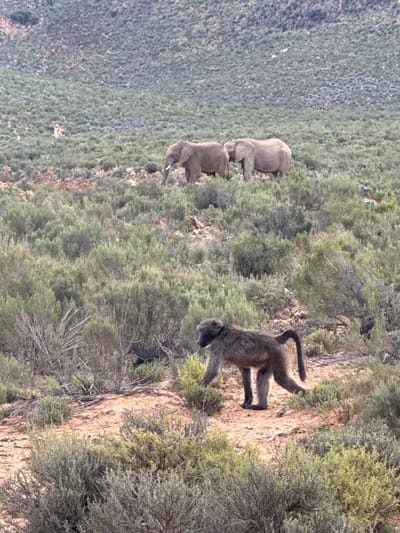
This media file presents a natural outdoor scene featuring wildlife in a rugged, vegetated landscape, likely within the Witzenberg Local Municipality, South Africa. The central subject is a baboon, positioned in the foreground on a reddish-brown dirt path or rocky ground. It is facing towards the right side of the frame, with its head slightly lowered, appearing to be walking or foraging. Its fur displays shades of brown and grey. In the mid-ground, further to the left of the baboon, two elephants are visible. They are partially obscured by dense green and brownish shrubbery and appear to be moving towards the left. One elephant is larger, followed closely by a somewhat smaller individual. The setting is characterized by an extensive area of arid-looking, low-lying green and brown vegetation, including various shrubs and bushes, covering rolling hills or mountainous terrain that extends into the background. The ground is dry and rocky in places. The natural lighting indicates it is daytime, with clear skies. There is no visible text in the image. The scene captures a moment of these animals existing together in their wild environment.
Witzenberg Local Municipality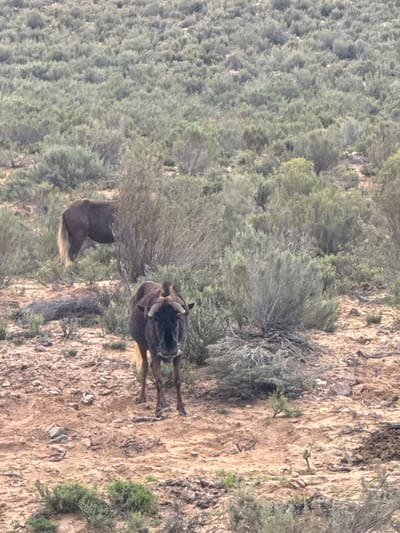
The image, correctly oriented horizontally, captures two large, dark-furred bovids, likely wildebeest, in a natural, arid environment. The scene is divided, with a textured, light brown, rocky hillside or path occupying the right side of the frame, and a dense expanse of green and greyish-green scrub vegetation covering the left side and extending into the background. One bovid stands prominently in the mid-ground, slightly to the right, facing away from the viewer. It displays a dark coat, a shaggy mane or beard, and distinctively curved horns. Its legs are visible on the rocky terrain. A second bovid is partially visible towards the bottom-left, mostly obscured by the surrounding vegetation, with only its dark hindquarters and tail clearly seen. It appears to be facing left, possibly grazing or moving through the dense bushes. The ground is dry, uneven, and covered with rocks and scattered, low-lying plants. The extensive background features a uniform spread of dense, low-growing bushes and shrubs, suggesting a semi-arid biome. The lighting indicates natural daylight, likely late morning or afternoon, with soft illumination. There are no human subjects, man-made objects, or visible text in the image. The setting is a wild, natural landscape consistent with the Witzenberg Local Municipality in South Africa.
Witzenberg Local Municipality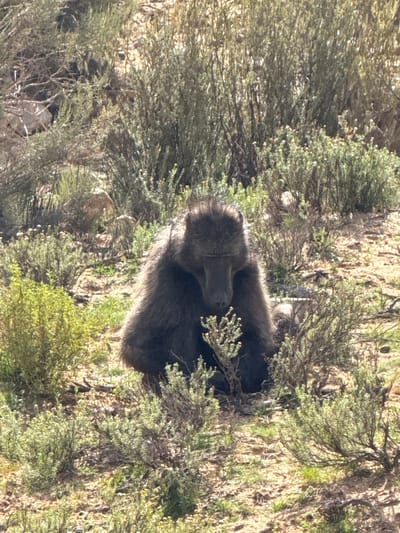
The image captures a full-body view of a large baboon resting within its natural, rugged habitat. The baboon, covered in thick, dark grey and brown fur, is seated among sparse, scrubby vegetation, with its head slightly lowered, giving an impression of calm or contemplation. Its fur appears shaggy, especially around its head and shoulders, catching the bright sunlight which highlights its texture. The scene is an arid or semi-arid landscape, consistent with parts of Witzenberg Local Municipality, South Africa. The ground is a mix of dry earth, rocks, and patches of dry grass. Surrounding the baboon are numerous low-lying bushes and shrubs with light green and brownish foliage, providing both cover and visual texture to the environment. Some taller, slender tree branches are visible in the background, adding to the density of the natural setting. The lighting indicates bright daylight, likely mid-morning or afternoon, with strong highlights on the baboon's fur and clear shadows cast by the vegetation. This natural light emphasizes the details of the environment and the animal. The overall impression is one of a wild animal coexisting peacefully within its harsh yet beautiful environment. There is no visible text in the image.
Witzenberg Local Municipality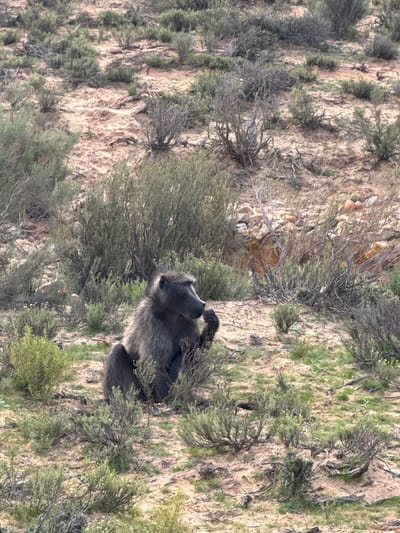
This vertically oriented image captures a baboon in its natural habitat within the Witzenberg Local Municipality, South Africa. The main subject is a dark-furred baboon, likely a Chacma baboon, positioned in the lower right portion of the frame. The baboon is looking upwards and to the left, its head tilted, and its mouth closed. Its body appears relaxed, partially obscured by the surrounding vegetation, suggesting it might be resting or observing its environment. The scene depicts an arid, rugged landscape characterized by light brown, rocky terrain and sparse vegetation. The ground is dotted with numerous rocks and covered with dry, pale grasses and scrub bushes that vary in density, some appearing as small, bushy plants and others as bare, twisted branches. The overall environment suggests a semi-arid, mountainous or hilly region. The lighting indicates it is daytime, with bright, clear sunlight illuminating the scene evenly. No shadows are particularly harsh, implying either an overhead sun or indirect lighting. There are no visible signs of adverse weather conditions. No human activity or objects are present, and there is no visible text in the image. The image provides a glimpse of wildlife thriving in a challenging, natural setting.
Witzenberg Local Municipality