Zaria, Nigeria
30 memories from Zaria, Nigeria
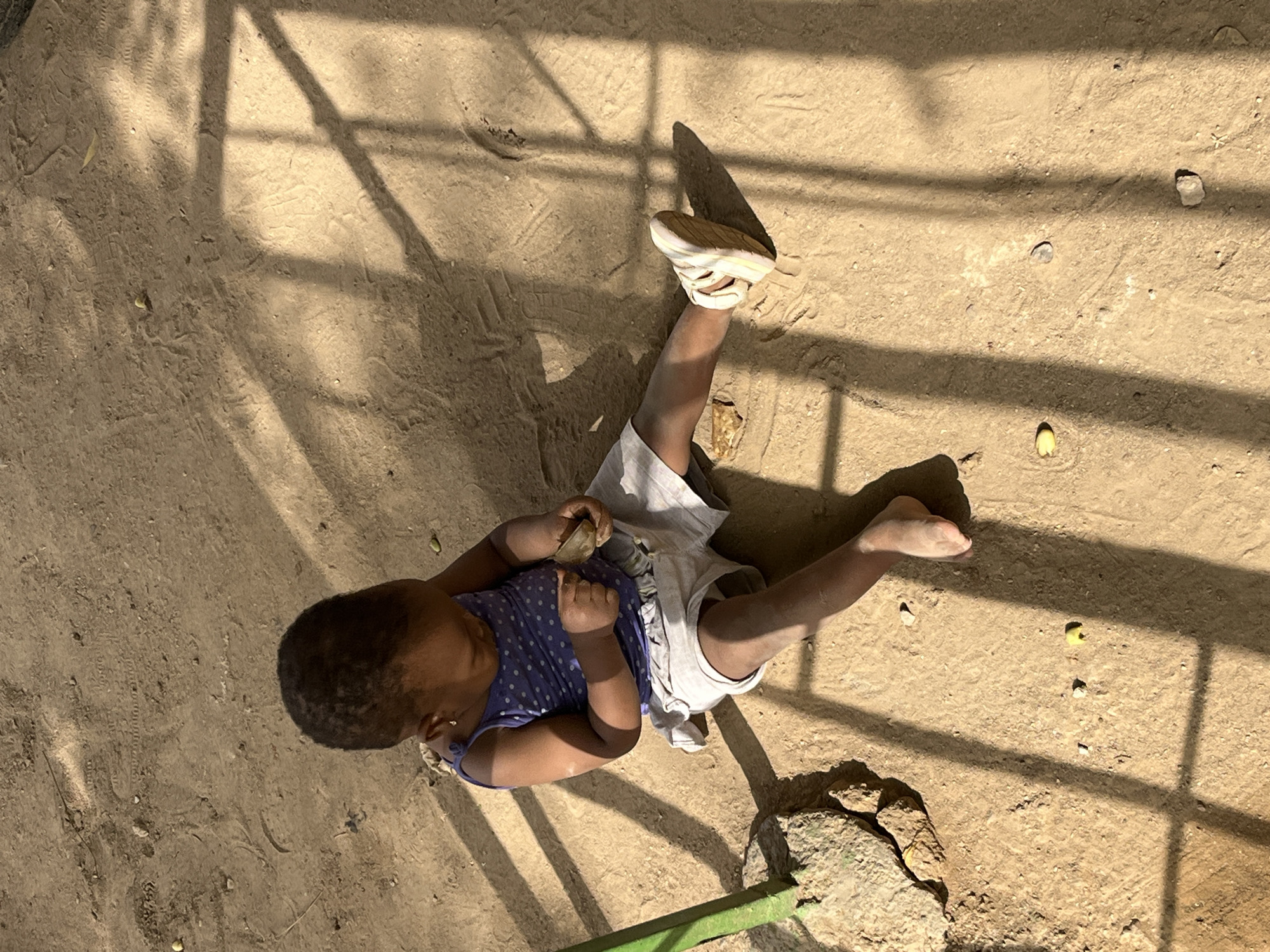
This high-angle outdoor photograph, taken in Zaria, Nigeria, shows a young child lying on a dusty, sandy ground under bright sunlight. The child, with dark skin and short, dark hair, is dressed in a blue or purple polka-dotted top and light-colored shorts. One foot wears a white sandal, while the other is bare. The child appears to be engaged in solitary play, holding a small, irregular, light-brown object (possibly a stone or seed pod) in their right hand, seemingly examining it with concentration. The ground is textured with footprints and small indentations, scattered with small rocks, pebbles, and a few small green or yellowish objects that resemble seeds or nuts. A larger, light-colored rock is visible towards the bottom right, and a segment of a green metal bar or pipe runs along the bottom edge of the frame. Strong, linear shadows from an overhead structure, possibly a fence or lattice, are cast across the ground, indicating bright sunshine and suggesting either morning or afternoon. The scene conveys a sense of calm, simple outdoor play in an unpaved, possibly yard or open area. No text is visible in the image.
Zaria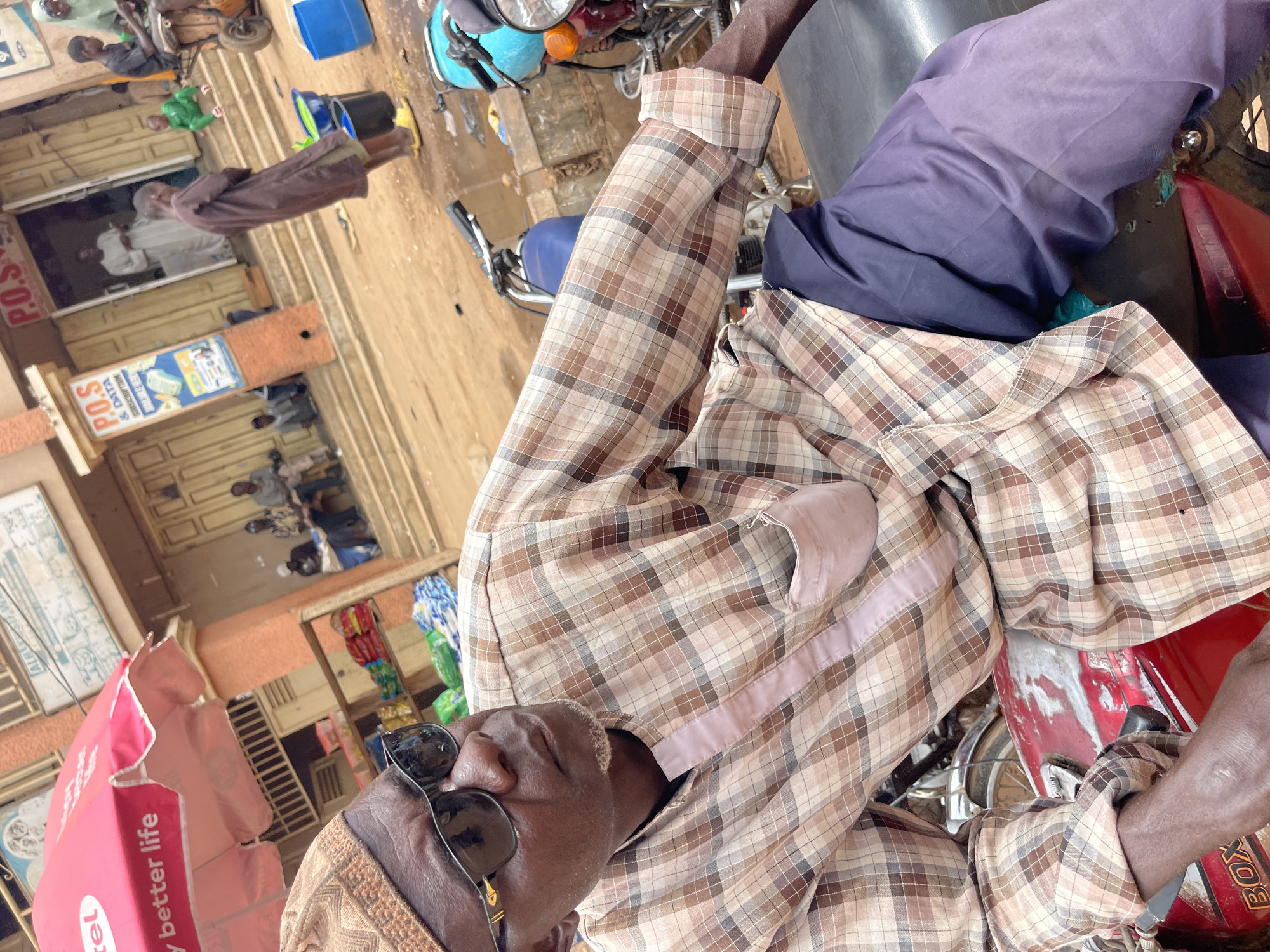
An eye-level, angled view depicts an African man wearing a brown and tan plaid shirt and navy pants, sitting on a red motorcycle. He wears sunglasses perched on his nose, and a tan hat, and his hands are visible on the motorcycle's handlebars. A building with "P.O.S" signs on it is in the background, with people sitting on the porch and inside the building. A red advertisement sign can be seen on the left side of the image. This scene is likely in Zaria, Nigeria, based on contextual clues, but that is not explicitly present in the image.
Zaria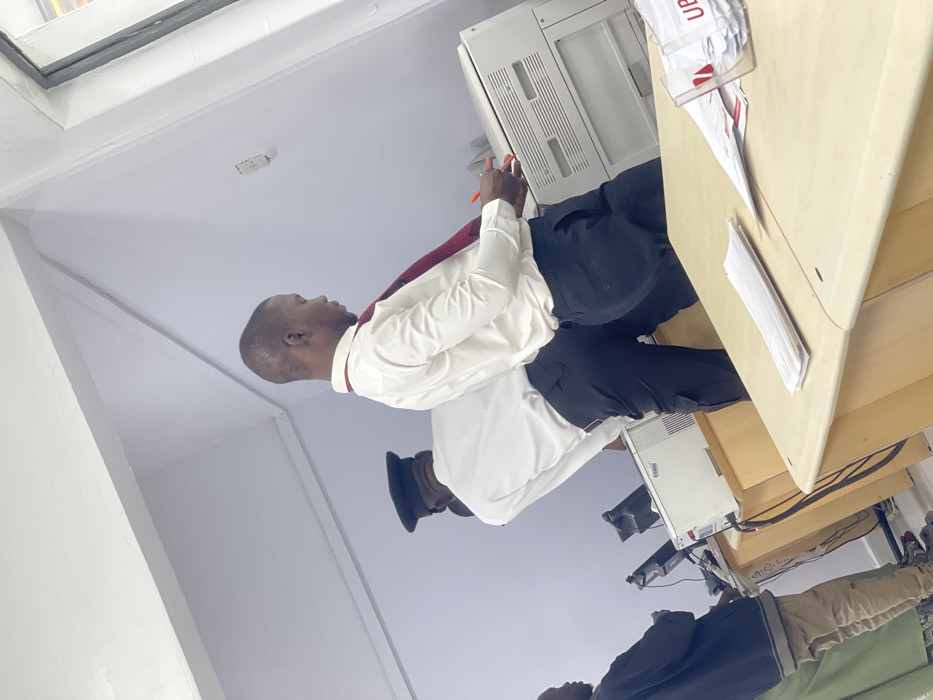
The image depicts an indoor office or administrative area in Zaria, Nigeria. Three individuals are present within a brightly lit space featuring white walls and a light-colored ceiling with visible support beams. In the mid-ground, a male subject with short hair, wearing a white long-sleeve shirt, a dark red tie, and dark trousers, stands with his back partially to the camera, leaning towards a large, light-colored multifunction copier machine. He holds a red pen or marker in his right hand near the copier's control panel. Directly behind him, another male subject, also in a white long-sleeve shirt and dark trousers, wears a dark peaked cap. He is partially obscured and appears to be standing at a workstation with a computer monitor. Further to the left, a third individual, mostly visible from the waist down, wears a dark jacket, a light green garment, and light-colored trousers, standing at another workstation with a computer monitor. The foreground features a light-colored desk or counter with stacks of white papers and a clear plastic holder containing additional papers, with the partial letters "UBE" visible on it. Multiple computer monitors and other office equipment are visible on desks throughout the scene. A white electrical outlet is mounted on the wall to the far right, adjacent to a visible window frame.
Zaria
The video shows a street in what appears to be a town or city in Africa, with many people riding motorcycles. The road is paved but looks dusty, and there are buildings and trees along the roadside. The sky is overcast, suggesting either early morning or late afternoon. People are dressed in various clothing, some wearing traditional attire. There's a mix of motorcycles, and a red three-wheeled vehicle can also be seen. The overall impression is of a busy and active street scene in a developing region.
Zaria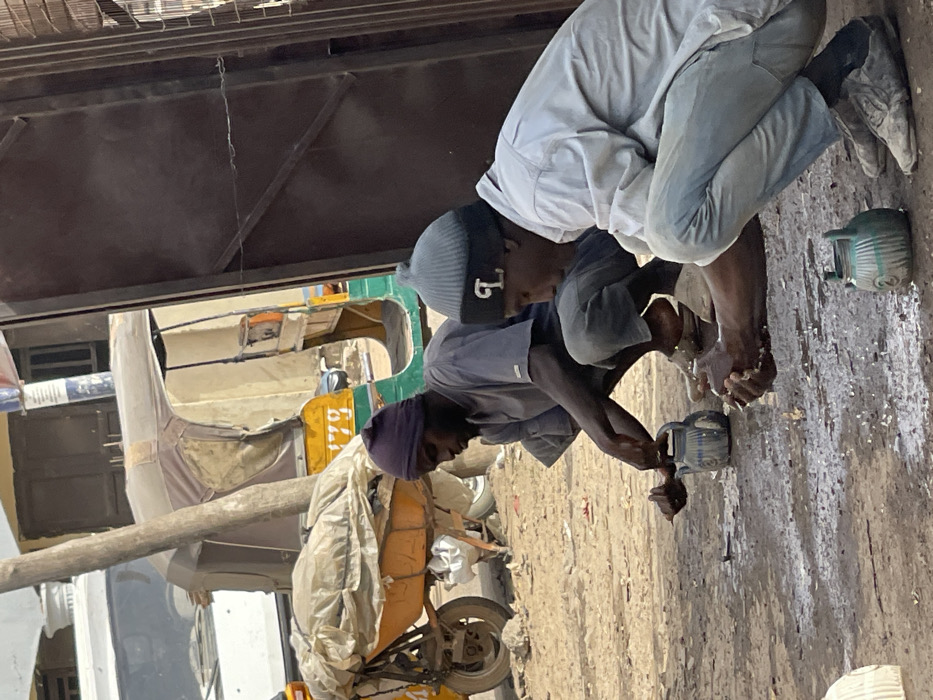
This image captures an outdoor scene in Zaria, Nigeria, featuring two adult males engaged in handwashing on an unpaved, dusty ground surface. White foamy residue and water splashes are visible on the ground directly in front of both individuals. The man positioned on the left, with dark skin, is wearing a dark purple knit beanie, a short-sleeved grey t-shirt, and dark trousers. He is squatting, utilizing his left hand to pour water from a blue, patterned metal kettle onto his right hand, which is held cupped over the ground. The man on the right, also with dark skin, wears a grey ribbed knit beanie with a black band featuring a white 'L' emblem, a light blue long-sleeved button-up shirt, and light-colored trousers. He is also squatting, holding his cupped hands over the ground, appearing to rinse them. A light green, patterned metal kettle rests on the ground in front of him. In the background, a yellow and green three-wheeled auto-rickshaw (Keke Napep) with the number "1770" visible on its side is parked. A white vehicle is partially visible further to the left. A yellow wheelbarrow covered with a white tarp is situated behind the left man. A vertical wooden pole stands in the mid-ground. On the right side of the frame, a dark brown metal gate or door, secured with a wire latch, is visible. Buildings are faintly discernible in the far background. The scene is illuminated by bright daylight.
Zaria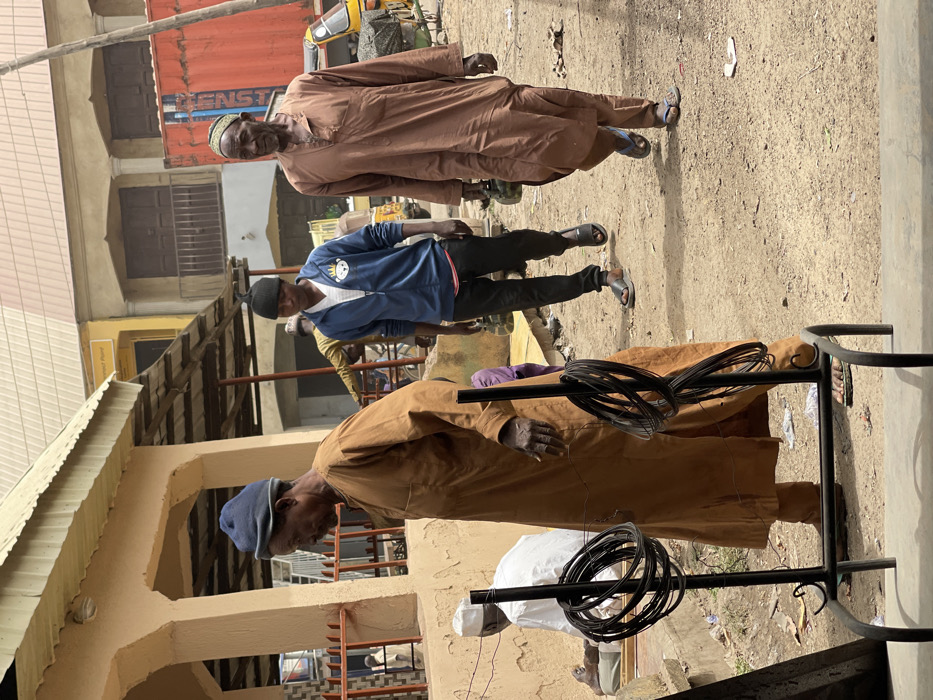
An outdoor scene in Zaria, Nigeria, depicts a busy, unpaved street or market area under daylight conditions. In the left foreground, an older man, wearing a brown long-sleeved traditional garment and a dark blue cap, stands in profile, facing right. He holds a thin object between the fingers of his right hand. Directly in front of him is a black metal display rack holding multiple coils of black wire. To his left and slightly behind, a man in a white garment is seated on a low structure. In the midground, moving from left to right, a younger man walks, wearing a blue zip-up hoodie with a white v-neck shirt underneath, black pants, and black slides. He also wears a black beanie with a knot at the top. To his right, an older man walks in the same direction, dressed in a light brown long-sleeved traditional garment and a patterned green and yellow cap. He wears blue flip-flops and carries two green, possibly plastic, containers in his left hand. The ground is predominantly dirt or dusty earth, with scattered debris including white litter. Buildings line the background, featuring a mix of painted structures, some with corrugated metal roofs. A yellow tricycle (Keke Napep) is visible in the far right background, adjacent to a large red shipping container. The architecture suggests a commercial or residential district.
Zaria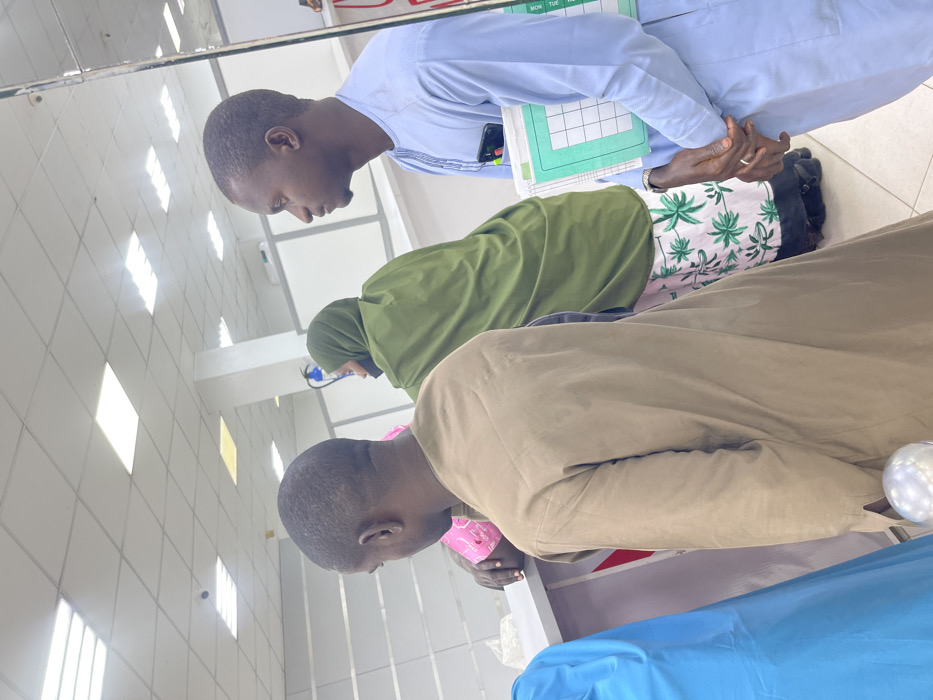
The image depicts an indoor public service facility, possibly in Zaria, Nigeria, characterized by white walls, a white ceiling with square panels, and evenly spaced fluorescent lighting. A black security camera is visible on the ceiling in the upper left. Three individuals are primarily visible, along with a partial view of a fourth. From left to right: 1. A person in a light blue garment is partially visible, facing right, near a grey-topped counter. 2. A male individual stands with his back to the camera, wearing a light brown, long-sleeved tunic. He leans slightly over the grey counter, with his right arm bent at the elbow and resting on its surface. 3. A female individual stands behind the counter, positioned with her back mostly to the camera, but slightly turned towards the right. She wears a dark olive green hijab covering her head and shoulders, and a white skirt with a repeating green leaf pattern. A pink object is held in her visible right hand. 4. A male individual stands in profile on the right, facing right. He has short dark hair and wears a light blue traditional tunic with embroidered details on the chest. He holds a light green-bordered notebook or folder tucked under his left arm. A dark-colored smartphone is partially visible in a pocket on his right side. His hands are clasped in front of him. All individuals are standing. The environment suggests a waiting area or a service point. A reflective surface, possibly a mirror or glass partition, is present on the far right edge of the frame. A silvery, spherical object is visible at the bottom center of the image.
Zaria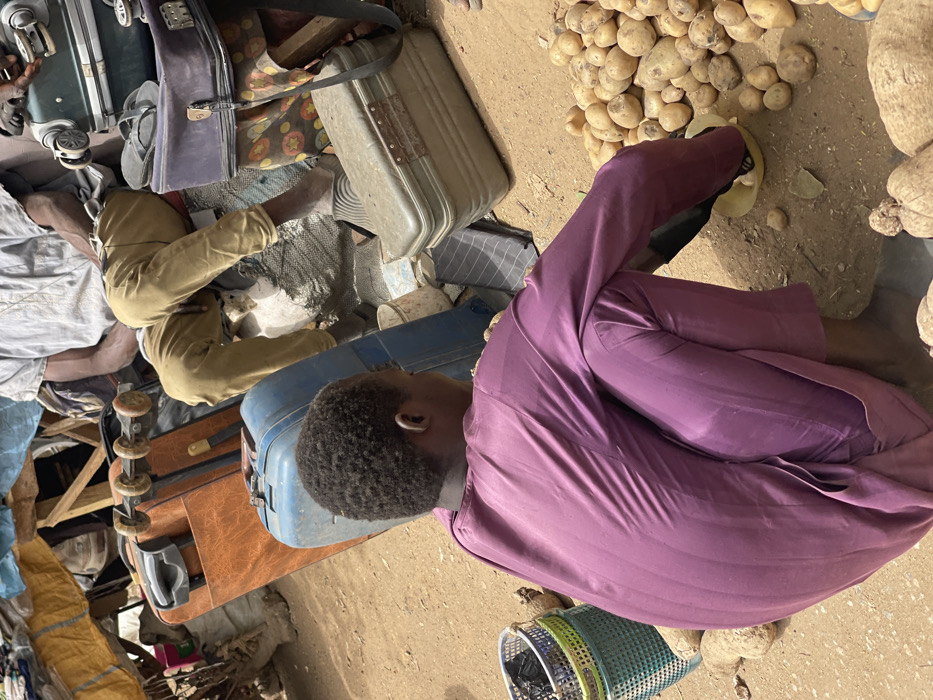
This image depicts an outdoor market scene in Zaria, Nigeria. In the foreground, a person with dark, short curly hair is squatting, viewed from behind, wearing a long-sleeved purple garment with subtle vertical stripes. This individual is positioned next to a pile of light-skinned potatoes or similar tubers on the sandy, dirt ground and appears to be handling or sorting them into a small yellow bowl. To their left, stacked light blue and lime green plastic baskets are visible. In the mid-ground, behind the squatting figure, several pieces of luggage are stacked. These include an upright orange-brown wheeled suitcase, a light blue suitcase, a dark purple suitcase with a grey flip-flop resting on it, and a partially visible dark green suitcase. A rectangular, olive-green container with a latch is on the ground to the right of the purple-clad person. Further back, partially obscured, a second person is seated, wearing a light-colored, possibly striped shirt and khaki pants. Their bare feet and a dark slide sandal are visible. The background reveals a makeshift shelter structure composed of wooden poles and draped tarpaulins or fabrics in blue and orange hues. The ground is consistently a reddish-brown dirt.
Zaria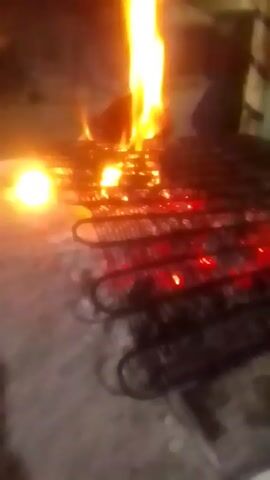
The video shows a metal rack or grid on fire. The flames are bright orange and yellow, with some areas glowing red underneath the metal. The rack is sitting on a concrete surface, and the background is dark, suggesting it is nighttime. There are some blurry lights visible in the distance, but they are out of focus. There are no people visible in the frame. The focus is mainly on the fire and the metal rack.
Zaria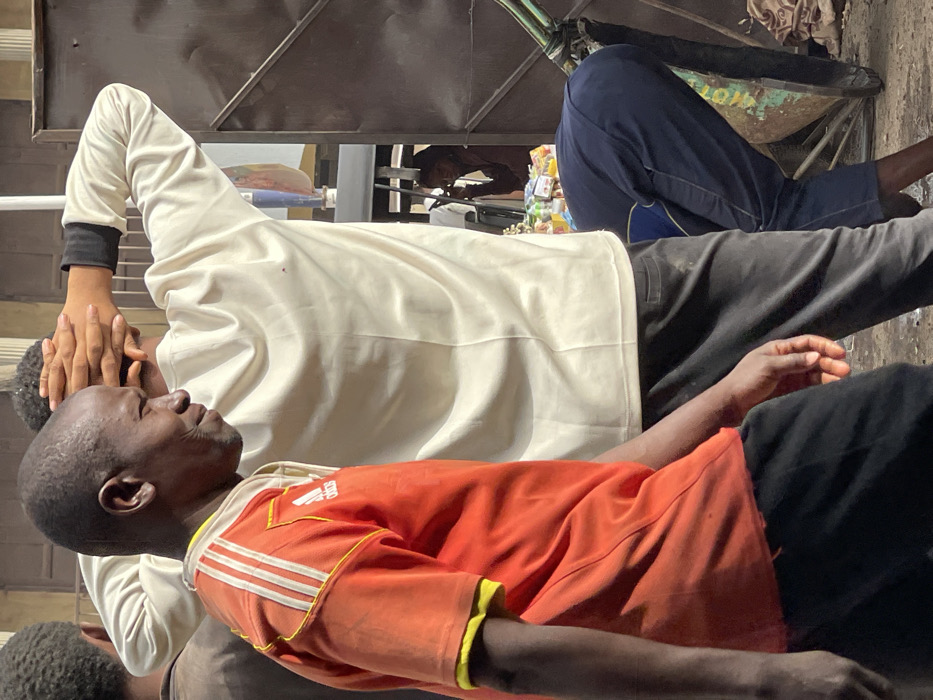
Two men are sitting in close proximity. One wears an orange shirt with white stripes on the shoulders and black shorts. The second man behind him wears a white long-sleeved shirt with a black wrist cuff and dark gray pants. The back of his head and hand are visible over the first man's head. The men appear to be in a transport vehicle or cart with various items in the background. The image is rotated slightly.
Zaria
A low-angle shot displays a street scene during daylight. A group of men are scattered around a dirt patch in the middle of the street. One man is kneeling and working on something on the ground. Another man in a white robe and cap is holding a trowel. A tricycle is parked in the background. People walk across the foreground. The background features buildings and other street activity. The ground is a mix of dirt and concrete.
Zaria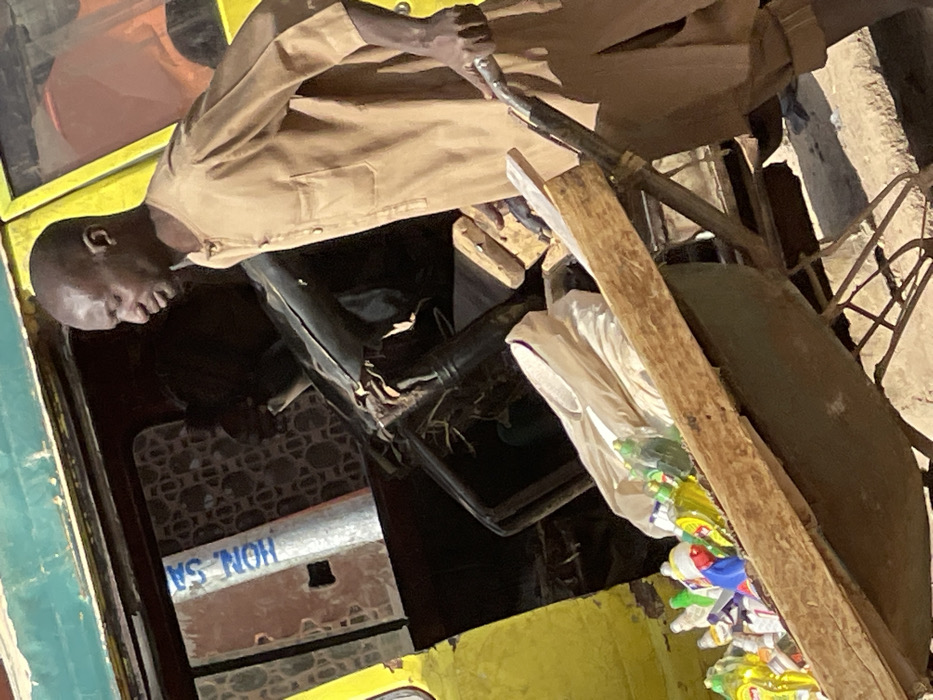
A bald male, dressed in a light brown tunic, pushes a metal wheelbarrow laden with numerous plastic bottles containing various colored liquids and white plastic bags. His right hand grasps the wheelbarrow handle as he moves leftward. In the background, a yellow and green vehicle, likely a bus or large van, displays an open interior with a dark steering wheel, a damaged seat, and a reflective pole inscribed with "HON-SA" in blue text. An obscured individual is visible within the vehicle's interior. The ground is dusty and uneven. The scene is located in Zaria, Nigeria.
Zaria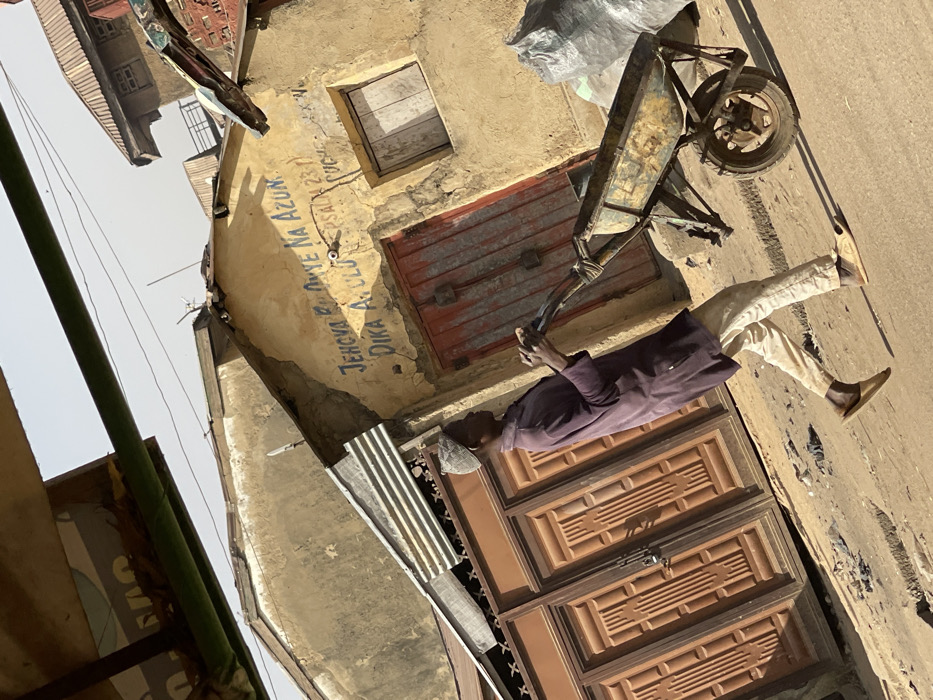
In Zaria, Nigeria, an outdoor scene depicts a male subject walking from left to right, pushing a metal wheelbarrow containing a grey bag. The man wears a light-colored cap, a dark purple long-sleeved tunic, light-colored trousers, and light brown slip-on sandals. He is positioned on an uneven, unpaved surface under direct sunlight, indicated by strong shadows. Behind the subject, a series of weathered buildings are visible. The central building features light tan or yellowish stucco walls with visible peeling and cracks. Its facade prominently displays faded blue text: "JEHOVA BU ONYE NA AZUN", "DIKA A.ULU", and "PSALM 23:1". This building has a distressed, double-leaf, red-painted wooden door with vertical panels and a small, boarded-up window to its right. To the left of the central building, a large set of paneled brown double gates, secured with a padlock, is partially visible. Corrugated metal sheets are affixed above these gates, serving as a rudimentary awning or roofing extension. Additional building structures with corrugated metal roofs are discernible in the background. The sky is hazy light blue, and overhead, thin wires and a partial view of a green structural element are present in the upper frame. The entire image has a slight diagonal tilt.
Zaria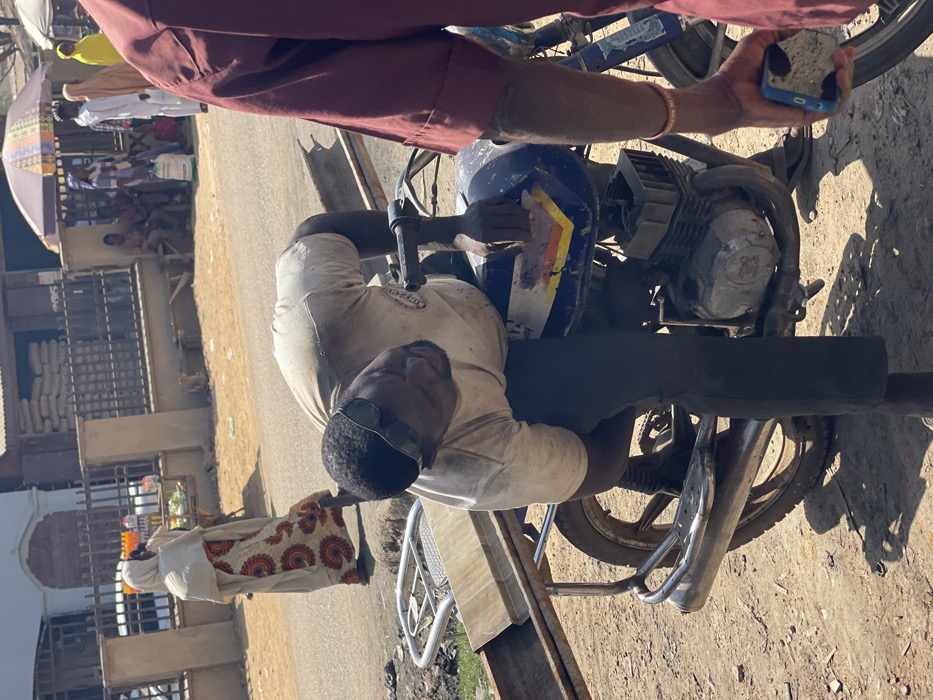
The image depicts a street scene in Zaria, Nigeria, under bright daylight. In the immediate foreground, a dark-skinned male, wearing a dirty white short-sleeved t-shirt, dark trousers, and sunglasses pushed onto his forehead, is bent over a blue motorcycle. His left hand is positioned on the motorcycle's fuel tank area, which exhibits wear and a partial white, yellow, and blue stripe design. The motorcycle has a visible engine block and exhaust pipe, and a metal rack on its rear carrying a rectangular light-colored object, possibly a piece of wood or metal. To the right, only the torso and arm of another individual, wearing a maroon long-sleeved garment and holding a blue smartphone with a patterned case, are visible. The ground is dusty and unpaved in the foreground. In the midground, a paved road stretches across the frame. A woman dressed in a cream-colored hijab and a patterned long dress with orange, black, and white motifs walks away from the camera on the road. To the left of the road, a small vendor's cart with various bottled items is visible next to a black metal fence. The background features a building with a light-colored facade, in front of which large sacks are stacked, likely containing grain or cement. Further behind, under a multi-colored striped umbrella, a group of individuals are seated and standing. Several other people, including women in hijabs and men in traditional attire, are visible walking or standing in the distance, suggesting a busy urban or market environment.
Zaria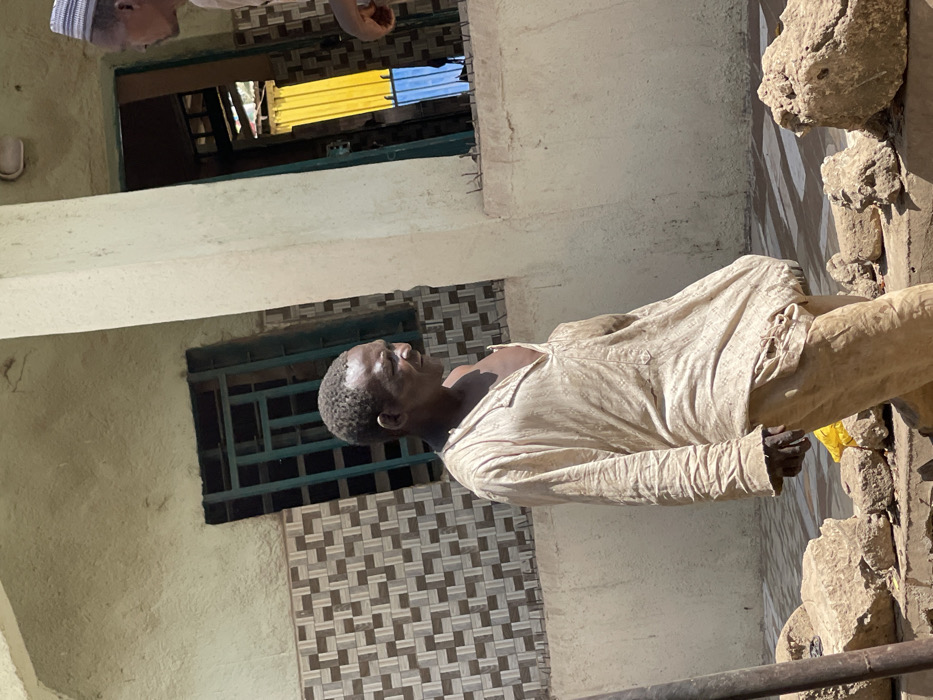
The image depicts an outdoor scene in Zaria, Nigeria, featuring two adult males against a building facade. The primary subject, a male with dark skin and short, dark hair, is positioned slightly right of center, facing right in profile. He wears a light-colored, long-sleeved tunic, open at the neck, revealing his chest, and light-colored trousers. His expression is neutral. To the far right, partially visible, is a second male wearing a light-colored cap and holding a reddish-brown object in his hand. The background consists of a light-colored building wall with a lower section featuring patterned brown and off-white geometric tiles. Two window or door openings are present: one on the left with dark green metal grilles, and another on the right revealing a vibrant yellow structure and a blue surface deeper inside. A light-colored structural pillar separates the two individuals. The foreground is an unpaved, uneven surface with several large, irregularly shaped earth clods or rocks and a partially visible yellow object. The scene is brightly illuminated by direct sunlight, casting distinct shadows.
Zaria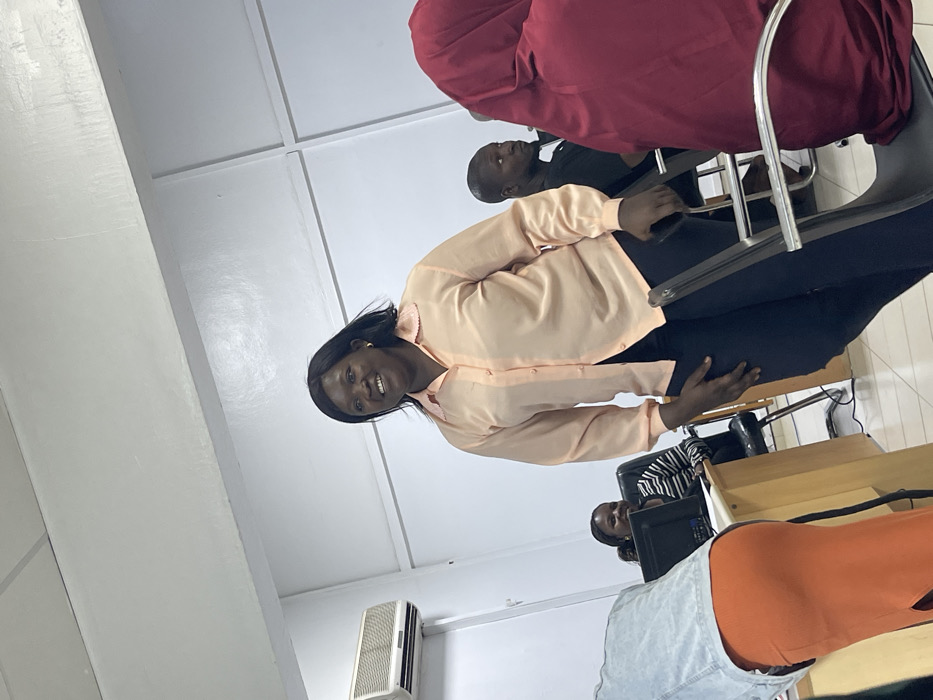
The scene depicts an indoor gathering of several individuals in a brightly lit room. The location is specified as the City of Zaria, Nigeria. A dark-complexioned adult female, with dark hair, stands prominently in the mid-ground, slightly off-center to the right. She is wearing a light peach-colored long-sleeved button-up shirt with a ruffled collar and dark trousers. Her expression is a broad smile, and she is looking towards the left side of the frame. Her right hand rests on the back of a black office chair. To her left, partially obscured by a light blue denim jacket and an orange skirt worn by a person in the immediate foreground, a dark-complexioned female is seated at a light brown wooden desk. This seated female, wearing a black and white striped shirt, is also smiling and looking towards the left, with a black computer monitor visible on the desk in front of her. To the right of the central standing figure, a dark-complexioned male with short hair is partially visible, seated in a dark shirt, also looking towards the left. In the extreme foreground on the right, the back and right side of a person wearing a maroon head covering and garment are visible, seated on a black chair. The room features plain white walls, a white ceiling with visible trim, and a light-colored tiled floor. A white wall-mounted air conditioning unit is present on the upper left wall. Several black office chairs with metal frames are visible throughout the space. The overall environment suggests an office, classroom, or meeting room setting.
Zaria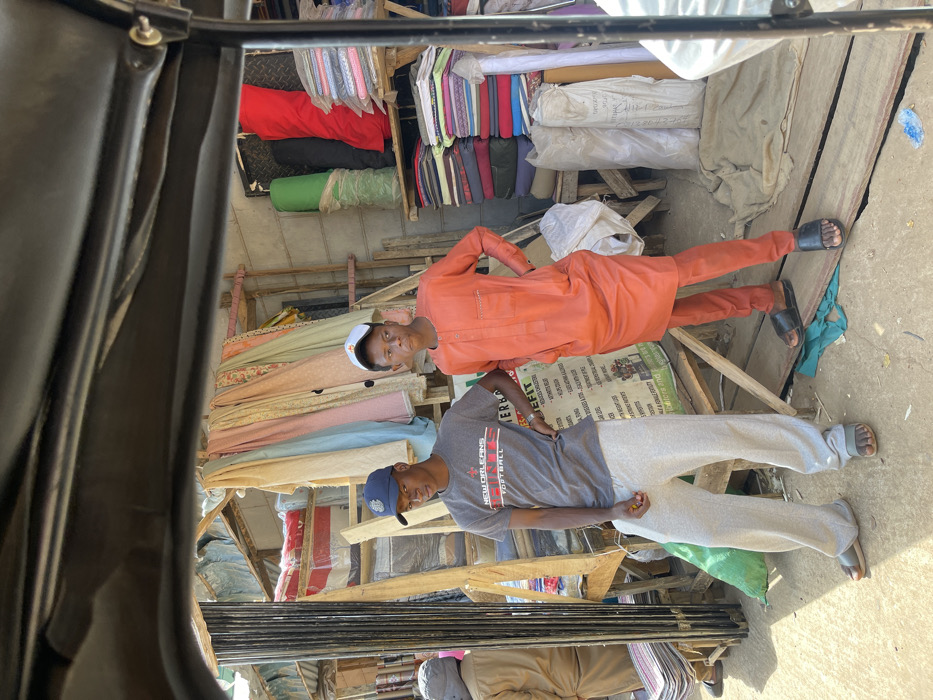
The image displays two young males standing within an outdoor market stall area in Zaria, Nigeria. The photograph is taken from a slightly elevated position, partially framed by a dark overhead structure, suggesting it was captured from inside a vehicle. The male on the left wears a navy blue baseball cap, a grey t-shirt featuring "NEW ORLEANS FOOTBALL" text, light grey sweatpants, and olive green slide sandals. His hands are clasped together at waist level. The male on the right wears a white baseball cap with a red star emblem, an orange traditional long-sleeved tunic with matching trousers, and black slide sandals. His hands are placed on his hips. Both individuals face the camera with neutral expressions. The background depicts a market stall structure constructed from wooden beams and concrete blocks. Various textiles are prominently displayed: multiple rolls of green, black, and red fabric are stacked vertically on shelves to the right. Below these, numerous piles of folded fabric in assorted colors and patterns are arranged. Overhead, several colorful and patterned fabrics are draped horizontally. A partially visible green and white commercial sign is situated behind the central figures. The ground consists of unpaved dirt, with loose wooden planks and a green plastic bag visible. Partial figures are present on the far left, dressed in light brown, and on the far right, wearing white, indicating additional individuals or activity within the scene.
Zaria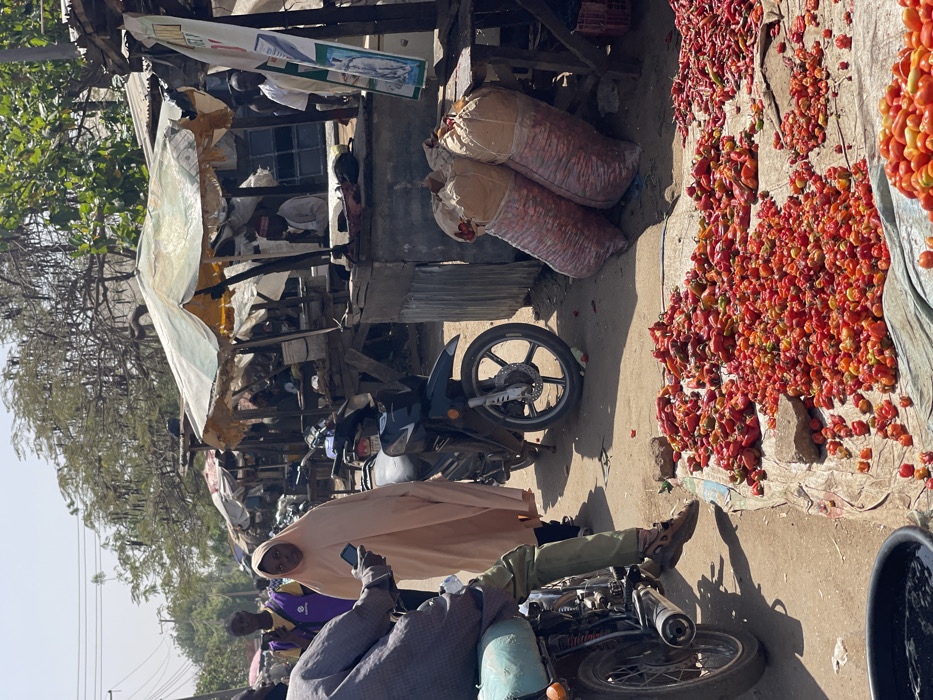
This image captures a bustling open-air market scene in Zaria, Nigeria, under bright daylight. In the immediate foreground on the left, the back of a man is visible, seated on a turquoise-seated motorcycle, holding a mobile phone. Adjacent to him, a woman in a light peach-colored hijab and dress walks towards the left, holding a mobile phone in her left hand and looking towards the camera. The ground in the mid-ground is covered with large, irregular piles of various red and orange peppers, including bell-shaped and smaller, pointed varieties, displayed on a grey tarp. To the right of these peppers, two large, bulging translucent sacks, filled with reddish produce, possibly onions or peppers, lean against a market stall. The market stalls are constructed from wood and corrugated metal, featuring assorted overhead canopies. A prominent, tattered white and yellow striped umbrella provides shade over one stall. Beneath this umbrella, a man in a white cap and light-colored attire is seated at a counter. A dark blue motorcycle is parked between the walking woman and the stalls. Other individuals are present in the background: a man in a purple and yellow top stands to the left of the walking woman, and another man in a white shirt is partially visible behind a white and green banner on the far right. Trees with sparse foliage line the distant background under a clear sky. A black bucket containing liquid is partially visible in the lower-left corner.
Zaria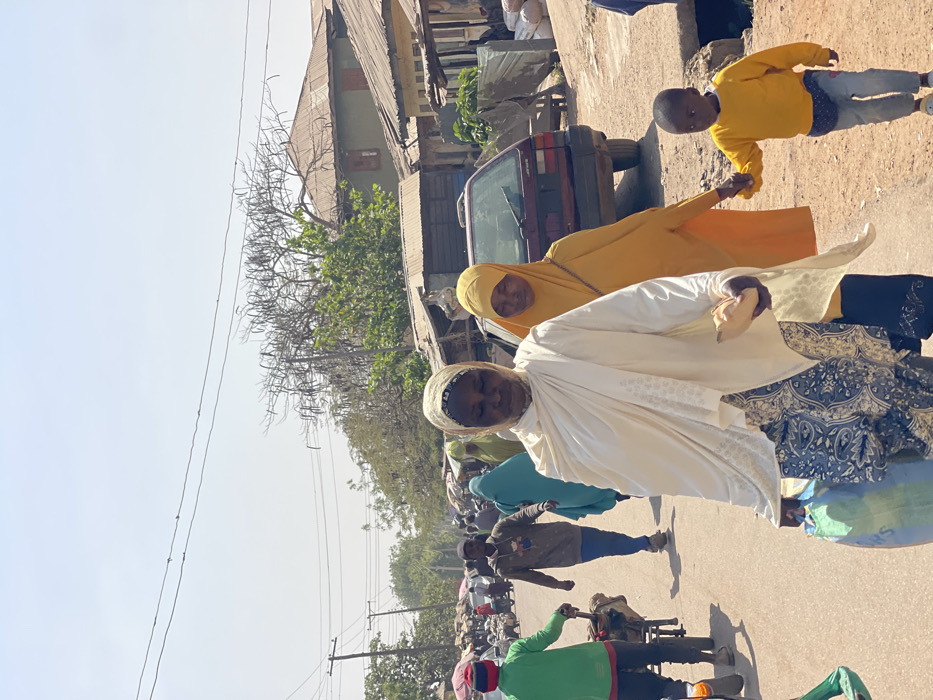
The image presents a busy street scene within Zaria, Nigeria, under bright, clear daylight. In the foreground, an older woman with a medium complexion walks towards the viewer's left. She wears a white hijab, a white patterned long-sleeved top or shawl, and a blue and white patterned skirt. She carries a light blue bag in her left hand and a smaller, light-colored wrapped object in her right. To her immediate right and slightly behind, a younger woman with a similar complexion wears a yellow hijab and a long yellow dress. She holds the right hand of a young, dark-skinned child who wears a bright yellow long-sleeved top and blue jeans, walking on the unpaved dirt shoulder to the far right. The street is an unpaved, reddish-brown dirt road populated by numerous pedestrians. On the far left, a man in a green shirt is visible pushing a handcart. Other individuals are distributed throughout the mid-ground, including one person in a teal garment. Along the right side of the street, a parked dark-colored hatchback sedan, possibly maroon, is visible behind the foreground figures. Beyond the vehicle, a row of single and two-story buildings line the street, many featuring corrugated metal roofs. A prominent two-story building in the mid-ground exhibits a light green facade with reddish-brown window shutters and a corrugated roof. Sparse trees with dry branches and some green foliage are present in the background. Multiple overhead utility wires are visible against a clear, light blue sky.
Zaria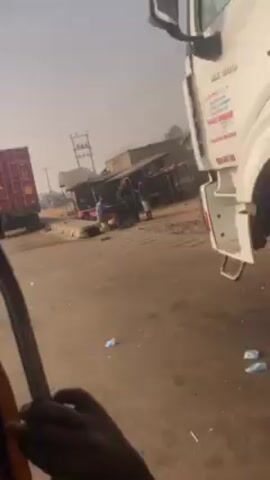
The video shows a roadside scene, likely in a developing country. A red shipping container on a large truck is moving along a paved road. Alongside the road are several makeshift stalls, appearing to be small shops. People are visible near these stalls, going about their business. The environment has a dusty or hazy atmosphere. The perspective is from a vehicle, possibly a smaller motorcycle-style vehicle, moving alongside the truck.
Zaria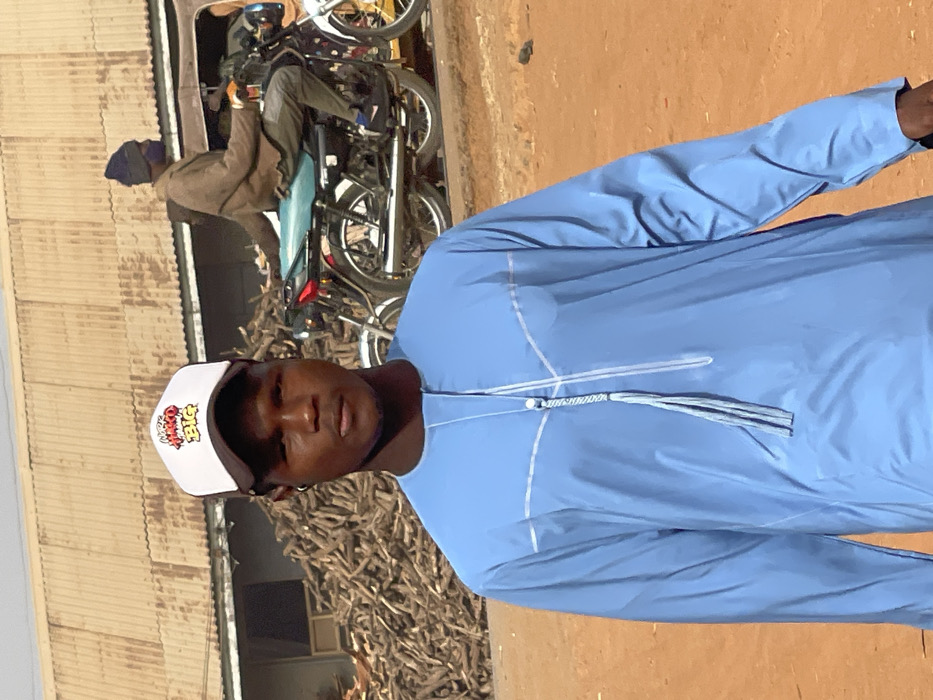
The image depicts an outdoor scene in Zaria, Nigeria. In the foreground, a young Black male is centered, facing the camera with a neutral expression. He wears a white and black baseball cap with multi-colored stylized text "AKO BIG" on the front, and a light blue long-sleeved traditional tunic featuring white piping details and a decorative tassel at the neckline. A small dark earpiece is visible in his right ear. The ground beneath him is reddish-brown dirt. In the mid-ground, slightly to the left, is a large pile of light-colored dry wooden branches or firewood. To the right of this pile, a second Black male is seated on or operating a black motorcycle with a light blue seat, facing right, away from the camera. This individual wears a brown jacket, dark pants, a dark blue beanie, and a dark face covering. A second white motorcycle is partially visible behind the black one. The background features a building with a light brown corrugated metal roof and walls, positioned behind the woodpile. The sky above is clear and light blue, indicating bright daylight conditions.
Zaria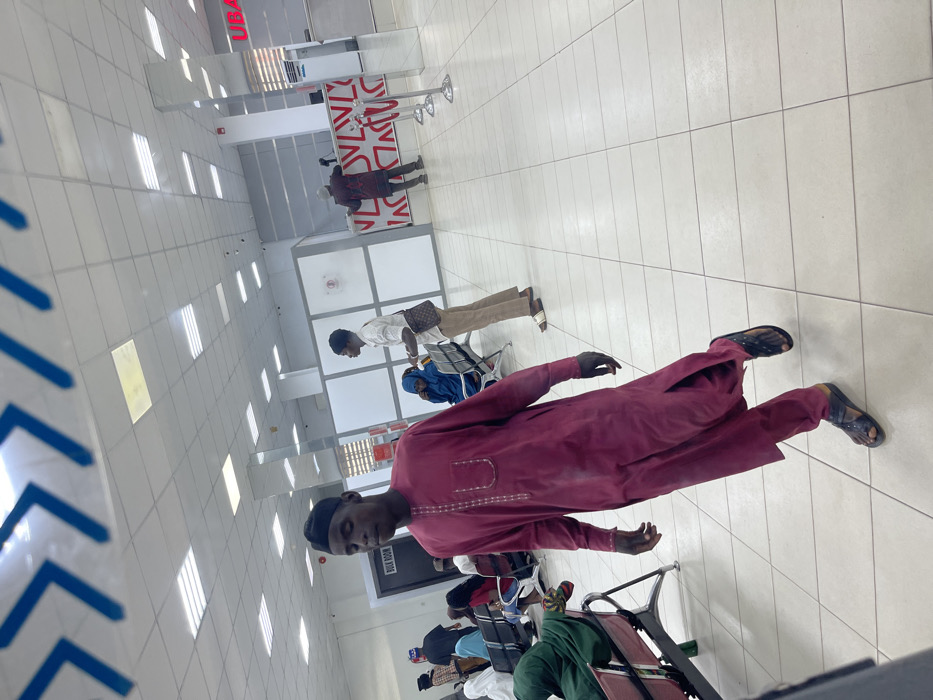
This image depicts the interior of a UBA bank branch in Zaria, Nigeria. In the foreground, a dark-skinned male wearing a maroon traditional tunic with embroidered patterns, matching trousers, and dark sandals is walking from left to right, his left foot mid-stride. His gaze is directed downwards and to his right. In the midground, to the left, a row of metallic benches with red and green seating is partially visible, occupied by several individuals. A dark doorway marked "BULK ROOM" is present. To the right of the walking man, another dark-skinned male stands facing right, wearing a white long-sleeved collared shirt, light brown trousers, and light-colored sandals. He carries a dark-patterned crossbody bag on his right side. Behind him, a person in a blue head covering sits on a bench. The background features bank counters with white and red patterned facades. A dark-skinned individual wearing a patterned shirt and dark trousers is standing at one of these counters, facing away from the camera, engaged in a transaction. Red stanchions with ropes are positioned in front of the counter. The "UBA" logo in red lettering is visible on a pillar or wall section to the far right. The environment is well-lit by numerous recessed rectangular fluorescent lights in a white tiled ceiling. The floor is also white-tiled with a grid pattern.
Zaria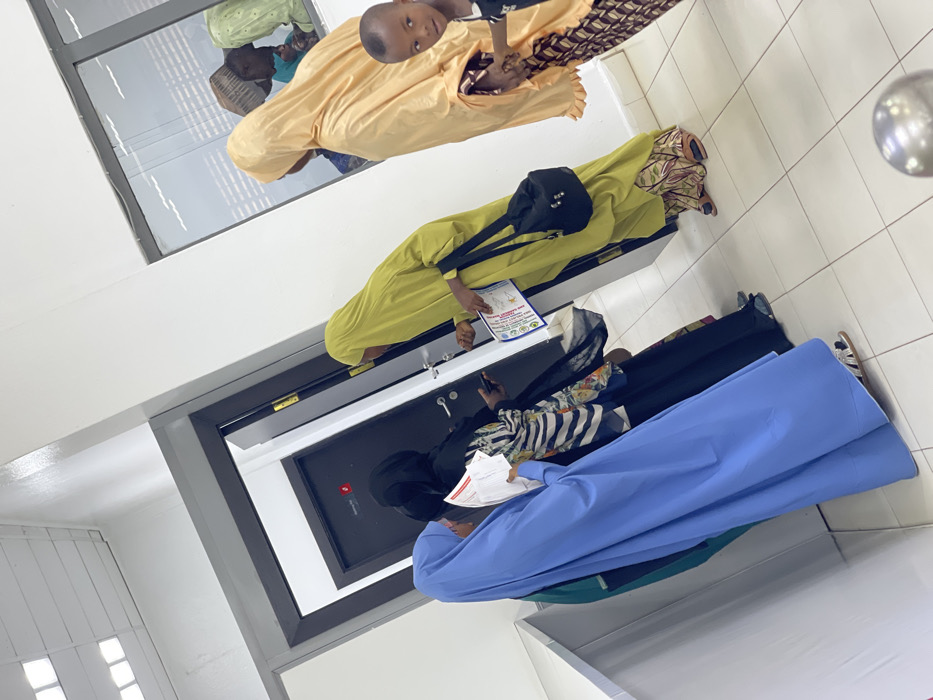
An indoor scene within a building in Zaria, Nigeria, depicts five individuals and reflections of others in what appears to be a waiting or reception area. The environment features white walls, a white tiled floor, and overhead fluorescent lighting. Two dark grey doors with silver handles are visible on the left, one partially open, revealing a darker interior. The visible door displays a small red square emblem and faint text "Opening Hr." From left to right: 1. A woman, obscured from the waist down, wears a blue abaya and hijab, holding white papers in her hands. 2. Next to her, a woman in a black abaya and hijab, with a striped and floral garment visible underneath, holds a mobile phone in her left hand and papers in her right. She faces the central door. 3. A woman in a lime green abaya and hijab, carrying a black shoulder bag, extends her right hand towards the door frame or a wall-mounted device next to the door. She holds a document with a colorful emblem in her left hand. 4. On the right, a woman in a light orange/peach abaya and hijab stands, holding the hand of a young child. 5. The child, partially visible in the lower right foreground, has short dark hair and wears a dark top, looking directly towards the camera. A horizontal window on the right wall reflects other individuals, including an adult with a patterned head covering and a child, suggesting additional people are present outside the immediate frame. A metallic spherical object is visible on the floor in the bottom right corner, possibly part of a barrier or fixture.
Zaria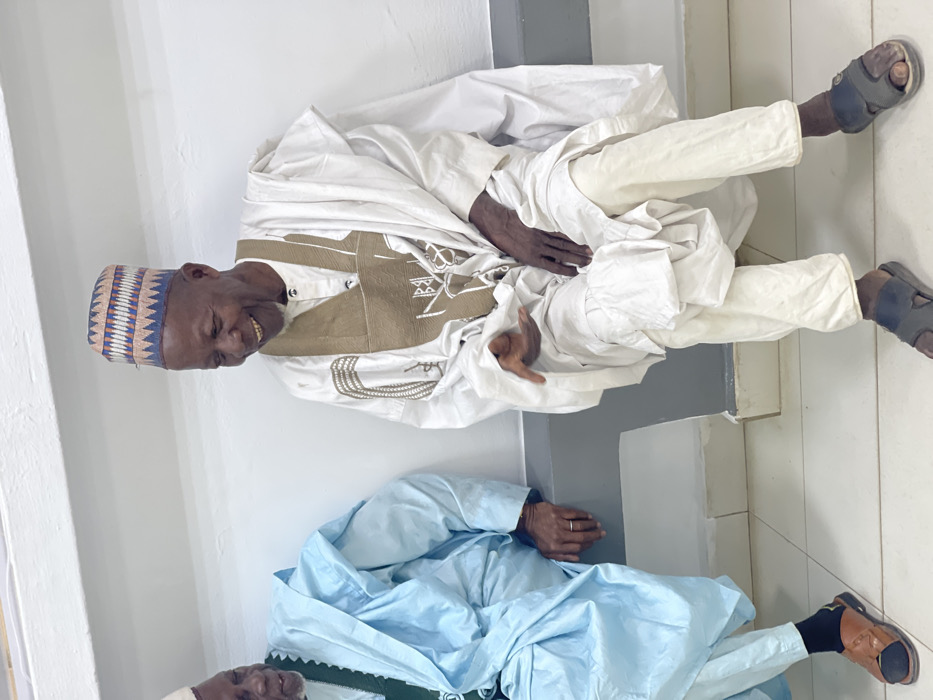
Two elderly men are depicted seated indoors in Zaria, Nigeria. The man on the right, with a dark complexion, wears a white traditional tunic featuring prominent brown embroidery, beige trousers, and a multi-colored geometric patterned cap. He is smiling broadly, exposing his teeth, with his left hand slightly open and extended forward, and his right hand resting on his lap. He wears dark slide sandals. The man on the left, partially visible, also dark-complexioned, wears a light blue traditional garment over a green undergarment and a white cap. A silver ring is visible on the ring finger of his left hand, which rests on his lap. He wears brown slide sandals over black socks. Both men are positioned against a plain, off-white wall with a horizontal relief detail and a grey lower section, above a light-colored tiled floor.
Zaria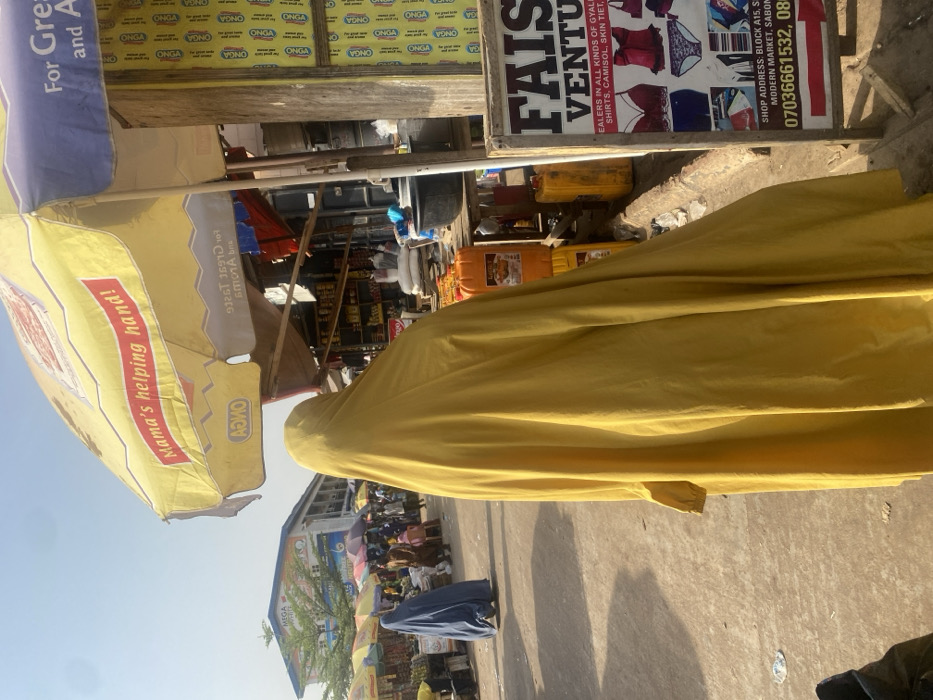
This image depicts a bustling outdoor market scene in Zaria, Nigeria, captured during bright daylight with clear skies, indicated by strong shadows and overhead light. The photograph is oriented vertically, rotated 90 degrees clockwise. In the foreground, a person is largely obscured, draped in a vibrant yellow garment that covers most of their body. Their head is visible, also covered in yellow fabric. To the left, a large yellow market umbrella is prominent, displaying text such as "Mama's helping hand!" and branding for "ONGA." A blue umbrella is partially visible next to it. These umbrellas provide shade over market stalls. The background reveals more of the market environment. To the right, a white signboard for "FAISAL VENTURES" advertises "DEALERS IN ALL KINDS OF GYALI, SHIRTS, CAMISOL, SKIN TIET." The sign also provides a "SHOP ADDRESS: BLOCK A15, S MODERN MARKET, SABON" and contact numbers "07036661532, 08". Behind this sign, a wall is covered with repeated "ONGA" branding. Various yellow jerry cans or containers are visible on the ground near the stalls. Further into the distance, other market stalls, goods, and several other people (partially obscured) can be seen, contributing to the lively atmosphere. A distant building with a "MEGA" sign is also visible under the clear sky. The ground is a paved surface, showing some minor debris.
Zaria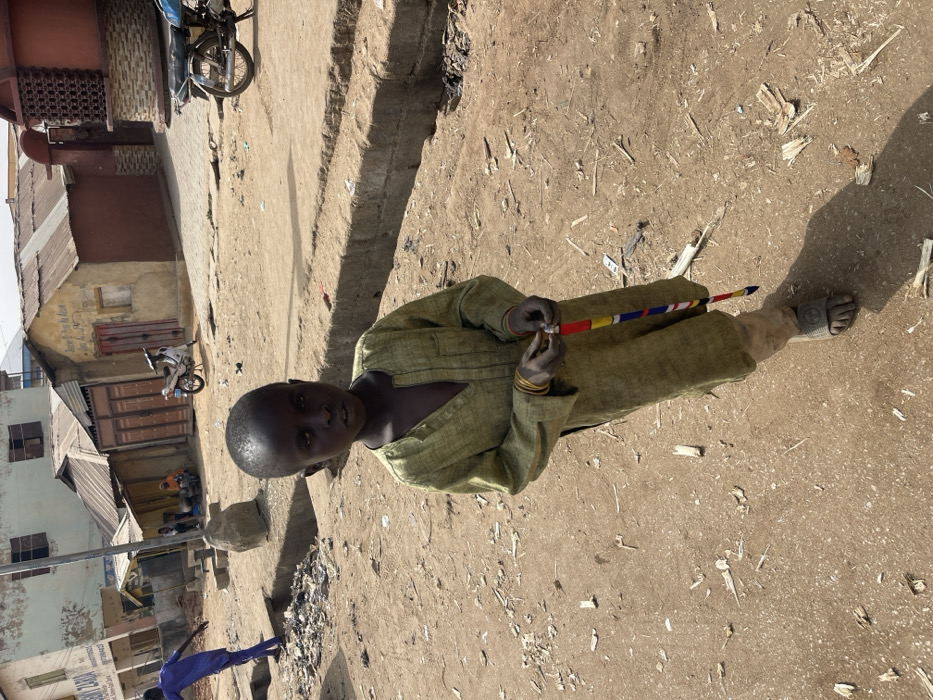
The image depicts a young, dark-skinned child standing centrally on an unpaved, dusty ground. The child wears a loose-fitting, long-sleeved olive-green garment, light-colored trousers, and dark sandals. Multiple gold-colored bangles are visible on their left wrist. In their hands, the child holds a vertically oriented object wrapped with multicolored fabric (red, yellow, blue, white). The child looks directly at the camera with a neutral expression. To the child's left, a person in a blue outfit is partially visible, standing near a pile of debris in a ditch or gutter. Beyond them, a building with a light-colored facade and a partially visible sign that reads "BUILDING ZARIA" is present. Several other structures with corrugated metal roofs and varying wall finishes are visible in the background, along with a white motorcycle parked to the left. To the child's right, a concrete curb or low wall runs horizontally across the mid-ground, separating the foreground's dirt path from a slightly elevated, possibly paved, area. More buildings with corrugated roofs and a parked motorcycle are visible further back. The ground throughout the scene is unpaved, covered in dirt, and scattered with debris including wood fragments and trash. Strong sunlight casts clear shadows. The specific location is identified as Zaria, Nigeria, based on the visible signboard.
Zaria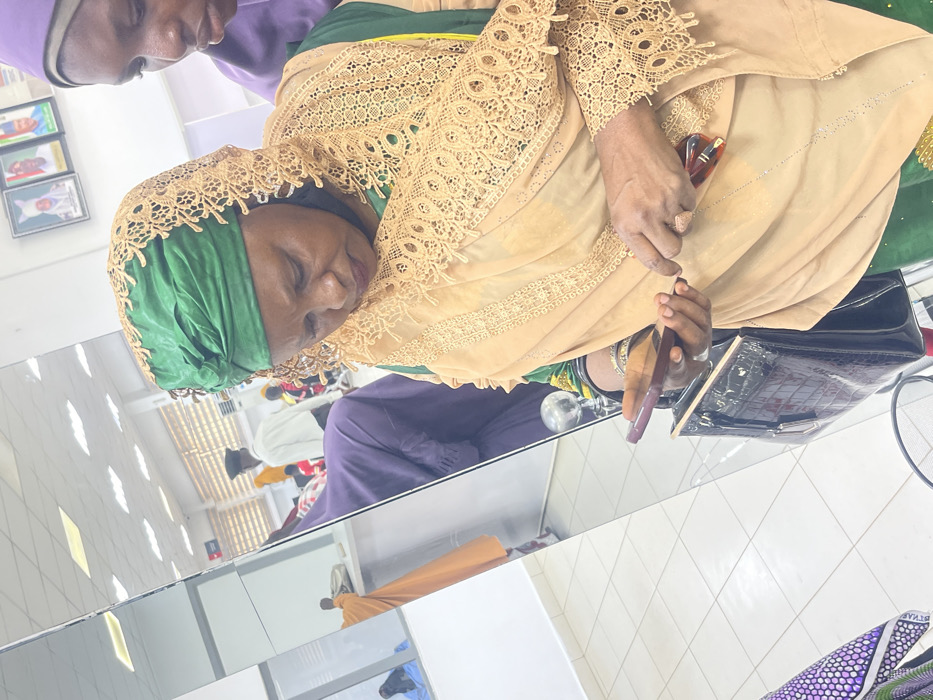
An indoor scene in Zaria, Nigeria, features a woman, likely middle-aged, positioned centrally on the right, looking downwards at a dark-colored smartphone held in both hands. She wears a green headwrap and a beige lace-edged veil over a green garment. Her left wrist displays multiple silver-colored bangles. A pair of brown-framed eyeglasses is held in her right hand near the phone. A dark brown, crocodile-patterned handbag with a gold-colored clasp is visible below her hands. The upper right corner shows the partial view of another woman, wearing a purple head covering, observing the main subject. The left side of the image is dominated by a large mirror, reflecting an interior space with white walls, a light-colored tiled floor, and several individuals, including one in an orange garment and others further back. On the wall in the upper right background, three framed portraits of men in traditional attire are mounted. The environment is brightly illuminated by overhead artificial lighting.
Zaria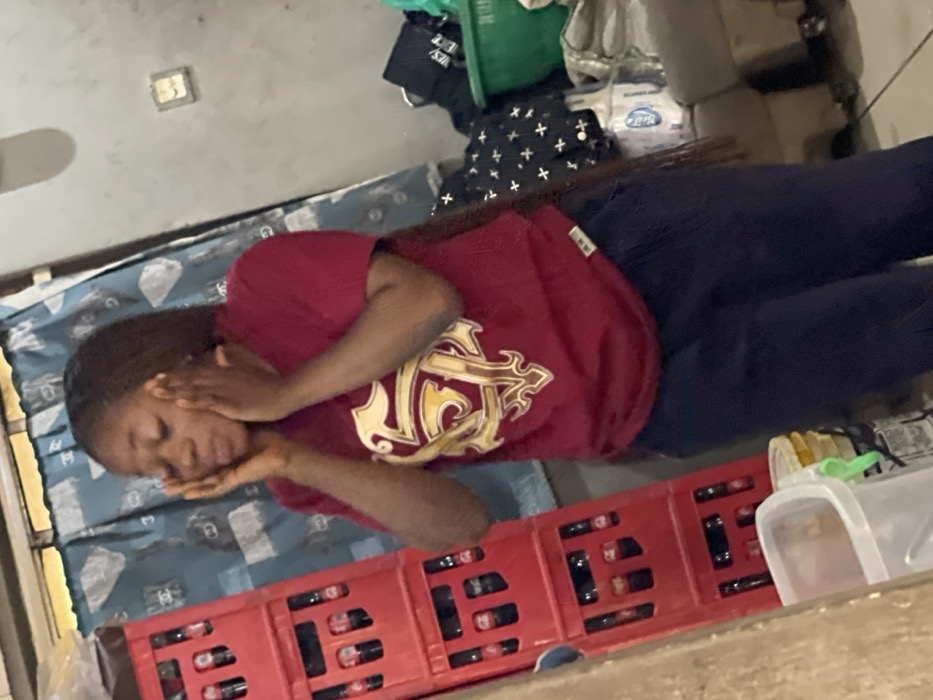
A young woman lies on a bed, her head propped on her hands. She's wearing a maroon t-shirt with a large gold crest. The bed has a blue and white patterned cover. Next to her is a red plastic crate filled with dark bottles. In the background are assorted items including a green basket, bags with white crosses, and white boxes. A light switch plate is on the wall behind the bed. She looks distressed.
Zaria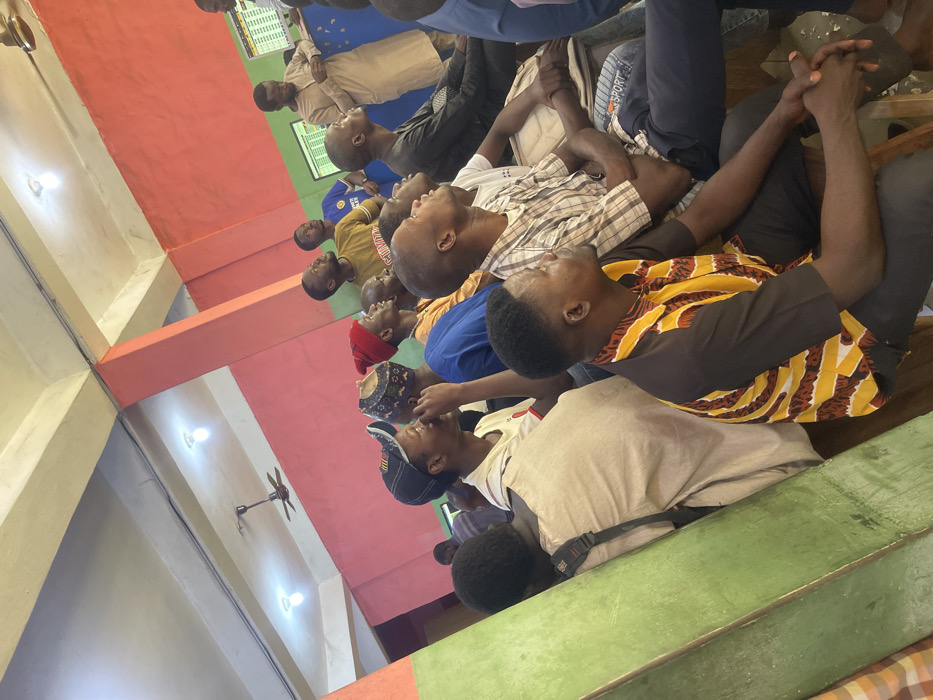
The image displays an indoor scene in Zaria, Nigeria, featuring a group of approximately twenty men, predominantly young adults. They are seated on the floor, arranged in rows, with most individuals looking upwards and towards a focal point outside the frame, suggesting attentive observation or listening. Many have their heads tilted back, and some have their hands clasped, indicating engagement. The men wear a mix of clothing styles, from casual t-shirts and plaid shirts to more traditional attire. One man in the foreground wears a distinct brown and yellow patterned long-sleeve shirt. Another sports a blue t-shirt with "ENI" partially visible, and a cap with "NE" visible is worn by a man in the bottom right. The interior space features walls painted in contrasting colors of red and green, alongside beige pillars. Overhead, a ceiling fan and two light fixtures provide illumination. In the background, two wall-mounted screens display text or data that is unreadable from the distance, hinting at a setting used for presentations, education, or monitoring information. The general atmosphere is one of calm attention and communal gathering, possibly for a lecture, discussion, or religious event. The bright lighting suggests it is either daytime indoors or a well-lit evening event.
Zaria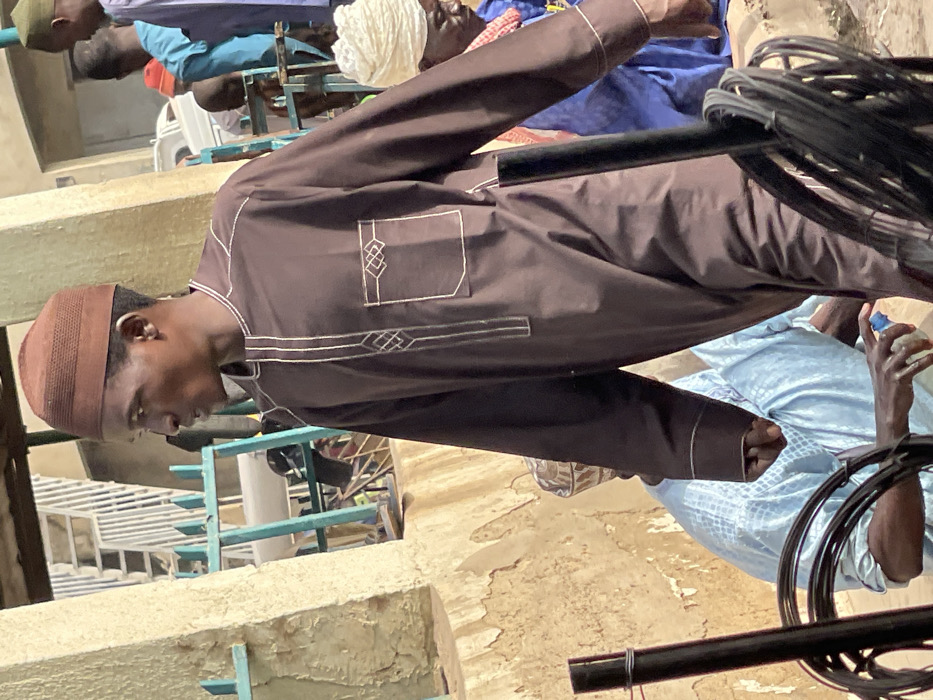
This image captures a group of men gathered in what appears to be an outdoor or semi-outdoor setting in Zaria, Nigeria, during bright daylight hours, suggesting sunny weather. The primary subject is a young man, centrally positioned and looking downwards, wearing a brown long-sleeved traditional garment, likely a thobe or kaftan, adorned with intricate white embroidery around a chest pocket and along the side. He also wears a textured brown kufi (prayer cap). In the background, several other men are visible, some partially obscured. One man wears a light blue traditional garment, while others are seen in blue clothing, a white turban, and a green kufi, indicating a diverse array of attire common in the region. The men appear to be sitting or standing casually, possibly engaged in conversation or waiting, though no specific activity is clearly depicted. The setting includes light blue metal structures, possibly chairs, tables, or part of a market stall, and concrete or mud-plastered walls and ground surfaces. A prominent black bar runs diagonally across the frame, with coiled black cables wrapped around one end, suggesting utility infrastructure. A hand holding a clear plastic bottle with a white cap is visible in the lower right, indicating the presence of refreshments. There is no discernible text visible in the image. The overall scene conveys a casual gathering in a functional, possibly community-oriented, environment.
Zaria