Zarkent, Uzbekistan
10 memories from Zarkent, Uzbekistan
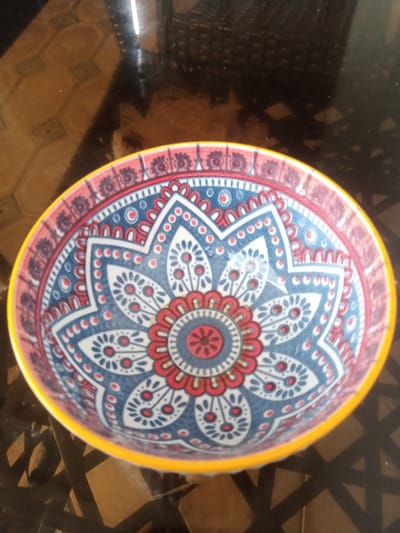
A decorative, brightly colored ceramic bowl with a yellow rim sits on a dark, reflective surface. The bowl features a intricate mandala-like pattern in shades of blue, red, and white. The surface appears to be a table with a geometric pattern visible through its reflection. There are no people or active events depicted in the image. The scene is static and focuses solely on the bowl and its immediate surroundings. The location is not specified in the image itself.
Zarkent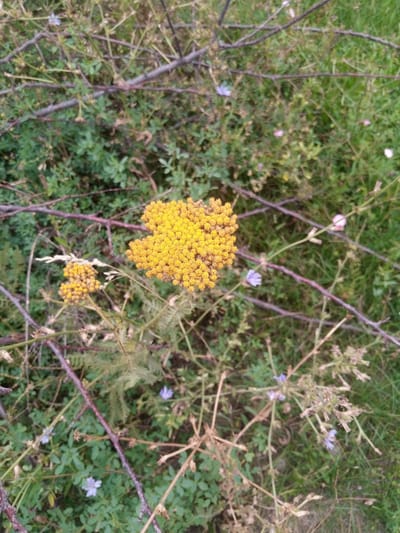
The image shows a close-up of a cluster of small yellow flowers, likely Yarrow (Achillea millefolium), surrounded by dried branches and green foliage. The flowers are clustered together in a flat-topped formation, with individual florets appearing as tiny yellow dots. The branches are thin and dark, crisscrossing the frame and some appear thorny. The background consists of blurred green grass and other low-lying plants, with occasional tiny blue and pink flowers scattered throughout. There are no people or any other living creatures visible in the image. The scene appears to be an outdoor natural setting. The prompt's request to include the location in Zarkent, Uzbekistan, cannot be fulfilled as there are no visual cues in the image to indicate this specific location.
Zarkent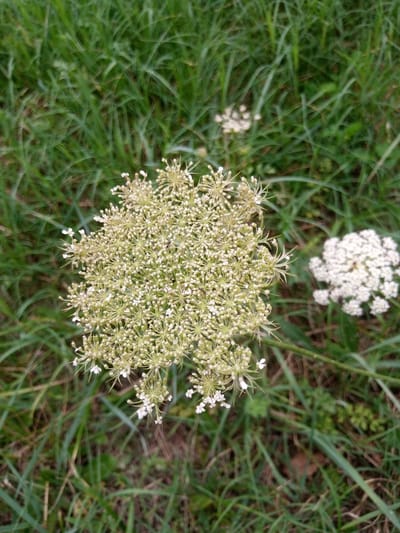
A close-up, eye-level, vertical shot shows a cluster of delicate, cream-colored wildflowers against a blurred green background of grass. The main subject is a large, umbrella-shaped flower head composed of numerous tiny blooms, with some smaller white petals scattered around it. To the right and slightly further back, another, smaller, fully bloomed white flower of similar type is visible. The scene is set in a grassy area, possibly a park or meadow, in Zarkent, Uzbekistan. No people are present, and the focus is on the flora.
Zarkent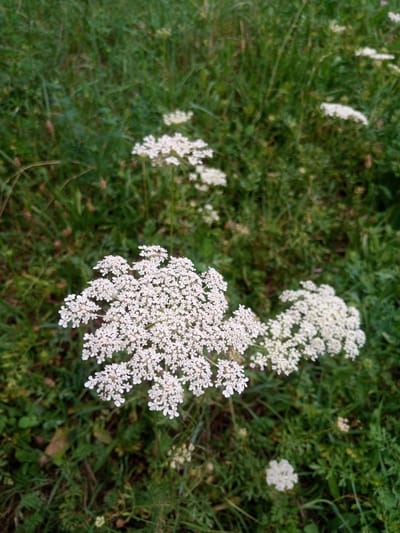
The image depicts a close-up, eye-level shot of wild Queen Anne's lace flowers in a grassy area. The flowers are white and clustered in large, intricate umbels, with smaller individual blossoms forming a delicate lace-like pattern. They are set against a backdrop of lush green grass and foliage, which appears slightly out of focus, suggesting a shallow depth of field. Several other smaller white flower clusters are visible in the background, also partially obscured by greenery. The scene is natural and outdoors, with no artificial elements or human presence evident. The lighting appears to be natural daylight, casting soft shadows. The overall impression is one of a peaceful, natural setting, possibly a meadow or a roadside verge. There is no specific indication of location within the city of Zarkent, Uzbekistan, beyond it being an outdoor, natural environment.
Zarkent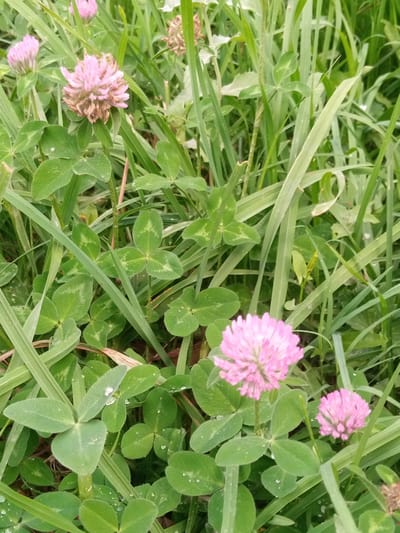
A close-up, eye-level shot captures a patch of clover and tall grass, glistening with dew drops. The scene is dominated by shades of green, with several pink clover blossoms adding pops of color. The clover leaves are distinctive, with their characteristic three heart-shaped leaflets, and some have a lighter green pattern. The grass stalks are tall and slender, some appearing slightly dried or faded. In the foreground, three pink clover flowers are visible, one larger and more in focus than the others. The background is a blur of green foliage, suggesting a natural, outdoor setting. There are no people or animals present. The image appears to have been taken in Zarkent, Uzbekistan, based on the provided context.
Zarkent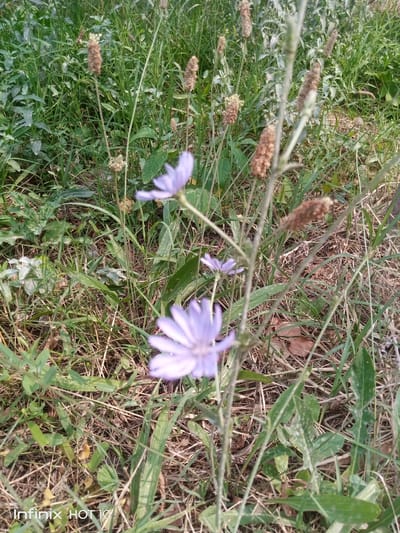
The image is a close-up, eye-level outdoor shot of wild vegetation. In the foreground, two pale purple flowers with thin petals are in focus, with one being more prominent than the other. Behind the flowers, the scene is filled with various green plants, tall dry grasses, and some brown seed pods. The ground is covered with dry leaves and grass. The lighting appears to be natural sunlight, casting a slightly warm tone over the scene. There are no people or man-made objects visible, except for a watermark at the bottom left corner that reads "Infinix HOT 10". The scene depicts a natural, uncultivated area.
Zarkent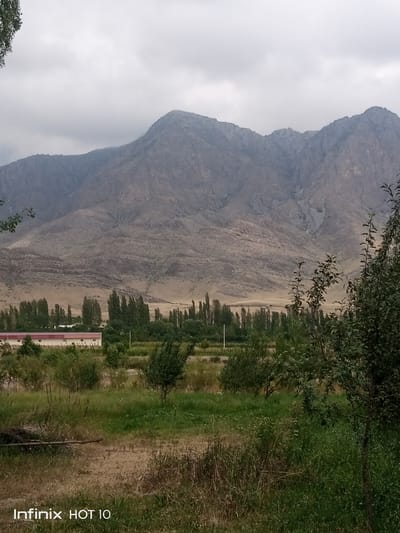
The image captures a rural landscape under a cloudy sky. In the foreground, there is overgrown grass and some dead branches. Further back, a low-slung building with a red-tiled roof is visible, surrounded by a variety of trees and vegetation. A line of tall, slender trees runs horizontally across the mid-ground, separating the immediate foreground from the distant mountains. These mountains dominate the background, their rugged slopes receding into the hazy atmosphere. The overall scene suggests a natural, undeveloped environment. The Infinix HOT 10 watermark indicates the device used to capture the image. The location is Zarkent, Uzbekistan.
Zarkent
The image displays a close-up, angled shot of a person's upper body, focusing on the chest, neck, and lower part of the face. The person appears to be lying down or reclining, with their head tilted slightly backward. The individual is wearing a blue, long-sleeved polo-style shirt made of a knitted or textured fabric. The shirt has a collar and a half-zip closure in the front, with a metallic zipper pull visible at the bottom of the open placket. A prominent Adam's apple is visible on the person's neck. Above the shirt, the lower half of the person's face is visible, including the chin, jawline, and mouth area. There is light stubble or short facial hair on the chin and around the mouth. The lips are slightly parted. The right ear is partially visible on the right side of the frame, near the collar of the blue shirt. At the very bottom of the image, a dark, solid-colored garment, possibly trousers or shorts, is visible. To the right of the person's body, a section of patterned fabric is visible. This fabric features an intricate, repeating geometric and floral design in various shades of red, orange, green, and cream, suggesting a blanket, cushion, or upholstered surface. The background on the left side of the frame appears dark and textured, while the background on the right is lighter and less distinct. The overall lighting is soft, and the image has a somewhat grainy quality. No text is visible in the image.
Zarkent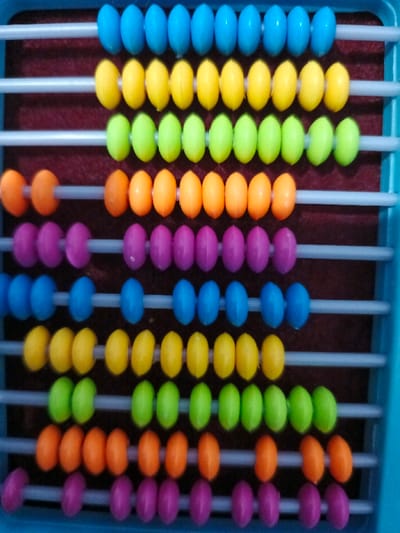
The image displays a colorful abacus, a traditional calculating tool, viewed from a slightly elevated, straight-on angle. The abacus features a light blue plastic frame, partially visible at the top, right, and bottom edges of the image. Within this frame, ten horizontal, light gray or white plastic rods are evenly spaced, running across a dark, reddish-brown, felt-like background. Each rod holds ten brightly colored, oval-shaped plastic beads. The beads are arranged in a repeating color pattern for every five rows. From top to bottom, the color sequence is: 1. **Top Row:** Blue beads. All ten blue beads are pushed to the left side of the rod. 2. **Second Row:** Yellow beads. All ten yellow beads are pushed to the left side of the rod. 3. **Third Row:** Lime green beads. All ten lime green beads are pushed to the left side of the rod. 4. **Fourth Row:** Orange beads. Three orange beads are pushed to the left, and seven are on the right side of the rod. 5. **Fifth Row:** Purple beads. Four purple beads are pushed to the left, and six are on the right side of the rod. 6. **Sixth Row:** Blue beads. Five blue beads are pushed to the left, and five are on the right side of the rod. 7. **Seventh Row:** Yellow beads. Six yellow beads are pushed to the left, and four are on the right side of the rod. 8. **Eighth Row:** Lime green beads. Seven lime green beads are pushed to the left, and three are on the right side of the rod. 9. **Ninth Row:** Orange beads. Eight orange beads are pushed to the left, and two are on the right side of the rod. 10. **Bottom Row:** Purple beads. Nine purple beads are pushed to the left, and one is on the right side of the rod. The beads appear glossy, with some subtle reflections indicating a smooth surface. The lighting is bright and even, illuminating the vibrant colors of the beads. There are no people visible in the image, nor is there any visible text. The abacus seems to be clean and in good condition, suggesting it is either new or well-maintained. The arrangement of the beads in the lower rows indicates that various numbers are currently represented, consistent with the function of an abacus as a counting and calculation tool, possibly used for educational purposes or play.
Zarkent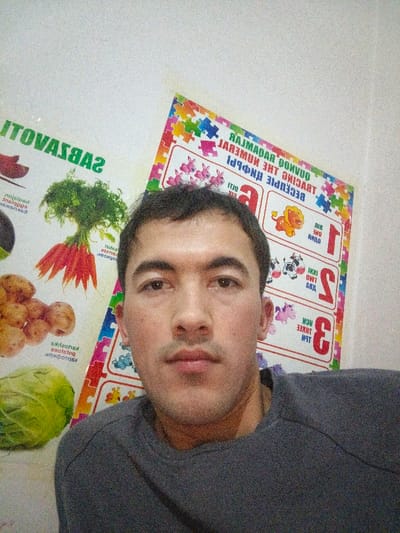
A man poses for a selfie in front of two educational posters. One poster showcases various vegetables and fruits, with accompanying names. The second poster features a colorful puzzle-piece border and displays numbers one to three, each associated with an image and written description. The man is wearing a grey, textured crewneck shirt. The background consists of a plain white wall.
Zarkent