Zeltingen-Rachtig, Germany
5 memories from Zeltingen-Rachtig, Germany
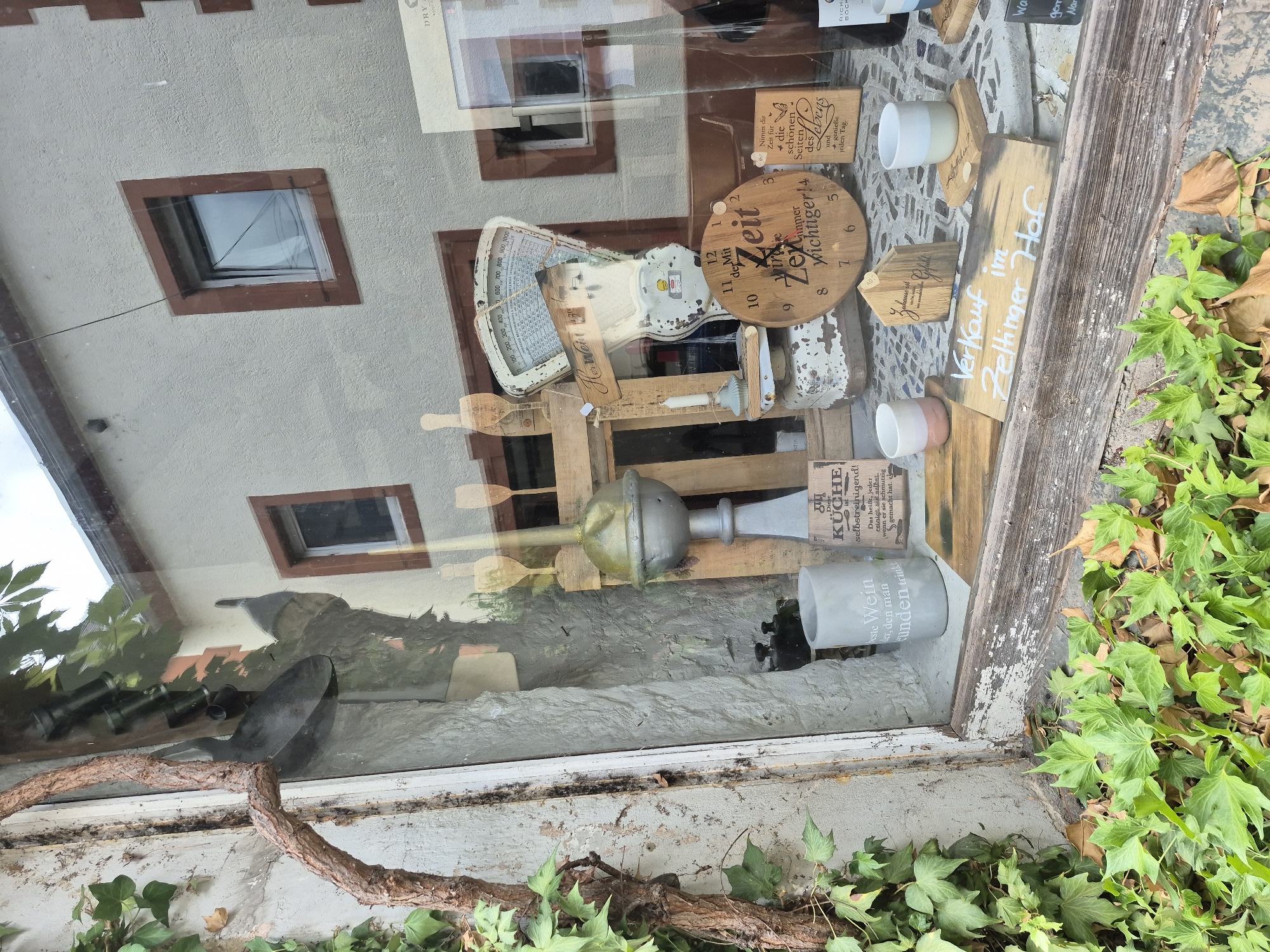
This image captures a shop window display in Zeltingen-Rachtig, Germany, viewed from an outdoor perspective. The immediate foreground features lush green ivy with some dried brown leaves on the ground, growing against a light-colored, rough-textured building wall with peeling white paint on a wooden window frame. A thick, gnarled vine or branch is prominently visible on the left side, extending horizontally. Through the reflective glass of the shop window, a collection of rustic and decorative items is arranged for sale. Dominating the display is a large, distressed white mechanical scale, possibly a kitchen or market scale, exhibiting chipped paint. Adjacent to the scale, a round wooden sign, designed like a clock face, reads "Mit der Zeit wird Zei immer wichtiger!" (approx. "With time, time becomes more important!"). To its right, a rectangular wooden sign advises: "Nimm dir Zeit für die schönen Seiten des Lebens und genieße jeden Tag." ("Take time for the beautiful sides of life and enjoy every day."). Other visible objects include a small house-shaped wooden sign stating "Zuhause ist kein Ort, sondern ein Gefühl." ("Home is not a place, but a feeling."), and a larger rectangular wooden sign on the lower display surface with "Verkauf im Zeltinger Hof" ("Sale at Zeltinger Hof") written in white script. A grey cylindrical container displays text that appears to be "Beste Wein, der, den man trinken trinkt." (likely "The best wine one can drink."). Further into the display, partially obscured, is a sign starting with "Diese KÜCHE ist selbstreinigend!" ("This KITCHEN is self-cleaning!"). The display also features two ceramic cups with two-tone glazes (one pink and white, one light green and white), a rustic metal sphere on a stand, and a white candle on a blue holder. Wooden cutouts resembling wine bottles are visible, and wooden pallets or crates are used as risers. Reflected in the window glass, behind the display items, is a building with a light-colored, textured facade and two square windows framed in a reddish-brown material, indicating a structure across the street or nearby. No individuals are visible in the scene.
Zeltingen-Rachtig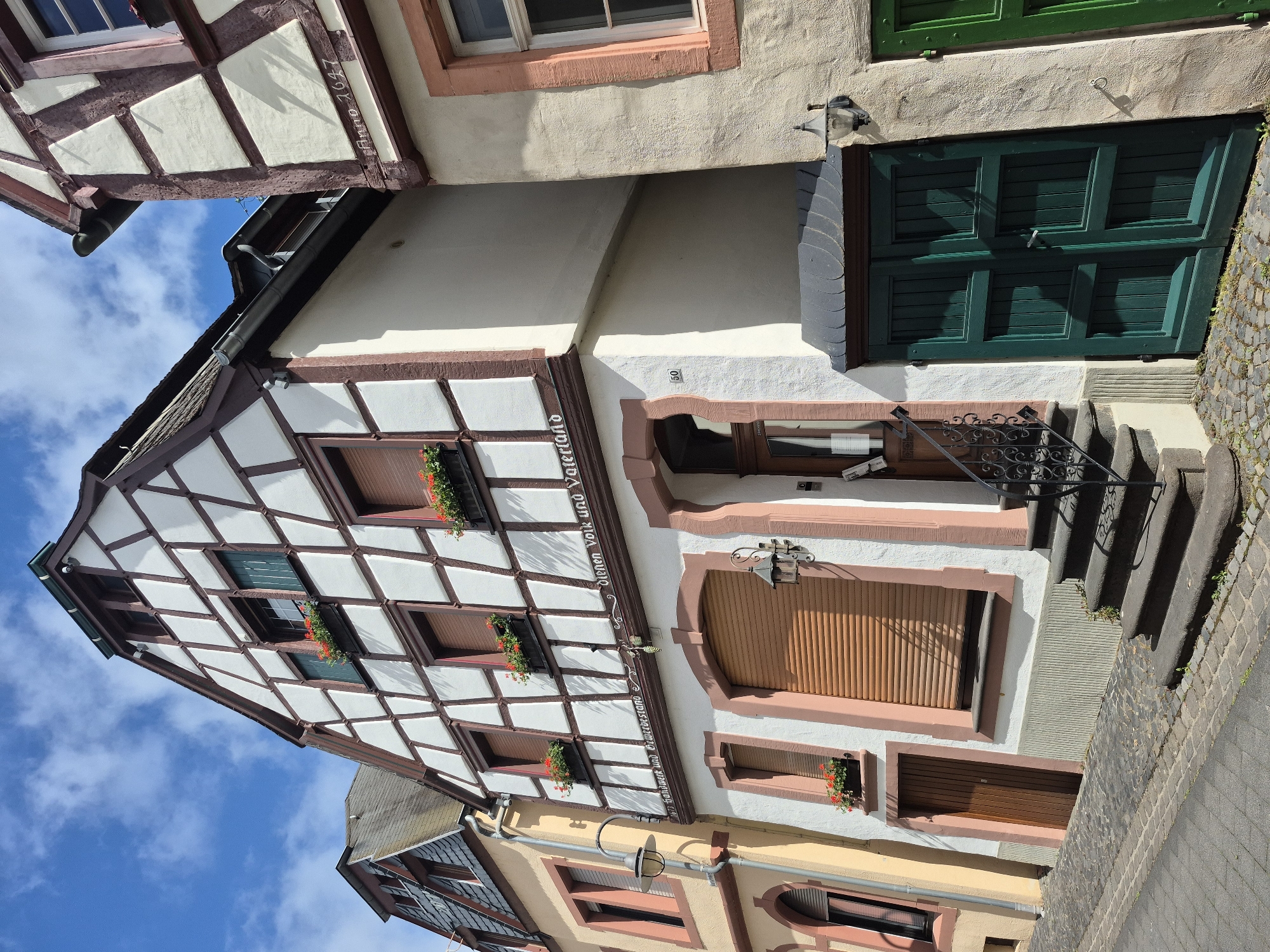
This image depicts a street scene in Zeltingen-Rachtig, Germany, featuring three traditional German buildings under a bright blue sky with scattered white clouds. The central building, a multi-story half-timbered structure with white infill panels and dark brown timbers, occupies the majority of the frame. Its prominent gable roof has a dark green trim along the top edge. Several windows adorn its facade; some are open with dark green or brown shutters, while others have closed brown roller shutters. Red geraniums bloom in window boxes on multiple levels. Below the first-floor windows, a dark brown timber beam bears white lettering that reads "Wir Handwerk und Gewerbestand" (We craftsmanship and trade) followed by a decorative vine, and then "dienen Volk und Vaterland" (serve people and fatherland). The main entrance, recessed beneath an arched opening, features a dark brown wooden door and is accessed by three stone steps with a black wrought-iron handrail. To the left of the door, the house number "50" is affixed. Below the main entrance steps, a double-leaf dark green wooden door with a small slate overhang is visible at street level. A wall-mounted lantern with a dark metal finish is positioned to the right of the main entrance. To the right of the central building, a cream-colored stucco building with reddish-brown timber framing is partially visible. White lettering on one of its timbers reads "Anno 1647." A window with a white frame and a wall-mounted lantern are also present on this facade. To the left of the central building, a light yellow stucco building with a dark slate gable roof is partially seen. It features reddish-brown arched window frames and a brown wooden door at ground level beneath a window box with red flowers. A silver-colored street lamp is mounted on the left side of this building, and a dark grey drainpipe runs vertically down its facade. The street in the foreground is paved with dark cobblestones, interspersed with some small weeds. A narrower paved path runs along the immediate left edge of the frame. Sunlight casts distinct shadows on the buildings and street, indicating a sunny day.
Zeltingen-Rachtig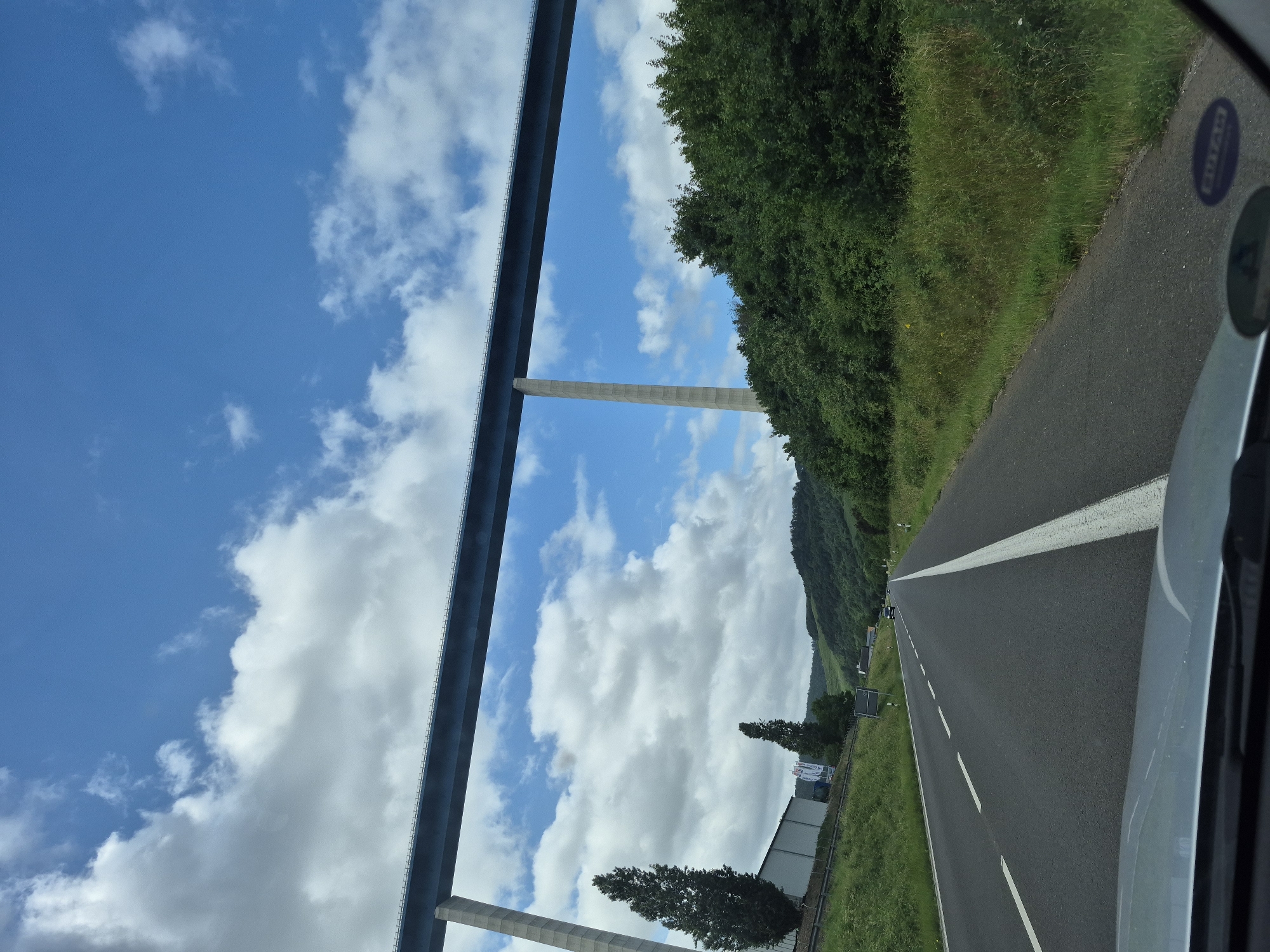
The image displays a forward-facing view from the interior of a vehicle traveling on a two-lane asphalt road in the vicinity of Zeltingen-Rachtig, Germany, directly beneath the Hochmoselbrücke. The lower foreground reveals the light grey dashboard and windshield base of the observer's vehicle. The road surface is dark grey asphalt, delineated by a continuous white line on the right shoulder and dashed white lines separating the opposing traffic lanes. Two dark-colored vehicles are visible in the distance on the road ahead. To the left of the road, a steep, manicured grassy embankment leads up to a silver-colored, low-rise industrial building, behind which stand two tall, dark green coniferous trees. Further in the background on the left, rolling hills are covered in lush green vegetation, including what appears to be vineyards. To the right of the road, a natural verge of green grass and assorted foliage transitions into a dense hillside completely covered with a variety of green trees and shrubs. The upper portion of the scene is dominated by the massive blue-painted structure of the Hochmoselbrücke, which spans the entire width of the frame. This elevated roadway is supported by two visible, towering, slender, light grey concrete pillars: one prominent on the far left and another towards the mid-right. The sky overhead is predominantly clear blue, interspersed with numerous distinct white cumulus clouds.
Zeltingen-Rachtig
A first-person view from inside a moving car shows a two-lane asphalt road with a solid white line on the right shoulder and a dashed white line separating the two lanes. A large bridge crosses the road horizontally in the distance. On the left side of the road, there are houses and green vegetation. On the right, there are trees and a slight incline of a hill. The sky is partly cloudy with blue patches visible. The car's dashboard and windshield are visible in the foreground.
Zeltingen-Rachtig
The image captures a daytime sky with a mix of cumulus and cirrus clouds. The clouds vary in color from bright white to dark gray, suggesting different thicknesses and densities. The sun is visible through a thin layer of clouds, creating a bright, diffused light source. The sky is a deep blue color where it is not obscured by clouds. The image was likely taken outdoors in daylight. There are no people or objects visible other than the clouds and sky. There is no indication of the specific location within Zeltingen-Rachtig, Germany from this image.
Zeltingen-Rachtig