Friday, March 20, 2026 · Updated Friday, March 20, 2026
Nairobi, Kenya
In Nairobi, Kenya, a powerful narrative of resilience and advanced medical care unfolds daily within the city's bustling hospitals and specialized units. From intricate surgical procedures to the delicate care of newborns, medical professionals across the capital are working tirelessly, showcasing the robust and evolving landscape of healthcare on the African continent.
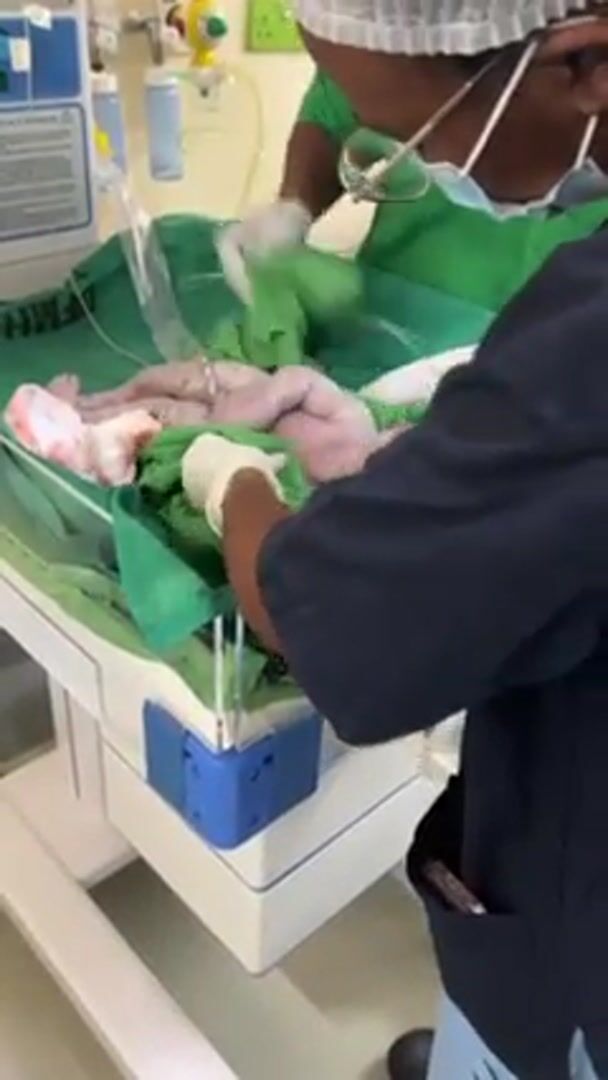
In a brightly lit medical setting, likely a neonatal unit, two individuals wearing scrubs and protective gear are attending to a newborn baby. The baby lies on a medical bed draped with green cloths. Both individuals are wearing gloves, and one is wearing a surgical mask and eyeglasses. They appear to be cleaning or examining the baby, gently manipulating the infant with care. Medical equipment, including tubing and monitors, are visible in the background, contributing to the clinical atmosphere of the scene.
Nairobi, Kenya · Mar 20, 2026, 9:01 AM · 35.9k attention
Operating rooms across various facilities, including those at the University of Nairobi's Department of Surgery and Kenya Air Force medical establishments, are scenes of intense focus and precision. Surgeons, uniformly clad in green scrubs, caps, and masks, gather under bright KLS Martin surgical lights. Their gloved hands navigate complex procedures, with an array of gleaming stainless steel instruments laid out on sterile green drapes, ready for use.
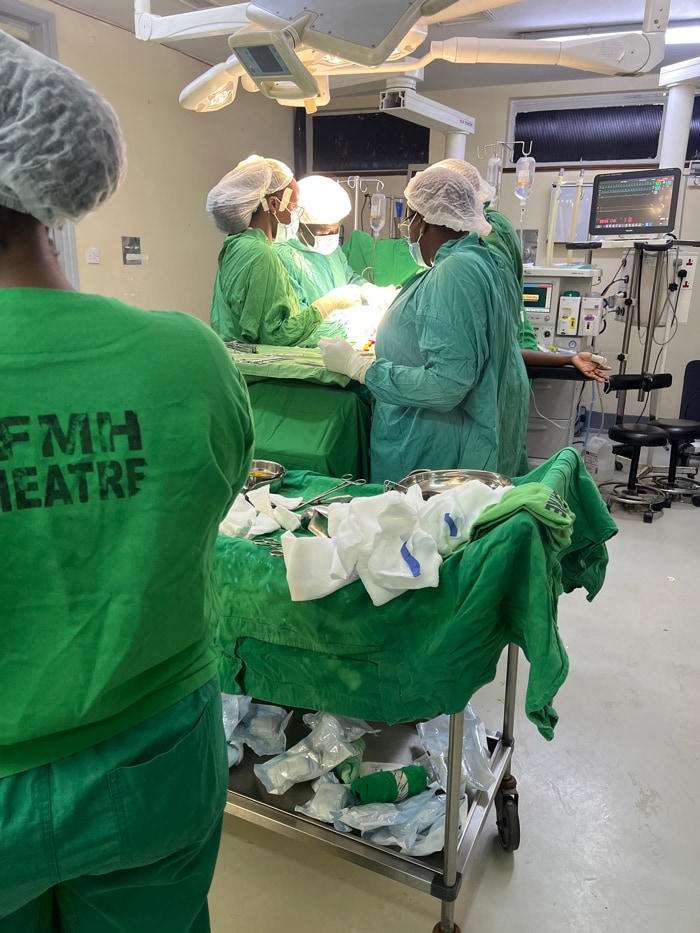
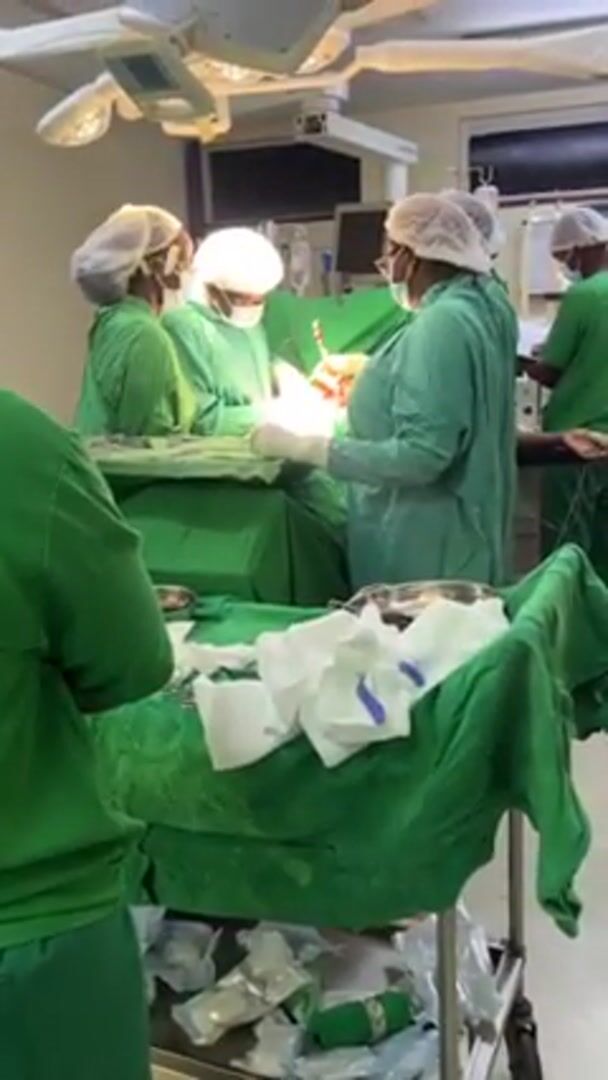
An operating room at FMH Theatre in Nairobi, Kenya, is depicted during a surgical procedure. In the foreground, facing away from the camera, stands a person wearing a green scrub shirt with "FMH THEATRE" printed on the back and a white hair net. Before them, a sterile field is established around a patient on an operating table, covered in green drapes. Three medical personnel, all wearing green scrubs, surgical masks, and hair nets, are actively engaged in the surgery, illuminated by multiple overhead surgical lights. One individual is positioned directly over the patient, another assists to their left, and a third stands to the right. A patient's arm, extended on a support to the right of the operating table, shows a finger connected to a device, possibly a pulse oximeter. Nearby, a medical monitor displays vital signs. Adjacent to the foreground observer is a stainless steel surgical trolley covered in green drapes, laden with various surgical instruments, used white gauze pads, and metal bowls. The lower shelf of this trolley holds individually packaged sterile medical supplies. Intravenous fluid bags are suspended from stands in the background. The room features light-colored walls and a clean floor, characteristic of a medical facility.
The scope of care is broad and impactful. One particularly poignant scene captures the critical moment of an infant delivery, highlighting the specialized skills required in neonatal care. Elsewhere, teams attend to newborns in brightly lit units, meticulously cleaning and examining the infants, surrounded by essential medical equipment, tubing, and monitors, ensuring the earliest stages of life are met with expert attention.
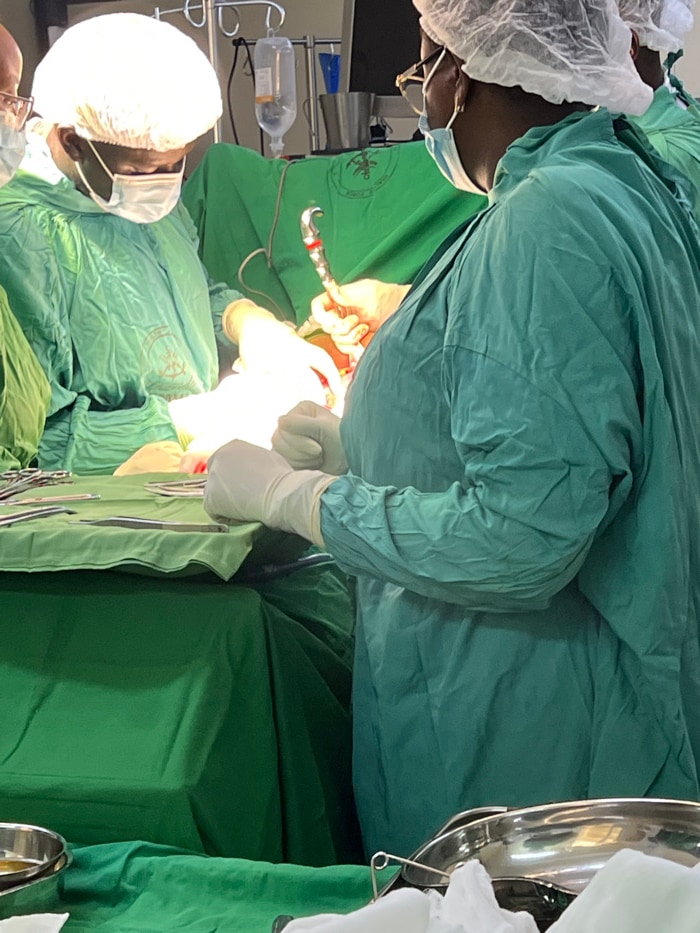
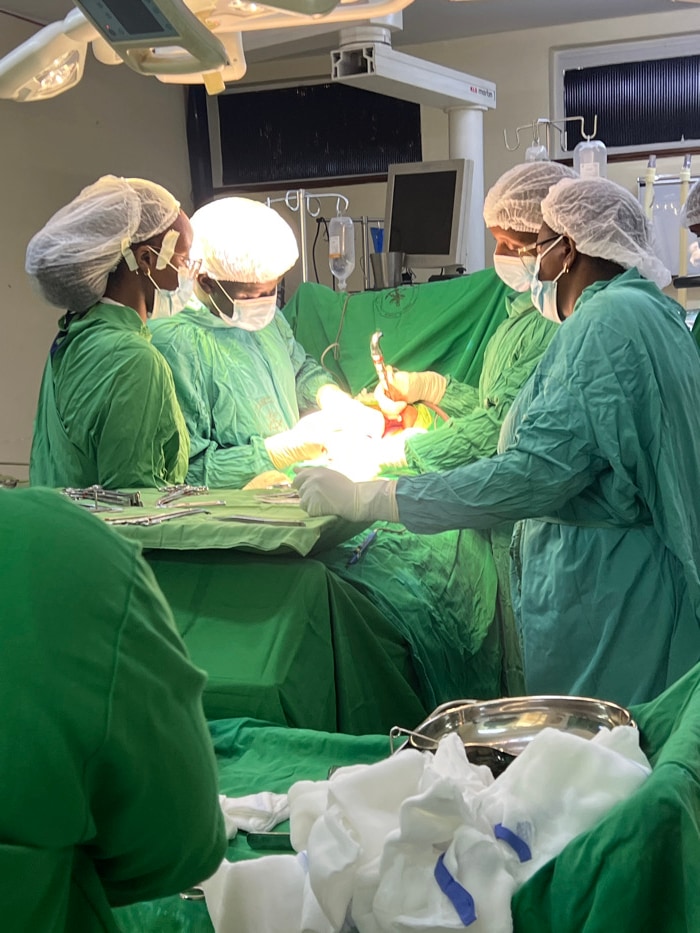
The image captures a surgical procedure in progress within an operating theater at the Department of Surgery, University of Nairobi, Nairobi, Kenya. Three medical professionals are visible, uniformly dressed in green surgical gowns and white hair nets.
On the left side of the frame, a surgeon, wearing a white surgical mask, leans over a brightly illuminated surgical field, actively engaged in the procedure with gloved hands. A second individual is partially visible in the far background left, wearing glasses and a hair net. On the right side, a surgeon or surgical assistant, wearing a blue surgical mask and light-colored surgical gloves, stands attentive with hands poised over a green-draped instrument table. This table is laden with various sterile surgical instruments.
The central, brightly lit surgical field reveals gloved hands manipulating tissue. One hand holds a distinct surgical instrument featuring a curved, serrated tip and a red band. Green surgical drapes cover the patient and the surrounding tables. In the upper background, an intravenous fluid bag hangs from a metal stand. The lower foreground shows two metal medical bowls, one containing white medical gauze. A circular white logo, clearly visible on the green background drape, identifies the location with the text "UNIVERSITY OF NAIROBI" and "DEPARTMENT OF SURGERY."
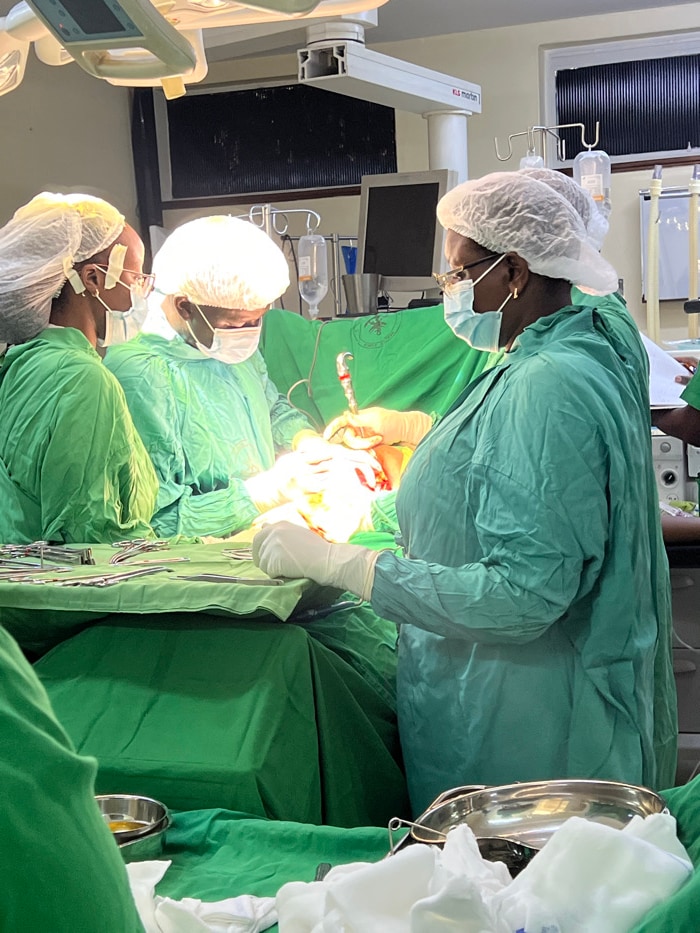
An operating room in Nairobi, Kenya, is depicted during an active surgical procedure. Four individuals are present, all wearing green surgical gowns, white bouffant caps, and face masks.
In the center-right foreground, a dark-skinned female, wearing glasses and a light blue surgical mask, is positioned with her gloved hands actively engaged at the patient's incision site. To her left, a dark-skinned male, also wearing glasses, a mask, and gloves, leans over the surgical field, participating in the procedure. Further left, a third dark-skinned individual, similarly attired, observes the activity. The fourth individual, partially visible on the far right, holds a clipboard or chart.
The patient is mostly obscured by green surgical drapes, with a brightly illuminated surgical field revealing exposed tissue and blood, indicating an ongoing incision. A specific surgical instrument, possibly an electrocautery pen, is visible in the hands of one surgeon, directed at the incision.
The environment features multiple overhead surgical lights, one with a visible "KLS Martin" brand label. In the background, an IV pole holds two hanging intravenous fluid bags, alongside a medical monitor screen and a wall-mounted light panel. A table in the foreground holds an array of stainless steel surgical instruments, including clamps and forceps, laid out on a sterile green drape. Metal basins and white surgical gauze are also visible on nearby surfaces. The overall scene is brightly lit and sterile.
The commitment to medical excellence is evident not only in the procedures themselves but also in the institutional presence, with logos from the University of Nairobi, Kenya Air Force, and DFMSA Kenya visible on drapes and equipment. These details underscore a coordinated effort to provide high-stakes, life-saving care. The scenes from Nairobi offer a compelling testament to the dedication of its medical community, providing vital stories from the heart of East Africa.
The video shows a surgical operation in progress. Five medical personnel wearing green scrubs, caps, and masks are visible in the operating room. Under bright surgical lights, they are positioned around a patient covered with green surgical drapes. The surgical team is focused on the patient's abdomen. Various surgical instruments are laid out on a tray covered with a green drape, and there are discarded surgical supplies on a cart below. Monitors and medical equipment are in the background, and an IV drip is hanging. The scene is sterile and clinical, indicative of a high-stakes medical procedure.
The image depicts a surgical procedure occurring in an operating room located in Nairobi, Kenya. Four individuals are present, all adorned in green surgical scrubs, white hairnets, and white face masks. Three individuals are actively positioned around a patient, who is obscured by green sterile drapes, revealing only an exposed and brightly illuminated abdominal or pelvic surgical field. The central individual, wearing white surgical gloves, is holding a surgical instrument, possibly a retractor, within the open surgical cavity. To their right, a second individual, also gloved, has hands positioned near the surgical field, indicating assistance or close observation. To the left, a third individual stands observing the procedure. In the immediate foreground, the back of a fourth individual in green scrubs is visible, positioned near a sterile tray containing a stainless steel basin filled with liquid, surrounded by multiple white surgical gauze sponges. A second sterile tray, covered in a green drape, holds an array of surgical instruments including scissors, clamps, and forceps. Overhead surgical lights provide intense illumination to the surgical area. In the background, medical equipment such as an IV pole with an intravenous bag, a wall-mounted monitor with a dark screen, and additional suspended medical devices are visible against light-colored walls. A window with vertical blinds is also present in the upper right background.
The image depicts an active surgical procedure underway inside an operating room at a Kenya Air Force medical facility in Nairobi, Kenya.
Four individuals, all wearing green surgical scrubs, white hair caps, and blue medical masks, are present. The central figure, presumed to be the lead surgeon, is leaning over a supine patient, whose abdominal or torso area is exposed and illuminated by a bright surgical lamp. Blood and tissue are visible within the open surgical site. The surgeon's hands are gloved and actively engaged with the patient. To the right of the lead surgeon, an assistant, also gloved, holds a white gauze pad. To the left, a third individual, wearing glasses with tape on the temples, observes the procedure. A fourth person in scrubs is partially visible behind the central surgeon.
In the foreground, a sterile tray covered with a green drape holds an assortment of silver surgical instruments, including various forceps, clamps, and scissors. The patient is largely obscured by green sterile drapes. In the background, an intravenous (IV) drip bag hangs from a metal pole, and a dark monitor screen is visible above it. A green surgical drape with the distinctive Kenya Air Force emblem is visible in the background, confirming the location as a Kenya Air Force medical establishment.
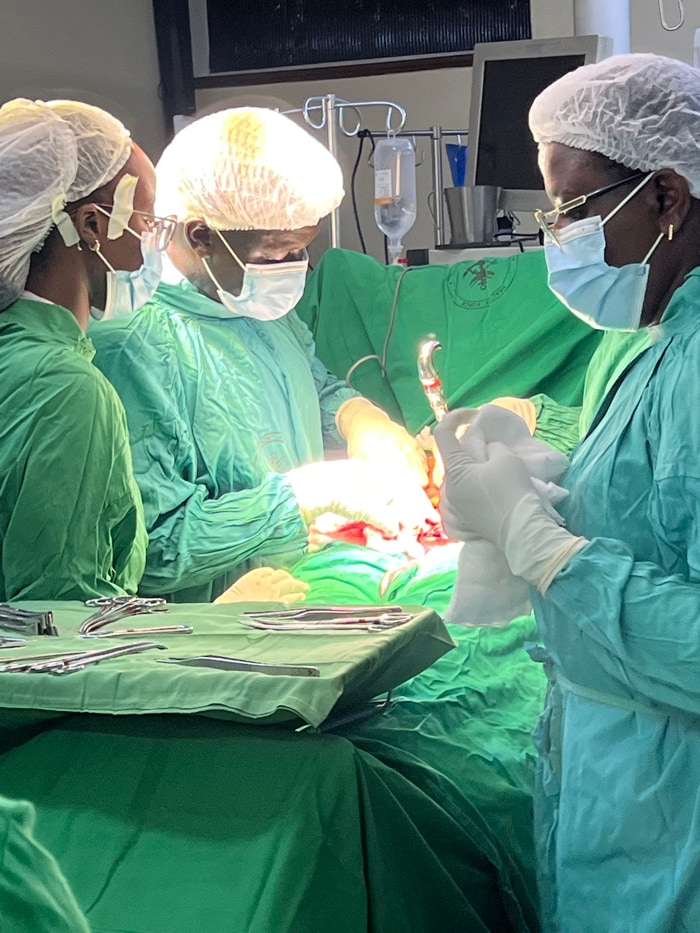
An operating room in a medical facility in Nairobi, Kenya, is depicted during a surgical procedure involving three medical professionals. All three individuals are clad in green surgical scrubs, light blue surgical masks, and white bouffant caps. The primary surgeon on the left, wearing glasses and with bandages visible on the forehead beneath the cap, is actively manipulating the surgical field with gloved hands, revealing the lower extremities of an infant being delivered from a surgical incision. The central surgeon is also focused on the surgical area, illuminated by overhead lights. An assistant on the right, also wearing glasses, is positioned near the surgical field, holding a surgical instrument. A tray containing numerous metallic surgical instruments is arranged on a green-draped table in the immediate foreground. Overhead surgical lights, branded "K. L. S. martin," provide illumination. In the background, an IV drip stand and a medical monitor are visible, along with a green surgical drape featuring a circular logo that includes "DFMSA" and "KENYA."
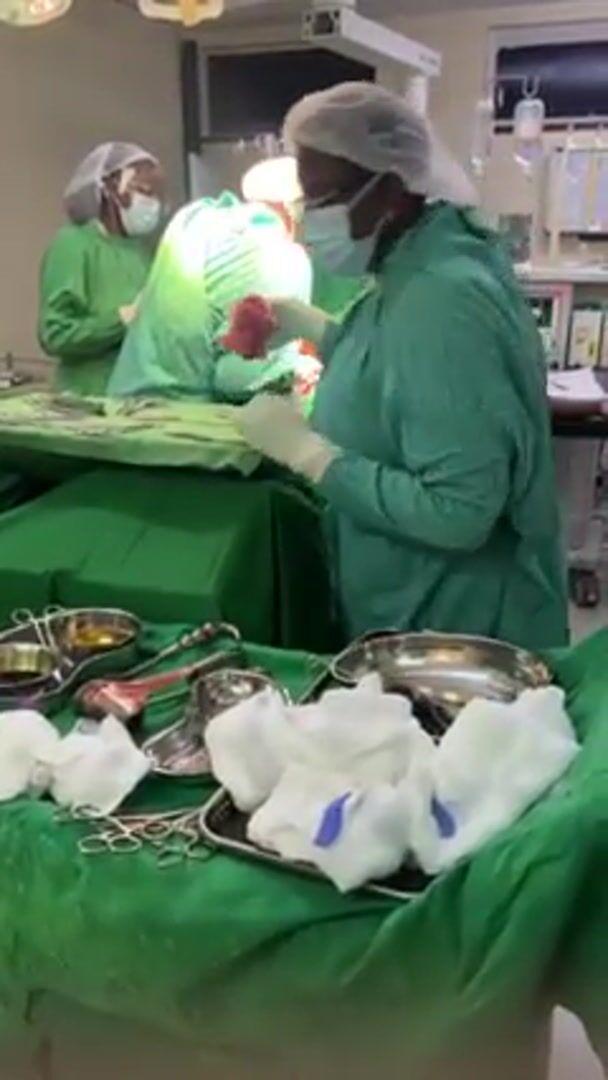
The video shows a surgical operating room with multiple medical personnel dressed in green surgical gowns, caps, and masks. At least three individuals are visible, focused around an operating table covered in green drapes. One person is directly involved in the procedure, while others assist. The room is brightly lit with surgical lights. A tray of surgical instruments, including scalpels, forceps, and swabs, is in the foreground on another draped table. The setting suggests an active surgical procedure is underway.
Nairobi, Kenya · Mar 20, 2026, 8:59 AM
In a brightly lit medical setting, likely a neonatal unit, two individuals wearing scrubs and protective gear are attending to a newborn baby. The baby lies on a medical bed draped with green cloths. Both individuals are wearing gloves, and one is wearing a surgical mask and eyeglasses. They appear to be cleaning or examining the baby, gently manipulating the infant with care. Medical equipment, including tubing and monitors, are visible in the background, contributing to the clinical atmosphere of the scene.
An operating room at FMH Theatre in Nairobi, Kenya, is depicted during a surgical procedure. In the foreground, facing away from the camera, stands a person wearing a green scrub shirt with "FMH THEATRE" printed on the back and a white hair net. Before them, a sterile field is established around a patient on an operating table, covered in green drapes. Three medical personnel, all wearing green scrubs, surgical masks, and hair nets, are actively engaged in the surgery, illuminated by multiple overhead surgical lights. One individual is positioned directly over the patient, another assists to their left, and a third stands to the right. A patient's arm, extended on a support to the right of the operating table, shows a finger connected to a device, possibly a pulse oximeter. Nearby, a medical monitor displays vital signs. Adjacent to the foreground observer is a stainless steel surgical trolley covered in green drapes, laden with various surgical instruments, used white gauze pads, and metal bowls. The lower shelf of this trolley holds individually packaged sterile medical supplies. Intravenous fluid bags are suspended from stands in the background. The room features light-colored walls and a clean floor, characteristic of a medical facility.
The image captures a surgical procedure in progress within an operating theater at the Department of Surgery, University of Nairobi, Nairobi, Kenya. Three medical professionals are visible, uniformly dressed in green surgical gowns and white hair nets.
On the left side of the frame, a surgeon, wearing a white surgical mask, leans over a brightly illuminated surgical field, actively engaged in the procedure with gloved hands. A second individual is partially visible in the far background left, wearing glasses and a hair net. On the right side, a surgeon or surgical assistant, wearing a blue surgical mask and light-colored surgical gloves, stands attentive with hands poised over a green-draped instrument table. This table is laden with various sterile surgical instruments.
The central, brightly lit surgical field reveals gloved hands manipulating tissue. One hand holds a distinct surgical instrument featuring a curved, serrated tip and a red band. Green surgical drapes cover the patient and the surrounding tables. In the upper background, an intravenous fluid bag hangs from a metal stand. The lower foreground shows two metal medical bowls, one containing white medical gauze. A circular white logo, clearly visible on the green background drape, identifies the location with the text "UNIVERSITY OF NAIROBI" and "DEPARTMENT OF SURGERY."
An operating room in Nairobi, Kenya, is depicted during an active surgical procedure. Four individuals are present, all wearing green surgical gowns, white bouffant caps, and face masks.
In the center-right foreground, a dark-skinned female, wearing glasses and a light blue surgical mask, is positioned with her gloved hands actively engaged at the patient's incision site. To her left, a dark-skinned male, also wearing glasses, a mask, and gloves, leans over the surgical field, participating in the procedure. Further left, a third dark-skinned individual, similarly attired, observes the activity. The fourth individual, partially visible on the far right, holds a clipboard or chart.
The patient is mostly obscured by green surgical drapes, with a brightly illuminated surgical field revealing exposed tissue and blood, indicating an ongoing incision. A specific surgical instrument, possibly an electrocautery pen, is visible in the hands of one surgeon, directed at the incision.
The environment features multiple overhead surgical lights, one with a visible "KLS Martin" brand label. In the background, an IV pole holds two hanging intravenous fluid bags, alongside a medical monitor screen and a wall-mounted light panel. A table in the foreground holds an array of stainless steel surgical instruments, including clamps and forceps, laid out on a sterile green drape. Metal basins and white surgical gauze are also visible on nearby surfaces. The overall scene is brightly lit and sterile.
Handball match plays out on outdoor court in Nairobi