Sunday, June 14, 2026 · Updated Sunday, June 14, 2026
Puebla, Mexico
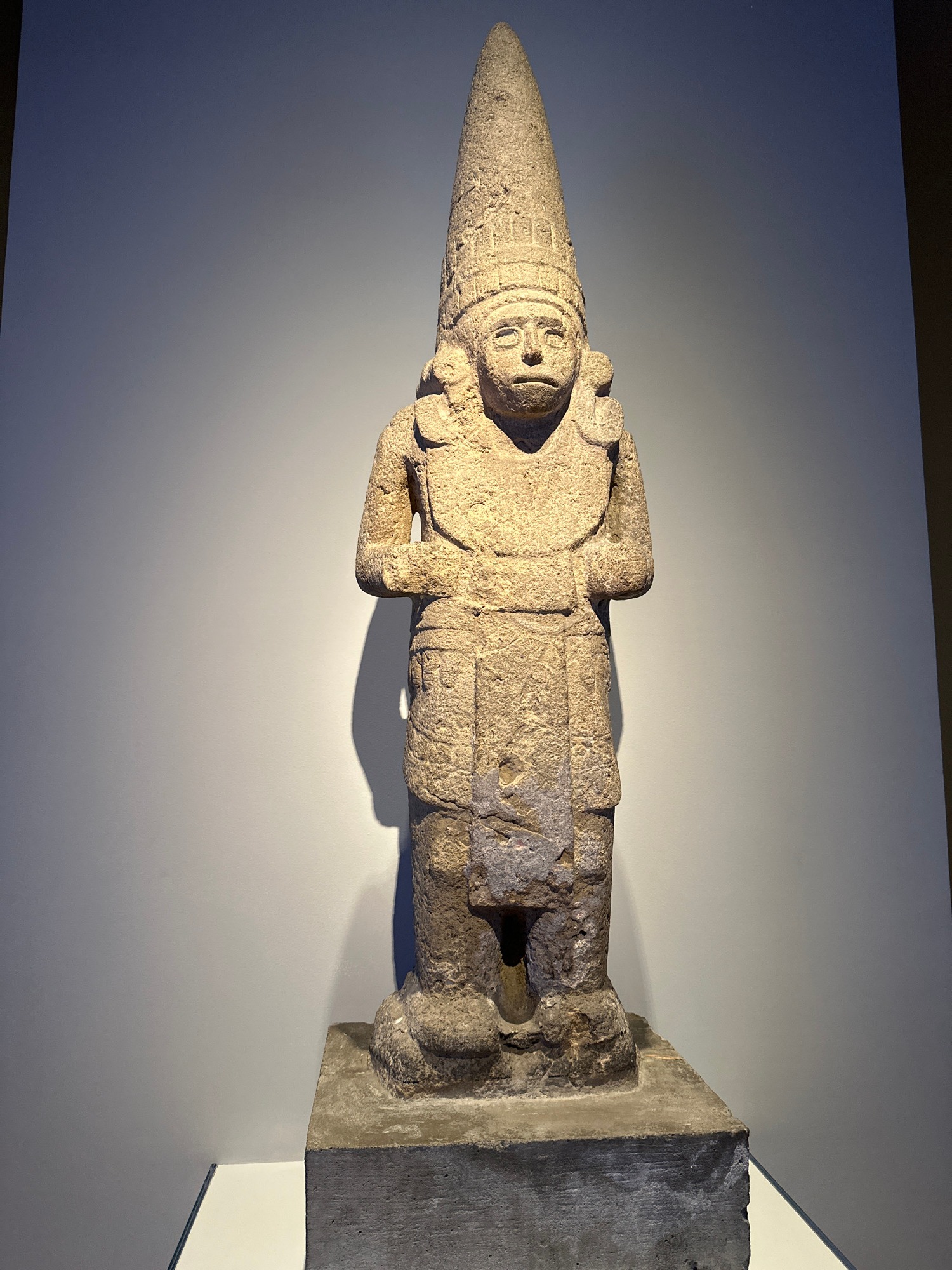
A full-shot, eye-level, studio photograph captures an ancient stone statue standing on a concrete pedestal against a neutral gray backdrop. The statue depicts a figure with a tall, conical headdress, adorned with horizontal bands and vertical lines, reaching a pointed apex. The figure's face is roughly carved, with wide-set eyes, a straight nose, and a straight mouth. It wears a necklace or chest plate with a rounded protrusion, and its arms are held down, hands clasped in front of the torso. A patterned tunic or kilt falls to the figure's knees, with a vertical slit at the bottom. The statue is illuminated from the front and slightly to the left, casting a distinct shadow to the right. The statue is displayed in the Museo de Arte Popular de Puebla, located in the historic center of Puebla, Mexico.
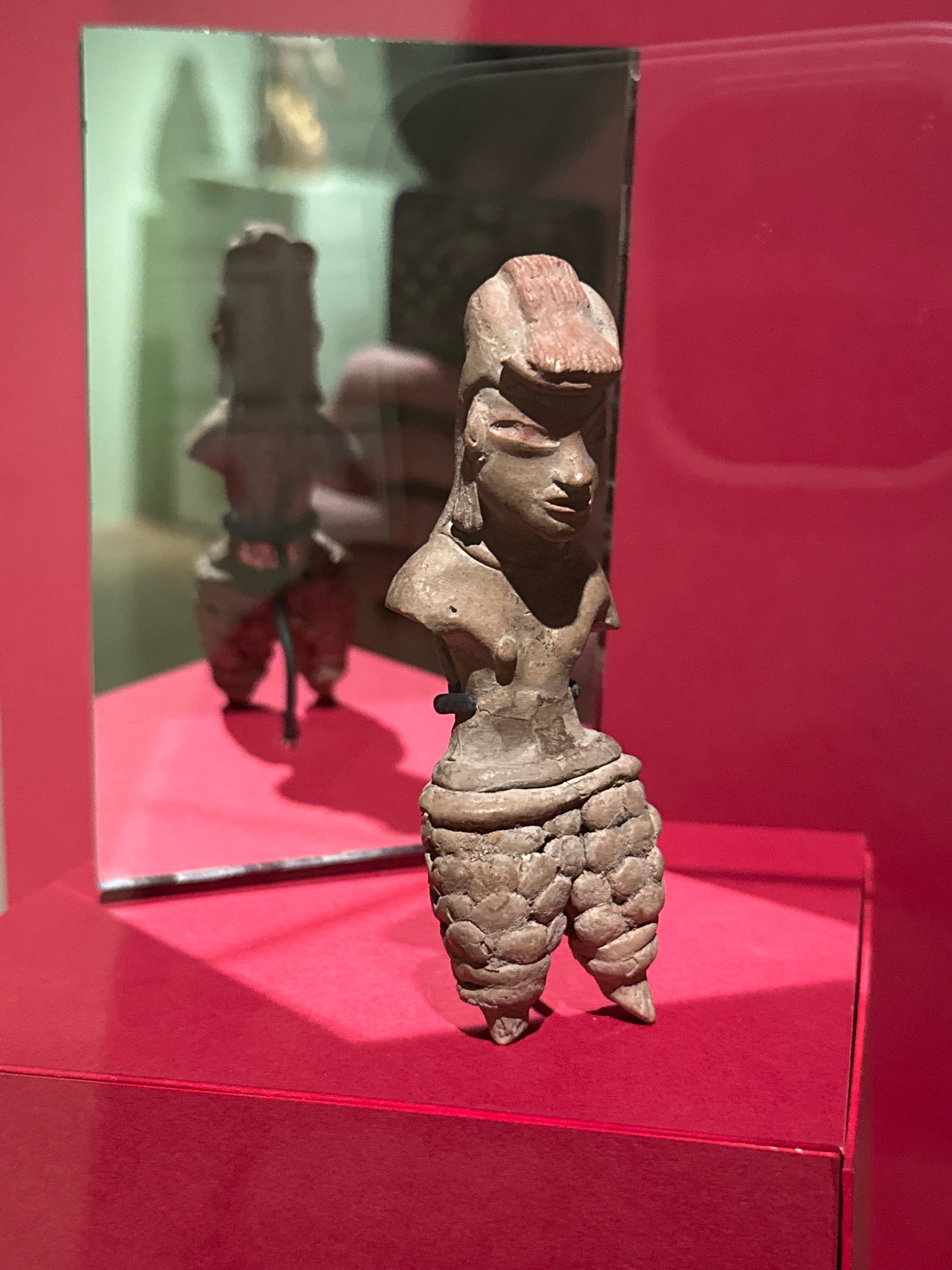
This is a photograph of a small, ancient terracotta figurine on display at the Museo Amparo in Puebla, Mexico. The figurine depicts a human-like figure with elaborate headdress, and detailed clothing or adornments around the legs. The figurine is light brown in color and appears to be made of fired clay. It is positioned in the foreground, slightly to the right of the center, on a red display platform. In the background, a mirror reflects the figurine and its surroundings, creating a sense of depth and symmetry. The overall background is a vibrant red, with soft lighting that highlights the details of the artifact. The setting appears to be a museum exhibit, with the red surfaces suggesting a curated display.
This is a photograph of a small, ancient terracotta figurine on display at the Museo Amparo in Puebla, Mexico. The figurine depicts a human-like figure with elaborate headdress, and detailed clothing or adornments around the legs. The figurine is light brown in color and appears to be made of fired clay. It is positioned in the foreground, slightly to the right of the center, on a red display platform. In the background, a mirror reflects the figurine and its surroundings, creating a sense of depth and symmetry. The overall background is a vibrant red, with soft lighting that highlights the details of the artifact. The setting appears to be a museum exhibit, with the red surfaces suggesting a curated display.
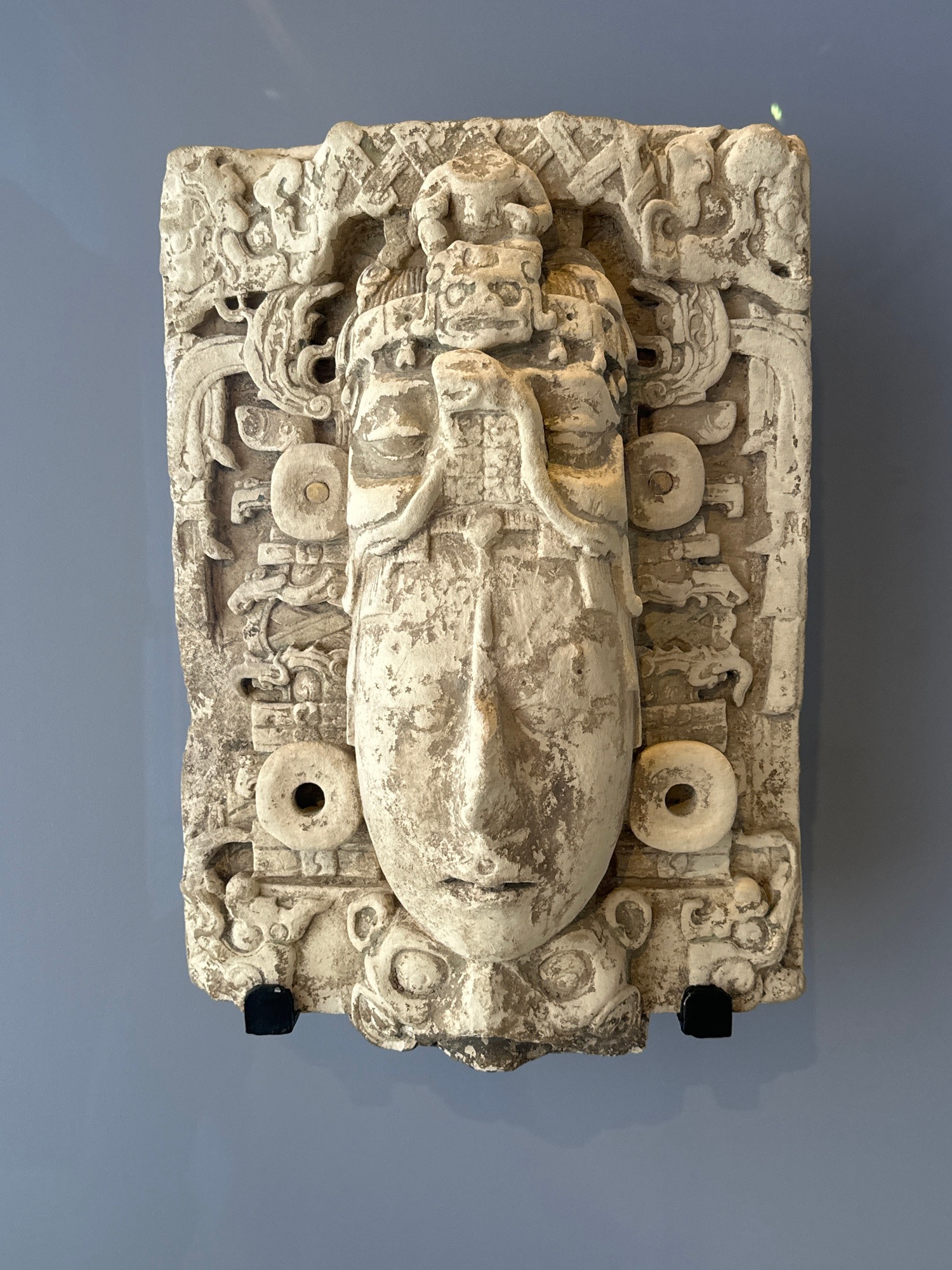
An ancient, stone relief carving of a human face is centered in the frame, mounted against a muted blue wall. The carving, likely Mayan in origin due to its stylistic elements, features a central, elongated face with a prominent nose and subtly defined lips. The eyes are recessed, with circular elements positioned on either side of the face, possibly representing jewelry or decorative embellishments. The head is adorned with an elaborate headdress, intricately carved with geometric patterns and what appear to be smaller figures or mythological creatures. The edges of the relief are rough and weathered, indicating its age. Two small, black mounting brackets are visible at the bottom of the carving, securing it to the wall. The lighting appears even, with no strong shadows. The background is a plain, solid blue, providing no context about the location beyond its exhibition setting. Without further information, it is impossible to determine the specific location in Puebla, Mexico.
An ancient, stone relief carving of a human face is centered in the frame, mounted against a muted blue wall. The carving, likely Mayan in origin due to its stylistic elements, features a central, elongated face with a prominent nose and subtly defined lips. The eyes are recessed, with circular elements positioned on either side of the face, possibly representing jewelry or decorative embellishments. The head is adorned with an elaborate headdress, intricately carved with geometric patterns and what appear to be smaller figures or mythological creatures. The edges of the relief are rough and weathered, indicating its age. Two small, black mounting brackets are visible at the bottom of the carving, securing it to the wall. The lighting appears even, with no strong shadows. The background is a plain, solid blue, providing no context about the location beyond its exhibition setting. Without further information, it is impossible to determine the specific location in Puebla, Mexico.
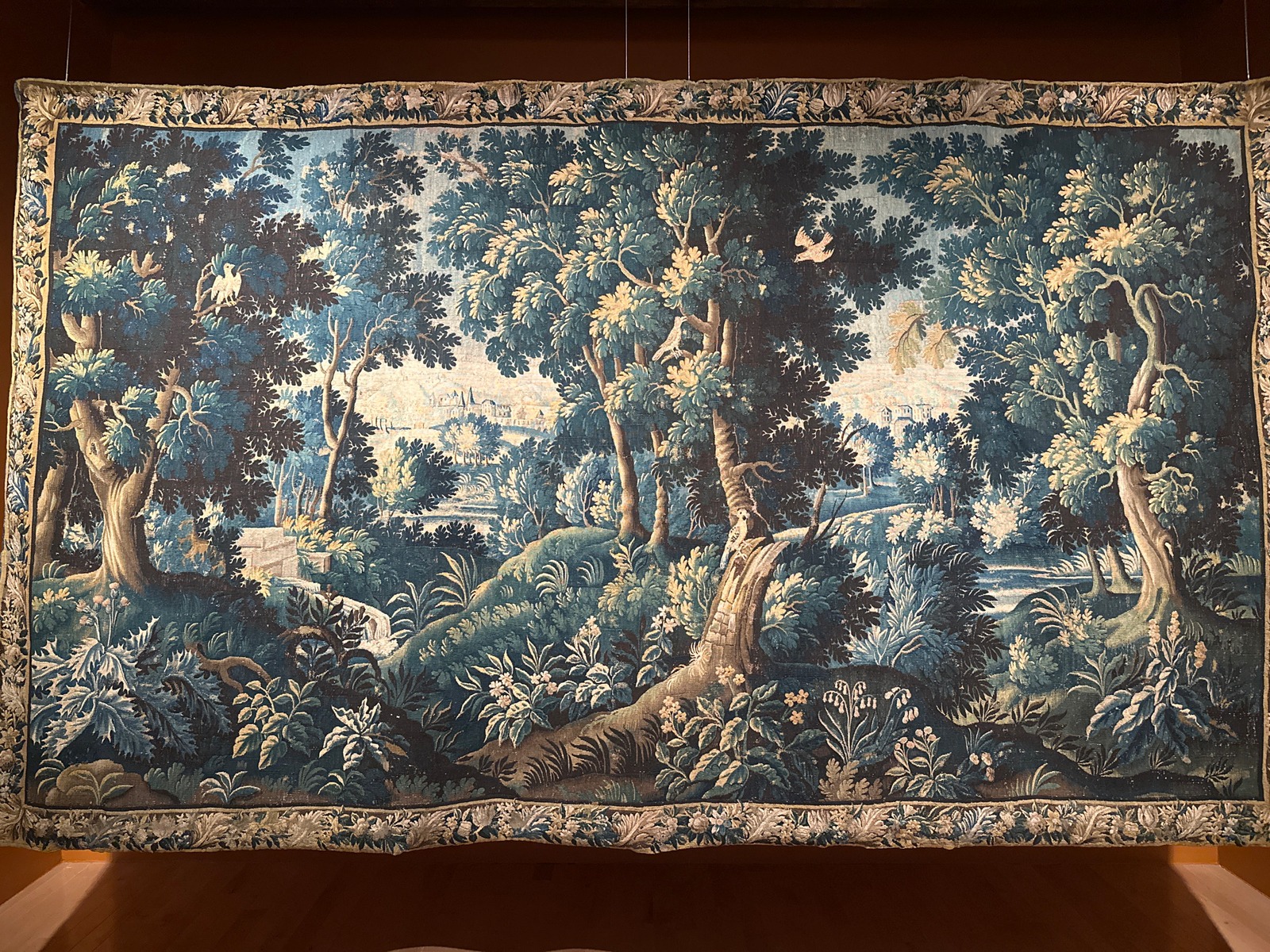
The image shows a large, intricately woven tapestry depicting a lush, wooded landscape. The tapestry features a dense arrangement of trees with dark green foliage and lighter, almost yellow-green accents on some of the leaves. The ground is covered with a variety of plants, including ferns, flowers, and bushes, rendered in shades of blue, green, and white. A winding path or stream is visible in the middle ground, leading towards a distant, hazy landscape with architectural structures that suggest buildings or a town. Two white birds are depicted in flight within the trees, and the overall impression is one of a vibrant, natural scene. The tapestry has a decorative border along the top and bottom edges, composed of floral and leafy motifs in muted colors. The tapestry is hung against a dark background, likely a wall, and is illuminated by artificial lighting.
The tapestry is located in the Museo Amparo in Puebla, Mexico.
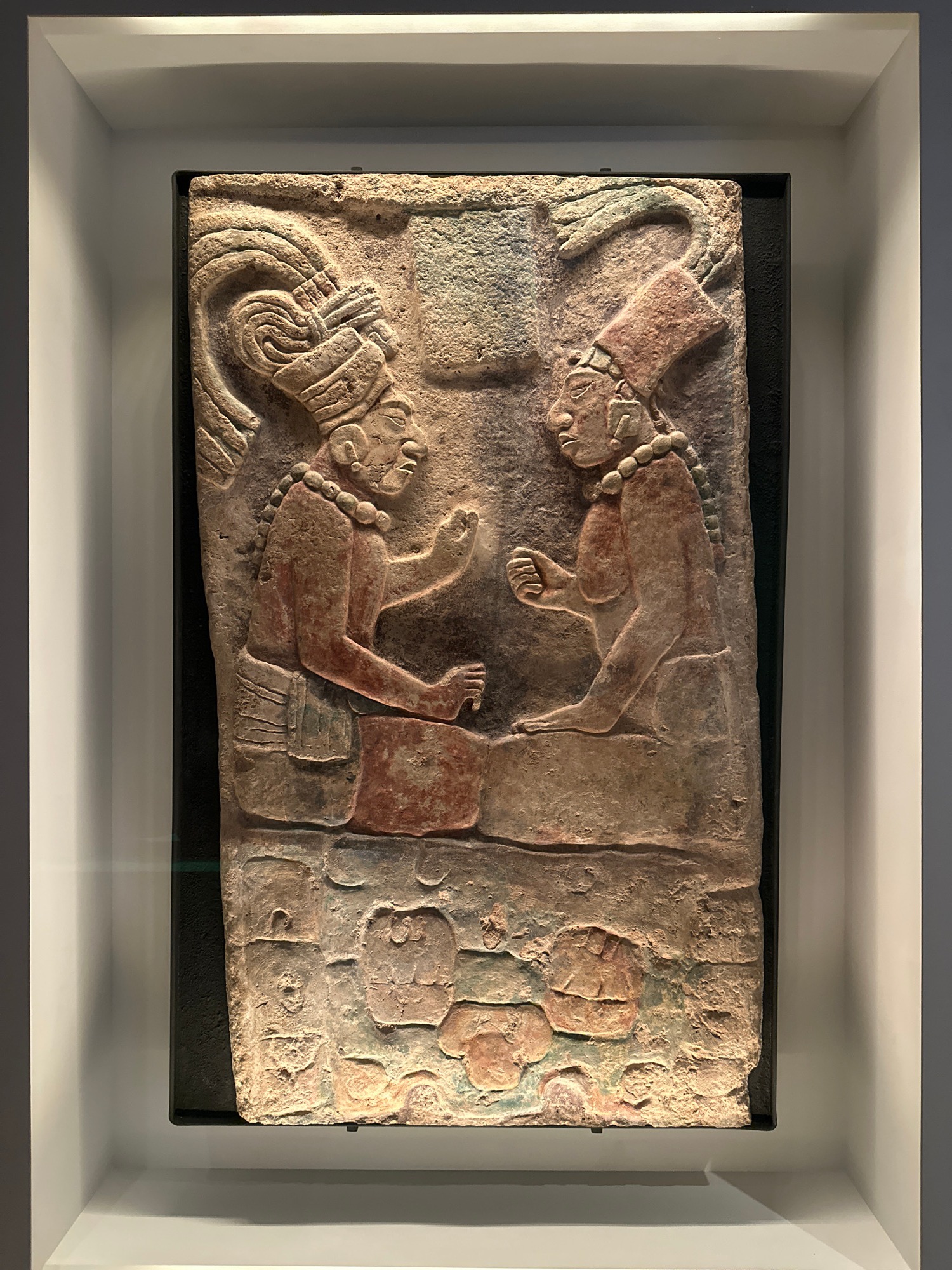
The image shows a framed stone relief depicting two figures in profile, facing each other. Both figures are adorned with elaborate headdresses and necklaces. The figure on the left, with a more complex headdress featuring swirling patterns and what appear to be feathers, wears a beaded necklace and a kilt-like garment. The figure on the right wears a simpler, conical headdress and a similar beaded necklace. Both figures have their hands raised, suggesting an interaction or communication. The relief has a textured surface and shows signs of wear and fading, with remnants of color visible on the figures' skin and clothing. The lower part of the relief features a band of carved glyphs or symbols. The relief is mounted within a thick, light-colored frame, with a dark background visible behind it. The overall impression is of an ancient artifact, possibly a historical or religious carving.
This artifact is located in the Museo Amparo in Puebla, Mexico.
The image shows a large, intricately woven tapestry depicting a lush, wooded landscape. The tapestry features a dense arrangement of trees with dark green foliage and lighter, almost yellow-green accents on some of the leaves. The ground is covered with a variety of plants, including ferns, flowers, and bushes, rendered in shades of blue, green, and white. A winding path or stream is visible in the middle ground, leading towards a distant, hazy landscape with architectural structures that suggest buildings or a town. Two white birds are depicted in flight within the trees, and the overall impression is one of a vibrant, natural scene. The tapestry has a decorative border along the top and bottom edges, composed of floral and leafy motifs in muted colors. The tapestry is hung against a dark background, likely a wall, and is illuminated by artificial lighting.
The tapestry is located in the Museo Amparo in Puebla, Mexico.
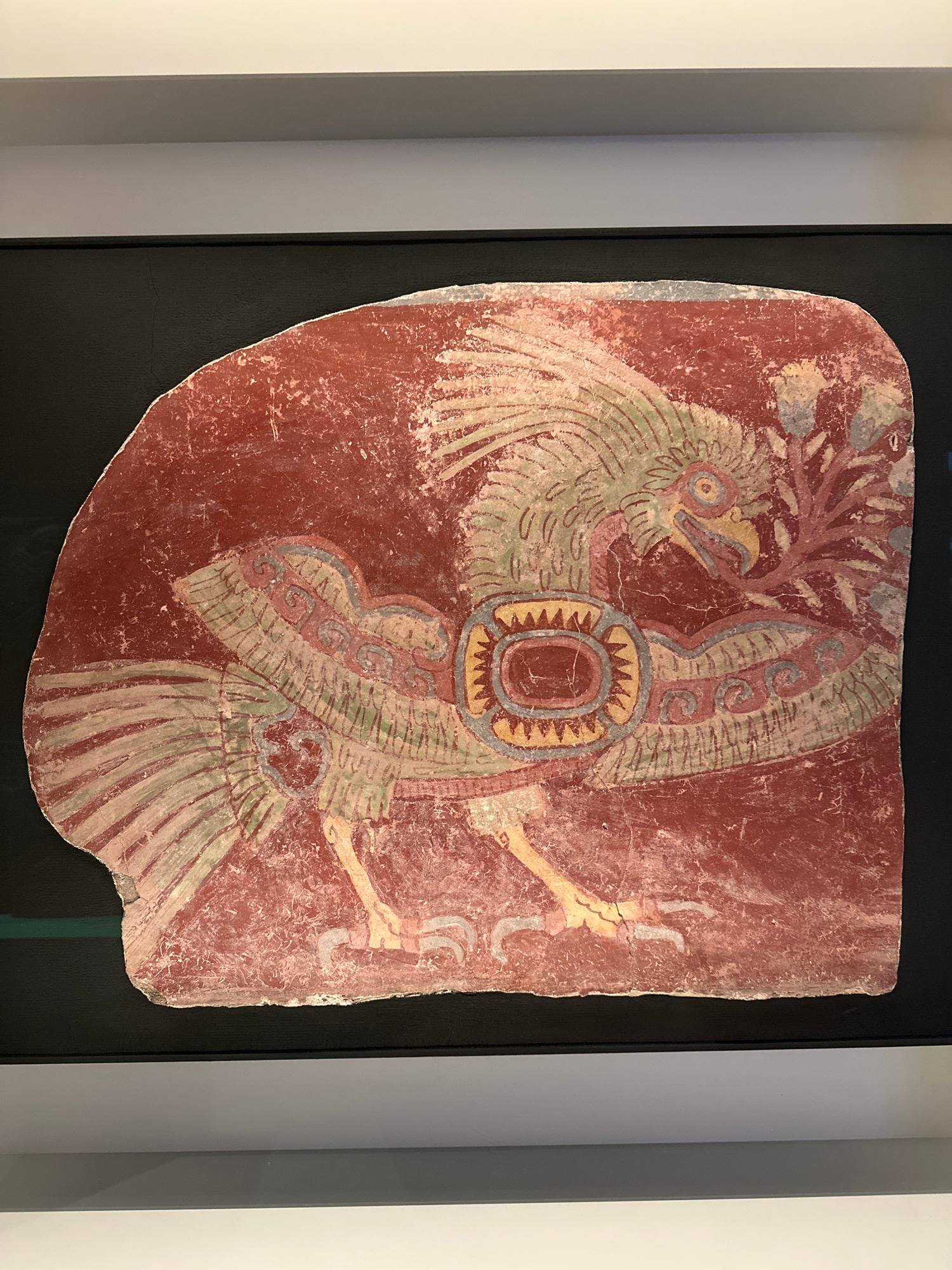
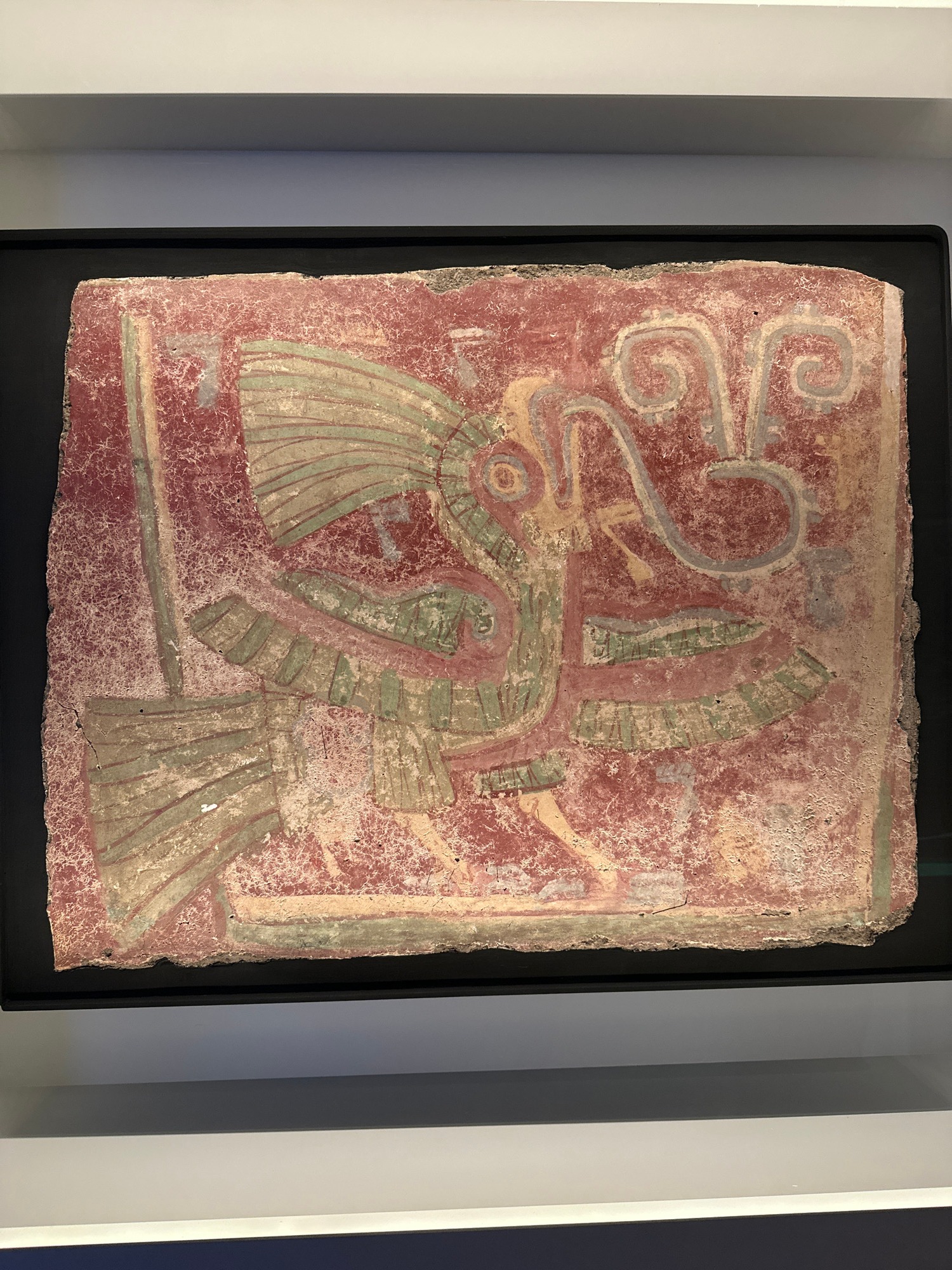
The image displays an ancient mural fragment, likely a fresco, depicting a stylized bird. The background is a reddish-brown hue, unevenly applied and showing signs of age and wear, with visible cracks and chips. The bird itself is rendered with a vibrant palette of greens, yellows, blues, and reds. Its body is elongated, with prominent wings spread wide. The bird has a distinctive head with an open beak, a sharp eye, and a crested headdress. Decorative elements in shades of blue and yellow adorn its chest and wings. Its legs are depicted with clawed feet, and it appears to be standing on wavy lines, possibly representing water or ground. To the right of the bird, there's a depiction of a plant or branch with red and blue foliage. The mural is framed by a dark border and mounted on a wall in what appears to be a museum or gallery setting, suggested by the clean white ceiling and wall above the dark frame. This artwork is an example of pre-Hispanic mural painting, potentially from the Teotihuacan or Aztec civilizations. Such artifacts are often housed in museums like the Museo Nacional de Antropología in Mexico City or provincial museums in areas where these civilizations flourished, such as the city of Puebla, Mexico, known for its rich history and archeological sites.
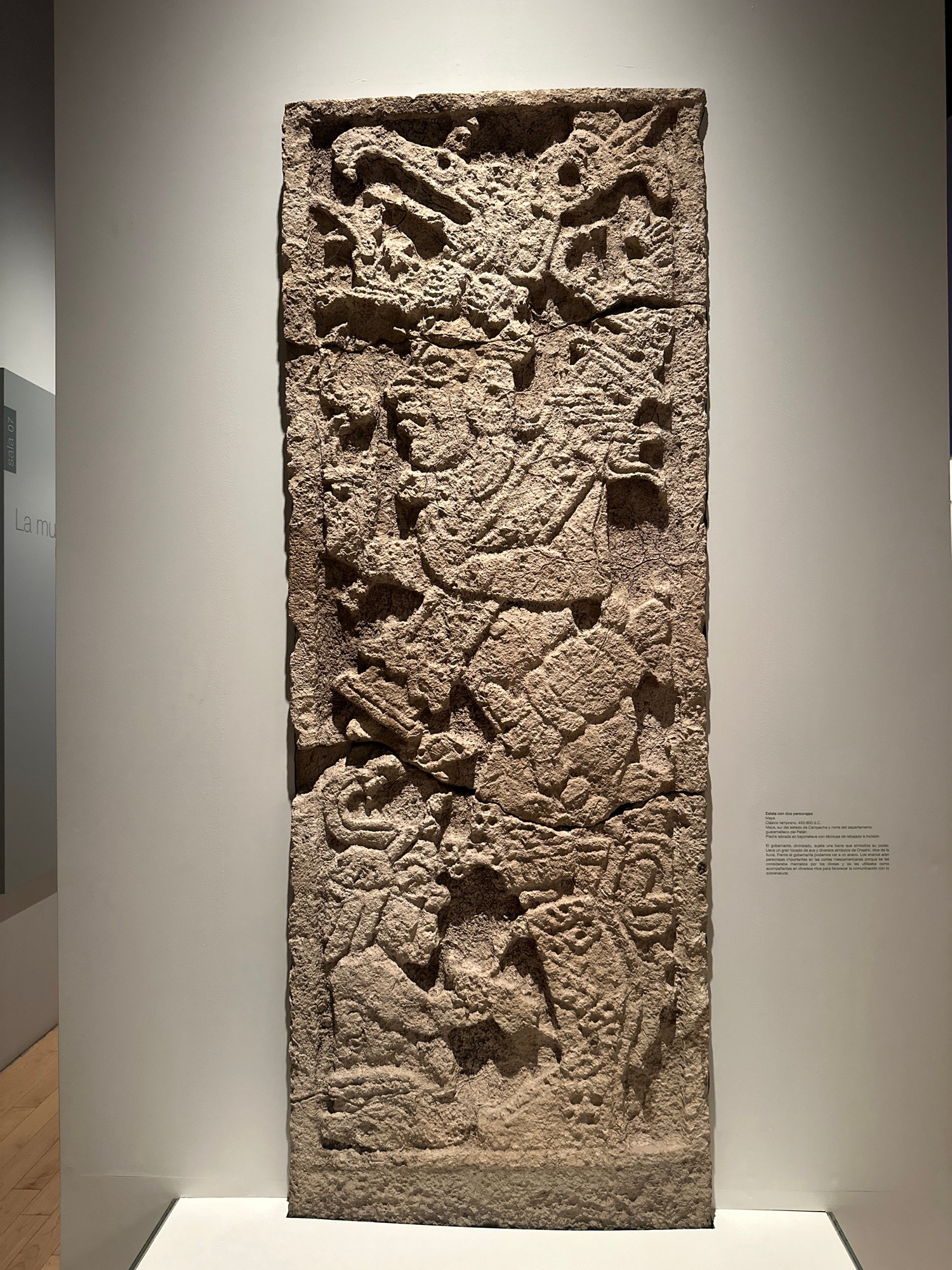
An upright, rectangular stone stele, carved with relief imagery, stands against a plain, light grey wall in a museum exhibition space. The stele, likely Mayan, features a detailed scene with two figures rendered in low relief. The figures are depicted in profile, engaged in a narrative composition that includes symbolic elements. The stone itself appears weathered and exhibits a rough texture.
To the left of the stele, a sliver of a vertical sign is visible, with the text "sala 07" and "La mu" partially readable, suggesting it's part of an exhibit label or directional signage. The floor beneath the stele is not visible.
To the right of the stele, a printed informational placard is affixed to the wall. The placard contains text in Spanish, with the title "Estela con dos personajes". The text details that the stele is Mayan, from the southern part of Campeche and the northern part of the Petén department, dating to the Late Classic period (400-600 AD). It describes the carving as "Piedra labrada en bajorrelieve con técnicas de rebajado e incisión" (Carved stone in bas-relief with lowered and incised techniques). The text further explains that the relief depicts a divine ruler, adorned with a great headdress and various symbols of power, holding a scepter. It also mentions that the ruler is accompanied by figures, possibly attendants, who were considered intermediaries with the gods and used in rituals to communicate with the supernatural.
The lighting in the exhibition space is focused on the stele, casting shadows that accentuate the carved details. The overall environment is a clean, minimalist museum setting designed to highlight the artifact. The location is identified as the city of Puebla, Mexico, though the specific museum is not indicated.
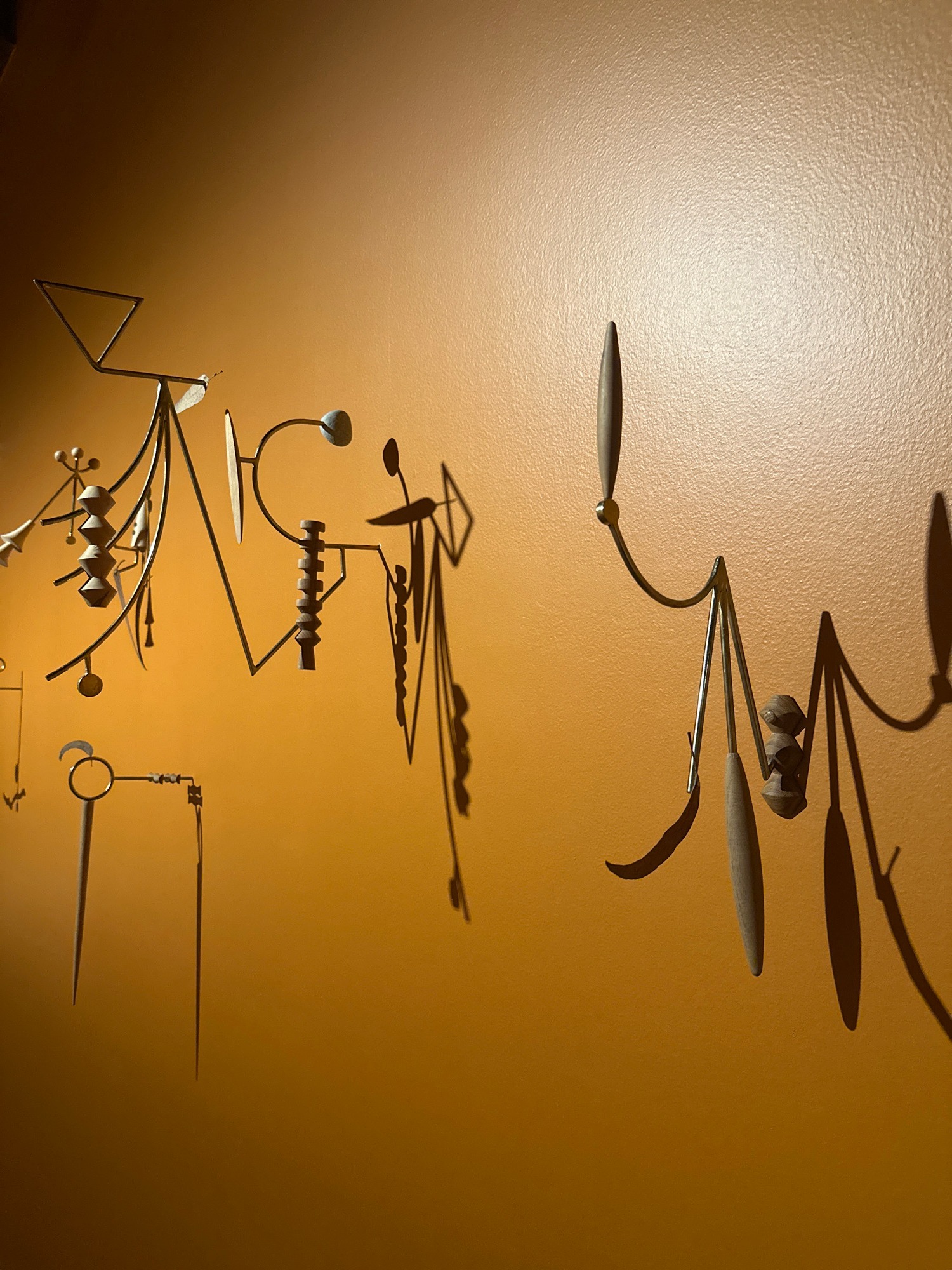
The image displays a wall with textured orange paint, illuminated by a strong light source coming from the right, casting elongated shadows of metal sculptures onto the wall. On the left side of the image, a complex metal sculpture is mounted, featuring various geometric shapes, circular elements, and ribbed cylindrical pieces. To the right, another, simpler metal sculpture is present, consisting of curved metallic rods and oval wooden elements. The overall aesthetic suggests a modern art installation. The scene is devoid of people, indicating it is likely a display in a gallery, museum, or private collection. The location in Puebla, Mexico, is not directly discernible from the visual information provided in the image.
The image shows a framed stone relief depicting two figures in profile, facing each other. Both figures are adorned with elaborate headdresses and necklaces. The figure on the left, with a more complex headdress featuring swirling patterns and what appear to be feathers, wears a beaded necklace and a kilt-like garment. The figure on the right wears a simpler, conical headdress and a similar beaded necklace. Both figures have their hands raised, suggesting an interaction or communication. The relief has a textured surface and shows signs of wear and fading, with remnants of color visible on the figures' skin and clothing. The lower part of the relief features a band of carved glyphs or symbols. The relief is mounted within a thick, light-colored frame, with a dark background visible behind it. The overall impression is of an ancient artifact, possibly a historical or religious carving.
This artifact is located in the Museo Amparo in Puebla, Mexico.
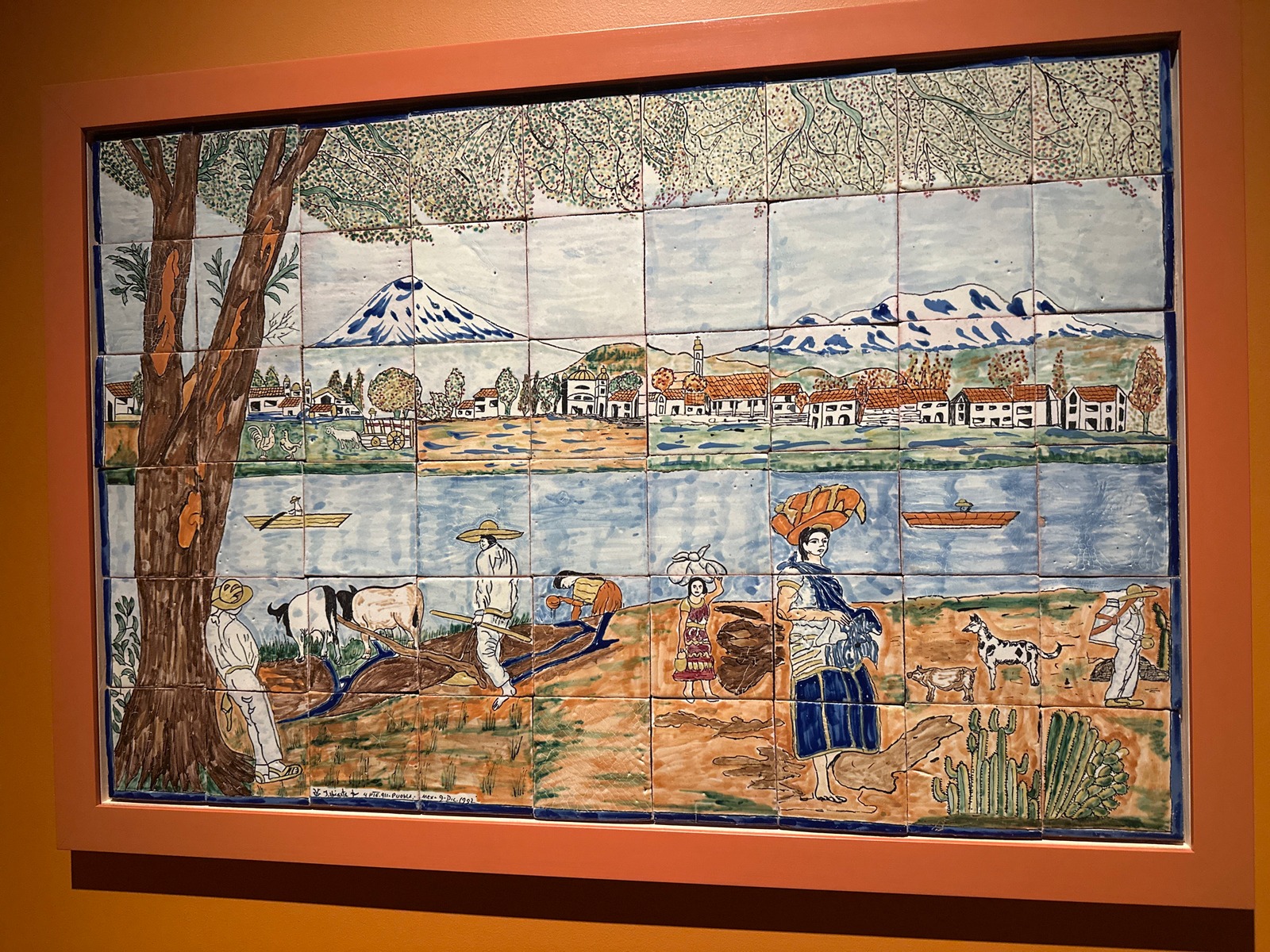
This is a panoramic tile mural depicting a rural scene in Puebla, Mexico. The mural is composed of approximately 24 tiles and framed by a coral-colored border. The upper portion of the mural features a distant view of a town nestled against a mountain range, with a snow-capped volcano in the background. The town is characterized by white buildings with red-tiled roofs and a prominent church steeple. A body of water, likely a river or lake, separates the town from the foreground.
The foreground of the mural depicts agricultural activities and daily life. On the left, a man in a straw hat and white clothing leans against a large tree, while two cows graze nearby. Further to the right, a man is engaged in plowing a field with a team of oxen. In the center, a woman in traditional attire carries a bundle on her head, and a young girl stands beside her. To the right, a woman with a basket on her head walks with a dog and a cow. The rightmost portion of the mural shows a man carrying a load on his back, with a backdrop of cacti. The sky is depicted with clouds and a light blue hue. The bottom of the mural has text which reads "V. Sabraste - 9 - Dic 1902 Puebla, Mex".
The image displays an ancient mural fragment, likely a fresco, depicting a stylized bird. The background is a reddish-brown hue, unevenly applied and showing signs of age and wear, with visible cracks and chips. The bird itself is rendered with a vibrant palette of greens, yellows, blues, and reds. Its body is elongated, with prominent wings spread wide. The bird has a distinctive head with an open beak, a sharp eye, and a crested headdress. Decorative elements in shades of blue and yellow adorn its chest and wings. Its legs are depicted with clawed feet, and it appears to be standing on wavy lines, possibly representing water or ground. To the right of the bird, there's a depiction of a plant or branch with red and blue foliage. The mural is framed by a dark border and mounted on a wall in what appears to be a museum or gallery setting, suggested by the clean white ceiling and wall above the dark frame. This artwork is an example of pre-Hispanic mural painting, potentially from the Teotihuacan or Aztec civilizations. Such artifacts are often housed in museums like the Museo Nacional de Antropología in Mexico City or provincial museums in areas where these civilizations flourished, such as the city of Puebla, Mexico, known for its rich history and archeological sites.
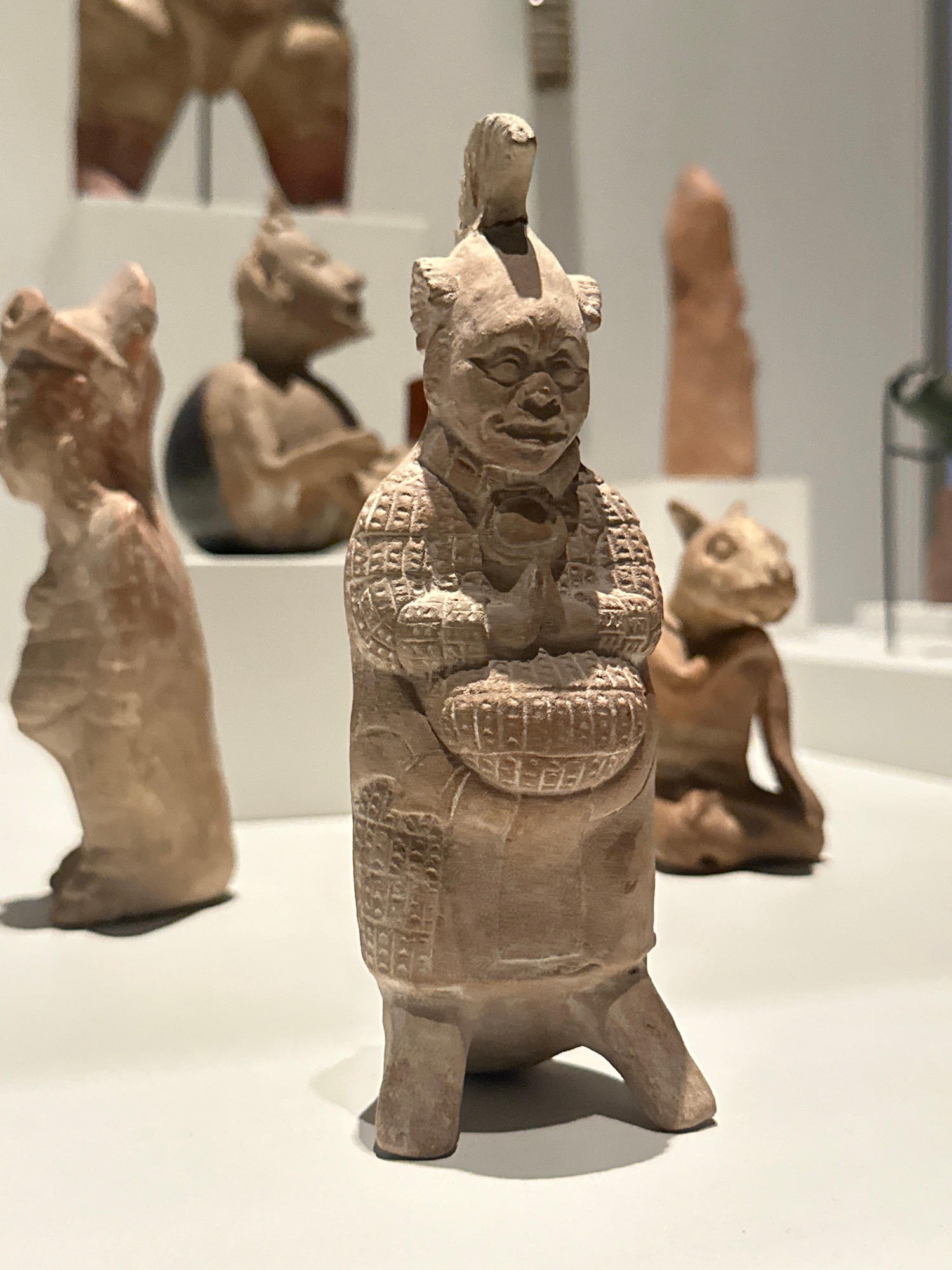
The image displays a collection of small, terracotta figures exhibited on a white surface, likely within a museum or gallery setting. In the foreground, a central figure stands upright, featuring a detailed, patterned tunic and a basket-like object held in its hands. Its face is round with prominent features, and it wears a headdress. To the left of this central figure is another, partially visible terracotta figurine, appearing to be in a seated or crouching position, with a rounded head. In the background, slightly out of focus, are other terracotta figures, including one with an animal-like head and a body that is seated. The overall presentation suggests an archaeological or historical exhibit. The lighting is soft and diffused, casting gentle shadows on the white display surface. There is no discernible urban environment or specific city location evident in the image itself.
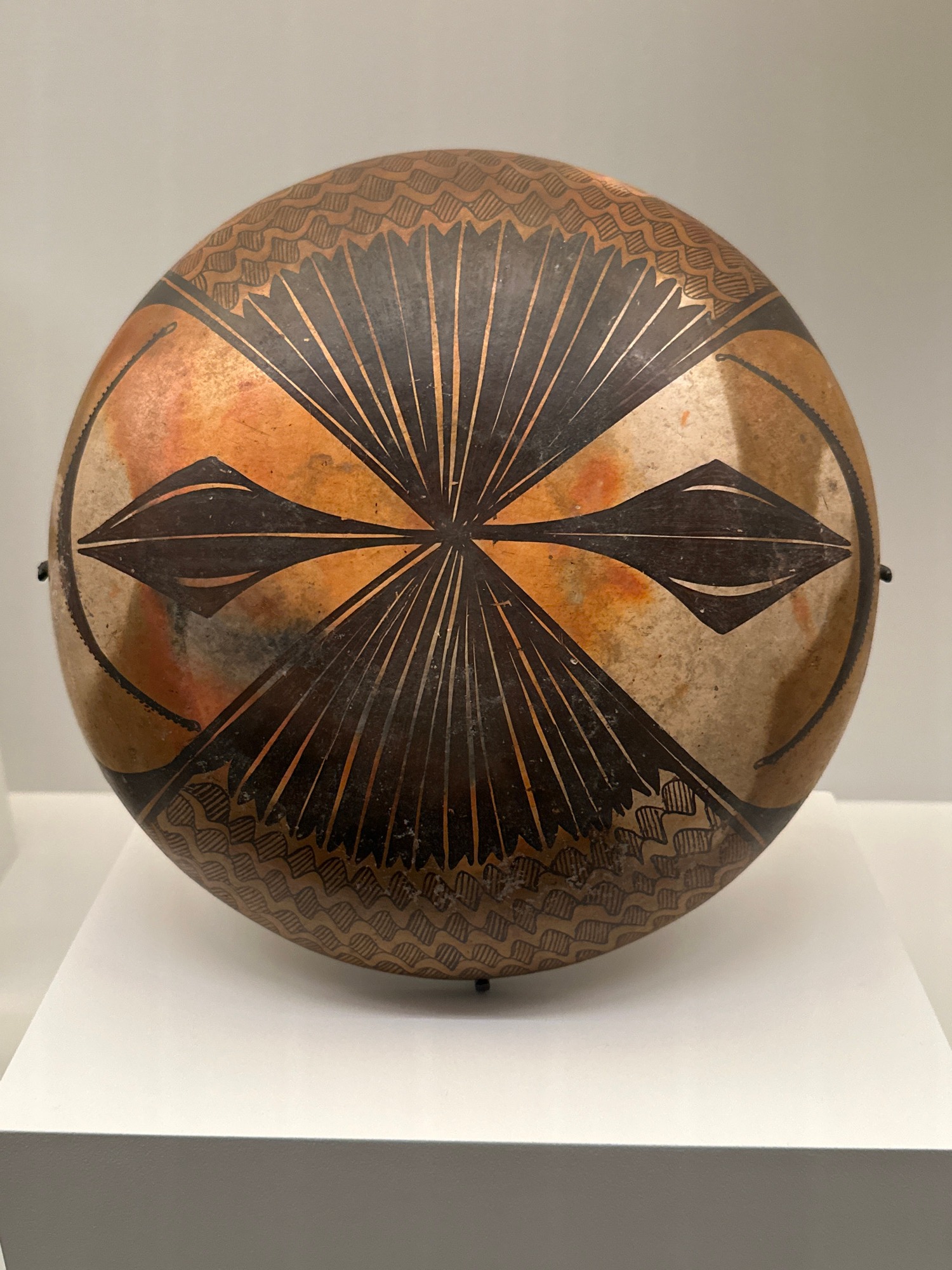
A round, terra cotta pot with intricate geometric patterns in dark brown and copper tones is displayed on a white pedestal. The pot features a central, symmetrical design resembling fanned rays emanating from a horizontal, diamond-shaped motif. This central design is bordered by bands of wave-like patterns. The pot has a rough texture and is displayed in a museum or gallery setting, indicated by the plain white background and pedestal. No people or specific landmarks are visible. The location is not specified in the image, and therefore, it cannot be identified as being in Puebla, Mexico.
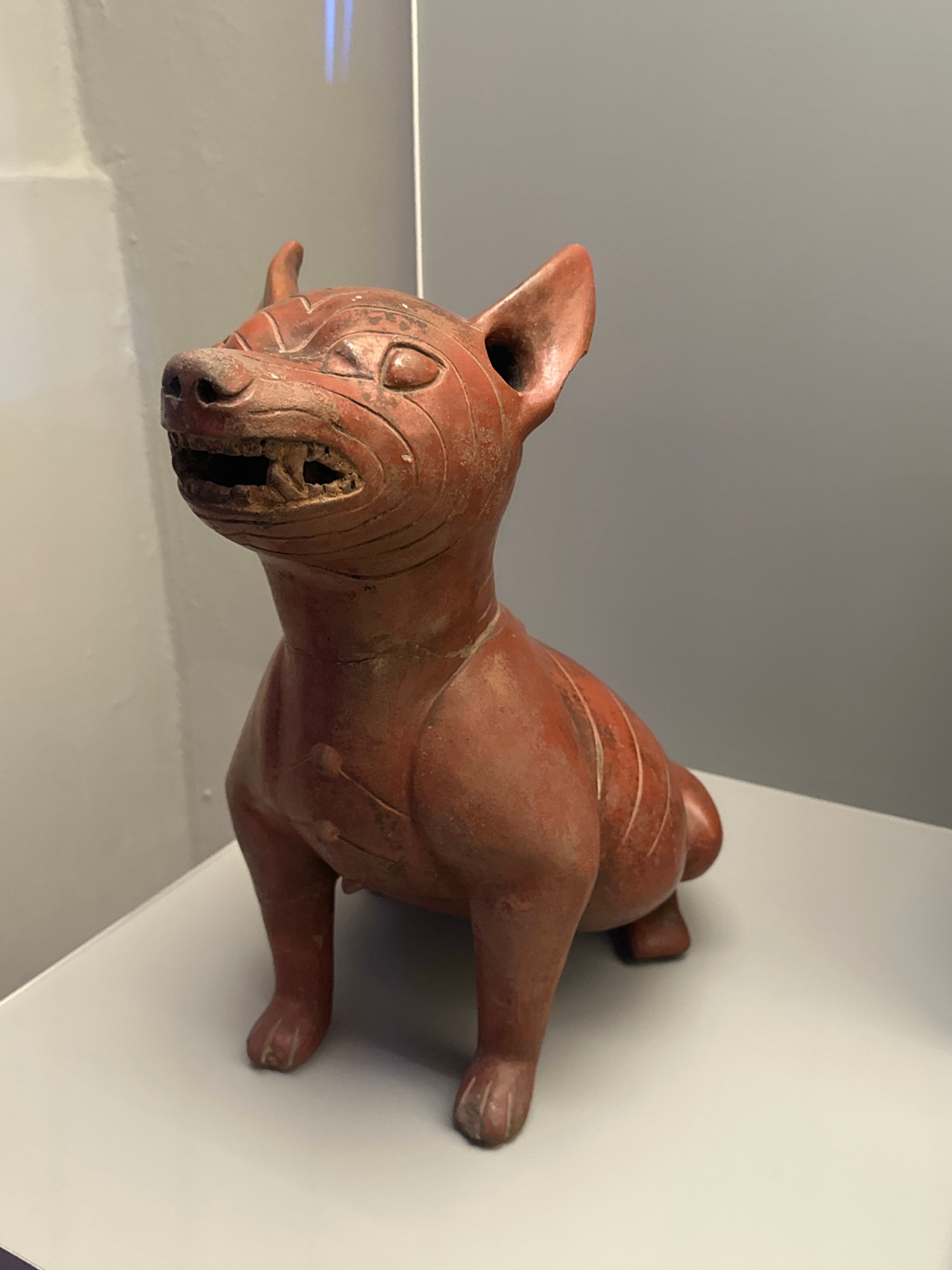
A terra cotta statue of a dog, possibly a Xoloitzcuintli, sits on a white surface. The statue is a reddish-brown color and exhibits detailed carvings on its face, ears, and body. The dog's mouth is open, revealing carved teeth, and its eyes are prominent. The background consists of a light gray wall. The statue appears to be displayed in a museum or exhibition. Puebla, Mexico, is known for its rich history of ceramics and artisanal crafts, and terra cotta dog sculptures are a common motif in the region, often associated with pre-Hispanic traditions.
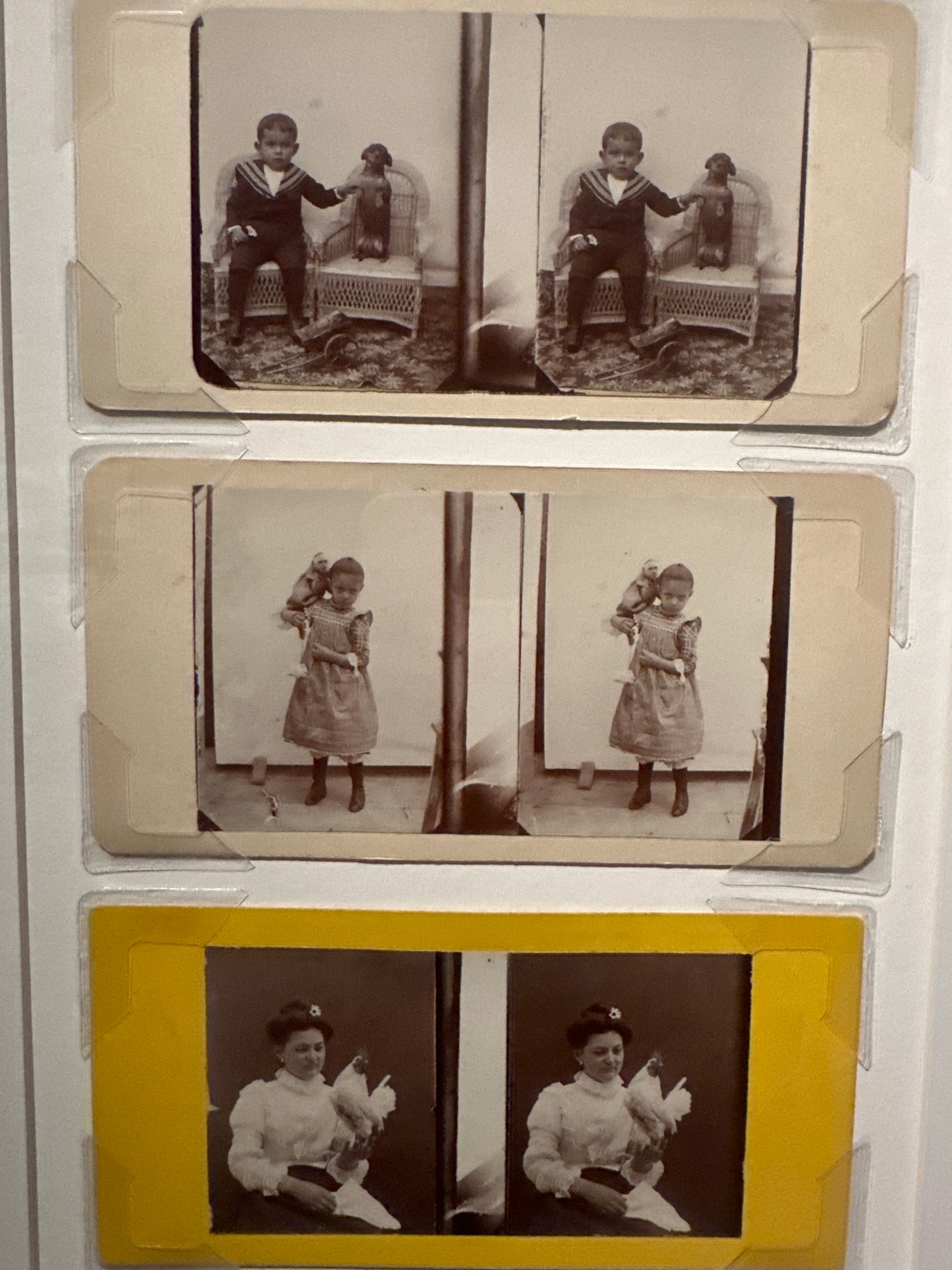
This is a photograph of three stereoscopic cards arranged vertically. The top card shows a young boy in a sailor suit sitting on a wicker chair with a dachshund next to him. The middle card shows a young girl holding a monkey on her shoulder. The bottom card shows a woman in a white blouse holding a chicken. The image does not provide any information about the location in the city of Puebla, Mexico, or any specific details about the people, subjects, objects, actions, interactions, or environment depicted.
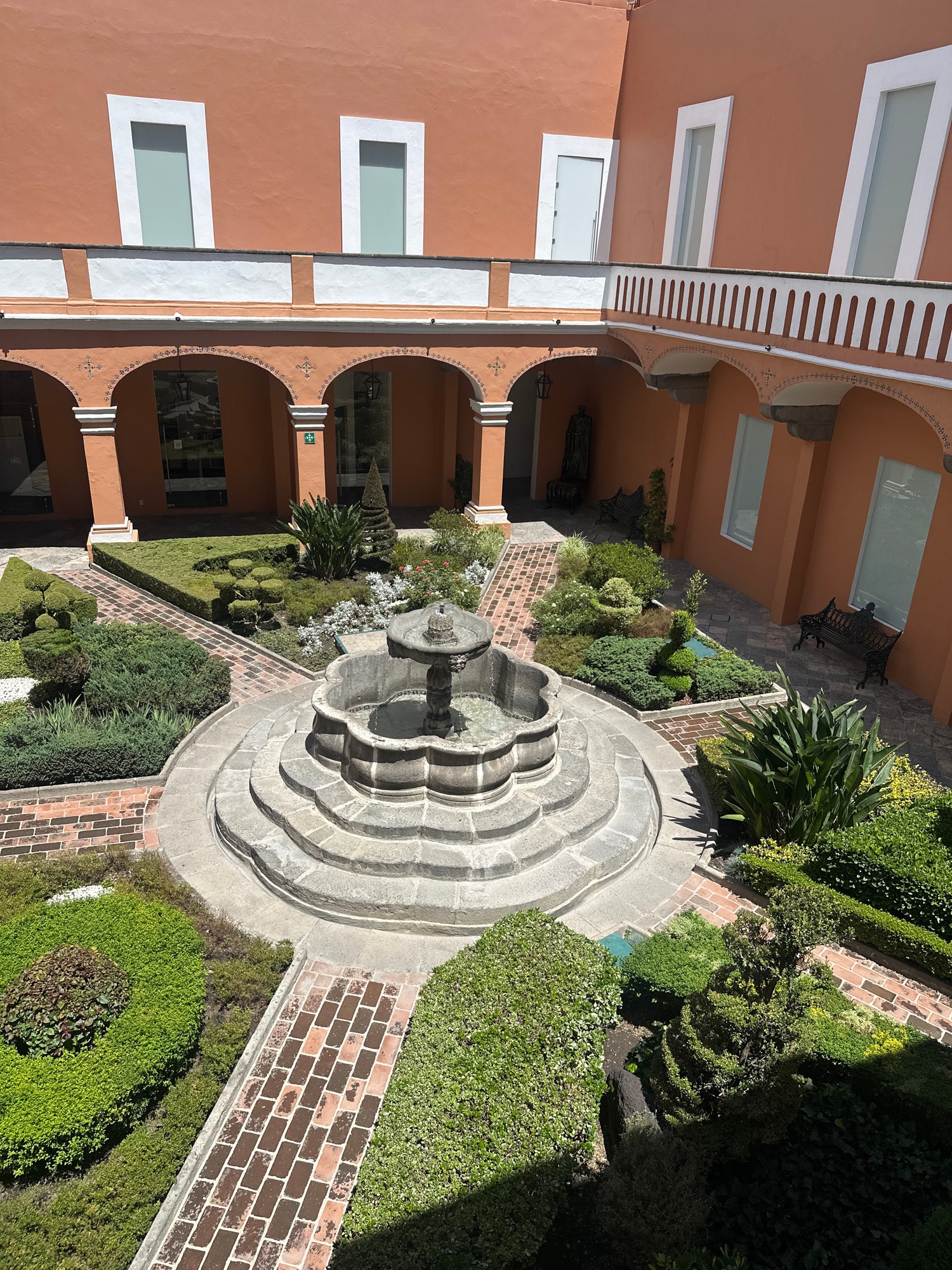
This is an aerial, high-angle medium shot of a courtyard in Puebla, Mexico, featuring a central tiered fountain surrounded by manicured gardens. The courtyard is enclosed by an orange-hued building with arched walkways and large, rectangular windows. The architecture appears colonial or Spanish-influenced. The gardens consist of neatly trimmed hedges, topiaries, and flowering plants, with brick pathways winding through them. Two dark metal benches are visible in the courtyard, one on the left and one on the right, suggesting it is a public or semi-public space. Sunlight casts shadows on the courtyard, indicating it is daytime. No people are visible in the scene. The overall impression is one of tranquility and careful landscaping.
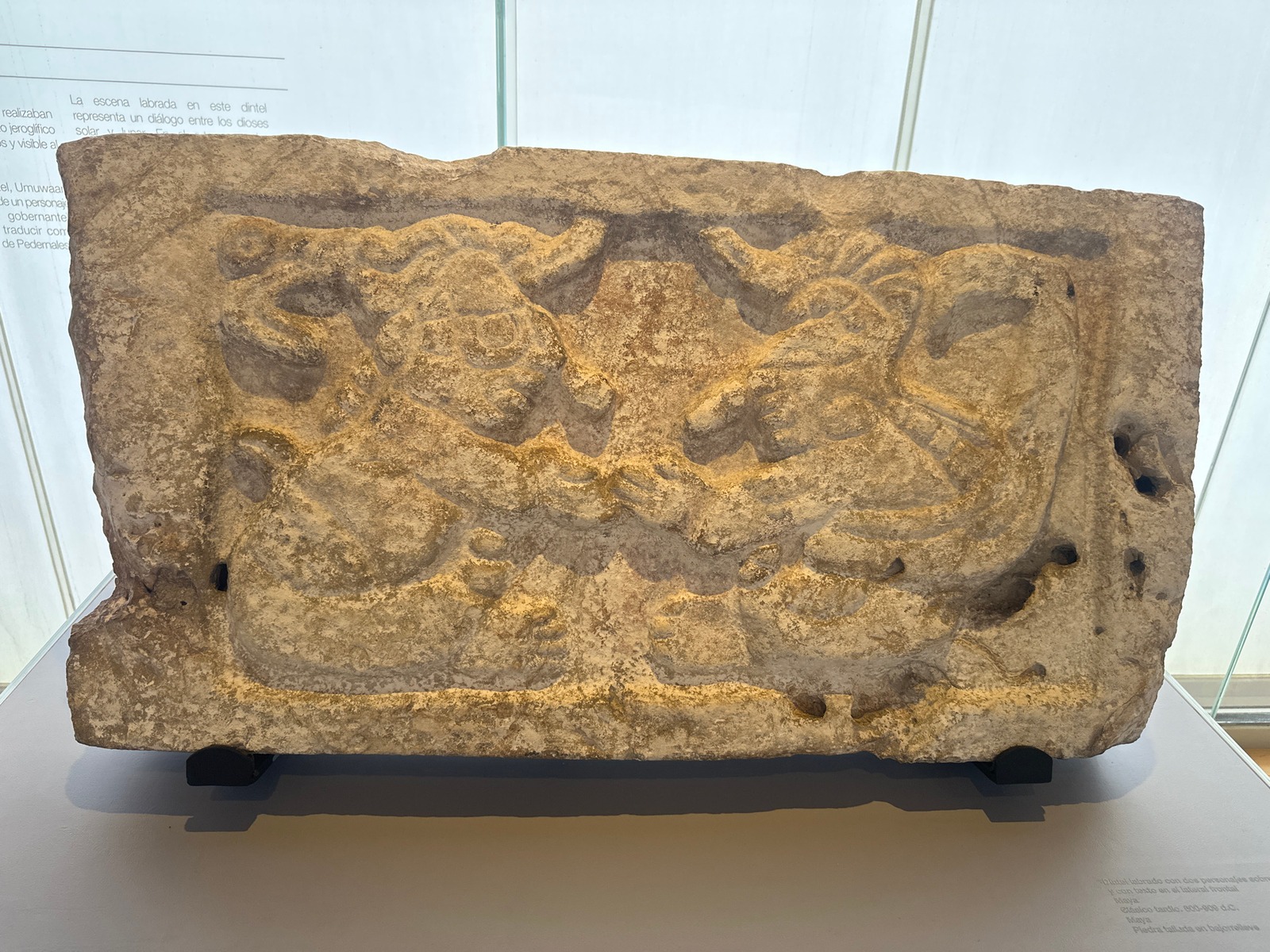
The image shows a close-up, eye-level, frontal view of an ancient Maya lintel carved from limestone, displayed in a museum. The lintel, measuring approximately 1.5 meters in length and 0.5 meters in height, is heavily worn and shows signs of erosion, with many areas of the carving obscured or damaged. The relief depicts two figures in profile, facing each other in what appears to be a narrative scene. The figures have detailed headdresses and are adorned with jewelry. They are surrounded by glyphs, some of which are remarkably preserved, while others are heavily eroded. The lintel is supported by two small black blocks. In the background, a white display panel with text is visible, and beyond that, a glass partition and a bright, diffused light source, suggesting an indoor museum exhibit. The text on the display panel, though partially illegible due to the angle and resolution, appears to be a description of the artifact, possibly including its origin, date, and subject matter. The context provided with the image indicates this artifact is from "Palenque, Chiapas" and is dated to the Late Classic Maya period (600-900 AD). Although the image's metadata mentions Puebla, Mexico, the artifact itself is from Palenque, Chiapas.
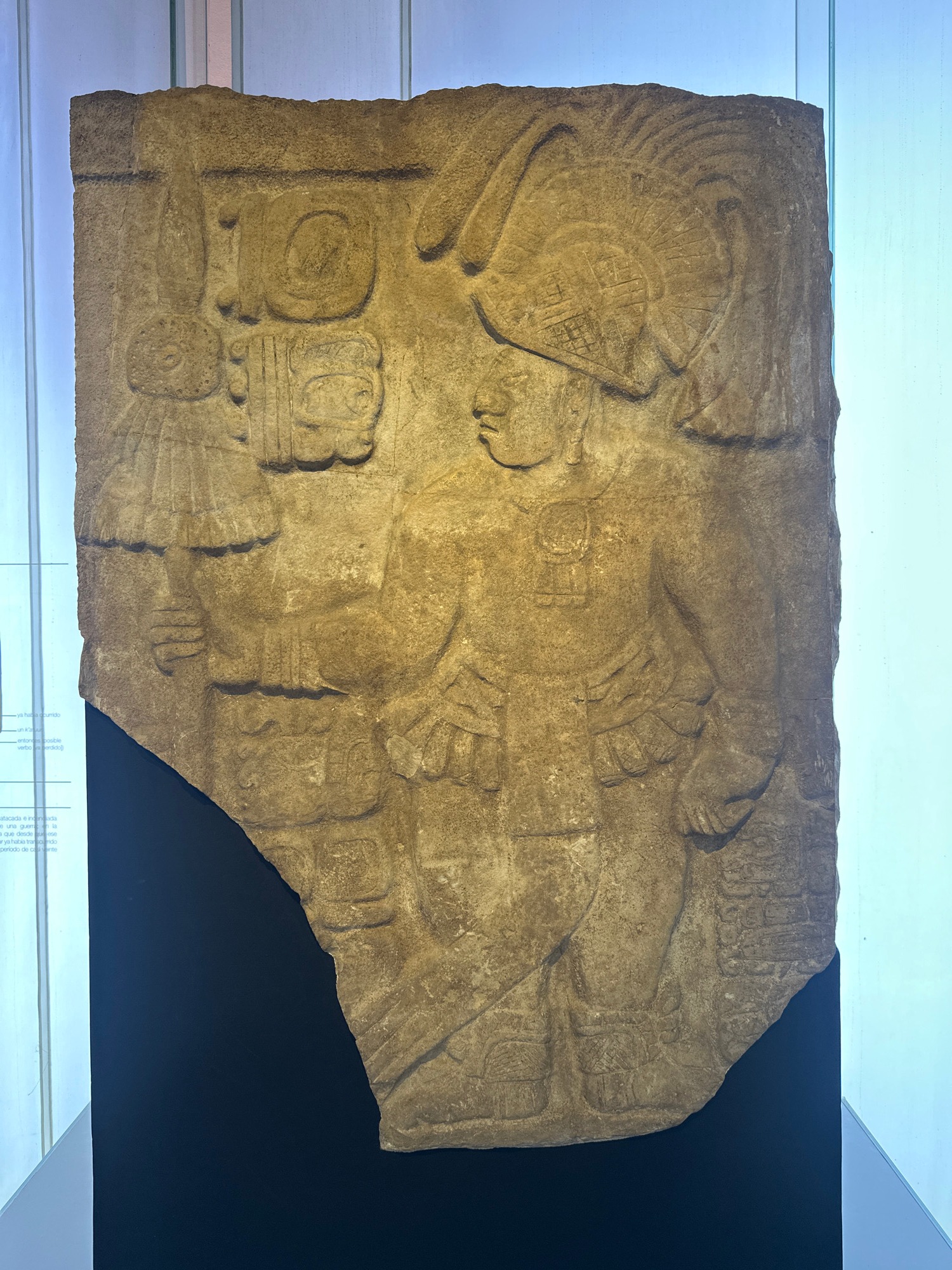
A relief carving on a large, weathered stone slab depicts a standing figure in profile, facing right. The figure wears a feathered headdress and ornate attire, including a sash and possibly armor. To the left of the figure, a cluster of glyphs is carved into the stone, representing what appears to be a form of ancient writing. The slab is broken along its left and bottom edges. The stone is illuminated from above and to the right, casting subtle shadows that highlight the carving's details. The slab is displayed against a dark background, with a bright, possibly artificial, light source visible behind it, creating a blue-green hue in the upper portion of the image. A partially visible informational placard is positioned to the left of the slab. This artifact is located in the Museo Amparo in Puebla, Mexico.
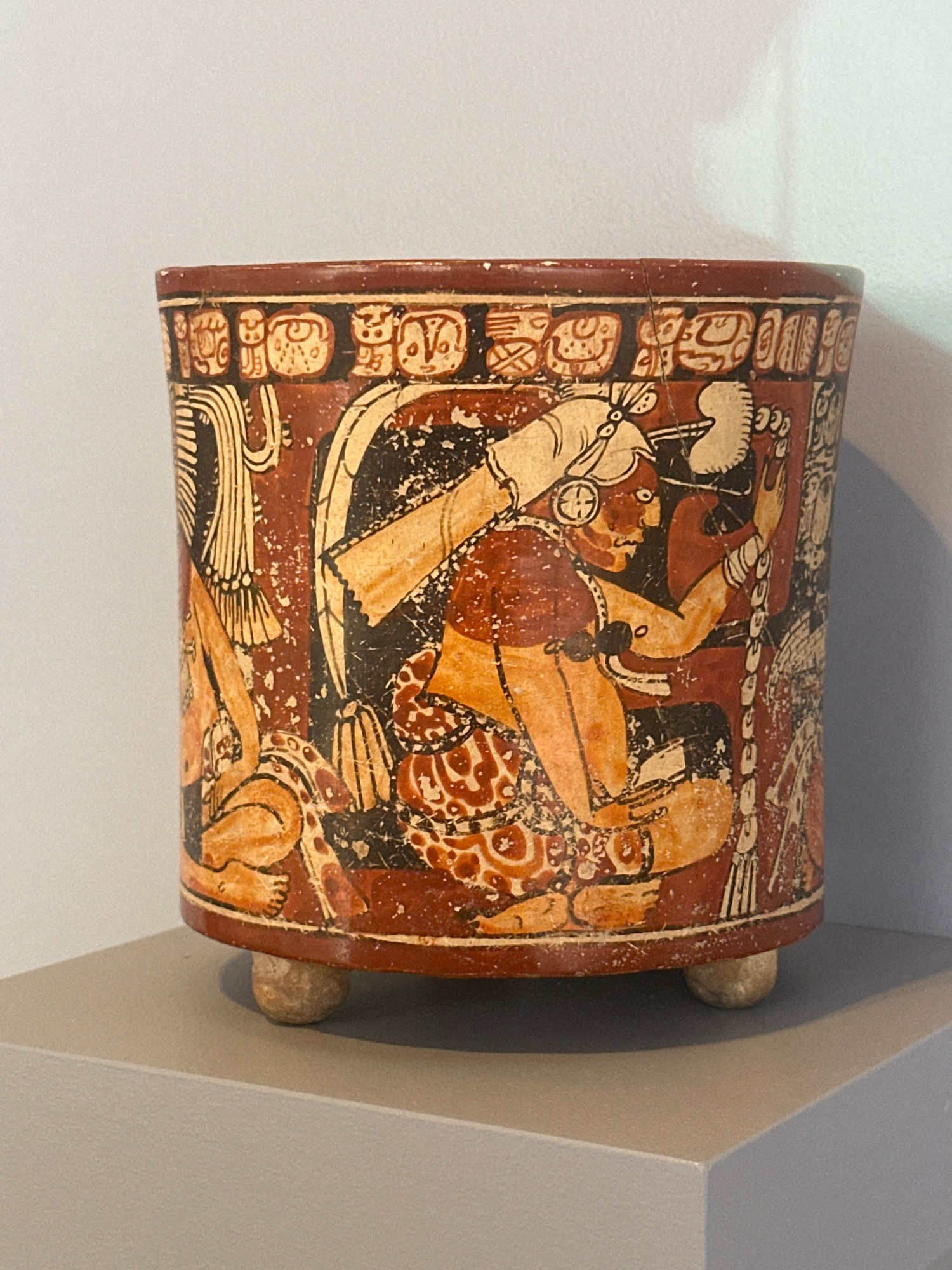
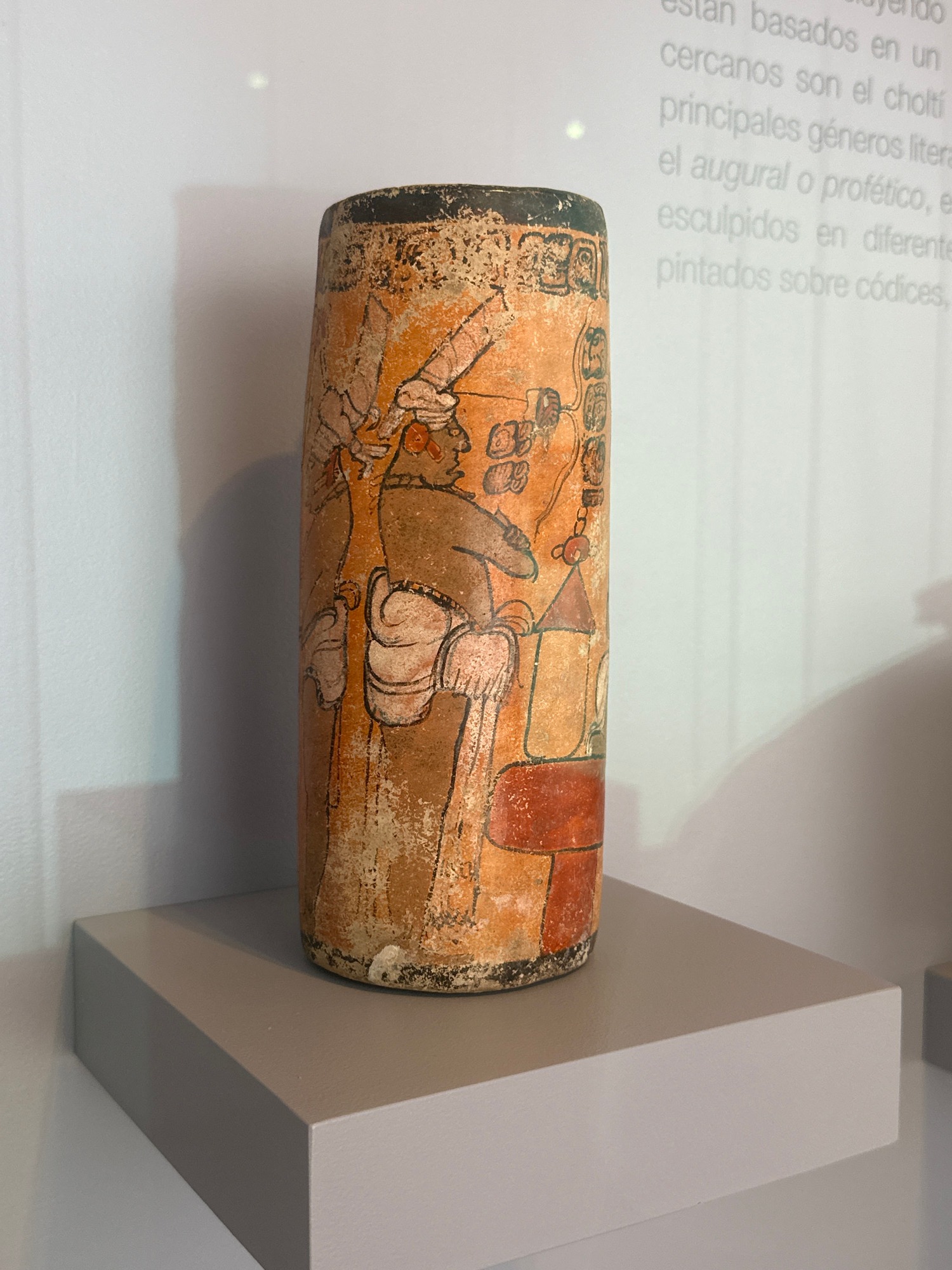
A cylindrical Mayan ceramic vessel, reddish-brown in color with painted scenes, rests on three small, spherical feet. The vessel is decorated with figures in red, orange, yellow, white, and black. The top rim of the vessel features a band of glyphs. The central scene depicts a seated figure wearing an elaborate headdress, a patterned skirt, and jewelry. This figure appears to be interacting with other figures and objects rendered in a stylized, two-dimensional manner. The vessel is placed on a light gray, matte surface, likely a display pedestal, against a plain, off-white background. The lighting is even, highlighting the details of the ceramic. This artifact is located in the Museo Amparo in the city of Puebla, Mexico.
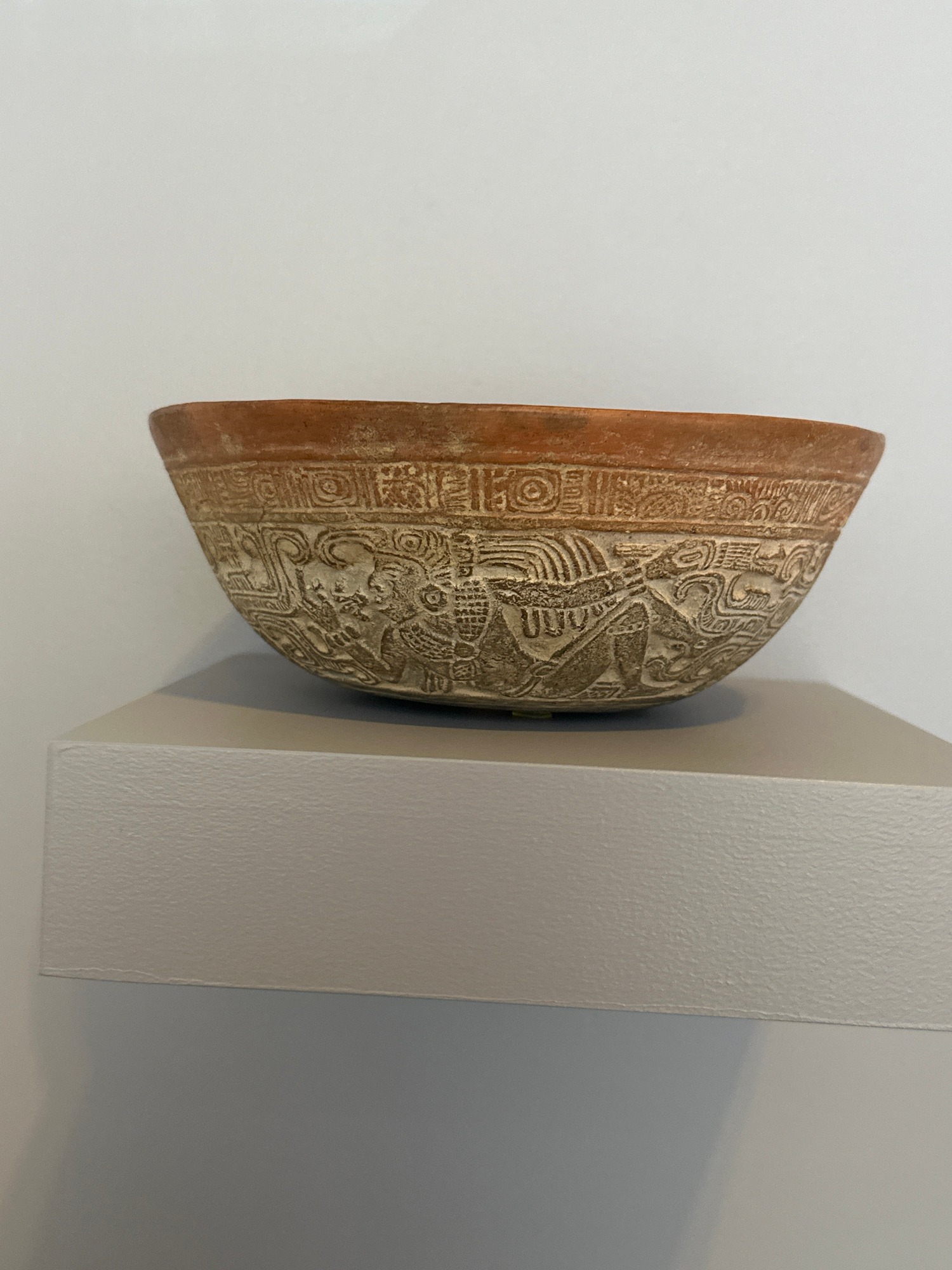
The image shows a close-up, eye-level view of an ancient Mayan ceramic bowl, featuring intricate bas-relief carvings of figures and glyphs. The bowl is terra cotta colored with a lighter, intricately carved band around its exterior. It rests on a plain, rectangular light gray shelf against a white wall. The lighting is soft and diffused, highlighting the texture of the bowl and the shelf. The scene is devoid of people or any other context that would indicate a specific location within Puebla, Mexico.
The image shows a close-up view of a cylindrical ceramic vase, likely an ancient artifact, displayed on a gray rectangular pedestal. The vase is adorned with painted figures and what appear to be Mayan glyphs. The background consists of a plain white wall with a faint shadow cast by the vase and pedestal. There is also text visible on the wall to the right of the vase, appearing to be informational or descriptive. The overall scene suggests an exhibition or museum setting. There is no discernible information indicating a specific location in Puebla, Mexico.
Puebla, Mexico · Jun 14, 2026, 6:56 PM
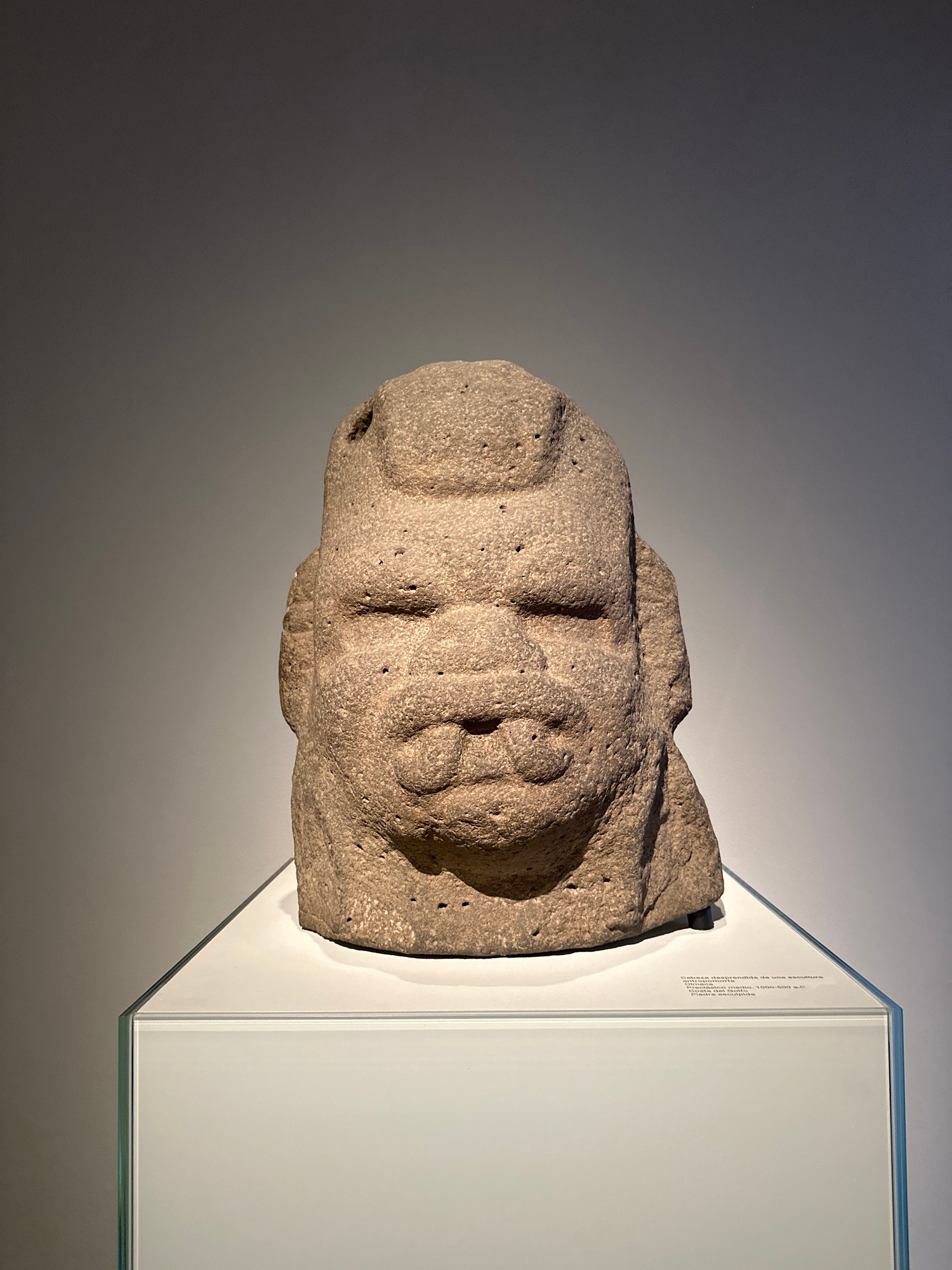
The image shows a stone sculpture of a human head displayed on a modern white pedestal with a glass front. The sculpture is rough-hewn with deep-set eyes, a wide nose, and a thick mouth with visible lips and chin. The head has a rounded top and appears to be a fragment of a larger piece. The background is a plain, gradient gray wall, illuminated by subtle lighting that casts soft shadows. A small informational plaque is visible on the front of the pedestal, partially obscured by the glass. The plaque contains Spanish text, which appears to identify the sculpture as "Cabeza desprendida de una escultura" (Head detached from a sculpture) and provides a date range of "Preclásico medio, 1000-500 a.c." (Middle Preclassic, 1000-500 BCE). This sculpture is located in the Museo Amparo in Puebla, Mexico, a prominent museum known for its extensive collection of pre-Hispanic and colonial art.
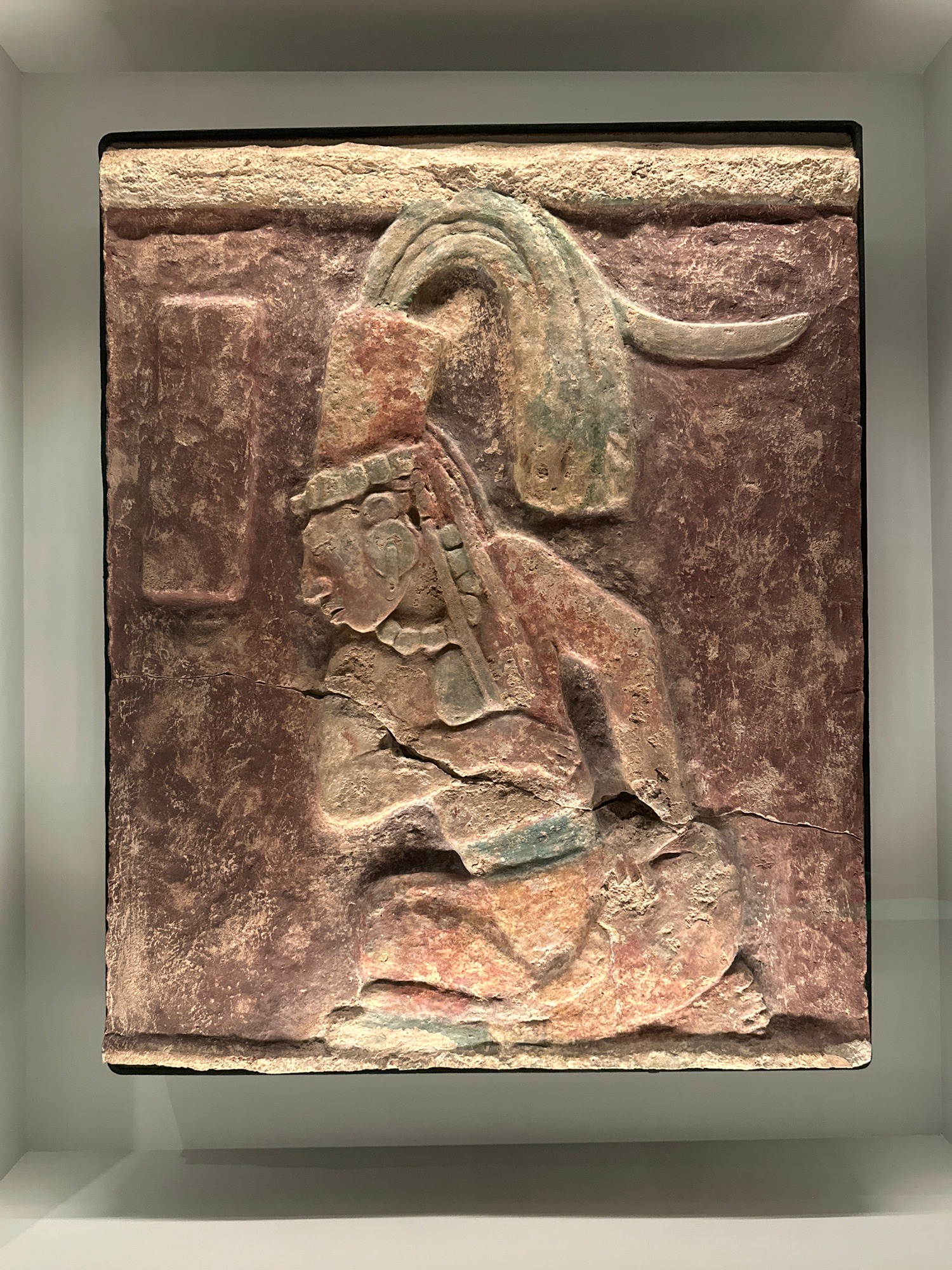
A relief carving of a kneeling figure in profile is displayed on a textured, reddish-brown surface. The figure wears an elaborate headdress with a large, curved plume and a segmented headdress band. They have a prominent nose, and their hair is styled in braids. A necklace or collar is visible around the neck. The figure's body is depicted in a kneeling posture, with legs tucked underneath. They are wearing a sash or belt around their waist and a garment that extends down to their feet. The carving exhibits remnants of color, including green on the headdress plume, light blue around the waist, and reddish-orange and yellow tones on the body and clothing. The surface of the relief is cracked in several places, most notably across the lower body of the figure. The carving is mounted within a dark frame, and the entire piece is set against a pale gray background, suggesting it is displayed in a museum or gallery. This artifact is located in the Museo Nacional de Cerámica in the city of Puebla, Mexico.
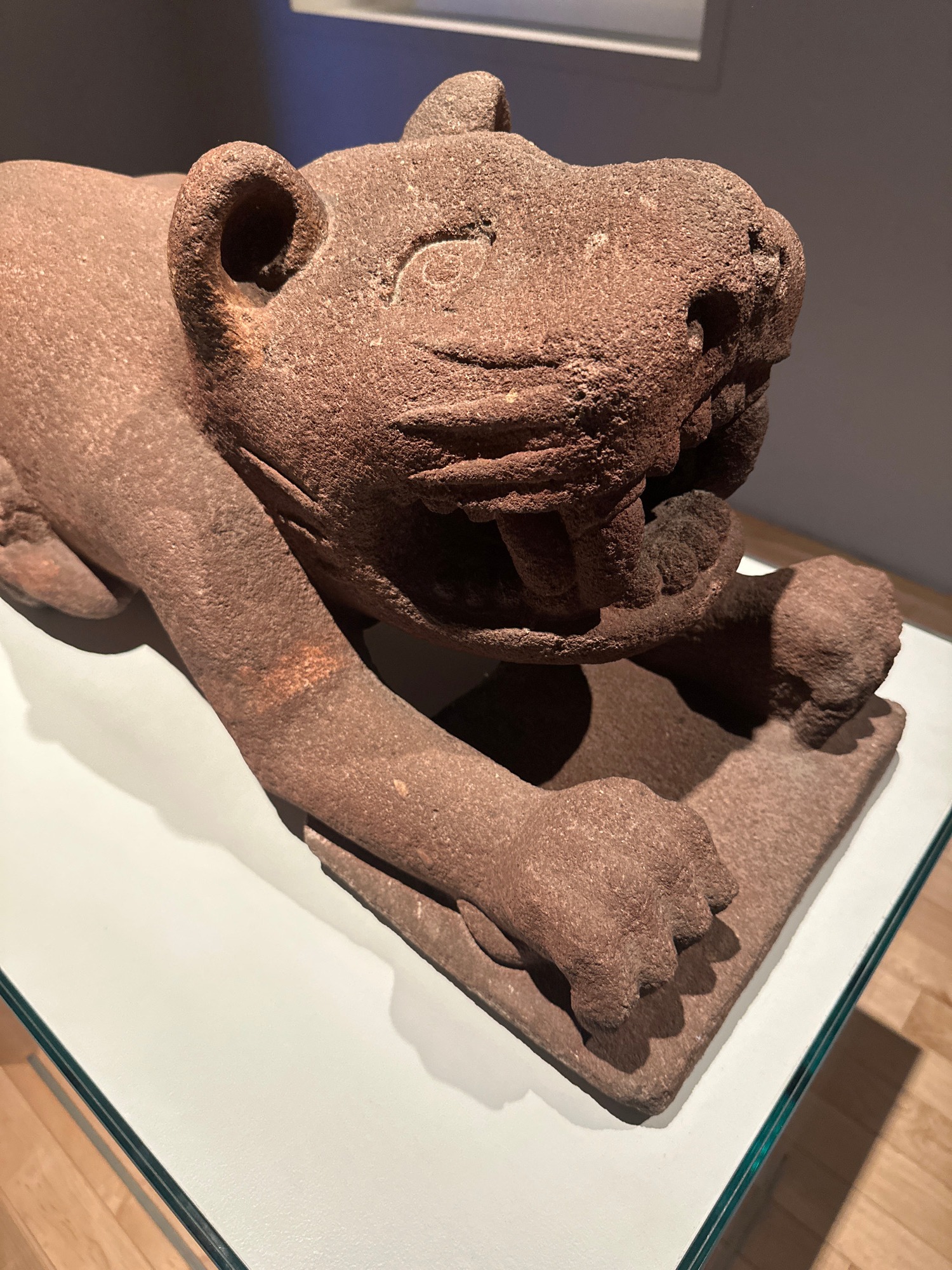
This is a close-up, eye-level shot of a weathered, reddish-brown stone sculpture of a jaguar. The sculpture is positioned on a white pedestal with a glass edge, suggesting it is an exhibit in a museum. The jaguar is depicted in a recumbent, or possibly pouncing, pose, with its front paws extended and its head turned towards the viewer. Its mouth is open, revealing carved teeth and a dark interior, conveying a sense of ferocity or aggression. The stone is textured and shows signs of age, with some areas appearing more worn than others. The lighting is focused on the sculpture, creating shadows that emphasize its form and details. The background is a muted gray wall, typical of a museum setting. The presence of this jaguar sculpture in Puebla, Mexico, likely indicates a connection to pre-Hispanic civilizations such as the Olmec, Maya, or Teotihuacan, cultures that revered the jaguar as a powerful symbol in their art and mythology.
The image shows a framed pre-Hispanic mural fragment featuring a stylized bird-like creature with elaborate plumage and swirling decorative elements. The fragment is predominantly red, with accents of green and light yellow. The surface exhibits a textured, aged appearance with visible cracks and imperfections. The artwork is displayed on a black matte board within a black frame, against a neutral background that suggests an indoor exhibition setting. The specific location in Puebla, Mexico is not discernable from the visual information provided.
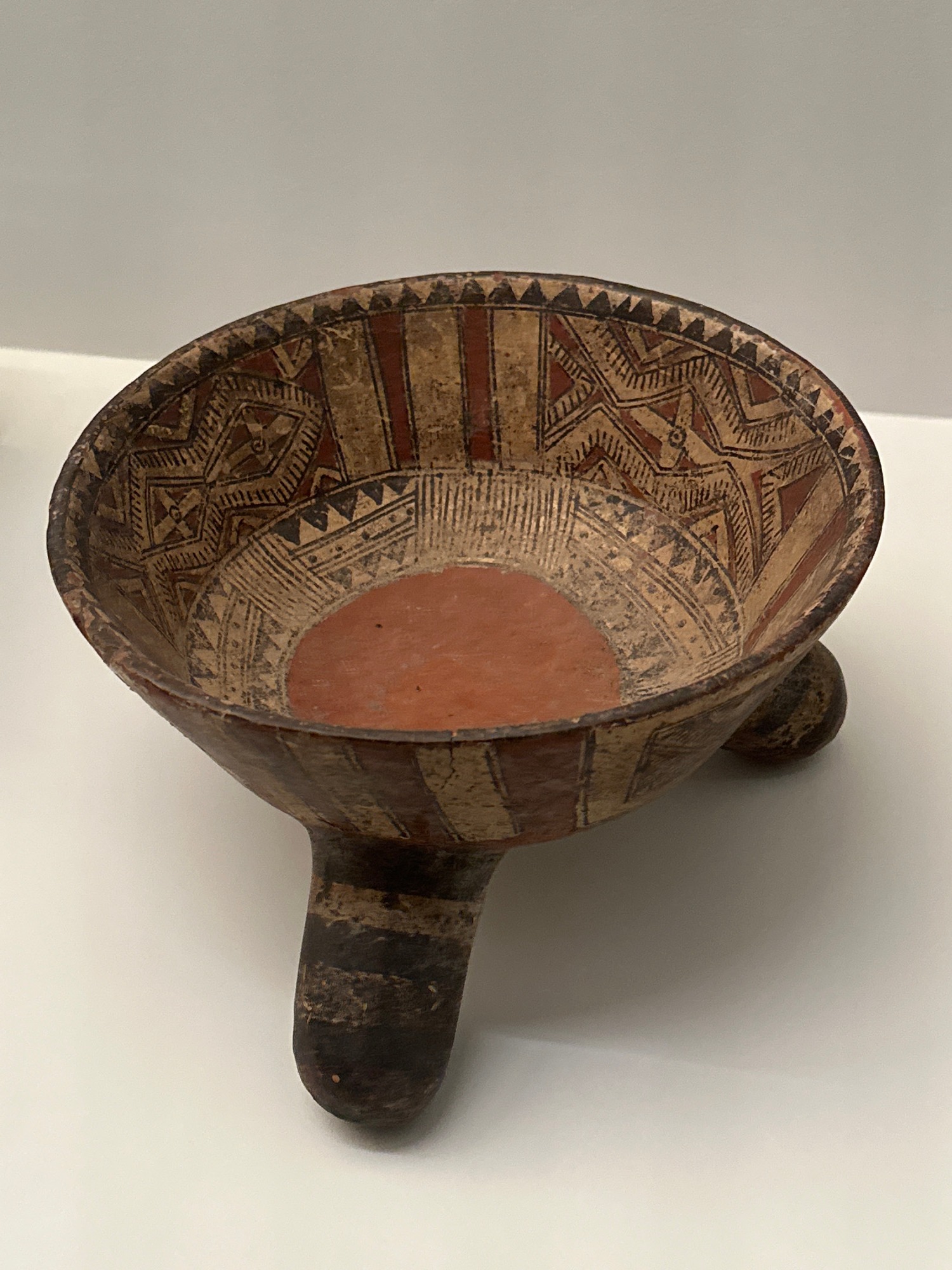
The image shows a close-up, eye-level view of an ancient, tripod ceramic bowl. The bowl is wide and shallow, with a reddish-orange interior. The exterior is decorated with geometric patterns in red, black, and beige. The bowl rests on three rounded legs, two of which are visible in the frame. The background is a plain, light gray surface, suggesting the bowl is displayed on a pedestal or shelf in a museum or exhibition setting. There are no people or other objects visible in the scene. The lighting is even and diffuse, highlighting the texture and details of the ceramic. The location in Puebla, Mexico is not discernible from the image itself.
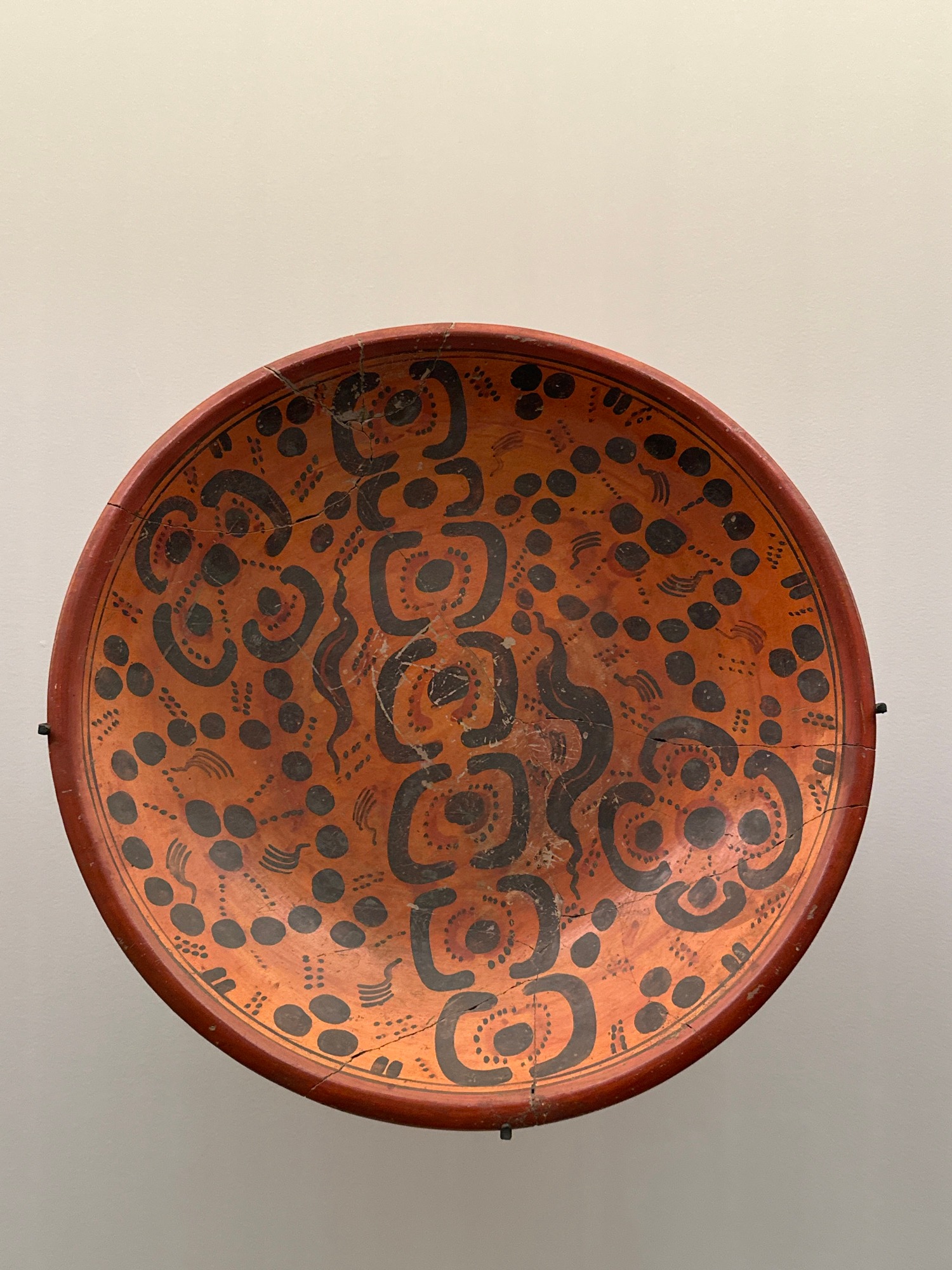
An overhead view of a round, terracotta-colored ceramic plate with intricate black geometric and curvilinear designs, as well as scattered black dots, rests against a plain, light-colored wall. The plate, which appears to be ancient or historical, displays visible cracks and chips, suggesting age and fragility. The decoration features repeating motifs of concentric circles, wavy lines, and stylized spiral shapes. The plate is supported by two small, dark metal stands visible on its outer rim. The lighting is even, casting no harsh shadows, and the background is a smooth, untextured surface. The context of this object's location in the city of Puebla, Mexico, is not discernible from the image itself; the image solely depicts the artifact against a neutral backdrop.
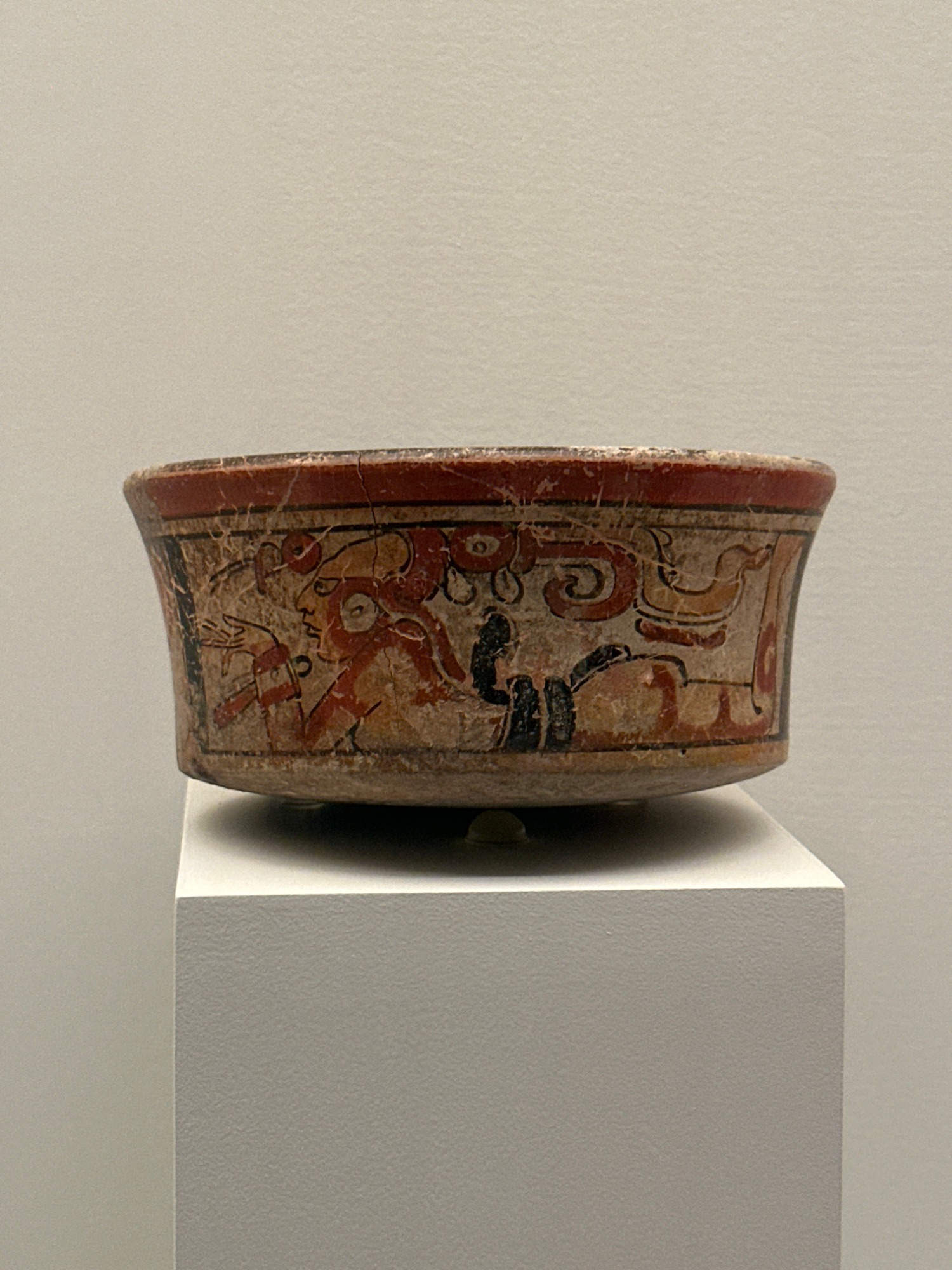
The image shows a shallow, cylindrical ceramic bowl with a flared rim, decorated with painted scenes. The bowl is displayed on a white, cubic pedestal in a well-lit exhibition space. The background is a plain, light-colored wall. The ceramic itself is light brown and exhibits signs of age and wear, with visible cracks and some chipped areas.
The painted decoration on the bowl features figures and symbolic motifs in red, black, and ochre. On the visible side of the bowl, a profile of a human-like figure is depicted. This figure has an elaborate headdress and is rendered in profile, with a prominent nose and eye. Its body is depicted with a red torso and limbs. The figure's right arm is extended, with an open hand. To the right of this figure, there are abstract, swirling red and yellow shapes that suggest movement or a cosmic element. Below these figures, a darker, possibly black, element is visible, which could represent an animal or a more abstract form. The rim of the bowl is banded with red.
The image does not provide any information about the location in the city of Puebla, Mexico.
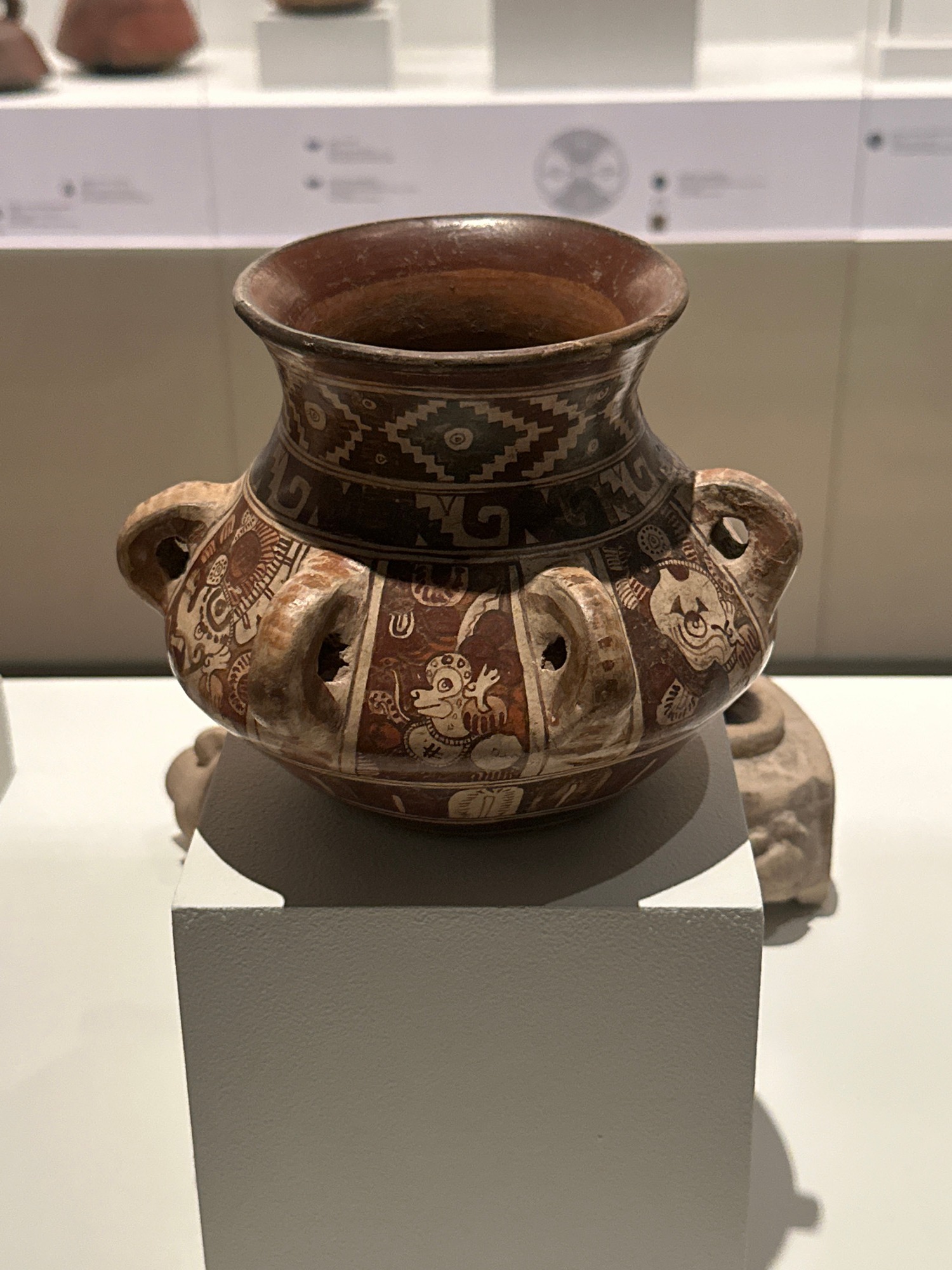
A close-up, eye-level shot shows an ancient, reddish-brown ceramic pot with two handles, resting on a white pedestal in a museum. The pot is decorated with intricate geometric patterns and depictions of figures in brown, white, and black. The background is blurred, showing a white display case with some text and images, and other artifacts. The lighting is soft, with shadows cast on the pedestal and the right side of the pot. The image appears to be taken in the Museo Amparo in Puebla, Mexico, based on the architectural style and displayed artifacts common in such institutions.
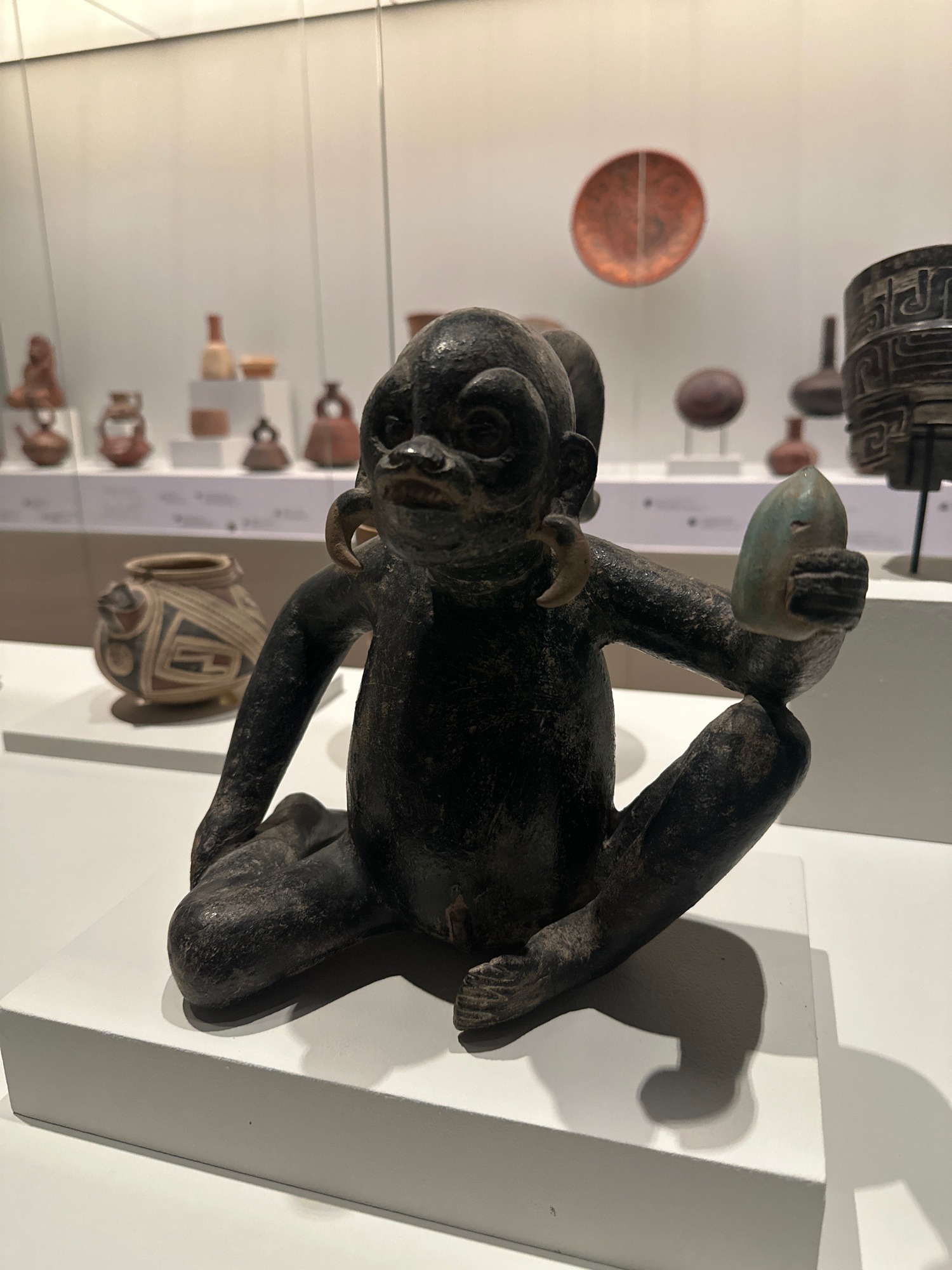
A dark, anthropomorphic clay figurine with large, protruding ears and a small object in its right hand sits cross-legged on a white pedestal. The figurine is positioned in the foreground, and its dark, weathered surface suggests age. In the blurred background, a museum display case exhibits various artifacts, including pottery and other ceramic objects, some of which are reddish-brown and others dark. The lighting is neutral, illuminating the objects without casting harsh shadows. The scene appears to be indoors, likely in a museum or gallery setting, possibly in Puebla, Mexico, given the mention of the city.
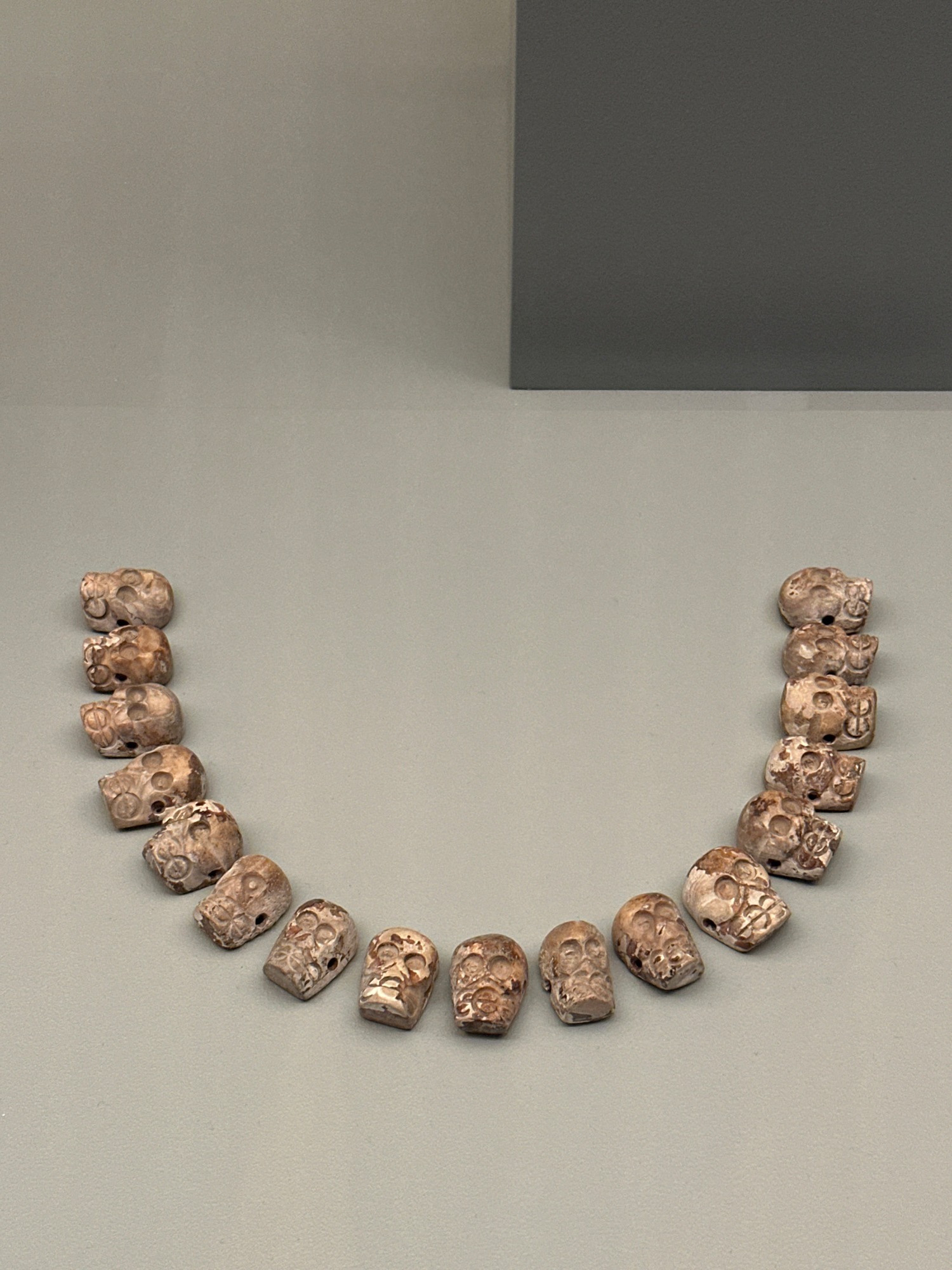
A string of approximately 15 carved skull beads, likely made of bone or a similar material, are arranged in a U-shape on a plain, neutral-colored surface. The beads are small, with carved features representing eyes, noses, and mouths. The surface they rest on is smooth and appears to be a display area, possibly in a museum or exhibition. The background is a split of two neutral-toned rectangles, with the upper right being darker gray and the lower left being a lighter gray. This image does not contain any information that would indicate its location in Puebla, Mexico.
Puebla, Mexico · Jun 14, 2026, 7:18 PM
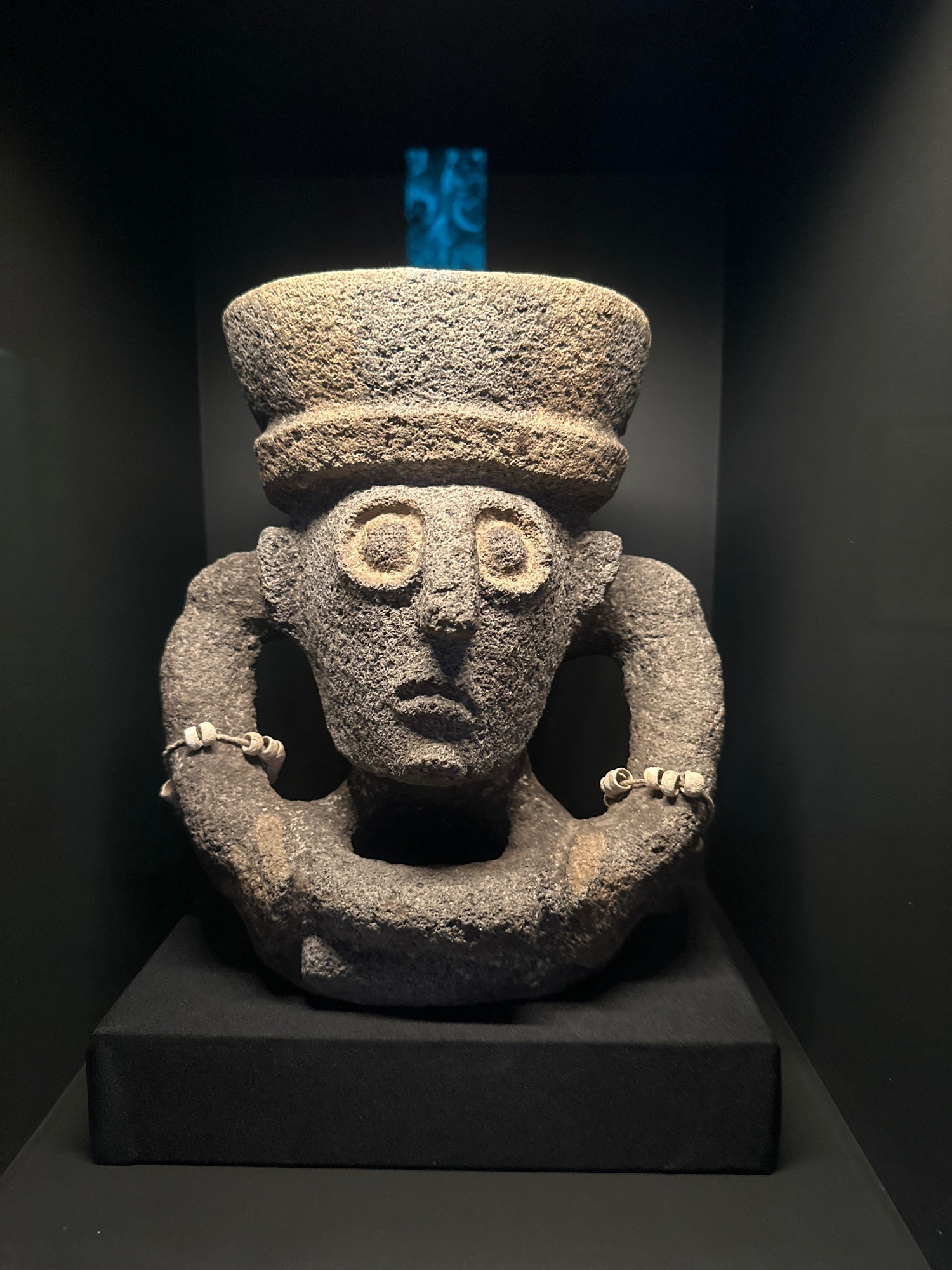
An ancient stone sculpture of a stylized human figure wearing a wide, flat headdress is displayed in a dark, museum-like setting. The figure is carved from a rough, greyish-brown stone and has large, circular eyes, a small mouth, and arms that form a circular shape around its body. There are small, light-colored beads or shells strung around the figure's wrists. The sculpture sits on a black, rectangular pedestal, which is placed on a larger black surface. In the background, there is a dark wall with a glowing blue, patterned light fixture above and to the right of the sculpture. This artifact is likely housed at the Museo Amparo in Puebla, Mexico, a renowned cultural institution that preserves pre-Hispanic art and artifacts from the region.
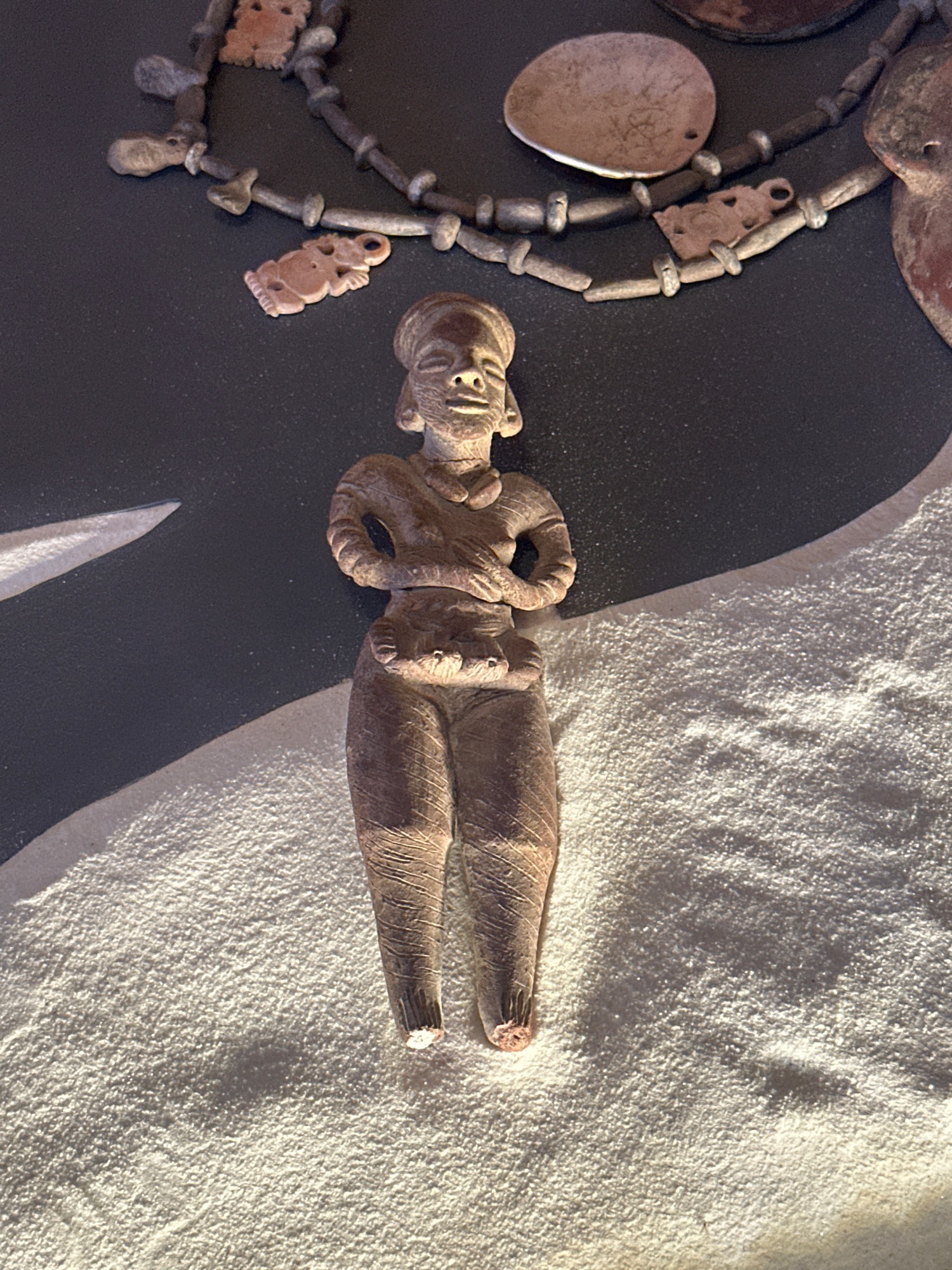
A close-up, eye-level, full shot shows a small, anthropomorphic figurine made of clay. The figurine is standing upright, centered in the frame, with its hands clasped at its waist. It has a smooth, rounded head with etched facial features and detailed hair. The body is slender, with defined limbs and a pronounced abdomen. The figurine is placed on a surface of white sand. Behind the figurine, the background transitions from a dark gray textured surface to a lighter, abstract pattern with a sharp, triangular white shape on the left. At the top of the frame, a necklace composed of various beads and pendants, some made of bone or shell and others of metal, is visible. The lighting casts shadows, highlighting the textures of the sand, the figurine, and the necklace. This artifact is displayed in a museum exhibit within the city of Puebla, Mexico.
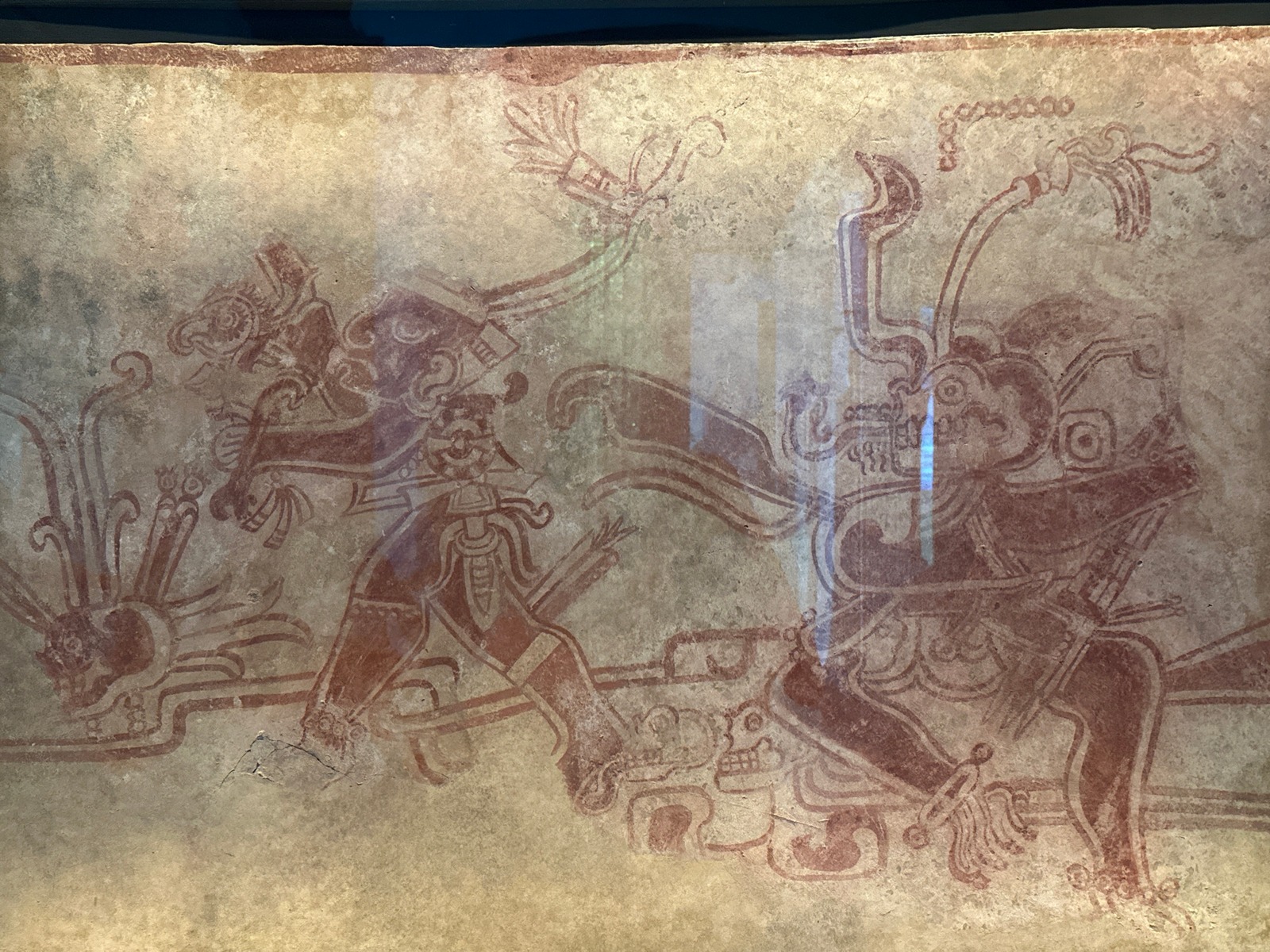
This image depicts a vibrant Maya mural from the tomb of the ruler K'inich Yax K'uk' Mo' in the city of Tikal, Guatemala. The mural, dated to the Late Classic period (600-800 CE), features two figures in ceremonial attire. The figure on the left is K'inich Yax K'uk' Mo' himself, shown in profile, adorned with a headdress and jewelry, holding a ceremonial scepter. He is depicted in the act of a ritual, possibly a bloodletting ceremony, as indicated by the presence of a stingray spine in his hand. The figure on the right is a deified ancestor or deity, also elaborately dressed and carrying a similar scepter. The background is adorned with hieroglyphs, which detail K'inich Yax K'uk' Mo's lineage and achievements. The mural's vivid colors and detailed imagery offer valuable insights into Maya cosmology, rituals, and royal power.
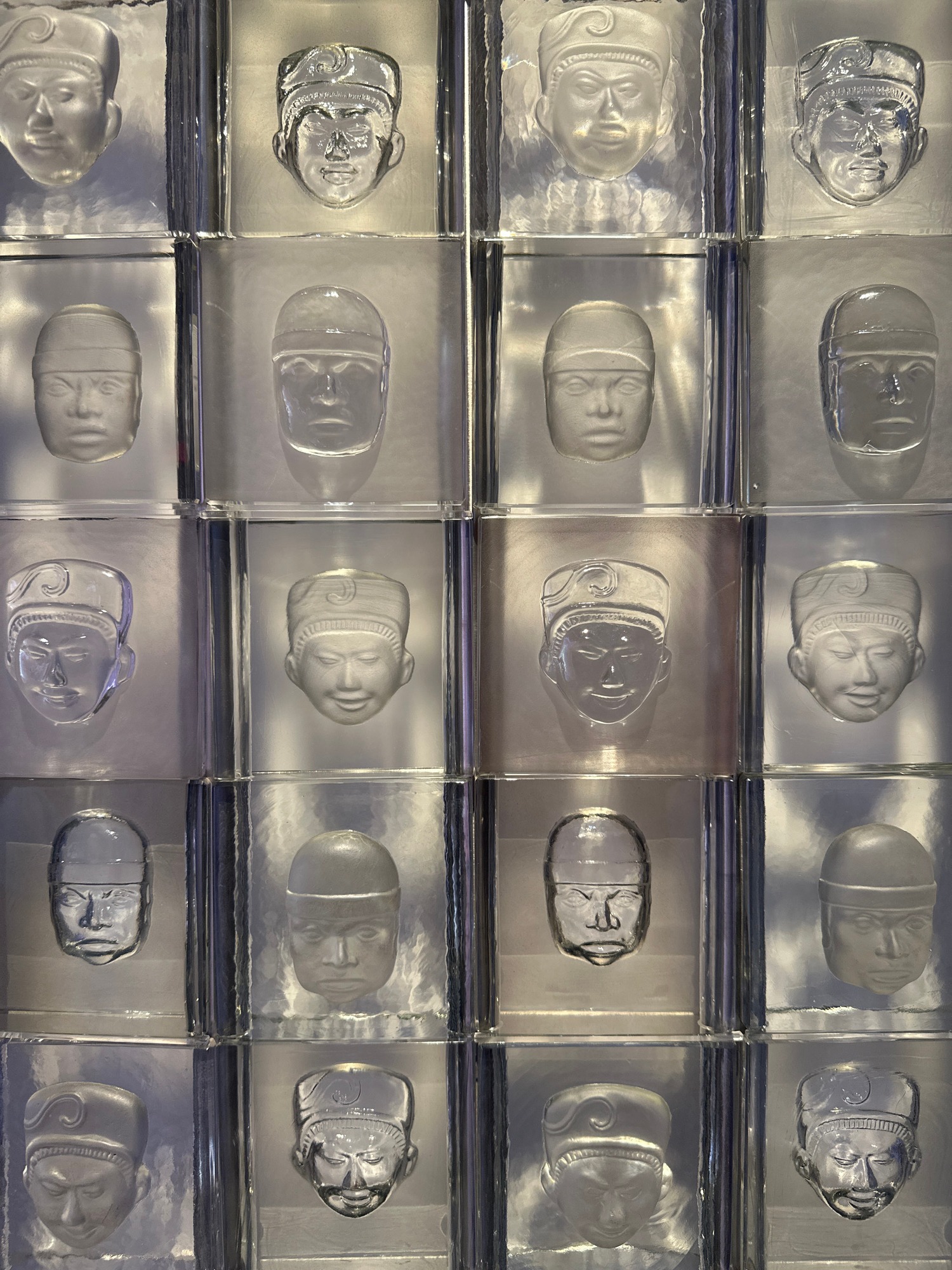
The image displays a grid of twenty-four glass blocks, each containing a cast of a human head. These blocks are arranged in six rows and four columns. The heads appear to be made of glass or a similar translucent material and are cast in relief, with faces and hats or head coverings visible. The lighting creates reflections and highlights on the glass, obscuring some details but generally revealing the outlines of the faces.
This artwork is located in the city of Puebla, Mexico, specifically within the **Museo de Arte Popular de Puebla** (Puebla Museum of Popular Art). The installation is titled **"Rostros de Puebla"** (Faces of Puebla). The heads represent diverse individuals, reflecting the cultural heritage and inhabitants of the region. The artist, Marco Arce, created this piece to honor the people of Puebla. The grid structure and the material evoke a sense of multiplicity and shared identity.
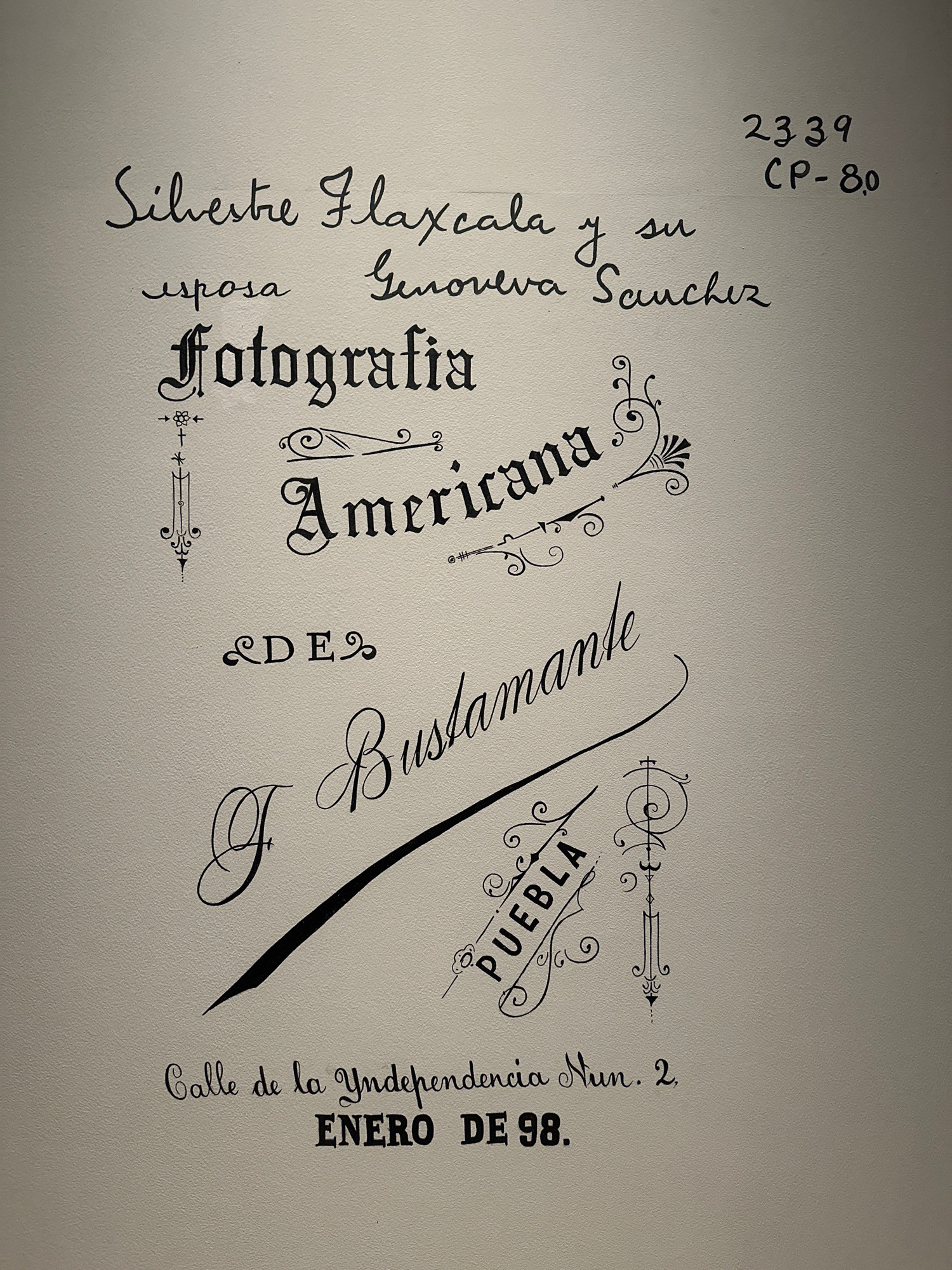
The image displays a vintage photograph with ornate calligraphy. At the top right, the numbers "2339" and "CP-80" are handwritten. Below that, in script, is "Silvestre Flaxcala y su esposa Genoveva Sanchez." Centered below this is the text "Fotografia Americana" in a decorative, gothic-style font. Further down, in a flourish, is "y Bustamante," with "PUEBLA" written diagonally on a decorative banner. At the bottom, the address "Calle de la Yndependencia Nun. 2." is followed by "ENERO DE 98." in bold capital letters, indicating the photograph was taken in Puebla, Mexico, in January of 1898. The background is a plain, textured surface.
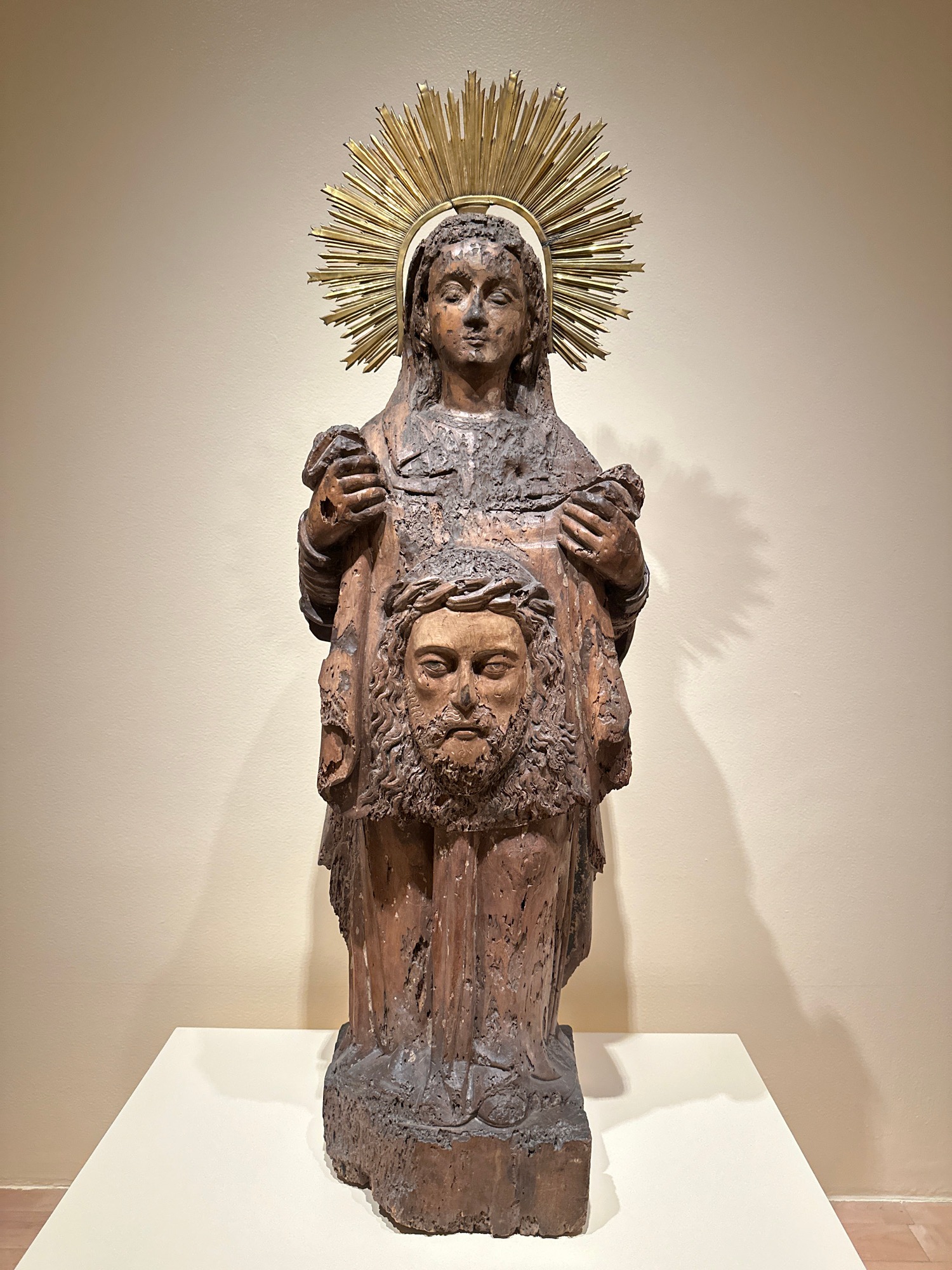
This image shows a wooden statue of a female figure with a halo, holding a severed head that appears to be Jesus Christ. The statue is displayed on a white pedestal against a plain, cream-colored wall. The background is a smooth, neutral wall that provides a stark contrast to the textured and aged appearance of the statue. The lighting casts shadows on the wall, suggesting the statue is illuminated from the front. The statue itself is a deep brown, with visible grain and what appears to be a rough, possibly weathered, finish. The halo is a bright, metallic gold, radiating outwards in sharp points. The facial features of both the female figure and the head are detailed, though the overall style suggests an older, perhaps religious, artifact. The location in Puebla, Mexico is not discernible from the image itself.
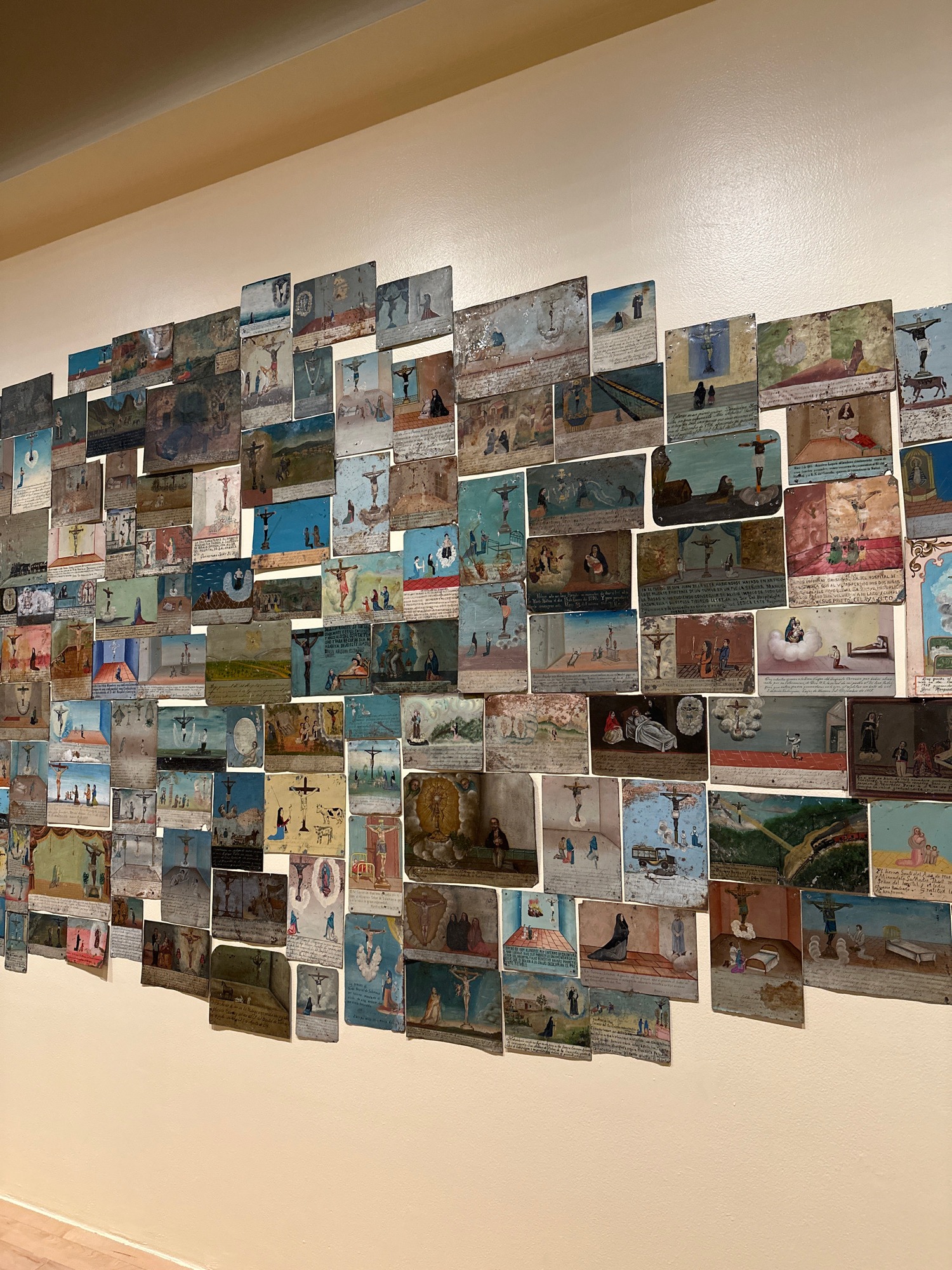
The image shows a dense collection of small, rectangular folk art paintings, likely ex-votos or retablos, displayed on a lightly textured, off-white wall. The paintings are arranged in a seemingly haphazard, overlapping manner, covering a significant portion of the wall. The artwork depicts religious scenes, predominantly crucifixions, with stylized figures and simplified landscapes. Many of the paintings appear aged, with visible wear and tear, and some have handwritten inscriptions in Spanish, suggesting they are devotional offerings or historical records. The overall impression is that of an archive or an exhibit of historical religious art. This type of folk art is prevalent in Puebla, Mexico, where retablos are a significant part of the region's cultural heritage.
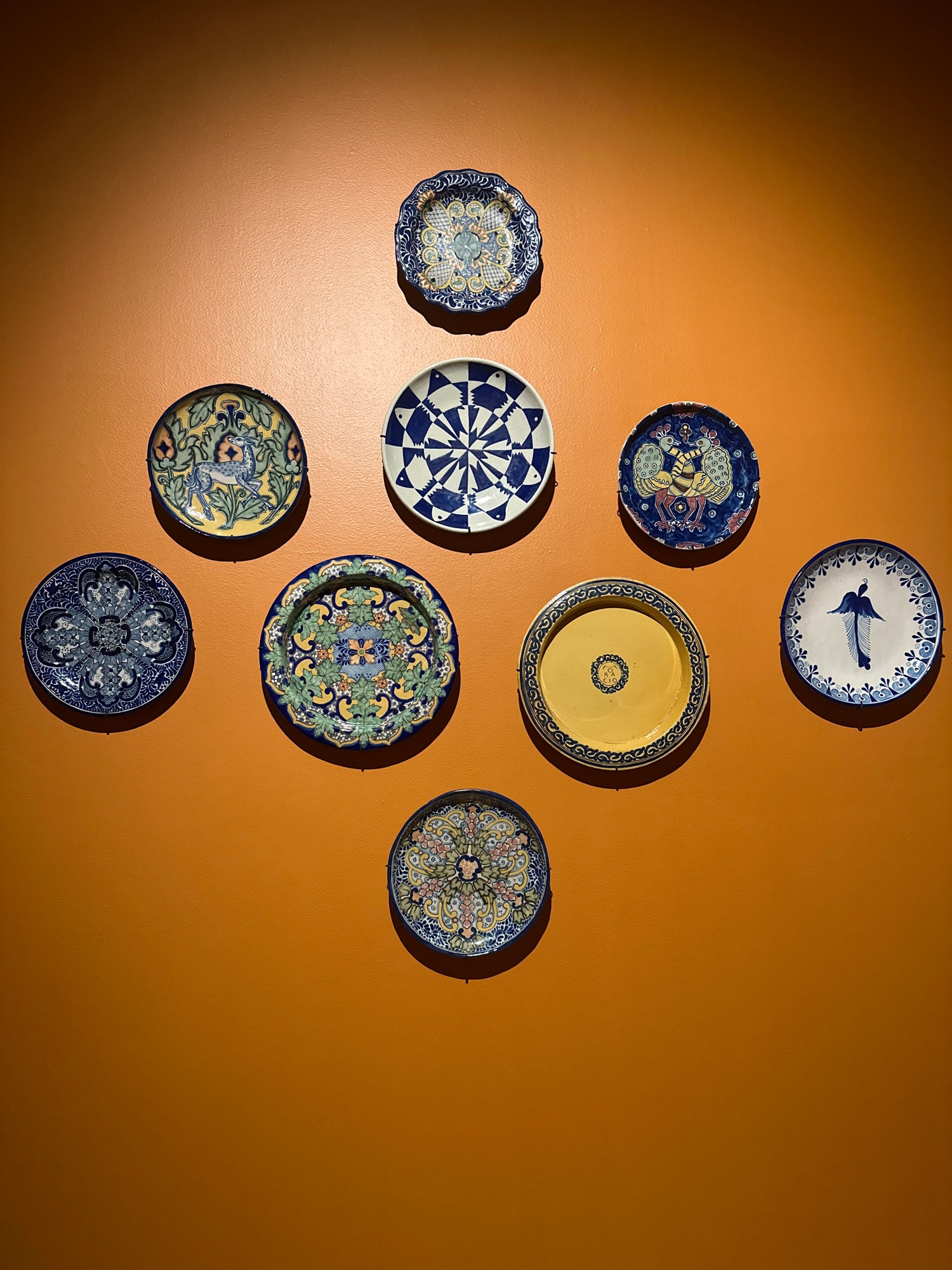
A collection of ten decorative ceramic plates are displayed on an orange-tinted wall. The plates vary in size and design, featuring intricate patterns, floral motifs, and animal imagery in shades of blue, yellow, and green. The lighting casts shadows, highlighting the texture of the wall and the dimensionality of the plates. The scene is static and devoid of people. The arrangement of the plates suggests a deliberate decorative installation. This scene is located in the city of Puebla, Mexico, known for its rich tradition of Talavera pottery, a type of maiolica earthenware.
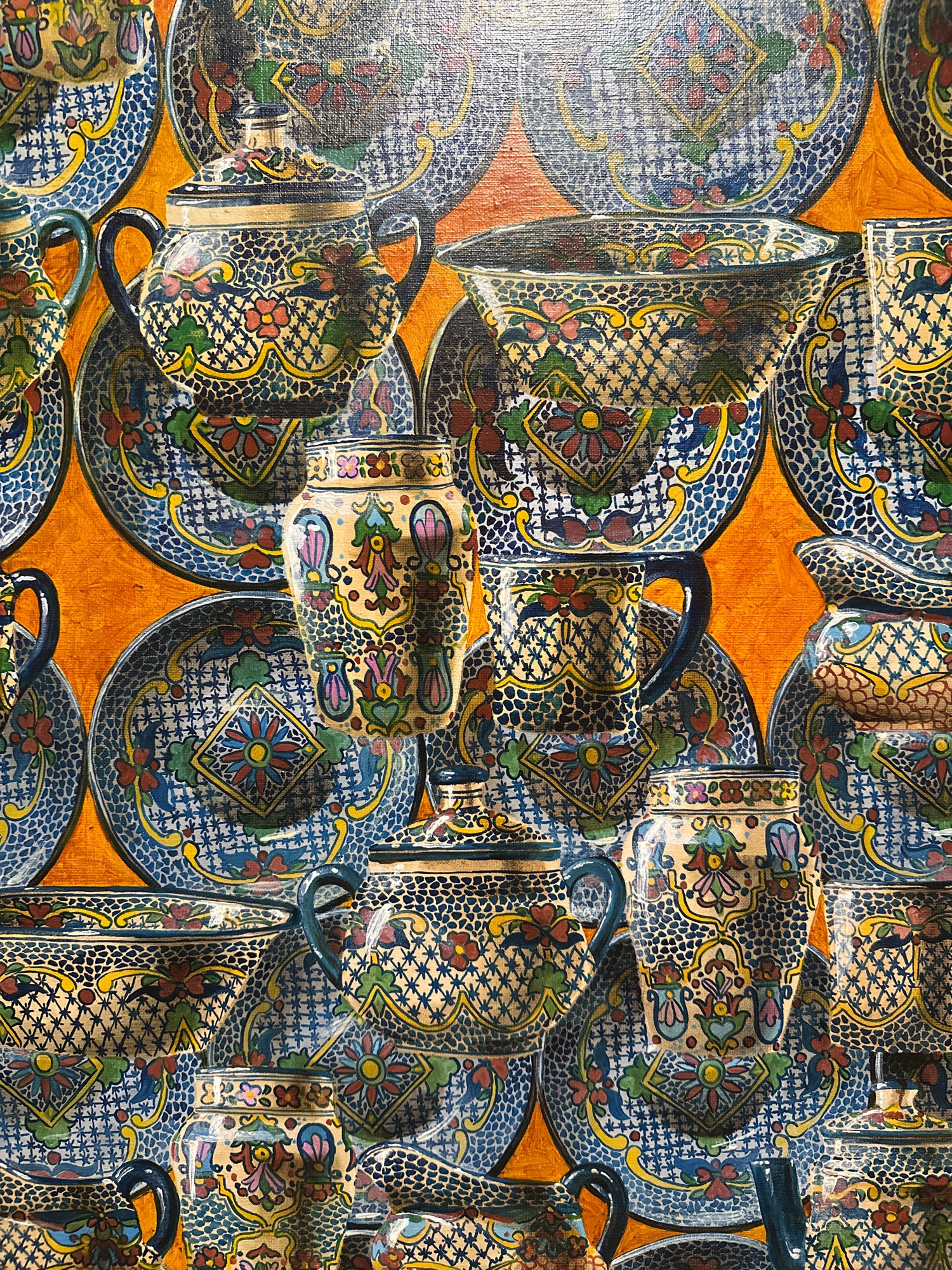
The image is a close-up, overhead shot of a vibrant, intricately patterned Talavera pottery collection. The scene is dominated by a chaotic yet harmonious arrangement of plates, bowls, pitchers, and vases, all adorned with traditional blue, yellow, and red floral and geometric designs against a bright orange background. The pottery is stacked and overlapping, creating a sense of depth and abundance. There are no people, actions, or interactions depicted; the focus is solely on the decorative ceramics. This style of pottery, Talavera, originates from the city of Puebla, Mexico, where it is a significant cultural and artistic tradition.
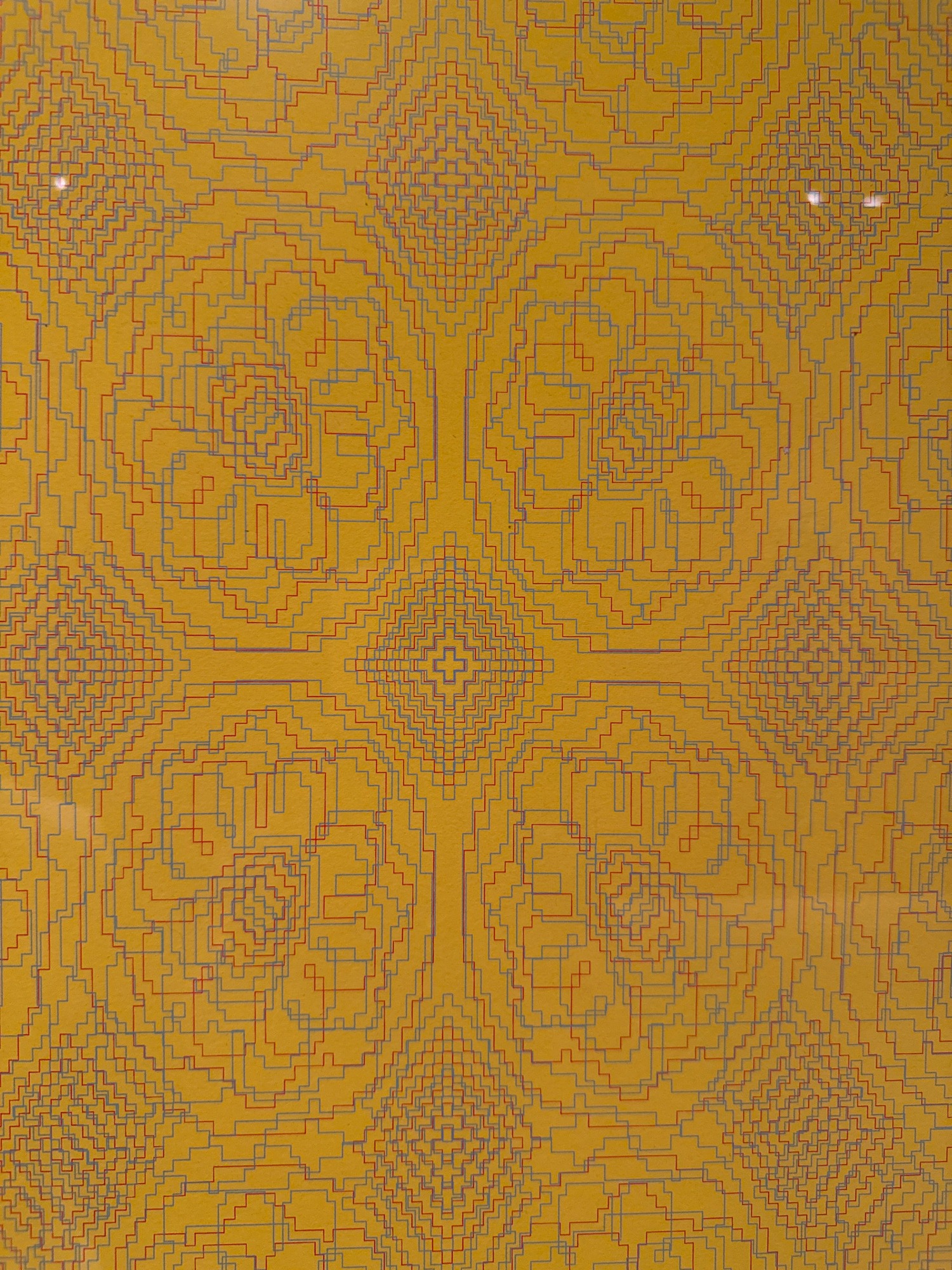
The image shows a close-up, full-frame shot of a yellow wall with an intricate geometric pattern in thin red and blue lines. The pattern is abstract and appears to be composed of repeating square and diamond shapes that create a sense of depth and dimension. The lines are sharp and clearly defined, creating a textured visual effect against the matte yellow background. There is a slight sheen on the surface of the wall, suggesting it might be covered with a protective coating or is a glossy finish. The pattern is uniform and covers the entire visible area of the image. This wallpaper pattern is located on a wall in the Zocalo, the main public square in the historic center of Puebla, Mexico.
Puebla, Mexico · Jun 14, 2026, 7:49 PM
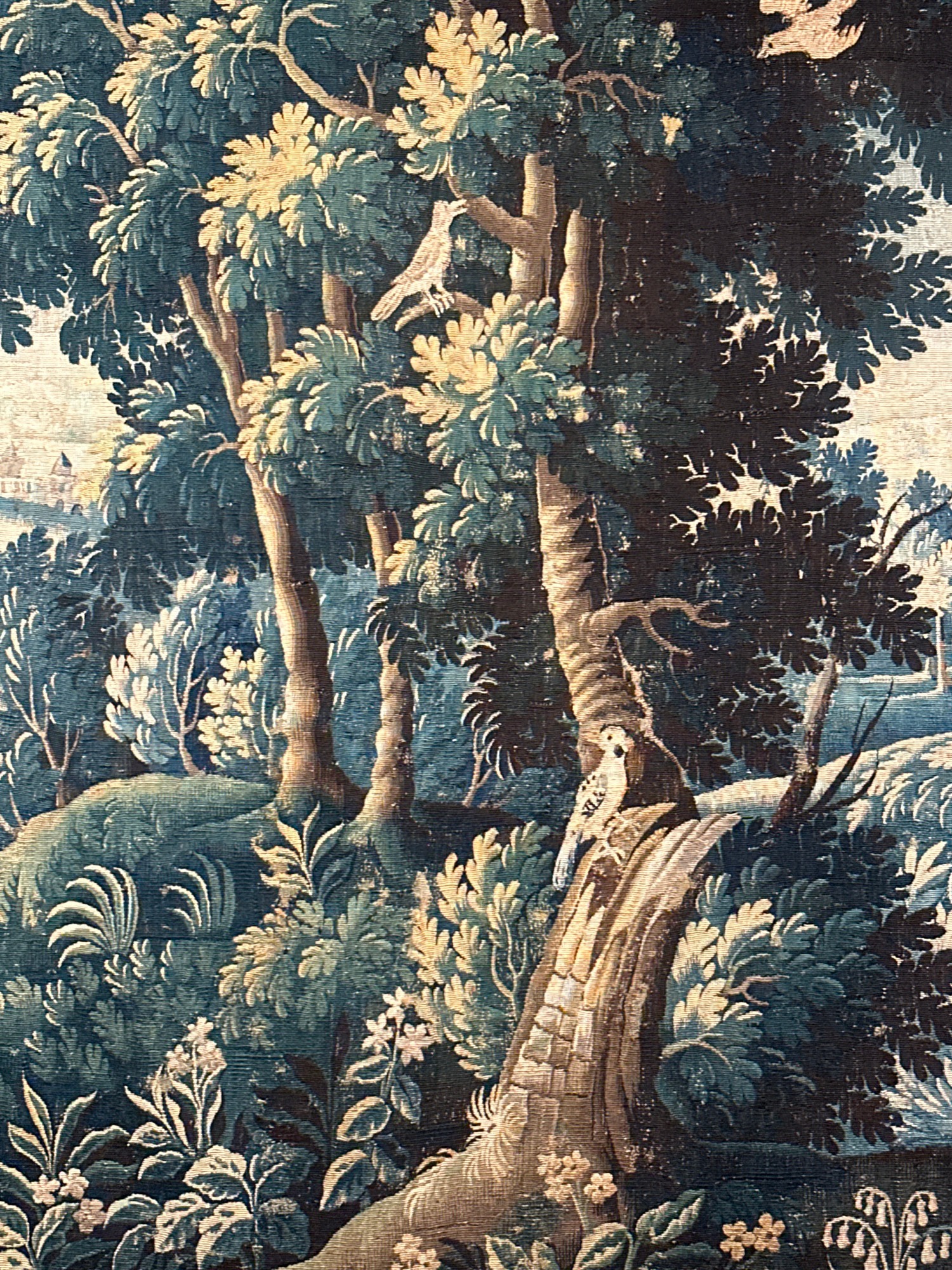
This is a close-up image of a tapestry depicting a forest scene with birds and foliage. The tapestry is rendered in rich blues, greens, and browns, with highlights of yellow and white. In the foreground, on the right side of the image, a bird with white and brown plumage is perched on a rustic, stone-lined embankment that appears to be part of a tree trunk. Another bird, also rendered in light colors, is visible in the upper left portion of the image, perched on a branch amongst dark green leaves. Lush vegetation, including various types of plants and trees with detailed leaves, fills the scene. The tapestry's texture is evident, suggesting it is an antique piece. There are no discernible elements within this specific image that would associate it with the city of Puebla, Mexico.
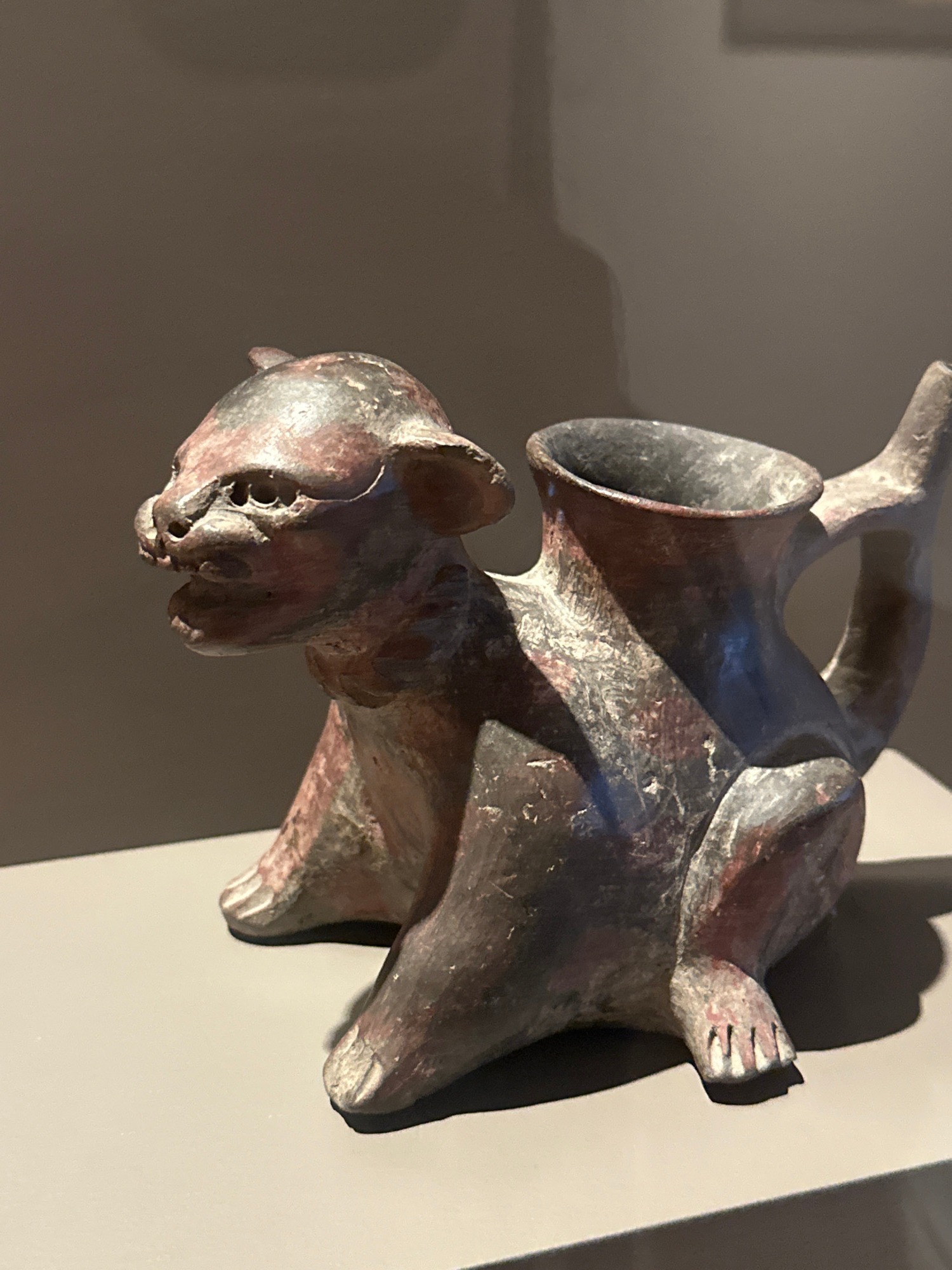
The image shows a close-up, side view of a dark, reddish-brown ceramic artifact shaped like a mythical creature, possibly a jaguar. The artifact is sitting on a plain, light grey surface. The creature is crouched with its front paws visible, and its head is turned to the left, revealing a fierce expression with open mouth and visible teeth. It has large ears and distinct eye sockets. The back of the creature is incorporated into a vessel or spout. The background is a smooth, dark grey wall, suggesting an indoor setting such as a museum exhibit. The lighting casts a shadow of the artifact onto the grey wall. This artifact is located in the Museo de Artes Populares in Puebla, Mexico.
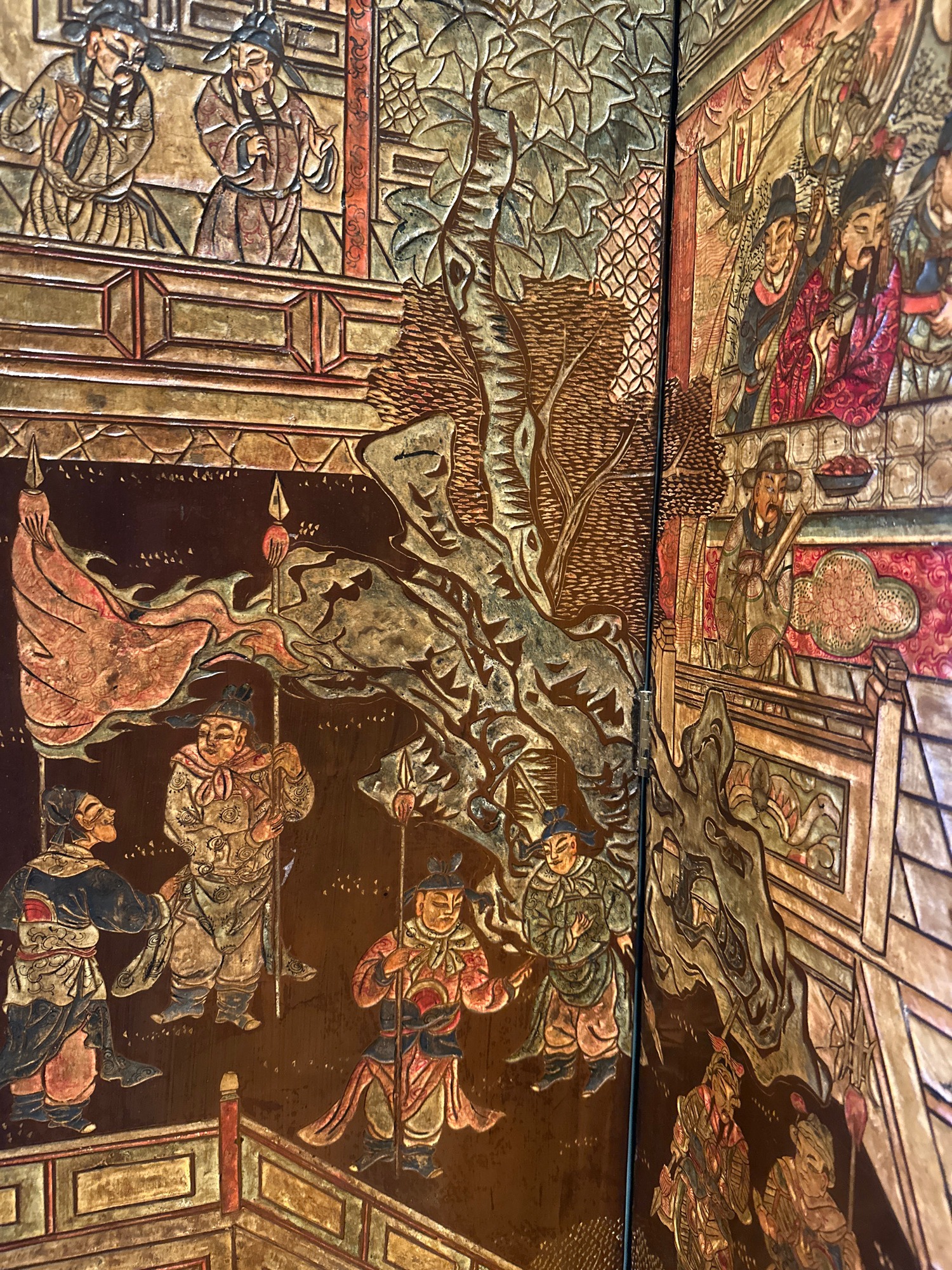
The image depicts a close-up view of a carved and painted wooden screen, likely an antique folding screen. The style of the artwork suggests East Asian origin, possibly Chinese, with figures dressed in traditional attire and depicted in narrative scenes. These scenes appear to show groups of men engaged in conversation or ceremonial activities, set against architectural backdrops and natural elements like trees. The color palette is rich, with deep browns, reds, golds, and muted blues and greens, indicating age and possibly a lacquered finish.
There is no visual information within the image or the provided crops that allows for the identification of a specific location in the city of Puebla, Mexico. The artwork itself is not representative of typical Mexican folk art or architecture. Therefore, this scene cannot be placed within Puebla, Mexico based on the visual evidence.

 Puebla, Mexico