Monday, February 23, 2026 · Updated Monday, February 23, 2026
Khan Yunis, Palestine
The city of Khan Yunis in the Palestinian Territory stands as a grim testament to the devastating impact of urban conflict. Buildings that once housed vibrant communities are now skeletal remains, their facades riddled with bullet holes and shrapnel marks. The widespread destruction paints a harrowing picture of war's relentless toll on civilian life and infrastructure.
The image depicts a multi-story residential building in Khan Yunis, Palestinian Territory, exhibiting severe structural damage and extensive facade pockmarks from bullet holes. The ground in the foreground is covered with a thick layer of concrete rubble and debris.
On the ground level, arched entryways lead into darkened, damaged interiors. A red utility box is affixed to a wall section on the right. Upper floors show widespread damage with sections of concrete missing, exposing rebar and internal structures. Many windows are broken, boarded, or covered with makeshift materials.
Mid-level sections feature multiple openings, some covered by white tarps. One such tarp on the left clearly displays "UNICEF" branding, with items of clothing hanging on a line within the opening. Adjacent rooms on the right contain piles of debris and various makeshift enclosures using fabric and corrugated metal.
Higher levels include balconies on the right with laundry hanging. A large, rectangular opening on an upper-middle floor is partially enclosed by a white sheet, revealing two blue cylindrical objects and a red-and-white container within the space. The uppermost visible floors continue to display bullet holes, broken windows, and some openings covered with fabric, including one with a blue patterned sheet. No individuals are visible.
Amidst the chaos, a landscape of rubble, dirt, and twisted metal now defines the city's streets. Multi-story apartment buildings, once symbols of urban life, are extensively damaged, with many windows missing or boarded up, and sections partially gutted or collapsed. The ground is a chaotic expanse of shattered concrete and debris, where a crushed white vehicle lies mangled, signaling catastrophic impact.
An elevated view captures a scene of extensive damage in Khan Yunis, Palestinian Territory. The central focus is a multi-story, light-colored building exhibiting severe structural compromise. The building's facade is heavily pockmarked with numerous impact holes consistent with bullet or shrapnel strikes. Multiple sections of the building's walls and windows are blown out or heavily damaged, exposing interior rooms on various levels. Visible interior debris includes scattered personal belongings, such as clothing hanging on lines, and fragments of furniture. Several window openings on the upper floors are boarded with white material, while others remain open or contain shattered glass. The ground floor features an open area with arched supports, also showing damage. Inside a ground-level room, two red objects and one yellow object, possibly furniture remnants, are discernable.
The ground area in front of the building is a landscape of destruction, covered extensively with building rubble, concrete chunks, rebar, shattered glass, and sand. A heavily damaged, crushed white sedan, missing its roof and significant portions of its body, rests partially embedded in the sandy ground in the foreground. In the background, two individuals are visible walking away from the building. One person, wearing dark clothing, is seen walking from right to left further back, while a second, partially obscured figure is on the far right. The scene is illuminated by bright daylight.
Khan Yunis, Palestinian Territory · Feb 23, 2026, 12:09 PM
Yet, life persists in the shadow of ruin. Makeshift shelters, constructed from tarpaulins and fabric, cluster together, offering temporary refuge for displaced individuals. These encampments are a poignant symbol of human resilience, as residents adapt to harsh conditions and attempt to rebuild their lives in an environment profoundly altered by conflict. A lone individual is seen sitting amidst the debris, perhaps contemplating the future, while another walks a sandy path, carrying a light-colored object, underscoring the ongoing struggle for normalcy.
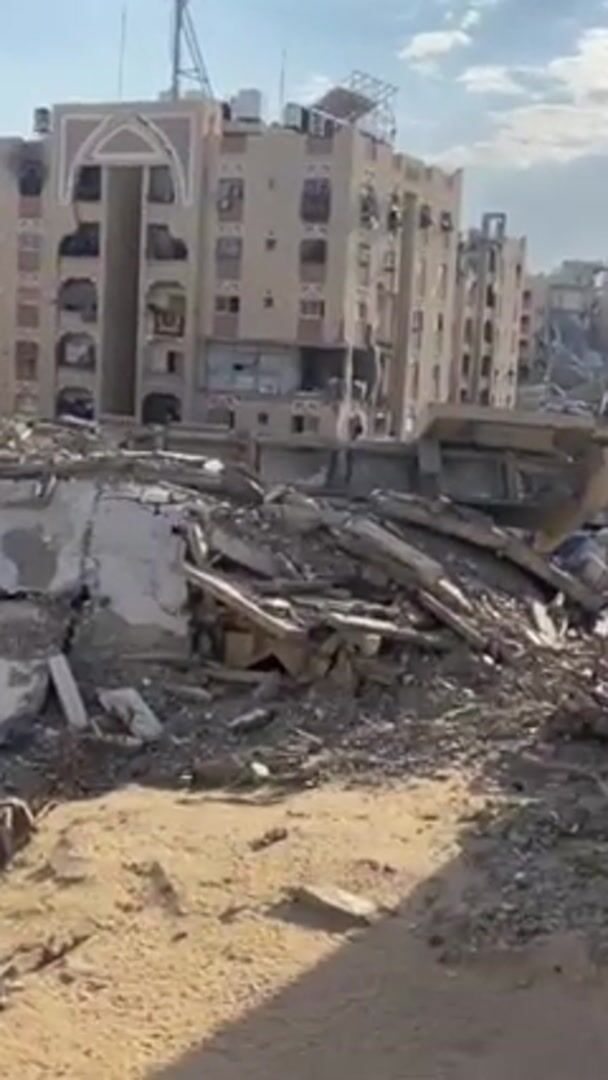
This image depicts a scene of widespread destruction in Khan Yunis, Palestinian Territory. In the midground, a substantial expanse of concrete rubble, rebar, and pulverized building materials from collapsed structures covers the landscape. Amidst this debris, a single individual, dressed in dark clothing and possibly wearing a head covering, walks on a sandy, cleared path. This person appears to be carrying a long, light-colored object diagonally across their left shoulder.
In the background, a large, multi-story beige building with distinct architectural elements, including a prominent arched decorative facade at the top center, stands partially damaged. The building exhibits visible signs of impact, including dark scorch marks, particularly on the left side of the upper floors, broken windows, and exposed interiors on multiple levels. Some balconies show signs of daily life, such as hanging laundry, while others are damaged. A cellular antenna tower is mounted on the roof of this structure. To the right and further back, additional damaged buildings are visible under a partly cloudy sky.
Khan Yunis, Palestinian Territory · Feb 23, 2026, 12:09 PM
The image displays a severely damaged multi-story residential building located in Khan Yunis, Palestinian Territory. The beige facade of the approximately eight-story structure exhibits extensive impact damage, with numerous circular holes consistent with bullet or shrapnel strikes. Many windows are shattered, missing, or partially covered with improvised materials like plywood, fabric, and metal sheets. Several sections of the exterior walls are collapsed, exposing the interiors of multiple apartment units. Significant burn marks are visible on the upper-right portion of the building and other areas. Balconies, particularly on the right side, show structural damage to their railings, with some containing debris and visible laundry. The ground floor is heavily destroyed, with walls and supporting columns severely compromised, creating open, arch-like cavities filled with rubble. A telecommunications antenna array is mounted on the roof's left side, alongside water tanks.
The ground directly in front of the building is a widespread debris field, consisting of sand mixed with large quantities of shattered concrete, broken masonry, twisted metal, and general construction waste. A heavily crushed and contorted white vehicle, possibly a sedan, lies on the sandy ground to the lower right. The scene is illuminated by bright daylight under a clear blue sky with scattered white clouds. No people are visible within the immediate area.
Khan Yunis, Palestinian Territory · Feb 23, 2026, 12:10 PM
Further emphasizing the humanitarian crisis, a partially visible UNICEF logo on a damaged concrete structure serves as a stark reminder of the international efforts and the immense needs within this conflict zone. The scene, observed under a clear, bright sky, creates a poignant contrast between the natural world's tranquility and the man-made devastation below, highlighting the enduring human cost of war.
An extensively damaged multi-story residential building stands under a clear blue sky in Khan Yunis, Palestinian Territory. The light-colored concrete facade of the structure, exhibiting at least four visible levels, is heavily fractured and pockmarked with numerous large, irregular openings where walls and windows have been destroyed. Remnants of balconies with balustrades are present on upper floors. Within the exposed interior spaces and openings, various white and light-colored tarps, fabric sheets, and blankets are suspended or draped, serving as makeshift partitions or temporary coverings. Garments are visible hanging to dry within some of these improvised shelters. At the lower levels, near the base of the building, a large mound of rubble, consisting of dirt, concrete fragments, and debris, is accumulated. A black plastic water tank is situated on this debris mound. A dark chair is discernible within one of the lower-level tarp-covered sections. The scene is illuminated by strong sunlight, casting defined shadows. No individuals are visible in the frame.
Khan Yunis, Palestinian Territory · Feb 23, 2026, 12:10 PM
This image depicts a scene of extensive urban destruction in Khan Yunis, Palestinian Territory. The foreground consists of a sandy, light-brown patch of ground with sparse vegetation and scattered small debris. In the midground, a substantial, irregular mound of gray and off-white concrete rubble, rebar, and shattered building materials dominates the view, marking the site of a collapsed or demolished structure.
In the background, behind the rubble pile, stand multiple multi-story residential buildings, beige or light-brown in color, exhibiting significant damage. Several sections of the buildings' facades are missing, exposing internal rooms and structural elements. Bullet holes are visible on the exterior walls of some buildings. Balconies are present, with items resembling laundry or tarps hanging from some.
One individual is visible in the lower-right portion of the image, positioned on the sandy ground. The person is dressed in dark clothing and holds a light-colored object, possibly an umbrella or traditional head covering, over their head, casting a distinct shadow. The person appears to be stationary, either observing the scene or resting. The environment is brightly illuminated by natural sunlight, indicating daytime conditions.
Khan Yunis, Palestinian Territory · Feb 23, 2026, 12:11 PM
The image depicts a severely damaged urban landscape in Khan Yunis, Palestinian Territory, under a partly cloudy blue sky. The scene is framed by two partial views of heavily damaged multi-story concrete buildings in the immediate foreground.
To the left, a vertical section of a beige building shows a weathered and cracked concrete surface. To the right, another beige building exhibits extensive structural damage. Its facade is scarred with numerous small impact marks, consistent with bullet holes, and large sections of the exterior wall are missing, exposing internal structures. One exposed rectangular opening reveals a panel containing the blue "Unicef" logo and text. Below this, exposed brickwork and yellow fibrous material are visible. The lower section of this building features an arched entryway, partially obscured by rubble.
The midground is dominated by a vast expanse of building debris and rubble. This chaotic field consists of shattered concrete slabs, twisted rebar, fractured masonry, and other construction materials, indicating catastrophic structural failure. Among the rubble, what appears to be a large, dark, crumpled sheet or tarpaulin covers a pile of debris.
In the background, a cluster of multi-story buildings, consistent with residential or commercial structures, show significant damage. Many appear partially collapsed, with exposed interiors and crumbled sections. One prominent structure in the background exhibits a massive inward collapse, creating a jagged, uneven profile of reinforced concrete and debris, partially covered by a dark, possibly metallic or plastic sheet. No individuals are visible within the depicted area.
Khan Yunis, Palestinian Territory · Feb 23, 2026, 12:11 PM
The image captures a scene of urban destruction and makeshift living under a clear, bright blue sky. The central focus is a large, multi-story apartment building, light-colored (likely beige or yellow), exhibiting extensive damage. Many windows are either completely missing, broken, or boarded up, and the facade is heavily pockmarked with numerous small holes, suggesting bullet or shrapnel damage. Several sections of the building appear partially gutted or collapsed, exposing the interiors of multiple floors. Large water tanks are visible on the building's roof. A distinctive arched architectural detail is present on one of its higher facades.
To the left and slightly in front of this severely damaged building, a second, shorter building is visible, also showing signs of damage, primarily broken windows.
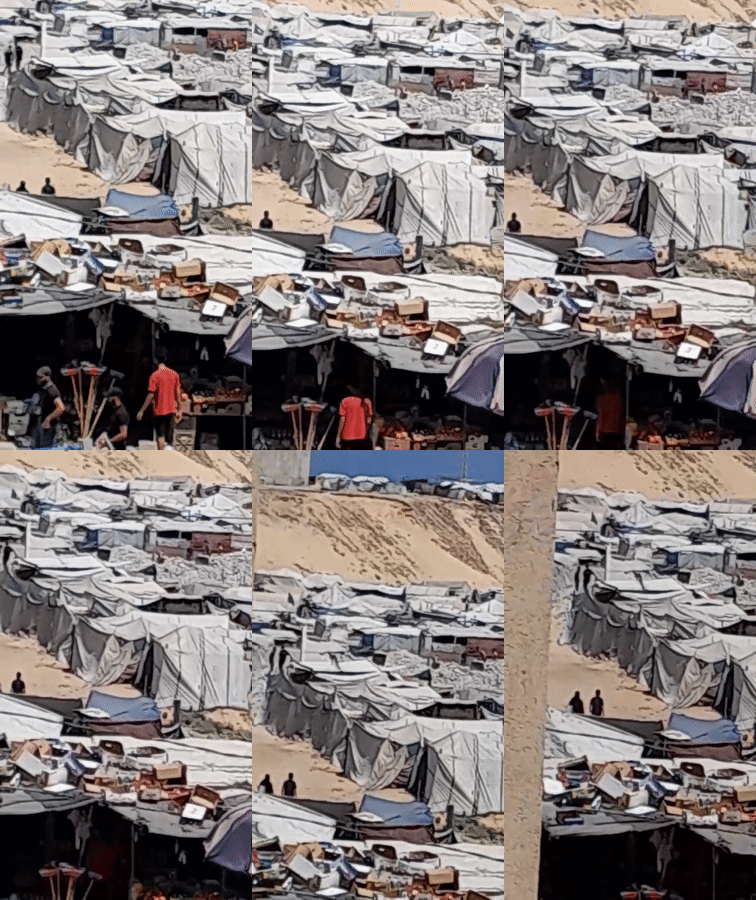
The ground area in front of and surrounding these buildings is a landscape of rubble, dirt, and debris, including fragments of concrete and twisted metal. Amidst this devastation, numerous makeshift shelters, or tents, are clustered together. These shelters are constructed from various materials such as tarpaulins, sheets of fabric, and possibly some corrugated metal, suggesting a temporary encampment for displaced individuals.
A dark-colored dog is seen walking on the sandy ground in the upper right portion of the ground area. Further down and to the left, near the cluster of shelters, a person is faintly visible.
The clear, vibrant blue sky suggests a bright, sunny day, with distinct shadows cast by the buildings and debris, indicating it is likely mid-morning or afternoon. The overall scene conveys a powerful sense of conflict's aftermath, highlighting both the extensive destruction and the resilience of human life adapting to harsh conditions. No discernible text is visible in the image.
An extensively damaged multi-story residential building stands in Khan Yunis, Palestinian Territory. The structure exhibits severe degradation, with significant portions of its exterior walls and balconies either destroyed or collapsed, exposing the interiors of multiple apartment units. The beige-colored facade is heavily pockmarked with numerous bullet and shrapnel holes of varying sizes.
On the upper floors, several windows are missing panes, and some openings are covered with makeshift tarps or fabric, including a large white sheet secured with ropes in a prominent second-story void on the left, behind which two blue objects are visible. On the right side, multiple balconies with white balusters are visible, with clothes hanging to dry on clotheslines.
Mid-level sections of the building show complete wall failures, revealing cluttered interior spaces filled with debris, twisted metal, and broken furnishings. In two separate fourth-floor sections, white tarpaulins bearing the UNICEF logo are used as improvised screens or closures. Laundry, primarily dark clothing, is hanging on lines in some of these exposed areas. A stack of concrete blocks and a black tarp are visible on the third floor right.
The ground floor of the building is also heavily impacted, featuring large irregular openings in the facade, rubble-strewn interior spaces, and debris covering the immediate exterior ground. Arched entryways on the left display accumulated debris and what appears to be pooling liquid on the floor. A red box, possibly a fire extinguisher cabinet, is mounted on a partially intact wall section on the ground floor right. No active human figures are discernibly present in the scene.
Khan Yunis, Palestinian Territory · Feb 23, 2026, 12:12 PM
The image depicts a multi-story residential building in Khan Yunis, Palestinian Territory, exhibiting severe structural damage and extensive facade pockmarks from bullet holes. The ground in the foreground is covered with a thick layer of concrete rubble and debris.
On the ground level, arched entryways lead into darkened, damaged interiors. A red utility box is affixed to a wall section on the right. Upper floors show widespread damage with sections of concrete missing, exposing rebar and internal structures. Many windows are broken, boarded, or covered with makeshift materials.
Mid-level sections feature multiple openings, some covered by white tarps. One such tarp on the left clearly displays "UNICEF" branding, with items of clothing hanging on a line within the opening. Adjacent rooms on the right contain piles of debris and various makeshift enclosures using fabric and corrugated metal.
Higher levels include balconies on the right with laundry hanging. A large, rectangular opening on an upper-middle floor is partially enclosed by a white sheet, revealing two blue cylindrical objects and a red-and-white container within the space. The uppermost visible floors continue to display bullet holes, broken windows, and some openings covered with fabric, including one with a blue patterned sheet. No individuals are visible.
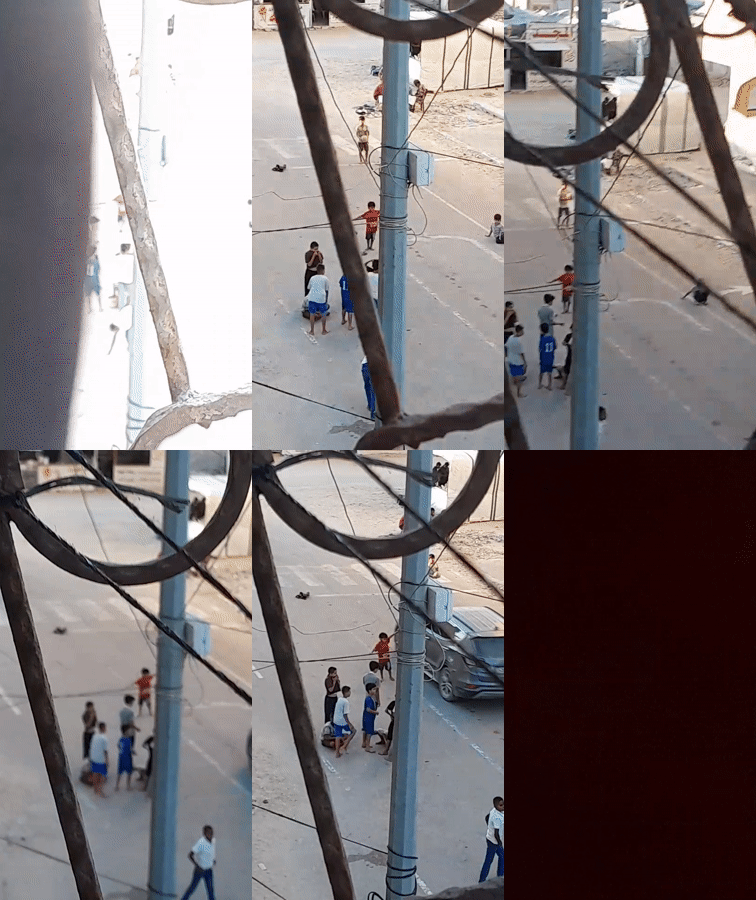
An outdoor scene in Khan Yunis, Palestinian Territory, depicts three individuals, likely children, walking across an unpaved, sandy path. In the foreground, two individuals walk side-by-side from left to right. The leftmost individual wears a grey tracksuit and light shoes, looking towards the second. The second individual wears a black Adidas long-sleeved shirt with white stripes, black pants, and light shoes, looking forward. Further to the right and slightly behind them, a third, smaller individual walks, wearing a light-colored top and dark pants, carrying a bright yellow plastic jerrycan in their right hand, held close to their body. The ground is a light brown sandy earth scattered with small pieces of concrete and debris. In the background, a large mound of construction rubble, including concrete fragments, rebar, and broken building materials, dominates the scene. Behind this mound, several makeshift shelters constructed from white tarpaulins or fabrics are visible, one featuring a dark barrel on its roof.
Khan Yunis, Palestinian Territory · Feb 23, 2026, 12:12 PM
An elevated view captures a scene of extensive damage in Khan Yunis, Palestinian Territory. The central focus is a multi-story, light-colored building exhibiting severe structural compromise. The building's facade is heavily pockmarked with numerous impact holes consistent with bullet or shrapnel strikes. Multiple sections of the building's walls and windows are blown out or heavily damaged, exposing interior rooms on various levels. Visible interior debris includes scattered personal belongings, such as clothing hanging on lines, and fragments of furniture. Several window openings on the upper floors are boarded with white material, while others remain open or contain shattered glass. The ground floor features an open area with arched supports, also showing damage. Inside a ground-level room, two red objects and one yellow object, possibly furniture remnants, are discernable.
The ground area in front of the building is a landscape of destruction, covered extensively with building rubble, concrete chunks, rebar, shattered glass, and sand. A heavily damaged, crushed white sedan, missing its roof and significant portions of its body, rests partially embedded in the sandy ground in the foreground. In the background, two individuals are visible walking away from the building. One person, wearing dark clothing, is seen walking from right to left further back, while a second, partially obscured figure is on the far right. The scene is illuminated by bright daylight.
An overhead forensic image depicts four adult males in an open, sandy area in Khan Yunis, Palestinian Territory, under direct sunlight casting long shadows. The ground consists primarily of unpaved sand and dirt, with significant amounts of scattered rubble, concrete fragments, and debris along the left and top edges. In the lower-left quadrant, one man in a light-colored thobe is seated on the ground, holding a small white object in his right hand. To his right, a second man in dark clothing is crouched low to the ground near a small pile of debris and a wooden plank. To the right of the crouching man, a third man in dark attire is seated on a light-colored concrete block, leaning forward with his head bowed. The fourth man, wearing a light-colored shirt, dark trousers, and a red baseball cap, is positioned in the center-right, captured mid-stride, walking towards the right side of the frame. A strong diagonal shadow divides the left portion of the sandy terrain. A light-colored structural ledge is visible in the immediate foreground, indicating an elevated vantage point.
Khan Yunis, Palestinian Territory · Feb 23, 2026, 12:12 PM
This image depicts a scene of widespread destruction in Khan Yunis, Palestinian Territory. In the midground, a substantial expanse of concrete rubble, rebar, and pulverized building materials from collapsed structures covers the landscape. Amidst this debris, a single individual, dressed in dark clothing and possibly wearing a head covering, walks on a sandy, cleared path. This person appears to be carrying a long, light-colored object diagonally across their left shoulder.
In the background, a large, multi-story beige building with distinct architectural elements, including a prominent arched decorative facade at the top center, stands partially damaged. The building exhibits visible signs of impact, including dark scorch marks, particularly on the left side of the upper floors, broken windows, and exposed interiors on multiple levels. Some balconies show signs of daily life, such as hanging laundry, while others are damaged. A cellular antenna tower is mounted on the roof of this structure. To the right and further back, additional damaged buildings are visible under a partly cloudy sky.
The image depicts an urban landscape in Khan Yunis, Palestinian Territory, characterized by extensive structural damage and widespread rubble under a partially cloudy blue sky. In the foreground, a sandy-colored expanse of ground is scattered with small rocks and concrete fragments. A lone individual, dressed in dark clothing, stands facing slightly right on this ground, approximately centered horizontally.
Behind the individual, a large mound of pulverized concrete, twisted rebar, and various building debris forms a significant pile across the mid-ground, indicating a collapsed structure. Portions of concrete slabs and walls are visible within this rubble.
In the background, multiple multi-story buildings, predominantly light beige, stand partially intact but heavily damaged. The leftmost building features an ornate archway on its upper facade and exhibits numerous broken windows, damaged balconies with clothes hanging, and visible interior rooms. Air conditioning units and exposed infrastructure are present. Its roof supports multiple white water tanks, a communications tower, and scaffolding. Adjacent buildings to the right are similarly damaged, with large sections of their external walls missing, exposing interiors, and contributing to the immense field of debris. One building further right appears to have suffered a partial collapse of its upper sections, leaving a gaping void. The overall scene is one of extensive urban destruction.
Khan Yunis, Palestinian Territory · Feb 23, 2026, 12:12 PM
The image displays a severely damaged multi-story residential building located in Khan Yunis, Palestinian Territory. The beige facade of the approximately eight-story structure exhibits extensive impact damage, with numerous circular holes consistent with bullet or shrapnel strikes. Many windows are shattered, missing, or partially covered with improvised materials like plywood, fabric, and metal sheets. Several sections of the exterior walls are collapsed, exposing the interiors of multiple apartment units. Significant burn marks are visible on the upper-right portion of the building and other areas. Balconies, particularly on the right side, show structural damage to their railings, with some containing debris and visible laundry. The ground floor is heavily destroyed, with walls and supporting columns severely compromised, creating open, arch-like cavities filled with rubble. A telecommunications antenna array is mounted on the roof's left side, alongside water tanks.
The ground directly in front of the building is a widespread debris field, consisting of sand mixed with large quantities of shattered concrete, broken masonry, twisted metal, and general construction waste. A heavily crushed and contorted white vehicle, possibly a sedan, lies on the sandy ground to the lower right. The scene is illuminated by bright daylight under a clear blue sky with scattered white clouds. No people are visible within the immediate area.
The image displays a multi-story residential building in Khan Yunis, Palestinian Territory, exhibiting extensive damage. The building's facade, constructed of light-colored concrete, is severely pockmarked with numerous small impact holes, indicative of sustained gunfire. Larger sections of the structure show significant destruction, including partial collapses and gaping holes exposing interior spaces.
On the upper visible floors, multiple balconies feature clotheslines with various items of laundry hanging, including shirts, pants, and towels in shades of blue, pink, and white, suggesting recent or ongoing habitation despite the damage. Windows on these floors are a mix of intact, shattered, or covered with dark fabrics and white sheets.
Mid-level sections of the building show more severe structural compromise. One central section exhibits extensive charring and fire damage, with blackened walls and collapsed balcony elements. Interiors on these floors are exposed, revealing debris, twisted metal, broken glass, and personal belongings. Some openings are covered with makeshift materials, including blue tarps and white sheets, some bearing the UNICEF logo. Air conditioning units are visible, some dislodged or damaged.
The ground floor is extensively destroyed, with large sections of its exterior walls entirely missing, creating wide, irregular openings. These breaches expose inner rooms and hallways filled with rubble and debris. Two distinct red cuboid objects are visible within the destroyed ground-level interior.
The ground immediately in front of the building is covered by a dense layer of concrete rubble, shattered building materials, and miscellaneous debris, consistent with explosions and structural collapse. No people are visible within the frame.
Khan Yunis, Palestinian Territory · Feb 23, 2026, 12:13 PM
The image depicts a severely damaged multi-story concrete building in Khan Yunis, Palestinian Territory, under a clear blue sky. The structure, characterized by light tan and brown sections with decorative white arch-like motifs above and below windows, exhibits extensive destruction. Large sections of the exterior walls are missing across multiple floors, exposing internal rooms, debris, and fractured concrete. Several window openings are empty, while others on the lower visible floors are covered with white tarpaulins, some featuring vertical black stripes. One white tarpaulin on the third floor from the bottom clearly displays a blue "UNICEF" logo. Visible structural cracks run vertically down portions of the remaining facade. A blurred, dark, vertical object wrapped in clear plastic partially obscures the right foreground. No individuals are present in the scene.
Khan Yunis, Palestinian Territory · Feb 23, 2026, 12:13 PM
The image captures a scene of widespread urban destruction in Khan Yunis, Palestinian Territory, under a partly cloudy sky. In the foreground, vast piles of concrete rubble, rebar, and pulverized building materials cover the ground. A lone individual, dressed in dark attire, is visible standing or kneeling on a small patch of dirt and sparse vegetation in the lower-left quadrant amidst the debris.
The midground is dominated by heavily damaged multi-story residential structures. One building appears partially collapsed, with its upper floors and roof caved in, exposing internal supports and debris. Another building exhibits significant structural failure, with a large concrete slab leaning precariously above a lower section of wreckage.
In the background, a row of multi-story, light-colored apartment buildings stands, several of which show extensive damage. Many windows are blown out or missing, revealing darkened interiors, and some balconies contain visible items like clothing or blankets. Structural damage, including missing sections and facades pocked with holes, is evident across multiple buildings. Communication towers and scaffolding are visible on the rooftops of some of the taller background structures. A heavily damaged building with multiple impact marks on its facade is present in the immediate right foreground. The overall environment is one of substantial devastation.
Khan Yunis, Palestinian Territory · Feb 23, 2026, 12:13 PM
The scene depicts extensive urban destruction in Khan Yunis, Palestinian Territory, under a clear blue sky with scattered white clouds. In the immediate foreground on the right, a multi-story concrete building stands severely damaged. Its facade shows numerous perforations consistent with bullet impacts or shrapnel. Most window openings are either shattered, boarded with various materials including wood panels and white fabric, or covered with blue and white tarps. On the top floor, a communications tower equipped with multiple antennas and several water storage tanks is visible. Below, a large rectangular opening on a mid-level floor is covered by a stretched white tarp, with blue buckets discernible behind it. Further down, another opening displays hanging clothes. The ground level of this building appears dark and partially recessed.
To the left and extending into the midground and background, multiple other multi-story residential buildings are visible, all exhibiting significant structural damage, including partially collapsed sections, exposed rebar, and missing wall segments. Extensive piles of concrete rubble, twisted metal, and general debris cover the ground between these structures. A partially collapsed elevated walkway or section of building lies amidst the rubble in the midground, contributing to the debris field. No individuals are present or identifiable within the visible areas of the image.
Khan Yunis, Palestinian Territory · Feb 23, 2026, 12:13 PM
The image displays an interior view looking down a structurally damaged building in Khan Yunis, Palestinian Territory. A concrete staircase with dark metal railings, featuring decorative scrollwork, descends from the foreground. The surrounding concrete walls are extensively damaged, revealing exposed rebar, crumbling plaster, and irregular openings. Multiple black utility cables are visible, some looped, running along the left wall and traversing the open vertical space. A substantial horizontal concrete beam spans the mid-ground, with a large gap beneath it. Below the stairwell, a metal grate provides a view to a sunlit exterior area, where vertical orange pipes are visible alongside the partial rear view of a white vehicle. No individuals are present. The scene indicates significant structural compromise or ongoing demolition.
Khan Yunis, Palestinian Territory · Feb 23, 2026, 12:17 PM
The image depicts a scene of extensive structural damage in Khan Yunis, Palestinian Territory, under a daylight sky. In the foreground, a sandy, uneven terrain is visible, sparsely littered with small debris and a few larger concrete fragments. A lone adult individual, dressed in dark clothing, is seated or crouched on this sandy ground, with a smaller individual, likely a child, similarly dressed and positioned close beside them.
The midground is dominated by a substantial pile of pulverized concrete and building wreckage, interspersed with exposed rebar and fractured wall sections, indicating the complete collapse of a structure. This rubble pile varies in elevation, featuring large, irregular chunks of concrete.
In the background, a row of multi-story residential buildings, appearing to be apartment complexes, stands partially intact but severely damaged. Their facades display numerous impact marks or bullet holes. Many windows are shattered or completely missing, revealing the interiors of apartments where personal belongings, such as clothing, hang exposed. One building exhibits a large, rectangular section completely blown out, exposing internal frameworks and debris. Balconies with decorative railings are visible on several floors, some showing signs of damage. The overall environment conveys widespread devastation.
Khan Yunis, Palestinian Territory · Feb 23, 2026, 12:18 PM
The image presents a close-up, focused view of a person's two fingers, likely the index and middle, positioned near a white window frame in the foreground. The skin of the fingers is light-toned, with visible lines and texture, and is brightly illuminated by direct sunlight from the left, casting distinct shadows. A small, dark speck is visible on the tip or edge of the index finger's nail. Through the window, the background is significantly blurred but depicts an urban landscape consistent with the city of Khan Yunis, Palestinian Territory, under clear daylight conditions. Distant multi-story buildings, appearing in light earth tones, feature multiple windows. The ground area visible between the foreground and buildings contains indistinct debris or rubble. No specific individuals or identifiable actions are discernible in the blurred background.
Khan Yunis, Palestinian Territory · Feb 23, 2026, 12:18 PM
The image depicts a scene of extensive destruction in Khan Yunis, Palestinian Territory. The ground is covered with a thick layer of grey and brown rubble, consisting of fragmented concrete, stones, dust, and sand.
In the mid-ground, a heavily damaged white four-door sedan is prominent, crushed and mangled, resting amidst the debris. Its roof is significantly caved in, and the side panels are warped and torn. A reddish object, possibly a bag, is visible within the wreckage of the car's rear section.
An adult male, viewed from behind, is walking across the scene from left to right. He wears a light-colored long-sleeved top and dark trousers. His path is directly through the rubble-strewn terrain.
In the background, piles of debris from what appear to be collapsed buildings are evident, with broken concrete slabs, twisted reinforcement bars, and fractured structural elements. The overall environment indicates widespread architectural devastation.
Khan Yunis, Palestinian Territory · Feb 23, 2026, 12:18 PM
A multi-story residential building in Khan Yunis, Palestinian Territory, displays extensive structural damage under clear daylight. The building's beige facade is heavily pockmarked with bullet or shrapnel impacts, and numerous large sections of walls and windows are missing, exposing internal spaces. Balconies are either partially destroyed or completely absent.
The ground level features several arched openings, beyond which dark interiors are visible. The area immediately in front of the building is covered by a dense field of concrete rubble, debris, and scattered fragments of building materials.
Despite the severe damage, evidence of habitation is present. Many of the exposed window and balcony openings are covered with makeshift white and blue tarpaulins or sheets, several of which bear the UNICEF logo. On various floors, clothes are seen hanging to dry on lines strung within these temporary enclosures. On one upper-level balcony, a white bucket and two blue items are visible behind a white sheet. Another lower balcony is covered with a large black tarp. Scattered personal belongings and remnants of furniture are discernible in several exposed interior sections. No individuals are visible in the scene.
Khan Yunis, Palestinian Territory · Feb 23, 2026, 12:19 PM
An indoor scene in Khan Yunis, Palestinian Territory, displays a white-painted room. A horizontal rectangular breach, approximately 75 cm wide and 25 cm high, is present in a white wall below the ceiling. The edges of the breach are rough and irregular. The white ceiling and the adjacent white wall surface are covered with numerous small, dark, circular impact marks. A light-colored electrical wire with a green clip descends from the upper left ceiling area, crossing in front of the wall breach. A clear white wall corner and a smaller white structural projection are visible on the right side of the frame.
Khan Yunis, Palestinian Territory · Feb 23, 2026, 12:22 PM
The scene depicts an interior room located in Khan Yunis, Palestinian Territory. A large, light-toned rug with an abstract grey and beige pattern covers the majority of the light-colored tiled floor, with a rectangular patch of direct sunlight illuminating a section of the rug. The prominent white wall in the background displays numerous small, dark pockmarks, consistent with impact damage, and a visible horizontal crack. An electrical outlet is present on this wall, alongside an empty, rectangular wall cavity. To the left, an adjacent area with brown tiled walls and a similar tiled floor is visible, containing blue and red electrical conduits, dark cables, and a yellow object on the floor. No individuals or explicit actions are depicted.
Khan Yunis, Palestinian Territory · Feb 23, 2026, 12:22 PM
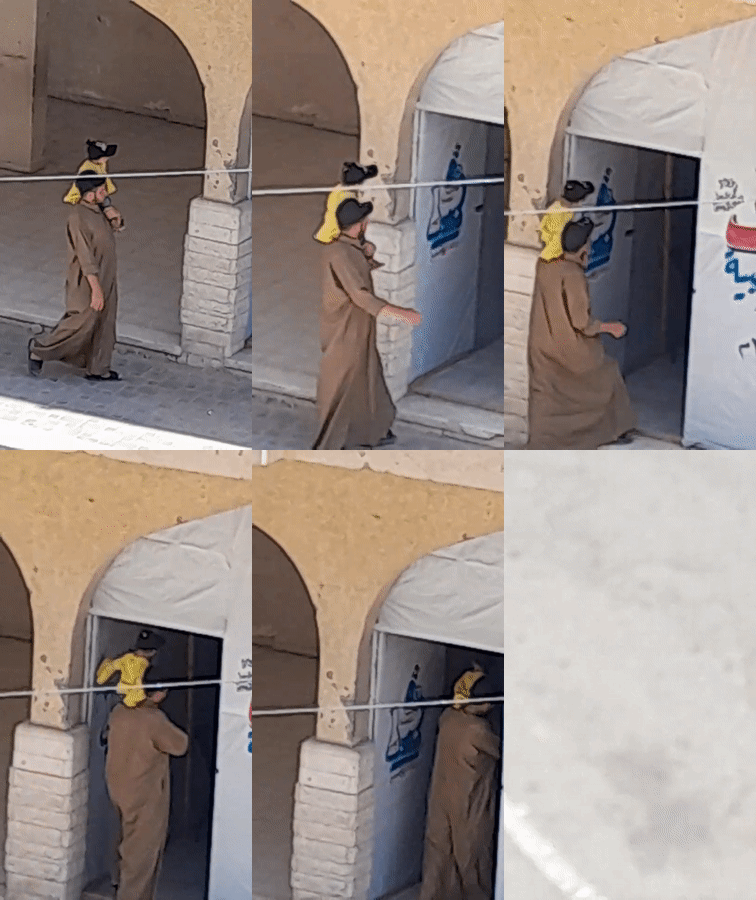
A lone individual, likely a child, is observed from behind, wearing a dark red long-sleeved garment. They are seated on a small, light-colored, four-legged stool positioned atop the severely damaged and crumpled roof of a white four-door sedan. The vehicle is extensively deformed, with its doors and body panels visibly bent and broken, indicating a state of destruction. The immediate and surrounding environment consists of a vast expanse of light-colored rubble, broken concrete pieces, and dirt, consistent with a demolition or destruction site. This scene is located in Khan Yunis, Palestinian Territory.
Khan Yunis, Palestinian Territory · Feb 23, 2026, 1:07 PM
The image presents a high-angle view of a desolate and debris-strewn environment. The primary subject is a severely damaged white vehicle, which appears to be a van or a large car, resting amidst a field of rubble. The vehicle is crumpled and extensively distorted, with its body panels bent and twisted, indicating a catastrophic impact or destruction. A reddish object, possibly a bag or fabric, is visible within the mangled interior of the vehicle.
Adjacent to the wreckage, a single person is seen standing. The individual is dressed in dark clothing, possibly a black bottom garment (pants or skirt) and a reddish or orange top or undergarment, with their back mostly turned towards the viewer. They appear to be observing or interacting with the damaged vehicle.
The ground beneath and around the vehicle is uneven and covered with a vast amount of debris, including small rocks, gravel, sand, and larger pieces of concrete or building materials. This suggests a scene of demolition, disaster, or significant destruction. The overall color palette of the image is muted, dominated by shades of beige, grey, and white from the ground and vehicle, with the person's clothing providing a small contrast of black and red/orange.
The lighting indicates it is daytime, with shadows suggesting clear weather, but no specific time of day or location can be determined. There are no discernible texts or identifiable landmarks in the image. The scene conveys a sense of aftermath or abandonment, with the sole human figure engaging with the wreckage.
Khan Yunis, Palestinian Territory · Feb 23, 2026, 1:47 PM
The image presents a high-angle, almost aerial view of a desolate and debris-strewn landscape. The ground is largely composed of light brown sand or dirt, interspersed with extensive areas covered by rubble. This rubble consists of numerous small, irregular pieces of light-colored material, likely broken concrete, rocks, and fragments of building materials, giving the impression of a destroyed or neglected site.
In the lower-center portion of the image, a person is visible, appearing to be standing or walking across a sandy patch. The individual is dressed in light-colored trousers, a dark top or vest, and a light-colored head covering, possibly a hijab or scarf, in a muted pink or beige tone. Their arms are slightly extended, suggesting motion. Near this person, a bright purple plastic chair lies on its side amidst the rubble.
Towards the upper-left corner of the image, another human figure is discernible, lying on the ground amidst a dense cluster of debris. This figure appears to be dressed in a reddish-brown garment. The posture suggests they are lying on their back with bent legs. Next to this figure, a large, curved piece of white debris is present.
Scattered throughout the sandy areas are various smaller fragments of trash or debris, including some darker pieces. A long, thin, dark, serpentine object, possibly a wire, rope, or even a snake, is visible on a clearer sandy patch in the upper-middle section of the image.
The lighting indicates daytime, likely under clear skies, as there are no strong shadows that would suggest an overcast day. The overall scene conveys a sense of hardship, destruction, or abandonment. No text is visible in the image.
Khan Yunis, Palestinian Territory · Feb 23, 2026, 1:47 PM
The image displays a scene of significant destruction, likely from conflict or a disaster, featuring a heavily damaged multi-story building next to a large pile of rubble. The overall impression is one of devastation.
To the left of the frame, a tall, multi-story building, appearing to be a residential or apartment complex, dominates the background. It is constructed from light-colored (beige or off-white) concrete or stucco. The building shows extensive damage; numerous windows are broken or appear boarded up, and many balconies are either damaged or have items, such as clothes or rugs, hanging from them, hinting at recent habitation or attempts at salvage. Several air conditioning units are mounted on the exterior walls, particularly on the lower floors. On the far left, black water tanks are visible on the roof of a lower section of the building. The building's facade exhibits multiple holes and impact marks, especially in the central section. A large section of one of the middle floors appears completely blown out, exposing the interior structure and giving the impression of a direct hit or collapse. An arched architectural detail is present on the lower part of the building on the far left.
In the foreground and extending towards the damaged building is a substantial pile of debris and rubble. This pile consists of broken concrete slabs, fragmented bricks, twisted rebar, and general construction waste. Some of the larger concrete pieces are light-colored, indicating structural components. Below the main mound of rubble, a fragmented and cracked section of what appears to be a foundation or a lower wall is visible. At the very bottom right of the rubble, a blue tarp or piece of fabric is partially visible, covering some of the smaller debris.
To the right of the rubble, the ground is sandy or dusty, with sparse patches of small green vegetation or weeds growing in it. Bright sunlight casts clear shadows across the sandy ground and the rubble, suggesting it is daytime with a clear sky. The destructive state of the buildings and the presence of such extensive rubble indicate a recent catastrophic event.
Khan Yunis, Palestinian Territory · Feb 23, 2026, 1:48 PM
A multi-story building stands partially destroyed. Some apartments are missing walls, exposing interiors with furniture and hanging laundry. Bullet holes pepper the facade. Debris and rubble fill the ground next to a sandy area, possibly a beach. Another damaged building is visible in the background. The overall scene conveys devastation and destruction in a coastal area.
Khan Yunis, Palestinian Territory · Feb 23, 2026, 1:49 PM
The image captures a scene of extensive destruction, showing a tall, multi-story building partially damaged and a massive pile of rubble in the foreground and to its right. The photo appears to be taken during bright daylight, under a clear sky.
On the left side of the frame, a light-colored (beige or tan) residential or commercial building stands. It appears to be at least ten stories tall. The building shows significant signs of damage, particularly in its central and upper-middle sections, where large portions of the exterior walls are missing, exposing the building's interior structure and rooms. Some windows are broken, while others still show closed blinds or curtains. Numerous air conditioning units are mounted on the exterior walls of various apartments. Balconies or recessed areas are visible, with one showcasing a rug or blanket draped over a railing. The architectural style includes decorative arch-like elements on the lower floors.
To the right of the damaged building and extending into the foreground, there is a large, irregular pile of debris and rubble. This pile consists of broken concrete slabs, shattered masonry, twisted metal rebar, and smaller fragments of dirt and rock. The sheer volume and chaotic nature of the rubble suggest the collapse or demolition of a substantial structure. The debris varies in size, from fine grit to large, jagged chunks of concrete.
The scene conveys the aftermath of a catastrophic event, such as an explosion, earthquake, or conflict, indicated by the structural damage to the standing building and the extensive pile of wreckage. No people are visible in the image, emphasizing the desolation of the area. There is no visible text in the image.
Khan Yunis, Palestinian Territory · Feb 23, 2026, 1:49 PM
The image captures a scene of extensive urban devastation under a clear blue sky with scattered white clouds. The perspective appears to be from a vantage point within or near a damaged structure, looking out over a ruined cityscape.
In the immediate foreground, likely above the viewer, is a severely damaged concrete structure. It has multiple rectangular openings, some of which appear to be windows that are broken, boarded up with various materials (some brown, some white fabric-like), or simply gaping holes revealing darkness or debris inside. The concrete surface shows numerous small impact marks or holes, suggesting shrapnel damage or bullet holes. On a section of exposed wall or debris within this damaged structure, a partially visible "UNICEF" logo in blue and white is discernible.
Below and beyond this foreground structure, a wide expanse of destroyed and damaged buildings is visible. On the left side of the frame, several multi-story residential or commercial buildings stand. Many of these structures exhibit significant damage, including broken windows, missing sections of walls or balconies, and some blackened areas that might indicate fire damage. One building on the far left has a large, empty billboard-like frame on its roof.
The right side and central midground of the image are dominated by a massive pile of rubble. This debris consists of large concrete slabs, broken bricks, twisted metal, and other construction materials, indicating the complete collapse of one or more buildings. Behind and amidst this rubble, other buildings are seen in various states of disrepair and partial collapse. One building appears to have had its upper floors entirely destroyed, leaving only lower sections and a chaotic jumble of internal structures.
The overall scene conveys the aftermath of a catastrophic event, such as a major conflict or a natural disaster like an earthquake. The bright daylight, with clear blue skies and wispy white clouds, provides a stark contrast to the widespread destruction below. There are no people visible, and no active events are taking place; the image is a static portrayal of devastation.
Khan Yunis, Palestinian Territory · Feb 23, 2026, 1:56 PM
The image displays a multi-story building, severely damaged and appearing to be in an urban environment. The photo is taken from an elevated perspective, looking down at the side of the building, which appears to be rotated 90 degrees clockwise in the provided image.
The building itself is constructed of light-colored (beige or tan) concrete or masonry. It shows extensive damage across its entire visible facade. Large sections of the outer walls and internal partitions are missing, exposing the interiors of multiple rooms on various floors. The structure is pockmarked with numerous small holes, consistent with bullet holes or shrapnel damage, particularly on the left side of the facade. Many windows are broken, missing glass, or boarded up with various materials. Some windows feature decorative, light brown and white patterned frames.
Inside the exposed rooms and openings, there is evidence of makeshift living arrangements and debris. Several sections of the building are covered with white or light grey tarpaulins, used to create temporary walls or roofs within the damaged structure. Notably, several of these tarpaulins bear the blue "unicef" logo, suggesting the use of humanitarian aid materials.
On the upper left side of the building, an exposed room or balcony shows a pink item of clothing hanging, possibly to dry. Below this, another level has rooms with dark fabrics or clothes visible. Further down the building, more rooms are exposed, filled with an assortment of objects, including what appears to be discarded furniture, plastic sheets, and other household items. In some areas, dark clothes are seen hanging on lines.
To the right of the damaged building, the ground is completely covered in a vast expanse of rubble and debris, indicating significant destruction in the immediate vicinity. This area consists of fragmented concrete, twisted metal, and other remnants of demolished structures.
No active human presence is clearly visible, and the scene depicts the aftermath of a destructive event, likely conflict or a disaster, given the extent of the damage and the presence of humanitarian aid materials. The lighting suggests it is daytime, with no strong shadows indicating a specific time of day. The overall impression is one of widespread devastation and displacement.
Khan Yunis, Palestinian Territory · Feb 23, 2026, 1:56 PM
An aerial shot shows a sandy terrain with rocks and sparse vegetation. A person in dark clothing lies on the sand, near a pile of debris that includes a metal chair. The lighting creates strong shadows, suggesting a bright, sunny day. The overall scene conveys a sense of desolation.
Khan Yunis, Palestinian Territory · Feb 23, 2026, 1:57 PM
The scene depicts a landscape of devastation, seemingly in an urban setting. The foreground is dominated by piles of concrete rubble and debris, suggesting a building or structure has been destroyed. In the distance, multi-story buildings stand, several of which appear damaged with broken windows and visible structural damage. A person is visible in the foreground, near the rubble, appearing to be sitting and surveying the scene. The sky is partially cloudy, and a telecommunications tower is visible atop one of the buildings. Overall, the scene conveys a sense of destruction and loss.
The image displays white text on a solid, vibrant magenta (or fuchsia) background. The text is centrally aligned towards the bottom half of the image. The font is sans-serif and appears to be plain and legible.
The text reads:
"Massive explosion sounds right now in southern Gaza."
The text is enclosed in quotation marks, indicating it might be a direct quote or a report of an event. There are no other visual elements, objects, or people depicted in the image. The overall impression is that of a text-based alert or message presented against a striking, uniform color.
Khan Yunis, Palestinian Territory · Feb 23, 2026, 1:58 PM
The image, oriented correctly with the sky at the top, depicts a scene of extensive urban destruction under a bright daytime sky. The primary focus is on heavily damaged buildings and large piles of rubble.
In the foreground, a substantial amount of debris, consisting of broken concrete, rebar, dust, and other construction materials, covers the ground on the right side of the frame, extending into the midground. To the far left, the corner of a taller, seemingly less damaged building is partially visible. Running diagonally across the top portion of the frame, acting as a partial overhead frame, is a damaged concrete structure, possibly part of a collapsed upper floor or another building, showing holes and weathered patches.
The midground features several multi-story buildings, almost all of which exhibit significant damage. Many windows are blown out, walls are partially collapsed, and interiors are exposed. Some buildings appear to have completely crumbled into piles of rubble, leaving only skeletal remains of their structure. One building on the left side, though still standing, shows multiple air conditioning units on its facade and what appear to be clotheslines hanging from some windows, suggesting it was once residential. This building also has a communications tower or cell tower erected on its roof. Further into the midground and background, more buildings are visible, also showing varying degrees of damage, contributing to a widespread sense of devastation.
The sky above is a clear blue with scattered white, fluffy cumulus clouds, indicating fair weather and bright daylight.
Notable details include the widespread structural damage to the buildings and the substantial amount of debris on the ground, strongly suggesting the aftermath of an event like a conflict or a natural disaster. On a partially standing wall or piece of debris in the midground, near the center-right, a blue and white sign or banner is visible with the word "UNICEF" clearly printed on it, indicating the presence or involvement of humanitarian aid organizations in the area. The general architecture suggests an urban setting.
Khan Yunis, Palestinian Territory · Feb 23, 2026, 1:58 PM
An aerial view depicts three children on barren ground, possibly a war-torn area. The child at the top is wearing pink, the middle child is wearing purple, and the bottom child is wearing gray. They are walking near piles of rubble and garbage. The soil is sandy with scattered debris. Patches of sparse vegetation are present. The overall scene suggests poverty and environmental degradation.
Khan Yunis, Palestinian Territory · Feb 23, 2026, 1:59 PM
The image presents a stark and somber scene of urban destruction. A large, multi-story building, constructed from light-colored (beige or pale yellow) concrete or stucco, dominates the left and central portions of the frame. This building has sustained extensive damage, with numerous sections of its outer walls and internal partitions completely missing across multiple floors. This reveals the skeletal structure and exposed interiors of numerous rooms, indicative of severe structural compromise. Many window openings are empty or contain shattered frames.
Amidst the destruction, there are clear signs of makeshift habitation. Several openings and exposed rooms on various floors of the damaged building, as well as areas on the ground level adjacent to it, are covered with white tarpaulins or fabric sheets, forming temporary, tent-like shelters. These coverings attempt to create enclosed spaces within the ruined architecture. Inside some of these visible spaces, hints of personal belongings can be seen, such as a patterned rug hanging or clothes, suggesting continued or recent occupation. A black water tank is also visible near one of the ground-level makeshift shelters.
To the right of the damaged building, a substantial and uneven mound of rubble and debris stretches across the mid-ground, composed of broken concrete, twisted rebar, and assorted construction waste. This pile is a direct result of the structural collapse. Beyond this debris, the ground consists of a dirt or sandy path or road.
Several individuals are present in the scene, underscoring the human impact of the destruction. In the mid-ground, standing on the dirt path next to the rubble, a person dressed in a dark top and light trousers is visible. Further back, near the debris, two other people are standing together. Other figures are less distinct, potentially in the background or near the makeshift shelters.
The lighting in the image suggests either early morning or late afternoon, as long shadows are cast across the ground, and parts of the building and debris are brightly illuminated by a low-angled sun. The overall atmosphere conveys a sense of desolation and resilience in a severely damaged urban landscape. No discernible text is visible in the image.
Khan Yunis, Palestinian Territory · Feb 23, 2026, 1:59 PM
The image displays a desolate scene, likely an area devastated by conflict or a natural disaster, viewed from a high angle looking down. The ground is largely covered in rubble, consisting of broken concrete, bricks, and debris of various sizes, with patches of dirt and dust.
In the lower-center of the frame, a person, possibly a child or young adult, is seated on a large, relatively flat piece of concrete or debris amidst the rubble. They are wearing a dark blue or black jacket and dark trousers. Their posture is relaxed, with their legs drawn up and arms resting on their knees, and they appear to be looking towards the right side of the frame, seemingly observing the surroundings.
To the right of the seated person and occupying a significant portion of the upper-right area, lies the heavily damaged wreck of a light-colored vehicle, possibly white or beige. The car is severely crushed and distorted, with its roof largely torn off and its body crumpled, suggesting it has been through an intense impact or explosion. A vivid red object, possibly a piece of fabric, a seat, or an item from the interior, is visible inside the wrecked cabin.
In the upper-left and central-left areas, remnants of damaged structures or buildings are visible. These structures are broken and fragmented, showing exposed concrete, rebar, and brickwork. One notable detail in this area is a distinct red, square-shaped object or container resting on a broken ledge or wall of one of the structures.
The overall impression is one of widespread destruction and hardship. The lighting suggests daytime, but the absence of strong shadows could indicate an overcast sky. There is no visible text in the image.
Khan Yunis, Palestinian Territory · Feb 23, 2026, 1:59 PM
The image captures an outdoor scene of significant destruction and debris. The ground throughout the frame is covered in a mixture of dirt, dust, and various sizes of rubble, including rocks, shattered concrete, and fragmented building materials.
A prominent feature in the middle-right of the image is a heavily damaged white vehicle. The car is severely crushed and mangled, its original shape barely discernible. Its body panels are torn and twisted, the roof appears caved in, and the interior is exposed, revealing warped metal and some red material, possibly upholstery or an item inside. The vehicle lies partially on its side or overturned amidst the extensive debris, indicating a catastrophic impact or collapse.
In the bottom-left section of the image, a young male figure is visible, sitting on a low, light-colored piece of debris or a concrete block. He is dressed in a dark blue long-sleeved shirt and dark trousers. His posture suggests he is looking downwards or slightly ahead, and his expression or demeanor is not clearly visible but implies contemplation or weariness. A dark object, possibly a backpack or a bag, is situated on the ground next to him.
On the far-left side of the image, there are more remnants of what appear to be demolished or destroyed structures, including stacks of bricks or concrete blocks and fragmented wooden or metal elements, further contributing to the scene of ruin. The lighting suggests natural daylight, providing a clear view of the devastation. There is no visible text in the image.
Khan Yunis, Palestinian Territory · Feb 23, 2026, 2:00 PM
The image depicts a scene of extensive urban destruction, likely the aftermath of a natural disaster or conflict. The photograph is taken from an elevated perspective, looking down on a severely damaged multi-story building and surrounding rubble.
On the left side of the frame, a partially collapsed building dominates the view. Its walls are broken and crumbled, exposing interior rooms and structural elements. The building's exterior appears to be made of light-colored, possibly beige or pale yellow, masonry. Visible within the exposed sections are various items:
* In an upper exposed room, a bright yellow, box-like object or piece of furniture is visible.
* Two prominent red, rectangular objects are embedded in the damaged walls. One is higher up, resembling a small alcove or a painted section of a wall, possibly with faint, unidentifiable white text or symbols (possibly Arabic script) on it. The other red object is located lower down within another exposed section of the building, similar in appearance but without discernible markings.
* The interior spaces are dark and dusty, showing the skeletal remains of rooms with shattered concrete and twisted rebar.
The ground extending from the base of the building to the right side of the image is covered in a vast expanse of rubble. This debris consists primarily of broken concrete, fragmented bricks, dust, and twisted metal pieces.
In the mid-right section of the image, amidst the rubble, a single person is visible. They are wearing a dark blue or black hooded top and dark pants. The person is lying or reclining on a relatively flat piece of debris, appearing to rest or observe the surroundings. Their body is oriented horizontally across the frame, with their head facing towards the left, in the direction of the damaged building. Their posture suggests a moment of stillness in a chaotic environment.
Further to the far right, a severely damaged and crumpled white object is prominent. It appears to be the wreckage of a vehicle, most likely a car, with its structure heavily distorted, crushed, and perhaps overturned. Its roof is caved in, and the interior is exposed.
The lighting suggests it is daytime, with clear weather conditions, as there are no visible shadows indicating harsh sunlight or signs of rain. The overall atmosphere conveys a profound sense of devastation and the impact of a destructive event. No discernible text beyond the faint markings on the red object is visible in the scene.
Khan Yunis, Palestinian Territory · Feb 23, 2026, 2:00 PM
The image displays a scene of significant urban destruction alongside a partially damaged residential building, suggesting the aftermath of conflict or a major disaster.
In the right half of the frame, a massive pile of rubble, concrete slabs, and fragmented building materials dominates the foreground. This debris field consists of various sizes of broken concrete, twisted metal rebar, and pulverized masonry, indicating the complete collapse or severe demolition of a structure. Parts of what appear to be foundational walls or lower sections of a building remain, heavily cracked and fractured, with their internal construction exposed. Toward the very bottom right, a section of a blue tarp is visible, partially covering some of the debris.
To the left and extending into the background is a multi-story apartment building, which appears to be largely standing but shows distinct signs of damage. The building is light-colored, possibly beige or tan, and features multiple floors with numerous windows and balconies. Many windows are framed with decorative "K"-shaped patterns. On several balconies, various items such as rugs or clothing are seen hanging, suggesting continued or recent habitation.
Upon closer examination, the standing apartment building exhibits several dark impact marks or scorch marks on its facade, particularly on the middle and lower-middle sections. Some windows appear broken or are covered, and one section on an upper floor reveals a large, gaping hole where a wall or a part of the structure is missing, indicating substantial damage. Further in the background, another similar apartment building is partially visible, with several water tanks on its rooftop.
The lighting indicates it is daytime, possibly morning or late afternoon, with clear skies. The scene is static, capturing the aftermath rather than an ongoing event. No discernible text is visible within the image. The overall impression is one of devastation and disruption to urban life.


 Khan Yunis, Palestine