Friday, February 27, 2026 · Updated Friday, February 27, 2026
Florence, Italy
Florence, the cradle of the Renaissance, remains an enduring testament to human creativity and architectural genius. A comprehensive tour through its historic heart reveals an astonishing concentration of art and design, meticulously preserved within its famed galleries and monumental buildings. This journey captures the essence of a city where every corner tells a story of artistic mastery.
The image displays an interior view of a room within the Palazzo Vecchio in Florence, Italy. Central to the scene is a white marble sculpture depicting a nude, muscular male figure, identified as Hercules, standing and grappling with a struggling centaur, likely Nessus. Hercules, positioned behind the centaur, grips its head with both hands, pulling it backward. The centaur, half-human and half-horse, exhibits a pained expression and appears to be in mid-struggle, its equine legs partially obscured by its human torso. The sculpture rests on a plain white marble base, which is set upon a reddish-brown marble plinth.
The room features an ornate, vaulted ceiling adorned with intricate Renaissance grotesque patterns, framed mythological scenes, and decorative elements in muted colors against a light background. Dark-framed paintings, including portraits and dark-toned scenes, are visible on the surrounding walls. To the left, a smaller marble statue of a draped female figure seated on a pedestal is visible. Large, multi-paned wooden windows span the background, offering a view of an exterior building constructed from light-colored, rough-hewn stone blocks, typical of Florentine architecture. A portion of a person's shoulder and arm is visible on the far right edge of the frame.
The Uffizi Gallery, a crown jewel of Florence, offers an unparalleled experience. Here, Baccio Bandinelli's powerful "Laocoön Group" sculpture stands prominently, its dramatic forms captivating onlookers. Positioned before a window, this masterpiece provides a breathtaking backdrop: a glimpse of the iconic red-tiled dome of Florence Cathedral, Santa Maria del Fiore, asserting its dominance over the city skyline. The gallery's interiors themselves are a work of art, with ceilings adorned with elaborate grotesque ornamentation, featuring mythological figures and intricate patterns, all framed by dark wooden beams and tall, light-filled windows.
The image displays a detailed view of a richly decorated hall or corridor within the Uffizi Gallery in Florence, Italy. The perspective is from a slightly low, upward angle, emphasizing the elaborate ceiling.
The ceiling features extensive grotesque ornamentation on an off-white background. This decoration includes several large central panels; one prominent oval panel depicts a winged figure in classical drapery, while a rectangular section below it shows a classical male nude statue on a pedestal. These panels are surrounded by intricate designs of smaller mythological figures, animals, floral motifs, architectural elements, and abstract patterns, rendered in a muted palette of reds, blues, greens, browns, and ochres. The ceiling's structure incorporates prominent dark wooden longitudinal and transversal beams, with additional decorated friezes running along the upper wall sections.
The left wall consists of a series of tall, rectangular windows with multiple panes, framed in dark wood, providing significant natural illumination. The far wall functions as a gallery space, dominated by a large framed painting in the center depicting a figure in red robes. This central painting is flanked by numerous smaller framed artworks. Below these paintings, additional window panels are visible.
In the foreground, at floor level, a large marble sculpture of two intertwined male figures is partially visible on the left, with a smaller, lighter-colored sculpture to its right. The right wall, partially visible, also exhibits multiple framed paintings displayed in a gallery style. A dark human head is discernible in the lower-left corner of the frame, near the bottom of the window frames, indicating human presence.
Just steps away, the Palazzo Vecchio further immerses visitors in Renaissance splendor. Its grand rooms showcase magnificent white marble sculptures, such as Hercules grappling with the Centaur Nessus, set against a backdrop of ornate vaulted ceilings. These ceilings are a frescoed marvel, depicting winged putti, mythological scenes, and intricate floral motifs in a muted yet rich palette, flanked by dark-framed paintings that add to the room's historical gravitas.
The image displays a bronze statue of Saint Matthew by Lorenzo Ghiberti, located within an elaborate Gothic niche on the exterior of the Orsanmichele Church in Florence, Italy. The statue depicts a robust, bearded male figure with flowing drapery, holding an open book with both hands. He stands upon a dark pedestal. The niche is composed of white marble, featuring twisted, fluted columns on either side and an arched top. The recessed background behind the statue is decorated with a pattern of blue and gold stars. Below the statue, the marble base is intricately carved with a central relief featuring a winged quadruped resembling a griffin or lion, surrounded by scrolling foliage. To the lower left of the base, a circular relief with a star-like motif is present. The niche is set into a wall constructed from aged, light brown stone blocks. To the upper left, an archway and a portion of a decorative window or panel, possibly a rose window, are visible on the building's facade.
The image displays a wide view of the Piazza della Signoria in Florence, Italy, under an overcast sky. The prominent subject is the Palazzo Vecchio, a large, fortified stone palace with a tall, crenellated tower, the Arnolfo Tower, rising from its right side. The tower features a visible clock face. The Palazzo's facade is characterized by rusticated stonework, multiple levels of arched windows, and a crenellated roofline. Flags are displayed from a balcony situated centrally on the building's facade.
The piazza is populated by a dispersed crowd of pedestrians. Individuals are observed walking in various directions, standing, and observing the surrounding architecture and monuments. In the immediate foreground, with their backs to the viewer, two figures are prominent: one in a teal jacket and another in a dark jacket, both appearing to be observing or photographing the scene. A person is visible walking a dog on a leash in the midground.
To the left of the Palazzo Vecchio's main entrance, the large white marble Fountain of Neptune is visible, featuring a central statue of Neptune and surrounding figures. A replica of Michelangelo's David stands on a pedestal near the Palazzo's entrance, to the right of the fountain. Partially visible on the far right of the frame is the arched structure of the Loggia dei Lanzi. The ground surface of the piazza is paved with light-colored stone. The sky is uniformly gray, indicating an overcast condition.
Beyond the museum walls, Florence's architectural landscape continues to inspire. The Piazza della Signoria, bustling with pedestrians and horse-drawn carriages, is dominated by the formidable Palazzo Vecchio and the Loggia dei Lanzi, housing its own collection of sculptures. Even the narrow streets contribute to the city's charm, with the distinctive Vasari Corridor spanning between historic buildings, an enclosed walkway hinting at centuries of hidden passages and artistic connections. Florence truly is a living museum, where art, architecture, and history converge in a single, unforgettable experience.
The image displays a multi-story corner building in Florence, Italy, specifically the location of a Gelateria Perseo and a Tabacchi shop at street level. The ground floor features a rough-hewn stone (rusticated) facade with arched storefront openings. Upper floors exhibit light-colored stucco, regularly spaced rectangular windows fitted with closed wooden louvered shutters, and ornate wrought-iron balconies; one balcony holds a single small potted plant. Several pigeons are perched on ledges of the upper facade.
At the corner, a "Gelato Artigianale" shop, with "Perseo" partially visible on its sign, features white awnings, glass display cases, and two dark, illuminated ornate lanterns flanking its entrance. Adjacent to the gelato shop, a "Tabacchi" establishment is identified by a prominent blue "T" symbol on a black sign and similar ornate lanterns. Both shopfronts are framed with dark wood. Multiple small green potted plants in terracotta containers are arranged along the sidewalk in front of the shops. The street surface in the foreground is paved with flagstones. In the far right background, a person wearing a red jacket is partially visible walking away, and two individuals are seated on a low stone ledge or step.
The image captures a wide view of the Piazza della Signoria in Florence, Italy, under an overcast sky. In the immediate foreground on the right, the rear of a dark horse-drawn carriage with wooden paneling and metal-spoked wheels is visible; a person in a dark jacket occupies the driver's seat. Further ahead, a second similar carriage is present, with an individual walking adjacent to its left side.
The central and left portions of the mid-ground comprise the stone-paved piazza, occupied by numerous pedestrians, singly and in small groups, moving across the square. Several pigeons are scattered on the ground. To the left, the prominent Palazzo Vecchio stands as a large, fortified stone structure with battlements and a tall clock tower, the Torre d'Arnolfo, which displays a circular clock face. Flags are mounted on the building's facade. In front of the Palazzo Vecchio, statues, including a white marble figure, are discernible.
In the mid-ground to the right of the Palazzo Vecchio, the Loggia dei Lanzi is visible, characterized by its large arches and containing sculptures beneath its vault. Behind and to the right of the Loggia, multiple multi-story buildings with varied facades, including yellow with green shutters, line the square. A commercial establishment with several outdoor umbrellas is also present in this area.
An outdoor, eye-level shot captures a daytime scene in the Piazza della Signoria, Florence, Italy, with the Palazzo Vecchio in the background. On the left, the Fountain of Neptune, a large white marble sculpture depicting Neptune on a chariot pulled by four horses and surrounded by bronze figures, is actively spouting water. Red and white striped temporary barriers partially enclose the fountain area.
A dark brown horse, harnessed, walks right to left across the paved piazza, pulling a dark-colored, four-wheeled tourist carriage with wooden accents. A male driver, wearing a black jacket, dark beanie, and sunglasses, sits on the elevated front seat of the carriage, holding the reins. In the rear passenger compartment, a male and a female passenger, both appearing middle-aged and dressed in dark jackets, are seated.
The Palazzo Vecchio, constructed of light brown rough-hewn stone blocks, rises behind the entire scene, featuring multiple arched windows and a second-story balcony adorned with several national flags, including the Italian flag. Various smaller bronze statues are visible on pedestals against the Palazzo's facade. Several pedestrians, including two women dressed in dark jackets and jeans, walk in the background near the fountain and barriers. The sky appears overcast, providing diffused lighting.
The image displays a large, light-toned marble or terracotta sculpture identified as Baccio Bandinelli's "Laocoön Group." The sculpture features a muscular, bearded male figure centrally, engaged in struggle, with two smaller nude figures tightly intertwined around him and a serpentine entity. A partial inscription "BACCIVS BANDINELLVS FLOREN" is visible on the sculpture's base.
The sculpture is positioned indoors, in front of a window covered by a dark metal grille composed of vertical bars. Through the grille, an exterior view reveals an overcast sky and the iconic red-tiled dome of Florence Cathedral (Santa Maria del Fiore) in the upper left background. Below the dome, a rooftop or terrace with several terracotta planters containing plants with reddish-brown foliage is visible. An ornate, painted frieze with vine motifs runs along the ceiling structure above the window. The presence of Bandinelli's sculpture and the clear view of Florence Cathedral's dome place the scene within the Uffizi Gallery in Florence, Italy.
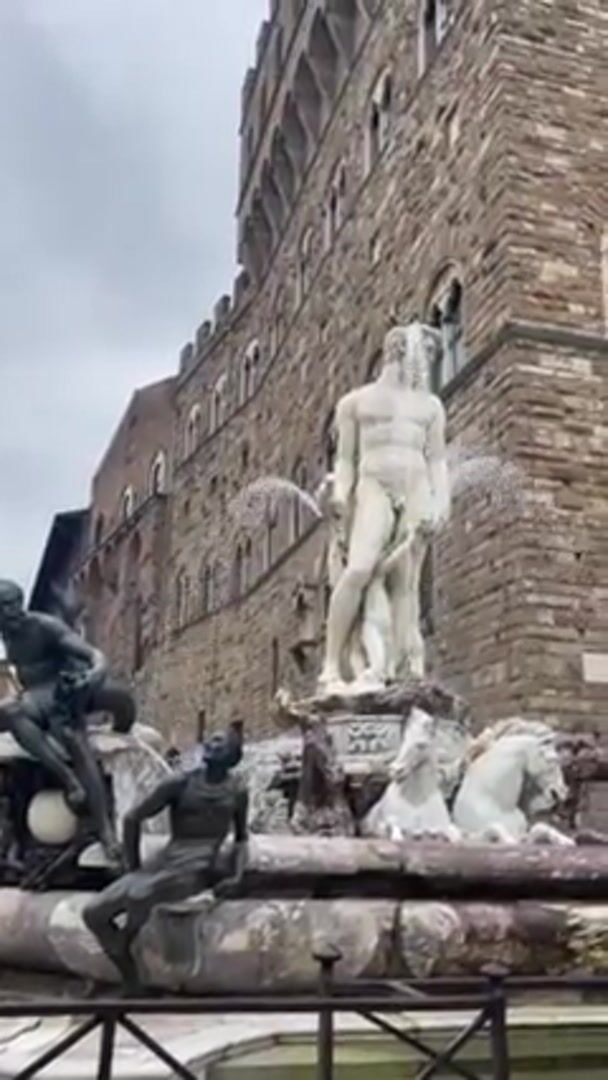
The video shows a stone fountain with sculptures in front of a tall stone building. The primary statue on the fountain is a nude male figure. Water is spraying from the statue and other parts of the fountain. There are other bronze figures including humans and horses, arranged around the base of the fountain. A low black fence surrounds the fountain. The building behind the fountain is made of light-brown stone with rectangular windows and decorative trim. The sky above is overcast.
Firenze, Italy · Feb 27, 2026, 12:23 PM
The image displays an interior view of a room within the Palazzo Vecchio in Florence, Italy. Central to the scene is a white marble sculpture depicting a nude, muscular male figure, identified as Hercules, standing and grappling with a struggling centaur, likely Nessus. Hercules, positioned behind the centaur, grips its head with both hands, pulling it backward. The centaur, half-human and half-horse, exhibits a pained expression and appears to be in mid-struggle, its equine legs partially obscured by its human torso. The sculpture rests on a plain white marble base, which is set upon a reddish-brown marble plinth.
The room features an ornate, vaulted ceiling adorned with intricate Renaissance grotesque patterns, framed mythological scenes, and decorative elements in muted colors against a light background. Dark-framed paintings, including portraits and dark-toned scenes, are visible on the surrounding walls. To the left, a smaller marble statue of a draped female figure seated on a pedestal is visible. Large, multi-paned wooden windows span the background, offering a view of an exterior building constructed from light-colored, rough-hewn stone blocks, typical of Florentine architecture. A portion of a person's shoulder and arm is visible on the far right edge of the frame.
The image displays the Fountain of Neptune, situated in the Piazza della Signoria, directly in front of the Palazzo Vecchio, in Florence, Italy.
The central subject is a colossal white marble statue of Neptune, depicted as a muscular, nude male figure with a beard, standing prominently. Water forcefully sprays from his head, obscuring his face, and from a point on his left side, forming streams that arc away. His right hand holds a part of what appears to be a trident, while his left arm is draped over a smaller, partially visible figure, likely a sea creature, at his left leg. The statue is positioned on an elaborate, multi-tiered marble base, featuring darker, reddish-brown stone accents. At the base level, several additional sculptures are visible, including dark bronze figures and white marble horses, all surrounded by spraying water.
In the background, the rough-hewn stone facade of the Palazzo Vecchio rises. The building exhibits rusticated masonry, characterized by irregular blocks of light brown and grey stone. Multiple arched windows with ornate stone frames and dark panes are visible across several levels. The architecture suggests a medieval or early Renaissance style. The sky above is overcast, providing diffuse lighting to the scene.
The image displays a detailed view of a richly decorated hall or corridor within the Uffizi Gallery in Florence, Italy. The perspective is from a slightly low, upward angle, emphasizing the elaborate ceiling.
The ceiling features extensive grotesque ornamentation on an off-white background. This decoration includes several large central panels; one prominent oval panel depicts a winged figure in classical drapery, while a rectangular section below it shows a classical male nude statue on a pedestal. These panels are surrounded by intricate designs of smaller mythological figures, animals, floral motifs, architectural elements, and abstract patterns, rendered in a muted palette of reds, blues, greens, browns, and ochres. The ceiling's structure incorporates prominent dark wooden longitudinal and transversal beams, with additional decorated friezes running along the upper wall sections.
The left wall consists of a series of tall, rectangular windows with multiple panes, framed in dark wood, providing significant natural illumination. The far wall functions as a gallery space, dominated by a large framed painting in the center depicting a figure in red robes. This central painting is flanked by numerous smaller framed artworks. Below these paintings, additional window panels are visible.
In the foreground, at floor level, a large marble sculpture of two intertwined male figures is partially visible on the left, with a smaller, lighter-colored sculpture to its right. The right wall, partially visible, also exhibits multiple framed paintings displayed in a gallery style. A dark human head is discernible in the lower-left corner of the frame, near the bottom of the window frames, indicating human presence.
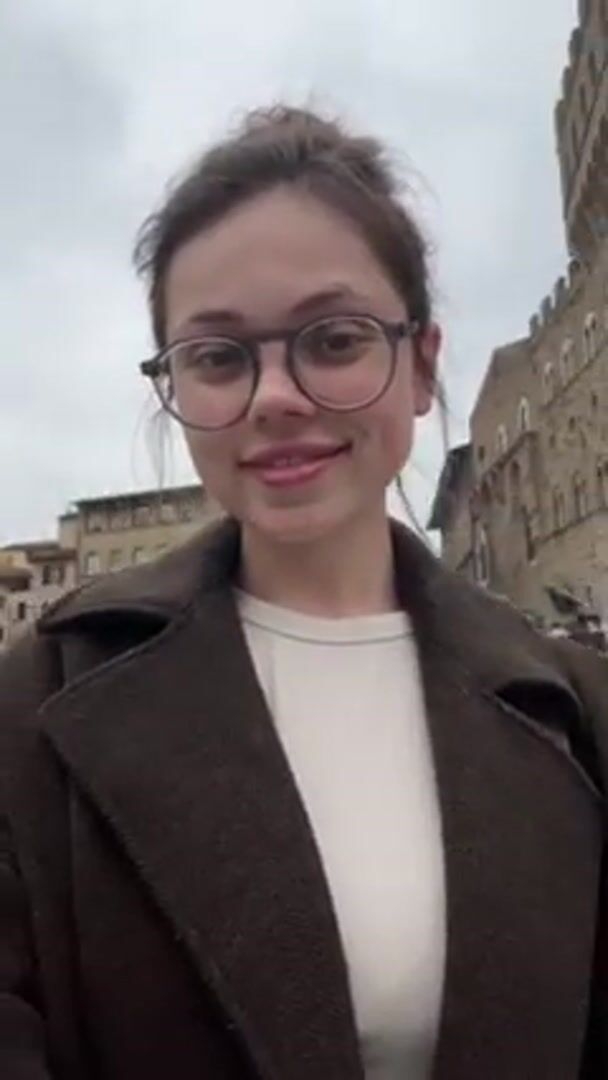
A young adult female is centered in a selfie-style photograph, taken outdoors in a bustling area of Florence, Italy, specifically in a square resembling Piazza della Signoria, under an overcast sky. Her brown hair is styled in a messy bun, and she wears round, translucent grey-framed glasses. She has a subtle smile with pink-tinted lips. Her attire consists of a dark brown, herringbone-patterned wool coat worn over a cream-colored, ribbed long-sleeved top. The background features historic Florentine architecture: to the left, a multi-story building with a light yellow/ochre facade, multiple arched windows, and closed dark shutters; to the right, a darker, multi-story stone building with a rusticated ground floor and classical window treatments on upper levels. Numerous individuals, including adults and a small child, are visible in the mid-ground and background, walking or standing; some are holding mobile phones.
The image displays a bronze statue of Saint Matthew by Lorenzo Ghiberti, located within an elaborate Gothic niche on the exterior of the Orsanmichele Church in Florence, Italy. The statue depicts a robust, bearded male figure with flowing drapery, holding an open book with both hands. He stands upon a dark pedestal. The niche is composed of white marble, featuring twisted, fluted columns on either side and an arched top. The recessed background behind the statue is decorated with a pattern of blue and gold stars. Below the statue, the marble base is intricately carved with a central relief featuring a winged quadruped resembling a griffin or lion, surrounded by scrolling foliage. To the lower left of the base, a circular relief with a star-like motif is present. The niche is set into a wall constructed from aged, light brown stone blocks. To the upper left, an archway and a portion of a decorative window or panel, possibly a rose window, are visible on the building's facade.
The image displays a young adult female in the foreground, positioned within the Piazza della Signoria in Florence, Italy. Directly behind her is the Fountain of Neptune, a monumental structure featuring a large white marble statue of Neptune standing centrally, flanked by four white marble horses, and surrounded by various bronze figures of tritons and sea nymphs, with water actively spraying from multiple points. The imposing stone facade of the Palazzo Vecchio, a historical building characterized by its medieval architecture and crenellated battlements, rises in the background.
The female subject, who has fair skin and dark hair styled in a bun, wears round-rimmed eyeglasses. She is dressed in a dark brown, herringbone-patterned overcoat over a light-toned, ribbed top. A light-colored strap from a bag is visible over her right shoulder. She is looking towards the viewer's left with a neutral expression. Metal barricades, composed of horizontal and vertical bars, are situated between the female and the fountain. The sky above is overcast. In the far background, indistinct figures are visible within the public square.
The image displays a wide view of the Piazza della Signoria in Florence, Italy, under an overcast sky. The prominent subject is the Palazzo Vecchio, a large, fortified stone palace with a tall, crenellated tower, the Arnolfo Tower, rising from its right side. The tower features a visible clock face. The Palazzo's facade is characterized by rusticated stonework, multiple levels of arched windows, and a crenellated roofline. Flags are displayed from a balcony situated centrally on the building's facade.
The piazza is populated by a dispersed crowd of pedestrians. Individuals are observed walking in various directions, standing, and observing the surrounding architecture and monuments. In the immediate foreground, with their backs to the viewer, two figures are prominent: one in a teal jacket and another in a dark jacket, both appearing to be observing or photographing the scene. A person is visible walking a dog on a leash in the midground.
To the left of the Palazzo Vecchio's main entrance, the large white marble Fountain of Neptune is visible, featuring a central statue of Neptune and surrounding figures. A replica of Michelangelo's David stands on a pedestal near the Palazzo's entrance, to the right of the fountain. Partially visible on the far right of the frame is the arched structure of the Loggia dei Lanzi. The ground surface of the piazza is paved with light-colored stone. The sky is uniformly gray, indicating an overcast condition.
This image depicts a scene in Piazza della Signoria, Florence, Italy, under an overcast sky. The dominant structure on the left is the Palazzo Vecchio, a medieval fortress-palace constructed of rusticated stone blocks. Its upper section features a crenellated roofline adorned with numerous heraldic shields. A tall clock tower, the Torre d'Arnolfo, rises from the structure, displaying a circular clock face on its visible side. Below the tower, multiple arched and rectangular windows are visible. A small balcony on the facade holds an Italian flag and a European Union flag. At the ground level, a prominent replica of Michelangelo's David statue stands near the main entrance, flanked by other sculptures, including a bronze statue. Multiple individuals are present at the base of the building, appearing to be tourists or onlookers. To the right, a portion of the Loggia dei Lanzi, an open-air arcade, is visible, characterized by large arches and additional statuary at its base, with more people gathered there. Beyond the Loggia, other historic buildings with distinct architectural styles are partially observable.
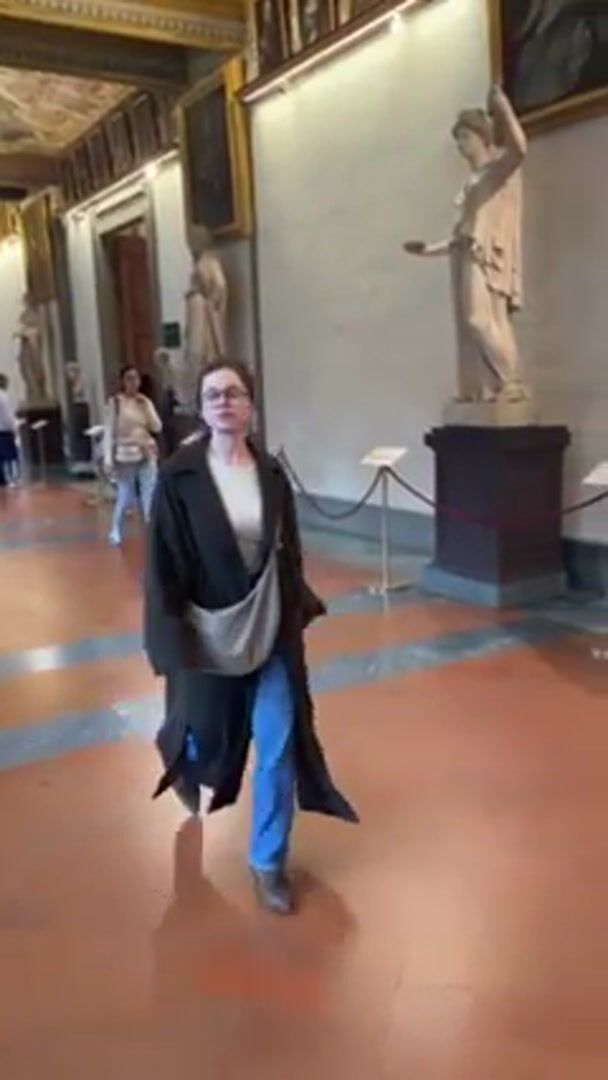
A woman wearing glasses and a brown coat is standing in a public square, likely in Europe, holding a camera at arm's length and filming herself. Behind her is a stone building with many windows and some sculptures. People can be seen walking around the square, and the sky is overcast.
A large, full-length marble statue of a nude male figure, identified as David, stands on a simple plinth in the Piazza della Signoria, Florence, Italy, directly in front of the Palazzo Vecchio. The statue depicts a young man in contrapposto, with his left index finger touching his chin in a contemplative pose. His left arm rests against his torso, while his right arm extends slightly outwards, holding a sling strap partially visible over his shoulder. The figure exhibits detailed musculature and curly hair.
The background consists of the rusticated stone facade of the Palazzo Vecchio, characterized by large, rough-hewn rectangular blocks in varying shades of brown and grey. Above the statue's head and to the left, an arched window with elaborate Gothic tracery and a central column is set into the stone wall. Directly behind the statue, a dark, rectangular metal plaque is affixed to the wall. To the right of the statue, a segment of an ornate white stone architectural element featuring carvings is partially visible. The scene is illuminated by diffuse, overcast daylight.
The image depicts the marble sculpture "Hercules and Cacus" by Baccio Bandinelli, located in Piazza della Signoria, Florence, Italy, adjacent to the Palazzo Vecchio.
The central subject is a large white marble sculpture of two nude, muscular male figures. The taller figure, Hercules, stands upright, bearded, holding a dark club in his right hand. His left hand is positioned on the head of the smaller figure, Cacus, who kneels below him with a contorted, pained expression. Cacus is also muscular and bearded, with his left hand resting on the sculpture's base. The entire sculpture rests on a multi-tiered white marble pedestal adorned with carved animal heads on its lower section.
To the left of the sculpture is a section of the Palazzo Vecchio, characterized by its robust construction of rough-hewn, brown-grey stone blocks. Visible details include a gridded arched window at mid-height and, above it, an ornate Gothic-style double window with pointed arches and intricate tracery, reflecting a bright linear light source. Below the double window and to the left, a rectangular decorative panel displays a golden animal figure on a blue background adorned with gold fleurs-de-lis.
To the right of the sculpture, a building with pale grey stucco walls and dark architectural details is present. It features multiple rectangular windows with dark frames, some appearing to have closed shutters. The roofline includes a pronounced eave with visible dark rafter ends. Further back and to the right, an arched entrance or loggia with dark columns is partially visible. The sky above is uniformly overcast.
The image depicts an outdoor sculptural display within the Loggia dei Lanzi, located in the Piazza della Signoria, Florence, Italy.
The foreground is dominated by a large bronze statue of Perseus holding the head of Medusa, positioned on the right. Perseus is a nude male figure, standing with a sword in his right hand and Medusa's severed head raised in his left. His right foot rests on Medusa's prone, headless body. The statue is mounted on an intricately carved white marble pedestal featuring smaller bronze figures in niches and ornate reliefs.
To the left of the bronze statue, a large white marble group sculpture titled "The Rape of the Sabine Women" is displayed. This dynamic composition features three figures: a male figure lifting one woman, while another woman crouches below.
Further to the right and slightly behind the marble group, another standing draped marble figure is visible.
In the lower left quadrant of the image, a single individual with long, wavy blonde hair, wearing a dark jacket, is seen from behind. The person is holding a smartphone horizontally, appearing to photograph the white marble "Rape of the Sabine Women" sculpture.
The background consists of light-colored, plain walls, characteristic of the loggia's interior, topped by a series of arched, vaulted ceilings with visible support ribs. The architectural details suggest a historical open-air gallery setting. The lighting is diffused, indicating an overcast day or shaded environment.
This image depicts a narrow street in Florence, Italy, prominently featuring a section of the Vasari Corridor connecting two historic buildings, likely within or adjacent to the Uffizi Gallery complex.
On the left, a tall, multi-story building constructed from rough-hewn, light brown stone blocks (rusticated masonry) dominates the frame. It features multiple arched windows, some with protective grilles, and a series of deep, arched corbels supporting an upper section.
On the right, a building with smoother, lighter-colored facades, detailed with grey stone trim, cornices, and window frames, stands against the sky. Its upper visible section includes a dark, overhanging wooden eave supported by exposed beams.
Spanning the street between these two structures is the Vasari Corridor. It consists of a large, pale-colored stone archway at street level, surmounted by an enclosed, rectangular pedestrian walkway featuring a series of horizontally arranged rectangular windows with dark frames. The corridor's roof is flat.
The street extends into the distance, revealing additional historic buildings with varied architectural details, some displaying what appear to be Italian flags. The sky above is uniformly overcast and grey. No people, vehicles, or active interactions are visible in the scene.
This image depicts the ornate, high-ceilinged entrance hall of the Museo di Storia Naturale di Firenze - La Specola, located in Florence, Italy.
The scene is an upward-angled view of a classical-style interior space, characterized by a vaulted or shallow-domed ceiling painted a pale off-white, featuring a central, light-colored floral medallion. Three arched, grid-paned windows are visible, admitting bright natural light: one at the apex of the ceiling and two symmetrically positioned on the curved side walls.
The walls are segmented by white pilasters and decorative cornices, with the recessed wall panels painted a light teal or mint green. Below the central upper window, a framed white marble bust of a male figure is mounted within an oval decorative wreath. Beneath this bust, a rectangular white marble plaque bears a Latin inscription, which includes "PETRI LEOPOLDO PRINCIPI ARCHI. AVSTRIAE M. D. ETRVRIAN REGNANTI," "MVSEVM MEDICAEVM," and "ANNO M D CC LXXD," indicating the museum's establishment by Pietro Leopoldo, Grand Duke of Tuscany, in 1770. Below the inscription, a large, dark wooden double door stands open, revealing a glimpse of another dimly lit interior space beyond.
On the left side of the hall, within a recessed arched niche, stands a tall, white marble nude male statue, likely classical or neoclassical, with its left arm raised. On the right side, within a similar arched niche, is a tall, white marble draped male statue, also in a classical or neoclassical style, with its right arm extended slightly forward. No people are present in the scene.
Florence, Italy · Feb 27, 2026, 1:07 PM
A beige marble statue of a seated classical female figure is prominently displayed indoors, positioned slightly to the right of a large wooden multi-pane window. The figure, draped in flowing robes and wearing sandals, gazes slightly upwards and to the right, with her left arm resting on the armrest of her integrated stone seat. The statue stands on a rough-hewn rectangular stone plinth, which rests on a polished dark reddish-brown tiered pedestal.
Through the window, a multi-story building constructed of rusticated light-colored stone blocks is visible. This exterior structure features several distinct arched windows with radiating voussoirs and lower cross-mullioned sections, characteristic of Renaissance architecture. These architectural elements identify the building as the interior courtyard of the Palazzo Pitti in Florence, Italy. The interior setting suggests the statue is located within one of the museums or galleries of the Palazzo Pitti.
The interior wall to the right of the statue is plain and light-colored. A gold-framed artwork or mirror is partially visible in the upper right background. A red velvet rope barrier is partially visible near the bottom left corner, indicating a managed display environment.
A full-length Roman statue, identified as a veiled female figure, stands in an interior gallery within the Palazzo Pitti in Florence, Italy. The sculpture comprises a head, neck, hands, and exposed feet carved from light-toned marble, distinctly contrasting with the body's deeply folded drapery, which is rendered in dark grey or black stone. The figure's head is tilted upward and to the viewer's left, displaying a neutral facial expression. Her right hand is positioned near her upper chest, fingers gently curled, while her left hand rests lower, grasping the folds of her garment. She stands barefoot on a light-colored, rectangular stone plinth. Directly above the statue, an ornate gold-framed painting is mounted on a light grey textured wall, depicting a partial view of a figure in a red tunic against a dark background. Dark wood-framed architectural elements, possibly windows, are visible on both sides of the statue, admitting ambient light.
The image presents a detailed view inside the Vasari Corridor in Florence, Italy, a long, historical passageway functioning as an art gallery. The most prominent feature is the intricately frescoed barrel-vaulted ceiling, adorned with mythological and allegorical scenes, grotesque patterns, putti, and smaller framed paintings, all set against a light background with ornate gold and dark wood trim.
The left wall of the corridor displays numerous framed paintings, mostly portraits and landscapes, hung closely together. Beneath these, various classical marble sculptures are placed on pedestals; a prominent, nude male sculpture holding an object is visible in the foreground. Further down, a marble bust is also present. The wall itself is light-colored and illuminated by overhead artificial lights.
The right side of the corridor features a series of tall, multi-paneled windows with dark wooden frames, offering glimpses of an exterior view. Another classical sculpture is partially visible against these windows. The floor is dark and reflective, suggesting a polished surface.
Approximately two dozen individuals, appearing as visitors, populate the corridor. Most are walking away from the camera, moving deeper into the passageway. They are dressed in modern casual attire. Their faces are generally indistinct due to distance and angle. No specific interactions beyond general movement and observation of the surroundings are discernible.
The image displays an upward view of an elaborately decorated ceiling within the Palazzo Vecchio in Florence, Italy. The primary visual is a vast frescoed ceiling, rendered in the grotesque style, featuring a dense arrangement of figures and motifs on a light background. Prominent elements include numerous winged putti, mythological figures, various human forms (some nude, some draped), fantastical beasts, birds, and animals, intertwined with intricate floral patterns and architectural ornamentations.
Specific details visible on the ceiling include an oval framed panel in the upper section depicting a winged, fair-skinned figure, possibly Cupid, drawing a bow. Below this, a rectangular panel features a standing, semi-nude male figure within an ornate niche, likely a deity. The fresco's color palette comprises muted tones of red, blue, green, yellow, and brown, contributing to its aged aesthetic.
Below the main frescoed ceiling, a series of heavy, dark brown wooden beams with intricate carvings and subtle painted details (including red, blue, and gold accents) traverse horizontally. These beams define a coffered structure, with recessed panels between them also containing painted decorations. Further below, a portion of a lower, similarly decorated ceiling is visible, continuing the grotesque motifs. On the far left and right edges of the frame, sections of walls are discernible, adorned with multiple framed portrait-style paintings arranged vertically, suggesting a richly appointed interior space. The overall scene depicts a complex, multi-layered decorative scheme from the High Renaissance or Mannerist period.
A full-length, light-toned marble statue of the mythological figure Mercury stands centrally on a round, stepped base. The nude male figure is depicted in a contrapposto stance, with his right leg bearing weight and his left leg relaxed and slightly bent. His left arm leans on an integral tree trunk support, which also features a small, ambiguous protuberance. He wears a winged petasus (hat) on his head. His right arm is bent at the elbow, holding a small flute or pipe extended forward, while his left hand is lightly clenched near his left hip. His head is turned slightly to the viewer's left, with a downward gaze. The statue exhibits surface wear and minor discoloration consistent with age.
The background consists of a light-colored, textured wall. Above the statue, a section of a large, gold-framed painting with dark and red tones is visible. Dark wooden architectural elements, possibly doorframes or paneling, are present on both the left and right sides of the image. Strong, natural light illuminates the scene primarily from the right. The setting is an interior space, specifically the Bargello Museum (Museo Nazionale del Bargello) in Florence, Italy.
The image displays a full-length white marble statue, identified as the "Allegory of Intellect" by Orazio Mochi, created circa 1620. This artwork is situated in the Palatine Gallery (Galleria Palatina) within the Pitti Palace in Florence, Italy.
The statue depicts a draped female figure standing, facing slightly left. Her left hand rests upon a sculpted torch, which features a fluted columnar base. Her right hand holds a small, spherical object. The figure is clad in flowing classical-style drapery, with her bare right foot partially visible. The marble shows subtle surface variations consistent with age.
Behind the statue is a light-colored, textured plaster wall. Above and to the right of the statue, the lower section of a large, framed oil painting is visible. The painting's ornate gold frame encloses a depiction of a torso in elaborate robes, featuring white ermine trim over a red garment.
The scene is illuminated by directional lighting from the upper left, casting distinct shadows on the statue's drapery and the background wall. The environment is an indoor setting, consistent with a museum or gallery.
The image depicts a marble statue positioned directly beneath a framed oil painting within a museum or gallery setting in Florence, Italy.
The central subject is a life-sized, light-colored marble statue of a youthful, nude male figure identified as Michelangelo's Bacchus. The figure stands with a slight contrapposto pose, his left arm raised high, holding a bunch of grapes. His right arm is bent, cradling a gnarled tree trunk or staff that is adorned with grapevines and clusters of grapes. A small satyr-like figure is carved into the base of the staff, bending down as if to partake in the grapes. A piece of drapery is draped over the statue's left shoulder and back. The statue rests on a simple, rectangular plinth. This statue, Michelangelo's Bacchus, is famously housed in the Museo Nazionale del Bargello in Florence, Italy.
Above the statue, a rectangular oil painting with a thick, ornate gold frame is mounted on the wall. The painting portrays two figures: an adult woman and a young child. The woman is seated, wearing an elaborate, dark-patterned gown with gold accents, a white inner garment, and a necklace and earrings. Her left arm is around the child, who stands closely beside her, dressed in a plain, darker tunic. The background of the portrait is a plain, dark green drapery or wall.
Both artworks are displayed against a light, textured, off-white wall. The upper left corner of the image shows a glimpse of a decorative frieze or border near the ceiling, and a light fixture illuminates the scene from above and to the left.
A full-length, white marble statue of a classical female figure, identified as Ceres or Demeter, stands centrally in an interior space. The statue faces slightly to the viewer's right, with her head tilted upward. She wears a flowing, high-waisted chiton with voluminous drapery. Her left arm is raised and bent at the elbow, grasping a small, cylindrical object, possibly a torch. Her right arm is bent and holds a cluster of grapes or flowers. Her feet, clad in sandals, are visible beneath the flowing gown. The statue rests on a rectangular plinth.
Behind and above the statue, a framed oil painting is mounted on a light, textured grey wall. The painting features a gilded frame and depicts the upper torso of a male figure dressed in a dark robe with a white fur collar, consistent with a historical portrait. The scene is illuminated from the left, casting subtle shadows. This display is located within the **Uffizi Gallery in Florence, Italy**.
The image presents a full-length, off-white marble statue of a nude male figure, exhibiting aged surfaces and minor discoloration. The figure, depicted with short, curly hair, stands on a dark rectangular base, with its left leg supported by a tree stump. Its right arm is extended upwards and bent at the elbow, with the open hand positioned above its head, palm facing upwards, as if shielding its eyes. The left arm is bent, with the left hand resting on the left thigh. The figure's head is tilted upwards and turned towards the right. In the background, a large, dark rectangular painting with a prominent gold frame is mounted on a light-colored wall. To the left, a dark vertical structural element is partially visible, while to the right, a darker wooden window or door frame runs vertically. The setting is an indoor space with ambient lighting. This statue, known as *Apollo* by Michelangelo, is located within the Bargello National Museum in Florence, Italy.
The image displays the marble sculpture known as the Venus de' Medici, situated within the Tribuna of the Uffizi Gallery in Florence, Italy.
The central subject is a standing female nude, sculpted from white marble, presented in a contrapposto pose. Her right arm is bent, with her hand covering her breasts, and her left hand is positioned over her groin. Her hair is styled with braids pulled up into a topknot. Standing to her right, a smaller, nude, winged male figure, commonly identified as Cupid, leans against her right leg. This figure has curly hair, its right arm is raised, and its left arm holds a torch-like object against its side. Both figures are positioned on a rectangular marble plinth, which rests on a dark, flat base.
Above the sculpture, centered on a light beige wall, hangs a large, rectangular oil painting enclosed in a prominent gold frame. The painting depicts a male figure with dark hair, visible from the chest up, wearing a dark garment with a red accent and holding a light-colored staff in his left hand against a dark background.
Tall, dark-framed wooden windows flank the sculpture and painting. The windows reflect interior light and partially reveal exterior views, including a section of a terracotta tiled roof and light-colored building facades typical of Florentine architecture. A small, rectangular green sign with white text is affixed to the frame of the left window. A dark vertical pilaster is visible on the right side of the image, contributing to the architectural context of the interior space.
Florence, Italy · Feb 27, 2026, 1:15 PM
A full-length white marble statue of the armless Venus de' Medici is centrally positioned within the Uffizi Gallery in Florence, Italy. The nude female figure faces slightly left, her hair styled in a prominent bun. Her arms are absent from the shoulders, and a carved drapery acts as a support along her left leg, resting on a simple rectangular base. Directly above and behind the statue, a dark-toned painting in an ornate gold frame is visible against a light-colored wall. To the right, a tall, dark wooden window frame is partially seen, suggesting an interior space with natural light. A sliver of a red vertical object is visible on the far left edge of the frame.
A white marble statue, identified as Michelangelo's *David-Apollo*, stands prominently within the Museo Nazionale del Bargello in Florence, Italy. The male figure is nude, exhibiting classical contrapposto, with his left leg advanced and his right foot resting on a rough stone block. His head is turned slightly to the right, looking upward. The left arm is bent at the elbow, holding a slingshot against his midsection. The right arm is raised above his head, holding a small, indistinct object, possibly a stone or part of a weapon. A fluted, tiered column or tree stump support is positioned to the left of the figure's left leg. The statue is placed against an aged, textured light-colored wall. Directly behind and above the statue, a large framed oil painting with a gold frame is partially visible, depicting a figure in a blue garment. Additional framed artworks and museum lighting are visible further right along the wall.
A marble sculpture, identified as Michelangelo's Bacchus, is depicted indoors at the Museo Nazionale del Bargello in Florence, Italy. The sculpture features two nude male figures. The taller figure, Bacchus, stands upright, gazing downwards and slightly to his right. He holds a shallow bowl in his raised left hand, while a piece of fabric or animal skin drapes over his left shoulder and down his back, bunching near his right leg alongside a cluster of grapes. His penis is visible. A smaller, nude figure, a satyr, crouches to the right of Bacchus's legs, looking upwards towards Bacchus. The satyr's right hand grasps grapes from the cluster at Bacchus's leg, and his left arm is wrapped around Bacchus's right leg. The satyr's penis is also visible. Both figures stand on a sculpted marble base, which rests on a dark plinth. The background consists of a light-colored wall framed by dark architectural elements on the left and right, with a golden frame visible at the top edge.
This image displays a light-colored marble sculpture group, identified as "Bacchus and Ampelus," located within the Uffizi Gallery in Florence, Italy. The sculpture features two male figures in an embracing pose.
The figure on the right, Bacchus, stands taller, his head crowned with grapevines and leaves, and long, flowing hair. His left arm extends around the shoulder of the figure on the left. His right hand holds a cluster of grapes and is positioned to drape fabric over his groin, though his genitals are partially visible. An ornate band adorns his left ankle. He gazes downwards towards his companion.
The figure on the left, Ampelus or a young satyr, is shorter and primarily nude, with curly hair. He looks upwards towards Bacchus. His right hand holds a small wine jug (oenochoe). An animal skin, resembling a panther's, is draped over his left shoulder, with its head visible on his chest. His left arm wraps around Bacchus's waist. He leans against a tree stump serving as a support.
Both figures are depicted with well-defined musculature. The sculpture is positioned indoors against a plain, light-colored wall. Above and behind the figures, a portion of a gold-framed painting is visible, containing text that includes the word "MEDICI," confirming its museum context. The lighting suggests an indoor, controlled environment.
The image displays a large plaster cast, resembling marble, of the sculpture group 'Mars and Venus' by Antonio Canova, situated in the Galleria dell'Accademia in Florence, Italy. Two standing figures are depicted: a female and a male. The female figure, draped from the waist down in classical style, stands slightly behind the male, her bare right arm extended across his chest to grasp his right wrist. Her left hand rests on his left shoulder. The male figure stands nude, with visible genitalia, a short sword sheathed on his left side, and a sash draped across his right shoulder to his left hip. His head is turned slightly to the right with an upward gaze. Both figures stand on a rectangular stone plinth. In the background, mounted on a light-toned wall, a framed oil portrait depicting a woman and a child is visible above the statues. The scene is illuminated by overhead light from the left.
This image depicts a wide shot of the Arno River and its south bank in Florence, Italy, under an overcast sky. The foreground features the greenish-brown waters of the Arno River, exhibiting ripples on its surface. Immediately above the river, a dark, low stone or concrete retaining wall is visible, topped by a strip of green grass. A brick archway, part of a bridge or riverside structure, is positioned centrally in the lower mid-ground.
Above the river and its immediate bank, a paved road stretches horizontally across the image, serving as a parking area for numerous vehicles, including cars and scooters, with some white vans and cars visible. A few indistinct human figures are present on the sidewalks.
A row of multi-story buildings lines the riverbank. On the left, several cream-colored or light-grey buildings with regularly spaced rectangular windows, many fitted with closed or partially open shutters, dominate. Their ground floors feature commercial establishments. To the right, a prominent, large yellow building with multiple ornate windows, decorative balconies, and a classical facade stands out.
Behind these riverside structures, the terrain rises into a densely packed hillside covered with numerous buildings of varying sizes and colors, interspersed with evergreen trees, including tall cypresses. Two large construction cranes are visible on the distant part of the hillside, indicating ongoing work. The sky is uniformly grey with heavy cloud cover.
This image displays a multi-panel, gold-ground polyptych, an artwork by Andrea Orcagna, housed in the Uffizi Gallery in Florence, Italy. The artwork features elaborate gilded Gothic architectural framing with pointed arches, decorative spires, and spiraling gold columns separating the individual panels. It is displayed against a plain, light-colored wall.
The central panel depicts the Virgin Mary, crowned and seated on a throne, cradling the naked Christ Child. Two smaller, winged angels with pink complexions are visible below the Virgin's throne, appearing to support it.
To the left of the central panel, in two distinct sections:
The leftmost panel portrays an elderly male saint, identified as St. Romuald. He stands in a dark, open cloak worn over a white monastic habit and holds a closed brown book in his left hand. He has a tonsured head and a dark beard.
The adjacent panel features another elderly, bearded male saint, identified as St. John the Baptist. He is depicted wearing a flowing yellow-gold outer garment over a dark undergarment, holding a closed book in his left hand and a tall, slender staff in his right.
To the right of the central panel, also in two distinct sections:
The panel directly beside the central one presents an elderly, bearded male saint, identified as St. Peter. He is dressed in a pinkish-red outer garment over a blue undergarment, holding an open scroll with partially legible Latin text in his left hand and a long staff in his right.
The rightmost panel portrays a tonsured male saint, identified as St. Bartholomew. He is clad in a black monastic habit over a white undergarment and holds an open book with partially legible Latin text in his left hand. Rays of light appear to emanate from behind his figure.
The image displays a framed oil painting titled "Still Life with an Open Book" by Ludger tom Ring the Younger, housed in the Uffizi Gallery in Florence, Italy. The painting depicts a large, open manuscript or choir book positioned centrally on a dark, unadorned background. The book's pages are fanned outwards, creating a three-dimensional, trompe-l'œil effect.
The left page features a prominent illuminated capital 'D' in red and gold, followed by columns of black text interspersed with red annotations. Below this, musical notation, specifically square notes on a four-line staff, is visible. A dark brown leather strap with a metallic buckle extends from the book's spine, curving across the left page, and a dark quill pen with a metal nib rests diagonally across the page, tucked under the strap.
The right page presents a large illuminated capital 'H' enclosed within a yellow rectangular block at the top. This page also contains columns of black and red text and musical notation. The lower right section of this page features an intricate illumination depicting figures, including one cloaked in red, accompanied by a skull, set within a landscape bordered by ornate floral and foliage motifs. The book's binding is dark brown.
The painting is enclosed within a thick, dark, multi-tiered frame with textured details. The entire framed artwork is mounted on a light gray, textured wall, characteristic of a museum or gallery setting. A thin wire, likely for hanging, is faintly visible against the wall at the top of the frame.
Two large, vertically oriented oil paintings, individually set within ornate gilded frames, are displayed side-by-side on a plain, light-colored wall within the Galleria dell'Accademia in Florence, Italy.
The left painting portrays a full-body nude male figure, identified as Adam, standing with a wreath of green leaves on his head. He holds a red apple in his left hand, while a large green leaf partially covers his groin. A deer's head and antlers are visible behind his lower right leg, emerging from a dark, forested background.
The right painting depicts a full-body nude female figure, identified as Eve, with long, wavy hair. She holds a red apple in her right hand, and a large green leaf conceals her groin. A serpent is coiled around a branch above her, extending towards the apple. A small feline, resembling a lion cub, is visible resting at her feet, and a bird is perched near her left leg, all set against a dark, wooded backdrop.
Both figures gaze generally forward. A small, dark information plaque is positioned on the wall beneath the right painting.
An intricately frescoed vaulted ceiling spans above a multi-panel altarpiece (triptych) encased in a large glass display. The ceiling features a central rectangular painting depicting a dark, expansive cityscape under a cloudy sky, surrounded by elaborate gold, green, and blue decorative motifs, including putti, floral garlands, and smaller medallions with classical figures. The triptych, presented in an open configuration, consists of three gold-framed panels. The central panel portrays a somber scene with multiple figures, predominantly in red and dark robes, gathered around a supine body, likely Christ, with a gilded, ornate architectural background. The left panel shows figures, including a kneeling woman in a green gown, against a landscape background with distant hills. The right panel depicts another group of figures, one prominently holding a white cloth or shroud, under a similar gilded architectural backdrop. The altarpiece rests on a black display base within the clear glass enclosure, which exhibits reflections of the surrounding room. This scene is located within a gallery space in Florence, Italy, specifically the Galleria dell'Accademia.
Florence, Italy · Feb 27, 2026, 1:23 PM
A formal room in the Palazzo Pitti, Florence, Italy, features a large, dark-framed multi-paneled window overlooking the city's historic center under an overcast sky. The ceiling is elaborately frescoed and coffered with dark wooden beams, displaying a central circular mythological painting surrounded by panels of grotesque designs, intricate scrollwork, garlands, and smaller landscape vignettes in muted colors. The light-colored walls are adorned with four recessed niches: two on the left contain a dark bust in the upper niche and a dark standing figure in the lower, while two on the right hold a light-colored bust in the upper niche and a light-colored standing female figure with an outstretched arm in the lower. The panoramic view from the window encompasses numerous terracotta-tiled rooftops, historical buildings, including the distinctive tower of the Palazzo Vecchio, and distant hills. In the foreground, a red velvet rope barrier supported by golden stanchions delineates an area on the reddish-brown terrazzo floor. A dark wooden structure, possibly a radiator cover, is present below the window. No people are visible.
The image displays an elevated view across the rooftops of Florence, Italy, under an overcast sky. In the foreground, the upper portion of a cream-colored building with a dark, sloped roof and an exposed wooden soffit is visible on the left. The midground consists of a dense urban fabric composed primarily of multi-story buildings with traditional red-orange terracotta tile roofs. Several buildings feature light-colored stucco facades, some with visible windows displaying open wooden shutters. A prominent architectural detail in the mid-right foreground is a large, circular window with radial spokes on a building's cream-colored wall, adjacent to multiple roof levels. In the distant background, several key Florentine landmarks are identifiable. The tall, slender bell tower (campanile) of Badia Fiorentina rises centrally above the cityscape. To its left, the distinct white and dark marble facade of the Basilica di Santa Croce is clearly visible. The horizon is marked by faint, undulating hills. No individuals or specific activities are depicted within the scene.
This image depicts a detailed interior view within the Sala delle Carte Geografiche (Hall of Geographical Maps) located in the Palazzo Vecchio, Florence, Italy. The scene shows a corner where two walls meet beneath an ornate ceiling.
The ceiling features a central, rectangular fresco or painting enclosed within an elaborate gilded frame, surrounded by painted decorative borders displaying garlands of fruit and foliage. The painting depicts an allegorical female figure, draped in orange-yellow and green fabric, appearing to float on clouds.
The right wall is dominated by a large, historical-style painted map of Tuscany, rendered in blue for the sea and light greens and browns for the land. Visible text includes "PARTE DEL DOMINIO VECCHIO" and "MARAMMA TERRA DI PISA," indicating geographical regions. Numerous small, detailed sailing ships are depicted on the blue painted waters.
The left wall is a plain, light grey surface with subtle, vertically paneled architectural details. A contemporary black metal light fixture, approximately vertical, with three exposed circular bulbs, stands in the lower left foreground. The juncture between the ceiling and walls is adorned with a decorative cornice featuring intricate gilded molding and painted friezes.
The image depicts an interior view of a grand room located in the Palazzo Pitti, specifically within the Galleria Palatina, in Florence, Italy. The scene is dominated by a richly decorated, coffered ceiling and a series of tall windows.
The ceiling features a grid of rectangular and square panels, each containing a frescoed or painted canvas depicting mythological or allegorical scenes. These paintings showcase multiple human figures, some nude or semi-nude, and animals, including horses, rendered in a palette of muted golds, browns, reds, and blues. The individual panels are framed by ornate, gilded, and dark reddish-brown decorative woodwork or plasterwork, which incorporates intricate scrollwork and detailed patterns.
Below the ceiling, the upper portion of a wall is visible, featuring a series of tall, narrow windows with dark frames. Through these windows, a uniformly overcast, light gray sky is visible, indicating a cloudy daytime environment. Artificial lighting fixtures are present; a prominent white, circular spotlight is mounted on the upper right wall, angled towards the ceiling, and a smaller, dark rectangular fixture is on the upper left wall. No individuals or specific actions are visible within the frame.
An individual, female, is depicted in a close-up, selfie-style photograph, positioned in the foreground. She has light skin, dark hair pulled back, and wears round, light-framed prescription glasses. Her lips are slightly parted, revealing a glossy finish, and her expression indicates a subtle smile. She is dressed in a dark brown, textured coat, possibly wool with a herringbone pattern, over a light-colored, ribbed top. The background consists of a large, antique-style wall map or fresco, rendered in earth tones of gold and light brown for landmasses and pale blue-green for water. Visible text fragments on the map include "DI PISA" and "MAR", along with part of "ANCUM", and a small stylized sailboat icon. This map is identifiable as one of the 53 geographical frescoes in the Sala delle Carte Geografiche (Room of Geographical Maps) located within the Palazzo Vecchio, Florence, Italy. No other subjects or interactions are visible.
The image displays an elevated view of the Florence cityscape under an overcast, light grey sky, framed by a dark window. In the mid-ground, numerous traditional Florentine buildings with terracotta-tiled roofs and predominantly light-colored facades are visible. The prominent bell tower of the Badia Fiorentina, a slender structure with a pointed spire, rises above the rooftops slightly right of center. To its left, a section of the Palazzo del Bargello is identifiable, and further left, a portion of the Florence Cathedral (Duomo) with its dome and white stone apse is visible. Several metallic television antennae are mounted on various rooftops. The background features distant, dark blue-grey hills. No individuals or specific actions are discernible within the scene.
The image displays a long, well-lit interior corridor within the Uffizi Gallery in Florence, Italy. The floor features a checkerboard pattern of dark gray and white marble tiles. An elaborate, vaulted ceiling is present, extensively decorated with frescoed artwork depicting mythological scenes and grotesque motifs, supported by visible wooden beams.
The left wall contains a series of tall, multi-pane windows with dark wooden frames, admitting natural light. Between these windows, framed artworks are visible. The right wall is light-colored and showcases numerous white marble busts and full-body sculptures positioned on dark pedestals, with framed paintings mounted higher on the wall. A continuous linear light fixture runs along the upper portion of this wall. Gold-colored stanchions connected by red ropes delineate the central pathway, separating visitors from the exhibits. Small informational placards are situated near several artworks.
Approximately 15-20 individuals are present in the corridor. In the immediate foreground left, one person with curly hair, dressed in a dark blue top and jeans, is seated on a bench or ledge, leaning against the wall with arms crossed. Other visitors are distributed throughout the corridor, predominantly walking away from the viewer towards the background. A person in a bright red jacket is visible in the mid-ground, moving away. Another individual in a dark, patterned jacket stands on the right, observing an exhibit. No specific interactions between individuals are discernible.
This image displays Cimabue's *Maestà* (also known as the *Santa Trinita Maestà*), a large panel painting from the late 13th century, located in the Uffizi Gallery in Florence, Italy.
The artwork depicts the Virgin Mary and Christ Child enthroned, flanked by angels, with four biblical figures below. The central figure, the Virgin Mary, is seated frontally on an elaborate, ornate architectural throne, wearing a dark blue mantle over a red garment. She holds the Christ Child, clad in a pink-mauve tunic, in her left arm. The Christ Child holds a scroll in his left hand and raises his right hand in a gesture of blessing. Both figures have golden halos.
Six winged angels, each with a golden halo, are arranged vertically in three pairs behind the throne, seemingly supporting it. They wear tunics in varying shades of blue, red, and brown. The throne itself is an intricate, multi-tiered structure with columns, arches, and geometric patterns, rendered in a brownish-gold tone. The Virgin's feet rest upon a footstool. The entire background of the upper section is a luminous gold, indicative of a divine setting.
Below the main scene, an architectural base frames four bearded male figures, likely prophets or patriarchs, within individual arched niches. From left to right, these figures hold scrolls, some with visible script, and wear robes of red, brown, and grey. One figure, second from the right, wears a red cape and a crown-like headpiece.
The painting is housed in a museum setting, observed against a plain, light-colored wall. The panel itself is tall and vertically oriented, tapering to a pointed, trefoil-arch top. It is displayed on a dark support structure.
This image displays the interior of the Tribuna, an octagonal room within the Uffizi Gallery in Florence, Italy. The room features walls covered in deep red fabric, densely hung with numerous framed oil paintings of various sizes in ornate gold frames. Centrally positioned on a dark, decorative pedestal is a prominent marble statue of a standing nude female figure, the Venus de' Medici. To the right, a marble sculpture depicting two wrestling figures, known as "The Wrestlers," is visible on another pedestal. A smaller multi-figure marble sculpture is present on a pedestal to the left. In the foreground, a dark, polygonal table occupies the lower portion of the frame. Above the red walls, an elaborate frieze with blue and gold scrollwork frames several evenly spaced, rectangular windows with gridded panes. The ceiling is an octagonal dome, intricately inlaid with thousands of reflective, tear-drop shaped elements, consistent with mother-of-pearl, creating a luminous, patterned surface. Ambient light enters through the windows and illuminates the dome. No individuals are depicted, and the scene is static.
This image depicts the interior of the Tribuna of the Uffizi Gallery in Florence, Italy. The scene is an octagonal room with walls covered in deep red fabric, displaying numerous framed oil paintings of various sizes, predominantly in ornate gold frames. These artworks include portraits, religious, and mythological scenes.
A vaulted, octagonal ceiling features a mother-of-pearl or shell inlay pattern and is bordered by a gilded and blue painted frieze with intricate scrollwork. Four rectangular windows with light-colored, gridded panes are visible in the upper sections of the walls.
In the central area, a large, nude marble male sculpture stands upright on a pedestal. Other marble sculptures are positioned on pedestals throughout the room, including one depicting a figure wrestling another creature, and smaller, seated figures. A dark-colored octagonal table or display plinth occupies the lower central foreground. The floor is dark and reflective. The environment is well-lit, and no live individuals are present in the frame.
Florence, Italy · Feb 27, 2026, 1:50 PM
The image presents an elevated, north-facing view down the Uffizi Gallery courtyard (Piazzale degli Uffizi) in Florence, Italy, beneath an overcast, light grey sky. The scene is framed by the symmetrical, multi-story facades of the Uffizi Gallery buildings on both the left and right. The building on the left exhibits a ground-level arcade with visible columns and arched openings, surmounted by two upper floors featuring rows of rectangular windows with decorative surrounds. The building on the right, closer to the camera and partially shadowed, displays a similar architectural style with numerous large, wooden-framed windows.
The paved courtyard below is populated by numerous pedestrians, dispersed throughout, walking in various directions. In the midground, towards the right side of the courtyard, a substantial area is occupied by a construction or renovation site, indicated by multi-level metal scaffolding, temporary protective barriers, and stacked construction materials. Several vehicles are present on the left side of the courtyard, including a white van or car in the foreground and a dark red car further down the path. A white umbrella structure, possibly a vendor stall, is visible on the left.
In the background, at the northern end of the courtyard, the medieval Palazzo Vecchio stands prominently with its crenellated Arnolfo Tower rising above. To the left and slightly behind the Palazzo Vecchio, the large, red-tiled dome of the Florence Cathedral (Duomo) is partially visible against the sky.
The image displays an elevated urban landscape in Firenze, Italy. The central elements are two prominent historical structures: the Arnolfo Tower of the Palazzo Vecchio, positioned on the right, and Brunelleschi's Dome of the Cattedrale di Santa Maria del Fiore (Duomo), visible in the mid-ground on the left.
The Arnolfo Tower is a tall, slender, light-brown stone edifice, characterized by a crenellated top, an open-arch bell housing, and multiple levels of smaller rectangular and arched windows. Its apex features a spired finial. The Duomo's large, ribbed, red-tiled dome, surmounted by a white lantern and finial, is partially visible above lower buildings; its white marble drum with circular windows is also discernible.
The scene is framed by multi-story, classically styled Florentine buildings. On the left, a long structure with a dark, overhanging roof and numerous regularly spaced rectangular windows forms a strong horizontal element. An arched passageway beneath this building opens to a street level where indistinct figures, possibly pedestrians and vehicles, and a light-colored statue are present. A similar building with a dark roofline borders the upper right. The sky is uniformly overcast, presenting a diffused light environment. No distinct individual actions or interactions are clearly identifiable.
A young adult female is depicted in a low-angle selfie, looking directly at the camera with a faint smile. She has light skin, dark hair, and wears round, light-rimmed eyeglasses. Her attire includes a light-colored, ribbed long-sleeved top beneath a dark brown, collared coat. The background is an elaborately decorated historical room, dominated by a richly frescoed and gilded Baroque ceiling. The ceiling features multiple panels depicting mythological or allegorical scenes in warm golden, yellow, and pastel tones, framed by intricate stucco and architectural moldings. Below the ceiling, wooden structures resembling display cases or window frames are visible along the walls, with small framed portraits placed above them. A white marble sculpture is partially discernible on the far right, seen through glass. The scene is located in the Palatine Gallery (Galleria Palatina) of the Pitti Palace (Palazzo Pitti) in Florence, Italy.
This image depicts a marble statue titled "Amore e Psiche" (Cupid and Psyche), prominently displayed within the Uffizi Gallery in Florence, Italy. The sculpture features two figures in a close embrace, appearing to kiss. The figure on the left is a nude male with wings, identifiable as Cupid, and has a garter-like band on his right thigh. The figure on the right is a draped female, representing Psyche. The sculpture rests on a dark, multi-tiered pedestal, with the title "AMORE E PSICHE" inscribed on the base in capital letters. A small dark placard on the pedestal displays "138 ⬆141".
The statue is positioned directly in front of a series of tall, multi-paned windows with dark wooden frames. Bright daylight streams through these windows, causing significant lens flare and backlighting the sculpture, creating a radiant glow around its contours. Large, fluted architectural columns, dark in color, frame the windows and the statue within the interior space. Through the windows, portions of the urban landscape of Florence are visible, including traditional Italian buildings with light-colored facades, multiple windows, and terracotta-tiled roofs.
A light-colored marble statue of a nude, winged, youthful male figure stands positioned against a dark, featureless wall. The figure, supported by a sculpted tree trunk base, gazes upward with its head tilted back. Both arms are raised and bent at the elbows, with open hands, the left arm higher than the right. The figure exhibits male genitalia. A bright, rectangular light source, likely a window, is visible directly behind the statue, creating a strong backlight effect and lens flare, particularly illuminating the left side of the figure. This statue, known as Michelangelo's "Genius of the Vatican" or "Winged Genius," is located in the Galleria dell'Accademia in Florence, Italy.
The image depicts a panoramic view of Florence, Italy, focusing on the Ponte Vecchio bridge across the Arno River under an overcast sky.
In the foreground, the Ponte Vecchio extends horizontally across the frame, featuring numerous multi-story shops built directly onto its structure. These buildings display varying shades of yellow, ochre, and light brown, with red-tiled roofs. Visible arches support the bridge over the greenish-brown river, which reflects the bridge and sky. Pedestrian activity is observable on the bridge's main walkway, particularly under its central arched sections.
To the right, a distinctive red-tiled roof, likely part of the Vasari Corridor or an adjacent structure, angles downwards into the frame. Beneath this roof, a narrow street is visible, populated by numerous pedestrians. Buildings lining this street feature multiple windows and storefronts, one with a green awning.
Beyond the Ponte Vecchio, multiple other arched bridges span the Arno River, receding into the hazy distance. The cityscape extends across both riverbanks, characterized by dense clusters of historic buildings with varied rooflines. Prominent distant landmarks include a tall, slender bell tower with a spire and a domed building, characteristic of Florentine architecture. The sky is uniformly light grey, indicating heavy cloud cover. A faint crescent moon is discernible in the upper right sky. No specific interactions between individuals are discernible due to the distance.
The image displays a long, ornate corridor within the Uffizi Gallery in Florence, Italy. The ceiling is characterized by a series of richly painted, vaulted frescoes interspersed with dark wooden beams and decorative molding. The frescoes depict mythological or allegorical scenes featuring cherubs, human figures, and elaborate grotesque ornamentation. An inscription reading "VERSO LA PATRIA" is visible on a frieze segment near the ceiling on the left side of the gallery.
The corridor walls are lined with classical sculptures. In the foreground on the right, a standing female nude statue, likely marble, with drapery covering her lower body, is depicted with her left arm raised towards her head. Further down the gallery, numerous other classical busts and full-figure statues are visible along both walls. The right wall also features a series of tall, dark wooden architectural elements, possibly window frames or decorative panels, with spotlights providing illumination. The left wall exhibits framed artworks interspersed with sculptures. The perspective extends far into the gallery, revealing additional indistinct human figures, likely visitors, in the distance. The lighting combines natural light from unseen sources and artificial spotlights illuminating the art and ceiling.
This image displays the oil painting "The Baptism of Christ," located in the Uffizi Gallery in Florence, Italy. The painting features five figures positioned in a natural landscape with a river.
In the center, Jesus Christ stands frontally, with long dark hair and a beard, hands clasped in prayer, and a red and white striped cloth draped around his waist. His feet are partially submerged in the river. To his right, John the Baptist, an older man with a halo, stands with his right arm extended, pouring water from a small golden bowl onto Christ's head. John wears a dark garment covered by a light-colored, flowing drapery and holds a tall staff topped with a golden cross in his left hand, around which a scroll with Latin text is wrapped. Both figures are positioned in the brown-toned water and surrounded by rocky riverbanks.
Above Christ's head, a white dove, representing the Holy Spirit, descends amidst golden rays of light radiating downwards from a luminous source in the upper sky.
To the lower left, two angels with haloes kneel on a rocky outcrop. The angel on the left, dressed in dark blue robes with a brown undershirt, looks towards the right. The younger angel on the right, with blonde curly hair and a light blue robe, holds a light-colored cloth and gazes upwards towards Christ.
The background depicts a winding river, distant blue mountains, and hazy landscapes under a light blue sky with scattered clouds. A prominent palm tree with dark green fronds stands on the far left edge of the scene.
The image displays Leonardo da Vinci's unfinished panel painting, "Adoration of the Magi," prominently exhibited in the Uffizi Gallery in Florence, Italy. The artwork is presented within a contemporary, recessed light grey display frame against a neutral grey wall, illuminated by overhead lighting.
The painting itself is a large, rectangular composition rendered primarily in a sepia-toned monochrome palette, characteristic of an underpainting or preparatory stage. At the center, the Virgin Mary, depicted in lighter tones, is seated, holding the infant Jesus. To her left, an older, bearded king kneels, reverently kissing the infant's foot. Another king kneels to her right, presenting a gift.
Numerous figures surround the central group. On the left, a cluster of individuals, some draped in dark robes, observe the scene, while others appear to be interacting or in contemplation. The background on this side features intricate architectural ruins, including arched structures, columns, and a staircase, with figures and horses present, suggesting a stable or ancient city. On the right side, a dense crowd of figures extends into the background, displaying varied expressions and gestures, indicating animation and interaction. A prominent, dark, solitary tree stands in the mid-ground on this side, beyond which a more chaotic scene unfolds, involving mounted figures and dynamic activity.
This image displays Leonardo da Vinci's painting *The Annunciation*, located in the Uffizi Gallery in Florence, Italy.
The painting depicts a pivotal biblical scene within a meticulously rendered Renaissance landscape and architectural setting. On the left, an angel with large, light-brown wings and a subtle halo kneels on one knee amidst a bed of small white flowers and green grass. The angel wears a white tunic, a green sash, and a voluminous red drapery covering the lower body, with their right arm extended forward, holding a white lily flower. Their gaze is directed towards the right side of the composition. Behind the angel is a low stone wall, beyond which a garden features tall, dark cypress trees and other conical foliage. In the far background, a hazy mountain range is visible under a light sky.
On the right, the Virgin Mary is seated on a stone bench within an open architectural structure, possibly a loggia or portico, constructed from light grey ashlar blocks. She wears a pink undergarment and a flowing blue cloak that drapes extensively over her body. Her left hand rests on an open book placed on an elaborately carved marble lectern, featuring shell motifs. Her right hand is raised, palm slightly open, in a gesture of surprise or acknowledgement. Her head, adorned with a faint halo, is turned towards the angel. The floor she sits on is a light-colored stone.
The overall scene is bathed in natural light, creating soft shadows and highlighting the detailed textures of the garments, foliage, and architecture. The painting itself is presented within a museum environment, mounted on a light-colored wall, bordered by a substantial white mat and a narrow dark frame.
Florence, Italy · Feb 27, 2026, 2:05 PM
The image displays an interior scene from the Uffizi Gallery in Florence, Italy. The central subject is a large, horizontal painting, *The Annunciation* by Leonardo da Vinci, mounted within a recessed, illuminated alcove on a prominent light-colored wall.
Approximately 15 individuals, ranging in age and gender, are present in the expansive room. Most are standing, observing the artwork or moving through the space. In the foreground, a woman with dark hair, wearing a grey hoodie and dark wide-leg trousers, stands with her arms crossed, looking towards the painting. To her immediate right, a man in a dark shirt and light beige trousers also faces the artwork. Further right, a younger individual in a grey hoodie and light-wash jeans stands in profile. Other individuals are visible in various positions, some engaging in conversation, others observing the art from different distances.
The floor features a distinctive black and white checkered marble pattern in the foreground, transitioning to a geometric design with darker grey tiles and a central metal grate further into the room. The walls are predominantly light grey or white. The high ceiling incorporates a large rectangular skylight, indicating natural light entry, supplemented by multiple parallel track lighting fixtures. A doorway on the right wall contains two small, dark informational signs. A small white device, possibly a security camera or sensor, is visible near the ceiling in the upper right quadrant.
This image depicts a dimly lit hall within the Uffizi Gallery in Florence, Italy. The central subject is Leonardo da Vinci's painting, "The Annunciation," prominently displayed within a deep, multi-layered architectural frame set into a large white wall. The artwork is brightly illuminated by direct spotlights, creating a focal point.
Approximately seven individuals are present in the scene. In the mid-ground, a group of five people observe the painting. Three individuals stand on the left, two women in light-colored tops and one person in a dark jacket. A person with their back to the viewer, wearing a dark patterned jacket and carrying a shoulder bag, stands directly in front of the artwork. To their right, a man in a dark top and blue jeans holds a smartphone up, appearing to photograph the painting. Another person is partially visible near the doorway on the far right, walking away from the main display.
The floor is covered with a black and white checkered tile pattern, reflecting the ambient light. A dark metal grate is visible on the floor in the immediate foreground. On the right wall, above a doorway leading to another dimly lit room, two dark square fixtures are mounted. A red cylindrical object, possibly a fire extinguisher, is visible to the right of the doorway. The overall environment is quiet, with visitors engaged in viewing the artwork.
A young adult female, with dark hair and dark-rimmed glasses, is centered in a close-up selfie taken indoors. She wears a light-colored top and a dark brown herringbone-patterned overcoat, exhibiting a slight smile. The background reveals an art gallery or museum setting with light-colored walls and a patterned floor. On the right, a large painting identified as "The Baptism of Christ" by Andrea del Verrocchio and Leonardo da Vinci is displayed on a wall, illuminated by overhead lighting. Multiple individuals are visible in the background, facing away from the camera, observing the artwork. One person stands directly in front of the painting, and another with a tan backpack is to the right of it. A third person is partially visible on the far left. The location is the Uffizi Gallery (Galleria degli Uffizi) in Florence, Italy.
The image displays a marble sculpture of a male torso, identified by its base inscription as "TORSO DI FAUNO" (Torso of a Faun). The sculpture, rendered in an antique style, features well-defined musculature, with its head, arms, and lower body missing due to breakage. It is crafted from light-colored marble, exhibiting areas of wear and rough fracture lines. The torso rests on an ornate, multi-tiered pedestal. The upper circular platform of the pedestal, directly beneath the sculpture, bears the aforementioned inscription. Below this, the pedestal features a decorative element resembling stylized lotus leaves, transitioning into a flared, veined marble column. The base of the pedestal is square and intricately carved with figures and scrollwork. The entire scene is set against a plain, deep red wall, illuminated by a light source predominantly from the left, casting a subtle shadow of the sculpture to the right. This sculpture is housed in the Uffizi Galleries (Galleria degli Uffizi) in Florence, Italy, specifically within the Tribuna room.
A young adult female is depicted in a selfie, positioned to the right of a classical white marble bust. The female wears round-framed eyeglasses, a dark brown herringbone-patterned coat over a light-colored ribbed shirt, and has her brown hair pulled back. She displays a slight smile while looking directly at the camera. The marble bust, located to her left, portrays a male figure with a full beard and prominent curly hair, wearing a draped garment. It rests on a multi-tiered stone pedestal. Both subjects are illuminated against a solid, dark reddish-brown wall, indicating an indoor museum setting. This specific marble bust is identified as the "Bust of Jupiter" (Zeus Verospi), confirming the location as the Uffizi Gallery in Florence, Italy.
The image displays a slightly angled view of Raphael's oil painting, "Madonna of the Goldfinch," exhibited within the Uffizi Gallery in Florence, Italy. The vertical rectangular artwork depicts the Virgin Mary, dressed in a red gown and blue cloak, seated and observing two young boys. To her left, the young Saint John the Baptist, identified by his curly hair and animal skin tunic, presents a small goldfinch to the infant Christ, who is nude and reaches out to receive the bird. The figures are set against a classical landscape featuring rolling green hills, scattered trees, and a pale blue sky. The painting is enclosed in an elaborate, carved gold-leaf frame, which is then recessed behind protective glass within a larger, minimalist light-gray display frame. Visible reflections on the glass indicate artificial overhead lighting in the museum environment.
A circular oil on panel painting, Michelangelo's *Doni Tondo* (The Holy Family), is displayed within the Uffizi Gallery in Florence, Italy. The artwork features the Holy Family prominently in the foreground: the Virgin Mary, dressed in a pink tunic and blue drapery, is depicted in a seated position, receiving the Christ Child, who reaches towards her from atop her left shoulder. Behind them, Saint Joseph is visible, looking at the Christ Child. The background of the painting contains numerous nude male figures on a landscape setting under a blue sky. The tondo is encased in an elaborate, gilded wooden frame, intricately carved with foliage patterns and featuring five sculpted busts or heads protruding at various points, with a grotesque face at the bottom center. The painting and its frame are mounted on a light gray wall, viewed through a curved glass barrier that reflects architectural elements from above.
The image depicts an interior scene within the Palatine Gallery of the Palazzo Pitti, Florence, Italy. The central subject is a large, light-colored stone or stucco statue of a rearing horse, positioned on a sculpted base resembling clouds or organic forms. The horse is depicted on its hind legs, with front legs lifted and its head turned slightly to the viewer's right.
Behind the statue, a large arched window with multiple rectangular panes dominates the background, revealing an overcast sky. Flanking the central arched window are two smaller rectangular windows, all framed by classical fluted columns with ornate capitals. The walls are adorned with elaborate gold stucco detailing, featuring floral motifs and cornices. Directly above the central arched window, a golden relief sculpture depicts a winged head, possibly Medusa. The floor is a distinctive black and white checkered marble pattern. A thin black rope barrier is visible on the floor in the foreground, delineating a viewing area.
Several individuals are present in the room. To the left of the statue, a female subject with long dark hair wears a white long-sleeved top and white trousers, carrying a dark shoulder bag and a light-colored garment. She is looking to her left. Partially obscured behind her and the statue is a male subject in a light-colored sweater and dark trousers. To the right of the statue, another female subject with long dark hair wears a white long-sleeved top and light blue jeans, looking towards the right. Partial figures of additional individuals are visible at the far left and far right edges of the frame. All visible individuals appear to be observing the surroundings or transiting through the space.
The image displays an interior view of the Palatine Gallery within the Pitti Palace in Florence, Italy. The scene features multiple marble sculptures positioned against a wall adorned with large, framed oil paintings, beneath an ornate, gilded ceiling.
In the immediate foreground on the left, a large, white marble statue of a draped female figure is partially cropped. She is depicted with her head tilted sharply upwards, her left arm raised with the palm open in a gesture of appeal or supplication. Her right arm is also raised but largely out of frame.
Further into the midground, a central marble sculpture depicts a partially draped male figure in an active, upward-gazing stance, with another draped figure positioned behind him, forming a compact group. To the right of this group, a smaller, draped marble figure is rendered in a stooped or bent posture, appearing to move forward. All sculptures are mounted on classical pedestals, some featuring Greek key patterns.
The background wall is a light green-grey, upon which hangs a prominent, large, framed oil painting depicting a complex, dramatic scene with numerous figures, horses, and elements suggestive of a historical battle or mythological narrative. A portion of another framed painting is visible to the left.
The ceiling above is extensively coffered and gilded, featuring intricate gold moldings and decorative patterns. The floor in the lower right corner displays a geometric tile pattern.
The image depicts an ornate domed ceiling and upper walls within the Palatine Gallery of the Pitti Palace, Florence, Italy. The central domed ceiling is extensively gilded, featuring a radial pattern emanating from a circular central medallion with a winged figure. The dome's surface is divided into sections by gilded bands, with each section filled with a repeating pattern of gilded diamond-shaped coffers, each containing a smaller decorative motif. Below the main dome, intricate gilded cornices and friezes transition to the upper wall sections, which feature arched vaults and rectangular panels. These panels contain white or light-colored classical relief sculptures depicting multiple figures. Within the spandrels of the arches, circular medallions with dark red backgrounds frame white classical figures. A large arched window with a rounded top, emitting a strong blue light, is visible in the lower-left quadrant. No individuals or actions are present in the scene.
Florence, Italy · Feb 27, 2026, 2:14 PM
A full-length white marble statue, identified as Antonio Canova's "Venus Italica," stands centrally within an opulent gallery interior. The female figure is depicted in a classical pose, facing three-quarters to the right and looking downwards. Her left arm is raised, holding a voluminous drapery that falls over her shoulder, while her right arm extends forward with fingers slightly splayed. She is dressed in a flowing classical chiton, revealing one foot. The statue rests on a plain rectangular plinth, which itself sits atop a darker base adorned with a gilded Greek key pattern. In the background, a large, dark oil painting with dynamic figures is visible, enclosed within an ornate gilded frame. To the far left, a fluted column with gold accents vertically spans the image against a pale green wall. This scene is located within the Tribuna of the Uffizi Gallery in Florence, Italy.
A detailed marble sculpture, identified as "The Rape of Polyxena" by Pio Fedi, dominates the foreground. It depicts two figures: a taller adult woman, draped in classical robes, leaning forward, looking upwards and to her right with an expression of distress or appeal. Her right arm encircles and pulls close a smaller, kneeling figure who clings to her, head pressed into the adult's body, indicating fear or reliance. The adult's left arm is raised, holding a section of her drapery aloft. The sculpture rests on a multi-tiered plinth, the lowest visible tier adorned with a Greek key pattern.
In the background, positioned directly behind the sculpture, is a large oil painting encased in an ornate, gold-colored frame. The painting depicts a chaotic and dynamic battle scene with numerous figures, including armored warriors on horseback and fallen soldiers, rendered in muted tones of brown, gray, and red. A bright, elongated reflection is visible across the upper right portion of the painting. Below the painting, a plain, light blue-green wall completes the environment. The overall setting appears to be an interior gallery or museum.
The sculpture "The Rape of Polyxena" by Pio Fedi is permanently located in the Loggia dei Lanzi, Piazza della Signoria, Florence, Italy.
The image displays the interior of the Pitti Palace in Florence, Italy, characterized by opulent 17th-century architecture. A large, light-colored marble or plaster equestrian statue of a rearing horse, bridled and facing left, dominates the left foreground. To the right and slightly behind the statue, an elderly male with a white beard and glasses is seated on a white chair, wearing a red sweater and dark trousers, actively engaging with a smartphone held in both hands. A partial view of another individual, wearing a brown jacket, is visible on the far right. The background features a tall, arched window with dark wooden frames, looking out onto a cloudy sky and the rooftops of distant buildings in Florence. The walls and high ceiling are elaborately decorated with extensive gold leaf ornamentation, intricate relief carvings, and classical columns topped with gilded Corinthian capitals. A gilded console table is positioned beneath the horse statue, and a small wooden information stand is visible near the seated man.
A young adult female is captured in a low-angle selfie within the Accademia Gallery in Florence, Italy. The subject, positioned centrally, wears dark-rimmed round eyeglasses, a dark coat over a light-colored long-sleeved top, and has her left hand resting below her chin, revealing dark nail polish. She is looking directly at the camera. The background features a highly ornate, frescoed ceiling with intricate patterns in gold, red, and beige tones, encompassing multiple painted medallions. To the upper right, a large, light-colored plaster or marble statue is visible; specifically, the upper torso and extended left arm of a male figure, identifiable as part of Giambologna's *The Rape of the Sabine Women* plaster model. On the upper left, a tall, dark-framed window reflects interior elements. A red sign with a white symbol is affixed to the wall to the right of the subject, near the statue.
A woman wearing glasses, a white shirt, blue jeans, a dark coat, and a light gray bag walks quickly through a museum. The museum has orange-colored floors, white walls, paintings, and statues. Other people are also walking through the museum.
A sculptural composition of intertwined nude figures dominates the scene, viewed through a decorative window. The window features horizontal bars and a semi-circular radial design, partly obscuring the sculptures. The central figure appears to be in conflict, possibly being constricted by a snake or serpent. Additional figures, perhaps cherubic or youthful, are also caught within the struggle. Ornate details are visible to the left, suggesting an opulent interior setting.
The image depicts an interior scene within the Uffizi Gallery in Florence, Italy. A young adult female is the primary subject, positioned in the foreground, looking directly at the viewer in a selfie-style shot. She wears round, dark-framed eyeglasses, a dark-colored peacoat, and a cream-colored ribbed top. Her dark hair is pulled back, and she has a slight smile.
In the mid-ground, a large, white classical sculpture group, identified as "Laocoön and His Sons," is prominently displayed on a tall, rectangular pedestal. The sculpture depicts three nude male figures, the central one a muscular adult, entangled by serpents. Behind the sculpture, a large arched window with vertical metal bars allows natural light to illuminate the space and offers a blurred view of a city exterior. To the far left, the back and left shoulder of another person wearing a dark green jacket are partially visible, observing the sculpture.
To the right of the primary subject, a dark bust of a male figure rests on a white pedestal. The ceiling of the room is elaborately decorated with intricate gold patterns, frescoes, and framed paintings of landscapes and mythological scenes. The walls are light-colored, featuring dark-framed paintings. A red velvet rope barrier is discernible near the base of the sculpture on the left. The scene is brightly lit by natural light entering through the window.
The image displays a low-angle view of the Palazzo Vecchio in Florence, Italy, under an overcast sky. The primary subject is the building's rough-hewn, light brown-grey stone facade and its prominent Arnolfo Tower. The main structure features Ghibelline battlements along its roofline and two tiers of uniform arched windows. Below the upper tier of arches, decorative heraldic shields are visible within arched niches. The lower visible section of the building includes ornate pointed arched windows with tracery. The tall, square Arnolfo Tower rises centrally from the building, topped with a machicolated, corbeled gallery, battlements, and a finial. A large, circular clock face with Roman numerals is integrated into the tower, indicating approximately 10:45. No individuals or specific actions are visible within the frame.

 Florence, Italy