London Unveils: Schiaparelli's Vision at the V&A

Wednesday, March 25, 2026 · Updated Wednesday, March 25, 2026
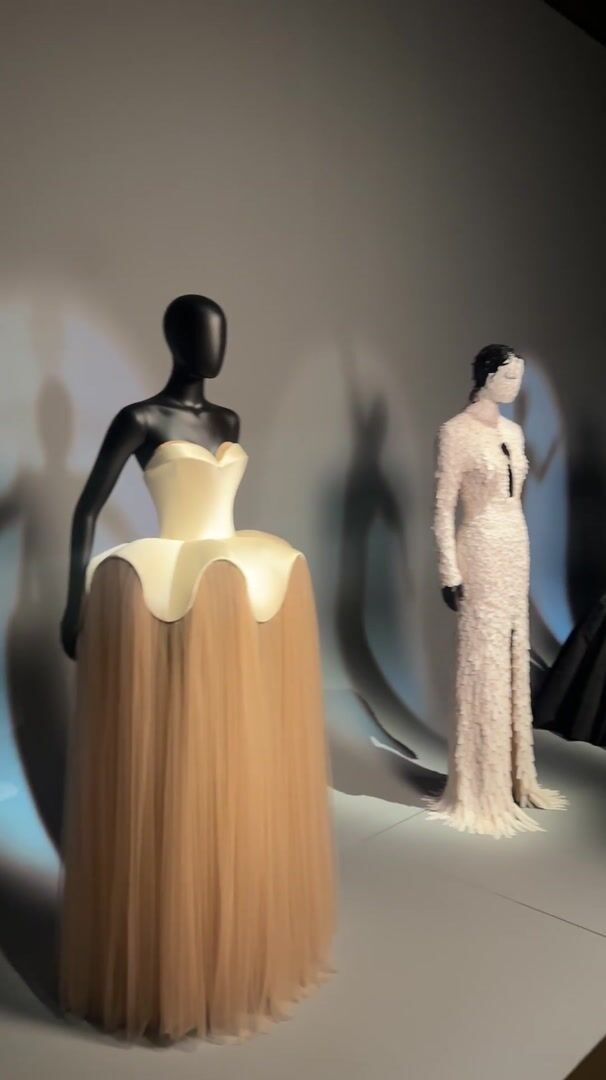
London, a global epicenter of culture and creativity, recently unveiled a captivating fashion exhibition that seamlessly blends haute couture with artistic expression. The Victoria and Albert Museum (V&A) played host to a mesmerizing display, highlighting the visionary designs of Schiaparelli by Daniel Roseberry, offering an intimate look into the intricate artistry that defines high fashion.
The video shows a museum exhibition featuring three mannequins dressed in elaborate gowns. The first mannequin, on the left, is black and wears a strapless, cream-colored top with a ruffled edge, paired with a flowing beige skirt. The second mannequin is white and wears a long-sleeved white gown with a slit up the side. The third mannequin, also black, wears a strapless black gown with a gold design resembling bones on the bodice and a voluminous skirt. The mannequins are displayed on a platform under spotlights. A woman in a black suit and gold jewelry stands near the mannequins, appearing to observe the exhibition. Several other people are in the background, some conversing with each other. The environment is dimly lit with a dark carpeted floor.
@nikofrenchkiss
London, United Kingdom · Mar 25, 2026, 8:19 PM · 17.2k attention
Central to the exhibition were stunning garments presented on mannequins, each piece a testament to meticulous craftsmanship and bold imagination. Among the highlights were elaborate gowns, including a strapless cream-colored top with a ruffled edge paired with a flowing beige skirt, and a striking black gown featuring a gold design resembling bones on the bodice. A highly embellished jacket, a true showstopper, bisected into a pink sleeve adorned with human eye motifs and a blue-green sleeve intricately embroidered with gold baroque scrolls and three-dimensional elements like eyes, lips, and noses, underscored Schiaparelli’s surrealist legacy.
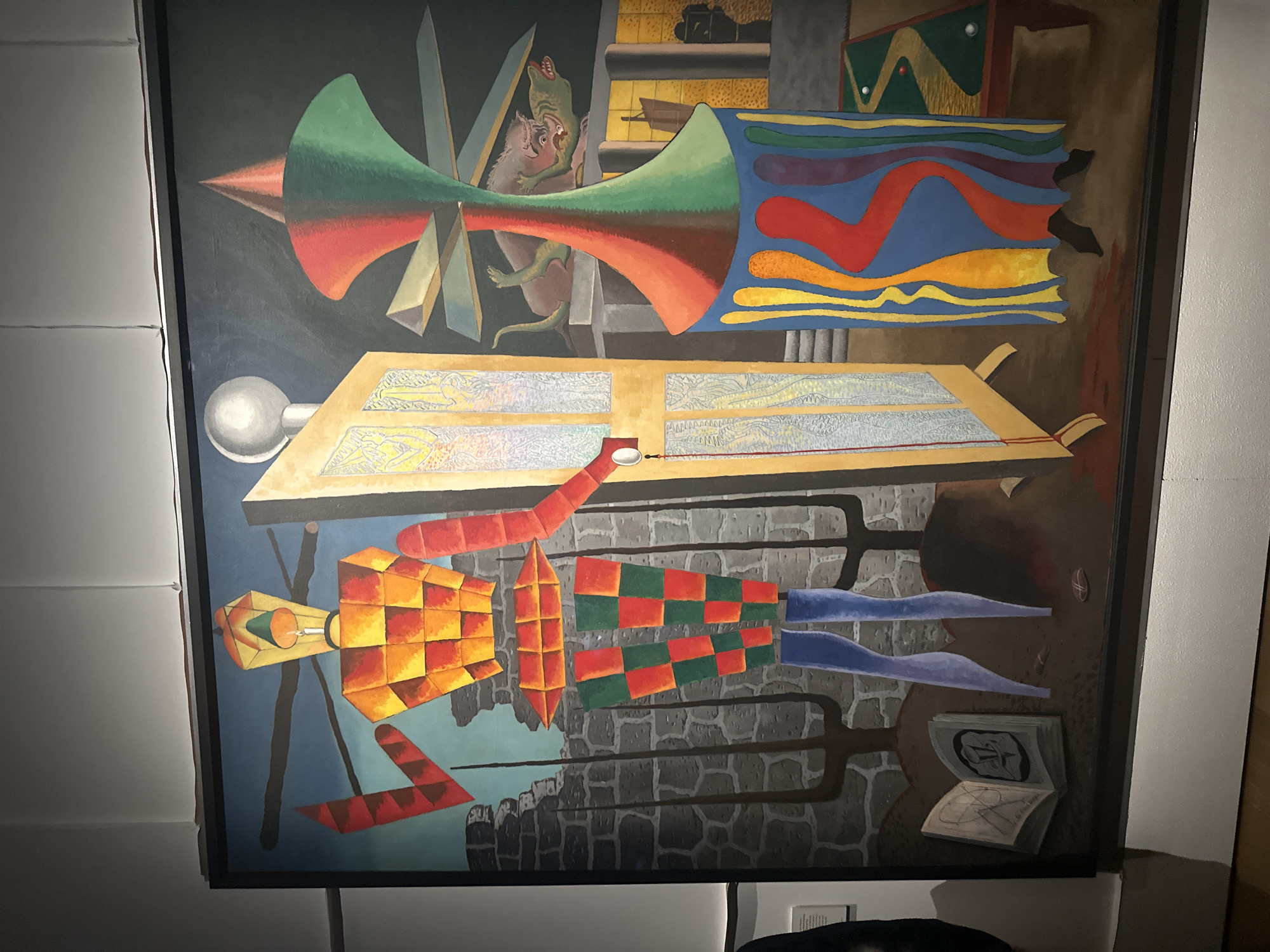
The image displays a large, framed oil painting titled "The Bride" by Max Ernst, exhibited at the Tate Modern in London, United Kingdom. The surrealist artwork features a stylized, geometrically segmented humanoid figure on the left, primarily constructed from orange and yellow checkered blocks for the torso and head, red angular arms, and red and green checkered blocks for the upper legs, with solid blue lower legs. Its head resembles a yellow lantern with an internal light source. The figure's right arm extends towards a tall, narrow, light-colored screen or door featuring intricate, translucent panels and topped by a white spherical object. A red string with a white ornament hangs from the door's right side. Behind the figure, crumbling grey stone ruins and several dark, three-pronged, fork-like objects rise from the ground. An open book displaying an abstract drawing rests on the ground at the figure's feet. To the right, a prominent, multi-colored, hourglass-shaped abstract form is depicted, with its upper half split vertically in red and green, a narrow middle section featuring horizontal planes, and a wide blue base adorned with vertical wavy stripes in yellow, orange, red, and purple, with dark, shoe-like forms beneath. In the mid-ground, behind this abstract form, two green reptilian creatures are entangled in an aggressive interaction on a grey platform. Further right, architectural structures with glowing windows are visible under a dark sky, and a green surface resembling a miniature golf course with a winding yellow path and two white balls occupies the lower right foreground.
@nikofrenchkiss
London, United Kingdom · Mar 25, 2026, 8:03 PM
The V&A's curation showcased a range of designs, from a two-piece denim ensemble extensively embellished with ornate gold metallic appliqués and Baroque patterns, to a cream-colored jacket featuring black pointed lapels and intricate gold thread embroidery. These pieces, often incorporating eye motifs and sculptural elements, were dramatically illuminated by spotlights against dark, textured walls, creating an immersive experience for visitors.
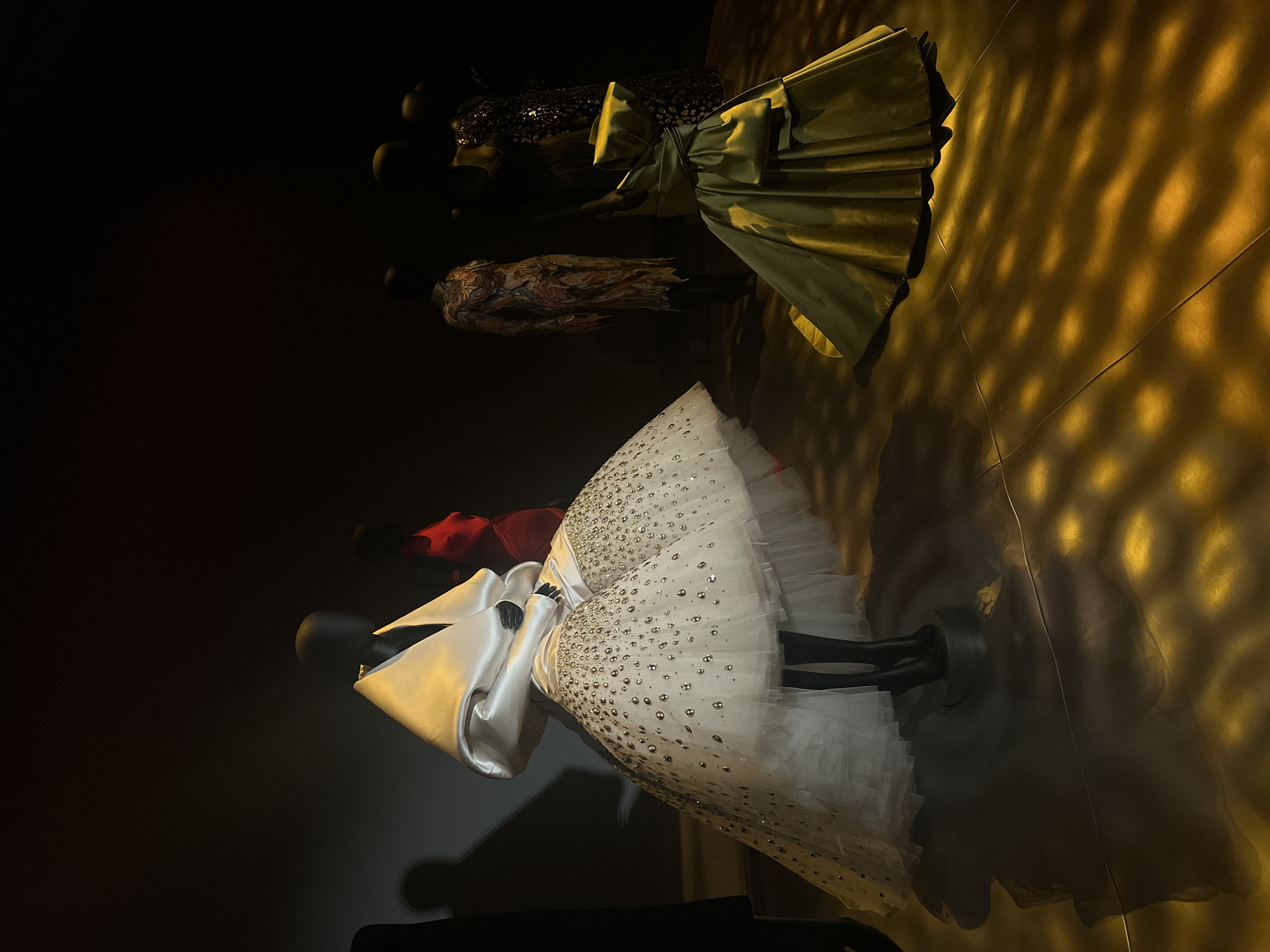
The image displays an interior scene from a fashion exhibition within a museum or gallery in London, United Kingdom. The dimly lit space showcases multiple headless mannequins dressed in elaborate gowns, illuminated by focused spotlights. In the prominent foreground-left, a black mannequin presents a voluminous white gown. The top features a draped, structured high collar and bodice in a white satin-like fabric, with arms posed across the chest. The expansive skirt consists of multiple layers of white tulle, heavily embellished with numerous reflective silver-toned studs or crystals, extending outwards significantly. The mannequin stands on a dark circular base, casting a distinct shadow on the dark background wall. To the foreground-right, another black headless mannequin displays a full-length, olive-green/chartreuse gown. This garment is characterized by a soft, draped fabric and a large bow or knot detail at the waist/back, with the skirt pooling on the floor. In the mid-ground and background, additional dark mannequins are partially visible. One centrally positioned mannequin wears a long, form-fitting dress with an abstract, earthy-toned pattern in shades of brown, orange, and beige. Another mannequin to its right is attired in a dark, possibly sequined or intricately embellished dress. A faint outline of a red dress on another mannequin is visible further back on the left. The environment features dark, solid walls and a dark, somewhat reflective floor. The foreground floor area is illuminated by a projected yellow-orange light, forming a distinct patterned, wavy texture. The overall lighting is dramatic, emphasizing the displayed garments against a dark backdrop.
@nikofrenchkiss
London, United Kingdom · Mar 25, 2026, 8:05 PM
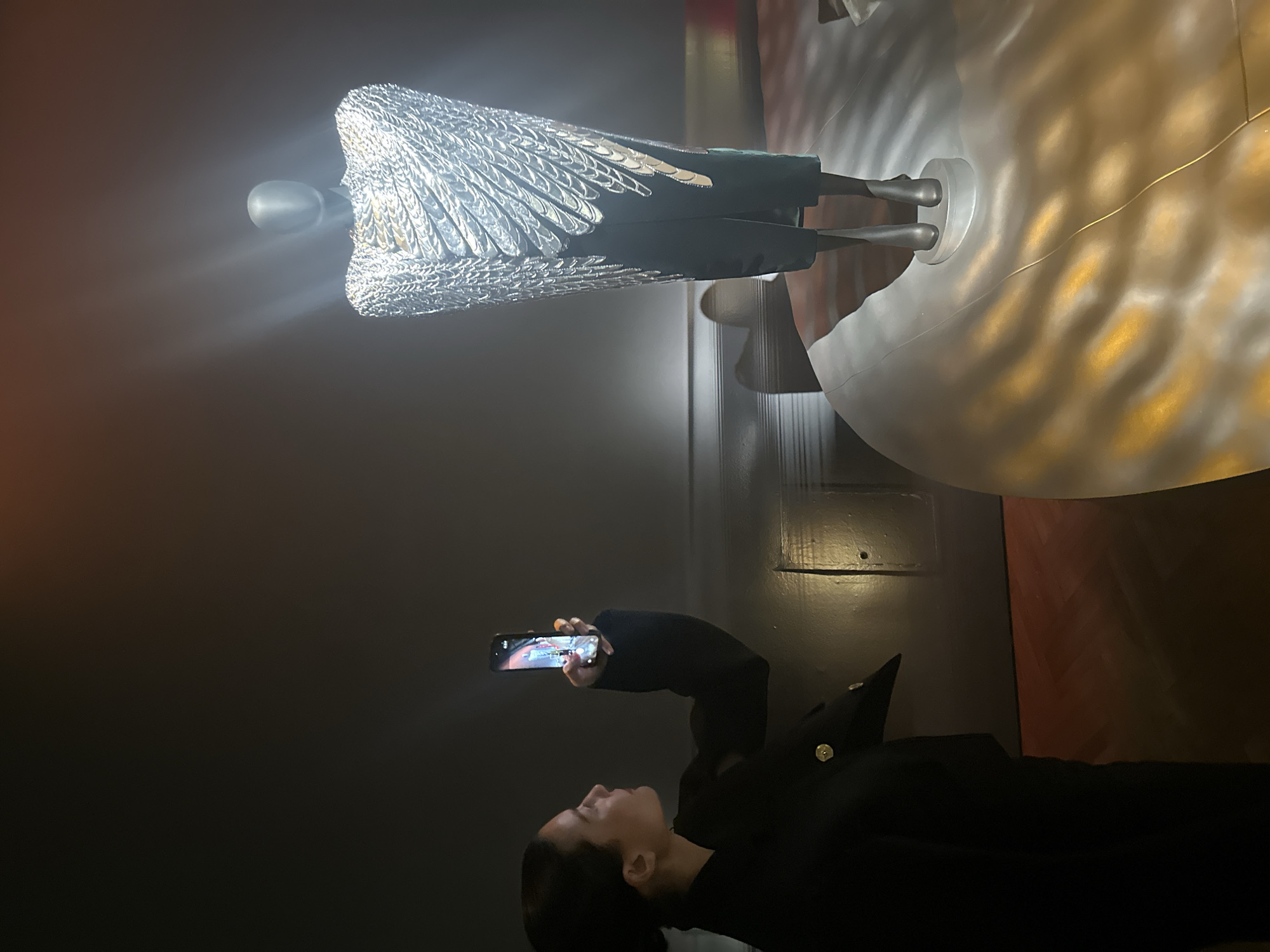
An indoor scene within an exhibition space, likely a museum or gallery, located in the city of London, United Kingdom, is depicted. The primary subject is a dark grey, headless mannequin standing on a large, undulating, metallic-silver display platform in the right half of the frame. The mannequin is adorned with a dark, knee-length garment featuring elaborate, silver, layered wing-like structures covering its upper torso and back. Its legs are visible, clad in dark ankle boots. To the left, a female individual, seen in left profile, stands partially visible. She has dark hair tied back and wears a dark jacket with a gold button on the lapel area. She is holding an illuminated smartphone vertically with both hands, aimed towards the mannequin, appearing to photograph or record the display. The environment is dimly lit, with a smooth, dark wall in the background featuring a dark wooden dado rail. The floor exhibits a dark, reddish-brown herringbone parquet pattern. Focused overhead lighting illuminates the mannequin and its garment, creating bright reflections on the metallic display platform and a radiant glow above the mannequin's head.
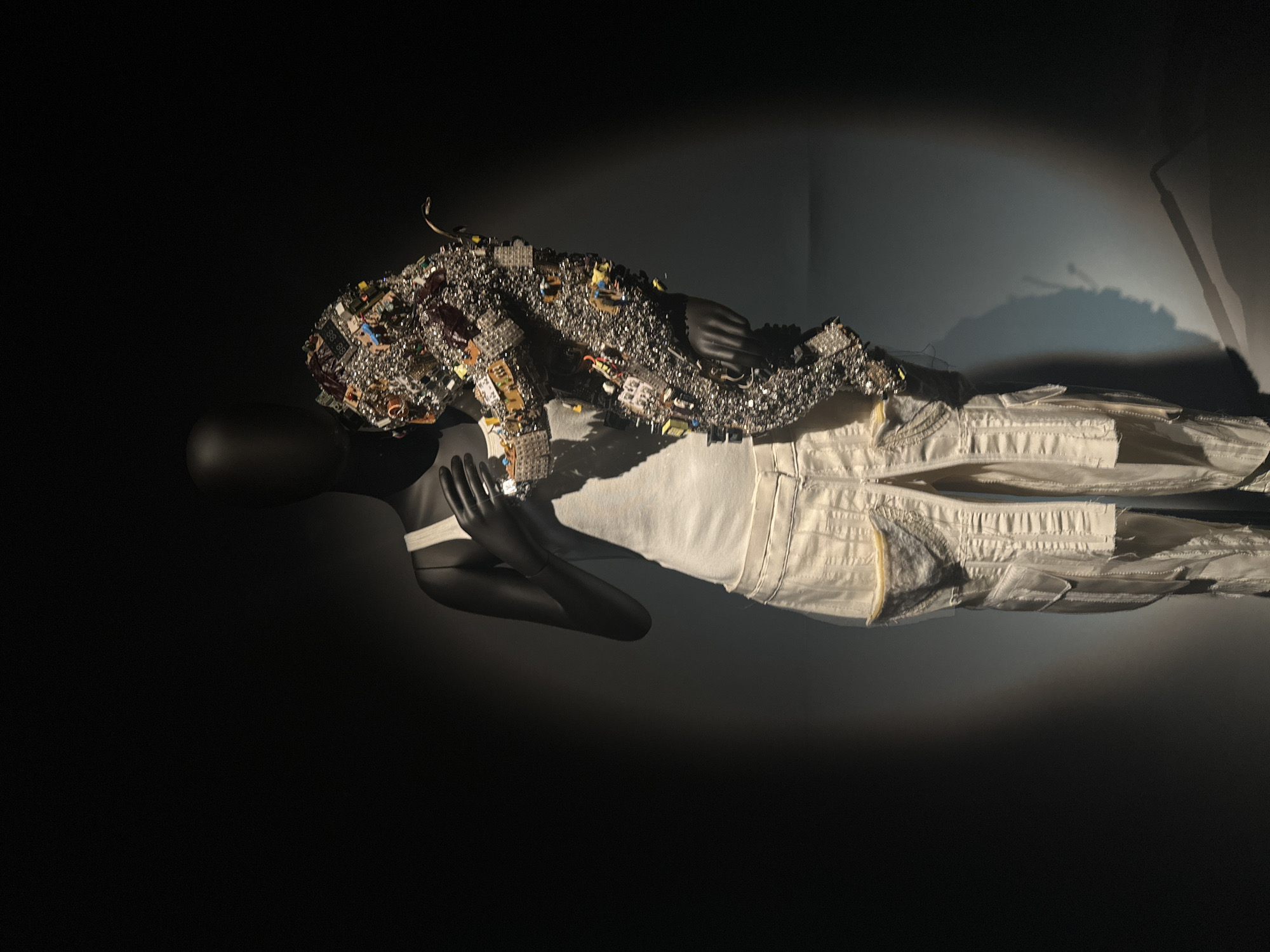
Beyond the V&A, London's Design Museum contributed to the city's creative dialogue with an abstract sculpture crafted from electronic components, cradled by a mannequin in modern attire. Meanwhile, the Tate Modern presented a different facet of art with Max Ernst's surrealist oil painting, 'The Bride,' a complex artwork of fragmented figures and dreamlike landscapes, further cementing London's role as a multifaceted cultural hub.
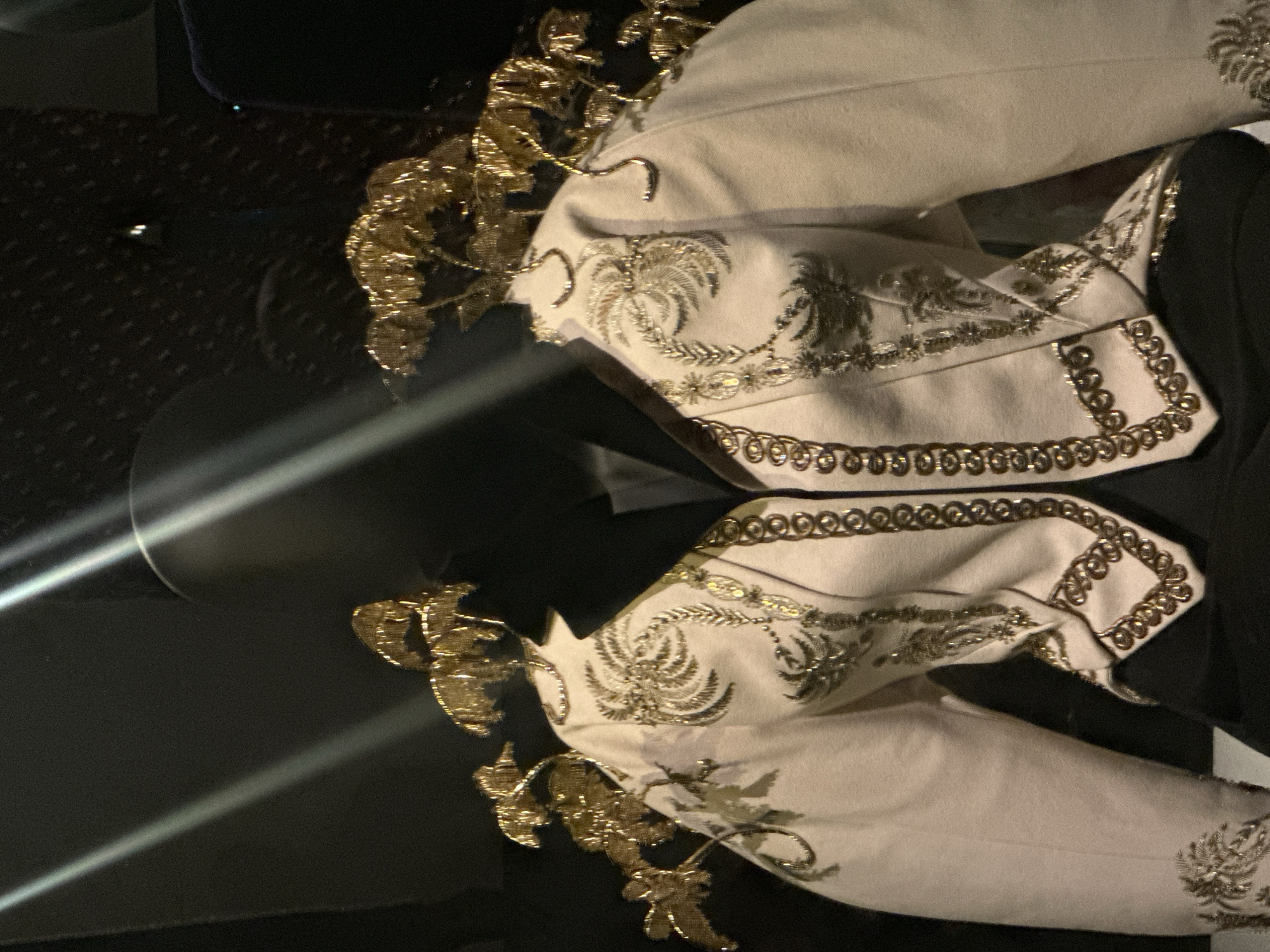
The image displays a cream-colored, heavily embroidered jacket on a black, headless mannequin. The jacket features black pointed lapels and is adorned with intricate gold thread embroidery, primarily depicting stylized palm fronds or botanical patterns across the front panels and sleeves. Vertical lines of gold circular embellishments run along the front opening and bottom hem of the jacket. Elaborate, three-dimensional golden structures, resembling clusters of leaves or small trees, are attached to the shoulder areas, extending upwards. The mannequin is positioned against a dark background within a display environment, likely a museum or exhibition in London, United Kingdom, characterized by bright, directional overhead lighting casting prominent reflections across the upper portion of the frame.
@nikofrenchkiss
London, United Kingdom · Mar 25, 2026, 8:10 PM
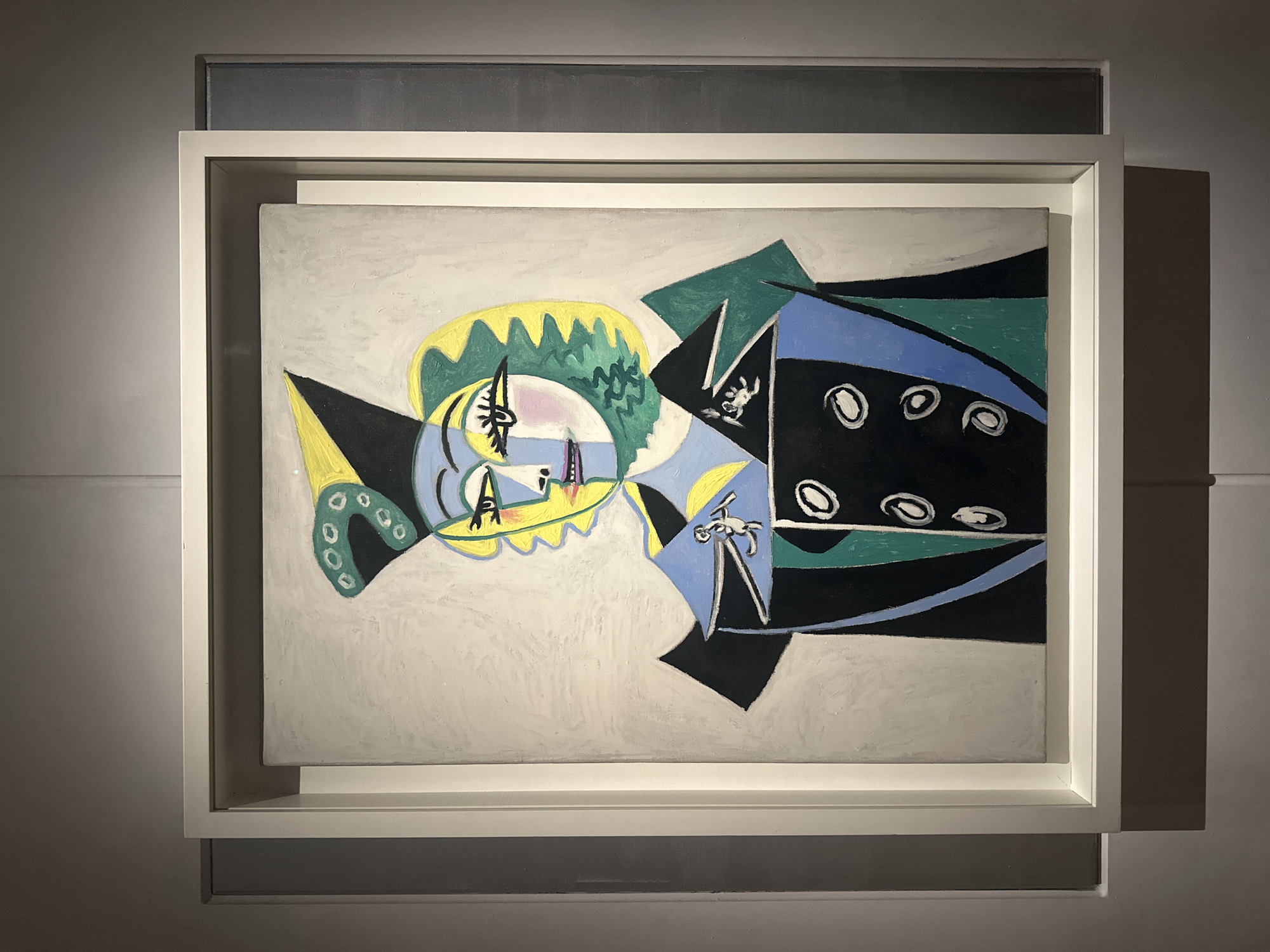
An oil painting, vertically oriented, depicting a cubist portrait of a woman's bust, is displayed in a gallery setting. The artwork features a fragmented face, rendered in light blue, yellow, and green, with stylized eyes and red facial accents. The woman wears a pointed, geometric hat in black, yellow, and green, with a coiled green element adorned with white circles. Wavy yellow hair is visible on the right. Her torso is clad in a dark garment, likely a jacket, with sharply angled blue and green lapels. Four white, circular buttons are arranged vertically on the garment, and two small, stylized white figures are pinned to the left lapel. The painting is housed within a deep, white box-style frame, casting a shadow beneath it. It is mounted on a light grey wall, with darker wall sections visible to the left and right, in an indoor exhibition space. This scene is located at Tate Modern, Bankside, London, United Kingdom.
Together, these exhibitions across London's prestigious institutions illustrate the city's enduring appeal as a destination where fashion, art, and design converge. From the historical grandeur of Schiaparelli's couture to contemporary artistic expressions, the capital continues to inspire, offering visitors a rich tapestry of creative exploration.
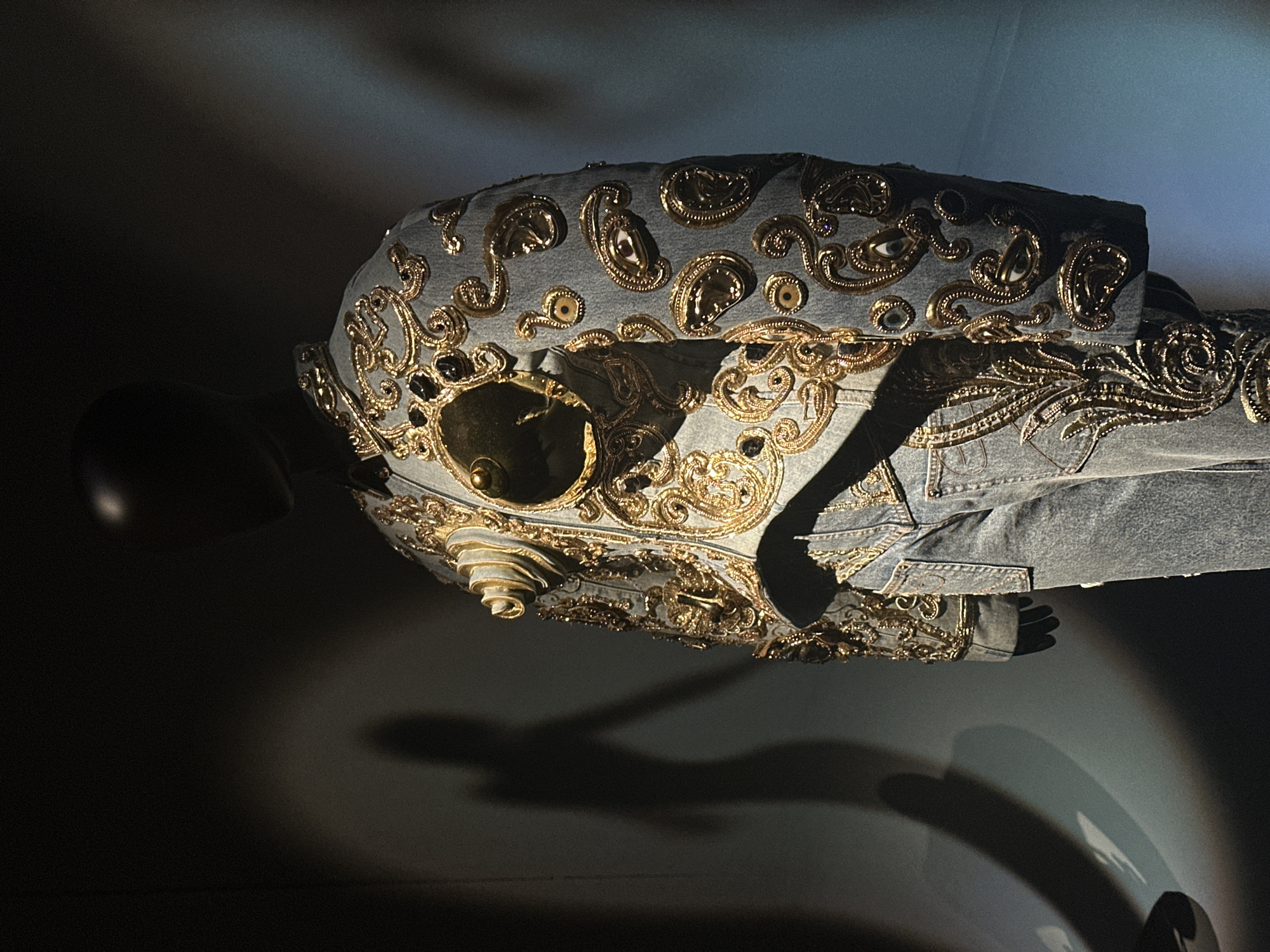
A black, headless mannequin displays a two-piece denim ensemble, comprising a jacket and matching jeans, within a dimly lit exhibition space. The light-wash denim garments are extensively embellished with ornate, gold-colored metallic appliqués and embroidery, creating elaborate Baroque or Rococo-inspired patterns. The jacket features several prominent three-dimensional elements, including a large, spherical metallic protrusion on the right chest area (viewer's left) and smaller, ribbed cylindrical forms on the left shoulder. Numerous eye motifs, some with realistic irises, are integrated into the gold patterns, particularly visible on the jacket's sleeves. Small, dark, possibly black stone or enamel elements are also set within the goldwork. The background consists of a dark, indeterminate wall, upon which a distinct human silhouette shadow is cast to the left of the mannequin, indicating an external light source and the presence of a viewer or attendant. The scene is located at the Victoria and Albert Museum (V&A) in London, United Kingdom.
London, United Kingdom · Mar 25, 2026, 8:18 PM
A highly embellished jacket is displayed on a black, headless mannequin within a dark museum exhibition space. The jacket is bisected into two distinct designs: the viewer's left side features a pink fabric sleeve embroidered with multiple human eye motifs and green leafy patterns, terminating in a teal cuff with a metallic, open-weave gold-colored band. The viewer's right side features a light blue-green fabric sleeve intricately embroidered with gold baroque scrolls and embedded three-dimensional elements resembling eyes, lips, and noses. The jacket's bodice includes a large, polished gold oval resembling a mirror on the left and a textured black, possibly tasseled, component on the right. The mannequin stands on a dark grey platform against a dark, textured wall, illuminated by spotlights. A black exhibition plaque at the bottom right identifies the piece as 'Schiaparelli by Daniel Roseberry, Autumn/Winter 2021, Paris,' and details its materials and design influences related to Elsa Schiaparelli. This object is exhibited at the Victoria and Albert Museum (V&A) in London, United Kingdom.
The video shows a museum exhibition featuring three mannequins dressed in elaborate gowns. The first mannequin, on the left, is black and wears a strapless, cream-colored top with a ruffled edge, paired with a flowing beige skirt. The second mannequin is white and wears a long-sleeved white gown with a slit up the side. The third mannequin, also black, wears a strapless black gown with a gold design resembling bones on the bodice and a voluminous skirt. The mannequins are displayed on a platform under spotlights. A woman in a black suit and gold jewelry stands near the mannequins, appearing to observe the exhibition. Several other people are in the background, some conversing with each other. The environment is dimly lit with a dark carpeted floor.
The image displays a large, framed oil painting titled "The Bride" by Max Ernst, exhibited at the Tate Modern in London, United Kingdom. The surrealist artwork features a stylized, geometrically segmented humanoid figure on the left, primarily constructed from orange and yellow checkered blocks for the torso and head, red angular arms, and red and green checkered blocks for the upper legs, with solid blue lower legs. Its head resembles a yellow lantern with an internal light source. The figure's right arm extends towards a tall, narrow, light-colored screen or door featuring intricate, translucent panels and topped by a white spherical object. A red string with a white ornament hangs from the door's right side. Behind the figure, crumbling grey stone ruins and several dark, three-pronged, fork-like objects rise from the ground. An open book displaying an abstract drawing rests on the ground at the figure's feet. To the right, a prominent, multi-colored, hourglass-shaped abstract form is depicted, with its upper half split vertically in red and green, a narrow middle section featuring horizontal planes, and a wide blue base adorned with vertical wavy stripes in yellow, orange, red, and purple, with dark, shoe-like forms beneath. In the mid-ground, behind this abstract form, two green reptilian creatures are entangled in an aggressive interaction on a grey platform. Further right, architectural structures with glowing windows are visible under a dark sky, and a green surface resembling a miniature golf course with a winding yellow path and two white balls occupies the lower right foreground.
The image displays an interior scene from a fashion exhibition within a museum or gallery in London, United Kingdom. The dimly lit space showcases multiple headless mannequins dressed in elaborate gowns, illuminated by focused spotlights. In the prominent foreground-left, a black mannequin presents a voluminous white gown. The top features a draped, structured high collar and bodice in a white satin-like fabric, with arms posed across the chest. The expansive skirt consists of multiple layers of white tulle, heavily embellished with numerous reflective silver-toned studs or crystals, extending outwards significantly. The mannequin stands on a dark circular base, casting a distinct shadow on the dark background wall. To the foreground-right, another black headless mannequin displays a full-length, olive-green/chartreuse gown. This garment is characterized by a soft, draped fabric and a large bow or knot detail at the waist/back, with the skirt pooling on the floor. In the mid-ground and background, additional dark mannequins are partially visible. One centrally positioned mannequin wears a long, form-fitting dress with an abstract, earthy-toned pattern in shades of brown, orange, and beige. Another mannequin to its right is attired in a dark, possibly sequined or intricately embellished dress. A faint outline of a red dress on another mannequin is visible further back on the left. The environment features dark, solid walls and a dark, somewhat reflective floor. The foreground floor area is illuminated by a projected yellow-orange light, forming a distinct patterned, wavy texture. The overall lighting is dramatic, emphasizing the displayed garments against a dark backdrop.
An indoor scene within an exhibition space, likely a museum or gallery, located in the city of London, United Kingdom, is depicted. The primary subject is a dark grey, headless mannequin standing on a large, undulating, metallic-silver display platform in the right half of the frame. The mannequin is adorned with a dark, knee-length garment featuring elaborate, silver, layered wing-like structures covering its upper torso and back. Its legs are visible, clad in dark ankle boots. To the left, a female individual, seen in left profile, stands partially visible. She has dark hair tied back and wears a dark jacket with a gold button on the lapel area. She is holding an illuminated smartphone vertically with both hands, aimed towards the mannequin, appearing to photograph or record the display. The environment is dimly lit, with a smooth, dark wall in the background featuring a dark wooden dado rail. The floor exhibits a dark, reddish-brown herringbone parquet pattern. Focused overhead lighting illuminates the mannequin and its garment, creating bright reflections on the metallic display platform and a radiant glow above the mannequin's head.