Art lover documents masterpieces across Seville's historic museums
Friday, March 27, 2026 · Updated Friday, March 27, 2026
 Spain
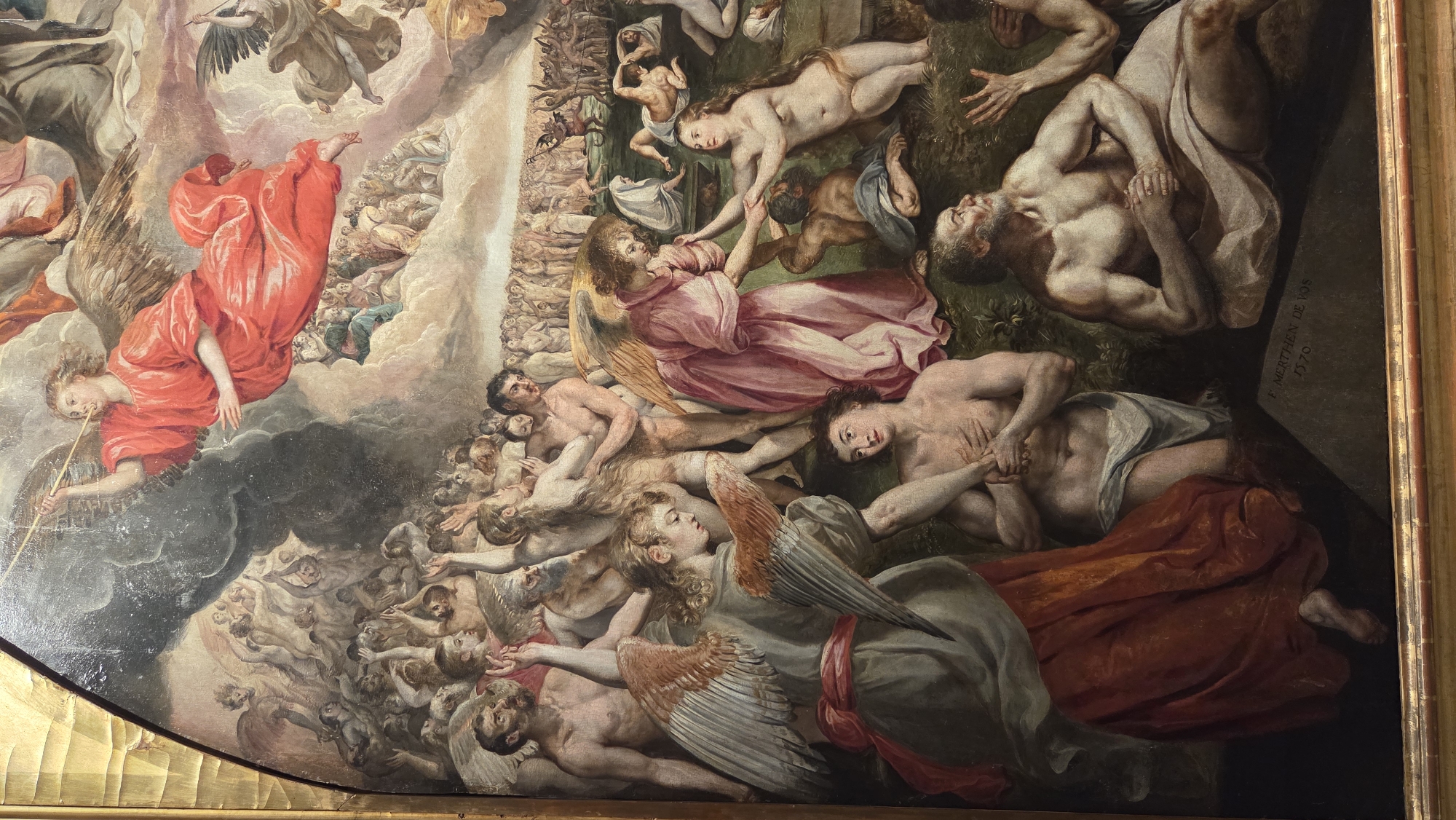
SpainThis image is a detailed depiction of the oil painting *The Last Judgment* by Maerten de Vos, dated 1570, as evidenced by the inscription "F. MERTHEN DE VOS 1570" on a dark slab in the lower portion of the artwork. The painting is located in the Cathedral of Seville (Catedral de Santa María de la Sede) in Seville, Spain. The artwork is partially visible within a gold, ornate frame on the left and bottom edges. The scene is vertically organized into celestial and earthly realms. In the upper section, a winged angel in a vibrant red robe floats horizontally, blowing a long, slender trumpet to the right, enveloped by dark, swirling clouds. Above and to the right of this angel, numerous figures in varied light-colored robes ascend on bright clouds. The mid-section features a dense multitude of figures, primarily nude or partially draped in white cloths, depicting the resurrection of the dead. Several winged angels are interspersed among the resurrected. One angel in a grey tunic with a red sash, facing away from the viewer, extends a hand to assist a rising figure. Another angel in a flowing pink robe in the mid-right actively pulls a nude female figure by the hand from the ground. Numerous individuals are shown emerging from the earth or shrouds, reaching upwards with expressions of awe or anticipation. The lower foreground includes additional nude or partially draped figures, some with beards, gazing skyward. The overall composition is crowded and dynamic, focusing on divine intervention and human resurrection.
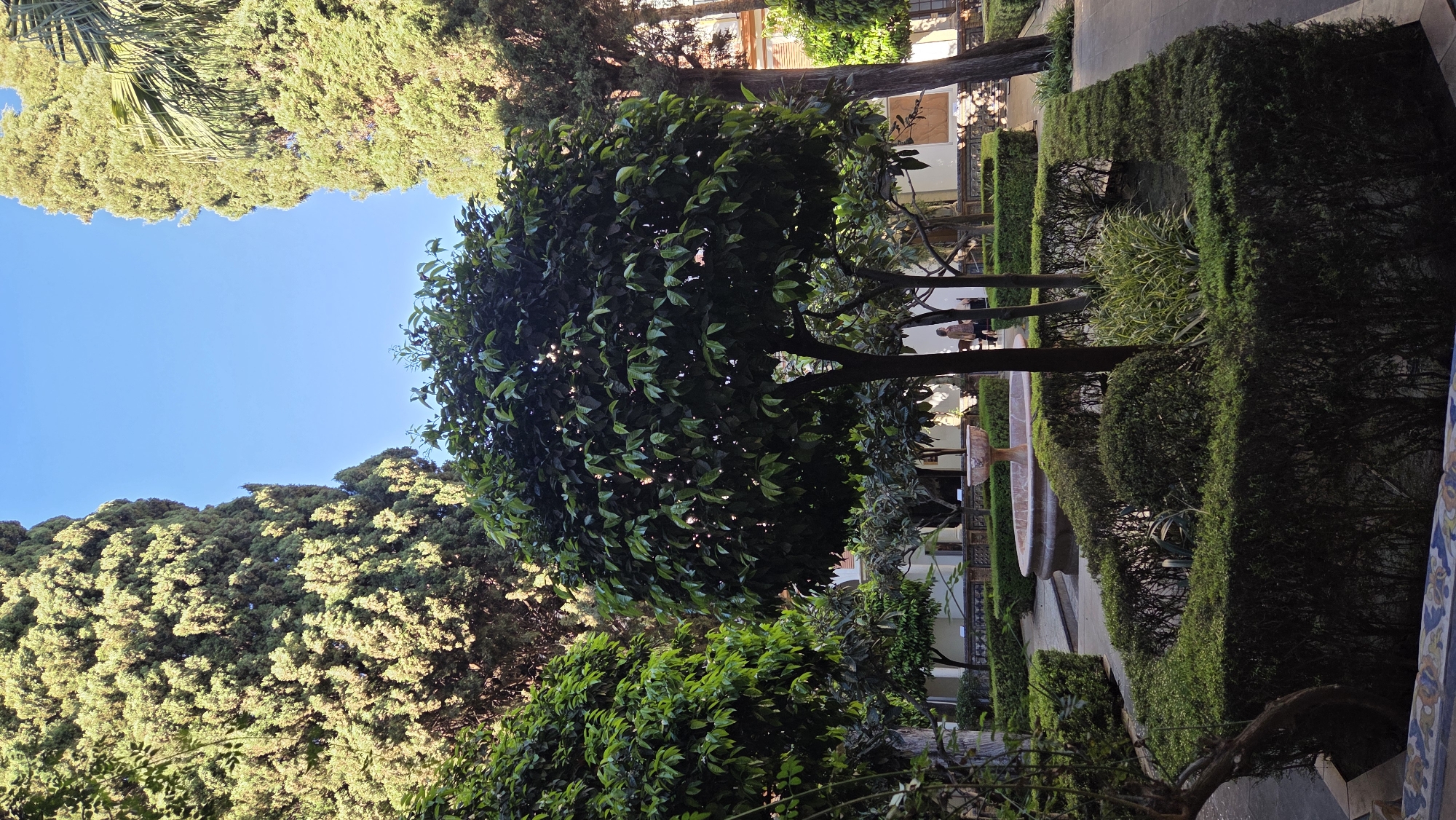
The image depicts a formal garden or patio within the Royal Alcázar of Seville, Spain, under a clear blue sky. In the foreground, a low wall adorned with multi-colored ceramic tiles (azulejos) is visible on the bottom left. A central, geometrically pruned orange tree with dense green foliage stands prominent, surrounded by a rectangular parterre edged with tightly clipped green hedges. Inside this parterre, a cluster of lighter green herbaceous plants is present. In the midground, a two-tiered, light pinkish-beige stone fountain with a circular basin is centrally located, partially obscured by the foreground tree. Surrounding the fountain and extending throughout the garden are numerous neatly trimmed green hedges forming structured beds and pathways. Several smaller orange trees and other deciduous trees are interspersed within the garden layout. In the background, a light-colored historic building featuring columns and arched openings is partially visible on the right. A single individual, dressed in a light-colored top, walks on a paved path adjacent to the building. The garden is framed by very tall, slender cypress trees and other large, mature trees with dense green foliage, casting distinct shadows on the ground. The sky above is cloudless and bright blue.
Durantia
Seville, Spain · Mar 27, 2026, 4:33 PM
The image depicts a formal garden or patio within the Royal Alcázar of Seville, Spain, under a clear blue sky. In the foreground, a low wall adorned with multi-colored ceramic tiles (azulejos) is visible on the bottom left. A central, geometrically pruned orange tree with dense green foliage stands prominent, surrounded by a rectangular parterre edged with tightly clipped green hedges. Inside this parterre, a cluster of lighter green herbaceous plants is present. In the midground, a two-tiered, light pinkish-beige stone fountain with a circular basin is centrally located, partially obscured by the foreground tree. Surrounding the fountain and extending throughout the garden are numerous neatly trimmed green hedges forming structured beds and pathways. Several smaller orange trees and other deciduous trees are interspersed within the garden layout. In the background, a light-colored historic building featuring columns and arched openings is partially visible on the right. A single individual, dressed in a light-colored top, walks on a paved path adjacent to the building. The garden is framed by very tall, slender cypress trees and other large, mature trees with dense green foliage, casting distinct shadows on the ground. The sky above is cloudless and bright blue.
An overhead view captures a tiled floor, likely in a public space, patio, or historic building in Seville, Spain. The surface consists primarily of rectangular, light beige ceramic tiles with visible minor scuffs and wear. Interspersed within this beige tiling are six smaller, square, hand-painted ceramic tiles, each featuring a white background and a distinct blue circular border with a quatrefoil design at its corners. These decorative tiles are arranged in three vertical pairs: one at the top, one in the middle, and one at the bottom, creating a symmetrical pattern. Each pair is separated vertically by two rows of the plain rectangular tiles. The motifs on the individual tiles, executed in a traditional Sevillian style with a color palette of yellow, orange, blue, and green, include: * **Top left:** A stylized architectural structure, possibly a tower or windmill, surrounded by swirling lines. * **Top right:** A winged mythological creature, possibly a gryphon, amidst swirling patterns. * **Middle left:** Another stylized architectural element, similar to the top left, in yellow-orange hues. * **Middle right:** A small, rustic building, possibly a house or chapel, with a red roof, situated on a landscape with green foliage. * **Bottom left:** A building resembling a church or tower with a conical roof, set against a landscape. * **Bottom right:** A stylized animal, possibly a deer or goat, in a reclining or leaping posture, on a green and brown base. No people, actions, or specific interactions are depicted. The environment is solely the described tiled flooring.
Durantia
Seville, Spain · Mar 27, 2026, 4:36 PM
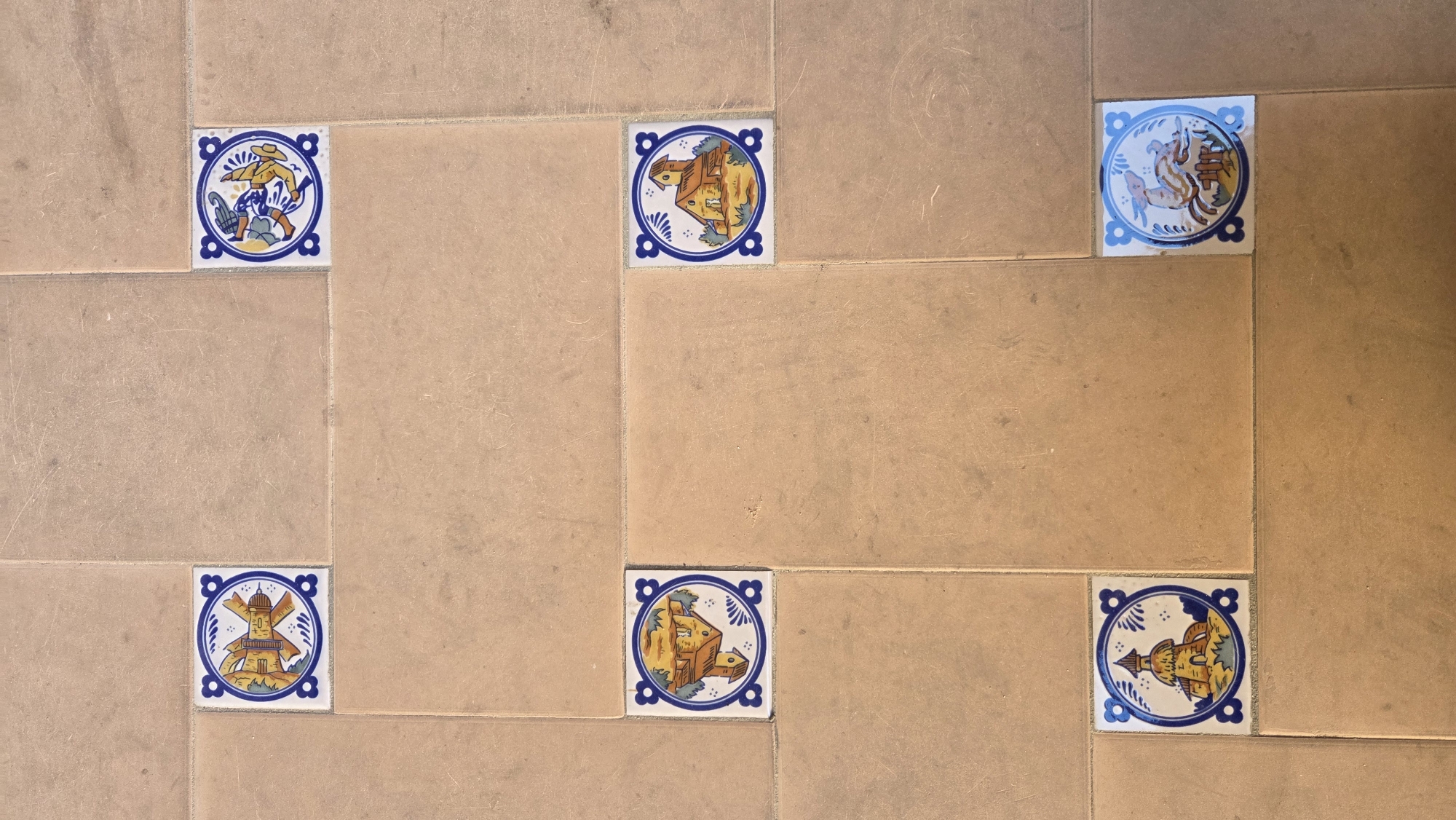
An overhead view captures a tiled floor, likely in a public space, patio, or historic building in Seville, Spain. The surface consists primarily of rectangular, light beige ceramic tiles with visible minor scuffs and wear. Interspersed within this beige tiling are six smaller, square, hand-painted ceramic tiles, each featuring a white background and a distinct blue circular border with a quatrefoil design at its corners. These decorative tiles are arranged in three vertical pairs: one at the top, one in the middle, and one at the bottom, creating a symmetrical pattern. Each pair is separated vertically by two rows of the plain rectangular tiles. The motifs on the individual tiles, executed in a traditional Sevillian style with a color palette of yellow, orange, blue, and green, include: * **Top left:** A stylized architectural structure, possibly a tower or windmill, surrounded by swirling lines. * **Top right:** A winged mythological creature, possibly a gryphon, amidst swirling patterns. * **Middle left:** Another stylized architectural element, similar to the top left, in yellow-orange hues. * **Middle right:** A small, rustic building, possibly a house or chapel, with a red roof, situated on a landscape with green foliage. * **Bottom left:** A building resembling a church or tower with a conical roof, set against a landscape. * **Bottom right:** A stylized animal, possibly a deer or goat, in a reclining or leaping posture, on a green and brown base. No people, actions, or specific interactions are depicted. The environment is solely the described tiled flooring.
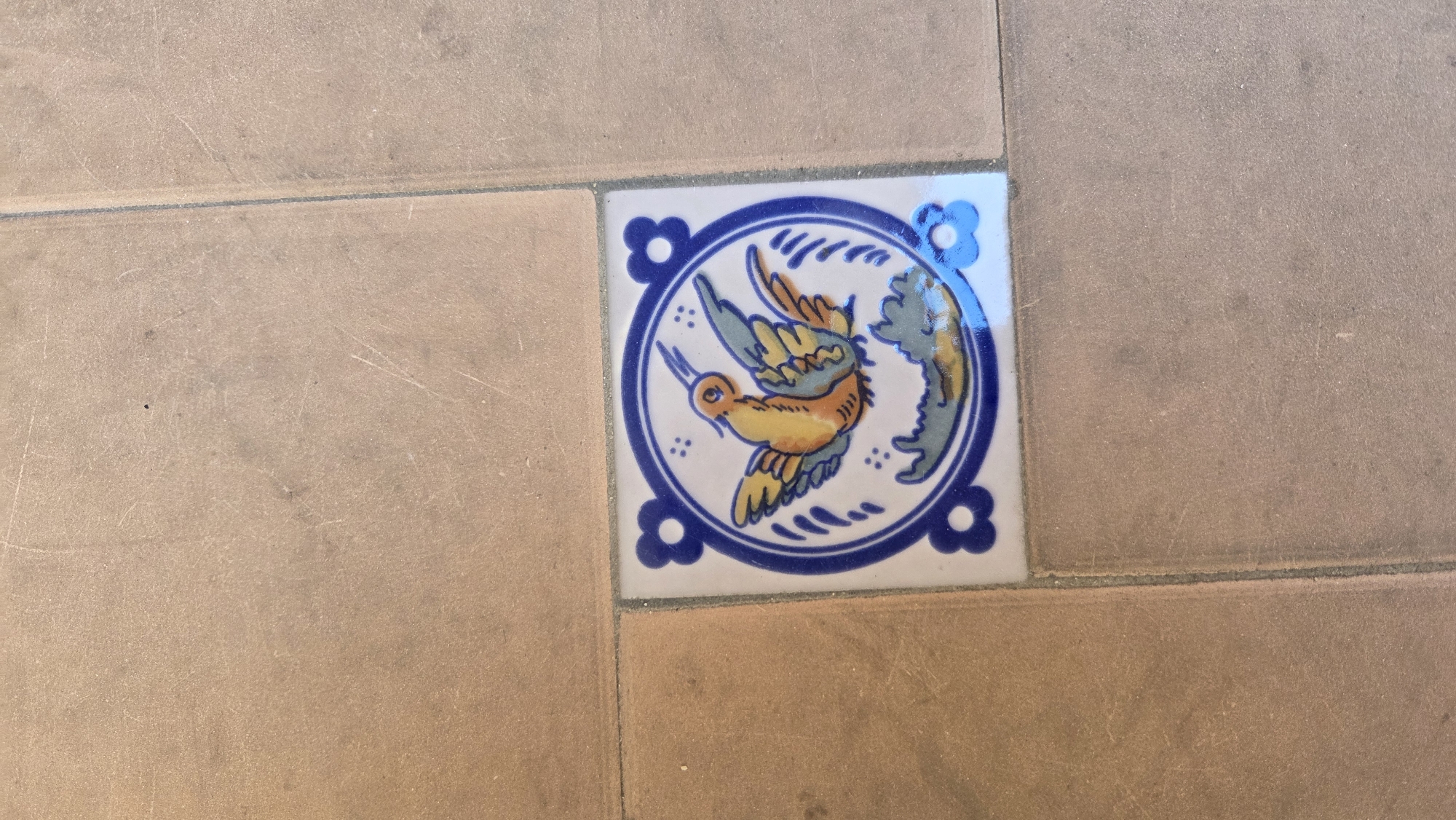
The image displays a close-up view of a decorative ceramic tile set into a larger tiled surface. The main decorative tile is square, featuring a hand-painted design of a bird in flight, enclosed within a circular blue border. The bird has predominantly yellow-orange feathers on its body and wings, with accents of a muted blue-green color on its wings and tail. Its beak is pointed, and small dots are scattered around the bird within the blue circle. The corners of the square tile, outside the circular border, are adorned with small, blue, four-petaled floral or clover-like motifs. A prominent, bright, slightly blue-tinted glare is visible on the upper right portion of this decorative tile, suggesting a reflective surface and a light source overhead or nearby. The decorative tile is surrounded by larger, rectangular tiles that appear to be made of a natural stone or unglazed ceramic, possibly terracotta or a similar material, in a light brown or sandy beige color. These surrounding tiles have a matte, somewhat textured finish and show signs of wear, including faint scratches and scuff marks across their surfaces. Grout lines, appearing dark gray or black, separate the decorative tile from the surrounding rectangular tiles and also define the edges of the rectangular tiles themselves. The arrangement suggests the decorative tile is an accent piece within a larger tiled area, possibly a floor or a wall. The overall scene is static, showcasing an architectural or interior design element. No text is visible in the image.
Durantia
Seville, Spain · Mar 27, 2026, 4:37 PM
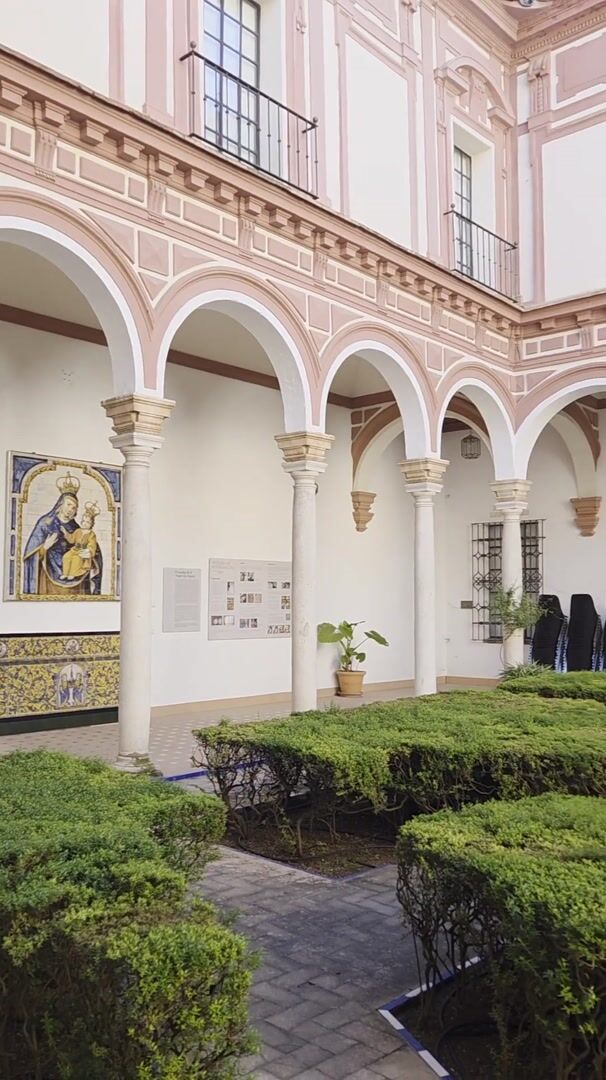
The camera pans slowly across a courtyard garden with a two-tiered white stone fountain in the center. The garden is enclosed by a building with arched corridors supported by white columns. The building has a pink and white exterior. The garden consists of neatly trimmed hedges arranged in rectangular patterns. There are potted plants placed around the fountain and along the corridors. The building has windows with decorative iron grilles and small balconies. There is a religious tile mural hanging on the wall behind one of the corridors. Stacked black chairs covered in plastic are positioned next to a corridor opening in the building.
The image displays a close-up view of a decorative ceramic tile set into a larger tiled surface. The main decorative tile is square, featuring a hand-painted design of a bird in flight, enclosed within a circular blue border. The bird has predominantly yellow-orange feathers on its body and wings, with accents of a muted blue-green color on its wings and tail. Its beak is pointed, and small dots are scattered around the bird within the blue circle. The corners of the square tile, outside the circular border, are adorned with small, blue, four-petaled floral or clover-like motifs. A prominent, bright, slightly blue-tinted glare is visible on the upper right portion of this decorative tile, suggesting a reflective surface and a light source overhead or nearby. The decorative tile is surrounded by larger, rectangular tiles that appear to be made of a natural stone or unglazed ceramic, possibly terracotta or a similar material, in a light brown or sandy beige color. These surrounding tiles have a matte, somewhat textured finish and show signs of wear, including faint scratches and scuff marks across their surfaces. Grout lines, appearing dark gray or black, separate the decorative tile from the surrounding rectangular tiles and also define the edges of the rectangular tiles themselves. The arrangement suggests the decorative tile is an accent piece within a larger tiled area, possibly a floor or a wall. The overall scene is static, showcasing an architectural or interior design element. No text is visible in the image.
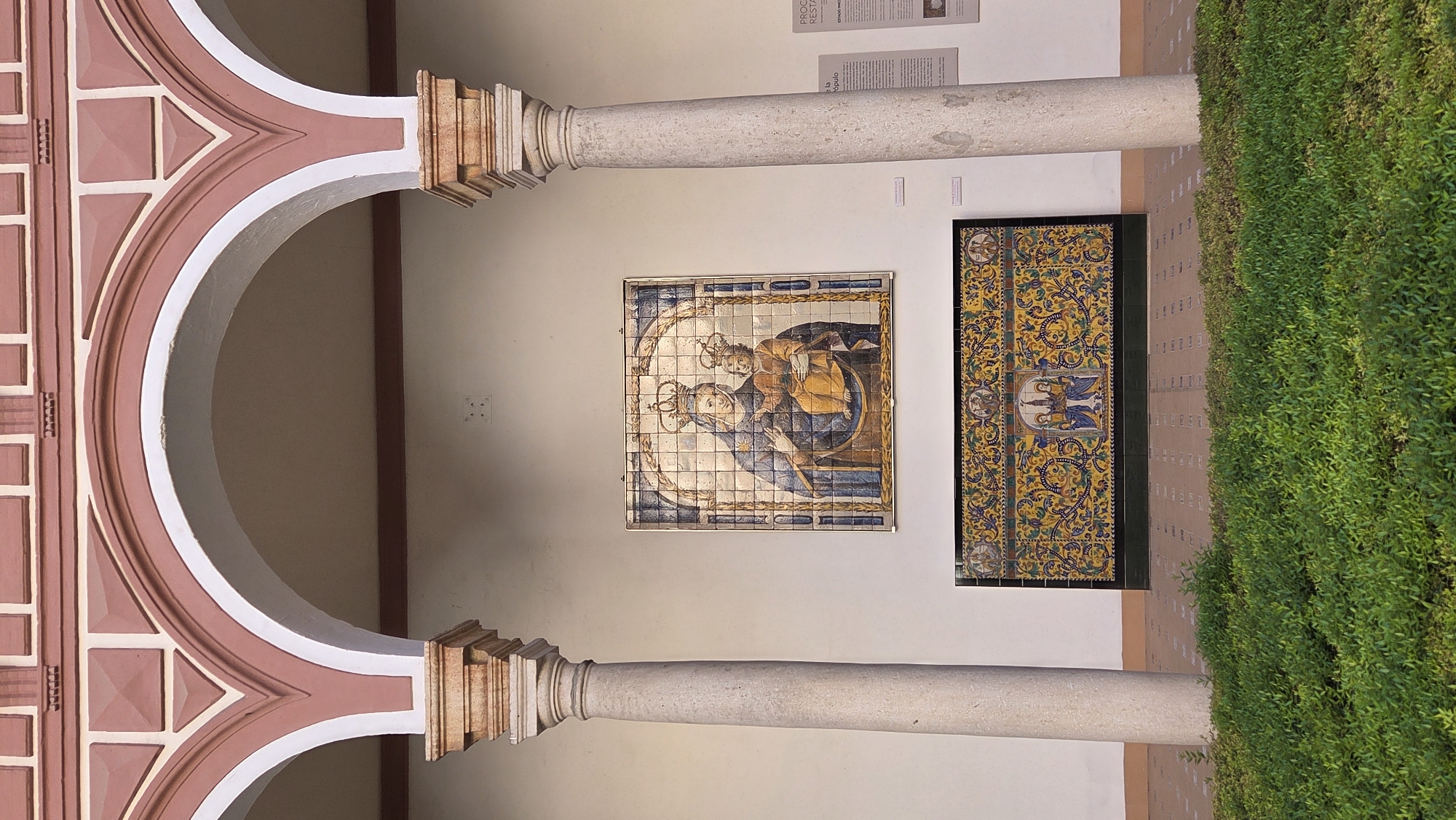
The image depicts a section of an architectural arcade, likely within a cloister or courtyard, at the Hospital de la Caridad in Seville, Spain. The foreground features a strip of dense green shrubbery. Behind this, a light brown tiled floor extends to a white wall adorned with two prominent ceramic tile artworks. Two classical-style columns with fluted shafts and decorative bases support a series of arches, painted reddish-brown with contrasting white interior edges. Above the arches, the building's facade is also reddish-brown, featuring geometric relief patterns. Centered on the white wall between the columns is a large rectangular tile panel, composed of numerous individual ceramic tiles, depicting the Virgin Mary holding the infant Jesus. Both figures are crowned, with Mary in blue robes and Jesus in yellow/orange, set within an oval border and a rectangular blue and white frame. Directly below this, a longer, narrower decorative tile panel extends horizontally, featuring intricate yellow and blue floral and scroll motifs with small religious figures at its center and ends, framed by a black border. To the right of the main tile panel, several small informational plaques are affixed to the wall, including a larger one with Spanish text discussing a "PROCEDIMIENTO DE RESTAURACIÓN." No individuals are present in the scene.
Durantia
Seville, Spain · Mar 27, 2026, 4:40 PM
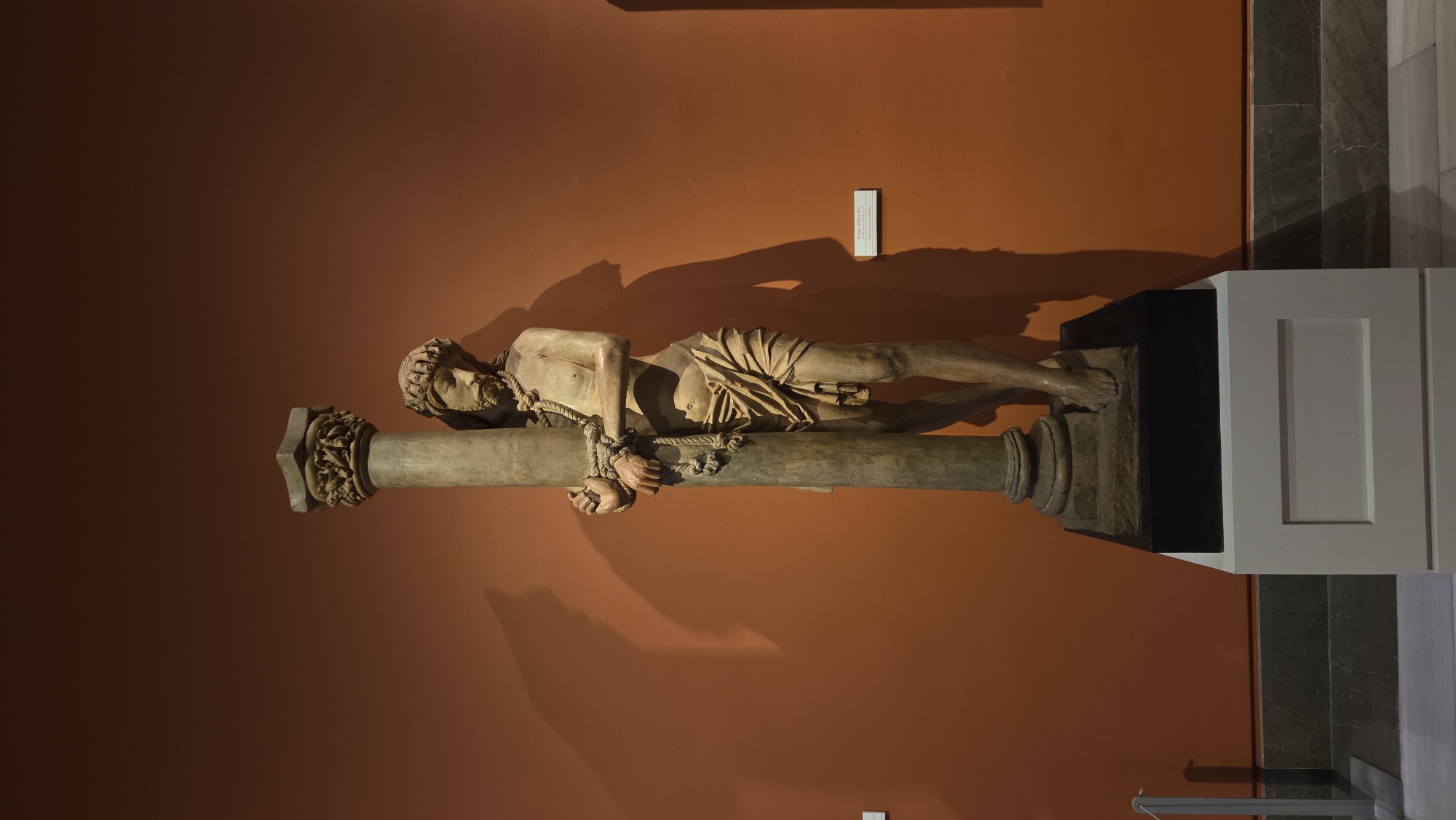
A vertical shot captures a wooden sculpture, identified as Pedro Millán's "Cristo atado a la columna" (Christ at the Column), displayed in the Museo de Bellas Artes de Sevilla (Museum of Fine Arts of Seville), Spain. The sculpture depicts a male figure, presumably Christ, standing upright and bound to a plain, fluted column with a decorated capital and base. The figure wears a crown of thorns and a loincloth, with his torso bare. His hands are tied around the column by a thick rope, and his head is bowed to the left, showing a bearded face. The sculpture rests on a multi-tiered plinth composed of a white rectangular base, a narrower black section, and the sculpture's own dark square base. It is positioned against a plain, matte terracotta-orange wall, which exhibits prominent shadows cast by the sculpture, suggesting directional lighting. A small white information plaque is affixed to the wall to the right of the sculpture. The floor visible at the bottom consists of light-colored tiles, meeting a dark grey baseboard along the wall. A silver stanchion, part of a barrier, is partially visible on the far left.
The camera pans slowly across a courtyard garden with a two-tiered white stone fountain in the center. The garden is enclosed by a building with arched corridors supported by white columns. The building has a pink and white exterior. The garden consists of neatly trimmed hedges arranged in rectangular patterns. There are potted plants placed around the fountain and along the corridors. The building has windows with decorative iron grilles and small balconies. There is a religious tile mural hanging on the wall behind one of the corridors. Stacked black chairs covered in plastic are positioned next to a corridor opening in the building.
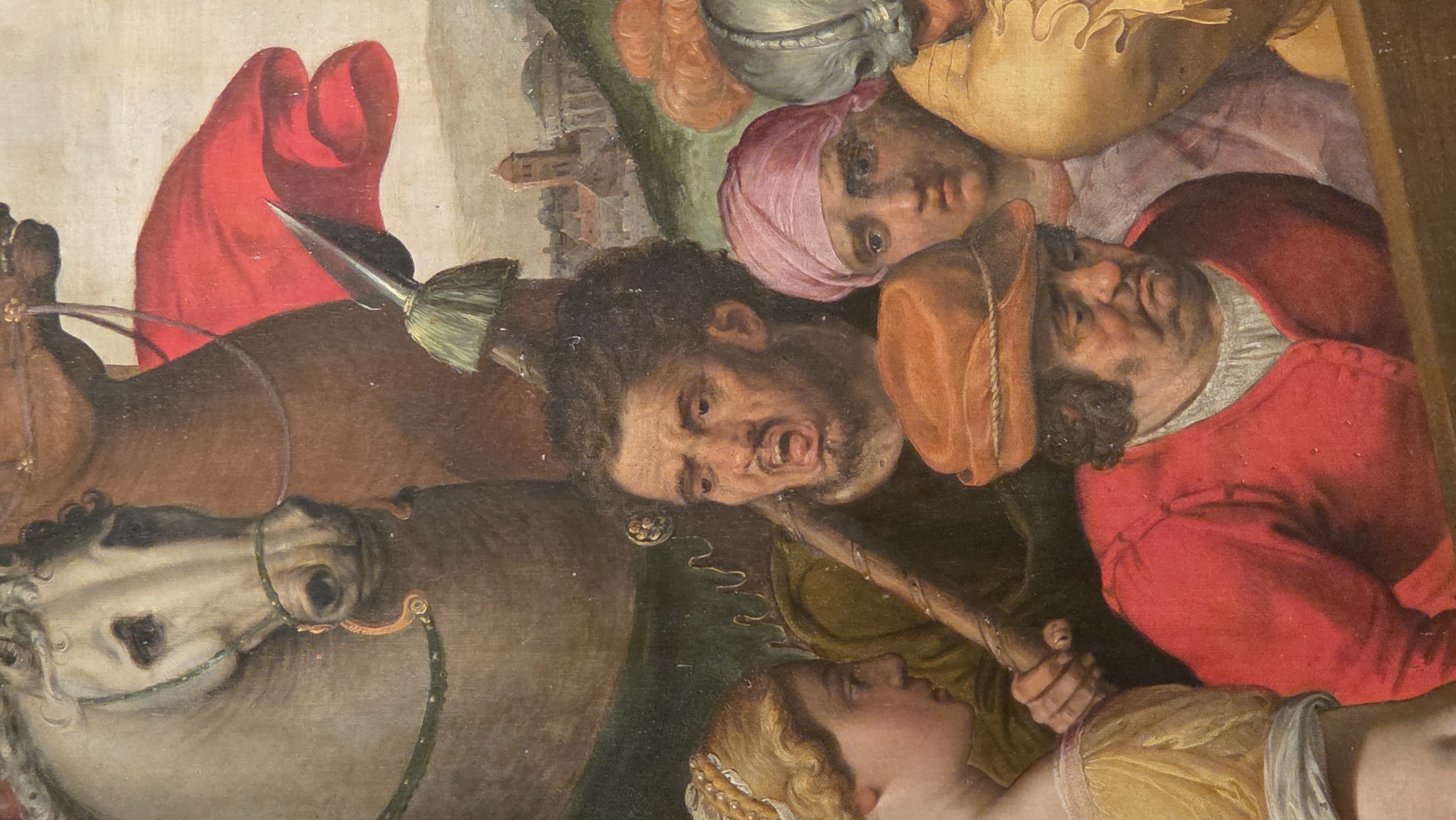
The image is an oil painting depicting a crowded, dramatic scene. The background prominently features the Giralda tower and other historic architecture of Seville, Spain, beneath a pale sky. In the upper left, the head of a white horse with a green bridle is visible, adjacent to the brown body of another horse. A red cloak unfurls behind the brown horse, and a spear with a green tassel is held vertically in the mid-right. The mid-ground and foreground are occupied by several figures. On the far left, a fair-skinned woman with golden, beaded hair and a yellow dress looks rightward. Adjacent to her, a bearded man with dark, curly hair, dressed in an olive-green tunic, shouts with an open mouth while clutching a dark wooden staff. To his right, a person in a pink headwrap looks ahead with a somber expression. A figure wearing a silver-grey helmet-like headpiece and a yellow garment is partially visible on the far right. In the lower foreground, a stout man with dark hair wears an orange cap and a red buttoned jacket over a light shirt, his gaze directed downward with a melancholy demeanor.
Seville, Spain · Mar 27, 2026, 4:47 PM
The image depicts a section of an architectural arcade, likely within a cloister or courtyard, at the Hospital de la Caridad in Seville, Spain. The foreground features a strip of dense green shrubbery. Behind this, a light brown tiled floor extends to a white wall adorned with two prominent ceramic tile artworks. Two classical-style columns with fluted shafts and decorative bases support a series of arches, painted reddish-brown with contrasting white interior edges. Above the arches, the building's facade is also reddish-brown, featuring geometric relief patterns. Centered on the white wall between the columns is a large rectangular tile panel, composed of numerous individual ceramic tiles, depicting the Virgin Mary holding the infant Jesus. Both figures are crowned, with Mary in blue robes and Jesus in yellow/orange, set within an oval border and a rectangular blue and white frame. Directly below this, a longer, narrower decorative tile panel extends horizontally, featuring intricate yellow and blue floral and scroll motifs with small religious figures at its center and ends, framed by a black border. To the right of the main tile panel, several small informational plaques are affixed to the wall, including a larger one with Spanish text discussing a "PROCEDIMIENTO DE RESTAURACIÓN." No individuals are present in the scene.
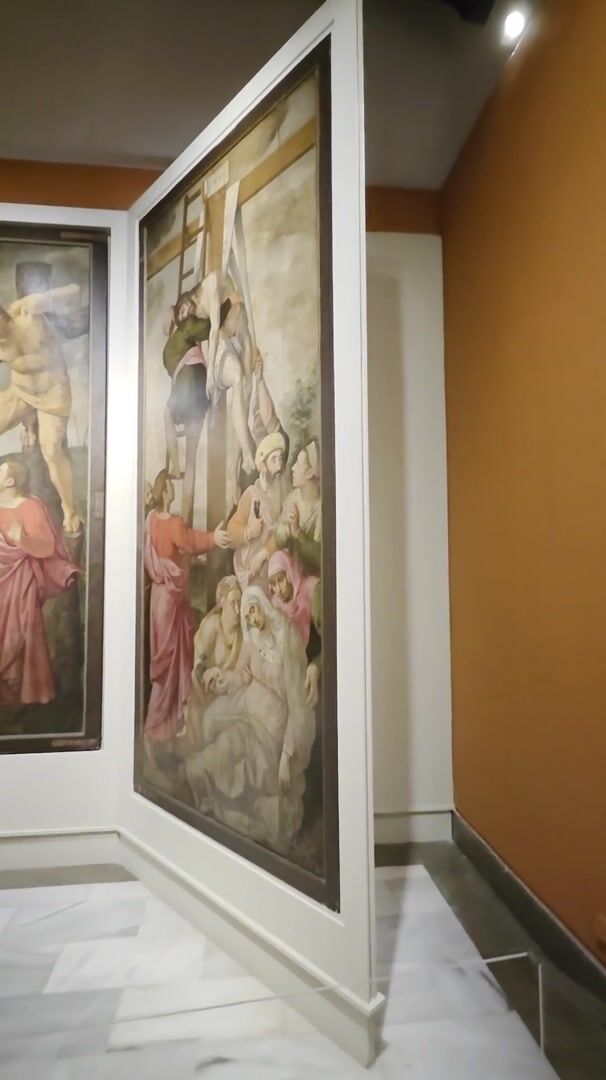
The video shows a display of paintings in a gallery. Two large framed paintings are visible, attached to a structure that allows them to rotate and reveal the paintings on the opposite side. The paintings depict religious scenes with figures in biblical settings. The walls of the gallery are painted white and orange. The floor is covered with white marble tiles. The paintings are well-lit, possibly with spotlights. The focus is on the rotating structure and the display of the paintings.
Durantia
Sevilla, Spain · Mar 27, 2026, 4:49 PM
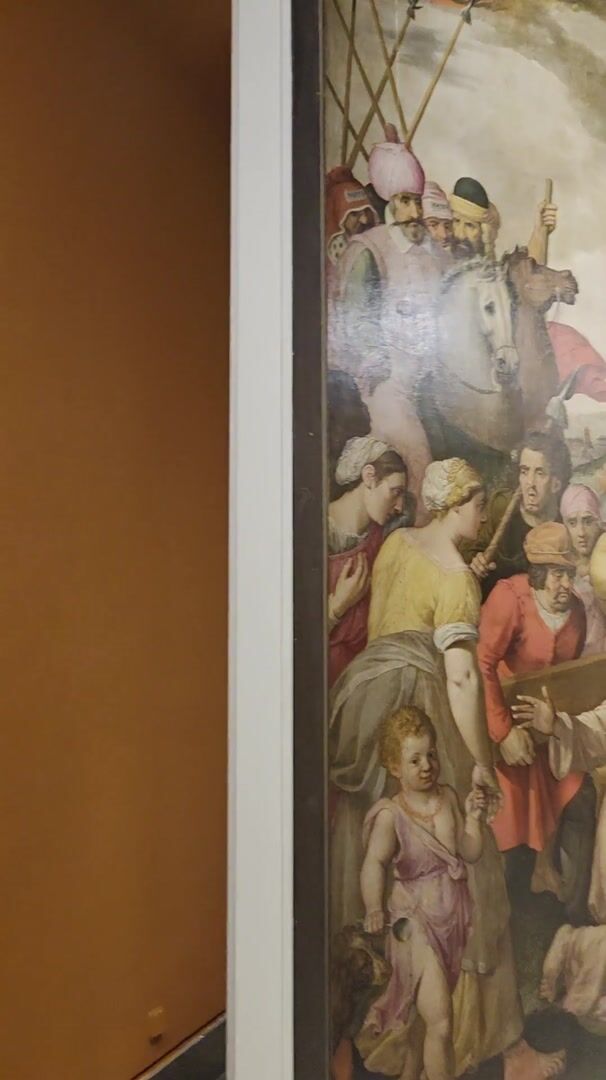
The video shows a close-up view of two paintings on a wall. Initially, the view focuses on a painting depicting a scene with numerous figures, including a man kneeling and carrying a cross. The camera then slowly moves to reveal a second painting to the side. This painting shows a woman holding a baby, positioned in front of a draped curtain and a classical column. The wall is painted in neutral colors.
Durantia
Sevilla, Spain · Mar 27, 2026, 4:50 PM
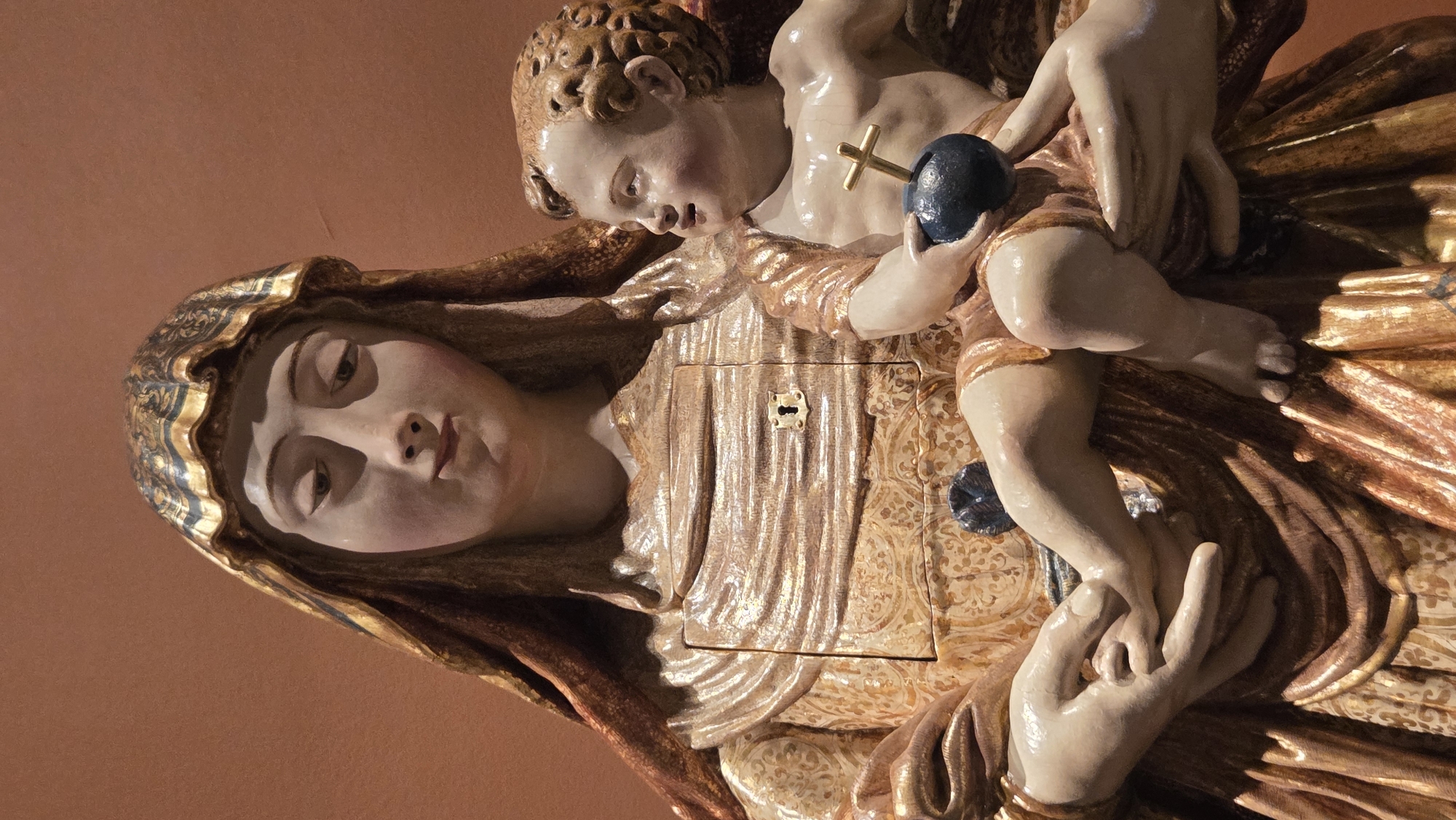
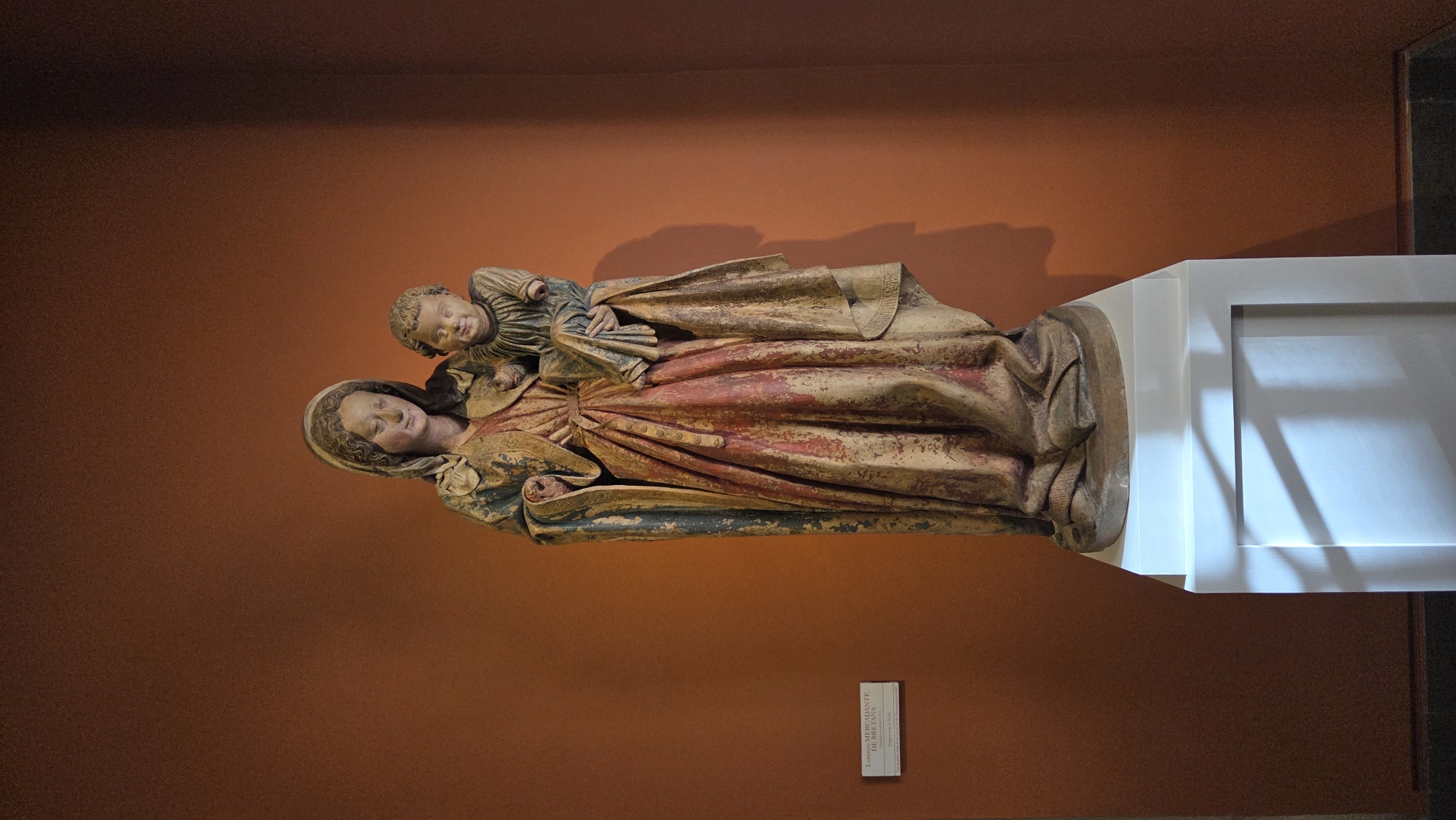
A polychromed wooden statue of the Virgin Mary and Child Jesus is depicted in an indoor setting in Seville, Spain. The Virgin Mary, facing forward with a slight downward gaze, wears elaborate gilded robes with a decorative pattern and a matching hooded mantle with a gold border. Her skin is fair with subtle pink accents on her cheeks and lips. A small, golden keyhole is visible on her chest, suggesting an internal cavity or reliquary. She cradles the Child Jesus, who has fair skin, light brown curly hair, and is nude from the waist up. He holds a dark blue orb surmounted by a golden cross in his left hand and gazes upwards and to his right. The background is a smooth, unadorned reddish-brown wall.
Durantia
Seville, Spain · Mar 27, 2026, 4:50 PM
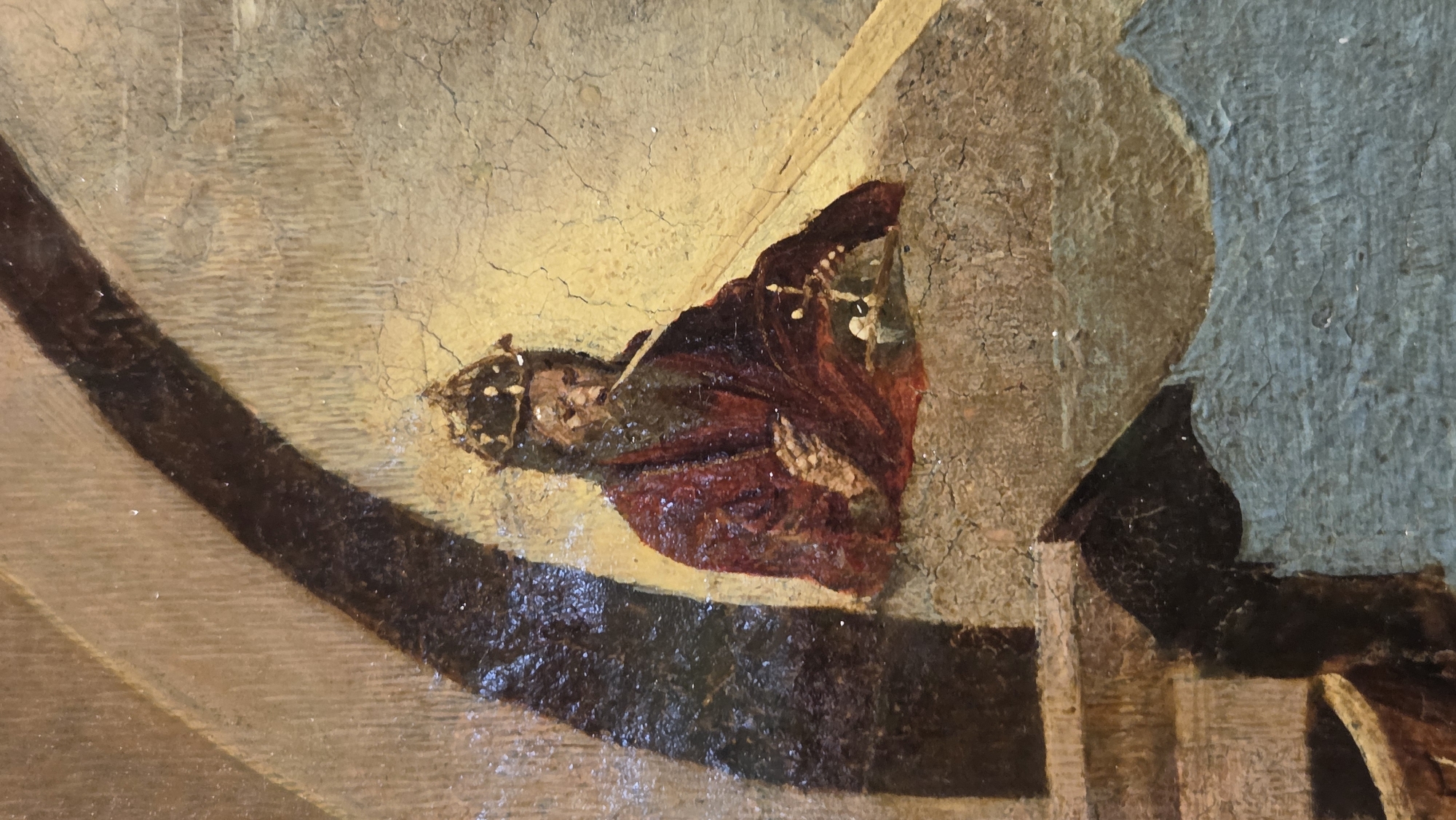
This image is a detailed close-up of a section from the painting "Adoration of the Magi" by Lucas Valdés, located within the Seville Cathedral (Cathedral of Saint Mary of the See) in Seville, Spain. The subject is an elderly male figure identified as King Melchior, depicted with a long, dark beard and wearing a gold-colored crown adorned with small, dark, possibly jeweled elements. He is clothed in a rich, crimson-red robe. The figure is positioned beneath a broad, dark, arched structure, with a textured, light-yellow background exhibiting extensive craquelure, indicating the painting's age. He leans forward over a flat, light-brown surface, likely a table or ledge. His left hand holds a slender, dark, pointed instrument, resembling a compass or stylus, which is directed towards the surface. His right hand is also engaged with the surface. A distinct, diagonal, light-yellow beam or ray of light extends from the upper right portion of the frame towards the instrument and the surface. The lower part of the frame displays indistinct dark and bluish-grey elements.
Durantia
Seville, Spain · Mar 27, 2026, 4:52 PM
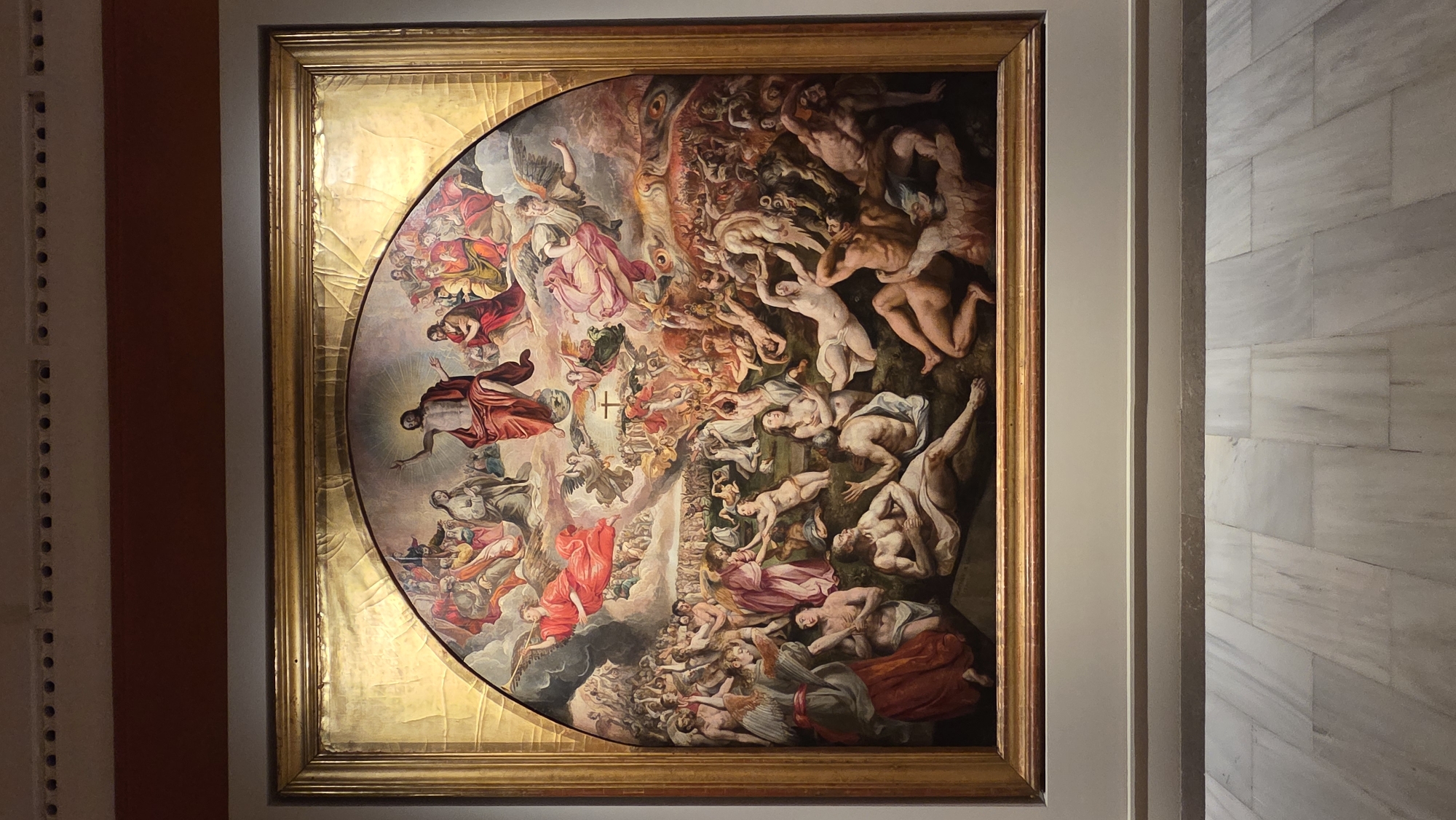
A large, arched oil painting titled "The Last Judgment" by Joaquín Antonio de la Concha is displayed vertically in a gallery within the Museum of Fine Arts of Seville, Spain. The artwork is housed in an ornate, gilded frame. The painting depicts a multi-tiered scene of the Last Judgment. In the upper central section, Christ, cloaked in red, stands with arms outstretched amidst a radiant halo of light and clouds, flanked by saints, apostles, and the Virgin Mary. Angels with trumpets are visible in the middle ground, heralding the event. Below the heavenly realm, a multitude of figures represents the resurrected. On the left side, souls, some clothed and some nude, are shown ascending, guided by benevolent angels towards heaven, exhibiting expressions of hope and relief. On the right side, nude, contorted figures are depicted falling into a fiery, chaotic abyss, tormented by demonic entities, signifying the damnation of souls. The color palette transitions from bright, ethereal tones in the upper section to darker, more dramatic hues in the lower regions, emphasizing the contrast between salvation and damnation. The painting is mounted on a light gray wall. Below the artwork, a light-colored baseboard separates the wall from the floor. The floor is composed of large, rectangular marble tiles exhibiting subtle gray and white veining. Above the painting, a dark reddish-brown horizontal band is visible, featuring a row of small, circular ventilation openings.
Durantia
Seville, Spain · Mar 27, 2026, 4:54 PM
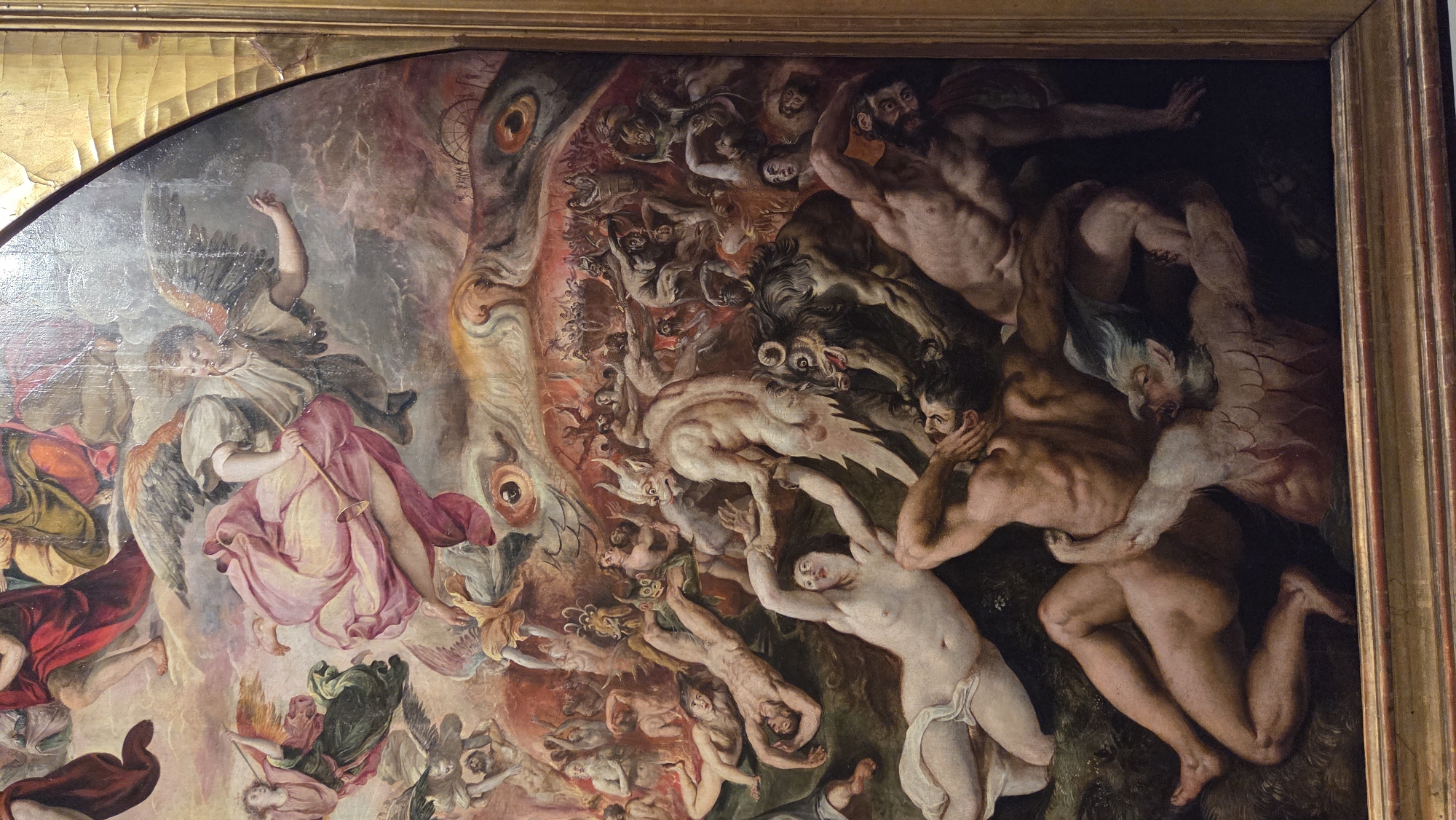
This image depicts *The Last Judgment*, an oil painting by Jacob de Backer, located in the Museo de Bellas Artes de Sevilla in Seville, Spain. The artwork is presented within an ornate, weathered gold frame and is arched at the top. The painting is vertically segmented into distinct realms. The upper section portrays a celestial environment with a light, cloudy sky. Multiple figures, primarily angels and ascending souls, are visible. A central figure, possibly a female angel in voluminous pink drapery, floats mid-air, blowing a long golden trumpet downwards. Another winged angel is seen to the right, while other draped figures in red, olive, and darker tones are partially visible further above. The middle section is dominated by a monstrous, dark, serpentine entity with large, prominent yellow-orange eyes, forming a gaping maw that functions as the entrance to the infernal realm below. Its body shows a textured or scaly surface. The lower two-thirds of the painting depicts a chaotic, densely populated infernal landscape. Numerous nude or partially clothed human figures, representing damned souls, are intermingled with various grotesque demons against a fiery, dark, and cavernous background. * **People (Damned Souls):** Individuals of various ages and builds are shown in states of torment and distress. A pale, nude female lies on her back, reaching upwards with a look of anguish. Muscular male figures struggle, recoil, or cover their faces in despair, being pulled and wrestled by demons. * **Demons:** Diverse demonic entities with bestial features, horns, claws, and wings (both feathered and bat-like) actively engage the human figures. A large, pale, horned demon with expansive bat-like wings and a tail forcefully pulls a human. A dark, lion-headed demon with bared fangs attacks a prone figure. Smaller, imp-like demons with pale or greenish complexions and varied appendages are also observed, some with feathered limbs. * **Actions & Interactions:** Demons are depicted pulling, dragging, wrestling, and inflicting torment upon the human figures. The humans are shown struggling, recoiling, and expressing profound anguish through their contorted postures and facial expressions. The interactions are characterized by violence and subjugation. * **Environment:** The background is composed of dark, fiery tones and indistinct, shadowy forms, suggesting a hellish and oppressive atmosphere of eternal suffering.
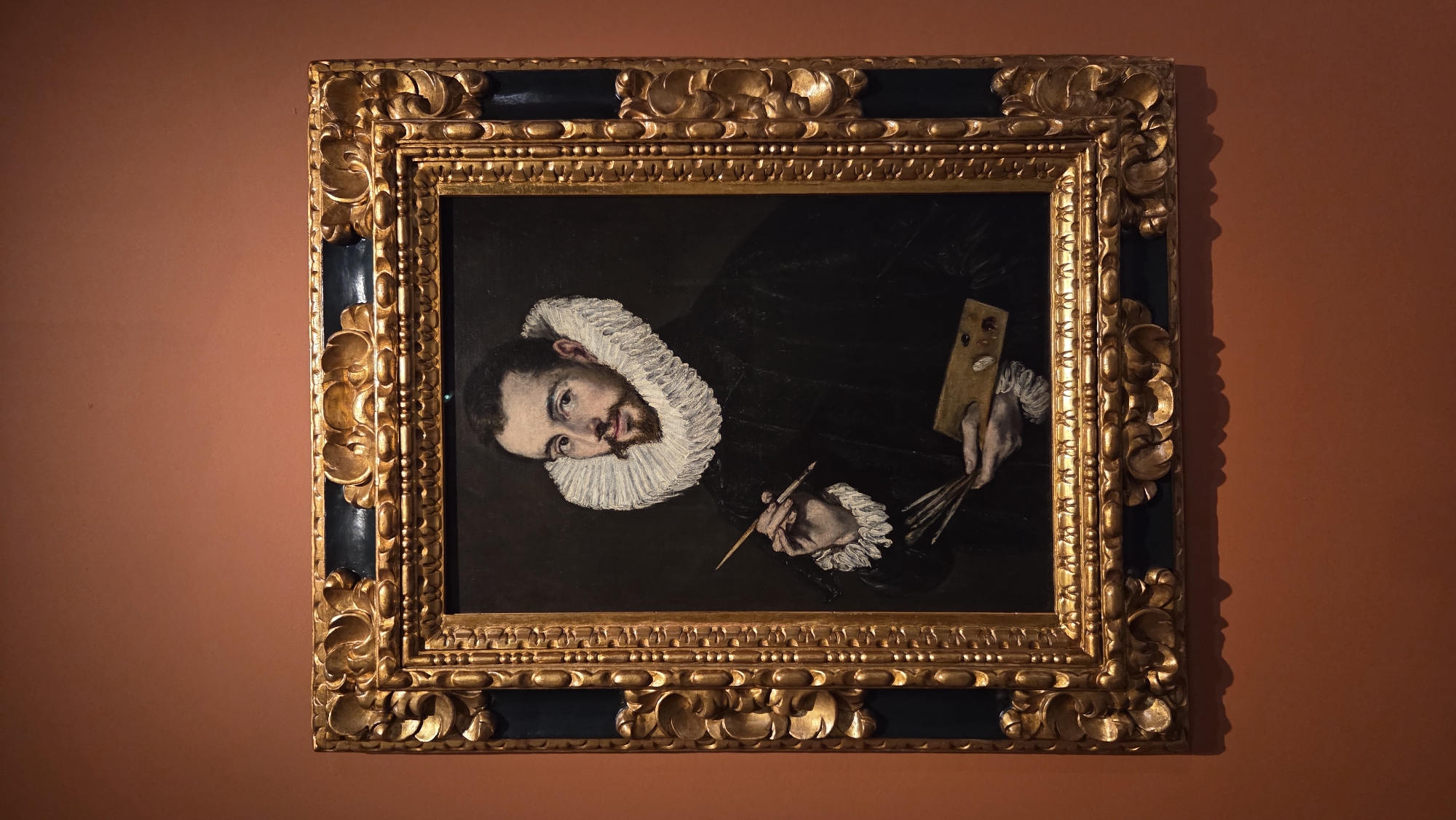
The image displays an oil painting titled "Portrait of an Artist" by Francisco de Herrera the Elder, exhibited in the Museo de Bellas Artes de Sevilla in Seville, Spain. The painting, a half-length portrait, depicts a male figure with dark hair, a neatly trimmed beard, and a mustache, gazing directly forward. He wears a large, pleated white ruff collar over a dark, textured doublet. His right hand holds a fine paintbrush aloft, while his left hand supports a wooden artist's palette with various paint dabs and several brushes. The painting's background is uniformly dark. It is encased in an elaborate gilded frame featuring dark blue trim and ornate carved motifs, suspended on an unadorned, reddish-brown wall. A subtle shadow is cast beneath the frame.
Durantia
Seville, Spain · Mar 27, 2026, 4:58 PM
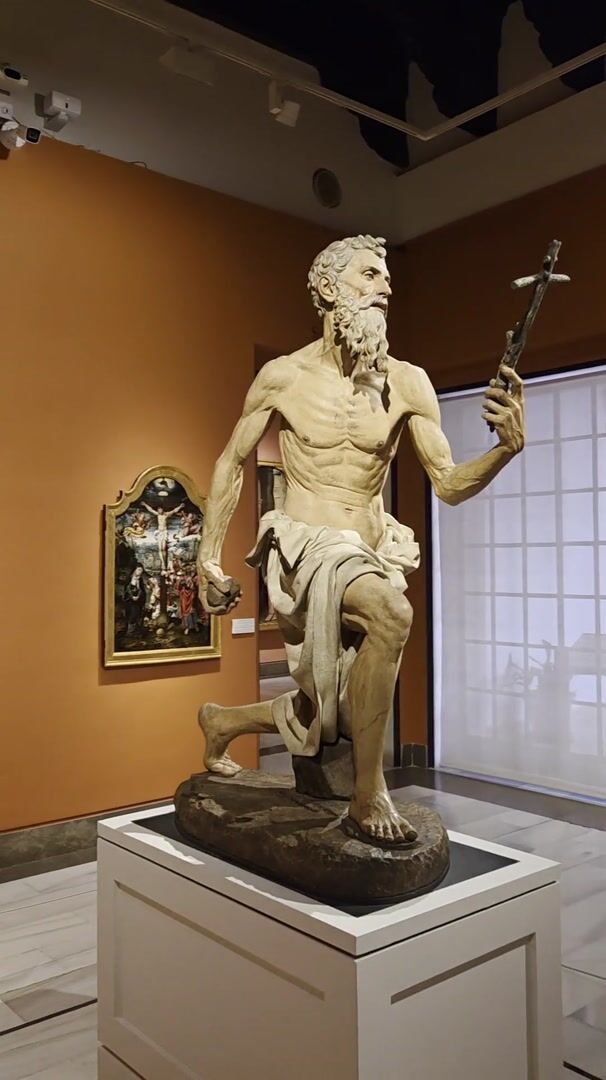
The video shows a statue of a man holding a cross in a museum. The statue is of a bearded, muscular man, kneeling on a rocky base. He is partially draped in a white cloth and holds a cross in his right hand. The museum walls are painted a warm orange color. Behind the statue, there are paintings on the wall and a doorway leading to another room. The room is lit by spotlights on the ceiling. The statue is on a white pedestal, and the floor is made of light gray stone tiles.
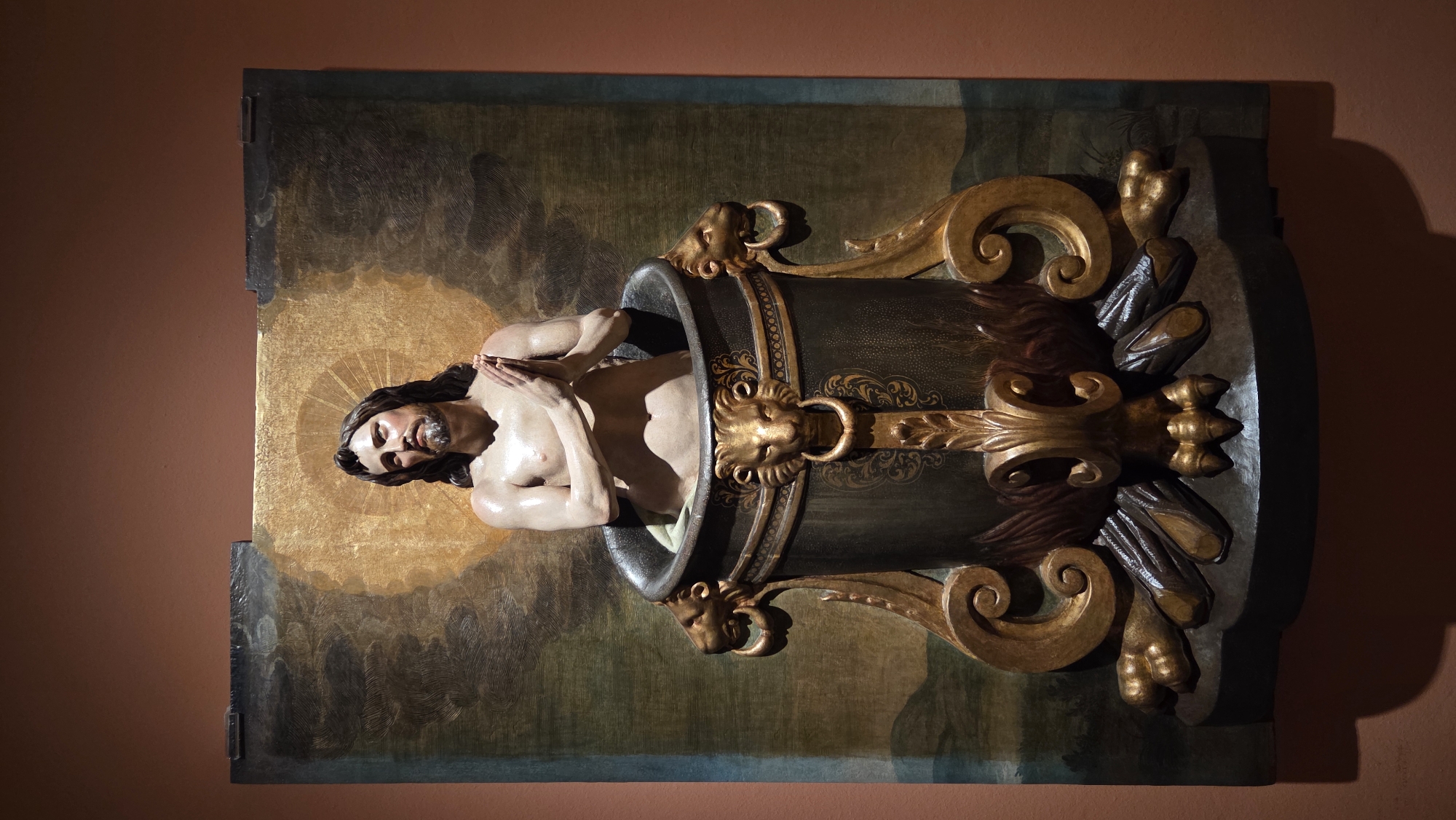
A polychromed wooden sculpture, depicting Jesus Christ as the Man of Sorrows, is presented against a dark, textured painted panel. The figure of Christ, half-naked with long dark hair and a beard, looks upwards with a pained expression, his hands clasped in prayer at chest level. His skin exhibits a subtle sheen. He is partially submerged in a large, dark, ornate cauldron. This vessel is richly embellished with gold-colored decorative elements, including prominent three-dimensional lion heads with rings in their mouths, intricate scrolling acanthus leaf patterns, and stylized clawed feet at its base. The cauldron's dark surface features a stippled texture. Behind Christ's head, the painted backdrop displays a prominent golden, radiating halo or sunburst. The artwork is illuminated, casting a soft shadow on a plain reddish-brown wall. This sculpture is located in the Convento de Santa Paula, Seville, Spain.
Seville, Spain · Mar 27, 2026, 5:03 PM
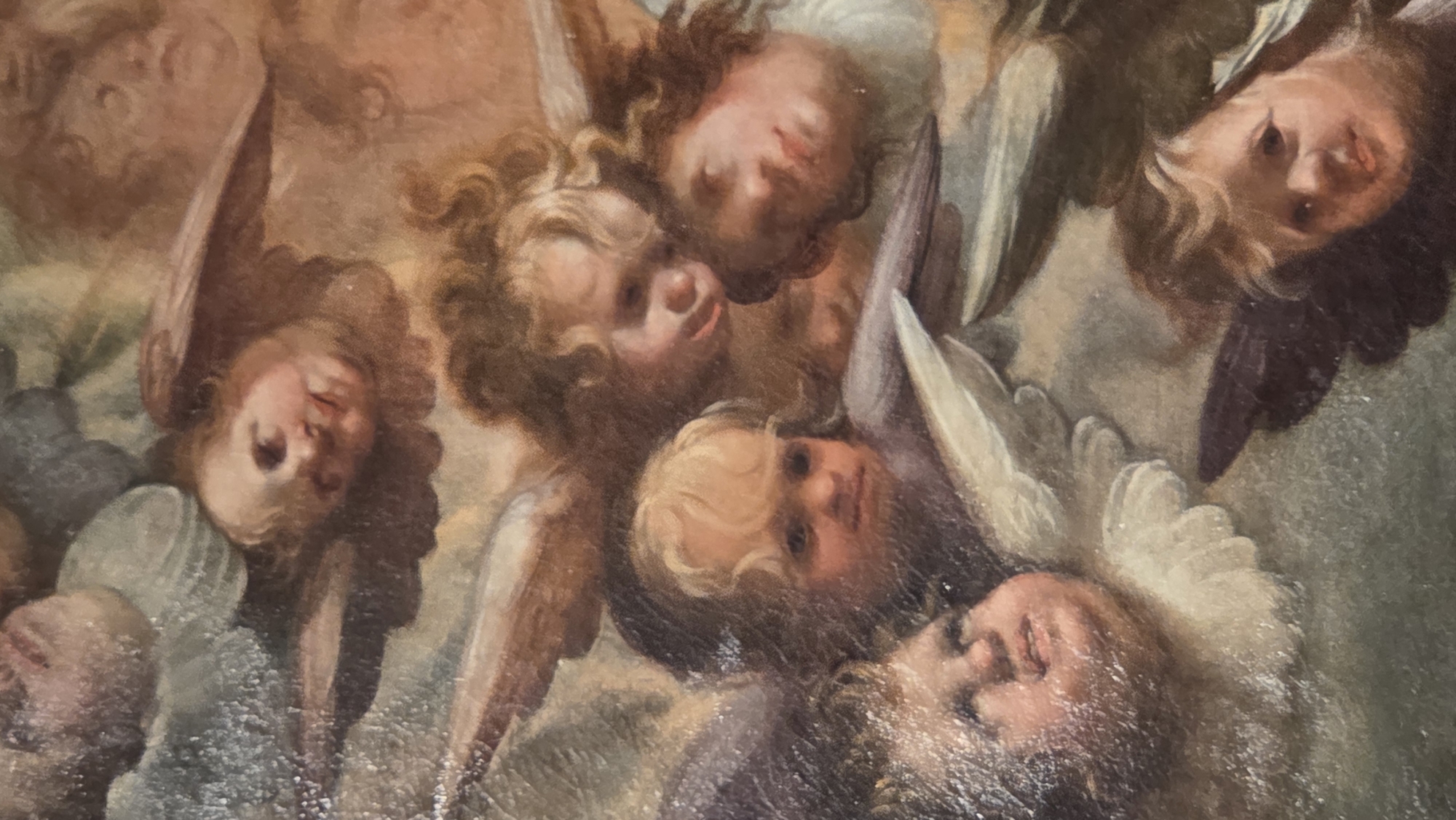
This image is a detailed vertical crop of an oil painting depicting a cluster of cherubic figures (putti or child angels) in a celestial environment. The painting, characteristic of the Baroque style, displays a soft, muted color palette dominated by creams, light browns, pale blues, and purplish-greys, with warm flesh tones for the figures. Visible brushstrokes and minor surface cracking indicate the age and medium of the artwork. Approximately seven distinct cherub faces are discernable within the frame, arranged in an overlapping, dynamic composition. Each figure has youthful features, often with rosy cheeks and varying shades of curly hair (blonde to dark brown). Most figures exhibit a serene or contemplative expression, with eyes gazing in different directions – some upwards, some directly out of the frame, and others softly downwards. Several sets of feathered wings, rendered in shades of cream and brown, are visible, suggesting the figures are in flight or floating amidst clouds. The background is an indistinct, cloud-filled sky, giving a sense of depth and ethereal space. This detail is from Bartolomé Esteban Murillo's painting *Immaculate Conception* (also known as *The Immaculate Conception of Los Venerables* or *Soult's Immaculate Conception*), originally commissioned for the chapel of the **Hospital de los Venerables** in the city of Seville, Spain.
Durantia
Seville, Spain · Mar 27, 2026, 5:04 PM
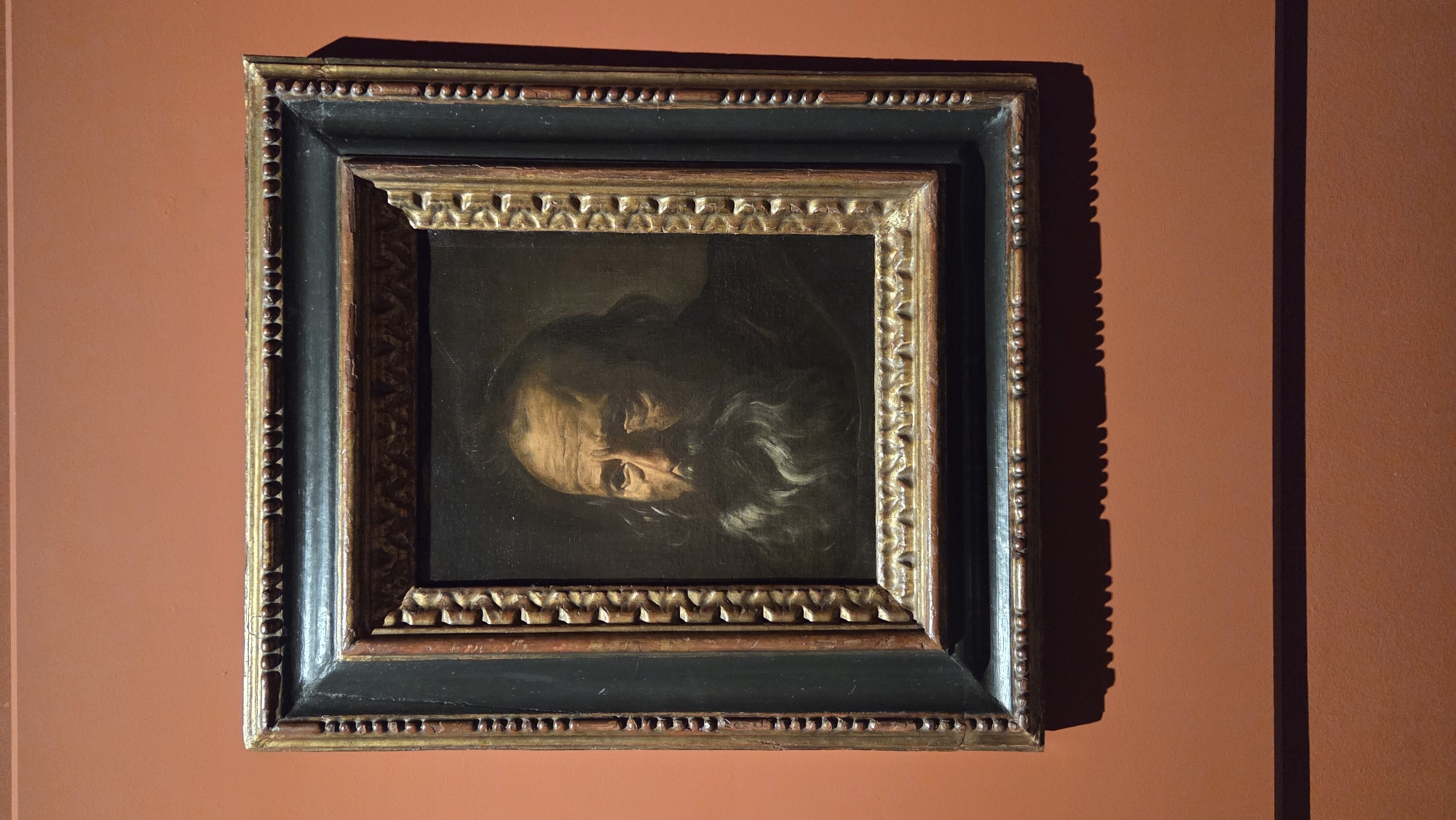
A rectangular oil painting titled 'Saint Paul (San Pablo)' by Diego Velázquez is centrally mounted on a rust-orange wall inside the Museo de Bellas Artes de Sevilla, located at Plaza del Museo, 9, 41001 Sevilla, Spain. The portrait features a bust-length depiction of an elderly man with a balding head, a prominent nose, and a long, flowing white beard. His head is turned slightly to the viewer's left, and his gaze is directed forward. The man's face is illuminated from the upper left, creating deep shadows on the right side of his face and under his brow, nose, and beard. The painting's background is a dark, indeterminate brown, contrasting with the subject's illuminated features. The artwork is housed within an ornate, multi-layered wooden frame. This frame comprises an inner gilded band with a repeating geometric pattern, a wider dark-colored (possibly black) molded section, and an outer gilded band embellished with a continuous beaded relief. The frame exhibits visible signs of age and minor surface wear. Illumination sources cast a distinct, serrated shadow from the top and sides of the frame onto the wall, accompanied by a fainter horizontal linear shadow positioned lower on the wall.
Durantia
Seville, Spain · Mar 27, 2026, 5:05 PM
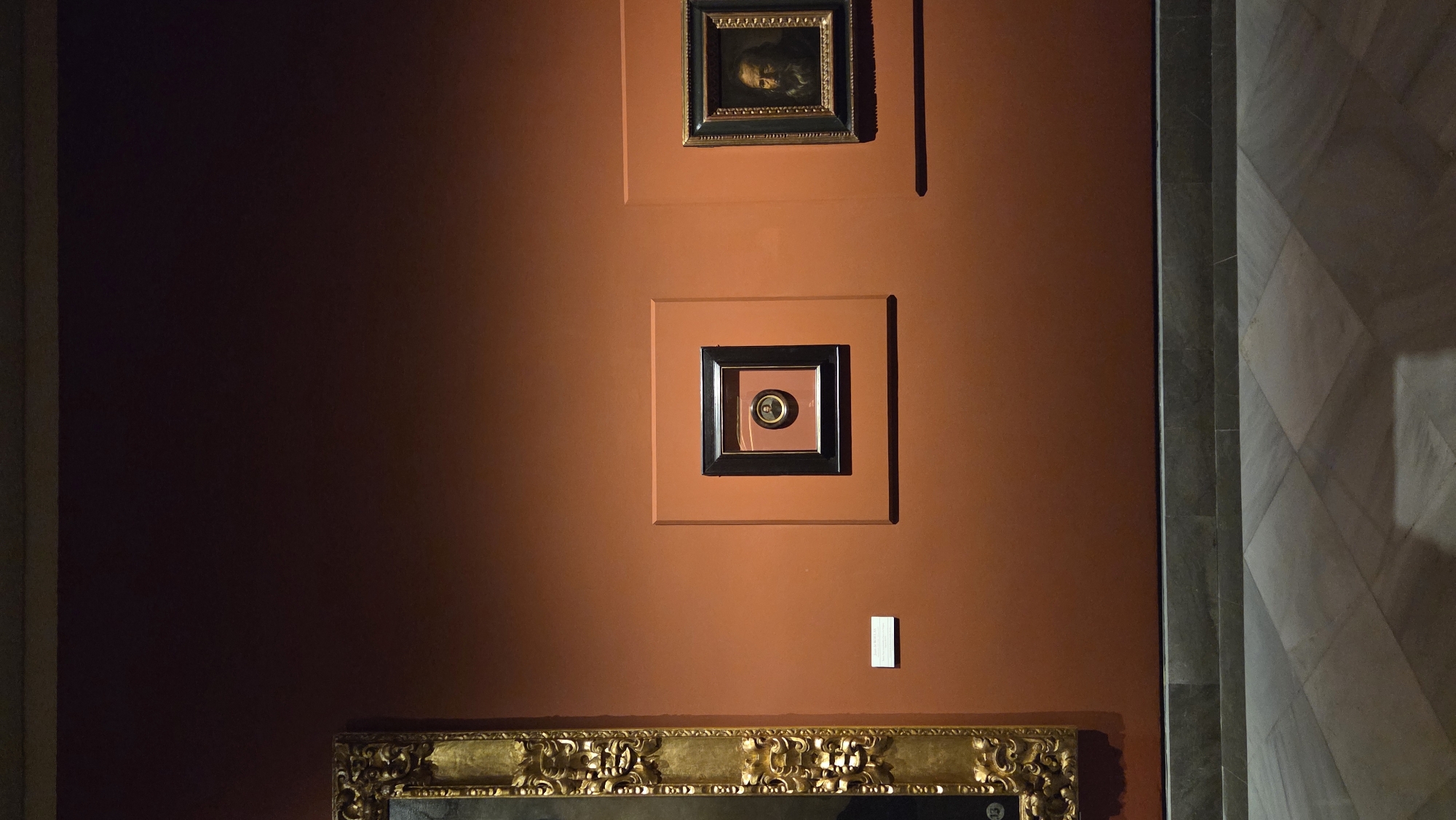
The image displays an interior view of a gallery within the Museo de Bellas Artes de Sevilla, Spain. The walls are painted a uniform terracotta or burnt orange color. The floor consists of large, light-colored square marble tiles laid in a diagonal, checkered pattern, bordered by a dark grey baseboard. Three framed artworks are visible on the wall. On the far left, a portion of a large, highly ornate gold-gilded frame is visible, showing intricate decorative carvings. Centrally, a small, circular miniature portrait is showcased within a black rectangular frame, which is mounted on a larger, square, terracotta-colored panel protruding from the wall. Below and slightly to the left of this central display, a small white rectangular informational plaque is affixed to the wall. To the right, another rectangular portrait is displayed in a dark frame with potential gold accents. This painting depicts an older man with a beard, facing to the viewer's left, rendered in a classical style against a dark background. This artwork is also mounted on a square panel of the same wall color, subtly protruding. No people or actions are depicted in the scene; it is a static display of museum exhibits.
Durantia
Seville, Spain · Mar 27, 2026, 5:06 PM
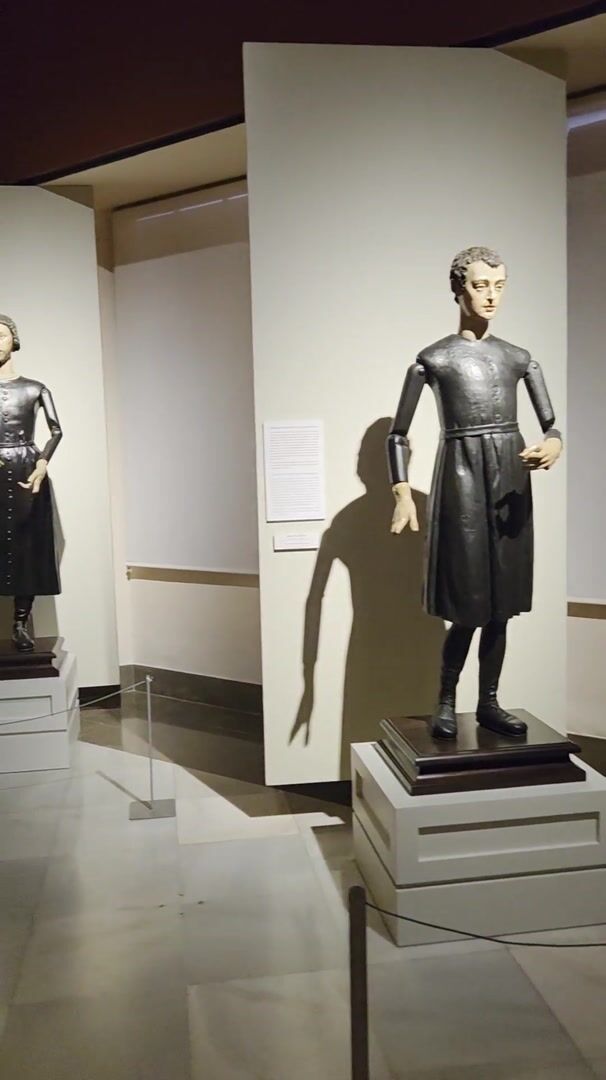
The video shows two statues of men in an art museum. The statues are dark-colored and stand on individual platforms, and are separated by white walls. The camera pans from right to left, showing the second statue and then the first. Ropes surround the statues. Informational plaques hang on the walls behind the statues. The floor is shiny and reflects light.
Durantia
Sevilla, Spain · Mar 27, 2026, 5:06 PM
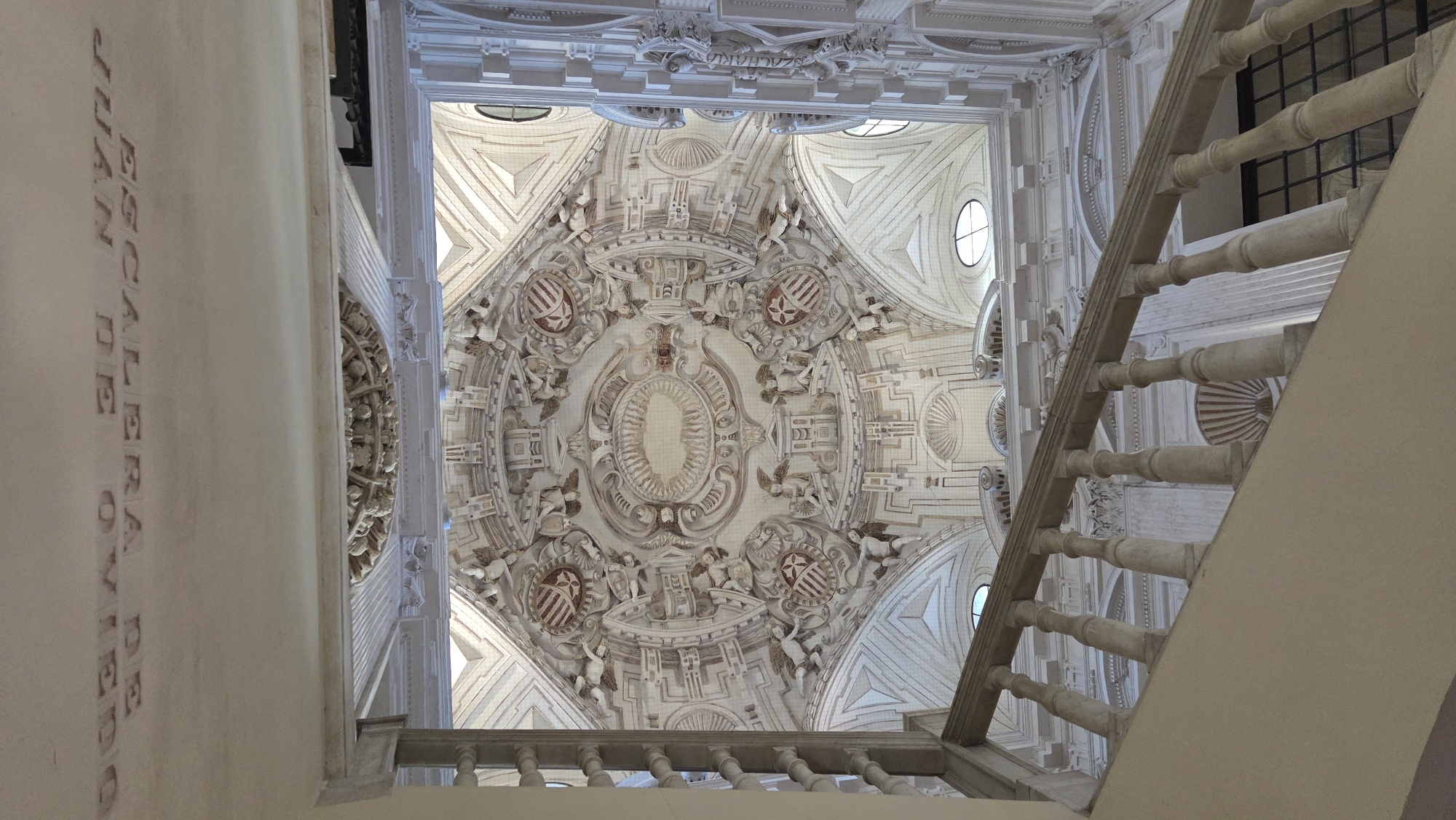
The image displays an upward view of the highly ornate Baroque ceiling and a section of a staircase balustrade inside the Hospital de los Venerables in Seville, Spain, specifically depicting the Escalera de Juan de Oviedo. The dominant feature is the intricately detailed ceiling, rendered in off-white, cream, and light beige stucco, accented with reddish-brown elements on heraldic crests. It comprises a large central oval medallion surrounded by concentric rings of elaborate decorative relief, including numerous sculpted winged cherubim and several shield-shaped crests featuring vertical striped patterns. The ceiling incorporates vaulted sections and various architectural motifs such as shell designs and pilasters, with multiple oval windows allowing natural light to illuminate the space. An inscription in capital letters, "ESCALERA DE JUAN DE OVIEDO," is visible on a flat ceiling section in the upper part of the frame. In the lower left and mid-right, a section of a light-colored, probably stone, balustrade with several classically-designed balusters ascends diagonally, indicating the presence of a grand staircase. No individuals are present.
Durantia
Seville, Spain · Mar 27, 2026, 5:10 PM
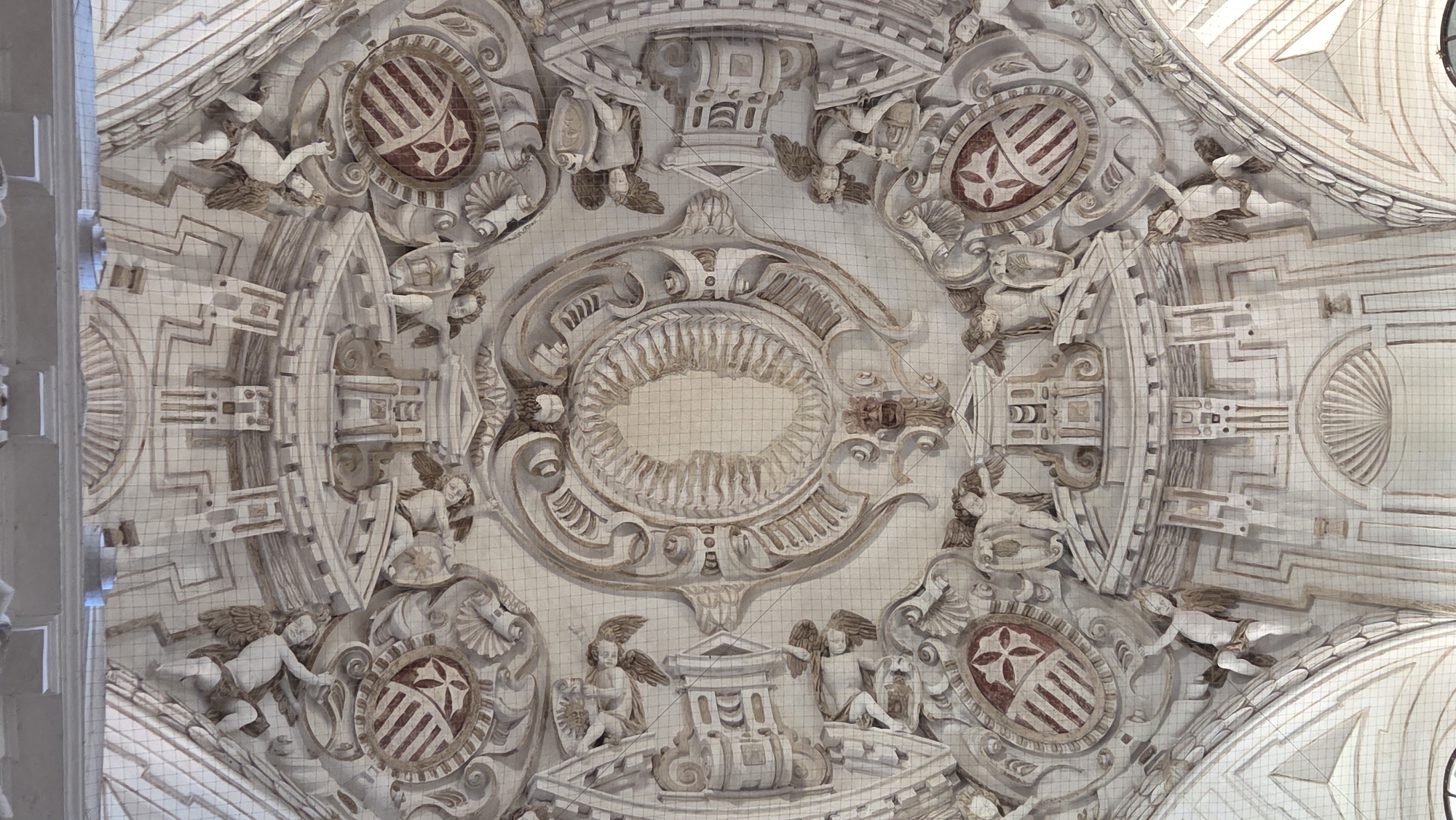
The image displays a highly ornate Baroque-style stucco ceiling, specifically identified as being within the Church of San Jorge at the Hospital de la Caridad in Seville, Spain. The ceiling features intricate white and off-white relief sculptures with subtle brownish accents, particularly on the heraldic elements. A central oval-shaped void, surrounded by elaborate decorative framing, dominates the composition. Flanking this central element are numerous winged putti or cherubs in various poses, some seemingly supporting architectural structures or holding objects like urns or shields. Four prominent circular shields, or coats of arms, are symmetrically arranged, each featuring distinct patterns: two display five red vertical stripes on a lighter background, while the other two show a stylized cross or star design on a similar striped background, all within decorative cartouches. The ceiling is further adorned with architectural motifs including arcades, cornices, balustrades, shell designs, and volutes. Grotesque masks are integrated into the lower sections of the central ornamentation. A fine, grid-like protective netting covers the entire decorated surface, indicating preservation measures. The overall impression is one of dense, sculptural embellishment executed with elaborate detail.
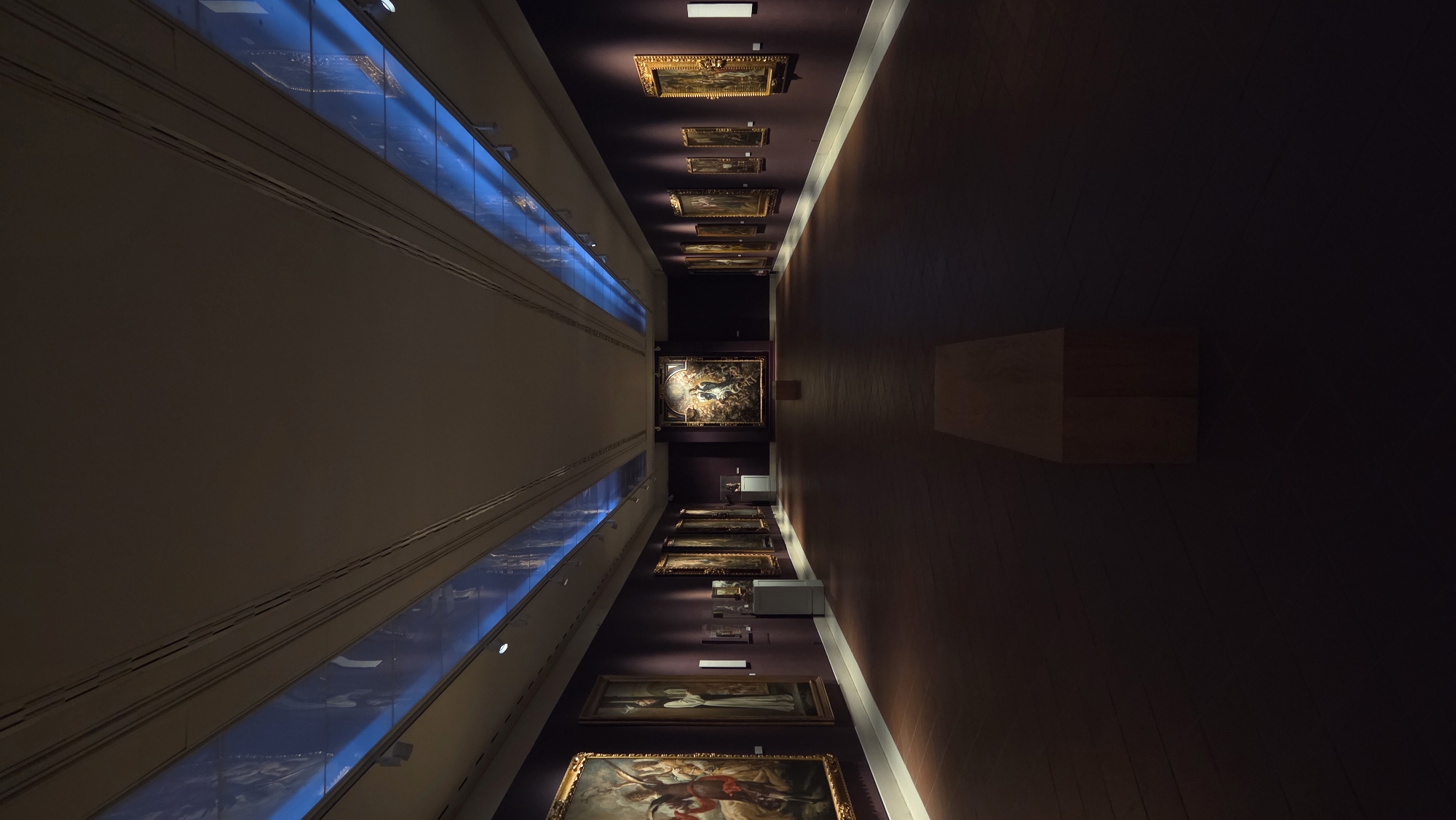
The image depicts an empty art gallery hall within the Museo de Bellas Artes de Sevilla, located in Seville, Spain. The long, symmetrical hall features walls painted a deep plum or dark purple. The floor is composed of dark reddish-brown tiles, laid in a rectangular pattern. The high, light-colored ceiling incorporates two elongated, recessed panels running lengthwise, illuminated with a distinct blue light, creating an atmospheric effect. Beneath these panels, track lighting fixtures are directed towards the artworks. Numerous oil paintings, primarily of Baroque style with ornate gold frames, are hung along both walls. Subjects appear to be religious or historical, featuring multiple figures. A particularly large, elaborately framed painting depicting a complex religious scene, possibly an Assumption or Immaculate Conception, is centrally positioned at the far end of the gallery. In the foreground, a rectangular, light-brown wooden bench is situated in the middle of the tiled floor, aligned with the length of the hall. Additionally, several light-colored pedestals are visible along the walls, displaying smaller, indistinct objects or sculptures. No individuals are present in the scene.
Durantia
Seville, Spain · Mar 27, 2026, 5:13 PM
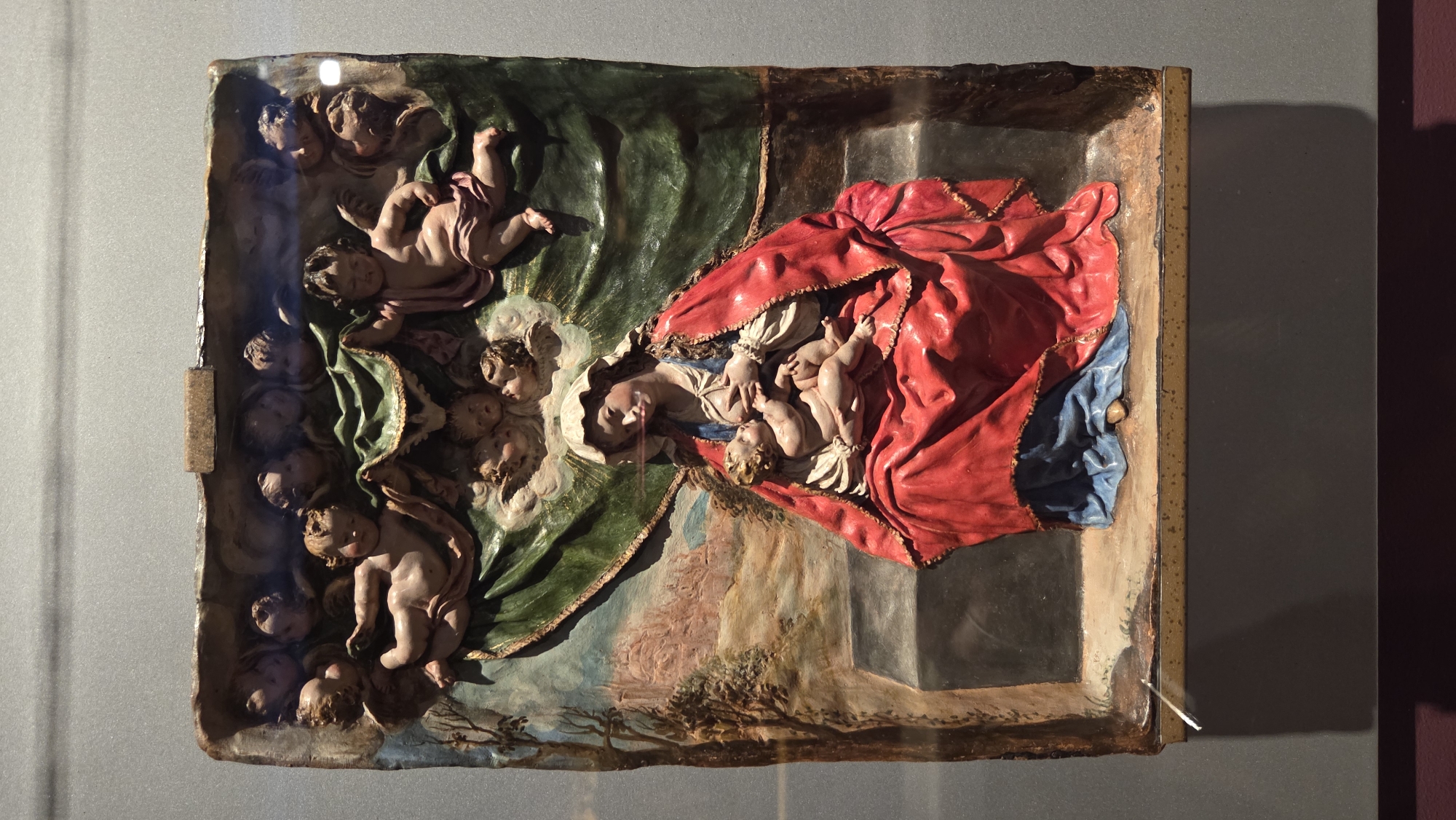
This image depicts the polychrome sculpted relief panel "Virgen de la Leche" (Virgin of the Milk) by Cristóbal de Morales, dating from approximately 1560, located in the Museo de Bellas Artes de Sevilla (Museum of Fine Arts of Seville), Spain. The artwork, vertically oriented, features a central seated female figure, identified as the Virgin Mary, in the lower portion. She wears a white head covering, a dark blue garment, and a voluminous red robe with gold trim. Her left hand supports an unclad infant, identified as Jesus, who is actively breastfeeding from her exposed left breast. The female figure is seated on a simple, dark rectangular plinth. To her left, a painted landscape background displays a bare tree, rolling hills, and a distant architectural structure. Above the central figures, eight light-skinned, unclad putti/cherubs are distributed. Two larger putti are prominent, reclining on either side, partially covered by a dark green, gold-trimmed draped fabric that functions as a canopy. Four smaller putti emerge from clouds below this canopy, gazing downwards. The relief exhibits deep carving, distinct polychrome coloring in red, green, blue, and flesh tones, and signs of age-related surface wear. The panel is presented in a museum environment against a plain grey wall, visible through a reflective glass or acrylic display barrier.
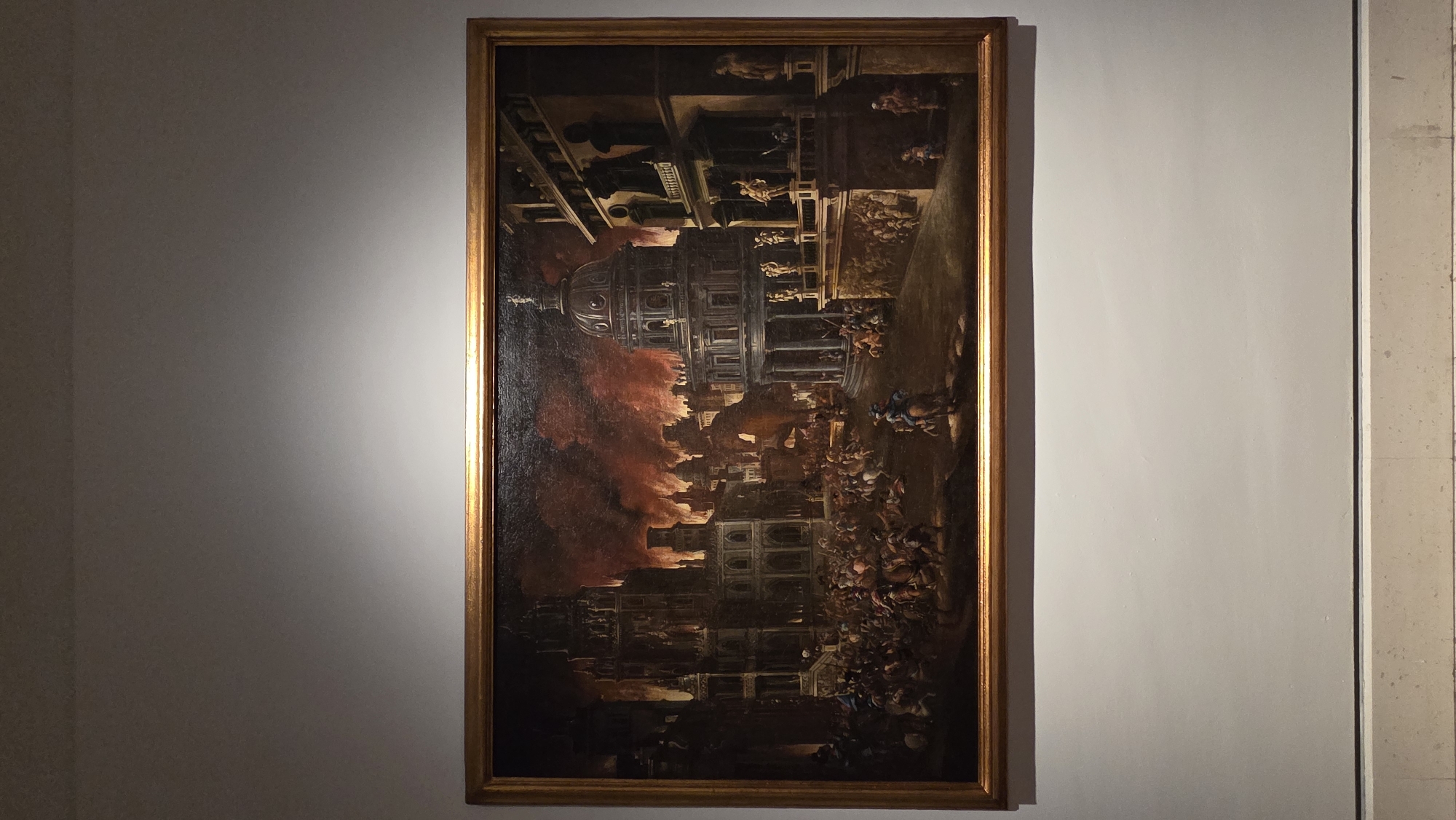
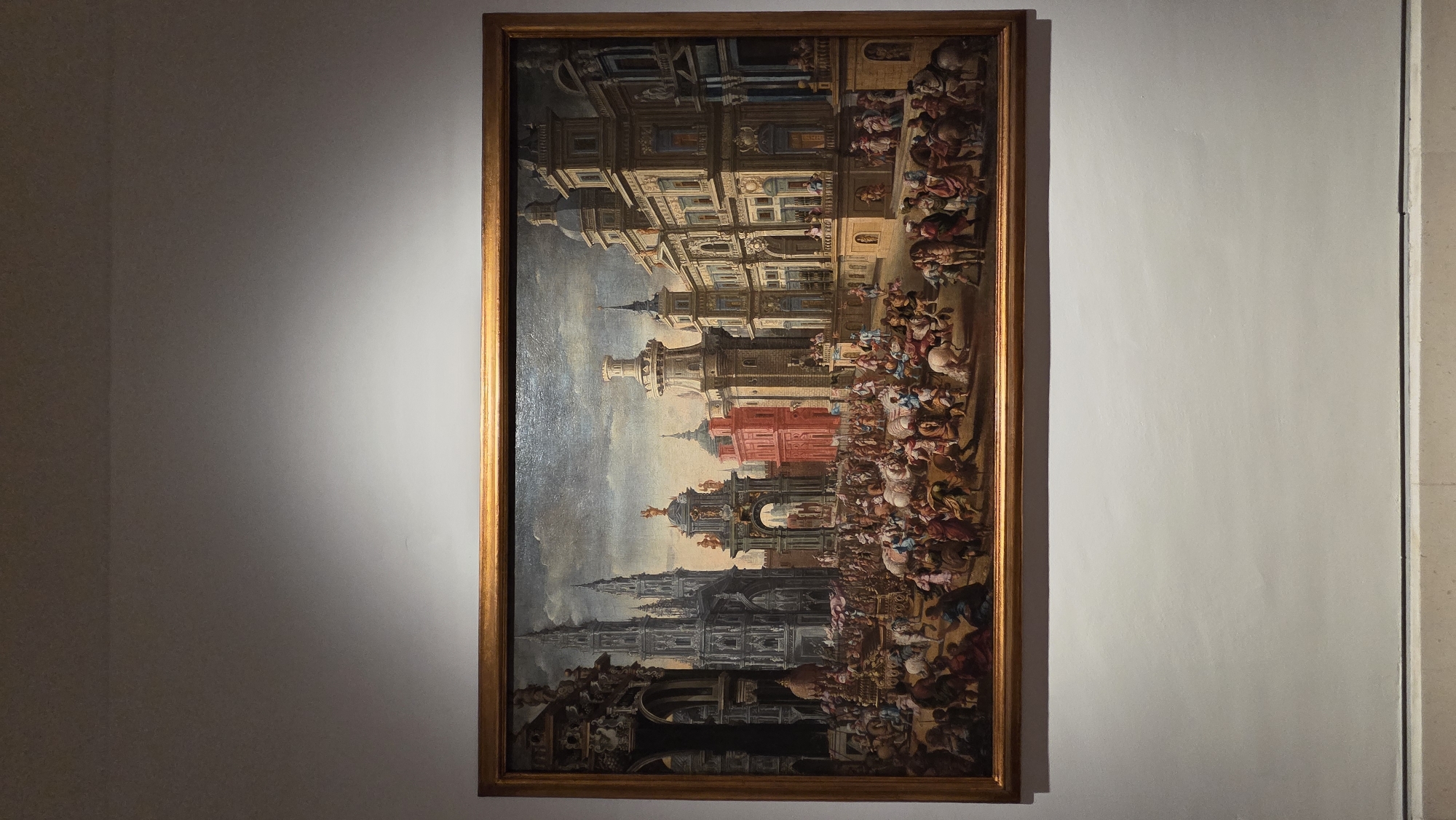
This image displays a framed oil painting, identified as "The Fire of Rome" by Antonio Joli, housed within the Museo de Bellas Artes de Sevilla, Spain. The painting depicts a chaotic, destructive cityscape dominated by a massive fire. Numerous classical stone buildings, including a prominent domed structure with a colonnaded portico on the right-center and a tall, multi-story building with arcades on the left, are engulfed in extensive orange and red flames, producing dense smoke that obscures the sky. The foreground and midground are filled with a tumultuous multitude of small figures, both individuals on foot and groups on horseback, engaged in flight, struggle, or observation amidst the burning city. A central figure on a light-colored horse is prominently positioned in the lower midground, seemingly observing the devastation. On the right, a raised architectural platform or balcony features several figures, some resembling statues and others human observers. The painting is enclosed within a wide, ornate gold-colored frame and mounted centrally on a plain light gray wall, illuminated by ambient gallery lighting.
Seville, Spain · Mar 27, 2026, 5:17 PM
29
Memories1
Contributors2
Topics
Visitors tour historical museum exhibits in Altura, Spain
Altura, Spain · 1 memories
Underground cave structure with religious artwork documented in Altura
Altura, Spain · 6 memories
Peaceful afternoon scenes captured along Seville's Guadalquivir River
Sevilla, Spain · 5 memories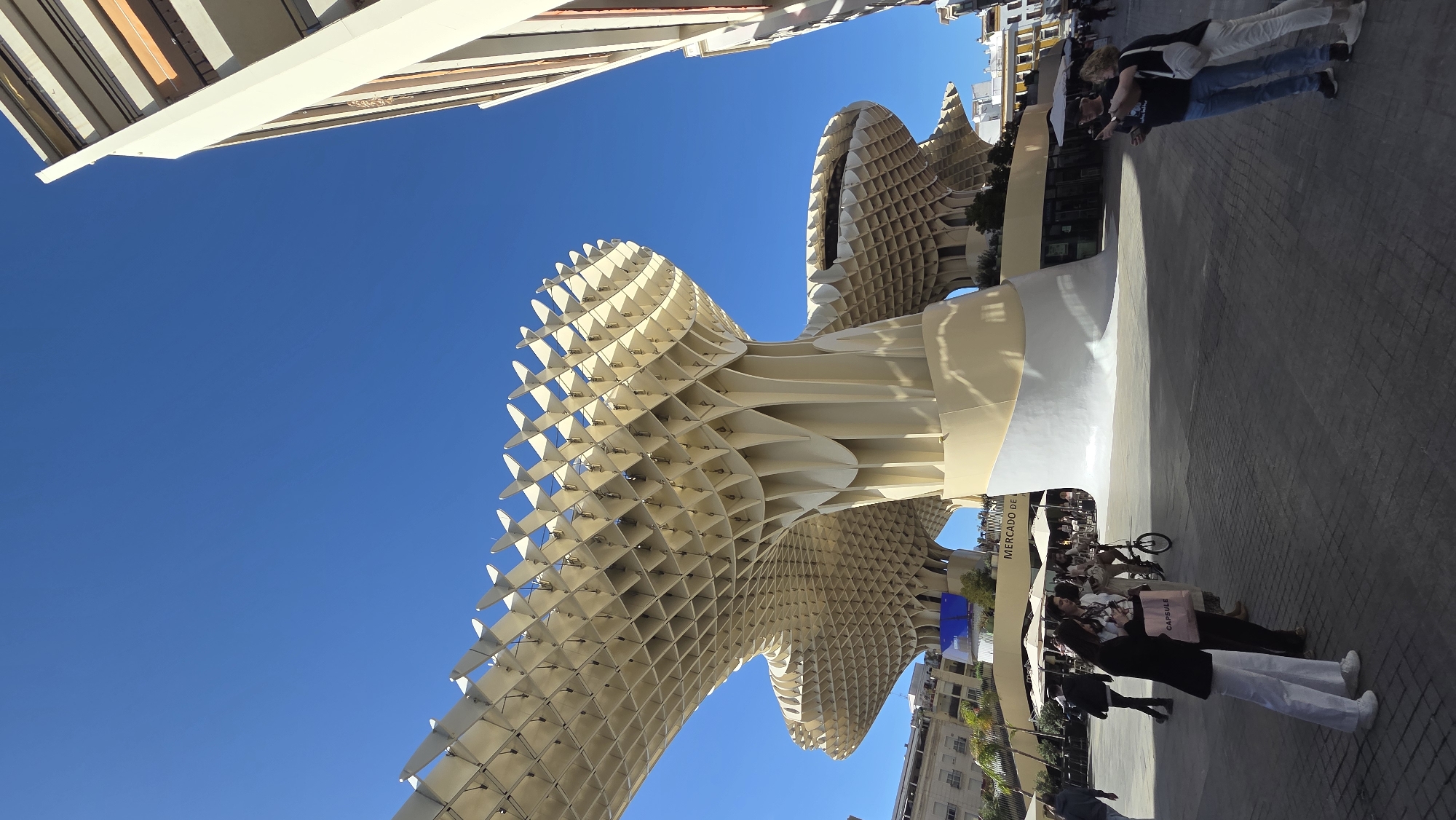
Afternoon documentation of central Seville landmarks and streetscapes
Seville, Spain · 5 memories