Untitled Story

Tuesday, July 14, 2026 · Updated Tuesday, July 14, 2026
 Eindhoven, Netherlands
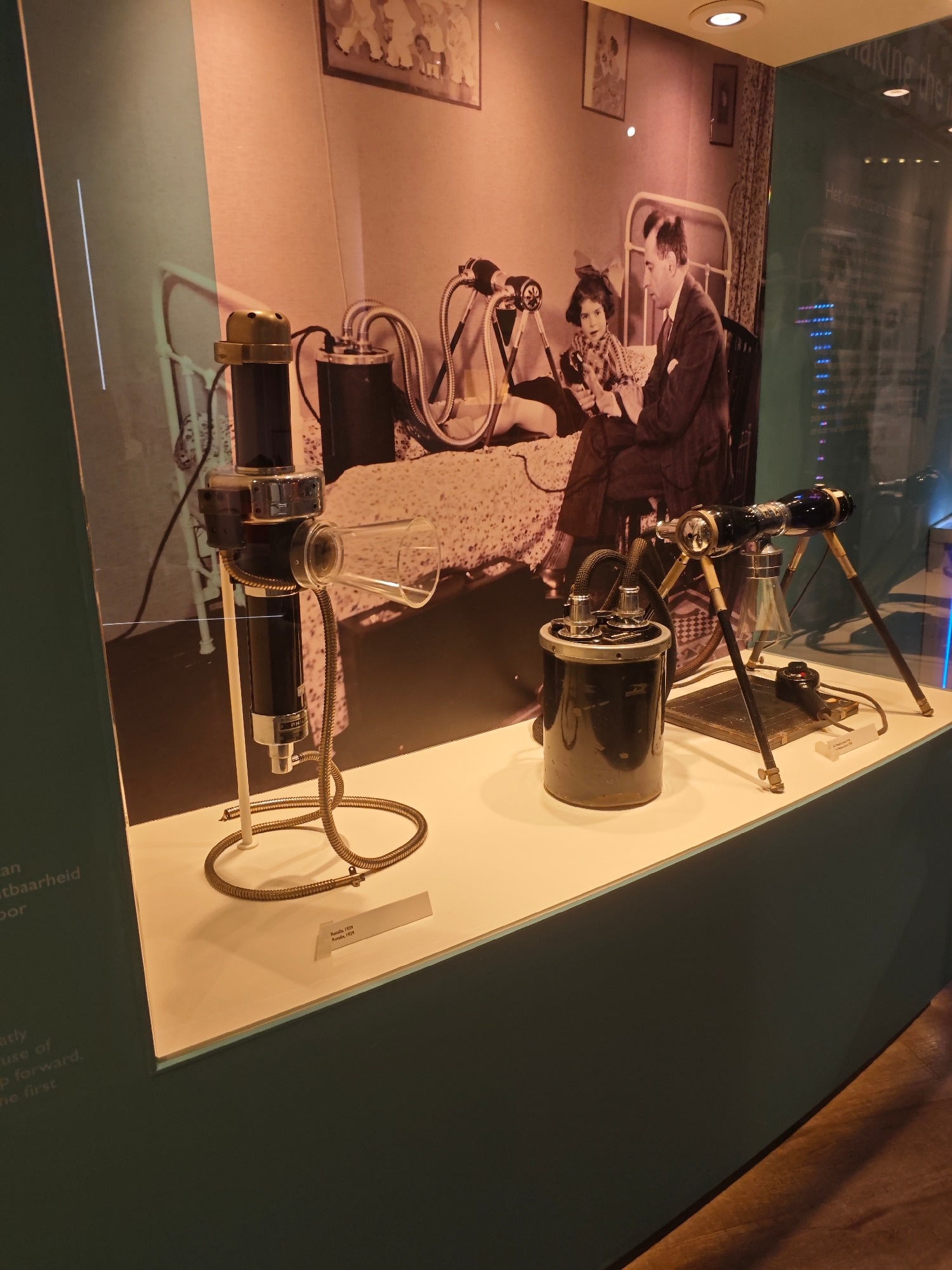
This image shows an exhibit inside a museum. The exhibit features historical medical equipment displayed on a white platform in front of a large photograph of a man and a child in a bedroom setting. The man is seated next to the child, who is sitting on a bed. The photograph appears to be from the early to mid-20th century. In the foreground, there are two distinct pieces of medical equipment. On the left is a tall, black and silver device with a brass cap and a glass funnel at the top, connected by a flexible metal hose to a smaller black cylinder at its base. On the right, there is another apparatus with a black cylindrical base, and a tripod-like stand supporting a glass tube with a light source inside. This device is also connected to the base via hoses. A small label is visible beneath the equipment on the right, which reads "Revox; 1939; Ronden, 1939." The background photograph depicts a room with a metal-framed bed, a window with curtains, and framed pictures on the wall. The lighting in the exhibit is warm and focused, highlighting the objects on display. The overall environment suggests an educational display about the history of medicine. The text on the left side of the image, partially visible, is in Dutch and discusses "vatbaarheid" (susceptibility) and "vooruit" (forward). The text on the upper right, also in Dutch, is cut off but appears to be part of a title related to "making the in" and "Het onzichtbare zichtbaar maken" (making the invisible visible). This likely refers to the historical context of the exhibited items. While the image itself does not explicitly state the location, a search of museum exhibits related to historical medical equipment and the phrase "Het onzichtbare zichtbaar maken" points to the Philips Museum in Eindhoven, Netherlands. The museum's focus is on the history of Philips, a company that has been involved in medical technology.
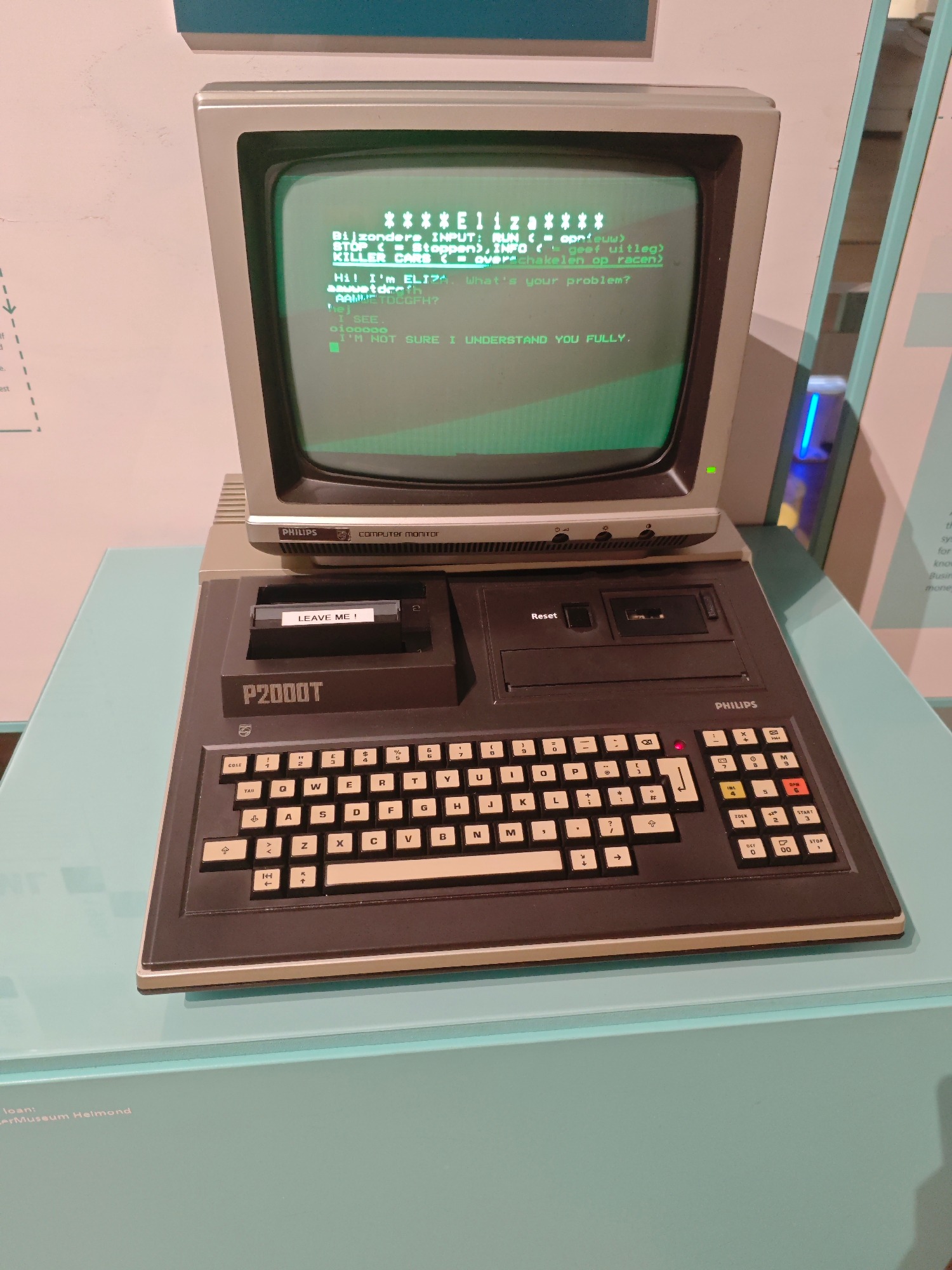
The image shows a vintage Philips P2000T personal computer with a built-in monitor and keyboard. The monitor displays green text on a black background, with a conversational program running. The keyboard has a QWERTY layout and a numeric keypad with special function keys. A cassette tape drive is visible above the keyboard. The computer is placed on a light blue surface, possibly a display table in a museum. The background is a blurred white wall and a greenish-blue vertical element with blue lighting, suggestive of an exhibition setting. The image does not provide specific information about the location in Eindhoven.
denn
Eindhoven, Netherlands · Jul 14, 2026, 10:44 AM · 10.2k attention
The image shows a vintage Philips P2000T personal computer with a built-in monitor and keyboard. The monitor displays green text on a black background, with a conversational program running. The keyboard has a QWERTY layout and a numeric keypad with special function keys. A cassette tape drive is visible above the keyboard. The computer is placed on a light blue surface, possibly a display table in a museum. The background is a blurred white wall and a greenish-blue vertical element with blue lighting, suggestive of an exhibition setting. The image does not provide specific information about the location in Eindhoven.
The image displays a museum exhibit featuring early digital audio technology, located in Eindhoven, Netherlands. Dominating the center is a Philips CD player, model CD100, from 1983, with its lid open, revealing the disc mechanism. To its right, an older Philips compact cassette recorder from 1963 is also displayed, with a cassette inserted. Below the CD player, a brass plaque commemorates the "IEEE MILESTONE IN ELECTRICAL ENGINEERING AND COMPUTING - COMPACT DISC AUDIO PLAYER, 1979." The plaque details the groundbreaking demonstration of the compact disc audio player by N.V. Philips' Gloeilampenfabrieken on March 8, 1979, highlighting its ability to reproduce audio signals with superb stereo quality and its role in establishing the technical standard for digital optical recording. Also visible are several audio cassettes, including a Philips branded cassette and a compact Philips audio cassette. The exhibit is presented on a white surface, encased within a glass display, suggesting it is part of a museum or exhibition. The background is blurred, but appears to show the interior of a building with some reddish furniture and indistinct figures of people.
denn
Eindhoven, Netherlands · Jul 14, 2026, 10:06 AM · 0.8k attention
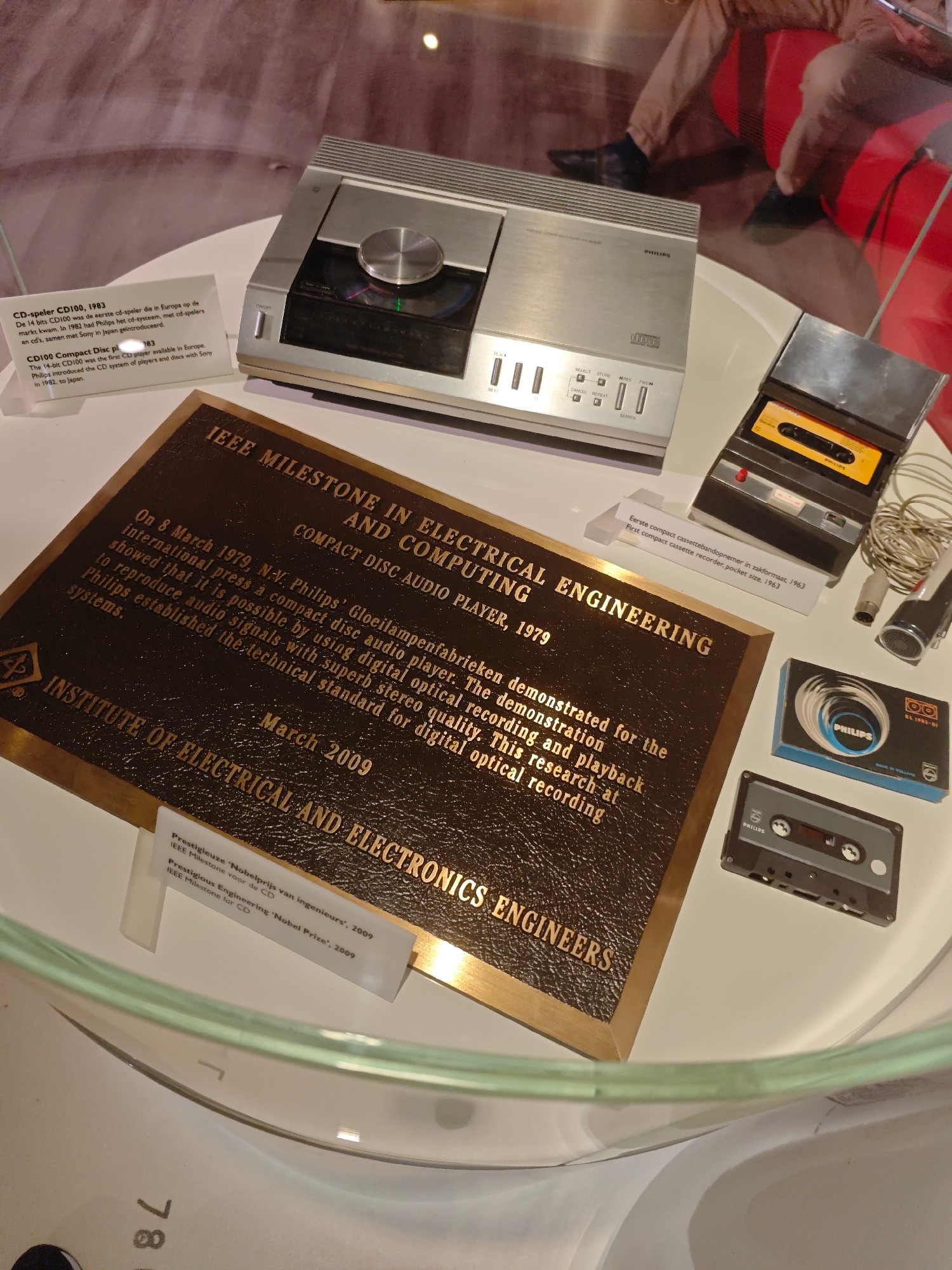
The image displays a museum exhibit featuring early digital audio technology, located in Eindhoven, Netherlands. Dominating the center is a Philips CD player, model CD100, from 1983, with its lid open, revealing the disc mechanism. To its right, an older Philips compact cassette recorder from 1963 is also displayed, with a cassette inserted. Below the CD player, a brass plaque commemorates the "IEEE MILESTONE IN ELECTRICAL ENGINEERING AND COMPUTING - COMPACT DISC AUDIO PLAYER, 1979." The plaque details the groundbreaking demonstration of the compact disc audio player by N.V. Philips' Gloeilampenfabrieken on March 8, 1979, highlighting its ability to reproduce audio signals with superb stereo quality and its role in establishing the technical standard for digital optical recording. Also visible are several audio cassettes, including a Philips branded cassette and a compact Philips audio cassette. The exhibit is presented on a white surface, encased within a glass display, suggesting it is part of a museum or exhibition. The background is blurred, but appears to show the interior of a building with some reddish furniture and indistinct figures of people.
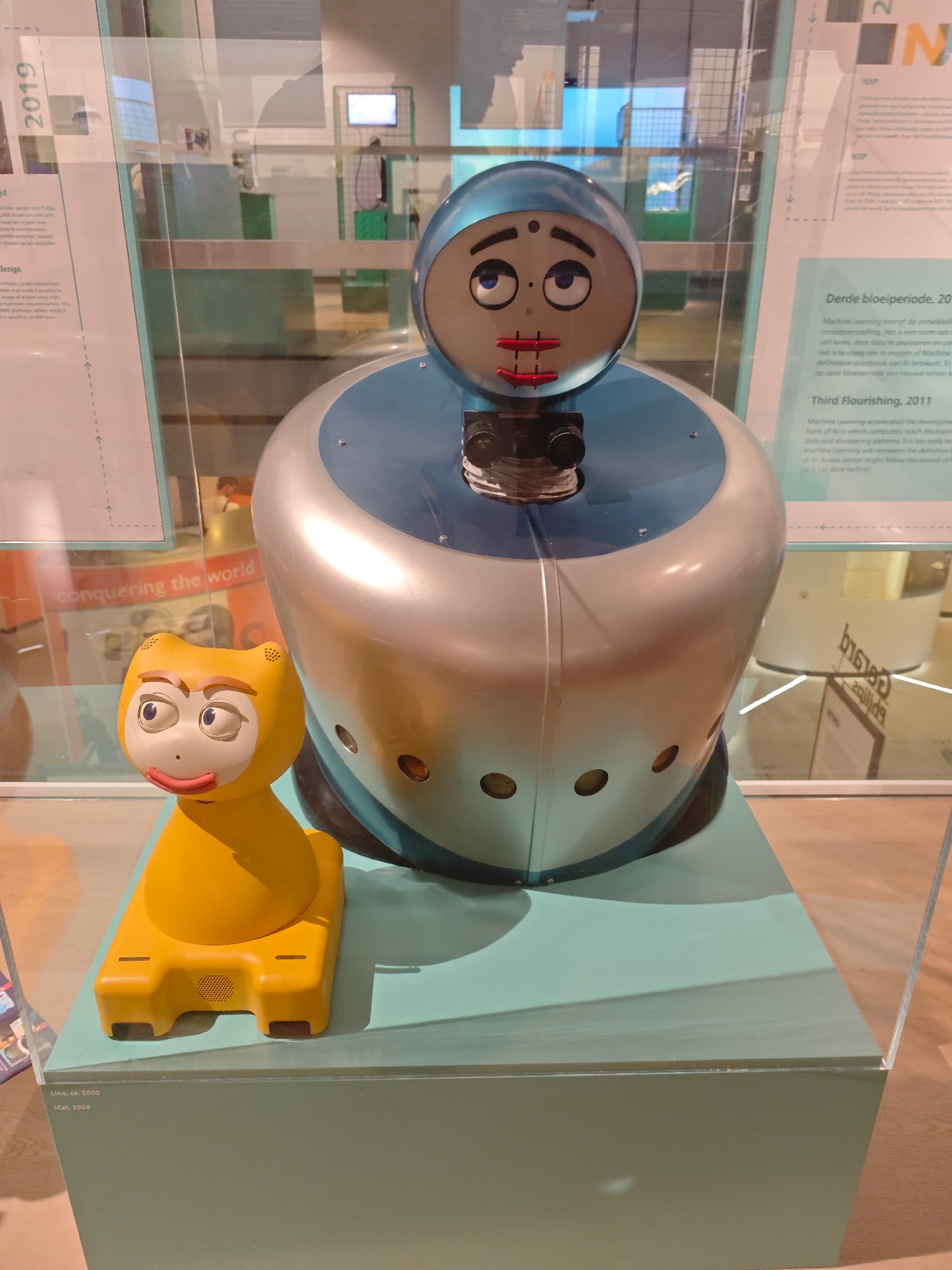
An exhibition display features two robots. The larger robot, a bipedal unit with a blue head and a silver, rounded torso, is positioned centrally. Its head is roughly spherical with wide, blue eyes and red, stylized lips. Two dark camera lenses are visible beneath its eyes. The robot's torso is adorned with several circular, metallic-colored vents. It stands on a teal-colored pedestal. To the left of the larger robot, a smaller, yellow, cat-like robot sits on the same teal pedestal. This robot has a rounded head with large, expressive eyes and a smiling mouth. It has small, pointed ears and a distinctly feline facial structure. The robots are encased within a glass display. Behind the robots, a wall features text and graphics. One prominent graphic shows the year "2019" in large white numerals. Another section of text discusses "Third Flourishing, 2011" and "Machine Learning". The background suggests an indoor exhibition space with other displays partially visible. The overall environment appears to be a museum or gallery. The text visible in the image, specifically the year "2019" and information about "Third Flourishing, 2011" and "Machine Learning", likely relates to the historical context of robotics or artificial intelligence exhibitions. While the image itself does not explicitly state the location as Eindhoven, Netherlands, such exhibitions focusing on technological history are common in cities known for innovation and technology.
denn
Eindhoven, Netherlands · Jul 14, 2026, 10:44 AM · 0.5k attention
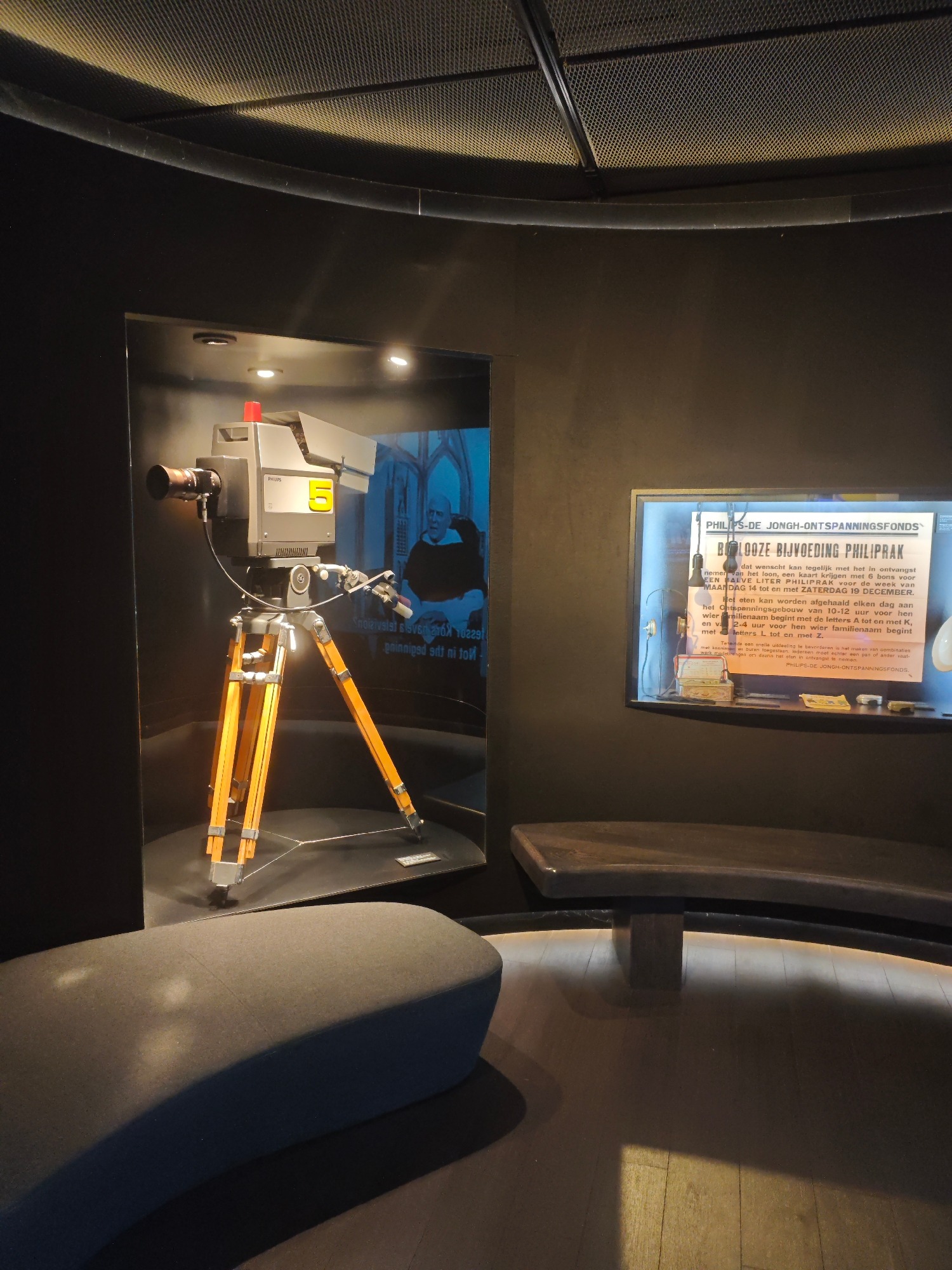
This is a photograph taken inside a museum in Eindhoven, Netherlands. The main subject is a vintage television camera mounted on a tripod, displayed in a glass enclosure. The camera is silver and black with a red indicator light on top and a yellow panel with the number "5". The tripod has wooden legs with metal accents. Behind the camera, a projection shows a man in a monk's habit. To the right of the camera display is another glass-encased exhibit. This exhibit features a framed document with Dutch text, likely an announcement or advertisement, and some smaller items. The document is headed "PHILIPS-DE JONGH-ONTSPANNINGSFONDS" and appears to be related to an offer involving "PHILIPRAK" and a date in December. In the foreground, a dark gray, curved bench is visible, and to the left, another dark gray, similarly curved seating area is partially visible. The floor appears to be made of dark wood with subtle lighting. The overall environment suggests a museum setting with a focus on technology or broadcasting history, possibly related to the Philips company, given the prominent branding. The lighting is dim, with spotlights illuminating the exhibits.
An exhibition display features two robots. The larger robot, a bipedal unit with a blue head and a silver, rounded torso, is positioned centrally. Its head is roughly spherical with wide, blue eyes and red, stylized lips. Two dark camera lenses are visible beneath its eyes. The robot's torso is adorned with several circular, metallic-colored vents. It stands on a teal-colored pedestal. To the left of the larger robot, a smaller, yellow, cat-like robot sits on the same teal pedestal. This robot has a rounded head with large, expressive eyes and a smiling mouth. It has small, pointed ears and a distinctly feline facial structure. The robots are encased within a glass display. Behind the robots, a wall features text and graphics. One prominent graphic shows the year "2019" in large white numerals. Another section of text discusses "Third Flourishing, 2011" and "Machine Learning". The background suggests an indoor exhibition space with other displays partially visible. The overall environment appears to be a museum or gallery. The text visible in the image, specifically the year "2019" and information about "Third Flourishing, 2011" and "Machine Learning", likely relates to the historical context of robotics or artificial intelligence exhibitions. While the image itself does not explicitly state the location as Eindhoven, Netherlands, such exhibitions focusing on technological history are common in cities known for innovation and technology.
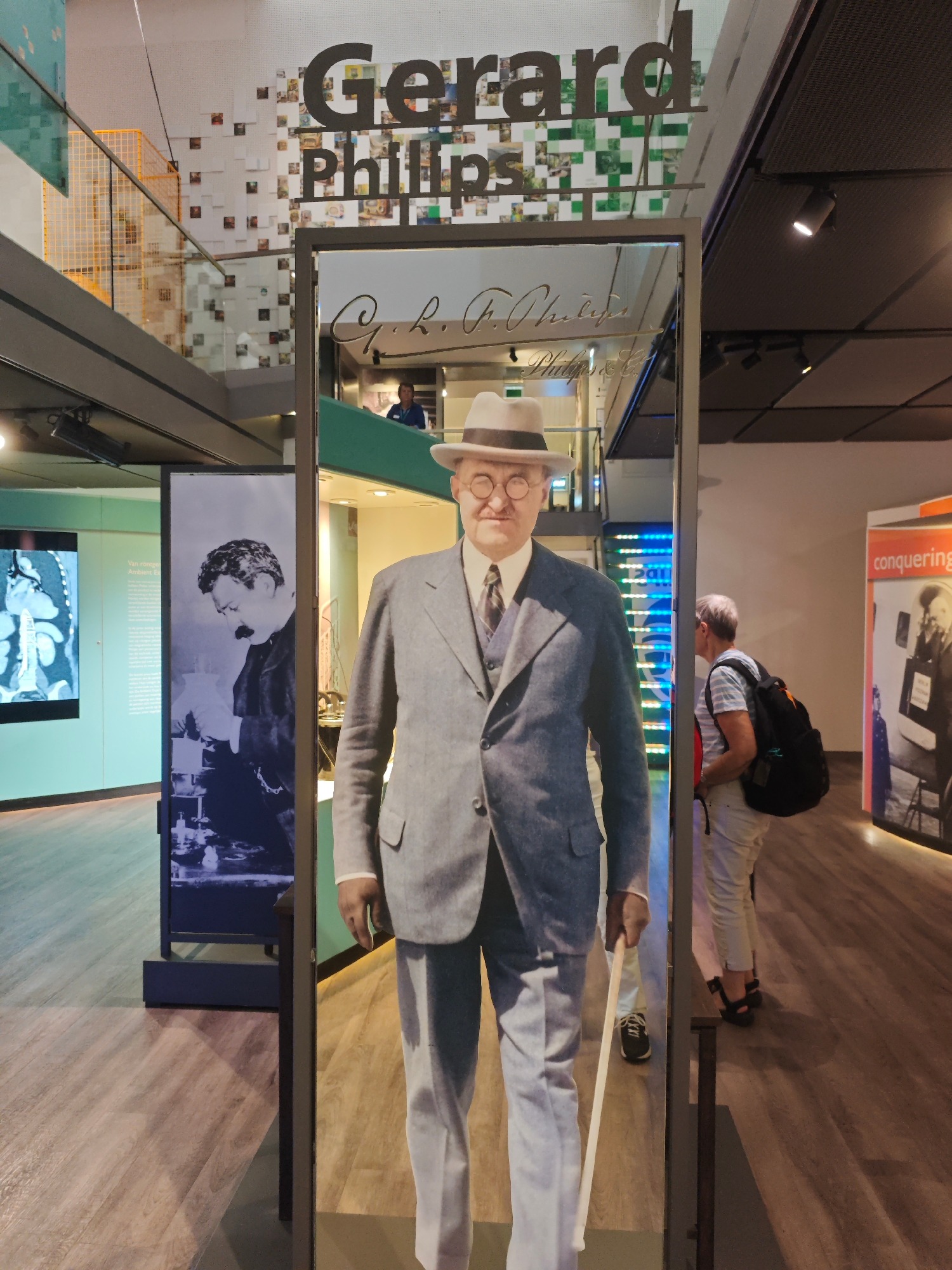
The image depicts a museum exhibit in Eindhoven, Netherlands, likely the Philips Museum given the prominence of the Philips name and imagery. A life-size cutout of Gerard Philips, a founder of Philips, stands prominently in the foreground, dressed in a suit and hat and holding a cane. Behind him, a historic photograph of a man working at a microscope is displayed. Further in the background, a visitor wearing a backpack examines another exhibit. The museum environment features modern architecture with suspended walkways and informational displays. The lighting is a mix of ambient museum lighting and spotlights.
denn
Eindhoven, Netherlands · Jul 14, 2026, 9:57 AM · 0.2k attention
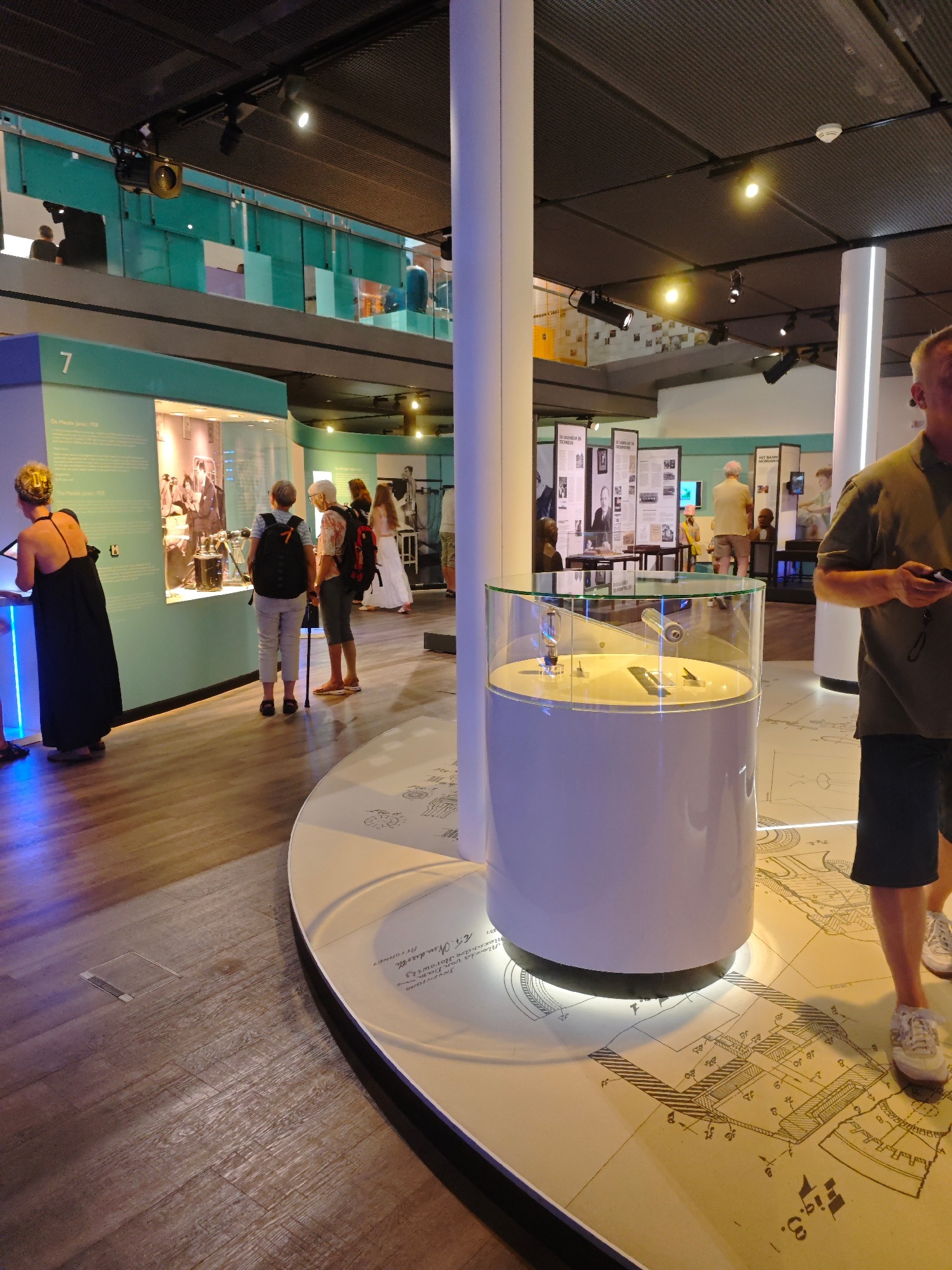
The image depicts the interior of a museum exhibit, specifically within the Philips Museum located in Eindhoven, Netherlands. The exhibit showcases historical artifacts and information, likely related to the Philips company. In the foreground, a cylindrical display case with a glass top contains what appear to be scientific or technological objects, possibly early light bulbs. A person in a green polo shirt and dark shorts is visible in the right foreground, holding a smartphone. Behind them, a display of historical documents and images is mounted on a teal-colored wall. Further back, several visitors are observing the exhibits. One woman in a black dress stands at a touch screen display on the left. Two women, one with a backpack and another with a cane, are looking at an exhibit. The floor is adorned with a large schematic diagram, possibly of a building or device. The overall environment is modern and well-lit, with track lighting visible on the ceiling.
This is a photograph taken inside a museum in Eindhoven, Netherlands. The main subject is a vintage television camera mounted on a tripod, displayed in a glass enclosure. The camera is silver and black with a red indicator light on top and a yellow panel with the number "5". The tripod has wooden legs with metal accents. Behind the camera, a projection shows a man in a monk's habit. To the right of the camera display is another glass-encased exhibit. This exhibit features a framed document with Dutch text, likely an announcement or advertisement, and some smaller items. The document is headed "PHILIPS-DE JONGH-ONTSPANNINGSFONDS" and appears to be related to an offer involving "PHILIPRAK" and a date in December. In the foreground, a dark gray, curved bench is visible, and to the left, another dark gray, similarly curved seating area is partially visible. The floor appears to be made of dark wood with subtle lighting. The overall environment suggests a museum setting with a focus on technology or broadcasting history, possibly related to the Philips company, given the prominent branding. The lighting is dim, with spotlights illuminating the exhibits.
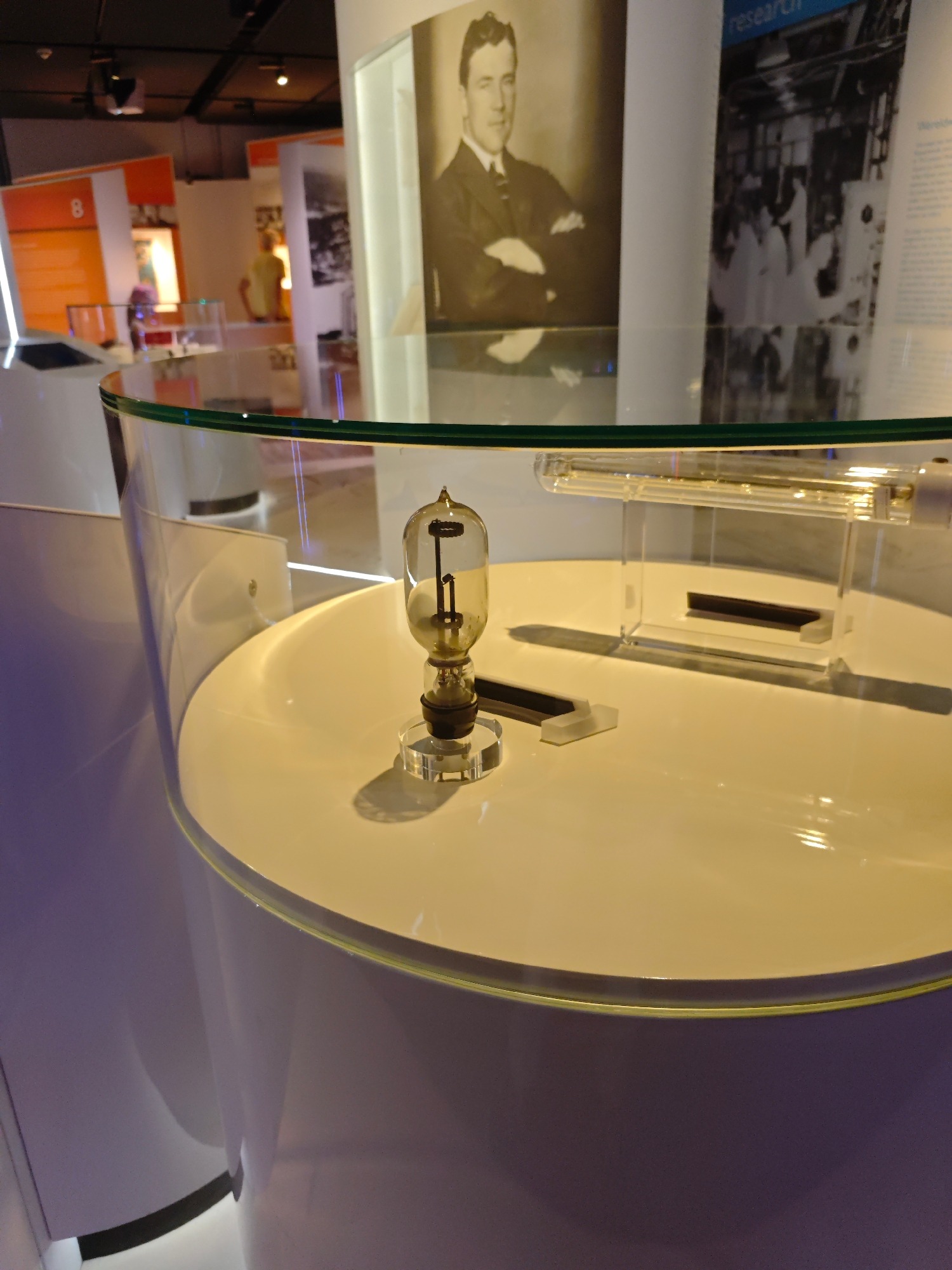
The image shows a display case inside a museum. The display case is made of glass and is curved. Inside the display case is an old-fashioned lightbulb with a filament. There are also some documents and images on display in the background, including a portrait of a man in a suit and a document with the word "research" visible. The museum appears to be well-lit and modern, with clean lines and minimalist design. The overall impression is one of a historical or scientific exhibition. This scene is located at the Philips Museum in Eindhoven, Netherlands, a city renowned for its technological innovations and the birthplace of Philips.
Eindhoven, Netherlands · Jul 14, 2026, 9:55 AM
The image depicts a museum exhibit in Eindhoven, Netherlands, likely the Philips Museum given the prominence of the Philips name and imagery. A life-size cutout of Gerard Philips, a founder of Philips, stands prominently in the foreground, dressed in a suit and hat and holding a cane. Behind him, a historic photograph of a man working at a microscope is displayed. Further in the background, a visitor wearing a backpack examines another exhibit. The museum environment features modern architecture with suspended walkways and informational displays. The lighting is a mix of ambient museum lighting and spotlights.
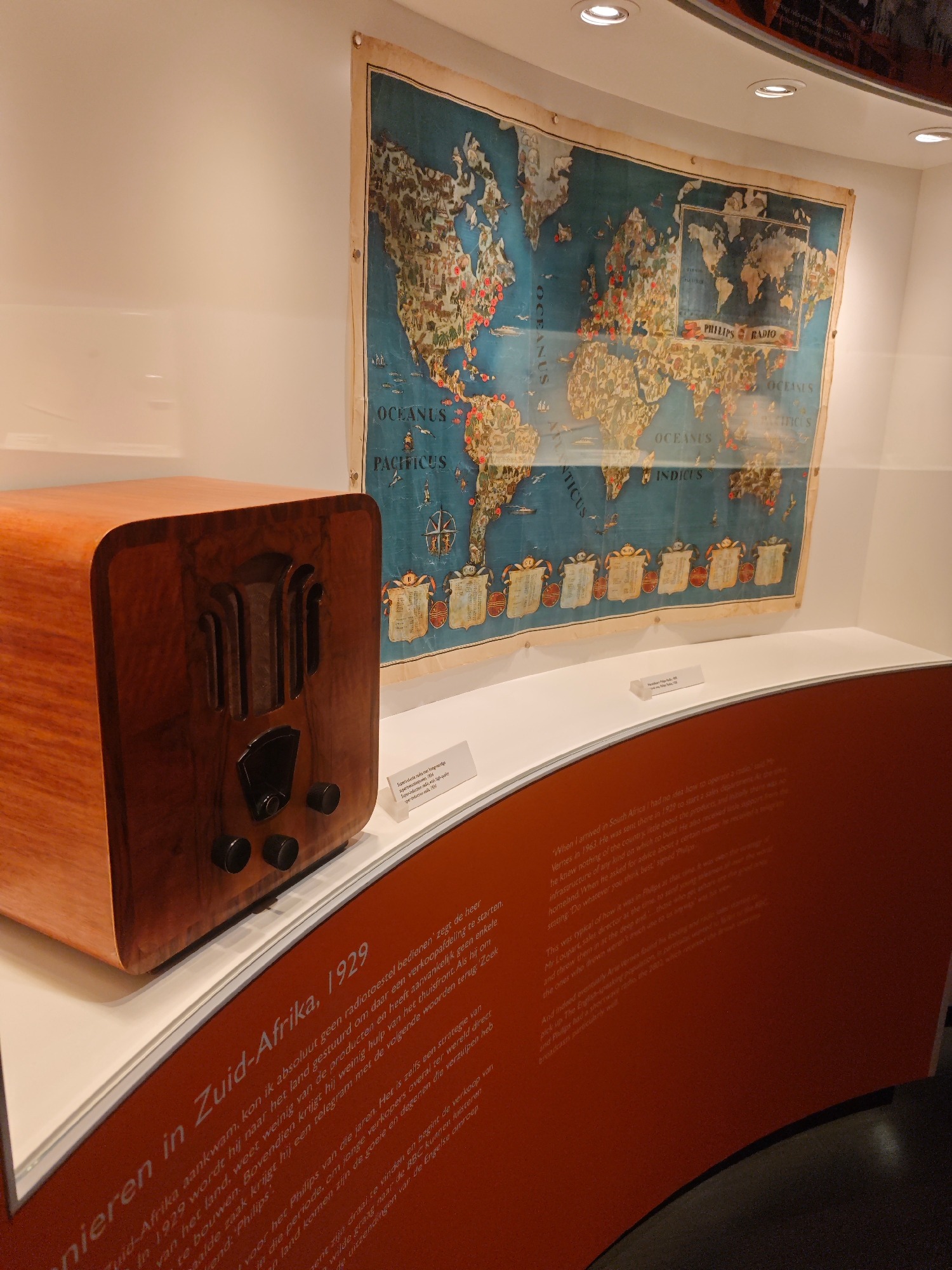
The image shows a museum exhibit featuring an antique wooden radio and a vintage world map. The map, titled "Philips Radio," is displayed on the wall behind the radio and shows various locations marked with red dots, suggesting a global reach for the Philips brand. The radio itself is a mid-century design with a wooden case and a grille on the front. Below the map and radio, there is informational text displayed on an orange panel, partially obscured by the curve of the display. This exhibit appears to be located at the Philips Museum in Eindhoven, Netherlands, which chronicles the history of the Philips company. The text on the orange panel, though partially obscured and at an angle, provides biographical and historical information related to the company's expansion and broadcasting activities, mentioning South Africa and the year 1929. The overall environment is well-lit, typical of a museum setting, with spotlights directed at the displayed items. There are no people visible in the image.
denn
Eindhoven, Netherlands · Jul 14, 2026, 10:09 AM