Tuesday, April 21, 2026 · Updated Tuesday, April 21, 2026
Ubud District, Indonesia
Ubud, Bali's verdant spiritual heart, is a realm where the sacred and the artistic intertwine with breathtaking intimacy. Here, every stone carving, every temple gate, and every ceremonial effigy tells a story of devotion, myth, and a profound connection to the divine. A recent dispatch from the district offers a compelling glimpse into this vibrant tapestry, revealing the intricate beauty and powerful symbolism embedded within Balinese Hindu art, from the majestic, ephemeral effigies to the serene, ever-watchful guardian statues that punctuate the landscape.
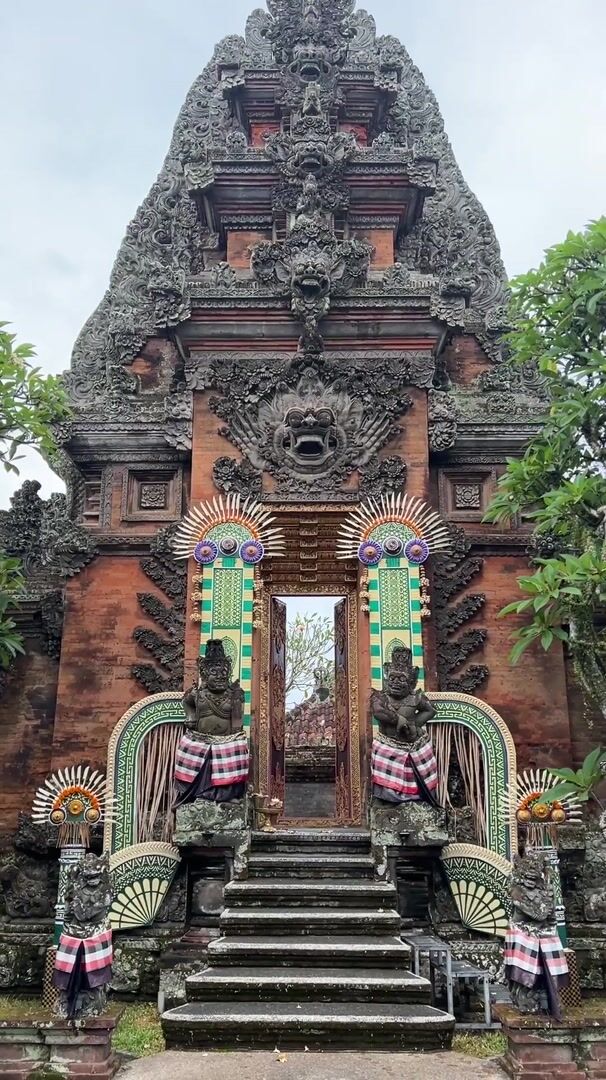
This video features a static shot of a highly ornate traditional Balinese temple entrance, located in the Ubud District, Indonesia. The central subject is a towering stone structure, intricately carved with mythical figures, floral motifs, and geometric patterns. Above the arched doorway, a prominent, stylized face or mask is carved into the stone.
Flanking the stone steps leading up to the entrance are two large guardian statues, each draped in traditional black and white checkered sarongs (known as "poleng" cloth). These statues are seated on ornate pedestals, which are further decorated with vibrant, fan-like ornaments and colorful embellishments. Additional smaller stone figures are visible near the base of the steps.
The temple's construction primarily uses dark grey stone and reddish-brown brick, with visible signs of weathering and moss growth, indicating its age. Lush green foliage and trees frame the entrance on both sides and can be seen through the open doorway, suggesting a verdant, natural setting. The sky is overcast, casting a soft, diffused light over the scene. No people are visible, and no specific activities are taking place; it is a serene view of architectural and cultural splendor. There is no visible text.
Ubud District, Indonesia · Apr 21, 2026, 8:36 AM · 9.7k attention
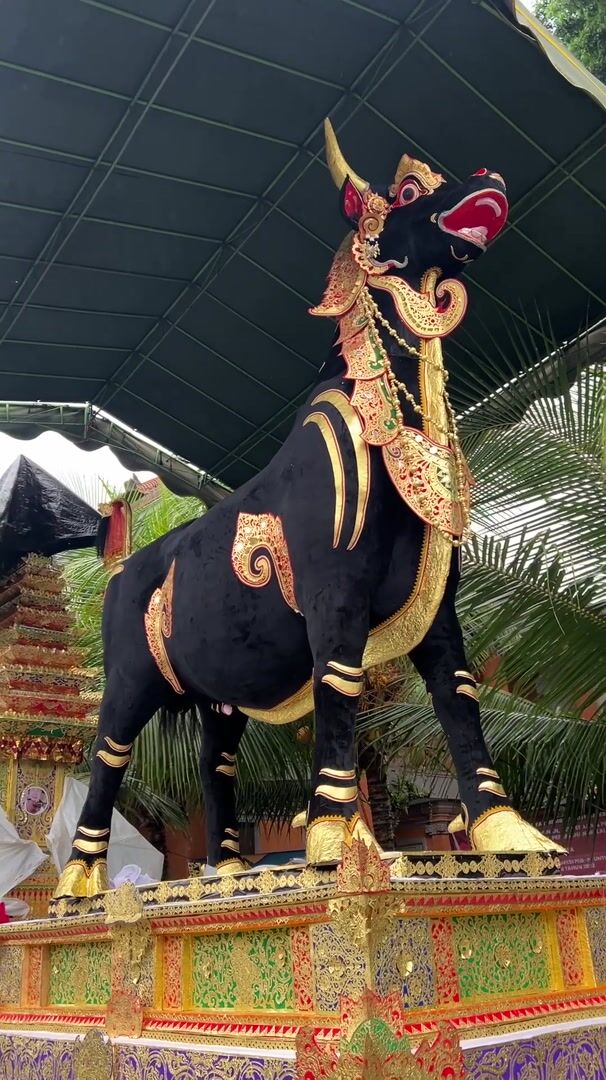
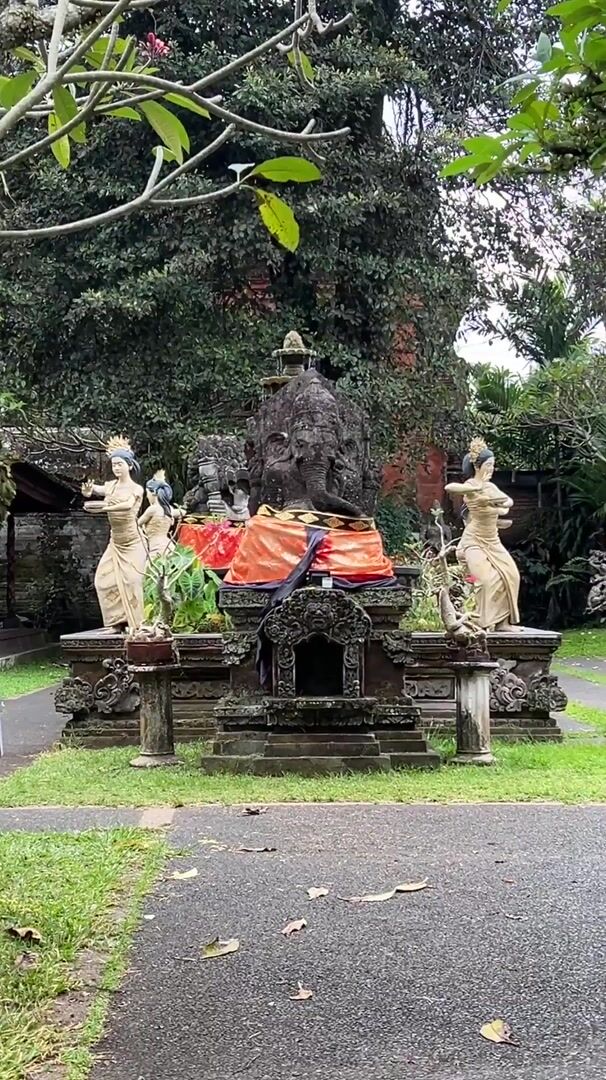
The journey into Ubud's artistic soul began on a soft, overcast morning in late April 2026, with the solemn grandeur of a meticulously crafted black bull effigy. Standing on an ornate, multi-colored platform, its form was adorned with intricate golden and red patterns that highlighted its raised head and open mouth, evoking a stylized majesty often associated with traditional cremation ceremonies [0]. Shortly after, the scene shifted to a tranquil garden setting, where a multi-headed elephant deity, possibly Ganesha, draped in an orange and black cloth, presided from a tiered stone platform. It was flanked by two gracefully posed female figures, perhaps dancers or devotees, their presence adding a delicate balance to the powerful central figure amidst lush tropical foliage [4].
A fair-skinned woman with light eyes and brown hair tied in a ponytail is taking a selfie, holding the camera or phone in her outstretched right arm. She is smiling faintly and wearing a brown sleeveless top and a necklace with a charm. Her left hand is near her ponytail.
Behind her is an ornate Balinese temple entrance, characteristic of a split gate or "candi bentar." The temple is constructed from red brick and stone, featuring intricate carvings, including a large, fearsome face at the top of the gate. Two large, dark guardian statues are seated on either side of the entrance, adorned with traditional Balinese striped cloths. Smaller statues are also visible further out. The entrance itself is decorated with colorful, fan-like elements and banners. Green trees and lush foliage surround the temple structure, suggesting a tropical environment.
The scene appears to be set during the daytime, possibly under an overcast sky, as there are no harsh shadows. The architecture and decorations are consistent with locations in Bali, Indonesia, specifically the Ubud District as indicated by the context. There is no visible text in the image.
Ubud District, Indonesia · Apr 21, 2026, 8:37 AM · 1.0k attention
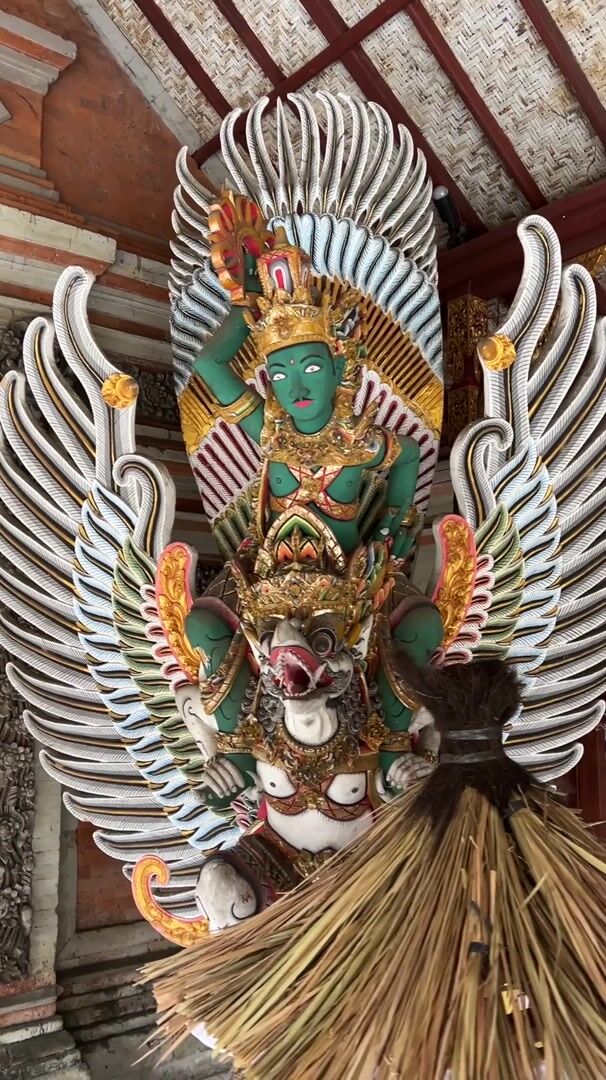
Moments later, the lens focused on the iconic architecture of a traditional Balinese temple entrance. A towering stone structure, intricately carved with mythical figures and patterns, featured a fearsome, stylized face above its arched doorway. Two imposing guardian statues, draped in traditional black and white checkered "poleng" cloths, sat sentinel on either side, their watchful eyes a testament to ancient protection [2]. Further within a protective roof structure, a vibrant statue of the Hindu deity Vishnu, depicted with green skin and golden regalia, rode upon his powerful vahana, Garuda, whose enormous, multi-layered wings, painted in striking white, gold, blue, and pink, fanned out dramatically [3]. This series of sacred encounters culminated with a fair-skinned tourist capturing a selfie before another ornate temple entrance, her faint smile a modern counterpoint to the timeless artistry, a personal moment against a backdrop of enduring faith [1].
The image displays a vibrant and intricately carved statue, likely depicting the Hindu deity Vishnu riding on his vahana (mount), Garuda. The statue is positioned within a traditional Balinese-style building, visible through its slatted wooden ceiling and dark wooden beams in the background.
The main deity, seated atop Garuda, has distinctive green skin, a serene expression, and is adorned with a golden crown and rich gold jewelry, including necklaces, armbands, and earrings. The deity's attire features red and gold striped drapery, and a golden object, possibly a chakra or conch shell, is held in their raised upper right hand.
Garuda, the mythical bird-like creature, is depicted with a white or light gray body, a powerful stance, a red beak, and visible fangs. It also wears a golden headdress and elaborate jewelry. Its most striking feature is its enormous, multi-layered wings, painted in white, gold, blue, and pink accents, fanning out grandly behind both figures.
In the lower right corner of the foreground, a bundle of dried straw or reeds, tied together, is visible, possibly part of a traditional offering or decoration. The scene is well-lit by natural light, suggesting it is daytime, and the statue appears to be under a protective roof, typical of temple or shrine architecture in Ubud District, Indonesia. The overall impression is one of cultural richness, spiritual significance, and detailed artistry.
Ubud District, Indonesia · Apr 21, 2026, 8:36 AM · 0.1k attention
The video presents a static view of a traditional Balinese sculpture arrangement set within an outdoor, garden-like environment. At the center stands a large, dark grey stone statue of a multi-headed elephant deity, possibly Ganesha, draped with an orange and black cloth around its lower body. This central statue rests on an ornate, multi-tiered stone platform.
Flanking the elephant deity are two lighter-colored stone statues of gracefully posed female figures, appearing as dancers or devotees, each standing on a separate, smaller pedestal. Their bodies are turned slightly inwards, facing the central figure. The entire ensemble is surrounded by smaller, intricately carved stone structures and potted plants.
The immediate foreground features a paved path or ground, partially covered with scattered leaves, bordered by vibrant green grass on both sides. In the background, dense tropical foliage and tall trees provide a lush green backdrop, with a glimpse of a reddish-brown brick wall or building nestled among the greenery. The lighting suggests an overcast day, providing soft, diffused light without harsh shadows. The scene evokes a sense of tranquility and cultural richness, characteristic of temple grounds or a traditional compound in the Ubud District of Indonesia. No text is visible in the frame.
These captured moments are more than mere visual records; they are windows into a living culture where art is not merely decorative but intrinsically spiritual. The guardian statues, like the powerful "poleng" cloth they wear, serve as protectors, embodying the balance of good and evil, light and dark. The effigies, whether for grand cremation rites or as permanent temple residents, are physical manifestations of mythological narratives and spiritual beliefs, designed to guide, protect, or honor. Each carving, each color, each pose is imbued with centuries of tradition, reflecting Bali's unique interpretation of Hinduism and its profound respect for the unseen world.
Ubud's sacred art, therefore, is not a static museum piece but a dynamic, evolving expression of faith that continues to shape daily life. It is a reminder that in Bali, the divine is not confined to distant heavens but is intricately woven into the very fabric of the earth, stone, and the human hand that shapes them. This enduring legacy, captured through the eyes of a modern observer, underscores the timeless allure and spiritual resonance that continues to draw seekers and admirers to this extraordinary island.
The video displays a large, meticulously crafted black bull effigy standing on an ornate, multi-colored platform. The bull is adorned with intricate golden and red patterns, particularly prominent on its head, horns, neck, and legs. Its head is slightly raised, and its mouth is open, giving it a majestic and stylized appearance. To the left of the bull, a smaller, tiered, and highly decorated structure is partially visible. The scene is outdoors, with a dark green canopy or tent roof overhead and lush palm trees in the background, suggesting a tropical environment. The lighting indicates it is daytime, possibly overcast. No people are visible in the frame. The elaborate craftsmanship and specific design elements strongly suggest a cultural or ceremonial context, likely in Bali, possibly related to a traditional cremation ceremony where such effigies, known as Lembu or Naga Banda, are used.
This video features a static shot of a highly ornate traditional Balinese temple entrance, located in the Ubud District, Indonesia. The central subject is a towering stone structure, intricately carved with mythical figures, floral motifs, and geometric patterns. Above the arched doorway, a prominent, stylized face or mask is carved into the stone.
Flanking the stone steps leading up to the entrance are two large guardian statues, each draped in traditional black and white checkered sarongs (known as "poleng" cloth). These statues are seated on ornate pedestals, which are further decorated with vibrant, fan-like ornaments and colorful embellishments. Additional smaller stone figures are visible near the base of the steps.
The temple's construction primarily uses dark grey stone and reddish-brown brick, with visible signs of weathering and moss growth, indicating its age. Lush green foliage and trees frame the entrance on both sides and can be seen through the open doorway, suggesting a verdant, natural setting. The sky is overcast, casting a soft, diffused light over the scene. No people are visible, and no specific activities are taking place; it is a serene view of architectural and cultural splendor. There is no visible text.
A fair-skinned woman with light eyes and brown hair tied in a ponytail is taking a selfie, holding the camera or phone in her outstretched right arm. She is smiling faintly and wearing a brown sleeveless top and a necklace with a charm. Her left hand is near her ponytail.
Behind her is an ornate Balinese temple entrance, characteristic of a split gate or "candi bentar." The temple is constructed from red brick and stone, featuring intricate carvings, including a large, fearsome face at the top of the gate. Two large, dark guardian statues are seated on either side of the entrance, adorned with traditional Balinese striped cloths. Smaller statues are also visible further out. The entrance itself is decorated with colorful, fan-like elements and banners. Green trees and lush foliage surround the temple structure, suggesting a tropical environment.
The scene appears to be set during the daytime, possibly under an overcast sky, as there are no harsh shadows. The architecture and decorations are consistent with locations in Bali, Indonesia, specifically the Ubud District as indicated by the context. There is no visible text in the image.
The image displays a vibrant and intricately carved statue, likely depicting the Hindu deity Vishnu riding on his vahana (mount), Garuda. The statue is positioned within a traditional Balinese-style building, visible through its slatted wooden ceiling and dark wooden beams in the background.
The main deity, seated atop Garuda, has distinctive green skin, a serene expression, and is adorned with a golden crown and rich gold jewelry, including necklaces, armbands, and earrings. The deity's attire features red and gold striped drapery, and a golden object, possibly a chakra or conch shell, is held in their raised upper right hand.
Garuda, the mythical bird-like creature, is depicted with a white or light gray body, a powerful stance, a red beak, and visible fangs. It also wears a golden headdress and elaborate jewelry. Its most striking feature is its enormous, multi-layered wings, painted in white, gold, blue, and pink accents, fanning out grandly behind both figures.
In the lower right corner of the foreground, a bundle of dried straw or reeds, tied together, is visible, possibly part of a traditional offering or decoration. The scene is well-lit by natural light, suggesting it is daytime, and the statue appears to be under a protective roof, typical of temple or shrine architecture in Ubud District, Indonesia. The overall impression is one of cultural richness, spiritual significance, and detailed artistry.
The video presents a static view of a traditional Balinese sculpture arrangement set within an outdoor, garden-like environment. At the center stands a large, dark grey stone statue of a multi-headed elephant deity, possibly Ganesha, draped with an orange and black cloth around its lower body. This central statue rests on an ornate, multi-tiered stone platform.
Flanking the elephant deity are two lighter-colored stone statues of gracefully posed female figures, appearing as dancers or devotees, each standing on a separate, smaller pedestal. Their bodies are turned slightly inwards, facing the central figure. The entire ensemble is surrounded by smaller, intricately carved stone structures and potted plants.
The immediate foreground features a paved path or ground, partially covered with scattered leaves, bordered by vibrant green grass on both sides. In the background, dense tropical foliage and tall trees provide a lush green backdrop, with a glimpse of a reddish-brown brick wall or building nestled among the greenery. The lighting suggests an overcast day, providing soft, diffused light without harsh shadows. The scene evokes a sense of tranquility and cultural richness, characteristic of temple grounds or a traditional compound in the Ubud District of Indonesia. No text is visible in the frame.