Untitled Story

Thursday, August 13, 2026 · Updated Thursday, August 13, 2026
 Santiago, Chile
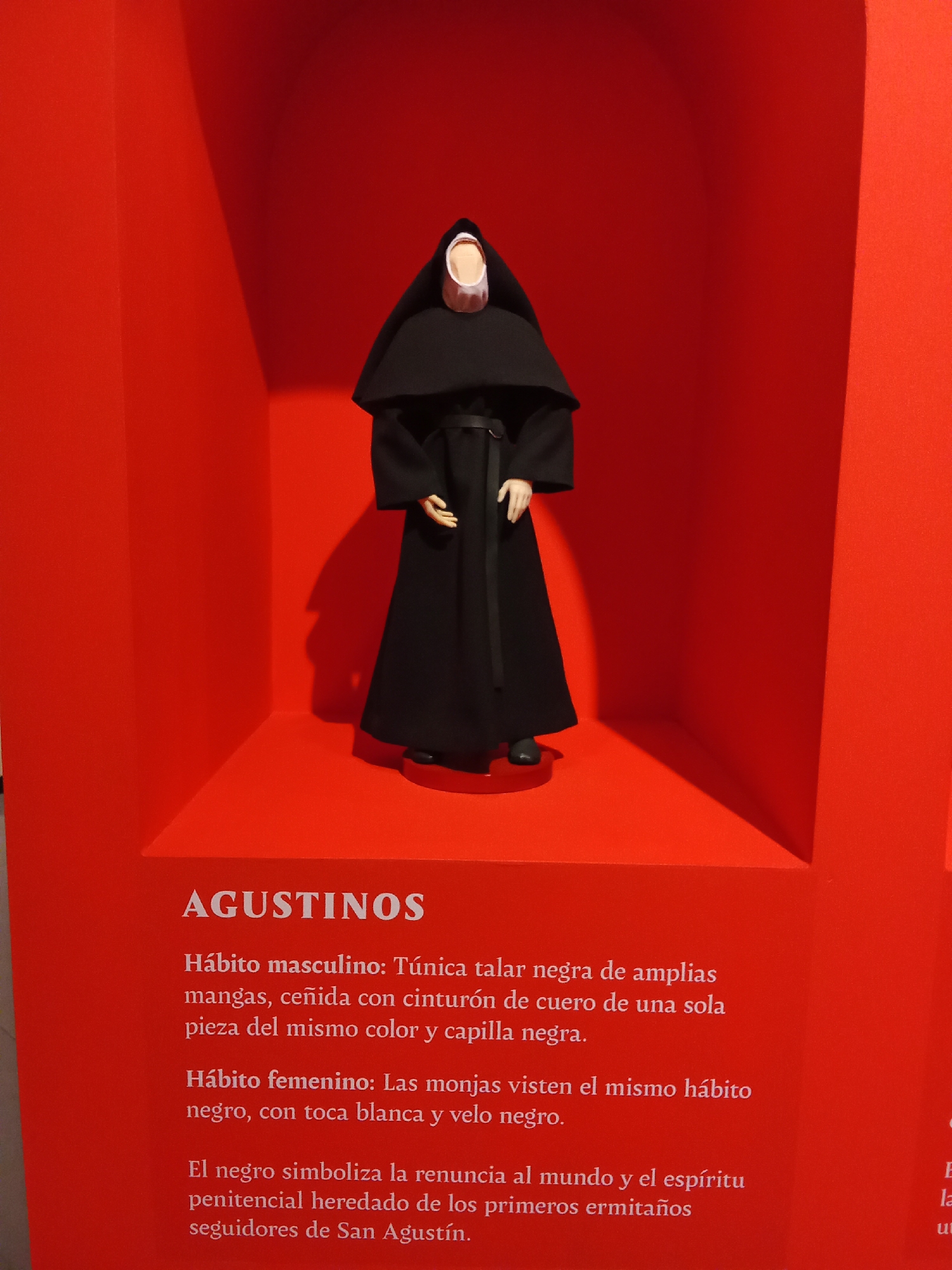
A mannequin dressed in a black religious habit stands inside a bright red, cube-shaped display case. The habit features a hood, long sleeves, and a belt. Text in Spanish is visible on a red panel to the right of the display, identifying the religious order as "AGUSTINOS" and describing the male and female habits, as well as the symbolic meaning of the black color. The text also mentions "seguidores de San Agustín" (followers of Saint Augustine). The scene appears to be a museum exhibit. The location in the city of Santiago, Chile, is not provided in the image or its accompanying text.
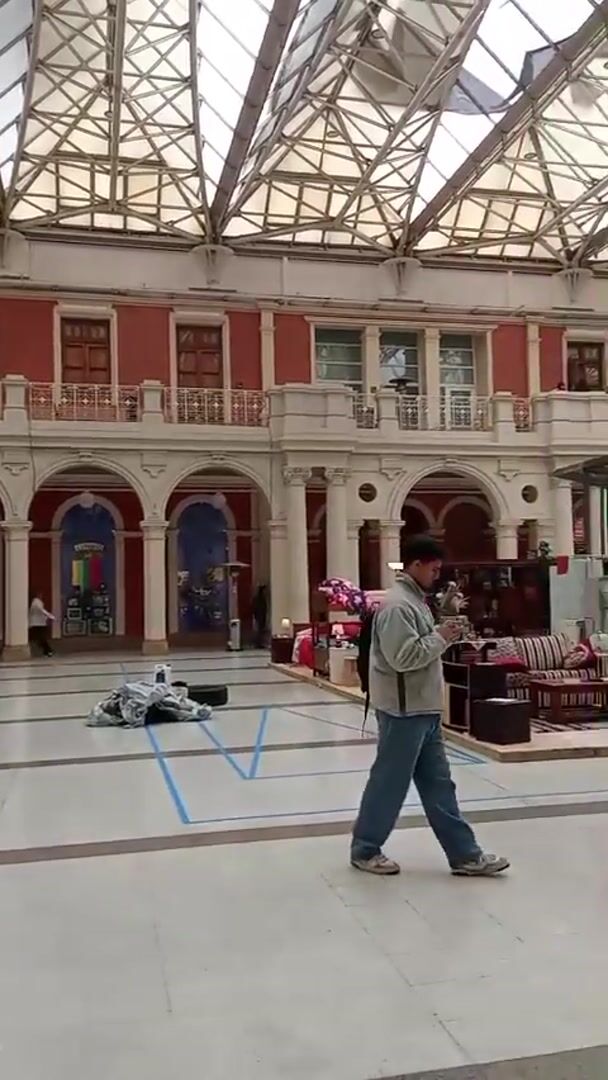
A man wearing a gray jacket and blue jeans walks through a large indoor space with a glass ceiling. The space has a tiled floor and ornate architecture with red walls and arched walkways. In the center of the space, there is a partially constructed metal frame structure resembling a house. To the left of the structure, there are some displays of furniture and decorations. The man is looking at his phone as he walks.
Mel Navala
Santiago, Chile · Aug 13, 2026, 2:56 PM · 19.1k attention
A man wearing a gray jacket and blue jeans walks through a large indoor space with a glass ceiling. The space has a tiled floor and ornate architecture with red walls and arched walkways. In the center of the space, there is a partially constructed metal frame structure resembling a house. To the left of the structure, there are some displays of furniture and decorations. The man is looking at his phone as he walks.
The painting is a devotional artwork depicting a central image of the Virgin Mary crowned and holding the infant Jesus. Surrounding this central figure are various saints and religious figures, enclosed within floral borders. The painting is aged and shows signs of wear and cracking in the paint. The style suggests a colonial or early republican era religious artwork. The artwork does not contain any information about its location in Santiago, Chile.
Mel Navala
Santiago, Chile · Aug 13, 2026, 2:36 PM · 10.2k attention
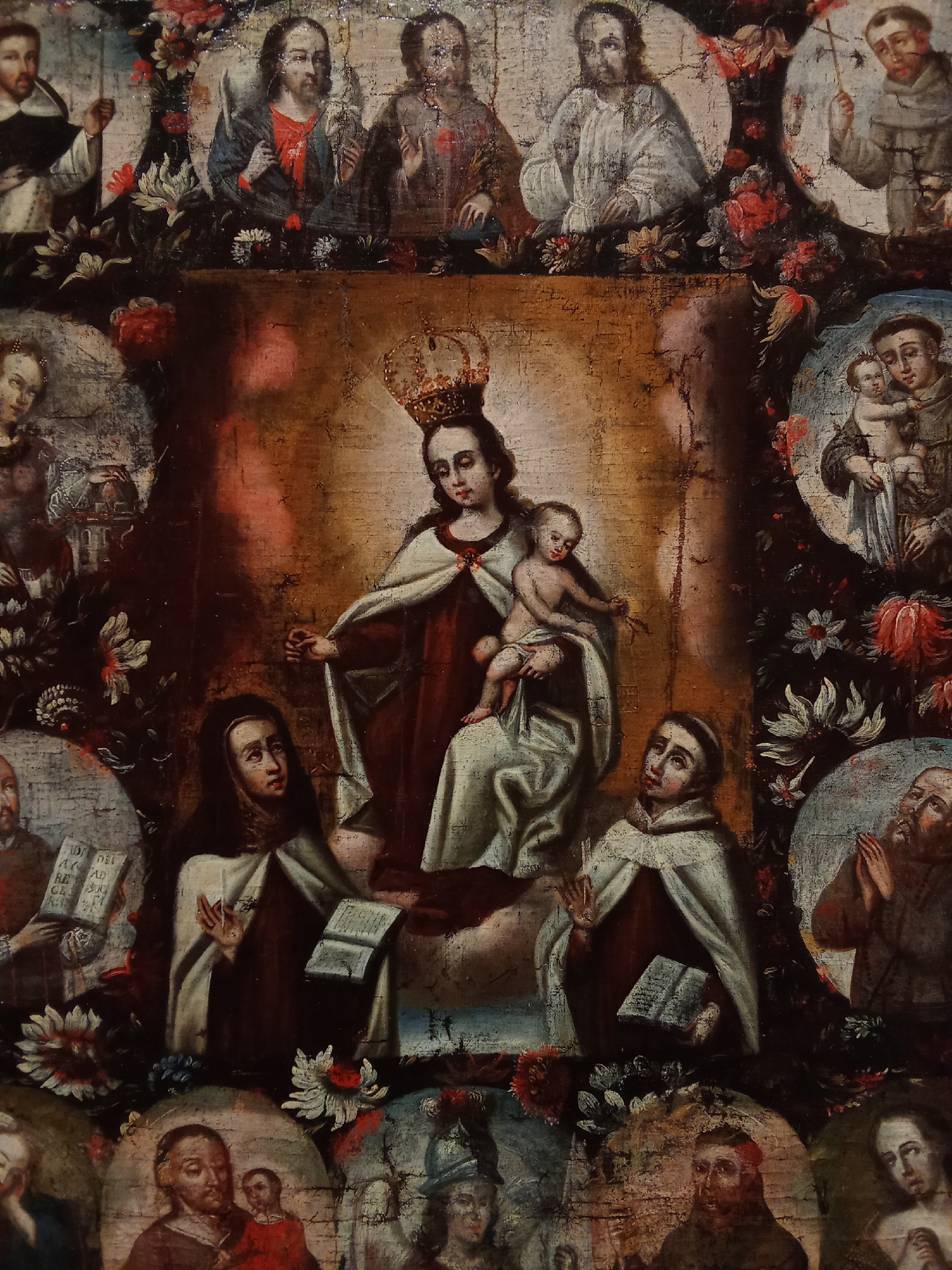
The painting is a devotional artwork depicting a central image of the Virgin Mary crowned and holding the infant Jesus. Surrounding this central figure are various saints and religious figures, enclosed within floral borders. The painting is aged and shows signs of wear and cracking in the paint. The style suggests a colonial or early republican era religious artwork. The artwork does not contain any information about its location in Santiago, Chile.
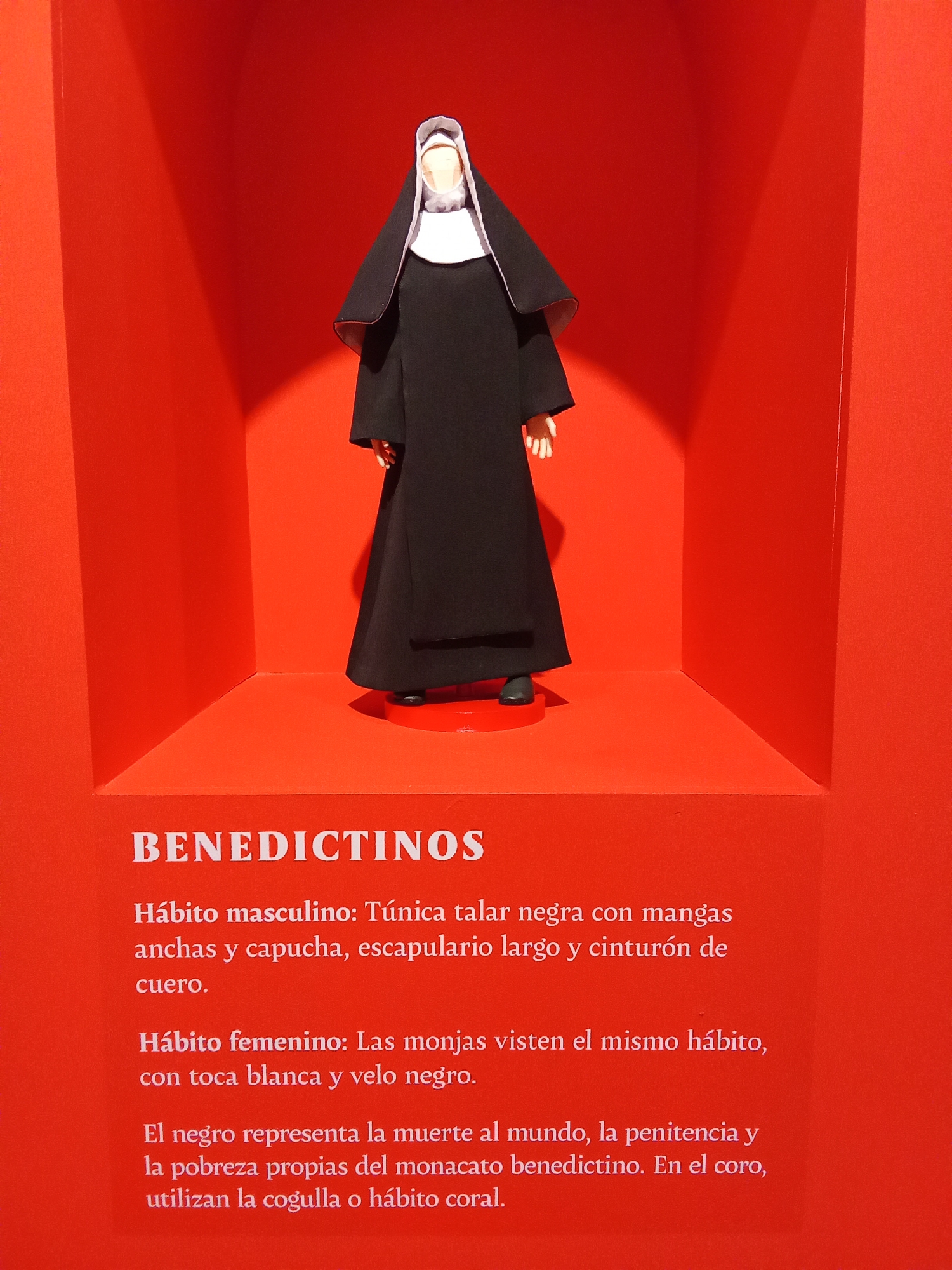
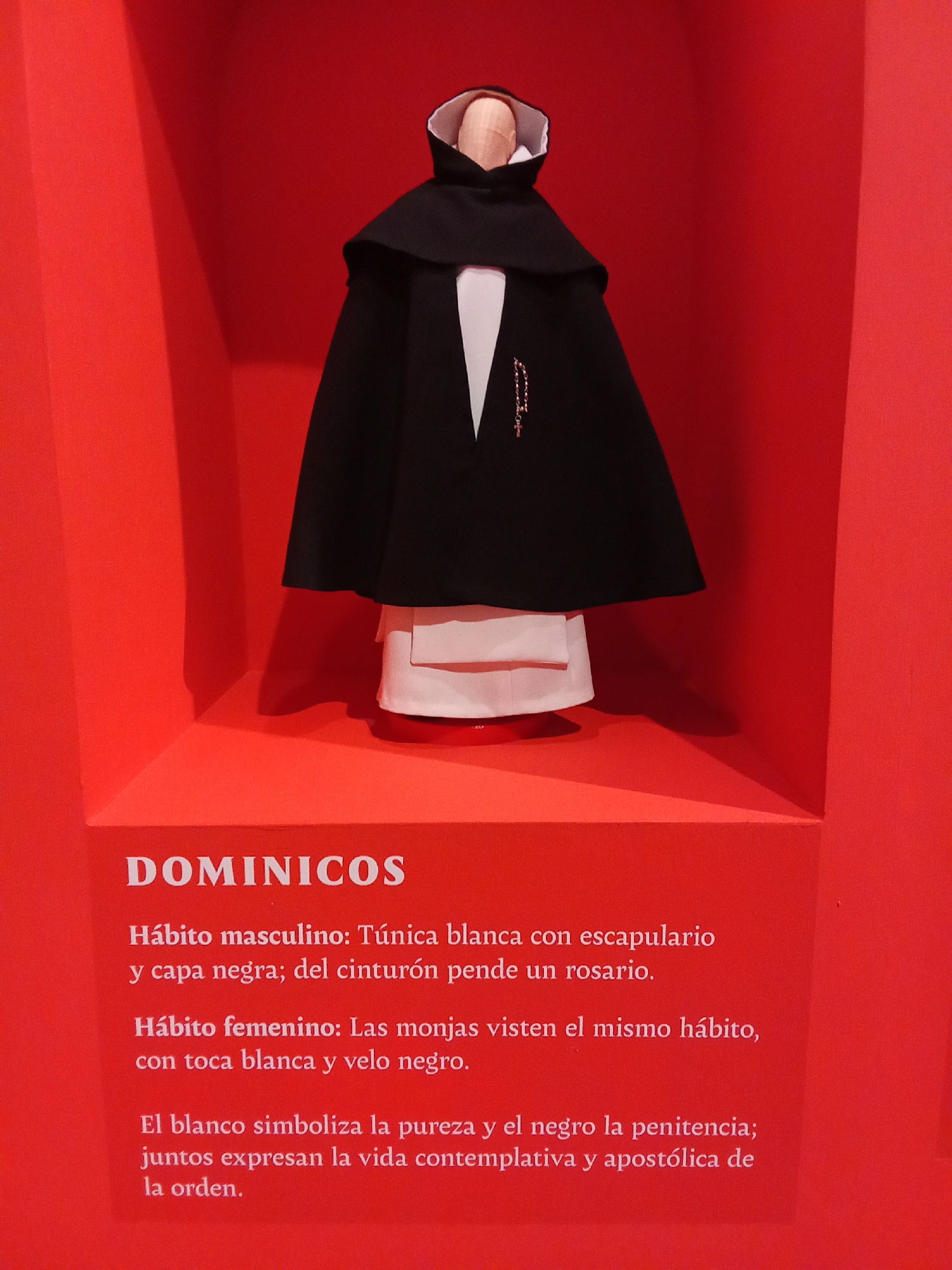
This image shows a display about Benedictine habits. A mannequin dressed in a black nun's habit, complete with a white wimple and veil, stands on a red platform within a red, recessed display case. Text below the mannequin describes the male and female Benedictine habits. The text is in Spanish and indicates that black represents death and poverty. The display is set against a vibrant red background. The specific location in the city of Santiago, Chile is not provided within the image.
Mel Navala
Santiago, Chile · Aug 13, 2026, 2:46 PM · 10.2k attention
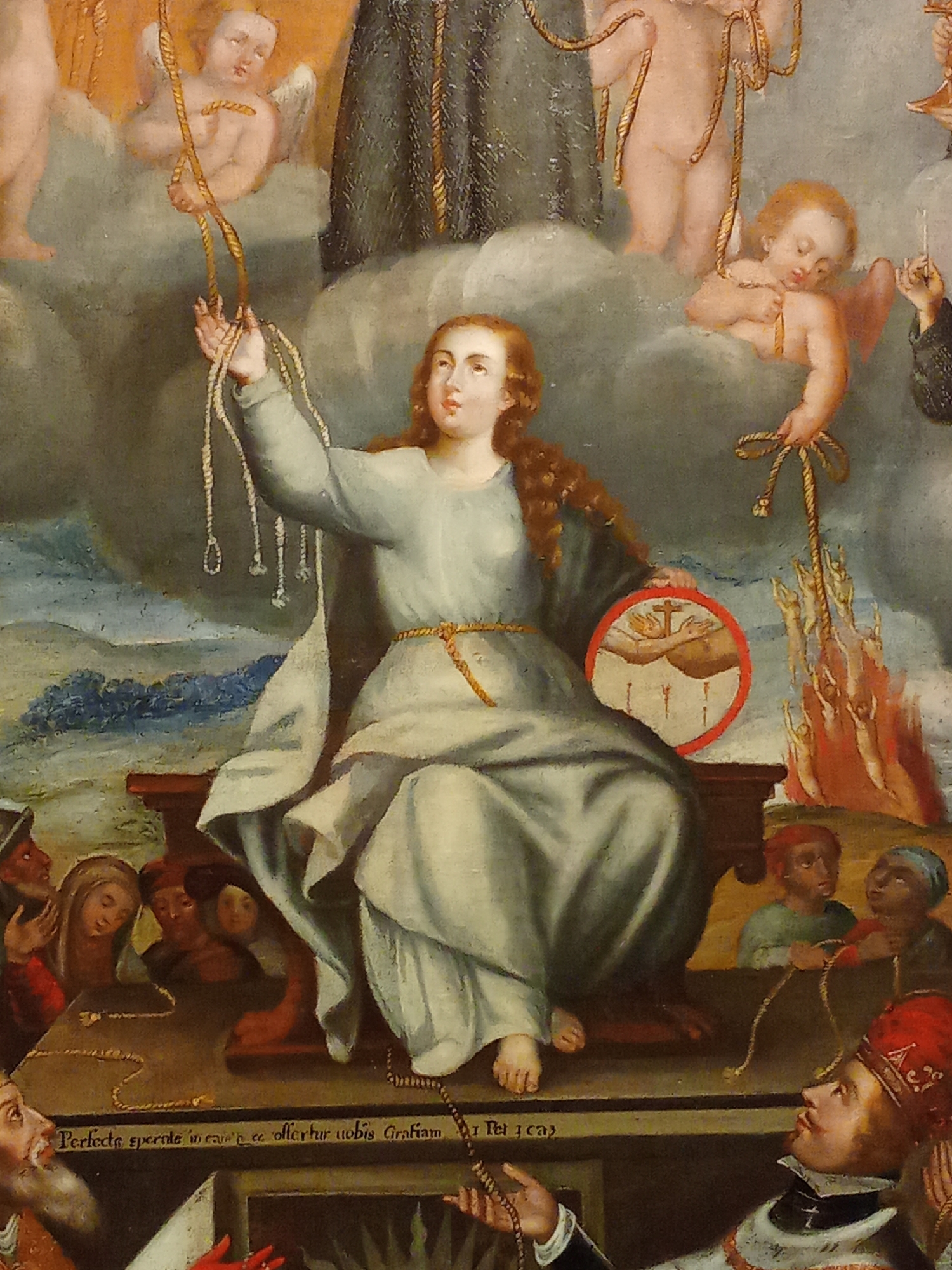
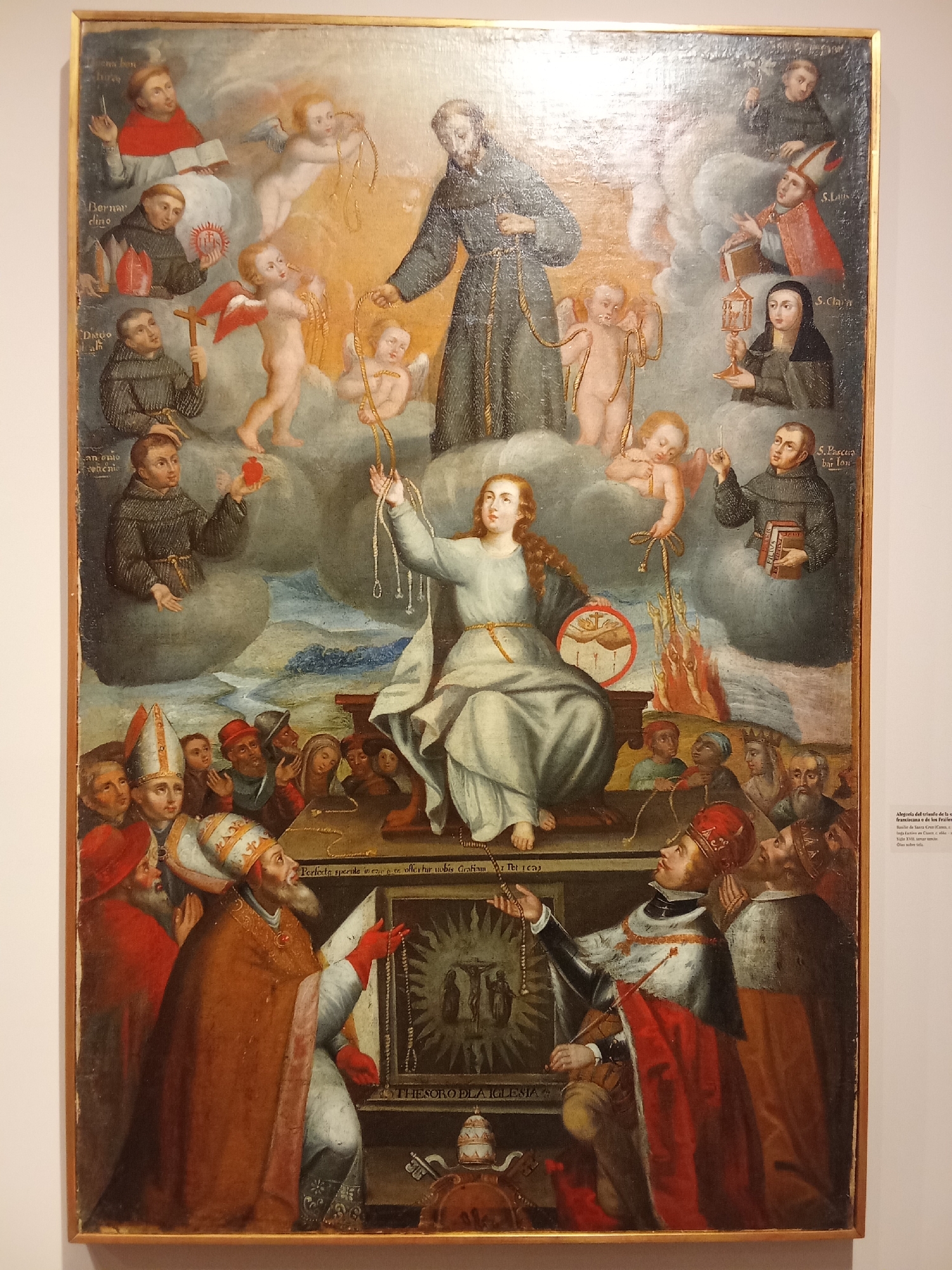
The painting depicts a scene with multiple figures, primarily religious in nature. In the center, a woman in a light-colored robe sits on a wooden structure, holding a rope with several nooses. She has long, reddish-brown hair and is looking upwards. To her left, cherubic figures are visible, one holding a rope. To her right, a circular emblem with a depiction of Christ on the cross and hands is held, and further to the right, figures engulfed in flames are shown. Below the central figure, a group of people are gathered, some looking towards the central figure. In the foreground, a man wearing a red hat and religious attire is also present, holding a rosary. A Latin inscription is visible at the bottom of the painting. The overall atmosphere is solemn and symbolic, suggesting a religious narrative. The image does not contain any elements that would allow for determining its location in Santiago, Chile.
This image shows a display about Benedictine habits. A mannequin dressed in a black nun's habit, complete with a white wimple and veil, stands on a red platform within a red, recessed display case. Text below the mannequin describes the male and female Benedictine habits. The text is in Spanish and indicates that black represents death and poverty. The display is set against a vibrant red background. The specific location in the city of Santiago, Chile is not provided within the image.
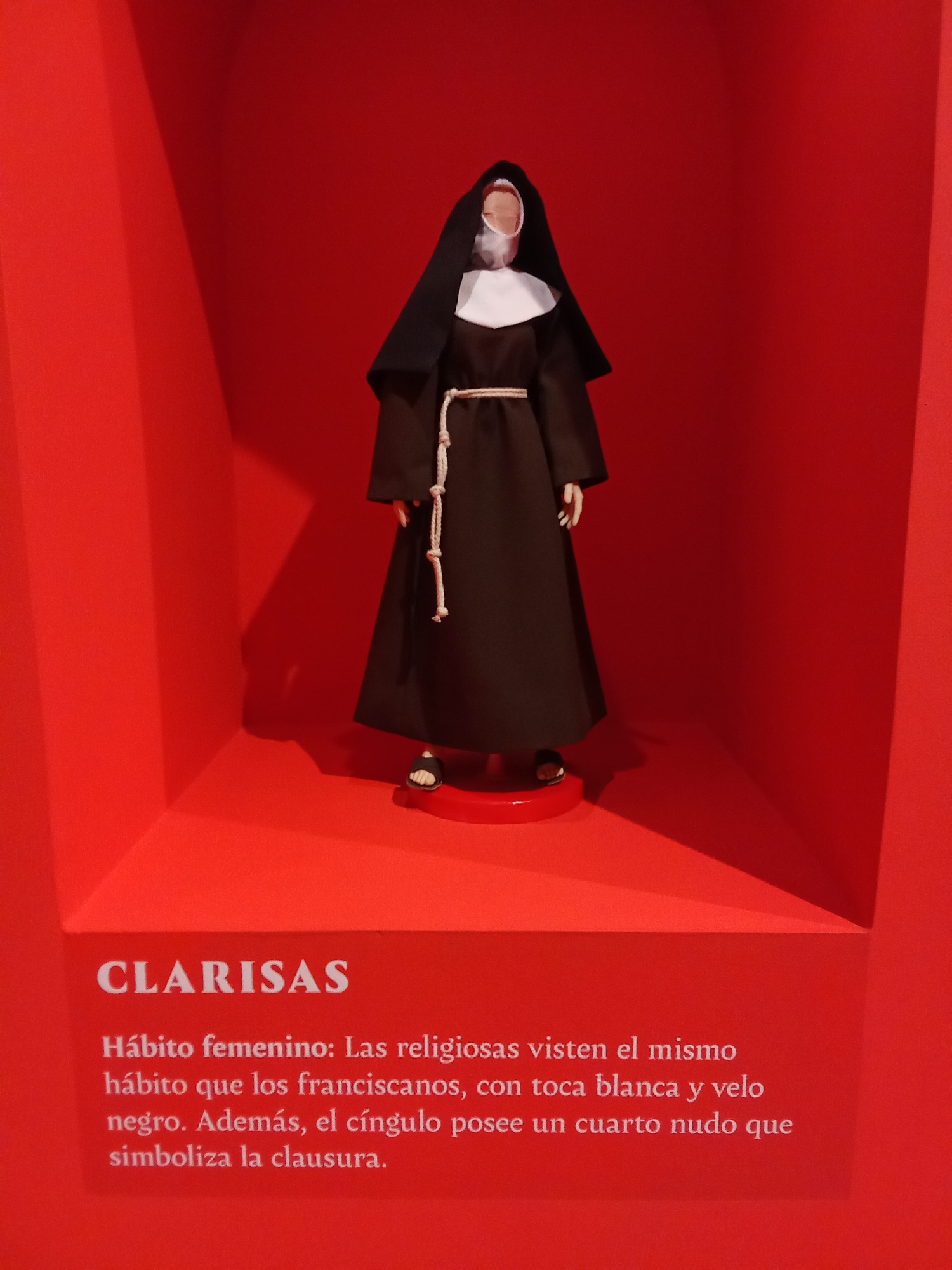
A doll dressed as a nun stands in a red display case, in front of a red background. The doll wears a black habit with a white wimple and veil, and a rope belt tied at the waist. The text below the display case reads "CLARISAS" and provides a description of the habit worn by religious women of the Franciscan order. The scene appears to be from a museum exhibit in Santiago, Chile, though no specific museum name is provided.
Mel Navala
Santiago, Chile · Aug 13, 2026, 2:49 PM · 9.1k attention
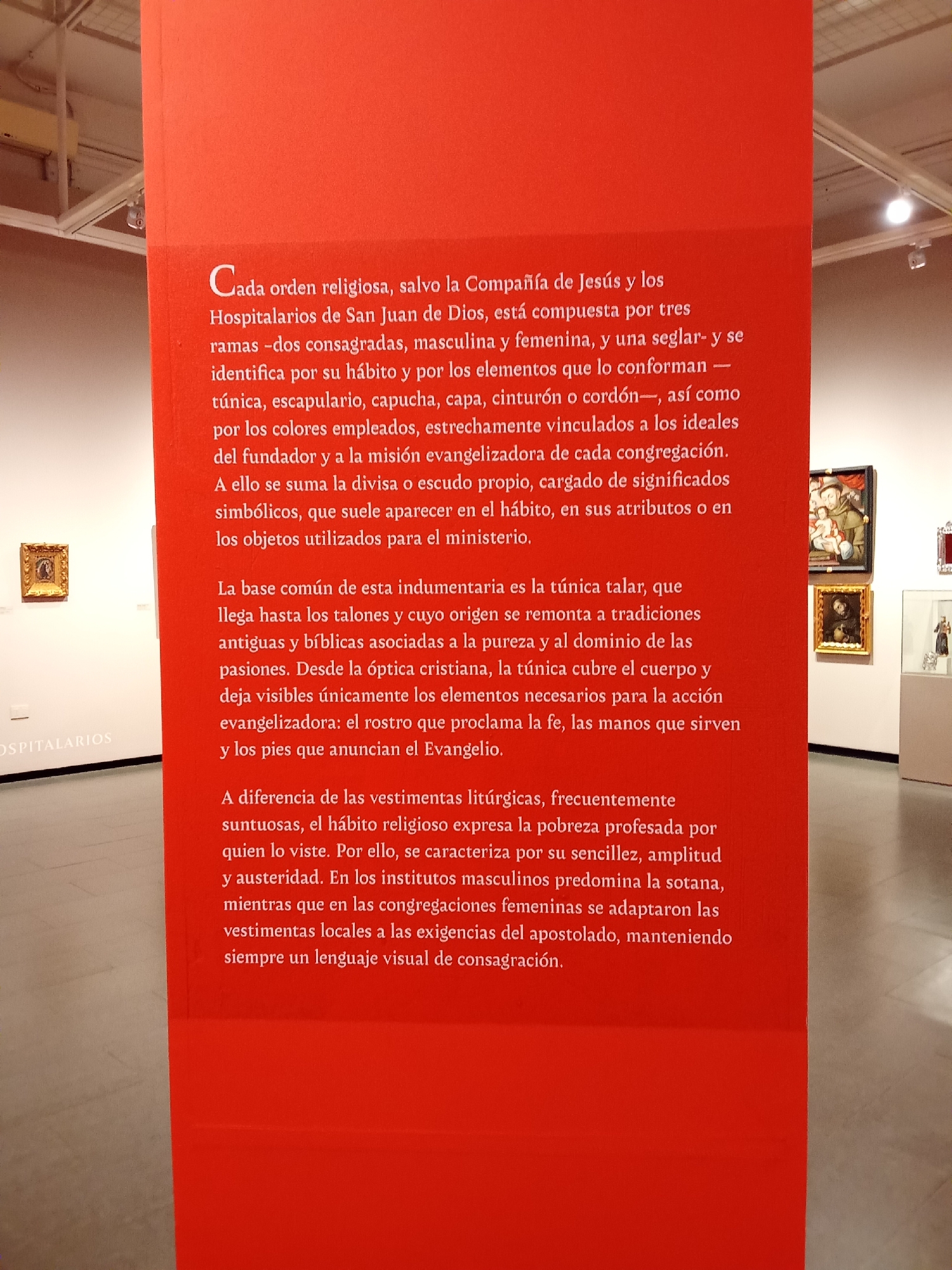
This image shows a red exhibition panel with Spanish text. The text discusses religious attire and its symbolism, mentioning orders like the Company of Jesus and the Hospitallers of San Juan de Dios. It describes the components of religious garments such as tunics, scapulars, and hoods, and how they relate to the founder's ideals and the congregation's mission. The text also contrasts liturgical vestments with the simple habits of religious orders, emphasizing poverty and austerity. In the background, several framed artworks are displayed on a wall. These appear to be religious paintings, one depicting a figure in a brown robe holding a child, and another smaller one with a dark, religious subject. To the right, there is a glass display case containing a small statue. The exhibition space seems to be well-lit with ceiling lights visible. The flooring is a light color. The overall setting suggests an art museum or cultural exhibition. There is no indication in the image that this scene is located in Santiago, Chile.
The painting depicts a scene with multiple figures, primarily religious in nature. In the center, a woman in a light-colored robe sits on a wooden structure, holding a rope with several nooses. She has long, reddish-brown hair and is looking upwards. To her left, cherubic figures are visible, one holding a rope. To her right, a circular emblem with a depiction of Christ on the cross and hands is held, and further to the right, figures engulfed in flames are shown. Below the central figure, a group of people are gathered, some looking towards the central figure. In the foreground, a man wearing a red hat and religious attire is also present, holding a rosary. A Latin inscription is visible at the bottom of the painting. The overall atmosphere is solemn and symbolic, suggesting a religious narrative. The image does not contain any elements that would allow for determining its location in Santiago, Chile.
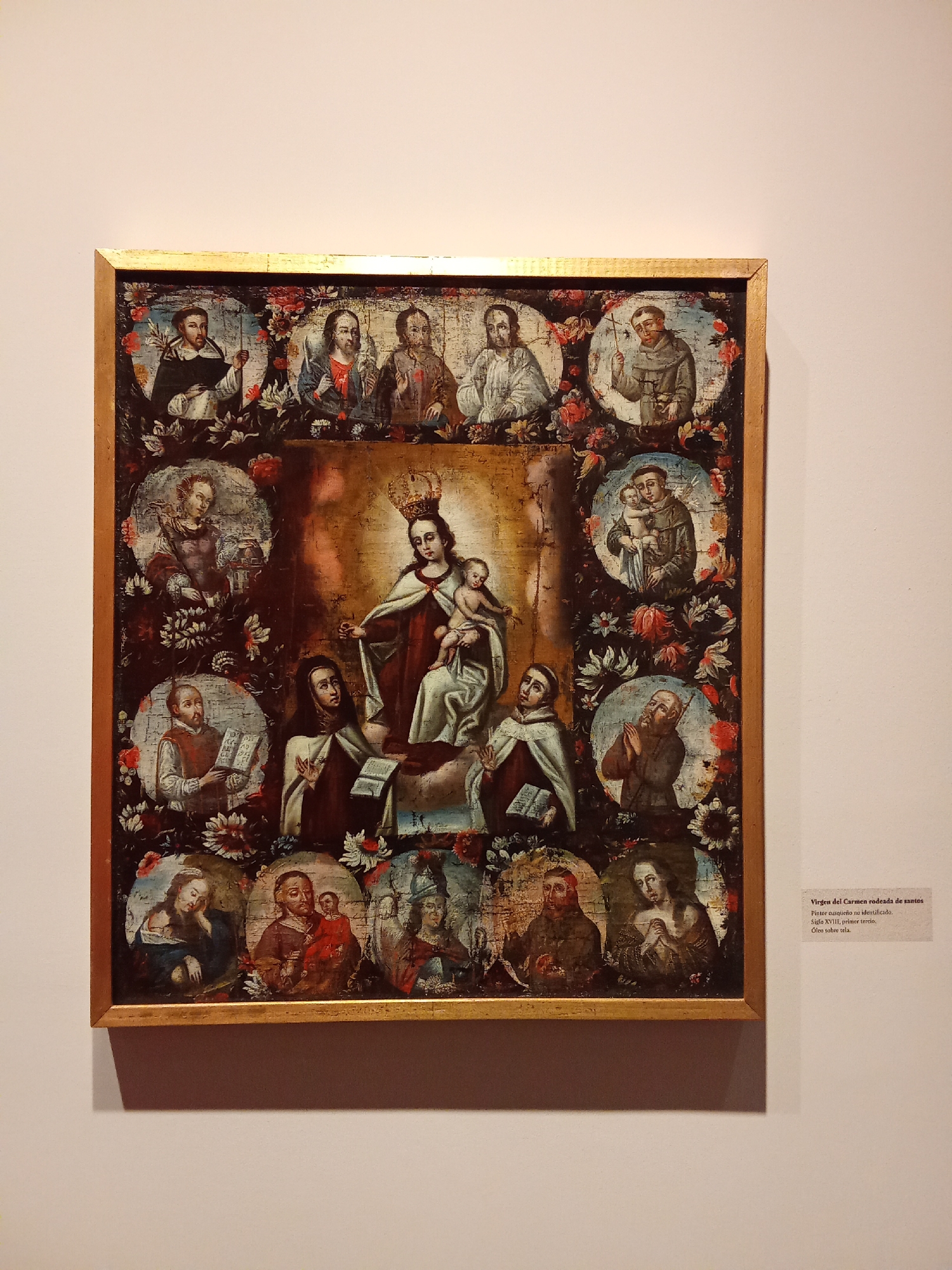
The image shows a painting titled "Virgen del Carmen rodeada de santos" (Virgin of Carmen surrounded by saints). The painting is framed in gold and depicts the Virgin Mary holding the Christ child in the center, crowned and with a halo. She is surrounded by numerous smaller circular portraits of saints, many of whom are depicted with halos and religious vestments. The background of the central image is a golden, textured effect, and the surrounding portraits are set against a dark floral pattern with red and white flowers. Below the painting, there is a label with the title, artist information ("Pintor cusqueño no identificado" - Cusco painter unidentified), date ("Siglo XVIII, primer tercio" - 18th century, first third), and medium ("Óleo sobre tela" - Oil on canvas). The painting is displayed on a plain, off-white wall. To the right of the painting is the same label providing information about the artwork. The lighting appears to be artificial, casting a soft illumination on the artwork. A shadow is cast on the wall below the painting, indicating the direction of the light source. The overall environment suggests an art gallery or museum setting. The provided information specifically mentions the city of Santiago, Chile as the location.
Santiago, Chile · Aug 13, 2026, 2:36 PM
A doll dressed as a nun stands in a red display case, in front of a red background. The doll wears a black habit with a white wimple and veil, and a rope belt tied at the waist. The text below the display case reads "CLARISAS" and provides a description of the habit worn by religious women of the Franciscan order. The scene appears to be from a museum exhibit in Santiago, Chile, though no specific museum name is provided.
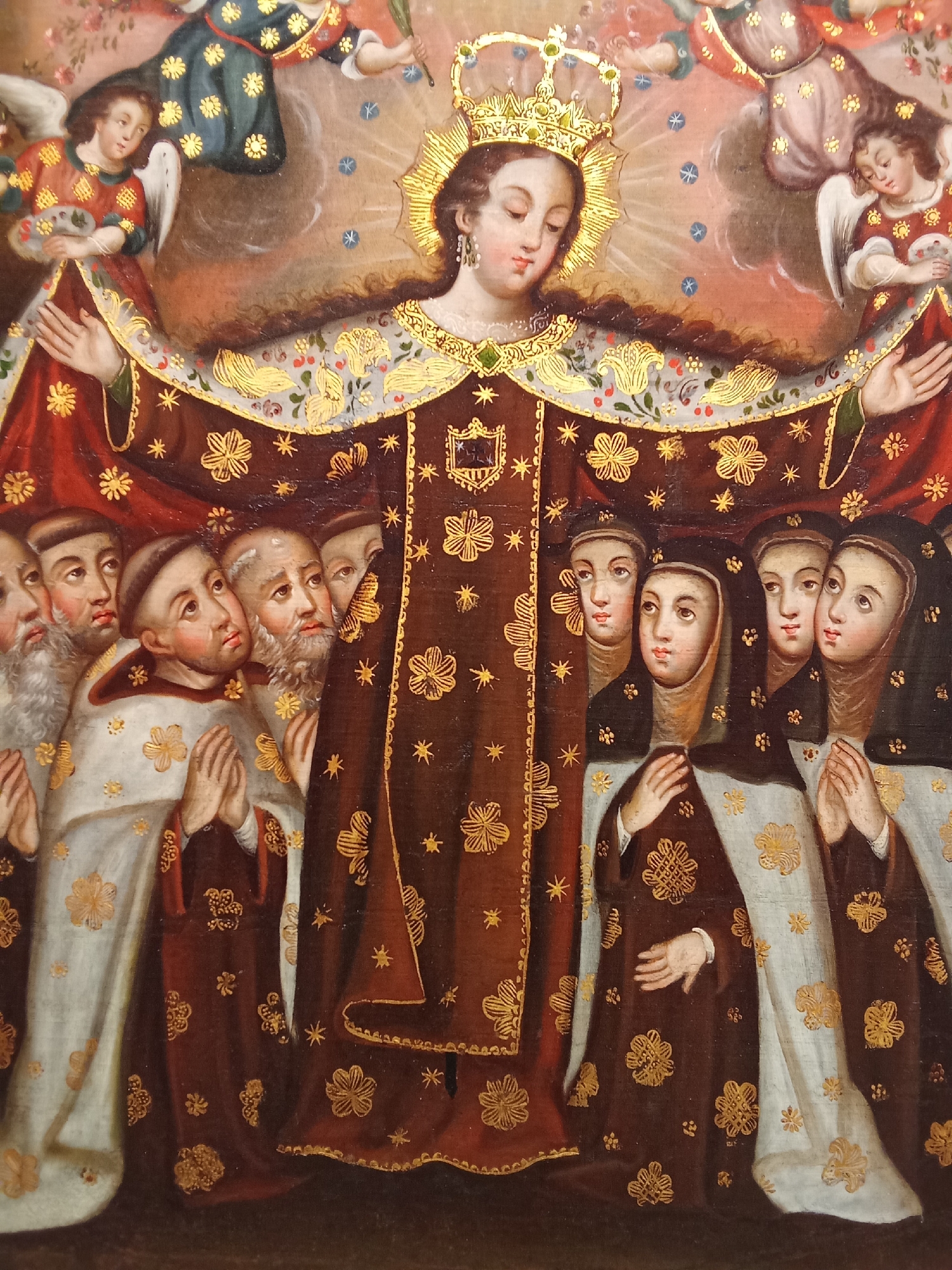
This is a detail of a religious painting, likely an altarpiece or devotional image, depicting the Virgin Mary, crowned and with a radiant halo, holding her cloak open to shelter a group of figures below. She is surrounded by angels, some of whom are in the upper corners of the frame. The figures beneath Mary's cloak appear to be monks and nuns, all looking up at her with expressions of devotion and prayer. They are dressed in their respective habits, many with their hands clasped. The Virgin's cloak is richly decorated with gold floral patterns on a dark red background, as are the garments of some of the figures beneath. The overall tone of the painting is reverent and solemn. The painting is in a state of good preservation, with vibrant colors and intricate details. The specific location in the city of Santiago, Chile, cannot be determined from the image alone, as it is a general religious scene.
Mel Navala
Santiago, Chile · Aug 13, 2026, 2:37 PM
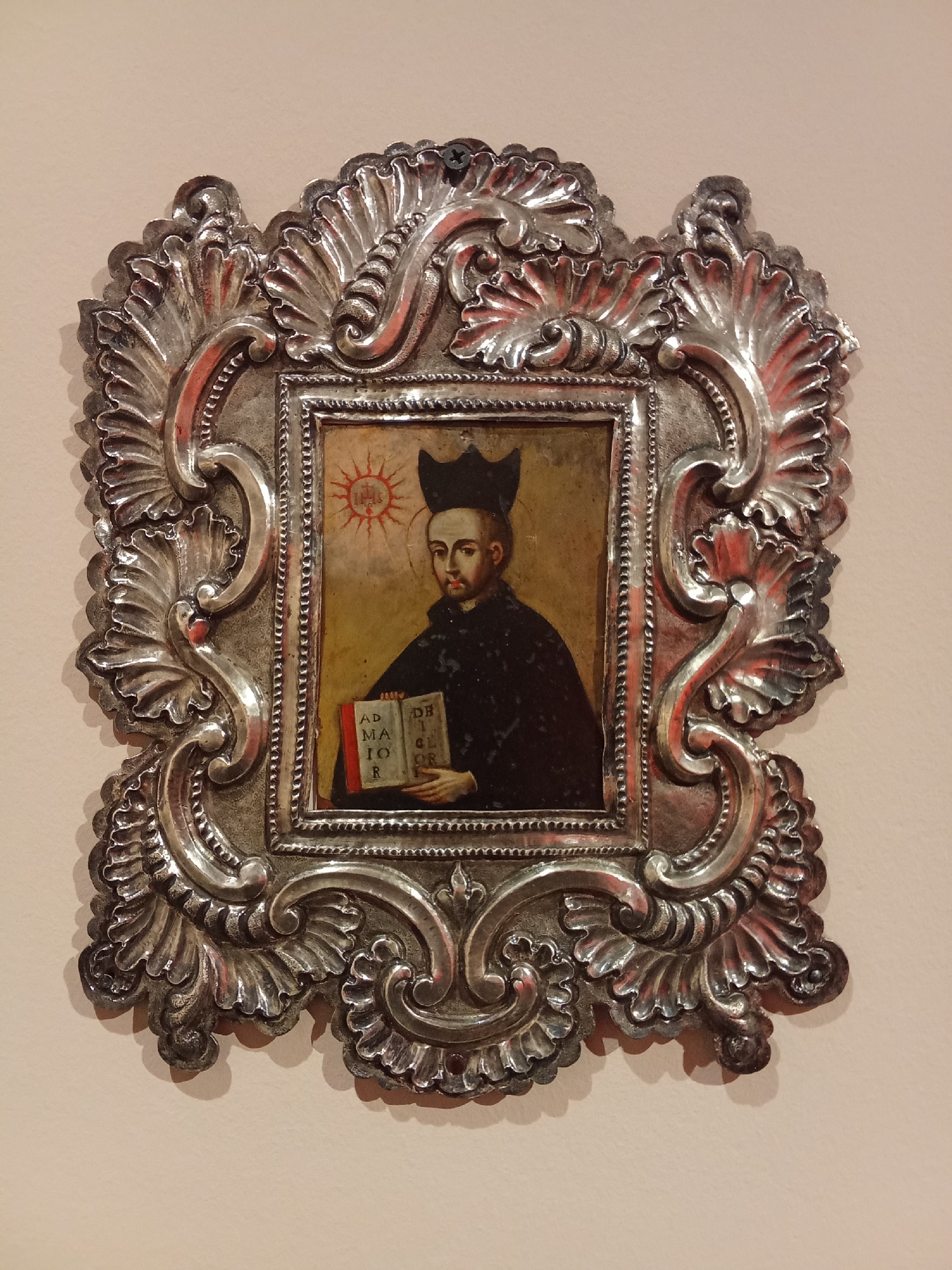
This is a photograph of a framed painting, likely a religious icon, hanging on a neutral-colored wall. The painting itself depicts a man wearing a black robe and a distinctive black hat, possibly a religious habit. He is holding an open book with red pages. Above his head, there is a sun-like symbol with rays and a red cross in its center. The painting is enclosed in a highly ornate, silver-colored frame with elaborate scrollwork, shell-like motifs, and decorative elements. The frame has a scalloped outer edge. The image is captured from a frontal perspective, with the painting and its frame being the sole focus. The lighting appears to be ambient, casting soft shadows on the wall behind the artwork. The photograph captures the texture and detail of the frame, as well as the colors and subject matter of the painting. This item is located at the Iglesia de San Agustín in Santiago, Chile.
Mel Navala
Santiago, Chile · Aug 13, 2026, 2:37 PM
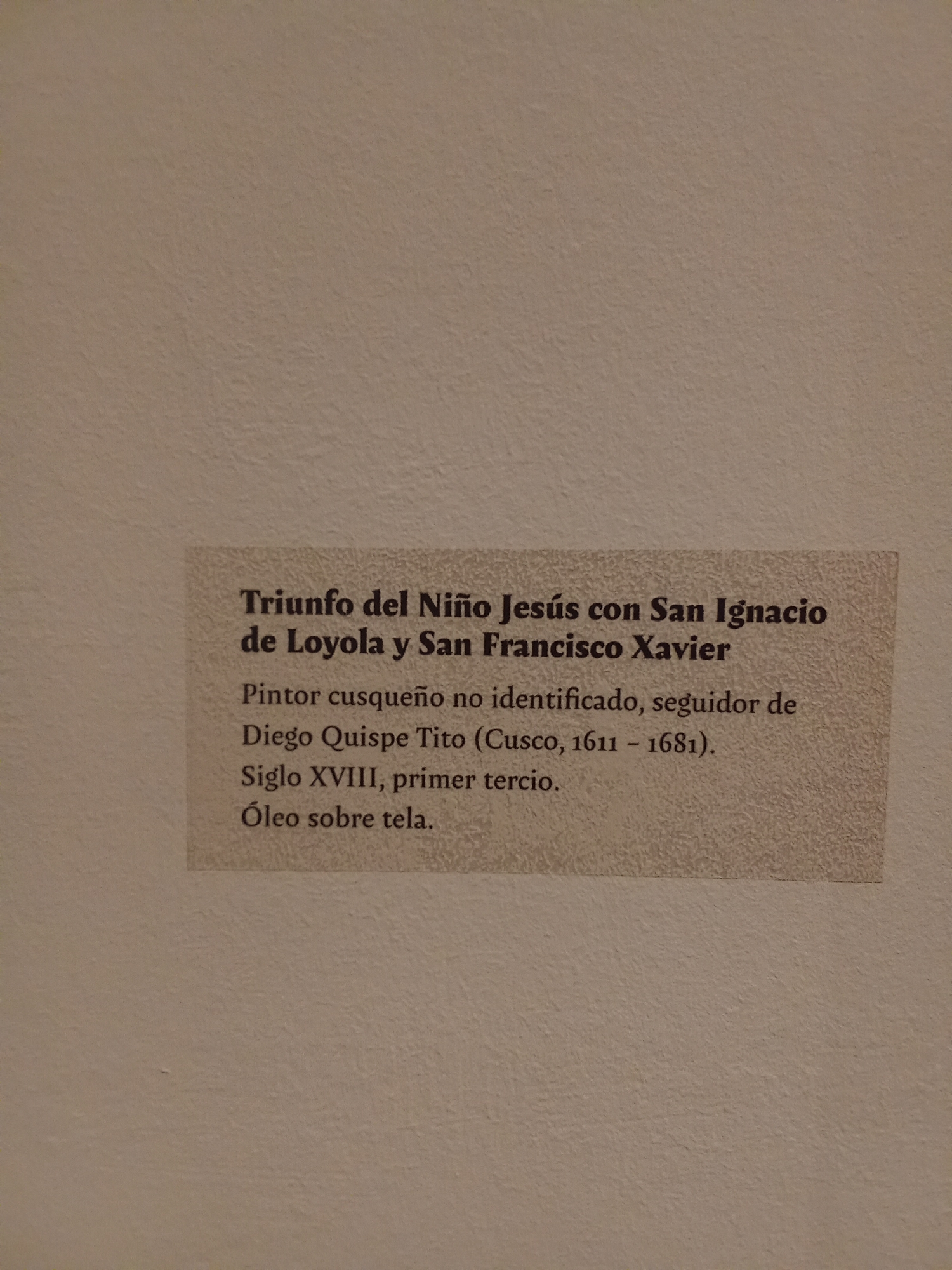
The image shows a plaque with text on a textured wall. The text is in Spanish and appears to be a description of a painting. The plaque is rectangular and oriented horizontally. The text reads: Triunfo del Niño Jesús con San Ignacio de Loyola y San Francisco Xavier Pintor cusqueño no identificado, seguidor de Diego Quispe Tito (Cusco, 1611 - 1681). Siglo XVIII, primer tercio. Óleo sobre tela. This translates to: Triumph of the Child Jesus with Saint Ignatius of Loyola and Saint Francis Xavier Unidentified Cuzco painter, follower of Diego Quispe Tito (Cusco, 1611 - 1681). 18th century, first third. Oil on canvas. The image does not provide any information about the location in the city of Santiago, Chile. It is a close-up shot of the plaque and the wall it is mounted on. The wall appears to be painted a light beige color and has a subtle texture. The plaque itself has a patterned background with a slightly darker shade.
Mel Navala
Santiago, Chile · Aug 13, 2026, 2:38 PM
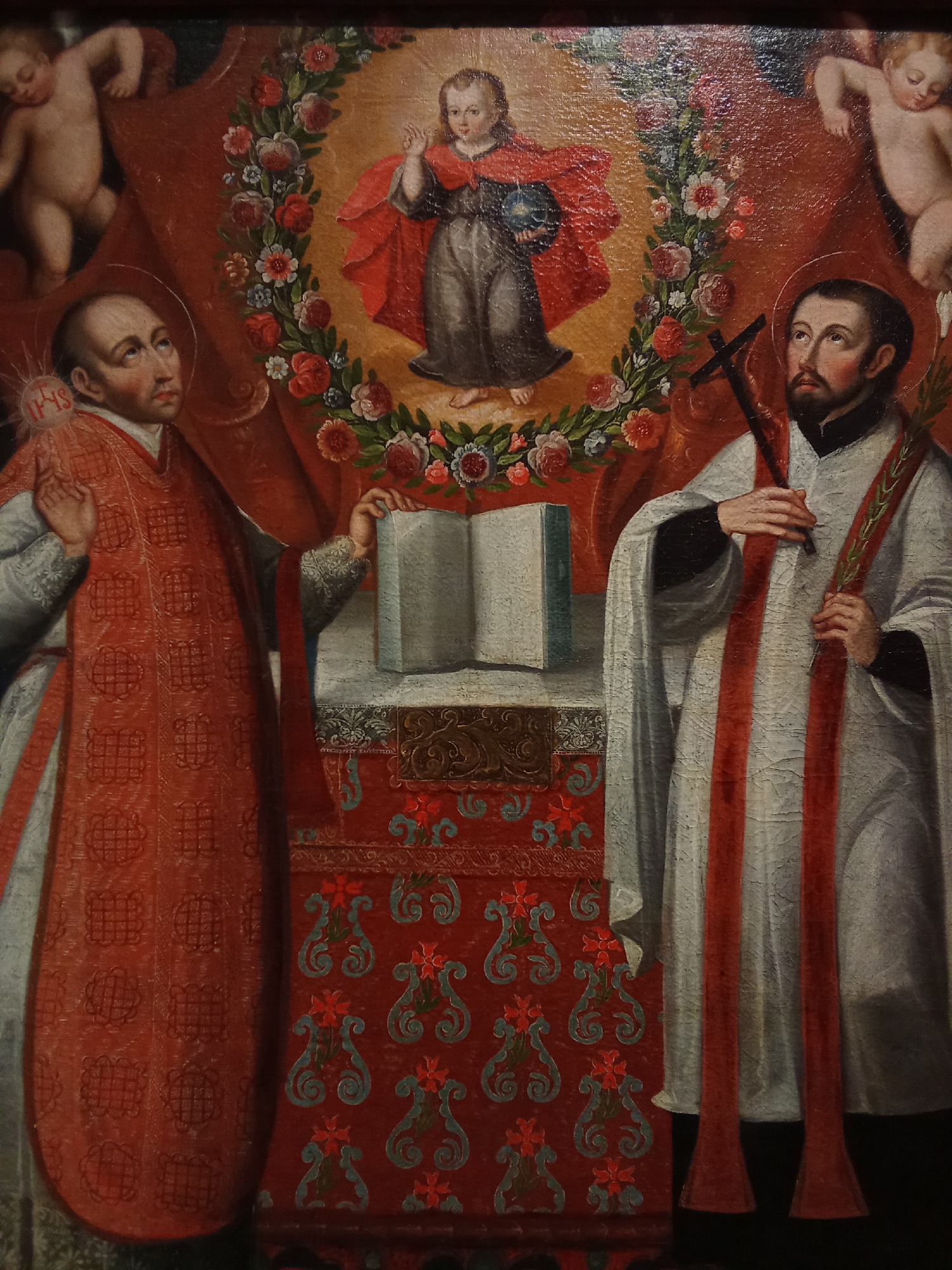
This is a painting depicting a religious scene with two male figures in clerical attire and a depiction of the infant Jesus. On the left, a bald man wearing an ornate red robe and a white garment underneath raises his left hand, with a halo bearing the inscription "IHS" surrounding his head. He stands to the left of a table draped with a red cloth decorated with a repeating pattern of blue and red floral motifs. On the table, a closed book with a light-colored cover rests. To the right of the table stands another man, who is bearded and wears a white alb and a black cassock, with a red stole draped over his shoulders. He holds a cross in his right hand and a sprig of greenery in his left. A halo surrounds his head. Above and behind these figures, the infant Jesus is depicted in a reddish garment, holding a blue orb in his left hand and raising his right hand. He is framed by a wreath of colorful flowers and greenery. Two cherubic figures are visible in the upper corners of the painting, one on the left appearing to lean forward, and another on the right. The background is a deep red fabric. This painting is located in the Church of San Francisco in Santiago, Chile.
Mel Navala
Santiago, Chile · Aug 13, 2026, 2:38 PM
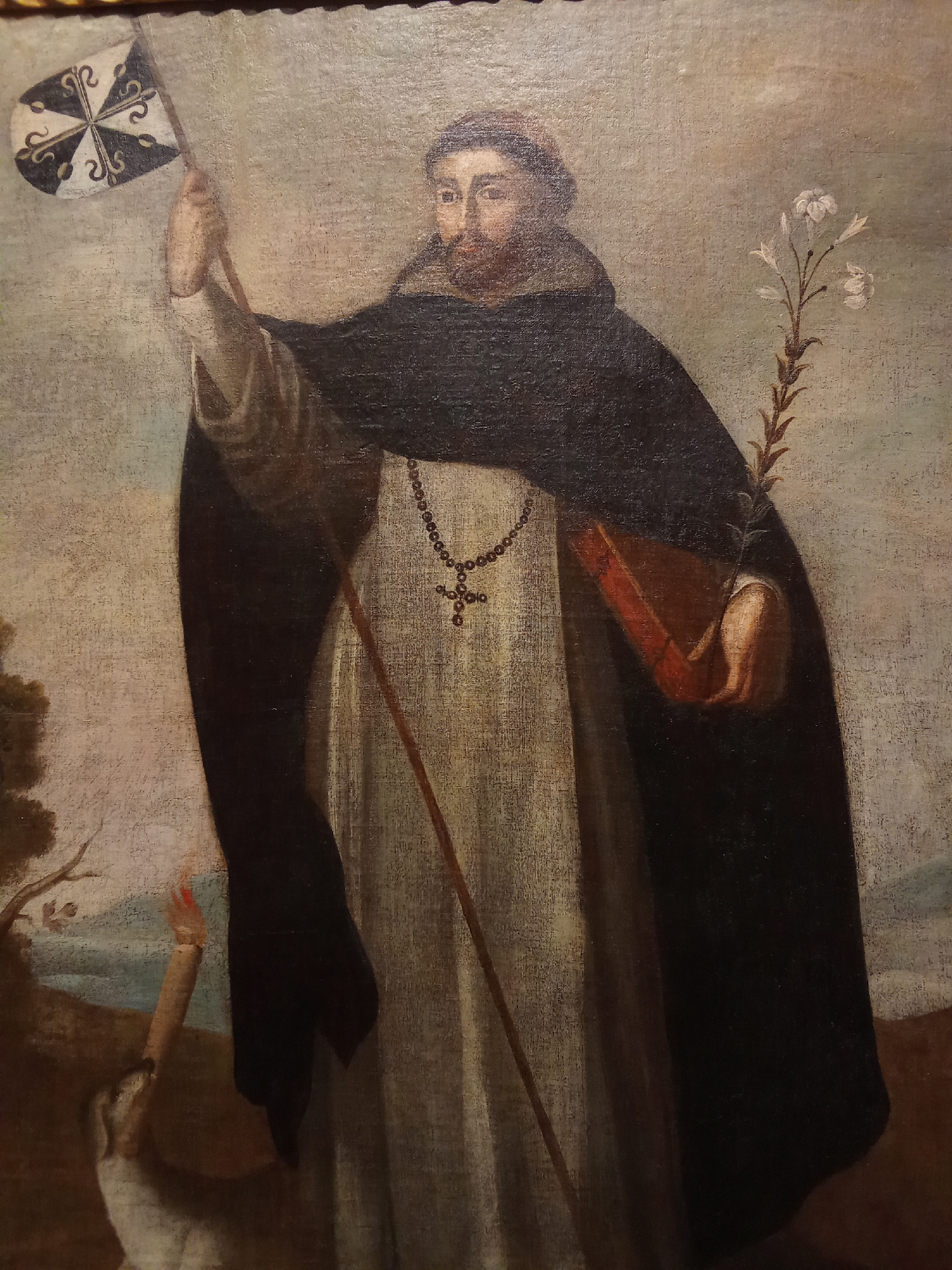
This is a full-length, portrait-style oil painting of a male figure in religious attire. The figure is depicted standing and is facing slightly to the viewer's left. He is wearing a dark hooded robe over a lighter, possibly white, tunic. Around his neck, he wears a rosary with a crucifix. His left hand is raised, holding a flag with a black and white emblem. His right hand is tucked into the folds of his robe, holding a reddish-brown book. To the right of the figure, a stem with three white lilies rises. In the lower left of the painting, a small white dog looks upwards towards a burning torch, which is partially visible. The background is a muted landscape with hints of trees and a sky. The painting is aged, with visible canvas texture and slight discoloration. Based on archival information, this painting is located in the Museo Histórico Nacional in Santiago, Chile.
Mel Navala
Santiago, Chile · Aug 13, 2026, 2:39 PM
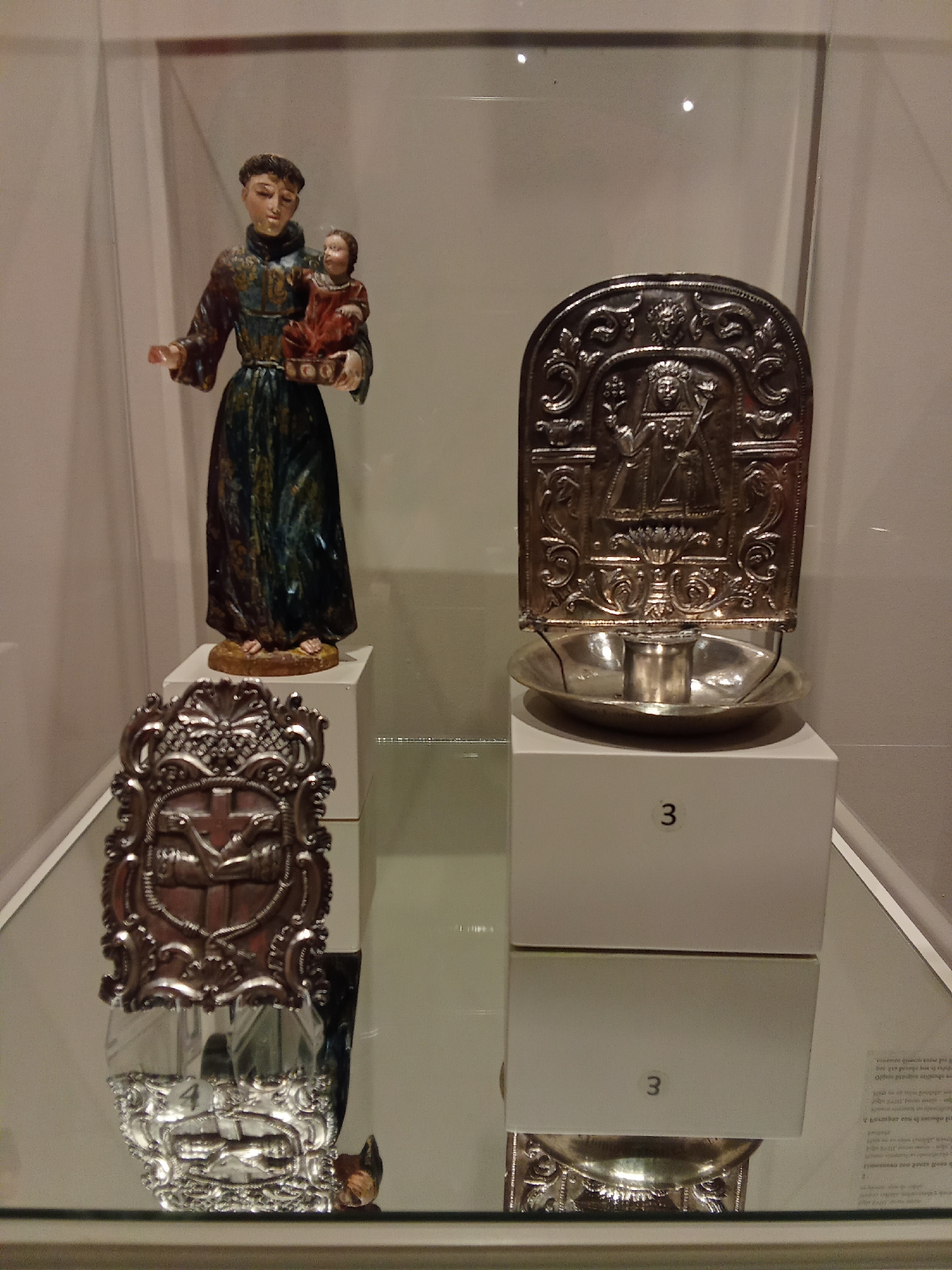
This image captures a museum display case in Santiago, Chile, featuring religious artifacts. On the left, a wooden statue depicts Saint Anthony holding the infant Jesus. The saint is dressed in a dark blue and green robe with gold accents. On the right, a silver devotional object, possibly a votive lamp or reliquary, is displayed. This object has an arched top with intricate carvings and a shallow dish at the bottom. Both artifacts are placed on white pedestals. The foreground shows a reflective surface, likely glass, revealing reflections of the objects and the surrounding display. In the background, the museum wall is visible, with a small label in the lower right corner.
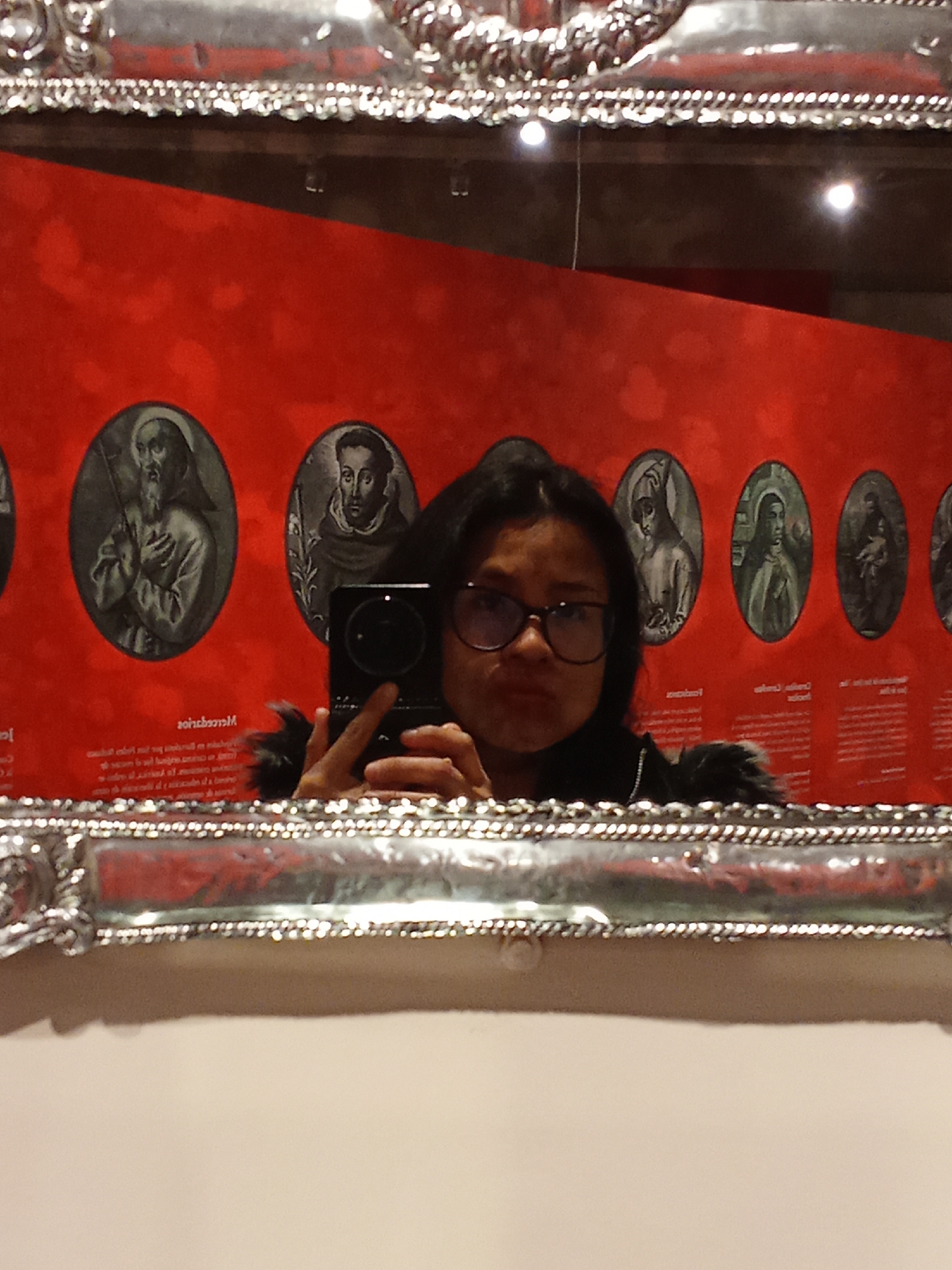
The image shows a reflection in a mirror of a woman taking a selfie. She is wearing glasses and holding a black camera. Behind her, the reflection shows a red wall with several oval portraits of figures, some with halos. Below the portraits, there is text that is reflected and appears to be in Spanish. The mirror has an ornate, silver frame. The scene appears to be indoors, possibly in a museum or art gallery. The location is identified as being in the city of Santiago, Chile, specifically within the Museo Histórico Nacional (National Historical Museum) on the Plaza de Armas.
Mel Navala
Santiago, Chile · Aug 13, 2026, 2:40 PM
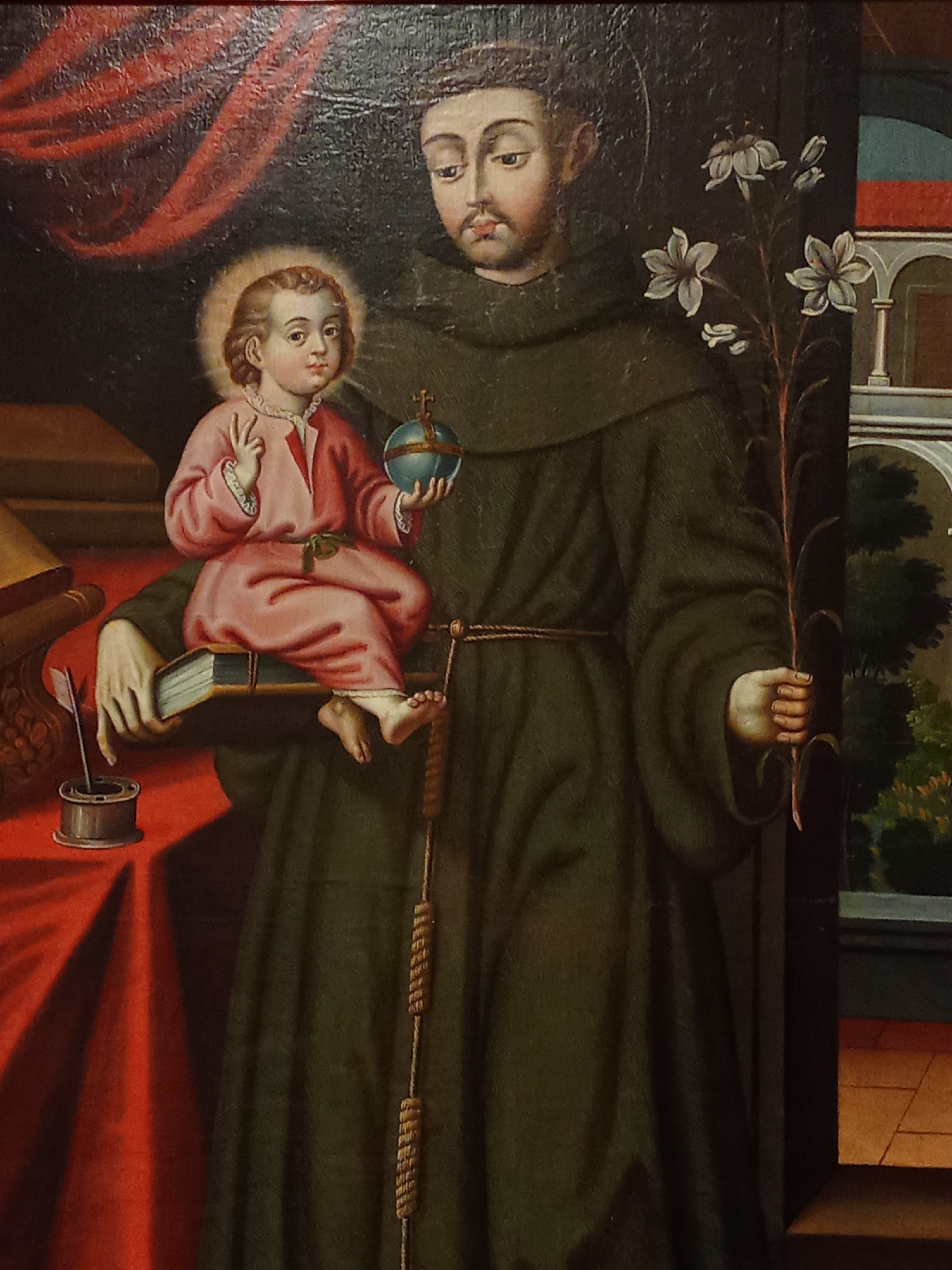
This is a full-body portrait painting of a robed figure, likely a saint, holding the Christ child. The main subject wears a dark, hooded robe with a rope belt. The Christ child, dressed in pink, sits on the robed figure's arm, which rests on a book. The child holds a blue orb with a cross and raises one hand in a gesture of blessing. A halo surrounds the child's head. To the right of the main subject, a stem with white lilies is depicted. The background on the right shows an architectural element resembling an archway and trees. The background on the left features red drapery and books. A small inkwell with a quill pen is visible on a red surface in the foreground. The painting is part of the collection of the Museo Chileno de Arte Precolombino in Santiago, Chile, but its specific location within the city is not detailed in this description.
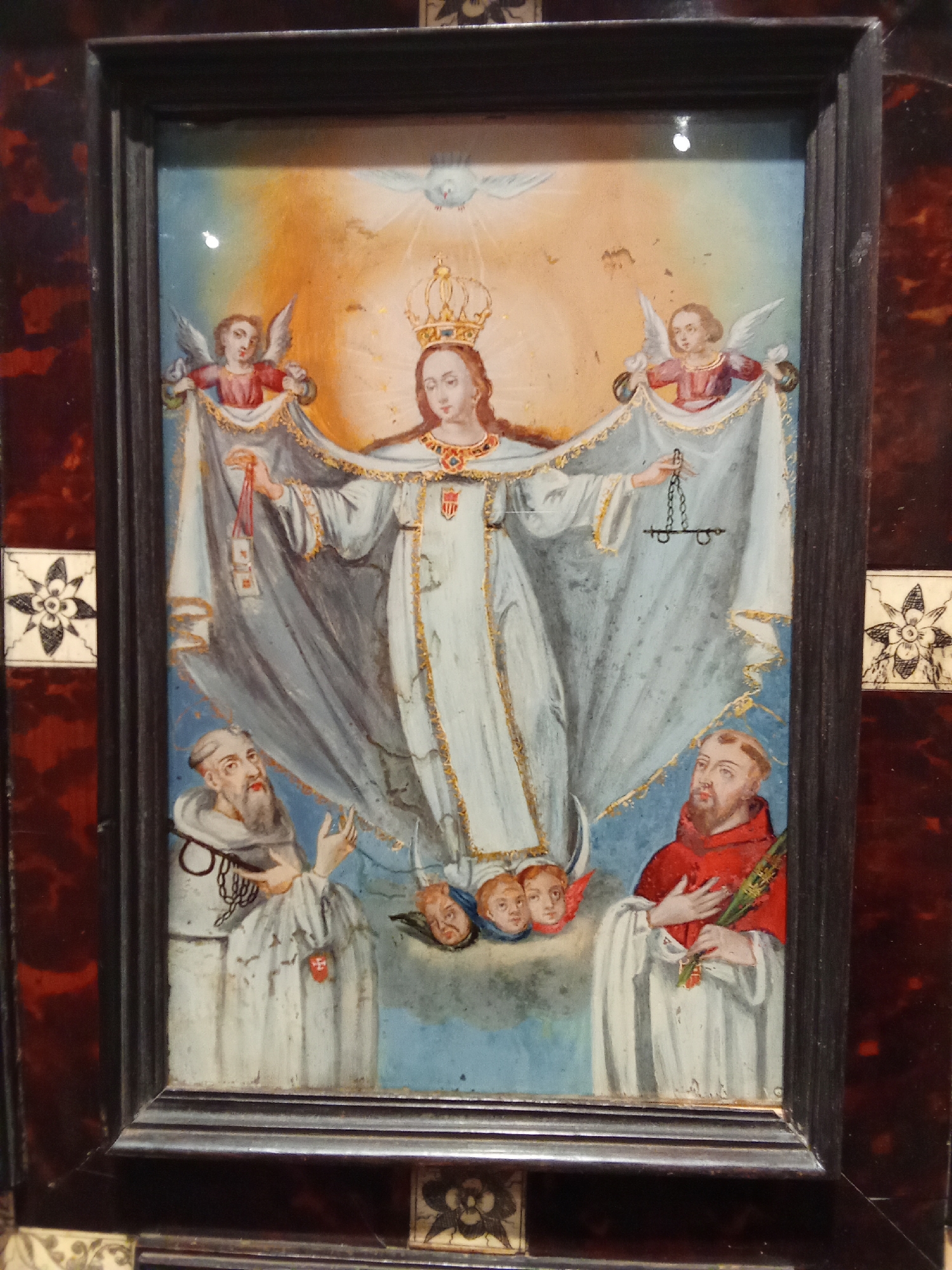
The image is a painting depicting a religious scene, likely the Assumption of the Virgin Mary, framed within a decorative wooden border with inlaid ivory or bone floral motifs. The central figure is a crowned woman in white robes, with outstretched arms, holding a chain with two small squares. She is surrounded by cherubic faces and two winged figures holding drapes. Above her, a dove descends from a golden, heavenly light. At the bottom of the painting, two figures in religious habit stand on either side. The figure on the left wears a white robe and cowl with a rope belt and has a gray beard. The figure on the right wears a red robe over a white garment and holds a green sprig. The painting appears to be an altar piece or devotional artwork. There is no information in the image to suggest its location in the city of Santiago, Chile.
Santiago, Chile · Aug 13, 2026, 2:42 PM
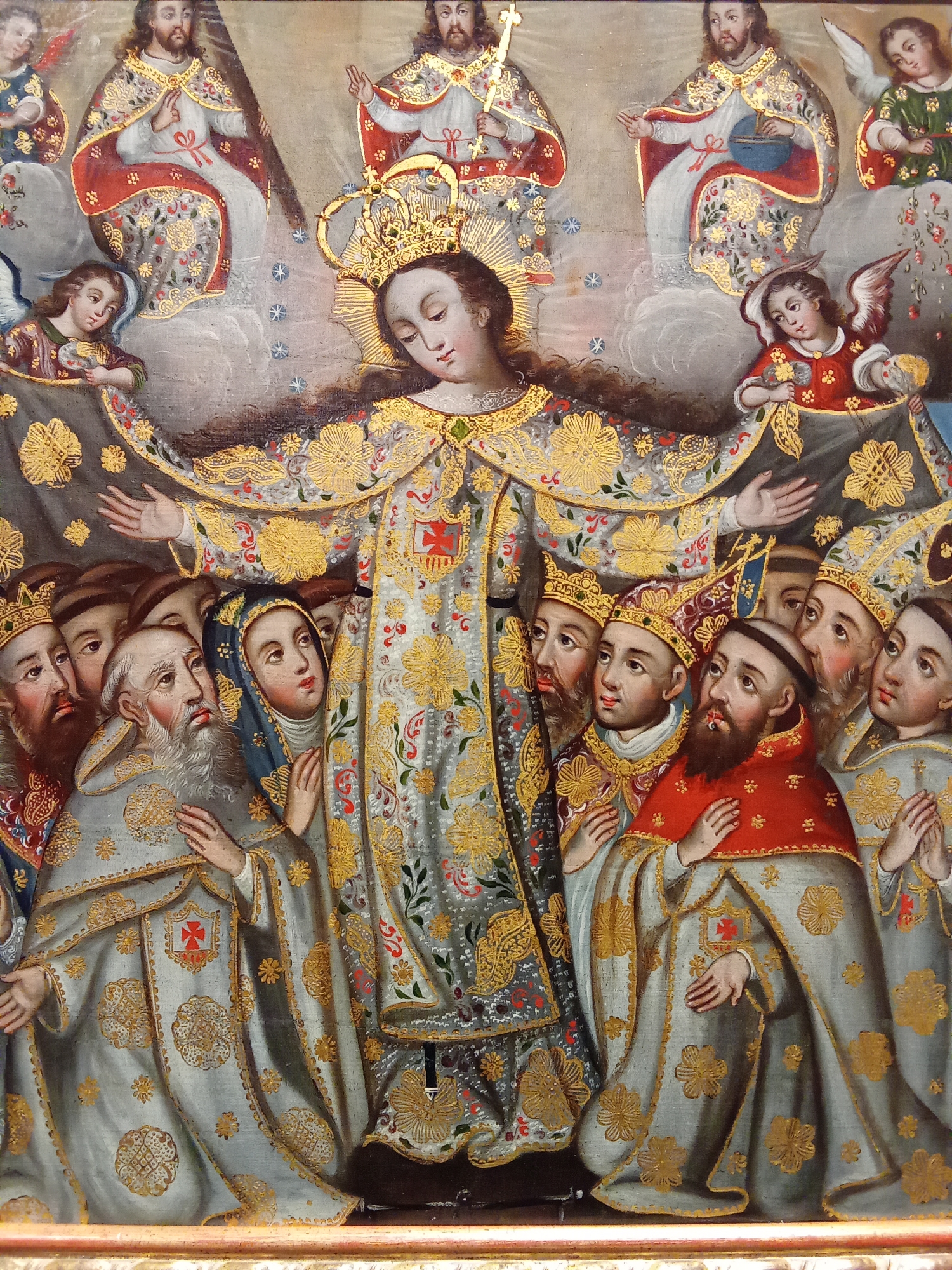
This painting depicts the Assumption of the Virgin Mary, surrounded by saints and angels. The Virgin Mary is centrally located, crowned and dressed in ornate robes adorned with gold floral patterns and red crosses. She is floating amidst clouds, with her arms outstretched in a gesture of welcome or blessing. To her left and right are figures that appear to be Jesus Christ and possibly God the Father, also seated on clouds and wearing similar elaborate garments. Various angels are also present, some with wings, tending to the figures. Below the Virgin Mary, a group of male figures, likely saints or religious figures, are looking up at her. They are dressed in religious attire, including crowns and monastic robes. One figure in the foreground wears a red cloak over a grey robe and has a beard. Another figure to his left wears a grey robe and has a beard, while another figure to the far left wears a crown and a richly decorated robe. The painting style suggests it is colonial-era religious art. The exact location in the city of Santiago, Chile, is not provided in the image itself, but such works are often found in churches and museums in the city. The overall scene is one of divine ascension and reverence.
Mel Navala
Santiago, Chile · Aug 13, 2026, 2:42 PM
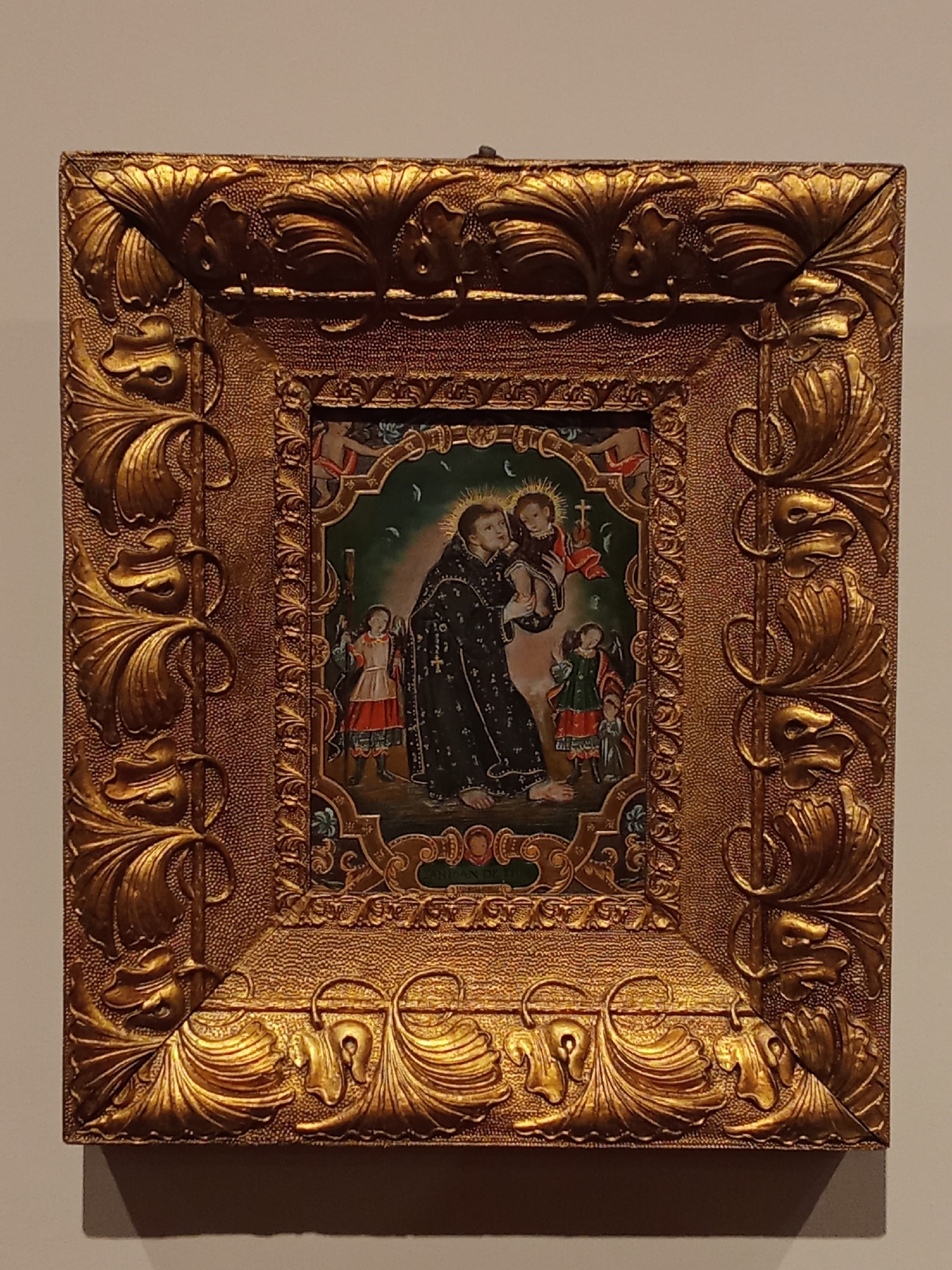
This is a framed painting depicting Saint Anthony of Padua. The saint, dressed in a dark robe, is holding the infant Jesus, who is reaching for a halo. They are surrounded by a green background with some floral motifs. To the left of Saint Anthony, a young person in a red and white outfit stands with their hands clasped. To the right, another young person in a green outfit is also depicted. The painting is housed in an ornate gold frame with intricate leaf and scrollwork designs. At the bottom of the painting, a plaque reads "SAN AN. DE PA..." suggesting it is indeed Saint Anthony of Padua. The painting appears to be on display in a museum or gallery setting, with a plain wall behind it and a shadow cast on the wall below. The specific location in the city of Santiago, Chile is not discernible from the image itself.
Mel Navala
Santiago, Chile · Aug 13, 2026, 2:43 PM
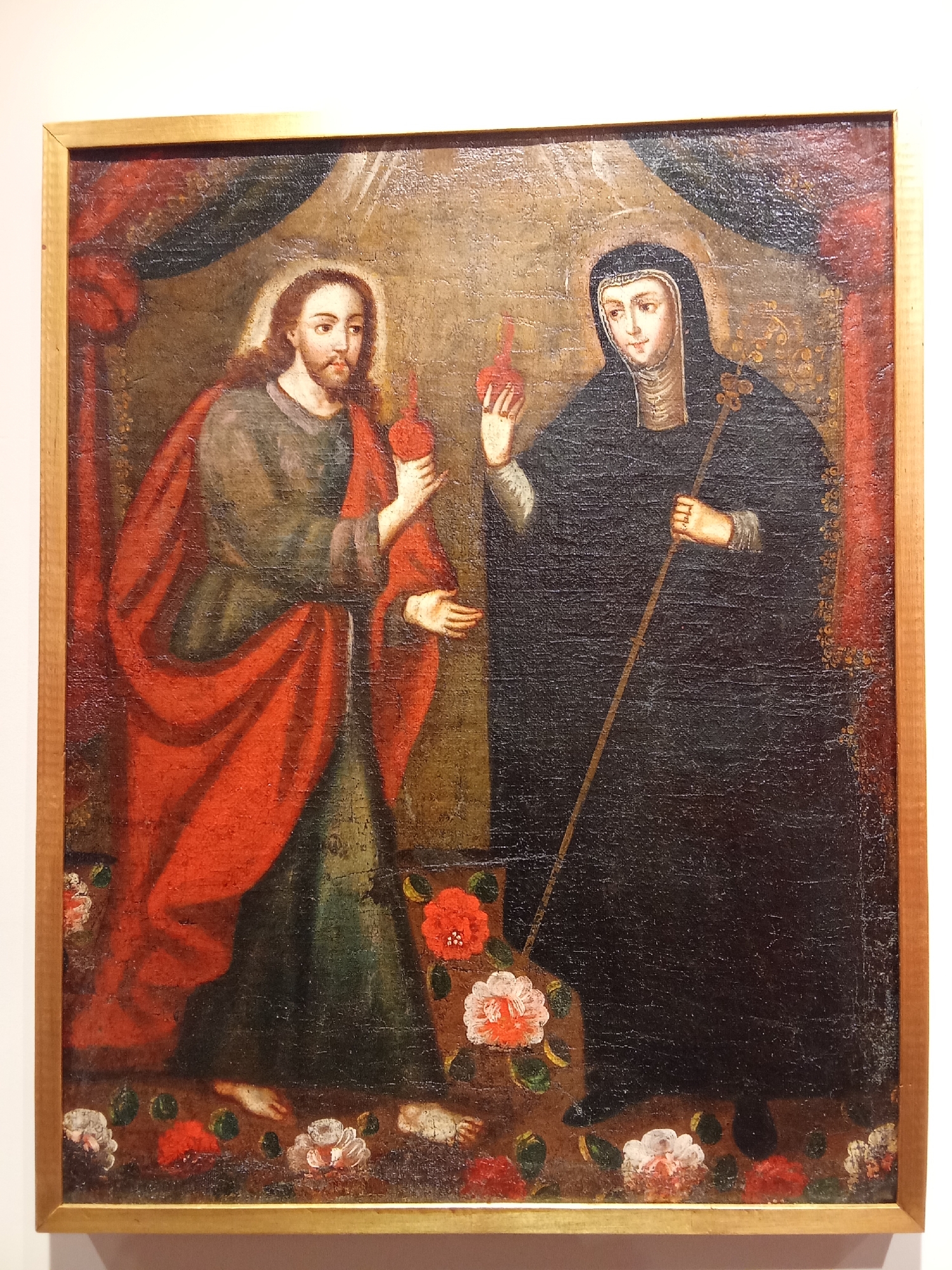
This is a vertical, full-shot oil painting depicting two religious figures in the foreground against a dark, curtained background. The figure on the left, identified as Jesus, has a halo and is wearing a red cloak over a green robe. He holds a flaming heart in his right hand, extending his left hand outward. The figure on the right, a woman wearing a dark habit and a white wimple, also holds a flaming heart in her raised left hand. She carries a staff in her right hand. The figures are surrounded by a border of colorful flowers at the bottom of the painting, including red and white roses and smaller buds. The painting is enclosed in a gold wooden frame. This painting is located in the Museo Colonial de San Francisco in Santiago, Chile.
Mel Navala
Santiago, Chile · Aug 13, 2026, 2:43 PM
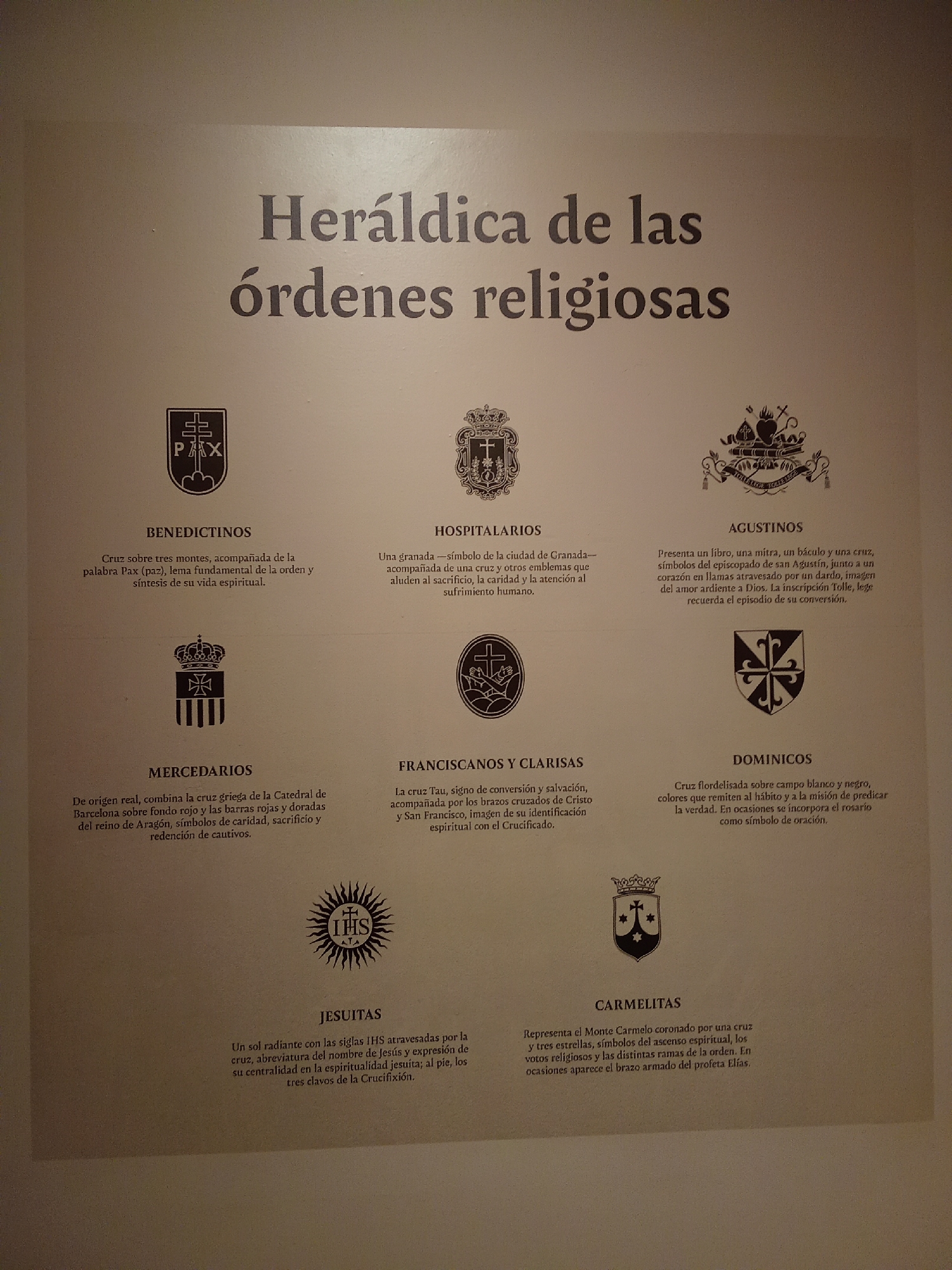
The image is a high-angle, full-shot photograph of a poster displaying heraldic symbols and descriptions of various religious orders. The poster has a light, neutral background. The title "Heráldica de las órdenes religiosas" is prominently displayed at the top in large, dark text. Below the title, the poster is organized into six sections, each featuring a crest or emblem accompanied by a name and descriptive text in Spanish. The sections are arranged in a grid-like fashion: - **Top row, left:** A crest with a cross above three mounds and the letters "PAX", labeled "BENEDICTINOS". - **Top row, middle:** A crest with a crown and a cross, labeled "HOSPITALARIOS". - **Top row, right:** A crest with a book, a miter, a cross, and a heart pierced by an arrow, labeled "AGUSTINOS". - **Middle row, left:** A crest with a crown above a shield with vertical stripes and a cross, labeled "MERCEDARIOS". - **Middle row, middle:** A crest with hands holding a cross with a heart and three nails, labeled "FRANCISCANOS Y CLARISAS". - **Middle row, right:** A crest with a black and white shield bearing a floral cross, labeled "DOMINICOS". - **Bottom row, left:** A radiant sun-like emblem with the letters "IHS" in the center, labeled "JESUITAS". - **Bottom row, right:** A crest with a star above a crown, labeled "CARMELITAS". The text accompanying each emblem describes its symbolism and significance. There are no people or animals present in the image. The environment is a flat, indoor surface, likely a wall or display board. There is no indication of the city of Santiago, Chile, or any specific location within it. The lighting appears even, suggesting a well-lit indoor setting.
Mel Navala
Santiago, Chile · Aug 13, 2026, 2:44 PM
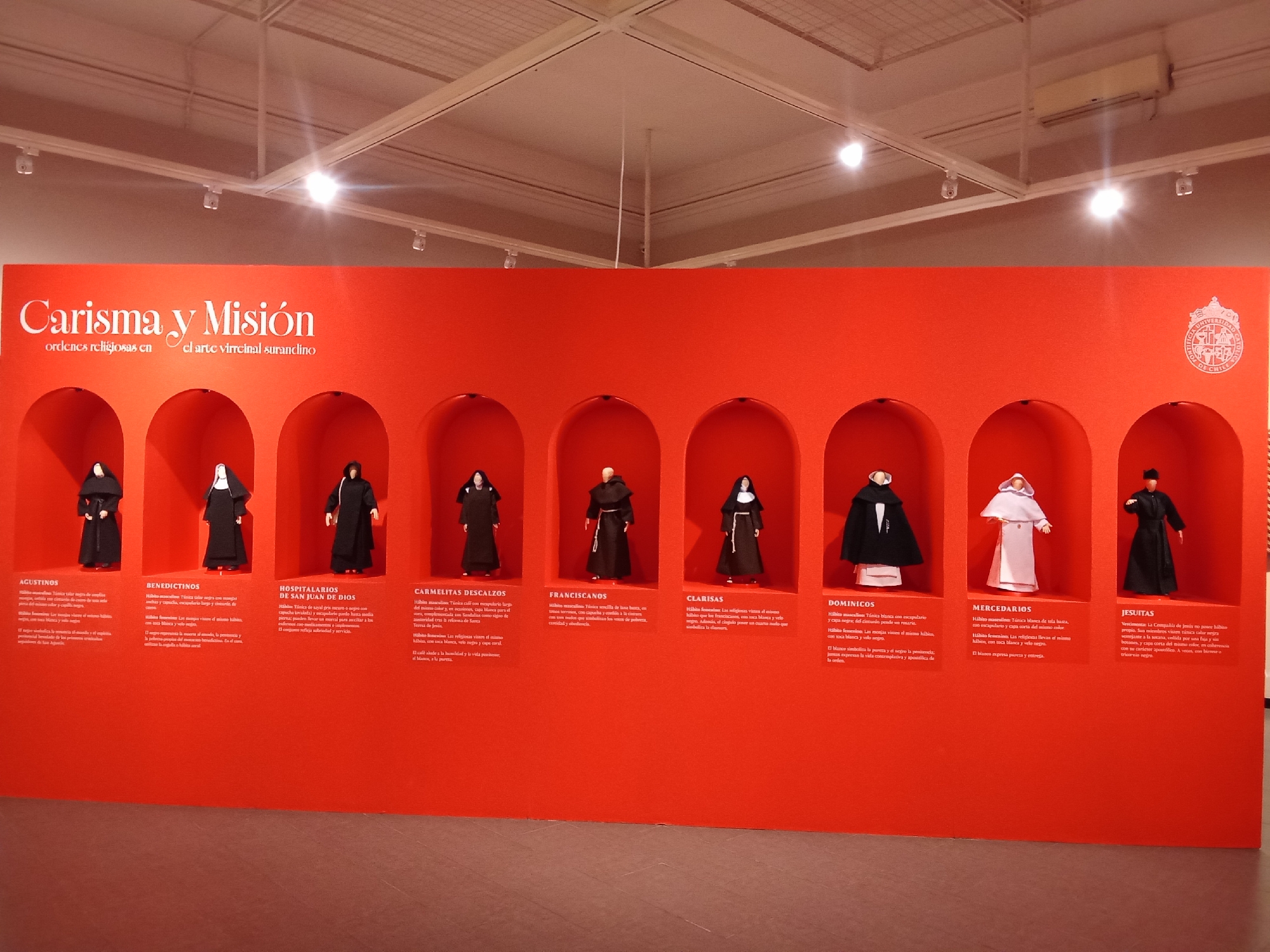
The image shows an exhibit of religious orders, with the title "Carisma y Misión: órdenes religiosas en el arte virreinal surandino". This translates to "Charisma and Mission: religious orders in the art of the Andean viceroyalty." The exhibit is set against a vibrant red backdrop, with a series of arched alcoves, each displaying a mannequin dressed in the habit of a specific religious order. Text panels below each figure describe the order and its attire. The displayed orders include Agustinos, Benedictinos, Hospitalarios de San Juan de Dios, Carmelitas Descalzos, Franciscanos, Clarisas, Dominicos, Mercedarios, and Jesuitas. The mannequins are depicted in various poses, some with hands clasped, others with heads bowed. The overall presentation suggests a historical and artistic exploration of religious life in the Andean region during the viceregal period. The text on the far right of the exhibit features a coat of arms, which appears to be the seal of the Pontifical Catholic University of Chile, indicating that this exhibit is likely housed at the university's museum or a related cultural institution in Santiago, Chile. The lighting in the image suggests an indoor setting, possibly a museum or gallery space, with track lighting illuminating the exhibit. The ceiling is visible in the upper portion of the image, featuring a white grid structure and track lighting systems. The red display wall runs horizontally across the image, serving as the primary visual element of the exhibit.
Mel Navala
Santiago, Chile · Aug 13, 2026, 2:46 PM
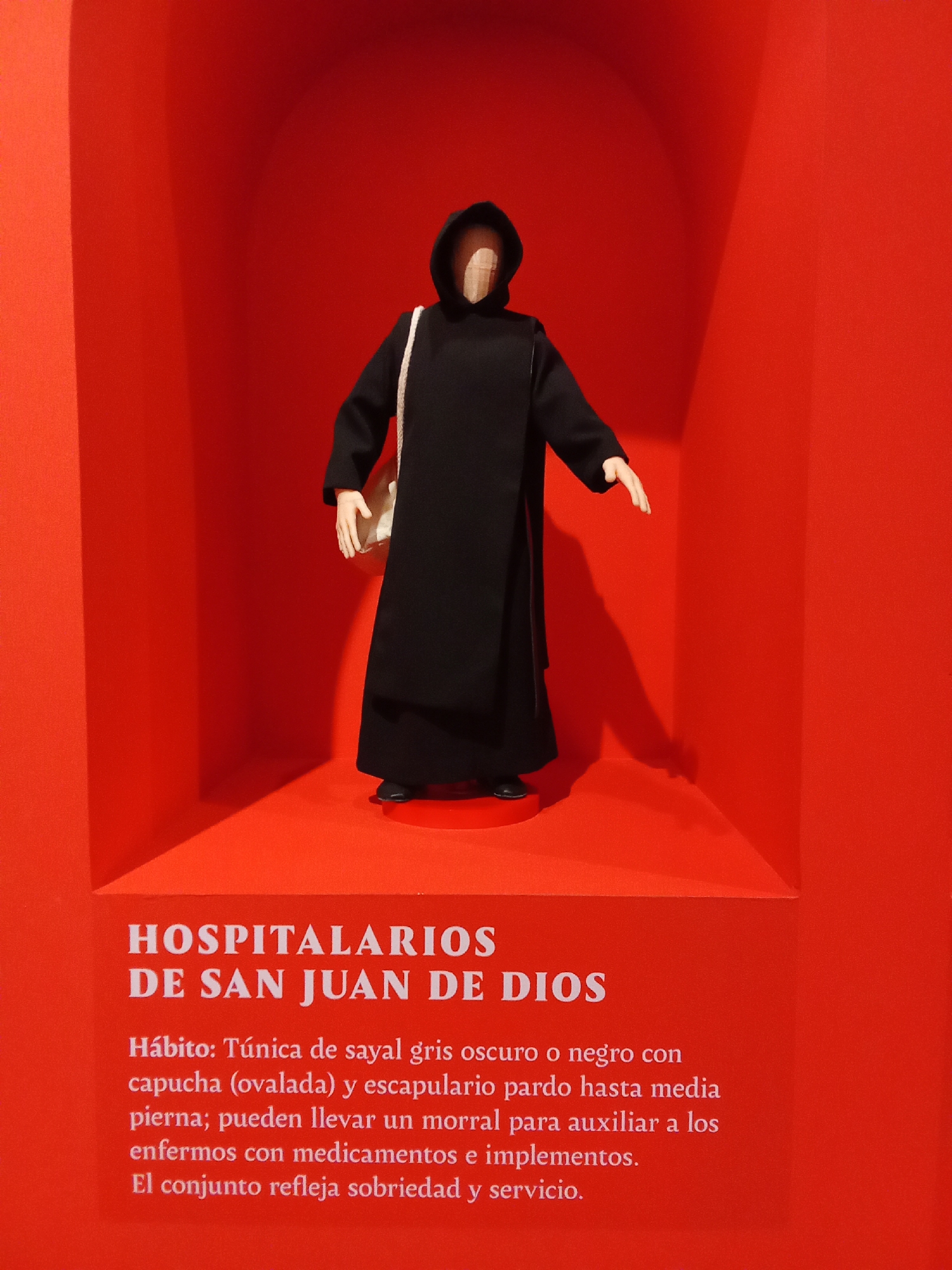
The image shows a mannequin dressed as a friar in a red, recessed display case. The friar is wearing a black robe with a hood and carrying a cream-colored bag over their shoulder. The display case is lit from above, casting shadows on the red floor and walls. Below the display case is text in white font on a red background. The text reads "HOSPITALARIOS DE SAN JUAN DE DIOS" and then describes the habit: "Hábito: Túnica de sayal gris oscuro o negro con capucha (ovalada) y escapulario pardo hasta media pierna; pueden llevar un morral para auxiliar a los enfermos con medicamentos e implementos. El conjunto refleja sobriedad y servicio." This translates to "Habit: Dark gray or black rough spun tunic with an oval hood and a brown scapular down to mid-leg; they can carry a satchel to help the sick with medicines and implements. The ensemble reflects sobriety and service." The context of the city of Santiago, Chile, is not explicitly stated in the image itself, but if this display were part of the Museo Histórico Nacional in Santiago, it would be located there.
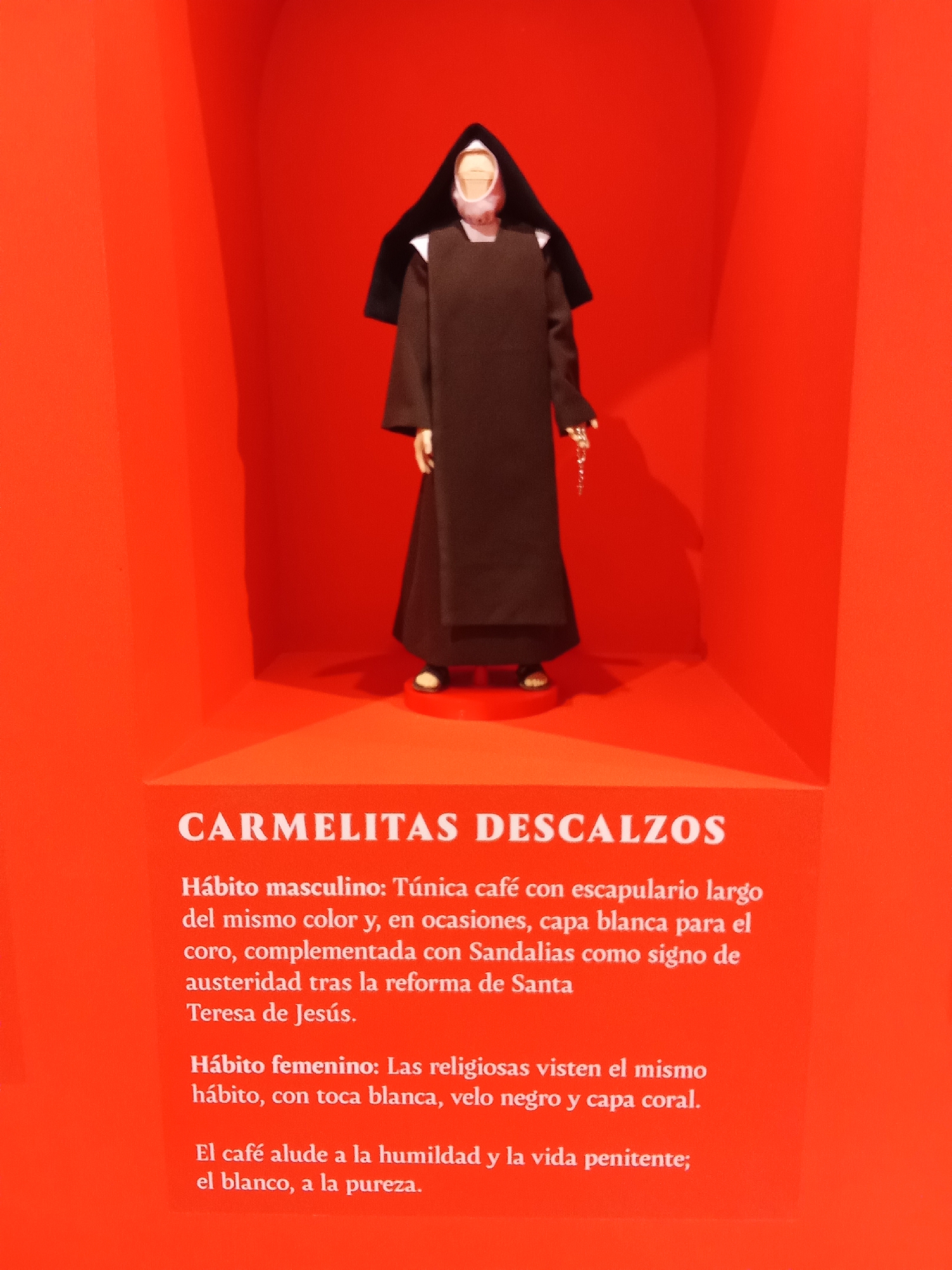
The image shows a display featuring a doll dressed as a Carmelite nun, positioned in the center of a bright red, cubical enclosure. The doll wears a dark brown habit with a black veil and wimple. A rosary hangs from its hand. The background is a vibrant red, with subtle lighting creating shadows. Below the display, white text on a red surface describes the Carmelite habit, differentiating between masculine and feminine attire and explaining the symbolism of the colors. This exhibit appears to be in a museum or cultural institution. There is no information within the image itself that indicates a specific location in the city of Santiago, Chile.
Mel Navala
Santiago, Chile · Aug 13, 2026, 2:47 PM
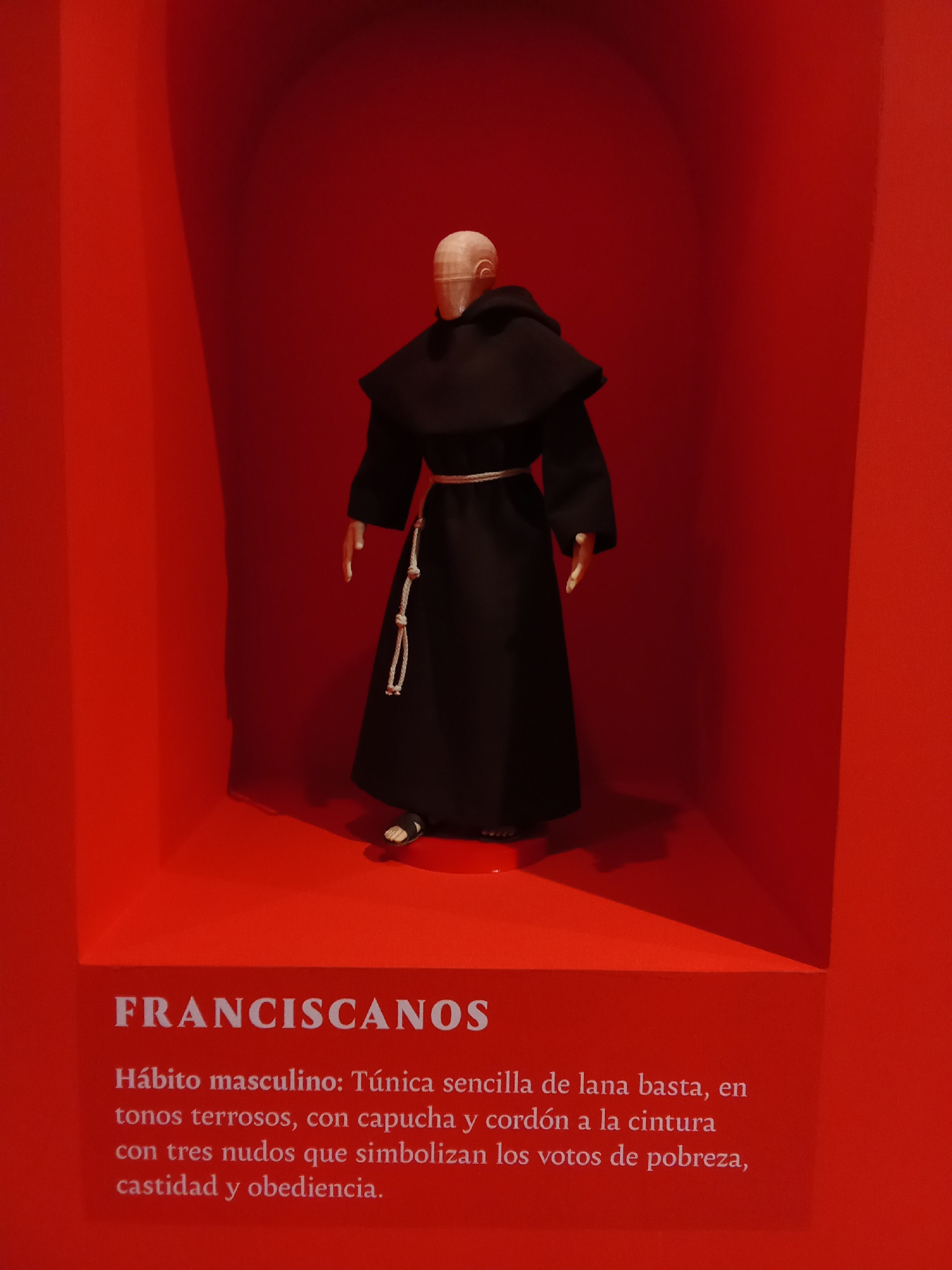
The image shows a doll dressed as a Franciscan monk standing in a red display case. The doll is wearing a black robe with a hood and a rope belt tied with three knots. The text below the doll reads "FRANCISCANOS" followed by a description of the habit. The location in Santiago, Chile is not specified in the image.
Mel Navala
Santiago, Chile · Aug 13, 2026, 2:48 PM
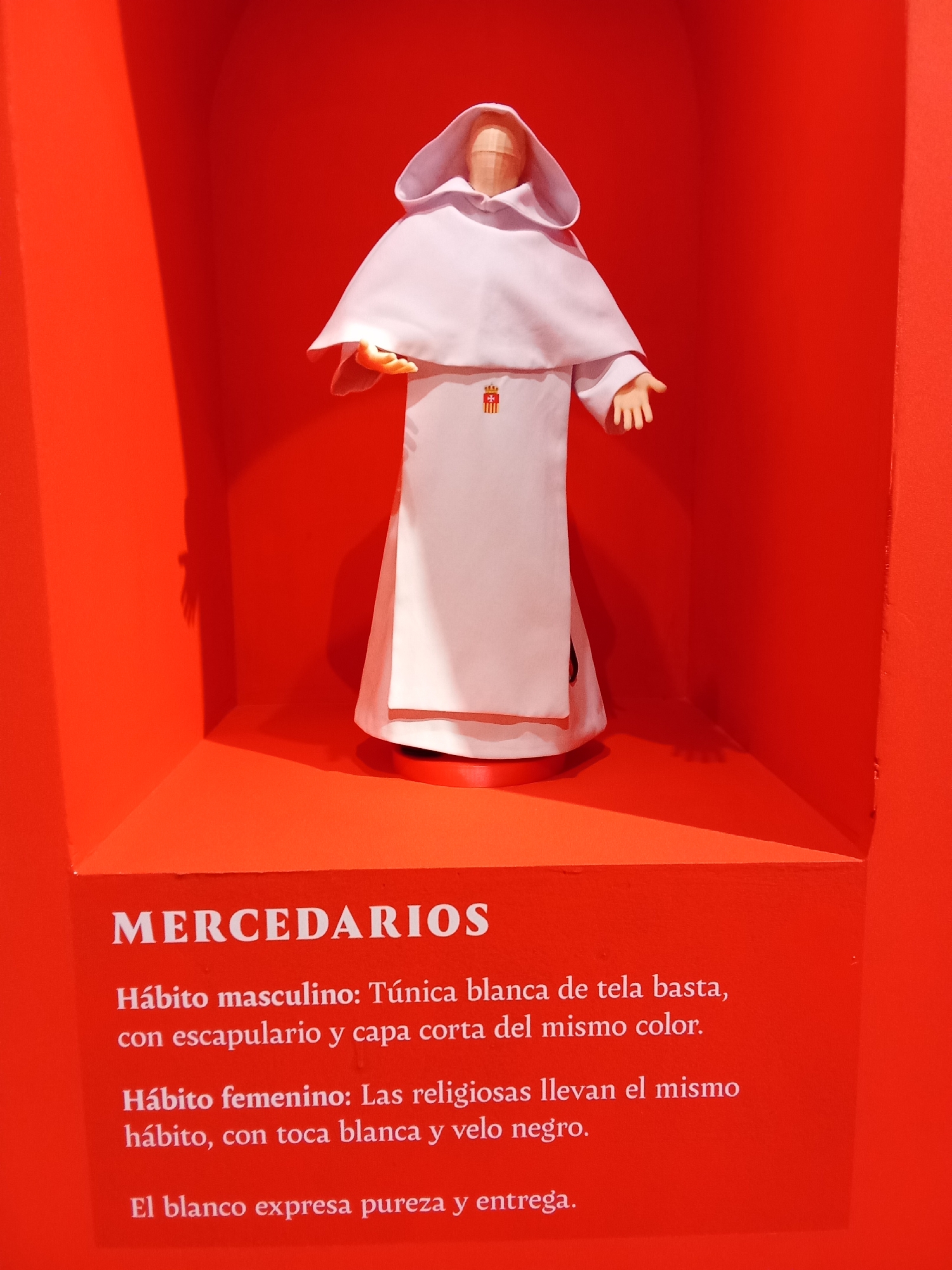
A mannequin dressed in a white religious habit with a hood and a crest on the chest stands in a red display niche. Text in white lettering on a red background below the niche describes the habit. The text is in Spanish and translates to "MERCEDARIAS. Male habit: Tunic of coarse cloth, with scapular and short cape of the same color. Female habit: The religious wear the same habit, with a white head covering and black veil. White expresses purity and delivery." The display appears to be in a museum or exhibition in Santiago, Chile. The lighting creates shadows on the red walls of the niche.
Santiago, Chile · Aug 13, 2026, 2:49 PM
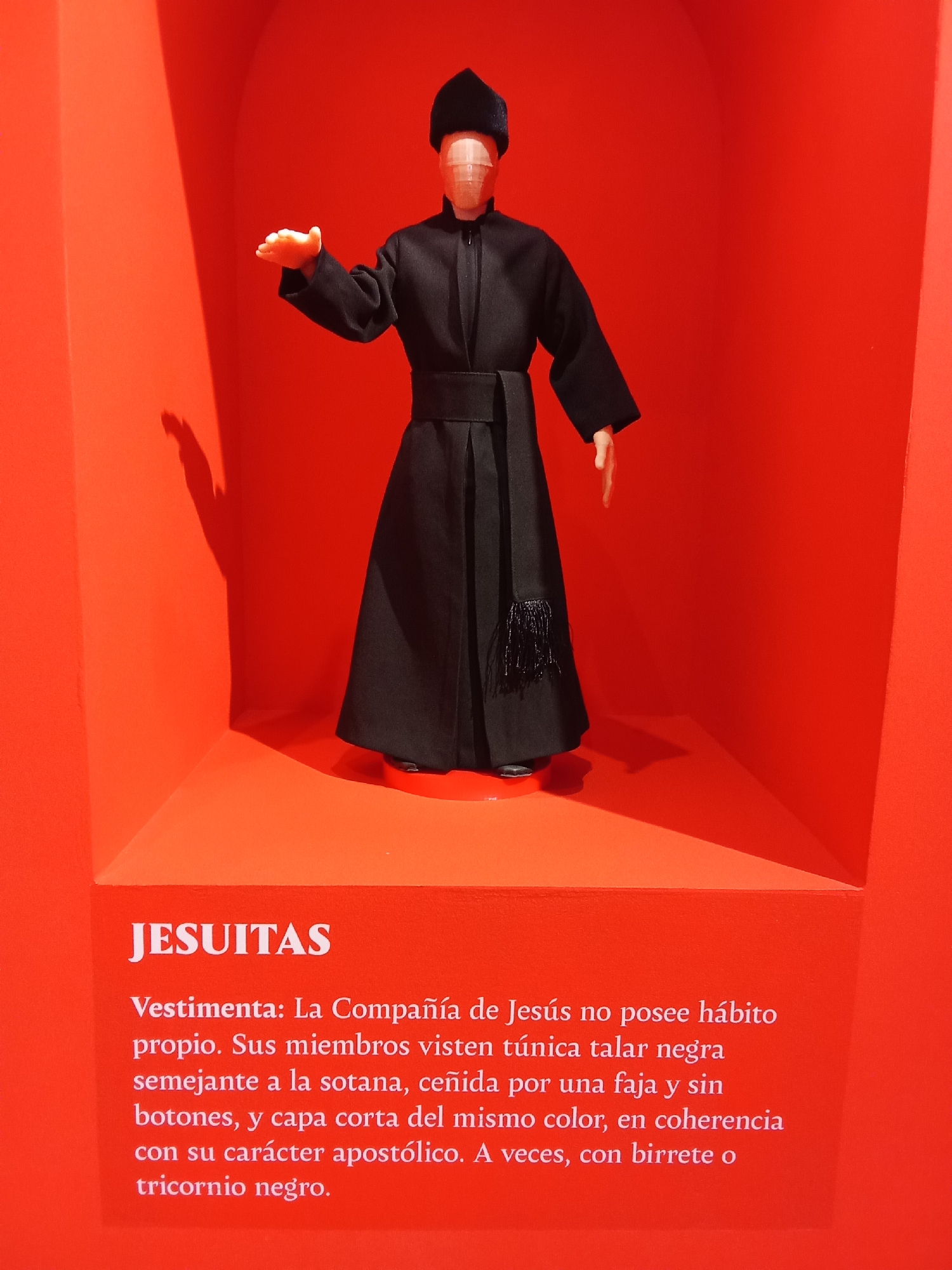
A full-body doll dressed in a black Jesuit priest's robe and a black skullcap is displayed on a red platform against a bright red background. The doll has a pale face with a textured finish and is positioned with its right arm extended slightly outward. The robe is floor-length, cinched at the waist with a black sash, and has a decorative fringe on the left side. The doll stands in a recessed, cubical display area, with harsh lighting casting a shadow on the back wall. Below the display, text on a red panel identifies the subject as "JESUITAS" and describes their attire. This display is located in Santiago, Chile, specifically at the Museo Histórico Nacional.
Mel Navala
Santiago, Chile · Aug 13, 2026, 2:49 PM
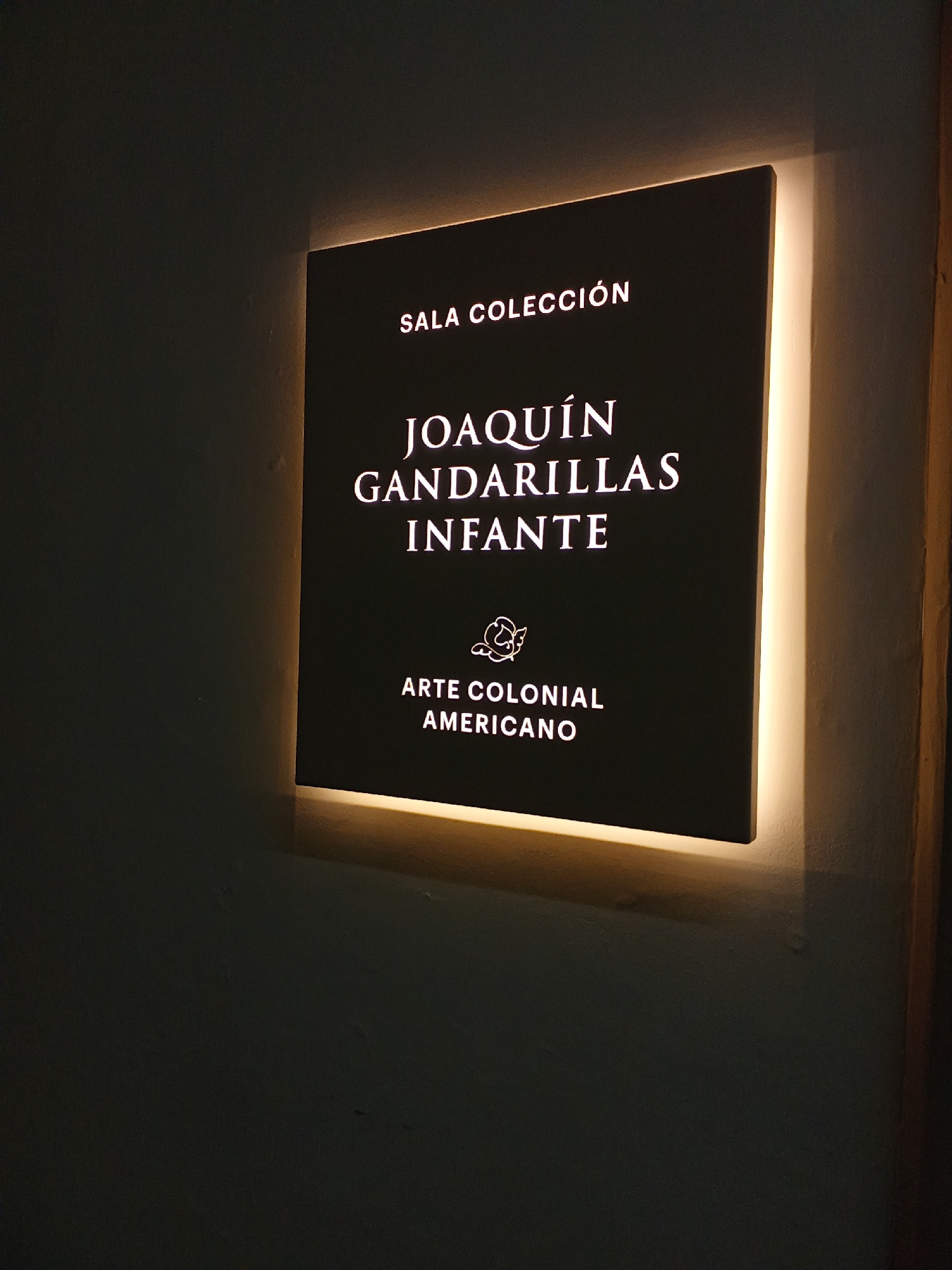
A lighted sign on a dark wall reads "SALA COLECCIÓN" at the top, followed by "JOAQUÍN GANDARILLAS INFANTE" in larger text. Below this is a small illustration of a bird or creature, and then "ARTE COLONIAL AMERICANO" at the bottom. The sign is illuminated from behind, casting a warm glow on the surrounding wall. The setting appears to be an indoor exhibit or museum. This sign is located in the Museum of Pre-Columbian Art in Santiago, Chile, which houses a collection of pre-Hispanic art from Latin America.
Mel Navala
Santiago, Chile · Aug 13, 2026, 2:55 PM
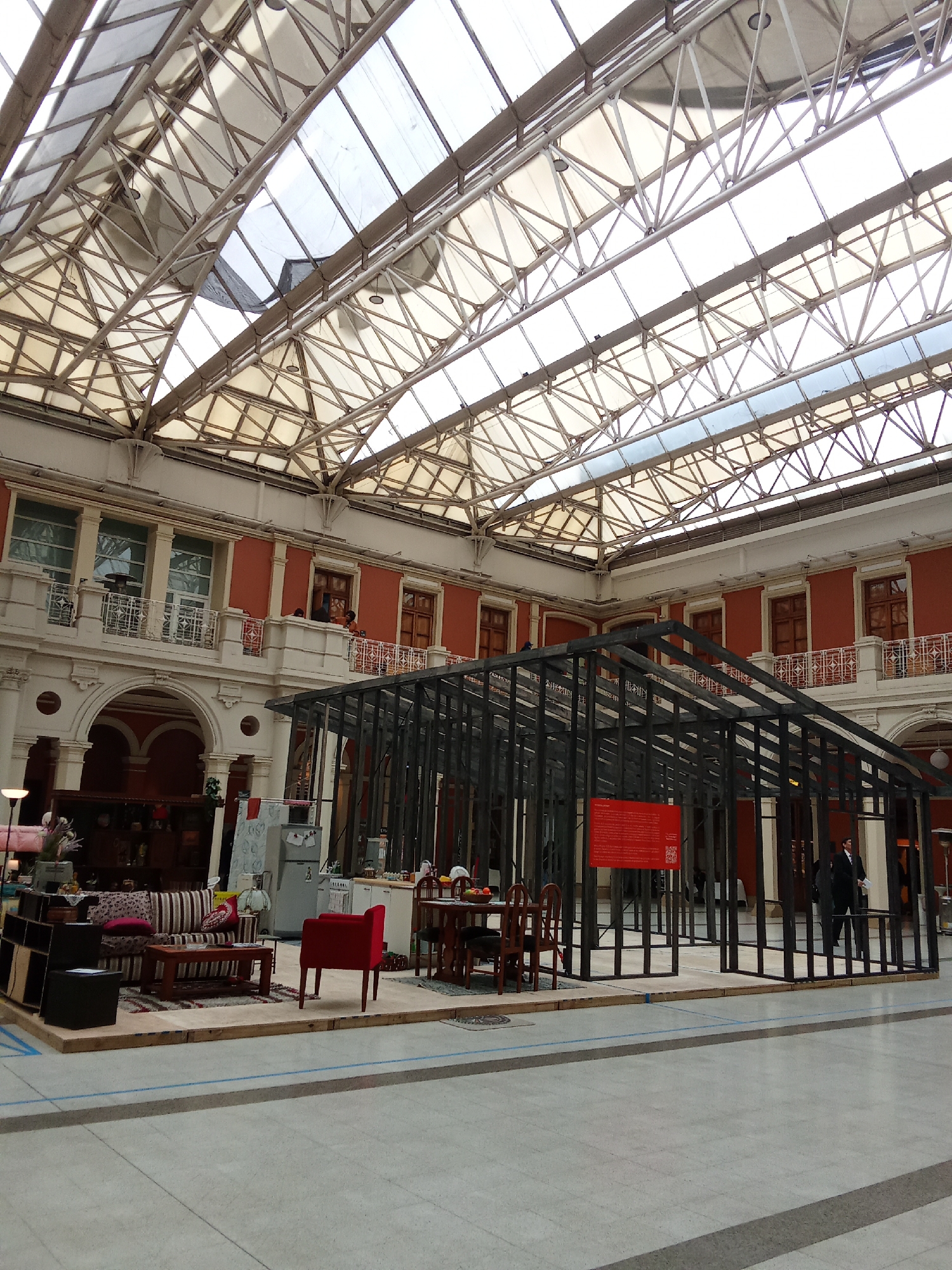
The image captures an interior view of a spacious building with a large, multi-paneled glass and metal roof. The architecture features multiple levels with arched walkways, balconies with intricate white railings, and reddish-orange walls. In the foreground, a partially constructed metal frame, resembling the skeletal structure of a house or room, is set up. Inside this frame, a dining table with chairs and a red armchair are visible. To the left of the frame, there is a furnished living area with a striped sofa, a coffee table, and shelving units, positioned on a raised wooden platform. A refrigerator and other appliances are also present in this area. A man in a dark suit is seen walking inside the metal structure, near a red sign with text. The flooring in the foreground is a light-colored, polished concrete or terrazzo with blue painted lines. This scene appears to be an exhibition or art installation within a public space, possibly the Palacio de Bellas Artes or a similar cultural venue in Santiago, Chile, given the architectural style and the presence of what looks like a contemporary art display.
Mel Navala
Santiago, Chile · Aug 13, 2026, 2:56 PM
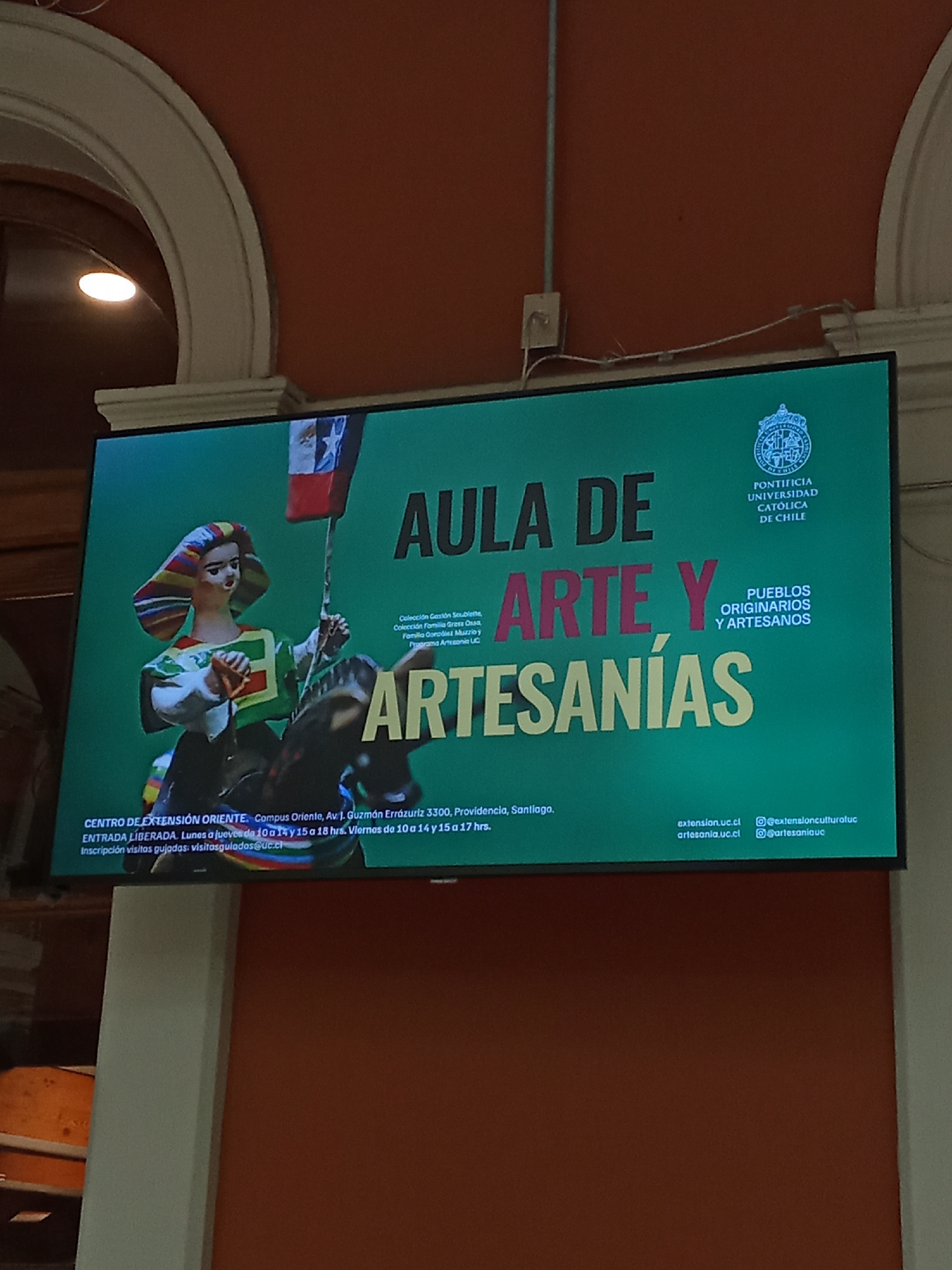
The image shows a digital screen displaying an advertisement for an exhibition titled "AULA DE ARTE Y ARTESANIAS" (Art and Crafts Classroom). The exhibition is held at the "CENTRO DE EXTENSIÓN ORIENTE" located at Campus Oriente, Av. J. Guzmán Errázuriz 3300, in the Providencia commune of Santiago, Chile. The exhibition is open from Monday to Thursday between 10 AM and 2 PM, and 3 PM to 6 PM. On Fridays, it's open from 10 AM to 2 PM and 3 PM to 5 PM. Admission is free. The screen also displays the logo of the Pontificia Universidad Católica de Chile and contact information for the extension center, including website addresses and social media handles. A colorful depiction of a traditional Chilean figurine holding a flag is prominently featured on the left side of the screen. The background of the screen is a bright green. The screen itself is mounted indoors, likely in a public space, with a wall and architectural elements visible in the background.
Mel Navala
Santiago, Chile · Aug 13, 2026, 2:57 PM
33
Memories1
Contributors
Person captures animated selfie sequence with exaggerated expressions
· Saturday, May 16, 2026
Woman pressure washes log cabin exterior in rural Russia
Areyskoye, Russia · Saturday, May 16, 2026
Late-night selfie session captures playful poses and expressions
· Saturday, May 16, 2026
Person films product review session with animated expressions
· Saturday, May 16, 2026
Unverified report claims White House bee swarm incident