Thursday, July 16, 2026 · Updated Thursday, July 16, 2026
London, United Kingdom
The British Museum remains one of the world's great spaces for quiet contemplation. Moving away from the crowded central court and into the specialized galleries reveals a vast, quiet archive of human history. The cool marble of ancient busts and the intricate carvings of stone reliefs stand under soft, directed spotlights, creating an atmosphere of calm focus.
This is a photograph of a display case in a museum, showcasing a collection of ancient gold jewelry. The items are arranged on a dark gray background and are illuminated by museum lighting, which creates reflections on the glass of the display case.
The jewelry pieces are varied in design and include:
* **Headbands/Diadems:** At the top of the display, there are two elaborate gold headbands. One appears to be a broader band with intricate repoussé work, while the other is a more delicate circlet adorned with leaves and small figures.
* **Necklaces/Pendants:** Several necklaces are visible. One long necklace, labeled with the number 7, features a chain with a pendant at the end. Another, labeled 8, is a choker-style necklace with multiple small pendants hanging from it. Below these, two longer Y-shaped necklaces are displayed, each with dangling elements resembling floral sprigs.
* **Earrings:** A pair of earrings, labeled 11 and 12, are displayed. They are intricate, with circular tops and dangling figures.
* **Rings/Other small items:** A gold ring, labeled 13, is present, as is a small circular pendant or disc, labeled 14.
The overall impression is that of an archaeological or historical exhibition focusing on ancient gold artifacts. The presence of numbered labels suggests that these objects are part of a curated collection within a museum.
Based on the style of the jewelry and the typical holdings of major London museums with significant ancient collections, this display is likely located in the British Museum in London, United Kingdom, possibly in a gallery dedicated to ancient Greece, Rome, or the Near East.
In the classical antiquities wing, the scale of the collection becomes clear. Rows of sculpted figures from Greece and Rome line the walls, each carving telling a silent story of ancient craftsmanship. Visitors move slowly through these rooms, pausing to study the fine details of textured hair, draped robes, and expressive faces preserved in stone.
The image displays a close-up, detailed view of an ancient artifact, likely a mosaic sculpture of a serpent or dragon. The object is predominantly made of small, irregularly shaped pieces of turquoise or a similar greenish-blue stone, fitted together to form a textured surface. Some dark red or brown material is visible beneath the turquoise pieces, suggesting a substructure or inlay. The serpent's head is particularly detailed, with an open mouth revealing sharp, pointed teeth and a vibrant orange or red interior. Its eye socket is a dark, empty cavity. The sculpture is presented against a solid black background, which highlights the intricate details and vibrant colors of the artifact. There is a soft, diffused light source illuminating the object, creating subtle reflections on the polished surfaces of the mosaic pieces. The overall impression is one of an ancient, possibly ritualistic or decorative, art piece. The image does not provide any information about its location in London, United Kingdom, or the presence of any people.
Further inside, smaller display cases hold delicate treasures that require a closer look. Ancient gold jewelry, from detailed diadems to intricate necklaces, glows under carefully positioned museum lighting. These small, fragile objects offer a personal connection to the past, showing the incredible skill of metalworkers from thousands of years ago.
This is a close-up photograph of a section of a bas-relief carving on a stone wall, likely located in the British Museum, London, United Kingdom. The relief depicts a scene with several figures, possibly soldiers or attendants, interspersed with stylized trees. The figures are carved in profile, with detailed beards and hair, wearing segmented skirts or robes and some form of headdress. Some figures are shown carrying spears and shields. The trees are depicted with rounded, layered foliage and segmented trunks. The carving is ancient, characterized by its textured stone surface and the worn appearance of the relief. The overall impression is one of a historical or mythological narrative rendered in stone.
This image shows a large, elaborate sculpture of a figure, possibly a masquerade costume, displayed in a museum setting. The figure is adorned with black and gold wings, a colorful, patterned headpiece, and various other decorative elements made of natural materials and metallic accents. The sculpture is mounted on a tall, slender base.
To the right of the sculpture, a museum display panel with text and a small video screen is visible. The text on the panel appears to be a description of the exhibit, with the word "MASQUERADE" prominently displayed at the top. The video screen shows footage of people participating in a lively event, likely related to the masquerade.
The environment appears to be a well-lit museum hall, with a white wall serving as the backdrop for the sculpture and display. The ceiling features modern lighting fixtures.
While the image does not explicitly state the location, the presence of a museum display in English and the style of the exhibition suggest it could be in a major city with significant cultural institutions. However, without further information, pinpointing the exact location within London, United Kingdom, is not possible based solely on the visual content of the image.
The galleries themselves are designed to encourage slow exploration. High ceilings and skylights let in the changing London light, casting soft shadows across the stone floor. Benches are positioned thoughtfully throughout the rooms, inviting people to sit, reflect, and take in the sheer weight of history surrounding them.
In a museum exhibit in London, a large, verdigris-covered bronze bull sculpture stands prominently on a pedestal. To its left, a white electronic device with a digital display is positioned on the pedestal's surface. Below the bull, a display case exhibits two rows of decorative friezes. The upper frieze features three carved, light-colored bird figures against a dark background. The lower frieze shows a procession of five carved, light-colored bovine figures, also set against a dark, textured background. To the right of these friezes, another display case shows a partial view of a similar artifact with carved human figures. The background of the exhibit is a muted, textured wall.
A marble bust of a man with curly hair and a beard is mounted on a grey wall in a museum. The bust is lit by a spotlight, casting a prominent shadow to its left. Above the bust, a decorative cornice runs along the top of the wall. The overall impression is one of classical art displayed in a dimly lit exhibition space. This scene is likely located in the British Museum, London, United Kingdom.
The image shows a section of a wall constructed with numerous rectangular stone blocks, each intricately carved with bas-reliefs. These reliefs depict scenes of ancient figures, possibly historical or mythological, engaged in various activities and adorned with detailed attire and headdresses. Hieroglyphic inscriptions are visible on many of the blocks, suggesting an Egyptian origin. The stones are of varying sizes and have a weathered, aged appearance, with some showing signs of erosion and damage. The overall impression is that of an archaeological display or part of an ancient monument. This particular display is located in the Egyptian Sculpture Gallery at the British Museum in London, United Kingdom.
Visiting these halls is a reminder of the enduring power of material culture. In a fast-paced city, spending a few hours surrounded by ancient stone and gold provides a rare chance to slow down and connect with the deeper currents of human creativity.
The image shows two Japanese lion-dog figurines displayed on a white surface in a museum. The figurines are dark gray with black markings, and both have gold horns. The left figurine has red accents and a gold-tipped tail. The right figurine has blue accents and its tongue is sticking out. Text labels are visible in front of the figurines. The left label contains Japanese and English text describing the "Pair of lion-dogs (koma inu), 2015" by Komatsu Miwa. The right label has Japanese and English text titled "Images of women". The background appears to be a light gray, textured wall or display case. The overall lighting is even, suggesting an indoor museum environment. There are no people visible in the image.
A marble bust of a bearded man, likely a historical figure, is displayed on a dark grey pedestal in a museum. The bust is detailed with textured hair and a prominent beard. To the right, another similar marble bust is partially visible, also on a pedestal. The background consists of a dark grey wall with a lighter grey section above, suggesting an exhibition space. The scene is brightly lit, casting soft shadows. The busts are positioned in front of a large, dark grey partition. This image was taken in the British Museum in London, United Kingdom.
The image shows a fired clay figurine displayed in a museum case in London, United Kingdom. The figurine, which is orange-brown in color and appears to be ancient, is situated on a light-colored pedestal. Behind the figurine, through the glass of the display case, several blurry figures of museum visitors can be seen walking in the background. To the right of the figurine, a white label with black text provides information about the artifact. The label states it is a "Fired clay figurine" from the Late Neolithic period, about 4500-4000 BC, originating from Vinča, Serbia. Below this, another label describes a "Painted pottery vessel" from the Late Neolithic/Copper Age, about 3700-3300 BC, from Kosyhlivtsi (Kosylowce), Ukraine. The overall environment suggests an indoor museum setting with overhead lighting reflecting on the glass.
This is a photograph of a display case in a museum, showcasing a collection of ancient gold jewelry. The items are arranged on a dark gray background and are illuminated by museum lighting, which creates reflections on the glass of the display case.
The jewelry pieces are varied in design and include:
* **Headbands/Diadems:** At the top of the display, there are two elaborate gold headbands. One appears to be a broader band with intricate repoussé work, while the other is a more delicate circlet adorned with leaves and small figures.
* **Necklaces/Pendants:** Several necklaces are visible. One long necklace, labeled with the number 7, features a chain with a pendant at the end. Another, labeled 8, is a choker-style necklace with multiple small pendants hanging from it. Below these, two longer Y-shaped necklaces are displayed, each with dangling elements resembling floral sprigs.
* **Earrings:** A pair of earrings, labeled 11 and 12, are displayed. They are intricate, with circular tops and dangling figures.
* **Rings/Other small items:** A gold ring, labeled 13, is present, as is a small circular pendant or disc, labeled 14.
The overall impression is that of an archaeological or historical exhibition focusing on ancient gold artifacts. The presence of numbered labels suggests that these objects are part of a curated collection within a museum.
Based on the style of the jewelry and the typical holdings of major London museums with significant ancient collections, this display is likely located in the British Museum in London, United Kingdom, possibly in a gallery dedicated to ancient Greece, Rome, or the Near East.
This is an indoor photograph taken in a museum exhibit hall. In the foreground, three men are visible, two from behind and one from the side. The man on the left is wearing a light blue short-sleeved shirt and is holding up a smartphone, appearing to take a photograph. The man in the center is wearing a dark green and black striped shirt and is also holding a smartphone, with its screen illuminated and displaying an image, suggesting he is also taking a picture or viewing something on it. The man on the right is wearing a black t-shirt and a black and gray baseball cap with a logo on the front. He is looking down at his phone.
Dominating the center of the image is a large, dark stone statue of a human head and torso, characteristic of a Moai statue from Easter Island. The statue is positioned on a light-colored pedestal.
In the background, through glass display cases, various museum exhibits are visible. These include cultural artifacts, framed pictures or portraits, and fabric displays. There are also other museum visitors, some obscured, and lighting fixtures on the ceiling. A sign with the text "Life's ordinary dangers" is partially visible in the background. The overall lighting suggests a well-lit exhibition space. The presence of Moai statues and other cultural artifacts strongly indicates the location is the British Museum in London, United Kingdom.
The image displays a close-up, detailed view of an ancient artifact, likely a mosaic sculpture of a serpent or dragon. The object is predominantly made of small, irregularly shaped pieces of turquoise or a similar greenish-blue stone, fitted together to form a textured surface. Some dark red or brown material is visible beneath the turquoise pieces, suggesting a substructure or inlay. The serpent's head is particularly detailed, with an open mouth revealing sharp, pointed teeth and a vibrant orange or red interior. Its eye socket is a dark, empty cavity. The sculpture is presented against a solid black background, which highlights the intricate details and vibrant colors of the artifact. There is a soft, diffused light source illuminating the object, creating subtle reflections on the polished surfaces of the mosaic pieces. The overall impression is one of an ancient, possibly ritualistic or decorative, art piece. The image does not provide any information about its location in London, United Kingdom, or the presence of any people.
A full-body statue of a classical female figure is displayed in an indoor setting, likely a museum or gallery, given the surrounding architecture and display. The statue, made of white marble, depicts a woman with her left hand covering her chest and her right hand resting on her lower abdomen. She is standing with a draped urn or pedestal to her right, and her hair is styled in an updo. The statue is positioned on a multi-tiered dark green marble base, which sits on a dark green marble platform.
The background features a wall with contrasting marble finishes: a section of warm, veined orange-brown marble to the right of the statue, and a section of white marble with grey veining to the left. A distinct shadow of the statue is cast onto the orange-brown marble, suggesting directional lighting from the left. To the far left of the image, a tall, glass-fronted bookcase filled with rows of books is visible, along with a metal railing and a window with green-tinted glass, indicating an upper level or mezzanine.
The lighting in the scene is bright, with sunlight streaming from the left, creating highlights and the prominent shadow. The overall impression is one of an art exhibition within a grand, architecturally significant building. This image was captured in the Victoria and Albert Museum, London, United Kingdom.
This is a close-up photograph of a section of a bas-relief carving on a stone wall, likely located in the British Museum, London, United Kingdom. The relief depicts a scene with several figures, possibly soldiers or attendants, interspersed with stylized trees. The figures are carved in profile, with detailed beards and hair, wearing segmented skirts or robes and some form of headdress. Some figures are shown carrying spears and shields. The trees are depicted with rounded, layered foliage and segmented trunks. The carving is ancient, characterized by its textured stone surface and the worn appearance of the relief. The overall impression is one of a historical or mythological narrative rendered in stone.
The image shows a young woman with dark hair and bangs, wearing a green knit top with ruffled sleeves and large, geometric earrings. She is taking a selfie in what appears to be the Great Court of the British Museum in London, United Kingdom. The background reveals the distinctive glass roof structure and the classical architecture of the museum. A man in a white t-shirt and beige trousers is visible walking up a curved staircase in the distance, with other museum visitors in the background. The woman is positioned in the foreground, her face angled slightly towards the camera, and her hair is styled in a braid.
This image shows a large, elaborate sculpture of a figure, possibly a masquerade costume, displayed in a museum setting. The figure is adorned with black and gold wings, a colorful, patterned headpiece, and various other decorative elements made of natural materials and metallic accents. The sculpture is mounted on a tall, slender base.
To the right of the sculpture, a museum display panel with text and a small video screen is visible. The text on the panel appears to be a description of the exhibit, with the word "MASQUERADE" prominently displayed at the top. The video screen shows footage of people participating in a lively event, likely related to the masquerade.
The environment appears to be a well-lit museum hall, with a white wall serving as the backdrop for the sculpture and display. The ceiling features modern lighting fixtures.
While the image does not explicitly state the location, the presence of a museum display in English and the style of the exhibition suggest it could be in a major city with significant cultural institutions. However, without further information, pinpointing the exact location within London, United Kingdom, is not possible based solely on the visual content of the image.
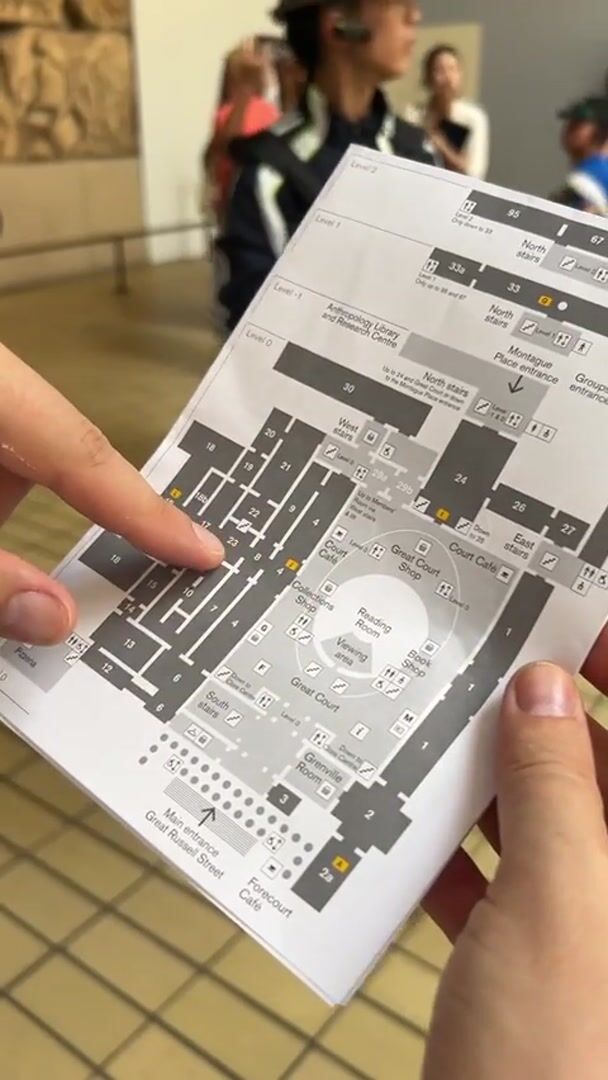
A close-up shot shows a hand holding a map of a museum. The map is detailed, showing different floors and sections of the museum. The finger on the hand is pointing to a specific area on the map, possibly a gallery or an exhibition. In the blurred background, several people are visible, appearing to be museum visitors. The lighting suggests an indoor environment, likely a public space within the museum.
The image displays a museum exhibit featuring ancient pottery and artifacts, likely an archaeological display. In the background, a rough, sandy wall simulates an excavation site. In the foreground and middle ground, various ceramic vessels are arranged, including large amphorae with two handles, smaller jugs, and bowls. Some of these items are resting on a sandy surface scattered with small, round objects that appear to be beads or weights, and fragments of bone or shell. The lighting suggests an indoor museum setting, with overhead lights creating a warm glow on the artifacts. There are no people visible in the image. The context of a museum exhibit indicates it is likely displayed within a cultural institution. This specific arrangement of artifacts is part of the collection at the Museum of London.
The image shows a large, rectangular marble relief sculpture displayed on a light blue wall in a museum. The sculpture is broken and incomplete, with jagged edges. It depicts a series of figures in several registers, suggesting a narrative scene.
The top register shows several figures, with one seated on a raised platform and others standing around. The central register features an arched doorway with figures entering and exiting. To the left of the arch, a seated woman is depicted next to a globe. To the right, several standing figures are shown. The bottom register contains a procession of figures with raised arms, some reaching towards a central pillar.
The sculpture is lit from the front, casting shadows that accentuate the relief carving. To the left of the sculpture, a white museum label with text is partially visible. The overall impression is of an ancient artwork, likely Greek or Roman, preserved and exhibited in a modern museum setting.
Based on the style of the sculpture and the presence of museum labels, this is very likely the British Museum in London, United Kingdom.
The image shows a close-up of a person's hands holding a folded map of a building's floor plan. The map is detailed, with numbered sections, staircases, rooms, and entrances labeled. Text on the map indicates different levels (Level 0, Level 1, Level 2, Level -1) and names of areas such as "Ground floor," "Pizzeria," "Court Café," "Reading Room," "Book Shop," "Great Court Shop," and "Main entrance Great Russell Street." The map also shows accessibility symbols for lifts and stairs.
In the blurred background, several people can be seen walking. Their attire suggests a casual daytime setting. The floor beneath the people is tiled in a grid pattern. The overall scene appears to be indoors, possibly in a museum, library, or a similar public institution given the map's contents. The lighting suggests it is daytime. The presence of the map and the people navigating the space indicates they are likely exploring or trying to find their way around the building.
The image shows a diorama featuring a black metal praying mantis sculpture in the foreground, posed as if hunting a black metal cicada sculpture positioned to its left. A dark, segmented metal tail, possibly belonging to another sculpture not fully visible, curves across the background. The sculptures are displayed on a textured, light-colored surface, likely within a museum exhibit. Shadows are cast by the figures. In the lower right corner, a portion of a sign is visible with Chinese characters and English text that reads "Articulated figures For centuries, from around". The lighting suggests an indoor, controlled environment. The location is not specified in the image, and therefore cannot be determined to be London, United Kingdom.
The image depicts the vast marble hall of the British Museum in London, United Kingdom. The hall is characterized by its imposing architecture, featuring high, stone walls adorned with classical sculptures, a long, polished floor, and a striking glass ceiling that allows natural light to flood the space. Numerous visitors are seen wandering through the hall, some pausing to admire the exhibits, others engaged in conversation or using their mobile phones. Several individuals are seated on benches, resting or observing their surroundings. The atmosphere appears to be one of quiet contemplation and cultural exploration, typical of a major museum setting.
Two women are sitting on a wooden bench in a museum. The woman on the left is wearing a brown polka-dot dress and the woman on the right is wearing a white strapless top and black pants. They are both looking at their phones. Behind them is a large stone structure with carvings. In the background are display cases with artifacts. The floor is tiled and there is a skylight in the ceiling. The location appears to be the British Museum in London, United Kingdom.
The image depicts an indoor exhibition space, likely a museum. In the foreground, a large, intricate sculpture resembling a tree made of metal pieces is prominently displayed. The tree has a dense trunk and branches adorned with what appear to be small, rectangular metal components forming leaves. At the base of the tree, other metal sculptures, possibly abstract representations of insects or creatures, are visible.
To the left of the tree sculpture, a portion of a person wearing dark clothing and a backpack is partially visible. In the middle ground, three individuals are observing the exhibits. A woman in a yellow top and tan pants stands in front of a display case. To her right, a man in a blue t-shirt and dark pants walks past. A woman in a red top and a floral skirt is also visible to the right, carrying a black backpack.
Behind the tree sculpture and the observers, a large glass display case showcases various artifacts. These include what appear to be ceremonial masks, shields, and weapons, arranged against a neutral-colored wall. Some of the artifacts have decorative patterns in gold and dark colors. A white information panel with text and images is also placed within the display case. The environment suggests a well-lit exhibition hall with polished wooden floors and ceiling lighting. The context of the artifacts and the overall presentation suggests an exhibition of cultural or historical objects, possibly from African or ethnographic collections. While the image is taken in London, the specific museum is not identified.
This is a photograph taken inside a museum. In the foreground, a marble statue of a boy, identified by a plaque as the "so-called 'spinario' (thorn-puller)", is centrally positioned. The statue depicts the boy squatting and concentrating on removing a thorn from his foot. The base of the statue has been modified to accommodate a fountain at a later date. Behind the statue, several people are visible, including a woman in a dark blue dress and two other individuals looking at displays. In the background, other sculptures and exhibit cases are present. The museum appears to be well-lit with a high ceiling and skylights. A sign on the wall indicates "The world of Alexander" and the number "22". Given the prominent display of Greek and Roman art, and the historical context of the "spinario" statue, the location is likely the British Museum in London, United Kingdom.
A decorative architectural fragment, likely a antefix or acroterion, made of plaster or stucco, is displayed against a vibrant blue background in a museum setting. The fragment features a central palmette design with volutes on either side, reminiscent of classical Greek or Roman ornamentation. The object is illuminated, casting a shadow behind it. In the background, behind a glass display case, are other exhibit items, including a framed document on the left and a bas-relief depicting figures on the right. The context suggests this artifact is part of a museum exhibit, potentially in London, United Kingdom, given the commonality of such displays in major London institutions.
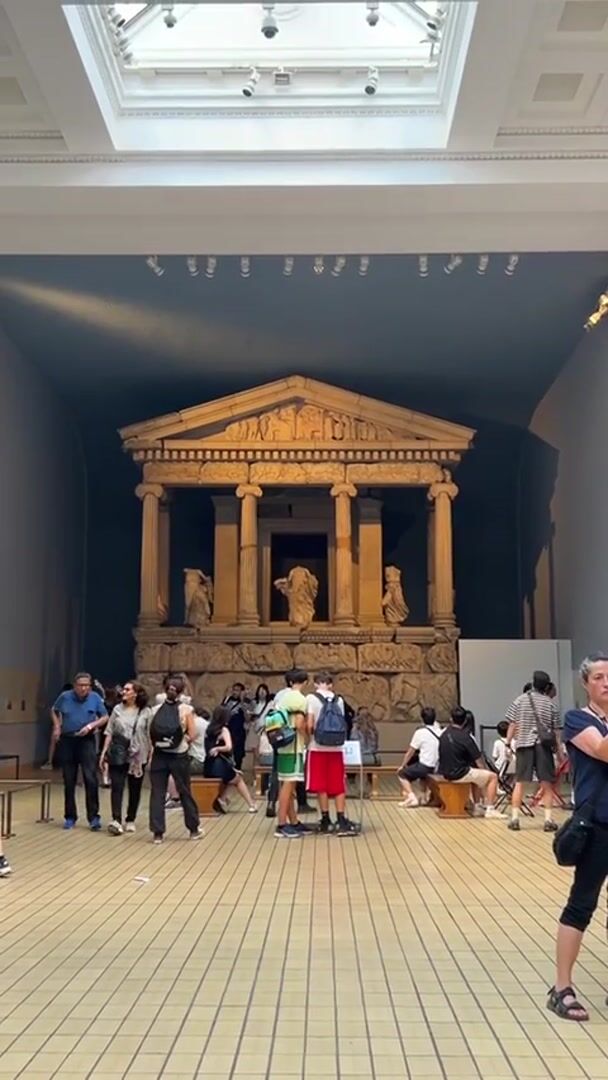
A crowd of people is gathered in a large, well-lit indoor space, likely a museum. In the center of the frame is a large, ancient-looking structure resembling a temple facade with columns and sculptures. People of various ages are walking around, standing, and sitting, some looking at the central display. The floor is tiled in a checkerboard pattern. The walls are dark, and the ceiling has a skylight and spotlights. The overall atmosphere appears to be one of cultural observation and tourism.
The image displays a display case in a shop, likely in London, United Kingdom. In the foreground, a silver necklace with a cat pendant rests on a black velvet bust. The pendant is detailed and depicts a seated cat. Below the bust are two informative plaques. The top plaque reads "Gayer Anderson cat pendant Sterling silver. £99.00". The bottom plaque provides further details: "The Gayer-Anderson Cat Museum number: EA64391 Date: Late Period". To the left of the display, a portion of another jewelry piece, possibly a bracelet with a lion's head design, is visible. The background is a neutral, light-colored surface.
An artifact, a mosaic-covered serpentine sculpture, is displayed in a dimly lit museum exhibit. The sculpture, predominantly green with reddish-brown and turquoise accents, depicts a coiled snake with an open mouth revealing sharp white teeth and an orange interior. Its head features circular eye sockets and a textured snout. The background shows blurred figures of museum visitors and the muted colors of the exhibition space, suggesting a public viewing area. The lighting casts a soft glow on the artifact, highlighting its intricate mosaic details. This scene is observed within the British Museum in London, United Kingdom.
Two young women are sitting on a wooden bench in a museum gallery. The woman on the left has dark hair pulled back in a ponytail and is wearing a brown polka dot dress. She is holding a phone and a light-colored bag. The woman on the right has dark hair and is wearing a light-colored strapless top and black pants. She is holding a white object, possibly a microphone.
In the background, a large, ancient stone structure, possibly a tomb or monument, is prominently displayed. The structure has intricate carvings and architectural details. To the left of the stone structure are glass display cases containing ancient artifacts, including pottery and figurines. The gallery has a high ceiling with a skylight, and the walls are painted white. The floor is tiled with a grid pattern. The overall environment suggests an indoor exhibition space, likely a museum, in London, United Kingdom. The scene is well-lit, likely by natural light from the skylight and artificial lighting.
This media file captures a woman taking a selfie indoors. She has dark hair and green eyes, and is wearing a green ribbed top. Her hair is pulled back in a braid. In the background, a large glass and metal dome ceiling is visible, characteristic of modern architectural design. The walls appear to be made of light-colored stone or tile. Other people are visible in the background, suggesting this is a public space such as a museum or gallery. The lighting is bright, indicating it is daytime. The overall tone is casual and relaxed, with the woman looking at the camera with a slight smile. There is no visible text in the image.
The image shows a detailed stone relief featuring a repeating pattern of stylized floral and winged motifs, arranged in a grid-like structure. The central motifs are square-shaped, each containing a circular floral design at its center, from which four large, stylized wings or petals emanate outwards. These wings are textured with a scale-like pattern. Flanking these central motifs and filling the spaces between them are rows of smaller, simpler floral designs. The stone appears weathered and aged, with a rough texture and subtle variations in color due to the material and environmental exposure. The lighting highlights the carved details, casting shadows that emphasize the depth and relief of the carvings. This stone relief is located on a wall in the British Museum, London, United Kingdom.
London, United Kingdom · Jul 16, 2026, 12:00 PM
A young woman with dark hair in a braid, wearing a green top and denim jeans, stands in front of a textured stone wall. She has a metallic purse slung over her shoulder and is looking upwards with her eyes closed. The stone wall features intricate carvings of geometric patterns and floral motifs. The lighting creates shadows that highlight the texture of the wall. The location is the British Museum in London, United Kingdom.
The image shows a museum exhibit hall in London, United Kingdom, likely The British Museum, displaying ancient Assyrian relief carvings. The reliefs, carved from stone, depict detailed scenes of warfare and historical events. They are mounted on a light blue wall and are partially fragmented, with some pieces missing. The floor is tiled in a beige, grid pattern. There are stanchions with ropes set up to guide visitors and protect the exhibit. In the foreground, a small black pedestal with a white sign is visible, with text on the sign partially obscured but readable as "The king is victorious." The ceiling features exposed wooden beams and a textured, light-colored material. The lighting appears to be from track lights, casting shadows on the walls and floor. The overall environment is dimly lit and museum-like, designed for the preservation and display of historical artifacts.
The image shows a section of an ancient Assyrian relief carving, likely from the British Museum in London, United Kingdom. The carving depicts a hunting scene featuring several lions. In the upper section, a lion is shown mid-stride, with arrows piercing its body, indicating it is wounded. Below this, another lion lies on its back, also apparently struck by arrows. Further down and to the left, a third lion is depicted in a contorted posture, possibly in its death throes. To the right, parts of other lions are visible, suggesting a larger narrative. The relief is rendered in a shallow, bas-relief style, with figures carved from a light brown stone. The surface of the carving exhibits signs of age and wear, with some areas showing erosion and cracks. The overall impression is one of dynamic action and violent struggle, a common theme in Assyrian art celebrating royal power and prowess.
This is a close-up, high-angle shot of a bas-relief carving on a stone wall, likely displayed within the British Museum in London, United Kingdom. The relief depicts a hunting scene. In the upper portion, a lion, pierced by several arrows, is shown in profile, walking to the left. Its head is lowered, and its mouth is open, with what appears to be blood or saliva depicted flowing from it. The lion's body is muscular and detailed, with a mane rendered in rows of stylized curls. Several arrows are visibly embedded in its back and flank. Below the lion, a human figure lies on its back, appearing to be deceased or severely injured. The figure's arms are raised, and its head is turned to the right, with its mouth open. Another arrow is depicted in the chest area of this figure. The background is a rough, textured stone surface, indicating the material of the relief. The lighting is somewhat diffused, highlighting the contours and details of the carved figures.
The image shows a museum display case containing ancient pottery. The background features a mural depicting a scene with many figures, likely a fresco or wall painting. The text below the mural indicates it is a representation of "THE THEATRE OF KNOSSOS," dating to "About 1550 B.C." and described as being "FROM THE PALACE OF KNOSSOS IN CRETE." The display case itself is made of glass and metal, with a black frame at the top and a reflective orange background.
On a glass shelf within the case, there are several pieces of pottery. From left to right, the first visible item is a dark, wide-mouthed pot. Next to it is a smaller, dark green pot with a handle. To the right of that is a dark cup with a handle. Following this are two lighter colored cups, one appearing yellow and the other light brown with painted designs.
Below the shelf, small labels provide descriptions of the pottery. One label, partially visible, reads "Pottery cup of 'Kamare' type with red and white leaves and linked discs Minos, 1650-1700 BC (MMII) Found at Knossos." Another reads "Pottery cup of 'Kamare's' type with white dotted decoration Minos, 1650-1700 BC (MMII) Found at Knossos." A third reads "Plain pottery cup Minoan, 1600-1450 BC (LMI) Found at Knossos." A fourth reads "Pottery cup with painted designs Minoan, 1550-1500 BC Found at Knossos."
In the foreground, at the bottom of the image, more pottery is visible, including a large, beige jug with black markings and a section of another pot with spiral designs.
Reflected in the glass of the display case, a person wearing a white t-shirt and a dark strap across their shoulder is visible, holding a smartphone. Another person wearing a yellow t-shirt is also reflected. The lighting in the museum is evident from the reflections and the way light illuminates the artifacts. The location is likely a museum in London, United Kingdom, given the text on the labels which often include acquisition details such as "Given by Sir Arthur Evans" and accession numbers which are common in British museums. However, the image itself does not explicitly state the museum's name or location.
This is a photograph of a museum exhibit displaying Minoan artifacts, likely in London, United Kingdom. The exhibit is housed in a glass display case with an orange-colored background and orange flooring.
The most prominent object in the upper left portion of the frame is a large, light-colored ceramic amphora with two handles and blue painted stripes. To the right of the amphora, a text panel with the heading "THE MINOANS" and a subheading "Minoan religion" is visible. This panel describes Minoan religious practices and includes an illustration of a "peak sanctuary."
The display case contains numerous ceramic vessels of various sizes and shapes, some with painted decorations including spirals, running patterns, and leaf motifs. There are also several small figurines made of clay or bronze, depicting human-like figures and animals, possibly bulls. A dark bronze sculpture of a standing female figure with raised arms is positioned on the right side of the display, near a tall, dark, reddish-brown ceramic vessel with painted black markings.
Below the upper shelf of artifacts, another row of display cases holds more objects. These include a large red-and-white painted ceramic pot with handles, a flat, round ceramic lid with intricate painted patterns, and a small, decorative ceramic jug. Further down, a dark surface displays a collection of small, animal-shaped figurines, predominantly in a light brown color, and some darker, bull-like figurines at the bottom.
The lighting in the exhibit is soft, highlighting the artifacts. The reflection of the surrounding museum environment is visible on the glass surface of the display cases. There are no people directly visible within the frame of the photograph, only the curated objects.
The image displays a museum exhibit featuring ancient figurines. In the upper section, displayed on a dark surface behind a glass barrier, are several small, human-like figurines made of a light-colored material, possibly terracotta or clay. Some of these figurines are supported by clear plastic stands. To the left, a larger, darker, vase-like figurine is visible.
The middle section of the exhibit showcases numerous small, stylized animal figurines, predominantly appearing to be dogs, scattered across a dark blue fabric background. These figurines vary in color, ranging from light tan to dark gray.
The bottom section of the exhibit features two dark-colored, possibly metal, animal figurines, also stylized, resting on an orange surface.
The overall scene suggests an archaeological or anthropological display in a museum setting. The exact location in London, United Kingdom, is not discernible from the image itself.
The image shows a display of ancient jewelry. In the foreground, a small, rectangular, clear acrylic case contains a silver pendant featuring two stylized animals in profile, facing each other. The pendant is mounted on a white base within the case. Behind this, on a dark blue fabric-covered display, are four gold pendants arranged vertically in a row. The topmost pendant is shaped like a bee. Below it is a more elaborate, scrolled design. The third pendant depicts a stylized wild goat with three small, circular discs suspended from its body. The bottommost pendant has a similar design of a goat with suspended discs. To the left of the display, part of a large, pale, spherical object is visible, possibly a vase or a sculpture. Text labels are partially visible at the bottom of the image, providing descriptions of the jewelry. The overall scene suggests a museum exhibition, likely within the British Museum in London, United Kingdom, given the typical displays of ancient artifacts there.
The image shows an exhibit in a museum, likely in London, United Kingdom. The exhibit displays ancient pottery and a small necklace on a dark grey surface.
In the background, a text panel is visible, discussing funerary clothing made of very thin sheet gold. Above the text panel, three ceramic vessels are displayed on a glass shelf. The leftmost vessel is a flask with concentric circle decoration. To its right is a shallow bowl with linear decoration. The rightmost vessel is a larger tankard decorated with murex shells. Below these vessels are labels providing details about each object.
On the lower level of the exhibit, two larger, tripod-like ceramic vessels with numerous raised bumps are displayed. The leftmost vessel is significantly larger than the rightmost one. Between and slightly in front of these larger vessels, a delicate string of small, bead-like objects, possibly a necklace, is laid out in a curved pattern on the dark grey display surface. The overall environment appears to be a museum display case with artificial lighting. No people are visible in the image.
The image shows an interior view of a museum exhibit, likely in London, United Kingdom. The scene features display cases filled with ancient pottery and artifacts. The pottery varies in size, shape, and decoration, with some pieces exhibiting intricate patterns and figures. The display cases are illuminated, casting a warm light on the artifacts. In the background, other exhibits and visitors can be seen, suggesting a public museum setting. The floor is tiled with a grid pattern, and the ceiling has exposed beams and light fixtures. The overall impression is one of a well-maintained museum exhibition showcasing historical artifacts.
London, United Kingdom · Jul 16, 2026, 12:10 PM
The image shows a museum display case containing ancient Greek terracotta figurines and pottery, with an informational plaque in the foreground. The display case is lit from above by a grid of fluorescent lights. In the foreground, a textured paper plaque provides text in a light grey font against a beige background, detailing two regions: "EUBOEA AND BOEOTIA" and "and". Below the main text, more detailed labels describe specific artifacts.
The artifacts themselves are predominantly terracotta, with a reddish-brown hue. In the center of the display, a tall, slender vase with painted geometric patterns and figural scenes is prominently featured. To its left and right, several stylized terracotta horse figurines are arranged on clear plastic stands. These horses are abstract in form, with elongated bodies and legs, and some are decorated with dark painted lines.
The background of the display case is dark, with reflections of the artifacts and lighting visible on the glass. The overall impression is one of a museum exhibit focusing on ancient Greek art and culture. The specific location of this museum in London, United Kingdom, is not provided within the image or its associated text.
A close-up, eye-level shot shows a small, weathered bronze figurine of a seated cat on a green base, displayed behind glass. The figurine is dark green with some lighter green patina, and its features are simplified, with pointed ears and a slender tail curled around its body. It is positioned on a rectangular base that is darker green than the figurine. The cat figure is centered in the frame, with the bottom edge of the glass display case and a label in the foreground. The label reads: "Bronze figure of a cat Egypt, c.500 BC – c.300 BC Found in Naukratis." Behind the cat, out of focus, is a fragment of a large ancient vase with painted figures and a geometric pattern. The background is blurred, suggesting an indoor museum setting.
The image displays ancient artifacts in a museum exhibition. In the foreground, a small bronze sculpture of a hare is positioned on a reflective surface, likely a glass display case. The hare is depicted in a resting or crouched posture, with its head turned. Behind the hare, and slightly to the left, stands a slender bronze figurine of a human, possibly a deity or a priest, wearing a long robe and a headdress, mounted on a clear rectangular base. Further in the background, a large, circular, decorated ceramic plate or shallow bowl is visible, supported by clear stands. The plate features intricate geometric and curvilinear patterns in red and black against a light background. The lighting in the scene is soft, creating reflections on the surface. Below the display, a museum label provides information about the bronze hare, stating it is inscribed with a dedication to the god Apollo, made in Ionia around 500 BC, and from Priene. It also includes an accession number: GR 1842.7-28.1103 (Bronze 237). The text on the right side of the label is partially visible, mentioning "St", "sw", "Ma", and "Fre". The overall environment suggests a controlled exhibition setting within a museum, though the specific location in London is not discernible from the image itself.
In London, United Kingdom, a close-up, eye-level shot showcases an ancient bronze figurine of a seal resting on a reflective surface, likely a glass display case. The seal is dark brown, with carved details on its face and body, and it is supported by small, clear plastic discs. In the blurred background, a tall, slender bronze figurine of a person stands on a clear plastic stand, with a large, decorated ceramic bowl behind it. To the right, a portion of another decorated ceramic plate is visible, featuring a red and white spiral pattern. The overall lighting suggests an indoor museum setting.
The image shows a display case containing ancient terracotta masks and pottery. In the foreground, several small clay pots and amphorae are visible, some with dark glaze. To the left, a terracotta figurine of a seated ape-like creature and a bronze representation of an animal on a rectangular base are displayed. Above these, a clear plastic stand holds several small, stylized terracotta heads.
The main subjects of the display are several large terracotta mask fragments mounted on a dark grey background. One mask, in the upper left, is a fragment of a face with sculpted hair. To its right, a larger, more complete mask is visible, showing eyes and a nose. Below these, a half-mask fragment, also terracotta, is mounted, revealing a detailed eye, nose, and mouth. To its right, another fragment of a terracotta mask displays an eye socket and a nose.
A small placard is visible in the lower right portion of the image, providing information about the artifacts. The text reads: "Masks from the Sanctuary of Artemis Orthia Made in Sparta, 6th century BC Thousands of such terracotta masks were found in the Sanctuary of Artemis Orthia. Most of them were originally painted. Different types of faces are represented - satyrs, gorgons, ugly and wrinkled faces, beautiful and young faces (cynics) and caricatures. Such masks have a long tradition in the Near East and are a striking example of foreign influence at Sparta." Another portion of text is partially visible, discussing the use of the masks in the cult of Artemis.
The environment appears to be a museum exhibit, with a tiled ceiling visible in the upper part of the image and a reflected image of a person taking the photograph in the glass of the display case. The lighting is even and diffuse. The overall impression is of a well-curated collection of ancient artifacts.
Based on the description on the placard mentioning "Artemis Orthia" and "Sparta," these artifacts are Greek. While the specific location within London is not indicated in the image itself, the British Museum in London houses a significant collection of Greek antiquities, including artifacts from Sparta. Therefore, it is highly probable that this display is located within the British Museum, London, United Kingdom.
The image depicts the interior of a museum exhibition hall, likely the British Museum in London, United Kingdom, given the architectural style and the presence of classical antiquities. In the foreground, several visitors are observing ancient sculptures. A man wearing a beige t-shirt and grey shorts stands to the left, looking at a large fragment of a horse sculpture. Next to him, a woman with a baseball cap and a grey tank top is also looking at the sculpture. Further to the right, a woman in a white top and a man in a red top are engaged in conversation.
The central focus of the image is a large, reconstructed marble temple structure with columns and intricate carvings. Several smaller sculptures of figures are visible within and around the temple. The backdrop is a dark blue wall, upon which shadows from the artifacts are cast.
In the midground and background, more visitors mill about, some examining other exhibits which appear to be stone carvings and fragments. The ceiling features a large skylight with a coffered design and multiple spotlights. The floor is tiled in a beige and cream checkerboard pattern. The overall atmosphere is that of a busy cultural institution with visitors appreciating historical artifacts.
The image depicts the Elgin Marbles, also known as the Parthenon Marbles, displayed within the British Museum in London, United Kingdom. The massive marble structure, comprising friezes, metopes, and pedimental sculptures, is illuminated by overhead lighting. Several visitors are present in the museum, observing the exhibit. Some are standing and looking at the marbles, while others are seated on benches or folding chairs. The floor is tiled with a light-colored pattern. The environment appears to be a large, indoor exhibition space with high ceilings and architectural detailing.
This is a low-angle, close-up shot of the Pergamon Altar, a monumental sculpture from ancient Pergamon, now housed in the Pergamon Museum in Berlin, Germany, although it appears the backdrop suggests it is on display in a museum in London, United Kingdom. The ancient Greek marble altar is seen from the side and below, with the blue wall of the exhibition space filling the upper portion of the image. The altar is characterized by its intricate frieze depicting a battle between gods and giants, with several statues of figures in flowing robes adorning the top. The architectural elements, including fluted columns and ornate moldings, are clearly visible.
This is a photograph of the Elgin Marbles, also known as the Parthenon Marbles, displayed in the British Museum in London, United Kingdom. The marble sculptures, originating from the Parthenon in Athens, Greece, are exhibited within a gallery with a blue ceiling and pale blue walls. The sculptures are displayed on a raised platform with a beige tiled floor. A metal barrier with stanchions separates the exhibit from the viewing area. In the foreground, to the right, a young boy wearing a white t-shirt and yellow shoes is crouched down, looking at the exhibit. Several information panels are visible in the background. The lighting in the museum appears to be ambient, creating soft shadows.
This is a photograph of the British Museum in London, United Kingdom. The image is taken from an interior perspective, showcasing a section of the museum's architecture and displayed artifacts. In the foreground on the left, a large, fluted stone column dominates the left side of the frame, its texture suggesting aged marble or stone. To the right of the column, a headless statue of a human figure, also made of stone, is partially visible, draped in what appears to be fabric.
The background is dominated by a large stone wall constructed from rectangular blocks. Mounted on this wall are two rectangular frieze panels, each containing relief sculptures. The panel on the left depicts two figures, one appearing to be a human struggling with a centaur. The panel on the right shows a human figure interacting with what appears to be a horse or similar creature, possibly in a wrestling or combat pose. Both frieze panels are illuminated by artificial lighting, highlighting their detail.
In front of the wall and friezes, a dark metal barrier with vertical supports is installed, creating a boundary for visitors. This barrier extends horizontally across the middle of the image. The floor is a reflective surface, possibly polished stone or marble, with a decorative tiled border visible in front of the barrier. The overall lighting suggests an indoor museum environment. There are no visible people actively interacting with the exhibits, though a portion of a person's arm and shoulder is visible on the far right edge of the image. A small sign on the barrier reads "Do not climb."
London, United Kingdom · Jul 16, 2026, 12:28 PM
This is a medium shot, eye-level photograph of a large, ancient stone architectural fragment displayed on a raised, light gray platform in a museum. The fragment appears to be the base and lower part of a column, made of weathered, beige-colored stone with visible cracks and irregularities. It has a rectangular top slab, below which is a fluted, bell-shaped section, and then a base with vertical, ribbed segments. The object is lit from the front and above, casting shadows on the wall behind and to the left. A low, brown metal railing with black vertical supports encloses the display. A white sign with text is visible to the right of the railing. The background wall is a plain, light beige color. The floor is dark gray with a speckled pattern. The overall environment is that of an indoor museum exhibit. The sign to the right of the railing indicates this is an exhibit at the British Museum in London, United Kingdom. There are no people visible in the image.
The image displays a museum exhibit with several ancient artifacts. In the foreground, a white marble statue of a nude woman is positioned prominently on a wooden pedestal. Her left leg is bent and resting on a pedestal, while her right hand is holding her left foot. To the left of this statue is a smaller, older, weathered statue of a seated female figure, also nude and damaged, mounted on a dark stone base. In the background, a large, ornately decorated terracotta amphora with handles and a lid is visible, featuring painted scenes of animals, including a bull and a bird, and Greek lettering. Above and behind the amphora, a glass shelf displays two small busts: a dark bronze bust of a male torso with pronounced musculature and a smaller terracotta bust of a female head wearing a headdress. The background wall is a muted greyish-brown, and the display is enclosed by glass. A label is affixed to the wall to the upper left, providing information about one of the artifacts. The exhibit appears to be located within the British Museum in London, United Kingdom.
This is a photograph of an exhibit in the British Museum in London, United Kingdom. The image showcases a glass display case containing several ancient Greek and Roman sculptures and artifacts. In the foreground, a large, dark green bronze statue of Aphrodite, with her left foot raised and resting on a raised surface, is prominently displayed. To its right, a smaller, reddish-brown terracotta figure of Aphrodite is shown in a similar pose, adjusting her sandal. Further to the right, a white marble statue of Aphrodite, also adjusting her sandal and accompanied by a swan, is visible. Various ancient vases and busts are also present within the display case. Descriptive labels are positioned at the bottom of the display case, providing information about each artifact. The lighting is focused on the artifacts, creating a museum-like atmosphere.
This image shows a close-up of a gold wreath, possibly oak leaves, displayed on a pale blue pedestal within a museum. The wreath is ornate, with many individual leaves crafted from gold, some appearing slightly crumpled or textured to mimic natural foliage. The lighting highlights the metallic sheen of the gold. To the left of the pedestal, a glass display case reveals further artifacts, including what appears to be a row of small, dark objects. To the right, behind the wreath, another display case is visible, showing a blurred background with what looks like a statue or figurine and a large dark vase. The ceiling above the display area has a textured pattern, likely a light fixture or acoustic paneling. The overall scene suggests an exhibition of ancient or valuable artifacts. This image was taken in the British Museum in London, United Kingdom.
A close-up, eye-level shot captures a golden wreath, likely crafted from hammered gold or a similar material, against a plain, light gray background. The wreath is composed of numerous oak leaves and acorns, meticulously rendered with textured surfaces that catch the light, creating highlights and shadows. The arrangement suggests it is part of a larger decorative piece, possibly a garland or a crown. The overall impression is one of opulence and intricate craftsmanship. The scene does not depict any people, actions, or interactions. The exact location within London, United Kingdom, cannot be determined from the provided image.
The image shows a close-up, eye-level view of a golden wreath, intricately crafted to resemble oak leaves and acorns. The wreath is displayed against a muted blue wall, likely in a museum or gallery setting. The lighting casts subtle shadows, highlighting the texture and shine of the gold. The wreath appears to be open at the top, suggesting it's designed to be worn or displayed in a particular way. No people are visible in the image. The location is not specified in the image or its context.
This media file shows a display of gold artifacts, possibly jewelry or decorative elements, against a textured grey background. The objects are arranged in rows and columns. On the left side, there are several larger, flat pieces of gold with intricate embossed patterns. These appear to be fragmented or pieces of a larger item, such as a headdress or a garment embellishment. Some of these pieces have labels beneath them, with one clearly showing the Roman numeral "I".
To the right of these larger pieces are several smaller, more delicate gold objects. These are hanging and appear to be part of a chain or necklace. They feature a repeating design of a flower-like element connected to a series of small beads and culminating in multiple delicate tassels that resemble small, bell-shaped flowers. One of these chains has a small red stone set within the central flower element. A small number "2" is visible near one of these hanging ornaments.
The overall presentation suggests a museum or gallery display. The lighting is even, indicating an indoor setting. There are no people visible. The objects appear to be ancient due to their style and the evident craftsmanship. The location context provided is London, United Kingdom, which might imply the artifacts are part of a collection housed in a museum in London. The scene is static and focused on the preservation and exhibition of these historical gold artifacts.
This media file shows a sculpture of a Molossian hound in a museum. The sculpture, made of marble, depicts a dog in a crouching position with its mouth open, appearing to bark or growl. The dog is resting on a rectangular marble base. Behind the sculpture, a pale grey wall is visible, with a white plaque to the left bearing text describing the artwork. The plaque's text, in part, reads: "MOLOSSIAN HOUND" and details the history and origin of the sculpture, mentioning its connection to Hellenistic realism and Roman copies of a lost Greek bronze. To the right of the sculpture, a darker, textured wall is visible. The overall setting suggests an indoor exhibition space, likely a museum. The lighting appears to be artificial, typical of museum displays. A small sign with the words "Please do not touch" is visible near the bottom right of the image, reinforcing the museum context. The sculpture itself conveys a sense of power and alertness.
The image depicts two ancient marble statues in a museum gallery, likely the British Museum in London, United Kingdom, given the style of the artifacts and the museum's architecture. The statues are of human figures draped in classical attire, with one figure appearing to be male and the other female. Both statues are missing parts of their bodies, with the male statue lacking its head and arms, and the female statue missing its head and right arm. They are positioned on separate, raised stone pedestals. In the background, a frieze depicting a procession or battle scene is visible on a wall, also seemingly made of marble. The gallery features a pale blue wall and a ceiling with a skylight composed of rectangular panels. The floor is tiled with light brown squares. A few people are present in the scene. In the foreground, the back of a person with dark, braided hair is visible, looking towards the statues. To the right of the male statue, a woman with blonde hair is standing, looking at the statue. There are informational placards on the pedestals and floor.
This is a medium-shot, eye-level photograph taken inside a museum, likely the British Museum in London, United Kingdom. The image features two ancient marble statues of humans. The statue on the right is larger and more prominent, appearing to be a male figure with a missing head and arm. It is draped in fabric, and the details of its musculature and drapery are clearly visible. The statue on the left is smaller and positioned further back, also appearing to be a draped human figure with a damaged head.
In the background, a light grey wall serves as a backdrop for the statues. Above the statues, a ceiling with a modern skylight system made of translucent panels and white beams is visible, allowing natural light to illuminate the space. There are also track lights mounted on the ceiling. To the far left, a shelf displays more ancient stone carvings or reliefs, one of which depicts figures in combat or procession. The overall environment suggests a well-lit, organized museum setting dedicated to ancient artifacts. The lighting creates a soft, diffused illumination, highlighting the texture and form of the marble sculptures.
London, United Kingdom · Jul 16, 2026, 12:42 PM
This media file showcases a marble sculpture of a lion in a dynamic pose, appearing to leap or roar. The lion is depicted with its head thrown back and mouth open, conveying a sense of power and ferocity. Its muscular body is well-defined, highlighting the craftsmanship of the artwork.
The sculpture is presented as an object of display, possibly within a museum or gallery setting, given the clean, neutral background and the way it is mounted on a stone pedestal. The lighting is even, suggesting an indoor environment. A hint of a wooden beam and glass structure is visible in the upper right corner, which could be part of the display case or the architectural elements of the venue. The overall impression is one of a carefully curated exhibit.
The sculpture's style suggests it could be from an ancient civilization, known for such artistic representations of animals. The material, marble, further points to a classical or neoclassical origin. The location context of London, United Kingdom, might imply its presence in a well-known museum there, such as the British Museum, which houses numerous ancient artifacts. There is no visible text in the image. The activity depicted is the pose of the sculpture itself, frozen in time to capture a moment of intense action.
A person stands in a museum, viewed from behind, looking at an exhibit displayed behind glass. The exhibit features a collection of historical artifacts, including swords, knives, a shield, a bow and arrow, and a small wooden sculpture. The artifacts are arranged on white and orange backdrops, with labels visible. The person is wearing a white t-shirt with black stripes on the sleeves, a black backpack, and patterned pants. The museum environment is dimly lit, with spotlights illuminating the exhibit. The flooring appears to be polished wood. The overall impression is of a cultural or historical exhibition. This scene is likely in a museum in London, United Kingdom, given the context.
The image depicts an indoor museum exhibit featuring a tall, metallic display structure adorned with numerous clay pots of various sizes and designs. The pots are positioned at different levels on metal arms extending from the central column. Some pots are smooth and rounded, while others have decorative patterns or sculpted elements. In the background, glass display cases contain more artifacts, possibly ancient tools or textiles, and exhibit labels are visible. Several individuals are present in the exhibit space, some observing the display, others walking by. One person, wearing a blue shirt, is seated on a bench to the left. A couple, a man and a woman, stand near a display case, appearing to discuss the artifacts. The environment suggests a museum setting, likely in a city given the urban lighting visible on the ceiling. The exhibit appears to focus on pottery and possibly related crafts.
In a grand hall with marble columns and walls, a classical statue of a discus thrower stands prominently. The hall is lined with tall, glass-fronted bookshelves filled with old books. A group of people, many of whom are holding up their mobile phones to take pictures, are gathered around the statue, observing the exhibit. The overall impression is of a public space, likely a museum or library, dedicated to art and historical artifacts.
The image depicts a marble statue of a discus thrower, possibly a replica of the Discobolus of Myron, centrally positioned against a wall adorned with yellow and white marble panels. The statue is life-sized and appears to be made of pale stone. In the foreground, several people are visible from behind, looking towards the statue. They are dressed casually, with one person wearing a green backpack. The environment suggests an indoor public space, likely a museum or gallery. The background shows a bookshelf filled with books on the right side, indicating a library or a similar institution. The overall lighting is bright, illuminating the statue and the surrounding marble. The specific location within London, United Kingdom, cannot be determined from the visual information provided in the image.
This is a full-frame, eye-level, medium shot of an Egyptian sarcophagus displayed in a museum case. The sarcophagus is made of wood and is painted with hieroglyphics and figures. It is standing upright in the center of the frame, within a glass-fronted cabinet with wooden trim. The sarcophagus is red-brown and decorated with intricate patterns and colorful figures. The lid of the sarcophagus is visible at the top, depicting a human face with large eyes and a mouth open. The body of the sarcophagus is covered in hieroglyphic inscriptions and depictions of figures. The background of the display case is a deep red color, possibly a fabric lining.
To the left of the sarcophagus, in other sections of the cabinet, there are various artifacts, including what appears to be a small lamp, and other inscribed objects. To the right of the sarcophagus, other display cases contain ancient artifacts such as stone busts and carved stone reliefs. The lighting in the museum is subdued, with light reflecting off the glass surfaces, creating some glare. Reflections of people and other museum exhibits are visible on the glass.
Based on the style of display, the artifacts, and the general museum setting, this image was likely taken at the British Museum in London, United Kingdom. The British Museum is renowned for its extensive collection of Egyptian antiquities, including sarcophagi.
The image shows the interior of a grand library, likely in London, United Kingdom, characterized by its ornate architecture. The space features high ceilings with intricate coffered patterns and a large, domed section. Tall marble columns line the sides of the room, and extensive bookshelves filled with numerous volumes are visible along the back wall, some housed in glass-fronted cabinets. Natural light streams in through tall windows positioned between the bookshelves.
In the foreground and mid-ground, a diverse group of people are present, appearing to be tourists or visitors. They are dressed in casual modern clothing. Some individuals are standing and looking around, while others are in conversation or examining displays. Two prominent classical statues are visible: one of a discus thrower on the left, and a larger, partially obscured statue of a male figure on the right. The floor is made of polished wood, reflecting the light and the surrounding architecture. The overall atmosphere suggests a cultural or historical site, possibly a museum or a historic library.
A full-body marble statue of a nude woman stands on a tiered dark green marble pedestal. The statue depicts the woman with her right hand covering her chest and her left hand positioned over her lower abdomen. She is looking slightly to her right. To her right, at her feet, is a draped urn or vase. The statue is set against a wall featuring a large section of polished reddish-brown marble, flanked by panels of white marble with grey veining. To the left of the statue and marble wall is a tall, dark wooden bookshelf filled with books, and a brass railing. To the right of the statue is a dark grey column. The lighting casts a strong shadow of the statue onto the reddish-brown marble. The setting appears to be an indoor exhibition space or museum.
This image shows a display case in a museum or gallery, likely in London, United Kingdom, exhibiting Byzantine jewelry by Bill Skinner. The display features several pieces of jewelry, including a pair of drop earrings with a price tag indicating £350.00, and a necklace and matching earrings in a circular graphic. The text in the display case describes the jewelry as being made from 18kt gold-plated brass, lapis lazuli, agates, and imitation pearls, designed in the United Kingdom and inspired by early Byzantine jewelry. A person's reflection is visible in the glass of the display case, wearing a green garment. The background shows racks of clothing, suggesting the display is part of a larger exhibition or shop.
The image displays a museum exhibit showcasing a collection of mid-century modern ceramic tableware. The items are arranged on a white shelf behind a glass display case, illuminated by soft, diffuse lighting.
In the upper portion of the image, two glass coffee makers are visible. The one on the left has a description card next to it, partially obscured. The coffee maker on the right is a Chemex style, with a leather tie around its neck.
The main focus of the image is the collection of ceramic pieces on the lower shelf. From left to right, there is a large, flat white plate with abstract black and red designs. Next to it is a large, round, teal-colored pot with a lid. In front of these, and arranged in a cluster, are several smaller ceramic pieces. These include a tall, dark red pitcher with a flared lip, a glossy black vase or jug with a flared opening, a pale yellow teardrop-shaped object, a bright teal teardrop-shaped object, and a small, light beige, smooth, pear-shaped object. Further to the right, there is a small, dark brown pitcher with a white interior and a distinctive handle. To the right of this, a prominent coral-colored teapot with a lid and handle is positioned. Next to the teapot, on the far right, is a dark green, bulbous ceramic object with a small cap on top.
Below the ceramic collection, a printed description card is visible. It details the "Town and Country" earthenware, designed by Eva Zeisel and made by Red Wing Pottery, Minnesota, USA, from 1941. The card mentions its purpose to produce an informal, inexpensive service and that it took its name from a popular magazine, highlighting Zeisel's love of inventive, humorous, and practical forms.
The environment appears to be a museum setting, with the sterile white of the display shelf and the glass of the display case suggesting a controlled exhibition space. The lack of any visible people or direct interaction with the objects indicates the scene is a static display. The overall aesthetic is clean, organized, and highlights the design principles of the showcased items. There is no information available to determine the specific location within the city of London, United Kingdom.
London, United Kingdom · Jul 16, 2026, 1:34 PM
This image depicts a collection of ceramic art pieces displayed on a white surface, likely within a museum or gallery. The collection includes a glossy, dark red pitcher or vase with a flared opening positioned on the right side of the frame. To its left, a large, bulbous, light yellow ceramic piece sits, and in front of it, a dark, almost black, rounded vessel with a reflective surface. Further to the left, a pale green ceramic spout extends from a hidden object. In the foreground, a small, light beige ceramic piece with a curled, organic shape rests, and in front of it, a bright turquoise ceramic object with a smooth, rounded form and a distinct indentation. A white oval plate with abstract black line drawings is visible in the upper left quadrant. The overall lighting suggests an indoor setting, possibly illuminated by overhead museum lighting, creating soft shadows on the display surface. There is no indication of people or specific actions occurring in the scene. The context of the location within London, United Kingdom, is not discernible from the visual information provided in the image.
The image shows a glass coffee maker displayed in a museum exhibit. The coffee maker is made of clear glass with a wooden collar and leather tie. It is placed on a glass shelf, which is part of a larger display case. There are informational labels next to the coffee maker. One label describes a "Chromium-plated brass pitcher" and the other describes the "Glass coffee maker." The background is blurry but appears to be the interior of a museum with other display cases and objects. The overall lighting is bright, suggesting an indoor exhibition space. The city of London, United Kingdom is not mentioned or depicted in the image.
The image shows an exhibition display case in a museum, likely in London, United Kingdom, featuring a collection of modernist tableware and decorative objects. The display is set within a glass cabinet with metal framing and glass shelves, illuminated by overhead lighting that casts reflections on the glass surfaces.
On the top shelf, a polished aluminum pitcher with a wooden handle is prominently displayed. To its right, partially visible, are stacks of clear glassware. Below this, on the middle shelf, are two ceramic pitchers: one is a striking teal, and the other is a soft gray. To the right of these, a ribbed amber glass vase is visible.
The bottom shelf showcases a variety of ceramic items. A dark green, boat-shaped dish sits on a matching oval plate. Next to it, a pale yellow, elongated spoon-like dish is positioned. A pair of salt and pepper shakers, one white and one light gray, are placed near the yellow dish. Further to the right, a decorative plate with a geometric and abstract pattern in shades of purple, green, and white is partially visible.
Several informational labels are placed in front of the objects, providing details about their design, origin, and creators, such as "American Modern earthenware," "Spun aluminium lemonade jug," and "Brass candlestick." The overall aesthetic suggests a curated exhibition focused on design history. The environment appears to be a well-lit museum gallery.
This image captures a display case in a museum, likely part of a larger exhibition of ceramics. The primary focus is on a collection of stoneware objects arranged on a white surface.
In the foreground, a pale yellow, elongated, shallow dish with a raised lip dominates the lower left of the frame. To the right of this dish, two small, rounded salt and pepper shakers are positioned; one is off-white, and the other is a pale grey. Behind these, a light grey, speckled ceramic pitcher with a handle and spout is prominently displayed.
In the background, a dark green, oval-shaped bowl rests on a matching dark green saucer. Above these, partially visible, is a large, dark teal pitcher. The display case itself is constructed with clear glass panels, supported by metal brackets, suggesting it is a museum exhibit.
A small, folded card with text is visible in the lower left corner, providing descriptive information about the items. The lighting suggests an indoor museum environment, with some shadows cast by the objects. The overall scene evokes a sense of curated artistry, showcasing the form and texture of the ceramic pieces. There are no people visible in the image. The location is not specified, but the description of the objects is factual and objective.
The image shows a display case in a museum. On the left side of the case, a label describes a "Chromium-plated brass pancake and corn set," designed before 1934 by Russel Wright and made by the Chase Brass & Copper Company. The set includes a butter can with salt and pepper pots and is noted for its Bauhaus influence and "machine age" aesthetic, serving as a stylish alternative to silver during the Depression. In the center of the display, the actual chromium-plated brass set is showcased. It features a spherical teapot with a handle and a spout, resting on a round blue tray. Three smaller spherical salt and pepper shakers, one with a perforated top, are also on the tray. On the right side of the case, another label describes a "Glass tea kettle," designed in 1944 by Peter Schlumbohm for the Chemex Corporation in Pittsfield, Massachusetts. The kettle is made of borosilicate glass with a simple tube stopper designed to prevent steam from escaping and provide a secure grip. The label also mentions that Schlumbohm was a German immigrant inventor whose designs proved commercially successful. The museum display is well-lit, with reflections visible on the polished surfaces of the objects. The background is a blur of the museum environment, including other display cases and possibly visitors. The image does not contain any information about the specific location in London, United Kingdom.
The image shows a display case in a museum containing various objects, likely related to design and craft. In the foreground, a detailed silver teapot with an ornate handle and lid is visible. Behind it, to the left, is a reddish-brown and white striped earthenware jug with a pewter lid. To the right of the jug, there is a silver tea-infuser, a modern metallic object, and a nickel silver candlestick. Text labels accompany each object, providing information about their origin, designer, and date. One label mentions "designed by Marianne Brandt... at the Metal Workshop of the Bauhaus." Another refers to "Albert Reinmann School, Berlin, 1931." The museum environment is suggested by the glass display case and the lighting. While the specific location in London is not explicitly stated, the presence of museum artifacts and descriptive labels indicates an indoor exhibition space.
A woman with dark hair braided down her back stands facing a museum display case. She is wearing a green ruffled tank top and denim cutoff shorts, with white athletic shoes. A light gray purse is slung over her left shoulder. The display case contains various ceramic and glass objects, including pitchers, vases, and teapots. The woman is looking intently at the objects. The display case is illuminated by track lighting mounted on the ceiling. The background is a plain white wall. The floor is dark blue. The scene appears to be in a museum in London, United Kingdom.
This media file is a photograph of an ancient Egyptian mummy displayed in a glass case. The mummy is wrapped in beige linen bandages, and a dark, carved head adorns its upper section. A small, square golden plaque with dark hieroglyphic figures is attached to the mummy's left side. To the right of the mummy, behind the glass, are two framed exhibits with text and images. The top exhibit contains a colored illustration depicting figures in ancient Egyptian attire. The bottom exhibit contains a block of text detailing information about the mummy. The text is partially visible and discusses the materials used for the mummy's adornments, such as white metal, ceramic, clay, gesso, gold leaf, and copper foil. It also mentions the discovery of hair plaits, sandals, and floral garlands with the coffin. The text refers to a funerary papyrus of Qenna and a Rijksmuseum van Oudheden in Leiden, suggesting a possible location context for the artifacts. The overall setting appears to be a museum exhibit. The lighting is somewhat dim, with a spotlight illuminating the mummy. The presence of a glass case indicates the object is protected and preserved for public viewing. The image is taken from a slightly angled perspective, looking through the glass.
The image shows two ceramic dog-like sculptures, possibly guardian lions, displayed in a museum exhibit. The sculpture in the foreground is black and grey with blue and gold accents, featuring a blue tongue sticking out and gold horns. The sculpture behind it is similar in color and design, with red patterned markings on its back and shoulders. Both sculptures have intricate detailing on their fur and faces. In the background, there is a white textured wall. Below the sculptures, a display case contains text panels. One panel on the right, with a green background, features Japanese text followed by "Images of women" in English. The text below discusses the challenges women face in modern cultures and their evolving roles. Another text panel on the left, with a white background, has partial text visible, including the year "2015". The overall setting appears to be a museum in London, United Kingdom, given the style of the exhibit and the inclusion of English text in the display.
The image depicts a selfie taken by a woman in the Great Court of the British Museum in London. She is positioned in the foreground, slightly off-center to the right, with her arm extended to take the photo. She has dark brown hair styled in a braid, bangs, and is wearing a green knit top and large, modern earrings. To her left and slightly behind her is a man with short brown hair, glasses, and a white t-shirt with a black strap visible across his chest.
The background reveals the architectural grandeur of the Great Court, characterized by its large, glass-domed roof, composed of a geometric pattern of glass panes and metal struts. To the right of the couple, a neoclassical building facade with prominent columns and entablatures is visible. In the middle ground, a crowd of museum visitors can be seen gathered on various levels and staircases, looking at exhibits or interacting. The lighting appears to be natural daylight filtering through the glass roof, creating a bright and open atmosphere. The overall scene suggests a casual visit to a major cultural landmark.
London, United Kingdom · Jul 16, 2026, 2:19 PM
The image depicts a wide-angle, low-angle view of the British Museum in London, United Kingdom, under a bright blue sky with scattered white clouds. The iconic Neoclassical facade of the museum is visible, featuring a grand portico with towering columns and a pediment adorned with sculptures. A British flag flies from a flagpole atop the building. In front of the museum, a wide set of steps leads up to the entrance, with numerous visitors walking up and down or sitting on the steps. In the foreground, a group of tourists are standing behind a barrier, many looking towards the museum or engaging with their phones. One woman in the foreground is wearing denim shorts and a pink top, holding a phone. Another woman further back has a pink backpack. The overall scene is one of a busy tourist attraction on a sunny day.
The image shows the exterior of the British Museum in London, United Kingdom, under a partly cloudy sky. A large building with a classical facade, featuring rows of Ionic columns and a pediment adorned with sculptures, dominates the scene. A flagpole with the Union Jack is visible at the top left of the building. In front of the museum, a set of wide stairs leads up to the entrance, with several people sitting and standing on them.
In the foreground, a paved plaza area is visible. There are several groups of people scattered throughout the scene. Some are walking, others are sitting on the stairs, and some are taking photographs. In the middle ground, an outdoor cafe area with tables and umbrellas is set up, with more people dining or socializing. Barriers are erected in the foreground, indicating a cordoned-off area. The overall scene depicts a bustling day at a major tourist attraction.

 London, United Kingdom