Friday, March 6, 2026 · Updated Friday, March 6, 2026
Mexico City, Mexico
Mexico City, a metropolis steeped in history and vibrant culture, offers a captivating journey through its ancient traditions and artistic masterpieces. This dynamic city beautifully preserves its heritage, from the gravity-defying spectacle of the Voladores ceremony to the profound works housed within its world-class museums, presenting an undeniable testament to Mexican identity.
An interior overhead shot captures a display of jewelry items on a white, illuminated circular surface, consistent with a museum or retail environment in Mexico City, Mexico. Four clear acrylic display risers are arranged on this surface. Three dark-colored jewelry pieces are exhibited on separate risers. In the bottom-left foreground, a dark beaded necklace with a central, stylized dark pendant, possibly an obsidian face or mask, rests on a rectangular acrylic riser. To the middle-right, a dark metal chain necklace with a small, dark circular pendant is displayed on a similar rectangular acrylic riser. A partially visible, ornate dark object, possibly a brooch or pendant, is situated on another small acrylic riser in the top-left background. The background beyond the display surface is dark and out of focus. No individuals are present in the scene.
Mexico City, Mexico · Mar 6, 2026, 5:26 PM · 0.2k attention
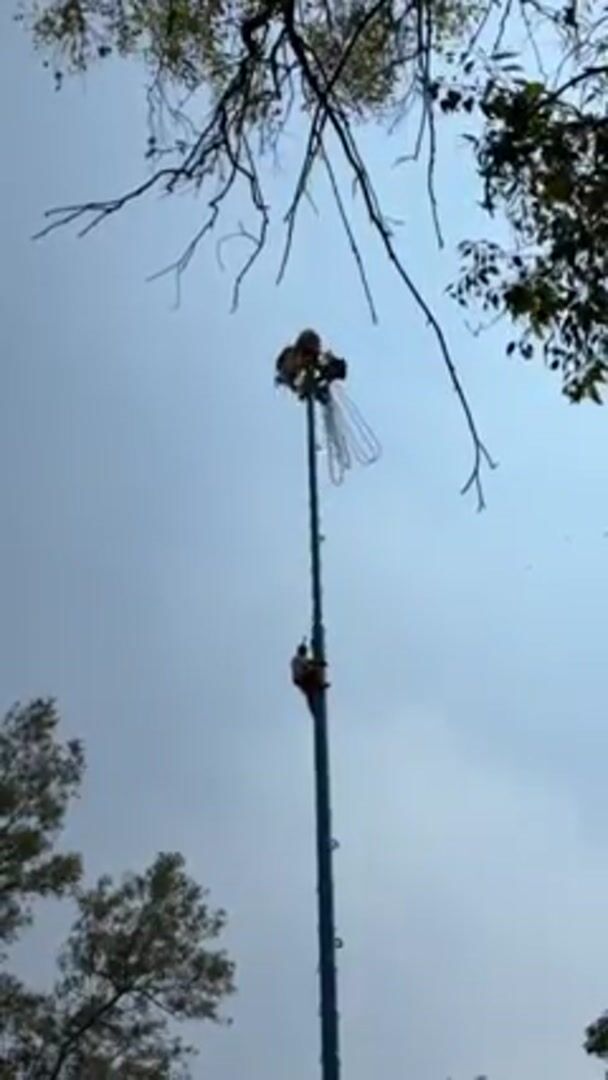
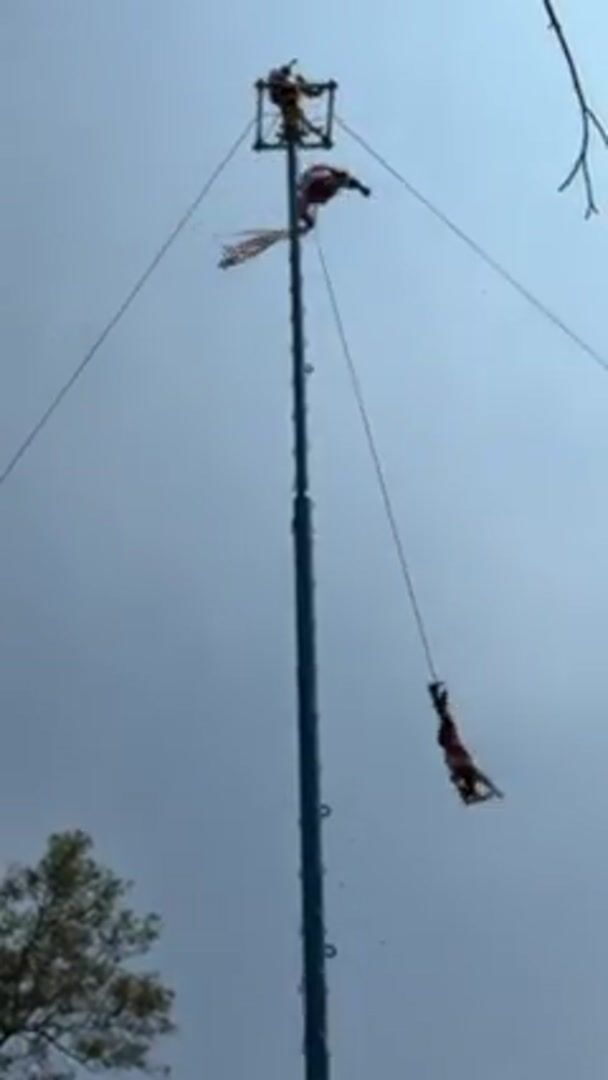
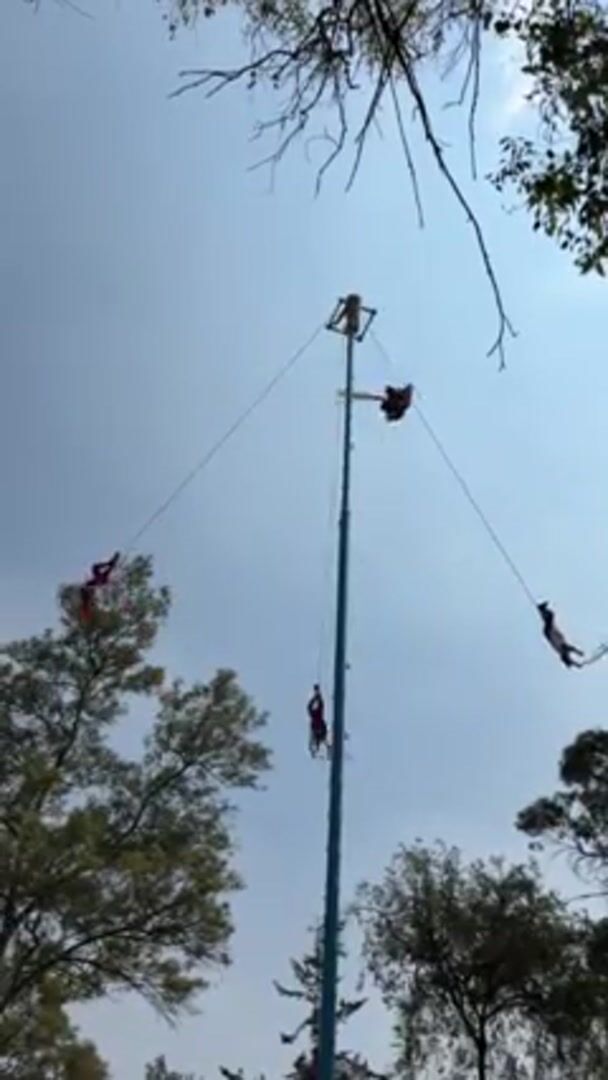
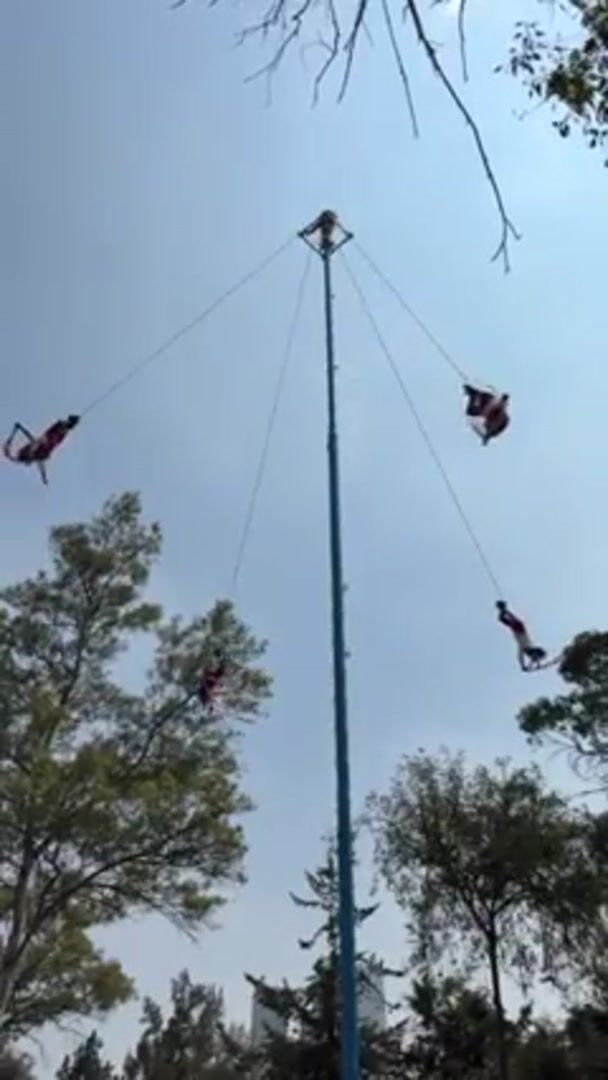
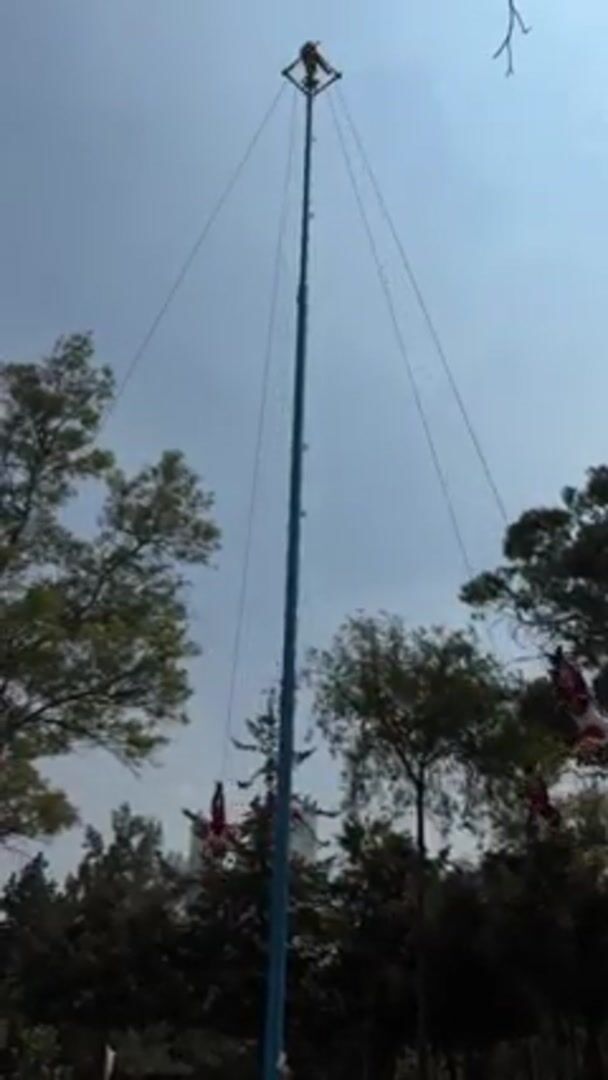
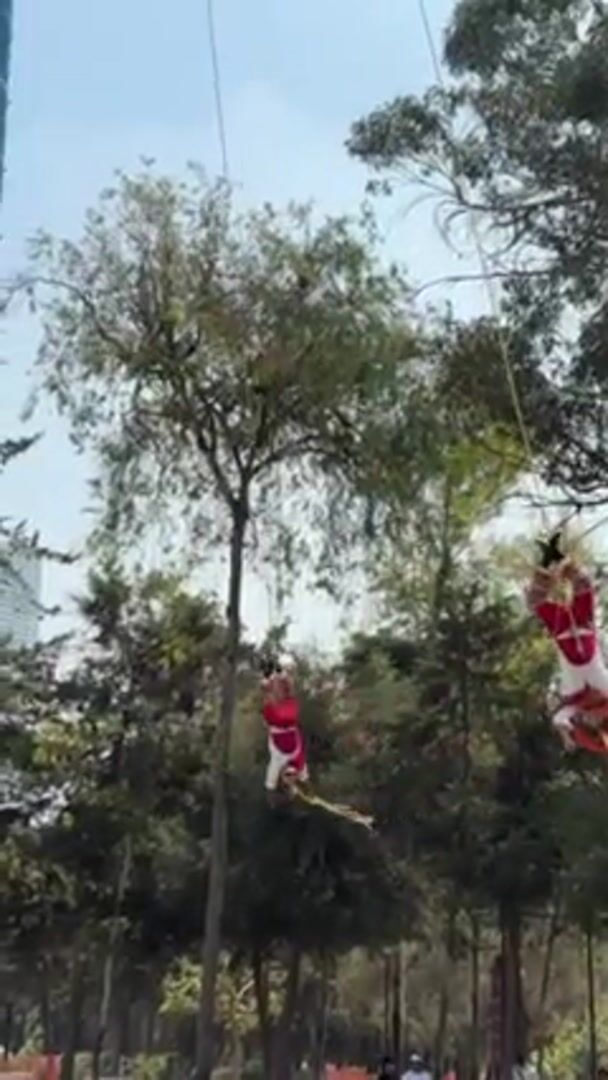
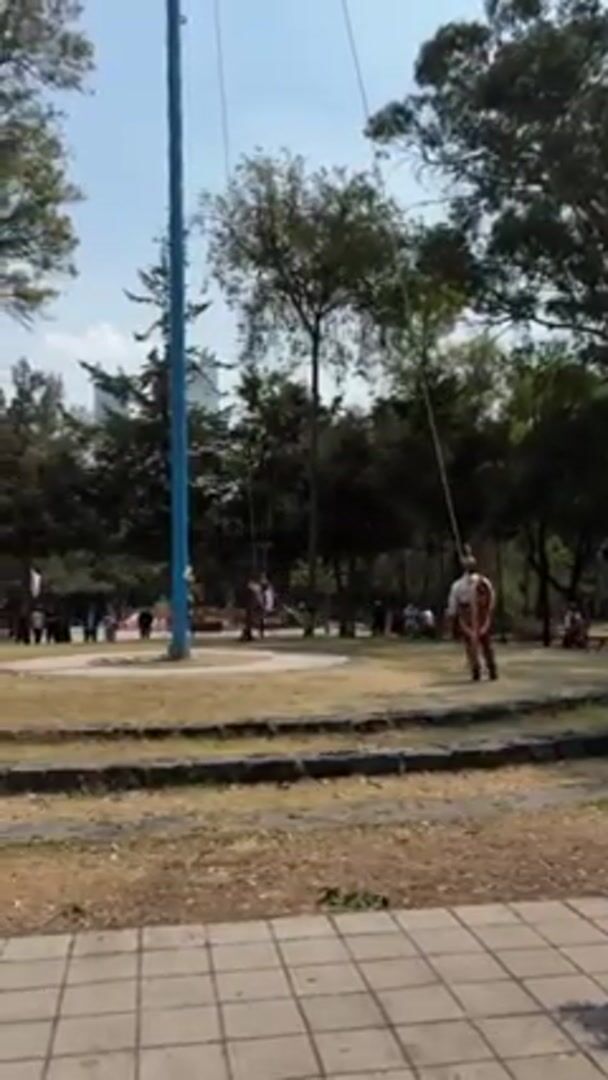
One of the most enthralling cultural performances is the Danza de los Voladores de Papantla. Often seen in public spaces like Chapultepec Park, this ritual involves individuals, or "Voladores," suspended upside down by their ankles from a tall mast. Dressed in traditional red and white attire with multi-colored ribbons trailing behind them, they slowly descend in a mesmerizing, rotational flight against a clear blue sky, evoking ancient Mesoamerican cosmology and fertility rites. These performers are a living link to Mexico's pre-Hispanic past, drawing crowds with their breathtaking aerial acrobatics.
The image displays two antique ornamental hair combs positioned on a dark red, reflective surface in Mexico City, Mexico. The upper comb, silver-toned, features approximately eleven tines and a wavy, enameled crest. The crest displays blue, white, and gold floral or cloud patterns, with a visible fracture in its upper band. The lower comb, gold-toned, possesses numerous fine tines and an elaborate, crown-like top with five upward-pointing spikes. This lower comb is embellished with small blue and white beads and metallic accents. It casts a distinct shadow onto the scratched display surface below. A lighter, indeterminate surface borders the top edge of the frame.
Mexico City, Mexico · Mar 6, 2026, 5:27 PM · 0.0k attention
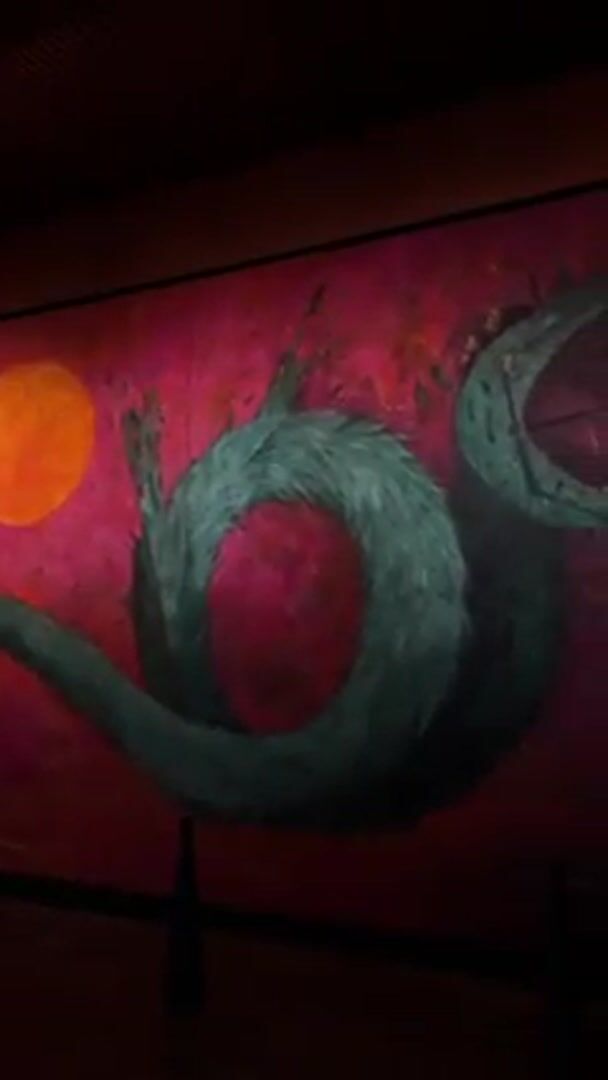
Complementing these ancient traditions are the city's artistic treasures, particularly within the National Museum of Anthropology. Here, visitors encounter monumental works such as Rufino Tamayo's "Duality" mural. This powerful piece depicts a confrontational scene between a green, feathered serpent and an orange, jaguar-like figure, symbolizing the cosmic struggle between opposing forces in Aztec mythology. The mural, set against vivid backgrounds of red, purple, blue, and orange, is a profound exploration of indigenous worldviews rendered in a modernist style, drawing attention with its intricate details and symbolic depth.
An ornate, crown-like object crafted from gold-colored metal filigree and repoussé work is displayed within a clear glass case. The object features intricate openwork designs depicting stylized foliage, scrolls, and structural elements, with several small, clear, faceted beads or stones embedded throughout its upper section. The metal appears tarnished or aged, exhibiting a dull golden hue. It rests upon a translucent, possibly frosted, light-colored acrylic platform. Reflections of a dark background containing indistinct shapes, potentially other museum exhibits or architecture, are visible on the upper glass surfaces of the display case. No people or interactions are present. The artifact's design is consistent with colonial-era Mexican religious or decorative art, frequently found in institutions such as the Museo Franz Mayer or the Museo Nacional de Historia in Chapultepec Castle, Mexico City, Mexico.
An interior museum exhibit is depicted within the Museo Nacional de las Culturas del Mundo in Mexico City, Mexico. The central subject is an ornate golden crown or elaborate headpiece, meticulously displayed on a clear acrylic stand. This artifact rests upon a luminous white circular platform encased within a large, cylindrical glass display unit. Text labels on the platform's base identify historical periods: "Dinastía Ming (1368-1644)", "Dinastía Qing (1644-1911)", and "República de China (1912-1949)". The surrounding environment is dimly lit, featuring additional glass display cases containing unseen exhibits in the background. The dark ceiling shows recessed spotlights and a prominent red circular light fixture. No individuals are visible, but reflections in the glass suggest ambient presence.
The museum itself, located in Chapultepec Park, serves as a repository of Mexico's rich history, housing countless artifacts and exhibits that narrate the country's diverse cultural evolution. From ancient sculptures to intricate decorative objects, each piece contributes to a comprehensive understanding of Mexican heritage, inviting contemplation and discovery.
The image displays an interior view of a museum gallery, identified as the Museo del Templo Mayor in Mexico City, Mexico. The room is dimly lit, with targeted illumination highlighting exhibit cases. The ceiling is dark and features a repeating embossed circular pattern across its surface, with track lighting fixtures mounted. A prominent large, circular red pendant light fixture hangs from the ceiling in the mid-ground. Numerous glass display cases are arranged throughout the space, varying in height and design, including horizontal countertop cases with light-colored bases and taller upright vitrines. Many cases are internally illuminated, showcasing small artifacts. Informational plaques are visible on the sides of some cases. The walls are a dark reddish-brown. Two individuals are present in the mid-ground: one person wearing a light top is walking away from the viewer towards the rear of the gallery, and another person in an orange shirt and blue pants stands observing an exhibit case on the right side of the frame. The floor is a dark, smooth surface.
A pair of intricately designed earrings are displayed within a clear acrylic case against a dark red background and surface. Each earring features a central, multi-layered gold-toned metal component, possibly representing a crown or stylized motif, adorned with circular red elements and small light blue or turquoise enamel details. Below the central component, multiple strands of gold-toned chain descend, each segment embellished with smaller light blue or turquoise shapes, including trapezoids and teardrops. The earrings are suspended from simple hooks. Distinct shadows of the earrings are cast onto the red surface beneath them. The scene takes place within an indoor exhibition setting, likely a museum or gallery in Mexico City, Mexico; however, the precise location is not visually identifiable from the image.
Two ornate, gold-colored earrings or pendants are displayed within a clear acrylic case, set against a dark red background. Each piece features an intricately detailed miniature figure, primarily in gold with accents of light blue enamel. Below each figure, a prominent oval red cabochon stone is centrally placed. Three elongated, tear-drop shaped elements, also in light blue, dangle from the bottom of each piece. The objects exhibit fine craftsmanship consistent with historical jewelry or decorative art. Reflections from an overhead light source are visible on the upper surface of the acrylic case. The display is situated in a museum setting, specifically identified as the Franz Mayer Museum in Mexico City, Mexico. No people are visible in the scene.
Together, the vibrant street performances of the Voladores and the contemplative power of Tamayo's art within the National Museum of Anthropology illustrate Mexico City's unique ability to weave its ancient past with its present, offering visitors a profound and unforgettable cultural experience.
Two colorful enameled figures, likely representing Chinese deities, are displayed vertically within a framed enclosure. The figures are positioned against a plain, light pink background panel.
The figure on the left is an elderly male with a prominent bald forehead and white beard, wearing a long yellow robe adorned with blue and red patterns. He holds a green staff topped with a leafy ornament in his right hand and a small white object, possibly a peach, in his left. His base is intricate, featuring blue and white swirling designs.
The figure on the right is a male with a dark beard and a blue hat, dressed in a long, predominantly red robe with blue, green, and yellow patterns. He holds a ruyi scepter in his left hand and a large, red bag-like object in his right. His base displays colorful geometric and swirling motifs.
Both figures exhibit detailed, sculptural qualities consistent with cloisonné or similar enameled artwork. They are enclosed within a dark rectangular frame with a light-colored inner mat, suggesting a museum or gallery display. The scene is observed through a reflective glass or acrylic panel, with internal lighting sources illuminating the figures from the sides. This display is located in Mexico City, Mexico.
Mexico City, Mexico · Mar 6, 2026, 5:17 PM
An outdoor, daytime scene under a clear blue sky depicts a single individual suspended upside down by their ankles. The person, identifiable as a "Volador" performer, wears traditional attire including a red lower garment, a white upper garment, and footwear. Multi-colored ribbons or streamers (red, yellow, green, and brown) extend downwards from their lower body. Two thin ropes are visible, attaching to the performer's ankles and extending upwards out of the frame. A tall, dark vertical pole with visible metal rungs is positioned on the far left. The upper canopy of green trees is visible in the lower right and bottom central portions of the frame. This scene depicts a performance of the "Danza de los Voladores de Papantla," commonly observed in public and tourist areas of Mexico City, such as Chapultepec Park or near the National Museum of Anthropology.
Two ornate, gold-toned and blue-enameled decorative pins are displayed vertically against a plain, light beige wall in a museum setting in Mexico City, Mexico. Each pin features a curved, segmented top section adorned with intricate scrollwork and stylized floral patterns in vibrant blue enamel, bordered by small gold-toned beads. A single, slender, pointed gold-toned metal pin extends downwards from the center of each decorative element. The pins are individually mounted with minimal, clear supports, suggesting they float slightly from the wall. The object on the left is positioned higher than the object on the right. No people or interactions are present.
An interior overhead shot captures a display of jewelry items on a white, illuminated circular surface, consistent with a museum or retail environment in Mexico City, Mexico. Four clear acrylic display risers are arranged on this surface. Three dark-colored jewelry pieces are exhibited on separate risers. In the bottom-left foreground, a dark beaded necklace with a central, stylized dark pendant, possibly an obsidian face or mask, rests on a rectangular acrylic riser. To the middle-right, a dark metal chain necklace with a small, dark circular pendant is displayed on a similar rectangular acrylic riser. A partially visible, ornate dark object, possibly a brooch or pendant, is situated on another small acrylic riser in the top-left background. The background beyond the display surface is dark and out of focus. No individuals are present in the scene.
Two ornate pins are displayed vertically against a plain, light brown wall. Each pin consists of a circular head featuring intricate royal blue enamel patterns on gold-toned metal, with small white or light-colored beaded details at the center. A slender, pointed gold-colored shaft extends downwards from each head. The pin on the left is positioned higher and to the left of the frame's center, while the pin on the right is lower and towards the right. The background exhibits a slight overhead lighting gradient, indicating an indoor exhibition environment, likely within a museum or gallery in Mexico City, Mexico.
The image displays two antique ornamental hair combs positioned on a dark red, reflective surface in Mexico City, Mexico. The upper comb, silver-toned, features approximately eleven tines and a wavy, enameled crest. The crest displays blue, white, and gold floral or cloud patterns, with a visible fracture in its upper band. The lower comb, gold-toned, possesses numerous fine tines and an elaborate, crown-like top with five upward-pointing spikes. This lower comb is embellished with small blue and white beads and metallic accents. It casts a distinct shadow onto the scratched display surface below. A lighter, indeterminate surface borders the top edge of the frame.
A curved, gold-colored metal ornament is centrally displayed against a plain, light brown background. The ornament, approximately semi-circular, features intricate filigree or repoussé work depicting floral and organic motifs, accented with bright blue enamel or small blue stones. A slender, pointed metal shaft extends vertically downwards from the base of the ornament, supporting it in an upright position. The background surface exhibits minor white speckling, consistent with dust or surface imperfections on a display wall or glass. This artifact is displayed within a museum setting, specifically consistent with collections found at the National Museum of Anthropology (Museo Nacional de Antropología) in Mexico City, Mexico.
An ornate, crown-like object crafted from gold-colored metal filigree and repoussé work is displayed within a clear glass case. The object features intricate openwork designs depicting stylized foliage, scrolls, and structural elements, with several small, clear, faceted beads or stones embedded throughout its upper section. The metal appears tarnished or aged, exhibiting a dull golden hue. It rests upon a translucent, possibly frosted, light-colored acrylic platform. Reflections of a dark background containing indistinct shapes, potentially other museum exhibits or architecture, are visible on the upper glass surfaces of the display case. No people or interactions are present. The artifact's design is consistent with colonial-era Mexican religious or decorative art, frequently found in institutions such as the Museo Franz Mayer or the Museo Nacional de Historia in Chapultepec Castle, Mexico City, Mexico.
An ornate, elongated decorative object, approximately 30-35cm in length, is centrally displayed against a plain, matte light brown background. The object is primarily a deep, rich blue with black outlining and intricate surface texture, possibly indicative of enamel or feathered ornamentation. The upper section, comprising roughly two-thirds of the object, features dense, stylized motifs resembling floral patterns or a grotesque face, with a prominent central drop-shaped element. Below this, a smaller, horizontally oriented, cloud-shaped segment in matching blue is suspended by short chains. From this cloud-shaped segment, five individual strands descend vertically. Each strand consists of numerous small, spherical white beads, interspersed with fewer, smaller, spherical reddish-orange beads. The strands terminate with larger, teardrop-shaped ornaments, which from left to right are dark blue, yellow, red, green, and yellow. The illumination suggests an indoor display setting. No individuals, actions, or interactions are visible within the frame. The specific location within Mexico City, Mexico, cannot be determined from the provided image.
An interior museum exhibit is depicted within the Museo Nacional de las Culturas del Mundo in Mexico City, Mexico. The central subject is an ornate golden crown or elaborate headpiece, meticulously displayed on a clear acrylic stand. This artifact rests upon a luminous white circular platform encased within a large, cylindrical glass display unit. Text labels on the platform's base identify historical periods: "Dinastía Ming (1368-1644)", "Dinastía Qing (1644-1911)", and "República de China (1912-1949)". The surrounding environment is dimly lit, featuring additional glass display cases containing unseen exhibits in the background. The dark ceiling shows recessed spotlights and a prominent red circular light fixture. No individuals are visible, but reflections in the glass suggest ambient presence.
A single, irregularly shaped metallic artifact is depicted centrally against a plain, light beige background with subtle vertical streaking. The artifact features a prominent circular element at its top, resembling an ancient Chinese cash coin with a square central hole and visible Chinese characters "萬曆通寶" (Wanli Tongbao), indicating a Ming Dynasty origin. Below this coin-like element, the artifact incorporates an intricate openwork design of two stylized dragons facing each other amidst cloud or wave motifs. The object exhibits a bronze or brass-like metallic hue with areas of darker patination highlighting the raised details, and several white reflective highlights are present on its surface, indicating an external light source. No people are visible. The specific location within Mexico City, Mexico, cannot be determined from the image, but the setting suggests an indoor display or exhibition environment.
A single, ornate gold-colored medallion is centrally displayed against a uniform muted brown background, likely within a museum exhibit in Mexico City, Mexico. The circular object, approximately 10-15 cm in diameter, features a central square aperture, surrounded by relief characters or symbols. An intricate, openwork filigree border with scalloped edges and swirling, possibly zoomorphic, motifs frames the central design. The medallion is suspended vertically by two thin, transparent filaments attached at the top and bottom-right edges, holding it slightly off the background surface. The scene is evenly illuminated, highlighting the metallic surface and intricate details of the artifact. No individuals or additional objects are present in the immediate frame.
An ornate metallic artifact, identified as a hair ornament or piece of jewelry, is centered within a display in Mexico City, Mexico. The object, appearing to be aged silver or a similar alloy, features a multi-tiered design approximately 15-20 cm in height. Its uppermost section comprises a small crown-like element, floral motifs, and approximately three small blue bead-like accents, with a thin, straight metallic pin extending horizontally from its right side. Below this, a circular tier supports numerous thin, metallic fringes or tassels, each approximately 3 cm long. A central oval element with a chainmail-like pattern is situated beneath this tier, connected to it. A cluster of similar metallic fringes, approximately 5 cm long, is suspended from the base of the oval element. The artifact is presented against a plain, light brown background, exhibiting subtle reflections indicative of a glass enclosure or polished wall, suggesting a museum exhibit setting. No individuals or active subjects are present in the scene.
The image displays a museum exhibit within a clear glass display case, situated in Mexico City, Mexico. The central focus is a white, stylized mannequin hand, prominently showcasing elaborate jewelry including multiple rings, a bracelet, and decorative, elongated finger or nail extensions. Directly beneath this hand, on a clear acrylic riser, several small, irregularly shaped, possibly metallic or jeweled objects are exhibited. The interior of the display case features a red platform and a red background wall. A vertical informational panel on the left side of the background includes a stylized illustration of figures and partially visible Spanish text, with the word "MUJERES" (women) clearly discernible. Additional Spanish text is present on the right-side red background panel. Reflections of the interior contents and surrounding museum environment are visible on the glass panels. The display case rests on a wooden base, and the broader environment appears to be a dimly lit museum setting. Overhead lighting casts a distinct shadow of the prominent mannequin hand onto the red display platform.
This image captures an illuminated exhibit within a museum or gallery setting in Mexico City, Mexico. The scene prominently features two white, stylized mannequin hands displaying various metallic adornments.
The left hand, positioned slightly to the rear and elevated on a clear acrylic stand, showcases three elongated, pointed metallic nail covers on its thumb, index, and middle fingers. Below this hand, on a separate clear acrylic rectangular riser, two detached, similar metallic nail covers are displayed: one standing vertically and another lying horizontally.
The right hand, in the foreground, is upright with its index finger extended. It exhibits a gold-toned, ornate ring on its middle finger, from which multiple delicate chains with small spherical charms are suspended. Below this hand, on a lower clear acrylic tray, two distinct silver-toned rings are displayed, each featuring a detailed, sculptural element resembling a skull or helmet.
All displayed objects rest on clear acrylic risers or trays, which are situated on a reflective red surface. The background consists of a dark red wall or partition, with subtle reflections and blurred elements of other exhibits visible through what appears to be a glass enclosure on the far left. The scene is lit to highlight the displayed artifacts, casting shadows on the red surface and the background. No individuals are present.
A gold-colored bangle bracelet, intricately adorned with multiple small white pearls and a delicate dangling chain, rests on a highly reflective, light brown display surface. The bracelet's form and its details, including possible etched markings, are mirrored on the glossy surface below. Overhead lighting is visible as a bright linear highlight along the upper edge of the frame, casting a distinct shadow from the bracelet and illuminating the scene. The immediate background is dark and indistinct. No people, other subjects, or actions are present. The scene is located in Mexico City, Mexico.
Mexico City, Mexico · Mar 6, 2026, 5:20 PM
A silver-colored metal hinged bangle bracelet with an attached safety chain is depicted resting on a smooth, reflective surface in Mexico City, Mexico. The bracelet is open, with its clasp mechanism disengaged. One half of the bracelet exhibits a patterned texture, while the other half is adorned with a series of small, circular, flattened disc-like embellishments. The interior surfaces appear smoother. A linked metal safety chain connects the two halves of the bracelet. The reflective surface clearly shows the shadow of the bracelet and its chain. The background is out of focus and uniformly dark, suggesting an indoor setting. No individuals or other objects are present in the immediate vicinity.
A silver-toned metal bracelet is displayed on a clear, U-shaped acrylic stand, which rests on a smooth, subtly reflective beige surface. The bracelet is composed of multiple links, including a prominent central circular medallion deeply embossed with an intricate design resembling the Aztec Sun Stone. This central piece is flanked by interconnected oval and rectangular links, also featuring relief patterns. The metal of the bracelet exhibits a dark patina, indicative of age or oxidation. A slender metal hook is visible extending from the lower left portion of the acrylic stand. The scene is evenly lit, casting soft shadows and reflections of the objects onto the underlying surface. This scene is located in Mexico City, Mexico.
This image depicts an ornate adjustable bangle bracelet displayed in Mexico City, Mexico. The bracelet consists of a dark-toned metal band with two hooks at the ends. Its central decorative element features a light green carved figure, identifiable as a laughing Buddha, possibly jade or a similar stone. This figure is set within elaborate metalwork with stylized leaf or wing motifs, flanked by red, blue, and clear/white circular faceted stones. Smaller clear/white faceted stones are positioned below the central figure. The bracelet is suspended on a slender, reflective metal stand, casting a prominent shadow on the plain, light-colored background. The setting suggests a museum or exhibition display.
The image depicts an indoor museum or gallery display located in Mexico City, Mexico. Two distinct, dark-toned metallic decorative objects, likely charm bracelets, are exhibited against a plain, light beige wall.
The first object, positioned higher and to the left, is a linked band from which approximately five small, individual metal charms are suspended. These charms include a bell-like shape, an elongated, bulbous form, and other abstract or figural elements, all exhibiting a darkened, possibly oxidized metallic finish.
The second object, situated lower and to the right, is a longer, more elaborate linked band with approximately eight small, hanging metal charms. These charms include identifiable miniatures such as a teapot, a fluted mold, a bell, and a spherical element, consistent in material and finish with the first object.
Both objects are held in place by transparent, rigid supports, creating the appearance of floating within a display case. The scene is viewed through a clear protective barrier, evidenced by reflections and a slight haziness across the image. Overhead lighting illuminates the display, highlighting the objects against the smooth, uniform background wall. No individuals or actions are depicted; the scene is static.
The image depicts a metallic hair clip suspended from a small hook against a light-colored wall. The hair clip features a decorative element resembling a cluster of red roses with green or dark-colored leaves, set on a silver-toned metal base. The clip is oriented horizontally and is hung by its open end from a thin, L-shaped metallic hook with a small, spherical white bead at its tip. The hook is affixed to a plain, off-white or beige wall, which shows minor surface irregularities. A vertical shadow line or adjacent wall is visible to the left of the main wall, indicating an interior corner or adjoining surface. No individuals are present. The specific location within Mexico City, Mexico, or any city, cannot be determined from the visual evidence provided.
An ornate ceremonial or theatrical headpiece is displayed within an exhibition setting in Mexico City, Mexico. The headpiece features a semi-circular structure adorned with numerous dark red spherical pom-poms, intricately interwoven with blue-teal fabric embellished with white or silver beadwork. It rests on a light-colored, contoured display support. Two identical, dark red, multi-strand tassels, approximately 20-25 cm in length, hang symmetrically from the sides of the headpiece. Each tassel is suspended by a chain of small, dark beads leading to a prominent, spiral-shaped metallic ornament detailed with additional small beads. The entire artifact is encased behind a clear, vertical acrylic or glass panel, which stands on a large, circular, back-lit white platform that illuminates the object from below. The background above the headpiece is dark and reflective.
The image displays three ornate, long, silver-toned metal decorative pieces, likely earrings or pendants, suspended vertically within an illuminated, glass-fronted rectangular display case. The case has a dark frame and a brightly lit white interior back panel. From left to right, the first piece features a rectangular dark bead and clustered decorative elements, terminating with two spherical elements. The central piece is the longest and most complex, exhibiting multiple dangling chains and floral-like motifs. The third piece is shorter, with a compact central motif from which a single chain and spherical element descend. The display case is situated against a dark red or maroon wall, consistent with a museum or cultural exhibition environment in Mexico City, Mexico. No individuals or actions are depicted.
Three ornate metallic artifacts are displayed vertically within a brightly illuminated museum exhibition case. The objects are suspended against a plain, light pinkish-beige back panel. Dark framing is visible at the top and bottom edges, defining the display enclosure.
From left to right:
1. A long, multi-segment pendant, primarily silver-toned, hangs from a small square loop. It consists of delicate chains connecting several decorative elements, including two square segments, two clusters of stylized forms (possibly floral or bell-like), and culminating in two teardrop-shaped pendants at the bottom.
2. A complex, multi-tiered pendant, predominantly silver-toned with possible oxidized details, hangs from a spherical cluster. Below this, an intricate central motif featuring abstract or stylized figures is flanked by multiple chains, each terminating in small decorative elements. Further down, a central figure depicts a person riding a quadrupedal animal, with additional chains and small pendants suspended beneath.
3. A shorter pendant, exhibiting both silver and golden/brassy tones, is suspended from an elongated figure-eight link. A single chain descends to a central, robust element that appears to be a cluster of stylized forms or a small architectural structure. A shorter chain extends from this, ending in a single, small, C-shaped or circular terminal.
The display and artifacts suggest an exhibition within the National Museum of Anthropology (Museo Nacional de Antropología) in Mexico City, Mexico.
An ornate, aged silver-colored metal ornamental object is displayed on a light tan, textured surface. The central feature is a detailed pendant depicting a stylized zoomorphic figure, possibly a lion or mythical creature, with intricate relief work, prominent eyes, and a prominent mane or ruff. Flanking elements resemble wings or additional animalistic features, with some areas exhibiting a faint greenish patina. Three flattened, stylized leaf or cloud-shaped charms dangle from the bottom of the central pendant. Chains composed of interlocking links extend from the central piece, connecting to at least three spherical bells, each adorned with engraved patterns. The object is illuminated by an overhead light source, casting subtle reflections on the display surface. This scene is located in Mexico City, Mexico.
A silver-toned metallic ornament, composed of interconnected fine-link chains and three heart-shaped pendants, is suspended vertically against a plain, light beige wall. The artifact is anchored at the top by a small metal pin, from which two main chains descend and diverge. These chains then branch to support a central, larger heart-shaped pendant with a detailed embossed design, resembling a stylized anatomical heart with a flame or crown motif. Two smaller, plain heart-shaped pendants are positioned laterally and slightly above the central piece, each suspended by a separate chain extension. The arrangement forms a balanced, hanging display. The background is unadorned, suggesting an indoor exhibit setting. Diffused lighting illuminates the object, creating soft shadows. No individuals are present in the scene. The precise location within Mexico City, Mexico, is not ascertainable from the image alone; however, the presentation method implies a museum or gallery environment.
Mexico City, Mexico · Mar 6, 2026, 5:23 PM
The image displays an interior museum exhibit located in Mexico City, Mexico, showcasing three distinct silver-toned metal artifacts against a plain, light brown wall, likely viewed through a glass panel.
The central and most prominent object is a necklace, consisting of a double chain suspended from two small pins embedded in the wall. The chains converge to support a horizontal pendant shaped like a dragon. The dragon features an ornate head with prominent features, scaled body details, and a stylized tail. Three spherical, intricately patterned ornaments dangle from the dragon's underside.
To the lower left, a separate, smaller silver-toned artifact is displayed. It depicts a seated figure, wearing a distinctive hat, riding a four-legged animal, possibly a mythical creature, with detailed features.
A third silver-toned object is partially visible at the bottom right corner of the frame. It appears to be a section of a lock or clasp, featuring decorative engravings.
The wall behind the artifacts is a uniform, pale brown or pinkish hue. Reflections are visible on the surface, indicating a glass barrier between the viewer and the displayed items. The lighting is uniform, casting soft shadows. No people are visible in the scene.
An ornate, rectangular, metallic lock is centered against a plain, light brown background. The lock features intricate floral and scrollwork engravings across its visible surface and has a prominent U-shaped shackle. Two small, U-shaped metal hooks are positioned beneath the lock, suggesting it is mounted or displayed. The background appears to be a smooth, uniformly colored wall or display panel, exhibiting slight variations in light reflection. No people, discernible actions, or specific location within Mexico City, Mexico, are visible in the image.
The image displays a dark, intricately detailed artifact, likely a pendant or small sculpture crafted from metal or a dark stone, centered against a plain, light-toned background consistent with a museum exhibit. The object depicts a stylized figure, possibly human or anthropomorphic, wearing a prominent hat, seated upon a four-legged, robust animal with visible textured or scaled patterns on its body. To the right of the seated figure, a stylized bird with distinct wings and a head stands adjacent to the rider and the animal. A small suspension loop is present at the top of the artifact, suggesting it could be worn or hung. This artifact is located within a museum exhibit in Mexico City, Mexico, most probably the Museo Nacional de Antropología.
A detailed image shows a single ornamental metal pendant, likely a traditional Chinese longevity lock, centered against a uniform light brown background. The object is silver-toned metal with intricate openwork and colorful enamel decoration. Its design is symmetrical, featuring a rectangular top section with a plain horizontal bar, flanked by stylized curved forms with dark green enamel. Below the bar, a horizontal row of six small cloud-shaped enamel motifs appears in shades of dark green, black, white, and blue.
The central body of the pendant contains four rectangular cartouches, each enclosing a single Chinese character rendered in enamel: green, blue, yellow, and green, from left to right. Flanking these characters, on the left and right sides, are circular medallions with blue and green enamel designs resembling ancient coins. The lower portion of the pendant features elaborate silver scrollwork, culminating in a central stylized motif, possibly a bat or a floral design, colored with pink, green, and blue enamel. Three small silver loops are visible along the bottom edge. Minor chips and wear are present on some enamel surfaces, notably on the outer green curves. The object is evenly lit. This image was captured in Mexico City, Mexico.
A dark, intricately detailed metallic object is displayed on a clear, reflective surface within a bright, minimalist environment in Mexico City, Mexico. The object features a roughly circular, ornate base with extensive scrollwork, possibly depicting a stylized face or creature, and a scalloped lower edge. Two slender, curved stems extend upwards from this base, one appearing smooth and the other coiled. Each stem terminates in a star-shaped or floral finial. An additional element, resembling a handle or the end of a spoon or scoop, extends from the main body to the right, also exhibiting decorative patterns. Reflections of the object and the display structure are visible on the transparent surface beneath and behind the item, indicative of a museum or gallery display case. The background is uniformly light, possibly white or off-white.
An ornate, gold-toned metallic hair ornament is displayed horizontally within a clear, rectangular acrylic case on a dark reddish-pink surface in Mexico City, Mexico. The artifact features a two-pronged pin extending from an intricately decorated head. This head incorporates fine wirework, two small spherical green textile elements, three irregularly shaped translucent whitish stones (possibly jade or similar material) encased in wire cages, and multiple small metallic spherical embellishments. The clear display surface exhibits minor scratches and reflections. No individuals or external elements are present in the immediate scene.
The image displays an ornate, open-ended metallic headpiece, identified as a gilded hair ornament, exhibited within the Museo Nacional de Historia (National History Museum) in Chapultepec Castle, Mexico City, Mexico. The item is crafted from a gold-toned metal, featuring intricate filigree patterns of leaves and flowers, accented with vibrant blue enamel. The headpiece rests on a clear, minimalist display stand positioned on a light-colored, flat surface within a museum display case. A partial exhibit label in Spanish is visible in the lower left, reading "Adorno dorad" (gilded ornament) and "el cabel" (the hair). The background consists of a plain, light-colored wall, illuminated by overhead lighting that creates subtle reflections on the display surface.
The image depicts three ornate metallic artifacts displayed vertically against a plain, light beige background within what appears to be a museum exhibit.
The central and most prominent object is a dark, elongated, rectangular metal strip, approximately four times longer than its visible width. It features intricate, repeating engraved floral or scroll patterns across its surface and is capped at the top by a prominent, circular, domed finial made of silver-colored metal. This finial is elaborately decorated with a central stylized flower or geometric motif, surrounded by concentric relief patterns. The strip is subtly secured by at least two small, light-colored fasteners or pins.
To the upper left, a silver-colored object, horizontally oriented, is visible. It possesses a pointed, elongated teardrop or leaf-like shape, approximately one-third the length of the central dark strip, and features delicate filigree or engraved details along its edges and surface. It is mounted on a thin, transparent support rod.
To the upper right, a portion of another silver-colored object is visible, also horizontally oriented. This fragment clearly displays a detailed, raised rose or floral design.
The background is uniformly light beige or off-white. A distinct, circular, bright white reflection, indicative of a light source, is visible in the lower right quadrant, suggesting the objects are enclosed within a glass display case.
This scene is located within the National Museum of World Cultures (Museo Nacional de las Culturas del Mundo) at Moneda 13, Centro Histórico de la Cdad. de México, Centro, Cuauhtémoc, 06010 Ciudad de México, CDMX, Mexico, likely within an exhibition showcasing East Asian artifacts.
Four decorative artifacts are displayed behind a reflective glass barrier against a light beige wall in a museum setting within Mexico City, Mexico, likely the Museo Nacional de las Culturas del Mundo. The upper section of the display features three ornate metallic hairpins. Each hairpin possesses a long, thin shaft and an elaborate, semi-circular or fan-shaped headpiece. These headpieces are crafted from blue cloisonné enamel with gold-colored metal filigree and small accents, including white pearls and red beads. Two hairpins are positioned near the top of the frame, one on the left and one on the right, both oriented vertically with their points downwards. A third, similar hairpin is centered below them, also vertically oriented. Directly beneath the central hairpin, a single, elongated, knife-like object is displayed horizontally. This object is adorned with complementary blue enamel patterns on a gold-colored metal base. Reflections of rectangular architectural elements and ambient light sources are visible on the transparent display barrier.
An ornate, curved segment of a decorative bangle or band, predominantly dark blue and black with intricate light blue enamel work, is on display against a plain, light brown surface. The object features raised patterns depicting stylized flora and traditional symbols. It is suspended by fine, transparent supports, indicating a museum or gallery exhibition. The scene is situated within a museum in Mexico City, Mexico. No individuals or active elements are present.
Mexico City, Mexico · Mar 6, 2026, 5:28 PM
An ornate, golden-hued metallic band is displayed on a reflective, light beige surface in an indoor setting in Mexico City, Mexico. The object exhibits intricate openwork filigree, featuring scrollwork, floral motifs, and a central rectangular panel containing a distinct, stylized emblem. Small, circular decorative elements are suspended along its lower edge. The reflective surface shows clear specular highlights from artificial light sources. The background is a uniform, light-colored wall or display interior. No individuals are present in the scene.
This image depicts a large mural titled "Dualidad" (Duality) by Rufino Tamayo, located on a wall within the Museo Nacional de Antropología (National Museum of Anthropology) in Chapultepec Park, Mexico City, Mexico.
The mural itself is a vibrant, textured painting occupying a significant portion of the wall. The left side of the mural features a dominant red and orange background, against which a large, circular orange form, representing the sun, is positioned in the upper left. A large, turquoise-green feathered serpent-like creature with an open mouth and fangs emerges from the lower left, coiling upwards and to the right. The right side of the mural transitions into a deep blue and purple background. On this side, a reddish-orange jaguar-like feline with black spots, also with an open mouth and visible fangs, is depicted in a lunging posture towards the left. A small yellow crescent, representing the moon, is visible in the lower right corner. Both mythical creatures face each other in an apparent confrontational or dynamic interaction.
The surrounding environment includes a polished, light brown or reddish-brown tiled floor, which reflects light from above. A barrier system, composed of several dark, tapering trapezoidal posts connected by a light-colored rope or strap, runs parallel to the mural in the foreground, indicating a viewing distance. Overhead, a textured wooden ceiling, featuring parallel ribbed panels, extends into the background. No people are visible within the frame.
The image captures a large, vibrant mural titled "Dualidad" by Rufino Tamayo, situated on a prominent wall within the entrance lobby of the Museo Nacional de Antropología in Mexico City, Mexico. The mural depicts a stylized, coiling, turquoise-green feathered serpent with an open, fanged mouth on the left, confronting a reddish-orange spotted jaguar with an open, fanged mouth on the right. The background behind the serpent is a textured field of pink and red, featuring a large, solid orange circle in the upper-left. The background behind the jaguar transitions to a dark blue and purple field, dotted with small white shapes and a yellow crescent in the far right.
The surrounding environment includes a patterned wooden floor, likely parquet, in varying shades of brown. Above the mural, a horizontal light-colored wooden beam runs beneath a distinctive ceiling composed of parallel reddish-brown wooden slats. A series of dark, conical bollards are placed in the foreground, connected by light-colored ropes or straps, forming a protective barrier along the base of the mural. No individuals are visible in the scene.
An abstract mural, "El Agua, origen de la vida" by Rufino Tamayo, is depicted, located within the Papalote Museo del Niño in Mexico City, Mexico. The artwork features a heavily textured surface dominated by vibrant fuchsia and magenta hues in the background, interspersed with reddish-orange accents. A large, circular, textured orange disc, resembling a celestial body, occupies the upper left quadrant. Two prominent, thick, textured serpentine or wave-like forms in teal and dark green sweep across the composition. One form originates from the bottom left, extending diagonally upwards, while the other emerges from the center-right, curving upwards and leftwards, interacting with the first form. The visible impasto technique creates a tactile surface across all painted elements. A distinct vertical seam or panel division is present slightly right of the image center, extending from top to bottom. No human figures or discernible actions are present.
A mural by Jorge González Camarena, titled 'Duality,' is depicted, located within the Museo del Templo Mayor in Mexico City. The artwork portrays two stylized, confronting creatures against a textured, abstract background of purples, reds, and dark blues. On the left, a large, teal-colored creature, resembling a feathered serpent or reptile, is shown with its mouth wide open, baring sharp white fangs and a visible tongue. Facing it on the right is an orange, black-spotted feline figure, indicative of a jaguar, also with its mouth agape, revealing prominent white fangs. The orange creature's foreleg, featuring claws, extends towards the lower center of the composition. Both figures are rendered in a dynamic, aggressive posture.
An abstract, textured painting depicts a stylized orange feline, possibly a jaguar or cheetah, against a deep blue background. The animal's body is marked with irregular black spots. Visible elements include the animal's mid-torso, two legs, and a section of its back extending into a horizontal form. The legs terminate in reddish paw-like feet. The blue background exhibits a rough texture and is interspersed with thin white lines suggesting constellations or stars. A bright yellow, crescent-shaped object is partially visible in the upper right quadrant of the image. The artwork is located in Mexico City, Mexico.
The video shows a painting of a large green snake with an open mouth facing a red jaguar with open mouth, both with large teeth. The snake's background is red-pink with a bright orange circle. The jaguar has a blue background. The painting is displayed indoors in dim lighting, protected by a black rope barrier.
A large mural titled "Duality" by Rufino Tamayo is prominently displayed, depicting a confrontation between two stylized creatures. On the left, a green, feathered serpent with an open, fanged mouth is shown against a mottled red and purple background. On the right, an orange, spotted jaguar-like figure with an open, fanged mouth and an extended clawed paw faces the serpent, set against a deep blue background. The mural is located within the National Museum of Anthropology in Chapultepec Park, Mexico City, Mexico. In the foreground, a polished wooden floor is visible. Two black, conical stanchions with a light-colored rope barrier are positioned in front of the mural. The ceiling above the mural consists of parallel wooden slats.
The image depicts the "Dualidad" (Duality) mural by Rufino Tamayo, located in the main hall of the National Museum of Anthropology in Chapultepec Park, Mexico City.
The scene features a wide, vibrantly colored mural dominating a dimly lit interior space. The mural itself illustrates a confrontation between two mythical creatures. On the left, a large, coiled feathered serpent in shades of green with a prominent open mouth, fangs, and a visible red tongue is set against a reddish-pink background that includes a bright orange disc representing the sun in the upper left quadrant. On the right, an orange and black spotted jaguar with an open mouth, fangs, and a red tongue is depicted in a dynamic, attacking pose against a dark blue background scattered with white constellations and a yellow crescent moon in the lower right.
In the foreground, a highly polished, dark brown parquet hardwood floor reflects ambient light and portions of the mural. Approximately one meter from the base of the mural, a series of five visible black stanchions connected by a light-colored rope forms a protective barrier. The ceiling above is constructed from horizontal dark wooden slats, creating a ribbed pattern. No individuals are visible in the scene.
The image displays an interior perspective looking outward through large windows into an exterior scene during daylight. The upper two-thirds of the frame are dominated by a flat ceiling composed of numerous reddish-brown, rectangular panels arranged in a grid pattern, exhibiting a subtle wood grain texture and minor surface undulations. Two small, dark, cylindrical objects hang from the ceiling in the lower-left quadrant. Below the ceiling, a wide expanse of reflective glass, segmented by three vertical metallic mullions, spans the width of the view. Through this glass, an exterior architectural landscape is visible. To the right, the prominent "El Paraguas" (The Umbrella) fountain is clearly identifiable, featuring a massive cylindrical stone column with carved details and a wide, circular canopy from which water cascades in a sheet, creating vertical visual streaks. Behind and to the left of the fountain, a large, multi-tiered concrete structure with a repetitive, patterned design is visible. Green foliage from trees is present in the middle ground, and the distant background shows the faint silhouettes of urban high-rise buildings beneath a bright sky. The location is the National Museum of Anthropology (Museo Nacional de Antropología) in Chapultepec Park, Mexico City, Mexico. No people are visible.
Mexico City, Mexico · Mar 6, 2026, 5:34 PM
The image depicts the grand interior of the National Museum of Anthropology (Museo Nacional de Antropología), located in Chapultepec Park, Mexico City, Mexico. The scene features a high, dark, paneled ceiling from which a large, intricate, sculptural chandelier is suspended, composed of numerous elongated, curvilinear elements forming an organic, symmetrical pattern. Below the ceiling, a series of tall, vertical glass panels define a transparent wall, allowing exterior light and views into the space. Through these windows, glimpses of concrete or stone architectural elements and green tree foliage are visible. In the foreground and mid-ground, a sweeping, curved wall structure made of light-colored, rectangular marble panels dominates the lower half of the frame. This wall ascends diagonally from right to left, forming a sloped surface or ramp, with its base reflecting light on a smooth, polished floor. Carved into the marble wall on the left side is an inscription in Spanish, detailing the monument's dedication. Visible text segments include "MEXICANO LEVANTA ESTE MONUMENTO," "CULTURAS QUE FLORECIERON DURANTE," "MÉXICO, D.F. 17 DE SEPTIEMBRE DE 1964," and "ADOLFO LÓPEZ MATEOS PRESIDENTE DE LA REPÚBLICA." No individuals are present in the scene. The lighting is bright, primarily natural light from the exterior, creating soft shadows.
The image displays an upward-angled interior view of the National Museum of Anthropology in Chapultepec Park, Mexico City, Mexico. The upper two-thirds of the frame are dominated by a grid-patterned ceiling composed of numerous reddish-brown square tiles, exhibiting varying tones and subtle reflections. Below the ceiling, a horizontal dark gray panel acts as a transition, beneath which a lighter, off-white wall extends. This wall features a carved or embossed inscription in Spanish, rendered in capital letters, attributed to Jaime Torres Bodet. A single small, dark rectangular fixture, likely a light or sensor, is centered within the dark gray panel. The bottom portion of the image reveals a large window with reflections, through which green trees and natural daylight are visible, alongside a partial red object on the left. No individuals or dynamic actions are depicted.
The image depicts the interior of the National Museum of Anthropology (Museo Nacional de Antropología) in Chapultepec Park, Mexico City, Mexico, specifically a large hall or foyer. The scene is heavily back-lit, with light streaming through a vast, multi-paneled glass wall that forms the primary interface between the dark interior and the brightly lit exterior.
The ceiling is dark, flat, and composed of square panels. The left wall features a textured, light brown stone or brick-like finish, displaying several rectangular information panels with visible text. The floor is a highly polished, dark tiled surface, exhibiting strong reflections of the glass wall, exterior light, and figures within the space.
Outside the glass wall, sunlit, monumental stone or concrete architectural structures are visible, along with green foliage and trees. Beyond these immediate exterior elements, a corrugated metal roof structure is apparent, and in the distance, a skyline of modern city buildings is visible under a clear sky.
Inside the hall, three prominent figures are captured in silhouette on the polished floor, casting distinct reflections. Two individuals walk from left to right in the midground, while a third individual stands further to the right, facing away from the viewer, potentially a staff member due to attire. Along the left wall, several indistinct figures are seated on wooden benches in shadowed areas. Through the exterior glass, additional human figures are faintly visible in the sunlit courtyard outside. On the far right, a dark, low partition wall is present, with a red object, possibly a fire extinguisher, partially visible behind it.
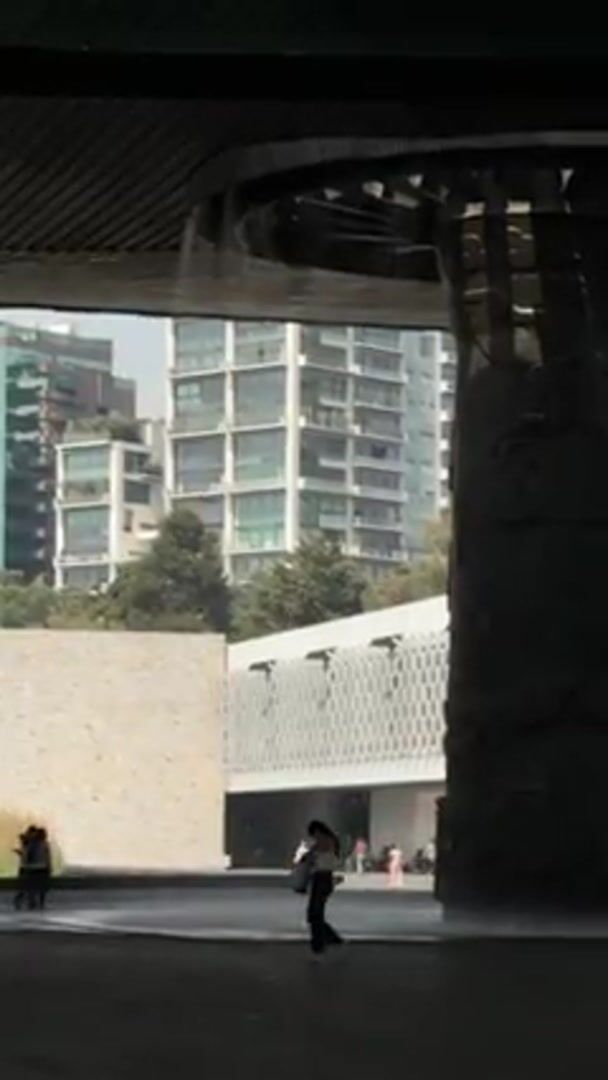
The video shows the exterior of a building, likely a museum or a public space, possibly in an urban setting. Water is flowing from the ceiling, creating a curtain-like effect, obscuring part of the view. People are walking in the courtyard, with high-rise buildings visible in the background. The architecture of the building features modern elements, with geometrical designs and neutral color tones. There's a large, sculpted stone pillar, and the general atmosphere is bright due to daylight.
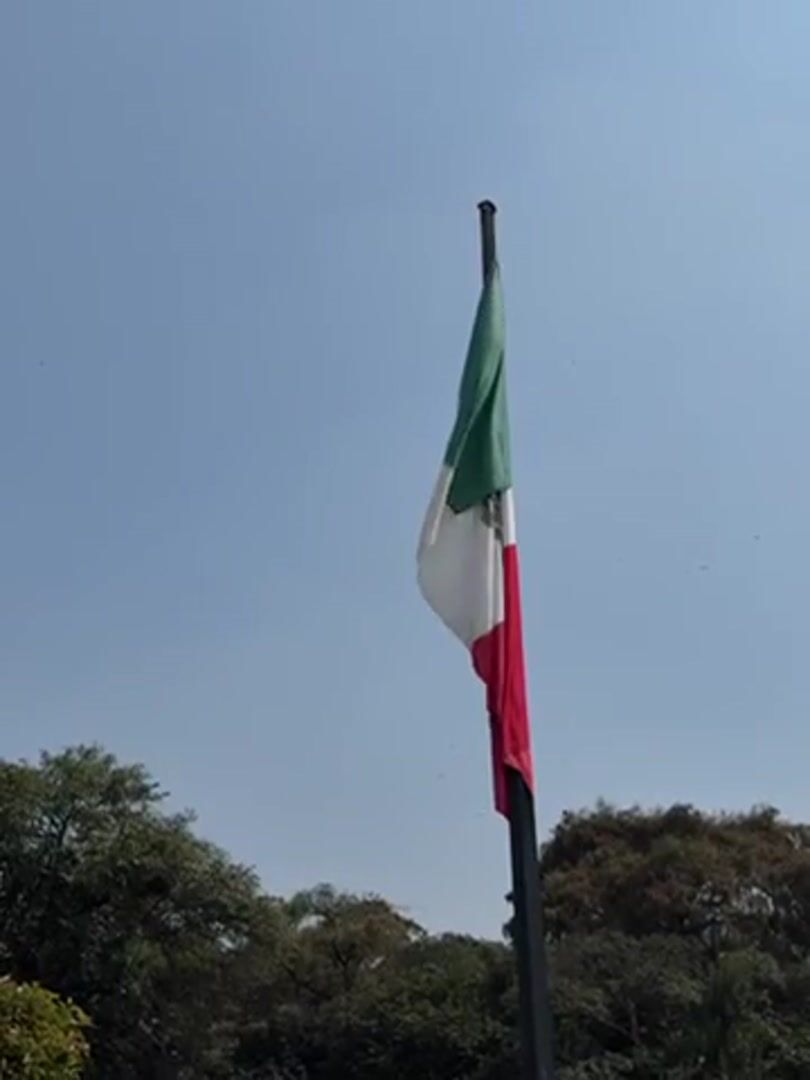
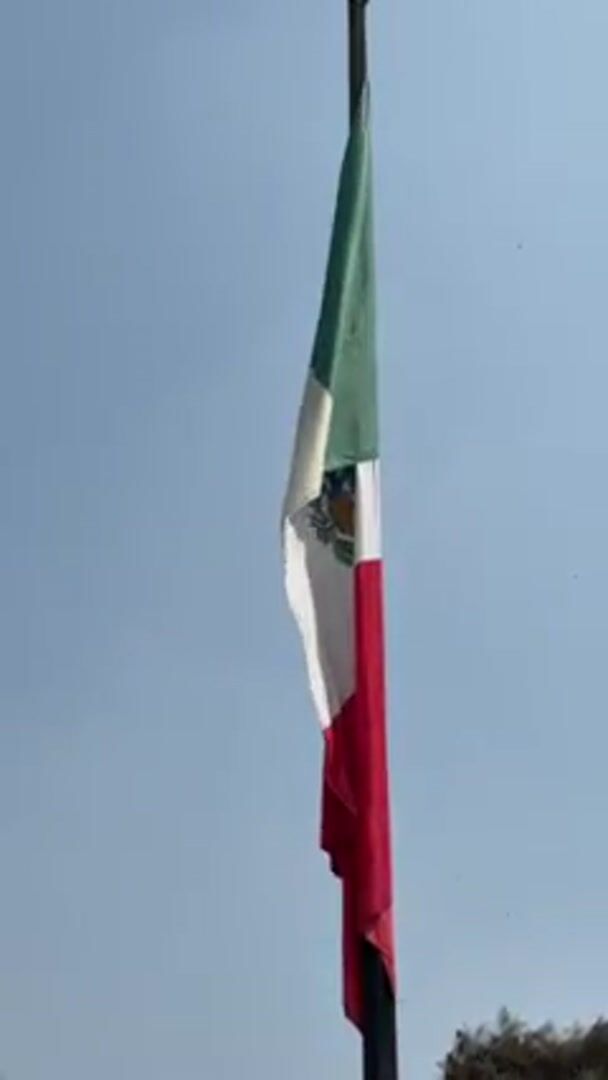
The national flag of Mexico is prominently displayed on a tall, dark flagpole, situated vertically and occupying the right side of the frame. The flag features vertical stripes of green (left), white (center), and red (right), appearing slightly creased as it hangs with minimal unfurling. The emblem on the white stripe is not clearly visible due to the flag's orientation and slack. Above the flag, the flagpole extends into a clear, light blue sky. Dense green foliage, including trees with both full canopies and some visible bare branches, forms the background and lower foreground of the scene. The lighting indicates a bright, sunny day. The scene is located in a green, park-like environment consistent with Chapultepec Park, Mexico City. No people or specific structures other than the flagpole and vegetation are visible.
The video shows the Mexican flag on a flagpole, which is slightly drooping due to the lack of wind. The sky is blue with some light haze. The trees are green and leafy, and a few people can be heard talking in the background.
The video shows a tall Mexican flag hanging limply from a flagpole against a clear, pale blue sky. The flag has three vertical bands: green on the left, white in the center with the national coat of arms, and red on the right. The fabric hangs nearly straight down with some ripples. Small dark particles are visible in the air. The lower portion of some trees are barely visible at the very bottom of the frame.
The image displays a wide-angle view of a large, open public plaza in Mexico City, specifically resembling areas within Bosque de Chapultepec. The scene is captured under a pale blue, slightly hazy sky, which occupies the upper two-fifths of the frame.
The foreground and mid-ground consist of an expansive, flat plaza paved with dark grey, rectangular concrete or stone pavers laid in a consistent grid pattern. The pavement appears well-maintained and uniform.
The background is dominated by a dense, tall forest of mature trees with dark green foliage, extending across the entire width of the image. Two particularly tall, prominent trees with full canopies are silhouetted against the sky in the left-center. Among the dark green canopy, faint hints of purple blossoms, characteristic of Jacaranda trees, are visible in the mid-background. Small, manicured bushes are planted within dark, rectangular, low-lying planters positioned at intervals along the edges of the paved plaza. A low, dark linear structure, possibly a bench or retaining wall, runs along the left side of the plaza. On the far right, a dark, angular, potentially decorative or sculptural object is partially visible.
In the mid-ground, nestled within the tree line, several small, light-colored structures resembling vendor kiosks or food stalls are discernible, though their details are indistinct. Through the trees in the distant background, left of center, a tall, modern skyscraper with a light facade is partially visible.
A few individuals are present. On the right side of the plaza, a single person dressed in dark clothing (dark top, light pants, and light shoes) stands near one of the dark planters, facing towards the left of the frame. In the mid-ground, near the vendor kiosks, several small, indistinct figures are visible, walking or standing, their forms largely obscured by distance and the shadows cast by the trees. No direct interactions between individuals are clearly depicted. The overall lighting suggests bright daylight, with the plaza illuminated while the dense trees appear somewhat shaded.
The image depicts the Glorieta de los Niños Héroes (Altar a la Patria) in Chapultepec Park, Mexico City, Mexico, under a clear, bright blue sky. The scene is dominated by a large, open plaza paved with dark grey square tiles. Several low, dark-colored, multi-tiered rectangular structures, resembling planters or fountain bases, are distributed across the plaza. These structures contain small, neatly trimmed trees with green foliage and patches of yellow-green ground cover. A circular planter with a similar trimmed tree is situated in the mid-ground, slightly left of center. Two individuals are visible in the mid-ground: one person in dark clothing walks from left to right near the circular planter, and another, less distinct figure is further back on the right near the tree line. The background consists of a dense line of mature green trees, some with exposed reddish-brown foliage. A very tall, dark tree with a dense, rounded canopy stands prominently on the far right. In the distant background on the left, a tall, cylindrical building with distinct horizontal banding, identified as the Torre Mayor, rises above the tree line. Direct sunlight illuminates the scene, casting subtle shadows.
The image depicts an outdoor urban environment in Mexico City, specifically from within or adjacent to Chapultepec Park, facing towards the Polanco district. The foreground features an expansive, unoccupied plaza paved with light gray rectangular and square flagstones. A low, dark-colored retaining wall delineates the plaza from a dense, verdant expanse of mature trees and undergrowth in the midground. Partially obscured within the foliage are multiple light poles, and a green and orange utility vehicle is visible further right. Two circular concrete planters, one containing a small, trimmed shrub, are positioned at the edge of the paved area. Dominating the background are two tall, distinctively striped cylindrical high-rise buildings, recognized as structures in Polanco (e.g., Presidente InterContinental Mexico City hotel and a neighboring tower), rising above the tree canopy. The buildings display alternating horizontal bands of a dark reddish-brown/orange and a lighter gray. The sky is clear and blue, indicating a bright, sunny day. No human figures are present.
Mexico City, Mexico · Mar 6, 2026, 5:43 PM
The image displays an urban green space in Mexico City, Mexico, under a clear, light blue sky. A large, dark green leafy tree occupies the left side, with its canopy and trunk partially visible. Centered prominently is a jacaranda tree in full bloom, characterized by abundant purple flowers and a complex network of branches. To the right, a tall, black lamppost extends upwards, topped with two square, black floodlight fixtures. Additional green foliage and trees are visible in the background and lower right. At the bottom right, a trimmed green hedge is present, with spiky, succulent-like plants situated behind it. No people, animals, or discernible interactions are visible.
The scene depicts an outdoor public area, specifically Bosque de Chapultepec Park in Mexico City, Mexico, under bright daylight. A large, leafy tree dominates the upper portion and central foreground, casting dappled light.
In the foreground, a person is observed from behind, standing on a grey paved pathway. This individual is dressed in elaborate traditional attire: a yellow headpiece featuring a vibrant, multi-colored, fan-shaped headdress with segments of red, orange, yellow, green, and blue. They wear a white, long-sleeved tunic. A prominent red shawl or cape-like garment covers their back, adorned with detailed white floral embroidery and green leaf patterns. Numerous long, multi-colored ribbons (red, yellow, blue, green, orange, pink) hang vertically from this garment. The person is looking downwards, holding a dark-colored smartphone-like device with both hands.
To the right of the main subject, on the paved surface, a dark, upright display stand exhibits multiple rows of colorful bracelets or small craft items. Beyond the paved path, a low, dark stone or concrete border separates it from a grassy area. In this mid-ground grassy section, two additional figures are visible. One figure is bent over, seemingly arranging items on the ground, and appears to be covered by a light-colored blanket or poncho. Piles of colorful textiles or goods are spread on the grass near these figures. The background consists of a park-like environment with numerous trees, some with exposed trunks, under a clear sky.
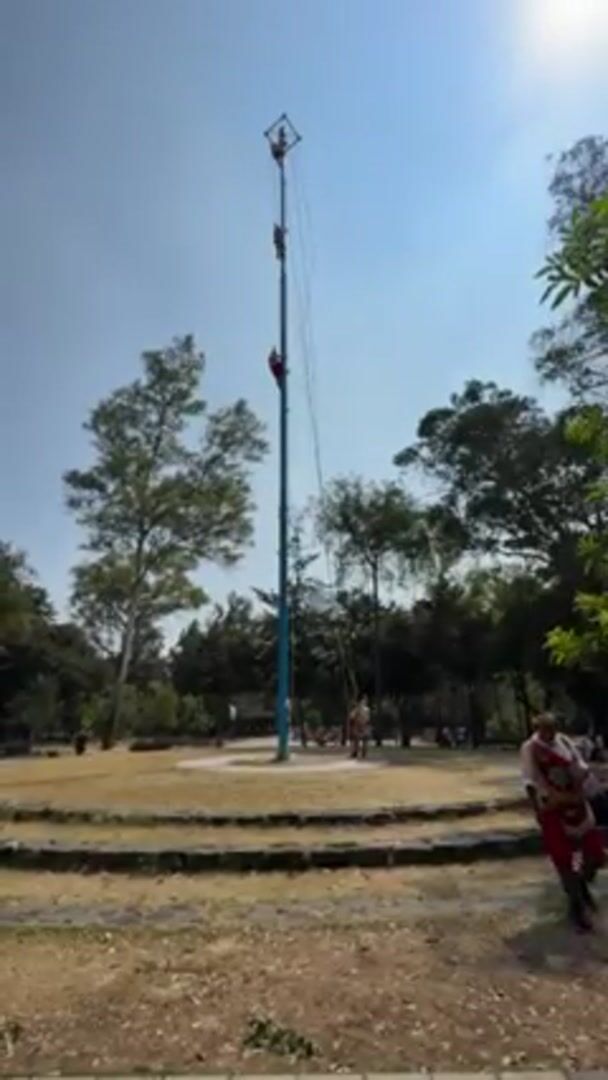
This image depicts a daylight scene of the Danza de los Voladores de Papantla ritual performance in Bosque de Chapultepec, Mexico City, Mexico. A tall, slender, blue pole stands vertically in the center-right of the frame. At the very top of the pole, one individual, dressed in traditional red and white attire with a feathered headpiece, is positioned on a small platform, playing an instrument resembling a flute or pipe. Below this individual, three other performers, similarly dressed, are either ascending the pole or have secured themselves with ropes attached to the rotating frame at the pole's summit, poised to descend headfirst. One of these three is actively descending.
On the ground near the base of the pole, another individual in traditional Volador attire is walking away to the lower right, with their back partially to the viewer. Another person is partially visible behind them. The ground is a mix of a circular paved area immediately surrounding the pole and dry grassy areas further out. The scene is set outdoors under a clear, bright blue sky. Numerous trees, including tall, leafy specimens on the left and denser, darker foliage forming a backdrop on the right, populate the environment. A modern, geometric building with a light facade is partially visible through the trees in the distant background on the right. Several indistinct figures are visible among the trees in the mid-ground, likely spectators or additional participants.
The video depicts a group of men performing the Danza de los Voladores, or Dance of the Flyers, in what appears to be a park. The Voladores are climbing a tall, blue pole to a small platform at the top. Ropes hang from the platform, and at least one man is ready to descend. A musician is on the ground, playing for the performance. The scene is set on a sunny day, with trees and grass in the background, and some stone steps lead up to the area around the pole. There are some spectators, including one individual in traditional clothing.
An outdoor scene in Chapultepec Park, Mexico City, depicts two men in traditional attire, presumably preparing for or performing the Danza de los Voladores ritual. In the foreground, a man is observed from behind, walking rightward. He wears a white long-sleeved shirt, red trousers with intricate patterns, black shoes, a colorful embroidered cape with cascading multicolored ribbons, and a vibrant fan-like headdress. In the mid-ground, a tall, blue metal pole stands centrally, with yellow ropes extending from its upper section. To the left of this pole, a second man stands, holding two of the yellow ropes. He wears a white shirt, red patterned trousers, and a white winged ornament on his back. The immediate ground consists of dry, yellowish grass and a section of dark stone steps. In the background, numerous dark green trees are visible, with a modern, light-colored skyscraper partially discernible through the foliage in the distance. The sky is clear and bright blue, indicating sunny weather. To the far left, a third individual is partially visible kneeling on a circular paved area.
A male individual, seen from behind, is seated on a dark wooden log stump in an outdoor paved environment within Mexico City, Mexico, consistent with historical public spaces like the Zócalo. The subject wears a white long-sleeved shirt, a yellow knotted headband, and a red beaded capelet featuring prominent multi-colored floral designs and yellow fringe. A secondary white-fringed garment is visible underneath. To the subject's right, positioned on a lower dark stone step, an elaborate feathered headdress rests. This headdress displays a floral-embroidered base and a fan-like crest of vertical multi-colored strips, with colorful ribbons extending onto the pavement. The ground consists of grey square pavers, exhibiting dappled sunlight and shadows from overhead foliage. A rope is tied around the wooden stump.
This image depicts a daytime scene in Chapultepec Park, Mexico City, Mexico, centered on a performance of the Danza de los Voladores. A tall, slender pole, painted blue, stands vertically in the midground, its base resting on a circular concrete platform surrounded by dry, sparse grass. Multiple yellow ropes are attached to the upper section of the pole, extending downwards.
One individual, dressed in a red and white traditional costume, is positioned high on the pole, near its apex, with arms raised. At the base of the pole, a second individual stands, facing away from the camera, wearing a traditional Volador costume consisting of a white shirt, an ornate vest, a red sash, red and white leg coverings, and a feathered headdress.
The surrounding environment consists of numerous tall trees with varied green and dark foliage, forming a dense background on both sides of the pole. The sky is clear and light blue, indicating bright, sunny weather conditions. Several indistinct human figures are visible in the distant background among the trees.
The image depicts an outdoor daytime scene at the Museo Nacional de Antropología in Chapultepec Park, Mexico City, Mexico. A large, light-colored modern building with a wide facade featuring a prominent bas-relief of the Mexican Coat of Arms (an eagle on a nopal cactus with a snake) is the central subject. Below the bas-relief, a series of dark-framed windows are visible, and behind the main structure, the distinct, light-colored domed or multi-faceted roof of the museum's "umbrella" structure is partially visible. A Mexican flag, green, white, and red, flies on a tall flagpole to the right of the building's central facade.
In the foreground, a paved plaza of square grey pavers is visible, partially shadowed. Two large tree trunks, one central and one on the right, obstruct parts of the view. A raised garden bed with low green foliage and some orange-flowered plants sits in front of dark, multi-tiered steps leading up to the building. To the left, a large tree with purple blossoms is present.
Several individuals are dispersed across the scene. One person in a light shirt and shorts stands facing the building on the lower steps to the right. Another individual, possibly wearing a yellow cap, stands near the base of the large central tree, looking towards the building. Multiple other indistinct figures are visible seated on steps near the building's entrance or walking in the distant left background. In the far background, behind the museum, modern high-rise buildings with glass facades are visible against a bright, hazy sky. The scene is illuminated by strong natural light, casting pronounced shadows.
The video captures a tall blue pole with individuals at the top and bottom, set against a backdrop of trees and a clear sky. At the pole's summit, figures are seen maneuvering, while a person is present near the pole's base. Ropes are visible connecting the top and bottom of the pole. The surroundings consist of a grassy area with trees, and people can be seen scattered in the background, suggesting a park setting.
Certainly! Here's a description of the video:
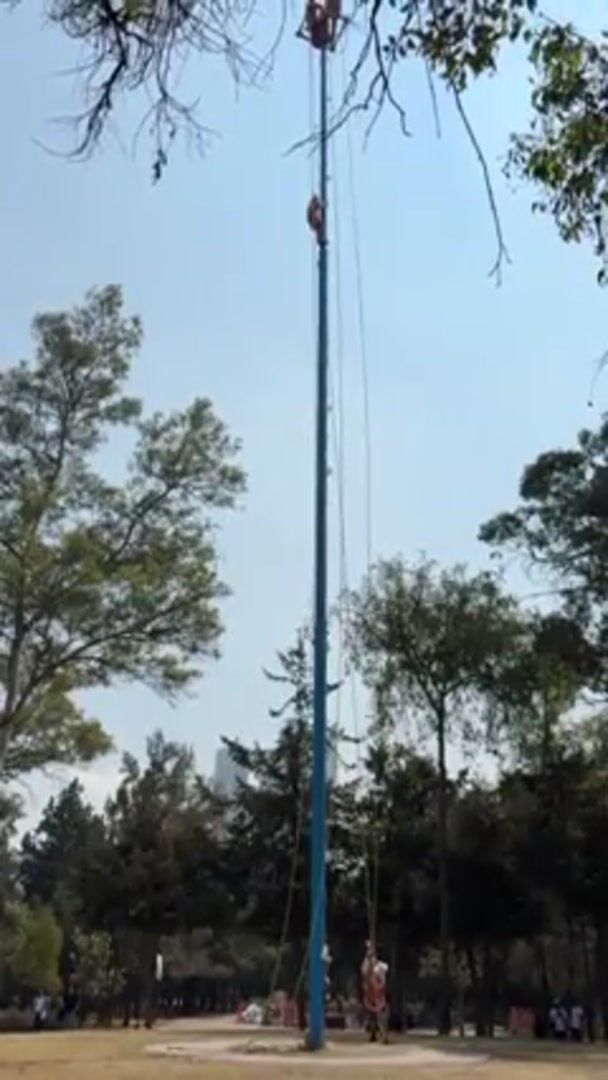
The video shows a tall pole against a light-blue sky, partially obscured by tree branches at the top and bottom of the frame. At the top of the pole, two figures are visible, appearing to be working with ropes and possibly some sort of apparatus. The angle is low, looking upwards towards the sky and the figures on the pole. The overall impression is of someone performing a task at a significant height.
Ciudad de México, Mexico · Mar 6, 2026, 5:51 PM
A low-angle shot shows a very tall, blue-painted pole with two people at the top and one person climbing up. At the very top are four people, arranged on a square platform. A set of ropes are attached to the platform and hanging down. A fifth person is climbing up the pole towards the platform. The sky is light blue. Trees surround the pole, and branches are partially obscuring the view.
The video shows a performance called the "Danza de los Voladores" (Dance of the Flyers), a Mesoamerican ceremony still practiced today. Four performers are hanging upside down from ropes attached to a tall pole. At the top of the pole, another person, possibly the leader, is sitting on a square platform. The performers slowly descend in a spiraling motion, controlled by the ropes, while the leader remains at the top of the pole, possibly playing music or chanting. The sky is a clear blue, and a tree is visible on the left side of the frame.
The video shows four people suspended from a tall pole, performing what appears to be the Danza de los Voladores (Dance of the Flyers), a Mesoamerican ceremony. The individuals are dressed in red and white costumes and are attached to the pole by ropes. They are rotating downwards in a circular motion, descending from the top of the pole. The pole is blue and has a square platform at the top. The scene is framed by trees, with a bright sky in the background.
The video shows a high pole or tower in an outdoor setting, with a square platform at the top. Four figures are suspended by ropes connected to the platform, and they are gradually descending in a circular motion around the pole. The figures appear to be wearing red clothing. The sky is visible in the background, and the scene is bordered by trees, with their foliage partially obscuring the view.
The image displays a public performance of the Danza de los Voladores de Papantla in Mexico City, Mexico, a ritual often conducted in locations such as Chapultepec Park or the Zócalo. Two individuals, referred to as voladores, are suspended upside down by ropes from a tall, blue metal mast. Each performer is attached by an ankle to a rope originating from a rotating platform at the mast's apex, indicating a controlled descent. Both voladores wear traditional costumes, primarily red and white, with long, multi-colored ribbons trailing from their feet. The volador on the left is positioned higher and farther from the central mast than the one on the right, which is lower and closer. The background consists of a clear, light blue sky, with the green foliage of trees visible in the lower foreground and midground. Small, scattered dark flecks, consistent with debris or confetti, are visible in the sky.
A high-angle shot captures three individuals performing the Danza de los Voladores (Dance of the Flyers) against a clear, light blue sky. A tall, slender, light blue-grey metal pole with small, ring-like attachments ascending its length stands vertically in the center. Three performers, dressed in traditional red and white attire, are suspended upside down by ropes attached to the top of this central pole, with additional ropes extending to their ankles or feet. They appear to be descending in a circular motion around the pole. One performer is visible on the far left, another on the lower right, and a third on the upper right, indicating their spatial arrangement during the descent. Trailing ribbons are visible from at least one performer. Dark green tree foliage is present in the lower left, lower right, and upper right sections of the frame, suggesting an outdoor, park-like environment. This scene is consistent with performances held in locations such as Chapultepec Park in Mexico City, Mexico.
The image displays a performance of the Danza de los Voladores (Dance of the Flyers), a traditional ritual, set against a clear blue sky. This performance is commonly associated with Chapultepec Park in Mexico City, Mexico. A prominent, tall blue metal pole, equipped with ladder-like rungs, stands vertically. Four individuals are visible, all dressed in traditional red and white costumes. One participant is positioned atop the pole. Three other participants are suspended upside down by ropes secured to their ankles, in the process of descending from the pole. Colorful ribbons stream from the lower legs of these descending individuals. The upper canopy of several large green trees is visible in the lower portion of the frame, indicating an outdoor park-like environment.
The image depicts the traditional Danza de los Voladores (Dance of the Flyers) occurring outdoors, likely within Chapultepec Park, Mexico City, Mexico. Three individuals, identified as performers, are suspended headfirst by yellow ropes attached to a tall, vertical blue metal pole. The central performer, positioned mid-descent, wears a red tunic, white pants, and a decorative sash with multicolored streamers extending downwards. Two additional performers are visible lower and to the left and right, similarly attired and descending, partially obscured by the dark green foliage of surrounding trees. The sky above is clear and light blue.
The scene depicts the Danza de los Voladores (Dance of the Flyers) ritual performance in Chapultepec Park, Mexico City. A tall, light-blue metallic pole stands vertically in the center, from which multiple ropes descend. Two individuals, identified as performers, are suspended upside down from these ropes. The prominent performer, positioned centrally, wears a white and red costume with white trim, black footwear, and has colorful red, yellow, and blue ribbons attached to their lower legs, fanning out as they descend headfirst. A second performer, similarly attired and suspended, is partially visible on the right side of the frame, also in descent. The environment consists of a clear, bright blue sky dominating the upper background, with numerous green-leafed trees flanking the central pole. A modern, multi-story building is partially visible through the trees in the lower left background.
The image displays an outdoor performance of the Danza de los Voladores (Dance of the Flyers) in Chapultepec Park, Mexico City, Mexico. A tall, blue-painted pole stands vertically in the center of the frame against a clear blue sky.
At the apex of the pole, one individual is seated on a small platform. Four other individuals, dressed in traditional red and white attire with decorative elements, are suspended upside down by ropes attached to their ankles, spiraling downwards around the central pole. Their bodies are extended horizontally. One flyer is visible on the far left, two in the mid-left/center, and one on the far right.
The scene is set amidst numerous tall, green trees, which frame the performance. A modern, light-colored skyscraper is partially visible in the background on the right side, above the tree line. The lighting indicates clear daytime conditions.
Mexico City, Mexico · Mar 6, 2026, 6:05 PM
The video shows a tall, blue pole with a square platform on top. A person is visible on the platform. Four ropes extend from the top of the pole to the ground, and people are attached to each of these ropes. The people are dressed in red and white. As the video progresses, the ropes uncoil, and the people descend in a circular motion around the pole. The scene is set outdoors, surrounded by trees under a bright sky.
The video shows a traditional Mexican voladores ceremony, also known as the "Dance of the Flyers." Two performers wearing red and white outfits are suspended upside down from ropes attached to a tall, blue pole. They are slowly descending in a circular motion, simulating flight. The background includes green trees and a building in the distance under a bright blue sky.
Here is a detailed description of the video:
The video shows the "Voladores de Papantla" (Flyers of Papantla) performing their traditional Mesoamerican ceremony. Two men are suspended upside down from high ropes attached to a tall blue pole. The men are dressed in traditional red and white attire and wear headdresses. They are slowly rotating as the ropes unwind, gradually descending to the ground. Colorful ribbons attached to their ankles flow in the wind as they spin.
The ceremony takes place in a park-like setting, with numerous green trees in the background. The sky is blue with scattered clouds. A modern building can be seen in the distance behind the trees. The camera pans slightly to follow the movement of the performers.
The video shows people performing the Danza de los Voladores. They are in a park with trees and a blue sky. The dancers are dressed in red and white costumes. They are attached to ropes and are spinning around a pole. There are people watching on the ground.
The image captures an outdoor cultural performance featuring two male individuals, identified as "Voladores de Papantla," suspended upside down in Mexico City, Mexico. Each performer is secured by a thick yellow rope tied around their ankles, descending from an overhead structure (implied to be a tall pole, though only the ropes and surrounding tree branches are visible).
The primary performer, positioned centrally on the left, wears traditional red pants, a white long-sleeved shirt with a red sash around the waist, and striped leg coverings over black footwear. This individual holds and is adorned with numerous brightly colored ribbons (pink, yellow, blue, orange, green) that fan out. The secondary performer, visible in the lower right background, is similarly dressed in red pants, a white shirt, and striped leg coverings, with some colored ribbons also trailing from their head/waist area. Both performers are oriented head-downward, mid-descent, with their bodies parallel to the ground.
The environment consists of numerous dense green trees under a clear, bright sky, indicative of a large park or recreational area. A sparse crowd is faintly visible at the very bottom edge of the frame. The location is consistent with public performance areas in Bosque de Chapultepec, Mexico City.
An outdoor scene in Chapultepec Park, Mexico City, Mexico, depicts a solo performer engaged in the Danza de los Voladores. The central figure, dressed in traditional attire comprising a red patterned tunic, white pants, and a conical cap, is suspended upside down by one leg from a rope attached to the apex of a tall, blue metal pole. The performer's arms are outstretched, and multicolored ribbons stream from their lower back and from a point on the pole. The blue pole features visible rungs along its length and has multiple ropes extending from its top. Surrounding the pole is a circular area of disturbed earth or a dirt path. In the mid-ground, a diverse group of approximately ten individuals, identified as spectators, stand observing the performance. The background is dominated by dense, mature green trees indicative of a park setting. A modern, multi-story skyscraper is visible between the trees in the far distance under a clear, light blue sky. The ground in the foreground consists of dry, light-brown grass and low, dark stone barriers.
The video shows a group of people in a park performing a traditional ceremony. There is a tall, blue pole in the center of a circular area, with ropes extending from the top. Four people dressed in what appears to be traditional clothing are swinging from the ropes, rotating around the pole. Other people are standing around watching. The area is surrounded by trees and grass, with a sidewalk in the foreground. A tall building can be seen in the background. The sky is blue with some clouds.
A monumental, pre-Hispanic style stone sculpture stands prominently outdoors in direct sunlight. The sculpture is a massive, grey-brown monolith depicting a stylized anthropomorphic figure with a blocky, rectangular form. Key features include a rectangular head with large carved eyes, a protruding nose, and a mouth represented by a horizontal band containing eight circular depressions. Geometric carvings suggest arms, a torso, and a skirt-like lower body.
The sculpture rests on a multi-tiered base. The lowest visible tier is a light-colored stone slab, upon which the text "MUSEO NACIONAL DE ANTROPOLOGIA" is faintly engraved. The immediate foreground consists of a textured, reddish-brown paved surface, displaying clear shadow patterns.
The background features dense, lush green foliage, including tall trees with broad leaves, lighter green trees, and several palm-like plants with spiky fronds. To the right of the sculpture, behind the base, a dark, decorative metal screen or fence with geometric circular patterns is visible amidst the vegetation. The upper portion of the scene reveals a clear, bright blue sky, partially framed by tree branches.
This scene is located at the National Museum of Anthropology in Chapultepec Park, Mexico City, Mexico.

 Mexico City, Mexico