Tuesday, July 21, 2026 · Updated Tuesday, July 21, 2026
Zelenaya Roshcha, Russia
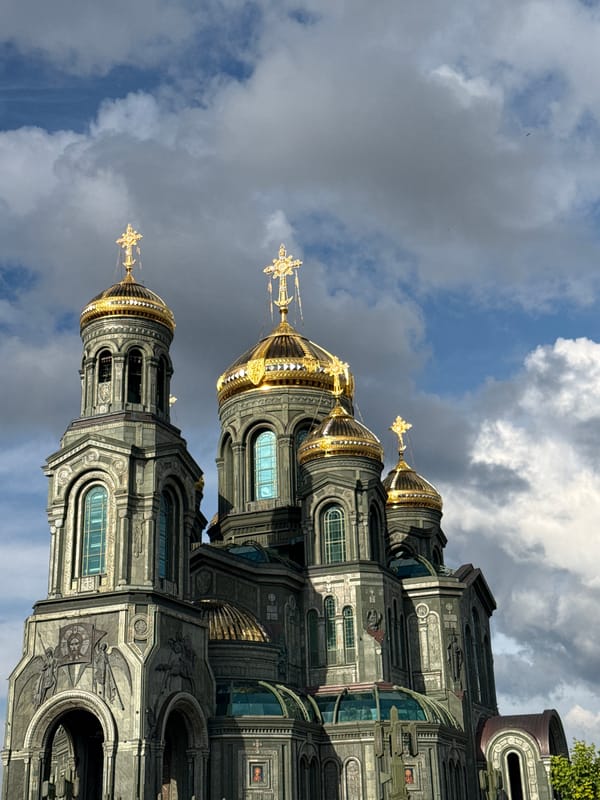
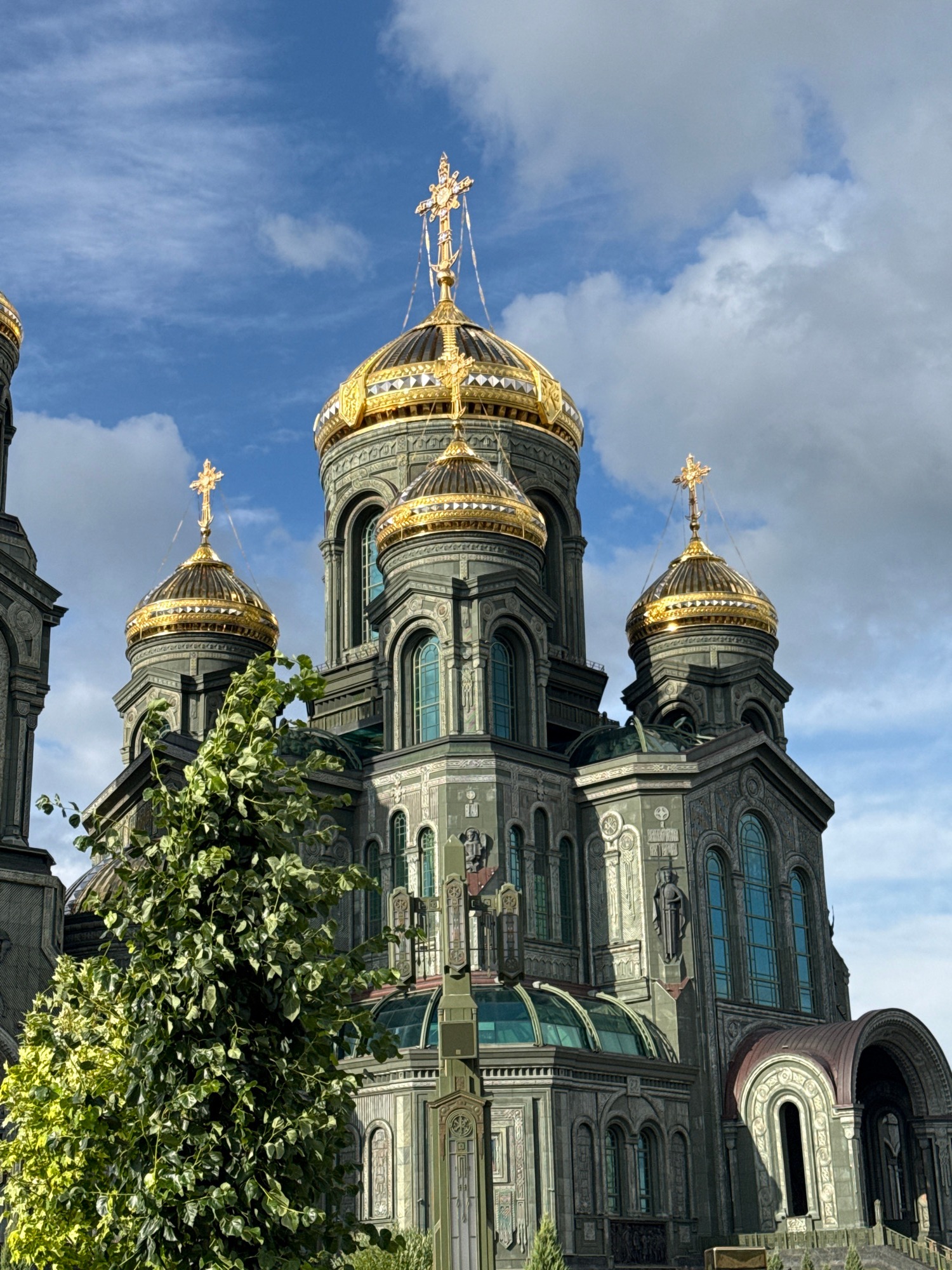
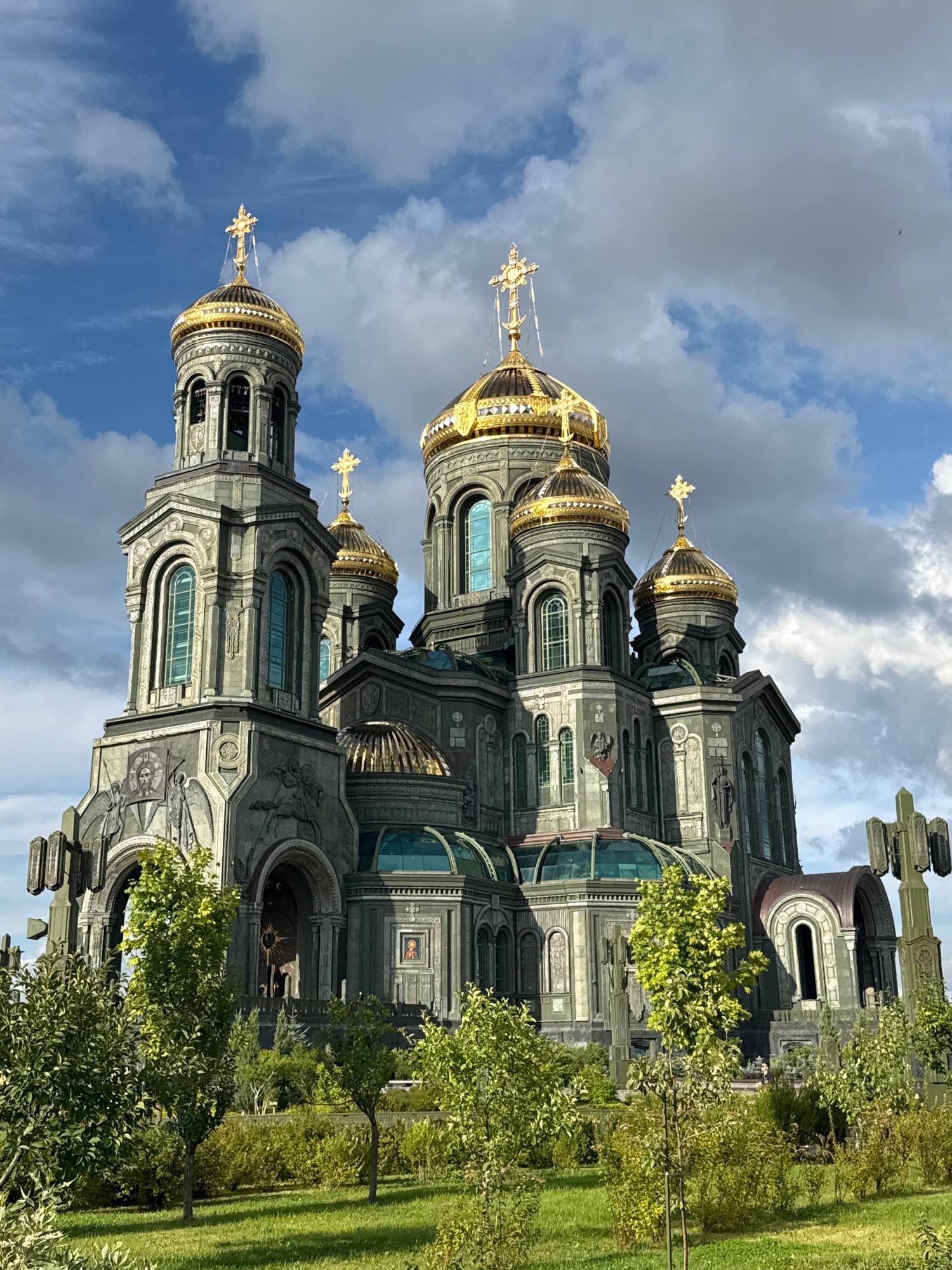
The image shows a grand, gray stone church with golden domes against a cloudy blue sky. The architecture is ornate, with intricate carvings and arched windows. Several domes are visible, each topped with a cross. The church is surrounded by lush green trees and grass, indicating an outdoor setting during daytime. The weather appears to be partly cloudy, with patches of sunlight casting shadows on the building and ground. The perspective suggests the photo was taken from a low angle, emphasizing the height and grandeur of the structure. No people are clearly visible, and there is no visible text in the image. The overall impression is one of solemnity and architectural splendor.
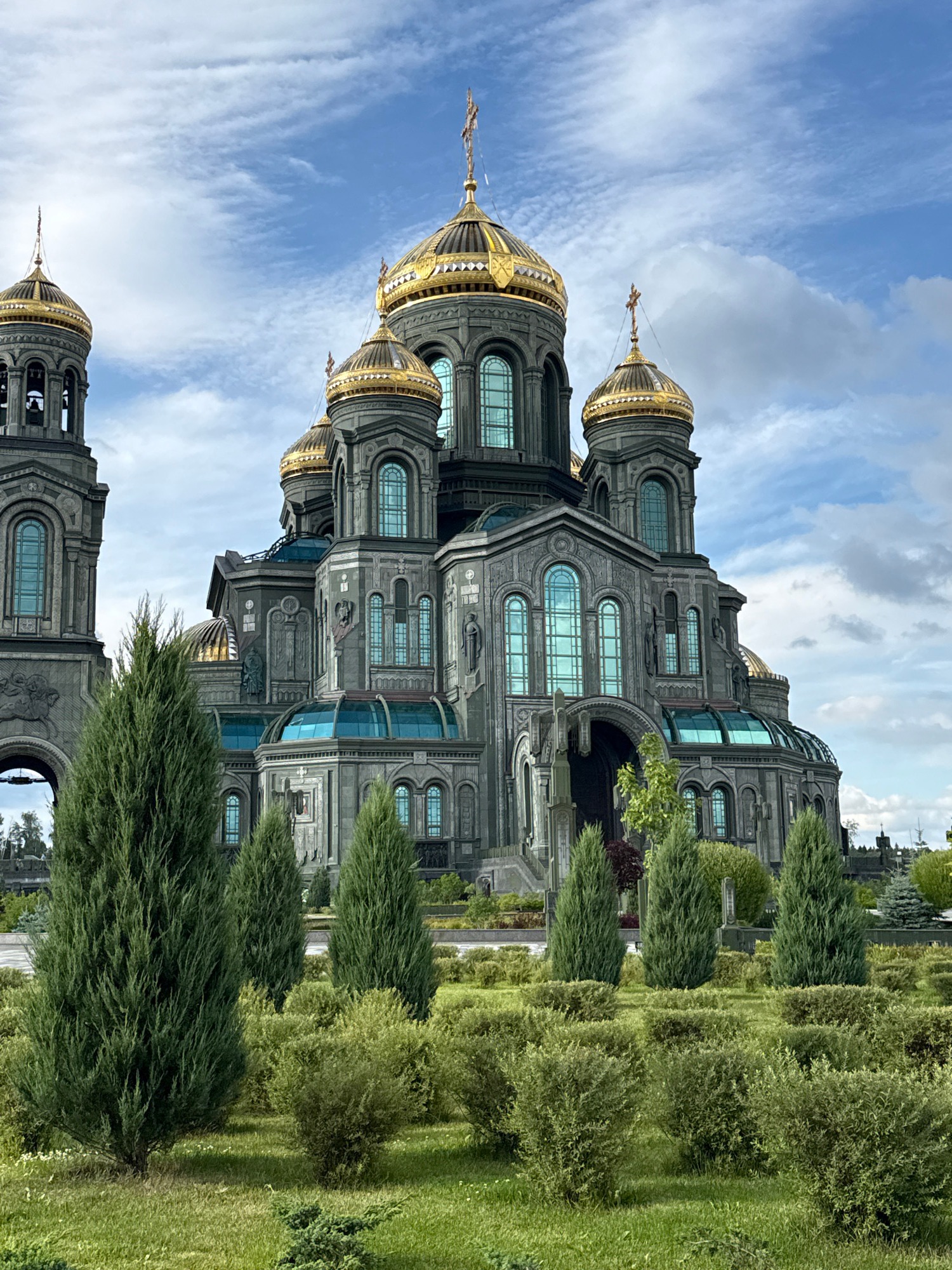
The image displays the exterior of a large, ornate religious building, likely a cathedral, with multiple gold-domed cupolas. The building is constructed from a dark, textured material, possibly stone or metal, and features numerous arched windows with aqua-colored glass, intricate carvings, and decorative architectural elements. Several prominent spires topped with crosses rise from the domes.
The building is surrounded by meticulously maintained greenery, including manicured bushes and tall evergreen trees, which are arranged in a formal garden setting. The perspective of the image is such that the building appears to be on the left and the garden on the right. The sky above is a bright blue with scattered white clouds, suggesting fair weather and daylight, likely daytime.
The scene evokes a sense of grandeur and solemnity associated with a religious site. There are no people visible in the image. The location is identified as Zelenaya Roshcha, Russia. No visible text is present in the image.
The image displays the exterior of a large, ornate religious building, likely a cathedral, with multiple gold-domed cupolas. The building is constructed from a dark, textured material, possibly stone or metal, and features numerous arched windows with aqua-colored glass, intricate carvings, and decorative architectural elements. Several prominent spires topped with crosses rise from the domes.
The building is surrounded by meticulously maintained greenery, including manicured bushes and tall evergreen trees, which are arranged in a formal garden setting. The perspective of the image is such that the building appears to be on the left and the garden on the right. The sky above is a bright blue with scattered white clouds, suggesting fair weather and daylight, likely daytime.
The scene evokes a sense of grandeur and solemnity associated with a religious site. There are no people visible in the image. The location is identified as Zelenaya Roshcha, Russia. No visible text is present in the image.
This image shows an ornate, green-hued building with gold-domed roofs and crosses, set against a blue sky with scattered clouds. The architecture is detailed, featuring intricate carvings, arched windows, and multiple levels. A lush green bush with variegated leaves partially obscures the lower portion of the building on the right side. The lighting suggests it is daytime, possibly late afternoon, with the sun casting shadows on the building's facade. The overall scene evokes a sense of grandeur and historical significance. The location context provided is Zelenaya Roshcha, Russia, which aligns with the architectural style that resembles a church or a significant public building. No people are visible, and no text is legible in the image.
This image shows an ornate, green-hued building with gold-domed roofs and crosses, set against a blue sky with scattered clouds. The architecture is detailed, featuring intricate carvings, arched windows, and multiple levels. A lush green bush with variegated leaves partially obscures the lower portion of the building on the right side. The lighting suggests it is daytime, possibly late afternoon, with the sun casting shadows on the building's facade. The overall scene evokes a sense of grandeur and historical significance. The location context provided is Zelenaya Roshcha, Russia, which aligns with the architectural style that resembles a church or a significant public building. No people are visible, and no text is legible in the image.
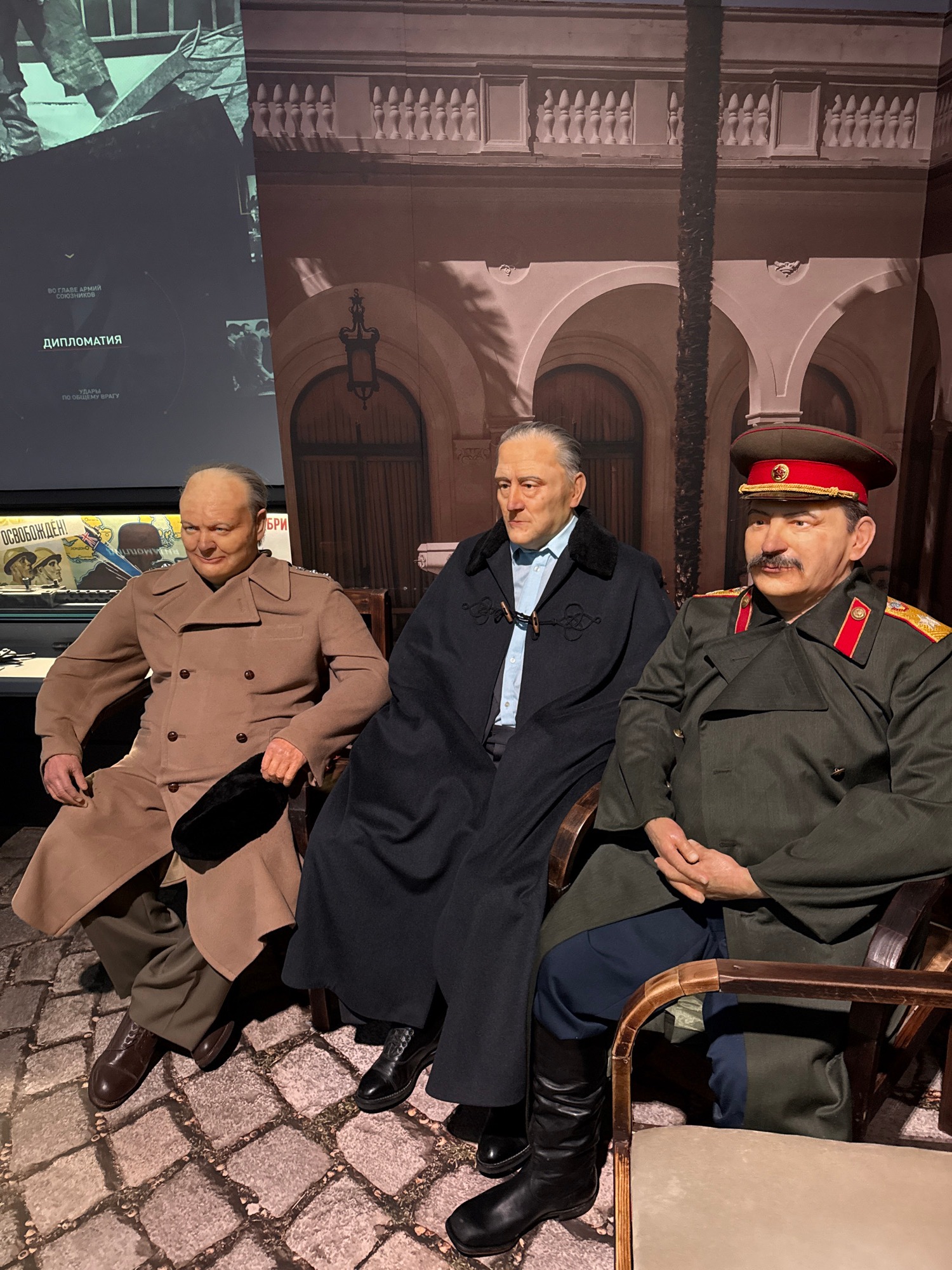
Three wax figures are seated in chairs in what appears to be a museum exhibit. The figure on the left is Winston Churchill, recognizable by his bald head and jowly face, wearing a tan trench coat and holding a black hat in his lap. The figure in the center is a man with graying hair, wearing a dark blue overcoat with fur trim over a light blue shirt. The figure on the right is Joseph Stalin, wearing a military uniform with a red cap and high black boots. He has a mustache and is depicted with his hands clasped in his lap. The figures are seated on a cobblestone-patterned floor. Behind them is a mural depicting an arched building with palm trees, and to the left, a large screen displays images and text, including "ДИПЛОМАТИЯ" (Diplomacy). The exhibit is located in the city of Zelenaya Roshcha, Russia.
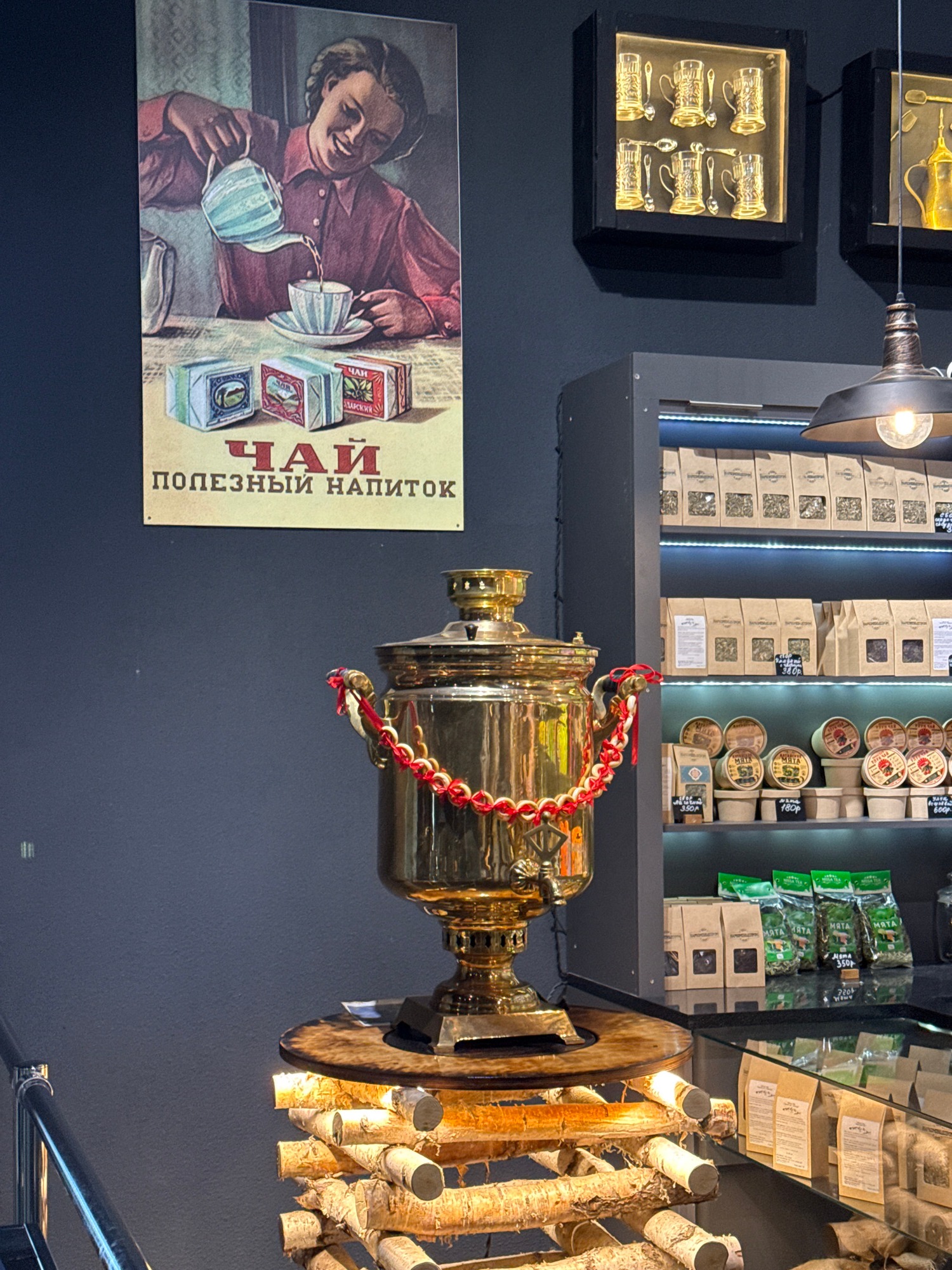
The image shows a close-up of a golden samovar, a traditional Russian tea urn, adorned with a red and white beaded chain. The samovar is the central object and is prominently displayed. To the left of the samovar, a vintage-style poster depicts a woman pouring tea from a teapot into a cup, with several tea boxes arranged beside her. The poster has Russian text that reads "ЧАЙ ПОЛЕЗНЫЙ НАПИТОК," which translates to "TEA HEALTHY DRINK."
In the background, shelves are filled with various tea packages and small jars. Some of the packages are made of brown paper, while others are clear plastic bags containing loose tea. Some jars are round and have labels with Russian text, including prices like "180р" and "350р." These items suggest a retail setting, possibly a tea shop or a market stall. A light fixture, possibly a lamp, is visible at the top of the image. The overall setting appears to be indoors, with dark grey walls. The lighting is somewhat dim, highlighting the metallic sheen of the samovar and the details of the tea products. The scene evokes a sense of tradition and the cultural significance of tea in Russia.
Three wax figures are seated in chairs in what appears to be a museum exhibit. The figure on the left is Winston Churchill, recognizable by his bald head and jowly face, wearing a tan trench coat and holding a black hat in his lap. The figure in the center is a man with graying hair, wearing a dark blue overcoat with fur trim over a light blue shirt. The figure on the right is Joseph Stalin, wearing a military uniform with a red cap and high black boots. He has a mustache and is depicted with his hands clasped in his lap. The figures are seated on a cobblestone-patterned floor. Behind them is a mural depicting an arched building with palm trees, and to the left, a large screen displays images and text, including "ДИПЛОМАТИЯ" (Diplomacy). The exhibit is located in the city of Zelenaya Roshcha, Russia.
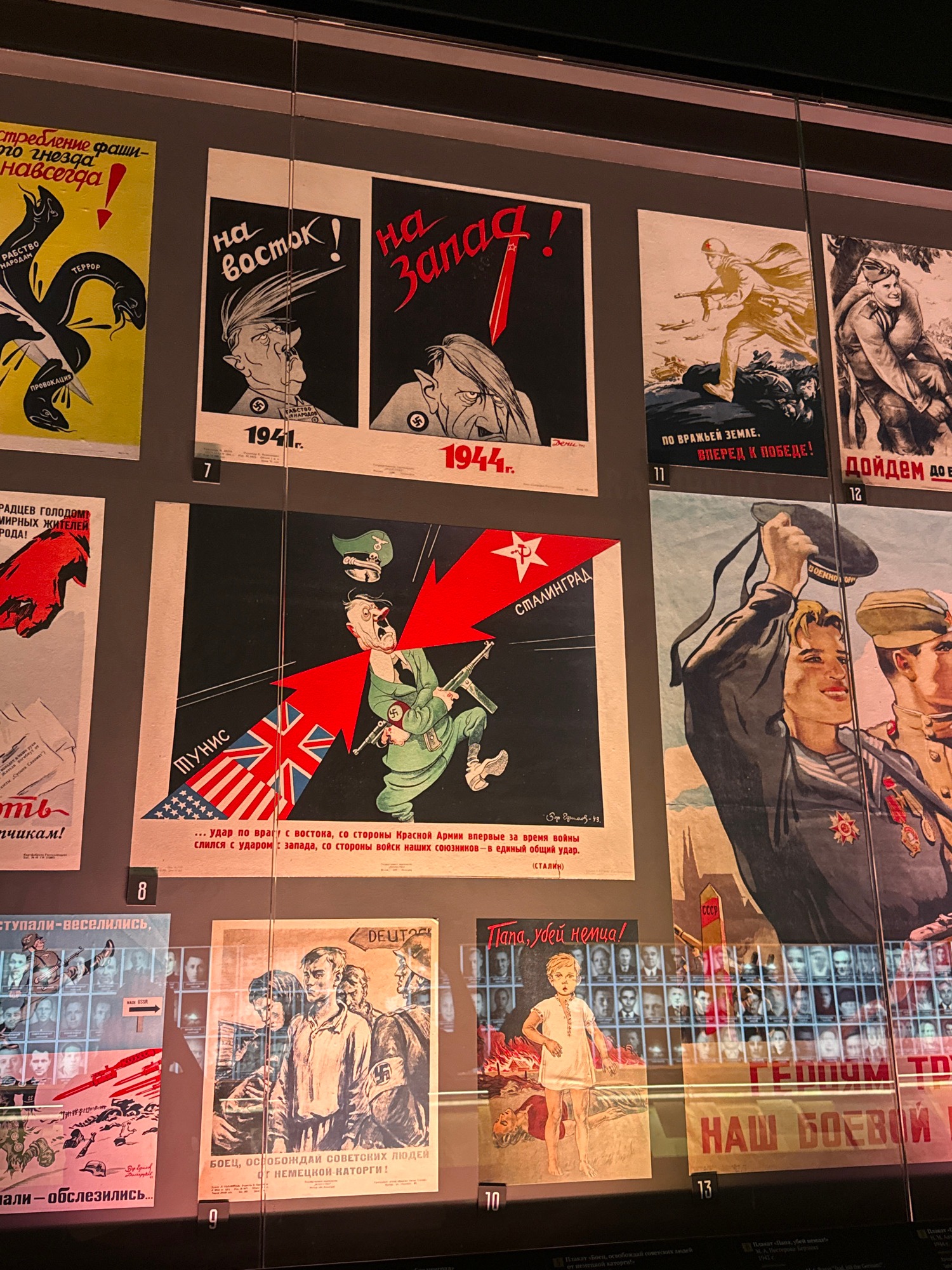
This media file shows a display of Soviet propaganda posters from World War II, likely in a museum or exhibition. The posters are arranged in a grid-like fashion, some overlapping, on a dark background.
The subjects vary across the posters. Several depict soldiers in military uniforms, including some in Soviet Red Army attire and others in what appears to be German Wehrmacht uniforms, some of which are being depicted as defeated or in distress. There are also images of civilians, including women and children, and in one poster, a baby being held by an adult. Objects include rifles, flags (Soviet and British Union Jack), and military medals.
The posters are designed to evoke strong emotions and convey messages related to the war effort. Some titles, such as "Папа, убей немца!" (Dad, kill the German!) and "На Восток! На Запад!" (To the East! To the West!), suggest themes of aggression, patriotic duty, and a call to action against the enemy. Other posters focus on liberation and victory, with titles like "Наш боевой" (Our combat) and references to defeating the enemy on foreign soil.
Several notable details are visible. The posters are dated, with some marked "1941г." and others "1944г.". The text is primarily in Russian, with some German words like "DEUTSCH" and swastikas also visible on some of the depicted enemy uniforms. The lighting suggests an indoor setting, with the display illuminated to highlight the artwork. Some of the posters have been overlaid with thin wires, possibly for protection or display purposes. The overall tone conveyed by the posters is one of determination, resistance, and a clear us-versus-them narrative characteristic of wartime propaganda.
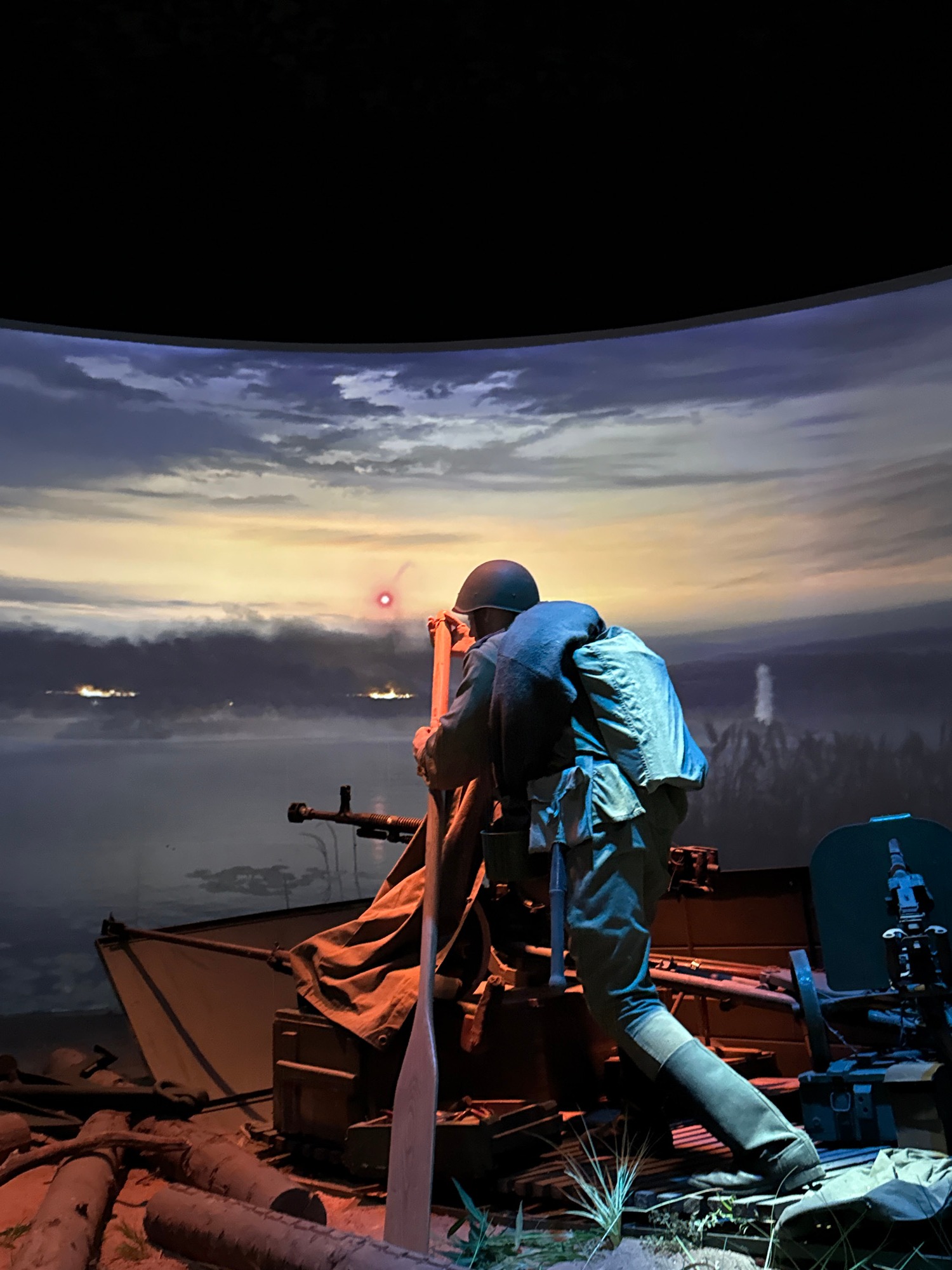
This is a medium shot of a diorama, likely a museum exhibit, depicting a military scene at dusk or dawn. In the foreground, a mannequin dressed in military attire, including a helmet, uniform, and backpack, is positioned behind a machine gun. The mannequin is hunched over, appearing to aim the weapon. The machine gun is mounted on a wooden structure and partially covered by a canvas tarp. In the background, a panoramic painted backdrop simulates a body of water with distant lights and a sky transitioning from dark to a warm, hazy light, possibly representing the sun. The overall scene evokes a wartime setting, possibly related to coastal defense or naval warfare. The scene is likely located in the city of Zelenaya Roshcha, Russia, given its specific location within the city.
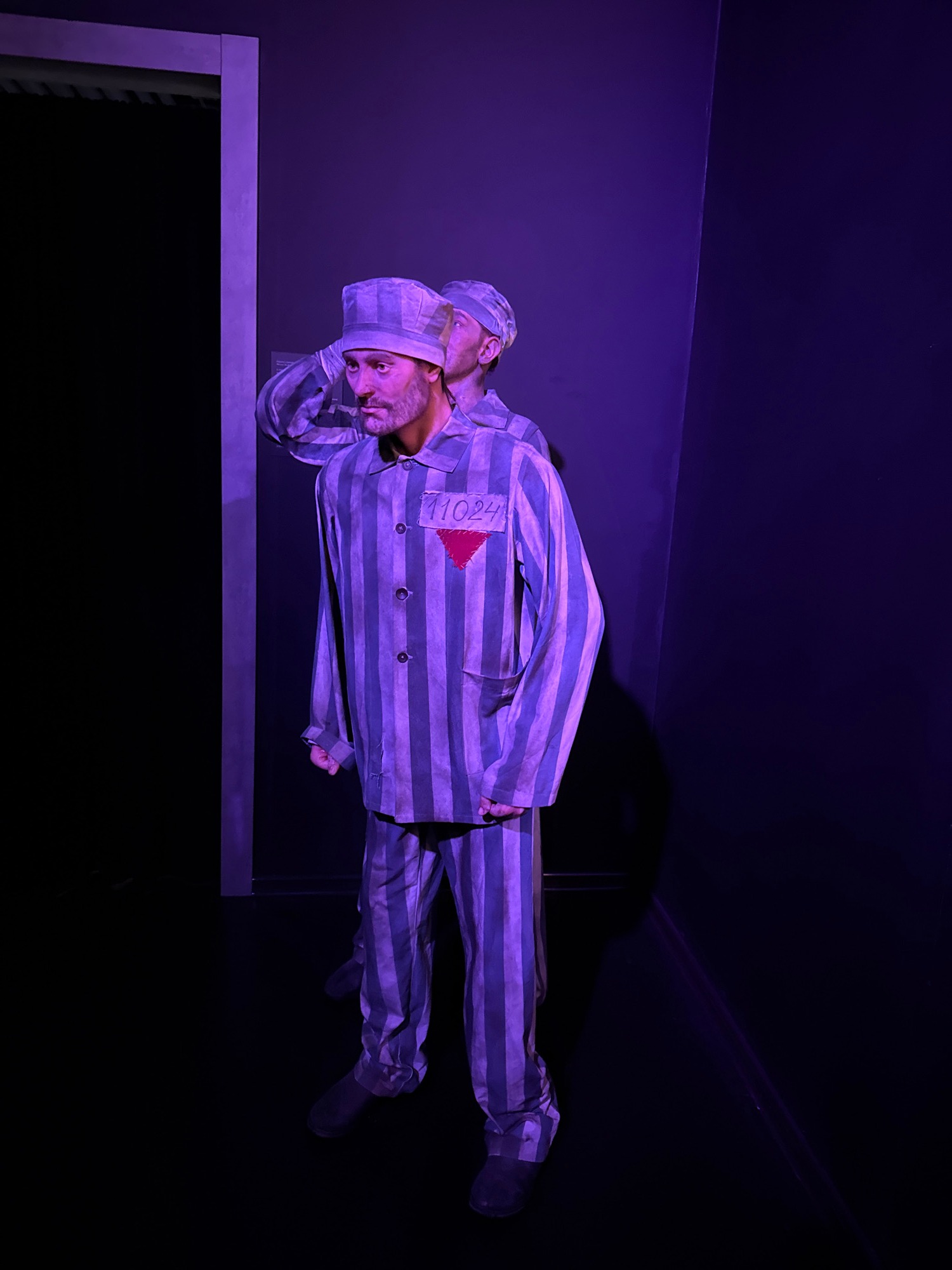
This is a photograph of two people on a stage, illuminated by purple light against a dark background. The two individuals are dressed in striped prison uniforms, consisting of a jacket and pants, and head coverings. One person is positioned in the foreground, lying on their back, with their head slightly raised. They have a beard and appear to be looking upwards. The other person is behind and above the first, their body also clad in a striped uniform, with their head resting on the chest of the person in front.
A prominent detail on the jacket of the person in the foreground is a red triangle with the number "11024" written in white. The clothing is loose-fitting and appears to be made of a coarse fabric. The setting suggests a theatrical performance or reenactment, possibly depicting a historical event or a scene of imprisonment. The lighting creates a dramatic and somber mood. The backdrop is dark, with some abstract light patterns visible in the upper right portion of the image, possibly from stage lighting. There are no obvious cues regarding time of day or weather, as the scene is indoors and artificially lit. The emotion conveyed is one of solemnity and perhaps despair. The visible text is "11024".
The image shows a close-up of a golden samovar, a traditional Russian tea urn, adorned with a red and white beaded chain. The samovar is the central object and is prominently displayed. To the left of the samovar, a vintage-style poster depicts a woman pouring tea from a teapot into a cup, with several tea boxes arranged beside her. The poster has Russian text that reads "ЧАЙ ПОЛЕЗНЫЙ НАПИТОК," which translates to "TEA HEALTHY DRINK."
In the background, shelves are filled with various tea packages and small jars. Some of the packages are made of brown paper, while others are clear plastic bags containing loose tea. Some jars are round and have labels with Russian text, including prices like "180р" and "350р." These items suggest a retail setting, possibly a tea shop or a market stall. A light fixture, possibly a lamp, is visible at the top of the image. The overall setting appears to be indoors, with dark grey walls. The lighting is somewhat dim, highlighting the metallic sheen of the samovar and the details of the tea products. The scene evokes a sense of tradition and the cultural significance of tea in Russia.
This media file shows a display of Soviet propaganda posters from World War II, likely in a museum or exhibition. The posters are arranged in a grid-like fashion, some overlapping, on a dark background.
The subjects vary across the posters. Several depict soldiers in military uniforms, including some in Soviet Red Army attire and others in what appears to be German Wehrmacht uniforms, some of which are being depicted as defeated or in distress. There are also images of civilians, including women and children, and in one poster, a baby being held by an adult. Objects include rifles, flags (Soviet and British Union Jack), and military medals.
The posters are designed to evoke strong emotions and convey messages related to the war effort. Some titles, such as "Папа, убей немца!" (Dad, kill the German!) and "На Восток! На Запад!" (To the East! To the West!), suggest themes of aggression, patriotic duty, and a call to action against the enemy. Other posters focus on liberation and victory, with titles like "Наш боевой" (Our combat) and references to defeating the enemy on foreign soil.
Several notable details are visible. The posters are dated, with some marked "1941г." and others "1944г.". The text is primarily in Russian, with some German words like "DEUTSCH" and swastikas also visible on some of the depicted enemy uniforms. The lighting suggests an indoor setting, with the display illuminated to highlight the artwork. Some of the posters have been overlaid with thin wires, possibly for protection or display purposes. The overall tone conveyed by the posters is one of determination, resistance, and a clear us-versus-them narrative characteristic of wartime propaganda.
 Zelenaya Roshcha, Russia