Anatomy in Moscow: Exploring the Human Form

Wednesday, March 25, 2026 · Updated Wednesday, March 25, 2026
In the educational institutions of Moscow, the rigorous pursuit of medical knowledge comes to life through the dedicated study of human anatomy. Far from being a dry academic exercise, the learning environment is dynamic, blending traditional anatomical models with advanced interactive technologies. This immersive approach allows students to gain a profound understanding of the human form, preparing them for the complexities of healthcare.

An anatomical teaching environment is depicted, likely in Moscow, Russia, given the Russian text on the visible objects. In the foreground, a multi-colored anatomical model of a human torso is displayed, cut sagittally to reveal organs including the liver, stomach, intestines, heart, and lungs, with various parts numbered. This model stands on a white rectangular base labeled with "41012450424/10-5" and "Модель мини-торс человека" (Human mini-torso model) in Cyrillic script. To the left, on a white desk surface, a black smartphone and a blue pen are present. In the blurred background, a full human skeleton model stands erect against a light grey wall, which also features a white electrical outlet.

w7kiss
Moscow, Russia · Mar 25, 2026, 4:44 PM · 0.3k attention
One vivid scene captures the intimate, hands-on nature of this education: a young adult female, dressed in a white lab coat, embraces a full anatomical human skeleton model. Her expression, marked by a playful smile and a distinctive bifid tongue, humanizes the otherwise stark subject of study. With a black smartwatch on her left wrist and a tattoo partially visible, she represents a modern student engaging deeply with foundational scientific concepts. Her interaction with the skeleton, her left arm wrapped around its torso and right hand supporting its upper arm, underscores the direct engagement required in anatomical learning.
A female individual, viewed in profile, is depicted indoors interacting with a full-body anatomical skeleton model. She has long, wavy, medium-brown hair and is wearing a white lab coat over a dark garment. Her lips are pursed, touching the left temporal region of the skeleton's skull, while her right hand gently supports the posterior neck/skull area of the model. A ring is visible on her right middle finger. The skeleton, an off-white plastic anatomical model with visible metallic joint articulation pins, stands upright. The background consists of light gray walls. On the left, a white electrical conduit or power strip is mounted horizontally on the wall, featuring multiple "220 B" electrical outlets, one of which is occupied by a black plug and cable. The "220 B" marking on the outlets is consistent with electrical standards found in Moscow, Russia. The setting appears to be a classroom, laboratory, or medical education facility.
w7kiss
Moscow, Russia · Mar 25, 2026, 4:42 PM

Further illustrating this tactile approach, another memory shows a female individual in profile, also wearing a white lab coat, gently touching the skull of a full-body anatomical skeleton model with her lips, her right hand supporting its neck. The skeleton itself, an off-white plastic model with visible metallic joint pins, stands upright against a light gray wall. The presence of "220 B" electrical outlets, consistent with Russian standards, subtly grounds the scene in its Moscow location, suggesting a classroom or laboratory setting.
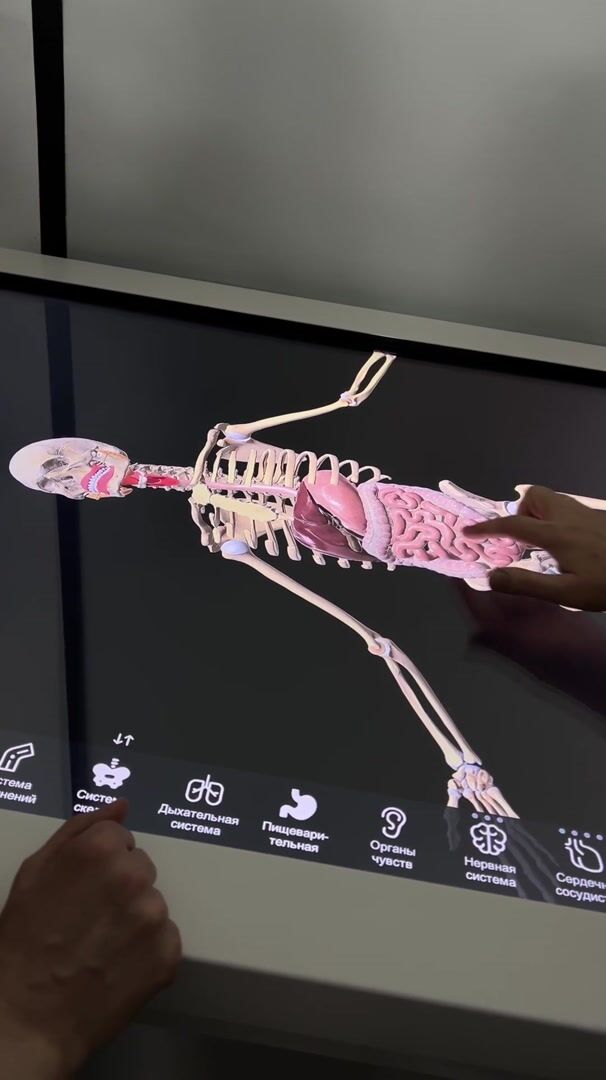
The video shows a close-up of a large interactive touchscreen display showcasing a 3D anatomical model of a human body. The model is primarily a skeleton, with various internal organs visible within the rib cage and abdominal cavity. The skeleton is oriented horizontally on a dark background, slightly angled as if viewed from above and to the side. A hand is visible in the lower left portion of the screen, interacting with the touch interface. The hand first points to an icon at the bottom of the screen. The lower part of the screen displays several icons representing different bodily systems, with their names in Cyrillic text. These include "Системы скелета" (Skeletal systems), "Дыхательная система" (Respiratory system), "Пищеварительная" (Digestive), "Органы чувств" (Sense organs), "Нервная система" (Nervous system), and "Сердечно-сосудистая" (Cardiovascular system). As the video progresses, the hand taps on an icon (likely related to the digestive system, though not fully visible). Subsequently, the small intestine within the 3D model is highlighted in a distinct blue color. A label appears near the highlighted organ, reading "Тонкая кишка (intestinum tenue)," which translates to "Small intestine." Following this, a pop-up window appears on the right side of the screen, containing descriptive text about the small intestine. Portions of the text are visible, including words like "относится," "грудного," "брюшной," "нервами," and "superior." The interaction demonstrates how the user can select and retrieve information about specific anatomical structures.
w7kiss
Moskva, Russia · Mar 25, 2026, 4:43 PM
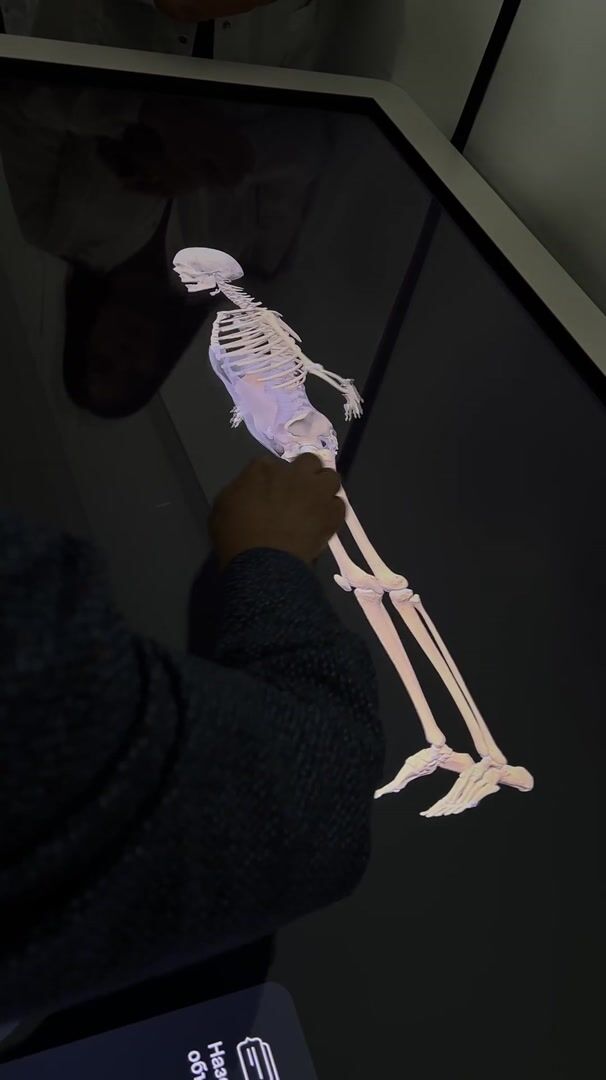
A man in a dark blue patterned blazer is using a touchscreen to manipulate a 3D rendering of a human skeleton. The skeleton, displayed against a dark background, is posed with its arms and legs spread. A translucent blue layer is visible over the abdominal area. The man's hand, adorned with a ring, is touching the screen, seemingly adjusting the skeleton's position. A second person in a white coat is reflected in the screen. The touchscreen is bordered by a white frame.
The educational experience is augmented by cutting-edge technology. A man in a dark blue patterned blazer is seen using a touchscreen to manipulate a 3D rendering of a human skeleton, displayed against a dark background. A translucent blue layer over the abdominal area suggests the exploration of organ systems. His ringed hand interacts with the screen, adjusting the skeleton's position, while a second person in a white coat is reflected in the display, highlighting collaborative learning.
Moreover, a close-up video reveals a large interactive touchscreen showcasing a detailed 3D anatomical model. The screen displays icons in Cyrillic for various bodily systems—skeletal, respiratory, digestive, sense organs, nervous, and cardiovascular. A hand taps an icon, leading to the small intestine being highlighted in blue, accompanied by a Cyrillic label and descriptive text. This blend of traditional models and interactive digital learning epitomizes the comprehensive and engaging approach to anatomical education in Moscow.
In an indoor setting within Moscow, Russia, a young adult female is shown embracing a full anatomical human skeleton model. The female has long, light brown hair and is dressed in a white lab coat over a dark-colored top. She displays a nose ring and a distinct bifid (split) tongue, which she extends playfully while looking upwards and to her right with a broad smile. A black smartwatch is worn on her left wrist, and a tattoo is partially visible on her left forearm. Her left arm is wrapped around the skeleton's torso, and her right hand holds its upper arm. The skeleton model is light-colored, constructed from a plastic-like material, and features a complete skull, rib cage, and spinal column. The background is a plain, light-colored wall, consistent with a laboratory or educational environment.
An anatomical teaching environment is depicted, likely in Moscow, Russia, given the Russian text on the visible objects. In the foreground, a multi-colored anatomical model of a human torso is displayed, cut sagittally to reveal organs including the liver, stomach, intestines, heart, and lungs, with various parts numbered. This model stands on a white rectangular base labeled with "41012450424/10-5" and "Модель мини-торс человека" (Human mini-torso model) in Cyrillic script. To the left, on a white desk surface, a black smartphone and a blue pen are present. In the blurred background, a full human skeleton model stands erect against a light grey wall, which also features a white electrical outlet.
A female individual, viewed in profile, is depicted indoors interacting with a full-body anatomical skeleton model. She has long, wavy, medium-brown hair and is wearing a white lab coat over a dark garment. Her lips are pursed, touching the left temporal region of the skeleton's skull, while her right hand gently supports the posterior neck/skull area of the model. A ring is visible on her right middle finger. The skeleton, an off-white plastic anatomical model with visible metallic joint articulation pins, stands upright. The background consists of light gray walls. On the left, a white electrical conduit or power strip is mounted horizontally on the wall, featuring multiple "220 B" electrical outlets, one of which is occupied by a black plug and cable. The "220 B" marking on the outlets is consistent with electrical standards found in Moscow, Russia. The setting appears to be a classroom, laboratory, or medical education facility.
The video shows a close-up of a large interactive touchscreen display showcasing a 3D anatomical model of a human body. The model is primarily a skeleton, with various internal organs visible within the rib cage and abdominal cavity. The skeleton is oriented horizontally on a dark background, slightly angled as if viewed from above and to the side. A hand is visible in the lower left portion of the screen, interacting with the touch interface. The hand first points to an icon at the bottom of the screen. The lower part of the screen displays several icons representing different bodily systems, with their names in Cyrillic text. These include "Системы скелета" (Skeletal systems), "Дыхательная система" (Respiratory system), "Пищеварительная" (Digestive), "Органы чувств" (Sense organs), "Нервная система" (Nervous system), and "Сердечно-сосудистая" (Cardiovascular system). As the video progresses, the hand taps on an icon (likely related to the digestive system, though not fully visible). Subsequently, the small intestine within the 3D model is highlighted in a distinct blue color. A label appears near the highlighted organ, reading "Тонкая кишка (intestinum tenue)," which translates to "Small intestine." Following this, a pop-up window appears on the right side of the screen, containing descriptive text about the small intestine. Portions of the text are visible, including words like "относится," "грудного," "брюшной," "нервами," and "superior." The interaction demonstrates how the user can select and retrieve information about specific anatomical structures.
A man in a dark blue patterned blazer is using a touchscreen to manipulate a 3D rendering of a human skeleton. The skeleton, displayed against a dark background, is posed with its arms and legs spread. A translucent blue layer is visible over the abdominal area. The man's hand, adorned with a ring, is touching the screen, seemingly adjusting the skeleton's position. A second person in a white coat is reflected in the screen. The touchscreen is bordered by a white frame.