Wednesday, June 3, 2026 · Updated Wednesday, June 3, 2026
Riga, Latvia
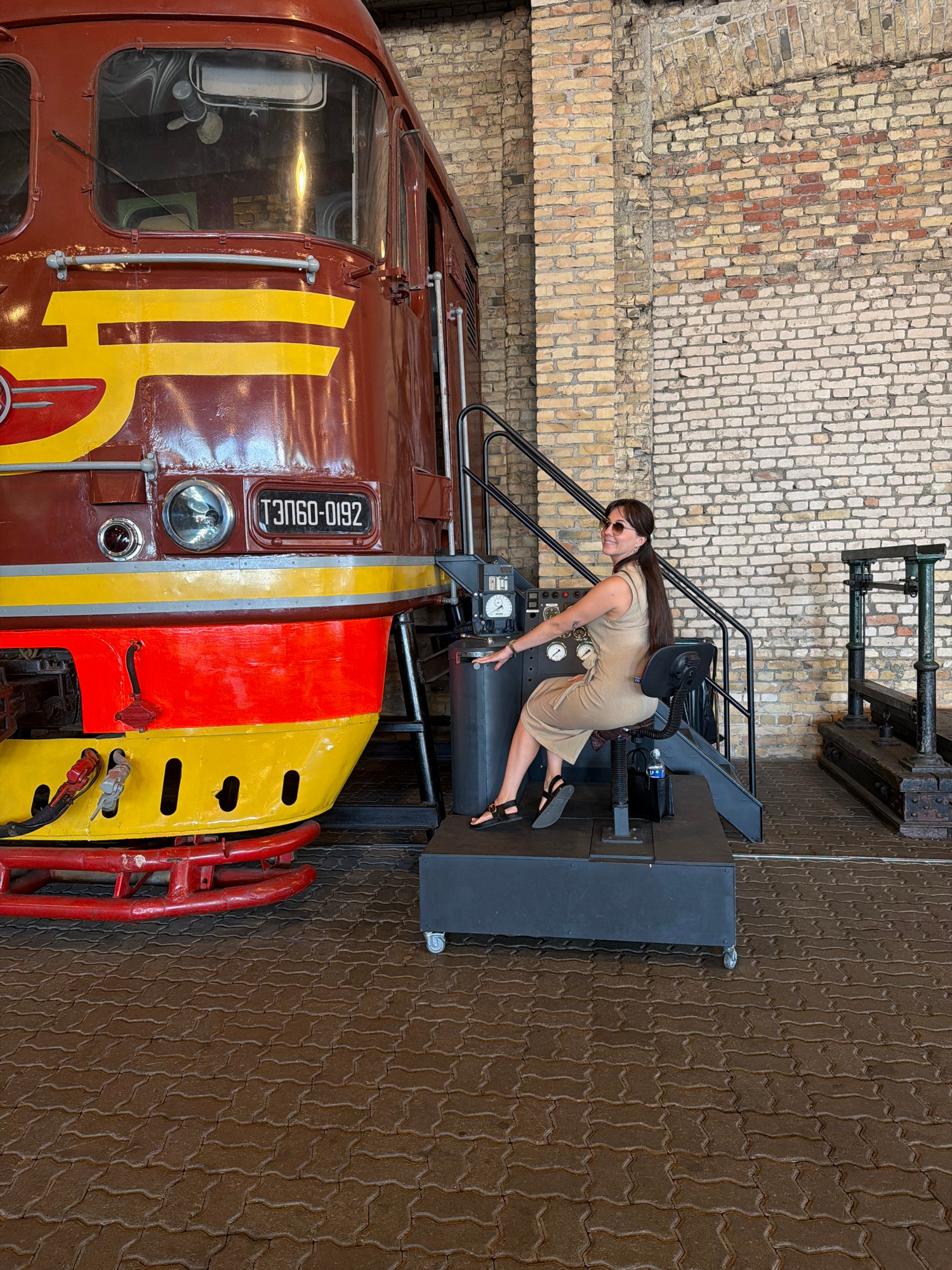
A woman is captured interacting with a train locomotive or simulator in an indoor setting. The image, presented vertically, depicts the scene as if the woman is centrally placed, leaning over a control panel, with the train's front to her left, brick walls behind, and paved ground below.
The subject is a woman with long, dark hair, wearing sunglasses, a beige sleeveless dress, and dark sandals, carrying a black shoulder bag. She is leaning forward over a dark control panel, her left knee bent on the platform, and is looking towards the camera with a slight smile, indicating she is posing or enjoying the experience of operating the machinery.
The train itself is a reddish-brown locomotive, featuring bold yellow and red sections on its front. A prominent white plate on its side displays the alphanumeric designation "T3H60-0192." The control panel she is using, equipped with gauges and levers, is part of a dark, robust structure with handrails, resembling a train's cabin or a detailed simulator.
The background consists of brick walls exhibiting diverse patterns and shades, including beige, white, and patches of red bricks, suggesting an old industrial building or museum environment. The floor is covered with dark brown, interlocking pavers. The lighting is diffused and even, consistent with an interior space or a covered outdoor area during daytime. The scene likely takes place at a railway museum or similar exhibition in Riga, Latvia, highlighting vintage transportation.
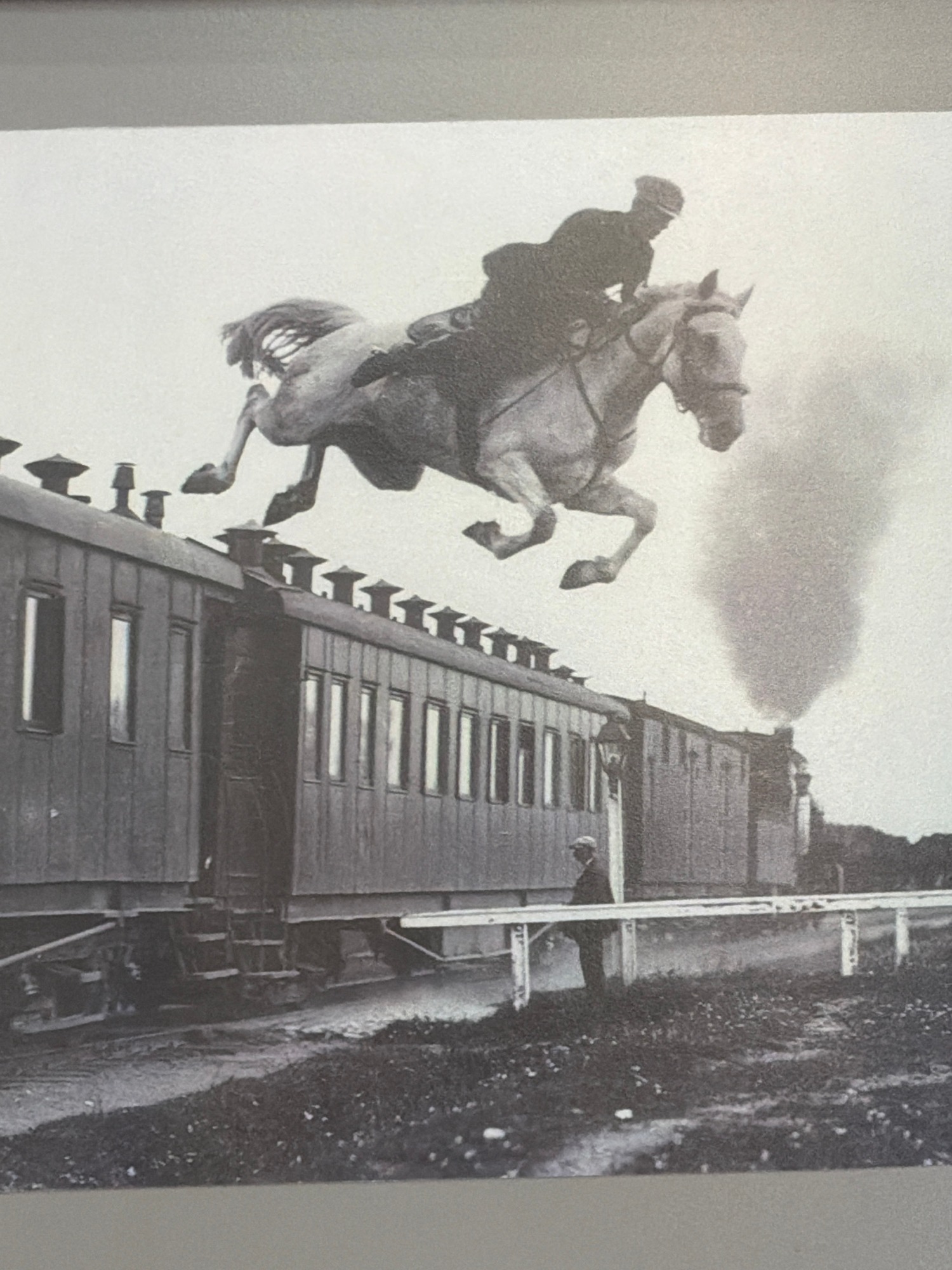
This black and white photograph captures a dramatic scene, juxtaposing a powerful equestrian statue with a moving steam train.
On the left side of the frame, a monumental equestrian statue stands prominently. The horse is rearing dynamically on its hind legs, conveying a sense of energy and triumph. A rider, likely a historical figure, is depicted astride the horse, wearing a uniform and a peaked cap, though specific details of their face are not clearly discernible.
To the right, a long steam train occupies the mid-ground and background. A powerful steam locomotive is visible, emitting a large, dense plume of smoke that billows into the sky. Behind the locomotive, several passenger cars or carriages stretch along the railway tracks. A lone figure is visible standing on the side of one of the train cars, possibly a conductor or railway worker, appearing to look outwards. The train tracks run horizontally through the image, paralleled by a dark, textured area that suggests a body of water, a ditch, or rough terrain, with some sparse vegetation.
The image creates a striking contrast between the static, heroic grandeur of the equestrian monument and the dynamic, industrial power of the moving train. Given the context of Riga, Latvia, the statue likely commemorates a significant historical person or event. The overall atmosphere is one of historical significance meeting technological advancement. No text is visible in the image.
Riga, Latvia · Jun 3, 2026, 10:59 AM · 7.7k attention
This black and white photograph captures a dramatic scene, juxtaposing a powerful equestrian statue with a moving steam train.
On the left side of the frame, a monumental equestrian statue stands prominently. The horse is rearing dynamically on its hind legs, conveying a sense of energy and triumph. A rider, likely a historical figure, is depicted astride the horse, wearing a uniform and a peaked cap, though specific details of their face are not clearly discernible.
To the right, a long steam train occupies the mid-ground and background. A powerful steam locomotive is visible, emitting a large, dense plume of smoke that billows into the sky. Behind the locomotive, several passenger cars or carriages stretch along the railway tracks. A lone figure is visible standing on the side of one of the train cars, possibly a conductor or railway worker, appearing to look outwards. The train tracks run horizontally through the image, paralleled by a dark, textured area that suggests a body of water, a ditch, or rough terrain, with some sparse vegetation.
The image creates a striking contrast between the static, heroic grandeur of the equestrian monument and the dynamic, industrial power of the moving train. Given the context of Riga, Latvia, the statue likely commemorates a significant historical person or event. The overall atmosphere is one of historical significance meeting technological advancement. No text is visible in the image.
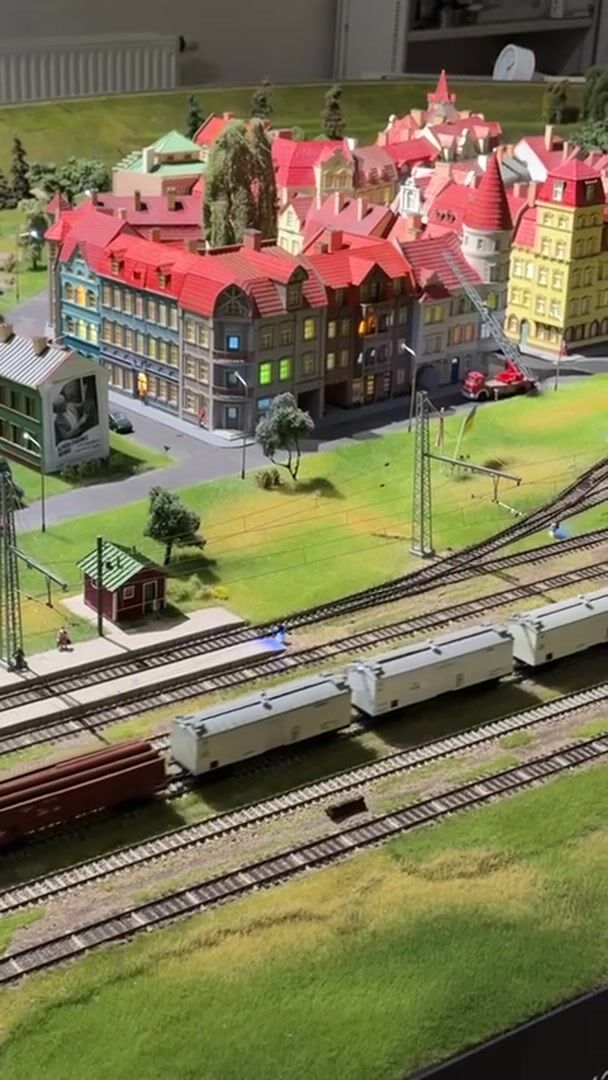
This video captures a detailed model train layout, showcasing a miniature town or city scene. A model train, consisting of several freight cars (including light-colored boxcars and darker open-top cars with logs), moves from left to right across multiple tracks in the foreground.
The background features an array of miniature buildings with vibrant red roofs, including multi-story apartment buildings with illuminated windows, a smaller green-roofed station house next to the tracks, and other structures. Miniature trees and streetlights are scattered throughout the landscape, which is predominantly green with grassy areas. Overhead power lines (catenary) span across the tracks. A miniature fire truck with a ladder is visible near one of the larger buildings on the right. On the far left, a miniature billboard with an image of a person's face is displayed. The illuminated windows in the buildings suggest an evening or nighttime setting for the model. While the location context is Riga, Latvia, the video depicts a detailed model train layout rather than a real-world scene of the city.
Riga, Latvia · Jun 3, 2026, 10:30 AM · 7.5k attention
This video captures a detailed model train layout, showcasing a miniature town or city scene. A model train, consisting of several freight cars (including light-colored boxcars and darker open-top cars with logs), moves from left to right across multiple tracks in the foreground.
The background features an array of miniature buildings with vibrant red roofs, including multi-story apartment buildings with illuminated windows, a smaller green-roofed station house next to the tracks, and other structures. Miniature trees and streetlights are scattered throughout the landscape, which is predominantly green with grassy areas. Overhead power lines (catenary) span across the tracks. A miniature fire truck with a ladder is visible near one of the larger buildings on the right. On the far left, a miniature billboard with an image of a person's face is displayed. The illuminated windows in the buildings suggest an evening or nighttime setting for the model. While the location context is Riga, Latvia, the video depicts a detailed model train layout rather than a real-world scene of the city.
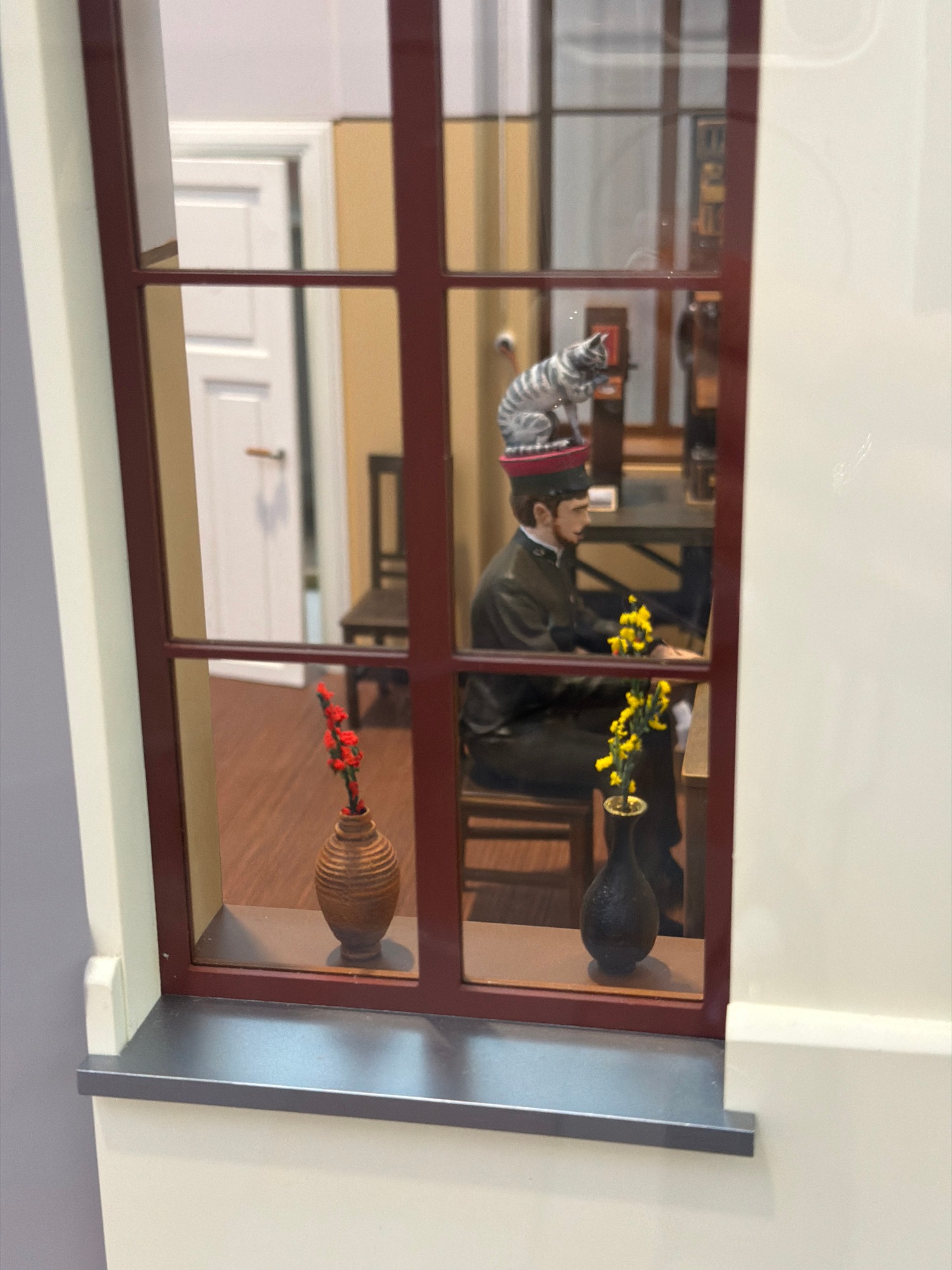
The image displays a close-up view through a multi-paned window, revealing a miniature diorama or display inside. The window frame is made of dark brown wood, dividing the view into several sections.
Within the miniature scene, a male figurine is seated at a table. He is dressed in a dark uniform with a prominent red and black cap. A striped tabby cat figurine is perched on his shoulder, looking upwards with its mouth open, suggesting interaction or a vocalization. On the table, two vases are visible: a sleek black vase containing bright yellow flowers, and a textured, light brown wooden vase holding red flowers or berries. In the background of the miniature room, additional furniture like chairs and tables can be discerned. Through the lower sections of the window, a white door with dark hardware is visible, possibly a reflection or part of the background of the display.
The window is set into a light-colored wall, and a grey, metallic-like vertical trim or sill is present on the right side of the frame. The overall impression is that of a meticulously crafted static display, possibly from a museum, art installation, or shop window, providing a glimpse into a fictional or historical moment. No visible text is present in the image.
Riga, Latvia · Jun 3, 2026, 10:43 AM · 5.9k attention
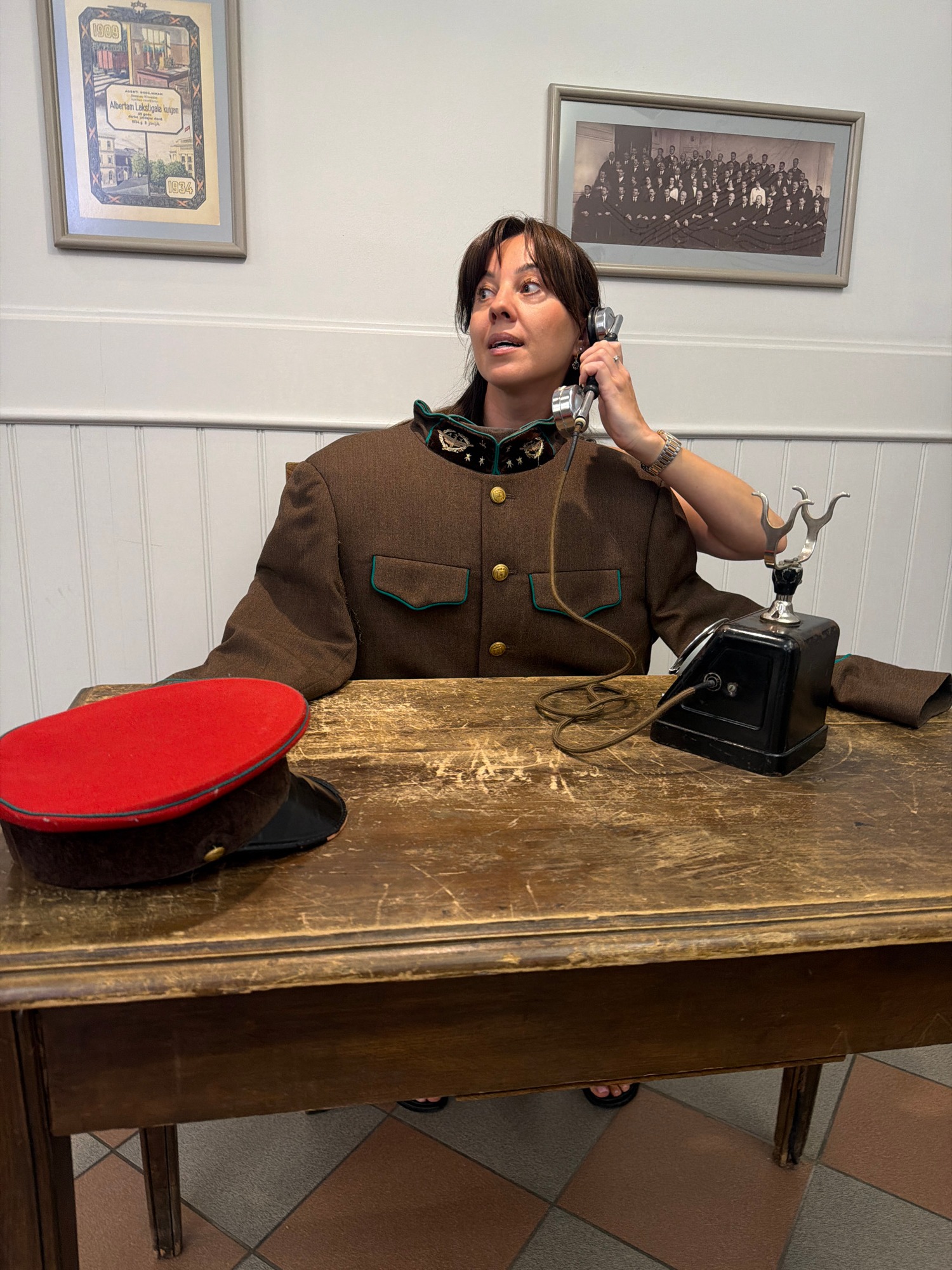
A candid, medium shot, taken from a slightly low angle, shows a woman in what appears to be a historical or military-style uniform, engaging with an antique telephone set inside a room. The image is rotated 90 degrees clockwise, placing the woman and desk vertically.
The woman, with dark brown hair and bangs, is wearing a brown uniform jacket with gold buttons and intricate green trim on the collar and cuffs. She holds an old-fashioned telephone receiver to her left ear with her right hand, which wears a silver watch. Her mouth is slightly open, suggesting she is speaking or reacting to something heard.
She is positioned behind a sturdy, distressed wooden desk. On the desk, next to her, is a black, antique box telephone with a crank. A dark hat with a prominent red brim and a gold accent is also on the desk.
The background features a white wall with wainscoting. Two framed pictures hang on the wall. The upper picture is a vintage black-and-white group photo of numerous men in formal attire. The lower picture is a more ornate framed document, possibly a certificate or advertisement, with text partly visible: "1909 Albertam Labatkopja Kupona 1934". The floor is tiled with a pattern of light and dark brown squares. A foot in a black sandal is visible beneath the desk.
The scene suggests a historical recreation or museum exhibit, possibly in Riga, Latvia, given the context. The lighting is bright and even, indicating an indoor daytime setting.
Riga, Latvia · Jun 3, 2026, 10:48 AM · 5.7k attention
The image displays a close-up view through a multi-paned window, revealing a miniature diorama or display inside. The window frame is made of dark brown wood, dividing the view into several sections.
Within the miniature scene, a male figurine is seated at a table. He is dressed in a dark uniform with a prominent red and black cap. A striped tabby cat figurine is perched on his shoulder, looking upwards with its mouth open, suggesting interaction or a vocalization. On the table, two vases are visible: a sleek black vase containing bright yellow flowers, and a textured, light brown wooden vase holding red flowers or berries. In the background of the miniature room, additional furniture like chairs and tables can be discerned. Through the lower sections of the window, a white door with dark hardware is visible, possibly a reflection or part of the background of the display.
The window is set into a light-colored wall, and a grey, metallic-like vertical trim or sill is present on the right side of the frame. The overall impression is that of a meticulously crafted static display, possibly from a museum, art installation, or shop window, providing a glimpse into a fictional or historical moment. No visible text is present in the image.
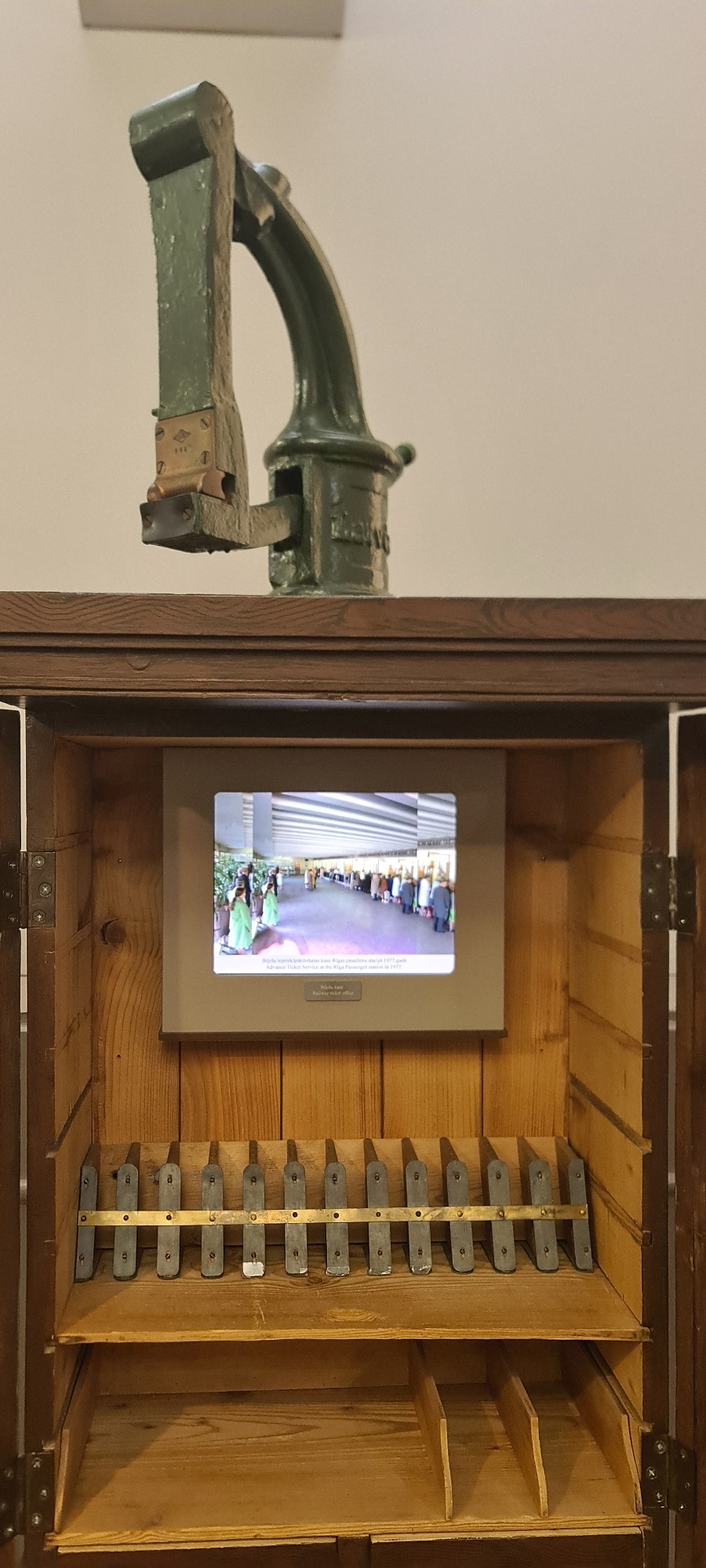
This media file captures a two-part exhibit, likely in a museum setting in Riga, Latvia. On the left, an old, dark green, possibly cast-iron mechanical device resembling a hand vise or a similar clamping tool is prominently displayed against a plain, light-colored background. This device shows signs of age and wear, with some embossed markings and a small brass plate that is partially legible, possibly reading "B.S.A" and "202".
To the right, a weathered wooden chest or box is open, revealing its interior as part of a display. Inside the lid, a flat screen is mounted, displaying a photograph or a video still of a gathering of people. The image on the screen shows numerous individuals seated at tables in what appears to be a large hall, suggesting a banquet or an official meeting. Visible text on the screen, in both Latvian and English, identifies the scene: "Bildē redzami svinību dalībnieki Lielās ģildes zālē 1977. gadā" and "Photo shows / jubilee / meeting in the Great Guild Hall in 1977." This pinpoints the event to the Great Guild Hall in 1977.
The main compartment of the wooden box is organized with internal wooden structures. On the left side of the compartment, there's a vertical arrangement of multiple small, rectangular metal pieces, possibly levers or weights, held in place by a brass strip, suggesting a functional or interactive element. To the right, there's a smaller, shelved section made of wood, creating storage compartments. The overall impression is that of a historical or cultural exhibit, showcasing an artifact alongside contextual information presented digitally. The lighting suggests an indoor setting, with artificial illumination highlighting the exhibit.
Riga, Latvia · Jun 3, 2026, 10:56 AM · 3.7k attention
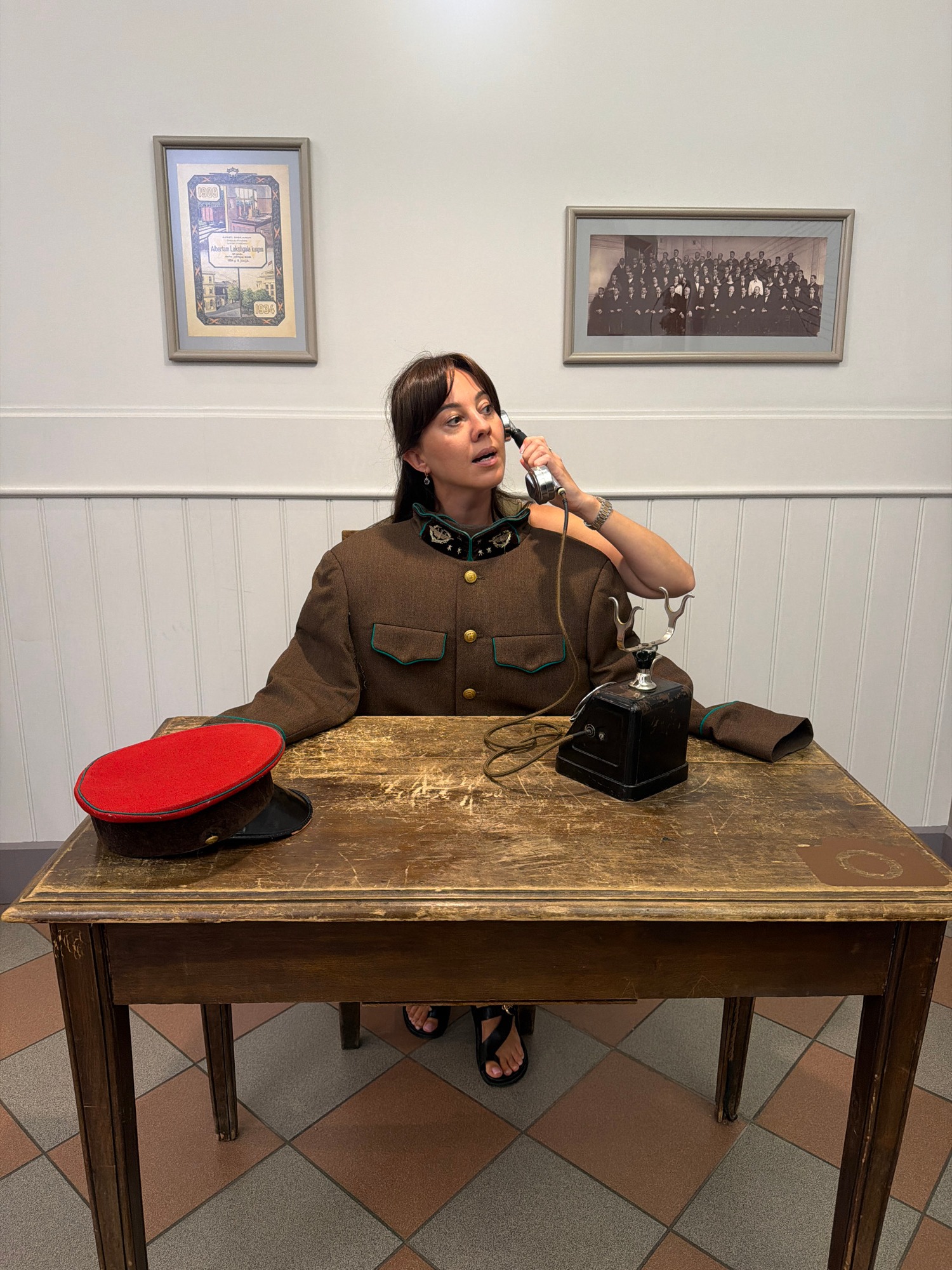
The image captures a person, likely a woman, dressed in a historical military-style uniform, sitting at a wooden desk and using a vintage telephone. The person, with dark hair, is seen from the chest up, holding a silver-colored telephone receiver to their left ear. Their mouth is slightly open, suggesting they are speaking or listening intently. They wear a brown jacket adorned with green piping, gold buttons, and a decorated collar featuring small insignia, possibly stars.
On the dark, worn wooden desk, to the person's right, rests a black, antique rotary telephone with a separate earpiece and mouthpiece, connected by a coiled cord. Also on the desk, near the person's right arm, is a military-style cap with a prominent red top and a black brim.
The background features white paneled walls. Two framed items hang on the left wall. The upper frame contains a sepia-toned group photograph of numerous individuals, typical of historical records. Beneath it, a second frame displays what appears to be a historical document or advertisement, which includes visible text such as "Abertum Leksikāla kopas" and dates "1908" and "1964".
The floor is covered with large, square tiles in a checkered pattern of alternating brown and beige/grey. Part of a bare foot, wearing a black sandal, is visible beneath the desk on the tiled floor. The scene evokes a historical setting, possibly a museum exhibit or a reenactment, suggesting a bygone era.
Riga, Latvia · Jun 3, 2026, 10:48 AM · 3.0k attention
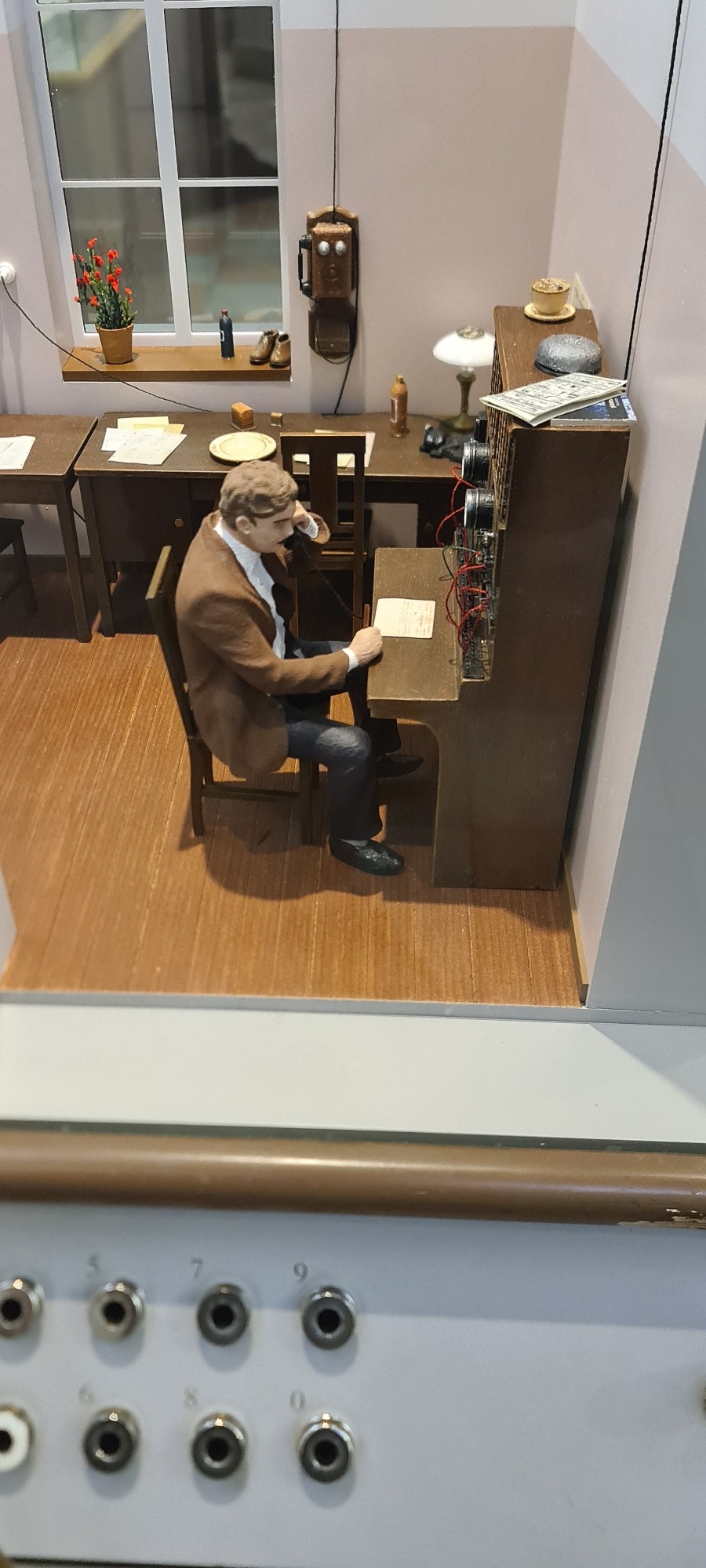
This image presents a highly detailed miniature diorama depicting an interior scene, likely an office or study. The central subject is a male figurine seated at a wooden desk, appearing to be engaged in work or a technical task. He wears a brown suit jacket over a light-colored shirt, with dark trousers and shoes.
The wooden desk is well-appointed with papers, a round, flat object, and a classic white-domed desk lamp. Beneath an upper tier of the desk, exposed electronic components, including multiple speakers, a circuit board, and a tangle of red, green, and black wires, are visible, suggesting a communication or audio setup. A small white label or document with faint text is affixed to the desk's side panel.
To the left, a multi-paned white window looks out, below which a shelf holds a potted plant with red flowers. Mounted on the wall above the window is a vintage-style brown radio or communication device with two large dials. Various other small objects, including what appears to be a bottle, are placed on shelves around the room. The floor is made of light-colored wooden planks.
To the right and outside the immediate diorama frame, a white panel features an array of silver, circular connectors. Several numbers are faintly visible next to these connectors, including "6", "0", "7", "8", and "5". A vertical brown pipe or rod runs alongside this panel.
The meticulous detail and the style of the objects, particularly the radio and desk setup, evoke a mid-20th-century aesthetic. The scene is brightly illuminated, but no specific time of day is discernible. There are no visual cues within the image itself to indicate the provided location context of Riga, Latvia.
Riga, Latvia · Jun 3, 2026, 10:44 AM · 2.8k attention
A candid, medium shot, taken from a slightly low angle, shows a woman in what appears to be a historical or military-style uniform, engaging with an antique telephone set inside a room. The image is rotated 90 degrees clockwise, placing the woman and desk vertically.
The woman, with dark brown hair and bangs, is wearing a brown uniform jacket with gold buttons and intricate green trim on the collar and cuffs. She holds an old-fashioned telephone receiver to her left ear with her right hand, which wears a silver watch. Her mouth is slightly open, suggesting she is speaking or reacting to something heard.
She is positioned behind a sturdy, distressed wooden desk. On the desk, next to her, is a black, antique box telephone with a crank. A dark hat with a prominent red brim and a gold accent is also on the desk.
The background features a white wall with wainscoting. Two framed pictures hang on the wall. The upper picture is a vintage black-and-white group photo of numerous men in formal attire. The lower picture is a more ornate framed document, possibly a certificate or advertisement, with text partly visible: "1909 Albertam Labatkopja Kupona 1934". The floor is tiled with a pattern of light and dark brown squares. A foot in a black sandal is visible beneath the desk.
The scene suggests a historical recreation or museum exhibit, possibly in Riga, Latvia, given the context. The lighting is bright and even, indicating an indoor daytime setting.
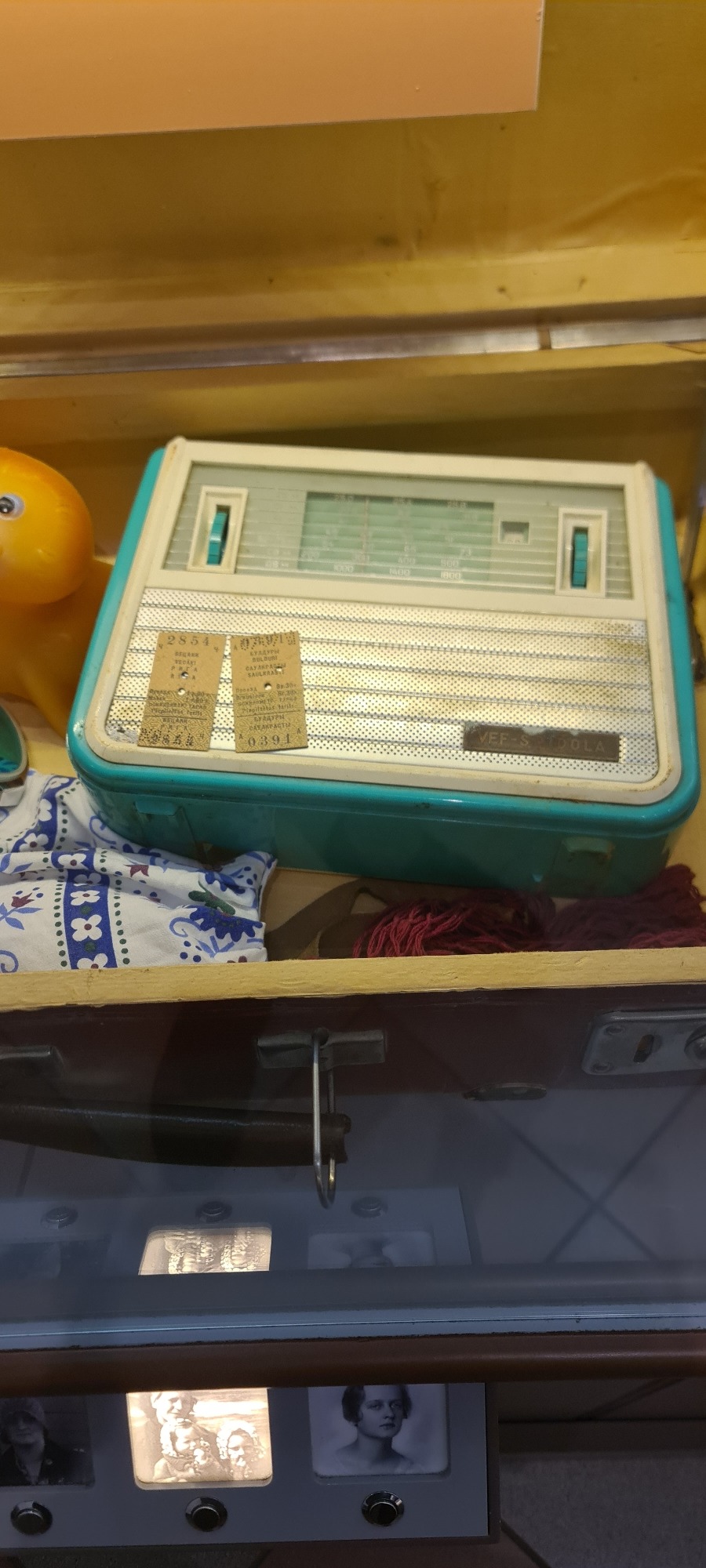
The media file captures a static display featuring an old portable radio and a cabinet with illuminated black and white images, likely in a museum or exhibition setting in Riga, Latvia.
The central subject is a vintage, teal/turquoise and white portable radio, depicted as if standing upright due to the image's orientation. Its front features a metallic speaker grille on the right and a tuning dial with frequencies and a slider switch on the left. Two small, aged paper labels are affixed to the lower right portion of the radio's front. Above the speaker grille, the brand name "VEF-SPIDOĻA" is clearly visible, referring to a historical Latvian radio model from the VEF factory. The labels contain text primarily in Cyrillic script, with fragments such as "БУДУЧИЕ", "БАЙКАЛ", and "СУПРАСТЫ А" along with numbers like "0391" and "N 2854," likely indicating production details, inventory, or technical specifications from the Soviet era.
To the right of the radio, a bundle of red fabric, possibly yarn or a mop head, rests on a light-colored strap, with a white cloth patterned with blue floral designs visible underneath. Further right, a dark brown object with a metallic ring handle is partially visible.
On the far right, a vertical display case or cabinet is present, showcasing several black and white images, some of which are illuminated. One clear image shows a portrait of a person's face (upper right), while another, illuminated from within, appears to be an x-ray or a detailed image of skeletal structures (lower middle). The overall arrangement suggests a historical or cultural exhibit. The background behind the radio is a plain yellow-orange surface, possibly a shelf or part of an enclosure. No activity is taking place, and the scene is entirely indoors.
Riga, Latvia · Jun 3, 2026, 10:55 AM · 2.5k attention
This media file captures a two-part exhibit, likely in a museum setting in Riga, Latvia. On the left, an old, dark green, possibly cast-iron mechanical device resembling a hand vise or a similar clamping tool is prominently displayed against a plain, light-colored background. This device shows signs of age and wear, with some embossed markings and a small brass plate that is partially legible, possibly reading "B.S.A" and "202".
To the right, a weathered wooden chest or box is open, revealing its interior as part of a display. Inside the lid, a flat screen is mounted, displaying a photograph or a video still of a gathering of people. The image on the screen shows numerous individuals seated at tables in what appears to be a large hall, suggesting a banquet or an official meeting. Visible text on the screen, in both Latvian and English, identifies the scene: "Bildē redzami svinību dalībnieki Lielās ģildes zālē 1977. gadā" and "Photo shows / jubilee / meeting in the Great Guild Hall in 1977." This pinpoints the event to the Great Guild Hall in 1977.
The main compartment of the wooden box is organized with internal wooden structures. On the left side of the compartment, there's a vertical arrangement of multiple small, rectangular metal pieces, possibly levers or weights, held in place by a brass strip, suggesting a functional or interactive element. To the right, there's a smaller, shelved section made of wood, creating storage compartments. The overall impression is that of a historical or cultural exhibit, showcasing an artifact alongside contextual information presented digitally. The lighting suggests an indoor setting, with artificial illumination highlighting the exhibit.
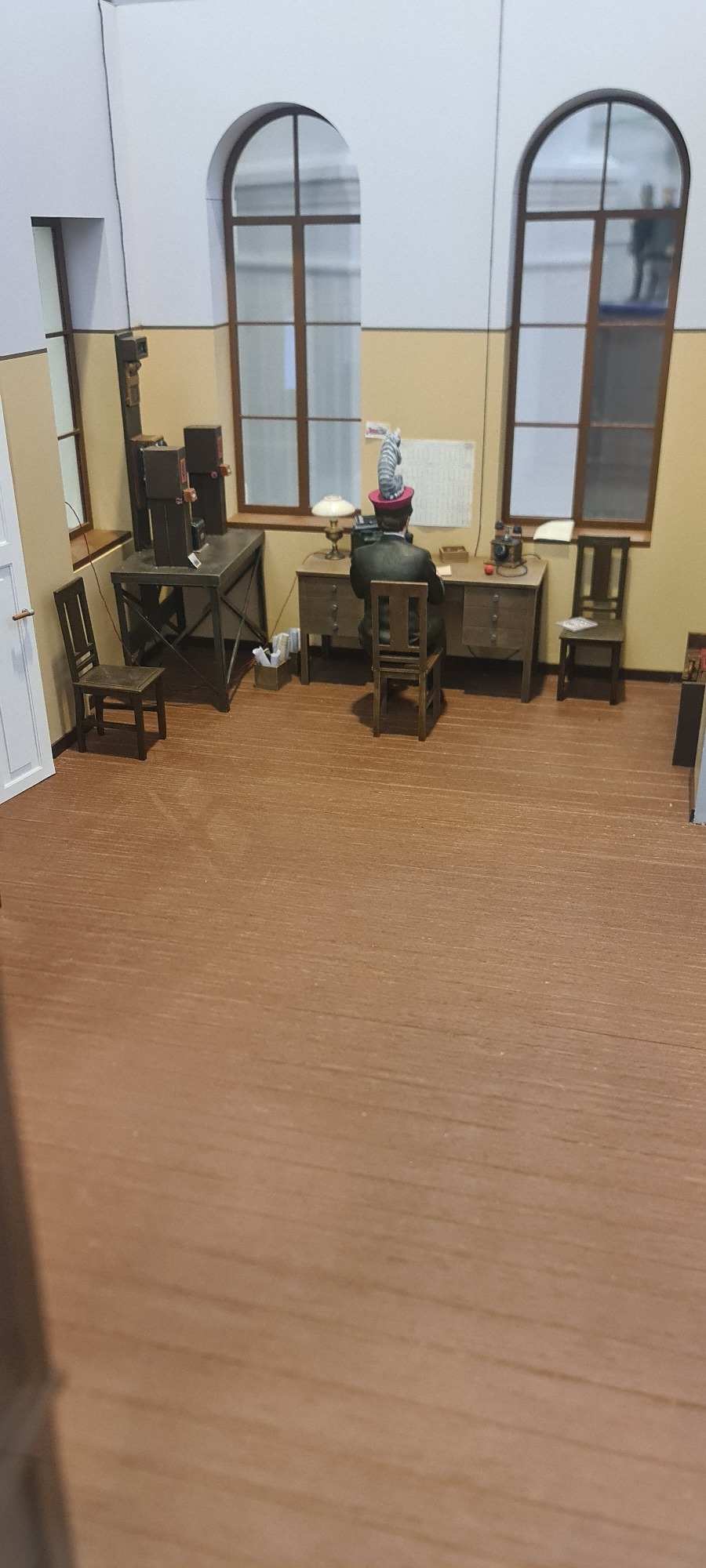
The image displays an interior scene, likely a historical museum exhibit or an old office/workshop, situated in Riga, Latvia. The room features a two-toned wall, with a lighter section (possibly white or cream) on the left side and a light brown or tan color on the back and right walls. Two distinctive arched windows, framed in dark wood and divided into multiple panes, are visible on the left wall, allowing natural light into the space. The floor is covered in light brown wooden planks with visible grain.
The room is furnished with several pieces of vintage dark wooden furniture. In the central area, there are two desks or workbenches with drawers, each paired with classic wooden chairs featuring slatted backs. A prominent, dark, historical apparatus sits on one of the central desks; it has a round base, a large round top, and a pipe-like extension adorned with a bright red ring near its apex. This device appears to be an early scientific, industrial, or communication machine. A small, old-fashioned desk lamp with a dome-shaped shade is also placed on a desk.
On the back wall, a white board or chart is mounted, showing what appears to be text or data, although it is illegible due to distance and blurriness. Another dark wooden cabinet or large box-like structure is visible further back on the right. No people are present, indicating a static display. The scene evokes a sense of history and a quiet, preserved environment.
Riga, Latvia · Jun 3, 2026, 10:58 AM · 1.5k attention
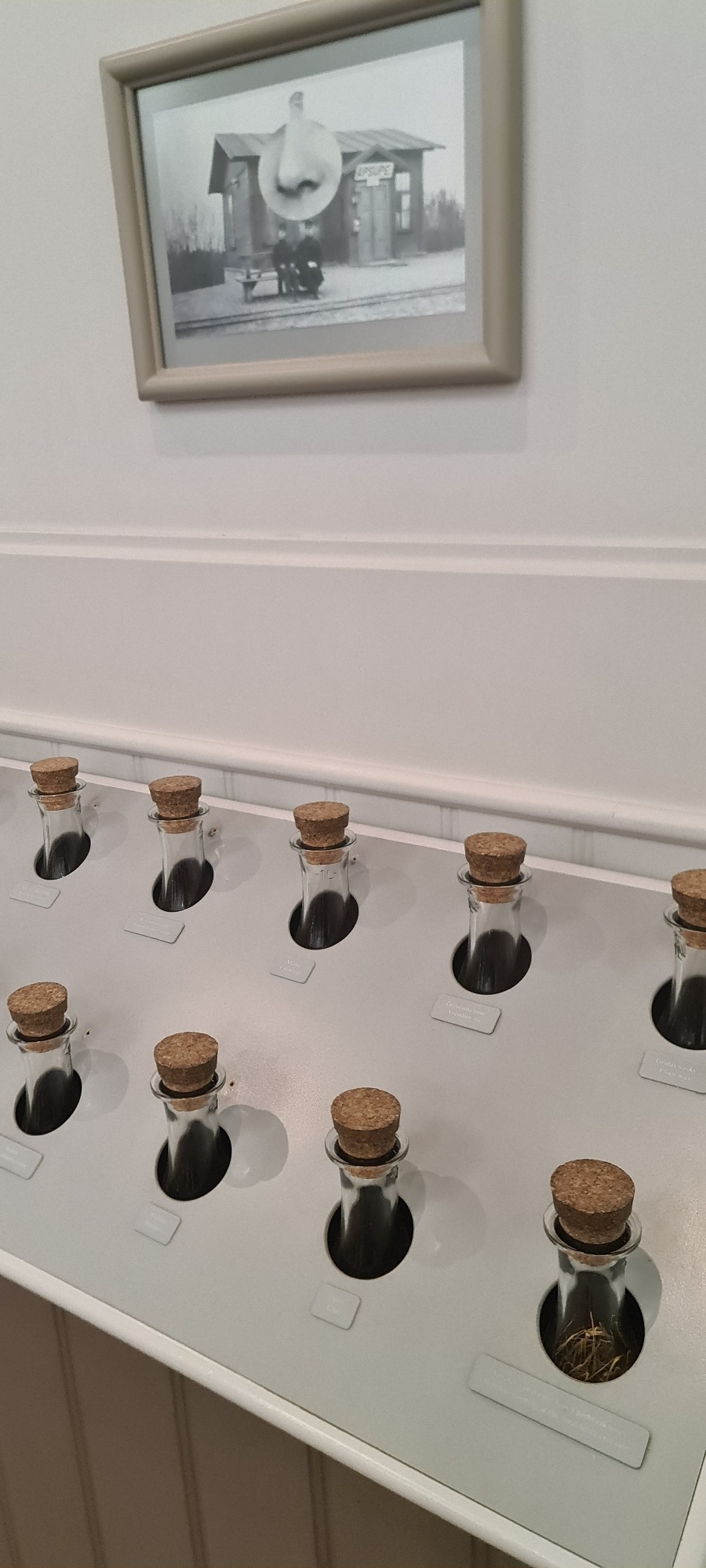
The media file presents an indoor scene with two main focal points on a light-colored wall.
On the left side, a framed black and white photograph is mounted vertically. The image within the frame depicts a historical scene, likely involving a train. A large, light-colored object, possibly part of a locomotive or a person wearing a distinctive hat, dominates the foreground. Behind it, a building resembling a train station or industrial structure is visible next to railway tracks. A sign on this building displays the partially legible text "APSURE". The frame itself is simple and light-colored.
To the right, a white, angled display board or shelf contains multiple small, clear glass bottles, each sealed with a cork stopper. These bottles are neatly arranged in circular cutouts on the surface. While most bottles appear empty, the bottle at the top right of the display holds dry, straw-like material, possibly hay. Adjacent to several bottles are small, rectangular white labels. Readable text includes "Dzintara zeme Vidzemes..." (Amber land Vidzeme...) near the top right bottle, and "Dzidruma zeme Vidzemes s." (Clarity land Vidzeme's...) further down. Other labels show faint numbers like "13" or "10" or are obscured. The wall on the far right features subtle vertical paneling.
The image is captured indoors, with even lighting. The arrangement suggests a decorative or informational display, potentially relating to local history or natural elements, given the location context of Riga, Latvia, and the mention of "Vidzeme" (a historical region of Latvia) on the labels.
Riga, Latvia · Jun 3, 2026, 10:49 AM · 1.3k attention
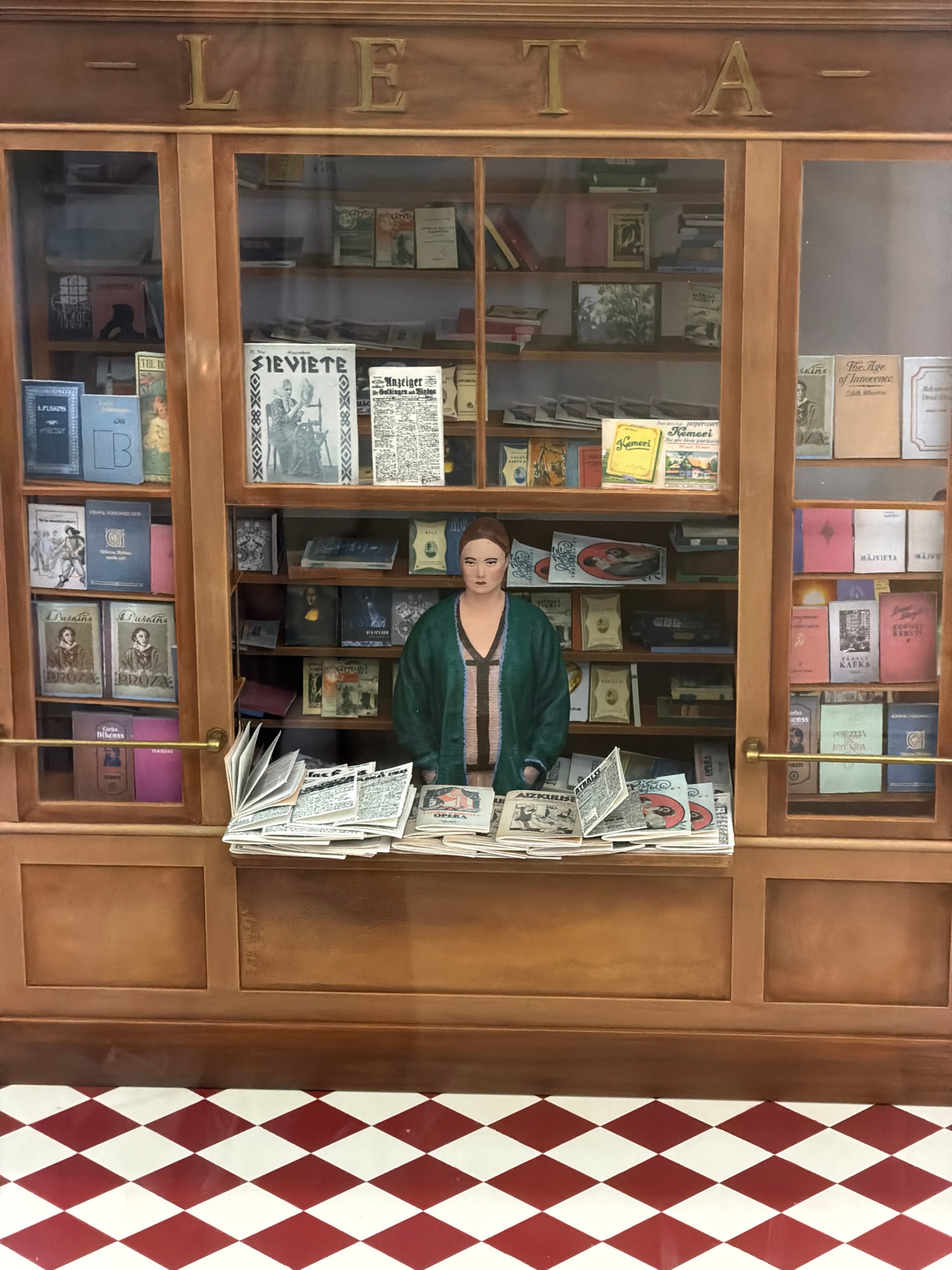
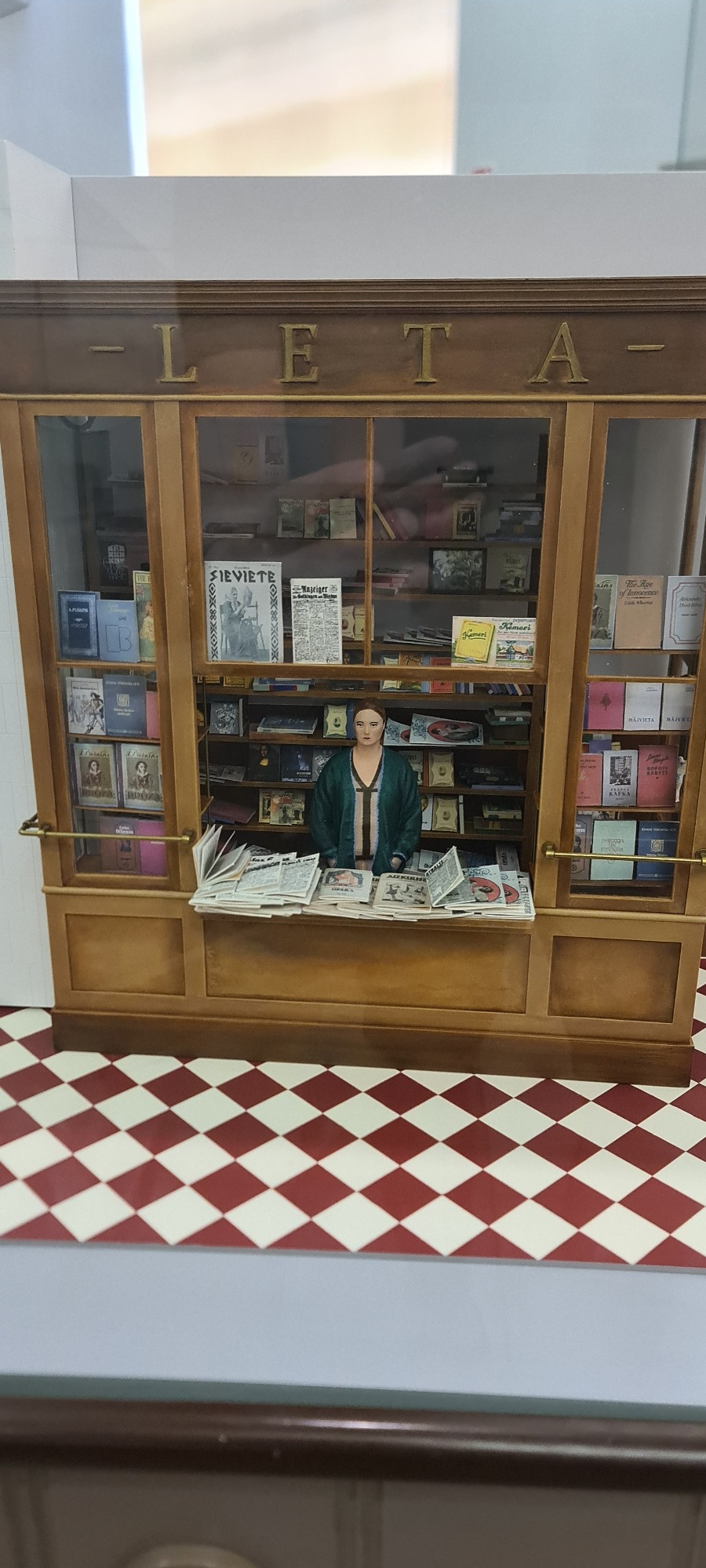
A highly detailed miniature diorama depicts the storefront of a shop, likely a bookstore or newsstand, in Riga, Latvia. The central subject is a small female mannequin or doll, dressed in a green tunic and a striped lower garment, positioned behind a wooden counter, appearing to attend to the shop.
The scene is framed by rich brown wooden display cases and shelves, meticulously filled with numerous miniature books, magazines, and newspapers. Some items stand upright, showcasing their covers and spines, while others are neatly stacked on the counter in front of the mannequin. Reflections on the glass of the display cases add depth and realism to the miniature scene. To the right of the shopfront, an adjacent wall features a striking red and white diamond checkered pattern.
Visible text on the publications includes several Latvian words such as "LETA" (likely part of the shop's name, on the left wooden frame), "SIEVIETE" (woman), "MAJVIETA" (home place), "PROZA" (prose), "POEZIA" (poetry), "ATBALSS" (echo), and "Kemeri" (a Latvian town), often appearing with "papirosuS" (cigarettes). English titles like "The Age of Innocence" and "Skins" are also present. German text, "Anzeiger" (advertiser/gazette), can be seen on a newspaper. Authors such as "A. PUSKINS" (Pushkin) and "Dikenss" (Dickens) are identified on book covers. Other recognizable fragments include "OPERA", "KAFKA", "ZIMAS", and "MARIJAI". The diverse languages reflect a potential cultural context typical of Latvia. The setting appears to be indoors, viewed through a display window.
Riga, Latvia · Jun 3, 2026, 10:41 AM · 0.8k attention
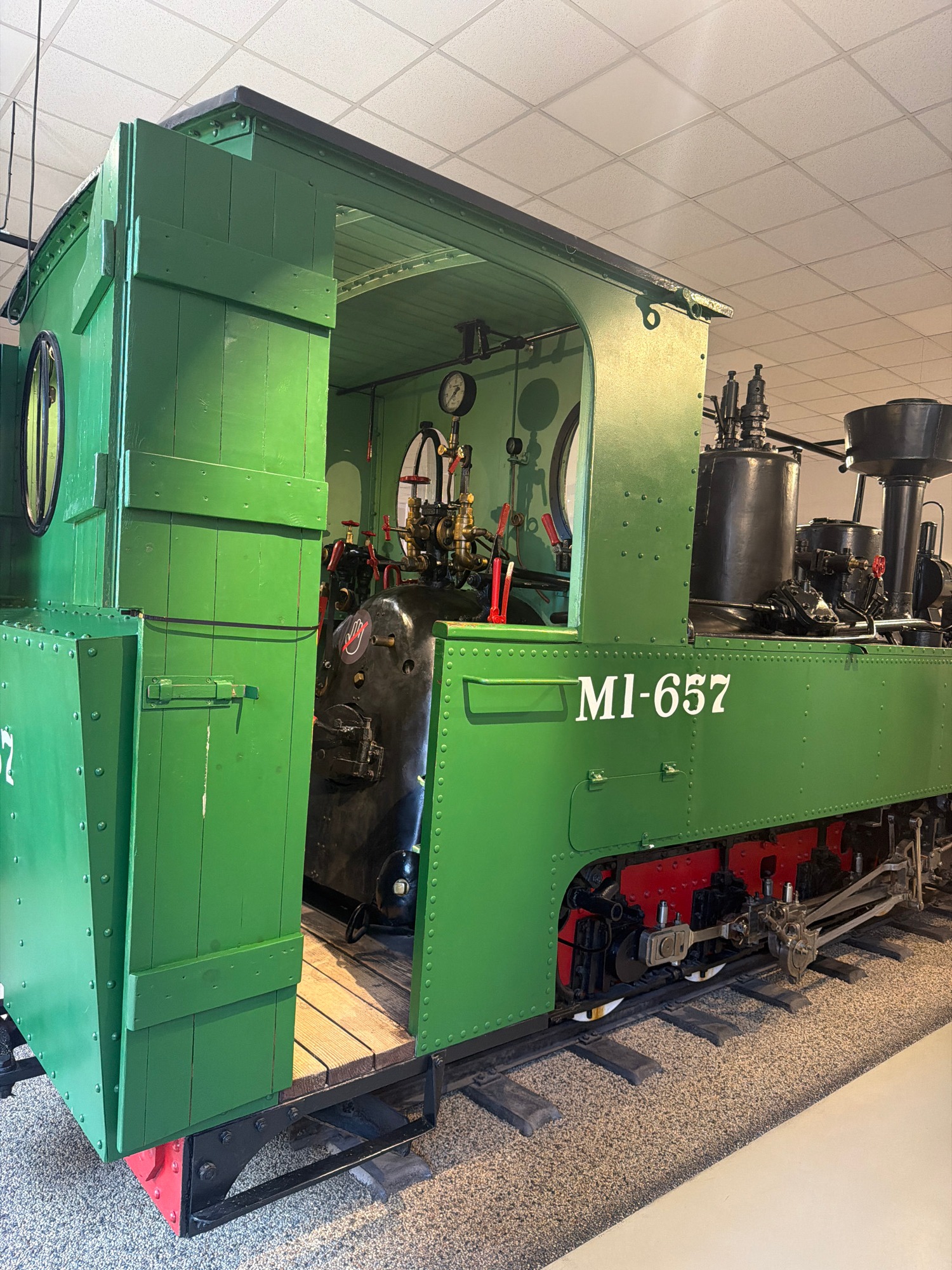
An indoor, sideways-oriented photograph showcases a large, meticulously preserved green steam locomotive, likely on display in a museum or exhibition hall in Riga, Latvia. The locomotive, predominantly painted in a vibrant green, features a contrasting red undercarriage and numerous black engine components, including its boiler and other mechanical parts.
The most prominent textual detail is the white number "M1-657" painted on the side of the locomotive's main body. The construction is heavily riveted, a testament to its industrial design. Visible through an open section on the side, possibly a cab window or doorway, are interior details such as control levers and pressure gauges. A circular window is also present on the front of the cab.
The locomotive rests on a section of track, complete with wooden ties and metal rails, embedded in a gravel-like bed, suggesting a static exhibit rather than an active railway. The surrounding environment consists of plain, light-colored walls and a ceiling with square acoustic tiles, reinforcing the impression of an indoor museum setting. No people are visible in the image, emphasizing the locomotive as the sole subject. The image captures the historical artifact in a clean, well-lit environment, showcasing its robust engineering and striking color scheme.
Riga, Latvia · Jun 3, 2026, 10:03 AM · 0.8k attention
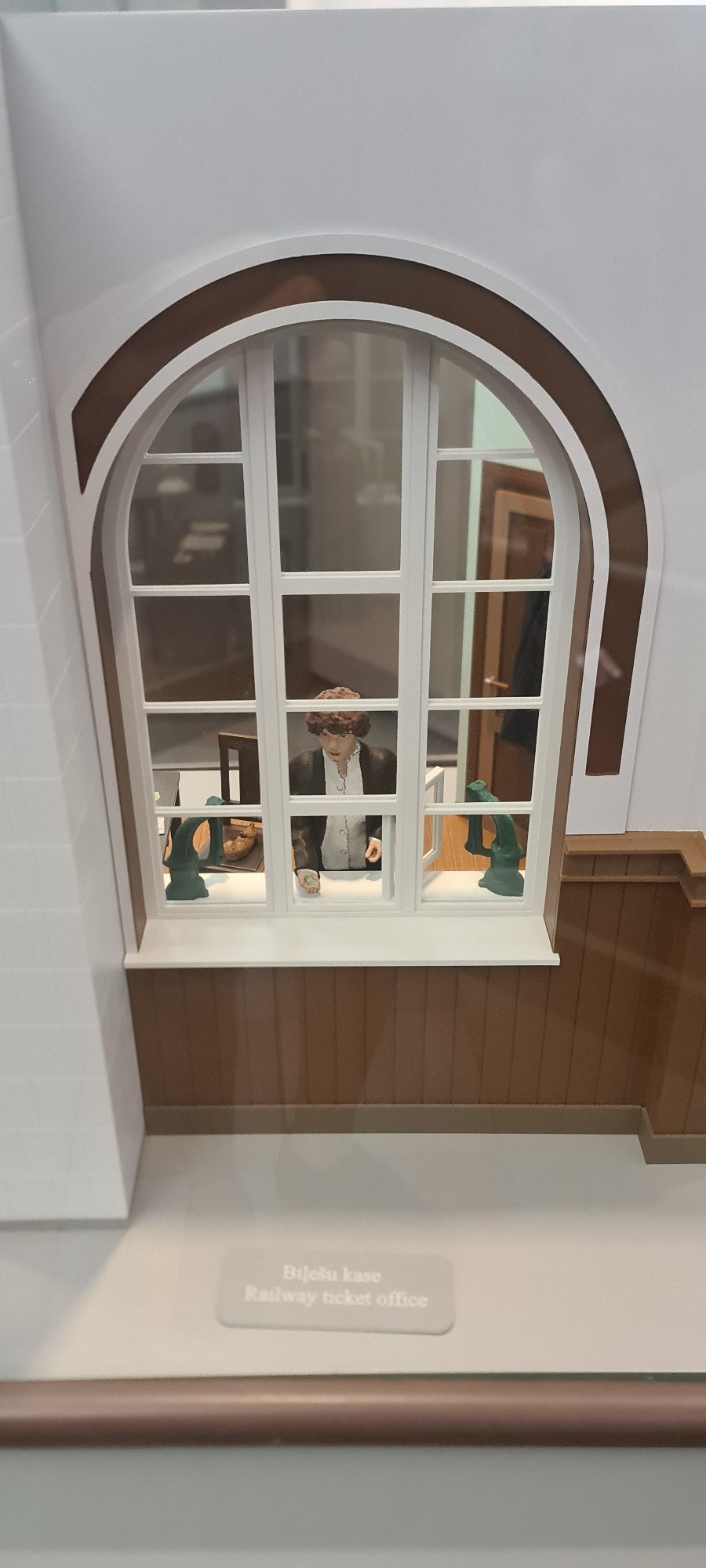
A miniature model or diorama depicts a section of a building facade, primarily featuring a large, arched window. The window has numerous white panes and is framed by a brown, arched trim against a white wall. Through the window, figures of people are visible inside what appears to be an interior setting. One prominent miniature figure, possibly a woman with reddish-brown hair and a white top, is seen near the bottom central part of the window, suggesting interaction or work at a counter. Other vague forms hint at additional figures or furniture within the space.
To the right of the window, the building's exterior wall shows two distinct sections: an upper part with horizontal brown siding and a lower, simpler white surface. A light grey plaque is affixed to the white wall section, containing text in two languages. The upper line reads "Biļešu kase" (Latvian for "Ticket office"), and the lower line states "Railway ticket office." The scene represents a railway ticket office, likely a historical or architectural model, with miniature figures bringing it to life. The lighting suggests an interior glow reflected on the window glass.
Riga, Latvia · Jun 3, 2026, 10:56 AM · 0.8k attention
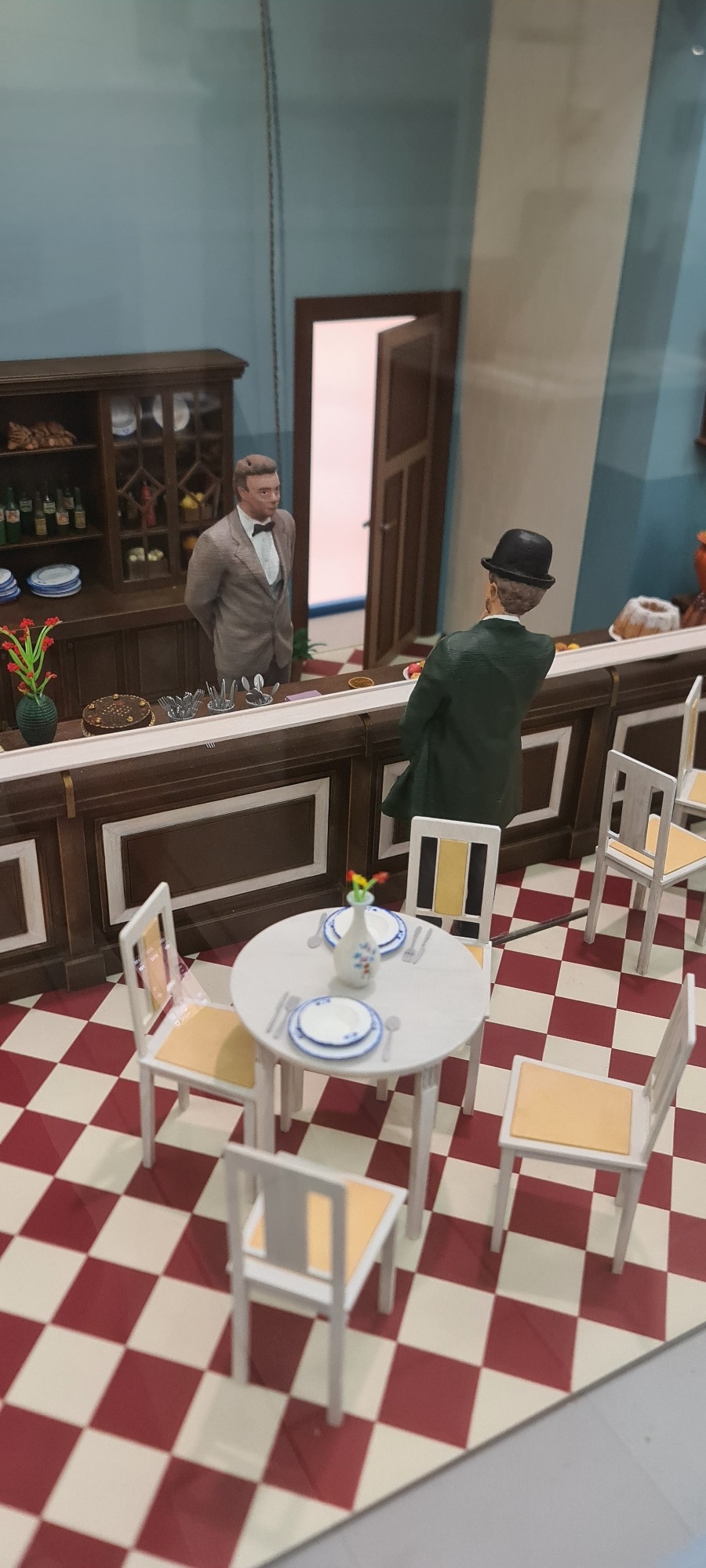
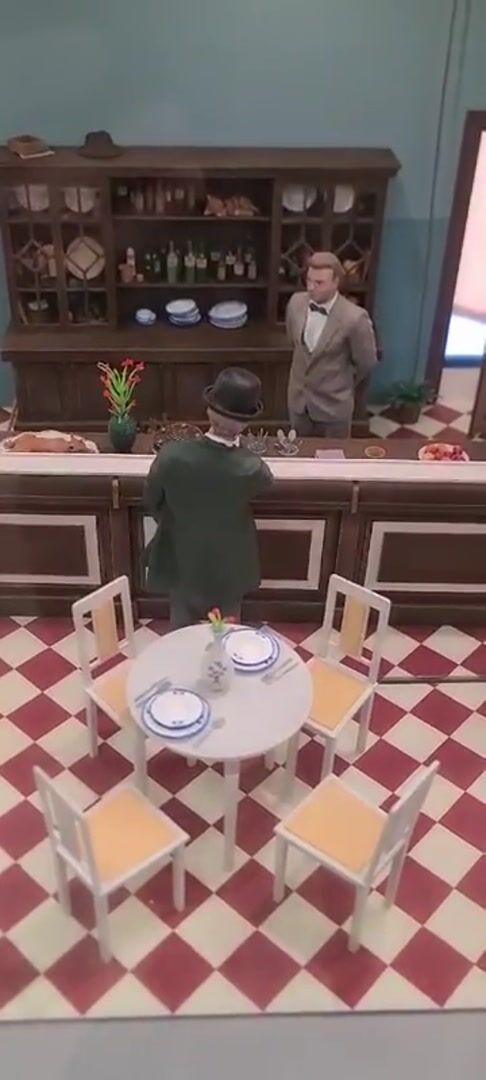
This media file captures a miniature diorama depicting the interior of a cafe or bar. The scene is viewed from a slightly elevated angle, looking down onto the checkered floor.
**Subjects:** Two miniature male figures are present. One, wearing a dark green coat and a black bowler hat, stands with his back mostly to the viewer, near a round table. The second figure, dressed in a light brown suit with a white shirt and bow tie, stands behind a dark wooden bar counter, facing slightly towards the viewer. The bar is well-stocked with shelves displaying miniature bottles, glasses, and white and blue dishes.
**Objects:** The cafe features several small round tables and chairs with white frames and light yellow or cream-colored seats and backs. One table is set with two small plates featuring blue patterns, cutlery, and teacups, alongside a tiny vase of colorful flowers. The floor is a distinctive red and cream/white checkerboard pattern. The walls are painted a light blue, and a dark brown framed window is visible on the back wall, showing a light-colored background.
**Activity or event:** The scene portrays a static moment in a cafe setting, with the figures posed as if interacting with their surroundings – one potentially as a patron and the other as staff. There is no dynamic activity taking place; it's a still life of a miniature environment.
**Notable details:** The primary notable detail is the miniature scale of the entire setup, creating a charming and intricate diorama. The attention to detail includes the patterned plates, tiny cutlery, and bottles on the shelves, contributing to the realism of the miniature. The red and cream checkered floor provides a classic cafe aesthetic. The overall setting suggests an indoor environment. Given the location context provided, this diorama is situated in Riga, Latvia.
**Visible text:** There is no visible text in the image.
Riga, Latvia · Jun 3, 2026, 10:57 AM · 0.8k attention
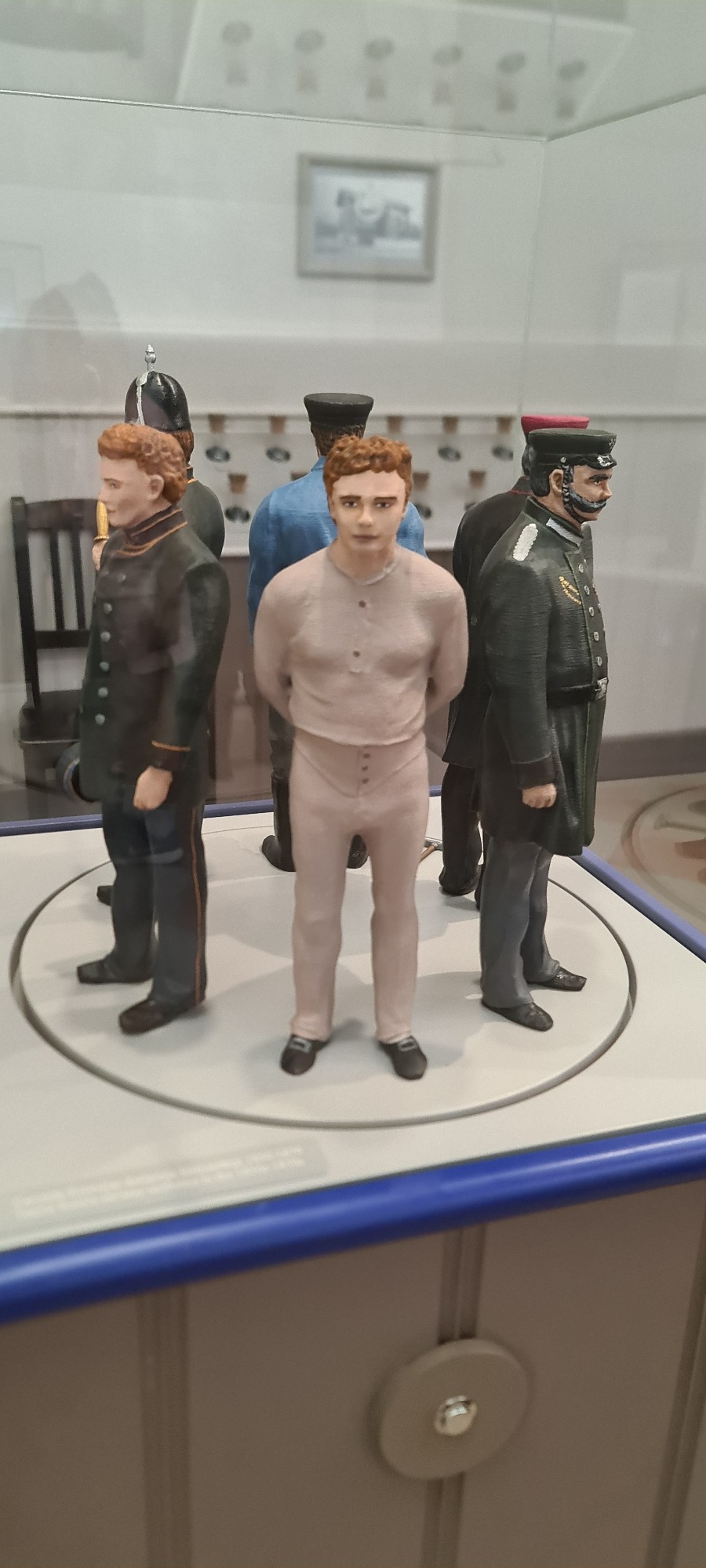
The image showcases three meticulously crafted male figurines, likely representing historical figures, displayed in a museum or exhibition setting in Riga, Latvia. They are arranged in a line within a glass case, standing on a white circular base with a blue outer rim.
From left to right, the first figurine depicts a man with reddish-brown hair, dressed in a dark uniform with a matching cap. He appears to be in an official or military capacity, with a serious expression.
The central figurine has reddish-brown, curly hair and is attired in light-colored civilian clothes, possibly off-white or pale pink, with a blue garment visible beneath. His hands are positioned behind his back, suggesting restraint or arrest. He maintains a neutral facial expression.
The third figurine on the right is a distinguished-looking man with a prominent dark beard and mustache. He wears a dark, ornate uniform, similar to the first figure, but with more detailed epaulets and a decorative cap featuring a red accent. His expression is also serious.
The background consists of a plain white wall, reflecting the clean aesthetic of an exhibition space. A small, framed picture is visible on the wall, though its contents are indistinct. Several small, peg-like fixtures are also mounted on the wall. The lighting is uniform, typical of an indoor display. There is no clearly legible text on the figurines or the display case. The arrangement of the figures, particularly the central figure's posture, hints at a narrative involving authority, perhaps a historical arrest or confrontation.
Riga, Latvia · Jun 3, 2026, 10:44 AM · 0.2k attention
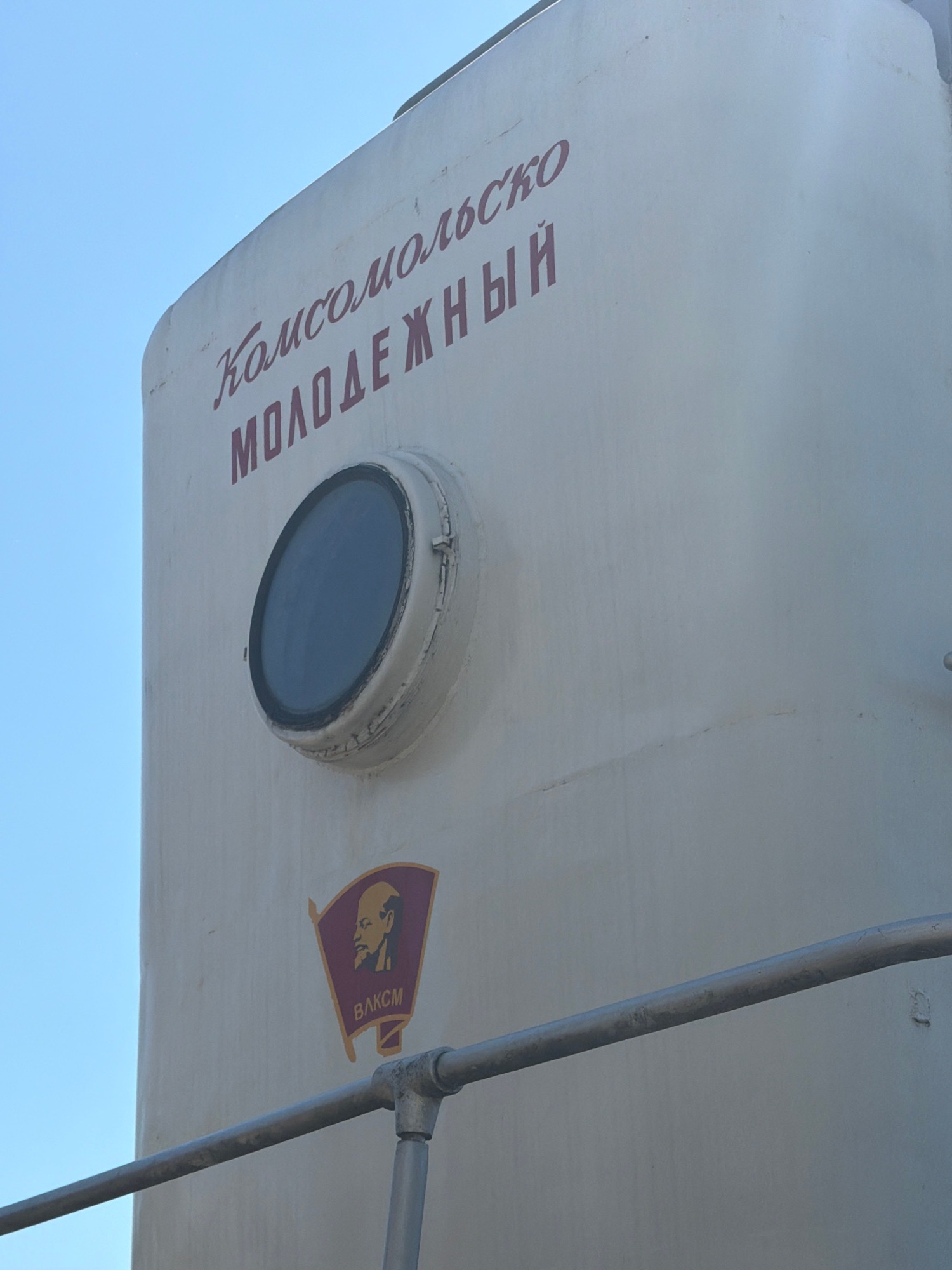
The image displays a detailed view of a large, light-colored surface, likely the underside of an aircraft or a similar substantial vehicle, against a bright blue sky. The surface is predominantly white or very light gray, showing minor signs of wear and faint marks.
Two key elements of Soviet-era symbolism are visible on this surface. On the left side, a phrase is stenciled in bold, red Cyrillic script: "Комсомольско МОЛОДЕЖНЫЙ". This translates to "Komsomol Youth" or "Komsomol Youthful," referencing the All-Union Leninist Young Communist League. Below this text, a circular, dark-tinted window or port is set into the surface, framed by a lighter ring that shows some signs of age and possible sealant.
To the right of the window, a distinctive reddish-brown, flag-shaped emblem is affixed. This emblem features a stylized golden profile of Vladimir Lenin's face, gazing to the left. Above his head, also in golden Cyrillic letters, is the abbreviation "ВЛКСМ," representing the Komsomol organization.
On the far right, two grey metallic poles or tubes are partially visible, connected by a fitting. These appear to be either structural components of the object itself or part of a display stand. The clear blue sky suggests the image was captured during daytime in bright, fair weather. Given the location context of Riga, Latvia, and the prominent Komsomol and Lenin iconography, the object is likely a historical artifact from the Soviet period, potentially an exhibit or monument.
Riga, Latvia · Jun 3, 2026, 9:52 AM · 0.1k attention
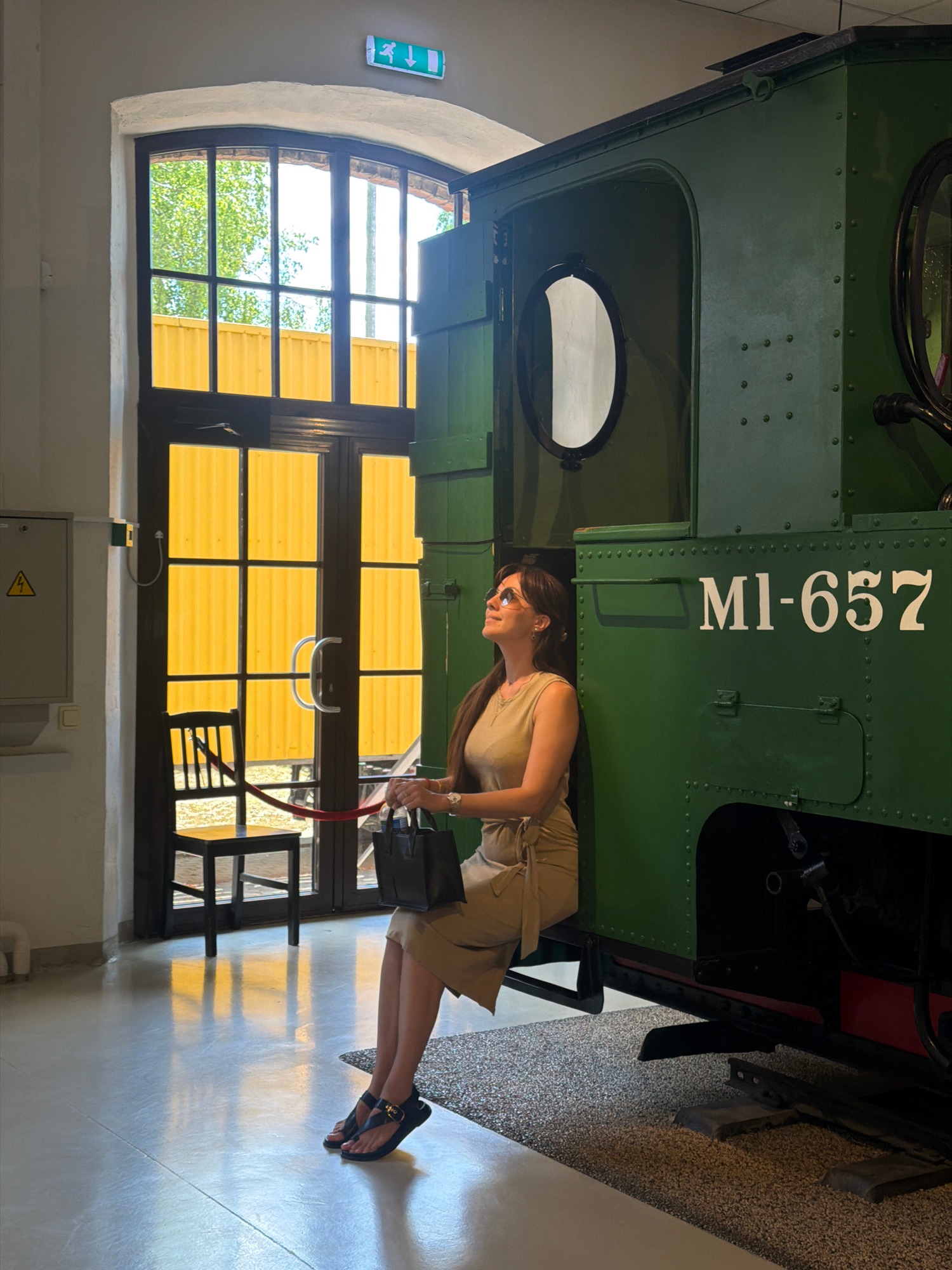
The image captures an indoor scene, likely within a museum or exhibition hall in Riga, Latvia, featuring a historical green train or tram and a woman observing it. A woman with long brown hair, wearing sunglasses, a light-colored sleeveless top, and a beige tie-waist skirt, stands facing right and looking downwards, seemingly focused on the exhibit or the floor. She carries a black handbag and wears dark sandals.
The most prominent object is a large, dark green train or tram car, partially visible on the left side of the frame. Its side is adorned with numerous rivets and a small oval window. Clearly visible in white on its side is the identification number "M1-657". A red rope barrier separates the woman from the exhibit. To the woman's right and extending behind her is a large, dark-framed arched window divided into multiple panes. Through this window, bright daylight illuminates green foliage from trees and parts of a yellow building or structure outside, indicating it is daytime with clear weather.
Further details include a green exit sign with a white running person symbol and an arrow on the wall near the window, and a grey electrical box marked with a yellow warning triangle on the wall below the window. The floor is light-colored, showing reflections from the natural light. The setting implies a calm, educational visit to a transport history display.
Riga, Latvia · Jun 3, 2026, 10:23 AM · 0.1k attention
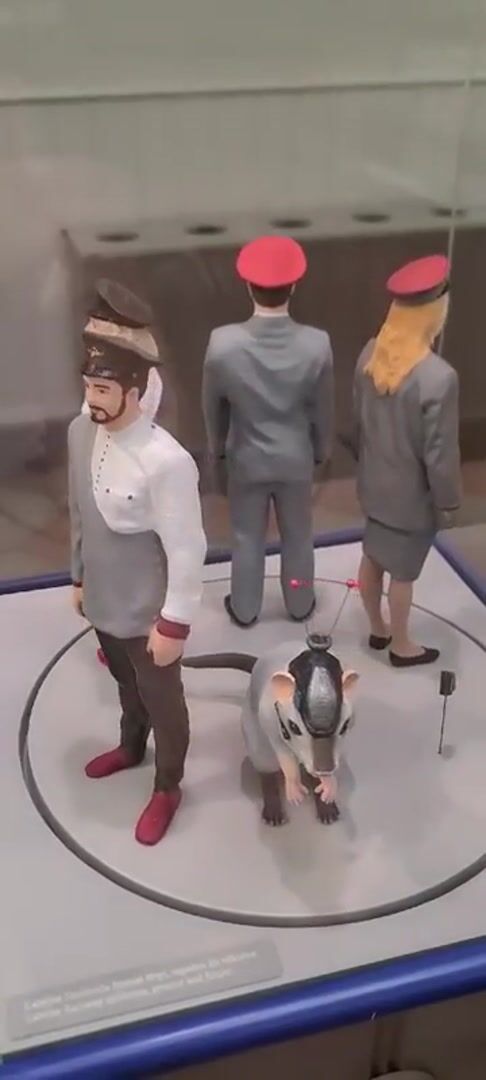
The video displays a miniature diorama featuring five figures on a circular, rotating base, likely an exhibit in a museum.
Four of the figures represent people, dressed in uniforms. In the foreground, a male figure faces left, wearing a light-colored, patterned tunic, dark pants, red shoes, and a dark cap, with a beard. To his left, a female figure is partially visible from the side, with blonde hair, wearing a white top, dark skirt, red heels, and a dark cap. In the background, two figures are seen from behind: a male in a grey suit and a red beret, and a female in a grey suit, a red cap, and dark flat shoes, also with blonde hair.
The fifth figure is a grey and white rodent-like animal, possibly a rat or opossum, positioned on all fours in the center foreground. It has a small, dark, cylindrical object with two antenna-like protrusions mounted on its back, and it faces towards the foreground male figure.
The light grey circular base appears to be slowly rotating. Small, dark, stick-like markers with tiny green or red tops are placed at various points on the base. A small white label with faint, illegible text is visible on the base. The entire display is behind glass, indicated by reflections visible in the video.
Riga, Latvia · Jun 3, 2026, 10:45 AM · 0.1k attention
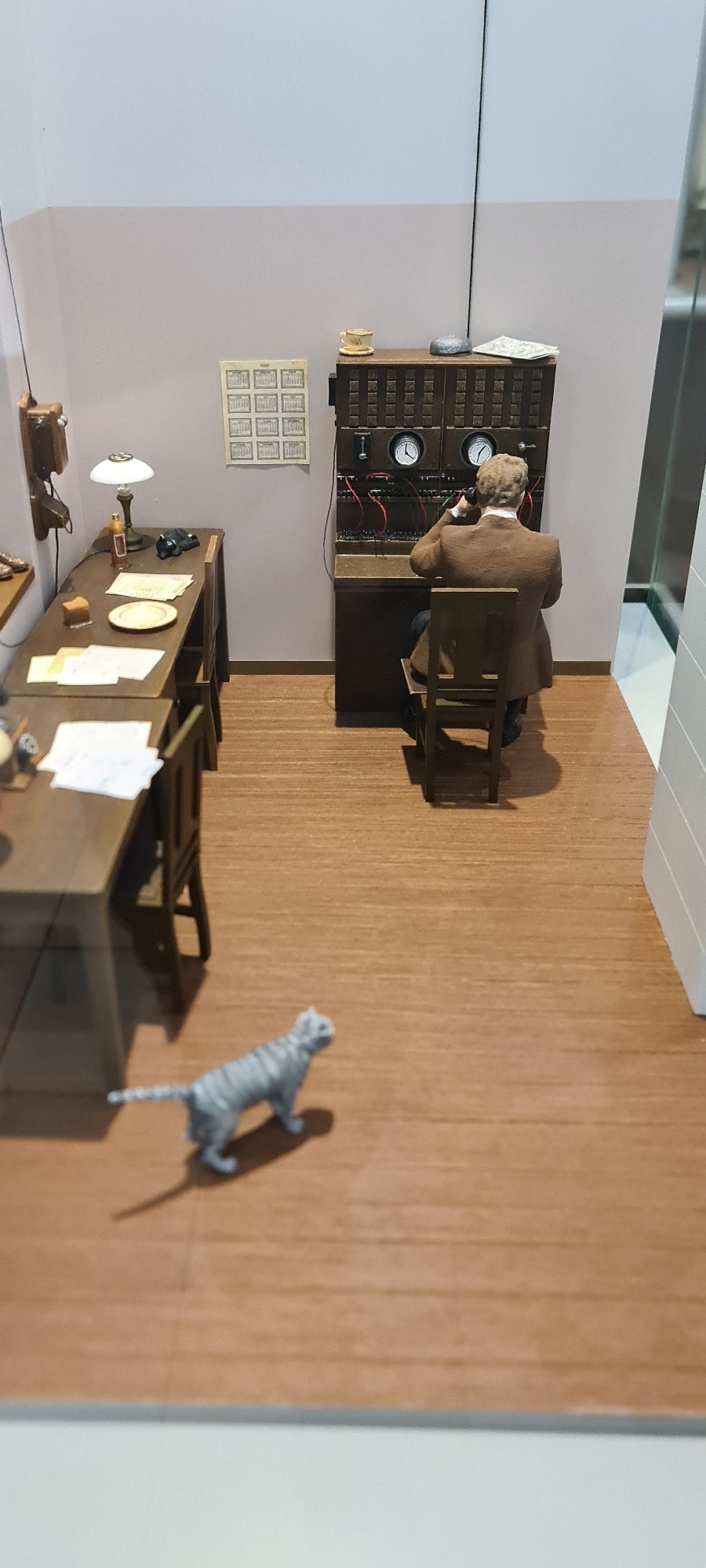
This image displays a detailed miniature diorama, characteristic of a museum exhibit. The scene depicts an interior setting, likely a control room, office, or laboratory from a past era.
In the mid-left section of the frame, a miniature human figure, dressed in a brown coat or suit, is seated on a high-backed wooden chair. The figure faces a complex, dark-brown control panel mounted on a light-colored wall. This panel is equipped with numerous small square buttons or switches arranged in grids, and two prominent round gauges with white faces and black hands, possibly indicating time or pressure. Red wires are visible, connecting components within the panel, suggesting an active operation.
Below the control panel, on the same wall, is a rectangular arrangement of multiple smaller, square documents or images, too indistinct to read.
Dominating the foreground and extending towards the right is a wooden desk or counter. Adorning this desk are several miniature objects: a vintage-style desk lamp with a white globe shade, an old rotary telephone, scattered papers, and a circular, light-colored dish or plate.
On the wooden floor, which fills the right side of the image, a miniature gray tabby cat is captured in motion, its body striped and facing the upper right. A distinct shadow is cast behind the cat on the floor.
The floor is a light-brown wood with a visible grain, and the walls are a plain light gray or beige. The overall display exhibits meticulous detail, recreating a historical or functional environment in miniature form. No discernible text is clearly readable on any items within the diorama.
Riga, Latvia · Jun 3, 2026, 10:58 AM · 0.1k attention
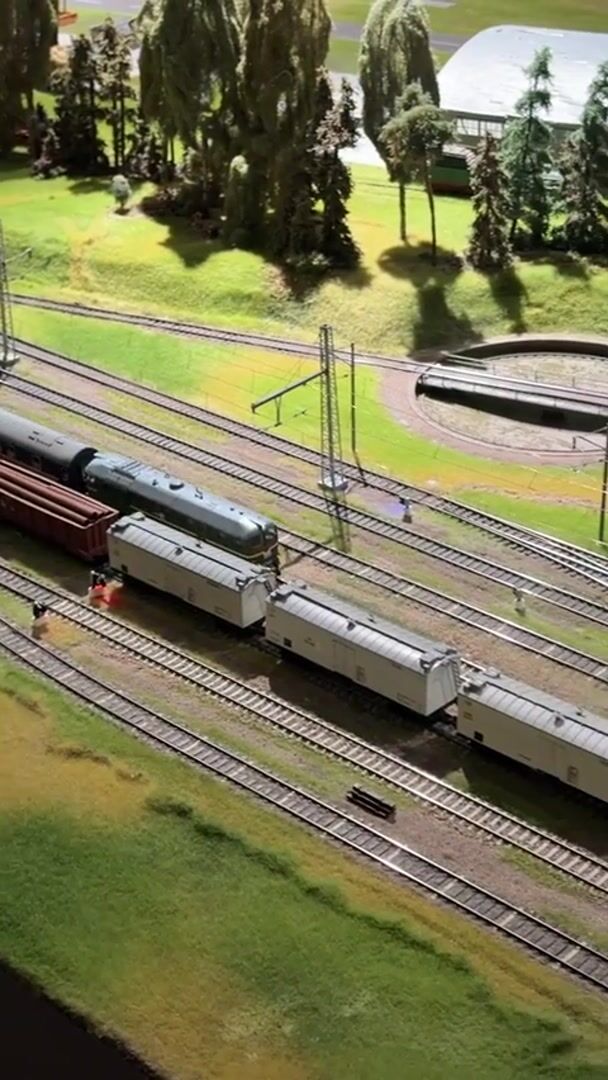
This video showcases a miniature model railway display, likely an indoor exhibit. The scene depicts a bustling train yard or station area, featuring multiple tracks, miniature trees, green landscapes, and several model buildings, including a prominent brick-red building with a large roof and a train turntable in the background.
At the beginning of the video, a sleek gray and green passenger train is visible on one set of tracks. On an adjacent track, a freight train, composed of a dark locomotive and several light-gray boxcars, is moving from left to right. The camera slowly pans to the right, following the freight train as it continues its journey across the model landscape. The details include miniature power lines above the tracks and small figures scattered around the scene, adding to the realism of the miniature world. The lighting is bright and consistent, characteristic of an indoor display.
Riga, Latvia · Jun 3, 2026, 10:30 AM · 0.1k attention
This image captures a detailed miniature diorama of a historical bookstore or newsstand, presented vertically but intended to be viewed horizontally. The central subject is a miniature female figure, resembling a doll or mannequin, dressed in a dark green, robe-like garment with brown accents. She stands behind a wooden counter, appearing as a shopkeeper.
The scene depicts a static display of a shop interior. The counter in front of the figure is piled with miniature newspapers and magazines. Behind her, a multi-shelved wooden display case is filled with numerous tiny books, many featuring visible titles or decorative covers. Notable book spine text includes "KAFKA" and "The Age of Innocence." A magazine on display clearly shows the Latvian word "SIEVETE" (Woman). Other visible text fragments on publications include "Maigiori," "Reviete," and "OPIERAS."
Along the left side of the wooden display frame, gold-colored vertical lettering spells out "ATELIE-," likely part of "ATELIER" or a similar shop name. To the right, a wall is covered in a striking red and white checkerboard pattern, adding a distinct decorative element to the scene. The left edge of the image shows a plain light-colored wall or reflections.
The diorama is intricately crafted, providing a glimpse into a meticulously recreated literary or news retail environment, consistent with a setting in Riga, Latvia, given the visible Latvian text. The time of day and weather are not discernible, and the static nature of the display precludes any conveyed emotions.
Riga, Latvia · Jun 3, 2026, 10:56 AM · 0.1k attention
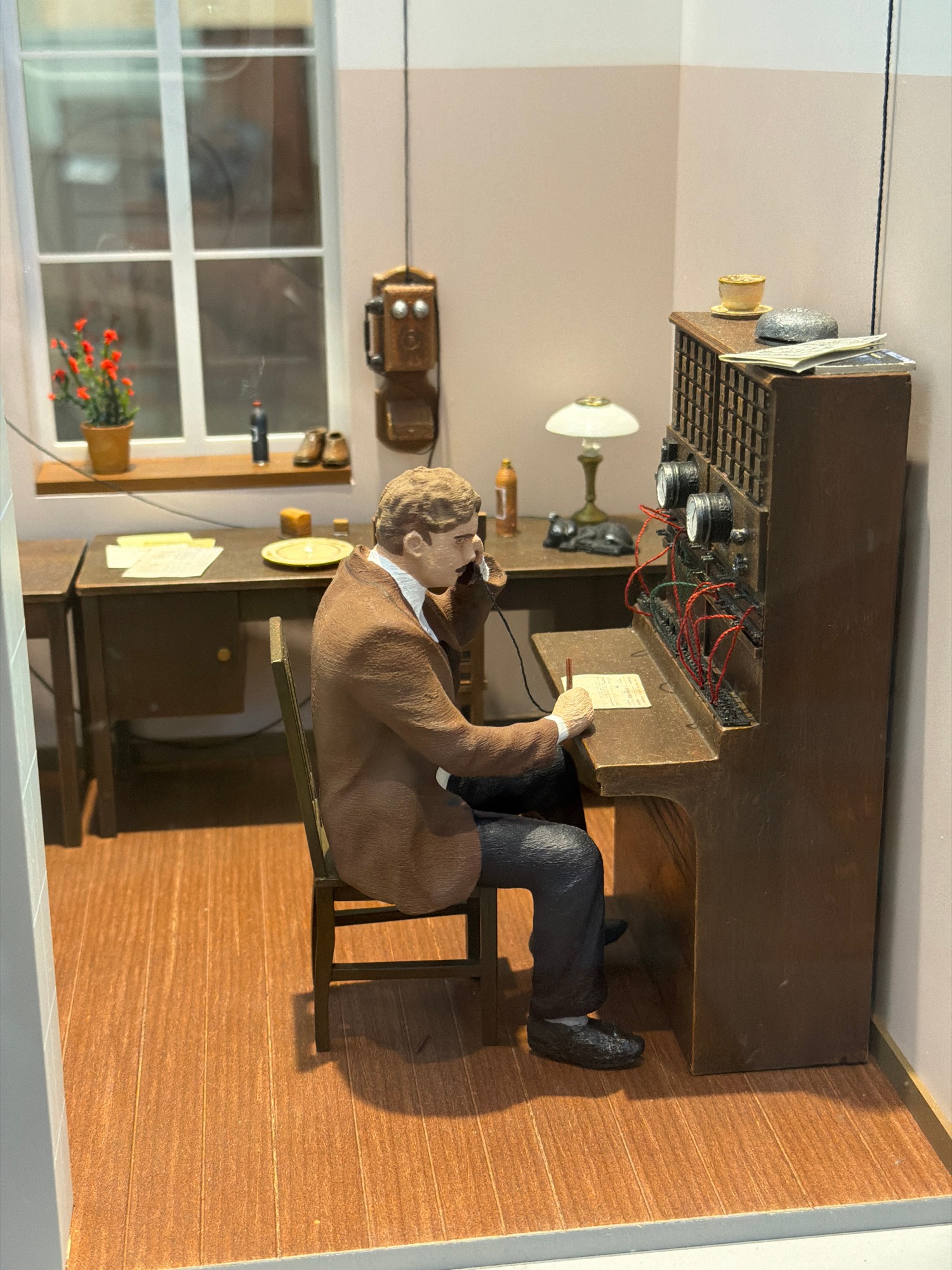
This media file depicts a detailed miniature diorama or model of an indoor scene, likely a room from an earlier historical period. The central subject is a male figurine, dressed in a brown jacket, white shirt, and dark trousers, seated at a wooden desk or console. He is engaged in a telephone conversation, holding an old-fashioned receiver to his left ear while his right hand holds a pencil, poised over a document on the desk.
The desk is a prominent feature, displaying what appears to be vintage radio or communication equipment with exposed red, green, and black wiring, along with several dials and knobs. A table lamp with a white shade provides illumination on the left side of the desk. To the left of the figurine, a small, multi-paned window with white frames allows a blurred view of the outside. Below the window, on the sill, a small pot with red flowers is visible. On the wall above the window, an antique wall-mounted telephone is installed.
The floor is constructed of light brown wooden planks, and the walls are a light beige, transitioning to white near the ceiling. The figurine's posture indicates concentration and engagement with the tasks at hand—communicating and writing. The overall setting, with its specific communication equipment, suggests an early 20th-century context. While there is a paper document on the desk, any visible text is illegible. The scene is presented as a static display, possibly from an exhibition in Riga, Latvia.
Riga, Latvia · Jun 3, 2026, 10:44 AM · 0.1k attention
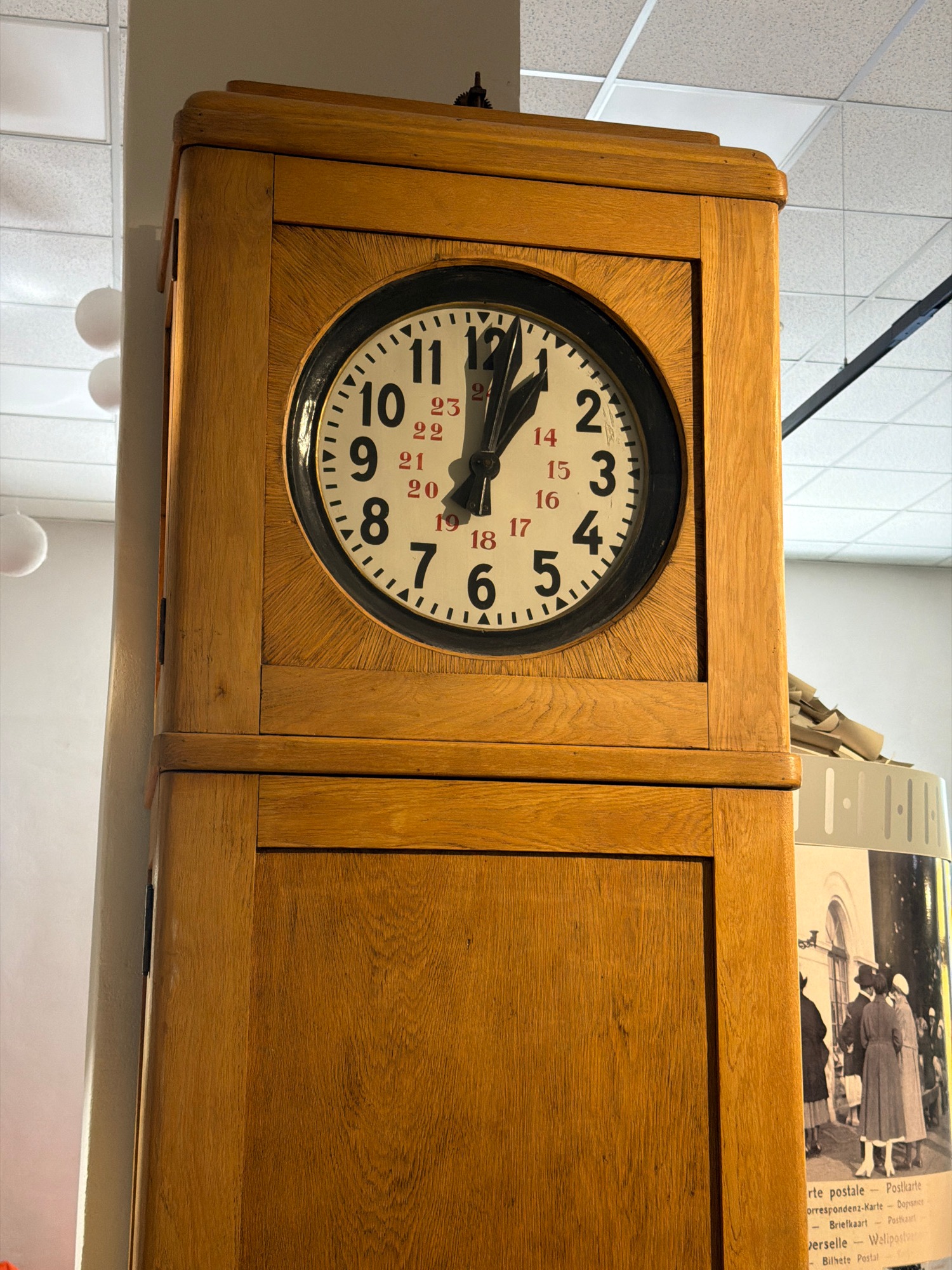
The image features a large, vintage wooden cabinet, likely a standing clock or part of a larger display, situated in an indoor setting in Riga, Latvia. The cabinet is crafted from light-colored wood, possibly oak, exhibiting a visible grain and a traditional design with stepped edges and molding.
The central object is a circular clock face integrated into the left side of the cabinet. It has a white face with clear black minute markers. The clock displays both standard 12-hour time (larger black numbers 1-12 on the outer ring) and 24-hour military time (smaller red numbers 13-24 on the inner ring). The black hour and minute hands indicate a time of approximately 1:50 (or 13:50).
On the top surface of the cabinet, a stack of old paper items, which appear to be postcards or similar printed materials, is visible. One prominent black and white image on a postcard depicts several people, possibly women in hats and long dresses, standing outdoors. Visible text on these items includes various linguistic forms of "postcard," such as "rte postale," "Postkarte," "Correspondenz-Karte," "Dopisnice," "Briefkaart," "Postkaart," "Walipostver," and "Bilhete Postal."
The background shows a ceiling made of white acoustic tiles, suggesting a public building, museum, or office environment. Several spherical white light fixtures are visible towards the lower left. The scene is static, with no discernible activity occurring.
Riga, Latvia · Jun 3, 2026, 10:05 AM · 0.0k attention
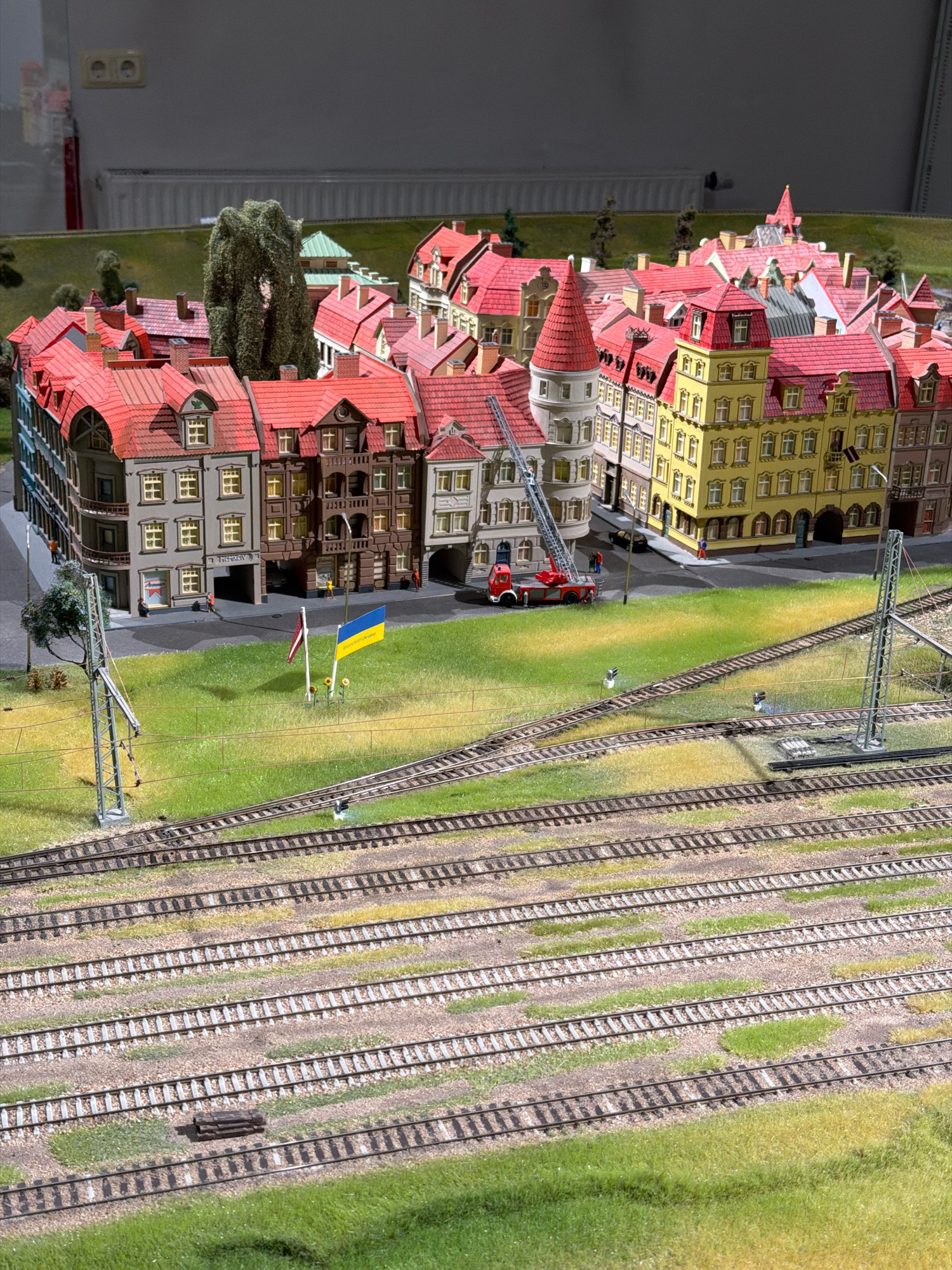
The image displays a detailed miniature model diorama, appearing in a sideways orientation where the model city occupies the left side of the frame and railway tracks span the right. The model city features numerous multi-story buildings, predominantly with red-tiled roofs, alongside structures with grey and brown facades and intricate architectural details. A vibrant red fire truck with its ladder extended is prominently placed among the buildings, suggesting an active scene.
Further within the urban landscape, a bright yellow and blue Ukrainian flag stands tall, with the text "SLAVA UKRAINI" (Glory to Ukraine) clearly visible. Adjacent to it is a smaller Latvian flag, represented by red-white-red horizontal stripes. Miniature trees and small figurines are scattered throughout the city streets and grassy areas.
To the right, a significant model railway yard is depicted, featuring multiple parallel tracks laid on gravel ballast and interspersed with green grassy sections. Overhead electrification structures, resembling catenary gantries, are visible spanning across some of the tracks. Small figurines are positioned on or near the railway lines.
The scene is brightly and evenly lit, suggesting a daytime setting, possibly under artificial lighting typical of a museum or exhibition display. The presence of the Latvian flag, combined with the context of Riga, Latvia, suggests the diorama represents a location within Latvia. The image offers a top-down perspective of this meticulously crafted miniature world.
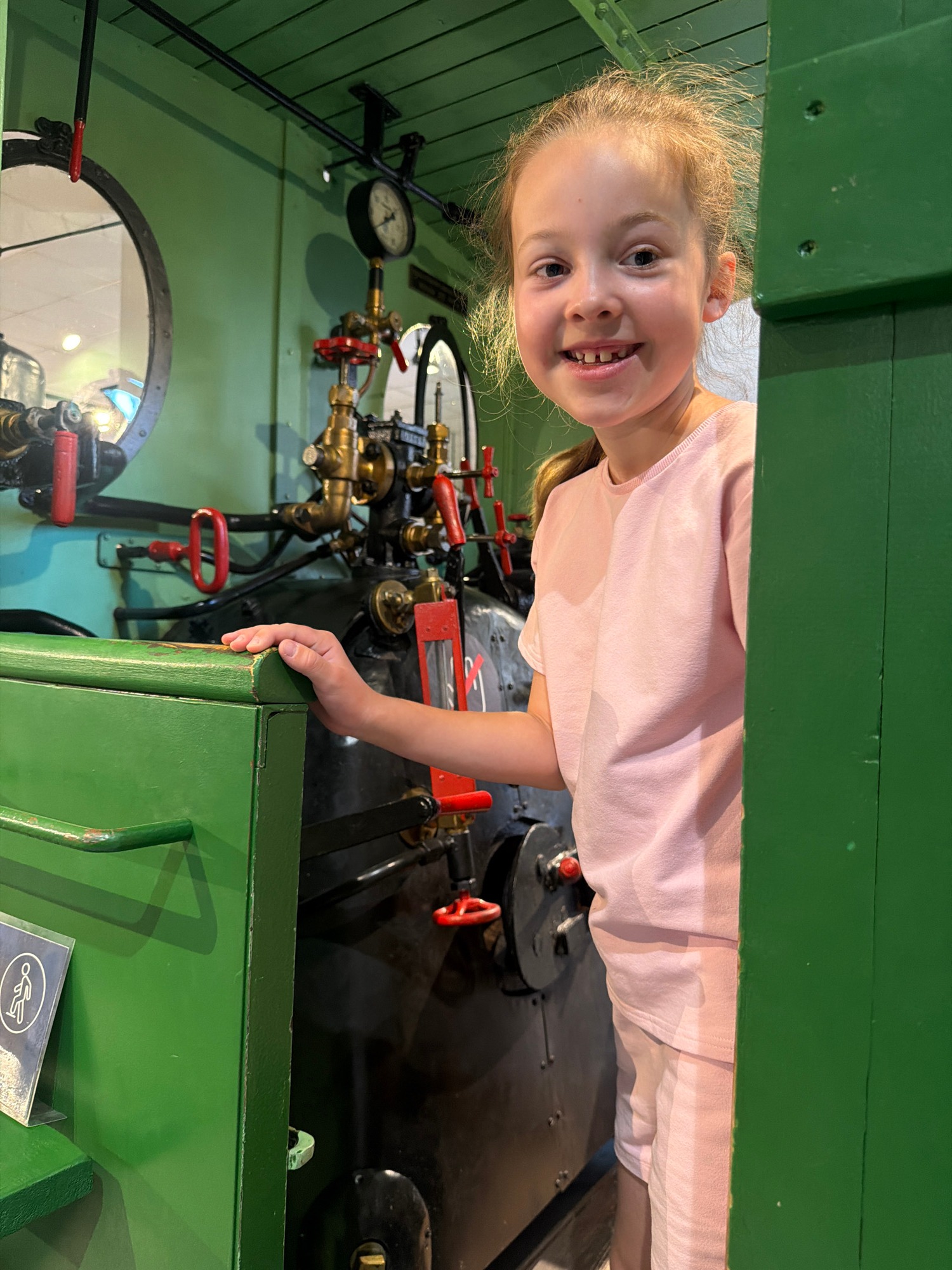
A young girl with light-colored hair is captured from the chest up, smiling broadly at the camera. She is leaning over a dark green partition, which forms part of what appears to be a locomotive's control cab. Her left hand rests on the edge of the partition. She wears a light pink t-shirt.
The setting is an indoor space, likely a museum exhibit, with artificial lighting. Behind the girl, the intricate machinery of a train's operating panel is visible. This includes various brass-colored valves, black metal levers, and gauges, many accented with red handles or components. The walls of the cab interior are painted a lighter shade of green, with circular windows or portholes set into them on the left side.
The girl's joyful expression and engaged posture suggest she is exploring the exhibit with curiosity and excitement. On a small white sign positioned on the lower right, a pictogram shows a person bending or crawling, likely indicating a height restriction or an instruction for interacting with the exhibit. Given the location context of Riga, Latvia, this scene is likely from a railway history museum or similar institution, showcasing an old locomotive.
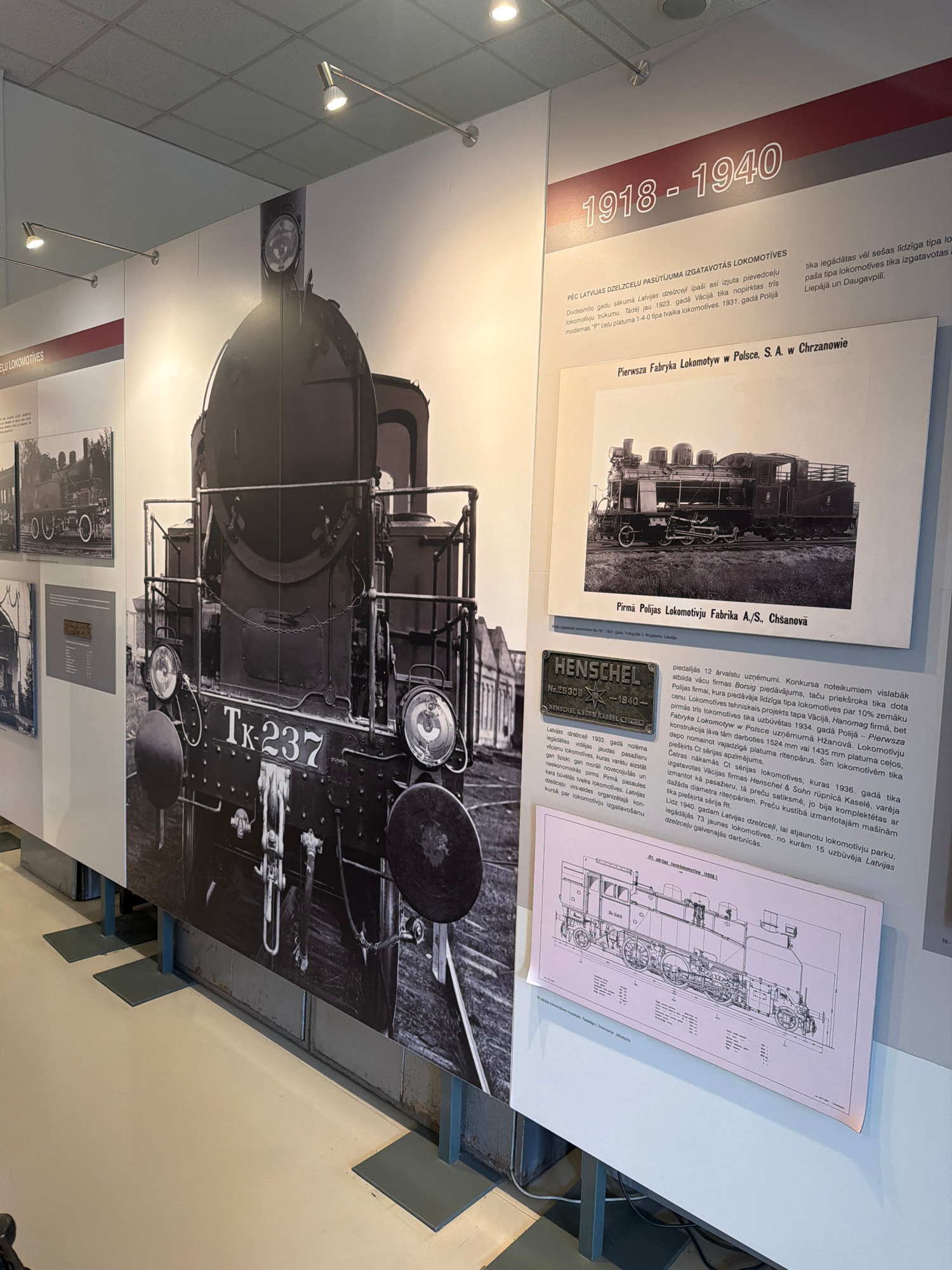
This media file captures an exhibition display in Riga, Latvia, focusing on the history of locomotives between 1918 and 1940. The main subject is a large, black and white photograph of a steam locomotive, prominently featuring the number "TK-237" on its front.
Surrounding the central image are several information panels with text in Latvian and Polish, smaller historical photographs, a technical drawing, and a metal plaque. The large title banner at the top left reads "1918-1940". One panel, titled "PÉC LATVIJAS DZELZCEĻU PASŪTĪJUMA IZGATAVOTAS LOKOMOTIVES" (Locomotives Manufactured by Order of Latvian Railways), describes the Latvian railway's need for locomotives in the 1920s, mentioning purchases from Germany in 1923 and Poland in 1931, and manufacturing in Liepāja and Daugavpils. It also names "Pierwsza Fabryka Lokomotyw w Polsce, S. A. w Chrzanowie" (First Locomotive Factory in Poland, S. A. in Chrzanów).
Another panel details the acquisition of medium-power passenger locomotives in 1933, noting a competition involving 12 foreign companies. It states that German firm Hanomag designed the technical project, and the first three locomotives were built in 1934 in Chrzanów, Poland. These "Ct series" locomotives could operate on different track gauges. Four subsequent Ct series locomotives were built in 1936 by Henschel & Sohn in Kassel, designated as "Rt series" for freight. By 1940, Latvian railways had acquired 73 new locomotives, 15 of which were built in Latvian railway workshops.
A small metal plaque displays "HENSCHEL", "Nr.25308 -1940-", and "HENSCHEL & SOHN KASSEL". A technical schematic is labeled "At sērijas tvaika lokomotive (1938)" (At series steam locomotive (1938)). The lighting suggests an indoor setting, typical of a museum.
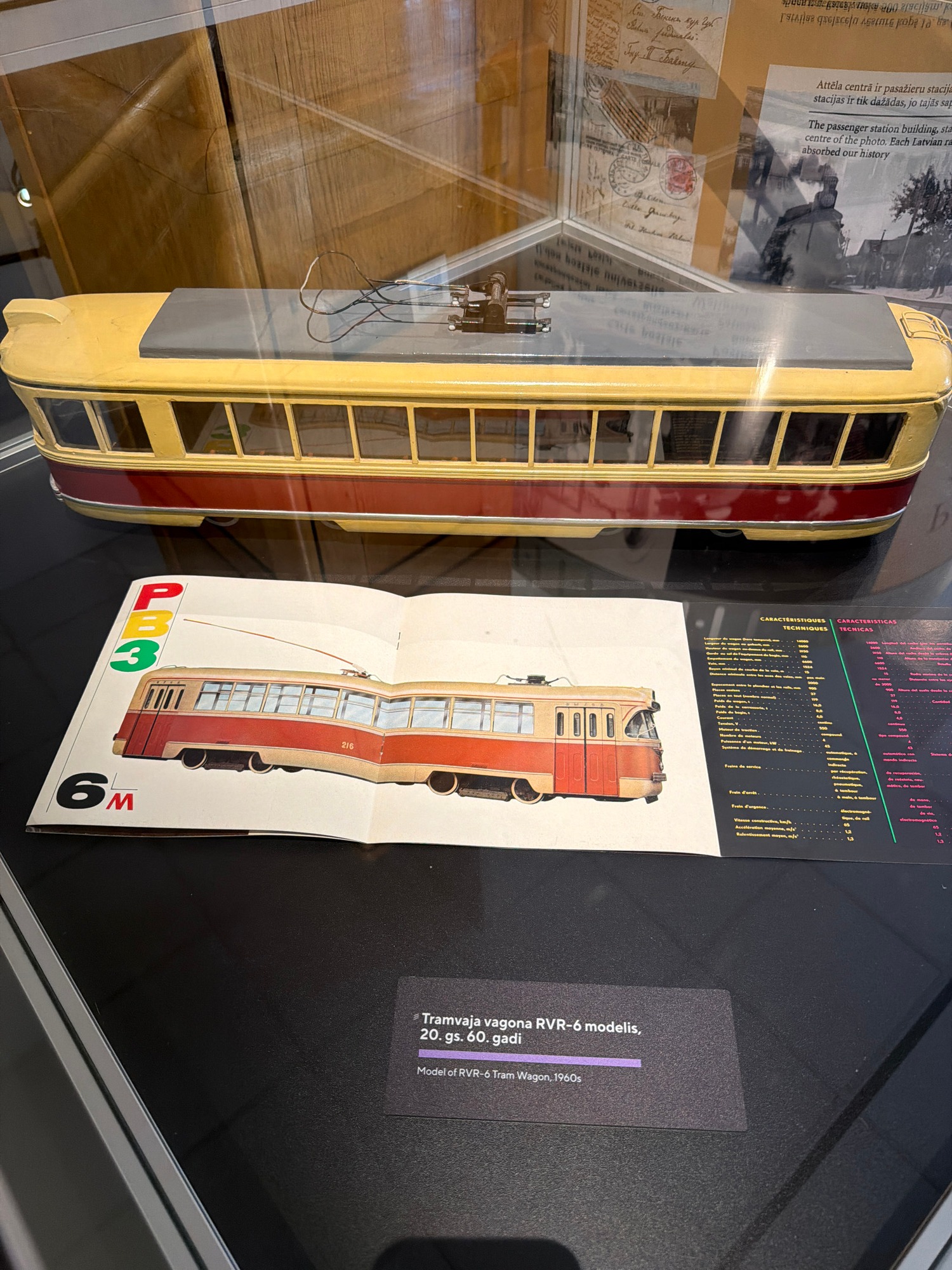
This image captures an indoor museum exhibit, likely in Riga, Latvia, centered around a model of a tram wagon. The main subject is a detailed physical model of a RVR-6 tram, presented horizontally in a display case. It is painted in yellow with a dark red/maroon lower section, and fine details such as windows and overhead electrical connections are visible.
Next to the model lies a folded pamphlet or brochure, displaying a graphic illustration of the same RVR-6 tram from a side view. This illustrated tram features a beige/orange and red color scheme, with the number "216" on its side and prominent "PB3" and "6M" markings. A small black plaque nearby identifies the exhibit in both Latvian and English: "Tramvaja vagona RVR-6 modelis, 20. gs. 60. gadi" and "Model of RVR-6 Tram Wagon, 1960s."
In the background, a larger black display card titled "CARACTERISTICAS TECNICAS" and "CARACTÉRISTIQUES TECHNIQUES" lists various technical specifications in multiple languages, including French terms like "Vitesse constante, km/h" and "Accélération moyenne, m/s²." Further behind, a reflective panel displays text in Latvian and English, alongside an old photograph of a building. The text refers to "The passenger station building" and how "Each Latvian rail station has absorbed our history," suggesting a broader context of transport history. The setting indicates an educational or historical display about transportation in Riga or Latvia.
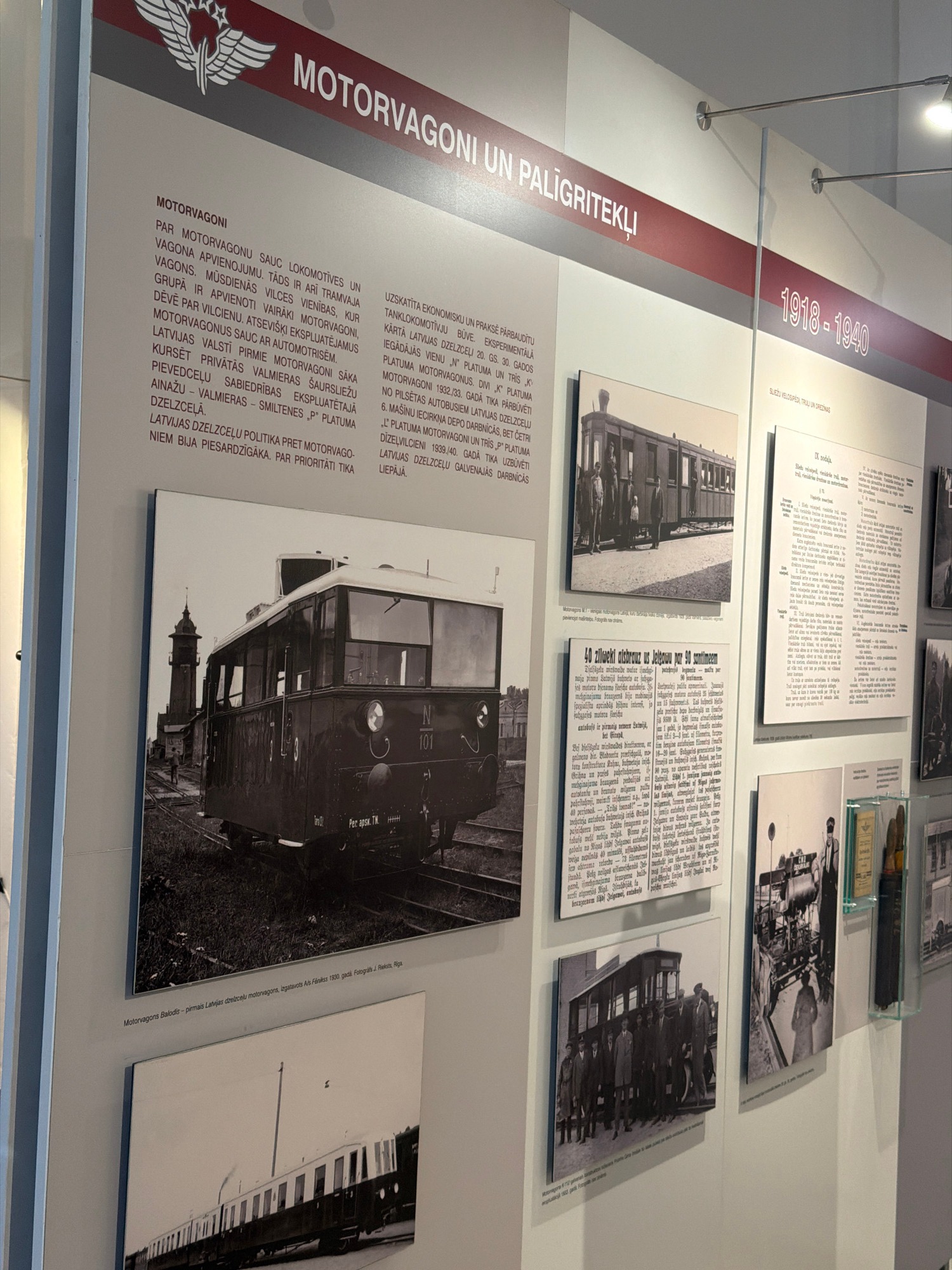
This image shows a wall exhibit in a museum, likely dedicated to the history of Latvian railways. The main title of the exhibit is "MOTORVAGONI UN PALĪGRITEKLI" (Motorwagons and Auxiliary Rail Vehicles), covering the period "1918-1940".
The exhibit features several black and white historical photographs of various motorwagons and people associated with them. One prominent photo shows a motorwagon labeled "N 101" with a church tower in the background, and another caption identifies it as "Motorvagons Balodis - pirmais Latvijas dzelzceļu motorvagons, izgatavots Als Féinks 1930. gada" (Motorwagon Balodis - the first Latvian railway motorwagon, manufactured by Alš Fēinks in 1930). Another photograph depicts a group of people standing next to a train car.
Accompanying the images are extensive text panels in Latvian, detailing the history, development, and use of motorwagons on Latvian railways. The text explains that motorwagons were self-propelled railcars, sometimes grouped into "vilcieni" (trains) or used as "automotrisēm" (autorails). It mentions their introduction on private narrow-gauge lines like Valmiera and Ainaži-Valmiera-Smiltene, and refers to experimental purchases and rebuilds from city buses. One section is titled "SLIEŽU VELOSIPEDI, TRULJ UN DREZINAS" (Rail bicycles, trolleys and draisines), suggesting that these auxiliary vehicles are also part of the display. A snippet of what appears to be a historical newspaper clipping is captioned "40 zilweki alsbrauz us Jelgawu par 90 santimeem" (40 people traveling to Jelgava for 90 santims).
The setting is an indoor, well-lit museum space with light-colored walls. The exhibit is presented chronologically, focusing on railway innovation in Latvia during the interwar period.
Riga, Latvia · Jun 3, 2026, 10:07 AM
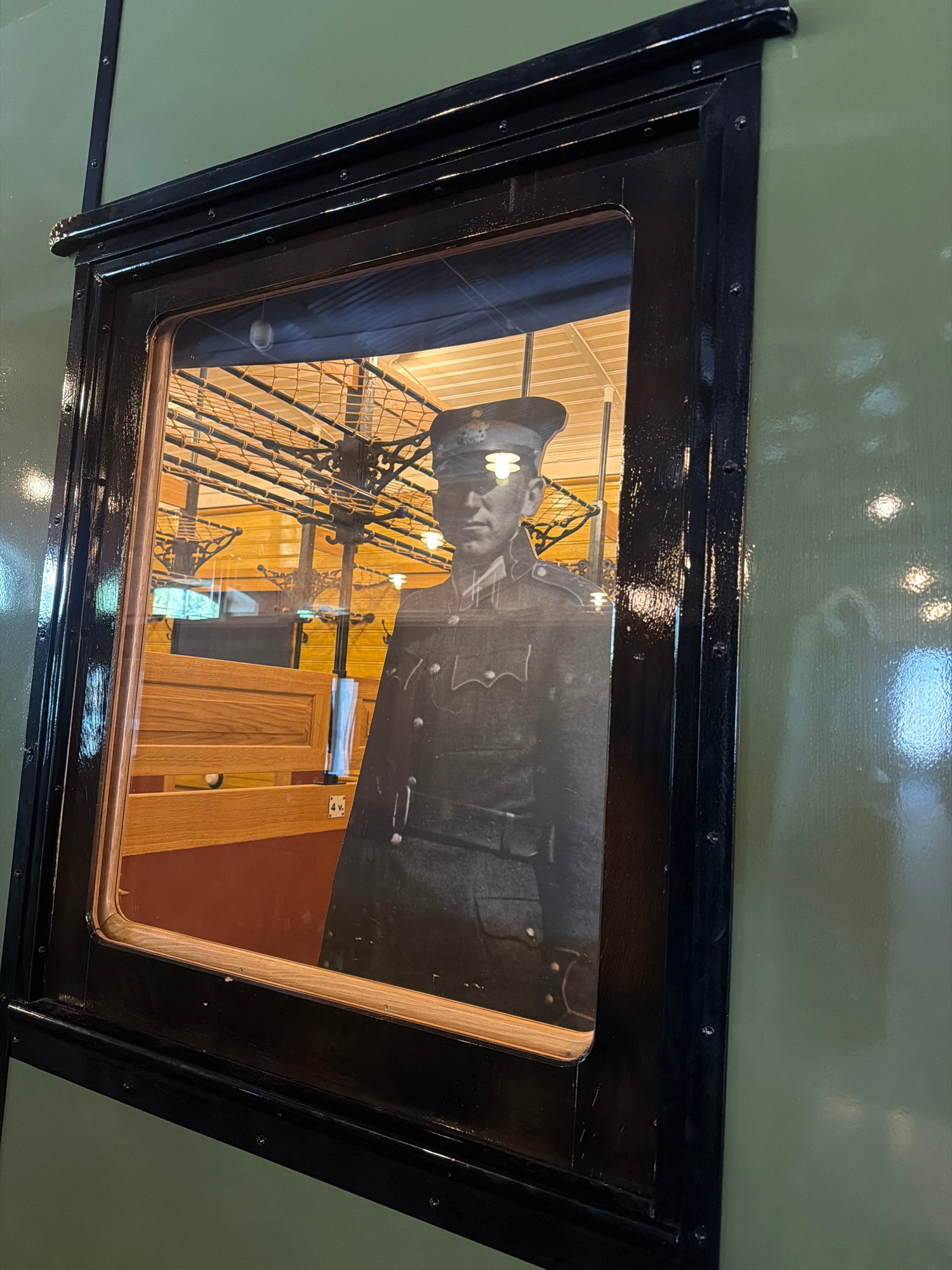
The image captures a reflection within a rectangular window, set into a glossy, olive-green ceiling or wall. The window has a thick, shiny black frame secured by multiple screws. The surface around the window reflects several bright, circular light sources.
Within the window's reflection, a prominent black-and-white image or cutout of a man in historical attire is visible, angled horizontally across the frame. He wears an elaborate military-style uniform with epaulets and a distinguished hat, and appears to be a person of rank, possibly from the 19th or early 20th century. His gaze is directed towards the left side of the frame, with a serious expression.
Behind the figure, the reflection reveals an interior space characterized by light-colored wooden walls and what appears to be a patterned floor or ceiling. A large, intricate structure made of dark metal, resembling a decorative balustrade or part of complex machinery, is also strongly reflected. Further back, two wooden doors with paneling are visible, and on one of the wooden elements, the faint text "4 V." can be discerned. The overall impression is that of a museum or exhibition space in Riga, Latvia, likely viewed through a window in a display case or an exhibit enclosure.
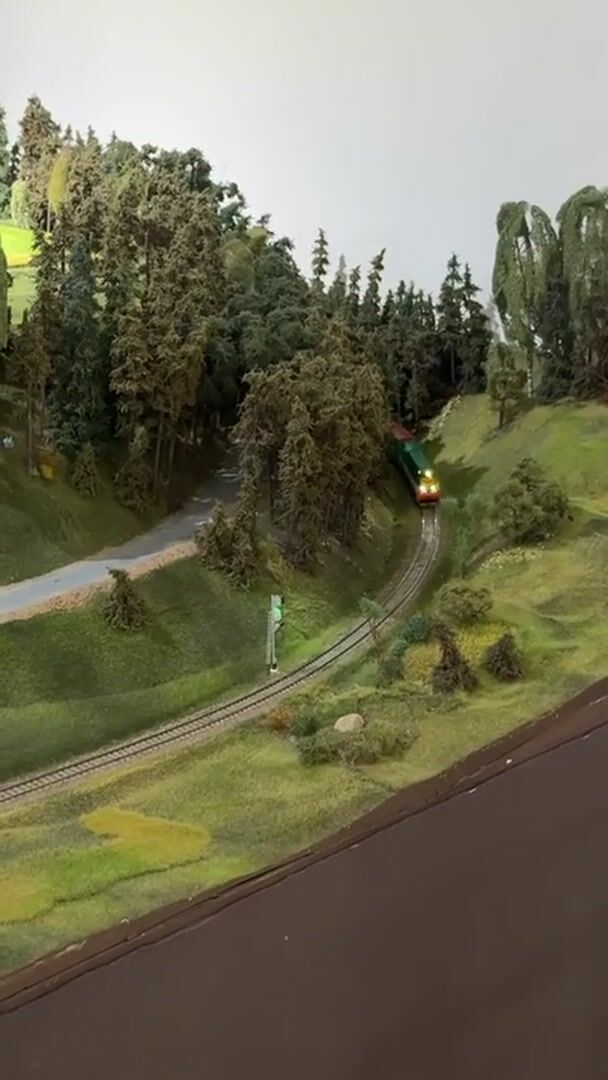
A model train set is shown, featuring a green and red train with illuminated headlights moving along a curved section of railway track. The miniature landscape depicts a hilly, forested area with numerous model evergreen trees and some deciduous trees. A model road runs alongside the train tracks for a short distance. A signal post with a green light is visible beside the tracks, indicating a clear route for the train. The terrain is covered in green flocking to simulate grass and dirt. The scene suggests an indoor display, possibly in Riga, Latvia.
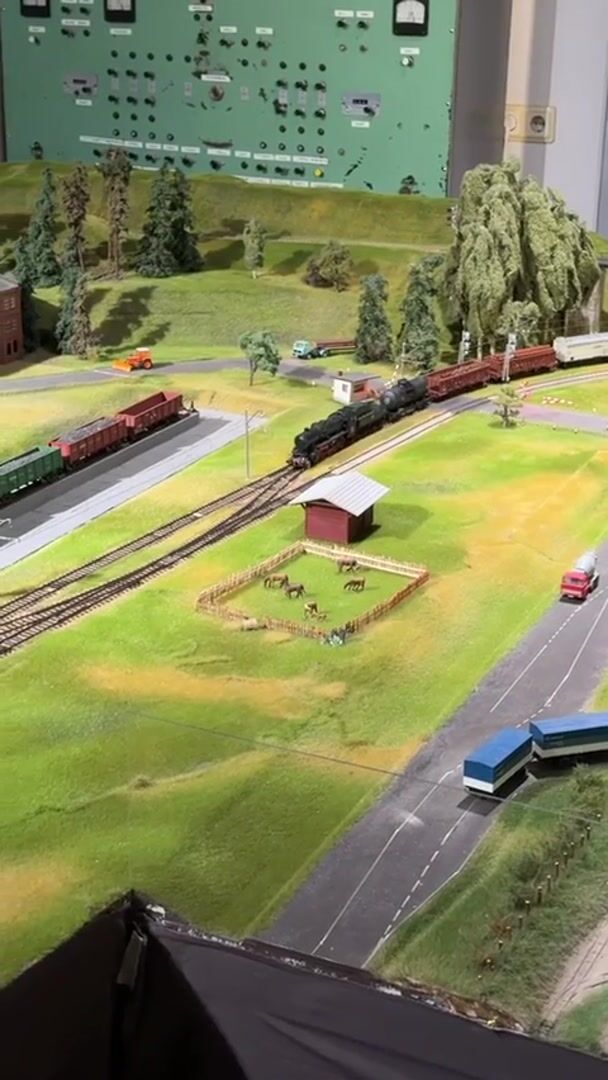
A model train layout in Riga, Latvia, is captured from an elevated perspective. The detailed diorama features a vibrant green landscape with various elements. A black steam locomotive pulls a line of freight cars (predominantly brown, with one green) along a track that curves through the scene. Parallel to the main track, another set of tracks holds several stationary freight cars next to a large, reddish-brown building.
In the mid-ground, a small red-roofed shed sits next to a fenced enclosure containing several miniature horses. Beyond this, a road runs across the landscape, with a blue and white articulated truck and a red tanker truck positioned on it. Numerous miniature trees and bushes are scattered throughout the grassy terrain. In the background, a large green control panel with an array of switches and dials indicates the operational nature of the model railway. The scene depicts a lively, miniaturized rural setting with active rail and road traffic.
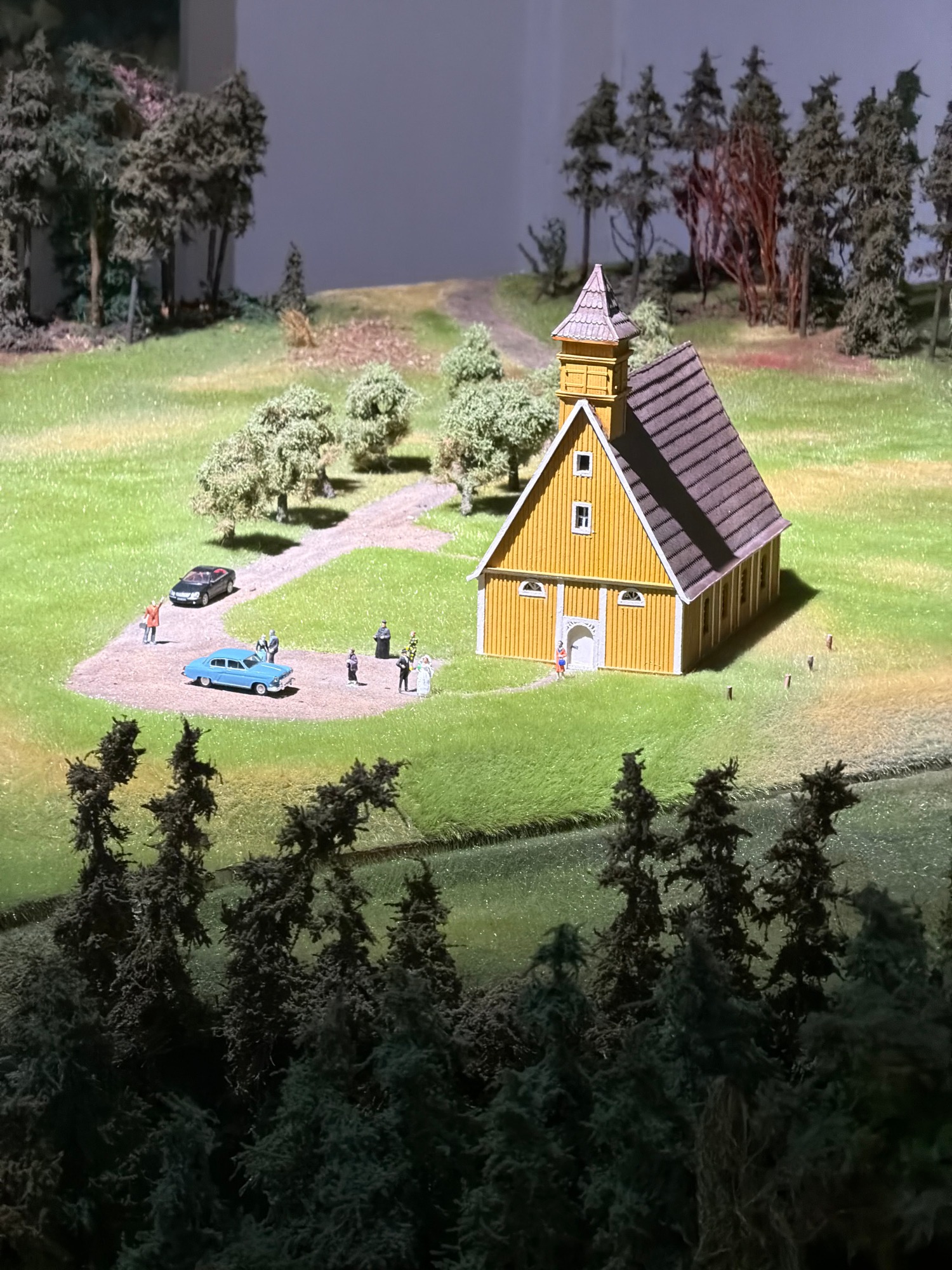
This media file captures a detailed miniature diorama, presented in the context of Riga, Latvia. The diorama depicts a serene rural or small-town scene, centered around a prominent yellow building with a dark shingled roof and a small steeple topped with a cross. The two-story building features multiple windows and a white-framed entrance, near which a miniature figure in a red top and blue pants stands, accompanied by a small bicycle.
The building is situated on a vibrant green landscape, simulating grass, with a winding dirt path leading to its front. Numerous miniature evergreen trees of various sizes and textures are scattered throughout the scene; some form dense clusters in the background and foreground, while others line the path.
On the dirt path, two miniature cars are present: a black sedan and a light blue vintage-style car. Several miniature human figures are arranged around the scene, suggesting social interaction. Two figures are near the blue car, one seemingly reaching into it. Further along the path, a small dog figure accompanies other human figures, including two walking towards the building – one in a light dress and another in dark attire. Another figure in orange/brown clothing stands near the black car.
The lighting within the diorama suggests a bright daytime setting, casting subtle shadows from the buildings and trees. There is no visible text in the image. The scene portrays a peaceful gathering or daily life activity within a meticulously crafted miniature environment.
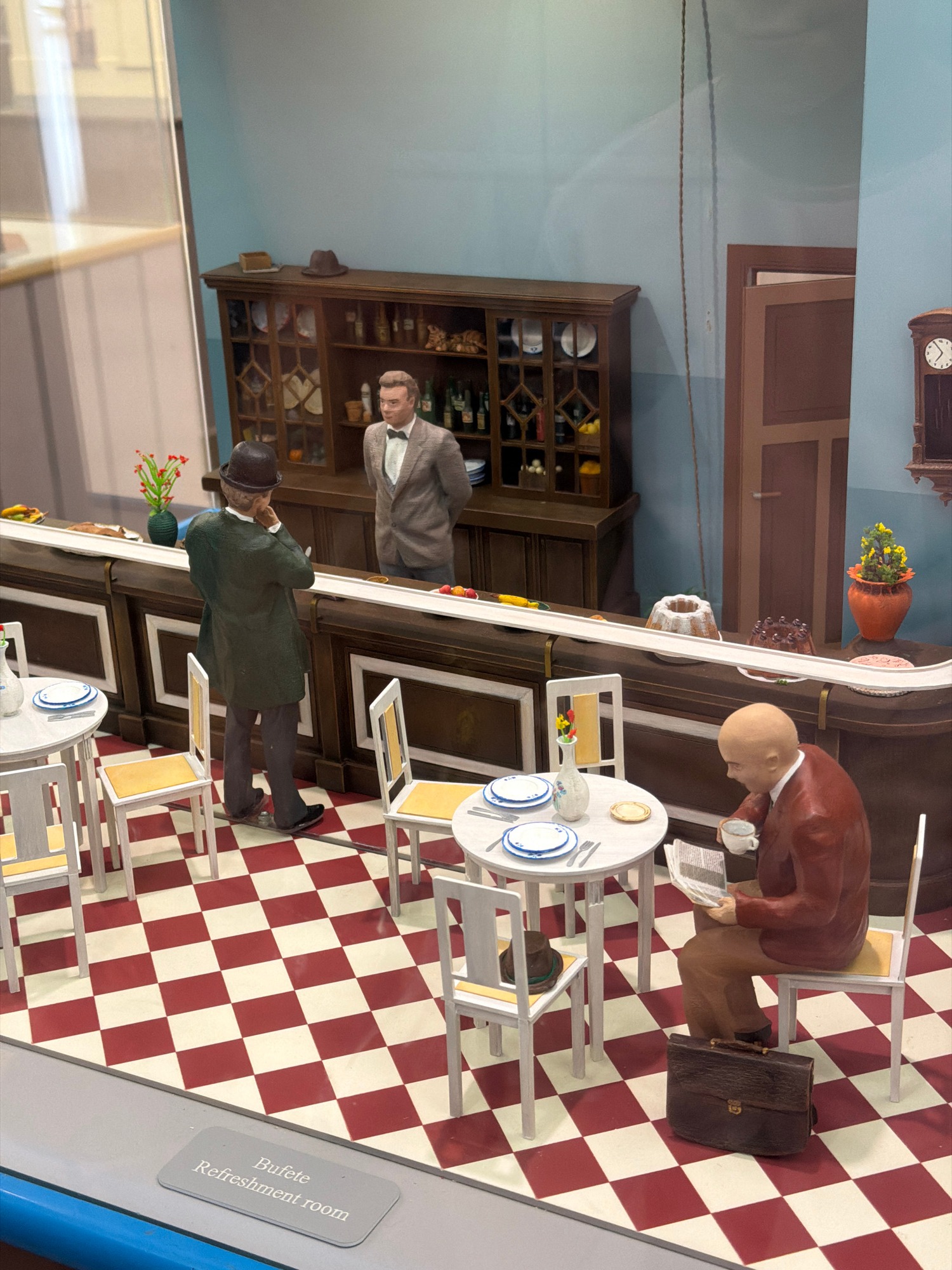
This media file captures a detailed miniature diorama of a "Bufete / Refreshment room," likely from an exhibition in Riga, Latvia. The indoor scene features light blue walls and a striking red and white checkered floor.
Several male figures are depicted in various activities. Behind a long, dark wooden counter, a man in a grey suit and bow tie stands, resembling a server. The counter holds miniature cakes, pastries, and floral arrangements. Behind him, a wooden display cabinet is filled with tiny bottles and dishes.
In the foreground, another man in a dark green coat and bowler hat stands near the counter. Further into the room, a bald man in a reddish-brown jacket is seated at a small, round white table. He holds a white cup and appears to be reading a miniature newspaper, with a dark brown briefcase resting on the floor beside him. The table is set with two blue-rimmed white plates and cutlery. Several other empty tables and chairs are arranged around the room.
Notable details include a wooden wall clock and a partially open wooden window frame on the upper wall. A simple braided rope-like wire runs horizontally across the upper wall. The entire scene is meticulously crafted, offering a glimpse into a historical or typical refreshment room setting. A grey sign in the lower right corner explicitly labels the scene in both Latvian and English: "Bufete / Refreshment room."
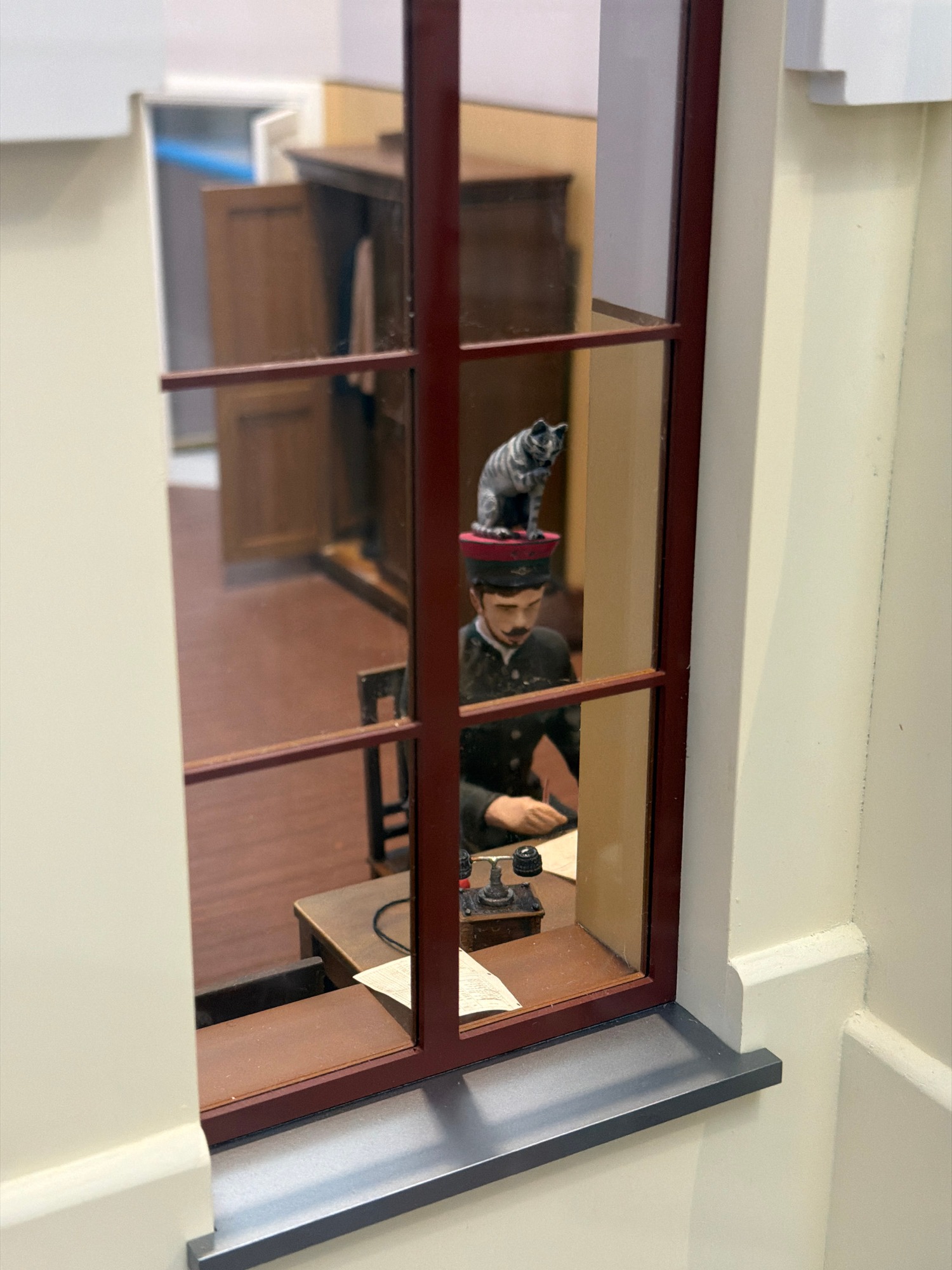
A miniature diorama depicting an indoor scene is viewed through a multi-paned window with a dark brown wooden frame. The perspective is from outside, looking into a room within a light cream-colored building. A grey metallic trim piece is visible on the exterior wall to the right of the window.
Inside the room, a miniature figure of a man, dressed in a dark uniform and hat, is seated at a wooden desk. He appears to be engaged with an old-fashioned black telephone device, with his hands positioned near it and some papers. Also on the desk, next to the man, is a small, striped grey cat figure wearing a red collar or hat. The desk features visible drawers. The room appears to be an office or study.
The man's uniform and the style of the telephone suggest a historical setting, likely early to mid-20th century. The scene is well-lit, indicating daytime, though no specific time or weather details are discernible. No visible text can be identified within the image. This intricate miniature display is located in Riga, Latvia.
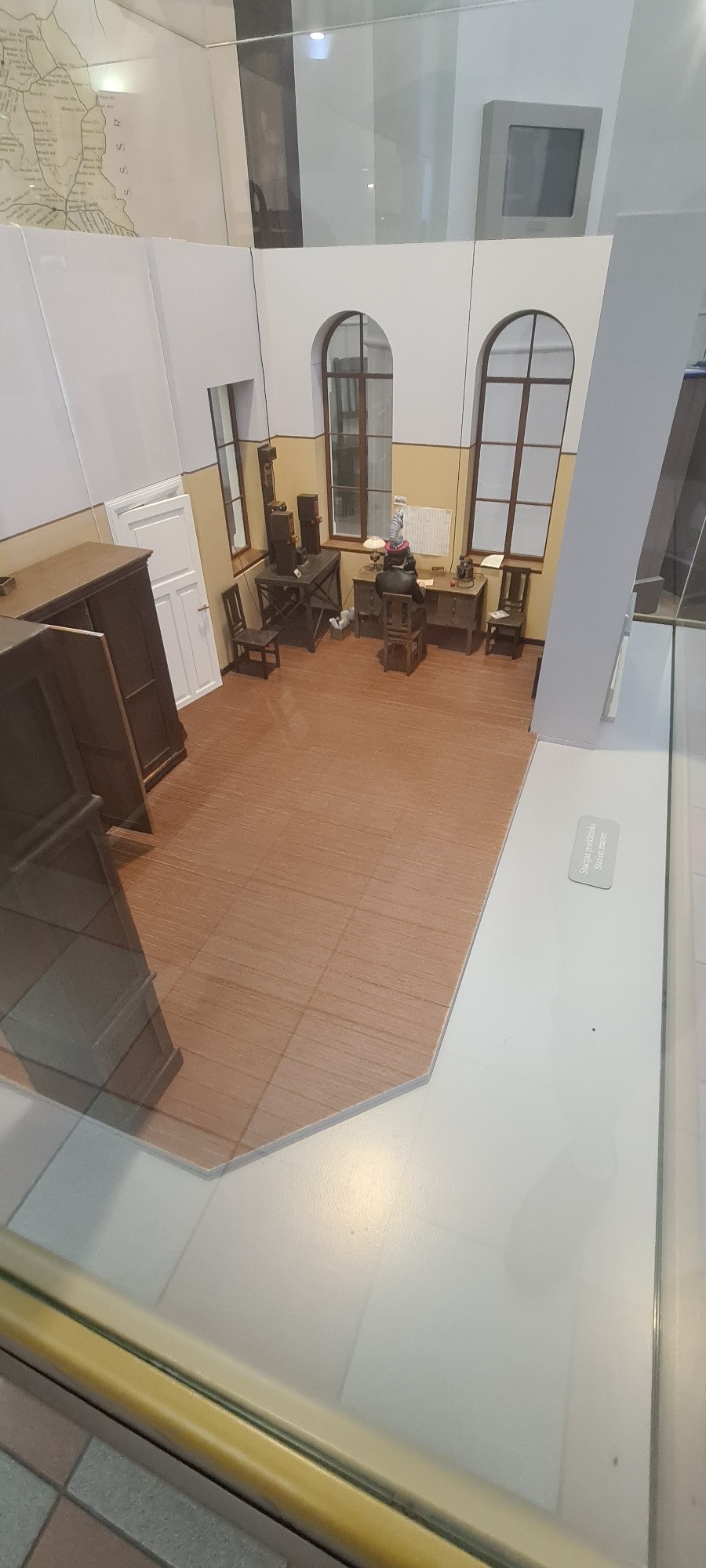
The media file displays a detailed miniature diorama or model of an interior space, likely an old railway station master's office, enclosed within a glass display case. The scene is presented from an elevated perspective, looking down into the meticulously crafted room.
The main subject is the intricately furnished office, featuring dark wooden furniture including several desks, chairs, and cabinets. Various miniature pieces of equipment, possibly telegraph machines or early communication devices, are arranged on the desks, suggesting a functional workspace. One desk holds a small white document. The room features light brown flooring and white walls. Two prominent arched windows with muntins are visible on one interior wall, while the "exterior" facade of the model shows similar arched windows and a smaller, rectangular window.
A miniature figure of a person, dressed in what appears to be a dark uniform with a red accent, is seated at one of the central desks, depicting the station master engaged in work.
The model is part of a museum exhibit, evident from the protective glass casing, which also causes reflections from the surrounding environment. In the bottom left, a portion of a map with the letters "SSSR" (USSR) is visible beneath the glass. A small, light-colored plaque on the white floor section of the model, outside the main room, displays text in two languages: "Stacijas priekšnieks" (Latvian for Station Master) and "Station master" (English), confirming the depicted scene. The equipment and visible text suggest a historical context, likely from the Soviet era. No specific time of day or weather is discernible.
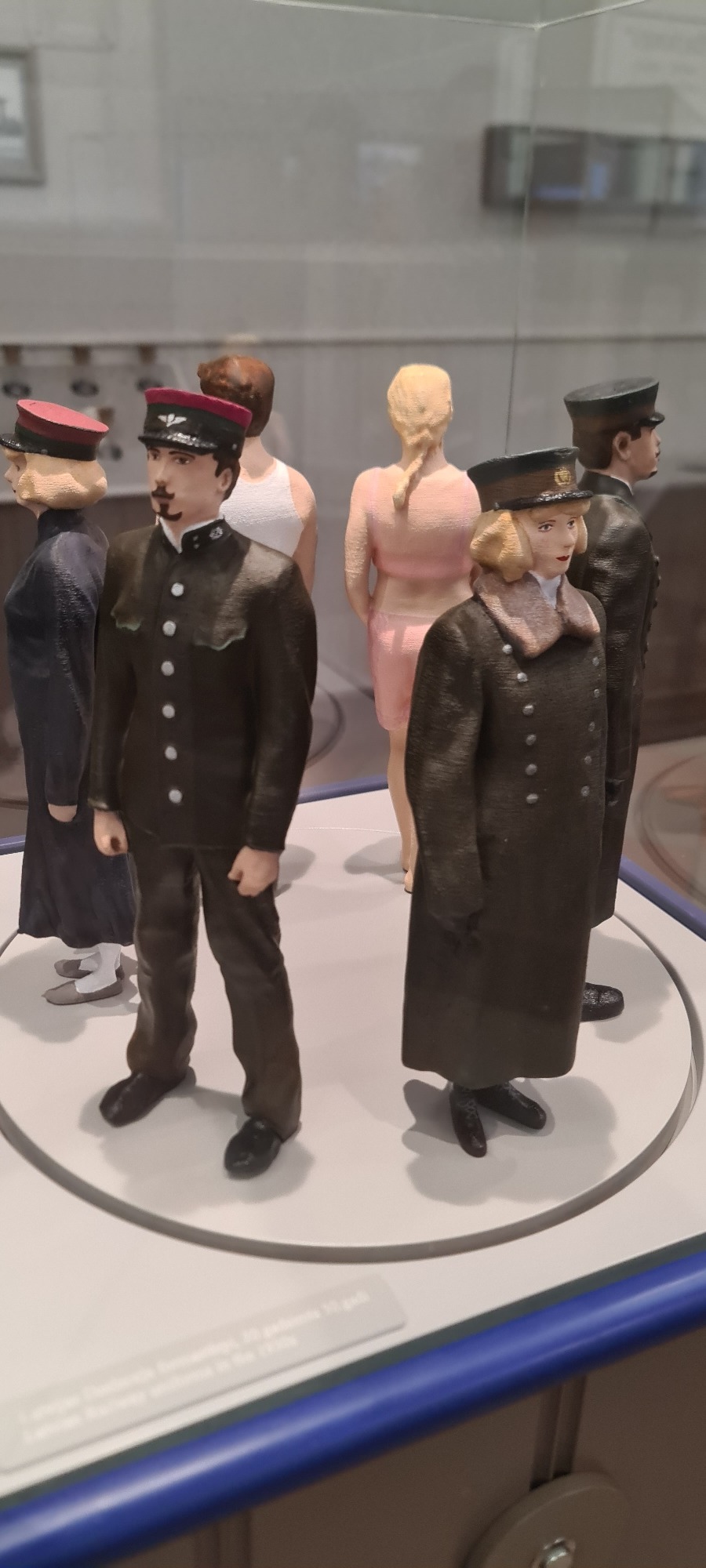
The image presents a museum exhibit featuring several miniature figures, likely depicting historical characters, displayed on a white circular base. The exhibit is viewed through a glass barrier, causing some reflections.
There are at least five figures visible, arranged in a line. Several male figures wear dark uniforms with peaked caps, some featuring official-looking insignia. One male figure in the foreground has a mustache and wears a dark uniform with light buttons and a cap with a red band. Another male figure behind him also wears a dark uniform and cap. Among the figures are two women: one with blonde hair wearing a light pink dress, and another with brown hair in a white top. A third female figure, with blonde hair and a cap, is dressed in a dark uniform similar to the male figures, positioned next to the woman in the pink dress.
A small white plaque is partially visible on the display base. The discernible text reads "Latviešu dzelzceļnieku no 1930.", which translates to "Latvian railway workers from 1930s." This indicates the figures represent individuals associated with the Latvian railway system during that decade. The uniforms and attire reflect the fashion and professional dress of the era. The background is a blurry indoor setting, consistent with a museum environment. The figures are static models, illustrating a historical period or specific roles within the railway industry in Riga, Latvia.
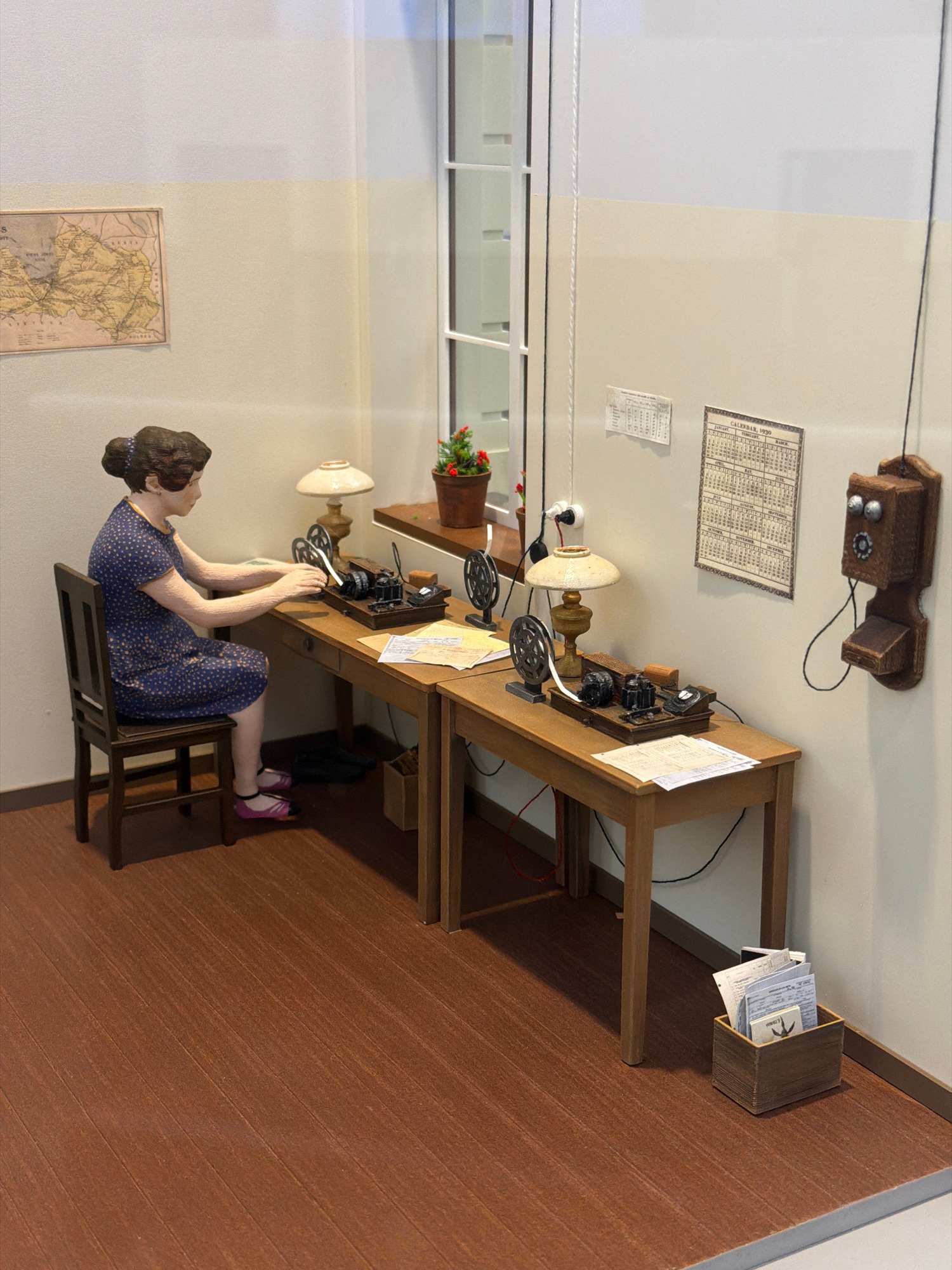
This image captures a detailed miniature diorama, likely a museum exhibit from Riga, Latvia, depicting an indoor scene from the year 1939. The central figure is a female figurine, dressed in a blue polka-dotted dress with her hair styled in a bun, seated on a wooden chair. She is actively operating an old-fashioned telegraph or teletype machine positioned on a long, sturdy wooden desk.
The desk holds a total of three such machines, each with a keyboard and paper mechanism, along with two antique desk lamps featuring white shades and brass-toned bases. On the wall directly above the desk, a vintage wall-mounted telephone with two bells, a crank, and a mouthpiece is installed. Below it, a large calendar or chart prominently displays the title "CALENDARIUM ANNI 1939," precisely dating the scene. A smaller document with illegible text is visible beneath the calendar.
Other notable objects include a small potted plant with red flowers on the desk near the figurine, and a framed map with unreadable details hanging on the lower left wall. To the right of the desk, resting on the brown, textured floor, is a wooden box filled with papers, one of which partially shows the word "ČEKULI." The room features light-colored walls and a white structure overhead, possibly a window or light fixture. The entire setup meticulously recreates a historical working environment, likely an office or communication station from the specified year.
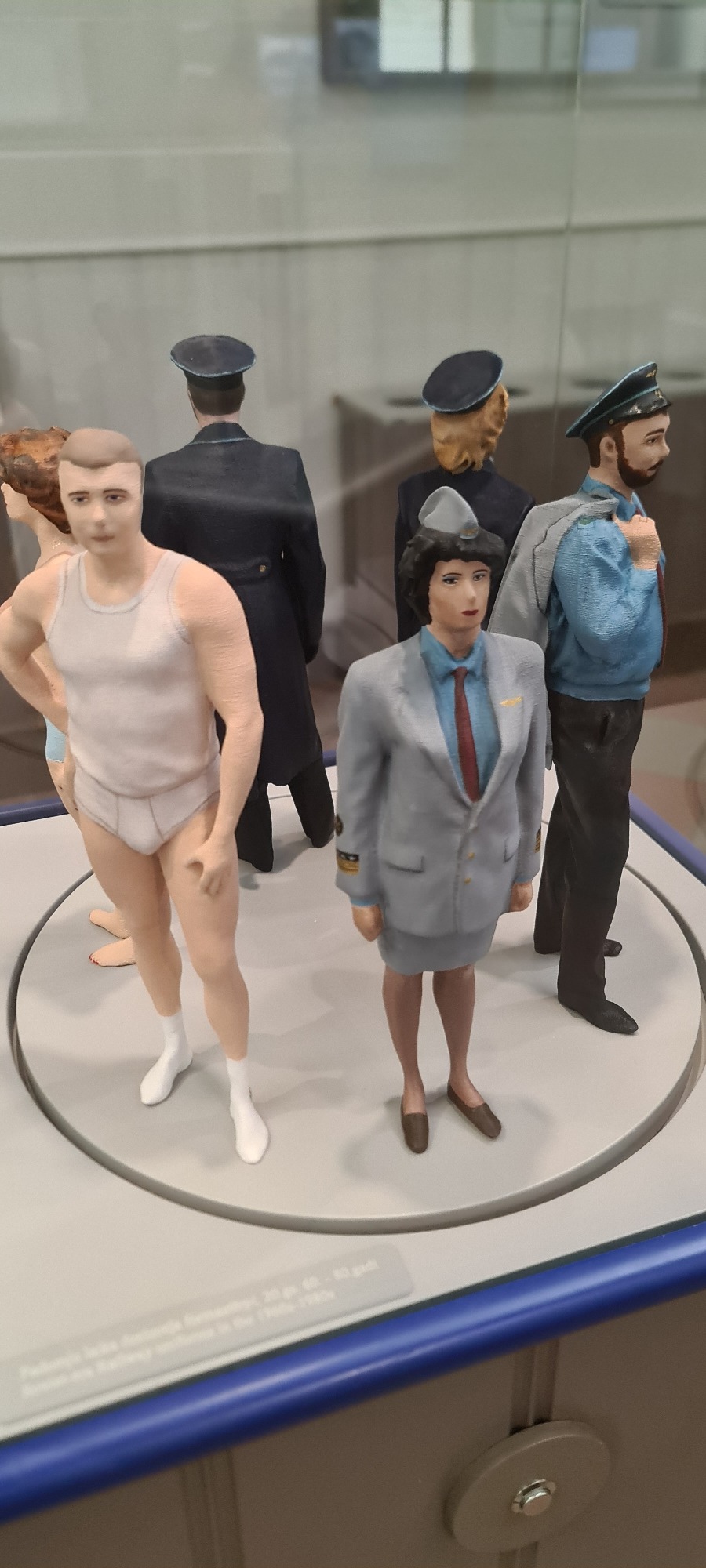
The image displays a series of four miniature figures, resembling dolls or models, arranged in a line on a circular, light grey display base. The setting appears to be an indoor exhibition or museum.
From left to right (when viewed upright):
1. A male figure with light skin and light brown hair, wearing only a white tank top and white briefs.
2. A male figure dressed in a dark blue uniform jacket, dark trousers, and a matching dark hat, possibly depicting a sailor or officer.
3. A female figure with dark hair, wearing a light grey uniform jacket, a light blue shirt, a red tie, and a matching grey cap, suggestive of an air hostess or another service professional.
4. A male figure with a beard, wearing a light blue shirt, a grey vest, dark trousers, and a dark cap, potentially representing a working-class individual or uniformed worker.
The figures are static, posed on the display, and are well-detailed with distinct facial features and clothing textures. The arrangement implies a thematic presentation, possibly illustrating changes in fashion, uniforms, or social roles over time.
In the background, reflections of what appear to be windows or a building are visible. A blue rail or trim borders the display base. A small, blurry plaque on the display base contains text in Latvian. Partially discernible phrases include "20 gs. 60.-90. gadu" (20th century 60s-90s) and "1900.-1930.", indicating the exhibit likely pertains to historical periods or social conditions within those timeframes, consistent with the location context of Riga, Latvia.
Riga, Latvia · Jun 3, 2026, 10:45 AM
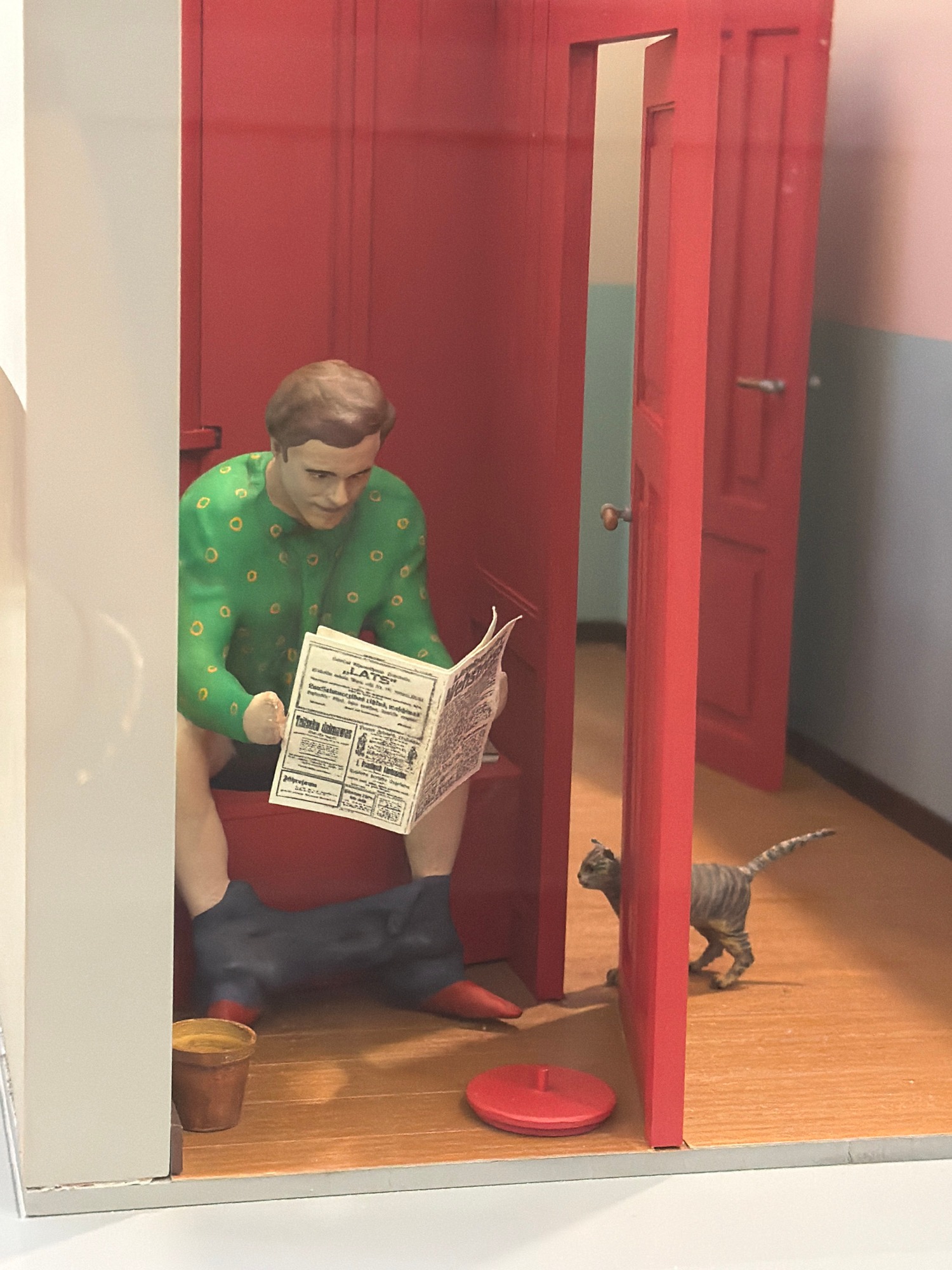
This image displays a highly detailed miniature diorama, depicting a domestic scene within what appears to be a small bathroom or private room.
The primary subject is a male figurine, seated on a toilet. He is dressed in a vibrant green shirt adorned with yellow polka dots and dark blue trousers. The figurine is engrossed in reading an open newspaper, which he holds in both hands. His gaze is directed downwards at the paper.
Behind the man, a striped tabby cat figurine is depicted in motion, with its front paws on a red partition or shelf and its hind legs on the wooden wall, as if climbing or playfully observing the scene.
The setting features red paneling on what appear to be doors or walls, and a warm wooden floor. A red circular disc, likely a toilet paper holder, is mounted on the wooden wall near the toilet. A small, light brown wooden bucket or bin rests on the floor beside the man's legs.
Notable details include the miniature newspaper, which shows several columns of text and advertisements. Partially visible words on the newspaper include "LATS" (the former currency of Latvia), "Speciellen Handel" (Special Trade/Shop), "pārdod" (sells), "pirkt" (buy), "dzivokļus" (apartments), and "Thirty Achieves". The overall composition creates a whimsical, slice-of-life snapshot. The image provides no specific time of day or weather cues, and the location is implied by the "LATS" currency, consistent with Riga, Latvia.
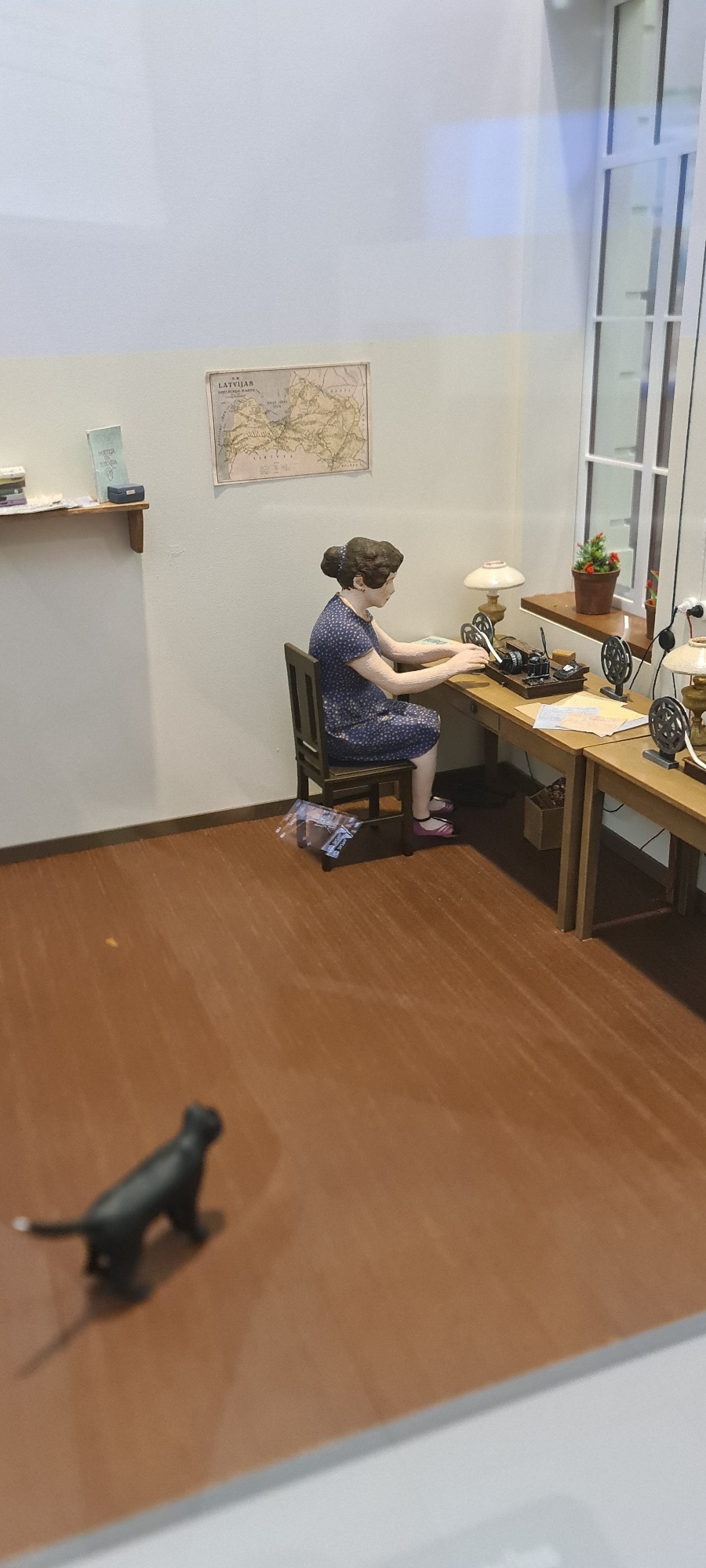
This image captures an indoor scene, likely a historical exhibit or museum display, presented from a tilted, overhead perspective. The setting features light-colored walls and a wooden floor.
The central subject is a female mannequin, or realistic doll, seated at a wooden desk. She wears a blue polka-dotted dress and has dark hair styled in a bun. Her hands are positioned on a vintage machine, possibly a typewriter or calculating device, suggesting an activity of work or operation. Pink shoes are visible on her feet beneath the desk.
On the wooden desk, there are several vintage machines, a white desk lamp, papers, and a small potted plant with red flowers. The background features a large window with multiple panes on the upper left, allowing natural light into the room.
To the left of the seated figure, on the wall, hangs a framed map. The visible text on the map clearly reads "LATVIJAS," indicating it is a map of Latvia. Below the map, a small wooden shelf holds a few books or objects. In the foreground, on the wooden floor, a dark, animal-like figurine, resembling a cat, is visible. The overall scene appears to be a static portrayal of a historical workspace or daily life, consistent with the location context of Riga, Latvia. No specific time of day or emotions are explicitly conveyed by the display.
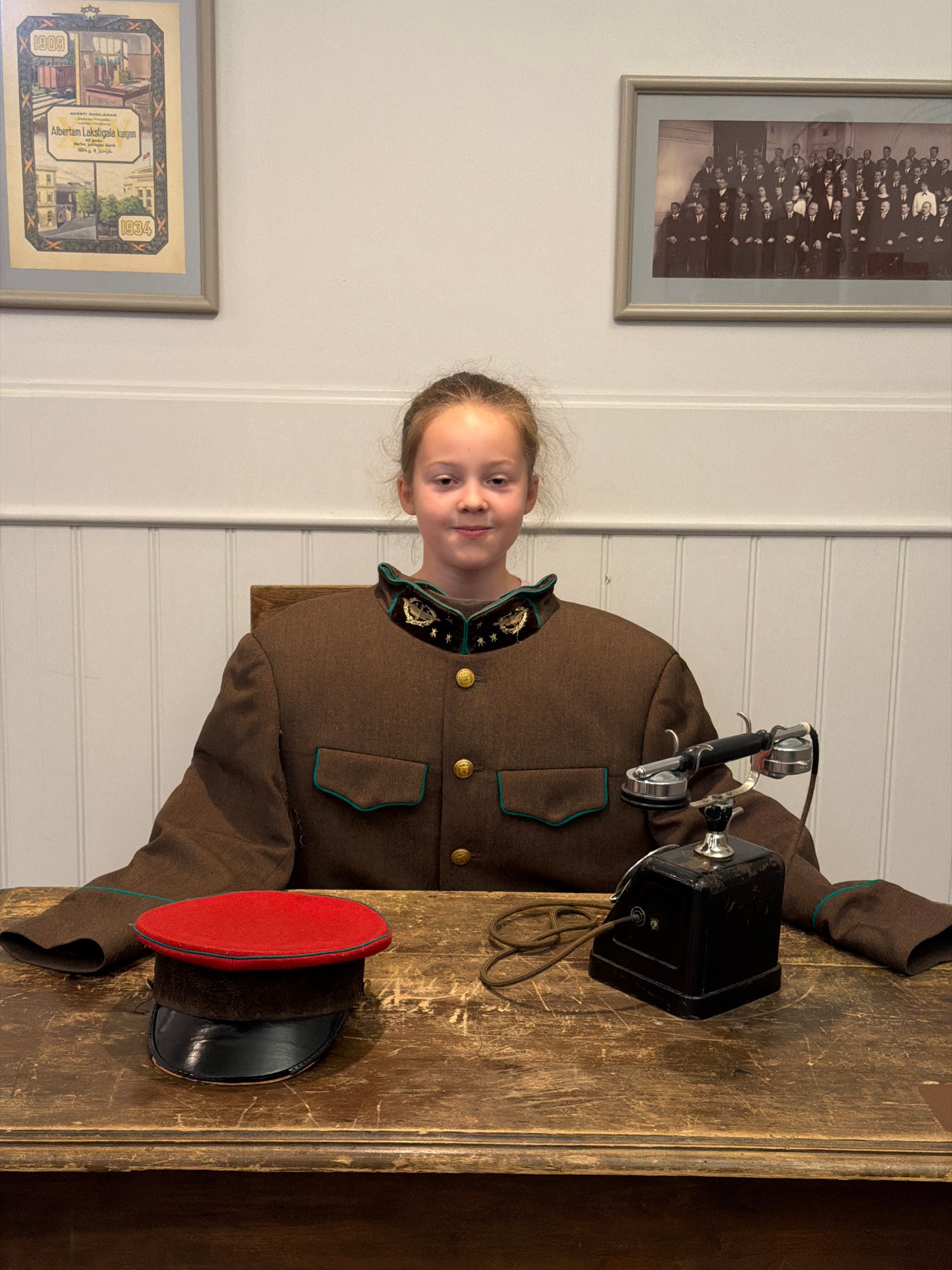
A young girl, approximately 6-10 years old, with light brown hair pulled back, is depicted indoors, smiling subtly towards the viewer. She is wearing an oversized, historical military-style uniform jacket in brown, featuring green piping, prominent brass buttons, and a dark collar embroidered with stars and a gold insignia.
She is positioned behind a worn wooden desk, upon which an antique black telephone with a metallic receiver and cradle is placed. Next to the telephone lies a cap with a striking red top, a black band, and a black brim, consistent with the uniform theme.
The background consists of a white wall with vertical wooden paneling. Two framed pictures hang on the wall. The upper frame contains a black and white photograph of a large group of men, possibly from a historical period. The lower frame holds a colored print that includes street scenes and legible text, notably "ALBERTA IELA" (Alberta Street), "RIGAS MUZEJA" (Riga Museum), and the dates "1908" and "1934".
The scene suggests an interactive exhibit or educational experience within a museum in Riga, Latvia, likely the Riga Museum, where the girl is engaging with historical artifacts and attire. Her expression conveys curiosity and slight amusement, indicating an enjoyable experience. The lighting is bright and even, characteristic of an indoor setting.
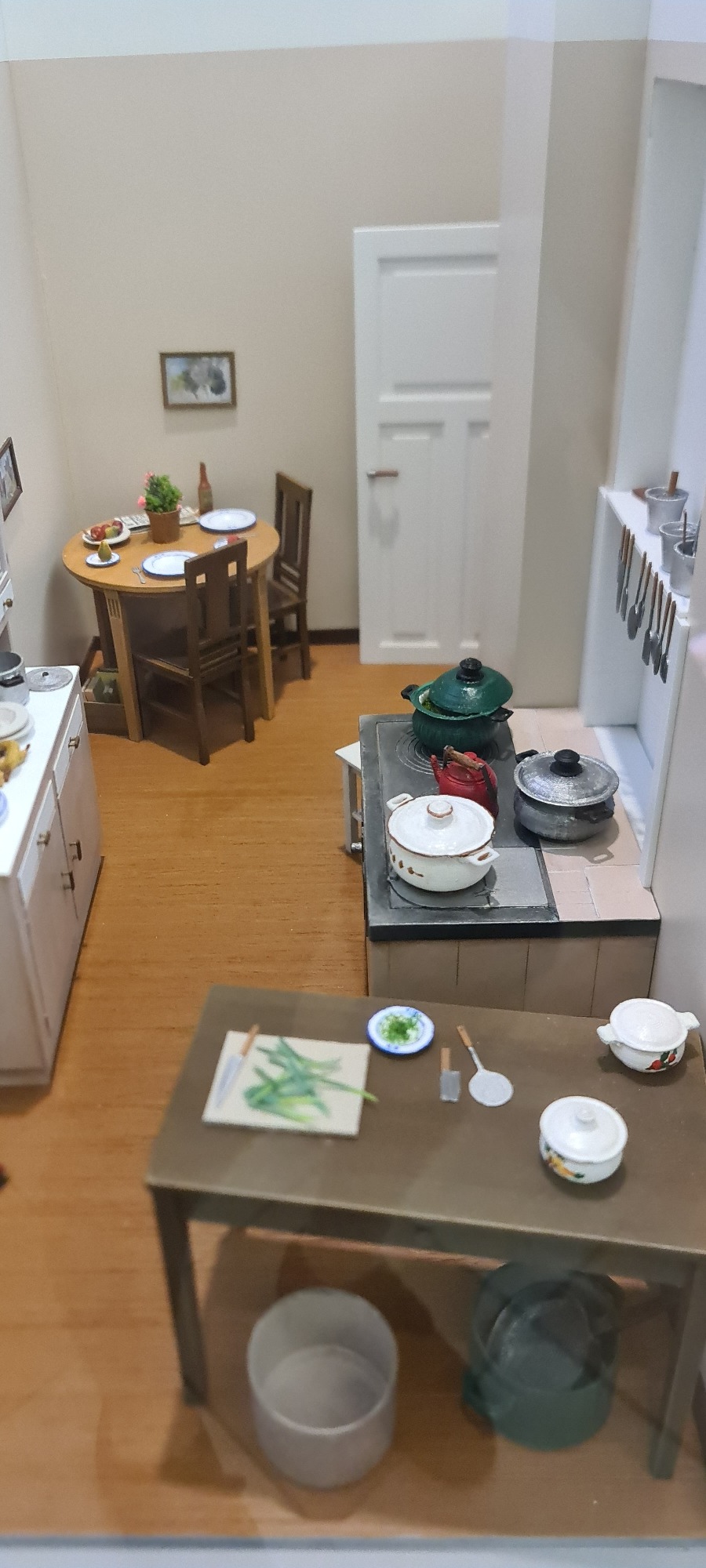
This media file presents a miniature diorama of a kitchen and dining area, captured from an overhead perspective and rotated 90 degrees clockwise. No people are visible in the scene.
The kitchen area on the upper right features a miniature stove with several pots and pans on its surface; one is a grey pot, a green pot, a red kettle, and a white pot. Above the stove, a white shelf holds miniature utensils including forks, knives, and spoons. To the right of the stove, on a brown countertop, are various miniature kitchen items: two white lidded serving dishes, a spatula, a small knife, a small blue and white plate with green garnish, and a small cutting board with green vegetables. A larger grey pot and a white cylindrical container are also present on a lower shelf or counter. White cabinets or cupboards are mounted on the wall above the kitchen counter.
The dining area occupies the lower left portion of the image. It features a round wooden dining table with four wooden chairs arranged around it. The table is set with miniature white plates, a small potted plant, and a bowl of fruit. On the light beige wall in the dining area, a small framed picture is hanging. The floor throughout the miniature setting appears to be made of wood, and the walls are a plain light cream or beige color.
The scene depicts an interior domestic setting, possibly prepared for a meal, but without any activity currently taking place. There is no visible text in the image. The lighting is uniform, suggesting an indoor setup rather than a specific time of day or weather condition.
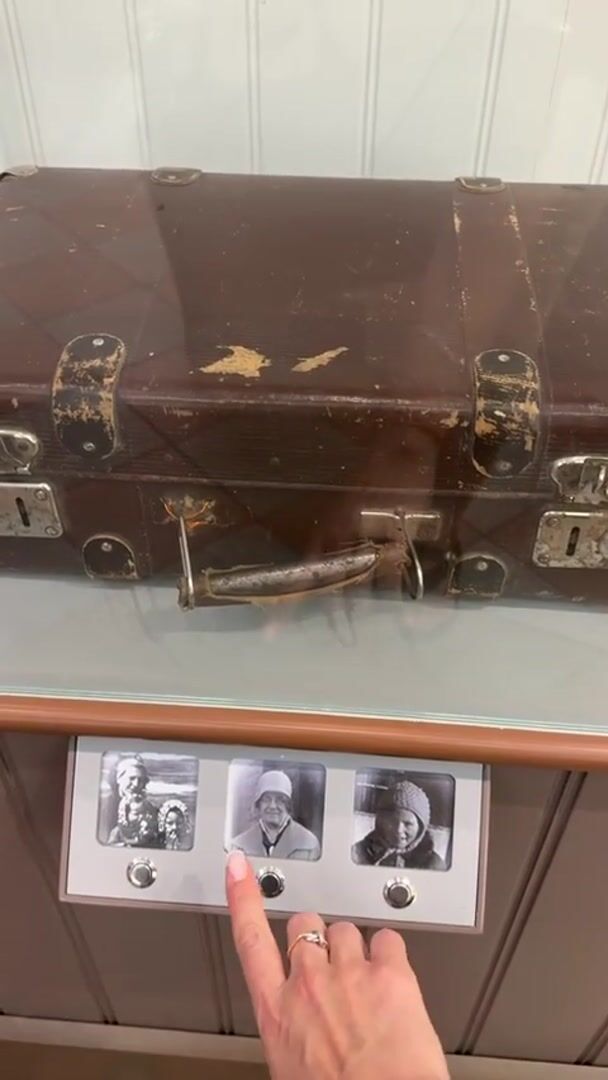
The video captures a close-up of an aged, brown wooden suitcase displayed in a museum or exhibition in Riga, Latvia. The suitcase shows significant wear with visible scratches, scuffs, and tarnished metal clasps and handle. It rests on a clear platform.
Below the display, a panel features three framed black and white photographs, each with a button underneath. The photos depict individuals, likely older, wearing head coverings.
A person's hand, wearing a ring, enters the frame and presses the button positioned below the middle photograph. Upon activation, the suitcase automatically opens, revealing its contents illuminated by a bright yellow light. Inside, various items are visible, including old papers, a small round object (possibly a compass or a tin), and other small articles. Partial text "DU" and "Ma Saldo" can be seen on some of the papers within the suitcase. The exhibit setup suggests an interactive display aimed at revealing the history or personal stories associated with the suitcase and the individuals in the photographs. The background consists of vertical light-colored wooden paneling.
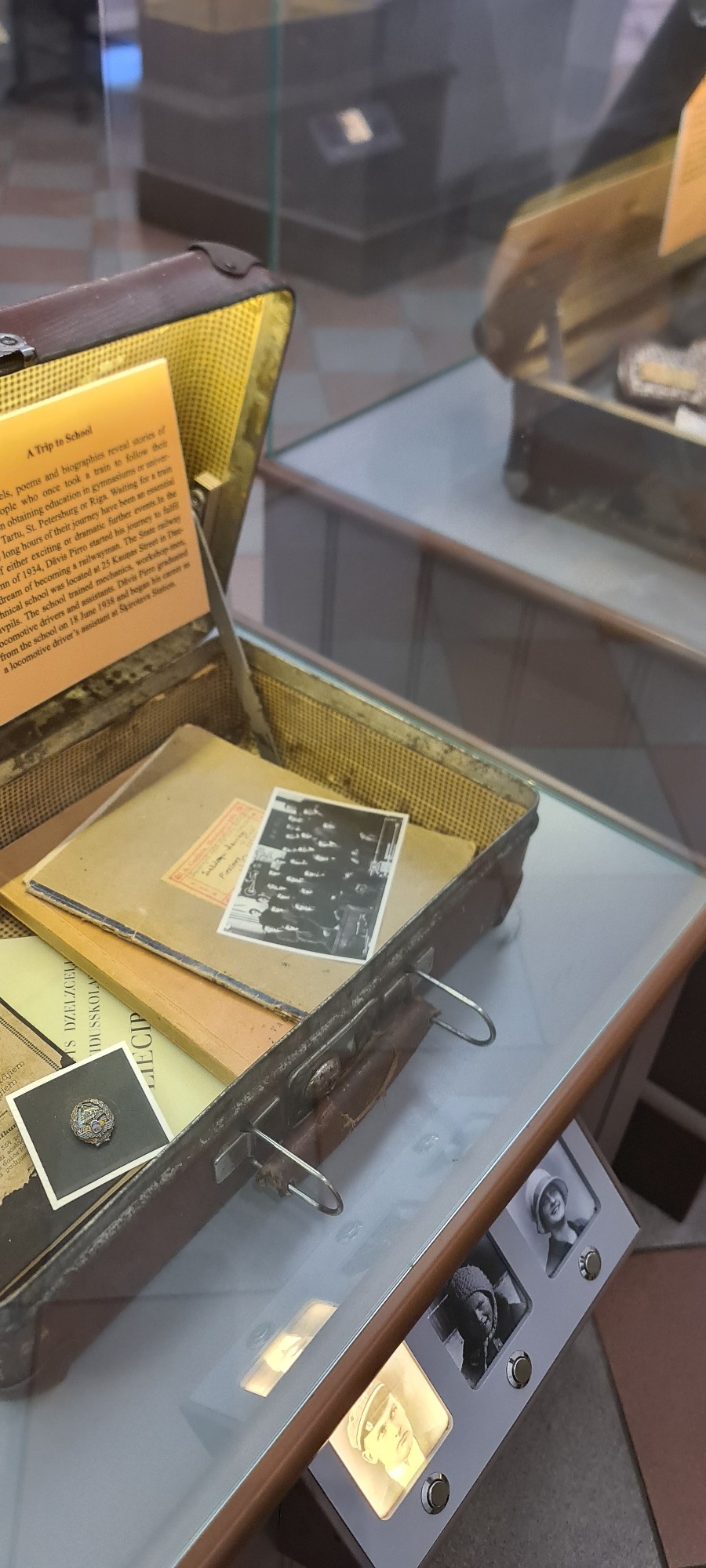
This image depicts a historical exhibit, likely in a museum in Riga, Latvia, featuring artifacts related to education and railway work from the early to mid-20th century. The central focus is an open, vintage-style school satchel or briefcase with a metal frame and clasps, displaying several aged documents and photographs.
Inside the satchel, a prominent document is titled "A Trip to School." Its text describes the journeys of individuals pursuing education in "gymnasiums or universities in Tartu, St. Petersburg or Riga," often involving long train trips. Specifically, it highlights the story of "Dāvis Pirro," who in 1934 began training to become a railwayman. He attended "The State railway technical school... located at 25 Kaugas Street in Daugavpils," which trained mechanics, workshop staff, locomotive drivers, and assistants. Pirro graduated on June 18, 1938, and started his career as a "locomotive driver's assistant at Šķirotava Station."
Also visible within the satchel are a black and white group photograph, possibly of students, attached to what appears to be a school album or yearbook. Another small, ornate ring with embedded stones is displayed on a dark card. Partially legible text on other documents includes "DZELZCEL," "IDUSSKOLA," and "LIECIP," which are likely related to railways or schooling in Latvian.
The items are presented under glass, indicating a museum display. Reflections on the glass surface suggest the presence of overhead lighting or ambient light from the surroundings. In the background, another section of the exhibit is visible, featuring illuminated display windows with additional photographs or small objects, further enhancing the historical context. The scene effectively communicates a narrative of historical educational pursuits and professional development within the Latvian region.
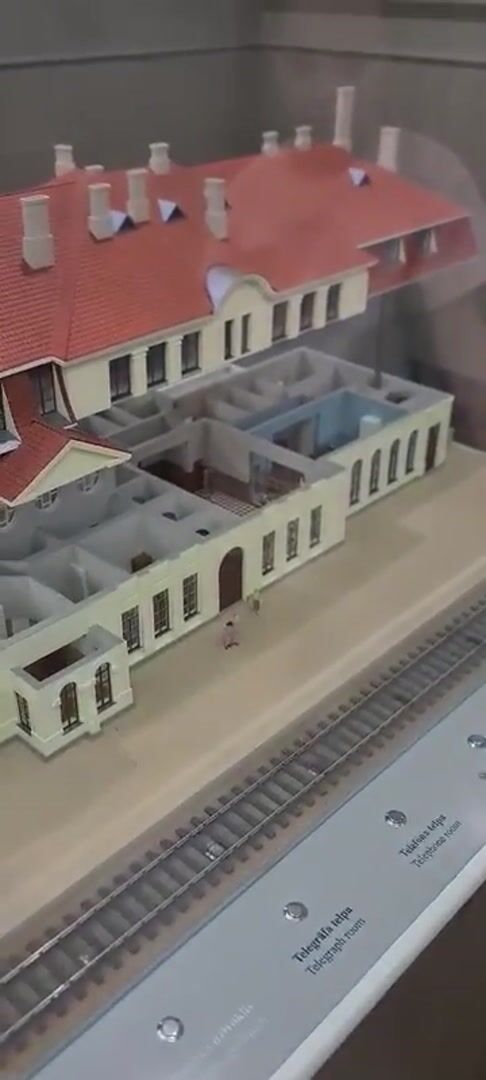
The video presents a detailed miniature architectural model of a historical building, likely a train station, set within a museum or exhibition. The building features cream-colored walls, multiple windows, and a prominent red-tiled roof with several chimneys. Its upper floor and roof section are cleverly designed to be lifted, revealing the intricate interior layout of the ground and first floors. Inside, various rooms are visible, some painted in distinct colors such as blue.
Adjacent to the building, two miniature figures of people, one possibly a child, stand near the main entrance. Two sets of miniature train tracks run parallel to the building on a light brown base, reinforcing the impression of a railway station. A partly visible informational sign in the foreground displays text in multiple languages, including Latvian ("Telefona telpa"), Estonian ("Telegraafi tuba"), and English ("Telegraph room"), suggesting a specific historical function for one of the rooms within the model. The location context provided indicates this model is situated in Riga, Latvia, hinting it could represent a historical building from that city. The sound of a train horn or whistle is audible throughout the video, likely part of an accompanying audio exhibit. The entire model is encased within a clear display barrier.
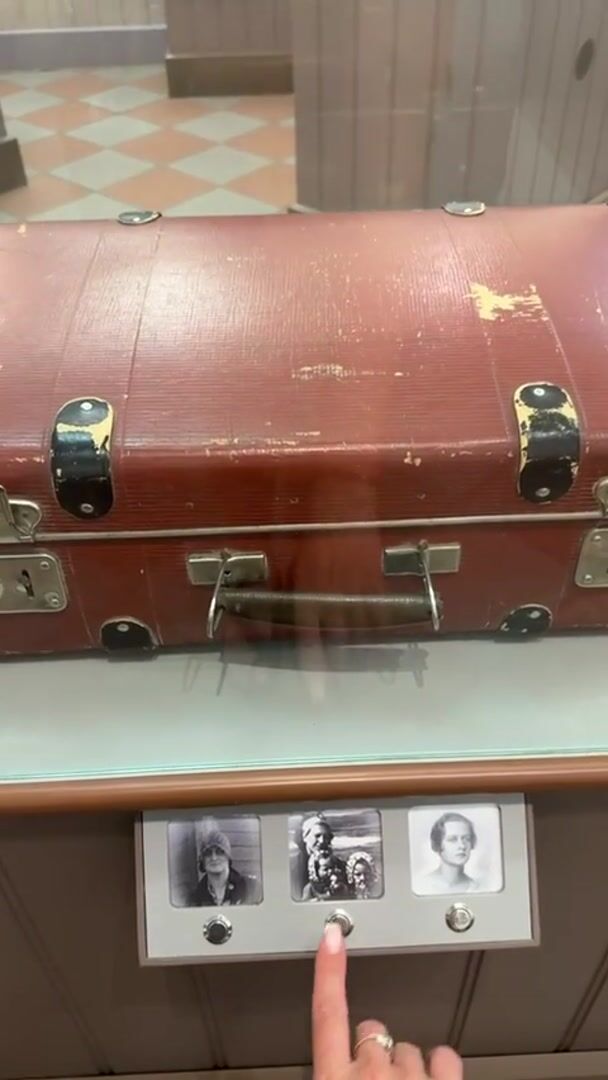
A vintage, worn, reddish-brown suitcase with black reinforced corners and metallic clasps is displayed behind a glass barrier. Below the suitcase, there's a display featuring three small framed black and white photographs: a person in a cap on the left, a group of people (possibly a family) in the center, and a woman on the right. A finger presses a button below the central photograph.
Upon activation, the suitcase automatically opens, revealing a yellow-lined interior. Inside, various items are visible: a yellow rubber duck-like toy, a pair of sunglasses, a book or magazine with "1980" and Cyrillic text on its cover, and a green and white portable electronic device, possibly a radio. An informational panel affixed to the inside lid of the suitcase contains text in two languages, Latvian and English. The English text reads: "TO THE SANDY BEACH OF JŪRMALA Memories of crowded electric trains to Jūrmala are an integral part of nearly every Latvian's childhood. Electric trains in Latvia are short, have no corridors, and it was hard to get a seat, but everyone still wanted to travel and go to enjoy the lovely beaches of Jūrmala. Merely a swim, a hotdog, a bottle of kvass, and a trip with favorite people - they were well rewarded. All of the passengers' items were often forgotten on the crowded train and train tickets reached the beaches." The scene suggests a museum or historical exhibit.
This video depicts a detailed miniature diorama of an old-fashioned cafe or bar scene. The primary subjects are two male figures. One figure, dressed in a grey suit and bow tie, stands behind a dark wooden bar counter, appearing to be a bartender. The second figure, wearing a dark green jacket and a bowler hat, stands in front of the bar, facing the bartender as if placing an order or having a conversation.
The bar counter is adorned with various miniature items, including a small vase with red flowers, what looks like pastries or desserts, and small dishes. Behind the bar, a large wooden cabinet with shelves holds numerous bottles, plates, and other decorative objects, contributing to the establishment's ambiance. A single hat rests on top of the cabinet.
In the foreground, a small round white table is set with two blue-patterned plates, forks, spoons, and a tiny vase containing two small flowers. Four white chairs with light yellow seats are arranged around this table, suggesting it's ready for patrons. The floor features a prominent red and white checkerboard pattern, a classic design often found in cafes and diners. To the far right, a sliver of a mirror or doorway is visible. The scene captures a static moment within this meticulously crafted miniature world.
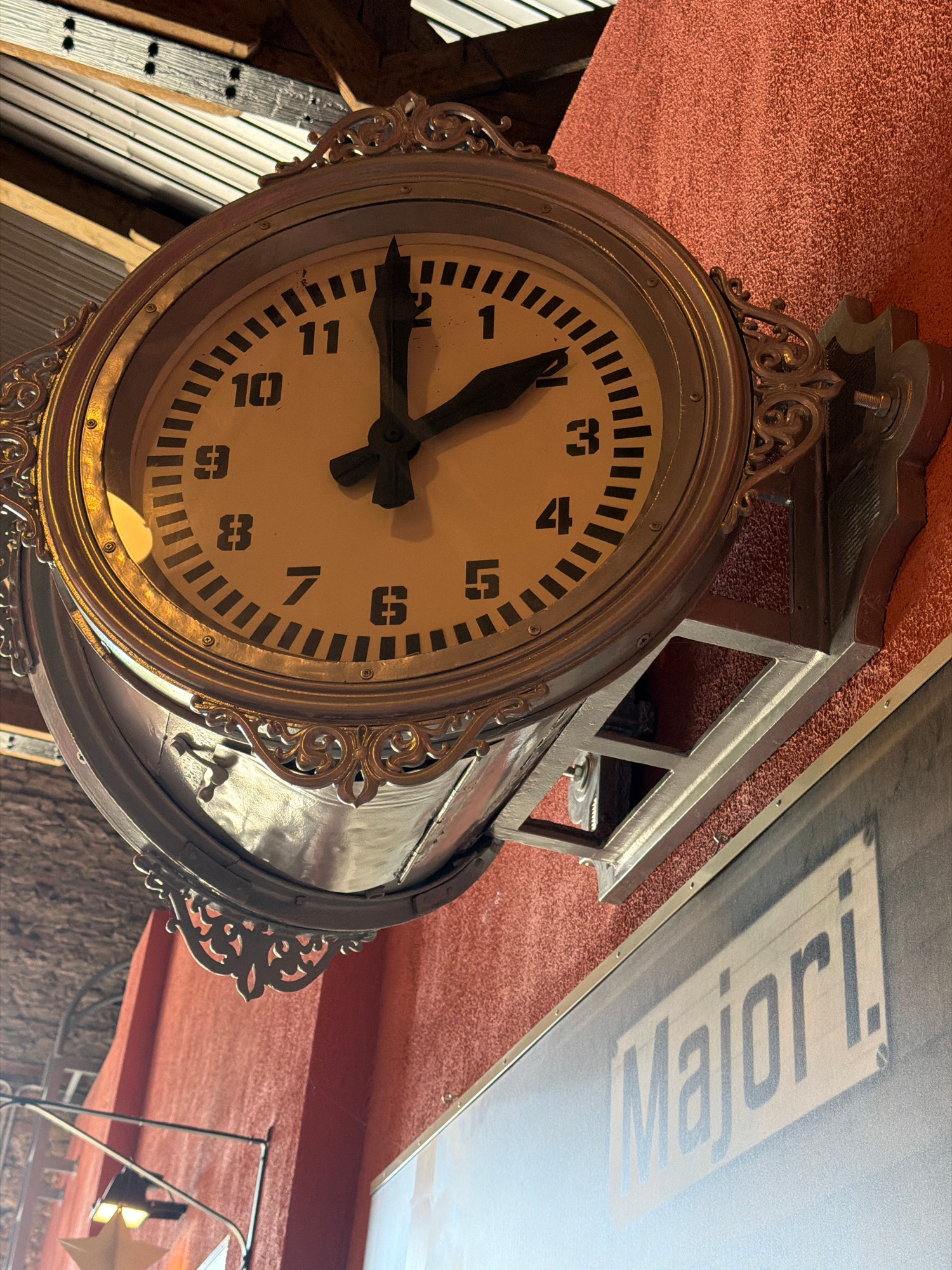
A large, ornate, double-sided clock hangs from a metallic bracket against a reddish-brown textured wall or ceiling. The clock features a cream-colored face with bold black rectangular hour markers and prominent black numerical hours (1, 3, 4, 5, 6, 7, 10, 11, 12). Thick, black hands indicate the time is approximately 11:55. The clock's metallic casing is embellished with intricate, silvery-gold scrollwork around its bezel and where it attaches to the support structure.
To the right and above the clock, a smooth, reflective surface, possibly glass or a polished sign, mirrors the word "Majori" in dark lettering on a lighter background. This reflection is partially obscured and appears inverted. The surrounding environment suggests an outdoor or semi-outdoor public space, possibly a train station, bus terminal, or a commercial establishment, given the bright, natural daytime lighting. Architectural details like wooden slats or louvers are visible to the left of the clock. The setting is consistent with a historical or charming area within Riga or nearby, with "Majori" being a known location in Jurmala, Latvia. No people are visible in the scene.


 Riga, Latvia