Thursday, April 16, 2026 · Updated Thursday, April 16, 2026
Hisarya, Bulgaria
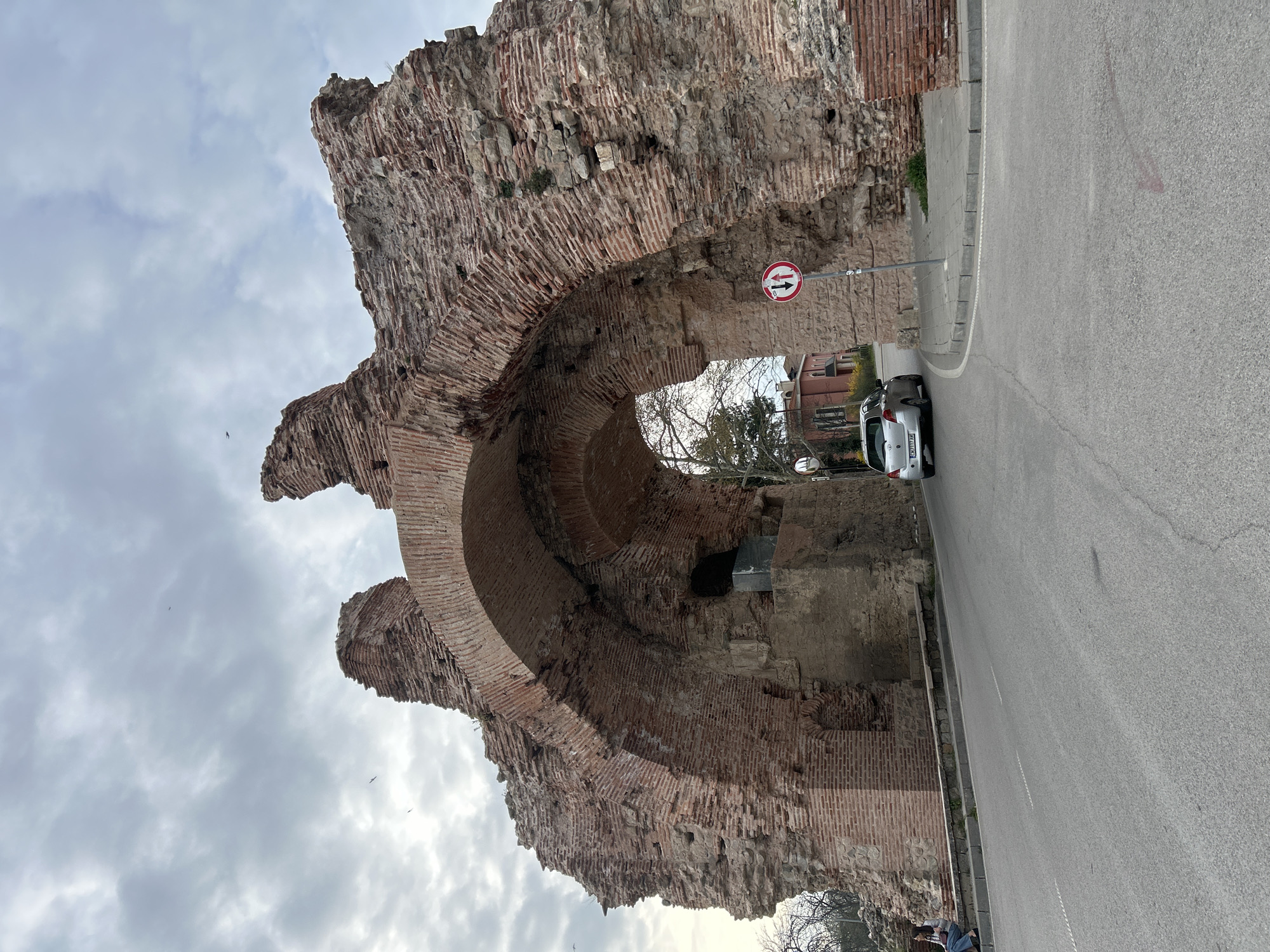
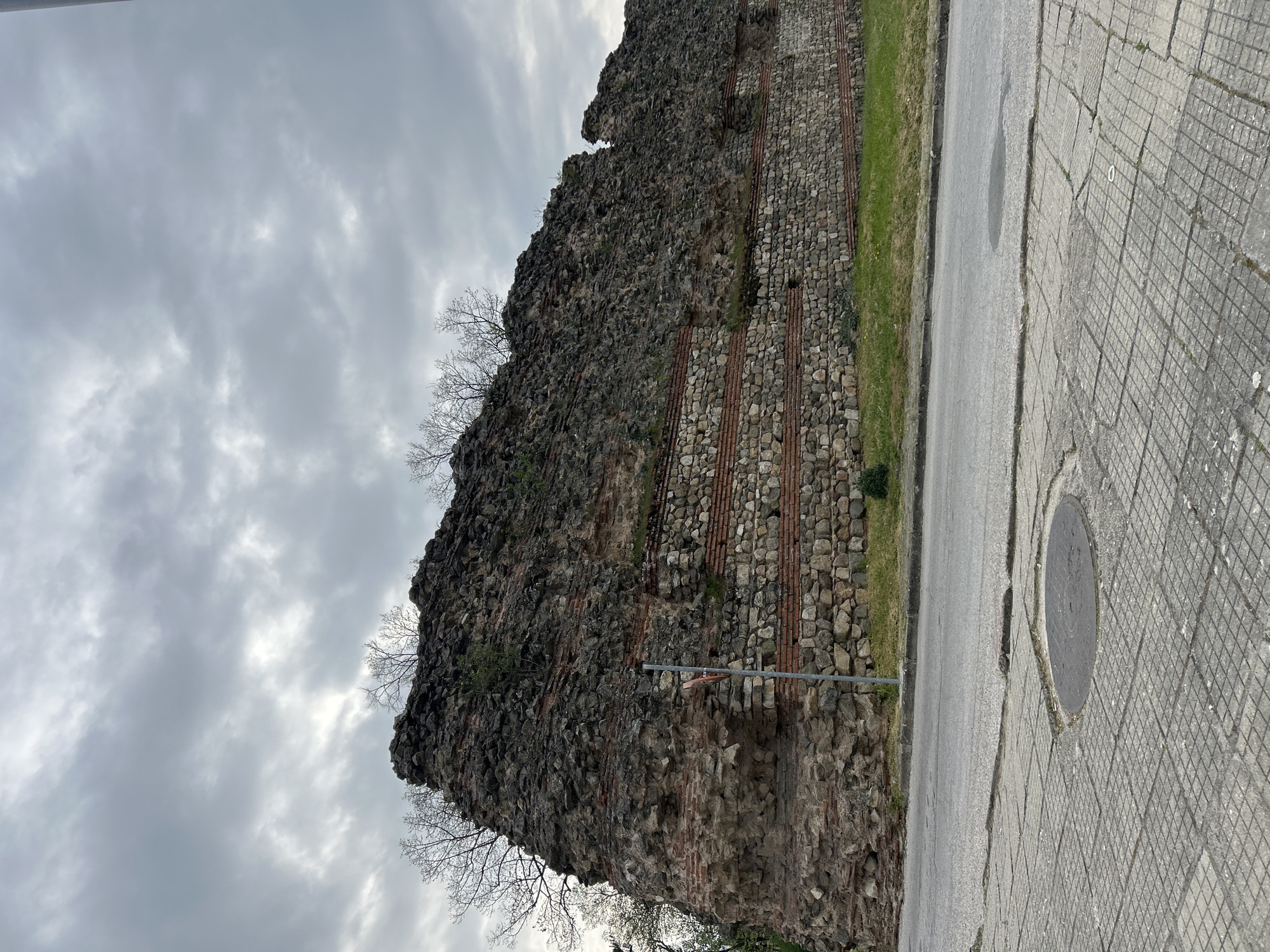
The image displays a segment of an ancient stone wall, likely part of the Roman ruins in Hisarya, Bulgaria. The wall is constructed from rough-hewn stones interspersed with several distinct horizontal bands of red bricks, a construction style often seen in Roman and Byzantine architecture. Bare tree branches protrude from the top and sides of the wall, set against a cloudy, overcast sky.
Adjacent to the historical wall is a paved asphalt road, and parallel to it, a patterned concrete sidewalk. A circular metal manhole cover is visible on the sidewalk. A thin metal pole with a small, unreadable sign is positioned near the base of the wall. The scene is static, devoid of people or discernible activity, and appears to be captured during an overcast day.
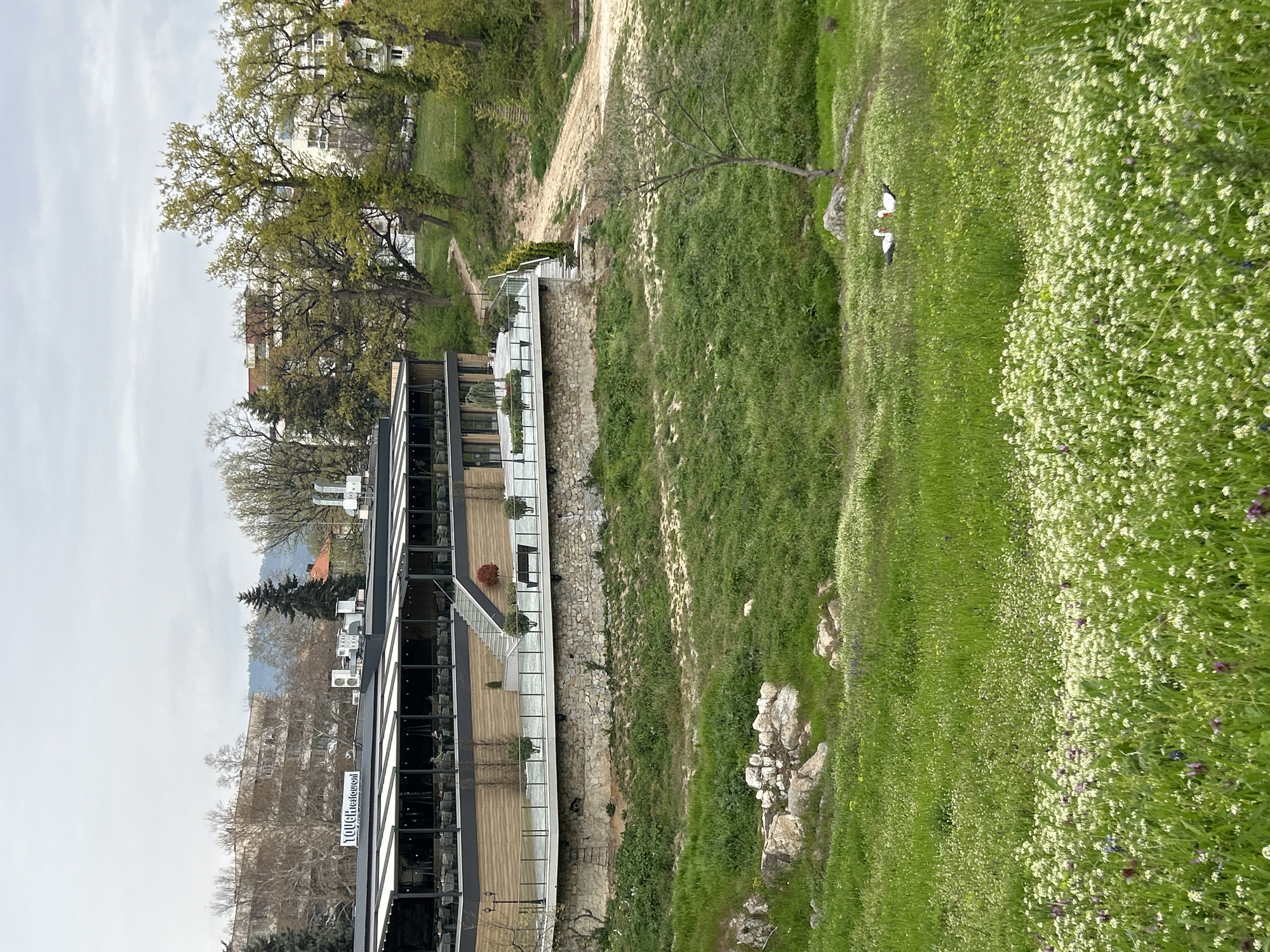
A modern architectural structure with a wooden facade and extensive glass windows is situated at the base of a verdant, gently sloping hill. The building features multiple outdoor balconies or terraces, equipped with white chairs and tables, and enclosed by glass railings. A stone retaining wall supports the earth behind the building.
The hill is covered in lush green grass, interspersed with numerous small white flowers, particularly dense on the right side of the image. A narrow, light-colored dirt path winds its way up the slope. Several trees are scattered across the landscape; some deciduous trees have fresh green leaves, indicating spring, while others appear more bare. A small, slender tree stands alone on the grassy incline.
In the middle-right of the grassy field, two white birds with dark markings on their wings, possibly storks or similar large waders, are visible standing. The sky above is overcast, suggesting a cloudy day, and the lighting is diffused, pointing to daytime hours, perhaps late morning or early afternoon. In the background, beyond the trees and building, other residential or urban structures can be seen, with a hazy mountain range in the far distance.
On a sign affixed to the side of the building, the text "YOVCHINIEWENI" is visible. The scene evokes a tranquil and natural setting, possibly a restaurant or hotel offering scenic views in Hisarya, Bulgaria. There are no people visible in the image.
A modern architectural structure with a wooden facade and extensive glass windows is situated at the base of a verdant, gently sloping hill. The building features multiple outdoor balconies or terraces, equipped with white chairs and tables, and enclosed by glass railings. A stone retaining wall supports the earth behind the building.
The hill is covered in lush green grass, interspersed with numerous small white flowers, particularly dense on the right side of the image. A narrow, light-colored dirt path winds its way up the slope. Several trees are scattered across the landscape; some deciduous trees have fresh green leaves, indicating spring, while others appear more bare. A small, slender tree stands alone on the grassy incline.
In the middle-right of the grassy field, two white birds with dark markings on their wings, possibly storks or similar large waders, are visible standing. The sky above is overcast, suggesting a cloudy day, and the lighting is diffused, pointing to daytime hours, perhaps late morning or early afternoon. In the background, beyond the trees and building, other residential or urban structures can be seen, with a hazy mountain range in the far distance.
On a sign affixed to the side of the building, the text "YOVCHINIEWENI" is visible. The scene evokes a tranquil and natural setting, possibly a restaurant or hotel offering scenic views in Hisarya, Bulgaria. There are no people visible in the image.
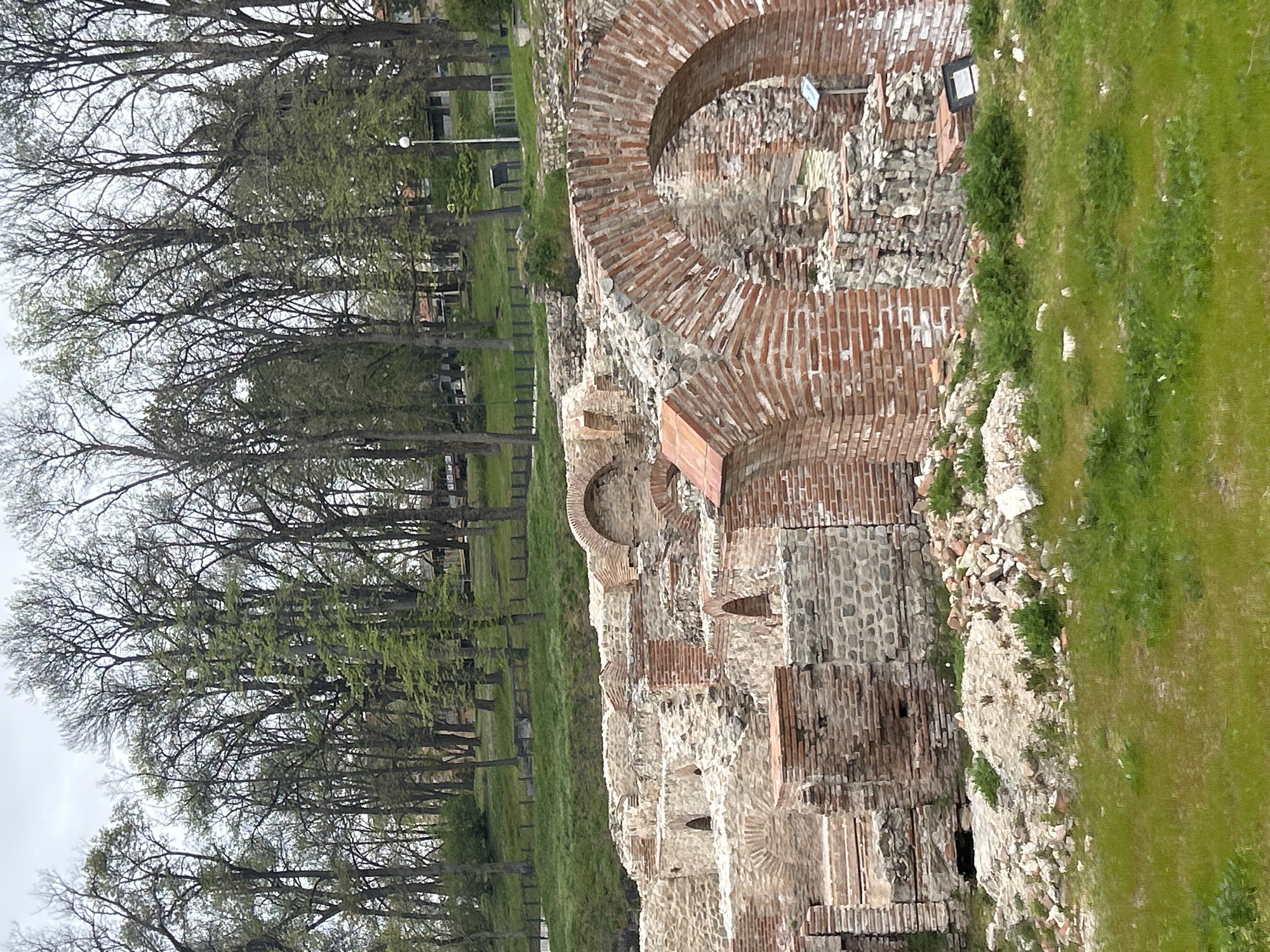
This image captures ancient Roman ruins in Hisarya, Bulgaria, set within a verdant park under an overcast sky. The prominent subject is a section of well-preserved ruins, characterized by robust walls constructed from alternating layers of brickwork and stone. A large, distinctive arch made of reddish-brown bricks forms a central feature, alongside other smaller archways and remnants of foundations. The construction style, with its rounded arches and mixed brick and stone masonry, is indicative of Roman architecture.
To the left of the ruins, a spacious public park extends into the background. It features extensive areas of green grass and numerous tall, bare deciduous trees, suggesting the period is late winter or early spring just before full leaf-out. Some smaller trees show nascent green leaves. Faintly visible amidst the trees are modern elements such as lampposts and distant buildings, indicating the site is integrated into a contemporary townscape.
The sky is a uniform, light grey, indicating overcast weather without direct sunlight. No people are visible, lending a quiet and contemplative atmosphere to the scene. Near the base of the ruins, modern spotlights or informational displays are discernible, suggesting the site is maintained for public viewing and possibly illuminated at night. The image conveys a sense of enduring history and the peaceful coexistence of ancient heritage with natural green spaces. No legible text is visible on any signs or objects.
This image captures ancient Roman ruins in Hisarya, Bulgaria, set within a verdant park under an overcast sky. The prominent subject is a section of well-preserved ruins, characterized by robust walls constructed from alternating layers of brickwork and stone. A large, distinctive arch made of reddish-brown bricks forms a central feature, alongside other smaller archways and remnants of foundations. The construction style, with its rounded arches and mixed brick and stone masonry, is indicative of Roman architecture.
To the left of the ruins, a spacious public park extends into the background. It features extensive areas of green grass and numerous tall, bare deciduous trees, suggesting the period is late winter or early spring just before full leaf-out. Some smaller trees show nascent green leaves. Faintly visible amidst the trees are modern elements such as lampposts and distant buildings, indicating the site is integrated into a contemporary townscape.
The sky is a uniform, light grey, indicating overcast weather without direct sunlight. No people are visible, lending a quiet and contemplative atmosphere to the scene. Near the base of the ruins, modern spotlights or informational displays are discernible, suggesting the site is maintained for public viewing and possibly illuminated at night. The image conveys a sense of enduring history and the peaceful coexistence of ancient heritage with natural green spaces. No legible text is visible on any signs or objects.
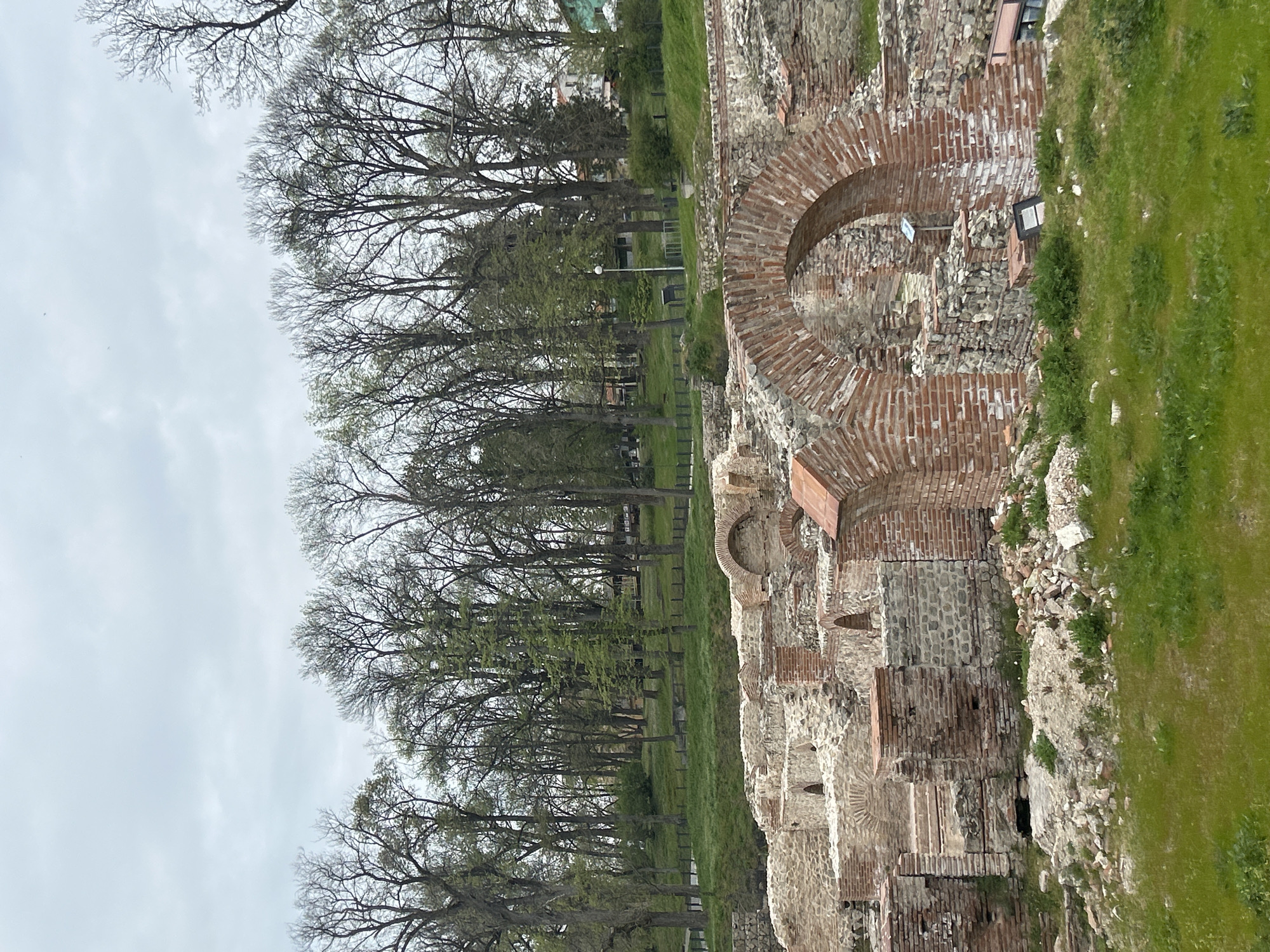
The image displays an archaeological site featuring extensive ancient ruins, likely an ancient city or fortress, characterized by walls constructed from a combination of rough-hewn stones and reddish-brown bricks. Prominent features include several well-preserved arched structures made entirely of brick masonry, showcasing sophisticated construction. The ruins are partially integrated with the natural landscape, with patches of green grass and small shrubs growing amidst the stone and brickwork.
In the background, a line of tall trees with both bare and newly leafed branches stretches across the frame, suggesting the season is early spring. Beyond the ruins and in front of the trees, a level grassy area is visible, with a modern street lamp discernible in the distance among the foliage. The foreground and the area immediately surrounding the ruins are covered in vibrant green grass, with scattered small rocks and debris.
The sky appears overcast, casting a soft, diffused light across the scene, indicating a cloudy daytime. No people are visible, and no specific activities are taking place. Small white signs are attached to various sections of the ruins, likely providing historical information, but their text is illegible. A dark, rectangular sign or display panel is also visible on the ground near the ruins.
Given the context of Hisarya, Bulgaria, these ruins are likely part of the Roman city of Diocletianopolis, known for its significant Roman architectural remnants. The scene evokes a sense of history, preservation, and the serene coexistence of ancient structures with nature.
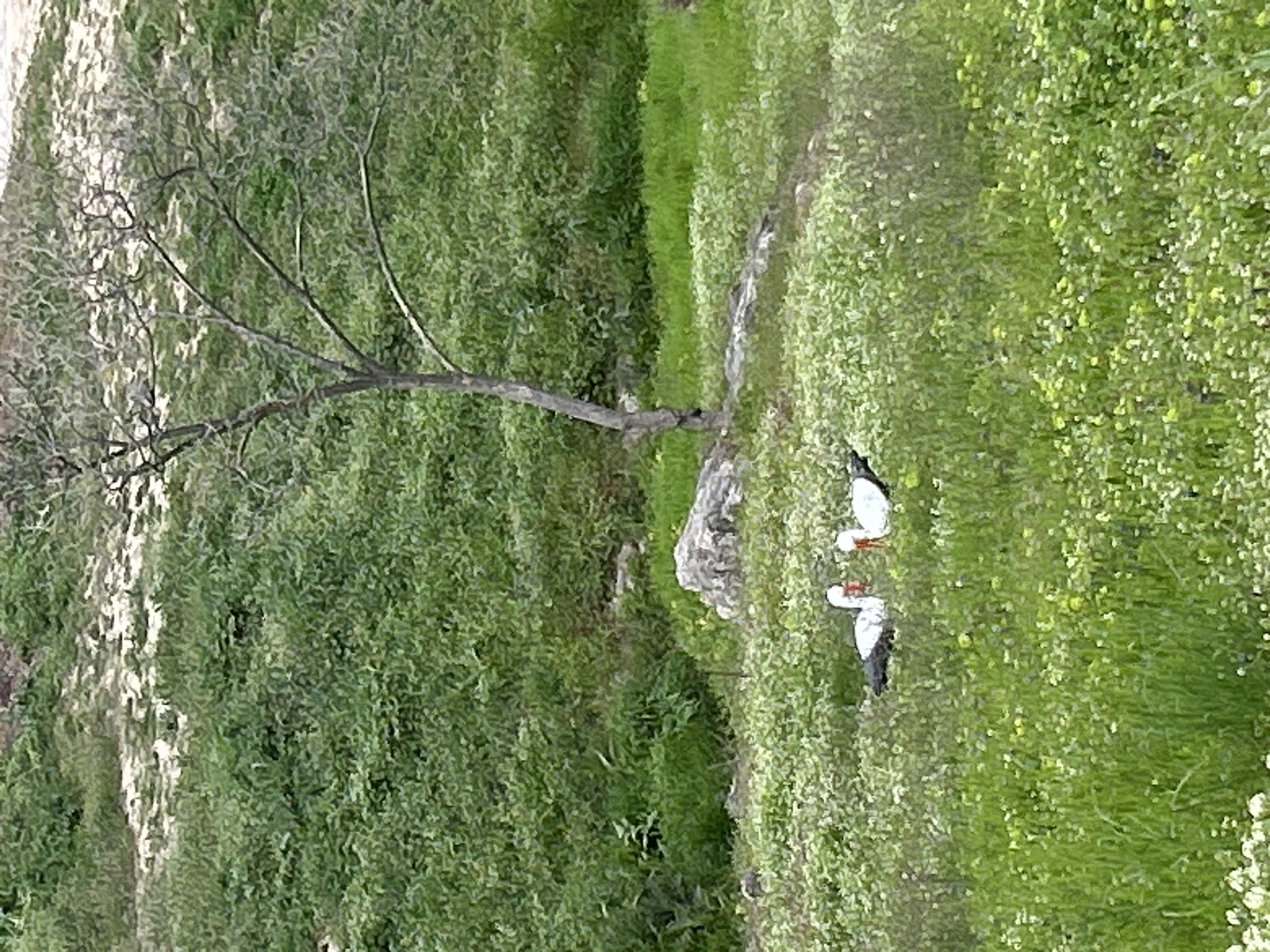
The image captures a serene outdoor scene, likely a natural landscape in Hisarya, Bulgaria, characterized by lush greenery and sparse trees.
The primary subjects are two storks standing on a verdant, grassy expanse towards the right side of the frame. Both storks exhibit classic white plumage with distinct black wingtips and appear to have red beaks and legs, although these details are somewhat obscured by distance and angle for one bird. One stork stands upright, while the other seems to be partially obscured by the grass or bending down, possibly foraging.
To the left, a solitary, bare-branched tree extends its intricate network of gray branches across the frame, contrasting with the vibrant green backdrop. The tree appears leafless, suggesting it might be late autumn, winter, or early spring, or a species that sheds its leaves. The ground is predominantly covered in thick, green grass and small plants, with scattered rocks visible, particularly around the base of the tree and near the storks.
The photograph was taken during the daytime, indicated by the natural light illuminating the scene. The weather appears clear and calm, allowing for the storks to be out in the open. The perspective is slightly elevated, looking down into the field. There is no visible text within the image.
The image displays an archaeological site featuring extensive ancient ruins, likely an ancient city or fortress, characterized by walls constructed from a combination of rough-hewn stones and reddish-brown bricks. Prominent features include several well-preserved arched structures made entirely of brick masonry, showcasing sophisticated construction. The ruins are partially integrated with the natural landscape, with patches of green grass and small shrubs growing amidst the stone and brickwork.
In the background, a line of tall trees with both bare and newly leafed branches stretches across the frame, suggesting the season is early spring. Beyond the ruins and in front of the trees, a level grassy area is visible, with a modern street lamp discernible in the distance among the foliage. The foreground and the area immediately surrounding the ruins are covered in vibrant green grass, with scattered small rocks and debris.
The sky appears overcast, casting a soft, diffused light across the scene, indicating a cloudy daytime. No people are visible, and no specific activities are taking place. Small white signs are attached to various sections of the ruins, likely providing historical information, but their text is illegible. A dark, rectangular sign or display panel is also visible on the ground near the ruins.
Given the context of Hisarya, Bulgaria, these ruins are likely part of the Roman city of Diocletianopolis, known for its significant Roman architectural remnants. The scene evokes a sense of history, preservation, and the serene coexistence of ancient structures with nature.
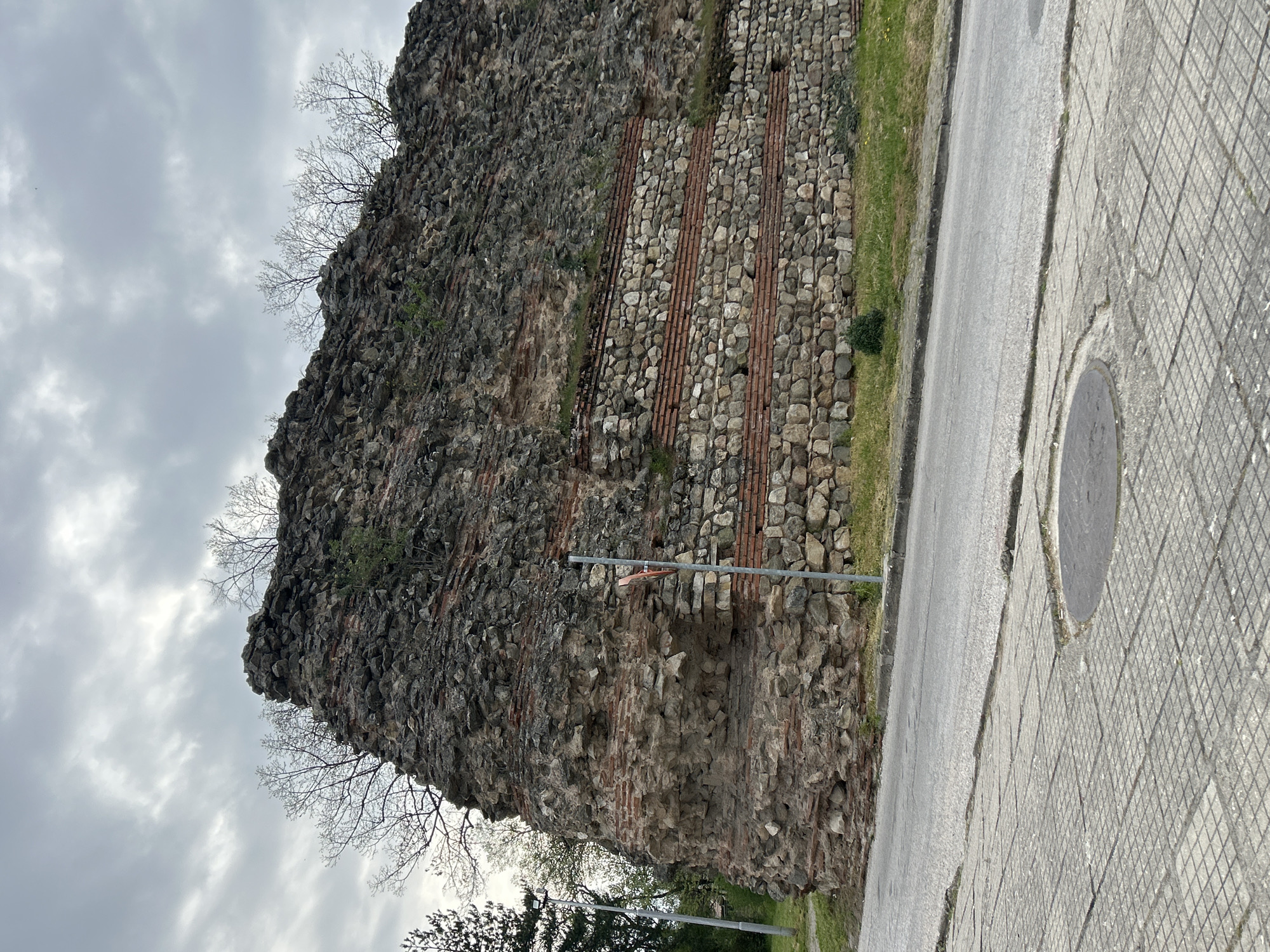
The image displays an ancient, robust stone wall under an overcast, cloudy sky. Located in Hisarya, Bulgaria, the wall is constructed from various sizes of irregular dark stones and mortar, featuring distinct horizontal bands of reddish bricks, characteristic of Roman-era engineering. Its rugged surface shows signs of age, with bare tree branches and small shrubs growing from its upper edges and crevices, indicating a late winter or early spring season.
The wall runs parallel to a paved environment. A narrow strip of green grass separates the base of the wall from a grey asphalt road. To the right of the road, there's a concrete sidewalk with a clear grid pattern, on which a circular metal manhole cover is visible. A thin, grey metal pole stands vertically near the wall's base.
The time of day appears to be daytime, but the uniformly grey, cloudy sky provides diffused lighting, without any direct sunlight. No people or activities are present in the static scene. The image provides a glimpse into a historical site, highlighting the endurance of ancient structures alongside modern urban elements. There is no visible text.
The image captures a serene outdoor scene, likely a natural landscape in Hisarya, Bulgaria, characterized by lush greenery and sparse trees.
The primary subjects are two storks standing on a verdant, grassy expanse towards the right side of the frame. Both storks exhibit classic white plumage with distinct black wingtips and appear to have red beaks and legs, although these details are somewhat obscured by distance and angle for one bird. One stork stands upright, while the other seems to be partially obscured by the grass or bending down, possibly foraging.
To the left, a solitary, bare-branched tree extends its intricate network of gray branches across the frame, contrasting with the vibrant green backdrop. The tree appears leafless, suggesting it might be late autumn, winter, or early spring, or a species that sheds its leaves. The ground is predominantly covered in thick, green grass and small plants, with scattered rocks visible, particularly around the base of the tree and near the storks.
The photograph was taken during the daytime, indicated by the natural light illuminating the scene. The weather appears clear and calm, allowing for the storks to be out in the open. The perspective is slightly elevated, looking down into the field. There is no visible text within the image.
The image displays an ancient, robust stone wall under an overcast, cloudy sky. Located in Hisarya, Bulgaria, the wall is constructed from various sizes of irregular dark stones and mortar, featuring distinct horizontal bands of reddish bricks, characteristic of Roman-era engineering. Its rugged surface shows signs of age, with bare tree branches and small shrubs growing from its upper edges and crevices, indicating a late winter or early spring season.
The wall runs parallel to a paved environment. A narrow strip of green grass separates the base of the wall from a grey asphalt road. To the right of the road, there's a concrete sidewalk with a clear grid pattern, on which a circular metal manhole cover is visible. A thin, grey metal pole stands vertically near the wall's base.
The time of day appears to be daytime, but the uniformly grey, cloudy sky provides diffused lighting, without any direct sunlight. No people or activities are present in the static scene. The image provides a glimpse into a historical site, highlighting the endurance of ancient structures alongside modern urban elements. There is no visible text.

 Hisarya, Bulgaria