Tuesday, April 28, 2026 · Updated Tuesday, April 28, 2026
Xuân Thành, Vietnam
Nestled in Xuân Thành, Vietnam, the Linh Phuoc Pagoda stands as an architectural marvel, a vibrant mosaic of faith and meticulous artistry. This renowned Buddhist temple complex is a testament to the region's rich cultural and spiritual heritage, drawing visitors into a world where every surface tells a story through intricate detail and symbolic representation.
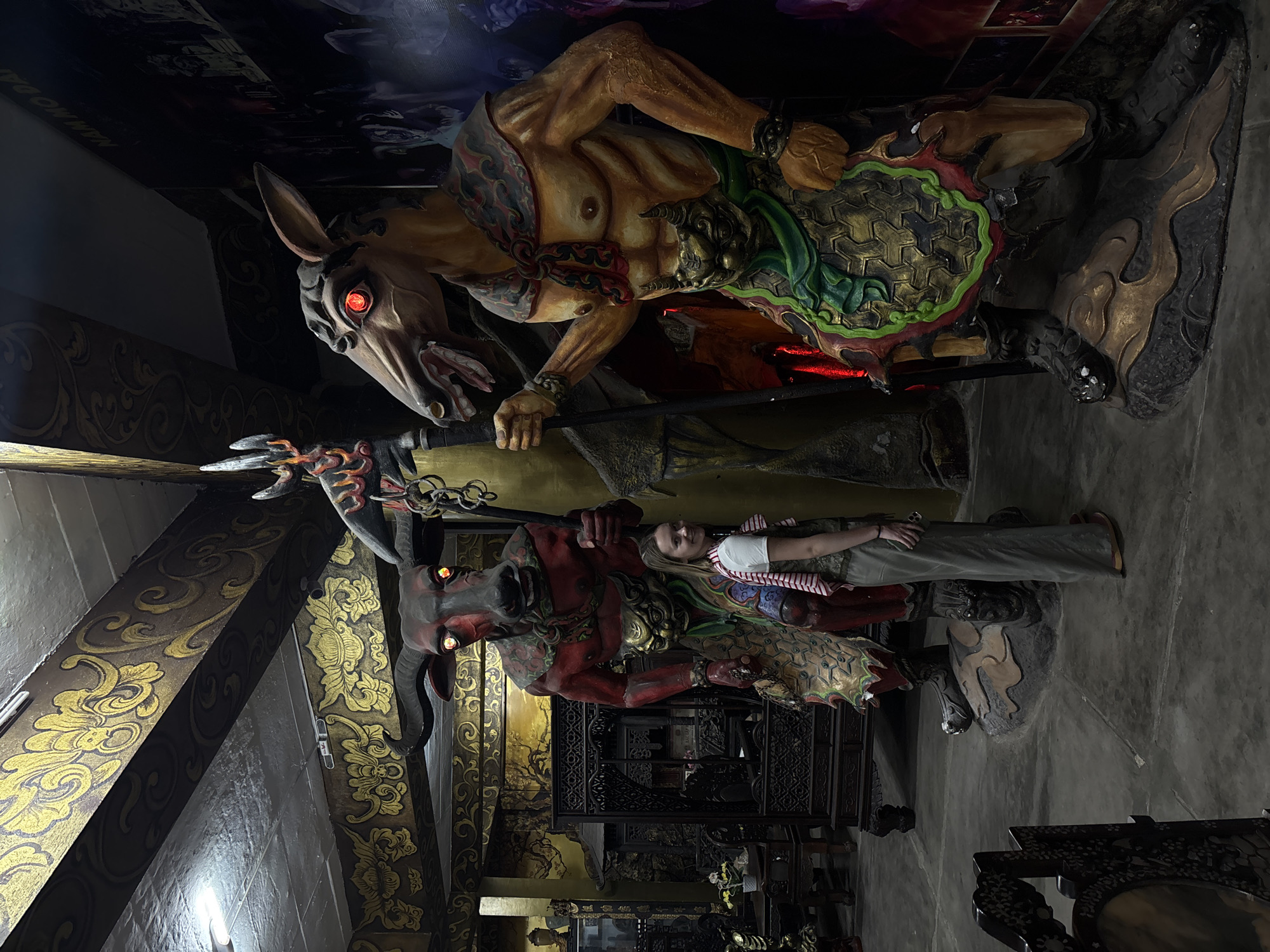
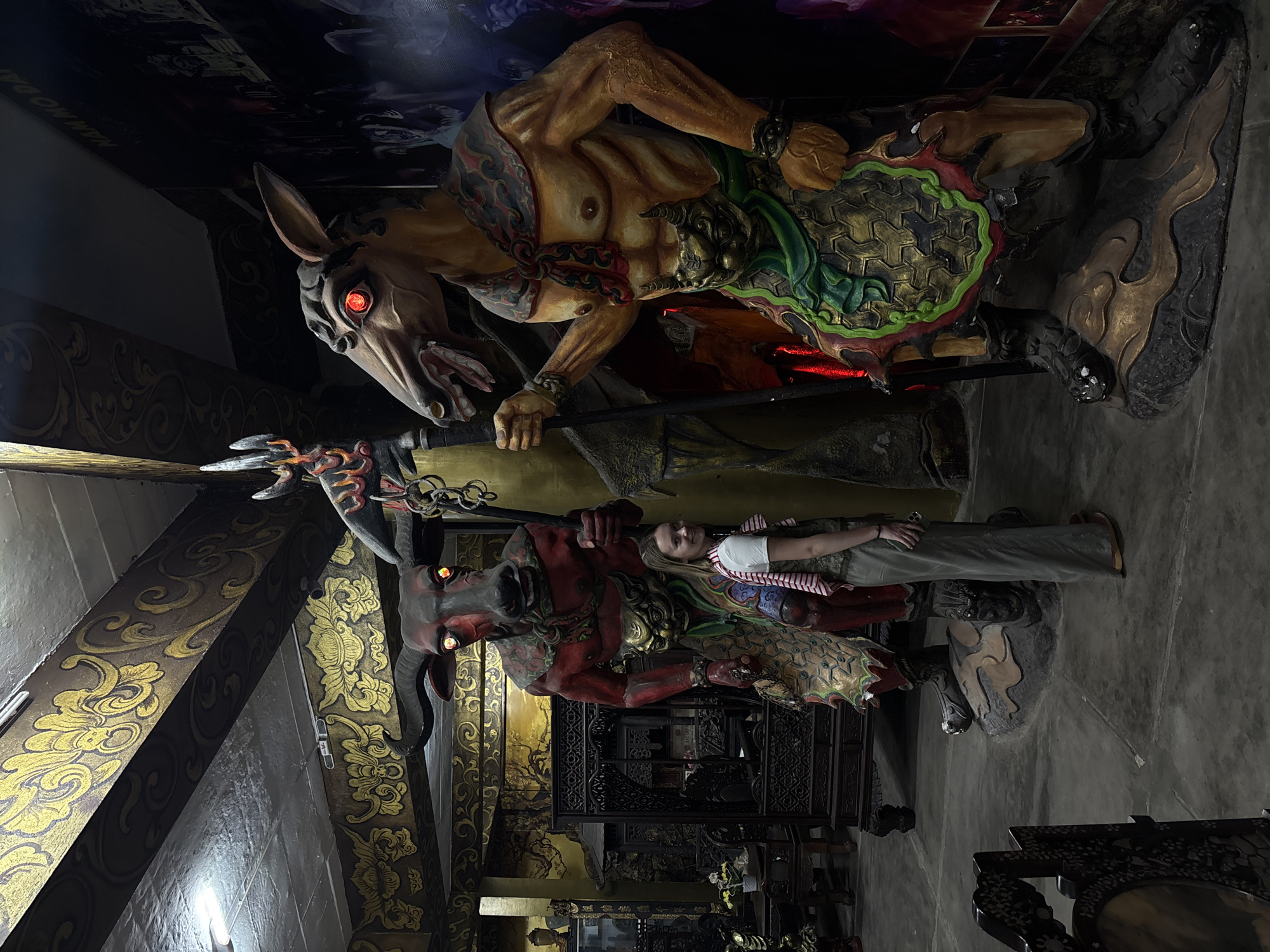
A young woman stands centered between two large, elaborate statues in an indoor setting, likely a temple or cultural exhibition in Xuân Thành, Vietnam. The woman, wearing a striped t-shirt and light-colored pants, looks towards the camera with a slight smile.
To her right (viewer's left) is a commanding statue of a figure with a horse-like head, prominent ears, and striking red glowing eyes. Its body is light brown, muscular, and adorned with an intricately patterned green and gold armor piece on its lower half. It holds a staff-like weapon.
To her left (viewer's right) is another formidable statue, dark red in color, featuring a bull-like head with horns and matching red glowing eyes. This figure also wears ornate green and gold armor and holds a multi-pronged trident.
The background consists of dark walls and pillars richly decorated with intricate gold floral and swirling patterns. The ceiling is dark, and faint text, possibly "NAM MO DIA," is visible. The lighting is dim, enhancing the dramatic effect of the glowing eyes and the statues' vibrant colors. The overall scene conveys a sense of cultural grandeur and ancient folklore.
The pagoda's exterior is an awe-inspiring spectacle, a multi-tiered structure adorned with countless mosaic-like decorations crafted from fragments of ceramic, glass, and pottery. Mythical creatures, prominently dragons and phoenix-like birds, are dynamically integrated into the eaves, roofs, and facades. Golden statues and bas-reliefs punctuate the colorful patterns, contributing to the grandeur under an often overcast sky, which only enhances the temple's mystical aura. The name 'CHÙA LINH PHƯỚC' is proudly inscribed, inviting all to witness its splendor.
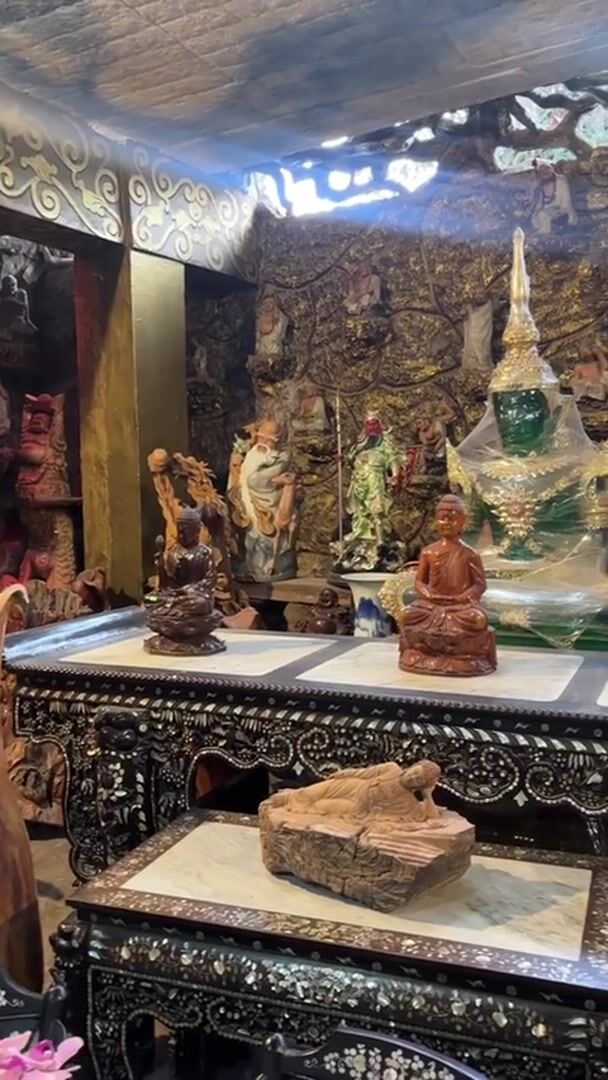
The video displays an ornate indoor space, likely a temple, shop, or private collection, filled with a multitude of religious statues. The scene is set in Xuân Thành, Vietnam, and features a diverse array of Buddha figures and other deities, varying in size and material. Statues made of wood, gold-colored metal, green stone, and red ceramic are prominently featured.
These figures are arranged on several large, intricately carved tables, some adorned with mother-of-pearl inlay. The background wall is extensively decorated with a textured, golden, or natural rock-like surface, embellished with numerous smaller statues. Overhead, bright light illuminates the detailed craftsmanship of the collection. Some of the statues, particularly a large green one, are partially covered with a protective layer of clear plastic or netting. A tall, slender wooden vase stands on a table in the foreground on the left. The camera pans slowly across this elaborate display, showcasing the cultural and spiritual richness of the objects. No people are visible, and no discernible text is present in the video.
Inside, the spiritual journey continues amidst a collection of remarkable statues and exhibits. Visitors encounter a display featuring Buddhist monks in meditative postures, set within an artificial forest environment bathed in ethereal green lighting, creating a tranquil and mystical atmosphere. Elsewhere, a young woman stands between two commanding, elaborate statues—one with a horse-like head and red glowing eyes, the other bull-like with horns—both adorned in intricate green and gold armor, evoking ancient folklore and powerful deities.
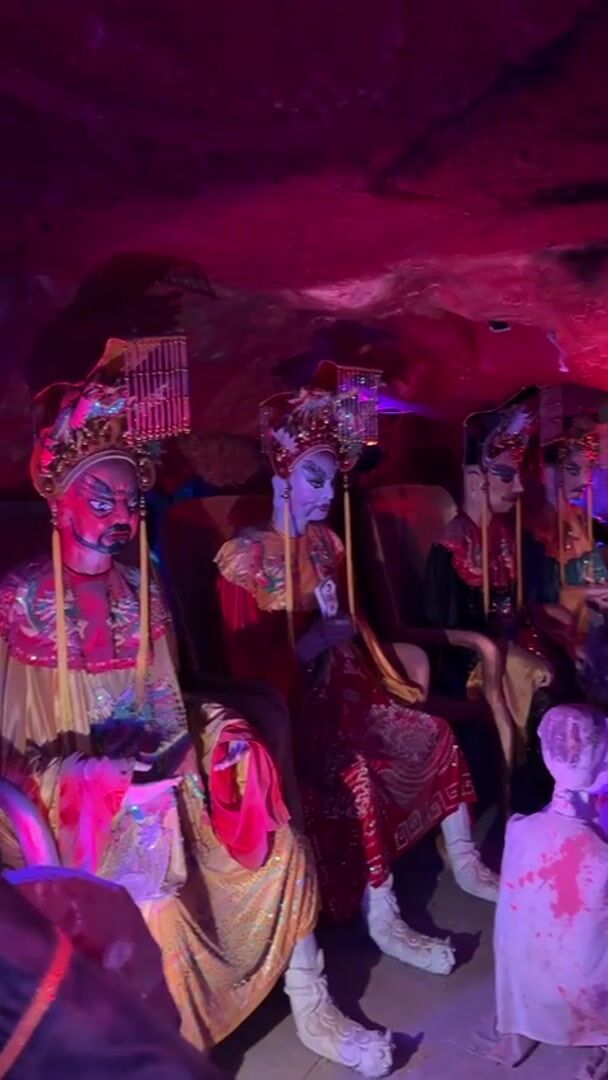
The image displays a theatrical diorama set within a dimly lit, cave-like interior. The scene is bathed in dramatic purple and red lighting, casting long shadows and creating an eerie, atmospheric effect.
The subjects are numerous humanoid figures, likely mannequins or statues, dressed in elaborate traditional costumes. In the background, several figures are seated behind a long table draped with a red cloth, upon which books are stacked. These seated figures wear ornate, tall headdresses and intricate robes. Their faces are painted with bold theatrical makeup, with one prominent figure on the left featuring a red face, while others display paler complexions. A banner hanging above the table clearly reads "CUNG THẬP ĐIỆN DIÊM VƯƠNG," identifying these figures as the Ten Courts of Yama Kings (Diyu), commonly associated with judgment in the afterlife in East Asian mythology.
In the foreground and mid-ground, many other figures are depicted kneeling or prostrate on the ground. These figures are predominantly white and heavily splattered with red, resembling blood, which suggests suffering, torment, or punishment. Their slumped and supplicating postures convey distress and agony. On the right wall, a partially visible sign contains Vietnamese text that appears to read "Vong xin tha tội" (Souls beg for forgiveness), with other words such as "tha thân" (forgive/release the body) also discernible, further reinforcing the theme of judgment and suffering of souls.
The rough, natural texture of the cave walls serves as a fitting backdrop for this dramatic and somewhat gruesome portrayal of the underworld. The entire setup in Xuân Thành, Vietnam, evokes a sense of spiritual drama and cultural storytelling related to the afterlife.
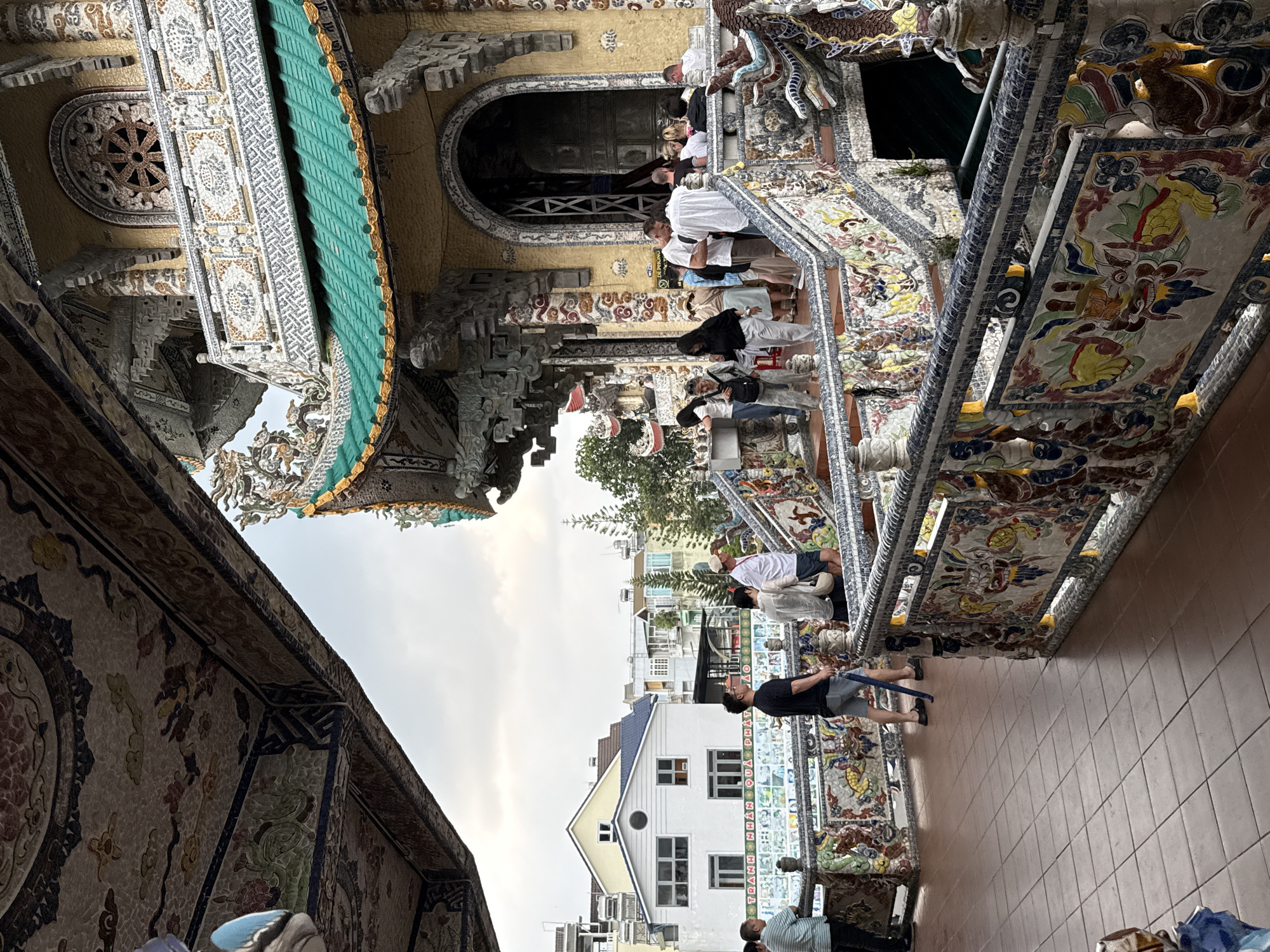
The image depicts an outdoor scene at an elaborately decorated architectural complex, characteristic of a temple or pagoda in Xuân Thành, Vietnam. The perspective captures a multi-level structure adorned with intricate mosaic tiles and ornate details under a bright, overcast sky.
On the left, a section of a building features a prominent green-tiled roof with a golden trim and white mosaic patterns. The walls and railings throughout the complex are extensively covered in colorful mosaic tiles, depicting a variety of patterns including floral motifs, geometric designs, and mythological creatures such as dragons, particularly visible beneath eaves and along balustrades.
Several people, mostly adults dressed in casual attire, are present on a tiled walkway or balcony on the right side of the frame. They appear to be visitors or tourists, walking around and observing the detailed architecture. One person holds a blue umbrella. In the mid-ground and background, various multi-story residential or commercial buildings are visible.
A notable detail is the Vietnamese text "TRANH NHÂN QUẢ PHẬT" written on a white building in the background, which translates to "Buddhist Karma Paintings" or "Buddhist Cause and Effect Paintings," reinforcing the religious context of the location. Another partially obscured sign reads "LÊ PHƯƠNG". The ground in the immediate foreground consists of brown square tiles. The scene conveys a sense of a vibrant cultural site, active with visitors exploring its rich artistic and architectural heritage during daylight hours.
Further within, an ornate indoor space showcases a multitude of religious statues, primarily Buddhist figures, varying in size and material from wood and gold-colored metal to green stone and red ceramic. These figures are meticulously arranged on intricately carved tables, some with mother-of-pearl inlay, while the background walls are embellished with a textured, golden surface supporting numerous smaller deities. This rich tapestry of craftsmanship and devotion underscores the pagoda's profound cultural significance, making it an unforgettable destination.
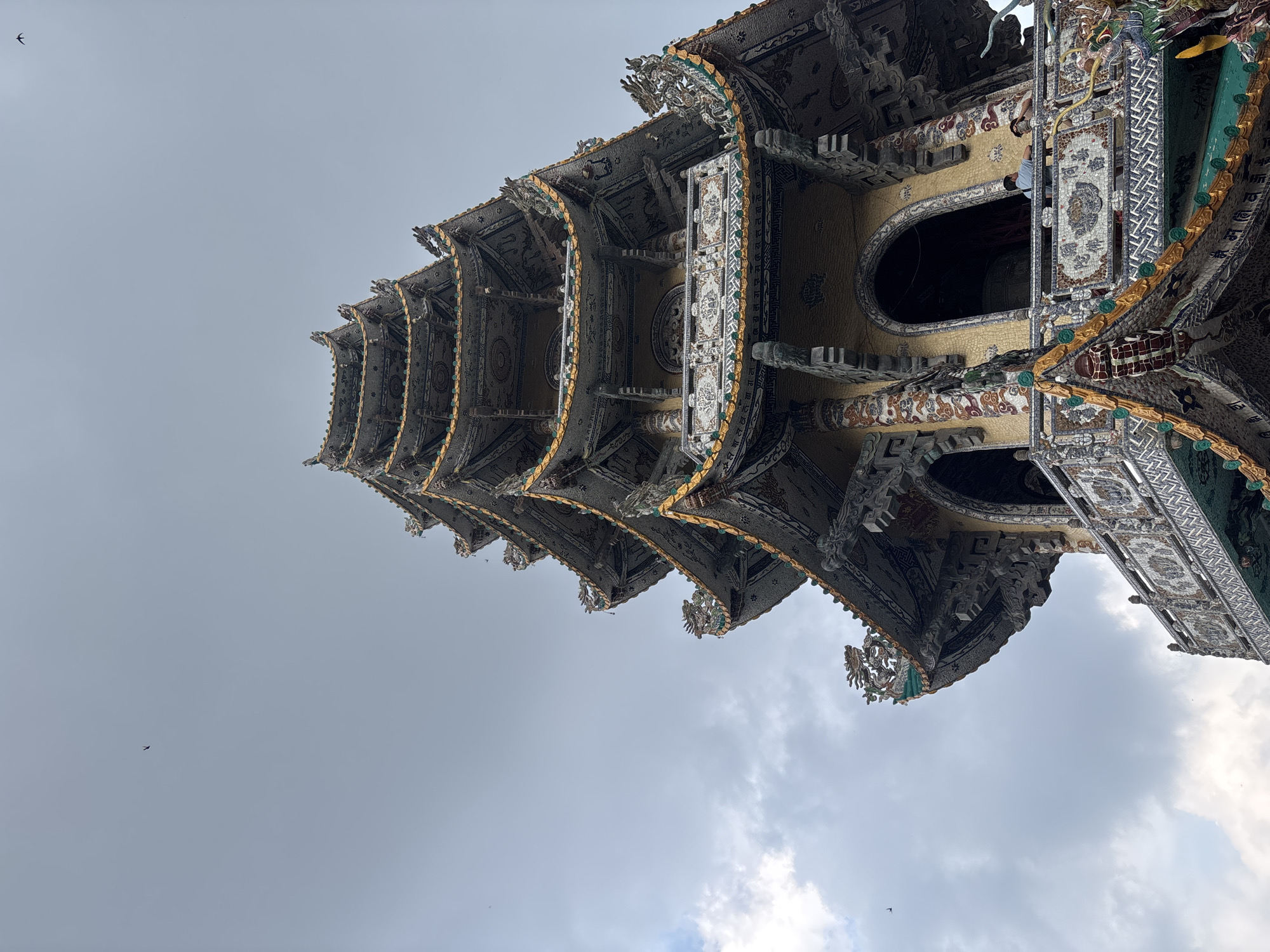
The image, rotated 90 degrees clockwise, displays a tall, multi-tiered, and highly ornate building, likely a pagoda or temple tower, against an overcast sky. The structure is richly decorated with intricate mosaic-like patterns, possibly crafted from ceramic or glass shards, covering its walls and tiered rooflines. Golden accents highlight the edges of each tier and various architectural details. Sculptures resembling dragons or mythical creatures adorn the corners of the eaves.
Through one of the building's arched openings on an upper level, a person's head and shoulders are partially visible, looking outwards. The sky is largely overcast with light gray clouds, indicating daytime. Several small, dark birds, resembling swallows, are seen flying in the sky, particularly in the upper left quadrant. No clearly legible text is identifiable, though some decorative patterns might incorporate stylized characters. The architectural style is consistent with traditional temple structures found in Xuân Thành, Vietnam. The perspective looks upwards, emphasizing the grandeur and intricate craftsmanship of the building.
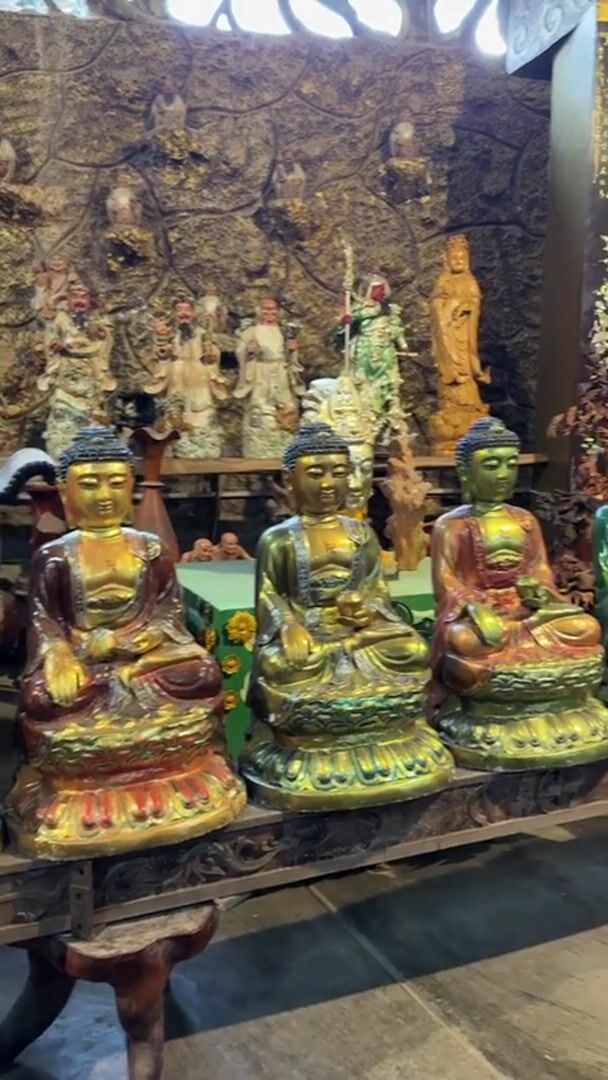
The video displays an array of religious statues, primarily Buddhist figures, arranged within what appears to be a temple, shrine, or a shop specializing in religious artifacts.
In the foreground, a row of four brightly colored Buddha statues sits in meditative poses on a wooden bench. These statues feature prominent gold accents, with their robes and bases incorporating shades of red, orange, and green, giving them a vibrant, metallic sheen.
Behind these, the background is dominated by a wall adorned with intricate golden, textured carvings or reliefs. Numerous smaller statues of various deities and mythological figures are placed on shelves against this elaborate backdrop. These background figures are diverse in appearance, some depicting venerable elders, others appearing more warrior-like with weapons, and some smaller, child-like figures are also visible.
On the far right, a tall, slender wooden statue, possibly depicting Guanyin or another bodhisattva, stands out among the other figures. The overall lighting is warm, highlighting the golden hues and intricate details of the statues and the background. The camera slowly pans slightly to the right, offering a broader view of the collection of statues.
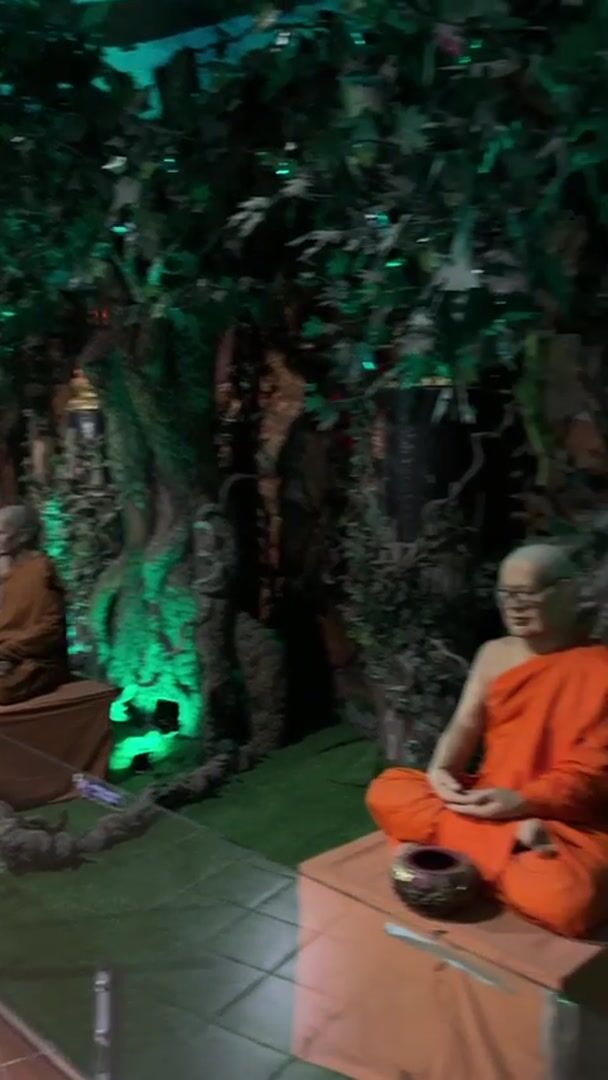
The video displays an indoor exhibit featuring several life-sized statues of Buddhist monks in a meditative posture. Each monk figure is bald, wears traditional orange robes, and sits cross-legged on a low, light brown platform or box. Some figures have a small alms bowl placed in front of them.
The setting is designed to resemble a serene, forested environment, with numerous artificial trees and roots dominating the background and foreground. The trees feature abundant green foliage, and their trunks and roots are intricately detailed. The ground is covered with what appears to be artificial green grass or moss.
The entire scene is illuminated by striking green lighting, which casts an ethereal glow on the trees and highlights the monk figures. This green light creates a tranquil and somewhat mystical atmosphere, suggesting a peaceful, spiritual forest setting. A short, transparent glass barrier separates the viewer from the exhibit in the foreground. The camera pans slowly across the display, showcasing different monk figures and elements of the artificial forest. The ambiance suggests a spiritual or cultural exhibit, likely located in a temple or museum in Xuân Thành, Vietnam. No specific activity is occurring as the subjects are static figures. There is no visible text in the video.
This vertically-oriented image captures a section of an extraordinarily ornate multi-tiered temple, likely a pagoda, under an overcast or partly cloudy sky. The building is a spectacle of intricate architecture, adorned with countless mosaic-like decorations crafted from fragments of ceramic, glass, and pottery. Mythical creatures, prominently dragons and phoenix-like birds, are integrated into the eaves, roofs, and facades, rendered in vibrant colors and dynamic forms. Golden statues and bas-reliefs are interspersed among the colorful patterns, adding to the grandeur.
The temple features multiple levels with distinct red-tiled roofs and spire-like finials. Arched doorways and a round window are visible within the elaborate structure. On one prominent facade, the name "CHÙA LINH PHƯỚC" (Linh Phuoc Pagoda) is clearly inscribed in large white letters. Other visible text includes "禪寺雙修" (Chan Temple Double Cultivation) and "欲知前世因" (If you want to know the cause of your past life), suggesting Buddhist themes.
Several people are visible, indicating visitors or worshippers. One person stands within a dark arched entrance, while others are seen near the base of the structure, some appearing to observe or photograph the detailed artistry with their phones. The overall impression is one of immense artistic craftsmanship and spiritual significance, characteristic of Vietnamese Buddhist architecture, consistent with the location context of Xuân Thành, Vietnam. The time of day appears to be daytime, with diffused light due to the cloudy conditions.
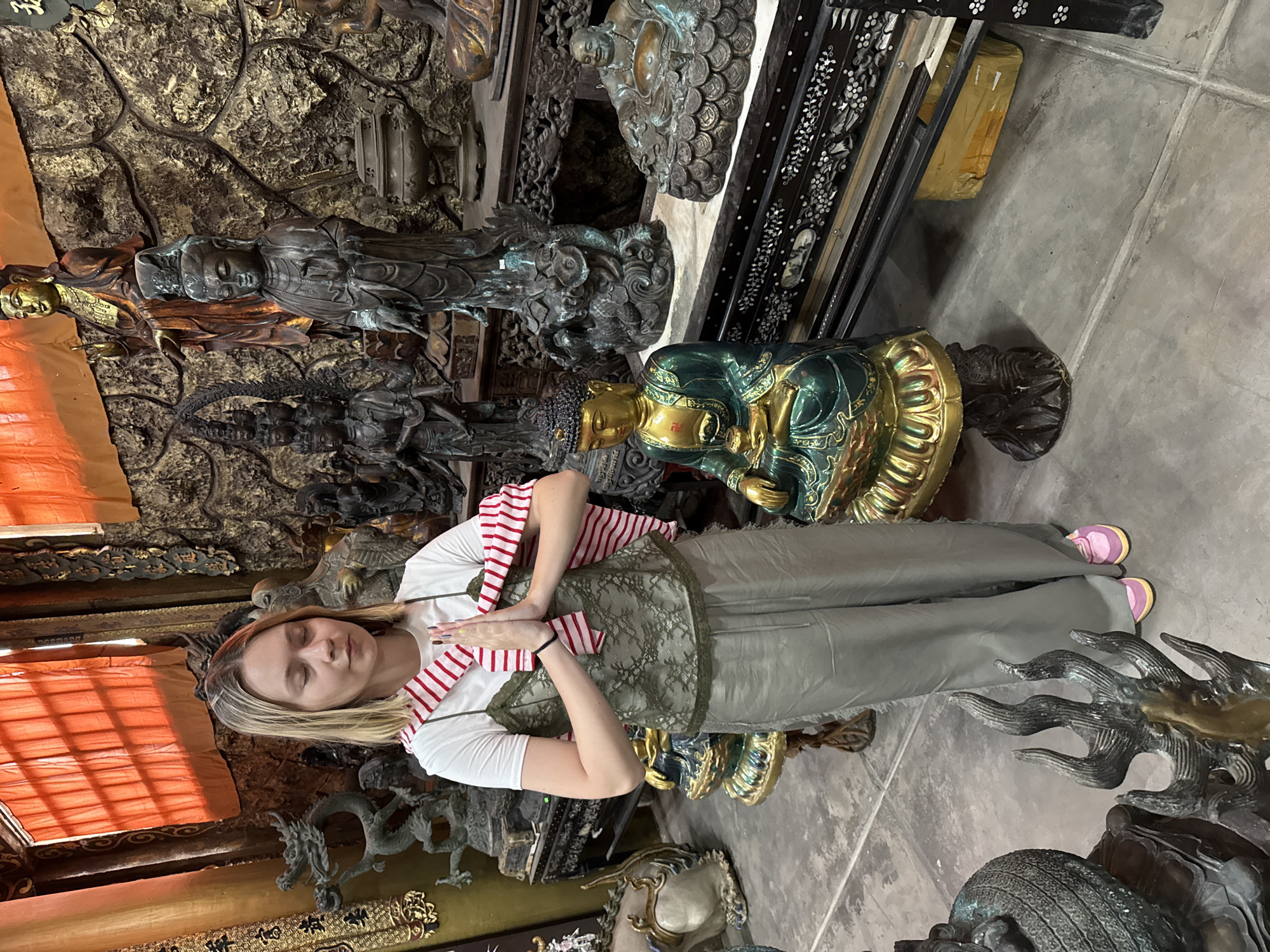
A young woman stands reverently amidst a collection of Buddhist or East Asian religious statues and artifacts in what appears to be an indoor temple, shrine, or antique shop in Xuân Thành, Vietnam. She has blonde hair and fair skin, dressed in a white t-shirt, a green lace camisole, and light grey/green wide-leg pants, with pink and yellow sneakers visible on her feet. Her hands are pressed together in a gesture of prayer or respect (Anjali Mudra), and her eyes are closed, conveying a sense of meditation, contemplation, or reverence.
The setting is rich with intricate details. To her immediate right, a large Buddha statue, predominantly green and gold, sits in a meditative pose. A golden swastika symbol, an ancient auspicious emblem, is visible on its chest. Behind her, a tall, dark bronze-colored statue of a standing figure, possibly a deity or Bodhisattva, is present. The background features more ornate carvings, including dragon figures, other statues, and panels with mother-of-pearl inlay. An orange fabric hangs on the left side, adding a pop of color to the otherwise earthy and metallic tones of the artifacts. The floor is tiled or concrete. The overall atmosphere suggests a place of cultural significance and spiritual devotion.
Xuân Thành, Vietnam · Apr 28, 2026, 8:22 AM
A young woman stands centered between two large, elaborate statues in an indoor setting, likely a temple or cultural exhibition in Xuân Thành, Vietnam. The woman, wearing a striped t-shirt and light-colored pants, looks towards the camera with a slight smile.
To her right (viewer's left) is a commanding statue of a figure with a horse-like head, prominent ears, and striking red glowing eyes. Its body is light brown, muscular, and adorned with an intricately patterned green and gold armor piece on its lower half. It holds a staff-like weapon.
To her left (viewer's right) is another formidable statue, dark red in color, featuring a bull-like head with horns and matching red glowing eyes. This figure also wears ornate green and gold armor and holds a multi-pronged trident.
The background consists of dark walls and pillars richly decorated with intricate gold floral and swirling patterns. The ceiling is dark, and faint text, possibly "NAM MO DIA," is visible. The lighting is dim, enhancing the dramatic effect of the glowing eyes and the statues' vibrant colors. The overall scene conveys a sense of cultural grandeur and ancient folklore.
The video displays an ornate indoor space, likely a temple, shop, or private collection, filled with a multitude of religious statues. The scene is set in Xuân Thành, Vietnam, and features a diverse array of Buddha figures and other deities, varying in size and material. Statues made of wood, gold-colored metal, green stone, and red ceramic are prominently featured.
These figures are arranged on several large, intricately carved tables, some adorned with mother-of-pearl inlay. The background wall is extensively decorated with a textured, golden, or natural rock-like surface, embellished with numerous smaller statues. Overhead, bright light illuminates the detailed craftsmanship of the collection. Some of the statues, particularly a large green one, are partially covered with a protective layer of clear plastic or netting. A tall, slender wooden vase stands on a table in the foreground on the left. The camera pans slowly across this elaborate display, showcasing the cultural and spiritual richness of the objects. No people are visible, and no discernible text is present in the video.
The image displays a theatrical diorama set within a dimly lit, cave-like interior. The scene is bathed in dramatic purple and red lighting, casting long shadows and creating an eerie, atmospheric effect.
The subjects are numerous humanoid figures, likely mannequins or statues, dressed in elaborate traditional costumes. In the background, several figures are seated behind a long table draped with a red cloth, upon which books are stacked. These seated figures wear ornate, tall headdresses and intricate robes. Their faces are painted with bold theatrical makeup, with one prominent figure on the left featuring a red face, while others display paler complexions. A banner hanging above the table clearly reads "CUNG THẬP ĐIỆN DIÊM VƯƠNG," identifying these figures as the Ten Courts of Yama Kings (Diyu), commonly associated with judgment in the afterlife in East Asian mythology.
In the foreground and mid-ground, many other figures are depicted kneeling or prostrate on the ground. These figures are predominantly white and heavily splattered with red, resembling blood, which suggests suffering, torment, or punishment. Their slumped and supplicating postures convey distress and agony. On the right wall, a partially visible sign contains Vietnamese text that appears to read "Vong xin tha tội" (Souls beg for forgiveness), with other words such as "tha thân" (forgive/release the body) also discernible, further reinforcing the theme of judgment and suffering of souls.
The rough, natural texture of the cave walls serves as a fitting backdrop for this dramatic and somewhat gruesome portrayal of the underworld. The entire setup in Xuân Thành, Vietnam, evokes a sense of spiritual drama and cultural storytelling related to the afterlife.
The image depicts an outdoor scene at an elaborately decorated architectural complex, characteristic of a temple or pagoda in Xuân Thành, Vietnam. The perspective captures a multi-level structure adorned with intricate mosaic tiles and ornate details under a bright, overcast sky.
On the left, a section of a building features a prominent green-tiled roof with a golden trim and white mosaic patterns. The walls and railings throughout the complex are extensively covered in colorful mosaic tiles, depicting a variety of patterns including floral motifs, geometric designs, and mythological creatures such as dragons, particularly visible beneath eaves and along balustrades.
Several people, mostly adults dressed in casual attire, are present on a tiled walkway or balcony on the right side of the frame. They appear to be visitors or tourists, walking around and observing the detailed architecture. One person holds a blue umbrella. In the mid-ground and background, various multi-story residential or commercial buildings are visible.
A notable detail is the Vietnamese text "TRANH NHÂN QUẢ PHẬT" written on a white building in the background, which translates to "Buddhist Karma Paintings" or "Buddhist Cause and Effect Paintings," reinforcing the religious context of the location. Another partially obscured sign reads "LÊ PHƯƠNG". The ground in the immediate foreground consists of brown square tiles. The scene conveys a sense of a vibrant cultural site, active with visitors exploring its rich artistic and architectural heritage during daylight hours.
Bac Nha Trang Ward, Vietnam · Saturday, May 16, 2026

 Xuân Thành, Vietnam