Thursday, March 26, 2026 · Updated Thursday, March 26, 2026
Italy
Rome, the Eternal City, and its sacred enclave, Vatican City, continue to captivate travelers with their unparalleled historical depth and architectural grandeur. A journey through these iconic destinations reveals a tapestry of ancient wonders and artistic masterpieces, drawing visitors from across the globe into a living history lesson. The experience is often defined by breathtaking views and the palpable sense of centuries unfolding.
The image displays an upward-angled view of a grand interior ceiling and upper walls, specifically identified as the Gallery of the Candelabra within the Vatican Museums, located in Vatican City, Rome, Italy.
The elaborate ceiling features a central octagonal fresco, depicting multiple human figures, possibly deities or allegories, against a vibrant blue sky with white clouds. This central panel is encircled by a complex arrangement of smaller trapezoidal and rectangular frescoed panels. These surrounding panels illustrate various mythological or allegorical narratives, populated by numerous dynamic, often nude or semi-nude, classical figures shown flying, falling, conversing, or engaged in heroic feats. The entire ceiling composition is intricately framed by gilded architectural elements, including classical Greek key patterns, foliate scrolls, and simulated white marble sculptural reliefs featuring putti and garlands.
Below the primary ceiling structure, a continuous frieze of rectangular painted panels adorns the upper walls. One visible panel on the left depicts approximately ten robed figures, resembling classical philosophers or scholars, engaged in an animated discussion; one figure points upward, another holds a globe, and several carry staffs or scrolls.
Architecturally, a large, light-colored marble-clad archway with prominent grey veining and gold trim is visible on the lower left. On the lower right, a substantial arched window with a simple grid pattern allows abundant natural light into the space. Beneath this window, a rectangular framed painting is visible, portraying three classical figures (two standing, one seated) in a pastoral setting. The overall scene is characterized by a rich color palette of blues, ochres, reds, and greens, extensively accented with gold leaf.
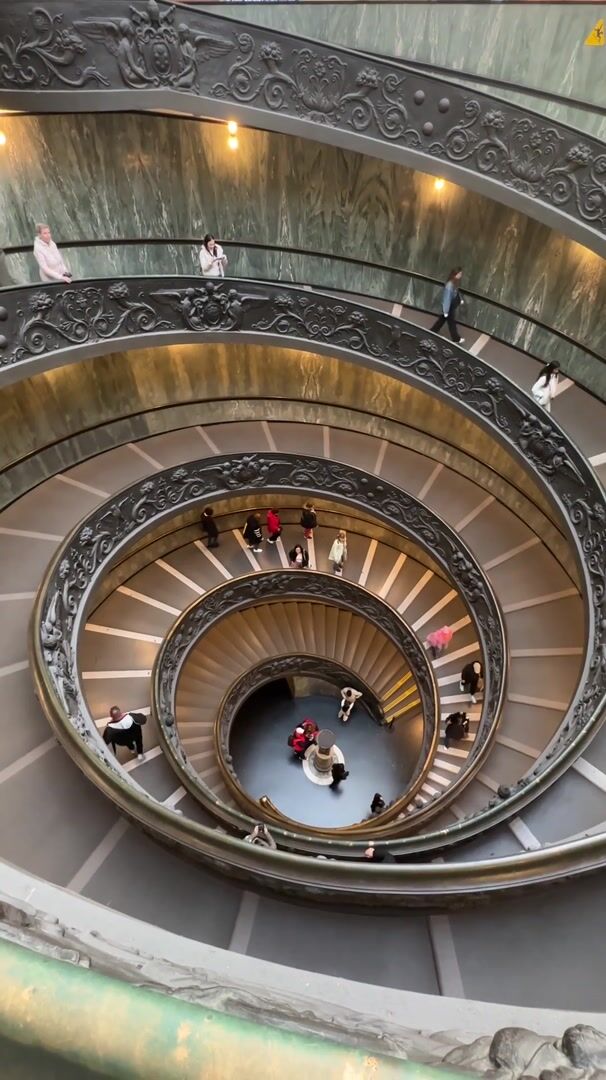
Among the most visually arresting sights is the grand, ornate spiral staircase within the Vatican Museums. Captured from an aerial perspective, this architectural marvel sees a continuous flow of people ascending and descending its elegant gray stone steps, framed by dark metal railings adorned with intricate designs. The walls, clad in a light green marbled material, and the warm-toned lighting create an ethereal glow, culminating in a central feature at the staircase's base where visitors gather, mesmerized.
An elevated panoramic view captures a densely built urban landscape within Città del Vaticano, Vatican City, under a heavily overcast sky with dark grey clouds. Reflections of two parallel vertical light sources are visible on the photographic plane.
In the immediate foreground, a dark grey, sloped slate roof with metal fasteners occupies the lower right. Below and beyond this, a green lawn populated by several small palm trees and a larger deciduous tree borders a complex of facilities. These include a large white arched tent structure labeled "San Giuseppe," positioned next to a green artificial turf sports field. This field features white markings, a soccer goal, and a basketball hoop against a low wall adorned with colorful handprints. Adjacent to this, a blue-surfaced court with metal railings is partially covered by a green tarp, and a second green artificial turf field is visible.
The mid-ground and background reveal a sprawling cityscape composed predominantly of multi-story buildings in varying shades of pink, beige, yellow, and orange, many featuring windows with dark shutters and a mix of flat and tiled roofs. A prominent tree-lined street runs through the urban fabric, with numerous parked vehicles visible along its length. No individuals are discernible within the scene.
Città del Vaticano, Vatican City · Mar 26, 2026, 1:54 PM
Beyond the Vatican's hallowed halls, Rome's streets tell their own stories. Near the Leonine Wall, adjacent to Vatican City, cobblestone streets host large gatherings of individuals, often seen queuing under an overcast sky. Uniformed Italian military personnel are interspersed among the crowds, overseeing metal crowd control barriers, a testament to the city's enduring allure and the sheer volume of visitors it attracts. Multi-story Roman buildings with light-colored facades and dark shutters line the streets, their timeless beauty enhanced by the occasional palm tree.
The image displays a bronze bust, identified as a fragment from the original Equestrian Statue of Roman Emperor Marcus Aurelius. The bust depicts an adult male figure from the chest upwards, featuring short, textured hair, a stern facial expression with hollow, deeply set eyes, and a prominent nose. A segment of draped fabric or a cloak is visible over the figure's proper right shoulder. The bronze surface exhibits an aged patina characterized by dark, oxidized areas, interspersed with patches of reddish-brown and verdigris (greenish-blue) corrosion. The figure's proper right arm is severed at the bicep, showing a rough, jagged break. The proper left arm extends forward, severed at the wrist, with a broken, organic-shaped object (identified as part of a horse's head) held in the remains of the hand.
The bust is mounted on a polished metallic rod, which is secured into a dark, rectangular display pedestal with a matte finish. The item is situated indoors against a plain, off-white wall, illuminated by a strong, directional light source that casts distinct shadows of the bust on the wall behind it. The floor consists of light beige-brown stone or marble tiles with a matching baseboard along the wall. To the right of the bust, a rectangular white informational plaque with black text and a crest is affixed to the wall. This plaque identifies the artwork as the "Upper part of equestrian statue," dates it to the second half of the 2nd century A.D., and notes its restoration by Michelangelo in 1538. The plaque specifies its location as the Capitoline Museums (Musei Capitolini), Palazzo dei Conservatori, Piazza del Campidoglio, Rome, Italy.
The scene depicts a large gathering of individuals on a cobblestone street in Rome, Italy, directly adjacent to a tall, weathered brick wall, consistent with the Leonine Wall near Vatican City. Under an overcast sky, numerous civilians, predominantly adults dressed in winter clothing, are visible in the foreground and midground, standing or moving slowly in what appears to be a queue or public gathering. Several uniformed Italian military personnel, identifiable by their camouflage uniforms and black berets, are interspersed among the crowd, with some positioned near metal crowd control barriers in the midground. The background features a street lined with multi-story, classically-styled Roman buildings, characterized by light-colored facades, dark shutters, and balconies. A prominent palm tree is visible among the background architecture.
Inside the Capitoline Museums, fragments of Rome's imperial past are meticulously preserved. A bronze bust, a fragment from the original Equestrian Statue of Roman Emperor Marcus Aurelius, offers a poignant glimpse into antiquity. Its aged patina, a mix of dark oxidation and verdigris, tells a story of time, while an informational plaque details its restoration by Michelangelo in 1538, connecting visitors to the hands that shaped history. The panoramic views from elevated points across Vatican City reveal a sprawling urban landscape, a mosaic of pink, beige, and orange buildings, offering a sense of the vastness and intricacy of this historic heartland.
The video shows a downward aerial view of a grand, ornate, spiral staircase within a building. Many people are seen ascending and descending the staircase. The staircase has gray stone steps and dark metal railings decorated with intricate designs. The walls are clad in a light green marbled material. The lighting is provided by warm-toned lamps. The bottom of the staircase features a central feature, possibly a fountain or sculpture, where several people are gathered.
The image displays an upward-angled view of a grand interior ceiling and upper walls, specifically identified as the Gallery of the Candelabra within the Vatican Museums, located in Vatican City, Rome, Italy.
The elaborate ceiling features a central octagonal fresco, depicting multiple human figures, possibly deities or allegories, against a vibrant blue sky with white clouds. This central panel is encircled by a complex arrangement of smaller trapezoidal and rectangular frescoed panels. These surrounding panels illustrate various mythological or allegorical narratives, populated by numerous dynamic, often nude or semi-nude, classical figures shown flying, falling, conversing, or engaged in heroic feats. The entire ceiling composition is intricately framed by gilded architectural elements, including classical Greek key patterns, foliate scrolls, and simulated white marble sculptural reliefs featuring putti and garlands.
Below the primary ceiling structure, a continuous frieze of rectangular painted panels adorns the upper walls. One visible panel on the left depicts approximately ten robed figures, resembling classical philosophers or scholars, engaged in an animated discussion; one figure points upward, another holds a globe, and several carry staffs or scrolls.
Architecturally, a large, light-colored marble-clad archway with prominent grey veining and gold trim is visible on the lower left. On the lower right, a substantial arched window with a simple grid pattern allows abundant natural light into the space. Beneath this window, a rectangular framed painting is visible, portraying three classical figures (two standing, one seated) in a pastoral setting. The overall scene is characterized by a rich color palette of blues, ochres, reds, and greens, extensively accented with gold leaf.
An elevated panoramic view captures a densely built urban landscape within Città del Vaticano, Vatican City, under a heavily overcast sky with dark grey clouds. Reflections of two parallel vertical light sources are visible on the photographic plane.
In the immediate foreground, a dark grey, sloped slate roof with metal fasteners occupies the lower right. Below and beyond this, a green lawn populated by several small palm trees and a larger deciduous tree borders a complex of facilities. These include a large white arched tent structure labeled "San Giuseppe," positioned next to a green artificial turf sports field. This field features white markings, a soccer goal, and a basketball hoop against a low wall adorned with colorful handprints. Adjacent to this, a blue-surfaced court with metal railings is partially covered by a green tarp, and a second green artificial turf field is visible.
The mid-ground and background reveal a sprawling cityscape composed predominantly of multi-story buildings in varying shades of pink, beige, yellow, and orange, many featuring windows with dark shutters and a mix of flat and tiled roofs. A prominent tree-lined street runs through the urban fabric, with numerous parked vehicles visible along its length. No individuals are discernible within the scene.
The image displays a bronze bust, identified as a fragment from the original Equestrian Statue of Roman Emperor Marcus Aurelius. The bust depicts an adult male figure from the chest upwards, featuring short, textured hair, a stern facial expression with hollow, deeply set eyes, and a prominent nose. A segment of draped fabric or a cloak is visible over the figure's proper right shoulder. The bronze surface exhibits an aged patina characterized by dark, oxidized areas, interspersed with patches of reddish-brown and verdigris (greenish-blue) corrosion. The figure's proper right arm is severed at the bicep, showing a rough, jagged break. The proper left arm extends forward, severed at the wrist, with a broken, organic-shaped object (identified as part of a horse's head) held in the remains of the hand.
The bust is mounted on a polished metallic rod, which is secured into a dark, rectangular display pedestal with a matte finish. The item is situated indoors against a plain, off-white wall, illuminated by a strong, directional light source that casts distinct shadows of the bust on the wall behind it. The floor consists of light beige-brown stone or marble tiles with a matching baseboard along the wall. To the right of the bust, a rectangular white informational plaque with black text and a crest is affixed to the wall. This plaque identifies the artwork as the "Upper part of equestrian statue," dates it to the second half of the 2nd century A.D., and notes its restoration by Michelangelo in 1538. The plaque specifies its location as the Capitoline Museums (Musei Capitolini), Palazzo dei Conservatori, Piazza del Campidoglio, Rome, Italy.
The scene depicts a large gathering of individuals on a cobblestone street in Rome, Italy, directly adjacent to a tall, weathered brick wall, consistent with the Leonine Wall near Vatican City. Under an overcast sky, numerous civilians, predominantly adults dressed in winter clothing, are visible in the foreground and midground, standing or moving slowly in what appears to be a queue or public gathering. Several uniformed Italian military personnel, identifiable by their camouflage uniforms and black berets, are interspersed among the crowd, with some positioned near metal crowd control barriers in the midground. The background features a street lined with multi-story, classically-styled Roman buildings, characterized by light-colored facades, dark shutters, and balconies. A prominent palm tree is visible among the background architecture.
Morning snapshots from Nha Trang: traffic, fast food, girl
Bac Nha Trang Ward, Vietnam · Saturday, May 16, 2026