Sign in
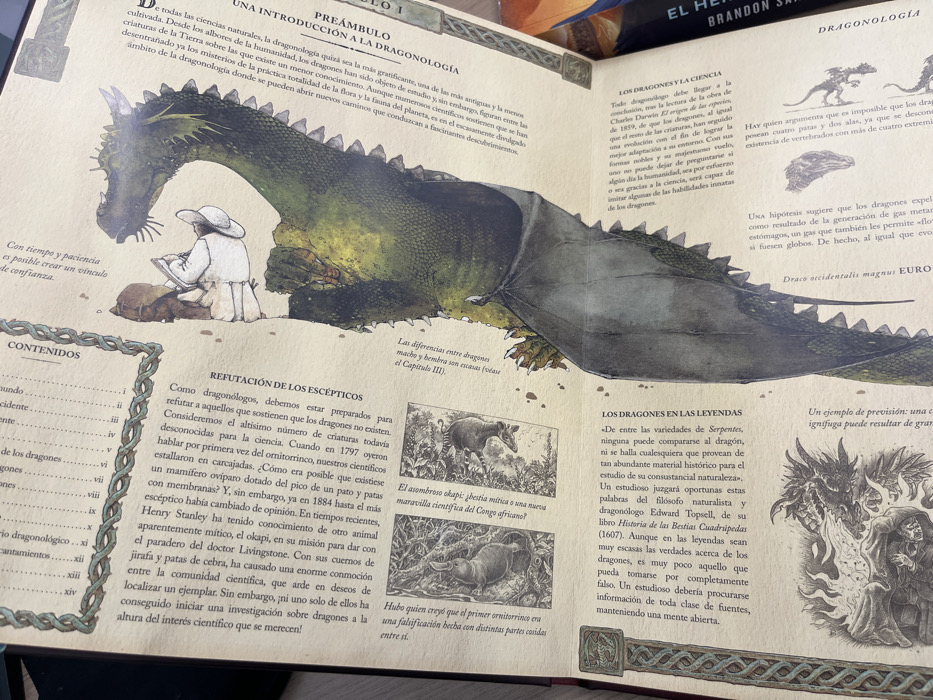
The image displays an open, large format book, likely a fictional field guide or encyclopedia dedicated to "Dragonology." The book is open to two pages, with a significant illustration spanning both. In the background, part of another book with the title "EL H BRANDON SAND" is visible, out of focus.

The main illustration depicts a large, green, scaly dragon with a spiked back and head. Its head is turned towards a human figure who is seated on the ground, wearing a wide-brimmed hat and a light-colored smock, engrossed in drawing or writing in a book. The dragon's body extends across the lower portion of both pages, suggesting a large, powerful creature. The overall artistic style is reminiscent of naturalist illustrations from past centuries.

The left page is titled "PREÁMBULO UNA INTRODUCCIÓN A LA DRAGONOLOGÍA" (Preamble: An Introduction to Dragonology). The introductory text explains dragonology as an ancient and gratifying natural science, asserting that despite scientific advancements in other fields, dragons remain largely unknown and offer new avenues for discovery. A small text box on the left margin reads, "Con tiempo y paciencia es posible crear un vínculo de confianza." (With time and patience it's possible to create a bond of trust.) Below the main illustration, there's a "CONTENIDOS" (Contents) section listing various topics with roman numerals. A prominent text box titled "REFUTACIÓN DE LOS ESCÉPTICOS" (Refutation of Skeptics) discusses how dragonologists should be prepared to counter those who deny the existence of dragons. It references historical instances where seemingly mythical creatures like the platypus and the okapi were eventually confirmed, implying that dragons might follow a similar trajectory. It concludes by lamenting the lack of serious scientific investigation into dragons.

The right page has "DRAGONOLOGÍA" (Dragonology) at the top. Several text boxes are spread across the page. "LOS DRAGONES Y LA CIENCIA" (Dragons and Science) argues for applying Darwinian evolution to dragons, questioning if humanity will ever replicate their innate abilities. Another box presents an argument against dragons having four legs and two wings, citing the lack of vertebrates with more than four extremities. A hypothesis suggests dragons expel fire due to methane gas generated in their stomachs, allowing them to "float like balloons." A Latin-sounding name, "Draco occidentalis magnus EURO," is also visible. Below the main illustration, a small caption notes, "Las diferencias entre dragones macho y hembra son escasas (véase el Capítulo III)." (Differences between male and female dragons are scarce (see Chapter III)). Two smaller, black-and-white illustrations are featured: one shows an okapi in a jungle, captioned, "El asombroso okapi: ¿bestia mítica o una nueva maravilla científica del Congo africano?" (The amazing okapi: mythical beast or a new scientific marvel from the African Congo?). The other shows a platypus, with the caption, "Hubo quien creyó que el primer ornitorrinco era una falsificación hecha con distintas partes cosidas entre sí." (There were those who believed the first platypus was a forgery made with different parts sewn together). The "LOS DRAGONES EN LAS LEYENDAS" (Dragons in Legends) section advises an open mind when studying dragons in historical texts and legends, referencing Edward Topsell's "Historia de las Bestias Cuadrupedas" (1607). A small, partially cut-off text box at the bottom right reads, "Un ejemplo de previsión: una c ignífuga puede resultar de grar" (An example of foresight: a fireproof... could be of great...). Below this, a small, dark illustration depicts a dragon-like creature with flames, possibly interacting with human figures.

The book's pages are a warm, aged parchment color, and the text is in Spanish, printed in a classic serif font. Decorative borders and elements are used throughout, adding to the antiquated, academic aesthetic.
Will Herondale

Feb 4, 2026

Mexico City, Mexico

Stake attention in this memory

dragonology
illustration
book
fantasy
text

The image displays an open, large format book, likely a fictional field guide or encyclopedia dedicated to "Dragonology." The book is open to two pages, with a significant illustration spanning both. In the background, part of another book with the title "EL H BRANDON SAND" is visible, out of focus. The main illustration depicts a large, green, scaly dragon with a spiked back and head. Its head is turned towards a human figure who is seated on the ground, wearing a wide-brimmed hat and a light-colored smock, engrossed in drawing or writing in a book. The dragon's body extends across the lower portion of both pages, suggesting a large, powerful creature. The overall artistic style is reminiscent of naturalist illustrations from past centuries. The left page is titled "PREÁMBULO UNA INTRODUCCIÓN A LA DRAGONOLOGÍA" (Preamble: An Introduction to Dragonology). The introductory text explains dragonology as an ancient and gratifying natural science, asserting that despite scientific advancements in other fields, dragons remain largely unknown and offer new avenues for discovery. A small text box on the left margin reads, "Con tiempo y paciencia es posible crear un vínculo de confianza." (With time and patience it's possible to create a bond of trust.) Below the main illustration, there's a "CONTENIDOS" (Contents) section listing various topics with roman numerals. A prominent text box titled "REFUTACIÓN DE LOS ESCÉPTICOS" (Refutation of Skeptics) discusses how dragonologists should be prepared to counter those who deny the existence of dragons. It references historical instances where seemingly mythical creatures like the platypus and the okapi were eventually confirmed, implying that dragons might follow a similar trajectory. It concludes by lamenting the lack of serious scientific investigation into dragons. The right page has "DRAGONOLOGÍA" (Dragonology) at the top. Several text boxes are spread across the page. "LOS DRAGONES Y LA CIENCIA" (Dragons and Science) argues for applying Darwinian evolution to dragons, questioning if humanity will ever replicate their innate abilities. Another box presents an argument against dragons having four legs and two wings, citing the lack of vertebrates with more than four extremities. A hypothesis suggests dragons expel fire due to methane gas generated in their stomachs, allowing them to "float like balloons." A Latin-sounding name, "Draco occidentalis magnus EURO," is also visible. Below the main illustration, a small caption notes, "Las diferencias entre dragones macho y hembra son escasas (véase el Capítulo III)." (Differences between male and female dragons are scarce (see Chapter III)). Two smaller, black-and-white illustrations are featured: one shows an okapi in a jungle, captioned, "El asombroso okapi: ¿bestia mítica o una nueva maravilla científica del Congo africano?" (The amazing okapi: mythical beast or a new scientific marvel from the African Congo?). The other shows a platypus, with the caption, "Hubo quien creyó que el primer ornitorrinco era una falsificación hecha con distintas partes cosidas entre sí." (There were those who believed the first platypus was a forgery made with different parts sewn together). The "LOS DRAGONES EN LAS LEYENDAS" (Dragons in Legends) section advises an open mind when studying dragons in historical texts and legends, referencing Edward Topsell's "Historia de las Bestias Cuadrupedas" (1607). A small, partially cut-off text box at the bottom right reads, "Un ejemplo de previsión: una c ignífuga puede resultar de grar" (An example of foresight: a fireproof... could be of great...). Below this, a small, dark illustration depicts a dragon-like creature with flames, possibly interacting with human figures. The book's pages are a warm, aged parchment color, and the text is in Spanish, printed in a classic serif font. Decorative borders and elements are used throughout, adding to the antiquated, academic aesthetic.

transactions
revenues
stakers
Earliest
Latest
Highest stake

No transactions found

More from this user

More from Mexico City

Will Herondale

Feb 4, 2026

Mexico City, Mexico

Licensed under Creative Commons Attribution 4.0 International License. You are free to share and adapt this content with proper attribution.