
Sign in
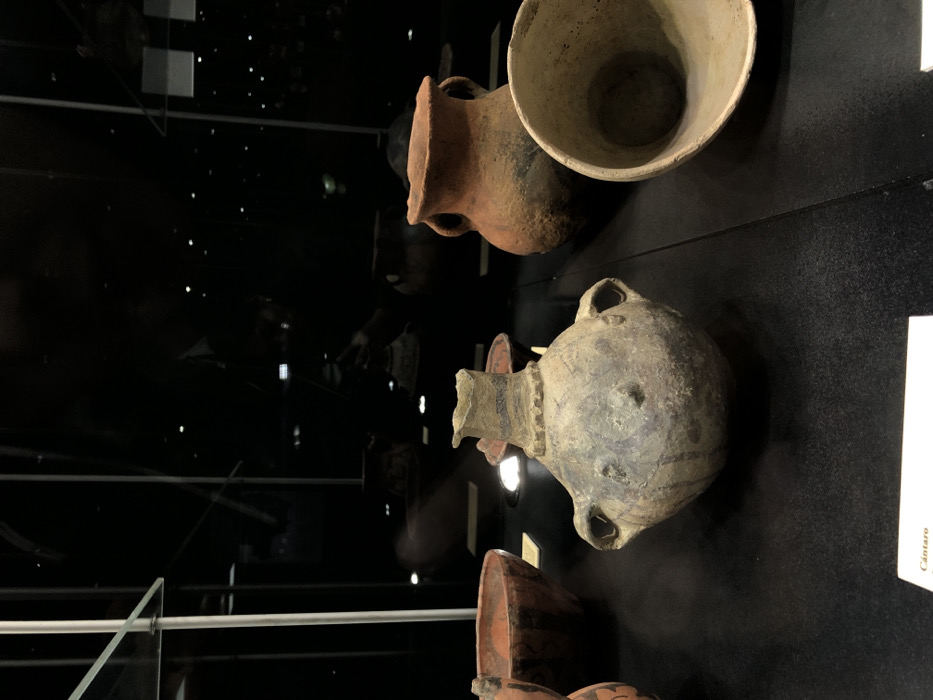
The image captures a museum display featuring several ancient ceramic vessels, set against a dark background with reflections. The scene presents an archaeological or historical exhibition, likely indoors under artificial lighting.

Prominently displayed are three distinct pottery pieces. In the upper part of the frame, there is a light-colored, wide-mouthed vessel, possibly a bowl or cup, viewed from above, revealing its textured interior. Below and to its left, a reddish-brown jar or amphora with two handles rests on its side, partially visible. The most complete object is positioned centrally in the lower half of the frame: a grayish-brown, two-handled vessel with a narrower neck and a bulbous body. This particular piece shows signs of age and features faint decorative bands or lines around its base and body. Other smaller, red-hued pottery fragments or vessels are partially visible towards the bottom edge and within reflections.

The dark, reflective background reveals faint reflections of the museum environment, including indistinct shapes of people, possibly visitors, and elements of display cases or ambient lighting, suggesting a viewing activity. Clear glass panels or barriers are also visible in the foreground and background, typical of museum exhibits.

A white label on the right side of the image contains visible text, identifying the central gray vessel as a "Cántaro," which is Spanish for "pitcher" or "jug." Given the location context of La Paz, Bolivia, these artifacts are likely pre-Columbian or colonial era pottery from the region, displayed for historical and cultural appreciation.
MNela

Jan 9, 2025, 8:39 PM

La Paz, Bolivia

Stake attention in this memory

The image captures a museum display featuring several ancient ceramic vessels, set against a dark background with reflections. The scene presents an archaeological or historical exhibition, likely indoors under artificial lighting. Prominently displayed are three distinct pottery pieces. In the upper part of the frame, there is a light-colored, wide-mouthed vessel, possibly a bowl or cup, viewed from above, revealing its textured interior. Below and to its left, a reddish-brown jar or amphora with two handles rests on its side, partially visible. The most complete object is positioned centrally in the lower half of the frame: a grayish-brown, two-handled vessel with a narrower neck and a bulbous body. This particular piece shows signs of age and features faint decorative bands or lines around its base and body. Other smaller, red-hued pottery fragments or vessels are partially visible towards the bottom edge and within reflections. The dark, reflective background reveals faint reflections of the museum environment, including indistinct shapes of people, possibly visitors, and elements of display cases or ambient lighting, suggesting a viewing activity. Clear glass panels or barriers are also visible in the foreground and background, typical of museum exhibits. A white label on the right side of the image contains visible text, identifying the central gray vessel as a "Cántaro," which is Spanish for "pitcher" or "jug." Given the location context of La Paz, Bolivia, these artifacts are likely pre-Columbian or colonial era pottery from the region, displayed for historical and cultural appreciation.

Loading AttnAds…

transactions
revenues
stakers
Earliest
Latest
Highest stake

No transactions found

More from this user

More from La Paz

MNela

Jan 9, 2025, 8:39 PM

La Paz, Bolivia

Licensed under Creative Commons Attribution 4.0 International License. You are free to share and adapt this content with proper attribution.