Sign in
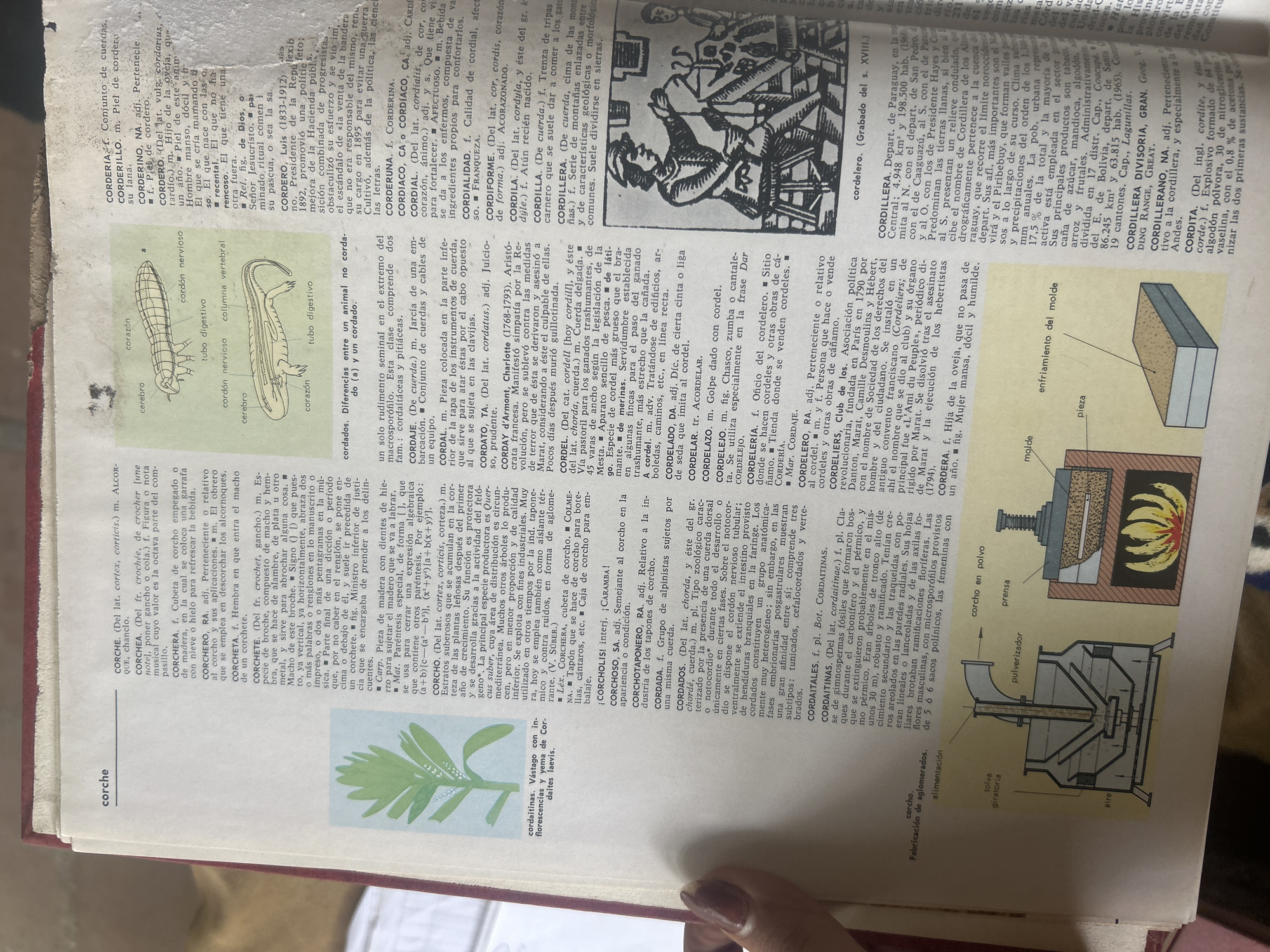
The image is a close-up of an open book, showcasing a dictionary or encyclopedia. The page displays entries for words starting with "Corch-" and "Cord-," with a focus on zoological and botanical terms, as well as biographical entries.

Two illustrations are prominent:

1.  **An anatomical diagram of a worm-like creature** (likely an invertebrate, possibly a Cestoda or Annelid, given the labels "cerebro," "corazón," and "tubo digestivo"). This diagram is positioned to the left, illustrating the internal structure of the organism. A caption below it describes differences between a "cordado" and a non-cordado animal.

2.  **A diagram of a cork production process.** This illustration shows a machine with parts labeled "pulverizador" (pulverizer), "prensa" (press), and "molde" (mold). A section depicting "enfriamiento del molde" (mold cooling) and a smaller inset showing flames suggest a heating or pressing process involved in creating cork products.

In the upper right quadrant, a detailed black and white woodcut or engraving depicts a figure wearing period clothing, possibly a craftsman or artisan, engaged in work. The style suggests an older publication, likely from the late 19th or early 20th century.

The text is entirely in Spanish. Notable entries include "corchete" (bracket or clasp), "cordados" (chordates), and various terms related to "corcho" (cork) and "cordillera" (mountain range). Biographical entries for figures like Charlotte Corday and Luis Cordero are also visible. The book is bound in a red cover.
Katy

Jun 25, 2026

Santa Ana, Venezuela

Stake attention in this memory

curiosity
discovery
informational
educational
reference

The image is a close-up of an open book, showcasing a dictionary or encyclopedia. The page displays entries for words starting with "Corch-" and "Cord-," with a focus on zoological and botanical terms, as well as biographical entries. Two illustrations are prominent: 1. **An anatomical diagram of a worm-like creature** (likely an invertebrate, possibly a Cestoda or Annelid, given the labels "cerebro," "corazón," and "tubo digestivo"). This diagram is positioned to the left, illustrating the internal structure of the organism. A caption below it describes differences between a "cordado" and a non-cordado animal. 2. **A diagram of a cork production process.** This illustration shows a machine with parts labeled "pulverizador" (pulverizer), "prensa" (press), and "molde" (mold). A section depicting "enfriamiento del molde" (mold cooling) and a smaller inset showing flames suggest a heating or pressing process involved in creating cork products. In the upper right quadrant, a detailed black and white woodcut or engraving depicts a figure wearing period clothing, possibly a craftsman or artisan, engaged in work. The style suggests an older publication, likely from the late 19th or early 20th century. The text is entirely in Spanish. Notable entries include "corchete" (bracket or clasp), "cordados" (chordates), and various terms related to "corcho" (cork) and "cordillera" (mountain range). Biographical entries for figures like Charlotte Corday and Luis Cordero are also visible. The book is bound in a red cover.

transactions
revenues
stakers
Earliest
Latest
Highest stake

No transactions found

More from this user

More from Santa Ana

Katy

Jun 25, 2026

Santa Ana, Venezuela

Licensed under Creative Commons Attribution 4.0 International License. You are free to share and adapt this content with proper attribution.