
Sign in
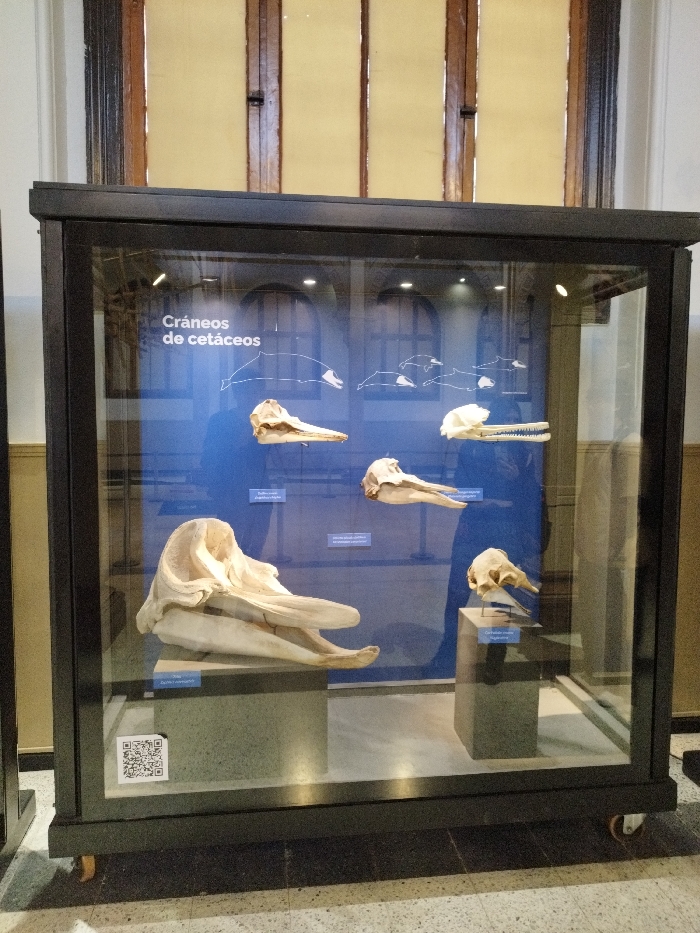
This media file captures an indoor scene, likely within a museum or educational institution in Santiago, Chile. The primary subject is a large, rectangular display case with a black frame and clear glass panels, showcasing a collection of cetacean skulls.

Inside the case, several light-colored skulls of various sizes are arranged on grey pedestals. The largest skull, identified by a label as "Orcinus orca" (orca or killer whale), rests prominently on the left. Other visible skulls include those labeled "Tursiops truncatus" (bottlenose dolphin) and "Lagenorhynchus australis" (Peale's dolphin). The background inside the display case is a vibrant blue panel featuring white outline drawings of different cetaceans, illustrating their forms. The prominent text at the top of this blue panel reads "Cránéos de cetáceos," which translates to "Cetacean skulls." A QR code is visible on the lower left side of the display case, likely offering more information about the exhibit.

Reflections on the glass panels show indistinct human silhouettes, suggesting visitors or staff are present, and reflections of the room's interior, including overhead lights and possibly arched windows. Behind the display case, a section of a wall with tall, narrow wooden window frames and light-colored panes is visible, suggesting an older architectural style often found in museums. The floor in front of the case is a light-colored tile. The overall scene depicts an educational exhibit focused on marine mammal osteology.
Mrv

Jan 7, 2025

Santiago, Chile

Stake attention in this memory

This media file captures an indoor scene, likely within a museum or educational institution in Santiago, Chile. The primary subject is a large, rectangular display case with a black frame and clear glass panels, showcasing a collection of cetacean skulls. Inside the case, several light-colored skulls of various sizes are arranged on grey pedestals. The largest skull, identified by a label as "Orcinus orca" (orca or killer whale), rests prominently on the left. Other visible skulls include those labeled "Tursiops truncatus" (bottlenose dolphin) and "Lagenorhynchus australis" (Peale's dolphin). The background inside the display case is a vibrant blue panel featuring white outline drawings of different cetaceans, illustrating their forms. The prominent text at the top of this blue panel reads "Cránéos de cetáceos," which translates to "Cetacean skulls." A QR code is visible on the lower left side of the display case, likely offering more information about the exhibit. Reflections on the glass panels show indistinct human silhouettes, suggesting visitors or staff are present, and reflections of the room's interior, including overhead lights and possibly arched windows. Behind the display case, a section of a wall with tall, narrow wooden window frames and light-colored panes is visible, suggesting an older architectural style often found in museums. The floor in front of the case is a light-colored tile. The overall scene depicts an educational exhibit focused on marine mammal osteology.

transactions
revenues
stakers
Earliest
Latest
Highest stake

No transactions found

More from this user

More from Santiago

Mrv

Jan 7, 2025

Santiago, Chile

Licensed under Creative Commons Attribution 4.0 International License. You are free to share and adapt this content with proper attribution.