
Stake attention in this memory
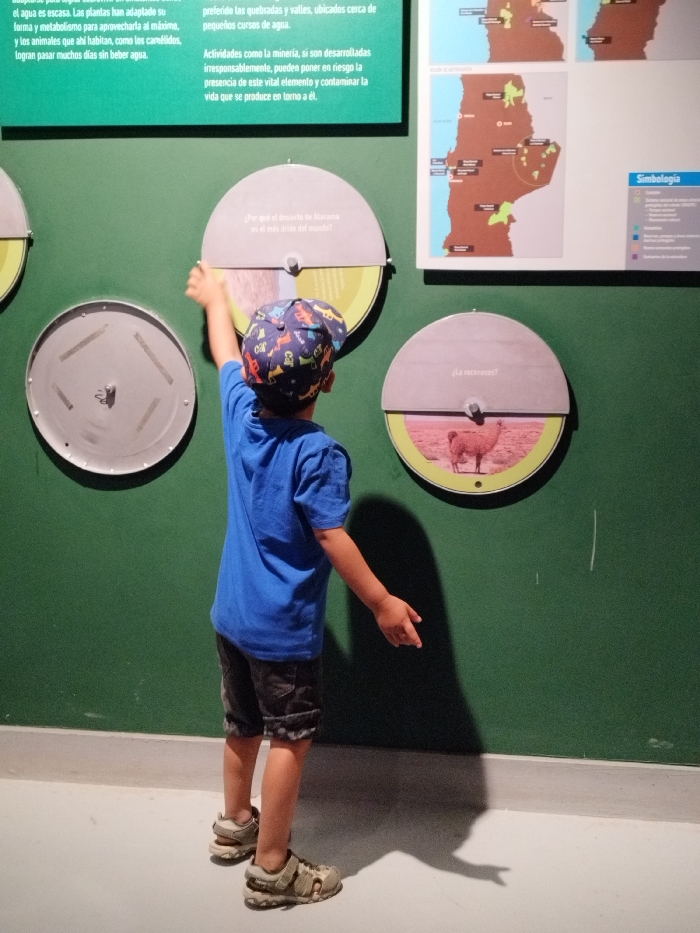
A young child, seen from behind, interacts with an exhibit at what appears to be a museum or educational center in Santiago, Chile. The child wears a blue t-shirt, dark shorts, a patterned baseball cap, and light-colored sandals, reaching up to manipulate a circular display panel on a vibrant green wall. The exhibit features several interactive circular panels. The child is actively engaging with one panel, which has a grey upper half that appears to rotate or lift, revealing content. The visible text on this panel asks, "¿Por qué el desarrollo de... es el más lento del mundo?" (Why the development of... is the slowest in the world?). To the child's right, another circular panel displays an image of a vicuña (a llama-like animal) and poses the question "¿La vicuña?". To the child's left, a plain grey circular disc is also mounted on the wall. Above these interactive elements, rectangular display panels feature Spanish text and maps. The text discusses water scarcity, how plants and camelids (like vicuñas) adapt to arid environments, and the risks of irresponsible mining. One panel explicitly states: "Actividades como la minería, si son desarrolladas irresponsablemente, pueden poner en riesgo la presencia de este vital elemento y contaminar la vida que se produce en torno a él." (Activities like mining, if developed irresponsibly, can put at risk the presence of this vital element and contaminate the life that is produced around it.) Another panel contains maps and the heading "Simbología" (Symbology/Legend). A prominent shadow of the child is cast on the wall and floor, indicating strong indoor lighting. The setting suggests an educational focus on natural resources, wildlife, and environmental issues specific to the region.
No transactions found