Stake attention in this memory
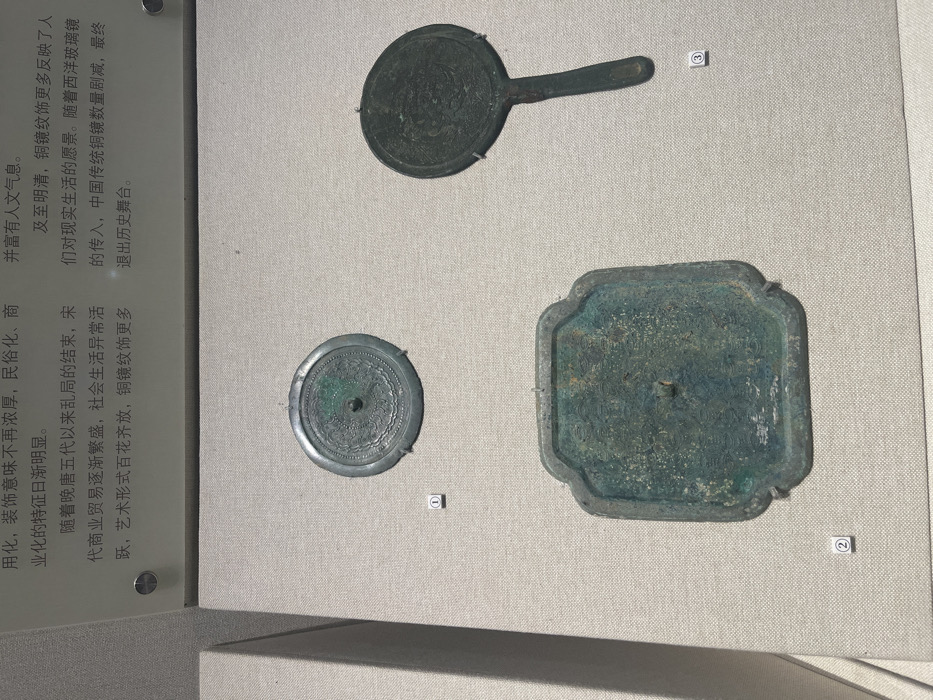
Three antique Chinese bronze mirrors are displayed in a museum exhibit, laid out on a light gray, textured surface. The image is captured from a slightly elevated angle, looking down into the display case, which appears to have a glass cover given the faint reflections. **Object 1**, located in the lower-left portion of the frame, is a circular bronze mirror. Its back is intricately decorated with a central knob or boss, surrounded by a complex pattern of swirling lines and possibly floral or geometric motifs. The outer edge features a scalloped or beaded border. The mirror exhibits a greenish patina, indicative of its age and material. **Object 2**, positioned in the lower-right, is a square-shaped bronze mirror with subtly lobed or scalloped edges, giving it a soft, ornate contour. Similar to Object 1, it has a central knob and is covered in detailed, though somewhat obscured by heavy patina, patterns across its surface. The greenish-blue patina is quite pronounced on this piece. **Object 3**, situated in the upper-right, is a bronze hand mirror. It features a circular mirror head with decorative patterns on its back, including a central design that might be a stylized animal or symbol. A long, rectangular handle extends from the mirror head. Like the other two pieces, it shows signs of age with a green patina. To the left of the displayed objects, a vertical panel contains descriptive text in Chinese. The text provides historical context for the bronze mirrors. The visible Chinese text translates to: **Left column (partially cut off at the beginning):** "...utilization, the decorative meaning is no longer profound, and the characteristics of popular customs and commercialization became increasingly obvious. With the end of the chaos since the late Tang and Five Dynasties, commercial trade in the Song Dynasty gradually prospered, social life became exceptionally active, artistic forms bloomed, and bronze mirror ornamentation became more..." **Right column:** "...and full of humanistic charm. By the Ming and Qing dynasties, bronze mirror ornamentation reflected more of people's aspirations for real life. With the introduction of Western glass mirrors, the number of traditional Chinese bronze mirrors sharply decreased, eventually exiting the stage of history." The objects are numbered with small white squares containing the numbers 1, 2, and 3, corresponding to their positions in the display. The overall impression is an informative and well-organized exhibit showcasing the history and artistry of Chinese bronze mirrors.
Loading AttnAds…
No transactions found