Sign in
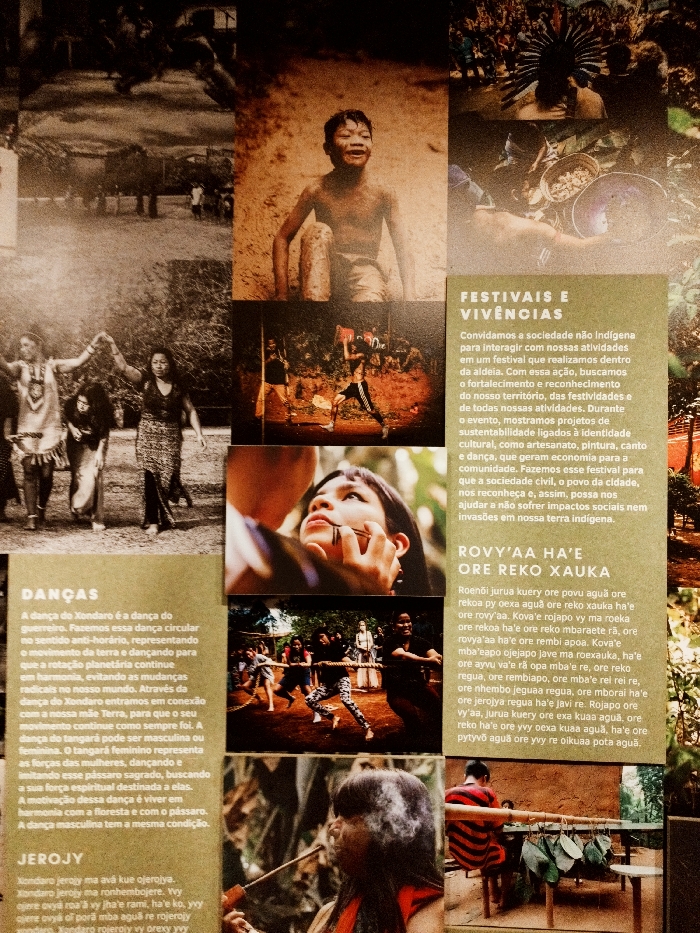
This image features a brightly lit, vertical exhibition panel, likely from a museum or cultural center, showcasing indigenous Brazilian culture. The panel uses a light green background for text sections and a collage of ten photographs, mixing sepia-toned and warm-toned images.

The photographs depict diverse aspects of indigenous life: a smiling, mud-covered indigenous boy (sepia); a person with an elaborate feathered headdress viewed from behind (sepia); hands holding a bowl of nuts or seeds (sepia); three indigenous women in traditional attire dancing outdoors (sepia); two individuals in dynamic poses during a ritualistic dance on reddish soil, one mid-air (warm-toned); a young indigenous woman receiving facial body paint (warm-toned); a group engaged in a tug-of-war on reddish soil (warm-toned); an indigenous woman in profile smoking a long pipe (warm-toned); a person near a wooden structure with hanging leaves (warm-toned, interior); and a blurry wide shot of an outdoor gathering (sepia).

Two large text blocks are presented in both Portuguese and an indigenous language. The right block, titled "FESTIVAIS E VIVÊNCIAS" (Festivals and Experiences) and "ROVY'YAA HA'E ORE REKO XAUKA," describes inviting non-indigenous society to village activities, strengthening culture, showcasing sustainability projects (crafts, painting, singing, dancing), and generating income. The lower-left block, titled "DANÇAS" (Dances) and "JEROJY," details the Xondaro warrior dance as a circular movement representing the earth's motion and spiritual strength.

This display strongly suggests its location within a cultural institution dedicated to indigenous heritage, most likely the Museu das Culturas Indígenas in São Paulo, Brazil, or a similar exhibition space.
Mrv

Aug 28, 2025, 5:09 PM

São Paulo, Brazil

Stake attention in this memory

Cultural Pride
Celebration
Resilience
Tradition
Community

This image features a brightly lit, vertical exhibition panel, likely from a museum or cultural center, showcasing indigenous Brazilian culture. The panel uses a light green background for text sections and a collage of ten photographs, mixing sepia-toned and warm-toned images. The photographs depict diverse aspects of indigenous life: a smiling, mud-covered indigenous boy (sepia); a person with an elaborate feathered headdress viewed from behind (sepia); hands holding a bowl of nuts or seeds (sepia); three indigenous women in traditional attire dancing outdoors (sepia); two individuals in dynamic poses during a ritualistic dance on reddish soil, one mid-air (warm-toned); a young indigenous woman receiving facial body paint (warm-toned); a group engaged in a tug-of-war on reddish soil (warm-toned); an indigenous woman in profile smoking a long pipe (warm-toned); a person near a wooden structure with hanging leaves (warm-toned, interior); and a blurry wide shot of an outdoor gathering (sepia). Two large text blocks are presented in both Portuguese and an indigenous language. The right block, titled "FESTIVAIS E VIVÊNCIAS" (Festivals and Experiences) and "ROVY'YAA HA'E ORE REKO XAUKA," describes inviting non-indigenous society to village activities, strengthening culture, showcasing sustainability projects (crafts, painting, singing, dancing), and generating income. The lower-left block, titled "DANÇAS" (Dances) and "JEROJY," details the Xondaro warrior dance as a circular movement representing the earth's motion and spiritual strength. This display strongly suggests its location within a cultural institution dedicated to indigenous heritage, most likely the Museu das Culturas Indígenas in São Paulo, Brazil, or a similar exhibition space.

Loading AttnAds…

transactions
revenues
stakers
Earliest
Latest
Highest stake

No transactions found

More from this user

More from São Paulo

Mrv

Aug 28, 2025, 5:09 PM

São Paulo, Brazil

Licensed under Creative Commons Attribution 4.0 International License. You are free to share and adapt this content with proper attribution.