
Stake attention in this memory
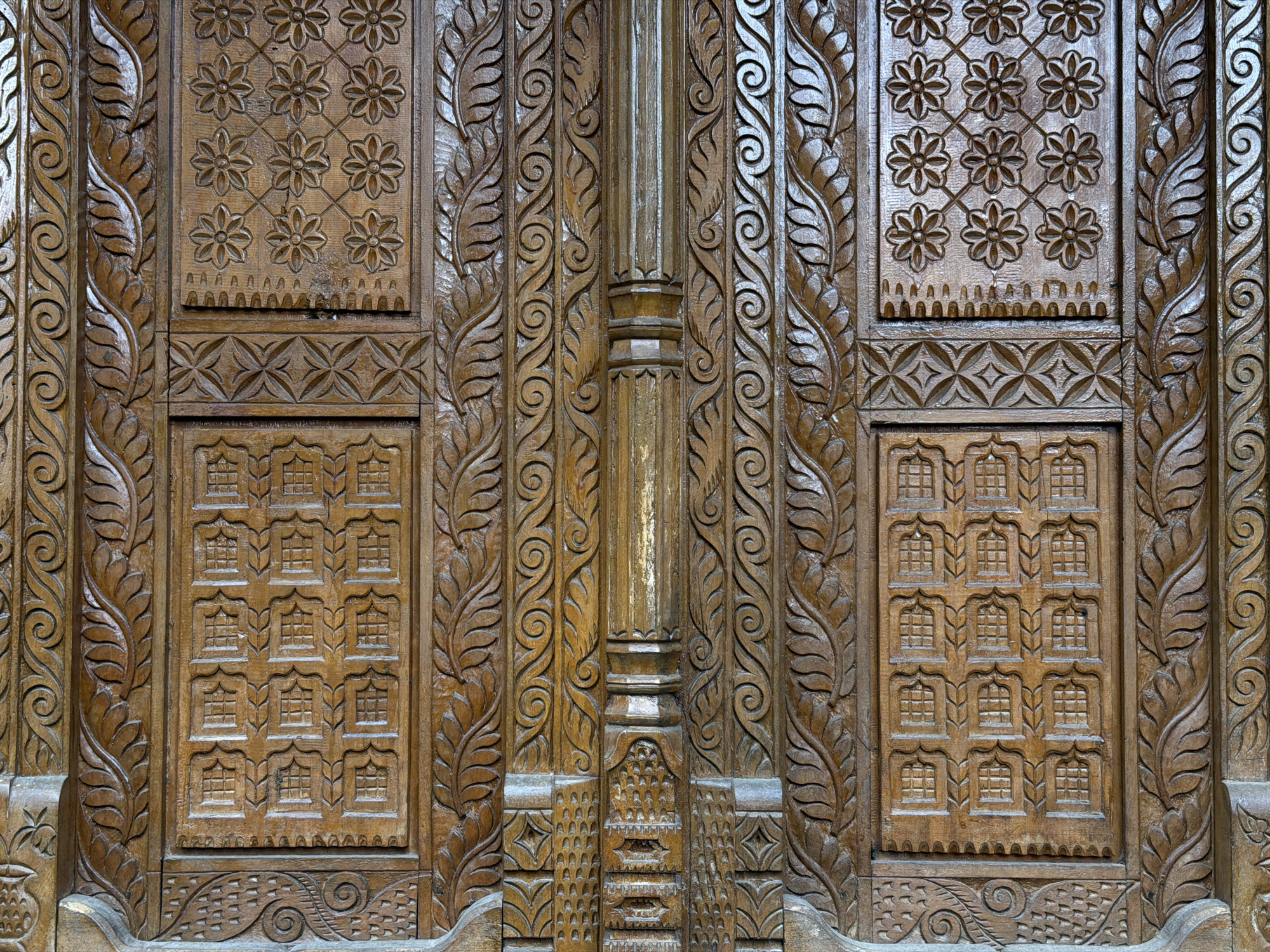
This image presents a detailed, frontal view of an intricately carved wooden surface located in Ghandruk, Nepal. The structure, likely a door or a large architectural panel, exhibits symmetrical relief carvings across its dark brown surface. The central feature is a prominent vertical column-like element, which is narrower at its upper and lower sections, featuring a distinct capital and base adorned with vertical fluting and geometric patterns, including a section of small, raised, pointed shapes near its bottom. Flanking this central column are four narrower vertical panels, two on each side, uniformly carved with continuous, intertwining leaf and scroll motifs ascending vertically. Two large rectangular panels are positioned in the upper sections, one on the left and one on the right, each displaying a grid of nine identical, eight-petaled floral motifs. Below these, intermediate horizontal bands feature repeating diamond-shaped patterns with internal crosses. Further down, two larger rectangular panels exhibit a grid of square or rectangular elements, each framed by an arched or trefoil-like surround. The lowest visible sections consist of horizontal carved bands with flowing scrollwork, wave-like textures, and a series of small, raised, elongated shapes. The wood displays varying brown tones with visible grain and minor signs of wear, consistent with a polished or varnished finish. No people, objects other than the carved wood, or actions are depicted. The scene is a close-up, isolating the carved surface from its broader architectural or natural environment.
Symbol
02391
Volume
3,898
Creator
+$0.00
Revenue
+$0.00
TVL
$0.33
Loading AttnAds…